INTRODUCTION
Peroxisome proliferator-activated receptor alpha (PPARα) is a ligand activated transcription factor
and has an important role in lipid homeostasis (1). Following activation by its endogenous/exogenous
Manuscript received: 09.05.2007 Accepted: 17.04.2008 Address for correspondence: Hakan BOZKAYA
Ankara Üniversitesi T›p Fakültesi Gastroenteroloji Bilim Dal› 06100 Dikimevi, Ankara, Turkey
Phone: + 90 312 362 70 40
E-mail: [email protected]
PPAR-alpha L162V polymorphism in human
hepatocellular carcinoma
Hepatosellüler kanserde PPAR
α L162V polimorfizmi
Elif Sare KOYTAK1, Dilfla MIZRAK1, Mehmet BEKTAfi1, Hasibe VERD‹1, Ayça ARSLAN ERGÜL2, Ramazan ‹D‹LMAN1, Kubilay ÇINAR1, Cihan YURDAYDIN1, Sad›k ERSÖZ3, Kaan KARAYALÇIN3, Özden UZUNAL‹MO⁄LU1, Hakan BOZKAYA1
Departments of 1Gastroenterology and 3General Surgery, Ankara University, School of Medicine, Ankara Department of 2Molecular Biology and Genetics, Bilkent University, Ankara
Amaç: Hepatosellüler kanserlerin gelifliminde PPARα ’n›n ro-lüne iflaret eden birçok kan›t mevcuttur. PPARα geninin L162V
polimorfizmi bu transkripsiyon faktörünün transaktivasyonu-nu artt›r›r. Bu çal›flman›n amac› hepatit virüsü enfeksiyotransaktivasyonu-nu ze-mininde geliflmifl hepatosellüler kanser hastalar›nda PPAR· L162V polimorfizminin s›kl›¤›n›n ve bu mutasyonun klinik se-yir ile iliflkisinin araflt›rmas›d›r. Yöntem: Ankara Üniversitesi Gastroenteroloji Klini¤inde Ocak 2002 – Temmuz 2003 tarihle-ri aras›nda tan› alm›fl ve 90 hepatosellüler kanserletarihle-rin hastas› ve 80 sa¤l›kl› kontrol (normal beden kitle indeksi, kan biyokim-yas› olan ve viral serolojisi negatif olan) çal›flmaya al›nd›. PPAR· L162V polimorfizmi PZR-RFLP yöntemi ile tespit edil-di. Bulgular: Hastalar›n etyolojileri, 56 HBV, 12 HBV+HDV, 22 HCV olarak tespit edildi. 87 hasta(%97) sirotikti ve 60 has-tan›n (%67.5) tümörü ileri evredeydi. 83 hastada (%92-50 HBV, 12 HBV+HDV, 21 HCV) PPAR· geninin polimorfik bölgesini PZR ile amplifiye edilebildi. Bu hastalar›n 6’s›nda (%7,2- ta-mam› HBV) L162V polimorfizmi tespit edilirken, kontrol hasta-lar›n›n 2’sinde (%2,5-p=0,162) bu polimorfizm tespit edildi. Bu trendin HBV+HDV olan hastalar ile kontroller karfl›laflt›r›ld›-¤›nda daha belirgin oldu¤u (6/62, %9.2 – 2/80 %2.5, p=0.071). L162V polimorfizmi olan hastalardan 5 ‘inde ileri evre hastal›k mevcuttur. Sonuç: PPAR· geninin L162V polimorfizmi HBV ile iliflkili hepatosellüler kanserde görülürken HCV zemininde ge-liflenlerde görülmemektedir. Bu bulgular farkl› iki etyoloji ze-mininde geliflen hepatosellüler kanserlerin karsinogenetik me-kanizmalar›n farkl› olabilece¤ini düflündürmektedir. L162V polimorfizmi olan hastalardaki Hepatosellüler kanserin ileri evrede olmas› bu polimorfizmin hastal›¤›n progresyonunu etki-ledi¤ini düflündürmektedir.
Anahtar kelimeler: PPARα, L162V, polimorfizm, hepatit C
virü-sü, Hepatit B virüvirü-sü, hepatosellüler kanser
Background/aims: Several lines of evidence suggest that pero-xisome proliferator-activated receptor alpha may be involved in hepatocarcinogenesis. L162V polymorphism of the peroxisome proliferator-activated receptor alpha gene enhances the transac-tivation activity of this transcription factor. The aim of this study was to determine the frequency and clinical correlates of peroxi-some proliferator-activated receptor alpha L162V polymorphism in hepatitis virus-induced hepatocellular carcinoma. Methods: 90 hepatocellular carcinoma patients diagnosed at Ankara Uni-versity Gastroenterology Clinic between January 2002 and July 2003 and 80 healthy controls with normal body mass index, blo-od chemistry and with negative viral serology were included. pe-roxisome proliferator-activated receptor alpha L162V polymorp-hism was determined by PCR-RFLP. Results: hepatocellular carcinoma etiologies were as follows: 56 HBV, 12 HBV+HDV, 22 HCV. Eighty-seven patients (97%) were cirrhotic, and 60 patients (67.5%) had advanced tumors. In 83 (92%) of 90 hepatocellular carcinoma patients, gene segment including polymorphic region could be amplified by PCR (50 HBV, 12 HBV+HDV, 21 HCV) and 6 of them (7.2%, all infected with HBV) had L162V poly-morphism, while 2 (2.5%) of 80 controls had this polymorphism (p=0.162). This trend became more remarkable when only HBV (HBV+HDV)-infected patients were compared with controls (6/62, 9.7% vs. 2/80, 2.5%, respectively, p=0.071). Five of 6 pati-ents with L162V had advanced disease. Conclusions: Peroxiso-me proliferator-activated receptor alpha L162V polymorphism tends to occur in HBV-induced epatocellular carcinoma and is absent in HCV-related epatocellular carcinoma. These findings may show clues for the existence of different carcinogenesis mec-hanisms in these two common etiologies. Frequent occurrence of advanced disease in patients with L162V polymorphism suggests a role for this polymorphism in tumor progression.
Key words: PPARα, L162V, polymorphism, hepatitis C virus,
hepatitis B virus, hepatocellular carcinoma
ligands, PPARα forms a heterodimer with the
9-cis-retinoic acid receptor (RXR), and PPAR/RXR
heterodimers bind to DNA sequences, termed PPAR response elements (PPRE), present in the 5´-flanking region of target genes (2-4). PPARα in-duces fatty acid oxidation in mitochondria, peroxi-somes and microperoxi-somes (1, 5), and there appears to be a cross-talk between these three fatty acid oxi-dation systems, with PPARα playing a controlling role (1, 6-9).
Hepatitis viruses are the main cause of human he-patocellular carcinoma (HCC). Although the mec-hanism of human tumor development is not comp-letely understood, chronic injury and subsequent hepatocyte regeneration as well as oncogenic po-tentials of viral proteins are thought to be respon-sible for tumor development (10, 11). The role of host factors in HCC development is less clear. Se-veral lines of evidences suggest that PPARα may be involved in carcinogenesis (12, 13). Hypolipide-mic peroxisome proliferators, well known PPARα activators, have been shown to cause liver tumors in mice and rats (14). Knock-out animal experi-ments also point to the role of PPARα-inducible fatty acid oxidation systems in the pathogenesis of liver tumor development. Disruption of the PPARα gene in mice causes liver steatosis by reducing mi-tochondrial fatty acid oxidation, while dramatic activation of PPARα by disruption of peroxisomal acyl CoA oxidase leads to steatohepatitis and liver cell tumors (15-17).
Recently, a polymorphism in the PPARα gene, le-ucine to valine change at codon 162 localized to exon 5 (L162V), has been described (18, 19). This polymorphism was shown to enhance the trans-criptional activity of PPARα in transfection assays (18). PPARα L162V polymorphism has been repor-ted to be associarepor-ted with altered lipid and apobe-talipoprotein concentrations and with an increa-sed body mass index (BMI) (18-21). These associ-ations raised the possibility that this polymorp-hism may be associated with non-alcoholic steato-hepatitis (NASH), which may result in liver cirr-hosis and hepatoma. However, our recent study did not show a link between NASH and PPARα L162V polymorphism (22). On the other hand, only a minority of human HCCs are due to NASH, and most are caused by hepatitis viruses.
Thus far, there has been no study addressing an association between PPARα L162V polymorphism and human HCC development. In this study, we aimed to determine the frequency and clinical
cor-relates of PPARα L162V polymorphism in human HCC, which is mainly induced by hepatitis viruses.
MATERIALS AND METHODS Study samples and data collection
Ninety HCC patients (77 M, 13 F) infected with hepatitis viruses diagnosed in Ankara University Gastroenterology Clinic between January 2002 and July 2003 were included. None of the patients had any other identifiable causes of HCC and alco-hol intake was absent or less than 20 g per week in all of these patients. None of the patients had a BMI greater than 30. In addition, none of the pa-tients had any evidence of systemic disease inclu-ding collagen-vascular, neoplastic, cardiopulmo-nary or renal disease. Eighty healthy subjects (44 M, 36 F) with normal BMI, normal blood che-mistry and negative viral serology served as con-trols.
Presence or absence of cirrhosis and Child score of the cirrhotic patients were recorded. The diagno-sis of HCC was based on detection of liver tumors by two different radiological visualizations in the presence of elevated alpha fetoprotein level or cytological/histological assessment of tumor tissu-e by tissu-examination of ptissu-ercutantissu-eous biopsy sampltissu-e or resection material obtained during resecti-on/transplantation procedures. Advanced tumor was defined as total tumor size ≥ 8 cm or multifo-cal/diffuse tumors without portal vein thrombosis or distant metastasis. A single solitary tumor <6.5 cm or ≤3 tumors with none >4.5 cm and a total tu-mor size <8 cm at presentation was accepted as less advanced tumor according to University of California at San Francisco (UCSF) criteria (23).
Detection of PPARαα L162V polymorphism
A blood sample was drawn from each patient and from healthy controls for DNA isolation. Cellular DNAs were kept at -20°C until polymerase chain reaction (PCR) analysis. In the mismatch PCR, the following primers generating HinfI restriction site were used for further RFLP analysis (18): Ex 5 F 5´ GAC TCA AGC TGG TGT ATG ACA AGT 3´
Ex 5 R mismatch 5´ CGT TGT GTG ACA TCC CGA CAG AAT 3´ (T: mismatch nucleotide). Following preparation of 1.25 U Taq polymerase, 2.5 mM MgCl and 0.2 mM dNTP, forward and re-verse primers (10 pmol each) were added. The
fi-nal volume of the reaction was adjusted to 50 µl. The annealing temperature of the reaction was 61°C. Following application of HinfI endonuclease enzyme to PCR products, while a 117 bp band was visualized for a normal allele, two separate bands of 93 bp and 24 bp were observed for a mutant al-lele on 2% agarose gel electrophoresis (Figure 1).
RESULTS
Patient characteristics
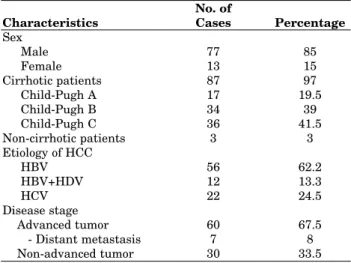
Table 1 shows the clinical characteristics of HCC patients at the time of the diagnosis. Male predo-minance was observed in the patient cohort. Eighty-seven patients (97%) were cirrhotic, most of whom (80%) were at Child B or C stage. Hepatocellular carcinoma etiologies were as fol-lows: 56 (62.2%) HBV, 12 (13.3%) HBV+HDV, and 22 (24.5%) HCV. Sixty patients (67.5%) had ad-vanced tumors (total tumor size ≥ 8 cm or multifo-cal/diffuse tumors w/o portal vein thrombosis or distant metastasis), while 30 (33.5%) patients had less advanced tumors. Seven patients had distant metastases (2 bone, 5 lung).
Frequency and clinical correlates of L162V polymorphism
In 83 (92%) of 90 HCC patients, gene segment inc-luding polymorphic region could be amplified by PCR. HCC etiologies of these 83 patients were as follows: 50 (60%) HBV, 12 (14.5%) HBV+HDV and 21 (25.5%) HCV. Six of 83 (7.2%) patients had L162V polymorphism, while only 2 (2.5%) of 80 controls had this polymorphism (p=0.162). This
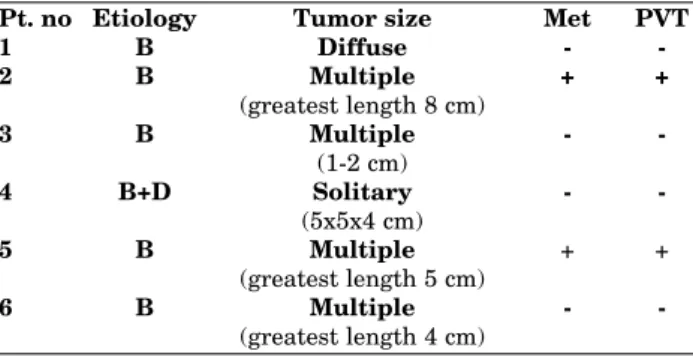
trend became more remarkable when only HBV (HBV+HDV)-infected patients were compared with controls (6/62, 9.7% vs. 2/80, 2.5%, respecti-vely, p=0.071) (Table 2). In fact, all of the 6 pati-ents who had L162V polymorphism were infected with HBV (5 HBV alone, 1 HBV+HDV) and none of the HCV-infected patients had this polymorp-hism (Table 3). Interestingly, 5 of these 6 cases (83.3%) had advanced disease (Table 3) and all of them had a normal BMI.
DISCUSSION
PPARα is a key regulator of fatty acid oxidation and plays important roles in lipid metabolism. Animal experiments suggest that it may also have some roles in liver tumor development, although possible mechanisms for tumor promotion are not well understood. PPARα may induce tumor deve-lopment by inhibiting apoptosis, interacting with growth control genes and enhancing H2O2 pro-duction by stimulation of peroxisome proliferation (12, 13). Genetic or acquired variations in expres-sion and activity of this molecule may have an im-pact on several physiological and pathological
con-No. of
Characteristics Cases Percentage
Sex Male 77 85 Female 13 15 Cirrhotic patients 87 97 Child-Pugh A 17 19.5 Child-Pugh B 34 39 Child-Pugh C 36 41.5 Non-cirrhotic patients 3 3 Etiology of HCC HBV 56 62.2 HBV+HDV 12 13.3 HCV 22 24.5 Disease stage Advanced tumor 60 67.5 - Distant metastasis 7 8 Non-advanced tumor 30 33.5
Table 1. Characteristics of HCC patients
No. of No. of patients
Etiology Patients with L162V L162V%
HBV 62 6 9.7 HBV alone 50 5 10 HBV+HDV 12 1 8.3 HCV 21 0 0 Controls 80 2 2.5 HBV vs HCV, p=0.163 HBV vs Controls, p=0.076 HBV+HDV vs HCV, p=0.163 HBV+HDV vs Controls, p=0.071
Table 2. Frequency of L162V in different etiologies
F
Fiigguurree 11.. Gel electrophoresis showing several cases with a sing-le band of normal alsing-lesing-les (L162L) and with two bands of mutant alleles (L162V)
ditions. L162V polymorphism of the PPARα gene was reported to enhance transactivation function but not increase the expression of this molecule (27). This polymorphism has been found to be as-sociated with several in vivo lipid and apolipopro-tein abnormalities (18-21), but its role in human cancers has not been explored yet. This study rep-resents the first investigating the role of this poly-morphism in human HCC.
PPARα L162V polymorphism tended to more fre-quently occur in HCC patients compared to he-althy controls. Interestingly, this trend was more significant in HBV-related HCC patients. Altho-ugh the present study included a total of 90 HCC patients, this sample size may not be enough to re-ach a statistical significance because of the low frequency of L162V polymorphism. In addition, the present study included a heterogeneous pati-ent population consisting of both HBV- and HCV-related HCC cases. In fact, L162V polymorphism was more frequently observed in HBV-related HCC patients, and this trend was not observed in HCV-related HCC patients. Interestingly, all pati-ents carrying L162V polymorphism were infected with HBV and none of the HCV-infected patients had this polymorphism. These findings may be clues for the existence of different carcinogenesis mechanisms in these two common etiologies. Associations of this polymorphism with several pathological alterations may be limited to some specific conditions. This can be exemplified by the finding that L162V polymorphism may be associa-ted with some specific lipid abnormalities and BMI only in diabetic patients (18-21, 24). In fact, L162V polymorphism was not found to be
associa-ted with blood lipid abnormalities nor with BMI in healthy controls and patients with coronary heart disease (18-21, 25). Similarly, L162V and HCC as-sociation may be restricted to HBV-induced HCC cases. Variations in the expression and/or the ac-tivity of PPARα, its ligands and PPRE and their regulators in different diseases and in different conditions may diversely affect the outcome of the-se dithe-seathe-ses. Prethe-sence of a variant PPARα molecu-le may render HBV-infected patients prone to HCC development.
The potential mechanism(s) of L162V polymorp-hism and HBV-induced HCC association are not clear. PPARα has been shown to interact with HBV X-associated protein2 (26). In addition, RXR-PPARα heterodimer may transactivate enhancer 1 of HBV (27). Such a viral protein/regulatory se-quence and PPARα/PPRE interaction may alter the cellular responses to PPARα and/or HBV viral proteins. Furthermore, variations in PPARα gene (e.g. L162V polymorphism) may change these res-ponses and may facilitate tumor development. In addition, gene activation status and expression of growth control molecules, and malignant cell res-ponses to exogenous/endogenous stimuli may be different in HBV- and HCV-induced HCC. Presen-ce of several variant host proteins (e.g. L162V) may promote cancer development in selected con-ditions (e.g. HBV-induced disease). Further studi-es are needed to clarify whether PPARα interacts with several viral and cellular proteins that may result in tumor promotion and progression. Another interesting finding of the present study was that most patients with L162V polymorphism had advanced tumors. Although this might be re-lated with the small number of patients having this polymorphism, change in transactivation function of PPARα may lead to more aggressive tumor behavior. This latter speculation must be cautiously interpreted and needs to be investiga-ted with further large-scale population studies. In summary, PPARα L162V polymorphism seems to be selectively associated with HBV-induced HCC but not with HCV-induced HCC. Further studies are needed to determine whether this polymorphism selectively changes cellular respon-ses to exogenous stimuli (e.g. HBV viral protein) and/or cellular factors, thus promoting tumor de-velopment.
Pt. no Etiology Tumor size Met PVT
1 B Diffuse - -2 B Multiple + + (greatest length 8 cm) 3 B Multiple - -(1-2 cm) 4 B+D Solitary - -(5x5x4 cm) 5 B Multiple + + (greatest length 5 cm) 6 B Multiple - -(greatest length 4 cm)
PVT: Portal vein thrombosis. Met: Metastasis.
Table 3. Characteristics of patients having L162V poly-morphism
REFERENCES
1. Rao MS, Reddy JK. Peroxisomal ß-oxidation and steatohe-patitis. Semin Liver Dis 2001;21:43-55.
2. Issemann I, Green S. Activation of a member of the steroid hormone receptor superfamily by peroxisome proliferators. Nature 1990;347:645-50.
3. Desvergne B, Wahli BW. Peroxisome proliferator-activated receptors: nuclear control of metabolism. Endocr Rev 1999;20:649-88.
4. Akb›y›k F, Ray DM, Bozkaya H, Demirpençe E. Ligand and species dependent activation of PPARα. Cell Physiol Bioc-hem 2004;14:269-76.
5. Akb›y›k F, Ç›nar K, Demirpençe E, et al. Ligand induced expression of peroxisome proliferator-activated receptor alpha and activation of fatty acid oxidation enzymes in fatty liver. Eur J Clin Invest 2004;34:429-35.
6. Hashimoto T, Cook WS, Qi C, et al. Defect in peroxisome proliferator-activated receptor alpha-inducible fatty acid oxidation determines the severity of hepatic steatosis in response to fasting. J Biol Chem 2000;275:28918-28. 7. Johnson EF, Palmer CN, Griffin KJ, Hsu MH. Role of the
peroxisome proliferator-activated receptor in cytochrome P450 4A gene regulation. FASEB J 1996;10:1241-8. 8. Lee SS, Pineau T, Drago J, et al. Targeted disruption of the
alpha isoform of the peroxisome proliferator-activated re-ceptor gene in mice results in abolishment of the pleiotro-pic effects of peroxisome proliferators. Mol Cell Biol 1995; 15:3012-22.
9. Mandard S, Müller M, Kersten S. Peroxisome proliferator-activated receptor α target genes. Cell Mol Life Sci 2004;61:393-416.
10. Koike K, Tsutsumi T, Fujie H, et al. Molecular mechanism of viral hepatocarcinogenesis. Oncology 2002;62:29-37. 11. Chisari FV. Viruses, immunity, and cancer: lessons from
hepatitis B. Am J Pathol 2000;156:1118-32.
12. Gonzales FJ. The peroxisome proliferators-activated recep-tor α: role in hepatocarcinogenesis. Mol Cell Endocrinol 2002;193:71-9.
13. Roberts-Thomson SJ. Peroxisome proliferators-activated receptors in tumorigenesis: targets of tumour promotion and treatment. Immunol Cell Biol 2000;78:436-41. 14. Reddy JK, Azarnoff DL. Hypolipidemic hepatic peroxisome
proliferators form a novel class of chemical carcinogens. Nature 1980;283:397-8.
15. Reddy JK. Nonalcoholic steatosis and steatohepatitis III. Peroxisomal ß-oxidation, PPAR alpha, and steatohepatitis. Am J Physiol Gastrointest Liver Physiol 2001;281:G1333-9.
16. Fan CY, Pan J, Usuda N, et al. Steatohepatitis, spontaneo-us peroxisome proliferation and liver tumors in mice lac-king peroxisomal fatty acyl-CoA oxidase. J Biol Chem 1998;273:15639-45.
17. Fan CY, Pan J, Chu R, et al. Hepatocellular and hepatic pe-roxisomal alterations in mice with a disrupted pepe-roxisomal fatty acyl-coenzyme A oxidase gene. J Biol Chem 1996;271: 24698-710.
18. Flavell DM, Pineda Torra I, Jamshidi Y, et al. Variation in the PPAR alpha gene is associated with altered function in vitro and plasma lipid concentrations in type II diabetic subjects. Diabetologia 2000;43:673-80.
19. Vohl MC, Lepage P, Gaudet D, et al. Molecular scanning of the human PPAR alpha gene: association of the L162V mu-tation with hyperapobetalipoproteinemia. J Lipid Res 2000;41:945-52.
20. Tai ES, Demissie S, Cupples LA, et al. Association betwe-en the PPAR alpha L162V polymorphism and plasma lipid levels. The Framingham offspring study. Arterioscler Thromb Vasc Biol 2002;22:805-10.
21. Robitaille J, Brouillette C, Houde A, et al. Association bet-ween PPAR alpha-L162V polymorphism and components of the metabolic syndrome. J Hum Genet 2004;49:482-9. 22. Verdi H, Koytak ES, Önder O, et al. Peroxisome
prolifera-tor-activated receptor alpha L162V polymorphism in NASH and genotype-1 HCV related liver steatosis. J Inves-tig Med 2005 (in press).
23. Duffy JP, Vardanian A, Benjamin E, et al. Liver transplan-tation criteria for hepatocellular carcinoma should be ex-panded, a 22-year experience with 467 patients at UCLA. Ann Surg 2007;246:502-11.
24. Evans D, Aberle J, Wendt D, et al. A polymorphism, L162V, in the PPAR alpha gene is associated with lower body mass index in patients with non-insulin-dependent diabetes mellitus. J Mol Med 2001;79:198-204.
25. Gouni-Berthold I, Giannakidou E, Muller-Wieland D, et al. Association between the PPAR alpha L162V polymorp-hism, plasma lipoprotein levels, and atherosclerotic disea-se in patients with diabetes mellitus type 2 and in non-di-abetic controls. Am Heart J 2004;147:1117-24.
26. Sumanasekera WK, Tien ES, Turpey R, et al. Evidence that peroxisome proliferator-activated receptor alpha is complexed with 90-kDa heat shock protein and the hepati-tis virus B X-associated protein 2. J Biol Chem 2003;278: 4467-73.
27. Huan B, Kosovsky MJ, Siddiqui A. Retinoid X receptor alp-ha transactivates the hepatitis B enalp-hancer 1 element by forming a heterodimeric complex with the peroxisome pro-liferator-activated receptor. J Virol 1995;69:547-51.