THE EFFECTS OF DAYLIGHT DESIGN FEATURES ON THE
VISITOR SATISFACTION OF ART MUSEUMS
A MASTER’S THESIS
PARTIAL FULLFILMENT OF THE REQUIREMENTS FOR THE DEGREE OF
MASTER OF FINE ARTS
BY
MERVE KAYA
DEPARTMENT OF
INTERIOR ARCHITECTURE AND ENVIRONMENTAL DESIGN
İHSAN DOĞRAMACI BİLKENT UNIVERSITY ANKARA
THE EFFECTS OF DAYLIGHT DESIGN FEATURES ON THE
VISITOR SATISFACTION OF ART MUSEUMS
A THESIS SUBMITTED TO THE DEPARTMENT OF INTERIOR
ARCHITECTURE AND ENVIRONMENTAL DESIGN AND THE INSTITUTE
OF ECONOMICS AND SOCIAL SCIENCES OF İHSAN DOĞRAMACI BİLKENT UNIVERSITY IN PARTIAL FULLFILMENT OF THE REQUIREMENTS FOR THE DEGREE OF MASTER OF FINE ARTS
BY
ŞEVKİYE MERVE KAYA JULY, 2015
I certify that I have read this thesis and have found that it is fully adequate, in scope and in quality, as a thesis for the degree of Master of Fine Arts in Interior
Architecture and Environmental Design.
……… Asst. Prof. Dr. Yasemin Afacan
Principal Advisor
I certify that I have read this thesis and have found that it is fully adequate, in scope and in quality, as a thesis for the degree of Master of Fine Arts in Interior
Architecture and Environmental Design.
……… Assoc. Prof. Dr. Nilgün Olguntürk
Examining Committee Member
I certify that I have read this thesis and have found that it is fully adequate, in scope and in quality, as a thesis for the degree of Master of Fine Arts in Interior
Architecture and Environmental Design.
……… Assoc. Prof. Dr. Berin Gür
Examining Committee Member
Approval of the Graduate School of Economics and Social Sciences
……… Prof. Dr. Erdal Erel
iii
ABSTRACT
THE EFFECTS OF DAYLIGHT DESIGN FEATURES ON THE
VISITOR SATISFACTION OF ART MUSEUMS
Şevkiye Merve Kaya
M.F.A. in Department of Interior Architecture and Environmental Design
Supervisor: Asst. Prof. Dr. Yasemin Afacan
July, 2015
Daylight is an important element of lighting design strategies. Daylight allows visual
comfort and enhances visual environmental quality within architectural spaces.
Daylight usage also allows sustainability by allowing energy conservation. In this
manner, proper daylight design issues and control strategies have significant role.
However, in art museums, daylight is a very difficult element to deal with. The
difficulty is caused because of the damage that can be caused by daylight exposure
on different objects with different sensitivity levels in art museums. This study aims
to search the effects of daylight design features on the visual environmental quality
of art museums and visual comfort of the visitors. A case study was conducted in
İstanbul Modern Art Museum, Istanbul. The thesis is based on the user data obtained through a survey questionnaire and daylight simulation data obtained by Autodesk
3D’s Max 2014. A three part questionnaire was conducted with 100 participants for both overcast sky and clear sky condition to rate visitor satisfaction with the museum
iv
and importance levels of daylight design issues by considering all art museums in
general. The daylight illuminance data of the museum was measured in a scaled
model by a computer simulation program. According to the statistical analyses and
simulation renderings, daylight design is a multi-parameter task. There are many
significant correlations between visual comfort and satisfaction. The study concludes
with a number of daylight design guidelines.
Keywords: Daylight Design, Daylight Control Strategies, Visual Comfort, Sustainability
v
ÖZET
GÜNIŞIĞI TASARIM ÖZELLİKLERİNİN MÜZE
ZİYARETÇİLERİNİN MEMNUNİYETİNE ETKİSİ
Şevkiye Merve Kaya
İç Mimarlık ve Çevre Tasarımı Yüksek Lisans Programı Tez Danışmanı: Yrd. Doç. Dr. Yasemin Afacan
Temmuz, 2015
Günışığı, ışıklandırma tasarımının önemli bir elemanıdır. Günışığı sadece görsel konfora katkıda bulunmaz aynı zamanda mimari mekânların görsel çevre kalitelerinde gelişme sağlar. Aynı zamanda günışığı kullanımı enerji tasarrufu sağlayarak sürdürülebilir bir çevre yapısına katkıda bulunur. Bu kapsamda etkili bir günışığı tasarımı ve kontrol stratejileri çok önemli bir role sahiptir. Ancak sanat müzelerinde günışığı tasarımı kolay değildir. Sanat müzelerinin bünyesinde barındırdığı farklı hassasiyet yapısındaki farklı sanat objeleri, günışığı tasarımını sanat müzeleri için zorlaştırır. Bu farklı hassasiyet yapısındaki sanat objelerinin fazla ve filtresiz gelen günışığına maruz kalarak bozulması, müze kavramına ters düşer. Bu çalışma günışığı tasarım özelliklerinin sanat müzelerinin görsel çevre kalitesine ve ziyaretçilerinin görsel konforuna etkileri üzerinedir. Bu çalışmaya yönelik İstanbul Modern Sanat Müzesinde saha çalışması yapılmıştır. Çalışma anket
vi
analizleri ve Autodesk 3D’s Max 2014 ile yapılan simülasyondan oluşmaktadır. Anket üç bölümden oluşmaktadır. İlk bölümde demografik bilgi edinilirken, ikinci bölümde belirlenen müze kullanıcılarının memnuniyet dereceleri belirlenmektedir. Anketin son bölümü ise listelenen günışığı faktörlerinin önem dereceleri üzerinedir ve bu bölüm genel olarak sanat müzelerini kapsar. Anket hem açık hava şartı hem de bulutlu hava şartı için aynı 100 kişiye uygulanmıştır. İstanbul Modern Sanat
Müzesinin aydınlanma değerleri simülasyon programı ile elde edilmiştir. İstatistiksel analizlere ve simülasyon analizlerine göre günışığı kullanımı çok parametreli bir işlemdir. Günışığının, görsel konfor ile birçok korelasyonu tespit edilmiştir. Çalışma sonucunda günışığı tasarımına yönelik önerilerde bulunulmuştur.
Anahtar Kelimeler: Günışığı Tasarımı, Günışığı Kontrol Stratejileri, Sürdürülebilirlik, Görsel Konfor
vii
ACKNOWLEDGEMENTS
First, I would like to express my appreciation to Assoc. Prof. Dr. Yasemin Afacan
for her help, guidance and valuable comments throughout the preparation of the
thesis. She did not hesitate on sharing her ideas and precious sources during my
studies about this thesis. I consider myself privileged of being supervised by her.
I would like to express my sincere gratitude to Assoc. Prof. Dr. Nilgün Olguntürk
and Assoc. Prof. Dr. Berin Gür for their valuable comments and suggestions about the thesis.
I would also like to thank Assoc. Prof. Dr. Hülya Sirel in particular for her valuable time and influential conversations on the subject. It was honor for me to get her
precious comments about my study.
I wish to express my gratitude to my beloved family. I am grateful to my parent’s; İlknur Kaya and Metin Kaya for their irreplaceable support throughout my entire life, but also for their patience and helpful guidance during my thesis studies. I would also
viii
special thanks to Holli Hankins, not only for her patience and incredible effort to
teach me English during my stay with her in Tennessee, United States of America in
2007, but also for her precious love and great character that makes her a great source
ix
TABLE OF CONTENTS
SIGNATURE PAGE ...ii
ABSTRACT ...iii
ÖZET ...v
ACKNOWLEDGEMENTS ...vii
TABLE OF CONTENTS ...ix
LIST OF TABLES ...xii
LIST OF FIGURES...xiii
1. INTRODUCTION 1
1.1. The Aim of the Study ...2
1.2. The Structure of the Thesis ...3
2. DAYLIGHT DESIGN IN ART MUSEUMS 5
2.1. Architectural Structure and Functions of Art Museums ...5
2.2. Daylight Design and Daylight Design Strategies ...8
2.2.1. Daylight Features...8
2.2.2. Advantages and Disadvantages of Daylight in Art Museums...10
x
2.3.1. Significance of Daylight Control Strategies...15
2.3.2. Methods of Daylight Control Strategies ...18
2.3.2.1. Windows ...19
2.3.2.2. Skylights ...20
2.3.2.3. Shading Systems ...21
2.4. Sustainable Design Features of Daylight Usage ...28
2.4.1. Energy Benefits and Conservation ...29
2.4.2. Environmental Benefits ...30
3. DAYLIGHT DESIGN EFFECTS ON ART MUSEUMS AND VISITORS 33
3.1. Visual Comfort ...33
3.2. Health and Wellbeing ...37
3.3. Perception ...39
3.4. Satisfaction...42
3.5. Experiences ...43
4. THE CASE STUDY: ISTANBUL MODERN ART MUSEUMS 44
4.1. Objectives of the Study ...44
4.1.1. Research Questions ...45
4.1.2. Hypotheses ...45
4.2. Method of the Study ...46
xi 4.2.2. Procedure ...47 4.2.3. Computer Simulation ...55 4.3. Results ...59 4.3.1. Survey Results ...59 4.3.2. Simulation Results ...75 4.4. Discussions ...91 5. CONCLUSIONS 94 REFERENCES 98 APPENDICES 103 Appendix A ...104 Appendix B ...116
xii
LIST OF TABLES
Table 4.1: Percentages related to participant demographics ..………60
Table 4.2: Pearson’s Correlation for questionnaire Part B- clear sky condition ...64
Table 4.3: Pearson’s Correlation for questionnaire Part B- overcast sky condition ..65
Table 4.4: Pearson’s Correlation for questionnaire Part B- clear sky condition ...…68 Table 4.5: Pearson’s Correlation for questionnaire Part B- overcast sky condition ..69
Table 4.6: Pearson’s Correlation for questionnaire Part C- clear sky condition …...71
Table 4.7: Pearson’s Correlation for questionnaire Part C- overcast sky condition ..73
Table 4.8: Points lux levels according to hours- clear sky condition ……...…89
xiii
LIST OF FIGURES
Figure 2.1: Figure 2.1: Visual obstructions (Drawn by author, adopted from
Boughdah & Sharples, 2010) ...………..……17
Figure 2.2: Light shelve (Drawn by author, adopted from Boughdah & Sharples,
2010) ...………...………24
Figure 2.3: Light pipe (Drawn by author, adopted from Boughdah & Sharples, 2010)
…………..………...26 Figure 4.1: Topkapı Palace and Hagia Sophia (Taken by the author.) ………….…49
Figure 4.2: Sea and Bosporus view (Taken by the author.) …….………...…49
Figure 4.3: İstanbul Modern Art Museum building (Taken by the author.) ………..50
Figure 4.4: Windows and view from İstanbul Modern Museum interior (Taken by the
author.) ……….………..50
Figure 4.5: İstanbul Modern Art Museum first floor plan (Drawn by the author.)
………….………....51 Figure 4.6: İstanbul Modern Art Museum’s analyzed area (Taken by the author.)
………….………....52 Figure 4.7: İstanbul Modern Art Museum’s analyzed area (Taken by the author.)
xiv
Figure 4.8: İstanbul Modern Art Museum’s analyzed area (Taken by the author.)
………….………53 Figure 4.9: İstanbul Modern Art Museum’s analyzed area (Taken by the author.)
………….………53 Figure 4.10: İstanbul Modern Art Museum’s analyzed area (Taken by the author.)
………….………...……….54 Figure 4.11: İstanbul Modern Art Museum’s analyzed area (Taken by the author.)
………….………..…..54 Figure 4.12: Light meter locations as represented by 18 points within interior space
of the İstanbul Modern Art Museum (Drawn by the author.) ...58 Figure 4.13: İstanbul Modern Art Museum front elevation with window design ………...……….….58 Figure 4.14: Clear sky perspective point 3 (Rendered by the author.) ……...76
Figure 4.15: Overcast sky perspective point 3 (Rendered by the author.) …..…..…76
Figure 4.16: Clear sky perspective point 1 (Rendered by the author.) .………...….78
Figure 4.17: Overcast sky perspective point 1 (Rendered by the author.) ….……...78
Figure 4.18: Clear sky perspective point 2 (Rendered by the author.) ……..…..….79
Figure 4.19: Overcast sky perspective point 2 (Rendered by the author.) ……...79
Figure 4.20: Clear sky perspective point 3 (Rendered by the author.) …...…...…81
Figure 4.21: Overcast sky perspective point 3 (Rendered by the author.) ....……....81
xv
Figure 4.23: Overcast sky perspective point 4 (Rendered by the author.) ……...….82
Figure 4.24: Clear sky perspective point 9 (Rendered by the author.) ……....…...83
Figure 4.25: Overcast sky perspective point 9 (Rendered by the author.) ……..…..83
Figure 4.26: Clear sky perspective point 5 (Rendered by the author.) ……...……85
Figure 4.27: Overcast sky perspective point 5(Rendered by the author.) ...….….…85
Figure 4.28: Clear sky perspective point 8 (Rendered by the author.) …….….…...86
Figure 4.29: Overcast sky perspective point 8 (Rendered by the author.) …..……..86
Figure 4.30: Illuminance level diagram in lux unit- clear sky condition (Drawn by
the author.) ……….…...….88
Figure 4.31: Illuminance level diagram in lux unit- overcast sky condition (Drawn
1
CHAPTER I
INTRODUCTION
Museums are the places, where art and science related works are presented,
preserved and protected. Museums are significant for their cultural values and they
are able to create cultural interactions (Şener & Yener, 2008). Daylight is considered
as one of the most important natural source of energy. Daylight usage with control
strategies allow energy conservation and thus, sustainability (Entwistle, 1999). It is
clear to see an inextricable link of daylight and building throughout the history as
well. Historically, daylight was considered as one of the primary sources of
illumination and the building designers were aware of how to bring daylight into
spaces at the appropriate time. Some of the examples of ancient times planned and
controlled use of daylight are; The Great Temple of Ammon in ancient Egypt and the
Pantheon in ancient Rome (Bougdah & Sharples, 2010).
Even if it is very difficult to design daylight because of its dynamic character, it is
very beneficial both for enhancing visual qualities and developing visual
environmental qualities of interior spaces. On the other hand, daylight contributes to
energy conservation, which allows sustainable environment. As a result, daylight
2
very fundamental issue in the aspect of art museums since deterioration of the
display object should be prevented. Since art museums contain “protection” function
within its functional definition (Melendez, Mecklenburg, & Domenechcarbo, 2010).
Thus, this study is based on questioning the effects of daylight design features on the
visual environmental quality of art museums and visual comfort of the visitors.
1.1. The Aim of the Study
The main purpose of this study is to understand the effects of daylight design
features of art museum buildings on the visual environmental quality and on its
visitor visual comfort.
Daylight design strategies are very crucial for art museum buildings. To be able to
examine art museums and daylight design, these two subjects are examined in detail
within the scope of this study. The relationship between two subjects was considered
as well. The impact of daylight integration with artificial light usage in art museum
environment is examined. The examination of the daylight is done in two groups
depending on the two different weather conditions, which are clear sky condition and
overcast sky condition. The findings of the study are based on these two different
daylight conditions.
Additionally, this study is also concerned with sustainability issues. In order to obtain
3
design allows energy conservation, it is considered within the study as well. Because
of this reasons, how energy conservation of the art museums are enhanced by
daylight design strategies are discussed.
1.2. Structure of the Thesis
This study focuses on the effects of daylight design features on the visual
environmental quality of art museums and visual comfort of the visitors. The first
chapter is the introduction part.
The second chapter examines daylight design in art museums. Architectural structure
and functions of art museums, daylight design and daylight design strategies,
daylight control strategies and sustainable design features of daylight usage are
examined in this chapter.
The third chapter is related with visitors of art museums. This chapter has a purpose
to examine the daylights effects on art museum visitors. The effects that are
examined in this chapter are related with issues of visual comfort, health and
wellbeing of art museums visitors as well as perception and museum experiences.
The fourth chapter describes the research of this study. Computer simulation is
4
daylight design features. Objectives of the field survey are illustrates with variables,
research questions and hypotheses. Sample group and techniques and procedure of
this study are also explained in this chapter. After these sections, study results and
discussions of the findings are stated.
Lastly, in the chapter five, conclusion is given. In this part, limitations of the study
are mentioned. There are not only suggestions in this last chapter, but there is also
some suggestions and guidelines for designing daylight in art museums with control
strategies. Guidelines are expected to be beneficial to the design field for future
studies by helping sustainable design and providing enhanced visual environments
5
CHAPTER II
DAYLIGHT DESIGN IN ART MUSEUMS
2.1. Architectural Structure and Functions of Art Museums
Museums are the places, where art and science related works are presented,
preserved and protected. According to Greek mythology “muse” means temple. Fist museum was built in 300 B.C in first Ptolemaios times, in İskenderiye. This museum was built to be able to run various activities for scholars. Throughout the history
museums are generally built to exhibit objects and for some social activities.
Museums are significant for their cultural values and they are able to create cultural
interactions. In eighteenth century, first modern museums were built for art
exhibitions. They are rectangular shaped and designed with skylights for daylight
intake, also walls are used as exhibition spaces. In the nineteenth century transparent
and flexible museum buildings were started to be built by the influence of Joseph
Paxton, who is the designer of Crystal Palace in London, used as an exhibition area
(Şener & Yener, 2008). After Joseph Paxton’s implications in this area, museums started to have geometric shapes and they are designed according to concepts of
6
research and education functions as well (Şener & Yener, 2008). Finally, in our last
few decades, museum buildings have an iconic attitude. Iconic attitude means that
museum building structures of modern world, acts like museum objects by
themselves (Şener & Yener, 2008). So, as well as exhibited objects, museum
buildings themselves became attractive and interesting as well. They have also
become center of attention by visitors in our recent world (Şener & Yener, 2008).
Museums include; representations of natural occurrences and human efforts.
Museums use these sources for human beings knowledge enhancements and for
preservation of the cultural heritage. To allow display objects of museums to reach
people effectively and efficiently, objects should be protected deliberately. Protection
and display are two major functions that cannot be eliminated. However, there can be
some other minor functions added to museums such as researching, arranging
educational programs and cultural events. Therefore, enabling visitors to benefit
from visual environment qualitatively and perceive efficiently are very significant
design issues. There are also other minor functions added to museums such as
researching, arranging educational programs and cultural events. Also to manipulate,
to provide interactions between occupants and display objects and to attract people
are the main functions that make museum experiences enhanced for the visitors (Kim
& Chung, 2010).
Museums have three different types according to the classification of the objects that
they display and preserve within their architectural shelves. These types are
historical, science and art according to their display objects. Historical museums
7
museums display art objects (Kurtay, et al., 2003). Objects that are displayed in
museums have a crucial role in all types of museums since they aim to obtain and
conserve tools that have cultural, historical, artistically or scientific significance.
Museums aim to use these tools for researches, display purposes and educational and
teaching purposes. These different purposes affect the structures of museums as well.
Architectural structures are designed according to these different types and the
functions that they require (Jacobsson & Davidsson, 2012).
Daylight is a significant source of energy and has important role on visual
environment which will be discussed. The importance of daylight should be analyzed
according to structure and function of museums (Kim & Chung, 2010). In this study
art museums will be considered and analyzed according to their daylight design
issues and its contribution on visitor’s visual comfort and sustainability and energy conservation.
Art museums have objects mostly related with visual arts. So art museums appeal
mostly to the sense of sight. Because of this reason; an art museum aims to create a
space that enhances human perception and museums visual environmental qualities
(Anthierens, et al., 2008). Therefore, lighting design within art museums is a very
important issue that should be handled with care for the sake of the ‘display’ and ‘protection’ functions of it.
8 2.2. Daylight and Daylight Design Strategies
2.2.1. Daylight Features
Daylight is considered as one of the most important natural source of energy. The
primary source of natural light is sun; it provides light directly during the day and
indirectly by the help of moon at night, and stars also contribute to reflecting suns
light at night. Even the intensity of the sun, efficiency and color changes according to
weather conditions, sun plays a huge role on daylight and its effects (Entwistle,
1999).
There are two types of daylight, one of them is warm daylight, and the second type is
cool daylight. Warm daylight is used in hot climates and also considered for energy
conservation issues. Control of warm daylight is also significant to regulate the
thermal comfort of an interior space such as interior terrace doors as a buffer zone,
aluminized louvers to reflect the daylight are some of the ways daylight is used
without damaging the thermal comfort of an interior space. Cool daylight is a type
that is used in cold weathers. Sloped double glazing, vertical louvers are some of the
solutions to have efficient cool daylight without disturbing the thermal comfort level
of the space. As a result, even if daylight provides energy consumption by allowing
natural light, it should also not disturb the optimal thermal comfort levels. Otherwise,
there will be loss of energy to provide optimal thermal comfort levels that have been
9
There are two kinds of daylight radiations. First one is the direct radiation and the
second is diffuse radiation. Direct radiation is directional depending on the solar
azimuth unlike diffuse radiation. Diffuse radiation is non directional. Also, diffuse
radiation is the product of scattering of solar radiation in the atmosphere. Direct
radiation is dependent on the degree of cloudiness and is subject to strong variation
depending on weather conditions.
Daylight enters to interiors from different types of glazing configurations, which are
either vertical or horizontal and from side or from the top. A daylight system is
defined by as; “ a device located near or in the openings of building envelope, whose
primary function is to redirect a significant part of the incoming natural light flux to
improve interior lighting conditions” (Alrubaih, et al., 2013, p. 496).
There are two main daylight systems. These are side lighting and top lighting. Side
lighting is more commonly observed simply as windows. Top lighting is an opening
in ceiling or roof element of the building. The most common way of use of the top
lighting are skylight, saw tooth and roof monitors (Alrubaih, et al., 2013).
Daylight, daylight sources and daylight availability are the other daylight design
features that should be considered carefully. According to the Illuminating
Engineering Society of North America (IESNA) Lighting Handbook (2000), the sun
is the source of natural light energy. The path of the sun determines the available
sunlight at a particular building location. There are three types of weather conditions
10
considered in these three types of weather conditions. In the overcast condition, the
sky is generally the brightest element in an outdoor scene and the light reflected off
of other surfaces has much lower luminance levels. The second sky condition is;
partly cloudy sky. In this type, there is a constant change between direct sunlight and
hazy daylight and fluctuations in intensity, distribution and color temperature. The
last type is; clear sky condition. In this condition, the sun is the brightest source of
light and is practically a point source (Alrubaih, et al., 2013).
Daylight availability refers to the amount of daylight available from the sun and the
sky at a specific location, time, date, and sky condition. So the sun, sky, buildings
and ground are the main sources of luminance distribution. In addition to the above
explained daylight design features, the latitude, climate and building orientation
should be also considered (Alrubaih, et al., 2013).
2.2.2. Advantages and Disadvantages of Daylight in Art Museums
Architecture and light are inevitably linked together to museums. The form of a
museum building is first perceived by the light penetrating from the sun and the sky
that is reflected from the building‘s external surfaces. The aesthetic appearance and emotional sensation of an internal space are influenced by the interplay of light, color
and texture. They are interpreted with these factors as well. According to Le
Corbusier architecture is the masterly, correct and magnificent play of masses
11
Many great architects, such as Louis Kahn; architect of Design Museum in London
and Tadao Ando architect of Naoshima Contemporary Art Museum, Nariwa
Museum etc. have used daylight as a fundamental design element in the museum
buildings that they designed.
Architectural lighting can be defined as both an art and a science, requiring an
understanding of not only the physical properties of natural and artificial light
sources, but also the visual effects that create when introduced into a space (Bougdah
& Sharples, 2010).
It is clear to see an inextricable link of daylight and building throughout the history
as well. Historically, daylight was considered as one of the primary sources of
illumination. The Great Temple of Ammon in ancient Egypt and the Pantheon in
ancient Rome are some of the examples of the planned and controlled use of
daylight. The development of artificial lighting in the twentieth century meant that
designing with daylight became a lost art. However, the environmental and financial
costs associated with artificial lighting have led to a renewed interest in the use of
daylight in sustainable buildings (Bougdah & Sharples, 2010).
In addition to the aesthetic appearance and illustration qualities, daylight design is
inevitable because of its energy conservation benefits and the opportunities for
various light qualities and color rendering impacts. Daylight with these impacts helps
spaces to provide efficient visual comfort for people. Thus, occupants also prefer
daylight as well as architects. They expect to have adequate quality and quantity of
12
quantity are different for different spaces and depend on ideal values depending on
functions of a space. As highlighted in the previous sections, one of the important
spaces that daylight is significant and should be handled with so much care is art
museums to increase the visual environmental qualities of art museums and visual
comfort for occupants for it (Kim & Chung, 2010).
Even if there are many benefits of daylight usage in art museums as mentioned in
detail above, there are also disadvantages such as deterioration of the collections and
the discomfort factors affecting visitors like glare, uncomfortable backlighting,
irregular and unbalanced light etc. (Anthierens, et al., 2008). A major design problem
with using daylight is the rapid decrease in daylight levels with distance from a
window, leading to the parts of the room not close to the window appearing gloomy.
To try to overcome this problem control strategies needs to be applied. These
innovative techniques, explained in detail in ‘shading system’ section, include the
light directing louvers, light shelf, movable shading systems, mirrored systems,
prismatic glazing and light pipes (Bougdah & Sharples, 2010).
Deterioration is one of the most important disadvantages of daylight usage in art
museums. Deterioration of the display object is related with the ‘protection’ function
of the art museums. Deteriorations need to be eliminated for the sake of the display
objects and should be analyzed according to the sensitivity levels of the display
objects. Since the daylight includes short wavelength radiations such as ultra violet
and infra-red radiations, which cause deterioration. It should be used carefully and
13
Moreover, light should be distributed homogeneously for all types of display objects
in art museums (Melendez, Mecklenburg, & Domenechcarbo, 2010). When vision is
considered, visible spectrum should be analyzed and vision should be understood
starting from eye to brain. Visible light has wavelengths range between 100 to
400nm. Visible light is the light that can be detected by the human eye. However,
human eye cannot see the whole spectrum of light. Ultra violet and infra-red
radiations are some of these invisible radiations. However, we can see the effects of
them. For example, ultra violet radiation can make damages in our skin or it can
deteriorate organic materials. We can experience infra-red radiation as heat within
the environment. Daylight consists of these short wavelengths. Since daylight is rich
in these kinds of harmful short wavelengths, in art museums it is significant to
preserve art collections from these radiations with control strategies. Otherwise,
exposure to these radiations can damage art museums displayed objects. This
damage on art objects can create a conflict with the design aim of light on art
museums with the efficient use of daylight since the protection function of museums
would not be achieved (Bougdah & Sharples, 2010).
In art museums, display objects illumination standards are decided according to the
levels that they get affected from it and deteriorate. This is related with their light
sensitivity (Şener & Yener, 2008). There are three types of levels according to the
sensitivity of art museums display objects. First level is high sensitive objects and
they are mostly the organic based art works such as; cloths, carpets, leathers,
watercolors, drawings etc. Since this group is the most sensitive, protection should be
done with a special care. Otherwise, there can be deteriorations, which might cause
14
temperature should be 2900 Kelvin. Second level is medium sensitive objects. These
are; oil paints, polished materials, enamels etc. For this group of objects, maximum
light level should be 150 lux and the maximum color temperature should be 4000
Kelvin. The third level is low sensitive objects. These are stone, glass, sculpture,
jewelry etc. The maximum light level should be 300 lux and the maximum color
temperature should be 6500 Kelvin. These maximum levels are according to “CIBS, Lighting Guide Museums and Art Galleries”. To be able to eliminate deteriorations, there are some design strategies different than control issues. An art museum should
be able to free of any kind of light when the museum is closed. The daily hours and
the working days should be considered according to these issues of lighting. Some
sensitive display objects should be displayed during certain times of a day, but not at
all the times so that they are exposed to maturation (Kurtay, et al., 2003).
Second significant disadvantage of daylight usage in art museum is related with
discomfort factors affecting the museums occupants such as; glare, uncomfortable
backlighting, irregular and unbalanced light etc. These kinds of issues require control
strategies within art museums interiors for qualitative lighting design and satisfied art
15 2.3. Daylight Control Strategies
2.3.1. Significance of Daylight Control Strategies
Lighting control strategies are strategies that provide efficient luminous environment
that are suitable and comfortable to the building visitors and users as well as
sustainability issues. In public buildings, large amount of energy can be saved by
using appropriately designed lighting control systems that can take advantage of the
daylight available (Galasiu & Veitch, 2006). Control strategies for daylight design in
art museums are significant to achieve important objectives of art museums daylight
design. These essential objectives are as follows; (i) there should not be glare on any
kind of art objects or display windows or shiny objects should not act like mirror; (ii)
vertical and horizontal illumination should be appropriate and balance there should
not be any kind of light patches or dark spots; (iii) daylight intake should be purified
on infrared and ultra violet radiation’s which can be harmful to allowable standards; (iv) daylight spectrum should be efficient enough for effective color rendering
qualities and effective perception and visual comfort; (v) lights spectrum should not
be different in vertical and horizontal illumination levels; (vi) according to the level
of intensity of objects there should not be any over illuminations within the interior;
(vii) display surface should be light grey and it should be matte color; (viii) there
should not be adaptation problem because of different light levels within the art
museum. By control strategies these objectives can be achieved successfully within
art museum, which will create qualitative visual environment for art museums (Sirel,
16
Designing a museum building that derives benefit from daylight in a controlled,
energy efficient and aesthetically satisfying manner is not a simply question of using
large areas of glazing. This kind of an approach will only create a new set of
problems. Instead, daylight design has to be an integral part of the overall design
process. A design strategy to ensure good daylight conditions in art museums should
consider the following features; daylight availability and sky conditions, the site and
any obstructions, the form and function of the building, interior planning and design,
protection issues, window and façade design, innovative daylight techniques, testing
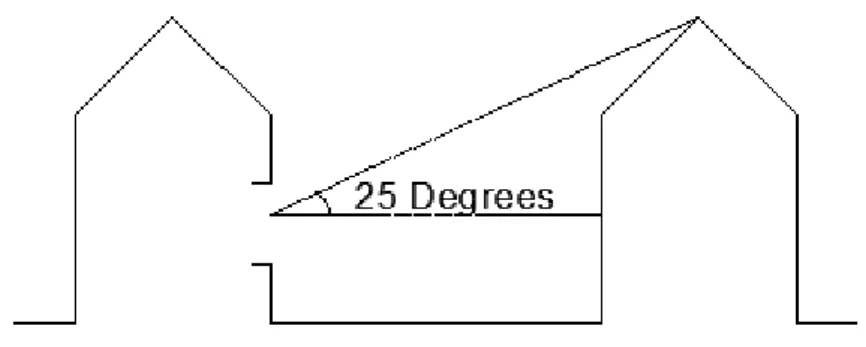
of the design strategy (Bougdah & Sharples, 2010). Figure 2.1 illustrates an
exemplary critical obstruction angle for specific latitudes in obstructed sites in order
to take effective daylight. To be able to check if good daylight on an obstructed site
is possible, a simple method can be applied. This method is based on a section
drawing of the new building and an existing obstruction (Bougdah & Sharples, 2010).
Draw a line from a point two meters above ground level on the new building to the
top of the obstruction. After this step, measure the angle between the line and the
horizontal, as shown in Figure 2.1. If this angle is less than the critical obstruction
angle h for various latitudes then there is potential for adequate daylight of the new
building. For up to 40 degrees latitude, critical obstruction angle should be less than
40 degrees. If the latitude is between 40 degrees to 45 degrees, critical obstruction
angle should be less than 35 degrees. For latitudes between 45 degrees to 50 degrees
than critical obstruction angle should be less than 30 degrees. For latitudes between
50 degrees to 55 degrees critical obstruction angle should be less than 25 degrees and
for latitudes between 55 to 60 degrees critical obstruction angle should be less than
22 degrees. Lastly for latitudes more than 60 degrees the critical obstruction angle
17
Figure 2.1: An exemplary diagram showing critical obstruction angle for specific latitudes for obstructed sites effective daylight availability. (Drawn by author,
adapted from Boughdah & Sharples, 2010)
Because of dynamic, variable and intense characteristics of the control strategies in
art museums, daylight should be applied deliberately and efficiently in order to fulfill
architectural satisfaction, protect the objects and display units and achieve visual
comfort. Design based control strategies are related with tasks, light level
preferences, glare mitigations and sensitivity levels of display artifacts. On the other
hand, user based control strategies are related with personal necessities, health,
privacy and perceptional issues (Fadzil & Sia, 2003).
There are three primary reasons for control of daylight. First reason is that because of
nature of daylight which is intense, dynamic and variable it can be harmful for the
humans and the interiors and objects within. The second reason is that modification
of the daylight source is necessary to support critical visual tasks performed within
interior spaces; light level, preferences, glare etc. The third reason is because of the
personal needs of users and visitors, such as view out, privacy and health etc. (Day,
18
To be able to understand the significance of daylight control strategies in interior
spaces, the characteristics of daylight should be fully understood, that is why it is
mentioned in detail in previous parts of this study. Also since the study’s focus is on
art museums and art museum visitor’s visual comfort, vision should be also considered in detail. Since art is highly related with visual aspects and visual
environmental qualities visible spectrum and perceptional qualities of humans should
be expressed.
2.3.2. Methods of Daylight Control Strategies
To prevent discomfort factors and allow satisfactory visual environmental quality
within sustainable levels by preventing deteriorations, there should be qualitative
daylight design strategies in art museums. These strategies are as follows; (i)
provision of effective light design (both daylight and artificial light) that is used with
controlled strategies; (ii) provision of good visual comfort for enhanced vision; (iii)
perception of the occupants and (iv) protection of display objects from harmful
radiations, which are mainly short wavelength radiations such as ultra violet, infrared
etc. Furthermore, integration of daylight and artificial light to provide adequate
illumination is significant. Allowing display elements enhancements of visional
qualities such as color rendering effects, shapes etc. is another aspect that should be
19 2.3.2.1. Windows
Windows are mostly used as architectural elements that allow daylight intake.
However, every kind of window is not effective and efficient for a place; especially
in art museums. The arrangement, size and division of windows play an important
role in daylight to penetrate deeper into the space. Because of this reason, floor to
ceiling windows are more advantageous for daylight intake. There is a standard about
efficient window size; the room depths must not exceed two and a half times the
window heights. This standard leads efficient window size for effective daylight
intake. So taller the windows, better the daylight utilization. Also views from the
windows and obstructions on daylight intake should be considered for effective
visual comfort and museum experience (Müller & Schuster, 2012).
Thus, in art museums it is significant to handle the shape, size and location of
windows carefully in this manner. Windows are not only elements to take daylight,
but they are also for allowing a view of the exterior. Moreover, when they are used
efficiently and in a correct way windows help energy savings (Bean, 2004).
Adequate daylight penetration for typical ceiling heights will only be approximately
equal to one and a half times the distance from the floor to the top of the window for
north facing glazing or overcast skies. But different scenarios should be kept also in
mind. If the window is south facing and if sunlight exists, or contains a reflective
element such as a light shelf the daylight penetration may increase by up to 2.5 times
20
window head height. Another issue that should be kept in mind is that a window area
should be around 20 percent of room floor area to avoid excessive overheating in
summer and excessive overcooling in winter (Bougdah & Sharples, 2010).
Window position and shape of openings in a building envelope are important.
Windows should be placed high on a wall and, if feasible, ceiling heights should be
raised for better illumination (Bougdah & Sharples, 2010).
Double glazing, tinted or coated glazing, sensors tracking daylight and adopting
window systems are some examples of window technologies to enhance daylight
while eliminating distractions in thermal comfort (Barker, 1994). Shading projections
can have a negative effect since they do not only reduce direct radiation, but they
also reduce percentage of diffuse light under an overcast sky (Müller & Schuster,
2012).
2.3.2.2. Skylights
Skylights are significant design elements of museums in case of daylight, since
openings in roofs are more efficient than lighting from the sides like windows.
Skylights are more advantageous, because they prevent direct daylight penetration on
the objects. Since the direct penetration might be harmful on museum elements it is
very safe to use skylights, where walls reflect daylight and there is a direct
penetration. Furthermore, because of the geological reasons, skylights can intake
21
reason, why windows are less effective compared to skylights, is the distribution of
brightness under an overcast sky, which diminishes by approximately one third from
the zenith to horizon. However, because of solar heat gains caused by skylights there
are also some control issues about energy gain from skylights. These kind of passive
solar heat gains are desirable for heating applications but they are not advantageous
for cooling applications (Müller & Schuster, 2012).
2.3.2.3. Shading Systems
Shading systems are significant in daylight control strategies. An effective shading
system prevents overheating in a building’s interior. They help adaptation to different weather and daylight conditions. The shading system automation is a
sustainable solution that is enhanced by complementing automatic controls with
manual options. This flexible way it enables the users to adjust lighting condition on
an individual standard of comfort and needs (Müller & Schuster, 2012).
A major design problem with using daylight is the rapid decrease in daylight levels
with a distance from a window, leading to the parts of the room not close to the
window appearing gloomy. To try to overcome this problem, control strategies need
to be applied as well. Since there are many innovative daylight strategies, it is
possible to achieve satisfactory visual qualities. These innovative techniques include
the light directing louvers, light shelf, movable shading systems, mirrored systems,
22
Daylight integration to lighting design of public buildings is an effective approach in
creating a pleasant visual environment as mentioned. Daylight is considered as the
best source of light to create good color rendering and its quality is the one of the
light sources that most closely matches human visual response (Tsang & Li, 2007).
The amount of daylight entering a building interior through window openings, does
not only take light for indoor environment to allow more attractive, comfortable and
pleasing environment, but it also allows people to maintain visual contact with the
outside surrounding environment. As a result, people are in need for good daylight in
their interior environment. Therefore, outdoor environment, building area and
orientation are important factors considering daylight design issues to allow
sufficient daylight intake within interiors and make users and visitors comfortable,
satisfied and attracted (Tsang & Li, 2007).
External obstructions might influence the daylight performance in two ways. First
way is the amount of the sky being obstructed or unobstructed. The second way is
the color of the external surface finish that can be effective as the reflected
luminance from the obstructing buildings. Furthermore, the dimensions of buildings
in the neighborhood are key points in this manner; i.e. when buildings are located
close to each other, blockage of daylight can occur, particularly for the lower floors.
The colors of the external surface finish can be grouped into light and medium as the
best solutions. Light surface finishes might not be causing drastic glare problems.
However, high reflectance depending on the color from nearby obstructions may
cause glare problems, which will affect the visual comfort of the interior space.
Because of these reasons, it is very important to locate buildings in proper areas,
23
because of their finish materials. As mentioned before, these kinds of obstructions
will prevent view that makes users and visitors pleasant and it might disturb the
feeling of exploring the outside world through window openings (Tsang & Li, 2007).
For all sky types it is desirable to make most use of the south and north facing
glazing for daylight. South facing glazing is relatively easy to shade using horizontal
devices that will not interfere with the view out, and north facing glazing will require
no shading (in the northern hemisphere) and admit skylight. East and west facing
glazing are the most difficult to shade because the lower sun means vertical shading
devices must be used, which have a very negative impact on the view through a
window (Bougdah & Sharples, 2010).
Even if there is a change in the intensity and efficiency of daylight according to time,
daylight is a key factor in the aspect of visual comfort as well as sustainability, and
visual environmental qualities of buildings. Daylight is an effective approach in
creating a pleasant visual environment. It helps to prevent discomfort factors.
Moreover, daylight quality closely matches to human visual response in the highest
level (Tsang, 2007).
The shading systems are mainly; light pipes, atriums, remote source lighting systems,
light directing systems, light shelves, filters, shading systems, mirror systems and
24
Light shelf is a light colored horizontal partition that is located inside and/or outside
a window and reflects light via the ceiling to the back of a room. It can also act like a
solar control device since it affects thermal comfort as well. Important point is that
light shelves should be carefully positioned and sized and should not act as
obstructions to light. They need to be placed above eye-level, both to preserve the
view and to prevent reflected glare. For their effective usage, a room height must be
greater than 3m (Bougdah & Sharples, 2010). Figure 2.2 shows an exemplary light
shelve.
Figure 2.2: An exemplary light shelve diagram (Drawn by author, adapted from Boughdah & Sharples, 2010)
Mirror systems are generally acts a series of mirrored louvers positioned above a
window or placed within a double glazed unit. They are generally placed in the upper
sections of windows to avoid glare and by this way it does not cause obstruction
problems. Mirror systems can be effective for reflecting the daylight from a low
altitude sun into rooms through ceiling reflection. It is also beneficial as a solar
25
systems have maintenance problems and they may act as obstructions on cloudy days
(Bougdah & Sharples, 2010).
Prismatic glazing systems use optical principles to redirect light either into a room
(low sun) or away from a room (high sun). They use reflection techniques. The
prismatic elements are applied to the upper part of a window either as part of the
glazing or as a film that is attached to the glass surface. They can act as obstructions
and distort views, however their maintenance is easier compared to mirrored
systems. They can also be used as glare control technique (Bougdah & Sharples,
2010).
A light pipe can redirect light deep into a building or even underground. It consists of
three parts; a light collection element, the light pipe itself and a diffusing cover to
emit the light. The pipe can be either a shiny metal tube that reflects light directly or
solid components, such as acrylic and fiber optic bundles, which use total internal
reflection to guide the light into a space. There are two kinds of this system; active
and passive system. In an active light pipe system, a mirror to track the sun and
directs the sunlight down the pipe and through an emitter. This kind of a system is
highly dependent on the sun. This is also expensive and its maintenance is not easy.
In a passive system, skylight and sunlight are collected by a transparent dome and
reflected downwards via a metal tube into a room (Bougdah & Sharples, 2010).
26
Figure 2.3: Light pipe system for effective daylight intake (Drawn by author, adapted from Boughdah & Sharples, 2010)
There are three types of daylight factors that should be handled with care. The first
factor is the amount of daylight and its intensity. Operable louvers and UV filtered
glazing systems are appropriate solutions to overcome uncontrolled daylight within
art museums. However even if the excessive amount should be controlled there
should be enough daylight for to allow visual quality when there is a performance,
when there are sensitive materials and there should be appropriate amount in
working spaces like laboratories etc.
Sensitive materials should be displayed with luminance level of 50 lux
approximately. Work areas should have maximum 100 lux of luminance. The second
factor is duration and exposure of the daylight. When this factor is analyzed the
important point should be that short duration of intense light affects art work as much
as low intensity level exposed over an extended period of time. Because of this some
art work that are displayed should be moved to different spaces regularly. Also art
27
systems can be advantageous to overcome this exposure in critical day times when
sun light comes directly. The third one is spectral characteristics of the daylight.
Glazing and shading systems are also suitable to have good spectral characteristics of
the daylight (Navvab, 2013).
There are also some specific innovative techniques for controlling daylight within art
museums. Daylight optimization for general illumination and exhibit display is one
of the specific innovative techniques for controlling daylight (Zannis, et al., 2006).
There should be a system to protect the sensitive exhibits from solar radiations and
fulfill the requirements that concern their exposure to daylight. Automation systems
also provide sufficient illuminations within the interior. Another innovative
technique is innovative glazing components like super insulating and diffusing glass.
Innovative diffusing glass has a role on increasing the visual comfort of the visitors
while providing reduction of heat flow through the glazing of windows of the art
museums (Zannis, et al., 2006). Another technique is light redirection ceiling
geometry for the best daylight distribution. This technique aims to increase the
‘penetration depth’ of the daylight within interior space by redirecting the on the ceiling of the space. By this way, this techniques aims to enhance the daylight
distribution by letting the distribution of daylight to reach spaces far away from the
opening areas. Also this system aims to protect art objects by preventing direct
exposure of daylight by reflecting daylight. Another technique is special window
panels. These systems aim to control daylight and acoustics by providing sound
28
In addition to architectural daylight design control strategies, there can be strategies
about the art museum management and rules. Appropriate art museums rules can
enhance protection of objects and prevent deteriorations. First important issue in this
aspect is the exhibition hours (Kurtay, et al., 2003). Exhibition hours should be well
decided. When there is not any visitors and when the art museum is not working, art
objects should not be exposed to any kind of light. They should be in dark (Kurtay, et
al., 2003). According to different levels of sensitivities, there can be some certain
time limitations on exhibitions of objects. Highly sensitive objects exhibition hours
should be limited. There can be also different sensitive objects that are exhibited
every period of times allowing sensitive objects to have decreased time of getting
light exposure (Kurtay, et al., 2003).
2.4. Sustainable Design Features of Daylight Usage
Until the invention of electrical light, daylights effects and characteristics were well
known and fully considered because there were no other medium that could support
adequate illumination to interior spaces. However, after the invention of electrical
light, concern on daylight has been decreased. Artificial light is an indisputable
process since it has the capacity to illuminate even rooms without windows. It is a
source without any weather and climate dependencies unlike daylight (Müller &
Schuster, 2012). However in the recent times, there is a growing interest in daylight.
Growing interest on daylight is not only because of effective visual comfort benefits
that it provides but also for its energy conservation and economic benefits (Müller &
29
If the daylight design strategies are implied in innovative new buildings. They will
be considered as effective and successful prototypes for future buildings. Their
sustainable design will lead to sustainable future as well. To design sustainable
buildings and conducting studies on them are key elements of our future architectural
lives. These building studies allow to compare performance in use to design and
make assumptions for the better use of the building. To see ‘what is working’ and
‘what is not’ regarding the specific daylight design strategies technologies should be implemented (Konis, 2012). The second issue is to improve the design guidance and
assumptions for comfort and satisfaction used in the design of future projects (Konis,
2012).
2.4.1. Energy Benefits and Conservation
Globally, electricity consumes approximately 20 percent of the world’s generated electricity (Bougdah & Sharples, 2010). Electricity usage for lighting is a very
inefficient and energy consuming process. Since people in many developed countries
use electricity, it has a large impact on energy consumption. For example, in United
Kingdom the total annual electricity consumption for lighting is around 230,500
GWh, producing around 9 percent of the United Kingdom’s total carbon dioxide emissions (Bougdah & Sharples, 2010). As a result of this, there are many good
reasons for trying to develop a lighting design in building interiors that is effective,
efficient and environmentally friendly without harming the environment (Bougdah &
30
Reviewing the literature showed that art museums that are optimized for daylight,
can drastically lower the operational costs without any obvious increase in
constructional costs (Müller & Schuster, 2012).Energy conservation through daylight
integration to interior spaces is inevitable. It is also a complex issue because the
environmental requirements for the preservation of the materials impose very strict
rules to avoid the deterioration of exhibits (Müller & Schuster, 2012). However, it is
possible to have qualitative daylight design with efficient visual comfort and save
energy efficiently without harming the display objects within art museums.
Therefore, art museums should be qualified with bioclimatic, environmental friendly
and energy conscious design (Zannis, et. al., 2006).
An efficient and sustainable museum building design can fully meet the architectural,
functional, comfort, control and safety requirements, by also providing radical
amounts of energy savings and providing reduction of carbon dioxide emissions
(Sala & Gallo, 2007).
2.4.2. Environmental Benefits
Buildings use energy to heat, cool, light, ventilate and service usages in internal
spaces. In most industrialized countries the energy used by buildings generally
represent around 50 per cent of total energy consumption (Bougdah & Sharples,
31
Most this energy comes from the burning of fossil fuels. Buildings are also
responsible for approximately 50 per cent of CO2 emissions into the atmosphere. In
addition, because of these burnings there is also 10 per cent of methane emissions, 25
per cent of NOx emissions and 25 per cent of SOx emissions (Bougdah & Sharples,
2010). Therefore, buildings are a major impact of global warming, climate change,
air pollution and acid rains (Bougdah & Sharples, 2010).
Aside from the qualitative significance of daylight for humans and architecture,
ecological points of daylight integration are also very crucial for sustainable lighting
design. Daylight without pollutant usage supplied through its design is readily
available and is environmentally friendly also cost free (Müller & Schuster, 2012).
Each year eight million of fluorescent lamps are disposed in many landfill sites these
disposals cause a lot of hazardous materials such as mercury (Bougdah & Sharples,
2010). According to the studies on the impact of daylight in Hospitals 60% of
patients in rooms with high indoor daylight intake were hosted for less time amounts
of recovery compared to rooms with lower levels of daylight (Hourani & Rizeq,
2012). A two years study in United States elementary schools showed that more
attendance of students was ensured in sufficient daylight existing classrooms than
students in other classes where there are lower amount of daylight (Hourani & Rizeq,
2012).
It is clear that when there is daylight usage there is a less pollution and less damage
on environment. Hence, daylight usage is also beneficial for our environment. Within
32
increased in places where museums are located and this will lead to reduction of air
pollution of the art museum buildings and improvement of the indoor environment
33
CHAPTER III
3. DAYLIGHT DESIGN EFFECTS ON ART MUSEUM VISITORS
3.1. Visual Comfort
“Vision is when a view is captured by the eye as light enters through the pupil, is focused by a lens onto a surface at the back of the eye called retina, which converts
the light into signals that are transmitted to and interpreted by the brain… The retina consists of light receptors called cones and rods. There are approximately six million
cone receptors in the retina and they are clustered around the center of the retina and
operate during good lighting conditions (pho-topic vision), such as in the day”
(Bougdah & Sharples, 2010, p. 142). The cones are color sensitive, and they are
responding to yellow-green wavelengths of light (the most copious in the solar
spectrum). Rod receptors process during low light conditions (sco-topic vision), such
as at night. There are approximately 100 million rods that are sited around the circle
of the retina (Bougdah & Sharples, 2010).
When the eye views a scene it may see a large variety of luminance or brightness, for
example a bright window, in a dark colored wall (Hebert, Arsenault and Dubois,
34
between the bright and dark areas is too large then the sensation of glare will occur
which is disadvantageous because it prevents visual comfort disturbing the eye.
There are many quantitative factors of daylight affecting visual comfort such as;
intensity, daylight temperature conditions, glare, shadow, angle, spectrum,
transmittance and distribution (Hebert, Arsenault and Dubois, 2012). There are two
types of glare; disability glare and discomfort glare (Bougdah & Sharples, 2010).
Disability glare affects the ability to see objects in detail. It generally arises from
reflections off surfaces. Common examples of disability glare include reflections
from glass cabinets housing exhibits in museums and images of surroundings
reflected off a computer screens. Discomfort glare causes visual discomfort and may
be the result of a very bright object in the field of view of a person (Bougdah &
Sharples, 2010). Minor levels of glare can be irritating but can be neglected however
at high levels glare can interrupt performance or even cause risk to get injured for
people as they move around unfamiliar spaces (Bougdah & Sharples, 2010).
Therefore, one very important aim in a lighting design is to try and control the range
of brightness likely to be experienced by a building user (Bougdah & Sharples,
2010). A design that tries to provide sufficient amount of daylight within interior
spaces may incorporate large glazing areas, which can cause the problem of
excessive glare. “Sizing the windows to provide view, daylight and some solar gain;
using controllable and moveable shading devices, such as Venetian blinds; reducing
the contrast between the window and its wall by using light walls; positioning
computer work spaces perpendicular to windows; partitioning large, open plan