Serum Amylase Levels Can Predict Hospitalization and Operation Rates
Serum Amilaz Aktivitesi, Hastaneye Yatış ve Operasyon Oranlarını Öngörebilir
Yasemin Baskın
1, Türkan Yiğitbaşı
2, Nihal Büyükuslu
3, Gizem Çalıbaşı Koçal
1, Füsun Üstüner
4, Banu Arslan
4, Hülya Ellidokuz
51Department of Basic Oncology, Dokuz Eylul University Institute of Oncology, İzmir, Turkey
2Department of Clinical Biochemistry, İstanbul Medipol University School of Medicine, İstanbul, Turkey 3Department of Nutrition and Dietetics, İstanbul Medipol University Faculty of Health Sciences, İstanbul, Turkey 4Department of Clinical Biochemistry, Katip Çelebi University, Atatürk Training and Research Hospital, İzmir, Turkey 5Department of Preventive Oncology, Dokuz Eylül University, Institute of Oncology, İzmir, Turkey
Cite this article as: Baskın Y, Yiğitbaşı T, Büyükuslu N, Çalıbaşı Koçal G, Üstüner F, Arslan B, et al. Serum amylase levels can predict the hospital-ization and operation rates. Clin Exp Health Sci 2018; 8: 44-9.
Sorumlu Yazar/Correspondence Author: Türkan Yiğitbaşı E-posta/E-mail: [email protected]
Geliş Tarihi/Received: 21.03.2017 Kabul Tarihi/Accepted: 19.06.2017 Çevrimiçi Yayın Tarihi/Available Online Date: 25.12.2017 DOI: 10.5152/clinexphealthsci.2017.405
©Telif Hakkı 2018 Marmara Üniversitesi Sağlık Bilimleri Enstitüsü - Makale metnine www.clinexphealthsci.com web sayfasından ulaşılabilir ©Copyright by 2018 Journal of Marmara University Institute of Health Sciences - Available online at www.clinexphealthsci.com
INTRODUCTION
Serum amylase is influenced by many factors under both physiological and pathological conditions. Dysfunction of the amylase-producing glands might alter enzymatic activities, which can be important in different clinical conditions (1, 2). Indeed, serum amylase is a frequently requested test in patients presenting with acute abdominal pain in emergency wards (3, 4).Therefore, the serum amylase level is the most widely used biochemical marker in the diagnosis of many diseases. High serum amylase is detected in several diseases such as acute pancreatitis, pancreatic cancer, ectopic amylase-producing tumors, abdominal trauma, kidney dysfunction, severe burns, hyperlipidemia, and diabetic ketoacidosis (5-8).
Although there is a debate over the use of amylase alone, lipase alone, or amylase and lipase together to predict pancreatic diseases, there is a common tendency to perform at least one if not both of the tests in the emergency ward (3, 9-11).Current practice in our hos-pital is to perform amylase tests on all patients admitted to the emergency ward for diagnosis of acute pancreatitis. However, amylase could be useful for other diagnostic purposes.
Abstract
Objective: The levels of serum amylase is an indicator of several diseases.
Therefore, a routine amylase test is frequently requested in hospital emer-gency admissions. This research aims to evaluate the hospitalization and sur-gery rates of patients with high amylase levels.
Methods: A retrospective clinical study was performed on 64,909 patients
aged 53.30±19.45 years who had a serum amylase test at hospital admission in the emergency ward between 2011 and 2015. Age, gender, serum amy-lase levels, diagnosis, hospitalization, and surgery status of the patients were obtained from the electronic medical records. The diseases were classified into seven groups according to the International Statistical Classification of Diseases and Related Health Problems codes. The patients were divided into three groups with respect to amylase levels– group 1 (<125 U/L), group 2 (125–375 U/L), and group 3 (>376 U/L). The results were statistically analyzed using the SPSS commercial tool package version 21.0. The χ2 test and Fisher’s exact probability test were adapted for categorical variables, while Student’s t-test was performed for the unpaired data of continuous variables.
Results: The hospitalization rate increased 2.4-fold and 4.7-fold and the surgery
rate increased 1.6-fold and 1.4-fold in group 2 and group 3 compared to group 1, respectively. The hospitalization rate of the patients (N=571) in group 3 was 59.4%. Among them, only 93 patients were diagnosed with acute pancreatitis.
Conclusion: Elevated serum amylase levels can predict hospitalization and
surgery status.
Keywords: Amylase, medical hospitalization, general surgery, hospital
ad-mission test
Öz
Amaç: Serum amilaz düzeyi birçok hastalığın göstergesidir. Bu yüzden,
ru-tin amilaz testi hastaneye acil başvurularda sıklıkla istenmektedir. Bu araş-tırmanın amacı, yüksek amilaz düzeyine sahip hastalarda hastaneye yatış durumu ve cerrahi riskleri değerlendirmektir.
Yöntemler: Acil serviste serum amilaz testi yapılmış, 53,30±19,45 yaşında
64909 hasta ile retrospektif klinik çalışma yapıldı. Yaş, cinsiyet, serum amilaz miktarı düzeyi, tanı, hastaların hastaneye yatış ve operasyonel durumlarına ait bilgiler tıbbi kayıtlar (Probel, Hastane İşletim Sistemi) kullanılarak elde edildi. Hastalıklar, ICD 10 kodlarına göre yedi grupta sınıflandırıldı. Serum amilaz düzeyleri amilaz konsantrasyonlarına göre üç gruba ayrıldı; Grup 1 (< 125 U/L), Grup 2 (125-375 U/L) and Grup 3 (> 376 U/L). Sonuçlar istatis-tiksel olarak SPSS ticari paket programı (versiyon 21,0) kullanılarak analiz edildi. Kategorik değişkenler için χ2 ve Fisher kesin olasılık testi; sürekli de-ğişkenlerin eşleştirilmemiş verileri için ise Student t testi kullanıldı.
Bulgular: Hastaneye yatış ve ameliyat oranlarının Grup 2 ve Grup 3’te Grup
1’e göre sırasıyla 2,4 ve 4,7 ve 1,6 ve 1,4 arttığı saptandı. Amilaz değeri 376 U/L üzerinde olan hastaların (N=571) hastaneye yatış oranları %59,4 idi. Bu hastalardan yalnızca 93’ünde akut pankreas iltihabı vardı.
Sonuç: Yüksek serum amilaz düzeyi hastaneye yatış ve ameliyatı
öngörme-de kullanılan parametreleröngörme-den biri olabilir.
Anahtar kelimeler: Amilaz, hastaneye yatış, genel cerrahi, hastaneye kabul
test
The aim of this study was to assess the hospitalization and surgery rates depending on serum amylase levels of patients at hospital ad-mission in emergency service, not just for pancreatic disease. METHODS
Study Design and Samples
This retrospective clinical study included 64,989 patients who were admitted to our hospital’s emergency ward between January 2011 and January 2012. Patients lacking a serum amylase test were not included to the analysis, and data analysis was thus performed on 64,909 patients. Age, gender, serum amylase level, prediagnosis, hospitalization, and surgery status of the patients were obtained retrospectively from the laboratory information system. We enrolled all patients with available amylase levels in the database at the time of hospital admission at the emergency ward. The amylase levels in patients with different diagnoses were classified according to the In-ternational Statistical Classification of Diseases And Related Health Problems codes (ICD 10 Codes). The diseases associated with amy-lase levels in the literature were categorized into seven groups as K85 (acute pancreatitis), R10 (abdominal and pelvic pain), 81 (cholecysti-tis), E78 (lipoprotein metabolism disorders and other lipidemias), F32 (depressive episodes), F41 (anxiety disorders), and others (the rest of the diseases). It is well known that serum amylase includes 60% saliva amylase (1), so we included the diseases such as E78, F32, and F41, which in turn resulted in increased saliva levels in our study. Missing values for serum amylase were ignored.
This study involved retrospective data extracted from our laboratory information system (LIS-Probel, Hospital Operating System) and did not include any medical or healthcare interventions. Therefore, in-formed patient’s consent was unexpected. This study was approved by the ethics and research committee of İstanbul Medipol University, in accordance with the Declaration of Helsinki.
Laboratory Analysis
Amylase level (U/L) measurement based on the colorimetric test prin-ciple was performed with an autoanalyzer (Olympus AU640, Olym-pus Corporation, Japan). It is well known that serum amylase levels increase within hours of pancreatic injury, and a threshold amylase level three times the upper limit of normal (375 U/L) is recommended for diagnosis of acute pancreatitis (10, 12).Therefore, in our study pa-tients were divided into three groups according to their amylase lev-els to determine whether high serum amylase level can predict the hospitalization and surgery rates. Group 1 had normal values (<125 U/L), group 2 had three times the normal level (125–375 U/L), and group 3 had over the three times the normal level (>376 U/L) (10). Statistical Analysis
The χ2 test and Fisher’s exact probability test were performed for
cat-egorical variables, and Student’s t-test for unpaired data of contin-uous variables was performed to compare clinicopathological char-acteristics between groups. Multivariate stepwise logistic regression analysis was performed to identify the independent risk factors asso-ciated with inpatients and operated patients. The multivariate odds ratios (ORs) are presented with 95% confidence intervals (CIs). Signif-icant differences in serum amylase level between groups were deter-mined using Bonferroni’s post hoc test. In all of these analyses, data are presented as means±standard deviations or as numbers and per-centages. A p-value <0.001 was considered statistically significant. All
statistical calculations were carried out with Statistical Package for the Social Sciences version 21.0 (SPSS IBM Corp.; Armonk, NY, USA). RESULTS
Demographic and Clinical Characteristics
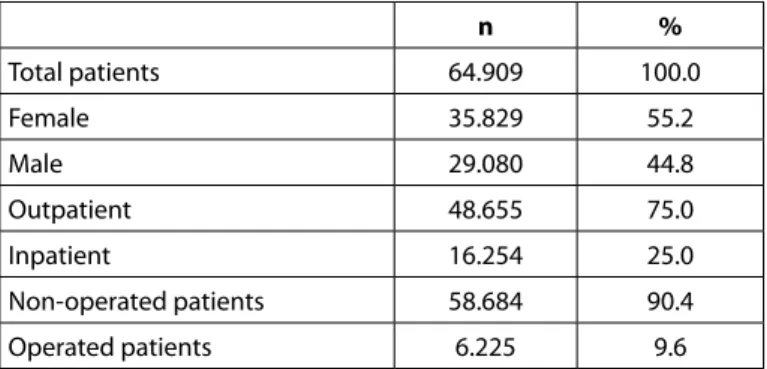
The patients with recorded age, gender, amylase levels, and diagno-sis (N=64.909) were included in the present study, and demographic and clinical characteristics are given in Table 1. The study included 29,080 (44.8%) men and 35,829 (55.2%) women aged 53.30±19.45 years (range 18–70 years). The patients were prediagnosed at hos-pital admission. Among all patients, 75% were outpatients and 25% were inpatients. Only 9.6% of the patients had an operation. The data were divided into three groups according to the amylase levels of patients. The age distribution according to the different pa-tient groups is shown in Table 2. The mean age of the papa-tients was higher in groups 2 and 3 than the patients with normal amylase lev-els (group 1). There was a statistically significant difference between the amylase levels and the age of patients by ANOVA (p<0.001), and Bonferroni’s correction for multiple comparisons showed a sig-nificant difference between the two age groups in groups 1 and 2 (p<0.001); groups 1 and 3 (p<0.001); and groups 2 and 3 (p<0.012). The numbers and percentages of patients categorized by amylase levels and diseases are shown in Table 3.
Comparison between Inpatient and Outpatient Groups
Data for inpatient and outpatient groups classified by serum amylase levels are summarized in Table 4. In total, the percentages of outpa-tients and inpaoutpa-tients in groups 1, 2, and 3 were 76.7% and 23.3%; 55.4% and 44.6%; and 40.6% and 59.4%, respectively.
Comparison between Operated and Non-operated Groups Among all patients (N=64.909), the total number of operated patients was 6.225 (9.6%) (Table 5). The percentage of operated Table 1. Characteristics of 64.909 patients admitted to the
emergency ward n % Total patients 64.909 100.0 Female 35.829 55.2 Male 29.080 44.8 Outpatient 48.655 75.0 Inpatient 16.254 25.0 Non-operated patients 58.684 90.4 Operated patients 6.225 9.6
Table 2. Age distributions according to the patient groups Group levels (U/L)Amylase n (%) (Mean±SD)Age Group 1 <125 60.331 (92.9) 52.97±19.45 Group 2 126–375 3.616 (5.6) 60.79±17.94 Group 3 >375 962 (1.5) 58.77±18.41
Total 64.909 (100.00)
Table 3. Amylase levels in diseases diagnosed according to the ICD 10 codes Patients ICD 10 Codes‡ Patients n (%) Amylase levels (U/L) n (%) Group 1 (<125 U/L) n (%) Group 2 (125–375 U/L) n (%) Group 3 (>376 U/L) n (%) All patients 64.909 (100.0) 60.331 (92.9) 3.616 (5.6) 962 (1.5) < 0.001 R10 10.420 (16.0) 9.422 (90.4) 625 (6.0) 373 (3.6) E78 415 (0.6) 396 (95.4) 19 (4.6) 0 K85 623 (1.0) 313 (50.2) 144 (23.1) 166 (26.6) F32 305 (0.5) 277 (90.8) 28 (9.2) 0 K81 1.756 (2.7) 1.547 (88.1) 144 (8.2) 65 (3.7) F41 282 (0.4) 274 (97.2) 8 (2.8) 0 Others 51.108 (78.8) 48.102 (94.1) 2.648 (5.2) 358 (0.7)
‡ ICD 10 codes: R10-Abdominal and pelvic pain, E78-Lipoprotein metabolism disorders and other lipidemias, K85-Acute pancreatitis, F32-Depressive epi-sodes, K81-Cholecystitis, F41-Anxiety disorders
U/L: units per liter; n: number of cases‡
Table 4. The number and percentages of outpatients and inpatients classified by serum amylase levels
ICD 10 Codes‡
Amylase levels (U/L)
Group 1 (<125 U/L) Group 2 (125–375 U/L) Group 3 (>376 U/L) Outpatient
n (%) Inpatient n (%) Outpatient n (%) Inpatient n (%) Outpatient n (%) Inpatient n (%) All patients 46.262 (76.7) 14.069 (23.3) 2.002 (55.4) 1.614 (44.6) 391 (40.6) 571 (59.4) R10 7.499 (79.6) 1.923 (20.4) 273 (43.7) 352 (56.3) 165 (44.2) 208 (55.8) E78 392 (99.0) 4 (1.0) 18 (94.7) 1 (5.3) 0 0 K85 102 (32.6) 211 (67.4) 45 (31.3) 99 (68.8) 73 (44.0) 93 (56.0) F32 158 (57.0) 119 (43.0) 2 (7.1) 26 (92.9) 0 0 K81 937 (60.6) 610 (39.4) 75 (52.1) 69 (47.9) 31 (47.7) 34 (52.3) F41 242 (88.3) 32 (11.7) 7 (97.5) 1 (12.5) 0 0 Others 36.942 (76.8) 11.160 (23.2) 1.582 (59.7) 1.066 (40.3) 122 (34.1) 236 (65.9)
‡ ICD 10 codes: R10-Abdominal and pelvic pain, E78-Lipoprotein metabolism disorders and other lipidemias, K85-Acute pancreatitis, F32-Depressive epi-sodes, K81-Cholecystitis, F41-Anxiety disorders
U/L: units per liter; n: number of cases
Table 5. The numbers and percentages of operated and non-operated patients classified by amylase levels
ICD 10 Codes ‡
Amylase levels (U/L)
Group 1 (<125 U/L) Group 2 (125–375 U/L) Group 3 (>376 U/L) Non-operated
n (%) Operated n (%) Non-operated n (%) Operated n (%) Non-operated n (%) Operated n (%) All patients 54753 (90.8) 5578 (9.2) 3088 (85.4) 528 (14.6) 843 (87.6) 119 (12.4) R10 8685 (92.2) 737 (7.8) 518 (82.9) 107 (17.1) 345 (92.5) 28 (7.5) E78 396 (100) 0 19 (100) 0 0 0 K85 272 (86.9) 41 (13.1) 133 (92.4) 11 (7.6) 154 (92.8) 12 (7.2) F32 271 (97.8) 6 (2.2) 16 (57.1) 12 (42.9) 0 0 K81 1260 (81.4) 287 (18.6) 120 (83.3) 24 (16.7) 53 (81.5) 12 (18.5) F41 269 (98.2) 5 (1.8) 8 (100) 0 0 0 Others 43600 (90.6) 4502 (9.4) 2274 (85.9) 374 (14.1) 291 (81.3) 67 (18.7)
‡ ICD 10 codes: R10-Abdominal and pelvic pain, E78-Lipoprotein metabolism disorders and other lipidemias, K85-Acute pancreatitis, F32-Depressive epi-sodes, K81-Cholecystitis, F41-Anxiety disorders
U/L: units per liter; n: number of cases
patients with normal amylase level was 9.2%. However, the per-centages rose to 14.6% and 12.4% for group 2 and group 3, re-spectively.
Relation of Serum Amylase Levels to Hospitalization and Surgery The hospitalization rates for the groups based on amylase levels were 23.3% for group 1, 44.6% for group 2, and 59.4% for group 3 (Table 4). The results of multivariable logistic regression to eval-uate risk factors for hospitalization rate are shown in Table 6. The difference between the hospitalization rates of the groups based on amylase levels was statistically significant (p<0.001). The hos-pitalization rate was associated with gender, age, and serum amy-lase levels. The differences in gender, age, and serum amyamy-lase lev-els between outpatients and inpatients were compared with a χ2
test, and they were found to be statistically significant (p<0.001). Furthermore, multivariable logistic regression analysis revealed the risk factors for hospitalization. According to this analysis, be-ing male [p<0.001, OR=1.597 (95% CI: 1.540–1.656)], bebe-ing over the age of 50 [p<0.001, OR=1.012 (95% CI: 1.011–1.013)], hav-ing amylase levels of 126–375 U/L (group 2) [p<0.001, OR=2.399 (95%CI: 2.182–2.507)], and having amylase levels over 376 U/L (group 3) [p<0.001, OR=4.658 (95% CI: 4.084–5.313)] were inde-pendent risk factors.
The results of the multivariable logistic regression to evaluate risk factors for operation rate are shown in Table 6. The risk factors for undergoing surgery included being male [p<0.001, OR=1.731 (95%CI: 1.642–1.826)], being over the age of 50 [p<0.001, OR=10.45 (95%CI: 1.050–104.1)], having amylase levels of 126–375 U/L (group 2) [p<0.001, OR=10.45 (95%CI: 1.050–104.1)], and having amylase levels over 376 U/L (group 3) [p<0.001, OR=10.45 (95%CI: 1.050– 104.1)].
DISCUSSION
Hyperamylasemia is a common result of pancreatitis but can also be a reflection of non-pancreatic disease (12). Elevation of serum am-ylase is observed in 14%–80% of critically ill intensive care unit pa-tients who do not have prior pancreatic disease. Elevated amylase levels represent a pancreatic manifestation of multisystem organ fail-ure, inflammation, and oxidative stress (13).
In a Scandinavian study, increased pancreatic enzyme level was noted in 8% of hospitalized patients with non-pancreatic diseases,
but pancreatic abnormalities were only found in a few patients (14). Weaver et al. (15) observed in a study of 192 patients that 26% (n=18) of all hyperamylasemia patients (n=70) had an elevation of the pan-creatic isoamylase fraction, and the remaining 74% (n=52) of the pa-tients were hyperamylasemic due to elevations in the non-pancreat-ic isoamylase fraction or to both the pancreatnon-pancreat-ic and non-pancreatnon-pancreat-ic isoamylase fractions.
For decades, serum amylase levels have been determined in the emergency wards for the diagnosis of pancreatic diseases. Although medical records contain important clinical information, they might not be accepted as reliable sources for scientific research due to of-ten the poor agreement between the patients and the profession-als who record the data (16). Accordingly, we took the data from the electronic medical record system in order to minimize such errors. In this study, we obtained serum amylase level from 64.909 patients with different clinical diagnoses between the years 2011 and 2012 and compared the amylase levels with their hospitalization and sur-gery status. The reason for choosing this period was that in those years it was compulsory to require serum amylase levels tests upon hospital admission in an emergency ward. There are some studies that have reported that amylase levels more than three times the reference value support the diagnosis of acute pancreatitis (10, 17, 18). However, we found that high serum amylase levels (over 125 U/L) predicts hospitalization and surgery rates for both pancreatic diseas-es and other diseasdiseas-es. Likewise, Frulloni et al. (5) reported that sev-eral conditions other than pancreatitis can be the cause of elevated serum amylase and/or lipase levels in patients both with and with-out abdominal pain. We found that patients with hyperamylasemia regardless of the disease also had increased risks for hospitalization and for having surgery. In the group of “other diseases,” the percent-ages of inpatients were increased with elevated serum amylase lev-els. Moreover, among all patients, the number of inpatients was in-creased with elevated serum amylase levels. At hospital admission, if the serum amylase level was 126–375 U/L, the risk for hospitalization increased 2.6-fold (OR 2.647), and if the value was over 376 U/L the risk increased 4.8 fold (OR 4.788).
Consistent with the literature (5, 19), the serum amylase levels of the patients with R10-abdominal pelvic pain (3.7%), K85-acute pancreati-tis (26.6%), and K81-cholecystipancreati-tis (3.7%) were higher than the mean amylase level (1.5%) of all patients over 360 U/L. There were no pa-tients with anxiety disorders, depressive episodes, or hyperlipidemia in group 3, even though many studies have referred to high saliva Table 6. Results of multivariable logistic regression; risk factors for hospitalization and operation rates
Covariate Hospitalization Operation OR 95% CI p OR 95% CI p Gender Male vs. female 1.597 1.540–1.656 <0.001 1.731 1.642–1.826 <0.001 Age (Years) <50 vs. 50+ 1.012 1.011–1.013 <0.001 1.003 1.002–1.004 <0.001 Amylase Levels (U/L)
≤125 vs. 126–375 2.399 2.182–2.507 <0.001 1.550 1.406–1.708 <0.001 ≤125 vs. ≥376 4.658 4.084–5.313 <0.001 1.373 1.130–1.669 <0.001
OR: odds ratio; CI: confidence interval
amylase level (20, 21). In all groups of diseases, the patients with ab-dominal and pelvic pain made up the highest percentage (16.0%). Although the patients with acute pancreatitis accounted for 0.96% of all patients, 26.6% of these patients had amylase level over 376 U/L. Male patients and patients older than 50 years old were also consid-ered at elevated risk for hospitalization and surgery. Previous studies indicated the relation between amylase level and age, and higher serum amylase levels were noted in subjects aged 55 years or more compared to younger subjects (22). Our results confirm a statistically significant correlation (p<0.001) between the serum amylase levels and the patients’ ages. To date, no large scale epidemiological stud-ies have been conducted to explore the association between high serum amylase levels and hospitalization and surgery rates.
In this study, the data for patients lacking serum amylase measure-ments were not included in the analysis. Despite this limitation, the large majority of the population in the present study was clearly well documented in terms of medical records that included age, gender, serum amylase level, diagnosis, hospitalization, and surgical status of the patients.
CONCLUSION
In conclusion, our results suggest a robust association between high serum amylase level and hospitalization and surgery rates. Serum amylase levels were higher in the inpatients and the operated pa-tients, indicating that the elevated serum amylase level might be a biomarker for predicting hospitalization and surgery.
Ethics Committee Approval: Ethics committee approval was received for
this study from the ethics committee of İstanbul Medipol University (Ethical approval number/date: 10840098-604.01.01-E.2226 / 16.09.2015).
Informed Consent: In this study retrospective data extracted from hospital
laboratory information system (LIS-Probel, Hospital Operating System) was collected and analysed, therefore informed consent was unexpected.
Peer-review: Externally peer-reviewed.
Author Contributions: Concept – Y.B., T.Y., N.B., G.Ç.K., F.Ü., B.A., H.E.; Design -
Y.B., T.Y., N.B., G.Ç.K., F.Ü., B.A., H.E.; Supervision - Y.B., T.Y., N.B., G.Ç.K., F.Ü., B.A., H.E.; Resources – Y.B., T.Y., F.Ü., B.A.; Materials – Y.B., T.Y.; Data Collection and/ or Processing – Y.B., T.Y.; Analiz ve/veya Yorum / Analysis and/or Interpretation – Y.B., T.Y., G.Ç.K., H.E.; Literature Search - Y.B., T.Y., N.B., G.Ç.K., F.Ü., B.A., H.E.; Writing Manuscript – Y.B., T.Y., G.Ç.K.; Critical Review - Y.B., T.Y., N.B., G.Ç.K., F.Ü., B.A., H.E.;
Acknowledgements: The authors would like to thank technicians of clinical
biochemistry laboratory who contribute to the analysis.
Conflict of Interest: No conflict of interest was declared by the authors. Financial Disclosure: The authors declared that this study has received no
financial support.
Etik Komite Onayı: Bu çalışma için etik komite onayı İstanbul Medipol
Üniversitesi Etik Kurulu’ndan alınmıştır (Etik onay numarası/tarihi: 10840098-604.01.01-E.2226 / 16.09.2015).
Hasta Onamı: Bu çalışmada, retrospektif veriler hastane laboratuvar bilgi
sisteminden (LIS-Probel, Hastane İşletim Sistemi) toplanmış ve analiz edilm-iştir; bu nedenle bilgilendirilmiş onam alınmamıştır.
Hakem Değerlendirmesi: Dış bağımsız.
Yazar Katkıları: Fikir – Y.B., T.Y., N.B., G.Ç.K., F.Ü., B.A., H.E.; Tasarım - Y.B., T.Y.,
N.B., G.Ç.K., F.Ü., B.A., H.E.; Denetleme - Y.B., T.Y., N.B., G.Ç.K., F.Ü., B.A., H.E.; Kaynaklar – Y.B., T.Y., F.Ü., B.A.; Malzemeler – Y.B., T.Y.; Veri Toplanması ve/veya İşlemesi – Y.B., T.Y.; Analiz ve/veya Yorum – Y.B., T.Y., G.Ç.K., H.E.; Literatür Tara-ması - Y.B., T.Y., N.B., G.Ç.K., F.Ü., B.A., H.E.; Yazıyı Yazan – Y.B., T.Y., G.Ç.K.; Eleştirel İnceleme - Y.B., T.Y., N.B., G.Ç.K., F.Ü., B.A., H.E.
Teşekkür: Yazarlar, analizlere katkıda bulunan klinik biyokimya laboratuvar
teknisyenlerine teşekkür ederler.
Çıkar Çatışması: Yazarlar çıkar çatışması bildirmemişlerdir.
Finansal Destek: Yazarlar bu çalışma için finansal destek almadıklarını beyan
etmişlerdir.
REFERENCES
1. Pieper-Bigelow C, Strocchi A, Levitt MD. Where does serum amylase come from and where does it go? Gastroenterol Clin North Am 1990; 19: 793-810.
2. Byrne MF, Mitchell RM, Stiffler H, Jowell PS, Branch MS, Pappas TN, et al. Extensive investigation of patients with mild elevations of serum am-ylase and/or lipase is low yield. Can J Gastroenterol 2002; 16: 849-54.
[CrossRef]
3. Vissers RJ, Abu-Laban RB, McHugh DF. Amylase and lipase in the emer-gency department evaluation of acute pancreatitis. J Em Med 1999; 17: 1027-37. [CrossRef]
4. Matull WR, Pereira SP, O’donohue JW. Biochemical markers of acute pan-creatitis. J Clin Pathol 2006; 59: 340-4. [CrossRef]
5. Frulloni L, Patrizi F, Bernardoni L, Cavallini G. Pancreatic hyperenzymemia: Clinical significance and diagnostic approach. JOP 2005; 6: 536-51. 6. Bindu CM, Vidya Shankar P, Shetty HV, Gupta D. Serum amylase in
pa-tients with chronic kidney disease. IJCRR 2013; 5: 10-5.
7. Berk JE, Shimamura J, Fridhandler L. Tumor associated hyperamylasemia. Am J Gastroenterol 1977; 68: 572-7.
8. Sudo K, Kanno T. Properties of the amylase produced in carcinoma of the lung. Clin Chem Acta 1976; 73: 1-12. [CrossRef]
9. Jasdanwala S, Babyatsky M. A critical evaluation of serum lipase and am-ylase as diagnostic tests for acute pancreatitis. Integr Mol Med 2015; 2: 189-95.
10. Kazmierczak SC, Catrou PG, Van Lente F. Diagnostic accuracy of pancre-atic enzymes evaluated by use of multivariate data analysis. Clin Chem 1993; 39: 1960-5.
11. Batra HS, Kumar A, Saha TK, Misra P, Ambade V. Comparative study of serum amylase and lipase in acute pancreatitis patients.Indian J Clin Bio-chem 2015; 30: 230-3. [CrossRef]
12. Lankisch PG, Burchard-Reckert S, Lehnick D. Underestimation of acute pancreatitis: patients with only a small increase in amylase/lipase levels can also have or develop severe acute pancreatitis. Gut 1999; 44: 542-44.
[CrossRef]
13. Muniraj T, Dang S, Pitchumoni CS. Pancreatitis or not?--elevated lipase and amylase in icu patients. J Crit Care 2015; 30: 1370-5. [CrossRef]
14. Lankisch PG, Doobe C, Finger T, Lübbers H, Mahlke R, Brinkmann G, et al. Hyperamylasaemia and/or hyperlipasaemia: incidence and underly-ing causes in hospitalized patients with non-pancreatic diseases. Scand J Gastroenterol 2009; 44: 237-41. [CrossRef]
15. Weaver DW, Busuito MJ, Bouwman DL, Wilson RF. Interpretation of serum amylase levels in the critically ill patient. Crit Care Med 1985; 13: 532-3.
[CrossRef]
16. Gilbert EH, Lowenstein SR, Koziol-Mclain J, Barta DC, Steiner J. Chart re-views in emergency medicine research: Where are the methods? Ann Emerg Med 1996; 27: 305-8. [CrossRef]
17. Lott JA. The value of clinical laboratory studies in acute pancreatitis. Arch Pathol Lab Med 1991; 115: 325-6.
18. Sutton PA, Humes DJ, Purcell G, Smith JK, Whiting F, Wright T, et al. The role of routine assays of serum amylase and lipase for the diagnosis of acute abdominal pain. Ann R Coll Surg Engl 2009; 91: 381-4. [CrossRef]
19. Gomez D, Addison A, De Rosa A, Brooks A, Cameron IC. Retrospective study of patients with acute pancreatitis: Is serum amylase still required? BMJ Open 2012; 2: E001471. [CrossRef]
20. Engert V, Vogel S, Efanov SI, Duchesne A, Corbo V, Ali N, et al. Investi-gation into the cross-correlation of salivary cortisol and alpha-amylase responses to psychological stress. Psychoneuroendocrinology 2011; 36: 1294-302. [CrossRef]
21. Vineetha R, Pai KM, Vengal M, Gopalakrishna K, Narayanakurup D. Use-fulness of salivary alpha amylase as a biomarker of chronic stress and stress related oral mucosal changes - A pilot study. J Clin Exp Dent 2014; 6: e132-7. [CrossRef]
22. Nakajima K, Muneyuki T, Munakata H, Kakei M. Revisiting the cardiometa-bolic relevance of serum amylase. BMC Res Notes 2011; 4: 419. [CrossRef]