DETERMINATION OF MILK CONSUMPTION HABITS OF ÇUKUROVA
UNIVERSITY STUDENTS
MURAT DURMUŞ
1*, MEHMET ALİ AÇIK
1, DEHOUEGNON JERRY AGOSSOU
1,
NAZAN KOLUMAN
11Agricultural Faculty, Department of Animal Science, Çukurova University, Sarıçam-Adana, Turkey.
*Corresponding author e-mail: [email protected]
ABSTRACT
The study consisted of primary data obtained from face to face surveys conducted with students who are studying at Çukurova University campus. In order to obtain the data used in the research, a questionnaire form was administrated to 140 students randomly selected from a total of 27,101 student enrolled in 1th education program at Çukurova University during the academic year 2018-2019. The present study was conducted to determine the milk consumption habits of studying students at the Çukurova University campus. Milk consumption habits were evaluated considering region, place of residence, income level and age factors of the students whose demographic characteristics. According to the results of the study, when the effects of the factors determined on the milk consumption habits are examined, it is determined that views on effective criteria to encourage milk consumption of students, effective criteria in milk purchase of students and various factors on type of milk package preferred by students are found important at 5% level.
Keywords: Çukurova University, Milk Consumption Habits, Students, Human Health.
INTRODUCTION
Every human has to feed to survive (Çalıştır et al., 2005). Nutrition is to take and use nutrient that will provide necessary energy and nutritional elements to live long periods of time in a growth, development, healthy and efficient way (Tanır et al., 2001). When any of these nutritional elements are not received or when received more or less than necessary, it has been scientifically demonstrated that growth and development are hindered and health is impaired (Baysal, 1993). At birth, milk is the first food that enters their body. Milk during infancy is a compulsory food for human beings but this necessity along with childhood period turns into a form of choice with various reasons. Milk is a important food for bone health in infancy, childhood and old age period. Research established the relationship between chronic diseases as such obesity, cancer, hypertension and milk (Jain et al, 1998; Heaney, 1999; Black et al, 2002). Milk, which people begin to consume after infancy, is an animal food especially rich in macro and micro minerals, B2 and B12 vitamins and protein content. Therefore, regular milk consumption is recommended in order to ensure adequate and balanced nutrition in childhood period in order to ensure an ideal growth of children (Toptaş, 2011). But the gained habits on nutrition with separating of individual from the family environment can change for reasons such as economic problems and efforts to adapt to a new order. University students, in particular, are the first group after childhood in the transition to an adult stage. Along with the start of university education of these students, start a new period in their nutrition especially as they make their own free choices more prominently. (Yılmaz ve Özkan, 2007). In this context, there are many studies on the milk consumption habits of university students (Karagözlü et al, 2005: Çetinkaya, 2010: Şimşek ve Açıkgöz, 2011: Şahinöz ve Özdemir, 2017). The present study was conducted to determine the milk consumption habits of studying students at the Çukurova University campus.
MATERIALS AND METHODS
The study consisted of primary data obtained from face to face surveys conducted with students who are studying at Çukurova University campus. Also in the study, was used books, articles and statistics published by various institutions and organizations studying on the topic as secondary data. In order to obtain the data used in the research, a questionnaire form was administrated to 140 students randomly selected from a total of 27,101 student enrolled in 1 th education program at Çukurova University during the academic year 2018-2019. Applied survey to students was applied equal number in terms of the region factor and completely randomly selected for other factors In the survey, 11 questions were asked on milk consumption habits based on the age of the students, their region, income level and place of residence. The results of the research were summarized in the tables and interpreted by giving frequency and percentage values. In addition, the statistical calculation of the data was calculated by the chi-square analysis method with the help of SPSS program.
RESULTS AND DISCUSSION
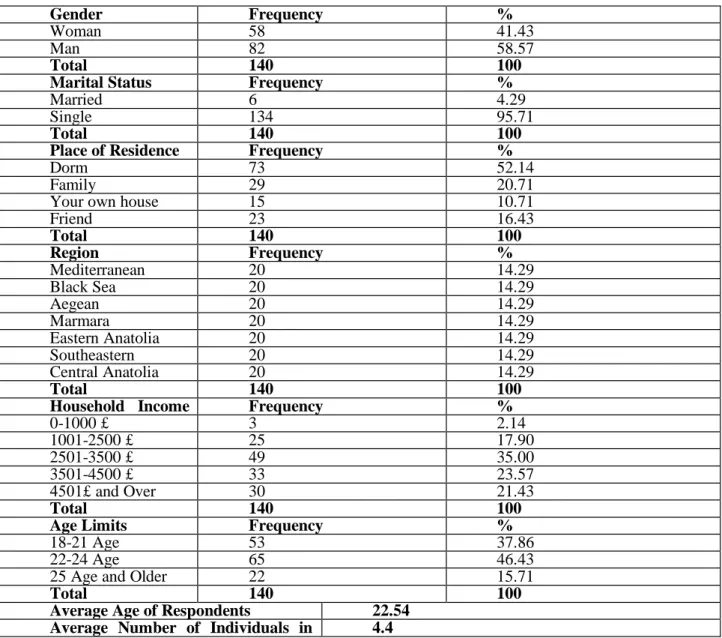
The frequency and percentage values of the demographics characteristics (gender, marital status, region, place of residence, income level and age) of the 140 students who made up the data of the current study were given in Table 1.
Table 1. Demographical characteristics of the surveyed students
Gender Frequency %
Woman 58 41.43
Man 82 58.57
Total 140 100
Marital Status Frequency %
Married 6 4.29
Single 134 95.71
Total 140 100
Place of Residence Frequency %
Dorm 73 52.14
Family 29 20.71
Your own house 15 10.71
Friend 23 16.43 Total 140 100 Region Frequency % Mediterranean 20 14.29 Black Sea 20 14.29 Aegean 20 14.29 Marmara 20 14.29 Eastern Anatolia 20 14.29 Southeastern 20 14.29 Central Anatolia 20 14.29 Total 140 100
Household Income Frequency %
0-1000 £ 3 2.14 1001-2500 £ 25 17.90 2501-3500 £ 49 35.00 3501-4500 £ 33 23.57 4501£ and Over 30 21.43 Total 140 100
Age Limits Frequency %
18-21 Age 53 37.86
22-24 Age 65 46.43
25 Age and Older 22 15.71
Total 140 100
Average Age of Respondents 22.54
Average Number of Individuals in 4.4
Milk consumption habits were evaluated considering region, place of residence, income level and age of the students whose demographic characteristics (Table 1). As shown in Table 1, 58.57% of the surveyed students were male and 41.43% were female. The average age of students was 22.54. Due to the fact that the survey was conducted in a university environment, the majority of the respondents constitute from students residing in dormitory, single and having family income (2501-3500 TL) slightly above the minimum wage. For the students surveyed, the most important periods for milk consumption were infancy and childhood periods. However, it was observed that consumption of milk is important in all periods. According to the statistical analysis of the study as shown in table 2, it was found that the region, place of residence, income level and age factors did not have any effect on the periods of milk consumption (P>0.05).
Table 2. Views on milk consumption periods of students
*: P<0.05, **: P<0.01, ***: P<0.001
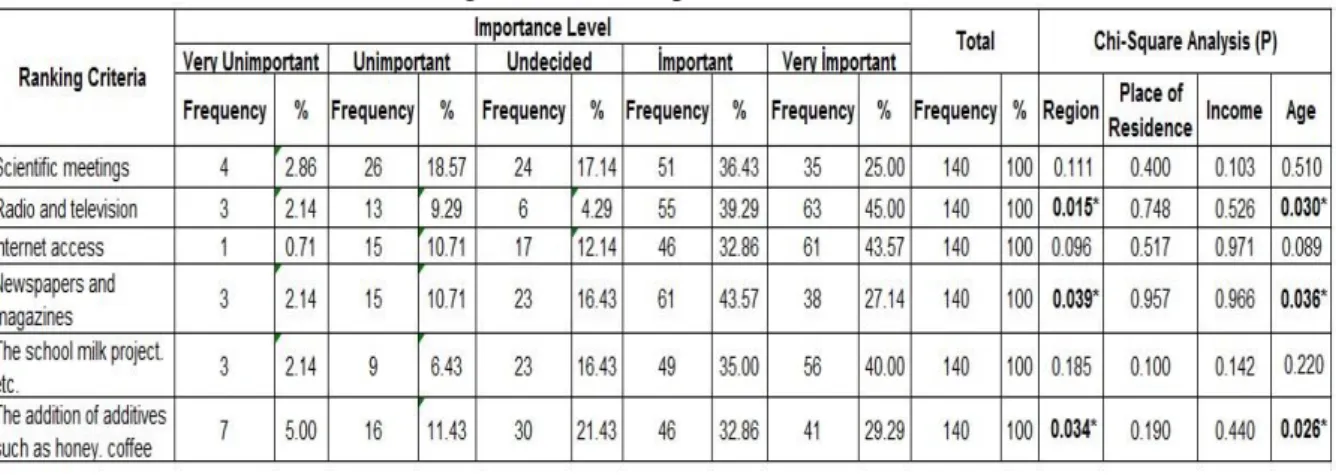
Because of rich nutritional content in human nutrition, the consumption of milk in every period is important for adequate and balanced nutrition. No milk consumption habits in the survey or for people who do not consume enough level milk, encouraging criteria milk consumption as regular were asked. As shown in Table 3, the results showed that the influencing factors of regular milk consumption were radio and television, internet access and school milk project. In a study conducted by Karagözlü et al (2005), %76.79 of the students stated that the most important tool promoting milk consumption was TV, newspaper and radio. In another study conducted by Şeker et al (2012), Radio and TV with 70.9% were determined as the most effective way to encourage people on drinking milk consumption. These results supported the results of our current study. Additionally, according to the statistical analysis of the study, it was determined that the region and age factors were important at the level of 5% on effective criteria to encourage milk consumption.
Table 3. Effective criteria to encourage milk consumption of students
*: P<0,05, **: P<0,01, ***: P<0,001
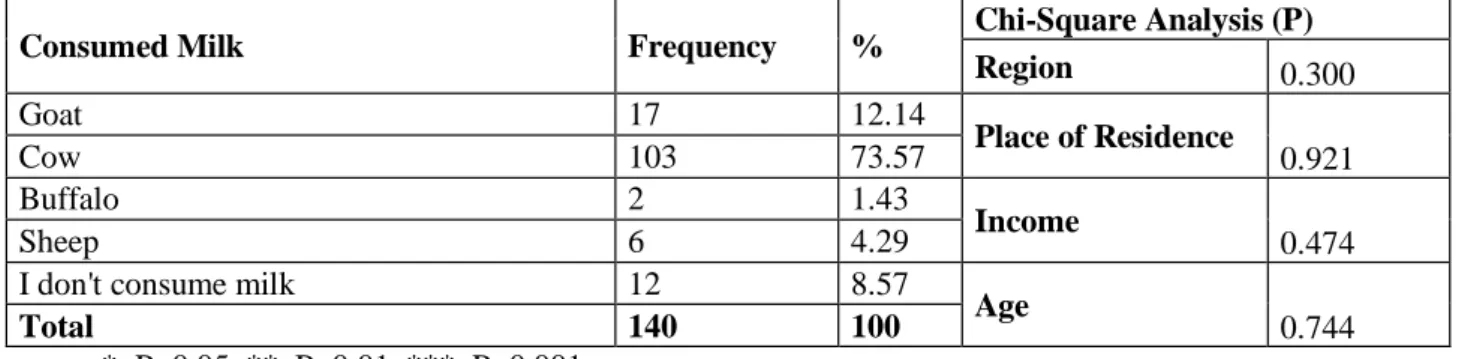
Regarding the milk drinking habits and type of milk, it was determined that 91.43% of the students consumed milk while 8.57% did not have milk consumption habits. As shown in table 4, 73.57 % of students who consumed milk preferred cow milk. In the study by Şeker et al (2012), most of the participants (79.0%) reported that they preferred cow milk. These findings were to the ones reported by Çelik et al (2005) who indicated that 87.8% of consumers preferred cow milk. In another study conducted by Yalcin and Argun (2017) showed that 51.7%, 10.8% and 5.8% of the respondents preferred cow, goat or sheep milk respectively; while 21.7% stated that them did not give the source of milk. These various studies conducted on milk consumption habits were in concordance with our results and it was found that cow milk consumption was the most high. The main reasons for this result may be that cow’s milk is easy to find and cheaper than other types of milk. Furthermore, the life style, livestock activities in the area where their lived and income of the people may affect the preference of milk consumption. As shown in table 4, it was found that the region, place of residence, income level and age factors did not significantly affect milk consumption preference (p>0.05). This can be explained with the adaptation period to a new life of incoming students from different regions and lifestyles.
Table 4. Milk consuming habit and type of consumed milk of students
Consumed Milk Frequency % Chi-Square Analysis (P)
Region 0.300 Goat 17 12.14 Place of Residence 0.921 Cow 103 73.57 Buffalo 2 1.43 Income 0.474 Sheep 6 4.29
I don't consume milk 12 8.57
Age
0.744
Total 140 100
*: P<0,05, **: P<0,01, ***: P<0,001
Many criteria positively or negatively affect milk consumption. Some of these criteria, which were effective on milk consumption, were asked to the students who participated in the survey. According to the answer of the students surveyed, the main criteria affecting milk consumption were the expiration date of milk, smell of milk and shelf life of milk. Also as seen in Table 5, ıt determined effective in other criteria on milk consumption. A study conducted by Şahinöz and Özdemir (2017), when purchasing milk, it was reported that 49.5% of the students were paid attention to the expiration date of milk, 33.3% of the students gave importance to the brand of milk. Another study conducted, it was stated that students first checked the expiration date secondly paid attention to the brand (Şimşek ve Açıkgöz, 2011). In another similar study Durmaz et al. (2002) reported that 40% of the students paid attention to the expiration date of milk, 23.8% of the students gave importance to the brand of the milk. The results of the current study were consistent with results of these studies. According to the statistical analysis of the study, it was determined that the region and income level factors were important at the level of 5% on effective criteria in milk purchase.
Table 5. Effective criteria in milk purchase of students
*: P<0,05, **: P<0,01, ***: P<0,001
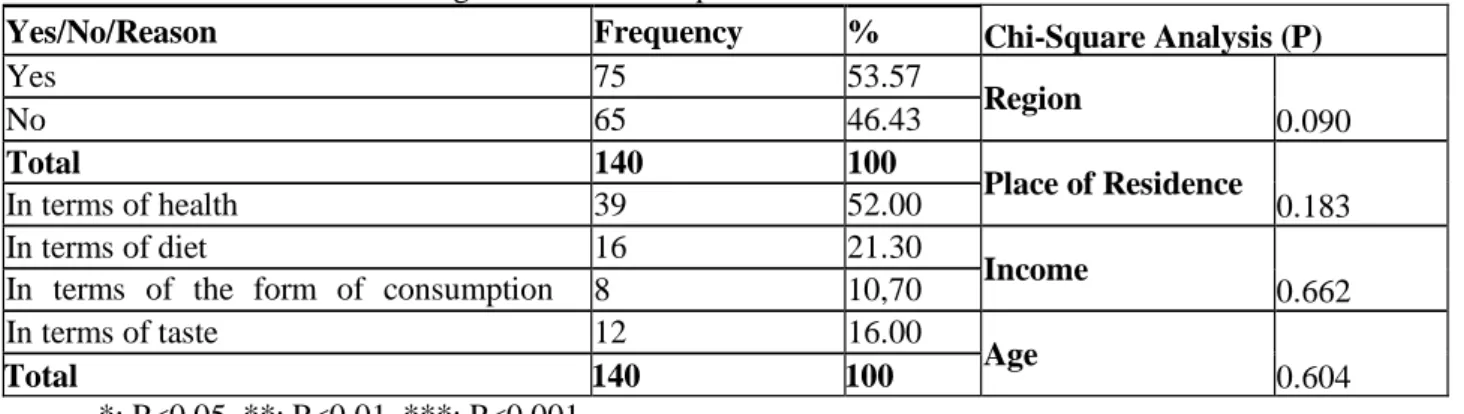
The fat ratio is one of the most important parameters determining the quality standard of milk. The ratio of fat in milk may be the cause of preference of consumers according to the use way of milk. About the fat ratio of milk when buying milk and reason motivating the choice of considering the fat ratio, 53.57% of the participants declared taking into account the fat ratio, while 46.43% of them did not consider that selection
Table 6. Reasons for looking in the fat rate of purchased milk of students
Yes/No/Reason Frequency % Chi-Square Analysis (P)
Yes 75 53.57 Region 0.090 No 65 46.43 Total 140 100 Place of Residence 0.183 In terms of health 39 52.00 In terms of diet 16 21.30 Income 0.662 In terms of the form of consumption 8 10,70
In terms of taste 12 16.00
Age
0.604
Total 140 100
*: P<0,05, **: P<0,01, ***: P<0,001
According to the answers given by the students to the question on the frequency of milk consumption, 40% of the respondents were found to be in the habit of consuming milk. Moreover, was determined that 51.43% consumed irregular milk and 8.57% did not consume any milk. In a study conducted by Çetinkaya (2010), it was found that 33% of the participants had the habit of milk consuming and 67% did not milk consume. In another study conducted by Karagözlü et al (2005), it was determined that 63.71% of the participants had the habit of milk consuming and 36.29% did not milk consume. In another study conducted by Şahinöz ve Özdemir (2017), it was determined that 70% of participants had the habit of milk consume. According to researchs on milk consumption habits, it was seen that the milk consumption habits of the students who participated in our study were low. Based on results given in the table 7, the region, place of residence, income level and age factors were not significant on frequency of milk drinking (P> 0.05).
Table 7. Frequency of milk drinking of students
Milk Drinking Frequency Frequency %
Chi-Square Analysis (P)
Region 0.741
Once a day 39 27.86
Place of Residence 0.998
Multiple times a day 17 12.14
Once a Week 46 32.86
Income 0.101
More than one a week, less than seven 26 18.57
I don't consume milk 12 8.57
Age 0.200
Total 140 100
*: P<0,05, **: P<0,01, ***: P<0,001
To make a habit of milk consumption to children of parents, they take care to consume 2 meals a day of milk especially in breakfast and before bedtime. However, acquired these habits can change with the individual's separation from the family due to his/her education life or with transition to his/her own family life in the subsequent. In order to determine the milk consumption meal of the students who participated in the survey, a question was asked as to what is your milk consumption meal. According to the most given answer by the students who participated in the survey, determined that 41.43% of them preferred to consume milk as a meal before bedtime in night. In the study conducted by Yalçın and Argun (2017) revealed that 21.7%, 5.8%, 16.7%, 31.7% and 12.5% of students consumed milk in the morning, at noon, at evening, at bedtime and between meals respectively. In another study conducted by Uzunöz and Gülşen (2007), it was found that 21.7% of the students consumed in the morning, 1.67% at noon, 53.67% at evening, 31.7% at any time milk. The results of many studies on the consumption of milk were similar to each other. According to the results of the research, it was determined that the meal in which milk is consumed the most is before bedtime in the evening. According to the statistical analysis of the study as shown in table 8, it was observed that the region, place of residence, income level and age factors were not significant on the milk consumption meal.
Table 8. Milk consumption meal of students
Milk Consumption Meal Frequency % Chi-Square Analysis (P)
Breakfast 27 19.29
Region 0.581
Lunch Break 2 1.43
Dinner 3 2.14 Place of
Residence 0.178
Evening before bedtime 58 41.43
Intermediate meals 26 18.57
Income 0.339
Breakfast and evening before bedtime 12 8.57
I don't consume milk 12 8.57
Age 0.153
Total 140 100
*: P<0,05, **: P<0,01, ***: P<0,001
The taste and smell of milk are the two most important criteria affecting to milk consumption. People who cannot consume the white milk because of the taste and smell of milk consume by adding different sweeteners that change the taste and smell of the milk and thus is benefit from the rich nutrient content of the milk. In order to determine of the way milk consume of the students who participated in the survey, a question was asked as to what is the way you milk consume. 47.86% of participated in the survey preferred to consume milk without additives, 43.57% of participated in the survey preferred with adding of milk additives (sugary, coffee, cacao ve honeyed). In the study conducted by Yalçın and Argun (2017) found that 49.4% of participated in the survey preferred to consume milk without additives, 42.2% of participated in the survey preferred with adding of milk additives (25.2% sugary, 11.6% cacao, 5.4% coffee). It was found that the results of these two studies were parallel to each other, and that about half of the participated in the survey in both studies drank by adding of milk additives to milk. For this reason, various additives added to the milk are of great importance in terms of consumption by loving of milk and gaining the consumption habit of milk. According to the statistical analysis of the study as shown in table 9, it was observed that the region, place of residence, income level and age factors were not important on the way of consuming milk (p>0.05).
Table 9. Milk consumption way of students
Milk Consumption Shape Frequency %
Chi-Square Analysis (P)
Region 0.452
Sugary 24 17.14
Without sugar 67 47.86 Place of
Residence 0.725
Coffee 14 10.00
Cacao 11 7.86
Income 0.990
Honeyed 12 8.57
I don't consume milk 12 8.57
Age 0.403
Total 140 100
*: P<0,05, **: P<0,01, ***: P<0,001
On the other hand it was determined that 36.43% of the students consumed warm milk, 30.71% consumed cold milk, and 24.29% had a habit of consuming hot milk. In the results gave in the table 10, indicated that the region, place of residence, income level and age factors were not important on the temperature of milk consumption (P>0.05).
Table 10. Milk consumption temperature of students
Milk Consumption Hot Frequency %
Chi-Square Analysis (P)
Hot 34 24.29
Cold 43 30.71 Region 0.063
Warm 51 36.43 Place of Residence 0.936
I don't consume milk 12 8.57 Income 0.650
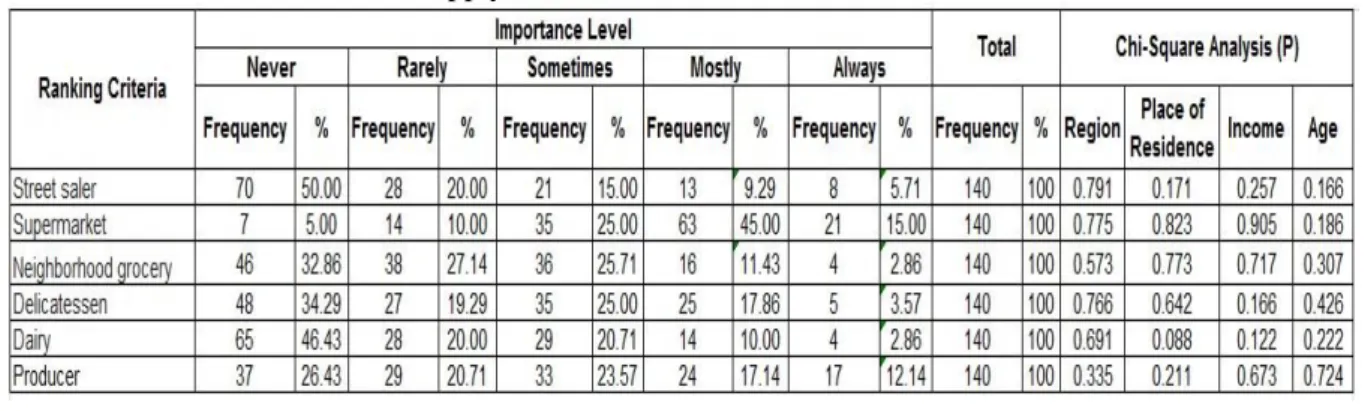
buy from street sellers and dairies. As seen in table 11, the region, place of residence, income level and age factors were not important on where provided milk of students.
Table 11. Place where students supply milk
*: P<0,05, **: P<0,01, ***: P<0,001
The type of packaging varies depending on where the consumer receives the milk. For example, if the milk is bought from dairies or farmers, the packaging type is usually plastic bottles or plastic bags. İf the milk is bought from place as such supermarket, neighbourhood grocery store, delicatessen, etc., the form of packaging is usually carton boxes or glass bottles. As seen in Table 12, the students involved in the current study mostly bought milk contained in glass bottles and carton boxes, plastic bags were least used as the packaging form. In a study conducted by Şeker et al (2012), 58% of consumers preferred cardboard boxes as packaging type. In a similar study, 52% of respondents preferred milk in glass, 31% cartonbox, 6% plastic bottles (Şimşek et al, 2005). According to the studies, the mostly preferred milk was the one contained in glass bottle and carton boxes. Among the main reasons for this, prolonging shelf life by subjecting of milk to a number of processes (pasteurization and UHT) and factors such as milk being ready to use directly can be counted. It was found that the place of residence factor were important at the level of 5% on the preference of milk packaging type.
Table 12. Milk package type preferred by students
*: P<0,05, **: P<0,01, ***: P<0,001 CONCLUSION
Milk is an animal food that forms the basis of adequate and balanced nutrition for human health in every period of human life. In the study it was found that 40% of the undergraduate students who studied at Çukurova University had milk consumption habits. This result showed that milk consumption habits of Çukurova University students were low. For this reason, for people who do not have milk consumption habits from the family or who gave up their milk consumption habits, the role of milk in human nutrition should be explained by the experts in the field. In this topic, departments related food in Universities, Media tools such as radio and television, newspapers and magazines, scientific studies such as school milk projects wıll have great impacts on the acquisition of milk consumption habits.
REFERENCES
Baysal A. 1993. Gençliğin Beslenme Sorunları. Aile ve Toplum Dergisi 1(3):97-108.
Black RE, Williams SM, Jones IE, Goulding A. 2002. Children who avoid drinking cow milk have low dietary calcium intakes and poor bone health. American Journal of Clinical Nutrition 76:675-80.
Çalıştır B, Dereli F, Eksen M, Aktaş S. 2005. Muğla Üniversitesi Öğrencilerinin Beslenme Konusunda Bilgi Düzeylerinin Belirlenmesi. Uluslararası İnsan Bilimleri Dergisi, 2(2):1-8.
Çelik Y, Karlı B, Bilgiç A, Çelik Ş. 2005. Şanlıurfa ili kentsel alanda tüketicilerin süt tüketim düzeyleri ve süt tüketim alışkanlıkları. Tarım Ekonomisi Dergisi 11:5-12.
Çetinkaya A. 2010. Kafkas Üniversitesi Öğrencilerinin İçme Sütü ve Süt Ürünlerini Tüketim Alışkanlıklarının Belirlenmesi. Atatürk Üniversitesi Veteriner Bilimleri Dergisi 5(2):73-84.
Durmaz H, Sağun E, Tarakçı Z. 2002. Yüksekokul Öğrencilerinin İçme Sütü Tüketim Alışkanlıkları. Yüzüncü Yıl Üniversitesi Veteriner Fakültesi Dergisi, 13 (2): 69-73.
Heaney P, McCarron D, Dawson-Huges B. 1999. Dietary Changes in Favourably Affect Bone Remodeling in Older Adults. Journal of the American Dietetic Association 99:1128-1133.
Jain M. 1998. Dairy Foods, Dairy Fats, and Cancer: A Review of Epidemiological Evidence. Nutrition Research 18(5):905-937.
Karagözlü N, Karagözlü C, Karaca S, Eren S. 2005. Üniversite Öğrencilerinde Süt ve Ürünleri Tüketim Alışkanlıkları ve Beslenme Bilinçleri Üzerine Bir Araştırma: Celal Bayar Üniversitesi
Mühendislik Fakültesi Örneği. Celal Bayar Üniversitesi Fen Bilimleri Dergisi 2(2005):101-108. Şahinöz S, Özdemir M. 2017. Üniversite Öğrencilerinin Süt ve Süt Ürünleri Tüketim Alışkanlıkları ve Etkileyen Faktörler. Gümüşhane Üniversitesi Sağlık Bilimleri Dergisi 6(4):106-112.
Şeker İ, Şeker P, Şahin M, Özen VS, Akdeniz A, Erkmen O, Kışlalıoğlu İ, Sargın G, Doğu GB. 2012. Elazığ İli Merkez İlçede Tüketicilerin Süt Tüketim Alışkanlıkları ve Bu Alışkanlıkları Etkileyen Faktörlerin Belirlenmesi. Fırat Üniversitesi Sağlık Bilimleri Veteriner Dergisi 26(3):131-143.
Şimşek O, Çetin C, Bilgin B. 2005. İstanbul ilinde içme sütü tüketim alışkanlıkları ve bu alışkanlıkları etkileyen faktörlerin belirlenmesi üzerine bir araştırma. Tekirdağ Ziraat Fakültesi Dergisi 2:23-35.
Şimşek B, Açıkgöz İ. 2011. Süleyman Demirel Üniversitesi Öğrencilerinin İçme Sütü Tüketim Alışkanlıklarının Belirlenmesi. Yüzüncü yıl Üniversitesi Tarım Bilimleri Dergisi 21(1):12-18.
Tanır F, Şaşmaz T, Beyhan Y. Bilici S. 2001. Doğankent Beldesinde Bir Tekstil Fabrikasında Çalışanların Beslenme Durumu. Türk Tabipler Birliği Mesleki Sağlık ve Güvenlik Dergisi 2(7):22-25.
Toptaş E. 2011. Konya İli 10-15 Yaş Aralığındaki İlköğretim Öğrencilerinde Süt ve Süt Ürünleri Tüketim Alışkanlığı, Laktoz Sindirim Güçlüğü ve İntoleransı Üzerine Bir Araştırma. Yüksek Lisans Tezi, Selçuk Üniversitesi Sosyal Bilimler Enstitüsü, Konya.
Uzunöz M, Gülşen M. 2007. Üniversite Öğrencilerinin Süt ve Süt Ürünleri Tüketim Alışkanlıklarının Belirlenmesi, Gıda Teknolojileri Elektronik Dergisi, 2007 (3): 15-21.
Yalçın M, Argun MŞ. 2017. Bitlis Eren Üniversitesi Sağlık Yüksekokulu Öğrencilerinin Süt ve Süt Ürünleri Tüketim Alışkanlıkları ve Etkileyen Faktörler. Bitlis Eren Üniversitesi Fen Bilimleri Dergisi 6(1):51- 60.
Yılmaz E, Özkan S. 2007. Üniversite Öğrencilerinin Beslenme Alışkanlıklarının İncelenmesi. Fırat Sağlık Hizmetleri Dergisi 2(6):87-104.