Post occupancy evaluation of
a transformed design studio
Abstract
The decision-makers choices regarding the design and construction of educa-tional spaces have a direct impact on the academic culture. With regard to the design studios, the physical conditions of the studio spaces specifically act as the main element that creates the studio culture. The present study aims at under-standing the relationship between the spatial transformation and the expectations of the students. Following a post occupancy approach, we asked, “What can we learn from collection of individual evaluations of students’ on transformed studio environment?” and “Where does this knowledge fit in the readily available litera-ture on built environment and learning spaces?” Twenty-five students are asked to write texts on their expectations related to a transformed studio in which they were receiving education at the time of the study. The texts are first examined for the frequency of the words used via cloud analysis. Following that analysis, two independent evaluators identified the phenomena in the texts and conducted a content analysis. The student expectations are classified into two main groups: Learning Experiences and Spatial Experiences. Learning experience involves three subgroups namely variation in work practices, creativity and social interactions and spatial experience is made up of physical comfort and furniture subgroups. Although during the spatial transformation, some improvement have been made, they did not completely fulfill the students’ expectations. The present study propos-es that in such spatial transformations, it would be possible to attain user satisfac-tion when decision-makers follow participatory processes in which all groups that would be effected can participate.
Keywords
Studio education, Post occupancy evaluation, Content analysis, Learning experience, Interior.
Orçun KEPEZ1, Selin ÜST2
1 [email protected] • Interior Architecture and Environmental Design Department, Kadir Has University, Istanbul, Turkey
2 [email protected] • Interior Architecture and Environmental Design Department, Kadir Has University, Istanbul, Turkey
Received: March 2017 •Final Acceptance: December 2017
do
i: 10.5505/i
tu
1. Introduction
University campuses, the buildings that make up the campuses, the interi-or and exteriinteri-or spaces of these build-ings are all integral components that shape the academic culture that will warrant the university to fulfill its mis-sion (Fugazzatto, 2009; 2010). While making decisions regarding these re-sources, beyond providing physical infrastructure that serves certain func-tions, the university administrators set the quality of life for the occupants of the campus spaces as well. Today, we cannot avoid facing the reality that the learning expectations of the new gen-eration of students are different and re-sponding to these in design of campus environments is more crucial than ever (Ruffo, 2008).
The present study seeks to under-stand the evaluations of the students regarding the spatial transformation carried out in the studios after the change in the studio pedagogy followed by the institutions. In order to frame the study we asked “What can we learn from collection of individual evalua-tions of students’ about a transformed studio environment?” and “Where does this knowledge fit in the readily available literature on built environ-ment and learning spaces?” The liter-ature review of this study is threefold. First, the literature on built environ-ment and learning spaces will be dis-cussed, and second review of literature on the design studio will be presented. Finally, similar studies conducted by incorporating Post Occupancy Evalu-ation approach will be shared.
2.Built environment and learning space
Earlier research indicates the fea-tures of built environment impacts the eagerness and interest for learning and in turn the learning process, social participation and academic achieve-ment (Duran-Narucki, 2008; Eartman, 2004; Kumar et al., 2008; Schneider, 2002; Yang et al., 2013; Devlin, 2010). Many design decisions that will have a direct impact on the education experi-ence such as the perception of the edu-cation building, the functions that will take place in the spaces, the relations between interior and exterior spaces,
elements of exterior space, the form of the class and the configurations of the furniture, are decisions everybody can contribute to when -through suitable instruments- participation is warrant-ed (Sanoff, 1994; 2000).
In the research they conducted at three US higher education institutions, Scott-Webber et al. (2013) conclud-ed that in classes that support active learning, the rates of participation, co-working and in-class interaction (between academician-student and be-tween students) are higher than it is in traditional classrooms.
3. Design studio
The studio spaces where students spend a great deal of their time form the heart of the design education.
Researchers describe the design stu-dio through the learning experience at the studio, referring to it as the space where the uncertainty and uniqueness in design education is foregrounded, where the students focus on solving the problems that emerge, develop new ways of understanding and reflect what they sense into knowledge (Schön, 1983; Schön, 1985; Schön and Wiggins, 1992; Salama, 1995; 2015).
The learning experience at the design studio is among the design research topics that has attracted the attention of researchers in our country. The re-lationship between the students verbal and written expression skills and their performance at the studio (Ulusoy, 1999); the importance of the critiques in sharing design knowledge (Uluoğ-lu, 2000), and the connection between varied learning skills of design students and academic achievement (Demirkan and Demirbaş, 2008) are among the studies carried out in Turkey.
Due to the features mentioned above, studio education provide a source to be used for the learning ex-perience in other disciplines (Brandt et al., 2013). Shaffer (2003) who observed the design studios at MIT, adopted the components of studio for mathemati-cal education. Brant et al. (2013) cre-ated a theoretical framework for the application of studio-based learning in the human computer interaction field.
Since the design studios are used not only during class hours but also at other
times, it is very crucial for the students to embrace the space and enjoy spend-ing time at the studio. Cuff (1991) ar-gues that design studios are not just “work spaces” but a combination of home and workspace thus bear a sim-ilarity with a “home-office” approach.
Due to the nature of the commu-nication tools used and the nature of learning experience, design studios are different from standard classrooms. This difference requires a specializa-tion in the physical specificaspecializa-tions of the studio space in accordance with the design education. Several research focused on the impact of the physical specifications of the studios on design and education and correlate spatial comfort components with student per-formance.
4. Post occupancy evaluation
Post Occupancy Evaluation ap-proach can be defined as a process that is proposed for determining and solv-ing problems which were not noticed during the design process, overlooked during construction but noticed at the time of occupancy; thus it is a process that is oriented towards increasing the performance of the environment (Prei-ser et al., 1988). According to Prei(Prei-ser et al. (1988), post occupancy evaluation is a systematic and practical method for the evaluation of buildings where the construction is completed and occu-pancy process started. Post occuoccu-pancy evaluation approach focuses on occu-pants of the buildings and their needs through the results of the design deci-sions made in the past and thus shed-ding light on the resulting performance of the building (Preiser et al., 1988).
According to Dülgeroğlu et al. (1996) the method of evaluation during occu-pancy impacted the role of the architect in the design process. The architect’s task no longer ends when the designed product is constructed; the cause and effect relationship between the design and the application becomes continu-ous through being combined with the evaluation of the occupancy process (Dülgeroğlu et al., 1996). According to Zimring (2003), post occupancy eval-uation research provide a great oppor-tunity for corporate learning. Dursun and Özsoy (2008) consider the post
oc-cupancy evaluation approach as a tool that is useful for designers to re-scruti-nized the human being-built environ-ment relation and learn from their own experience. Post occupancy evaluation approach, brings together research and design and provides a knowledge base for the future projects (Dursun and Özsoy, 2008).
The post occupancy evaluation re-search Sanoff (1999) carried out at the architecture school of six universities by using a walk through instrument, in which an evaluation of six compo-nents, namely context, massing, in-terface, wayfinding, social-spatial and comfort is studied, is one of the first such work in the field. The results of this work indicates that the wayfinding and comfort were the least successful components at all of the universities evaluated (Sanoff, 1999).
The results of another study evalu-ating sixteen architecture schools, thir-teen of which are in the United States, indicates that the occupants complain about the physical conditions of the space that are poor acoustics, lighting, inequality in air-conditioning, insuf-ficient ventilation (Nasar et al., 2007). The main reason for the observation of these common complaints at sever-al different faculties is that the studios, which are essential for architecture ed-ucation, are actually spaces constructed using large and hard, durable materials which render providing comfort quite tough. The existence of a small number of faculty buildings where the studio space is divided into smaller sections, with dedicated areas for critique and juries, and anti-glare sun-light control, adequate task lighting, sound absorb-ing materials and comfortable seatabsorb-ing indicates there are in fact solutions to this problem (Nasar et al., 2007).
In our country, the studies carried out on the exterior spaces of univer-sity campuses which were conducted through collaboration of several dif-ferent universities indicates a knowl-edge network is emerging in this area (Ünlü et al. 2009; Çubukçu and Işıtan, 2011). However, the post occupancy evaluation research in Turkey is main-ly focused on urban spaces (Özsoy et al.,1996; Korkmaz and Türkoğlu, 2003; Yıldız and Şener, 2006) and the
num-ber of studies on interior spaces in this research area is quite limited. The studies on the personal space needs of the students in the studio (Demirbaş and Demirkan 2000) and on the rela-tionship between the students’ choic-es of location in the studio and their achievement (Edgü, 2015) are works on single components of interior space. Karslı (2016) evaluated open and cell-type studios used for traditional architectural education through a post occupancy evaluation and after deter-mining the strong and weak aspects of the existing studios, she suggested a combi-design which will fulfill the spatial requirements of new learning styles. Combi-design studio is defined as a single space where in-group pre-sentations and critiques are allowed through flexible separators but where the social interaction and communica-tion is also strong.
In her article on the design studios of İstanbul Technical University’s Fac-ulty of Architecture, Gür (2010) points out to the different spatial features of
open and cell type design studios and dwells on the impact of these features on the student-to-student and the stu-dent-academician interactions.
Ultimately, findings of post occu-pancy evaluations provide a knowledge base for the future design activities with similar challenges to overcome some –if not all- future problems. However following a participatory de-sign approach will not only ensure that the implemented design fulfills the ex-pectations but it will also enable people to develop sense of belonging in early steps of implementation (Sanoff, 2000). 5. The scope and aim of the study
This study is about the students’ post occupancy evaluations on the spatial changes that took place in some of the studios at the Cibali Campus of Kadir Has University. The building where the Kadir Has University’s Cibali Cam-pus is situated at was constructed in 1884 during the reign of Abdulhamid II as the Cibali Tobacco and Cigarette Factory. Located on a 10.385 m2 land
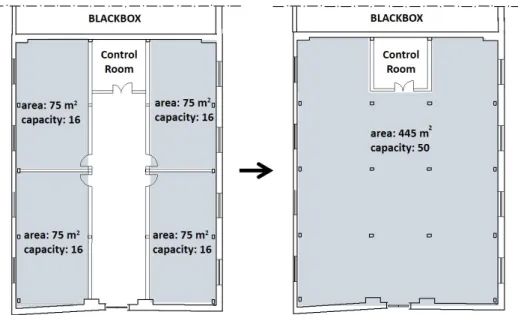
Figure 2. The transformation of the studios from four small studios to one big one.
Figure 1. The spatial transformation that took in place in 2010. Note the second floor
with a 45.000 m2 interior space, it is among the significant buildings of our early industrial era cultural heritage (Alper, 2004). In 1995, the factory was evacuated and allotted to Kadir Has University to be used for educational purposes for 29 years (Alper, 2004). The project for converting the Ciba-li Tobacco and Cigarette Factory into Kadir Has University received the Eu-rope Nostra award due to its elaborate and comprehensive restoration and its contribution to the improvement of the region it is located at (Alper, 2004).
The interior space that is the focus of the study was created in 2010 by dividing the space used as an indoor sports facility within the Faculty of Art and Design into two-stories. At its foundation, the university set up an aim for education focused on a small number of students. The spatial reflec-tion of this aim was studios which were separated from each other with a wall, opening up to a common hallway and each of which served a maximum of 15 students (Figure 1).
As a part of this transformation, small-scale studios that were situated at the ground level of the university and that could accommodate a maxi-mum of 15 students (a project group) were recreated at both of the newly ac-quired levels and a total of eight studios were attained. After the vertical
educa-tion model where students at different studio levels are taught by a single in-structor was abandoned for a new ed-ucational model, these spaces, which were used actively between 2010 and 2014, failed to fulfill the coordination needs of different group coordinators and communication needs among stu-dents who were in different groups. It is observed that to solve this problem, all of the studio instructors initially taught classes by keeping the studio doors open and used the halls for notices and joint critiques, encouraging the stu-dents to visit other studios. Eventual-ly, a decision to tear down the walls to transform this space, which was closed up by building walls four years ago, into a single body again is made (Figure 2).
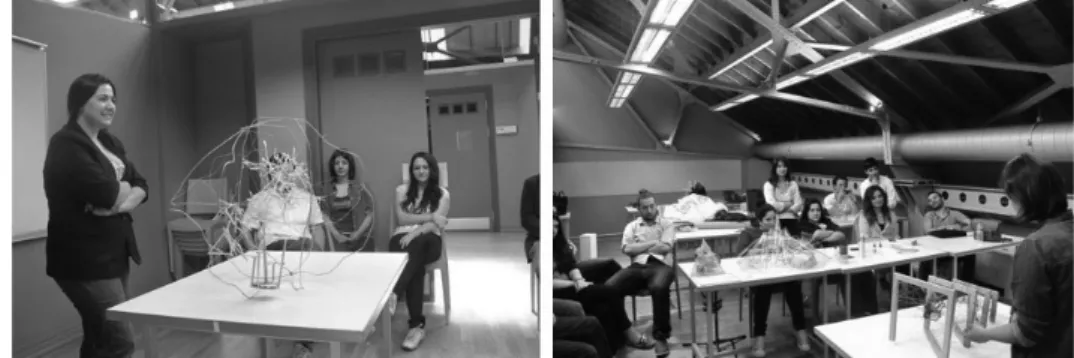
The aim of the transformation is to create a single, large area that will re-place four small studios serving 60 stu-dents with one big space that supports the group work of 50 students. Al-though by the removal of the walls, the visibility within the space increased, the project classes are hold with the same spatial organization using the same furniture and following the same organizational pattern. This transfor-mation, that took place only four years after the initial intervention, does not involve any improvement suggestions other than the removal of the walls (Figure 3 and 4).
Figure 3. Photographs of the old studio where each studio instructor was given a separate
room to conduct studios.
Figure 4. Panoramic photo of the new studio. Hall area where all studio doors were opened
In the first project class that was held at the new studio, a post occu-pancy evaluation was carried out to understand which aspects of the stu-dent expectations are fulfilled by this new space. Another aim was to have this study act as a source in the form of a case study on the given studio top-ic that is focused on education spaces. With post occupancy evaluation of this studio, a research-focused approach is followed with a goal of making stu-dents question the use/occupancy of the buildings, which are assigned to them as the project topic, via different techniques. Within this framework, the students had the opportunity to expe-rience the post occupancy evaluation approach initially as a participant and later as an implementer. An approach that considers research to be an inte-gral part of undergraduate education as well as acknowledging research-fo-cused education to be scientific are now widely accepted (Boyer, 1990; Boyer and Mitgang, 1996; Kepez, 2015). In this context, the design studio is not an environment that is merely designed upon debatable tastes and personal ap-proaches, where the instructors are the “masters” and the students are the “ap-prentices”. On the contrary, the studio is an environment of interaction and sharing where the provision of educa-tion is considered within the frame-work of “scholarship of teaching”. This, in turn, makes the studio a research space which is nourished by knowledge from other disciplines, where accepted research findings are shared and where the students and instructors investigate their questions and several phenome-na together. This definition also per-tains to the studio where the present research is undertaken and the work discussed in the article is also among the studio components.
6. Methodology
Post occupancy evaluation is an ap-proach that incorporates various action research methods (Zeisel, 2006). These methods may involve short visits by the experts of the field to the building that will be evaluated, and reports of a certain pre-determined format they prepare on the observations and views based on these visits (Zimring, 2003).
Manahasa and Özsoy (2016) who conducted a post occupancy evalua-tion of a campus building in Istanbul, sought to understand the impact of the new building on the student behavior and student satisfaction through the use of mixed techniques such as sur-veys, interviews, observations and be-havior mapping.
Daily user satisfaction surveys, uti-lized for systematic data collection from various occupants impacted by the design decisions, may also be the main source for post occupancy eval-uation. In addition to that, other post occupancy evaluation methods such as focus groups and new generation post occupancy evaluations that use mobile technologies for data collection are available. Ultimately, post occupancy evaluation techniques form a rich scale and they are field techniques that are designed in line with the goal, time and budget. When preliminary crite-ria are set for post occupancy evalua-tion, this in turn, leads to a reduction of the occupant feedback into only these preset criteria. When the peda-gogical approach at the project studio is considered, it becomes obvious that evaluating complex phenomena with a reductionist method will not help stu-dents build awareness on the issue.
Based on this premise, no preset cri-teria were determined, instead students were asked to write texts accounting their experiences in this new studio. This way, rather than being given pre-determined criteria, which may be leading, the students focused on their own experiences. In fact, each text has the characteristic of an open ended question they answered regarding their spatial experience. Through these texts, the students are expected to build the act of designing the studio space over their own learning practices, making use of their own experiences. With the texts the students are asked to write, the aim was to make them criticize the learning space, system and style and thus re-think on the studio space, face the problems and evaluate them.
For this research, 5000 words that are obtained from the texts produced independently by 25 students are eval-uated through a methodology which utilized both quantitative and
quali-tative research methods, namely tag clouding analysis and content analysis. 7. Analysis
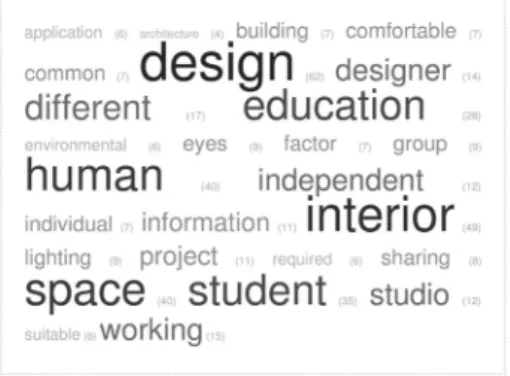
At the pre-evaluation stage, the words within the 5000 word text are listed according to their frequency and weight through tag clouding method which is a quantitative analysis meth-od. While the cloud that lists the words according to their frequency is created, words that occur often in Turkish text hence have a high frequency (such as but, a, according to, and, or, this, that) yet should not be included in the anal-ysis are eliminated. An open source online tag cloud software was used to conduct the analysis (Steinbock, n.d).
In the “tag cloud” illustration, the sizes and the shades of the words change in line with their degree of im-portance. As can be seen in the cloud, the words most often used by the stu-dents are “design”, “student”, “human being”, “area”, “space” and “education”. Other words that stand out are “dif-ferent”, “free”, “work” and “studio”. Tag cloud is a preliminary analysis that is carried out in order to obtain the sub-headings to be used in the content
analysis, which is the following step (Figure 5).
The aim of content analysis is to study the data obtained from the texts and discover the main concepts and re-lations (Creswell, 2007; 2009). The texts collected from the students are exam-ined by two independent researchers and grouped according to the observed phenomena. Later on, these phenome-na are compared and each group is giv-en a certain code (heading). Through a deeper analysis of the texts, which are categorized according to the common codes that are determined, the aim was to reveal concepts and relations which were not noticed earlier. According to the results of the content analysis, the student texts contain two main phe-nomena, namely the features regarding the spatial experience and the learning experience. When the collected 25 texts are examined, 13 sub-texts on the fea-tures of the spatial experience and 16 sub-texts on the features of learning experience are discovered (Figure 6). 7.1. Features of the spatial experience
The content analysis results show that in the studio environment, fulfill-ing occupants’ needs related to spatial experience is the initial step in in-creasing the productivity. This analysis indicates that the texts on the needs related to spatial experience involves two sub-headings; the components of physical environment comfort and components of furniture. An overview of the texts shows that 14 texts mention components of physical environment comfort and 8 texts mention compo-nents of furniture.
Physical environment comfort com-ponents can be considered as the first spatial comfort components that im-pact the productivity of the education process at the studio. The physical en-vironment comfort components im-pact the learning process of the student by providing auditory, visual and ther-mal comfort of the space. Krüger and Zannin (2004) suggest that all physical environment parameters are related to each other and the comfort of the oc-cupant is based on the perception of all these factors as a whole.
Students frequently mention that physical environment factors impact
Figure 6. Emerging phenomena from the content analysis. Figure 5. Tag Cloud analysis that included
the quality of life of the occupants and need to be considered at the design phase. An overview of the 14 texts in which physical environment comfort component are mentioned, we see that 11 texts comment on visual comfort elements, 5 text comment on acoustic comfort components and 6 text com-ment on thermal comfort components.
In the sections where they make a remark on the visual comfort in their texts on the design of the studio, the students mentioned the importance of daylight, the quality and quantity of the artificial lighting that is used and the control of glare and shades (Table 1).
In their texts, students mentioned that the design studios are not only a co-working environment but also a space for interaction. The earlier re-search indicates that a class with poor acoustics can become a distracting and boring space of learning. (Yang et al., 2013; Dockrell and Shield, 2004). The student views support these research and emphasizes the significance of auditory comfort due to the commu-nication and flow of knowledge at the studio (Table 2).
Students emphasized the impor-tance of indoor air quality through ex-amples, such as insufficient ventilation, polluted air, ambient temperature that is too hot or too cold and humidity that is below the comfort level, which cause the air to become uncomfortable and unhealthy (Table 3).
One reason why the component of the physical environment is dominant in the post occupancy evaluation of the new classroom is the failure to provide any improvements on this issue during the transformation. Students who ex-perienced similar issues in the previ-ous studios have a particular sensitivity towards this issue.
The other spatial comfort component the students consider important is the variety of furniture and ergonomy. It is known that ergonomic thus more com-fortable furniture allow students to fo-cus better and to participate more active-ly in the lesson (Knight and Noyes, 1999; Espey, 2008; Harvey and Kenyon, 2013). According to Taylor (2009), which focuses on the impact of studios on learning and teaching, the flexibility provided to the students and the
acade-micians through the transformation of a traditional classroom into a studio with mobile furniture and chairs has a pos-itive impact on the experience of both groups. In the texts collected, we see that the students make remarks on the fea-tures of the furniture as well (Table 4).
The results of the content analysis indicate that problems related to spatial comfort appear frequently in the texts. It is concluded that in comparison to the other phenomena, spatial comfort is more dominant and so long as the problems on this issue are prevailing, suggestions regarding the learning ex-perience would remain of secondary importance.
7.2. Features of the learning experience
When the students’ expectations on the learning experience are examined, it can be concluded that studios must
Table 1. Selected examples of student views on visual comfort.
Table 2. Selected examples of student views on acoustic comfort.
Table 3. Selected examples of student views on thermal comfort.
be spaces which enable individual and group work, support creativity by mo-tivating working for long periods, pro-viding opportunities for not only in-teraction and communication among students but also between students and academicians and allowing interdisci-plinary collaborations.
When we examine the texts, we see that students want studios that will in-crease their motivation to work and that will support their creativity (Table 5).
The students stated that besides the individual work spaces, where they will seek answers to their own design questions, there should be settings that allow the flow of knowledge and critiques through debates and thus en-courage group work (Table 6).
Studios are learning spaces where everyone can interact with others and where sharing of knowledge is possible. In the texts collected from the students, they suggest sharing of knowledge should not be limited to in-terior architecture students and acade-micians but it should involve students and academicians from different disci-plines and an environment that would support interdisciplinary work thor-ough common work spaces should be created (Table 7).
8. Conclusion
Presented study carried out content analyses of individual texts written about a transformed studio by students and reported multiple aspects of envi-ronment that played role in students’ learning and spatial experiences in the studio environment. There are a few limitations of the study. The first one is related to the fact that the research focused only on the area where the spatial transformation in the building is carried out without considering its relationship to the other related spac-es. Moreover, the research was done at a time when the students have expe-rienced the studio for just two weeks. Additionally, due to the fact that the research is carried out as an integrated part of the project taught at the studio, it was not possible to keep the identity of the students anonymous. However, through the democratic and participa-tory execution of the classes, the stu-dents are reassured to freely express their thoughts at every phase of the studio.
Studios must be spaces students fre-quently use and enjoy spending time in. Beyond being merely physical spac-es where education is provided, they should be spaces where each student has control over his/her own “learning”
Table 5. Selected examples of student views on creativity.
Table 6. Selected examples of student views on work styles.
experience. This control entails being able to modify both physical comfort components and spatial components according to personal preferences and even having a say in the activities that take place as a part of the studio edu-cation.
The present work reveals that the students highlight the necessity of a studio environment which goes be-yond being a space that fulfills the stu-dents’ expectations regarding physical environment and furniture compo-nents. They seek a space where they can work individually and in groups, be inspired to work for long stretches of time, interacting and communicat-ing not only with their own classmates but also with academicians from their own discipline as well as from other disciplines.
The present research indicates the modifications detached from the views of the occupants will not yield satis-faction. The studio spaces, which are the focus of this work, are turned into large and spacious spaces from con-stricted, tight places, however this is not enough to fulfill the expectations of the students completely. As a result, we see that the students’ expectations regarding studio space and the views of decision-makers, who consider studios merely as physical environments where classes are held, do not match. It is im-portant to handle the processes related to creation of spaces through participa-tory design workshops where all user groups that will be affected by these de-cisions are involved in the process.
The buildings and studio spaces, where design education is provided, should be exemplary living environ-ments by offering humanistic standards for future designers and architects. It is not a coincidence that the context of this research and the research that are carried out at universities with very prominent design schools report sim-ilar complaints, even when the spaces are high-budgeted designs created by well-known architects. The buildings that look pleasant and nice and that are impressive at first glance can be embraced only as much as the quality they add to the lives of their daily oc-cupants. On the other hand, it is also an issue of debate how much an
occu-pant-focused, participatory approach is pursued in studio education. In oth-er words, the design studio also has the responsibility to be the space where the students learn to include the occupants in the design process. Within that context, the studio where this study is carried out followed a research based approach by employing a user-orient-ed design knowluser-orient-edge. Applying textual content analysis as a post occupancy evaluation method is a novel approach as well as the original findings of this study. The study is replicable, and it would be interesting to conduct study in different learning environments in different cultures.
From a more general perspective, as we witness an era when the universities redefining their own existence when most of the knowledge and educatial training can be freely accessed on-line, quality of physical environments and their outcomes become even more crucial. At a time the competition in higher education is globally on the rise, the frequently used concept of “being student focused” undoubtedly necessi-tates spaces developed with a focus on students.
References
Alper, M. (2004). Dünü ve bügünü ile Cibali tütün fabrikası. In S. F. Göncüoğlu (Ed.), Sempozyum bildir-ileri (pp. 33–40). İstanbul: Kadir Has Üniversitesi Yayınları.
Boyer, E. L. (1990). Scholarship reconsidered: Priorities of the pro-fessoriate. Carnegie Foundation for the Advancement of Teaching. Re-trieved from http://scholar.google. com/scholar?q=Scholarship Recon-sidered: Priorities of the Professori-ate&btnG=&hl=en&num=20&as_ sdt=0%2C22
Boyer, E. L., & Mitgang, L. D. (1996). Building community: A new future for architecture education and practice: a special report. Princeton, N.J: Carnegie Foundation for the Advancement of Teaching.
Brandt, C. B., Cennamo, K., Douglas, S., Vernon, M., McGrath, M., & Reimer, Y. (2013). A theoretical framework for the studio as a learning environment. International Journal of Technology and Design Education, 23(2), 329–348.
Creswell, J. W. (2007). Qualitative inquiry and research design: Choos-ing among five approaches. Thousand Oaks, California: Sage.
Creswell, J. W. (2009). Research Design: Qualitative, quantitative, and mixed Methods approaches (Third Edi-tion). Thousand Oaks, California: Sage. Çubukcu, E., & Işıtan, Z. N. (2011). Does student behavior differ in re-lation to perception / evaluation of campus environments? A post-occu-pancy research in two university cam-puses. Gazi University Journal of Sci-ence, 24(3), 547–558.
Cuff, D. (1991). Architecture: The Story of practice. Cambridge: MIT Press.
Demirbaş, O., & Demirkan, H. (2000) Privacy dimensions: A case study in the interior architecture de-sign studio. Journal of Environmental Pscychology, 20, 53–64.
Demirkan, H., & Demirbaş, O. (2008). Focus on the learning styles of freshman design students. Design Stud-ies, 29, 254–266.
Devlin, A. S. (2010). What Ameri-cans build and why: psychological per-spectives. UK: Cambridge University Press.
Dockrell, J. E., & Shield, B. (2004). Children’s perceptions of their acoustic environment at school and at home. The Journal of the Acoustical Society of America, 115(6), 2964–2973.
Dülgeroğlu, Y., Aydınlı, S., Pulat, G., Yılmaz, Z., & Özgünler, M. (1996). Toplu konutlarda nitelik sorunu. Anka-ra: Toplu Konut İdaresi.
Duran-Narucki, V. (2008). School building condition, school attendance, and academic achievement in New York City public schools: A mediation model. Journal of Environmental Pscy-chology, 28, 278–286.
Dursun, P., & Özsoy, A. (2008). How can architects learn from their own ex-periences? A|Z ITU Journal of the Fac-ulty of Architecture, 5(2), 82–95.
Earthman, G. I. (2004). Prioritiza-tion of 31 criteria for school building adequacy. Baltimore, MD: American Civil Liberties Union Foundation of Maryland.
Edgü, E. (2015). Success in Basic Design Studios: Can seat selection be an advantage? A|Z ITU Journal of the
Faculty of Architecture, 12(3), 41–53. Espey, M. (2008). Does space mat-ter? Classroom design and team-Based learning. Review of Agricultural Eco-nomics, 30(4), 764–775.
Fugazzotto, S. J. (2009). Mission statements, physical space, and strat-egy in higher education. Innovative Higher Education, 34(5), 285–298.
Fugazzotto, S. J. (2010). Physical space and the resource-based view of the college. Innovative Higher Educa-tion, 35(4), 245–259.
Gür, E. (2010). Open and cell-type design studios: Their impact on ar-chitectural education. Archnet-IJAR, International Journal of Architectural Research, 4(2–3), 216–224.
Harvey, E. J., & Kenyon, M. C. (2013). Classroom seating consider-ations for 21st century students and faculty. Journal of Learning Spaces, 2(1). Retrieved from http://libjournal. uncg.edu/jls/article/view/578
Karsli, U. T. (2016). Performance evaluation of open and cell type design studios. Open House International, 41(1), 27-34.
Kepez, O. (2015). Bir araştırma or-tamı olarak lisansüstü eğitim. In Ö. Cordan (Ed.), İÇLEK: Ulusal İç Mi-marlık Lisansüstü Eğitim Kongresi I (pp. 45–52). İstanbul: İTÜ.
Knight, G., & Noyes, J. (1999). Chil-dren’s behaviour and the design of school furniture. Ergonomics, 42(5), 747–760.
Korkmaz, E., & Türkoğlu, H. (2003). Kentsel açık alanlar: Beşiktaş iskele meydanı ve çevresi. Yapı Mimarlık Kültür Sanat Dergisi, (264), 65–67.
Krüger, E. L., & Zannin, P. H. (2004). Acoustic, thermal and luminous com-fort in classrooms. Building and Envi-ronment, 39(9), 1055–1063.
Kumar, R., O’Malley, P. M., & John-ston, L. D. (2008). Association between physical environment of secondary schools and student problem behavior: A national study, 2000-2003. Environ-ment and Behavior, 40(4), 455–486.
Manahasa, O., & Özsoy, A. (2016). Do architects’ and users’ reality coin-cide? A post occupancy evaluation in a university lecture hall. A/Z : ITU Jour-nal of Faculty of Architecture, 13(3), 119–133.
T. (Eds.). (2007). Designing for design-ers : lessons learned from schools of ar-chitecture. Fairchild Publications.
Özsoy, A., Altas, N. E., Ok, V., & Pulat, G. (1996). Quality assessment model for housing: A case study on outdoor spaces in Istanbul. Habitat In-ternational: A Journal for the Study of Human Settlements, 20(2), 163–173.
Preiser, W. F. E., White, E., & Rabi-novitz, H. (1988). Post occupancy eval-uation. New York: Van Nostrand Rein-hold.
Ruffo, J. (2008). “Millenial” or “Net Generation” students and their impact on the development of student-cen-tered facilities. Planning for Higher Education, 37(1), 5–6.
Salama, A. M. A. (1995). New trends in architectural education: designing the design studio. Raleigh, NC, USA: Tai-lored Text Publishers.
Salama, A. M. A. (2015). Spatial design education: new directions for pedagogy in architecture and beyond. Farnham Surrey, England ; Burlington: Ashgate.
Sanoff, H. (1994). School design. New York: Van Nostrand Reinhold.
Sanoff, H. (1999). Student responses to architecture schools. In M. T (Ed.), The Power of Imagination: Proceedings of the Thirtieth Annual Environmental Design Research Association [EDRA] Conference (pp. 188–195). Florida: EDRA.
Sanoff, H. (2000). Community par-ticipation methods in design and plan-ning. New York: Wiley.
Schneider, M. (2002). Do school fa-cilities affect academic outcomes? Na-tional clearing house for educaNa-tional facilities. National Institute of Building Sciences. Retrieved from http://files. eric.ed.gov/fulltext/ED470979.pdf
Schön, D. A. (1983). The reflective practitioner: How professionals think in action. New York: Basic Books.
Schön, D. A. (1985). The design stu-dio: An exploration of its traditions and potentials. London: RIBA Publications.
Schön, D. A., & Wiggins, G. (1992). Kinds of seeing and their funcstions in designing. Design Studies, 13(2), 135– 156.
Scott-Webber, L., Aileen, S., &
Ka-pitula, L. (2013). Built environments impact behaviors: Results of an active learning post-occupancy evaluation. Planning for Higher Education, (Octo-ber-December), 28–39.
Shaffer, D. W. (2003). Portrait of the Oxford design studio: An ethnography of design pedagogy. Wisconsin Center for Educational Research. Retrieved from http://files.eric.ed.gov/fulltext/ ED497579.pdf
Steinbock, D. (n.d.). Tag Crowd. Re-trieved from http://tagcrowd.com
Taylor, S. S. (2009). Effects of studio space on teaching and learning: Pre-liminary findings from two case stud-ies. Innovative Higher Education, 33(4), 217–228. https://doi.org/10.1007/ s10755-008-9079-7
Uluoglu, B. (2000). Design knowl-edge communicated in studio cri-tiques. Design Studies, (21), 33–58.
Ulusoy, Z. (1999). To design versus to understand design: The role of graphic representations and verbal expressions. Design Studies, (20), 123–130.
Ünlü, A., Edgü, E., Cimşit, F., Sal-gamcioglu, M. E., Garip, E., & Ashkan, M. (2009). Interface of indoor and out-door spaces in buildings. In D. Koch, L. Marcus, & J. Steen (Eds.), Proceedings of the 7th International Space Syntax Symposium. Stockholm: KTH.
Yang, Z., Becerik-Gerber, B., & Mino, L. (2013). A study on student perceptions of higher education class-rooms: Impact of classroom attributes on student satisfaction and perfor-mance. Building and Environment, 70, 171-188.
Yıldız, D., & Şener, H. (2006). Binalarla tanımlı dış mekanların kul-lanım değeri analiz modeli. Itüder-gisi/A Mimarlık, Planlama, Tasarım, 5(1), 115–127.
Zeisel, J. (2006). Inquiry by design: environment/behavior/neuroscience in architecture, interiors, landscape, and planning (Rev. ed). New York: W.W. Norton & Company.
Zimring, C. (2003). Postoccupancy evaluation: Issues and implementa-tion. In R. B. Bechtel & A. Churchman (Eds.), Handbook of Environment Psy-chology. New York: John Wiley & Sons.