694
http://journals.tubitak.gov.tr/zoology/ © TÜBİTAK
doi:10.3906/zoo-1802-36
Standard weight equations of two sub-/tropic nonnative freshwater fish, Clarias
gariepinus and Oreochromis niloticus, in the Sakarya River Basin (NW Turkey)
Özgür EMİROĞLU1, Sercan BAŞKURT2, Sadi AKSU3, Daniela GIANNETTO4,*, Ali Serhan TARKAN5,6
1Department of Biology, Faculty of Arts and Sciences, Eskişehir Osmangazi University, Eskişehir, Turkey 2Department of Biology, Institute of Science, Eskişehir Osmangazi University, Eskişehir, Turkey
3Vocational School of Health Services, Eskişehir Osmangazi University, Eskişehir, Turkey 4Department of Biology, Faculty of Science, Muğla Sıtkı Koçman University, Muğla, Turkey
5Faculty of Fisheries, Muğla Sıtkı Koçman University, Muğla, Turkey
6Department of Ecology and Vertebrate Zoology, Faculty of Biology and Environmental Protection, University of Łódź, Łódź, Poland
* Correspondence: [email protected]
1. Introduction
In the last two centuries, a wide number of alien fish species have been introduced into freshwater ecosystems mainly for trading, aquaculture, and game fishing (Cox, 1998; Rahel, 2007). The worldwide deliberate and unintended spreading of nonnative species is now considered one of the main threats to biodiversity and the second leading cause of animal extinctions (Clavero and García-Berthou, 2005; Toussaint et al., 2016; Piria et al., 2018). In conjunction with introduction, translocations of species from native ranges to other basins within the same country are also common worldwide practices (Cox, 1998; Tarkan et al., 2015).
North African catfish Clarias gariepinus (Burchell, 1822) and Nile tilapia Oreochromis niloticus (Linnaeus, 1758) are two hot-water (subtropic and tropic) fish species of African origin introduced worldwide for aquaculture purposes (Vitule et al., 2006). Both species are valuable for aquaculture due to their fast growth, resistance to
diseases, and high stocking density (Lal et al., 2003). However, released specimens are able to quickly spread to nearby natural waters, escaping from aquaculture ponds or through river flooding (Vitule et al., 2006). Both C.
gariepinus and O. niloticus are known to severely impact
native biodiversity in their regions of introduction (Verreth et al., 1993; Lal et al., 2003; Amin et al., 2009; Khan and Panikkar, 2009; Booth et al., 2010). For all these reasons both species are currently assessed as potential pests worldwide (www.fishbase.org). With regard to Turkey, these species were assessed as having a “high risk” of being invasive by the Aquatic Species Invasiveness Screening Kit (AS-ISK) to assess the potential invasiveness for aquatic species (Tarkan et al., 2017).
C. gariepinus naturally occurs only in the southern part
of Turkey from Manavgat to the Orontes River (Geldiay and Balık, 2007). Nevertheless, in the late 1970s the species was translocated to the Sakarya River from the Göksu River for scientific purposes (Erençin, 1978; Ergüven, Abstract: Clarias gariepinus and Oreochromis niloticus are two hot-water fish species of African origin that have been recently reported
to occur unnaturally in hot-water resources and springs in the Sakarya River Basin (northwestern Turkey). Within effective planning strategies to maintain native biodiversity, monitoring fishes’ well-being can be useful to evaluate the status of nonnative fish populations and their degree of adaptation to new environments. Relative weight (Wr) is a condition index widely used to estimate the well-being of fish by comparing the actual weight of a specimen with a standard weight (Ws) that is the ideal weight of that fish at that length. In this study, length and weight data of C. gariepinus and O. niloticus, collected throughout the Sakarya River Basin, were used to estimate Ws equations. The resulting Ws equations were log10Ws = –3.668 + 1.885 log10TL + 0.2087 (log10TL)2 (TL range: 18–45 cm) for C. gariepinus
and log10Ws = –8.796 + 6.751 log10TL – 0.8479 (log10TL)2 (TL range: 8–28 cm) for O. niloticus. The use of these W
s equations to estimate
the fishes’ condition is suggested as a monitoring tool to assess the status and the best management actions of these two nonnative species populations throughout the Sakarya River Basin.
Key words: Condition index, nonnative species, translocated species, length-weight equation, relative weight
Received: 23.02.2018 Accepted/Published Online: 25.10.2018 Final Version: 12.11.2018 Research Article
1978). The peculiar environmental conditions of geothermal waters in the Sakarya River Basin give excellent potential for the acclimatization of the species and C. gariepinus has been stated as the most severe threat for endemic/ native fish species in the upper Sakarya Basin (Emiroğlu, 2011). C. gariepinus was also reported to exacerbate habitat degradation and the spread of diseases and new parasites (Booth et al., 2010; Tepe et al., 2013).
O. niloticus was first introduced in south-central Turkey
for scientific and aquaculture purposes (Tekelioğlu, 1991; Emiroğlu, 2011). Currently, several acclimatized populations are known from Çukurova, the Orontes River, Hirla Lake, and Köyceğiz Lake, where the species dominates the fish fauna and threats the native fish communities (Çelik and Gökçe, 2003; Başusta et al., 1996; Akin et al., 2005). O. niloticus is known to adversely impact self-recruiting native fish species because its high-density populations can strongly compete and dominate at spawning grounds (Perdikaris et al., 2000; Piria et al., 2018). In the Sakarya River Basin the species was introduced probably in the late 1990s and it is now present with large colonies throughout the region (Emiroğlu, 2011).
To be effective, any approach to preserve biodiversity involves an adequate knowledge of nonnative populations in order to evaluate their potential threats to native fauna. Monitoring of fishes’ conditions can be useful to evaluate the status of fish populations and their degree of adaptation to new environments. Relative weight (Wr) (Wege and Anderson, 1978) is an index of condition estimated by comparing the actual weight of a specimen with a standard weight (Ws) that is the ideal weight of a fish of the same species and size in good physical condition estimated by
species-specific Ws equations (Bister et al., 2000). While the methodology is currently commonly used in the United States (Blackwell et al., 2000), its use in other countries is still limited, probably because of the lack of specific Ws equations (Giannetto et al., 2015a). With regard to Turkey, specific Ws equations are currently available only for some endemic freshwater species (Giannetto et al., 2012c; Sülün et al., 2014; Giannetto et al., 2015b; 2019).
The main aim of this research was to propose specific
Ws equations for C. gariepinus and O. niloticus from the
Sakarya River Basin. A further aim was to provide the general models of length-length and length-weight for these species. Since both species’ survival and distribution mainly dependent on hot-water resources across the basin, the results of the study should represent a useful tool for the management of these nonnative species in the Sakarya River Basin and to investigate the adaptability of the two species to new environments.
2. Materials and methods
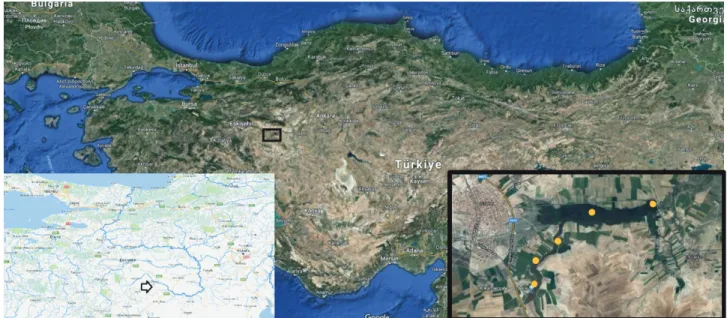
Specimens of C. gariepinus and O. niloticus were collected by means of electrofishing (with a backpack - SAMUS 725G, from a boat - LANJING LJ-4085NP-24V IGBT NC Fish Shocker) across the Sakarya River Basin during different monitoring studies carried out to study the fish biodiversity of the basin (Figure 1). After capture, each fish was measured for lengths (total (TL) and standard (SL)) to the nearest mm and wet weight (W) to the nearest 0.1 g. Specific linear conversion models to convert SL to TL and a log-transformed TL-W regression for the two species were computed by means of the following equations:
Figure 1. Area of collection of the data (black rectangle = Sakarya River Basin; yellow dots = locations of the field stations within the
TL (mm) = a + b SL (mm) and
log10W = log10 a + b log10 TL (mm),
where a is the intercept on the Y-axis of the regression curve and b is the regression coefficient (Ricker, 1975; Froese, 2006).
Then the total dataset was validated and screened according to the procedure recommended by Giannetto et al. (2012b). All the anomalous values (outliers) were removed from the regressions because they were almost certainly the consequence of incorrect measurements in the field (Bister et al., 2000). For each species, the total dataset was divided into “statistical populations” with every population consisting of data collected at the same sampling location (Sülün et al., 2014). The estimation of a Ws equation includes the preliminary determination of a proper range-length: a minimum and a maximum length of applicability. The minimum TL was estimated according to Willis et al. (1991) as the length at which the ratio variance/log10W mean was less than 0.01 (Murphy et al., 1991). The maximum TL was identified as the TL class in the dataset that was present in at least three different statistical populations (Gerow et al., 2005). All the specimens smaller or bigger than this proper length range were excluded from the dataset and not used in the subsequent analyses. For each statistical population of the two species a log-transformed TL-W regression was estimated separately to identify and remove the potential outliers (Bister et al., 2000). The resulting equations for all the populations were then screened to remove all the samples showing R2 values less than 90% or a value of b
outside the 2.5–3.5 range because, according to Carlander (1977), these anomalous values of b or R2 could derive
from statistical populations with narrow length range. The empirical percentile (EmP) method proposed by Gerow et al. (2005) was used to estimate the Ws equation for the two species. According to the EmP method, for every 1-cm length class the mean empirical W was estimated by the logarithmicTL-W equation of the single statistical populations; after the 75th percentile of the estimated mean empirical W values were plotted against TL to estimate the EmP Ws equation by using a weighted quadratic model (Gerow et al., 2005).
The developed EmP Ws equations were then validated to investigate the potential influence of length-related bias (Gerow et al., 2004), applying two different methods: analysis of residuals’ distribution versus fitted values of the Ws equation (Lorenzoni et al., 2012) and the empirical quartiles (EmpQ) method proposed by Gerow et al. (2004). Both methods were assessed by the Fisheries Stock Assessment package (FSA) (v 0.8.17) (https:// cran.r-project.org/web/packages/FSA/index.html) with R software (R Development Core Team, 2016) to verify whether the slope of the plot between the 3rd quartile of
mean W (standardized by Ws) and the 1-cm TL class was zero (Giannetto et al., 2016).
3. Results
During the study, a total of 521 specimens (261 C.
gariepinus and 260 O. niloticus) were analyzed (Table).
The estimated SL-TL equations were:
TL = 6.7518 + 1.1301 SL (R2 = 0.995; n = 261; TL range:
15–71.7 cm) for C. gariepinus and
TL = 2.2918 + 1.2336 SL (R2 = 0.994; n = 260, TL range:
8–28.9 cm) for O. niloticus.
The log-transformed TL-W equations were:
log10W = –4.9634+ 2.923 log10TL (mm) (R2 = 0.973, n
= 261) for C. gariepinus and
log10W = –5.0447+ 3.159 log10TL (mm) (R2 = 0.991, n
= 260) for O. niloticus.
For both species, the total datasets were divided into statistical populations, and for all of them the value of R2
was >0.95 and the b value resulted in the range of 2.5–3.5. Thus, no populations were removed.
For C. gariepinus the minimum TL was identified to be 18 cm and the maximum TL was 45 cm. For O. niloticus the applicable range was 8–28 cm.
The resulting Ws equations were:
log10Ws = –3.668 + 1.885 log10TL + 0.2087 (log10 TL)2
for C. gariepinus and
log10Ws = –8.7961 + 6.751 log10TL – 0.8479 (log10 TL)2
for O. niloticus.
For both species, the residuals distribution of the EmP
Ws equations displayed a random distribution and did not exhibit evident patterns (Figure 2). From the EmpQ method no length-related bias emerged for either species (for C. gariepinus pquadratic = 0.325, plinear = 0.537; for O.
niloticus pquadratic = 0.147, plinear = 0.394).
4. Discussion
The EmP Ws equations developed in this study were not affected by length bias and their use to estimate Wr for Table. Descriptive statistics for the samples of C. gariepinus and O. niloticus collected from the Sakarya River Basin.
N Mean Min Max SD
C. gariepinus TL (mm) 261 320 150 717 76.17 SL (mm) 277 130 645 67.03 W (g) 276 24 3816 309.71 O. niloticus TL (mm) 260 198 30 289 53.92 SL (mm) 158 25 234 43.50 W (g) 198 0.5 543 127.51
C. gariepinus and O. niloticus across the Sakarya Basin is
suggested. A further result of the study was the estimation of length-length and total length-weight equations for C.
gariepinus and O. niloticus from the Sakarya River Basin.
Previous studies on length-weight for C. gariepinus from its native Turkish range are available in the literature: Yalçın et al. (2002) reported a value of b of 2.82 (length range: 12.0–82.6 cm) from the Orontes River, whereas Özcan (2008), examining samples collected from the Hatay commercial fish market, reported a b value of 2.967 (length range: 18.2–47.0 cm). In this study, the value of
b for the length-weight relationship was estimated as
2.923 (length range: 15–71.7 cm) for the sample from the Sakarya River Basin. The differences may be due to the dissimilar length ranges and sample sizes, but it cannot be ruled out that differences in b values could illustrate different growth rates between native and translocated populations. In this regard, Turan et al. (2005) reported high morphologic differentiations among six populations of C. gariepinus from Turkey with the sample from Sakarya highly diverging from the other populations and they suggested that those differentiations may be related to different environmental conditions of the Sakarya River, though the species is widely tolerant to extreme environmental conditions.
For O. niloticus the b value of the TL-W in the Sakarya River Basin was 3.16 (length range: 8.0–28.9 cm). To the authors’ knowledge, no previous data on O. niloticus from Turkey have been available in the literature. Comparing the value of b with the data reported on FishBase (www. fishbase.org) for populations of O. niloticus from other countries, it is possible to underline that all the samples with similar b values (and similar length ranges) refer to nonnative populations.
Due to the risks of new introduction, acclimation, and competition with native/endemic species, especially under the condition of climate change predicted for Turkey (Tarkan et al., 2017), the potential impacts of these two species are expected to be exacerbated. Therefore, it is essential to monitor and manage their spread throughout Turkey and investigate their impact on native fish communities. To this end, assessment of well-being could be a useful tool to investigate the general status of nonnative populations and the degree of adaptation to new environments. Indeed, body condition indices have already been successfully used to assess the impact of nonnative species on natural and endemic species (Giannetto et al., 2012a; Gaygusuz et al., 2013). The current findings might also be particularly important for future eradication practices by giving priority to the populations in relatively higher conditions.
Overall, further specific studies are encouraged to better investigate the characteristics of these species in the Sakarya River Basin and to collect data on other populations of the species from Turkey. Such information can contribute to the development of specific management plans aiming to minimize the impacts of these species on native fish communities and environments.
Acknowledgment
This study was produced through the support by the Çifteler Municipality and the Research Fund of Eskişehir Osmangazi University with the project entitled “Support the native fish populations through the suppression of invasive freshwater fish species, in the Sakarbaşı in Çifteler” and coded 2016-1099.
Figure 2. Distribution of the residuals used to investigate potential length-bias in
the standard weight (Ws) equation for C. gariepinus (a) and O. niloticus (b) from the Sakarya River Basin (residuals = standardized residuals of the regression; fitted values = values obtained by the model fit).
References
Akın S, Buhan E, Winemiller KO, Yilmaz H (2005). Fish assemblage structure of Koycegiz Lagoon–Estuary, Turkey: Spatial and temporal distribution patterns in relation to environmental variation. Estuar Coast Shelf S 64: 671-684.
Amin MN, Ali MY, Salequzzaman M (2009). Identification and impact analysis of invasive species: a case study in the Mongla sea port area of Bagerhat district of Bangladesh. Daffodil International University Journal of Science and Technology 4: 35-41.
Başusta N, Yanar M, Cengizler İ, Göksu MZL (1996). Freshwater seabream (Oreochromis niloticus) adaptation trial in Hırla Lake (Kırşehir) with the characteristics of semi-thermal water resource. In: Proceedings of the National Biology Congress XIII, İstanbul, Turkey (in Turkish).
Bister TJ, Willis DW, Brown ML, Jordan SM, Neumann RM, Quist
MC, Guy CS (2000). Proposed standard weight (Ws) equations
and standard length categories for 18 warmwater nongame and riverine fish species. N Am J Fish Manage 20: 570-574.
Blackwell BG, Brown ML, Willis DW (2000). Relative weight (Wr)
status and current use in fisheries assessment and management. Rev Fish Sci Aquae 8: 1-44.
Booth AJ, Traas GRL, Weyl OLF (2010). Adult African sharptooth catfish, Clarias gariepinus, population dynamics in a small invaded warm-temperate impoundment. Afr Zool 45: 299-308. Carlander KD 1977. Handbook of Freshwater Fishery Biology. Ames,
IA, USA: Iowa State University Press.
Çelik M, Gökçe MA (2003). Determination of fatty acid compositions of five different tilapia species from the Çukurova (Adana/ Turkey) region. Turk J Vet Anim Sci 27: 75-79.
Clavero M, García-Berthou E (2005). Invasive species are a leading cause of animal extinctions. Trends Ecol Evol 20: 110. Cox IG (1998). Stocking and Introduction of Fish. Oxford, UK:
Fishing News Books, Blackwell Science.
Emiroğlu Ö (2011). Alien fish species in upper Sakarya River and their distribution. Afr J Biotechnol 10: 16674-16681.
Erençin Z (1978). Ankara Üniversitesi Veteriner Fakültesinin Çifteler Sakaryabaşı’ndaki yeni uygulama istasyonunda kültür balıkçılığı yönünden önemli ılımlı balıklarının yetiştirilmesi olanakları üzerinde görüşler. Ankara Univ Vet 2: 307-314 (in Turkish).
Ergüven H (1978). Production of Clarias orontis Günther 1856 in A.U. Veterinary Faculty Çifteler Sakaryabaşi Station. İstanbul, Turkey: İstanbul University Aquaculture and Fisheries Unit. Froese R (2006). Cube law, condition factor and weight-length
relationships: history, meta-analysis and recommendations. J Appl Ichthyol 22: 241-253.
Gaygusuz Ö, Emiroğlu Ö, Tarkan AS, Aydın H, Top N, Dorak Z, Karakuş U, Başkurt S (2013). Assessing the potential impact of non-native on native fish by relative condition. Turk J Zool 37: 84-91.
Geldiay R, Balık S (2007). Freshwater Fishes of Turkey. 5th ed. İzmir, Turkey: Ege University Publications (in Turkish).
Gerow KG, Anderson-Sprecher R, Hubert WA (2005). A new method to compute standard-weight equations that reduce length-related bias. N Am J Fish Manage 25: 1288-1300. Gerow KG, Hubert WA, Anderson-Sprecher R (2004). An alternative
approach to detection of length-related biases in standard-weight equations. N Am J Fish Manage 24: 903-910.
Giannetto D, Carosi A, Franchi E, Pedicillo G, Pompei L, Lorenzoni M (2012a). Assessing the impact of non-native freshwater fishes on native species using relative weight. Knowl Manag Aquat Ec 404: 1-12.
Giannetto D, Franchi E, Pompei L, Porcellotti S, Tancioni L, Lorenzoni M (2012b). Proposed empirical standard weight equation for brook chub Squalius lucumonis. N Am J Fish Manage 32: 428-435.
Giannetto D, Maio G, Pompei L, Porcellotti S, Lorenzoni M (2015a). Length-length, length-weight and a proposed standard weight equation for the Italian endemic species Barbus tyberinus Bonaparte, 1839. Turk J Fish Aquat Sc 15: 191-196.
Giannetto D, Maio G, Pompei L, Porcellotti S, Lorenzoni M (2016). Length-weight, length-length and a proposed empirical standard weight equation for the Italian endemic cyprinid species Sarmarutilus rubilio. Cybium 40: 115-119.
Giannetto D, Pompei L, Lorenzoni M, Tarkan AS (2012c). Empirical standard weight equation for Aegean Chub Squalius fellowesii, an endemic freshwater fish species of Western Anatolia. N Am J Fish Manage 32: 1102-1107.
Giannetto D, Tarkan AS, Akbaş F, Top N, Ağdamar S, Karakuş U, Pompei L, Lorenzoni M (2015b). Length-weight and length-length relationships for three endemic cyprinid species of the Aegean region (Turkey) with proposed standard weight equations. Turk J Zool 39: 925-932.
Khan MF, Panikkar P (2009). Assessment of impacts of invasive fishes on the food web structure and ecosystem properties of a tropical reservoir in India. Ecol Model 220: 2281-2290. Lal KK., Singh RK, Mohindra V, Singh B, Ponniah AG (2003).
Genetic makeup of exotic catfish Clarias gariepinus in India. Asian Fisheries Science 16: 229-234.
Lorenzoni M, Giannetto D, Maio G, Pizzul E, Pompei L, Turin P, Vincenzi S, Crivelli A (2012). Empirical standard mass equation for Salmo marmoratus. J Fish Biol 81: 2086-2091. Murphy BR, Willis DW, Springer TA (1991). The relative weight
index in fisheries management: status and needs. Fisheries 16: 30-38.
Özcan G (2008). Length-weight relationships of five freshwater fish species from the Hatay Province, Turkey. Journal of FisheriesSciences.com 2: 51-53.
Perdikaris C, Gouva E, Paschos I (2010). Alien fish and crayfish species in Hellenic freshwaters and aquaculture. Rev Aquacult 2: 111-120.
Piria M, Simonović P, Kalogianni E, Vardakas L, Koutsikos N, Zanella D, Ristovska M, Apostolou A, Adrović A, Mrdak D et al. (2018). Alien freshwater fish species in the Balkan-Vectors and pathways of introduction. Fish Fish 19: 138-169.
R Development Core Team (2017). R: A Language and Environment for Statistical Computing. Vienna, Austria: R Foundation for Statistical Computing.
Rahel FJ (2007). Biogeographic barriers, connectivity and homogenization of freshwater faunas: it’s a small world after all. Freshwater Biol 52: 696-710.
Ricker WE (1975). Computation and interpretation of biological statistics of fish population. B Fish Res Board Can 191: 382-393.
Sülün Ş, Başkurt S, Emiroğlu Ö, Giannetto D, Tarkan AS, Ağdamar S, Gaygusuz O, Dorak Z, Aydın H, Çiçek A (2014). Development of empirical standard weight equation for Pursak chub Squalius
pursakensis, an endemic cyprinid species of Northwest
Anatolia. Turk J Zool 38: 582-589.
Tarkan AS, Marr SM, Ekmekçi FG (2015). Non-native and translocated freshwater fish species in Turkey. FISHMED 1-28. Tarkan AS, Vilizzi L, Top N, Ekmekçi FG, Stebbing PD, Copp
GH (2017). Identification of potentially invasive freshwater fishes, including translocated species, in Turkey using the Aquatic Species Invasiveness Screening Kit (AS-ISK). Int Rev Hydrobiol 102: 47-56
Tekelioğlu N (1991). Course notes for local water fish breeding. Ç.Ü. Water Products Academy Publications 2: 243.
Tepe Y, Oğuz MC, Belk M, Özgen R (2013). Orientocreadium
batrachoides Tubangui, 1931 (Orientocreadiidae): the
only trematode parasite of Clarias gariepinus (Burchell, 1822) (Clariidae) from the Asi River (Southern Turkey). Turkiye Parazitol Derg 37: 203-207.
Toussaint A, Beauchard O, Oberdorff T, Brosse S, Villéger S (2016). Worldwide freshwater fish homogenization is driven by a few widespread non-native species. Biol Invasions 18: 1295-1304. Turan C, Yalçin Ş, Turan F, Okur E, Akyurt I (2005). Morphometric
comparisons of African catfish, Clarias gariepinus populations in Turkey. Folia Zool 54: 165-172.
Verreth J, Eding EH, Rao GRM, Huskens F, Segner H (1993). A review of feeding practices, growth and nutritional physiology in larvae of the catfishes Clarias gariepinus and Clarias
batrachus. Journal of World Aquaculture Society 24: 135-144.
Vitule JR, Umbri SC, Aranha JMR (2006). Introduction of the African catfish Clarias gariepinus (Burchell, 1822) into Southern Brazil. Biol Invasions 8: 677-681.
Wege GJ, Anderson RO (1978). Relative weight (Wr): a new index
of condition for largemouth bass. In: Novinger GD, Dillard JG editors. New Approaches to the Management of Small Impoundments. Bethesda, MD, USA: American Fisheries Society, pp. 79-91.
Willis DW, Guy CS, Murphy BR (1991). Development and evaluation of a standard weight (Ws) equation for yellow perch. N Am J Fish Manage 11: 374-380.
Yalçın Ş, Solak K, Akyurt İ (2002). Growth of the catfish Clarias
gariepinus (Clariidae) in the river Asi (Orontes), Turkey.