21
ORIGINAL RESEARCH
©Copyright 2018 by the Association of Urological Surgery / Journal of Urological Surgery published by Galenos Publishing House.
Objective: To investigate the prevalence of anal incontinence and constipation in patients with urinary incontinence.
Materials and Methods: Adult female patients who presented with the complaint of urinary incontinence were evaluated with anal incontinence and constipation assessment survey prepared on the basis of “the International Consultation on Incontinence Questionnaire-Short Form”, “the Overactive Bladder 8-Question Awareness Tool” and “the Rome 3” criteria.
Results: Two hundred female patients with urinary incontinence were evaluated. The patients were in the age group of 18-88 with the average age of 55.24±16.86 standard deviation. Stress incontinence was present in 19.5%, urge incontinence in 36% and mixed incontinence in 44.5% of the subjects. Seventy-seven percent of patients presented with flatal incontinence, 7.5% with fecal incontinence and 52.5% presented with constipation. There was no difference between sub-groups created according to age groups and types of urinary incontinence in terms of frequency of gastrointestinal symptoms. The incidence of constipation was statistically significantly higher in patients presenting with findings of urinary incontinence for more than 1 year and in those with overactive bladder (p<0.01 and p<0.001, respectively).
Conclusion: Flatal incontinence was found in 77%, fecal incontinence in 7.5% and constipation in 52.2% of female adult patients with urinary incontinence. The incidence of constipation was higher at the level of statistical significance in patients presenting with findings of urinary incontinence for more than 1 year and in those with overactive bladder.
Keywords: Urinary incontinence, Overactive bladder, Anal incontinence, Fecal incontinence, Constipation
Amaç: Bu çalışmanın amacı üriner inkontinanslı hastalarda anal inkontinans ve konstipasyon görülme sıklığının araştırılmasıdır.
Gereç ve Yöntem: Üriner inkontinans yakınması ile başvuran erişkin kadın hastalar; “International Consultation on Incontinence Short Form”, “Overactive Bladder 8-Question Awareness Tool” ve “Roma 3” kriterlerine göre hazırlanan anal inkontinans ve konstipasyon değerlendirme anket formları ile değerlendirildiler.
Bulgular: Üriner inkontinansı bulunan 200 kadın hasta değerlendirilmiştir. Hastaların yaşları 18-88 arasında olup ortalama 55,24±16,86 standart sapma olarak bulunmuştur. Stres tipi idrar kaçırma %19,5, sıkışma tipi idrar kaçırma %36 ve karışık tipte idrar kaçırma %44,5 oranlarında bulunmuştur. Gaz inkontinansı %77, fekal inkontinans %7,5 ve konstipasyon %52,5 oranlarında saptanmıştır. Yaş gruplarına göre ve üriner inkontinansın tiplerine göre oluşturulan alt gruplar arasında gastrointestinal semptomların görülme sıklığı açısından fark saptanmamıştır. Üriner inkontinansı bir yıldan daha uzun süreli olan hastalarda ve aşırı aktif mesanesi bulunan hastalarda konstipasyon görülme oranı istatistiksel olarak anlamlı bir şekilde daha yüksek bulunmuştur (sırasıyla; p<0,01 ve p<0,001).
Abstract
Öz
What’s known on the subject? and What does the study add?
Urinary incontinence and anal incontinence are quite prevalent conditions. On the other hand, some studies have been performed to investigate both of these entities with the hypothesis that they could co-exist due to common risk factors playing a role in the etiopathogenesis. Nevertheless, most of these studies involved elderly and home-care patients. This study aims at investigating the incidence of anal incontinence and constipation in patients with urinary incontinence in all adult age groups.
1Deniz Hospital, Clinic of Urology, İzmir, Turkiye
2Başkent University Faculty of Medicine, Department of Urology, İzmir, Turkiye 3Ege City Hospital, Clinic of Urology, İzmir, Turkiye
Musa Saraçoğlu1, Aşkın Eroğlu2, Rauf Taner Divrik3
Üriner İnkontinanslı Kadın Hastalarda Anal İnkontinans ve Konstipasyon Görülme Sıklığı
Prevalence of Anal Incontinence and Constipation in Female
Patients with Urinary Incontinence
Functional Urology
Correspondence: Aşkın Eroğlu MD, Başkent University Faculty of Medicine, Department of Urology, İzmir, Turkiye Phone: +90 232 241 10 32 E-mail: [email protected] ORCID-ID: orcid.org//0000-0003-2404-6209 Received: 22.10.2017 Accepted: 28.11.2017
Cite this article as: Saraçoğlu M, Eroğlu A, Divrik RT. Prevalence of Anal Incontinence and Constipation in Female Patients with Urinary Incontinence. J Urol
Surg 2018;5(1):21-24.
Doi: 10.4274/jus.1732 Journal of Urological Surgery, 2018;5(1):21-24
22
Journal of Urological Surgery, 2018;5(1):21-24
Introduction
Urinary incontinence and anal incontinence are quite prevalent conditions. Many community-based studies have been performed to investigate the prevalence of these two conditions. Majority of studies have focused on urinary and anal incontinence as two distinct entities. On the other hand, some other studies have been performed to investigate both of these entities with the hypothesis that they could co-exist due to common risk factors playing a role in the etiopathogenesis (1,2,3). Nevertheless, most of these studies involved elderly and home-care patients. The later studies concentrated on the prevalence of urinary incontinence in patients with anal incontinence and vice versa. There are only a few studies on this topic and more studies are needed with a larger age span.
This study aims at investigating the prevalence of anal incontinence and constipation in patients with urinary incontinence in all adult age groups.
Materials and Methods
Female patients aged 18 years and over presenting with urinary incontinence and agreeing to fill in the questionnaires on anal incontinence and constipation at the time of routine work-up were included in the study. Those who provided written informed consent were included in the study.
Patients with a history of lower urinary tract or anorectal surgery, pregnant women and those less than 6 months postpartum less than six months after labor and/or presenting with acute lower urinary tract infections were excluded.
The validated Turkish version of the International Consultation on Incontinence Questionnaire-Short Form (ICIQ-SF) and the Overactive Bladder 8-Question Awareness Tool (OAB-V8) were used to assess the lower urinary system complaints of the patients (4,5). The first two forms questioning gastrointestinal system functions are the forms prepared according to the Rome 3
diagnostic criteria. The first form questions anal incontinence. Anal incontinence was considered in two sub-types as flatal incontinence and fecal incontinence. The second form, on the other hand, questions constipation. Comorbidities were also questioned and registered. The comorbidity status was assessed according to the Charlson comorbidity index (6). The patients filled the questionnaires were filled with the supervision of a trained nurse during face-to-face interviews. The study was limited with 200 patients. The study was conducted after approval of the Ethics Board of Şifa University dated 30.01.2014 and numbered B.30.2.ŞFÜ.00.50.500/06.
Statistical Analysis
Chi-square and Fisher’s exact tests were used as statistical methods to evaluate the significance of differences between two groups.
Correlation analysis was performed to evaluate the relationship between urinary incontinence and OAB in comorbid cases.
Results
The study was performed between February 2014 and May 2015, and was terminated as soon as the number of patients reached 200.
Of the 200 patients presented with the complaint of urinary incontinence, 39 (19.5%) had findings of stress incontinence, 72 (36%) had urge incontinence and 89 (44.5%) had mixed incontinence. The mean age of the patients was 55.24±16.86 years ranging from 18 to 88 years. As for the age distribution according to type of urinary incontinence, stress incontinence was present in the mean age group of 50.26±14.89, urge incontinence in 54.0±18.06 and mixed incontinence in 58.44±16.27.
One hundred fifty-four (77%) patients presented with flatal incontinence, 15 (7.5%) with fecal incontinence and 105 (52.5%) with constipation. Table 1 shows the rates of flatal incontinence, fecal incontinence and constipation according to
Saraçoğlu et al. Female Patient with Urinary Incontinence
Sonuç: Üriner inkontinansı bulunan erişkin kadınlarda gaz inkontinansı %77, fekal inkontinans %7,5 ve konstipasyon %52,2 oranında görülmektedir. Konstipasyon; üriner inkontinansı bir yıldan daha uzun süreden beri bulunan hastalarda ve aşırı aktif mesanesi bulunan hastalarda istatistiksel olarak anlamlı bir şekilde daha yüksek oranlarda görülmektedir.
Anahtar Kelimeler: Üriner inkontinans, Aşırı aktif mesane, Anal inkontinans, Fekal inkontinans, Konstipasyon
Table 1. Incidence of gastrointestinal symptoms according to types of incontinence
n (%) Flatal incontinence n (%) Fecal incontinence n (%) Constipation n (%)
Stress incontinence 39 (19.5%) 31 (15.5%) 3 (1.5%) 17 (8.5%)
Urge incontinence 72 (36%) 51 (25.5%) 8 (4%) 35 (17.5%)
Mixed incontinence 89 (44.5%) 72 (36%) 4 (2%) 53 (26.5%)
23
Saraçoğlu et al. Female Patient with Urinary Incontinence Journal of Urological Surgery,
2018;5(1):21-24
types of urinary incontinence. There was no difference in the incidence of constipation between urinary incontinence and anal incontinence. P value was 0.29 for flatal incontinence, 0.28 for fecal incontinence and 0.18 for constipation.
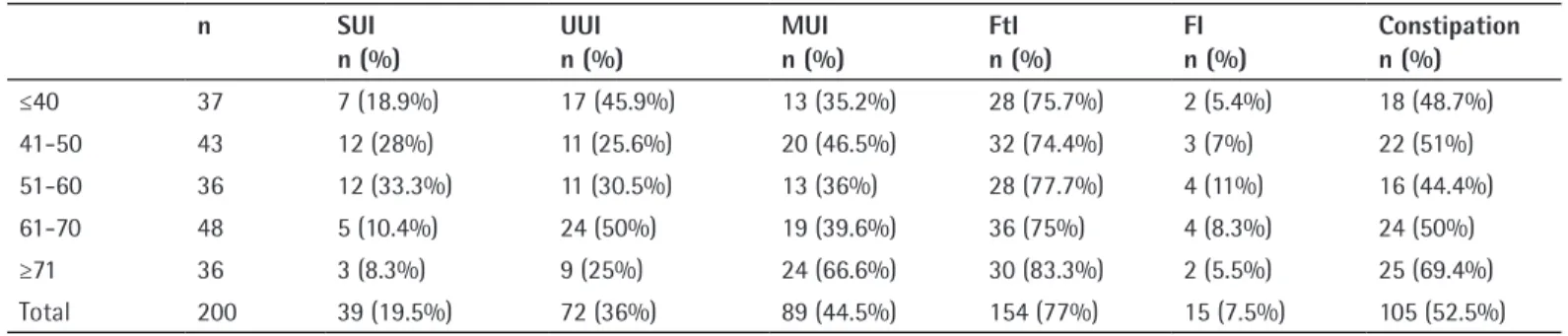
Table 2 shows the number of patients with urinary incontinence and lower gastrointestinal tract dysfunction according to the age groups. There was no statistically significant difference between age groups in terms of the prevalence of flatal incontinence, fecal incontinence and constipation (p=0.81, p=0.88 and p=0.24, respectively).
Table 3 presents an association between the duration of urinary incontinence complaints and lower gastrointestinal dysfunction. Patients having incontinence complaints for more than one year were found to have higher rates of constipation at the level of statistical significance.
One of the most prevalent diseases of the lower urinary system is OAB, which may be quite common in patients with urinary incontinence. OAB is diagnosed with thorough evaluation of patient complaints using OAB-V8. The treshold value was found to be 11 during the validation study of the Turkish version of OAB-V8. Accordingly, 174 patients were found to have OAB (Table 4). There was no difference in anal and fecal incontinence between patients with and without OAB (p=0.99 and p=0.42, respectively), whereas the incidence of constipation was statistically significantly higher in OAB patients (p=0.001). As for grouping of incontinent patients according to parity, there was no statistically significant difference among nulliparous, uniparous, secundiparous, triparous or other multiparous women in terms of flatal incontinence, fecal incontinence and constipation.
The patients were assessed for comorbidities using Charlson comorbidity index. The age of the patients was also considered in calculation. Nighty-three patients with a comorbidity score of 0 had no comorbidity. Fourty-seven patients with a comorbidity score of 1-3 had mild comorbidities. Sixty with a comorbidity score of 4 or higher had a moderate level of comorbidities. It was observed that Charlson comorbidity scores were weakly but
positively correlated with ICIQ-SF and OAB-V8 scores (r=0.0285 and r=0.0147, respectively).
Patients without comorbidities, low-risk patients and moderate-risk patients were compared in terms of anal incontinence and constipation but there was no statistically significant difference between the groups.
Discussion
Studies investigating the prevalence of urinary incontinence in women have reported a broad range of variation, from 5% to 69%. Nevertheless, most of the studies have reported a prevalence of 25-45% (7). Studies on anal incontinence have reported a prevalence of 11-15% in adults (7). Prevalence studies on anal incontinence, though, report results of 11-15% in adults (7).
The broad range of prevalence for urinary incontinence is due to lack of homogeneity in the patient population of studies and the difference in definition criteria used for incontinence. Whether or not flatal incontinence is included in anal incontinence inquiry also significantly affects the study results.
Table 2. Number of patients with urinary and gastrointestinal symptoms according to age groups
n SUI
n (%) UUIn (%) MUIn (%) FtIn (%) FIn (%) Constipationn (%)
≤40 37 7 (18.9%) 17 (45.9%) 13 (35.2%) 28 (75.7%) 2 (5.4%) 18 (48.7%) 41-50 43 12 (28%) 11 (25.6%) 20 (46.5%) 32 (74.4%) 3 (7%) 22 (51%) 51-60 36 12 (33.3%) 11 (30.5%) 13 (36%) 28 (77.7%) 4 (11%) 16 (44.4%) 61-70 48 5 (10.4%) 24 (50%) 19 (39.6%) 36 (75%) 4 (8.3%) 24 (50%) ≥71 36 3 (8.3%) 9 (25%) 24 (66.6%) 30 (83.3%) 2 (5.5%) 25 (69.4%) Total 200 39 (19.5%) 72 (36%) 89 (44.5%) 154 (77%) 15 (7.5%) 105 (52.5%)
SUI: Stress urinary incontinence, UUI: Urge urinary incontinence, MUI: Mixed urinary incontinence, FtI: Flatal incontinence, FI: Fecal incontinence
Table 3. Incidence of gastrointestinal symptoms according to duration of urinary incontinence
N Flatal
incontinence Fecal incontinence Constipation
<1 year 57 46 4 22
>1 year 143 108 11 83
p 0.43 0.87 0.01
Table 4. Gastrointestinal symptoms in individuals with and without overactive bladder
n Flatal
incontinence Fecal incontinence Constipation
OAB+ 174 134 12 99
OAB- 26 20 3 6
p 0.99 0.42 0.001
24
Saraçoğlu et al. Female Patient with Urinary Incontinence Journal of Urological Surgery,
2018;5(1):21-24
There are some common risk factors in the etiopathogenesis of both urinary and anal incontinence including age, gender, obesity, diabetes mellitus, pelvic organ prolapse, constipation, pregnancy, parity, pelvic surgery and gynecologic surgery. Therefore, several studies have been performed to investigate the prevalence of coexistence of both conditions.
In a study done with 778 male and 762 female subjects aged 50 and older, Roberts et al. (2) reported a female urinary incontinence rate of 48.4%, fecal incontinence rate of 15.2% and combined incontinence of 9.4%. In their study including 864 elderly women, Yuaso et al. (8) reported that the incidence of combined incontinence was 4.9%. In a study by Biswas et al. (9) including 177 women, it was found that 27.7% of women had urinary incontinence 28.8% had constipation and 17.5% had fecal incontinence.
Of those presenting with urinary incontinence, 41.2% also had constipation and 35.5% had fecal incontinence (9).
This study evaluated 200 women with urinary incontinence. 19.5% of patients were found to have stress incontinence, 36%- urge incontinence and 44.5%- mixed incontinence. This distribution corroborates with the literature. In our study, the incidence of flatal incontinence was 77%, fecal incontinence was 7.5% and the incidence of constipation was 52.5%. The rate of fecal incontinence was slightly lower than in the literature and slightly higher than the constipation rate, which may be due to differences in the patient population.
There was no difference between sub-groups based on age or types of urinary incontinence in terms of prevalence of gastrointestinal symptoms. Patients with urinary incontinence for one year and longer and those with OAB had a statistically significantly higher prevalence of constipation (p<0.01 and p<0.001, respectively).
High rates of constipation in patients with urinary incontinence lasting more than a year could be associated with the side effects of medicines used for the treatment of incontinence and it could be associated with the impacts of pathology that led to incontinence on the gastrointestinal tract in the course of time. There is a need for further studies on this subject.
High rates of constipation in OAB patients could also be related with the side effects of medicines used in the treatment. At this point, there may be a common etiopathogenesis. In addition, constipation may trigger OAB. Further studies are needed.
Study Limitations
The study included women aged 18 years and over, only using questionnaire forms, lack of pediatric patient group and male patient group, lack of functional evaluation studies for urinary system and gastrointestinal system is the missing side of the study.
Conclusion
Anal incontinence and constipation rates are critical in patients with urinary incontinence. Therefore, to question patients with urinary incontinence for other gastrointestinal symptoms, including anal incontinence and constipation, may be of key importance.
Ethics
Ethics Committee Approval: The study was conducted after
approval of the Ethics Board of Şifa University dated 30.01.2014 and numbered B.30.2.ŞFÜ.00.50.500/06.
Informed Consent: It was taken. Peer-review: Externally peer-reviewed. Authorship Contributions
Concept: M.S., R.T.D., Design: R.T.D., A.E., Data Collection or Processing: M.S., Analysis or Interpretation: R.T.D., A.E., Literature Search: M.S., A.E., Writing: R.T.D., A.E.
Conflict of Interest: No conflict of interest was declared by the
authors.
Financial Disclosure: The authors declared that this study
received no financial support.
References
1. Nakanishi N, Tatara K, Nakajima K, Takabayashi H, Takahashi S, Naramura H, Ikeda K. Urinary and fecal incontinence in a community-residing elderly population: prevalence, correlates and prognosis. Nihon Koshu Eisei Zasshi 1997;44:192-200.
2. Roberts RO, Jacobsen SJ, Reilly WT, Pemberton JH, Lieber MM, Talley NJ. Prevalence of combined fecal and urinary incontinence: a community-based study. J Am Geriatr Soc 1999;47:837-841.
3. Tpokinova E, Neuwirth J, Stankova M, Mellanova A, Haas T. Urinary and fecal incontinencein geriatric facilities in the Czech Republic. Cas Lek Cesk 1997;136:573-577.
4. 4.Çetinel B, Özkan B, Can G. ICIQ-SF Türkçe versiyonu validasyon (geçerlilik) çalışması. Türk Üroloji Dergisi 2004;30:332-338.
5. Tarcan T, Mangır N, Özgür MÖ, Akbal C. OAB-V8 Aşırı Aktif Mesane Sorgulama Formu Validasyon Çalışması. Üroloji Bülteni 21, 2012;113-116 6. Hall WH, Ramachandran R, Narayan S, Jani AB, Vijayakumar S.
Anelectronicapplicationforrapidly calculating Charlson comorbidity score. BMC Cancer 2004;4:94.
7. Milsom I, Altman D, De Cartwright S, Kanai AJ, et al. Epidemiologyof Urinary Incontinence andother Lower Urinary Tract Symtoms, Pelvic Organ Prolapseand Anal Incontinence. Incontinence 5th ed. In: Abrams P, Cardazo L, Khoury S, Wein A. Paris 2013, pp 72-84.
8. Yuaso DR, Santos JLF, Castro RA, Duarte YAO, Girão MJBC, Berghmans B, Tamanini JTN. Female double incontinence: prevalence, incidence, and risk factors from the SABE(Health,Wellbeingand Aging) study. Int Urogynecol J 2018;29:265-272.
9. Biswas B, Bhattacharyya A, Dasgupta A, Karmakar A, Mallick N, Sembiah S. Urinary Incontinence, Its Risk Factors, and Quality of Life: A Study among Women Aged 50 Years and above in a Rural Health Facility of West Bengal. J Midlife Health 2017;8:130-136.