Cent European J Urol. 2016; 69: 78-82 doi: 10.5173/ceju.2016.674 O R I G I N A L P A P E R
Continuous positive airway pressure therapy is associated
with improvement in overactive bladder symptoms
in women with obstructive sleep apnea syndrome
Tumay Ipekci
1, Gulgun Cetintas
2, Orcun Celik
3, Rahmi Gokhan Ekin
3, Sema Sarac
3, Ahmet Tunckiran
1,
Yusuf Ozlem Ilbey
31Baskent University Medical Faculty, Alanya Practise and Research Center, Department of Urology, Antalya, Turkey
2Sureyyapasa Chest Diseases and Chest Surgery Training and Research Hospital, Department of Chest Diseases, Istanbul, Turkey 3Tepecik Teaching and Research Hospital, Department of Urology, Izmir, Turkey
Key Words: obstructive sleep apnea syndrome ‹› overactive bladder ‹› continuous positive airway pressure
INTRODUCTION
Obstructive sleep apnea syndrome (OSAS) is a common disorder, which is characterized by instability of the upper airway during sleep, resulting in reduction or elimination of airflow, oxygen desaturation, and sleep disruption [1]. Approximately 4% of middle aged men and 2% of middle aged females are estimated to be affect-ed [1]. OSAS is associataffect-ed with cardiovascular and
cerebrovascular disorders and metabolic dysfunc-tion [2, 3, 4].
The association between OSAS and urologic symp-toms such as nocturia, erectile dysfunction, and urgency has been described [5–16]. Sleep disorders may present with nocturia [17]. The mechanism of nocturia in patients with OSAS is related to partial or full obstruction of the airway. An occluded airway leads to a rise in the negative intrathoracic pressures and increased venous blood flow to the heart. Atrial Citation: Ipekci T, Cetintas G, Celik O, et al. Continuous positive airway pressure therapy is associated with improvement in overactive bladder symptoms in women with obstructive sleep apnea syndrome. Cent European J Urol. 2016; 69: 78-82.
Article history Submitted: July 21, 2015 Accepted: Nov. 29, 2015 Published online: Jan. 18, 2016
Introduction To evaluate the impact of continuous positive airway pressure (CPAP) therapy on overactive bladder (OAB) symptoms in women with obstructive sleep apnea syndrome (OSAS).
Material and methods One-hundred and fifty women underwent an overnight polysomnography study between May 2014 and September 2014. Their voiding symptoms were evaluated using the OAB symp-tom score (OABSS) and International Consultation on Incontinence Questionnaire Short-Form at OSAS diagnosis and approximately 3-months after CPAP therapy. OSAS severity was assessed according to the apnea-hypopnea-index.
Results We evaluated 140 women and 111 of them (79.3%) reported symptoms consistent with OAB. There were no statistically significant differences between OSAS severity with a prevalence of OAB (p = 0.92). The prevalence of urinary incontinence (UI) was 35.7% (n = 50) and 39.6% (n = 44) in all pa-tients and papa-tients with OAB, respectively. There were no statistically significant differences between UI with OAB (p = 0.58). Baseline OABSS is comparable between OSAS severity (p = 0.143). After 3-months CPAP therapy, OABSS and ICIQ-SF sum scores were significantly decreased in patients with severe and moderate OSAS (p <0.01), however, change of OABSS sum score was insignificant in patients with mild OSAS (p = 0.44).
Conclusions CPAP therapy improves the OAB, OABSS and ICIQ-SF scores in women with severe and mod-erate OSAS. OSAS-induced OAB may be alleviated following CPAP therapy.
Corresponding author Rahmi Gokhan Ekin Tepecik Teaching and Research Hospital Department of Urology Gaziler Caddesi Yenisehir 35000 Izmir, Turkey phone: 505 315 7091 [email protected]
natriuretic peptide (ANP) is secreted by the cardiac ventricles and right atrium in response to volume expansion and an increased pressure load [18]. ANP increases sodium and water excretion, inhibits va-sopressin release and inhibits the renin-angiotensi n-aldosterone complex. Thus, nocturia derives from nocturnal overproduction of urine in patients with OSAS. Treatment of OSAS with continuous positive airway pressure (CPAP) prevents nocturia arising from OSAS [10].
Overactive bladder (OAB) is another syndrome char-acterized by urgency, with or without urgency in-continence, frequency and nocturia in the absence of other pathologic features [19]. In Europe, the prevalence of OAB is 4–15% in men and 14–40% in women [20]. The quality of life of sleep and vital-ity were compromised in 37% of patients with OAB symptoms [21]. There is no previous study, which has investigated the relationship between CPAP therapy and OAB symptoms. In this study, we evaluated the impact of nasal CPAP therapy on OAB symptoms in women with OSAS.
MATERIAL AND METHODS
We prospectively evaluated all female patients with symptoms of OSAS who underwent an overnight polysomnography study between May 2014 and Sep-tember 2014. We excluded women with diabetes mel-litus, neurologic disorders (e.g., diabetes insipidus, multiple sclerosis, disk herniation, stroke, demen-tia), congestive heart failure, chronic renal failure, physical disabilities, urinary retention, and patients who were taking hypnotics, diuretics or anticholin-ergics. The study protocol was approved by the local ethics committee. Informed consent was obtained from all participants.
OSAS was diagnosed with an overnight polysomnog-raphy study. Heart rate, central and occipital elec-troencephalogram, electromyography, blood oxygen saturation, extraocular eye movement, respiratory muscle effort, and nasal airflow by thermistor were recorded. Apnea was defined as a complete cessation of airflow lasting more than 10 seconds. Hypopnea was defined as a flow reduction in combination with an oxygen desaturation of more than 4% or an arous-al in the electroencepharous-alogram. The apnea hypopnea index (AHI) was the sum of the number of apneas and hypopneas per hour of sleep. OSAS was defined as an AHI of 5 events per hour and the presence of clinical symptoms or AHI of 15 events per hour without any OSAS symptoms [22]. The severity of OSAS was defined by the AHI. A frequency of 5 to 15 events per hour, 15 to 30 events per hour and more than 30 events per hour was considered mild,
moderate and severe OSAS, respectively. Minimum oxygen saturation and oxygen desaturation indexes were also determined.
All patients were asked to answer the overactive blad-der symptom score (OABSS) and the International Consultation on Incontinence Questionnaire Short-Form (ICIQ-SF) [23, 24]. Validated Turkish transla-tions of these were used [25, 26]. Patients completed self-report questionnaires at two time points: (1) the baseline assessment, after OSAS diagnosis; (2) ap-proximately 3-months after CPAP therapy, patients were contacted by phone.
The OABSS is an 8-item questionnaire for the as-sessment of OAB including symptoms of daytime fre-quency, nighttime frefre-quency, urgency and urgency incontinence. The possible range of the score sum is between 0-40 points. OAB was defined as ≥4 points on the OABSS.
The ICIQ-SF is a 4-item questionnaire for the as-sessment of urinary continence including the fre-quency of urinary incontinence (UI), perceived amount of urine incontinence and impact on qual-ity of life (QoL). The possible range of the score sum is between 0–21 points. The fourth question asks patients to indicate when urine leaks (never, urge incontinence, stress incontinence, nocturnal incon-tinence, physically active/exercising inconincon-tinence, post-void dribbling, no awareness of urine loss). Statistical analyses were performed with SPSS ver-sion 19.0 for Windows (IBM, NY, USA). Numerical variables were summarized with mean ± standard deviation and categorical variables with frequen-cy and percentage. The significance of differences among groups was assessed by Student’s t test or two-way ANOVA, and analysis of categorical vari-ables was examined by the chi-square test. Correla-tions between independent variables were assessed by Spearman’s correlation test. A p <0.05 was con-sidered statistical significance.
RESULTS
One-hundred and fifty patients were screened; 10 patients were excluded, 6 with diabetes mellitus, 2 taking diuretics, 1 with congestive heart failure and 1 with neurologic disorders. The return rate of questionnaires was 100%. The mean age, body mass index, minimum oxygen saturation, oxygen desaturation index, AHI, OABSS and ICIQ-SF pa-rameters for all patients are shown in Table 1. Se-vere OSAS was determined in 67 of the 140 patients (47.9%), mild and moderate were in 42 (30.0%) and 31 (22.1%) of the 140 patients, respectively. There were no significant differences between OSAS sever-ity with respect to age and BMI.
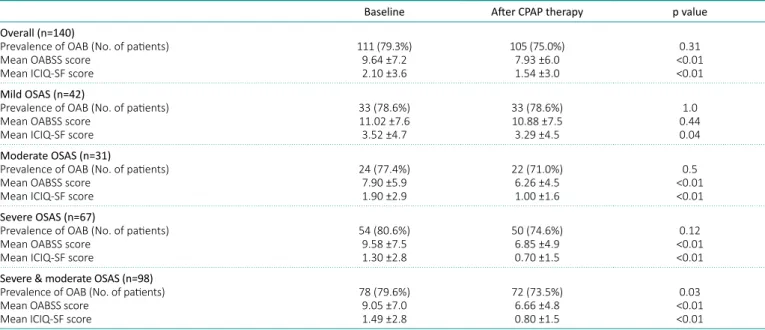
Overall, 111 of the 140 patients (79.3%) reported symptoms consistent with OAB, which was defined as ≥4 points on the OABSS. There were no statisti-cally significant differences between OSAS severity with a prevalence of OAB (p = 0.92). After 3 months of regular CPAP therapy, the overall prevalence of OAB decreased to 105 of the 140 patients (75.0%), which was statistically insignificant; however the prevalence of OAB in severe and moderate OSAS groups decreased from 78 of the 98 patients (79.6%) to 72 (73.5%), which was statistically significant (p = 0.03) (Table 2).
OABSS and ICIQ-SF sum scores at baseline and after CPAP therapy are shown in Table 2. Base-line OABSS is comparable between OSAS severity (p = 0.143). After 3 months CPAP therapy, OABSS and ICIQ-SF sum scores were significantly
de-creased in patients with severe and moderate OSAS (p <0.01), however, change of OABSS sum score was insignificant in patients with mild OSAS (p = 0.44). The AHI did not correlate with OABSS sum score (R =-0.062, p = 0.46). The prevalence of UI was 35.7% (n = 50) and 39.6% (n = 44) in all patients and patients with OAB, respectively. There were no statistically significant differences between UI with OAB (p = 0.58). Subgroup analysis of the ICIQ-SF with type of urine leaks revealed no significant dif-ferences in OSAS severity. There were no signifi-cant differences between UI with CPAP therapy (p = 0.81).
DISCUSSION
In this study, it was demonstrated that CPAP ther-apy improves the OAB, OABSS and ICIQ-SF scores in women with severe and moderate OSAS. How-ever, we could not confirm improvement in OAB and OABSS score in mild OSAS. We found that the prevalence of OAB is high among women with OSAS. Our data demonstrates that OSAS severity and AHI did not associate with OAB and OABSS sum score in women. These findings suggest that CPAP therapy for OSAS can provide alleviation of OAB, frequency of UI, perceived amount of urine incontinence and increment of QoL in women with OSAS.
CPAP therapy improves hypoxia, increases plasma NO concentration, and decreases blood pressure and sympathetic over activation [11]. It has been reported that CPAP therapy significantly improves
Table 1. Patient characteristics
Variables Mean ± SD (range)
Age (years) 49.3 ±9.6 (22-74)
Body mass index (kg/m2) 29.1 ±4.2 (20-44) Minimum oxygen saturation (%) 78.0 ±11.1 (40-95) Oxygen desaturation index 33.0 ±25.0 (116.4-0.9)
AHI 33.5 ±24.7 (5.0-110.3)
OABSS score 9.6 ±7.2 (0-40)
ICIQ-SF score 2.1 ±3.6 (0-14)
Table 2. Comparative data of patients before and after CPAP therapy
Baseline After CPAP therapy p value Overall (n=140)
Prevalence of OAB (No. of patients) Mean OABSS score
Mean ICIQ-SF score
111 (79.3%) 9.64 ±7.2 2.10 ±3.6 105 (75.0%) 7.93 ±6.0 1.54 ±3.0 0.31 <0.01 <0.01 Mild OSAS (n=42)
Prevalence of OAB (No. of patients) Mean OABSS score
Mean ICIQ-SF score
33 (78.6%) 11.02 ±7.6 3.52 ±4.7 33 (78.6%) 10.88 ±7.5 3.29 ±4.5 1.0 0.44 0.04 Moderate OSAS (n=31)
Prevalence of OAB (No. of patients) Mean OABSS score
Mean ICIQ-SF score
24 (77.4%) 7.90 ±5.9 1.90 ±2.9 22 (71.0%) 6.26 ±4.5 1.00 ±1.6 0.5 <0.01 <0.01 Severe OSAS (n=67)
Prevalence of OAB (No. of patients) Mean OABSS score
Mean ICIQ-SF score
54 (80.6%) 9.58 ±7.5 1.30 ±2.8 50 (74.6%) 6.85 ±4.9 0.70 ±1.5 0.12 <0.01 <0.01 Severe & moderate OSAS (n=98)
Prevalence of OAB (No. of patients) Mean OABSS score
Mean ICIQ-SF score
78 (79.6%) 9.05 ±7.0 1.49 ±2.8 72 (73.5%) 6.66 ±4.8 0.80 ±1.5 0.03 <0.01 <0.01
AHI – apnea hypopnea index; OABSS – overactive bladder symptom score; ICIQ-SF – International Consultation on Incontinence Questionnaire Short-Form
in diabetes or stroke has been reported [28]. Thus, the mechanism of OSAS induced OAB may be re-lated to hypoxia as well [16, 28]. Another possible mechanism is that malfunction within the central nervous system leads to dysregulation of sleep and micturition [16]. The hypothalamus regulates sleep, arousal and pontine micturition center. The contin-uous activation of the hypothalamus might induce urgency and might fail in the regulation of sleep and arousal [16].
One of the limitations of this study is that although the analysis was conducted on a sufficient and large population, the study population was not based on a power calculation. Another limitation is that there was no control group or other alternate ther-apy group such as surgery or mandibular advance-ment device. The third limitation is the absence of information about daytime and nighttime fluid intake and urine volumes. Finally, it should be not-ed that further urodynamic studies will be nenot-ednot-ed to underline our results. To our knowledge, this is the first study with the relationship between OAB and CPAP therapy in women with OSAS.
CONCLUSIONS
This study shows that CPAP therapy improves the OAB, OABSS and ICIQ-SF scores in women with severe and moderate OSAS. These findings have clinical implications, as OSAS-induced OAB may be alleviated following CPAP therapy or women with refractory OAB may be diagnosed with untreated OSAS. We should consider referral of women with refractory OAB to a sleep specialist. Future studies about the relationship of OSAS and OAB should fo-cus on the mechanism of OAB in these patients.
CONFLICTS OF INTEREST
The authors declare no conflicts of interest. the problems of OSAS and that patients with
se-vere OSAS may benefit more from therapy [12]. This observation might explain why CPAP therapy improved OAB in women with severe and moderate OSAS. Patients with OSAS show improved erectile function with CPAP therapy [12, 15]. Another study shows that patients with OSAS and nocturia who are treated with CPAP therapy demonstrate a decrease in the frequency of nocturia episodes [16]. There were no published studies with the relationship be-tween OAB and CPAP therapy in women with OSAS. Epidemiologic surveys of OAB and UI have yielded varying prevalence estimates. In Europe, the preva-lence of OAB is 4–15% in men and 14–40% in wom-en [20]. Prevalwom-ence of UI is 1.6–24% in mwom-en and 4.5–53% in women [27]. The overall prevalence of OAB in patients with OSAS is 39% in men and no data has been published for women before this study [28]. Further, it is shown that the OABSS is significantly higher in men with severe and mod-erate OSAS, compared in men with mild OSAS [28]. Our study shows that the OABSS is comparable between OSAS severity in women. Another study shows that OSAS is detected in 13 out of 16 women (81%) with OAB, compared with 4 out of 10 healthy women (40%) [29]. OABSS also comprises queries about nighttime frequency; therefore our findings may not be uniquely related to OAB.
The mechanism between OAB symptoms and OSAS is still unclear and may be different in men and women. OSAS is often seen in obese patients, and the risk of OAB is high in these patients [12, 30]. Obesity leads to OAB by way of nerve dys-function induced by decreased blood flow to the bladder; and OSAS induced hypoxia might increase this mechanism [16, 31]. Another theory based on this phenomenon is that OSAS causes erectile dysfunction by hypoxia-induced occult nerve dys-function [28]. OAB induced by nerve destruction
1. Young T, Palta M, Dempsey J, Skatrud J, Weber S, Badr S. The occurrence of sleep-disordered breathing among middle-aged adults. N Engl J Med. 1993; 328: 1230-1235.
2. Dong J-Y, Zhang Y-H, Qin L-Q. Obstructive sleep apnea and cardiovascular risk: meta-analysis of prospective cohort studies. Atherosclerosis. 2013; 229: 489-495. 3. Bradley TD, Floras JS. Obstructive
sleep apnoea and its cardiovascular consequences. Lancet. 2009; 373: 82-93.
4. Lam DCL, Lui MMS, Lam JCM, Ong LHY, Lam KSL, Ip MSM. Prevalence and recognition of obstructive sleep apnea in Chinese patients with type 2 diabetes mellitus. Chest. 2010; 138: 1101-1107. 5. Moriyama Y, Miwa K, Tanaka H, Fujihiro S,
Nishino Y, Deguchi T. Nocturia in men less than 50 years of age may be associated with obstructive sleep apnea syndrome. Urology. 2008; 71: 1096-1098. 6. Köseoğlu N, Köseoğlu H, Itil O, Oztura I,
Baklan B, Ikiz AO, Esen AA. Sexual function
status in women with obstructive sleep apnea syndrome. J Sex Med. 2007; 4: 1352-1357.
7. Margel D, Cohen M, Livne PM, Pillar G. Severe, but not mild, obstructive sleep apnea syndrome is associated with erectile dysfunction. Urology. 2004; 63: 545-549. 8. Perimenis P, Karkoulias K, Markou S,
et al. Erectile dysfunction in men with obstructive sleep apnea syndrome: a randomized study of the efficacy of sildenafil and continuous positive
airway pressure. Int J Impot Res. 2004; 16: 256-260.
9. Everaert K, Pevernagie D, Oosterlinck W. Nocturnal enuresis provoked
by an obstructive sleep apnea syndrome. J Urol. 1995; 153: 1236. 10. Guilleminault C, Lin CM, Gonçalves MA,
Ramos E. A prospective study of nocturia and the quality of life of elderly patients with obstructive sleep apnea or sleep onset insomnia. J Psychosom Res. 2004; 56: 511-515.
11. Margel D, Tal R, Livne PM, Pillar G. Predictors of erectile function improvement in obstructive sleep apnea patients with long-term CPAP treatment. Int J Impot Res. 2005; 17: 186-190.
12. Taskin U, Yigit O, Acioglu E, Aricigil M, Toktas G, Guzelhan Y. Erectile dysfunction in severe sleep apnea patients and response to CPAP. Int J Impot Res. 2009; 22: 134-139.
13. Stannek T, Hürny C, Schoch OD, Bucher T, Münzer T. Factors affecting self-reported sexuality in men with obstructive sleep apnea syndrome. J Sex Med. 2009; 6: 3415-3424.
14. Stavaras C, Pastaka C, Papala M, et al. Sexual function in pre- and post-menopausal women with obstructive sleep apnea syndrome. Int J Impot Res. 2012; 24: 228-233.
15. Shin H-W, Park J-H, Park J-W, et al. Effects of surgical vs. nonsurgical therapy on erectile dysfunction and quality of life in obstructive sleep apnea syndrome: a pilot study. J Sex Med. 2013; 10: 2053-2059.
16. Tsujimura A, Takao T, Miyagawa Y, et al. Urgency is an independent factor for sleep disturbance in men with obstructive sleep apnea. Urology. 2010; 76: 967-970.
17. van Kerrebroeck P, Abrams P, Chaikin D, et al. The standardisation of terminology in nocturia: Report from the
standardisation sub-committee of the International Continence Society. Neurourol Urodyn. 2002; 21: 179-183. 18. Ljunggren M, Lindahl B, Theorell-Haglöw J,
Lindberg E. Association between obstructive sleep apnea and elevated levels of type B natriuretic peptide in a community-based sample of women. Sleep. 2012; 35: 1521-1527.
19. Abrams P, Cardozo L, Fall M, et al. The standardisation of terminology of lower urinary tract function: report from the Standardisation Sub-committee of the International Continence Society. Neurourol Urodyn. 2002; 21: 167-178. 20. Wein AJ, Rovner ES. Definition and
epidemiology of overactive bladder. Urology. 2002; 5 suppl 1: 7-12.
21. Abrams P, Kelleher CJ, Kerr LA, Rogers RG. Overactive bladder significantly affects quality of life. Am J Manag Care. 2000; 6: S580-590.
22. Sateia MJ. International classification of sleep disorders-third edition: Highlights and modifications. Chest. 2014; 146: 1387-1394.
23. Avery K, Donovan J, Peters TJ, Shaw C, Gotoh M, Abrams P. ICIQ: a brief and robust measure for evaluating the symptoms and impact of urinary
incontinence. Neurourol Urodyn. 2004; 23: 322-330.
24. Acquadro C, Kopp Z, Coyne KS, Corcos J, Tubaro A, Choo MS. Translating overactive bladder questionnaires in 14 languages. Urology. 2006; 67: 536-540.
25. Tarcan T, Mangir N, Özgür MO, Akbal C. OAB-V8 Aşırı Aktif Mesane Sorgulama Formu Validasyon Çalışması. Üroloji Bülteni. 2012; 21: 113-116.
26. Çetinel B, Özkan B, Can G. The validation study of ICIQ-SF Turkish version. Turkish J Urol. 2004; 30: 332-338.
27. Kogan MI, Zachoval R, Ozyurt C, Schäfer T, Christensen N. Epidemiology and impact of urinary incontinence, overactive bladder, and other lower urinary tract symptoms: results of the EPIC survey in Russia, Czech Republic, and Turkey. Curr Med Res Opin. 2014; 30: 1-12. 28. Kemmer H, Mathes AM, Dilk O, Gröschel A,
Grass C, Stöckle M. Obstructive sleep apnea syndrome is associated with overactive bladder and urgency incontinence in men. Sleep. 2009; 32: 271-275.
29. Lowenstein L, Kenton K, Brubaker L, et al. The relationship between obstructive sleep apnea, nocturia, and daytime overactive bladder syndrome in women. Am J Obstet Gynecol. 2008; 198: 598.
30. Elia G, Dye TD, Scariati PD. Body mass index and urinary symptoms in women. Int Urogynecol J Pelvic Floor Dysfunct. 2001; 12: 366-369.
31. Dwyer PL, Lee ET, Hay DM. Obesity and urinary incontinence in women. Br J Obstet Gynaecol. 1988; 95: 91-96.