N J Pilgrim, A Khalid, G M Dunn et al.
INSTITUTE OF PHYSICS PUBLISHING SEMICONDUCTOR SCIENCE AND TECHNOLOGY Semicond. Sci. Technol. 19 (2004) S188–S190 PII: S0268-1242(04)72231-2
Gunn oscillations in GaN channels
C Sevik and C Bulutay
Department of Physics, Bilkent University, Ankara, 06800, Turkey E-mail: [email protected]
Received 28 July 2003 Published 5 March 2004
Online at stacks.iop.org/SST/19/S188 (DOI: 10.1088/0268-1242/19/4/065)
Abstract
Gallium nitride with its high negative differential mobility threshold is an appealing material for high power millimetre-wave oscillators as a Gunn diode. By means of extensive ensemble Monte Carlo simulations, the dynamics of large-amplitude Gunn domain oscillations from 120 GHz to 650 GHz is studied in detail. Their operations are checked under both impressed single-tone sinusoidal bias and external tank circuit conditions. The width of the doping notch is observed to enhance higher harmonic efficiency at the expense of the fundamental frequency up to a critical value, beyond which sustained Gunn oscillations cease. The degeneracy effects due to the Pauli exclusion principle are also considered, but their effects are seen to be negligible within the realistic bounds of the Gunn diode operation.
1. Introduction
The negative differential mobility threshold field due to intervalley carrier transfer for GaN is quite high, above 200 kV cm−1 based on recent experiments [1], which becomes appealing for building very high power millimetre-wave oscillators. In addition to their technological importance, these Gunn diodes (also called transferred electron devices) still pose a number of physical puzzles, such as the detailed understanding of the domain nucleation process in different doping profiles [2]. Also, the onset of chaotic behaviour [3] in these structures is another intriguing subject. As a matter of fact, the presence of impact ionization has been reported to give rise to chaotic multi-domain formation [4]. This result was based on a numerical solution of a set of partial differential equations under simplifying assumptions. The ensemble Monte Carlo (EMC) approach is believed to be much better suited for this task [5], and, for instance, it has been successfully tested in the analysis of InP Gunn diodes [6].
Along this line, here we employ the EMC method to shed light on the dynamics of millimetre-wave Gunn domain oscillations with large amplitudes in GaN channels. The same GaN material was the subject of another recent study with an emphasisonmultiple-transitregioneffectsontheoutputpower [7]. Hence, in this work we use the satellite valley energies of [7]. An analytical-band variant of EMC is preferred that enables a vast number of simulations. Very good agreement of such an approach with full band EMC results [8] gives
further confidence for this choice. Moreover, we use the actual density of states, rather than the valley-based non-parabolic bands in forming the scattering tables [9]. Other details about the material and simulation parameters can be found in our previous works on avalanche photodiodes [10, 11].
2. Technical details
The basic structure we investigate is of the form, n+–n−–n–n+, with the active region being formed by the n− notch with a doping of 1016 cm−3 and the main n-doped channel having 3 × 1017 cm−3 doping; the n+ contact regions are assumed to have 2 × 1018 cm−3 dopings. The length of the notch region is varied to investigate its effect on the harmonic operation, while keeping the total length of the active region (n−–n) constant at 1.2 µm. Our EMC simulations all start from a neutral charge distribution, and unless otherwise stated, are at 300 K. As a standard practice in modelling Gunn diodes (see [1] and references therein), a single-tone sinusoidal potential of the form Vdc + Vac sin(2πft) is imposed across the structure; in our work Vdc = 60 V and Vac = 15 V. This choice significantly simplifies our frequency performance analysis; its validity will be checked later on. The oscillator efficiency is defined as η=
Pac/Pdc, where Pac is the time-average generated ac power and
Pdc is the dissipated dc power by the Gunn diode. Therefore, a negative efficiency corresponds to a resistive (dissipative)
device and a positive value designates an rf conversion from dc.
3. Results
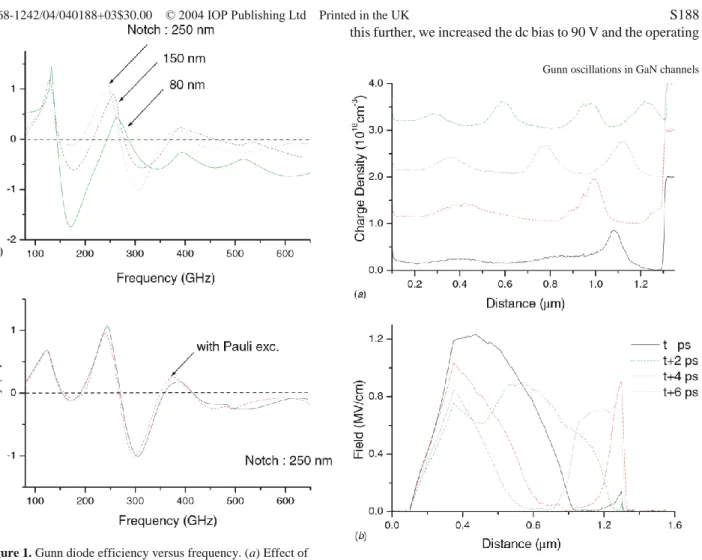
In figure 1(a) different notch widths are compared in terms of their frequency performance. Our main finding is that, by
Figure 1. Gunn diode efficiency versus frequency. (a) Effect of
different doping-notch widths, while keeping the total active channel length fixed at 1.2 µm. (b) Effect of including the Pauli exclusion principle for the 250 nm notch device.
increasing the notch width, GaN Gunn diodes can be operated
with more efficiency at their second harmonic frequency than
the fundamental, as seen for the 250 nm notch-width curve. However, we observed that further increasing the notch width above 400 nm gives rise to total loss of the Gunn oscillations. These results are extracted from long simulations up to 500 ps to capture the steady state characteristics at each frequency, which becomes quite demanding. Hence, the Pauli degeneracy effects requiring extensive memory storage are not included. Figure 1(b) illustrates the effect of including the Pauli exclusion principle using the Lugli– Ferry recipe [12,13]. Note that for Gunn diodes, this effect is quite negligible, slightly lowering the resonance frequencies at higher harmonics. Figure 2(a) displays Gunn domains for operations at the fundamental, second, third and fourth harmonic frequencies for a 250 nm notch device. As usual, the
domains build up as they approach the anode side. Figure 2(b) illustrates the evolution of the electric field in one period for the fundamental frequency operation (122.5 GHz). It can be noted that due to the relatively wide notch width, a significant amount of the electric field accumulates around this region, with a value that can exceed 1.2 MV cm−1 (under a dc bias of 60 V), reaching impact ionization threshold [10]. To analyse
this further, we increased the dc bias to 90 V and the operating
Gunn oscillations in GaN channels
Figure 2. (a) Typical charge density profiles for a 250 nm notch
device operating at the fundamental, second, third and fourth harmonic modes, each respectively vertically up-shifted for clarity. (b) Time evolution of the electric field profile within one period of the Gunn oscillation at 2 ps intervals for the 250 nm notch device.
Notch = 150 nm
Under Single-Tone Sinusoidal Bias
Time (ps)
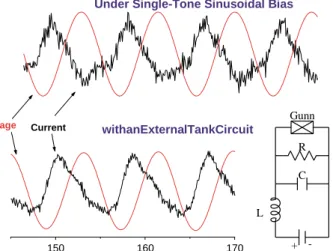
Figure 3. Current and voltage waveforms for a 150 nm notch Gunn
diode (a) under an imposed single-tone sinusoidal voltage, and (b) connected to an external tank circuit shown in the inset.
temperature to 500 K; the effect of turning off the impact ionization mechanism was observed to be marginal even at these extreme conditions for all notch widths considered.
S189 C Sevik and C Bulutay
Finally, we relax the imposed single-tone sinusoidal voltage across the Gunn diode and connect it to an external tank circuit with the voltage across the device being self-consistently updated at each simulation step (0.4 fs) through solving in the time domain a Gunn diode in parallel with a capacitor and a resistor, all in series with an inductor and a dc source (cf figure 3(b) inset). The ac voltage and current of the Gunn diode are shown in figures 3(a) and (b), comparing respectively the imposed single-tone bias with the tank circuit tuned to the fundamental frequency of the 150 nm notch device. For both cases the current and voltage are in anti-phase with each other leading to rf generation as intended; the main discrepancy being higher harmonic content in the tank circuit case as governed by the quality factor of the resonator.
4. Conclusions
In conclusion, by means of extensive EMC simulations, GaNbased Gunn diodes are analysed in detail. Multiple Gunn domain propagation in the higher harmonic modes within the channel has been illustrated. The effect of the Pauli exclusion principle is seen to be marginal in the operation of Gunn diodes, therefore it can be discarded to substantially reduce excessive memory requirements. The convenient choice of imposing a single-tone sinusiodal voltage across the device is compared with the results of an external tank circuit termination; very good agreement is observed between the two. Finally, it is shown that the notch width can be adjusted to enhance more efficient rf conversion at higher harmonics than the fundamental frequency.
S190
Acknowledgments
This work is supported by the Scientific and Technical Research Council of Turkey (TUBITAK) and the Bilkent¨ University. The continuous encouragement of Professor B Tanatar is gratefully acknowledged.
References
[1] Wraback M, Shen H, Carrano J C, Li T, Campbell J C, Schurman M J and Ferguson I T 2000 Appl. Phys. Lett. 76 1155
[2] Dunn G M and Kearney M J 2003 Semicond. Sci. Technol.
18
794
[3] Scholl E 2001¨ Nonlinear Spatio-Temporal Dynamics and
Chaos in Semiconductors (Cambridge: Cambridge
University Press)
[4] Oshio K and Yahata H 1995 J. Phys. Soc. Japan 64 1823 [5] Hess K 1988 Advanced Theory of Semiconductor Devices
(Englewood Cliffs, NJ: Prentice-Hall) p 207
[6] Gruzinskis V, Starikov E, Shiktorov P, Reggiani L andˇ Varani L 1994 J. Appl. Phys. 76 5260
[7] Joshi R P, Viswanadha S, Shah P and del Rosario R D 2003
J.
Appl. Phys. 93 4836
[8] Di Carlo A, Lugli P, Canali C, Malik R, Manfredi M, Neviani A, Zanoni E and Zandler G 1998 Semicond. Sci.
Technol. 13 858
[9] Fischetti M V and Higman J M 1991 Monte Carlo Device
Simulation: Full Band and Beyond ed K Hess (Dordrecht:
Kluwer) p 123
[10] Bulutay C 2002 Semicond. Sci. Technol. 17 L59 [11] Sevik C and Bulutay C 2003 Appl. Phys. Lett. at press [12] Lugli P and Ferry D K 1985 IEEE Trans. Electron Devices
32
2431
[13] Sevik C and Bulutay C 2003 IEEE Proc. J 150 86 170 150 160 withanExternalTankCircuit Current Voltage Gunn R C L + -(b) (a)