“IN DOMINIO SUNT III CARRUCAE ET VI SERUI ET III ANCILLAE”:
UNDERSTANDING FEMALE SLAVES IN EARLY MEDIEVAL
ENGLAND THROUGH DOMESDAY BOOK
The Graduate School of Economics and Social Sciences of
İhsan Doğramacı Bilkent University by
MERYEM TUĞBA PEKŞEN
In Partial Fulfillment of the Requirements for the Degree of MASTER OF ARTS IN HISTORY
THE DEPARTMENT OF HISTORY
İHSAN DOĞRAMACI BİLKENT UNIVERSITY ANKARA
ii ABSTRACT
"IN DOMINIO SUNT III CARRUCAE ET VI SERUI ET III ANCILLAE": UNDERSTANDING FEMALE SLAVES IN EARLY MEDIEVAL ENGLAND
THROUGH DOMESDAY BOOK
Pekşen, Meryem Tuğba M.A., Department of History Supervisor: Assist. Prof. Dr. Paul Latimer
September 2019
The aim of this thesis is to provide an insight into the place and role of female slaves in eleventh-century England by examining the records of six counties in Domesday Book. In a general sense, medieval women are portrayed, if they are, as either wives or
daughters; otherwise, they are invisible. However, Domesday Book reveals the presence of female slaves in Early Medieval England. They do not seem to be linked to any father or husband, and more interestingly, only female slaves are enumerated with a constant and regular pattern, and separately from the male members of peasantry with a few exceptions of widows. The records of the counties Cheshire, Gloucestershire,
Herefordshire, Shropshire, Warwickshire, and Worcestershire are selected and examined due to the fact that they have a greater number of female slaves than the other counties and they are geographically close to each other. Domesday Book offers statistical data of female slaves; however, their position, their duties and potential working areas remain a puzzle to be solved. Therefore, this thesis explores the possible places where slaves,
iii
especially female slaves may have been put to work, based on the number and clues of possible occupations obtained from Domesday Book. In this respect, it manifests that female slaves were active members of Early Medieval English society even though their class and gender may have restricted their life.
iv ÖZET
“IN DOMINIO SUNT III CARRUCAE ET VI SERUI ET III ANCILLAE”: “DOMESDAY BOOK” ARACILIĞIYLA ERKEN ORTA ÇAĞ İNGİLTERESİ'NDE
KADIN KÖLELERİ ANLAMAK
Pekşen, Meryem Tuğba Yüksek Lisans, Tarih Bölümü
Tez Danışmanı: Doktor Öğretim Üyesi Paul Latimer
Eylül 2019
Bu tezin amacı, İngiltere’deki altı idari bölgeye ait Domesday Book kayıtlarının incelenerek on birinci yüzyıl İngilteresi’nde kadın kölelerin rolü ve yerini açığa çıkarmaktır. Orta Çağ’da kadınlar genel olarak, tasvir edilirse, bir erkeğin ya eşi ya da
kızı olarak tasvir edilir; aksi takdirde görünmezdir. Ancak Domesday Book kayıtları, Erken Orta Çağ İngilteresi’nde kadın kölelerin varlığını açıkça ortaya koyar. Ayrıca bu kayıtlarda kadın kölelerden bir erkeğin ne eşi ne de kızı olarak bahsedilir. Daha da ilginci, birkaç dul kadın dışında, sadece kadın köleler hem köylü sınıfının erkek
üyelerinden bağımsız hem de düzenli bir şekilde sayılmıştır. Cheshire, Gloucestershire, Herefordshire, Shropshire, Warwickshire ve Worcestershire idari bölgeleri, kayıtlarının diğer bölgelere göre daha fazla kadın köle sayısı sunması ve bu idari bölgelerin coğrafi olarak birbirlerine yakın olması nedeniyle bu araştırma için seçilmiş ve incelenmiştir.
v
Domesday Book, kadın köleler hakkında sayısal olarak bilgi verir ancak bu kadınların toplumdaki konumları, görevleri ve potansiyel çalışma alanları çözülmesi gereken bir sır olarak kalmıştır. Bu sebeple, bu tez Domesday Book’un sayısal verilerine ve çalışma alanı olarak ipucu veren kayıtlarına dayanarak kölelerin, özellikle kadın kölelerin nerelerde çalıştırılmış olabileceğini araştırır. Bu yüzden, bu tez, sınıfları ve cinsiyetleri kadın kölelerin hayatını kısıtlamış olsa da onların Erken Orta Çağ İngiliz toplumunun aktif üyeleri olduğunu ortaya koyar.
vi
ACKNOWLEDGEMENTS
First of all, I would like to express my gratitude to my advisor, Asst. Prof. Dr. Paul Latimer, for his guidance, encouragement, and invaluable support throughout this thesis. I would be always grateful for his inspiring supervision and supportive approach to my enthusiasm in both medieval studies and gender studies. Moreover, I will always be grateful for being his student in Latin courses.
I owe a special word of gratitude to the committee members, Assist. Prof. Dr. David Thornton and Assist. Prof. Dr. Seda Erkoç Yeni. I am grateful to Assist. Prof. Dr. David Thornton for widening my perspective through his lively and enlightening courses. My gratefulness must also be extended to Prof. Dr. Özer Ergenç whose courses have always a special place in my heart. I also owe my deepest gratitude to my dear lecturers Dr. Gül Kurtuluş and Dr. Cory Stockwell, who have always encouraged and supported me
throughout my years at Bilkent University.
I will always feel fortunate and privileged for being a Bilkenter because of the priceless academic achievements and intellectual windows granted by Bilkent University.
vii
people of my life. I owe my special thanks to Özkan Akkaya and Ahmet Can Vargün for the incredible moments of sharing laughter, excitement, and secrets. I am thankful to them for being my brothers. My Master years have also given me a present: Handan Karakaş Demir. She is my best mentor, best yoga-mate, and yoga-teacher and best of
everything. Thanks to Handan, I am really fortunate to meet M. Caner Demir. Knowing that Handan and Caner Baba are always there for me is a great chance for me. I am also grateful to Seren Kaya Morgül who made my nights and days tolerable and beautiful by
sharing the dorm-room and so everything about us at 14th Dorm. I am also grateful to my dear friend and yoga-teacher Tuğçe Kancı. I cannot be thankful enough to Tuğçe for her sincere friendship, emotional support, and patience while listening to my complaints about everything, and her sound advice. I am glad to be a person having few friends but the best ones. However, I would never think of having close friends from EEE; thus, my gratitude must be extended to Ahmet Dündar Sezer, Ali Nail İnal, and Uğur Yılmaz. I would like to thank Dündar Abi for being the best friend for advice, gossip, and
discussion in any topic. I am eternally grateful to Nimet Kaya (R.I.P.) for her emotional support until her last day. Without her, I could not have met my love.
I wish to present my thanks to my teachers, Hatice Uslu, Önder Üstündağ, Necat Ulusoy, and Şerife Lucas who occupy an important place in my life. My dearest friends Ceyda Sevimli and Ezgi Gültekin are always kind and trustworthy friends in both good and bad
times. Their friendship made me stronger in every stage of my life, including this process. I would not have so much fun without them in this world. I cannot think of me
viii
without you, our crazy moments of shopping, and daily but profound chats no matter how far the cities we live in are.
During my thesis period, I started to work at CBRT, and CBRT has provided me different points of view about both personal and professional issues, and people beyond price; Mehmet Taylan Yıldız, Sema Kumral, Selcan Şantay Özyüncü, Pınar Şimşek, Eren Aydın, Ayşen Üstün, and Soner Aksu. They are beyond a colleague, and directors; they
have made me feel like a sister to them and supported me in every move I have had. CBRT has also replaced a friend to a best friend, Melik Babur. I am thankful to him for his kind support and sincere friendship.
My professional life continues at TÜBİTAK now. I am thankful that I have made this decision. I wish to extend my thanks to Bekir Çengelci, Tuba Akoğlu, Esra Kılıç, Öznur Kılıçkaya, Zeynep Çanakcı, Şermin Korkusuz Aslan, Özlem Köroğlu, Melike Erol, and
Duran Akca. I would like to thank my friends Nurulhude Baykal, Dilara Cumhur, Bengisu Özdemir, Yasemin Şahin, Merve Yıldırım, and Elnara Ahmetzade for sharing
moments of lunch break, drinking coffee, and laughing together. I owe a special word of gratitude to Elnara for helping in creating maps for this thesis. Above all, I owe special thanks to my office-mates Umut Hasdemir, Adem Uludağ, and Muhammed Said Vapur. They have always provided a peaceful and lively environment to work, to chat and to laugh for relaxation. They have also supported me in this stressful thesis process. I also would like to thank our honorary office-mate Ayşe Taydaş Battal.
ix
I would like to extend my gratitude to Yasemin Erden who is like a gift to me from TÜBİTAK. She has always been supportive, understanding, and encouraging. Her
uplifting comments and behavior have made my stressful days and nights tolerable. Without her support, I may have not complete this thesis. I am grateful to her for being my best friend.
I am also grateful to Nejla and Kamil Sarıtaş for raising a son like Serkan and their supportive and understanding approaches. I am also thankful to Hakan, Burcu, and Can Sarıtaş for the lovely moments we have together.
There are no words to express my gratitude to my family. I am forever indebted to my parents Adile and İsmail Pekşen for their endless love, patience, and support throughout
this thesis period, my decisions, and my entire life. We cannot choose the family we are born; however, I have never regretted being a member of this family. I owe a special word for my sister, Azime Pekşen Yakar who has always been my role model. I am so
lucky to have a sister like her. She has always loved me and supported me in every phase of my life. I am always grateful to my brother Cihan Yakar for his love, understanding, and emotional and financial support. You are my one and only brother. My grandmother Meryem and grandfather İbrahim Aydoğdu and my uncle Ömer Faruk Aydoğdu are the
best, good-hearted people I have ever known and I do not know how I could explain their understanding, love and effort to support me. I also would like to thank my cat, Helva for
x
not leaving me alone during the nights and days, and snuggling by my side while I was dealing with this thesis.
Finally, I would like to express my deepest gratitude to Serkan Sarıtaş who loves me unconditionally and supports me in every step I take. I know he is always there for me to encourage and support me regardless. His love has helped me through everything I have to deal with in my life, including but not limited to this thesis. Nonetheless, this thesis would not have been possible without his motivation and encouragement.
There are people to whom I, especially, would like to thank and emphasize my love and gratitude to them for their patience and support. I have already mentioned many of them, but mom, dad, sister, brother, Yasemin, Ezgi, Özkan, Ahmet, Handan and Serkan are the
ones who had to deal with my constant whining about this thesis and all my problems as well as my beautiful moments. I am so fortunate and glad to have you all.
xi
TABLE OF CONTENTS
ABSTRACT ... ii ÖZET ... iv ACKNOWLEDGEMENTS ... vi TABLE OF CONTENTS ... xiLIST OF TABLES ... xiii
LIST OF FIGURES ... xiv
CHAPTER I INTRODUCTION ... 1
1.1 Thesis Statement ... 1
1.2 Limitations ... 5
1.3 Organization and Methodology ... 6
CHAPTER II SLAVERY AND DOMESDAY BOOK ... 12
2.1 Slavery and Freedom ... 12
2.2 Slavery in Ancient and Medieval Europe ... 28
2.3 Slavery in Early Medieval Britain ... 40
2.4 How to Become a Slave in the Ancient and Early Middle Ages ... 50
2.5 How to Become Free Again: Manumissions ... 52
2.6 Domesday Book ... 54
CHAPTER III FEMALE SLAVES IN SIX COUNTIES’ DOMESDAY BOOK ... 65
xii 3.2 Worcestershire ... 80 3.3 Herefordshire ... 93 3.4 Gloucestershire ... 110 3.5 Shropshire ... 125 3.6 Warwickshire ... 138 3.7 Cheshire ... 149 3.8 Conclusion ... 158 CHAPTER IV CONCLUSION ... 160 BIBLIOGRAPHY ... 169
LIST OF TABLES
1. Representation of My Domesday Book Count ... 8
2. The Number of Slaves in Our Domesday Book Count ... 9
3. The Circuits ... 60
4. Total Slave Numbers in Worcestershire Hundreds ... 85
5. Mills mentioned in the same entries with female slaves in Worcestershire... 86
6. Total Slave Numbers in Herefordshire Hundreds ... 96
7. Mills mentioned in the same entries with female slaves in Herefordshire... 102
8. Total Slave Numbers in Gloucestershire Hundreds ... 114
9. Mills mentioned in the same entries with female slaves in Gloucestershire ... 117
10. Total Slave Numbers in Shropshire Hundreds ... 128
11. Mills mentioned in the same entries with female slaves in Shropshire ... 134
12. Total Slave Numbers in Warwickshire Hundreds ... 141
13. Mills mentioned in the same entries with female slaves in Warwickshire ... 144
14. Total Slave Numbers in Cheshire Hundreds ... 154
LIST OF FIGURES
1. Slave Population in Worcestershire ... 81
2. Ploughs in Worcestershire ... 83
3. Worcestershire Hundreds ... 84
4. Meadows in Worcestershire ... 90
5. Slave Population in Herefordshire ... 94
6. Herefordshire Hundreds ... 97
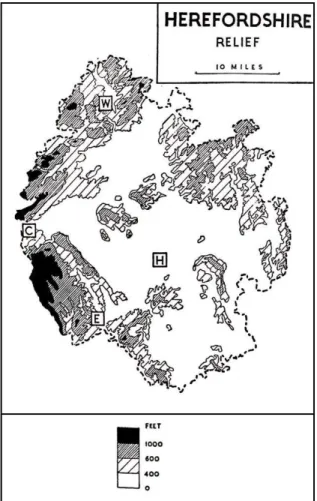
7. Herefordshire Relief Map ... 98
8. Ploughs in Herefordshire ... 100
9. Slave Population in Gloucestershire ... 111
10. Gloucestershire Hundreds (North) ... 112
11. Gloucestershire Hundreds (South) ... 113
12. Ploughs in Gloucestershire ... 115
13. Fisheries in Gloucestershire ... 119
14. Meadows in Gloucestershire ... 121
15. Woods in Gloucestershire ... 122
16. Slave Population in Shropshire ... 126
17. Shropshire Hundreds ... 127
19. Plough-lands of Shropshire ... 131
20. Plough Distribution in Shropshire... 132
21. Slave Population in Warwickshire ... 139
22. Warwickshire Hundreds ... 140
23. Plough Distribution in Warwickshire ... 143
24. Slave Population in Cheshire ... 150
25. Ploughs in Cheshire ... 151
26. Cheshire Hundreds ... 152
27. Cheshire Hundred in Wales ... 153
1
CHAPTER I
INTRODUCTION
1.1 Thesis Statement
This thesis was initiated with the realization of the fact that female slaves are the only group of this gender, who were regularly recorded in Domesday Book. There are few widows and dead widows in the records, yet the enumeration of female slaves manifests that there must have been something different from the others to be recorded in such an important survey. What makes them different? Whether their being a “resource” which was exploited by the owners, or their active and functional position in the society is indeed a profound question that needs to be examined in detail. In order to analyse their importance and functions, slavery as a term and practice is explored.
Slavery’s shape and exercise may change; however, it has retained its existence from very ancient times. On the other hand, the medieval era is thought to be where slavery
2
was not practiced although slavery is widely acknowledged to have existed in ancient times and in the New World. It is not true. Serfdom and free labour were conspicuously present in the Middle Ages.1 From this, we can infer that the majority of labourers may be serf or free. Yet, this does not mean that slavery was not exercised. On the contrary, slavery is usually one of the most prevalent components of the history of humanity. Also, slavery is considered very beneficial and important for a society. Its importance and benefit to the society lie of course in its advantage used in every aspect of labour and service. Moreover, some historians tone down slavery in their works by putting forward particular various justifications. We can observe that they put slavery in a position almost necessary for the sake of the society.2 Some other historians also profess that slavery was not executed by their own societies; even if it was executed, it was most probably
because of the trade with other civilisations.3
1 William D. Phillips, Slavery from Roman Times to the Early Transatlantic Trade (Minneapolis:
University of Minnesota Press, 1985), 3.
2 Edward Augustus Freeman displays slavery as salvation from the society’s contemporary conditions. He
touches on Yorkshire streets in which the circumstances are so poor. People could sell themselves as slaves so as to reach some food. Freeman shows this selling oneself as society’s self-healing process and mentions that when the conditions ameliorate, good masters could free them. (Edward Augustus Freeman, The
History of the Norman Conquest, vol iv. (Oxford: Clarendon Press, 1875–1879), 291-292.) Dorothy
Whitelock states slaves could be from different ethnic groups and some of them are obtained from wars. However, she also declares that people may consent to be enslaved in order not to be affected by famine. Moreover, people could be made slaves because of their illegal acts or their failure in fulfilling the responsibilities. (Dorothy Whitelock, The Beginnings of English Society (Baltimore, Maryland: Penguin Books, 1962), 111-2.) Both reasons, famine and penalty, seems justifications to normalization of slavery in the society. Also, David Wyatt criticises some medieval historians such as C. Oman, Sir Frank Stenton, R.A. Arnold and John Davies, for disregarding slavery intentionally in their studies. He finds their
approach perfunctory even if they mention slavery. (David Wyatt, Slaves and Warriors in Medieval Britain
and Ireland, 800–1200 (Leiden, Boston: Brill, 2009), 2.)
3 H. R. Loyn states that Moslems and Scandinavians are the ones who benefit from slave trade although he
admits that slave sources are wars, penalties and unfavorable conditions before the Norman Conquest. (H. R. Loyn, Anglo-Saxon England and the Norman Conquest (New York: Longman, 1991), 90-1.) Similarly,
3
The slavery examined in this thesis is primarily the slavery in England after Battle of Hastings which established that William, the Duke of Normandy as the new king of England. To put it more precisely, this thesis’s concern is the slaves alluded to in Domesday Book. This should not and does not necessarily mean that slaves are referred in Domesday Book as individuals. On the contrary, they were enumerated as a resource of their masters and/or mistresses. The first idea of collecting information and making a Domesday Book is also thought to aim to reveal who has what before and after the conquest. That is, Domesday Book is thought to be prepared for mainly fiscal motives among others. Regardless of this record’s target, Domesday Book is distinctly
appreciated by historians for its wide scope and its fast compilation at such an early date, eleventh century. This record includes landowners’—from the king to the far down in the social and economic scale— lands, ploughs and other possessions which were deemed valuable and maybe taxable in the eyes of the commissioners who were the representative of the new government.4
It is important to note that both male and female slaves were enumerated in Domesday Book. Slaves are thought of as male, to be exploited in hard works which require great energy and effort. Therefore, male slaves —as well as the ones mentioned Domesday Book— are easily connected to agricultural tasks. Moreover, they are also easily
David A. E. Pelteret states Scandinavians are the primary enslavers in England. However, before Scandinavians’ slaving people in England, there is not any indication that Anglo-Saxons do not perform any enslaving activities. (David A. E. Pelteret, Slavery in Early Mediaeval England (Suffolk: The Boydell Press, 1995), 70.)
4
connected to ploughs. However, a plough is not an equivalent indication for a social class that was seen the lowest of all. There must have been many other tasks which were more possible for the slaves.
What about female slaves? There is not a plausible indication suggesting female slaves were not abused in agricultural labour. We can also link female slaves to ploughs although a plough sounds higher for slave standard. On the one hand, it is now widely acknowledged that women are intentionally or unintentionally rarely dealt with and written about in historical documents. On the other hand, it does not seem possible to think that a slave, female or male, was not set to work by his/her master.
There are plenty types of works that can be attributed to female slaves. Works coming to mind straightforwardly are domestic ones in a household, such as cleaning, cooking, and needlework.5 However, regarding that Domesday Book presents so many puzzles to solve
and hints to discover; we can create new ideas about what female slave may do or may not do apart from their number in the record. Yet, there is one more important issue to take into consideration, that is, Domesday Book numbers may not reflect the real number of slaves, or other categories of people because the commissioners’ principles in
recording individuals may change from county to county.
5 Pelteret, Slavery in Early Mediaeval England, 203. Jane Whittle, “Rural Economies,” in The Oxford
Handbook of Women and Gender in Medieval Europe, ed. Judith M. Bennet and Ruth Mazo Karras (New
5
This study aims to analyse the female slaves recorded in six counties of Domesday Book. Through this analysis, we can also try to understand their lives and the importance of their presence in Domesday Book. In order to do that, first we create a table comprised of these six counties’ landholders, hundreds they reside in, and lands as well as male and
female slave numbers. This table also contains mills and ploughs. We know that women were always given secondary importance in life and in history. 6 However, Domesday Book recorded female slaves who are expected to be nameless. Based on the records of six counties, this thesis aims to portray the functions of female slaves and what they may have done in rural England in the eleventh century.
1.2 Limitations
Although Domesday Book is respected for its significant details about society after the Norman conquest, it does not offer a full and accurate account and statistics of the society. This is also what we witness throughout this study and for the aim of this study. Domesday Book does not adopt one particular system for its count and record. The determined questions to be answered may vary from county to county.7 In other words,
6 Judith M. Bennett and Ruth Mazo Karras, “Women, Gender, and Medieval Historians,” in The Oxford
Handbook of Women and Gender in Medieval Europe, ed. Judith M. Bennet and Ruth Mazo Karras (New
York: Oxford University Press, 2016), 2.
6
there is not a standard structure which all counties have. Therefore, we cannot reach an exact number of what we are able to look up in Domesday Book.
Another challenge in this study is to obtain a map of counties. Even if we are able to draw a map of a county; the hundreds’ boundaries are so complex that sometimes a part
of a hundred could be found in another hundred. Even, between the hundreds of a county, you may find land which actually belongs to another county. This also prevents us to comment on a hundred as a whole.
As stated perpetually, women are trivialized and put in the periphery in history. We do not have adequate data and sources in order to talk about them, and understand and interpret their life conditions. When it comes to female slaves then, it is much more challenging. There are not many sources related to them, even mentioning as “female slave”. This thesis aims to reveal female slaves in the society using the hints from
Domesday Book.
1.3 Organization and Methodology
This study has been based on Domesday Book records of six counties, namely, Cheshire, Gloucestershire, Herefordshire, Shropshire, Warwickshire, and Worcestershire. There are some indications that these records are gathered by the groups of people who are called
7
commissioners.8 They are charged with different regions but still there is not an explicit data about the region allocation. The number of the members of each group are not certain, either. Scholars call the regions which were allocated between the commissioners “circuits” and they are still sceptical about the allocation.
Although the records are invaluable sources for us to have statistical information about the society, uncertainty of some accounts brings about the limited interpretation. For instance, sometimes the slave numbers are not clearly stated and this aggravates our study because of the narrow comparison between the counties.
In these six counties’ records, we look up for the landlords, portion of the lands, ploughs, slaves (male and female), and mills as shown in Table 1. This table contains randomly chosen entries. In the factual (six) counting tables, each one includes only one county and its records.
8 Table 1 Representation of My Domesday Book Count
County Landholder Hundred Holding Hide Plough
Plough in Lordship Land for… Ploughs # of female slaves # of male slaves Combined # of slaves # of slaves Mills Worcestershire King William Came Broomsgrove 30 79 2 1 9 0 10 3 Warwickshire King William Fexhole Brailes 46 52 6 60 3 12 0 15 1
9
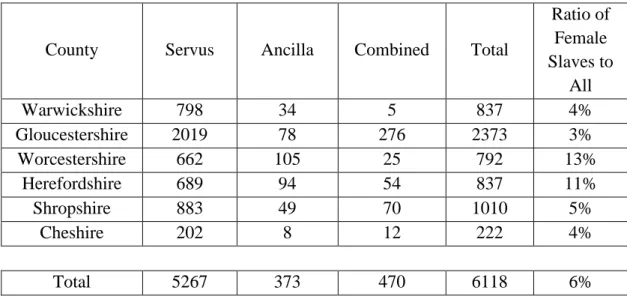
Domesday Book was originally written in Latin. There are some abbreviations which are common in all books I have a sample of. The table below (Table 2) is what we get when we enumerate what is recorded by the commissioners. As seen, there is also a column for the combined number. We call the number “combined” because records give a total number for female and male slaves. Thus, we do not understand the gender of the slaves and cannot categorize them according to their gender. We examine and analyse female and male slave numbers in the pertinent chapter. However, it is important to state that female slaves are indeed less, yet there is also the possibility that the commissioners do not record the exact number of female slaves.
Table 2 The Number of Slaves in Our Domesday Book Count
County Servus Ancilla Combined Total
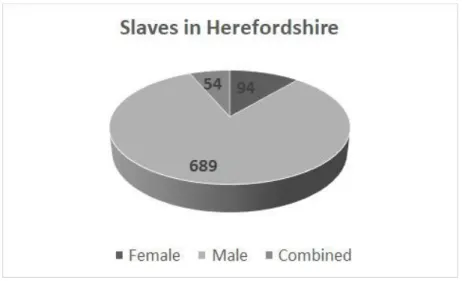
Ratio of Female Slaves to All Warwickshire 798 34 5 837 4% Gloucestershire 2019 78 276 2373 3% Worcestershire 662 105 25 792 13% Herefordshire 689 94 54 837 11% Shropshire 883 49 70 1010 5% Cheshire 202 8 12 222 4% Total 5267 373 470 6118 6%
10
This thesis consists of four chapters including introduction and conclusion. These
chapters are divided in accordance with their topic. The first chapter introduces the thesis statement and organization. The second chapter is employed as a background about slavery and Domesday Book in general. First, slavery’s definition(s) are meticulously examined and its contrast with freedom is examined. As slavery is often analysed as an economic organism in the society, we try to approach it from different ways. Then, slavery in ancient and medieval Europe will be our concern. Indeed, this section intends to observe how slavery as an institution is operated in the ancient societies and how slavery transforms into its medieval shape. This section is restricted to ancient Roman and the following civilisations since slavery in medieval England is greatly affected by them rather than the ancient Greek or other civilisations. Then, we focus on slavery in early medieval England. We analyse how slavery is approached and employed before Norman conquest in England. In the next section, we deal with the idea of how a person could be or is made a slave in the ancient and medieval world. We end this chapter with Domesday Book. We try to examine all the progress of Domesday Book, with its undeniable and obscure details.
The following chapter gives statistical data and analysis of six counties. However, before the analysis, the characters referred in Domesday Book, particularly slaves and the possible working areas are assessed. The counties’ analyses are sorted according to their female slaves’ numbers in total; and each analysis probes into details of total slave
11
areas are examined. These may vary among salt-houses, fisheries, meadows, pastures and woodland.
Finally, the last chapter concludes this study via the interpretation of female slaves in these six counties, supported with the background and critical approaches given in the second chapter. At last, we will have a portrayal of female slaves who may have been involved in different commitments in rural England in the eleventh century.
12
CHAPTER II
SLAVERY AND DOMESDAY BOOK
In this chapter, the first four sections will deal with slavery in general while the last section explores Domesday Book. Therefore, this chapter prepares a background for us to understand and analyse Domesday Book slaves.
2.1 Slavery and Freedom
We can state that “slavery” in the Middle Ages represents the lowest group of the people who are unfree. However, exploring slavery by its definition(s) as our first step will help to analyse it, and compare and contrast it with freedom. Moreover, some scholars’ definition of slavery may develop a new perspective and may resemble each other in some ways. For example, D. B. Davis explains a slave like this: “his person is the property of another man, his will is subject to his owner’s authority, and his labor and
13
services are obtained through coercion.”9 Some historians, on the other hand,
(intentionally or unintentionally) compare medieval slavery to New World slavery, which causes comparison of these two. New World slavery could easily be spotted since it is a part of economic, legal, and social structure and so it could create its own class. On the other hand, these three (economic, legal and social structure) make medieval slavery more complex to perceive and study on, since these are not possessed at the same time by the medieval slaves. That is to say while the society’s legal codes designate some people slaves, their economic position may be similar to free people’s economic position. In other words, medieval slavery as a status changes in accordance with the context.10 We can also relate this to our Domesday Book slaves. While slaves were enumerated as a property or resource in Domesday Book, they can also be likened to other groups of peasantry, like villagers or ploughmen. Legal codes may have separated slaves from other groups; yet the entries of Domesday Book display that slaves may have had share in a plough with villagers, smallholders or any other group of people: “A priest, 3 villagers, 4 smallholders and 4 slaves with 5 ploughs”11
William D. Phillips also refers to New World slavery and states that thanks to “our familiarity with the history of slavery in the antebellum American South”, we can
9 David Brion Davis, The Problem of Slavery in Western Culture (Ithaca, New York and London: Cornell
University Press, 1966), 31.
10 Ruth Mazo Karras, Slavery and Society in Medieval Scandinavia (New Haven and London: Yale
University Press, 1988), 5.
11 Frank and Caroline Thorn, Domesday Book, vol 17: Herefordshire (Chichester: Phillimore, 1983), fo.
14
imagine that slaves were brought from different and distant lands; their colour, their language were also different. However, he states that a working definition is crucial in studying slavery because American slavery may have some key points and maybe mutual features, but these features are not typical for all forms of slavery.12 For example, in American slavery, slaves were owned as a property and could be punished, sold, and put to work. Their body and physical power were all at their owner’s disposal. Thus, “they had few if any legal rights, not even the right to form families, although some indulgent masters did allow slave marriages.” 13 In order to have a general idea about slaves as a
property, we could see the power relation between the slave and the master. In other words, the master’s position is very important in this power struggle. This also works for
understanding the difference and discord between slavery and other use of labour. Even though the master’s behaviour was friendly and/or considerate, it would not be the same
with the free labour because slave was a property after all. Moreover, unlike the slavery in American South, in medieval societies there could be slaves from the same land and enjoying the same language.14 Although we cannot be sure about it, Domesday Book slaves also may have been from the same country and had the same language with their masters. Even though there is not any evidence, they may have also been descendants of slaves who had been bought, or made slaves because of not paying a debt. There is also
12 Phillips, Slavery from Roman Times, 5. 13 Phillips, Slavery from Roman Times, 5.
15
another possibility; that is, they may have intentionally been slaves for the sake of being fed.
Pierre Dockés, first gives a legal definition: “on the right of property in another human
being, comprising three elements: usus, fructus, abusus. Consequent upon the legal definition of the property is the purchase or sale of the slave commodity.” Then he remarks that this definition seems sufficient at first glance and only if the social relation in most cases parallels the legal relation. He also asserts that the master and/or mistress has such a great power that s/he is free to manipulate the slave “as he wishes (to extract from it surplus labor, services, or pleasure)”. Moreover, s/he also has the same power and liberty over the slave’s children and if s/he wishes, s/he could kill the slave.15 Here, we
can also observe the reflection of the master’s power over the slavery. That is, the master manifests his power through the slave. As we have mentioned above, the power relation is one of the key points to interpret slavery as it reveals not only the slave’s position but also the master’s authority gained from it. That is why we will concentrate on this later in
this chapter.
Ruth Mazo Karras describes slavery as a “conceptual category” and explains that it is a kind of method of designating individuals. Her conceptual category has two sides which are the juridical side and the social side. The juridical side reflects the legal
categorization of social classes, yet the latter one is what makes an individual a slave.
16
However, she emphasizes slavery is not a system on its own because slaves committed themselves to diverse tasks and uses in a society.16 Here, the slave system and slave
society are important to analyse because slave society and the societies which benefit from slaves are different kinds of phenomena.
While in some societies, slaves were the direct source of labour which was the most effective in economy, in some other societies slaves were seen as auxiliary power to the main economic authority. Marxist scholars call the first one “slave mode of production”, in which economy was sustained by the slaves.17 Hence, we can simply describe slave system as the system in which main production, if not all, was obtained from slaves’ labour. Dockés underlines the other slave system in which slaves were not the main element in economy, in detail. That is, in some societies, slaves were mostly benefited from their domestic labour instead of their production. Masters could glorify their status through having slaves; they could also exploit slaves sexually and/or make use of them in household issues. Such service from the slaves does not make slavery a system. In slave system, slaves produce and their masters gain wealth through the slaves’ products.18 In
light of this, we may state that many medieval societies were not slave societies because medieval slavery was not a principal element of economic production. However, this does not necessarily mean that medieval European societies did not benefit from slavery.
16 Karras, Slavery and Society, 6. 17 Phillips, Slavery from Roman Times, 9. 18 Dockés, Medieval Slavery, 9-10.
17
On the contrary, “slaves did exist in medieval Europe, in a wide variety of social and economic roles, and were culturally if not economically significant.”19 Yet, its degree
varied in accordance with time and place.
When we go back to the definitions, freedom also keeps an important place although it did not have an explicit definition. Hence, it could have been interpreted in plenty of ways. The terms, namely freedom and slavery, were definitely not used in the Middle Ages as we use them now. In other words, medieval people (both the public and the authority) who give us the sources did not think of the terms like we do. Wyatt states that freedom has more than one definition. He puts forward the idea that slaves in Britain in the Middle Ages had some “privileges.” They could get married, have a family and even have some possessions. However, they are still labelled as unfree. He states if we judge the people by their traditional and cultural privileges and/or rights, when they do not match our conception of slavery, we cannot call them slaves.20
Freedom is also not necessarily the absence of duties and commitments. If it is, then everyone is free and also unfree because a person could be dependent on someone else in various respects. In another respect, that someone else could be dependent on the other. If freedom represents the ultimate power, then even the higher class of people (whom we automatically think free) are not independent since they need the grant of the king or
19 Karras, Slavery and Society, 5. 20 David Wyatt, Slaves and Warriors, 37.
18
whoever is their supreme power.21 We can also define freedom as not being a slave, as the antonym of freedom. This definition also leads us to the sharp end of the spectrum. Also, this may mean the people who have duties to pay but still are not in the servile position. A person may not be a slave, so he is in the free line of the opposition. However, the same person could be financially weak and need to please his higher
positioned lord or someone else. Then, we can also state that a person’s financial capacity does not display that he is unfree.22
Although we seem to determine the direct contradiction between freedom and slavery and specify the apparent division, according to M. I. Finley, the reason why we do not
understand ancient (and/or medieval) societies very well, and why their social structure seems so complicated is because we have not set ourselves free from thinking about the opposition of free and unfree. Hence, approaching the social status in these societies regarding the two definitions above will not help us understand the atmosphere and conditions of the ancient/medieval society. Finley also remarks that a person’s position in classical society could be regarded as “continuum or spectrum” in which rankings are
described roughly as between slavery and freedom. He explains that the aforementioned “continuum” is a good metaphor “when applied to the ancient Near East or to the earliest
periods of Greek and Roman history. There one status did shade into another.”23
21 Karras, Slavery and Society, 37. 22 Karras, Slavery and Society, 37.
23 M. I Finley, “Between Slavery and Freedom,” Comparative Studies in Society and History 6, no. 3 (April
19
Similarly, Karras argues that almost all people in the Middle Ages were somehow contingent on each other. She gives nobles as an example: “even nobles, whose feudal
dependence would not make them unfree in the eyes of their contemporaries, had a set of specific freedoms— liberties or privileges granted by a king or emperor—rather than a generalized freedom.”24 This means that, if a special right or exemption was not
accorded, a person could do nothing about it even if he is from a higher position in the society. This also leads us to the conclusion that there is not a check list through which we can specify an individual as free or unfree. However, slavery remains as a property ready for the masters to benefit from although slavery’s definition may vary.
Finley formulates an “illustration” through which we can classify the status and/or position between the two ultimate ends, namely slavery and freedom:
1) Claims to property, or power over things […]. 2) Power over human labour and movements, whether one's own or another's –including, of course, the privilege of enslaving others. 3) Power to punish, and, conversely, immunity from
punishment. 4) Privileges and liabilities in judical process, such as immunity from arbitrary seizure or the capacity to sue and be sued. 5) Privileges in the area of the family: marriage, succession and so on […] 6) Privileges of social mobility, such as manumission or enfranchisement, and their converse: immunity from, or liability to, bondage, penal servitude and the like. 7) Privileges and duties in the sacral, political and military spheres.25
According to this measurement, we can understand that slavery covers those who have the least interest, benefit, immunity and advantage from the social structure. Slaves in
24 Karras, Slavery and Society, 6. 25 Finley, “Between Slavery” 247-8.
20
Medieval Scandinavia meet the requirements in accordance with the scheme above.26 When it comes to the medieval slaves in Britain, it becomes rather complex because there are indications that some slaves could own their home, and could get married etc.27
Karras argues that Finley’s scheme hinges on the juridical standards. Giving the example of a free peasant, she emphasizes that this free person could take advantage of the rights granted in theory, but in reality he could not manage his rights because of unfavourable financial conditions. She also states that a person whose owner prevented him/her from doing something cannot find a juridical remedy and security.28
Regarding what makes the slave a slave, she also generates a kind of scale. It may help us identify whom can be labelled as a slave in Medieval Europe.
1.The slave lacks all or most of the rights accorded to others in the particular society (or accorded to others of the same age and sex, since free women and children may also lack the rights of free men). 2. The slave is an outsider who does not belong in a kin group or the community. 3. The slave labors under the direct control of the owner or the owner´s representative. 4. Contemporaries identify slaves as a distinct status group, the lowest in the society. Where
contemporaries distinguish between slaves and another group (for example, bound debtors), we should respect that distinction and not consider bound debtors as slaves.
Here, the standards above encompass all the possible people who could be labelled slave in the Middle Ages.29 However, this scale does not question and/or attest whether they were indeed slaves or not. In this respect, we may state that the slave was a possession of
26 Karras, Slavery and Society, 7. 27 Wyatt, Slaves and Warriors, 37 28 Karras, Slavery and Society, 7. 29 Karras, Slavery and Society, 11.
21
a master who has authority over the slave’s body physically and sexually. These slaves
were in some way taken away from their family, land, and culture and are alienated in their new society. However, these standards are not totally accepted by all of the scholars.
Wyatt criticizes historians because they apply contemporary conceptions in expounding and interpreting slavery and freedom. In medieval Britain, social status determined the approaches and attitudes in the society. The society aggrandised the higher-class people, while people positioned lower are directly humiliated and deemed unworthy.30 Thus, we
can state that slavery was useful in society for indicating the power and supremacy of higher-class people. The abuse of labour became the indication of the power, honour and regard of the slaveowners. In other words, slavery was not only the manipulation of human labour or an economic resource. Rather, it has a psychological side. Through the slaves’ despair, the owner exalted his own honour, vigour, and potency.
This psychological side also encompasses sexual abuse of slaves. Wyatt likens slavery in Britain to the Middle East in the Middle Ages in terms of slavery’s sexual side although historians do not focus on this side while studying slavery in the Middle Ages. However, in medieval societies, slavery as an institution was set and used, though not everywhere at all times, and so the sexual side was certain since sexuality was also a sign of the power of patriarchy.31 It is not challenging to think that slaves were abused sexually. Since
30 Wyatt, Slaves and Warriors, 38. 31 Wyatt, Slaves and Warriors, 39-40.
22
women were considered fragile and powerless, when one of them was enslaved, the owner could use his property for his own pleasure. As it is a property, there is no limitation for its owner after all. For a different scenario, if a woman was enslaved by someone, either her father or husband’s honour would be tainted, whereas the owner of the enslaved woman strengthened his mightiness. Yet still, there are court records in which a male master and female slave or female mistress and male slave have sexual intercourse.32 This is not approved of in a society based on hierarchal codes. Thus, it
seems strange to see such relationships while treating slaves unhuman. Yet, it is
impossible not to think that sexual relations could be linked to the relationship of master and property. As the slave side of this relationship was the one seen as property, the owners could use their possessions as s/he wishes.
In the studies related to slavery, Orlando Patterson is highly regarded because he
approaches slavery as a social practice rather than as an economic one. Karras and Wyatt address Patterson’s definition of slavery: “the permanent, violent domination of natally alienated and generally dishonored persons.”33 Karras evaluates this definition as a
reminder that slavery has many more social and/or cultural cues than legal ones. She states that even though slavery is reached via the juridical documents, understanding the
32 Dockés, Medieval Slavery, 8. Dockés cites P. Bonnassié for his statement about that it was forbidden to
free women to have a relationship with male slaves. Dockés also states that this relationship was seen equal to bestiality in especially Visigoths.
33 Orlando Patterson, Slavery and Social Death: A Comparative Study (Cambridge, Mass. and London:
23
social mind which causes this slavery is the most significant.34 Thus, we can infer here that slavery’s definitions, even where it is based on legal grounds, should have a
component which provides a window showing the inner side of the slavery. Wyatt underlines that Patterson’s attention to honour in the formation of slavery is especially
relevant to “the warrior societies of medieval Europe in which powerful and emotive codes of honour had fundamental social significance.”35 We clearly see that Patterson’s
definition and the other definitions, legal and economic, strengthen each other. Evaluating sociological, economic, and legal definitions of slavery separately only provides us with the blurred idea of slavery. In this manner, we look at different attitudes towards slavery in order to understand and illustrate it. Scholars, for example, lay stress on the analogy of death and slavery.
Patterson is one of them: “Perhaps the most distinctive attribute of the slave's
powerlessness was that it always originated (or was conceived of as having originated) as a substitute for death, usually violent death.” Being a slave does not obliterate death. Likening the master to a ransomer, Patterson states that the master monopolises the life of the slave. As the slaves are dependent on the master in all senses, they become not
human.36 While s/he is alive, his/her life becomes exactly like death. His/her life in every
respect is determined and conditioned by someone else.
34 Karras, Slavery and Society, 7. 35 Wyatt, Slaves and Warriors, 43. 36 Patterson, Slavery and Social Death, 5.
24
Dockés also associates slavery with death and states that since the slave is totally under
the authority of a master, this master has the capacity to control the slave’s own life. He also likens this relationship between the slave and his/her master to the relationships between paterfamilias and his family, the ruler and his subjects, the judge and the detainees, and finally a warrior and his captives from a war.37 All of these examples display that the dominant character of the relationships above has a kind of power to determine whether his/her subordinate could live or die. In this very respect, the masters could kill their properties, yet they spare the slave’s life and it is their mercy. Moreover, all of the subjects above are in one way or another entirely captured, at all points. Therefore, slaves are socially and economically dead. Apart from being bereft of their native lands, languages, and families, the slaves’ being seen as a property makes them the other in the society and they lose their identity as a human being.
Alex Woolf, on the other hand, approaches this relationship between the slaves and their new families, the heads of which were their masters, in a different way. Stating that when slaves were sold to a new master it is much better working for someone other than their captors who had the slaves’ former lives, Woolf suggests that the owners and their slaves most probably worked together. He likens slaves to brides and children, because slaves were brought to the house at a young age and adapted themselves to their new home. The main reason for the slaves’ being like a family member may be that they are sold to
25
someone living in the countryside. The conditions in a rural place were already poor, when a slave was brought to the house, everything may be shared from food to the room. Thus, they probably saw their master as saviour and most probably felt gratitude to the master.38 Woolf’s suggestion may also be true of Domesday slaves. As the peasantry’s conditions may have not been so good, they could have worked together and eat together with the slaves. Dockés also emphasizes that separating the slave from his country, language, and family etc integrates slaves into their new places. Therefore, the slaves may see their masters as parents.39 Hence, we can deduce here that the assimilation process for a slave may easily take place because slaves are forced to leave their cultural and natural origins. However, this assimilation may bring about either strong new family ties as slaves become a child of the house, or enmity as slaves are properties of their masters after all.
There is one more point related to the assimilation of the slave, which needs to be highlighted: the slave’s lack of connections in the society. Phillips states that one of the major circumstances which makes slaves slaves is their being a stranger. In addition to their deprivation or withdrawal from any familial relations, their only connection to the society is through their masters:
The slave, as long as he or she remained a slave, was most often outside the kinship structure of the dominant society, thereby deprived of family ties and the ability to form them, and deprived of any links with the host society except
38 Alex Woolf, From Pictland to Alba 789-1070 (Edinburgh: Edinburgh University Press, 2007), 19-20.
26
through the master. In the Roman word, in the Christian and Islamic societies of the Middle Ages, in many African societies, and in the European colonies, slaves were mainly brought into the dominant society from outside, either by long distance trade or by more local exchanges.40
As they are possessions of a master or a mistress, their prices correspond to their utility, function, and maybe sex. It is not so hard to assume that the slave’s position in the social rank is quite low. Medieval law could also be helpful to estimate where slaves are
situated in social rank –it is a fact that slaves are marginalized from the society though— Dockés, states slaves are regarded “between women and animals” and different medieval societies’ legal codes put slaves into different categorizations. For example, while
Burgundian law classifies slaves with farm animals in the same value, Salic law
determines the value of a slave in accordance with the gender of the slave: “Burgundian
law sets up a hierarchy of animality: a slave is worth five and a half oxen or five hogs. Salic law lays it down that the male slave is the equivalent of a stallion, the female slave of a mare.”41 What we can interpret here may be that a stallion is more valuable than the
mare just like a male slave is thought to be useful thanks to his physical power. This also reminds us of the male slave numbers in Domesday Book: Were male slaves recorded more because they were seen much more functional than the female slaves, or were male slaves much more in number than female slaves in reality?
40 Phillips, Slavery from Roman Times, 6. 41 Dockés, Medieval Slavery, 8.
27
The most distinct and known feature of slavery is that the slave is deemed as a property and slavery is a kind of relation of production: “The slave’s position as property and the unlimited rights the master had over him or her are two of the necessary conditions that distinguish a slave from other sorts of dependent laborer.”42 However, this relationship
between the slavery/the property and the master may not be agreed by all the scholars. Patterson, for example, suggests that the relation between the master and the slave is a relation of domination. Regulating all the relations and even all the movements of the slave, the master dominates the slave’s life and estranges him/her from the society. Moreover, Patterson likens the master to a parasitic oppressor: through the domination over the slave, he reinforces his own status and power in the society.43 However, it is worth remembering that in order to have domination over a person, one needs to have something powerful to have influence over him/her. The master has the power to terminate the slave’s life; what else does he need to have? In other words, to have a
relation of domination also brings about the fact that the slave is the property of the master.
42 Phillips, Slavery from Roman Times, 6. 43 Patterson, Slavery and Social Death, 340.
28 2.2 Slavery in Ancient and Medieval Europe
This is a section which sketches the concept of slavery in ancient and medieval Europe chronologically, beginning with the Romans and Germanic tribes. However, this study and section do not include slavery in Ancient Greece because the main focus of this study, slavery in early medieval England, obliges us to examine or at least briefly mention the important aspects of the execution of slavery in Roman civilisation and its successors, because “Roman slavery and slave laws and the attitudes of early Christianity
shaped the European experience with slavery, despite major changes in the basic economies and social structures of the countries of the European West.”44 On the other
hand, it is important note that early German slavery and Scandinavian slavery may have not been affected by the Roman slavery.
At the very beginning of the Roman world, slavery was exercised to a small extent; they could use slaves in farms as labourers or at houses as domestic servants. However, the more the Romans occupied new lands, the more they enslaved people. We may infer from this that they provided their labour power or slave needs through their captives in wars.45 The Latin word “servus” also hints at that because in Roman law one of the meaning of servus is a man whose life is granted.46 The fate of slaves who were obtained
44 Phillips, Slavery from Roman Times, 4. 45 Phillips, Slavery from Roman Times, 17. 46 Dockés, Medieval Slavery, 5.
29
from wars could be shaped in various ways: they could be sold or could be brought to Italy and could be the possession of the Romans who make them slaves.
Slaves in the Roman world were deployed in many different ways. We encounter urban slaves more than slaves in rural places because slaves in towns were more frequently mentioned in laws and literature. These are known to have participated in commercial transactions and work at the mines.47 That is to say, slaves in rural places were generally benefited in agricultural labour while slaves were actively used in different areas. Urban slaves, on the other hand, were like a sign of the prosperity and authority of their masters. They were in service for anything their masters desire.48 Domestic slaves were also much used in Roman world. They are obliged to do many things from cooking to repairing. They could be guards or maids. Romans also bought slaves in order to make them sexual partners. Eunuch slaves were also popular in high-class houses because they were
expensive and hard to find. Urban slaves were also used in what we may call trade in town. To put it succinctly, they could work for their masters in artisanship and be agents on behalf of their masters in stores.49
From the third to the first century BC the wars and the conquests continued, causing an increase in not only the slave population but also the prosperity of Roman society. This prosperity also affected the extent of the practice of slavery. Peasants were removed from
47 Karras, Slavery and Society, 16. 48 Dockés, Medieval Slavery, 9.
30
their places and brought to the urban place, and slaves were put to work in the
countryside in order to provide and maintain the landholders’ wealth.50 The underlying
reason why peasants were sent to towns may actually be related to production. Slavery and the settlement of slaves in ancient Italy call forth more oversupply of food and goods and so more tradable yields. This oversupply may be obtained especially by the high capacity of the workers. Therefore, peasants and their families are forced to leave their lands; and slaves, who were less in number than the peasants, took their place. Keith Hopkins suggests that the rural or agricultural slaves were most probably male and single according to the treatises related to agriculture. Feeding one single man instead of a family costs the owner less. Changing the labour from peasants to slaves, the owners’
production grew.51
We may suggest here that slavery in all senses was required in the Roman world because, on the one hand, as we have just mentioned, Rome’s population expanded and the need for production increased. On the other hand, the higher classes of the Romans needed a labour force to employ in their lands in the countryside. Slaves were already being used on farms, but the expansion of the Roman world affects this, too. Large estates emerged in Italy and Sicily and the owners of these estates derive benefit from slave labour. These estates were also apparent in the recently conquered lands like northern Africa and
50 Phillips, Slavery from Roman Times, 17.
51 Keith Hopkins, Conquerors and Slaves. (Cambridge, London, New York and Melbourne: Cambridge
31
Spanish lands.52 Agriculture maintains its significance from ancient times to the medieval era due to its economic value.
Slavery in ancient Roman world can be best described by the gang slaves working in the villa.53 As we have mentioned above, many slaves are captives from the wars, and we can infer that slaves worked in these villas are generally foreign. The slaves in the Roman villa system (Dockés calls them “collective slave”) could work for themselves at specific
times. They could use the time for what they needed, such as growing food. However, the remaining time –that is, most of their time— they were compelled to work for the master. Their product that was yielded for the master could be expended in the villa or could be used for trade. The slaves who were not put to work in villas, on the other hand, were like an expense, because they do not earn through producing, such as the ones in villas.54 However, we should also keep in mind that some urban slaves were artisans.
When the Roman world enters a period of peace under Augustus, this actually brought them stability, and stagnation in wars and thus a lack of new captives. New regulations also emerge. These regulations, which are related to agriculture, society and life, also affected the slaves and of course their owners. Slaves were now obtained from outside of the empire since it is strictly limited within the boundaries. Thus, the number of slaves declined, yet there were some novelties which could ameliorate slaves’ lives. For
52 Phillips, Slavery from Roman Times, 17-19. 53 Karras, Slavery and Society, 16.
32
example, villas expanded and the number of dormitories where slaves could stay also increased. There wa a decrease in the number of gang slaves.55 One of the reasons for this
decrease may be related to fewer resources, yet there was also one more thing, which was the shortage of production. Gang slaves were not so willing to work and produce as they were treated as if they were not human and their production and its quality were poor.56 We can infer from these changes that the masters make use of the extant slaves and their children. As people in the Roman world could not be enslaved; slaves outside of the empire could be bought and brought to the empire. Consequently, slaves’ conditions improved because of this shortage. Yet, we cannot be sure how well these regulations are carried out. Our comments approach the changes under Augustus’s reign as if they were
favourable. However, scholars may not share the same approach for this. It is agreed that there is a fall of slave exploitation in these villas. However, the reason behind it creates discordance.
While some scholars suggest that the number of glorious victories is not sufficient to obtain slaves for the villas, the others suggest that the number of victories do not affect the quantity of slaves because trade could always meet the deficit of slaves. Moreover, besides trade, the breeding of new slaves reinforced the source of slaves and there is always the possibility of reproducing. However, this reproducing could damage the
55 Phillips, Slavery from Roman Times, 21.
56 Robert Latouche, The Birth of Western Economy: Economic Aspects of the Dark Ages (London: Methuen
33
owner in terms of the expenses. While just one slave could work, the owner could just feed the one. However, after breeding new slaves, the owner’s costs would multiply.
However, it is apparent that reproducing does not create a great deal of profit, either.57 As we have already mentioned, the need for agrarian production is an undeniable fact of the society; and gang slaves in the villas are dissolved.58 The landowners could change the labour power if they have another option rather than the slaves. Then, whom could the landholders make use of instead of slaves?
Although it was mentioned above that peasants are replaced by slaves in villas, there were also rural workers in the free class of the Roman Italian society. These labourers were working on their own lands or as free tenants. When the gang slaves were
dismissed, their masters allocated their lands to free peasants, former slaves who are now free, and even servi casati. Moreover, there were people renting the land. These were also free and called coloni. By the third century AD, free peasants were seen to become
tenants; however, this new title affected their economic position in an adverse way. The underlying cause in this seems sociological rather than economic. Roman Italian society seems to undergo a change that people of the free category are not dealt with in an equal or just the same way. The citizens of this society do not behave as if their society was composed simply of citizens and slaves, either. Some groups in the “free” category of
people have lost their respectful and honourable status in the society. However, this new
57 Karras, Slavery and Society, 17.
34
life changes not only the demeaned free people but also the slaves. Taking advantage of the new service from coloni causes the change in the life of slaves. They are allowed to settle in their own house. They are still unfree and more dependent on the landlord than coloni. However, they are allowed to have their own land and to work on there. This means that they are also allowed to maintain their own life. In the third century, coloni are made bound to the land (adscripti glebae). Hereby, they cannot depart from their land, yet their free status remains. That makes coloni different from slaves. However, their freedom and so free will are limited. This new system called colonate makes the tenants continue to lose their rights. For example, they are excluded from military service.59 In the light of this, we can state that even though they are free, the class of coloni gradually comes to resemble slaves in terms of their dependence on the land and the landholder. They first lose their freedom to leave the land, then they are deprived of other rights which had made them different from slaves. From the end of the 300s, slave usage in agrarian labour had much diminished due to the regression of some free people’s status and the development in slavery’s position. However, slaves could still be seen in the towns and rural regions, even as a possession of a colonus who is disrespected in the society. Hence, we observe servus and colonus and this colonate system in the following societies despite the fall of the Roman Empire. However, their exploitation is not as great as in Ancient Roman Italian society. The Franks used them too. Coloni and servi casati
35
are also observed being worked in lands in Merovingian society; both are still used in the landlords’ holdings as well as their own house.60
Roman Empire is thought to have economic and political power; and scholars make a connection between this power and its being a Mediterranean society. Thanks to development in trade, the Mediterranean Sea also provides stability and power. During this period, slaves who are captured in wars were sold in this trade. However, this creates a motive for other people, like German tribes, to attack. Their ceaseless attacks begin and when they settle in Roman world, they also internalize the Romans’ social behaviour and life.61 On the other hand, Agnes M. Wergeland, in her article “Slavery in Germanic Society During the Middle Ages”, indicates that Germanic races already had slavery in
their life. As the war is a part of Germanic tribes’ life, slavery makes itself a normal thing in their life, too.62 Despite the chaotic life style which is brought about by the wars and
endless interactions between different cultures and societies, there is always one thing steady. This is also what makes the slavery, in other words slave labour, the most required matter in the ancient and medieval world.
60 Latouche, The Birth of Western Economy, 18. Karras, Slavery and Society, 19-20.
61 Pınar Ülgen, Ortaçağ Avrupasında Kölelik-Toplum ve Hukuk (İstanbul: Arkeoloji ve Sanat Yayınları,
2013), 10-12.
62Agnes M. Wergeland, “Slavery in Germanic Society During the Middle Ages,” Journal of Political