BRINE SHRIMP LETHALITY BIOASSAY ON SOME RANUNCULUS SPECIES
BAZI RANUNCULUS TÜRLERİ ÜZERİNDE BRINE SHRIMP YÖNTEMİYLE
SİTOTOKSİK AKTİVİTE ÇALIŞMALARI
Tuğçe ERDOĞAN
Ege Üniversitesi, Eczacılık Fakültesi, Farmakognozi Anabilim Dalı, 35100 Bornova-İzmir, TÜRKİYE
ABSTRACT
The cytotoxic activity of Ranunculus pedatus Waldst.&Kit. subsp. pedatus growing wildly in Spil (Manisa), R. constantinapolitanus DC. growing wildly in Yamanlar (İzmir), R. isthmicus Boiss. subsp. tenuifolius growing wildly in Bozdağ (İzmir) respectively were determined. LC50 value of n-hexane, ethyl
acetate, ethanol, methanol and water extracts of the plant materials were determined using brine shrimp (Artemia salina) lethality bioassay. The n-hexane, ethyl acetate, methanol and water extracts of R.pedatus Waldst.&Kit. subsp. pedatus, the n-hexane, ethyl acetate and water extracts of R. constantinapolitanus DC. and the n-hexane, ethanol and water extracts of R. isthmicus Boiss. subsp. tenuifolius showed cytotoxic activity against the Brine shrimp.
Key Words: Ranunculus pedatus Waldst.&Kit. subsp. pedatus, R. constantinapolitanus DC., R.
isthmicus Boiss. subsp. tenuifolius, Brine shrimp, Cytotoxic activity ÖZET
Spil (Manisa)’ dan toplanan Ranunculus pedatus Waldst.&Kit. subsp. pedatus, Yamanlar (İzmir)’ den toplanan R. constantinapolitanus DC. ve Bozdağ (İzmir)’ den toplanan R. isthmicus Boiss. subsp. tenuifolius bitki örneklerinden hazırlanan n-hekzan, etil asetat, metanol, etanol ve su ekstreleri üzerinde Brine shrimp (Artemia salina) yöntemi ile sitotoksik aktivite tayini yapılmış ve LC50 değerleri hesaplanmıştır. R.pedatus
Waldst.&Kit. subsp. pedatus’ un n-hekzan, etil asetat, metanol ve su ekstreleri, R. constantinapolitanus DC.’ nin n-hekzan, etil asetat ve su ekstreleri ve R. isthmicus Boiss. subsp. tenuifolius’ un n-hekzan, etanol ve su ekstreleri sitotoksik aktivite göstermiştir.
Anahtar Kelimeler: Ranunculus pedatus Waldst.&Kit. subsp. pedatus, R. constantinapolitanus DC.,
INTRODUCTION
Ranunculus species have been used in traditional medicine as wound healing (1),
antihemoroidal (2, 3, 4), maturation of abscess (5, 6), treatment of jaundice (6) and against rheumatism (5). Ranunculus, with some 600 species, is the genus with the greatest richness within the Ranunculaceae family (7). There are 85 wild-growing species belonging to this genus in Turkey (8, 9). Ranunculus species are known as “basur otu, düğün çiçeği, katırnalı” in our country (10).
This genus have previously been investigated from its flavonoids, saponins and alkaloids (11, 12, 13, 14). Phytochemical investigation revealed the presence of several flavonoids such as quercetin, kaempferol, vitexin, isovitexin, orientin, isoorientin (15), alkaloids such as berberine, columbamine, magnoflorine, palmatine (11), anthocyanins such as delphinidin and cyanidin (16), organic acids such as lactic acid (17), methylparaben, p-coumaric acid (18) and triterpenes such as betulinic acid, oleanolic acid and ursolic acid (19).
The studies on the activity of some Ranunculus species are shown in Table 1. Table 1. Some studies on the activity of Ranunculus species
SPECIES PHARMACOLOGICAL ACTIVITIES NUMBER OF LITERATURE
R. ficaria L. Cytotoxic 20
′′ Antihemoroidal, antibacterial, antifungal 3
R. sceleratus L. Antienflamatuar 14
′′ Antifungal 21
′′ Antiparasitic 22
R. bulbosus L. Antifungal 22
R. tricophyllus Tausch. Antiprotozoal 23
In this study, the cytotoxic activity of extracts of some Ranunculus species were evaluated by Artemia salina Leach. (Brine shrimp) lethality bioassay (24, 25).
MATERIALS AND METHODS Plant Materials
The R.pedatus Waldst.&Kit. subsp. pedatus was collected from Manisa-Spil, the R.
constantinapolitanus DC. was collected from Yamanlar-İzmir and R. isthmicus Boiss. subsp. tenuifolius was collected Bozdağ-İzmir. All of them were collected in May 2005 and identified by
M. Ali Önür. Voucher specimens R.pedatus Waldst.&Kit. subsp. pedatus (No. 1364), R.
deposited in the herbarium of the Department Pharmacognosy of the Faculty of Pharmacy in Ege University in İzmir.
Preparation of Plant Extracts
Air-dried and powdered plant materials were extracted with n-hexane, ethyl acetate, ethanol, methanol and water (infusion) at room temperature; the extracts were evaporated to dryness in vacuo (60 ºC) and then weighed.
Cytotoxic Studies
Cytotoxicity was evaluated by the Brine shrimp lethality bioassay (25). Sea salt (3.8 g) was dissolved in 100 ml water and filtered. Brine shrimp (Artemia salina) (San-Fransisko Bay Brand Inc., Newark, CA 94560, USA) eggs were placed into the water and left to incubate for 48 h at 28 ºC in a small tank (Otsuka Pharmaceutical Co. Ltd., Tokyo, Japan). Each extract was tested at 1000, 100 and 10 ppm. Then 20 mg of plant extract was dissolved in 2 ml chloroform (20 mg/ 2 ml). From this solution 500, 50 or 5 µl was transferred to vials corresponding to 1000, 100 or 10 ppm, respectively. Vials including chloroform and extraction solvents (500 µl) were prepared as controls. After incubation, 10 brine shrimp larvae (nauplii) were introduced into vials containing graded concentrations (ranging from 10 to 1000 ppm) of the extracts. After 24 h, the number of surviving shrimps at each concentration of the extracts were counted and data analyzed with the Finney computer program to determine the LC50 at a 95 % confidince interval. Sea salt (Sigma
9883) was used in activity tests. The cytotoxic activity of all extracts was compared with umbelliferone and colchicine as the activity cyctotoxic substances (26, 27).
RESULTS AND DISCUSSION
The cytotoxic activity of n-hexane, ethanol, methanol, ethyl acetate and water extracts of
R.pedatus Waldst.&Kit. subsp. pedatus, R. constantinapolitanus DC. and R. isthmicus Boiss.
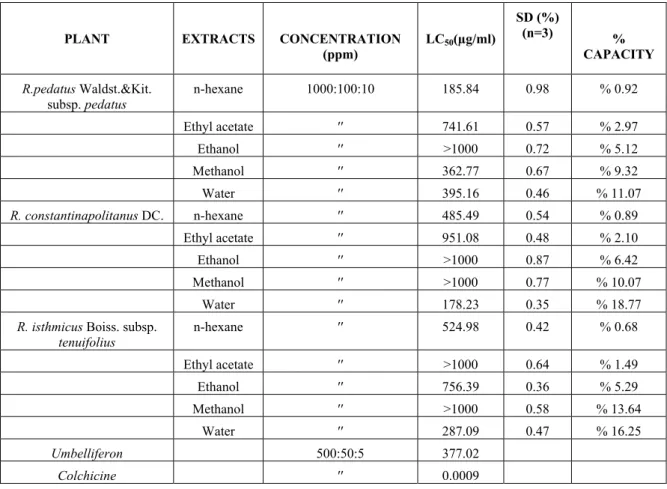
subsp. tenuifolius were investigated in vitro against the brine shrimp. The results are given in Table2.
Table 2. LC50 values of extracts of .pedatus Waldst.&Kit. subsp. pedatus, R. constantinapolitanus DC. and
R. isthmicus Boiss. subsp. tenuifolius on brine shrimp lethality bioassay
PLANT EXTRACTS CONCENTRATION
(ppm) LC50(µg/ml) SD (%) (n=3) % CAPACITY R.pedatus Waldst.&Kit. subsp. pedatus n-hexane 1000:100:10 185.84 0.98 % 0.92 Ethyl acetate ′′ 741.61 0.57 % 2.97 Ethanol ′′ >1000 0.72 % 5.12 Methanol ′′ 362.77 0.67 % 9.32 Water ′′ 395.16 0.46 % 11.07 R. constantinapolitanus DC. n-hexane ′′ 485.49 0.54 % 0.89 Ethyl acetate ′′ 951.08 0.48 % 2.10 Ethanol ′′ >1000 0.87 % 6.42 Methanol ′′ >1000 0.77 % 10.07 Water ′′ 178.23 0.35 % 18.77
R. isthmicus Boiss. subsp.
tenuifolius n-hexane ′′ 524.98 0.42 % 0.68 Ethyl acetate ′′ >1000 0.64 % 1.49 Ethanol ′′ 756.39 0.36 % 5.29 Methanol ′′ >1000 0.58 % 13.64 Water ′′ 287.09 0.47 % 16.25 Umbelliferon 500:50:5 377.02 Colchicine ′′ 0.0009
The phytochemical studies on various species of genus Ranunculus have reported that they contain flavonoids (quercetin, kaempherol, vitexin, isovitexin, orientin, isoorientin (15)), alkaloids (berberine, palmatine, columbamine, magnoflorine (11)), triterpenes (ursolic acid, oleanolic acid, betulunic acid (19)).
The Brine shrimp bioassay was used as an indicator for general toxicity and also as a guide for the detection of antitumor and pesticidal compounds (24). Vitexin and isovitexin were previously found to be cytotoxic (28). Cytotoxic effect of berberine was determined against human tumor cell lines and it presented interesting cytotoxicity (29). Ursolic acid showed modrate cytotoxicities against human cancer lines (30).
Vitexin, isovitexin, ursolic acid or berberine could be responsible for the observed Brine shrimp lethality activities of some extracts. The n-hexane, ethyl acetate, methanol and water extracts of R.pedatus Waldst.&Kit. subsp. pedatus, the n-hexane, ethyl acetate and water extracts of R. constantinapolitanus DC. and the n-hexane, ethanol and water extracts of R. isthmicus Boiss.
subsp. tenuifolius showed cytotoxic activity against the Brine shrimp. These extracts were toxic (LC50 <1000) in the Brine shrimp bioassay. The lethality of these extracts to Brine shrimp is
indicative of the presence in these plants of a potent cytotoxic component which warrants further investigation.
REFERENCES
1. Uğurlu, E., Seçmen, Ö. “Medicinal plants popularly used in the villages of Yunt mountain (Manisa-Turkey)”, Fitoterapia, 79, 126-131 (2008)
2. Gürhan, G., Ezer, N., “Halk arasında hemoroit tedavisinde kullanılan bitkiler-1”, Hacettepe
Üniversitesi Eczacılık Fakültesi Dergisi, 24 (1), 37-55 (2004)
3. Newall, C.A., Anderson, L.A., Phillipson, J.D., Herbal Medicines , Pharmaceutical Press, London, p. 209 (1996)
4. Passalacqua, N.G., Guarrea, P.M., De Fine, G., “Constribution to the knowledge of the folk plant medicine in Calabria Region (Southern Italy)”, Fitoterapia, 78, 52-68 (2007) 5. Honda,G., Yeşilada, E., Tabata, M., Sezik, E., Fujita, T., Takeda, Y., Takaishi, Y.,
Tanaka, T., “Traditional medicine in Turkey VI. Medicine in West Anatolia: Afyon, Kütahya, Denizli, Muğla, Aydın proviences”, J. Ethnopharmacol., 53, 75-87 (1996)
6. Sezik, E., Yeşilada, E., Honda, G., Takaishi, Y., Takeda, Y., Tanaka, T., “Traditional medicine in Turkey X. Folk Medicine in Central Anatolia”, J. Ethnopharmacology ,75, 95-115 (2001)
7. Tamura, M., Angiospermae Ordnung Ranunculales. Fam. Ranunculaceae. II. Systematic part. In: P. Hiepko, Editor, Natürliche Pflanzenfamilien (2nd ed.), Duncker and Humbolt, Berlin, p. 223–519 17a IV (1995)
8. Davis, P.H., Flora of Turkey, Davis, P.H. (Ed.), Edinburgh University Press, Edinburg, p. 146-195 (1965)
9. Davis, P.H., Flora of Turkey, Davis, P.H., Mill, R.R., Tan, K. (Eds.), 10, Edinburgh University Press, Edinburg ,p. 19-22, 231 (1988)
10. Baytop, T., Türkiye’ de Bitkilerle Tedavi, Nobel Tıp Kitabevleri (1999)
11. Bonora, A., Tosi, A., Dallolio, G., Bruni, A. “Quaternary alkaloids in rhizomes of R.
12. Markham, K.R., Campos, M., Mitchell, K.A. “An unusually lipophilic flavonol glycoside from R. sardous Pollen.” , Phytochemistry, 45 (1), 203-204 (1997)
13. Wegner, C., Hamburger, M., “Tensioactive compounds from the aquatic plant R.
fluitans L. (Ranunculaceae)” , Helv. Chim. Acta, 83, 1454-1464 (2000)
14. Prieto, J.M., Recio, M.C., Giner, S.M., Rios, J.L., “Pharmacological approach to the pro and anti-inflammatory effects of R. sceleratus L.”, J. Ethnopharmacology, 89, 131-137 (2003)
15. Webster, S.D., “A chromatographic investigation of the flavonoids of Ranunculus L. subgenus batrachium DC. (water buttercuos) and selected species in subgenus Ranunculus”,
Aquat. Bot., 40, 11-26 (1991)
16. Toki, K., Takeuchi, M., Saito, N., Honda, T., “Two malonylated antocyanidin glycosides in R. asiaticus”, Phytochemistry, 42 (4), 1055-1057 (1996)
17. Prieto, J.M., Braca, A., Morelli, F., Barker, A., Schaffner, M., “A new acylated quercetin glycoside from R. lanuginosus” , Fitoterapia, 75, 533-538 (2004)
18. Tian, J.K., Wu, L.M., Wang, M., Deng, L.Q., “Studies on chemical constituents of R.
ternatus”, J. Chin. Pharmaceut., 39 (9), 661-662 (2004)
19. Zhao, Y., Ruan, J.L., Wang, J.H., Cong, Y., Song, S., Caı, Y.L., Zhou, D.N., “Chemical constituents of Radix Ranunculi ternati”, Nat. Prod. Res., 22 (3), 233-240 (2008)
20. Karagöz, A., Cevahir, G., Özcan, T., Sadıkoğlu, N., Yentür, S., Kuru, A., “Bazı yüksek bitkilerden hazırlanan sulu ekstrelerin antiviral aktivite potansiyellerin değerlendirilmesi”, 14.BİHAT, Eskişehir, 318-321 (2002)
21. Misra, S.B., Dixit, S.N., “Antifungal properties of the leaf of R. sceleratus”, Experientia, 34, 1442 (1978)
22. Schinella, G.R., Tournier, H.A., Prieto, J.M., Rios, J.L., Buschiazzo, H., Zaidenberg, A., Barbaur, E.K., Sharif, M.A., Sagherian, U.K., Habre, A.N., Talhouk, S.N., “Screening of selected indigenous plants of lebanon for antimicrobical activity”, J.
Ethnopharmacol., 93, 1-7 (2004)
23. Orhan, I., Şener, B., Atıcı, T., Brun, R., Perozzo, R., Taşdemir, D., “Turkish freshwater and marine macrophyte extracts show in-vitro antiprotozoal activity and inhibit fabI, a key enzyme of Plasmodium falciparum fatty acid biosynthesis”, Phytomedicine, 13, 388-393 (2006)
24. Mc Laughlin, J.L., Chang, C.J., Smith, D.L., “Bench-top bioassays the discovery of bioactive natural products: an update”, Nat. Prod. Chem., 9, 383-397 (1991)
25. Finney, D.J., Probit Analysis, Cambridge University Press, (1971)
26. Mc Pherson, J.K., Chou, C.H., “Allelopathic constituents of the chaparral shrub
Adenostoma fasciculatum”, Phytochemistry, 10 (12), 2925 (1971)
27. Lee, K.H., “Novel antitumor agents from higher plants”, Med. Res. Rev., 19 (6), 569 (1999) 28. Hernández, M.M., Heraso, C., Villarred, M.L., Vargas-Arispuro, I., Aranda, E.,
“Biological activities of crude plant extracts from Vitex trifolia L.”, J. Ethnopharmacol., 67(1), 37-44 (1999)
29. Cordero, C.P., Gomez-Gonzalez, S., Leon-Acosta, C.J., Morantes-Medina, S.J., Aristizabal, F.A., “Cytotoxic activity of five compounds isolated from Colombian plants”,
Fitoterapia, 75, 225-227 (2004)
30. Min, B.S., Kim, Y.H., Lee, S.M., Jung, H.J., Lee, J.S., Na, M.K., Lee, C.O., Lee, J.P., Bae, K., “Cytotoxic triterpenes from Crategus pinnatifida”, Arch. Pharm. Res., 23(2), 155-158 (2000)
Received: 25.09.2009 Accepted: 18.03.2010