1Ankara University School of Medicine, Department of Public Health, Ankara
2Ankara University School of Medicine, Department of Psychiatry, Ankara
3Ankara University School of Medicine, Department of Bioistatistic, Ankara
Corresponding author Uz.Dr.M. Esin Ocaktan
Ankara University School of Medicine, Department of Public Health, Münzeviler sok. No:1 Akdere-Ankara, Turkey Phone : +90 (312) 363 89 90/133 E-mail adress : [email protected]
Received: 06.07.2006 • Accepted: 11.12.2006
D
epression is among the important reasons for disease related disabilities and more prevalent in women.Higher rates of depression in women is related to reproductive period (puberty, pregnancy, postpartum period and menopause) and the joint effects of biological and environmental provoking experiences (1,2).
Most studies on women had focused on postpartum period and pointed out that in this period women are highly vulnerable to depression. Depression rates increase in the first year after delivery (3,4). Prevalence of postpartum
depres-Aim: The aim of this community based study was to follow depression scores of pregnant women
after delivery and to determine factors associated with depressive mood in a primary health care center area.
Material and Method: In this study, all pregnant women (n=66) living in Park Health Center
Region in Ankara, completed a questionnaire and Edinburgh Postnatal Depression Scale (EPDS) once in pregnancy and twice in postpartum period at 2nd week and 6th month. EPDS scores above
cut off point (≥13) indicated possible depressive mood.
Results: Mean EPDS score in pregnancy was higher than both postpartum measurements
(p=0.054, p=0.003 respectively). Number of women with EPDS scores above cut-off declined in time as follows: 31.8% during pregnancy, 22.7% at postpartum 2nd week, 19.7% at postpartum 6th
month. Associated factors with postpartum depressive mood were type of delivery and working status (p<0.05).
Discussion: This study points out that women are at risk for depressive disorders not only in
postpartum period but also in pregnancy. Healthcare providers should consider possibility of de-pression in pregnant women.
Key words: Antepartum depression, pospartum depression, depression prevalence, EPDS
Amaç: Topluma dayalı bu çalışmada, Park Sağlık Ocağı bölgesinde yaşayan gebe kadınların
gebe-likte ve doğum sonrası depresyon skorlarını izlemek ve depresif duygu durum ile ilişkili faktörleri değerlendirmek amaçlanmıştır.
Gereç ve Yöntem: Park Sağlık Ocağı bölgesinde araştırma sırasında tespit edilen tüm
ler (n=66) Edinburgh Doğum Sonrası Depresyon Ölçeğini (EPDS) ve bir anket formunu gebe-lik sırasında bir kez, doğum sonrası iki kez (2.haftada ve 6. ayda) olmak üzere, toplam üç kez doldurmuşlardır. Depresif duygu durum tanısı için, EPDS kesme noktasına göre 13 ve üzeri puan olası depresif duygu duruma işaret etmiştir.
Bulgular: Tüm grubun ortalama EPDS puanı gebelikte, postpartum her iki ölçümden de
yük-sektir (ardışık olarak p=0.054, p=0.003). EPDS skoru kesme noktası üzerinde olan kadın oranı ge-belik döneminde %31.8 iken, doğum sonrası 2. hafta %22.7’ye, doğum sonrası 6.ayda %19.7’ye azalmıştır. Doğum sonrası depresif duygu durum varlığı ile doğumun şekli ve annenin çalışma durumu ilişkili bulunmuştur.
Tartışma: Bu çalışma ile, depresif bozukluk riskinin kadınlarda sadece doğum sonrası dönemde
değil, gebelikte de ortaya çıkabileceğini ve sağlık personelinin doğum sonrası olduğu kadar gebe-lik döneminde ruhsal durum değişikgebe-liklerini gözden kaçırmaması gerektiği sonucuna varılmıştır.
Anahtar sözcükler: Doğum öncesi depresyon, doğum sonrası depresyon, depresyon prevalansı, EPDS
Antepartum and postpartum depression in
a primary health care center area
Bir sağlık ocağı bölgesinde doğum öncesi ve doğum sonrası depresyonun değerlendirilmesi
sion varies between 13 %-35 % in different studies. This is due to the use of different depression scales and diag-nostic criteria, and also to differences in geographic and cultural regions where the studies are conducted (4-12). Usually initial depressive symptoms s are seen between 2nd-
8th weeks of postpartum period, and continues two weeks
to one year (3,12,13). Other psychiatric illnesses may also begin in this period but they are rare (obsessive compulsive disorder, psychos) or transient and less severe (baby blues) than postpartum depression (3,13).
Like postpartum period, physiological, hormonal and psychological changes occur at pregnancy (7). Several stud-ies reported that depressive symptoms in pregnancy were more frequent than postpartum period and antenatal de-pression was thougth to be more common (14-16). Factors associated with depression were similar in pregnancy and after delivery. Although obstetric, biological, psychologi-cal and social factors are important for aetiology of post-partum depression, antepost-partum personal and social factors are more relevant (6,12,17,18)and postpartum depression morbidity as well as perinatal outcomes are associated with depressed mood (19).
Maternal depression has a negative impact on the quality of the mother-infant relationship, cognitive and emotional development of child and their relationship with family (12,20,21). Children of depressed mothers are under in-creased risk for a variety of psychiatric problems, behavioral disturbances and social and achievement problems (22).
On the other hand several studies have yielded data to indicate that maternal stress and depression may have adverse physical effects on the newborn. It is found that increased risks of low birth weight, preterm delivery and small for gestastional age infants were associated with ma-ternal depressive symptoms (19).
In postpartum period and pregnancy vulnerability to mental illnesses are common and these cause important disturbances on infant, mother and family. Early identifi-cation and intervention should be provided (5). Investiga-tion of pregnant womens’ mental social and psychological status are as important as the assessment of their physical well being (15).
As rapid physiological and psychological changes are expe-rienced in pregnancy and postpartum period, cross sectional studies give limited information. Women should be evaluated longitudinally to determine the changes in their mood.
For these reasons, the purpose of this study was to deter-mine depression scores of women during pregnancy and fol-low it after childbirth, and to determine the prevalence and associated factors for antepartum and postpartum depressive mood in a primary health care center region in Ankara.
Materials and Methods
Subjects: In this prospective cohort study, all pregnant women living in a primary health care center region, in Ankara were included in the study. This is a semi-urban region with partly low or middle sociocenomic level. To-tal population of the region is 17.838, number of women between 15-49 years of age living in the region is 5225. Women between 15-49 years old are visited at their homes once in three months by nurses or midwifes who work in the health care center. During these visits all pregnant are visited at their homes at least 6 times during pregnancy and 3 times after delivery by nurses and midwifes. In Janu-ary 2003, 66 pregnant women in different trimesters of their pregnancies were exist all 15-49 years old women. All pregnant women were informed about the study and were taken verbal consent. Then all of the women accepted to participate to the study.
Materials: An anonymous questionnaire which
in-cluded questions such as age, educational level, presence of social security, working out of house, educational level of husband, age at marriage, reproductive features, presence of important disease during pregnancy, antenatal care, health conditions of mother and baby after delivery, wor-ries about taking care of the baby, history of mental disor-ders in mother herself, recent negative life events, breast-feeding and several factors related to delivery and baby.
Edinburgh Postnatal Depression Scale (EPDS) was used to assess depression scores. EPDS is a validated 10 item self-report questionnaire which is simple and practical to use in the primary care setting for detecting the cases with probable depressive disorder in pregnancy and postpartum period. It focuses on the cognitive and affective features of depression rather than somatic symptoms in the past 7 days. A large community study has revealed a specifity of 92.5% and a sensitivity of 88%. Usually, scores over13 and more has been shown to indicate a probable case of postpartum depression (12,13,16). EPDS is validated in Turkish population and its sensitivity and spesificity was reported to be 84% and 88% respectively (23).
Procedure: Pregnant women who completed the
ques-tionnaire and EPDS were reevaluated 2 weeks and six months after delivery during the routine home visits of nurses and midwifes. Women who had EPDS scores indi-cating possible depression were provided psychiatric con-sultations.
Data analysis: Descriptive analyses, chi-square, one-way anova, repeated measurement of one-one-way and two one-way ANOVA were used where appropriate. P value that were considered significant was less than 0.05.
Results
The mean age of the pregnant women was 25.21 years (range 17-40; SD 5.51 years). Eighteen percent (n=12) were in first, 36.4% (n=24) were in second and 45.4% (n=30) were in third trimester of their pregnancies. 39.4% (n=26) of the participants had one, 28.8% (n=19) had two, and 31.8% (n=21) had three or more pregnancies. Mean EPDS score of all pregnant women included in the study was 9.61±5.87. EPDS scores of women in differ-ent trimesters were as follows: 7.45±5.21 at first trimester, 10.85±5.50 at second trimester, 9.70±6.13 at third trimes-ter (F=1.175, p=0.315). Percentage of women with EPDS scores above cut off point were 16.7 % for first trimester, 41.7% for second trimester, 30.7 % for third trimester (χ²=2.38 p=0.302).
Mean EPDS scores at postpartum second week and sixth months were 8.06±6.54 and 7.26±6.62 respectively. The difference between mean EPDS scores of first and
sec-ond (t=1.963 p=0.054) and first and third (t=3.13 p=0.003) measurements were statistically significant. Second and third measurements were similar (t=1.594 p=0.116). Women with depression scores above EPDS cut-off point was 31.8% (n=22) in pregnancy, 22.7% (n=15) at post-partum 2nd week, and, 19.7% (n=13) at postpost-partum 6th month (χ²=2.82 p=0.244).
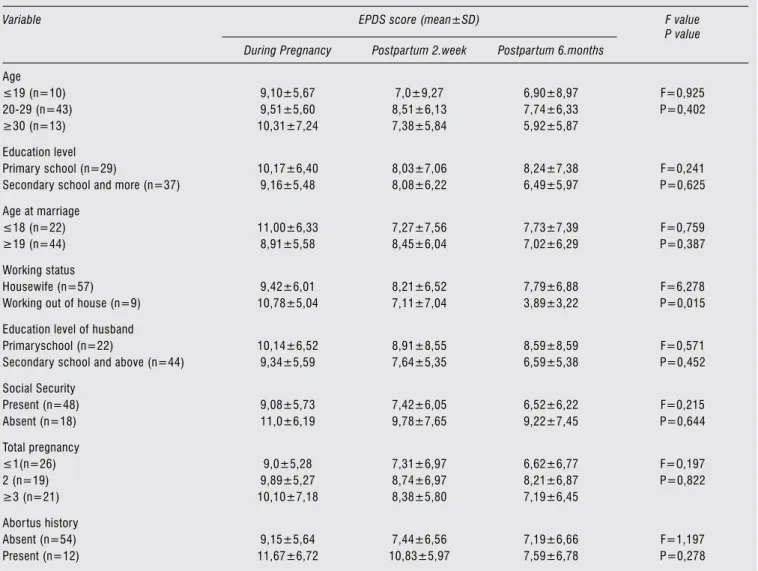
Depression scores of women with different sociode-mographic and reproductive characteristics are shown in Table 1. Women working out of house has lower depres-sion scores compared to housewifes (p=0.015). Interest-ingly while depression scores of housewifes tend to remain similar in all 3 measurements, there is a striking decrease for working women especially for the last measurement. For other factors depression scores were similar.
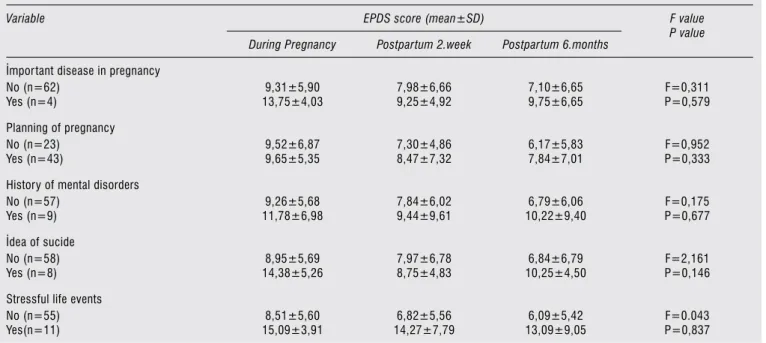
Depression scores of women with some selected risk factors are given in Table 2. Presence of physical illness in pregnancy, recent negative life events, history of mental
Table 1. Mean EPDS scores of women in pregnancy, 2 weeks and 6 months after delivery according to sociodemographic and reproductive
characteristics.
Variable EPDS score (mean±SD) F value
P value During Pregnancy Postpartum 2.week Postpartum 6.months
Age ≤19 (n=10) 20-29 (n=43) ≥30 (n=13) 9,10±5,67 9,51±5,60 10,31±7,24 7,0±9,27 8,51±6,13 7,38±5,84 6,90±8,97 7,74±6,33 5,92±5,87 F=0,925 P=0,402 Education level Primary school (n=29)
Secondary school and more (n=37)
10,17±6,40 9,16±5,48 8,03±7,06 8,08±6,22 8,24±7,38 6,49±5,97 F=0,241 P=0,625 Age at marriage ≤18 (n=22) ≥19 (n=44) 11,00±6,33 8,91±5,58 7,27±7,56 8,45±6,04 7,73±7,39 7,02±6,29 F=0,759 P=0,387 Working status Housewife (n=57) Working out of house (n=9)
9,42±6,01 10,78±5,04 8,21±6,52 7,11±7,04 7,79±6,88 3,89±3,22 F=6,278 P=0,015 Education level of husband
Primaryschool (n=22)
Secondary school and above (n=44)
10,14±6,52 9,34±5,59 8,91±8,55 7,64±5,35 8,59±8,59 6,59±5,38 F=0,571 P=0,452 Social Security Present (n=48) Absent (n=18) 9,08±5,73 11,0±6,19 7,42±6,05 9,78±7,65 6,52±6,22 9,22±7,45 F=0,215 P=0,644 Total pregnancy ≤1(n=26) 2 (n=19) ≥3 (n=21) 9,0±5,28 9,89±5,27 10,10±7,18 7,31±6,97 8,74±6,97 8,38±5,80 6,62±6,77 8,21±6,87 7,19±6,45 F=O,197 P=0,822 Abortus history Absent (n=54) Present (n=12) 9,15±5,64 11,67±6,72 7,44±6,56 10,83±5,97 7,19±6,66 7,59±6,78 F=1,197 P=0,278
disorders, presence of suicidal ideation had a tendency to effect mothers’ mood negatively in pregnancy but these ef-fects were not statistically significant (p>0.05)
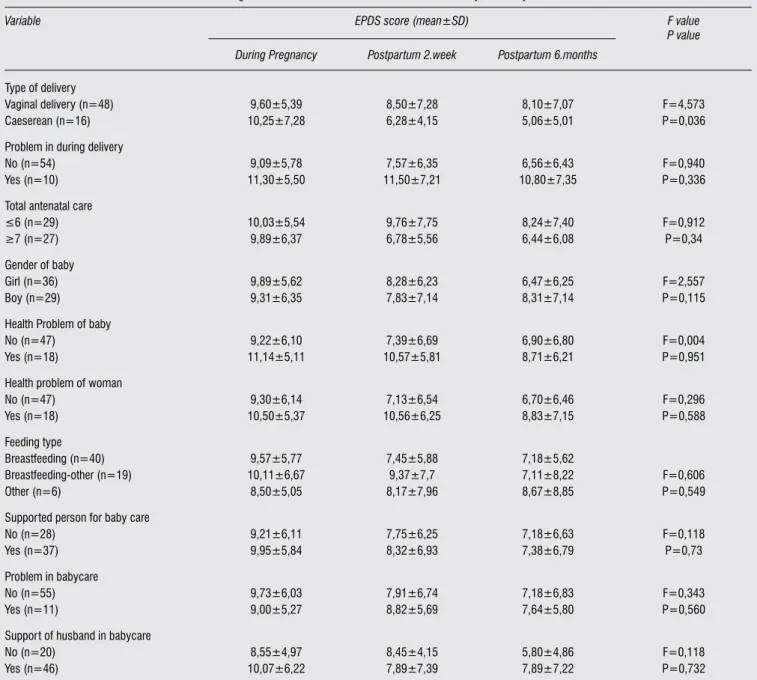
EPDS scores were also examined according to some se-lected factors related to delivery and baby. EPDS scores in pregnancy were taken as base-line value. The only factor associated with depression score was type of delivery (Table 3). Women who had caeserean sectio had lower depression scores after delivery (p=0.036). Women who experienced problems during delivery, who were given antenatal care less than 6 times, whose babies had health problems, who herself had health problems after delivery, and who per-ceived their babies as difficult to look after had a tendency to have higher scores in EPDS, however this difference was not statistically significant. Women who have breastfeed-ing have less score means than never breastfeedbreastfeed-ing.
Discussion
This study suggests that pregnant women moved above the threshold for depression in later trimesters of pregnan-cy similar to another study result (16). Percentage of preg-nant women who had experienced depression reported that 12%-14% in previous studies (7,19,24). Depression scores declined in postpartum period. This finding is simi-lar to other studies in which depression scores were higher in pregnancy than in postpartum period and depressive symptoms were more frequent in pregnancy (14, 19, 25).
Few studies have examined the predictors of depres-sion, however they all report that the most important predictor of postpartum depression is depressed mood in
pregnancy consistently (19,25). In general childbirth may be a nonspecific stressor for depression, on the other hand it may also be considered as a preventive event against de-pression.
Follow up of depression scores revealed that depressive mood declined in time. Hung et all, in a longitudinal study reported that postpartum stress was higher in third and fifth postpartum weeks than in first weeks after delivery (26). As we only have the depression scores for 2nd week
and 6th month, we might have missed this increase. In a cross-sectional study in Turkey, depression prevalence increased in time, however that study group also includ-ed women in postpartum one year and more (27). This finding might be explained by the decrease of social and physical support in time which was provided to mother few weeks after delivery. This support may have a positive effect on womens’ mood. With the decline in the support provided to the new mother, she might return to her mood before delivery.
In this study, women with depression scores above cut off point were 22.7% for 2nd week and 19.7% for 6th
month. Postpartum depressive disorder rates in Turkey are similar to other countries’ data and varies between 14% - 36% (6,21,28,29). Prevelance of postpartum depression is reported to be between 13%- 34.7% (5,10,13,30-33). This wide range of prevelance may be a result of socioeconomic and cultural differences of the samples, different scales used for measurement of depression and to use of different cut-off points. In our study percentage of women with possible depressive disorder was also between this range.
Table 2. Mean EPDS scores of women according to some selected risk factors.
Variable EPDS score (mean±SD) F value
P value During Pregnancy Postpartum 2.week Postpartum 6.months
İmportant disease in pregnancy No (n=62) Yes (n=4) 9,31±5,90 13,75±4,03 7,98±6,66 9,25±4,92 7,10±6,65 9,75±6,65 F=0,311 P=0,579 Planning of pregnancy No (n=23) Yes (n=43) 9,52±6,87 9,65±5,35 7,30±4,86 8,47±7,32 6,17±5,83 7,84±7,01 F=0,952 P=0,333 History of mental disorders
No (n=57) Yes (n=9) 9,26±5,68 11,78±6,98 7,84±6,02 9,44±9,61 6,79±6,06 10,22±9,40 F=0,175 P=0,677 İdea of sucide No (n=58) Yes (n=8) 8,95±5,69 14,38±5,26 7,97±6,78 8,75±4,83 6,84±6,79 10,25±4,50 F=2,161 P=0,146 Stressful life events
No (n=55) Yes(n=11) 8,51±5,60 15,09±3,91 6,82±5,56 14,27±7,79 6,09±5,42 13,09±9,05 F=0.043 P=0,837
Type of delivery and working out of house were associ-ated factors to depression scores in postpartum period. Ac-cording to Chaaya et all. Caeserean sectio decreases the risk of postpartum depression (30). This relation is explained by the difficulties experienced during vaginal delivery. However there are other studies reporting no association between type of delivery and postpartum depressive symptoms (34).
Working out of house is an important indicator about social status of women. Unemployment is frequently re-ported to have a significant relationship with postpartum depression (5,6,12).
Low educational level (6,19,28,31), marriage at an ear-ly age (5,6,28,30) were frequentear-ly reported to have an
im-portant effect on postpartum depressed mood. Also socio-economic characteristics are usually reported as important predictors of postpartum depression (35). Various studies reported a negative but not significant effect of recent neg-ative life events (12,30,31,35,36), history of mental disor-ders (4,6,12,30,31), important diseases in pregnancy (30), and stressful life events (12,30,31) on mother’s mood.
Problems encountered during delivery (36), health prob-lem of mother or baby after birth (3), perception of babycare as difficult (35,37), and status of antenatal care (6) were most-ly associated with postpartum depression in various studies.
Although it is not a significant factor in this study, breastfeeding may be a preventive factor for depressive
dis-Table 3. Mean EPDS scores of women according to some selected risk factors related to delivery and baby
Variable EPDS score (mean±SD) F value
P value During Pregnancy Postpartum 2.week Postpartum 6.months
Type of delivery Vaginal delivery (n=48) Caeserean (n=16) 9,60±5,39 10,25±7,28 8,50±7,28 6,28±4,15 8,10±7,07 5,06±5,01 F=4,573 P=0,036 Problem in during delivery
No (n=54) Yes (n=10) 9,09±5,78 11,30±5,50 7,57±6,35 11,50±7,21 6,56±6,43 10,80±7,35 F=0,940 P=0,336 Total antenatal care
≤6 (n=29) ≥7 (n=27) 10,03±5,54 9,89±6,37 9,76±7,75 6,78±5,56 8,24±7,40 6,44±6,08 F=0,912 P=0,34 Gender of baby Girl (n=36) Boy (n=29) 9,89±5,62 9,31±6,35 8,28±6,23 7,83±7,14 6,47±6,25 8,31±7,14 F=2,557 P=0,115 Health Problem of baby
No (n=47) Yes (n=18) 9,22±6,10 11,14±5,11 7,39±6,69 10,57±5,81 6,90±6,80 8,71±6,21 F=0,004 P=0,951 Health problem of woman
No (n=47) Yes (n=18) 9,30±6,14 10,50±5,37 7,13±6,54 10,56±6,25 6,70±6,46 8,83±7,15 F=0,296 P=0,588 Feeding type Breastfeeding (n=40) Breastfeeding-other (n=19) Other (n=6) 9,57±5,77 10,11±6,67 8,50±5,05 7,45±5,88 9,37±7,7 8,17±7,96 7,18±5,62 7,11±8,22 8,67±8,85 F=0,606 P=0,549 Supported person for baby care
No (n=28) Yes (n=37) 9,21±6,11 9,95±5,84 7,75±6,25 8,32±6,93 7,18±6,63 7,38±6,79 F=0,118 P=0,73 Problem in babycare No (n=55) Yes (n=11) 9,73±6,03 9,00±5,27 7,91±6,74 8,82±5,69 7,18±6,83 7,64±5,80 F=0,343 P=0,560 Support of husband in babycare
No (n=20) Yes (n=46) 8,55±4,97 10,07±6,22 8,45±4,15 7,89±7,39 5,80±4,86 7,89±7,22 F=0,118 P=0,732
order, mother’s who are breastfeeding have less mean scores than mothers who never breastfed their babies. Study of Abu Saleh et al supported that women who breastfed had significantly lower EPDS scores (18).
To summarize, working out of house and type of de-livery were mainly predictive factors for depressive mood in postpartum period. Housewifes and women with a history of difficult normal vaginal delivery should be candidates for depression screening. Unfortunately the majority of these women are probably undiagnosed and untreated despite the fact that simple reliable detection method for pregnancy and postpartum period have been developed. Undetected depression may be prolonged and affects the mother, her infant and her family and affects society through illness, social dysfunction, death and the cost of medical treatment and services. So, there is great responsibility of physician to identify the women at risk for psychological disturbances during pregnancy and early postpartum period. Early remission from depression, was
related to improved both maternal mood and the quality of the mother-infant relationship (12,15,24,30).
EPDS is a valid measurement for postpartum depres-sion. However depression is a clinical diagnosis and the absence of a standardized clinical interview is a limita-tion for the study. Other limitalimita-tion was small number of women included in the study. Communication problems with some participants, reaching the participants for every measurement were experienced as difficulties in conduct-ing the study.
In conclusion, this study points out that depressive syp-mtoms reached to important levels for all measurements, but they are higher in pregnancy than postpartum period.
Investigation of antepartum period provides an oppor-tunity for intervention to healthy development of mother, infant and family. So, women who are at risk for depressive disorders have to be identified not just only in postpartum period, but also during pregancy and preferably during all reproductive period in women.
References
1. Kessler RC. Epidemiolgy of women and depression. Journal of Aff ective Disorders 2003;74:5-13.
2. Steiner M, Dunn E, Born L Hormones and mood:from menarche to menopause end beyond. Journal of Aff ective Disorders 2003;74:67-83.
3. Kara B, Cakmakli P, Nacak E ve ark. Doğum sonrası depresyon, In Turkish. STED 2001;10:333-334.
4. Danaci AE, Dinc G, Deveci A et al. Postnatal depression in Turkey: epidemiological and cultural aspect. Soc Psychiatry Psychiatr Epidemiol 2002;37:125-129.
5. Lane A, Keville R, Morris M et al. Postnatal depression and elation among and their partners: prevalence and predictors. British Journal of Psychiatry 1997;171:550-555.
6. Inandi T, Elci OC, Ozturk A ve ark. Risk factors for depression in postnatal fi rst year, in eastern Turkey. International Journal of Epidemiology 2002;31:1201-1207.
7. Andersson L, Sunström-Poromaa I, Bixo M et al. Point prevalence of psychiatric disorders during the second trimester of pregnancy: a population-based study. Am J Obstet Gynecol 2003;189:148-54. 8. Matthey S, Barnett B, Ungerer J et al. Paternal and maternal
depressed mood during the transition to parenthood. Journal of Aff ective Disorders 2000;60:75-85.
9. Lee DTS, Yip SK, Chiu HFK et al. Detecting postnatal depression in Chinese women. British Journal of Psychiatry 1998;172:433-437.
10. Cooper PJ, Tomlinson M, Swartz L et al. Post-partum depression and the mother-infant relationship in South African peri-urban settlement. British Journal of Psychiatry 1999;175:554-558. 11. Aff onso DD, De AK, Horowitz JA et al. An international study
exploring levels of postpartum depressive symptomotology. Journal of Psychosomatic Research 2000;49:207-216.
12. Cooper PJ, Murray L. Clinical review: Postnatal depression. BMJ 1998;316:1884-1889.
13. Morris-Rush JK, Freda MC, Bernstein PS. Screening for postpartum depression in an inner-city population. Am J Obstet Gynecol 2003;188:1217-19.
14. Gotlib IH, Whiff en VE, Mount JH et al. Prevalence rates and demographic characteristics associated with depression in pregnancy and the postpartum. J Consult Clin Psychol 1989;57:269-74. 15. Wilson LM, Reid AJ, Midmer DK et al. Antenatal psychosocial
risk factors associated with adverse postpartum family outcomes. Can Med Assoc J 1996;154:785-799.
16. Evans J, Heron J, Francomb H et al. Cohort study of depressed mood during pregnancy and after childbirth. BMJ 2001;323:257-260.
17. Ahokas A, Kaukoranta J, Aito M. Eff ect of oestradiol on postpartum depression. Psyhopharmacology 1999;146:108-110.
18. Abou-Saleh MT, Ghubash R, Karim L et al. Hormonal aspect of postpartum depression. Psychoneuroendocrinology 1998;23;465-475.
19. Mc Elderry D. Screening of adolescent females for depression before, during and after pregnancy. Opinions in Pediatric and Adolescent Gynecology 2001;1,14:131-33.
20. Murray L, Cooper P.J. Postpartum depression and child development. Psychological Medicine 1997;27:253-60.
21. Meighan M, Davis MW, Th omas SP et al. Living with postpartum depression: the father’s experience. MCN 1999;24:202-208. 22. Lovejoy MC, Graczyk PA, O’Hare E et al. Maternal depression and
parenting behaviour: A meta-analytic review. Clinical Psychology Review 2000;20: 561-592.
23. Engindeniz AN, Kuey L, Kultur S. Th e Turkish version of Edinburgh Postnatal Depression Scale; A Study of Validity and Reliability. Spring Symposium First Book. Psychiatry Association Press, Ankara;2000.
24. Georgiopulos AM, Bryan TL, Yawn BP et al. Population-Based Screening for Postpartum Depression. Obstetrics&Gynecology 1999;93:654-657.
25. Costa DD, Larouche J, Dritsa M et al. Psychosocial correlates of prepartum and postpartum depressed mood. Journal of Aff ective Disorders 2000;59:31-40.
26. Hung CH, Chung HH. Th e eff ect of postpartum stres and social support on postpartum women’s health status. International Journal of Nursing Practice 2001;36;676-684.
27. Bugdayci R., Sasmaz T, Tezcan H ve ark. A cross-sectional prevalence study of depression At various times after delivery in Mersin province in Turkey. Journal of Women’s Health 2004;13:63-68. 28. Gürel SA, Gürel H. Th e evaluation of determinants of early
postpartum low mood: the importance of parity and inter-pregnancy interval. European Journal of Obstetrics&Gynecology and Reproductive Biology 2000;91:21-24.
29. Ekuklu G, Tokuç B, Eskiocak M ve ark. Prevalence of Postpartum Depression in Edirne,Turkey and Related Factors. J Reprod Med 2004;49:908-914.
30. Chaaya M, Campbell MR, El Kak F et al. Postpartum Depression: Prevaence and determinants in Lebanon, Archives of Womens Mental Health 2002;5:65-72.
31. Johnstone SJ, Boyce PM, Hickey AR et al. Obstetric risk factors for postnatal depression in urban and rural community samples. Australian and New Zealand Journal of Psychiatry 2001;35: 69-74. 32. Hana B, Jarman H, Savage S. Th e clinical application of three
screening tools for recognizing post-partum depression. Journal of Advanced Nursing 2004;10:72-79.
33. Huang YC, Mathers N. Postnatal depression-biological or cultural? A comparative study of postnatal women in the UK and Taiwan. Journal of Advanced Nursing 2001;33:279-287.
34. Josefsson A, Lisbeth A, Berg G et al. Obstetric, Somatic and Demographic Risk Factors for Postpartum Depressive Symptoms. Obstetrics&Gynecology 2002;99:223-228.
35. Beck CT. Predictors of Postpartum Depression, Nursing Research 2001;50:275-285.
36. Yoshida K, Marks MN, Kibe N et al. Postnatal depression in Japanese women who have given birth in England. Journal of Aff ective Disorders 1997;43:69-77.
37. Th ome M. Predictors of postpartum Depressive Symptoms in Icelandic Women. Archives of Womens Health 2000;3:7-14.