Prevalence of erectile dysfunction in men over 40 years of age in
Turkey: Results from the Turkish Society of Andrology Male Sexual
Health Study Group
Selahittin Çayan1, Muammer Kendirci2, Önder Yaman3, Ramazan Aşçı4, İrfan Orhan5, Mustafa Faruk Usta6, Oğuz Ekmekçioğlu7, Ateş Kadıoğlu8
1Department of Urology,
Mersin University School of Medicine, Mersin, Turkey
2Department of Urology,
İstinye University School of Medicine, Liv Hospital Ulus, İstanbul, Turkey
3Department of Urology,
Ankara University School of Medicine, Ankara, Turkey
4Department of Urology,
Ondokuz Mayıs University School of Medicine, Samsun, Turkey
5Department of Urology, Fırat
University School of Medicine, Elazığ, Turkey
6Department of Urology,
Akdeniz University School of Medicine, Antalya, Turkey
7Department of Urology,
Erciyes University School of Medicine, Kayseri, Turkey
8Section of Andrology,
Department of Urology, İstanbul University İstanbul School of Medicine, İstanbul, Turkey Submitted: 09.05.2017 Accepted: 20.05.2017 Correspondence: Muammer Kendirci E-mail: [email protected] ©Copyright 2017 by Turkish Association of Urology Available online at www.turkishjournalofurology.com ABSTRACT
Objective: Previous study conducted by the Turkish Society of Andrology in 1999 reported the prevalence of erectile dysfunction (ED) as 69.2% in men of ≥40 years of age, using a single-item non-validated question. This rate seemed to be higher compared to the studies reported worldwide. So, there was a need to carry out another epidemiological study by using validated questionnaires. Our aim was to investigate ED prevalence, severity, and its correlates in men aged ≥40 years using validated tools.
Material and methods: This cross-sectional, observational, population-based field survey was carried out in randomly selected males of ≥40 years from 19 provinces of Turkey. All participant completed a survey in-cluded with socio-demographic and socio-economic characteristics, medical and sexual history, associated physical and medical comorbidities. Erectile function was assessed by the International Index of Erectile Function (IIEF) questionnaire based on a total score of 30. The prevalence of ED, its severity and correlates in men aged ≥40 years were determined for main outcome measures. Data sets were statistically compared and p<0.05 was considered as significant.
Results: Median age of 2.760 males was 54.2 years. The mean prevalence of ED was calculated as 33% among all males of ≥40 years of age. When subjects were stratified by age; mean ED prevalence rates were 17% for 40–49 years, 35.5% for 50–59 years, 68.8% for 60–69 years, and 82.9% for ≥70 years. Among all ED men, 76.9% reported mild, 16.3% moderate, and 5.7% severe ED. At logistic regression analyses; age, diabetes, hypertension, atherosclerosis, dyslipidemia, lower urinary tract symptoms, educational status and monthly income were found to be independent risk factors for having ED.
Conclusion: This population-based survey in Turkish men of ≥40 years of age reported the prevalence of ED as 33%. Besides, this study reported age as the main predictor for presence and severity of ED. Keywords: Comorbidities; diagnosis; ejaculatory disorders; epidemiology; erectile dysfunction; lower uri-nary tract symptoms; prevalence; risk factors; sexual dysfunction; vascular risk factors.
Introduction
Erectile dysfunction (ED) is defined as the in-ability to attain and/or maintain penile erection sufficient for satisfactory sexual intercourse.[1] ED is a common disorder associated with aging that significantly impacts quality of life of men and their partners. ED has traditionally been classified as psychogenic, organic, or mixed type. Recent data show that approximately more than 90% of men aged over 40 years with ED
have an organic cause, with vascular diseases being the most common etiology.[2] Although ED is a natural consequence of aging, its sever-ity is directly related to vascular risk factors, such as high blood pressure, atherosclerosis, coronary artery disease, smoking, dyslipidemia, and diabetes mellitus, all of which are associ-ated with endothelial dysfunction.[3]
As the penis has been recently considered as the barometer of the body’s endothelial
func-tion, it is reasonable then to blame vascular risk factors as direct causes and worsening contributors of ED.[4] ED may also be the first clinical presentation of any of these comorbidities with the vascular endothelium playing a pivotal role in regulating vas-cular homeostasis of the corpora cavernosa. For these reasons, it might be of importance to know the prevalence and severity of ED in a population in order to extrapolate findings to better health care.
The Massachusetts Male Aging Study (MMAS), a substantial epidemiological survey quantitated the prevalence of ED in a non-institutionalized population of men. It revealed that 52% of 1,290 men aged 40 to 70 years had some degree of ED, with almost 10% exhibiting a total absence of erectile function.[5] Ex-trapolation of this data predicts that the worldwide incidence of ED will increase from 152 million men in 1995 to 322 million men by the year 2025.[6] Recent calculations reveal the overall incidence of ED after an average follow-up of 8.8 years to be 26 cases per 1,000 man-years.[7]
The first epidemiological survey conducted in Turkey in 1999 to determine the prevalence of ED and its associations with so-cio-economic, cultural factors, medical and lifestyle conditions. This population-based survey that included 1,982 men showed the age-adjusted overall prevalence of ED as 69.2% in men aged ≥40 years.[8] These findings of this study have been questioned for years for its method of using single-item self-reported ques-tion that was not universally-accepted. After improvements in assessing erectile function and its severity in recent years, a need to determine the real prevalence of ED in Turkey by using validated and universally-accepted questionnaires that assess a number of aspects of erectile function has arisen.
The goal of this cross-sectional, observational, population-based field survey was to determine the prevalence of ED and its as-sociations in Turkish men aged ≥40 years.
Material and methods
Subjects and study design
This study was conducted as non-interventional, observational, cross-sectional field survey. A total of 2,760 subjects from seven Eurostat-NUTS Level-2 regions randomly selected among 19 provinces of the country by a proportional sampling method ac-cording to postal code lists. The subjects were recruited to be representative of the Turkish population in terms of population distribution across urban and rural settings, geographic regions, and age groups. Heterosexual men who were ≥40 years of age and who had had regular sexual intercourse within the last 6 months were included. Participants who had a cognitive disorder or who were incapable of comprehending and speaking Turkish at a level that constrained understanding, and clear and direct
answering to the questions in the study form were excluded. Be-fore enrollment, the subjects were informed about the study and provided written informed consent. The Ethics Committee of the Ministry of Health approved the study before its initiation. Field survey
All subject were visited in their homes by trained health care workers who understood the text of the survey and its applica-tion for interviews, and asked the patients to respond all survey questions regarding demographics, socio-economic status, so-cio-cultural factors, medical and sexual history, current medica-tions, and sexual habits.
Possible determinants
The trained healthcare workers understood the text of the sur-vey and have been trained in its application in Turkish language for clinical interviews. In order to assess various aspects of ED, the entire study participants completed nationally-validated standardized International Index of Erectile Function (IIEF) questionnaire. The IIEF questionnaire was originally a 15-item scale of male sexual function that assessed separate domains of erectile function, orgasmic function, intercourse satisfaction, or-gasmic function, and overall satisfaction. However, an abridged form of the IIEF scale, IIEF-5, was used to assess erectile func-tion for the survey. The validated IIEF-5 scale consists of five questions scored from 0 to 5 points assessing erectile function domain and one additional item for overall satisfaction scored from 1 to 5, amounting to a total score of 30. ED was classified as absent (26–30), mild (18–25), moderate (11–17), or severe (0–10).[9]
Presence of associated morbid medical conditions including dia-betes mellitus, hypertension, atherosclerosis, cardiovascular and pulmonary diseases, renal insufficiency, prior pelvic surgeries, hormonal abnormalities (e.g. pituitary and thyroid hormone ab-normalities, testosterone deficiency, and adrenal disorders), dys-lipidemia, and other comorbidities and lifestyle factors such as smoking, alcohol consumption, and obesity were also assessed by standardized survey filled by the professionals. Body mass index (BMI) was calculated for all participants by dividing the body weight with square of the height in meters (kg/m2), and stratified as normal (<25), overweight (≥25 to 30), and obese (>30). Finally, the participants were requested to respond to a number of socio-demographic factors including overall monthly income, educational level, occupation, the geographic region, and province they were living.
After estimating the prevalence of ED in the study population, logistic regression analyses were performed to obtain indepen-dent predictors of ED such as age, comorbid medical conditions, lifestyle, and socio-demographic factors. The relation between ED and frequency of monthly sexual activity, lower urinary tract
symptoms (LUTS), ejaculatory disorders (EjD), and male pelvic dysfunction (MPD) were also evaluated. LUTS, EjD, and MPD were measured using standardized, nationally-validated ques-tionnaires included IPSS and MSHQ–4, and IIEF–5 as well. All three validated questionnaires were combined in order to define the presence of MPD as previously described.[10]
Statistical analysis
Statistical analysis was performed using Statistical Package for the Social Sciences (SPSS Inc.; Chicago, IL, USA) version 15.0 and using Stata v9.0 program (Stata Corp., College Station, Tex-as, USA). The prevalence of ED is presented for the whole group and then stratified according to age groups and severity of ED. Two groups were compared using Mann–Whitney U test and multiple groups were compared using Kruskal-Wallis test for nonparametric variables. Categorical variables were compared using chi-square test and Monte-Carlo simulation. Logistic re-gression analysis was performed using Backward LR method in order to find independent predictors. Level of significance was accepted as a p<0.05.
Results
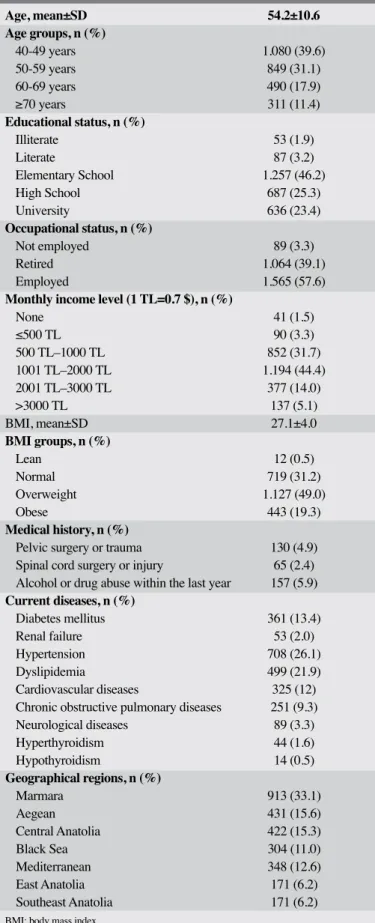
The mean age of a total of 2,760 males who completed the sur-vey was 54.2±10.6 years. Demographic data of the study partici-pants including age, inhabitancy, overall monthly income, occu-pational status, educational level, geographical region, medical history, BMI, and associated morbidities are provided in Table 1. Overall and age-stratified prevalence of ED
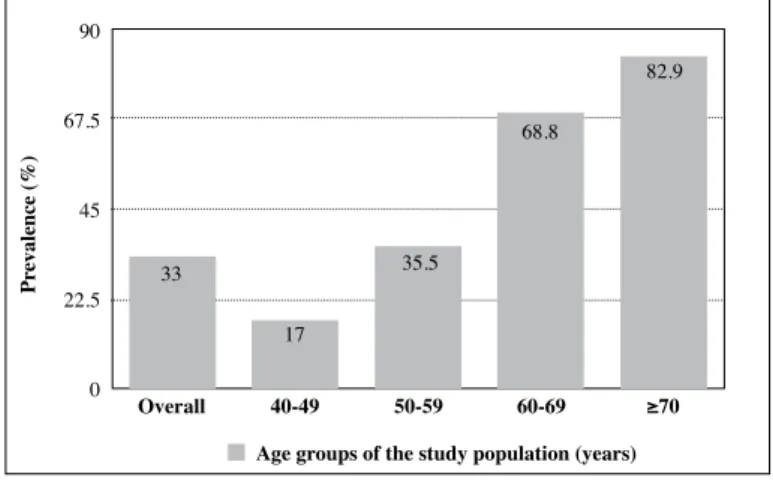
Overall prevalence of ED in men aged ≥40 years was found to be 33% among entire participants of the study. When the preva-lence of ED was stratified based on subjects’ age, it was 17.0% in men aged in 40–49, 35.5% in 50–59, 68.8% in 60–69 age brack-ets, and 82.9% in men ≥70 years (Figure 1). When compared to age group of 40–49 years, the prevalence of ED increased in parallel with age ie: 2.3-fold (1.78-2.96) for 50-59, 7.6-fold (5.44-10.55) for 60-69 age brackets, and 15.5-fold (8.93-26.94) for ≥70 years (<0.001) (Table 2).
Mean IIEF scores for the whole study population was found to be 26.1. Mean IIEF scores were stratified according to age groups, and IIEF scores decreased with aging (27.9 for 40-49, 26.0 for 50-59, 23.2 for 60-69, and 17.8 for ≥70 years) (Figure 2).
Overall and age-stratified severity of ED
When study participants were stratified by severity of ED, 67% of them reported no ED, 25.6% mild, 5.5% moderate, and 1.9% severe ED. Among all men with ED, aged ≥40 years, the rate of moderate-to-severe ED was found to be 22.5%. The overall rate for moderate-to-severe ED in entire population was calcu-lated as 7.4%. When the rate of having moderate-to-severe ED
in all study participants was stratified and calculated based on the age groups, there was a significant change according to the each decade of aging as 2.5% for 40–49, 5.8% for 50–59, 12.9% for 60–69, and 49.2% for ≥70 years, correlating with increased age (Figure 3).
Impact of socio-economic and demographic factors on ED Impact of socio-economic and demographic characteristics of the study population on presence of ED was also analyzed statistically. When educational status of the study participants was evaluated 48.7% of them were either high school or uni-versity graduates. Analyzed data exhibited that the likelihood of having ED was significantly increased at lower educational levels (p<0.001). When the graduation from a university was accepted as reference, the prevalence of ED increased 1.54− fold (1.16−2.03; p=0.002) for high school, 1.8−fold (1.34−2.23; p<0.001) for elementary school graduates, and 4.34−fold (2.23−8.24; p<0.001) for illiterates (p<0.001).
Figure 1. Overall and age-dependent prevalence of erectile dysfunction in men aged ≥40 years of age
33 90 67.5 45 22.5 0 17 Overall Pr evalence (%) 40-49 50-59
Age groups of the study population (years)
60-69 ≥70
35.5
68.8
82.9
Figure 2. Overall and age-dependent mean scores of the IIEF
26.1 27.9 26 23.2 17.8 30 25 20 15 10 5 0 Overall Mean IIEF scor es 40-49 50-59
Age groups of the subjects (years)
The impact of employment on presence of ED was also evalu-ated. Although being employed or unemployed did not show meaningful difference regarding rates of ED (p=0.809), only 20.1% of non-ED but 50.3% of ED men reported as retired (p<0.001). Parallel to this finding, being retired was found to be an independent risk factor for having ED with 4−fold increased risk compared to active working (p<0.001).
The possibility of having ED in men living in urban areas was 1.55−fold higher than those living in rural areas (1.091−2.207; 95% C.I. for EXP, p=0.014). The impact of earnings was also
Table 1. Socio-demographic characteristics and clinical features of the study population
Age, mean±SD 54.2±10.6 Age groups, n (%) 40-49 years 1.080 (39.6) 50-59 years 849 (31.1) 60-69 years 490 (17.9) ≥70 years 311 (11.4) Educational status, n (%) Illiterate 53 (1.9) Literate 87 (3.2) Elementary School 1.257 (46.2) High School 687 (25.3) University 636 (23.4) Occupational status, n (%) Not employed 89 (3.3) Retired 1.064 (39.1) Employed 1.565 (57.6)
Monthly income level (1 TL=0.7 $), n (%)
None 41 (1.5) ≤500 TL 90 (3.3) 500 TL–1000 TL 852 (31.7) 1001 TL–2000 TL 1.194 (44.4) 2001 TL–3000 TL 377 (14.0) >3000 TL 137 (5.1) BMI, mean±SD 27.1±4.0 BMI groups, n (%) Lean 12 (0.5) Normal 719 (31.2) Overweight 1.127 (49.0) Obese 443 (19.3) Medical history, n (%)
Pelvic surgery or trauma 130 (4.9) Spinal cord surgery or injury 65 (2.4) Alcohol or drug abuse within the last year 157 (5.9) Current diseases, n (%) Diabetes mellitus 361 (13.4) Renal failure 53 (2.0) Hypertension 708 (26.1) Dyslipidemia 499 (21.9) Cardiovascular diseases 325 (12) Chronic obstructive pulmonary diseases 251 (9.3) Neurological diseases 89 (3.3) Hyperthyroidism 44 (1.6) Hypothyroidism 14 (0.5) Geographical regions, n (%) Marmara 913 (33.1) Aegean 431 (15.6) Central Anatolia 422 (15.3) Black Sea 304 (11.0) Mediterranean 348 (12.6) East Anatolia 171 (6.2) Southeast Anatolia 171 (6.2) BMI: body mass index
Table 2. Relative risk for having ED according to age between 40 to 49 years of age
Level of
Age (years) Significance Exp (B) 95% C.I. for Ext (B)
40-49 Reference 1 Lower Upper
50-59 <0.001 2.299 1.782 2.964 60-69 <0.001 7.574 5.438 10.551 ≥70 <0.001 15.509 8.929 26.937 Table 3. Comparisons of the rates of ED and No-ED in stratified BMI groups
No ED ED
n (%) n (%) p
BMI Thin or Normal 386 (29.7) 200 (31.3) 0.624 Overweight 663 (51.0) 311 (48.7)
Obese 251 (19.3) 128 (20.0) BMI: body mass index
Figure 3. Overall and age-dependent rate of mild, moderate and severe erectile dysfunction according to the age stratifi-cation 14.6 1.7 0.8 25.6 5.5 1.9 67 29.7 56 33.9 17 4.5 11.71.2 17.9 31.3 1.3 64.5 31.1 83
No ED Mild ED Moderate ED Severe ED Age groups of study population
Overall 40-49 50-59 60-69 ≥70 100 80 60 40 20 0
Percentage of subjects with no, mild, moderate and severe ED
Pr
evaluated, men with lower monthly income reported higher pos-sibility of having ED (RR 1.56, 95% C.I. for EXP, p=0.001). As parallel to the global incidence of obesityy, 68.3% of this study population was noted as being either overweight (49.0%) or obese (19.3%). The rates of ED in men in different BMI groups are provided in Table 3. When study population was evaluated regarding BMI levels, the number of men with and without ED did not significantly differ among normal, over-weight and obese subjects (p=0.624). Regression analysis mod-el, demonstrated that compared to men with normal BMI levels, being overweight (p=0.370) or obese (p=0.909) did not statisti-cally significantly increase the risk for ED.
Clinical factors affecting prevalence of ED
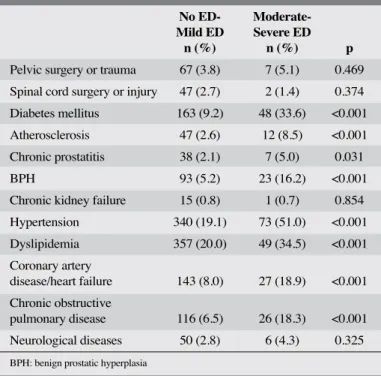
Presence and contribution of pelvic surgery or trauma, neuro-logic and endocrinoneuro-logic abnormalities, prostatic diseases, kid-ney failure, chronic obstructive pulmonary disease (COPD), and vascular risk factors including atherosclerosis, high blood pressure, dyslipidemia, coronary artery disease, heart disorders, and diabetes to ED were questioned in this survey. Vascular dis-orders were significantly more frequently documented in men with moderate-severe ED rather than those without or mild ED (Table 4). Chronic prostatitis (CP) or benign prostatic enlarge-ment (BPE) was also significantly more frequently reported in men with moderate-severe ED than those without ED (p=0.031 for CP and p<0.001 for BPE). These findings showed COPD as a significant risk factor for having moderate-severe ED (p<0.001). Interestingly, the rates of neurological disorders including mul-tiple sclerosis, prior pelvic surgery or trauma, spinal cord injury, and epilepsy were not significantly different between the mod-erate-severe ED and no-mild ED groups (p>0.05). The number of men who had endocrinologic disorders including pituitary, thyroid, adrenal disorders, and testosterone insufficiency were not adequate for statistical comparisons.
Predictive factors for moderate-severe ED
The impact of comorbidities on the presence of moderate-severe ED was evaluated using regression analyses and the outcomes are provided in Table 5. Diabetes mellitus was the strongest indepen-dent predictor for moderate-severe ED in men ≥40 years of age with 5−fold increased risk of ED (p<0.001). Among other inde-pendent predictive vascular risk factors, the risk of moderate-se-vere ED increased 4.4−fold for hypertension, 3.4−fold for athero-sclerosis, 2.6−fold for coronary artery disease, and 2.1−fold for dyslipidemia (p<0.001). This study also showed that prostate dis-orders were independent risk factors for occurrence of moderate-severe ED, as evidenced by 3.5−fold increase in BPH (p<0.001) and 2.4−fold increase in chronic prostatitis (p=0.036).
Relation of ED with LUTS and EjD
Mean IIEF−5, IPSS and MSHQ−4 scores categorized accord-ing to age groups of the participants are provided in Table 6.
A significant correlation was documented among mean scores derived from all three questionnaires. As expected, significantly increased mean IPSS and reduced MSHQ−4 scores were associ-ated with the presence and severity of ED (p<0.001), suggesting that ED, LUTS and EjD are age- dependent components of male pelvic dysfunction.
Erectile dysfunction and sexual activity
Frequency of sexual activity of the study participants was as-sessed by self-reported questionnaires based on the number of sexual activities during the previous one month (Table 7). Mean number of sexual activities in the study population was 7.3±6.3 per month. The average monthly frequency of sexual activity
Table 4. Comparisons of comorbid conditions in men with moderate-severe ED and mild-No ED
No ED- Moderate- Mild ED Severe ED
n (%) n (%) p
Pelvic surgery or trauma 67 (3.8) 7 (5.1) 0.469 Spinal cord surgery or injury 47 (2.7) 2 (1.4) 0.374 Diabetes mellitus 163 (9.2) 48 (33.6) <0.001 Atherosclerosis 47 (2.6) 12 (8.5) <0.001 Chronic prostatitis 38 (2.1) 7 (5.0) 0.031
BPH 93 (5.2) 23 (16.2) <0.001
Chronic kidney failure 15 (0.8) 1 (0.7) 0.854 Hypertension 340 (19.1) 73 (51.0) <0.001 Dyslipidemia 357 (20.0) 49 (34.5) <0.001 Coronary artery disease/heart failure 143 (8.0) 27 (18.9) <0.001 Chronic obstructive pulmonary disease 116 (6.5) 26 (18.3) <0.001 Neurological diseases 50 (2.8) 6 (4.3) 0.325
BPH: benign prostatic hyperplasia
Table 5. Independent predictive factors for having moderate-severe ED
Level of 95% C.I. for Ext (B) Significance Exp (B) Lower Upper Diabetes <0.001 5.012 3.419 7.349 Hypertension <0.001 4.420 3.119 6.263 BPH <0.001 3.502 2.139 5.732 Atherosclerosis <0.001 3.432 1.776 6.631 COPD <0.001 3.221 2.023 5.128 Coronary artery disease <0.001 2.666 1.696 4.191 Chronic prostatitis 0.036 2.416 1.058 5.513 Dyslipidemia <0.001 2.102 1.459 3.027 BPH: benign prostatic hyperplasia; COPD: chronic obstructive pulmonary disease
was significantly affected by the presence and severity of ED as expressed median IIEF−5 scores (8.4 for no ED, 5.7 for mild, 3.7 for moderate, and 2.9 for severe ED) (p<0.001).
Discussion
This cross-sectional, observational, population-based field survey reported the prevalence of ED in Turkish men aged ≥40 years as 33% (25.6% mild, 5.5% moderate, and 1.9% severe ED) by using validated, multi-item questionnaires. Based on these data, it can be calculated that among all ED men aged ≥40 years, the rate of moderate-to-severe ED was 22.5%. The overall rate for moderate-to-severe ED in the entire population was calculated as 7.4 percent. This work has also confirmed that the prevalence and severity of ED was significantly correlated with age as reported by previous studies worldwide. Last but not the least, our data suggested that, apart from age, vascular risk factors and prostate disorders were the independent predictors of ED.
Previously, Turkish Erectile Dysfunction Study Group carried out a study in 1999 and published in 2003 that age-adjusted overall prevalence of ED in Turkish men ≥40 years of age were 69.2% (including mild, moderate and severe ED) by us-ing sus-ingle-item question.[8] Erectile functions of all the partici-pants in that study were assessed with single question that also used in the Pfizer Cross-national Study of Erectile Dysfunction as “How would you describe yourself?” and the categorical responses were considered as “no ED,” “mild (minimal) ED,” “moderate ED,” and “severe ED”.[8] Cross-national study of the prevalence and correlates of ED conducted between 1997–1998 and reported in 2003 by Nicolosi et al utilized the same single-item question in order to assess the presence and severity of ED in men aged between 40–70 from 4 countries and reported the age-standardized prevalence of ED as between 42% and 78% in Brazil, Japan, Italy, and Malaysia.[11]
A systematic review conducted on prevalence of ED in gener-al population evgener-aluated 23 published studies from gener-all over the world based on 12-item criteria and reported that only a few of them have fulfilled the criteria of required methodological qual-ity.[12] Abovementioned two studies that used the same
single-item question reported the prevalence of ED which led to an overestimation relative to others as their evaluation of ED was based on one question. Our current study has taken all of the mistakes made by previous works into consideration, and used all methodological criteria defined by Prins et al.[12] Our study also included all external and internal validity and informativ-ity checklists and found the actual prevalence of ED as 33% in Turkish men ≥40 years of age by using nationally-validated and universally-accepted IIEF questionnaires.
ED has been considered as age-dependent phenomenon due to increased rates of comorbidities and enhanced severity. Previous well-conducted epidemiological surveys have also focused on age-dependency of ED. Two of the Asian studies showed dou-bling of the prevalence rate at age 60-70 with almost another doubling at age 70-79 years.[13,14] The more recent Korean report stratified by age showed a tripling of the prevalence for the 60-69 age group compared to those younger whether self-reported or scored by the IIEF.[15] Another recent report from western Australia had an older age range in their study and reported an overall prevalence rate of 40.3%, almost 4 times the prevalence from the other age-stratified study with an overall ED rate of 10percent.[16] Our study found similar results regarding age-dependency of ED by showing the higher rates of ED in 60-69 (68.8%) and ≥70 (82.9%) compared to those in 40-49 (17%) and 50-59 (35.5%) years of age. When compared to the age of 40s, the relative risk was increased 3-fold in 50s, 7.5-folds in 60s and 15.5 fold in 70s and older.
Table 7. Sexual activities per month according to age and severity of erectile dysfunction
Number of sexual activities per month p
Overall 7.3±6.3 IIEF–5 None 8.4±6.0 Mild 5.7±6.8 <0.001* Moderate 3.7±4.8 Severe 2.9±2.9 *Kruskal-Wallis
Table 6. Mean IPSS, IIEF–5 and MSHQ–4 scores of the study population according to the age groups Age Groups (years)
Overall 40–49 50–59 60–69 ≥70
n=2,730 n=1,080 n=849 n=490 n=311 p
IIEF–5 (mean±SD) 26.1±5.1 27.9±3.7 26.0±4.5 23.2±4.9 17.8±7.6 <0.001
IPSS (mean±SD) 4.2±5.5 2.4±3.8 4.0±5.0 5.9±6.1 8.1±7.6 <0.001
MSHQ–4 (mean±SD) 9.1±1.4 9.6±1.0 9.0±1.4 8.3±1.6 7.2±1.7 <0.001 IPSS: International Prostate Symptom Score; IIEF: International Index of Erectile Function; MSHQ-4: Male sexual health Questionnaire-4
Depending on the underlying vascular risk factors as well as age, an increased severity of ED can be expected. The widely-cited MMAS study showed that 52% of men aged 40–70 years had some degree of ED. Moderate-to-complete ED was encoun-tered in 34.8% of men, which was strongly related to age and associated with a number of major medical conditions.[5] This rate for ED was confirmed by Rosen et al.[17] data derived from the multinational MSAM-7 survey that reported 48.7% of men had erection difficulty and 10% of men had complete absence of erection based on responses to DAN-PSS questionnaire. Our study reported prevalence of ED as 33% in men aged ≥40 years, of those 25.6% had mild, 5.5% moderate, and 1.9% severe ED. Among all men with ED aged ≥40 years, the rate of moderate-to-severe ED was found to be 22.5% in our study. The overall rate for moderate-to-severe ED in entire population was calcu-lated as 7.4%. When the rate of having moderate-to-severe ED in all study participants was stratified and calculated based on the age groups, there was a significant change according to the each decade of aging as 2.5% for 40–49, 5.8% for 50–59, 12.9% for 60–69, and 49.2% for ≥70 years, demonstrating age-depen-dency for the severity of ED.
The main cause of ED is organic in nature, with vascular eti-ologies being the most common risk factors. The incidence of ED increases with the number of vascular comorbidities such as hypertension, diabetes mellitus, ischemic heath disease, dys-lipidemia, and atherosclerosis. The earliest signal of endothelial damage in men with vascular risk factors is the manifestation of ED. As the penis is a barometer of the body’s endothelial func-tion, it is reasonable then to blame vascular pathologies, as di-rect causes of ED.[2] ED may be the first clinical presentation of any of these comorbidities with the vascular endothelium play-ing a pivotal role in regulatplay-ing vascular homeostasis of the cor-pora cavernosa. Previous works demonstrated that the presence and number of associated vascular risk factors were correlated with the severity of penile vascular abnormalities evidenced by penile Doppler duplex ultrasound evaluation.[4] In our current work, we also assessed the impact of co-morbidities on the pres-ence and severity of ED.
According to the multimodal regression analyses, we found significantly higher rates of moderate-severe ED in men with comorbid vascular risk factors compared to men with no-ED or mild-ED. The RR for having moderate-severe ED compared to no-ED and mild-ED was found 5-fold in diabetes, 4.4-fold in hypertension, 3.4-fold in atherosclerosis, 2.6-fold in coro-nary artery disease, and 2.1-fold in dyslipidemia. Considering its multifactorial deleterious affect on penile erection, diabetes has been considered as the strongest underlying risk factor for ED. In our study population, 9.2% of the subjects with no ED-mild ED reported diabetes in contrast to 33.6% of the cases with moderate-severe ED. Not only the higher prevalence of ED in
diabetic subjects, but also the severity of ED was significantly higher in diabetic men. Another important comorbidity, high blood pressure was seen 19.1% of no ED-mild ED cases, but the rate was 51% in moderate-severe ED cases, demonstrating the strong relationship between severity of ED and hypertension. Other vascular risk factors including dyslipidemia, atheroscle-rosis and coronary artery disease were significantly correlated with the prevalence and severity of ED in men agyed ≥40 years. Epidemiological surveys using internationally-validated symp-tom scales, such as IPSS, have reported an overall rate of LUTS as >50% in men >50 years of age.[18-20] The MSAM-7 study by including a total of 14,000 male aged 50–80 years has reported prevalence of moderate-severe LUTS as 31% (34.2% for Eu-rope and 29% for the US).[17] Due to common pathophysiologi-cal links, LUTS suggestive of BPH and ED have been shown to have strong relationships evidenced by epidemiological surveys. [10] The current study reported that three out of four men aged ≥40 years exhibited some degree of LUTS, of which only 16.3% was moderate-to-severe. When this association was evaluated, our study has been presenting further statistically meaningful support to the link between ED and prostatic diseases including chronic prostatitis and BPH. Based on the regression analyses of the study population, it can be postulated that chronic prostati-tis had 2.4-fold and BPH had 3.5-fold increased risk of having moderate-severe ED in men ≥40 years of age.
Sexual activity is considered as an integral part of men’s health and their quality of life. As a part of ageing and deterioration of sexual functions, the number and quality of erection can be expected to reduce. Mean monthly sexual activity was also as-sessed in this study and found to be 8.4 in men without ED. Compared to the men with no ED or mild ED, mean monthly sexual activity was found to be significantly reduced in men with moderate (3.7) and severe (2.9) ED. These data would fur-ther support practicing physicians to focus on treating males’ sexual dysfunctions in order improve their overall health and quality of life.
The limitation of this study was the age of the study population. In order to reflect to the criteria for a population-based survey, relatively younger men had to be included into the study for rep-resenting the nations’ age, as seen in the 40−49 year-old group that consisted of 40% of the participants. Due to this age distri-bution, the prevalence of ED found in this population-based sur-vey might be different from previously published international large-population surveys including the MSAM-7 and MMAS outcomes. We believe that this age distribution needs to be taken into account when evaluating outcomes of this survey.
In conclusion, this population-based survey in Turkish men of ≥40 years of age reported the prevalence of ED as 33 percent.
Furthermore, this study reported age as the main predictor for presence and severity of ED. As parallel to the previous epide-miological reports, this work have provided further support to the contribution of vascular risk factors and a number of life-style issues on ED. We believe that a greater understanding on the epidemiological surveys of the prevalence of ED and its as-sociations will help clinicians to look outside our specialty for strategies to improve male sexual function in order to improve their quality of life. It is crucial to take a more global approach to management of ED, one that focuses not only on chronic dis-eases, but also men’s sexual quality of life.
Ethics Committee Approval: Ethics committee approval was received for this study from the ethics committee of Ministry of Health. Informed Consent: Written informed consent was obtained from pa-tients who participated in this study.
Peer-review: Externally peer-reviewed.
Author Contributions: Concept – A.K., R.A., Ö.Y., S.Ç., İ.O., M.F.U., M.K., O.E.; Design – A.K., R.A., Ö.Y., S.Ç., İ.O., M.F.U., M.K., O.E.; Supervision – M.K., S.Ç., A.K.; Resources – A.K., R.A., Ö.Y., S.Ç.; Materials – R.A., Ö.Y., S.Ç.; Data Collection and/or Processing – M.K., S.Ç., R.A.; Analysis and/or Interpretation – M.K., S.Ç.; Literature Search – M.K., S.Ç.; Writing Manuscript – M.K., S.Ç.; Critical Review – A.K., R.A., Ö.Y., S.Ç., İ.O., M.F.U., M.K., O.E.
Conflict of Interest: No conflict of interest was declared by the authors. Financial Disclosure: The authors declared that this study has received no financial support.
References
1. NIH Consensus Conference. Impotence. NIH Consensus Develop-ment Panel on Impotence. JAMA 1993;270:83-90. [CrossRef]
2. Kendirci M, Nowfar S, Hellstrom WJ. The impact of vascular risk fac-tors on erectile function. Drugs of Today 2005;41:65-74. [CrossRef]
3. Kendirci M, Hellstrom WJG. The Role of Endothelium in Erectile Function and Dysfunction. ed. W.C. Aird, in Endothelial Biomedi-cine 2007, Cambridge University Press, New York; 1541-9. 4. Kendirci M, Nowfar S, Gur S, Jabren GW, Sikka SC, Hellstrom
WJ. The relationship between the type of penile abnormality and penile vascular status in patients with peyronie’s disease. J Urol 2005;174:632-5. [CrossRef]
5. Feldman HA, Goldstein I, Hatzichristou DG, Krane RJ, McKinlay JB. Impotence and its medical and psychosocial correlates: results of the Massachusetts Male Aging Study. J Urol 1994;151:54-61. 6. Ayta IA, McKinlay JB, Krane RJ. The likely worldwide increase
in erectile dysfunction between 1995 and 2025 and some possible policy consequences. BJU Int 1999;84:50-6. [CrossRef]
7. Johannes CB, Araujo AB, Feldman HA, Derby CA, Kleinman KP, McKinlay JB. Incidence of erectile dysfunction in men 40 to 69 years old: longitudinal results from the Massachusetts male aging study. J Urol 2000;163:460-3. [CrossRef]
8. Akkus E, Kadioglu A, Esen A, Doran S, Ergen A, Anafarta K, ET AL. Turkish Erectile Dysfunction Prevalence Study Group: Preva-lence and correlates of erectile dysfunction in Turkey: a popula-tion-based study. Eur Urol 2002;41:298-304. [CrossRef]
9. Rosen RC, Riley A, Wagner G, Osterloh IH, Kirkpatrick J, Mishra A. The international index of erectile function (IIEF): a multidi-mensional scale for assessment of erectile dysfunction. Urology 1997;49:822-30. [CrossRef]
10. Kendirci M, Asci R, Yaman O, Cayan S, Orhan I, Usta MF, et al. Prevalence of male pelvic dysfunction: results from the Turkish society of andrology male sexual health study group. Andrology 2014;2:219-24. [CrossRef]
11. Nicolosi A, Moreira ED Jr, Shirai M, Bin Mohd Tambi MI, Glasser DB. Epidemiology of erectile dysfunction in four countries: cross-national study of the prevalence and correlates of erectile dysfunc-tion. Urology 2003;61:201-6. [CrossRef]
12. Prins J, Blanker MH, Bohnen AM, Thomas S, Bosch JL. Preva-lence of erectile dysfunction: a systematic review of population-based studies. Int J Impot Res 2002;14:422-32. [CrossRef]
13. Masumori N, Tsukamoto T, Kumamoto Y, Panser LA, Rhodes T, Girman CJ, et al. Decline of sexual function with age in Japanese men compared with American men--results of two community-based studies. Urology 1999;54:335-44. [CrossRef]
14. Kongkanand A. Prevalence of erectile dysfunction in Thailand. Thai Erectile Dysfunction Epidemiological Study Group. Int J An-drol 2000;23(Suppl 2):77-80.
15. Ahn TY, Park JK, Lee SW, Hong JH, Park NC, Kim JJ, et al. Prev-alence and risk factors for erectile dysfunction in Korean men: results of an epidemiological study. J Sex Med 2007;4:1269-76.
[CrossRef]
16. Richters J, Grulich AE, de Visser RO, Smith AM, Rissel CE. Sex in Australia: sexual difficulties in a representative sample of adults. Aust N Z J Public Health 2003;27:164-70. [CrossRef]
17. Rosen R, Altwein J, Boyle P, Kirby RS, Lukacs B, Meuleman E, et al. Lower urinary tract symptoms and male sexual dysfunction: the multinational survey of the aging male (MSAM-7). Eur Urol 2003;44:637-49. [CrossRef]
18. Jacobsen SJ, Jacobson DJ, Girman CJ, Roberts RO, Rhodes T, Guess HA, et al. Natural history of prostatism: risk factors for acute urinary retention. J Urol 1997;158:481-4. [CrossRef]
19. Sagnier PP, MacFarlane G, Teillac P, Botto H, Richard F, Boyle P. Impact of symptoms of prostatism on level of both-er and quality of life of men in the French community. J Urol 1995;153:669-73. [CrossRef]
20. Norman RW, Nickel JC, Fish D, Pickett SN. ‘Prostate-related symptoms’ in Canadian men 50 years of age or older: prevalence and relationships among symptoms. Br J Urol 1994;74:542-50.