This article was downloaded by: [Selcuk Universitesi] On: 07 February 2014, At: 03:43
Publisher: Taylor & Francis
Informa Ltd Registered in England and Wales Registered Number: 1072954 Registered office: Mortimer House, 37-41 Mortimer Street, London W1T 3JH, UK
Supramolecular Chemistry
Publication details, including instructions for authors and subscription information: http://www.tandfonline.com/loi/gsch20
Synthesis of new calix[4]arene amide derivatives and
investigation of their DNA cleavage activity
Şeyda Çiğdem Özkana
, Aydan Yilmaza & İsmail Özmenb a
Department of Chemistry, Faculty of Science, Selcuk University, 42031, Konya, Turkey b
Department of Chemistry, Faculty of Science and Arts, Süleyman Demirel University, Isparta, Turkey
Published online: 21 Aug 2013.
To cite this article: Şeyda Çiğdem Özkan, Aydan Yilmaz & İsmail Özmen (2014) Synthesis of new calix[4]arene amide derivatives and investigation of their DNA cleavage activity, Supramolecular Chemistry, 26:1, 25-31, DOI: 10.1080/10610278.2013.817578
To link to this article: http://dx.doi.org/10.1080/10610278.2013.817578
PLEASE SCROLL DOWN FOR ARTICLE
Taylor & Francis makes every effort to ensure the accuracy of all the information (the “Content”) contained in the publications on our platform. However, Taylor & Francis, our agents, and our licensors make no
representations or warranties whatsoever as to the accuracy, completeness, or suitability for any purpose of the Content. Any opinions and views expressed in this publication are the opinions and views of the authors, and are not the views of or endorsed by Taylor & Francis. The accuracy of the Content should not be relied upon and should be independently verified with primary sources of information. Taylor and Francis shall not be liable for any losses, actions, claims, proceedings, demands, costs, expenses, damages, and other liabilities whatsoever or howsoever caused arising directly or indirectly in connection with, in relation to or arising out of the use of the Content.
This article may be used for research, teaching, and private study purposes. Any substantial or systematic reproduction, redistribution, reselling, loan, sub-licensing, systematic supply, or distribution in any
form to anyone is expressly forbidden. Terms & Conditions of access and use can be found at http:// www.tandfonline.com/page/terms-and-conditions
Synthesis
of new calix[4]arene amide derivatives and investigation of their
DNA
cleavage activity
S¸eyda C¸ ig˘dem O ¨ zkana, Aydan Yilmaza* and I˙smail O ¨ zmen b a
Department of Chemistry, Faculty of Science, Selcuk University, 42031 Konya, Turkey; bDepartment of Chemistry, Faculty of Science and Arts, Su¨leyman Demirel University, Isparta, Turkey
(Received 19 April 2013; final version received 17 June 2013)
This study comprises the synthesis of new p-tert-butylcalix[4]arene with different amide functional groups and summarises an investigation of their DNA cleavage activities. The structural investigations of the synthesised compounds were examined by FTIR, 1H NMR, 13C NMR, elemental analysis and FAB-MS techniques. The interaction between these compounds and pBR322 plasmid DNA has been investigated via agarose gel electrophoresis and, according to the results, compounds 5, 7, 8 and 13 exhibit efficient DNA cleavage activity. In the electrophoresis images of 5, 7 and 8, Form IV which is small DNA fragment was observed in addition to supercoiled Form I, open circular Form II and linear Form III.
Keywords: calix[4]arene; DNA cleavage; amide; plasmid DNA
1. Introduction
Calix[n ]arenes can be viewed as examples of [1n] metacyclophanes that possess basket-shaped cavities which are composed of phenolic units ortho-linked by methylene bridges (1). Calixarenes can be used in many fields for a variety of purposes, including acting as cation and anion extractants (2), catalysts (3), sensor materials (4) and enzyme-mimic catalysts (5). Furthermore, the biological properties of calixarenes, i.e. antimicrobical agents (6), antiseptic and anticancer agents (7), cytotox icity (8), DNA binding (8), DNA interaction recognition (9) and protection from ultraviolet radiation (10), have recently been investigated. Amide derivatives of calix[4] arenes have commonly been used in the creation of cation (11), anion (12) and neutral (13) extractants. Recently, amido-calixarenes have been used as nucleic acid recognisers (14), enzyme inhibitors (15) and potent-DNA binding agents (16). In this study, we prepared six new amide derivatives (mono- and di-) of calix[4]arenes that have some aliphatic and aromatic groups, and then investigated the activities of these compounds on the DNA.
2. Results and discussion
2.1 Synthesis of calix[4]arene derivatives
More specifically, in this study, we synthesised the amide derivatives of p-tert-butylcalix[4]arene with different functional groups. First, different calixarenes with aliphatic and aromatic ester groups were synthesised. For
this purpose, carboxylic acid derivatives (i.e. 5-bromova leric acid and 4-(bromomethyl)benzoic acid) were converted to methyl esters with methanol in the presence of sulphuric acid through an esterification reaction. Then they were connected to calixarene in the form of an ester (17, 18). The obtained calixarene diester derivatives were hydrolysed for a period of 5 – 10 min via a microwave device, and through the continuation of the reaction with oxalyl chloride, the acid chloride derivatives were obtained. Calixarenes with diamide and monoamide derivatives were synthesised by treating calixarene compounds in the acid chloride form with various primary amines at room temperature. The synthetic process for the preparation of p-tert-butylcalix[4]arene amide derivatives is described in Schemes 1 and 2.
The diamide derivatives 5, 6, 11 and 12 were characterised via FTIR, 1H NMR, 13C NMR, elemental analysis and FAB-MS techniques. The formation of the diamide derivatives of p-tert-butylcalix[4]arene (5, 6, 11 and 12) was confirmed by the appearance of characteristic amide bands at 1648, 1650, 1639 and 1706 cm21 respectively, and by the disappearance of acid carbonyl band at about 1700 cm21 in the IR spectra. The conformational characteristics of calix[4]arenes were conveniently estimated by the splitting pattern of the ArCH2Ar methylene protons in the 1H NMR spectrum (19, 20). The 1H NMR spectroscopic data showed that compounds 5, 6, 11 and 12 were in the cone conformation. A typical AX pattern was observed for the methylene bridge of the ArCH2Ar protons as doublets 3.30 and 4.14
*Corresponding author. Email: [email protected]
q 2013 Taylor & Francis
26 S¸.C¸. O ¨ zkan et al. OH HO O (i) O OH HO OH HO (1)
(ii), (iii) COOCH
3 COOCH3 (2) OH HO O O O (iv) (vi) COCl (4) COCl (v) O O HO OH O HO OH
COR COR O HO OH O COOH COR
(5) R: HN O
(7) R: HN N O
COR COR
(6) R: HN O
Scheme 1. A schematic representation showing synthesis pathway of calix[4]arene amide derivatives5–7. (i) Methyl 5-bromovalerate, K2CO3, acetone, 42%; (ii) ethanol, NaOH, MW, 600 W (% 100), 10 min, 82%; (iii) oxalyl chloride, DCM/DMF; (iv) furfuryl amine, THF,
50%; (v) tetrahydrofurfuryl amine, THF, 65%; (v) 3-morpholinopropyl amine, THF, 75%.
(J ¼ 13.1 Hz) for 5, 3.33 and 4.25 (J ¼ 13.1 Hz) for 6, 3.34 and 4.28 (J ¼ 13.1 Hz) for 11 and 3.31 and 4.27 (J ¼ 13.0 Hz) for 12 in the 1H NMR data. Likewise, the monoamide derivatives 7 and 13 were characterised using the same techniques. The formation of these new compounds was confirmed by the appearance of new amide carbonyl bands at about 1650 cm21 and acid carbonyl bands at about 1720 cm21 in the IR spectra. In the H NMR spectra, the chemical shift for the amide NH was
recorded as a triplet (1H) at 7.89 (J ¼ 5.4 Hz) for 7 and 8.67 (J ¼ 5.2 Hz) for 13. The ArCH2Ar methylene protons of compound 7 showed two doublet signals at 3.31 and 4.22 (J ¼ 13.1 Hz). These signals indicated that compound 7 is in the cone conformation. The ArCH2Ar methylene protons for compound 13 showed one doublet at 4.27 (J ¼ 13.3 Hz) and an overlapped peak in the range of 2.94 – 3.47. The 13C NMR spectral data confirmed the obtained results.
1
OH HO HO OH (1) OH HO O O COOCH3 COOCH3 (ii), (iii) (8) (iv) (vi) (v) (11) R: HN O (13) R: OH HO O (10) O N HN COCl O COCl OH HO O COR O COR OH HO O COOH O COR OH HO O O COR COR (12) R: HN O
Scheme 2. A schematic representation showing synthesis pathway of calix[4]arene amide derivatives 11–13. (i) Methyl 4 (bromomethyl)benzoate, K2CO3, acetone, 75%; (ii) ethanol, NaOH, MW, 600 W (% 100), 5 min, 78%; (iii) oxalyl chloride, DCM/DMF;
(iv) furfuryl amine, THF, 65%; (v) tetrahydrofurfuryl amine, THF, 60%; (v) 3-morpholinopropyl amine, THF, 70%.
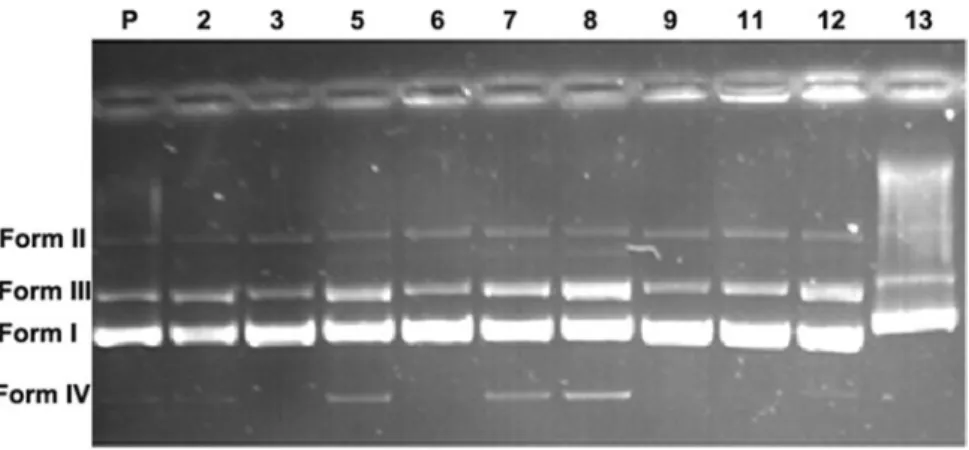
2.2 pBR322 DNA –compound interactions We determined whether the compounds were effective The compound – DNA interactions were investigated via based on the calculations obtained from the electrophor electrophoresis. In experimental studies, synthesised esis images. Table 1 presents the percentages that were amide compounds in concentrations of 10,000 mM and obtained from the intensity calculations of the bands pBR322 plasmid DNA were used. Figure 1 shows that revealed in the electrophoresis images of the compounds. modification of gel electrophoretic mobility of pBR322 When the numerical data obtained from the electro-DNA after treated with the compounds. phoresis images of compound 2 were compared with that
28 S¸.C¸. O ¨ zkan et al.
Figure 1. The electrophoresis image of pBR322 DNA after treated with the compounds (P: untreated plasmid DNA with compounds).
Table 1. The percentages of Form I, Form II, Form III and Form IV of pBR322 DNA after treated with the compounds.
% SC %NC % LC % SF
Compounds Form I Form II Form III Form IV
P 86.9 0.9 12.2 – 2 74.8 2.6 22.6 – 3 83.1 3.9 13.0 – 5 62.1 7.3 26.2 4.4 6 73.3 11.2 15.5 – 7 57.0 12.3 23.9 6.8 8 51.7 9.7 31.2 7.4 9 71.3 13.1 15.6 – 11 67.1 13.1 19.8 – 12 60.4 11.8 27.8 – 13 55.1 27.9 17.0 –
Note: Form I, SC; Form II, NC; Form III, LC and Form IV, small DNA fragments.
of the plasmid DNA, the intensity of Form I decreased and the intensities of Form II and Form III increased. This result also indicated that the supercoiled structure of the plasmid DNA was reduced, and the linear and open circular structure of the plasmid DNA was increased by compound 2. In a comparison of compound 3 with plasmid DNA, Form I, Form II and Form III did not significantly change. In contrast, compound 5 reduced the intensity of Form I of the plasmid DNA and increased the densities of Form II and Form III. In addition, the electrophoresis gel image of compound 5 reveals that the DNA is fragmenting into smaller units in Form IV. When compound 6 is compared with plasmid DNA, the density of Form I partially decreased and the density of Form III partially increased; however, the density of Form II significantly increased. The numerical data obtained from the electrophoresis images of compound 7 showed that the density of Form I significantly decreased and the densities of Form II and Form III increased. At the same time, the electrophoresis image of this compound revealed the formation of Form IV.
The electrophoresis image of compound 8 showed that the density of Form I significantly decreased and the density of Form II and Form III increased. Furthermore, as compounds 5 and 7 were formed, Form IV was revealed. When compounds 9 and 11 were compared with plasmid DNA, the intensity of Form I significantly declined; however, the intensities of Form II and Form III partially increased. Compound 12 showed a significant reduction in the intensity of Form I, while the intensities of Form II and Form III partially increased. The electrophoresis image of compound 13 showed that Form I, Form II and Form III progressed more slowly than the other compounds, because the mass of the plasmid DNA increased as the calixarene held onto the DNA molecule, thus causing it to migrated more slowly.
3. Conclusions
This study focused on the synthesis of calix[4]arene derivatives (i.e. diester, diacide, diamide and monoamide) with different functional groups. The characterisation of the compounds was accomplished via FTIR, 1H NMR,13C NMR, elemental analysis and FAB-MS techniques. In addition, the DNA interaction activities of the synthesised compounds were investigated. The DNA interaction studies were carried out via agarose gel electrophoresis and by using pBR322 plasmid DNA (21, 22). The investigation of the DNA cleavage activities of the valerate derivatives of calix[4]arene (2, 3, 5 and 6) showed that compound 5 is more effective in this area. The electrophoresis image of this compound showed a decrease in Form I and an increase in Form III. The investigation of the DNA cleavage activities of the benzoate derivatives of calix[4]arene (8, 9, 11 and 12) showed that compound 8 is the most effective in this area. The electrophoresis image of this compound revealed the formation of Form IV. The investigation of the DNA interaction properties of mono-morpholine amide deriva tives of calix[4]arene (7 and 13) revealed that compound
occurred more slowly. Consequently, calix[4]arene com pounds that have aromatic groups generally showed more DNA interaction activity. These results confirm the significant biological activity due to the topological and hydrophobic nature of aromatic arms of calixarenes (14).
As, scientists have expressed the need to develop new materials due to the drug-resistant nature of pathogenic micro-organisms, these results reveal the potential for new biomedical applications of calixarenes.
4. Experimental
4.1 Materials and methods
Chemicals and solvents were obtained from commercial sources (Merck; Darmstadt, Germany and Sigma; Stein heim, Germany) and used without further purification. DNA [supercoiled (SC) pBR322] was purchased from Fermantas (Vilnius, Lithuania). Measurements of 1H NMR and 13C NMR spectra were recorded in CDCl3 on a Varian MR 400 MHz spectrometer (UK) using tetramethylsilane as an internal standard. A Perkin-Elmer 1605 FT-IR spectrophotometer was used to record the infrared spectra of all compounds (4000 – 400 cm21). Elemental analyses (C, H and N) were carried out using a Leco CHNS-932 analyzer (USA). FAB-MS spectra were taken on a Varian MAT 312 spectrometer (Netherland). Microwave irra diated reactions were carried out by using a CEM MDS 2000. Determination of the melting points was carried out using a Bu¨chi B-540. Analytical TLC was carried out on precoated silica gel plates (SiO2, Merck PF254).
4.2 Synthesis
Compounds 1, 3, 8 and 9 were synthesised according to previously described methods (17 – 20, 23). The synthesis of the compounds 2, 4–7 and 10–13 was firstly reported in this study.
4.2.1 Synthesis of compound 2
p-tert-Butylcalix[4]arene (5 g, 7.7 mmol), potassium car bonate (2.04 g, 14.8 mmol) and 5-bromomethyl valerate (3.1 g, 15.1 mmol) dissolved in an anhydrous acetone (250 ml) and refluxed by stirring under a nitrogen atmosphere for 72 h. The cooled solution was filtered, the solvent was removed in vacuo to dryness. The remaining crude product was recrystallised from a mixture of dichloromethane – ethanol to obtain compound 2. Yield: 2.84 g (42%). Mp: 160 – 162oC IR: 3331 cm21 (OH), 1736 cm21 (CvO). 1H NMR (CDCl3): d ppm 0.96 (s, 18H, But), 1.28 (s, 18H, But), 1.98 – 2.10 (m, 8H,
ArCH2Ar), 6.80 (s, 4H, ArH), 7.04 (s, 4H, ArH), 7.48 (s, 2H, OH). 13C NMR (CDCl3): d 21.5 (ArOCH2CH2CH2), 28.6 (ArOCH2CH2), 31.3, 31.5, 32.2, 33.7, 34.1, 34.6, 51.3 (OCH3), 69.4 (ArOCH2), 125.4, 126.3, 128.2, 130.1, 132.7, 148.7, 150.8, 152.3, 174.2 (CvO). FAB-MS m/z: 900.1 (M þ Na)þ. Anal. calcd for C56H76O8 (877.27): C, 76.6; H, 8.7. Found: C, 77.0; H, 8.5.
4.2.2 Synthesis of compounds 3 and 9
Compound 2 or 8 (82.2 mmol), aqueous NaOH solution (6.5 ml) and ethanol (95 ml, 15%) were kept in microwave device for about 5 – 10 min (by TLC monitoring) and then the reaction was terminated. According to the literature procedures (24), reaction mixture was pured.
4.2.3 Synthesis of 4 and 10
To a solution of 3 or 9 (1.77 mmol) in a mixture of dichloromethane (20 ml) was added oxalyl chloride (1 ml, 7.85 mmol) and four drops of DMF. The reaction mixture was stirred at room temperature for 1 h and then refluxed for 3 h. The solvent removed under reduced pressure.
4.2.4 General synthesis method of 5, 6, 11 and 12 Acid chloride compound of calixarene (4 or 10) (1.77 mmol) was dissolved in THF, primary amine (8.85 mmol) was added, the reaction mixture was stirred at room temperature for 3 h. It was filtered, the filtrate was removed under vacuo. The residue was dissolved in DCM, later it was extracted with water. The organic phase was separated and dried over MgSO4. The solvent was removed and recrystallised from hot ethanol.
4.2.4.1 Compound 5. Yield 50%. Mp . 888C (decomp.). IR: 1648 cm21(CvO). 1H NMR (CDCl3): d ppm 0.90 (s, 18H, But), 1.31 (s, 18H, But), 1.79 – 2.10 (m, 8H, OCH2CH2CH2), 2.51 (t, 4H, J ¼ 7.2 Hz, COCH2), 3.30 (d, 4H, J ¼ 13.1 Hz, ArCH2Ar), 3.90 (t, 4H, J ¼ 5.6 Hz, OCH2),4.14 (d, 4H, J ¼ 13.1 Hz, ArCH2Ar), 4.43 (d, 4H, J ¼ 5.2 Hz, NHCH2), 6.12 – 6.17 (m, 2H, furfuryl), 6.18 – 6.24 (m, 2H, furfuryl), 6.73 (s, 4H, ArH), 6.77 – 6.79 (m, 2H, furfuryl), 7.07 (s, 4H, ArH), 7.16 (s, 2H, OH), 7.38 – 7.44 (m, 2H, NH). 13C NMR (CDCl3): d 22.2 (ArOCH2 CH2CH2), 24.6 (ArOCH2CH2), 29.6, 31.6, 32.1, 34.5, 34.6, 37.1 (NHCOCH2), 37.3 (NHCH2), 61.4 (ArOCH2), 108.1 (furfuryl vCH), 110.9 (furfuryl vCH), 125.7, 126.2, 128.6, 132.9, 133.1, 142.7, 147.7, 150.2, 150.8, 152.2, 174.6 (CvO). FAB-MS m/z: 1030.17 (M þ Na)þ.
30 S¸.C¸. O ¨ zkan et al. Anal. calcd for C64H82O8N2 (1007.34): C, 76.3; H, 8.2; N,
2.8. Found: C, 76.5; H, 8.1; N, 3.1.
4.2.4.2 Compound 6. Yield 65%. Mp: 100 – 102oC. IR:1650 cm21 (CvO). 1H NMR (CDCl3): d ppm 0.93 (s, 18H, But), 1.29 (s, 18H, But), 1.73 – 2.14 (m, 16H, OCH2CH2CH2 CH2CO, OCH2CH2CH2), 2.51 (t, 4H, J ¼ 7.2 Hz, COCH2), 3.33 (d, 4H, J ¼ 13.1 Hz, ArCH2 Ar), 3.39 – 3.52 (m, 4H, NHCH2), 3.66 – 3.76 (m, 4H, OCH2), 3.88 – 4.06 (overlapped, 6H, OCH2, OCH), 4.25 (d, 4H, J ¼ 13.1 Hz, ArCH2Ar), 6.76 (s, 4H, ArH), 7.07 – 7.11 (overlapped, 6H, ArH, OH), 7.37 (t, 2H, J ¼ 5.4 Hz, NH). 13C NMR (CDCl3): d 23.8 (ArOCH2CH2CH2), 25.9 (CHCH2CH2), 29.0 (ArOCH2CH2), 31.2, 31.8, 31.9, 34.0, 34.3, 37.1 (NHCOCH2), 43.8 (NHCH2), 64.5 (CHOCH2), 66.8 (ArOCH2), 77.6 (NHCH2CH), 125.3, 125.7, 128.2, 132.6, 141.7, 146.5, 148.9, 150.2, 174.1 (CvO). FAB-MS m/z: 1038.24 (M þ Na)þ. Anal. calcd for C64H90O8N2 (1015.41): C, 75.7; H, 8.9; N, 2.7%. Found: 75.5; H, 8.5; N, 2.9%.
4.2.4.3 Compound 11. Yield 63%. Mp: 226 – 229oC. IR: 1639 cm21 (CvO). 1H NMR (CDCl3): d ppm 0.92 (s, 18H, But), 1.30 (s, 18H, But), 3.34 (d, 4H, J ¼ 13.1 Hz, ArCH2Ar), 4.28 (d, 4H, J ¼ 13.1 Hz, ArCH2Ar), 4.69 (d, 4H, J ¼ 11.5 Hz, NHCH2), 5.08 (s, 4H, OCH2), 6.25 – 6.34 (m, 4H, calix-ArH), 6.78 (s, 4H, calix-ArH), 7.07 – 7.09 (m, 6H, furfuryl-H), 7.34 (s, 2H, OH), 7.56 (t, 2H, J ¼ 5.6 Hz, NH), 7.62 (d, 4H, J ¼ 8.4 Hz, ArH), 7.96 (d, 4H, J ¼ 8.4 Hz, ArH). 13C NMR (CDCl3): d 31.0 (CC H3), 31.5 (CC H3), 31.8 (ArCH2Ar), 33.9 (C(CH3)3), 34.1 (C (CH3)3), 37.1 (NHCH2), 63.5 (OCH2), 107.4 (furfuryl vCH), 110.6 (furfuryl vCH), 125.2, 125.7, 126.8, 127.6, 127.8, 132.3, 133.6, 140.9, 141.6, 142.0, 147.4, 149.6, 150.7, 152.0, 167.5 (CvO). FAB-MS m/z: 1098.21 (M þ Na)þ. Anal. calcd for C70H78O8N2 (1075.38): C, 78.1; H, 7.3, N, 2.6. Found: C, 77.6; H, 7.5, N, 2.2.
4.2.4.4 Compound 12. Yield 60%. Mp: 150 – 153oC. IR: 1657 cm21 (CvO). 1H NMR (CDCl3): d ppm 0.93 (s, 18H, But), 1.29 (s, 18H, But), 1.59 – 1.77 (m, 4H OCH2CH2), 1.86 – 1.98 (m, 4H, OCHCH2), 3.31 (d, 4H, J ¼ 13.0 Hz, ArCH2Ar), 3.44 – 3.54 (m, 2H, NHCH2), 3.73 – 3.84 (m, 4H, OCH2), 3.86 – 3.95 (m, 2H, NHCH2), 4.14 (p, 2H, J ¼ 5.4 Hz, OCH), 4.27 (d, 4H, J ¼ 13.0 Hz, ArCH2Ar), 5.09 (s, 4H, OCH2Ar), 6.78 (s, 4H, calix-ArH), 7.05 (s, 4H, calix-ArH), 7.13 (s, 2H, OH), 7.28 (t, 2H, J ¼ 5.4 Hz, NH), 7.75 (d, 4H, J ¼ 8.3 Hz, ArH), 7.91 (d, 4H, J ¼ 8.4 Hz, ArH). 13C NMR (CDCl3): d 25.9 (OCH2CH2), 28.9, 30.9, 31.6, 31.7, 33.8, 33.9, 43.8 (NHCH2), 68.2, 68.4, 77.9 (OCH), 125.0, 125.6, 126.8, 127.5, 132.4, 134.0, 140.8, 141.5, 147.2, 149.5, 150.6, 152.0, 167.5 (CvO). FAB-MS m/z: 1106.27 (M þ Na)þ. Anal. calcd for C70H86O8N2 (1083.44): C, 77.6; H, 8.0; N, 2.5. Found: C, 78.1; H, 7.8; N, 2.3.
4.2.5 Synthesis of monoamide derivatives (7, 13) Acid chloride compound of calixarene (4 or 10) (3 mmol) was dissolved in THF, 3-morpholinopropyl amine (3 mmol) was added, the reaction mixture was stirred at room temperature for 3 h. It was pured with same procedure of 5, 6, 11 and 12.
4.2.5.1 Compound 7. Yield 75%. Mp . 110oC (decomp.) IR: 1650 cm21 (CvO) 1729 cm21 (COOH). 1 H NMR (CDCl3): d ppm 0.95 (s, 18H, But), 1.27 (s, 18H, But), 1.93 – 2.12 (m, 10H, NHCH2CH2, COCH2CH2CH2), 2.40 – 2.60 (m, 4H, COCH2), 2.95 – 3.11 (m, 6H, N(CH2)3), 3.31 (d, 4H, J ¼ 13.1 Hz, ArCH2Ar), 3.41 (q, 2H, J ¼ 6.6 Hz, NHCH2), 3.92 – 4.02 (m, 8H, ArOCH2, CH2OCH2), 4.22 (d, 4H, J ¼ 13.1 Hz, ArCH2Ar), 6.72 – 6.84 (m, 4H, ArH), 7.03 – 7.11 (m, 4H, ArH), 7.47 (s, 2H, OH), 7.89 (t, 1H, J ¼ 5.4 Hz, NH). 13C NMR (CDCl3): d 22.8 (ArOCH2CH2CH2), 23.9 (ArOCH2CH2CH2), 29.3 (ArOCH2CH2), 29.5 (ArOCH2CH2), 30.3, 31.0, 31.5, 31.7, 33.8, 33.9, 34.0, 34.2, 36.0, 36.6, 52.1 (NHCH2), 55.4 (NCH2), 64.0 (CH2NCH2), 64.2 (CH2OCH2), 72.3 (ArOCH2), 125.5, 127.9, 128.2, 132.4, 133.4, 135.8, 142.1, 147.1, 149.7, 150.4, 150.8, 151.6, 174.5 (CvO), 177.1 (CvO). FAB-MS m/z: 998.17 (M þ Na)þ. Anal. calcd for C61H86O8N2 (975.34): C, 75.1; H, 8.9; N, 2.9. Found: C, 75.7; H, 8.5; N, 2.6.
4.2.5.2 Compound 13. Yield 70%. Mp . 155oC (decomp.). IR: 1640 cm21 (CvO) 1713 cm21 (COOH). 1H NMR (CDCl
3): d ppm 0.91 (s, 18H, But), 1.29 (s, 18H, But), 2.26 – 2.28 (m, 2H, CH2CH2CH2), 2.32 (t, 2H, J ¼ 5.4 Hz, NCH2) 2.94 – 3.47 (overlapped, 10H, NHCH2, CH2NCH2O, ArCH2Ar), 4.05 (bs, 4H, CH2OCH2), 4.27 (d, 4H, J ¼ 13.3 Hz, ArCH2Ar), 5.08 (s, 4H, OCH2), 6.75 – 6.81 (m, 4H, ArH), 7.02 – 7.14 (overlapped, 6H, ArH, OH), 7.81 (d, 4H, J ¼ 8.0 Hz, ArH), 8.09 (d, 4H, J ¼ 8.0 Hz, ArH), 8.67 (t, 1H, J ¼ 5.2 Hz, NH) 13C NMR (CDCl3): d 23.8 (NHCH2CH2), 29.5, 30.3, 30.9, 31.7, 33.8, 33.9, 34.2, 37.2 (NHCH2), 52.1, 55.5 (NCH2), 60.1 (CH2NCH2), 60.9 (CH2OCH2), 63.7 (OCH2), 125.0, 125.5, 125.6, 126.6, 127.0, 127.6, 127.9, 128.2, 129.9, 132.3, 132.5, 133.0, 135.8, 141.3, 141.6, 142.1, 147.3, 149.5, 150.5, 151.4, 166.4 (CvO), 167.9 (CvO). FAB MS m/z: 1066.21 (M þ Na)þ. Anal. calcd for C67H82O8N2 (1043.38): C, 77.1; H, 7.9; N, 2.7. Found: C, 76.7; H, 8.1; N, 2.5.
1 mM tested ligand and its complexes in DMF and 2 ml of 0.1 M Tris – HCl (pH 8.0) buffer. After incubation at 37oC for 2 h, 1 ml of loading buffer (0.25% bromophenol blue, 0.25% xylene cyanol, 30% glycerol in H2O) was added to each tube and the mixed solution was loaded on 1% agarose gel. The electrophoresis was carried out for 1.5 h at 100 V in TBE buffer (89 mM Tris – borate, pH 8.3, 2.5 mmol l – 1 EDTA). Gels were stained with ethidium bromide (1 mg ml21) for 10 min prior to being photo graphed under UV light. The efficiency of the DNA cleavage was measured by determining the ability of the compound to form linked circular (LC) or nicked circular (NC) DNA from its SC form by quantitatively estimating the intensities of the bands using the Biolab UVItec gel documentation system. The fraction of each form of DNA was calculated by dividing the intensity of each band by the total intensities of all the bands in the lane.
Acknowledgements
We thank the Research Foundation of Selcuk University, Konya-Turkey (BAP 2009/10201020) for financial support of this work produced from a part of S¸.C¸ . O ¨ zkan’s MS Thesis.
References
(1) Zhang, Y.; Yuan, H.; Huang, Z.; Zhou, J.; Kawanishi, Y.; Schatz, J.; Maas, G. Tetrahedron 2001, 57, 4161–4165. (2) (a) Sgarlata, C.; Zito, V.; Arena, G.; Consoli, G.M.L.;
Galante, E.; Geraci, C. Polyhedron 2009, 28, 343–348; (b) Sap, A.; Tabakci, B.; Yilmaz, A. Tetrahedron 2012, 68, 8739 – 8745; (c) Lakouraj, M.M.; Tashakkorian, H. Supramol. Chem. 2013, 25, 221–232.
(3) Liu, M.; Li, L.-S.; Da, S.-L.; Feng, Y.-Q. Talanta 2005, 66, 479 – 486.
(4) Qazi, M.A.; Qureshi, I.; Memon, S. J. Mol. Struct. 2010, 975, 69 – 77.
(5) Rondelez, Y.; Seneque, O.; Rager, M.-N.; Duprat, A.F.; Reinaud, O. Chem. Eur. J. 2000, 6, 4218–4226.
(6) (a) Dibama, H.M.; Clarot I.; Fontanay, S.; Salem, A.B.; Mourer, M.; Finance, C.; Duval, R.E.; Regnouf-de-Vains, J.-B. Bioorg. Med. Chem. Lett. 2009, 19, 2679–2682; (b) Mourer, M.; Dibama, H.M.; Fontanay, S.; Grare, M.; Duval, R.E.; Finance, C.; Regnouf-de-Vains, J.-B. Bioorg. Med. Chem. 2009, 17, 5496–5509; (c) Soomro, A.M.; Oad, R.K.; Memon, S.; Qureshi, I. Pak. J. Anal. Environ. Chem. 2012, 13, 36 – 39.
(7) (a) Geller, C.; Fontanay, S.; Mourer, M.; Dibama, H.M.; Regnouf-de-Vains, J.-B.; Finance, C.; Duval, R.E. Antivir.
Donofrio, G.; Ungaro, R. Tetrahedron 2004, 60, 11613– 11618; (b) Breitkreuz, C.J.; Zadmard, R.; Schrader, T. Supramol. Chem. 2008, 20, 109–115; (c) Terenzi, A.; Ducani, C.; Blanco, V. Chem. Eur. J. 2012, 18, 10893– 10990.
(9) (a) Consoli, G.M.L.; Granata, G.; Galante, E.; Di Silvestro, I.; Salafia, L.; Geraci, C. Tetrahedron 2007, 63, 10758– 10763; (b) Kivlehan, F.; Lefoix, M.; Moynihan, H.A. Electrochim. Acta 2010, 55, 3348–3354; (c) Li, L.S.; Huang, Z.B.; Wang, Y.X. Spec. Spectr. Anal. 2005, 25, 1088 – 1091; (d) Zadmard, R.; Schrader, T. Angew. Chem. Int. Edit. 2006, 45, 2703–2706; (e) Chao, J.; Wang, H.F.; Zhang, Y. Spectrochim. Acta A 2013, 103, 73–78. (10) Chawla, H.M.; Pant, N.; Kumar, S.; Mrig, S.; Bindu, S.;
Kumar, N.; Black, D.StC. J. Photoch. Photobio. B. 2011, 105, 25 – 33.
(11) (a) Akkus, G.U.; Cebeci, C. J. Incl. Phenom. Macrocycl. Chem. 2008, 62, 303–309; (b) Song, K.C.; Choi, M.G.; Ryu, D.H.; Kim, K.N.; Chang, S.-K. Tetrahedron Lett. 2007, 48, 5397–5400.
(12) (a) Yilmaz, A.; Tabakci, B.; Akceylan, E.; Yilmaz, M. Tetrahedron 2007, 63, 5000–5005; (b) Flidrova, K.; Tkadlecova, M.; Lang, K.; Lhotak, P. Tetrahedron Lett. 2012, 53, 678–680.
(13) (a) Curinova, P.; Pojarova, M.; Budka, J.; Lang, K.; Stibor, I.; Lhotak, P. Tetrahedron 2010, 66, 8047–8050; (b) Kamboh, M.A.; Akoz, E.; Memon, S.; Yılmaz, M. Water Air Soil Pollut. 2013, 224, 1424–1433.
(14) Francese, S.; Cozzolino, A.; Caputo, I.; Esposito, C.; Martino, M.; Gaeta, C.; Troisi, F.; Neri, P. Tetrahedron Lett. 2005, 46, 1611–1615.
(15) Chini, M.G.; Terracciano, S.; Riccio, R.; Bifulco, G.; Ciao, R.; Gaeta, C.; Troisi, F.; Neri, P. Organic Lett. 2010, 12, 5382 – 5385.
ˇ
(16) Hu, W.; Blecking, C.; Kralj, M.; S uman, L.; Piantanida, I.; Schrader, T. Chem. Eur. J. 2012, 18, 3589–3597. (17) Rouge, P.; Pires, V.S.; Gaboriau, F.; Dassonville-Klimpt,
A.; Guillon, J.; Nascimento, S.D.; Leger, J.-M.; Lescoat, G.; Sonnet, P. J. Enzym Inhib. Med. Ch. 2010, 25, 216–227. (18) Lhotak, P.; Zieba, R.; Hromadko, V.; Stibora, I.; Sykorab, J.
Tetrahedron Lett. 2003, 44, 4519–4522.
(19) Gutsche, C.D. Acc. Chem. Res. 1983, 16, 161–170. (20) Gutsche, C.D. In Calixarenes Revisited; Stoddart, J.F., Ed.;
Royal Society of Chemistry: Cambridge, MA, 1998. (21) Dede, B.; O¨ zmen, I˙.; Karipcin, F.; Cengiz, M. Appl.
Organomet. Chem. 2009, 23, 512–519.
(22) Dede, B.; O ¨ zmen, I˙.; Karipcin, F. Polyhedron 2009, 28, 3967 – 3974.
(23) Gutsche, C.D.; Iqbal, M.; Stewart, D. J. Org. Chem. 1986, 51, 742 – 745.
(24) Collins, M.; McKervey, M.A.; Madigan, E.; Moran, M.B.; Owens, M.; Ferguson, G.; Harris, S.J. J. Chem. Soc., Perkin Trans. 1991, 1, 3137–3142.