İSTANBUL BİLGİ ÜNİVERSİTESİ
SOSYAL BİLİMLER ENSTİTÜSÜ
KLİNİK PSİKOLOJİ YÜKSEK LİSANS PROGRAMI
THE ROLE OF SPIRITUALITY IN MORTALITY SALIENCE
EFFECTS
ECEM ÇOBAN İstanbul Haziran, 2014
ABSTRACT
Terror management theory posits that people tend to respond defensively to reminders of mortality by upholding their worldview. This study examines whether people differ in how defensively they respond to death’s
inevitability and suggests that level of spirituality can be counted as an individual difference determining how one relates to death. Results reveal that spirituality does not moderate the relation between mortality salience and worldview defense. The findings are discussed by referring to potential culture specific confounds in mortality salience effects, along with issues regarding conceptualization and operationalization of spirituality.
ÖZET
Terör Yönetimi Teorisi, insanların ölümlü olduklarına dair farkındalıklarıyla kendi dünya görüşlerini tasdik etmek suretiyle başa çıktıklarını ileri sürer. Bu çalışma, insanların ölümün kaçınılmazlığına illa ki savunmacı bir şekilde tepki vermeyebileceğini; kişinin tinsellik seviyesinin o kişinin ölümlülük farkındalığıyla nasıl ilişkileneceğini belirleyebileceği ihtimalini araştırmayı amaçlamıştır. Veri analizlerinden çıkan sonuçlar bu önermeyi
desteklememiştir. Bu bulguları açıklamak için kültürün ölüm ve savunma mekanizmaları arasındaki ilişkiye olan etkisi ile tinselliğin
ACKNOWLEDGEMENTS
First, I would like to acknowledge my committee. Nita Scherler, I am glad for working with such an attentive and accessible mentor. Your sincerity and embracing attitude has enriched not only my thesis and clinical skills, but also my perception of life contingencies. Levent Küey, it has been always a great pleasure to enjoy a cup of coffee in your fruitful presence. Thank you for organizing my chaotic train of thoughts, generating smart and to the point ideas, highlighting my strengths and encouraging me to go after things I value. Falih Köksal and Gökçe Özkarar, thank you for all of your time and effort, your contribution helped me put together this project. I would also like to thank TUBITAK for financially supporting me during my graduate school years.
Thank you to my parents, who have never hesitated to provide for what I needed –which even included being the most qualified research assistants during data collection! Your integrity and hard working attitude shed light on even the darkest paths of life. Thank you to Cenk and Gülçin Çoban for always being right by my side, on the earth or under the water.
Thank you to Alper Arıkan, whose comforting and encouraging attitude has kept me going, even when the finish line seemed so far away. Your unconditional love and support have been my main source of sanity. Thank you to my fellows, for sharing the jerky but exceptionally rewarding ride on the way of being a graduate student in Clinical
safe and contained but also encouraged to explore new territories. Among all, special thanks to Aslı, Aylin, Dicle, Merve and Zeynep, for bringing your own color and making a safety net out of rainbow to hold me, incase I fall.
Thank you to all the faculty members and supervisors in Istanbul Bilgi University, M.A. Program in Clinical Psychology. Guidance and supportive environment you provided helped me discover my authentic existence as a human being and as a psychotherapist. I am grateful and proud to be a member of this growing family.
Finally, thank you to my cat home mates, Rodya and Tamtam, for always making my day a playful one and reminding me what truly matters in life.
TABLE OF CONTENTS
INTRODUCTION 1
1. Terror Management Theory 1
1.1. General Introduction 1
1.2. Evidence for Worldview Defense 3
1.3. Systematics of Mortality Salience Effects:
Why and when these effects occur? 8
1.4. Individual Differences Influencing Mortality
Salience Effects 10
2. Current Study 13
2.1. Spirituality: As an Individual Difference in
Defensive Responses 13
2.1.1. Issues regarding Conceptualizing and
Measuring Spirituality 19
2.2. Statement of Purpose, Main hypothesis, and
Potential Implications 24
METHOD 26
1. Sample 26
2. Procedure and Instruments 28
3. Observations 33
RESULTS 35
1.1. Reliability of the Spirituality Subscale 35 1.2. Correlations with Other Subscales of ANPS 37
1.3. Spirituality and Demographics 39
2. Mortality Salience versus Dental Pain Prompts 40 3. Moral Transgression Scale (MTS) and Demographics 41 4. Role of Spirituality in Mortality Salience Effects 42
4.1. Spirituality as a Dimension 42
4.2. Spirituality as Categorical: Low and High Spirituality 43 5. Spirituality and Moral Transgressions (MTS) 45
DISCUSSION 46
1. Reliability of Spirituality Subscale 46
2. Spirituality, Age, and Gender 48
3. Interaction of Mortality Salience and Spirituality 51
4. Spirituality and Moral Transgressions 55
5. Summary and Future Directions 60
REFERENCES 63
APPENDICES 72
APPENDIX A Cover Page and Background Information 73 Form
APPENDIX B The Turkish Version of Affective 76 Neuroscience Personality Scale (ANPS)
APPENDIX C Mortality Salience versus 81
APPENDIX D Delay Task 83 APPENDIX E Moral Transgression Scale (MTS) 85 APPENDIX F Cronbachs’s Coefficients of & 89 Intercorrelations among Subscales of ANPS
LIST OF FIGURES
Figure 1: TMT model of defense 9
Figure 2: Mean Moral Transgression Scale scores 44 by Group (Mortality Salience vs
LIST OF TABLES
Table 1: Demographic Background of the Sample 37 Table 2: Descriptive Statistics, Correlations, and 38
Subscale Reliabilities
Table 3: Means and SDs of Spirituality Scores for 39 Different Age Categories
Table 4: Coefficient Values for the Regression Model 42 Table 5: Mean MTS Scores with SDs for 2 43
(Mortality Salience vs Dental Pain Prompt) x 2 (high vs low spirituality) ANOVA.
Table F1: Descriptive Statistics, Intercorrelations, and Scale 90 Reliabilities of Subscales of Turkish ANPS
(all education levels included, N=204)
Table F2: Descriptive Statistics, Intercorrelations, and Scale 91 Reliabilities of Subscales of Turkish ANPS
(only university, masters and doctorate level of education included, N=102)
INTRODUCTION
Humans share the instinct for self-preservation with other living organisms; yet unlike other species, they also host the awareness that death is inevitable. Then, how come people psychologically adjust themselves and navigate through their life paths, knowing that all roads are actually dead ends? One possible answer comes from Terror Management Theory (TMT) which suggests that people tend to respond defensively to reminders of death by attempting to maintain faith in their cultural worldview
(Pyszczynski, Greenberg & Solomon, 1999). However, what is not covered by this theory is that people may differ in their willingness to embrace death and in how defensively they respond to its inevitability. This study aims to explore whether spirituality, as an individual difference, is related to how people respond to death awareness. In the following section, an overview of the dynamics of terror management is presented in order to offer a
theoretical and empirical context onto which the proposed role of spirituality is placed.
1.Terror Management Theory
1.1. General Introduction
Terror Management Theory (TMT) is first proposed by social psychologists Jeff Greenberg, Tom Pyszczynski and Sheldon Solomon
(1986). The theory was largely derived from the work of Ernest Becker (1971, 1973, 1975) who borrowed a great deal from many influential
thinkers in Western civilization; such as Otto Rank, Kierkegaard, Nietzsche, Darwin and Freud. Theory builds on the assumption that since all life evolved from simple to complex, all life must have a common denominator: drive for continued existence. Humans, evolving from the same core as other organisms, possess this instinct for self-perseveration. On the other hand, evolution process has taken human beings to a level where humans having acquired distinct cognitive abilities think self-reflectively,
symbolically and in the abstract. Then, comes the capacity to acknowledge that one will eventually die with whereabouts and whenabouts of death being unknown and beyond the control of the individual. This pairing of an innate drive for continued existence and the awareness of mortality creates the potential for terror and anxiety, which is a threat to ongoing and purposeful behavior. Thus, to function effectively, TMT suggests, human beings must come up with a way to reduce and handle this existential anxiety.
TMT theorists propose that humans manage this potentially
incapacitating fear caused by knowledge of death by developing a “cultural anxiety buffer” composed of two related elements (Arndt, Greenberg, Solomon, Pyszczynski, & Simon, 1997). The first element is “worldview” which is a shared conception of reality that gives meaning and order to experiences offering symbolic immortality. For example, value of national
identity or gender roles could be linked to death concerns in a way that such values provide a sense that one is a part of something bigger –country and womanhood/manhood in these cases- which ultimately outlive the
individual (Greenberg, Pyszczynski, Solomon, Rosenblatt, Veeder, Kirkland, Lyon, 1999; Goldenberg, Pyszczynski, Greenberg, Solomon, 2000). The second element of the cultural anxiety buffer is “self-esteem”, defined by TMT theorists as the degree to which people believe they are meeting culturally posed standards. Following the previous examples on worldview, if a person bases her or his identity heavily on nationality or gender roles, how well she or he meets the standards of being a nationalist or woman/man is crucial in order such anxiety buffers to function. To sum, people can alleviate potentially paralyzing existential fear through gaining the promise of immortality from their worldview and through believing that they are living up to the standards of that worldview.
1.2. Evidence for Worldview Defense
In accordance with the above propositions, TMT researchers have hypothesized and found that when reminded of their mortality, (1) people try to uphold their worldviews and attempt to live up to the values
prescribed by that worldview and (2) people with naturally high levels of self-esteem and experimentally elevated levels of self-esteem exhibit less defense in response to threats (for a review, see Pyszczynski, Greenberg, & Goldenberg, 2003). The first hypothesis, that making mortality salient
should lead people to bolster their worldviews and attempt to live up to the values of the worldviews (termed worldview defense), is called the
mortality salience hypothesis (Rosenblatt, Greenberg, Solomon,
Pyszczynski, & Lyon, 1989). The present study focuses on the worldview defense (rather than self esteem defense) whose related literature, covering the relationship between mortality salience and worldview defense, is presented below.
The fundamental premise behind worldview defense relies on the idea that worldviews serve the function of an anxiety buffer. Since cultural worldviews are socially constructed, faith in their validity strongly depends on the consensual validation from other people. When other people agree with one’s worldview, act accordingly and view one in a positive light, this validates one’s worldview and increases one’s confidence in that
worldview. This validation, in turn, increases the effectiveness of the worldview as an anxiety buffer. On the other hand, disagreement with and violation of one’s worldview by others decrease faith in this structure and weaken its ability to protect people from anxiety. Thus, TMT posits, because of the need from protection from death-anxiety, people respond favorably to supporters of their worldview and unfavorably to those who threaten it (Maxfield, Kluck, Greenberg, Pyszczynski, Cox, Solomon & Weise, 2007)
Worldview defense has attracted a large and growing interest among researchers in the last three decades. There is convergent empirical evidence
showing that reminders of death (mortality salience; MS) lead to more favorable reactions to ideas and people supporting one’s worldview and more unfavorable reactions to those challenging it. In the first research testing MS hypothesis, Rosenblatt and colleagues (1989) asked half of the participants to fill out the Mortality Attitudes Personality Survey, which consisted of two open-ended questions asking participants “to write about (a) what will happen to them as they physically die, and (b) the emotions that the thought of their own death arouses in them” while the other half answered two parallel questions on a different subject (p. 682). Since then, this has become the standard mortality salience manipulation. After
prompting participants to think about their own death, researchers asked participants to assign a bail for a hypothetical woman accused of being a prostitute. It was found that participants in the mortality salience condition (those who are reminded of death) set higher bails to hypothetical
prostitutes than those in the non-mortality salience condition. Moreover, this difference was not due to mortality salience evoking negative emotions or physical arousal. This research was originally conducted on a sample of municipal court judges and findings were replicated with a sample of college students. (Rosenblatt et al., 1989).
Later, the finding of MS-increased punitiveness was replicated in another study where participants were asked to judge the deserved
punishment for moral transgressions presented in 10 vignettes (Florian and Mikulincer, 1997). This line of research indicated that the mortality salience
hypothesis is generalizable to other cultures. Moreover, researchers pointed out that mortality salience hypothesis could be refined to better predict judgments against social transgressors. Specifically, fear of death can be broken down into fear of interpersonal consequences (e.g., loss of social identity and worries about what will happen to loved ones after death) and intrapersonal consequences (e.g., one’s body decomposing) (Florian & Kravetz, 1983). Similarly, based on the consequences it yields, violations of values can also be broken down into having intrapersonal consequences (e.g., damages to victim’s ability to fulfill personal projects and physical health) and intrapersonal consequences (e.g. damages to victim’s social identity and severe harms to hers or his friend and family). What Florian and Mikulincer (1997) found is that mortality salience effects are strongest when there is a fit between the type of existential fear and the type of social transgressions. For example, people who feared more the intrapersonal consequences of death assigned harsher judgments against people whose violations had intrapersonal consequences such as a doctor who amputated the wrong patient’s leg (Florian & Mikulincer, 1997).
In addition to judging moral transgressions, TMT researchers operationalized worldview defense using different ways to see if the results replicate across different measures of worldview. Many studies have used responses given to essays that are pro- and anti- country, place of residence, or political views as operational definition of worldview defense (e.g., Greenberg et al., 1990; Greenberg, Pyszczynski, Solomon, Simon, & Breus,
1994; McGregor et al., 1998). Such studies indicated that being reminded of their mortality, people not only judge others’ compliance to reinforce their worldview, but also praise those who praise their worldview and react negatively to those who criticize or disagree with their worldview.
One may ask how far would someone go in order to defend and promote his/her worldview. According to TMT, people use any available means to alleviate the existential anxiety aroused by being reminded of death. McGregor and colleagues (1998) took this question into
consideration and came up with a creative way to give participants an opportunity to get somewhat violent toward others after inducing mortality salience. They first asked half of the participants to think about their own death and the other half to think about the next big exam. Next, all
participants were asked to write about their political views and then, after a delay, researchers presented participants an essay which either matched or disdained their political view. These essays were presented as if another student wrote them. As a supposedly second experiment (covered by a story that the study is on taste preferences), participants were asked to give the person, whose paragraph they read, hot sauce to taste. Beforehand, the participants were shown a food preferences form that indicated that the target (whose paragraph they read) disliked spicy food. The findings were in line with TMT predictions. People prompted with death gave the target who disdained their political views more hot sauce compared to (1) those who are not prompted with death and (2) those who are prompted with death but
read an essay convergent with their own views. The researchers later conducted two separate follow-up studies and found that when participants were given the opportunity to judge and to evaluate the author whose essay was worldview threatening to the participant, participants in the mortality salience condition did not later aggress with more hot sauce. Vice versa, when given the opportunity to aggress with more hot sauce, participants in mortality salience condition did not later judge the worldview threatening author hasher than did participants in other groups (McGregor et al., 1998). Taken together, these studies suggest that people use whatever means available to defend their worldview after their mortality is made salient.
1.3. Systematics of mortality salience effects: why and when these effects occur?
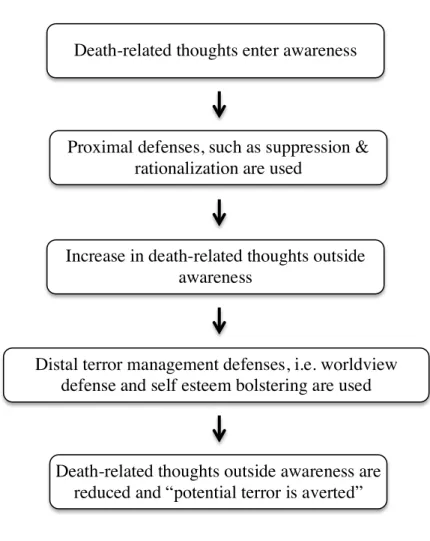
According to Pyszczynski and colleagues (1999) who are leading theoreticians in TMT literature, immediately after people focus on the their death (i.e., when death related thoughts are still in conscious awareness), “proximal defenses” kick in and removes death related thoughts from consciousness by suppressing these thoughts and/or pushes death into distant future by denying one’s vulnerability to disease and premature death. In other words, suppression, rationalization and denial are the first aid defenses to handle conscious death-related thoughts. On the other hand, when death thoughts are not in the current focal attention but highly accessible through implicit measures, “distal defenses”, such as worldview
defense, come to the picture.
Figure 1. TMT model of defense (from Pyszczynski, Greenberg, & Solomon, 1999, p. 840)
On the face value, this defense bears no rational or semantic relation to death. Instead, worldview defense responds the threat of mortality by enabling people to construe themselves as valuable participants in a meaningful universe and offering symbolic death transcendence to those who live up its values. Taken together, this process of using proximal and
Death-related thoughts enter awareness
Proximal defenses, such as suppression & rationalization are used
Increase in death-related thoughts outside awareness
Distal terror management defenses, i.e. worldview defense and self esteem bolstering are used
Death-related thoughts outside awareness are reduced and “potential terror is averted”
distal defenses against the conscious and unconscious death thoughts respectively is called “dual process model of defense against conscious and unconscious death-related thoughts” (Pyszczynski, Greenberg & Solomon, 1999). Figure 1 presents an illustrated demonstration of this dual process model through which mortality salience evokes worldview defense.
In empirical settings various studies put this proposed model into testing by giving participants a distractor task after mortality salience manipulation (in order to withdraw death thoughts from the focus of awareness) and then measuring the worldview defense. For example, Greenberg and colleagues (2000) found that when there was a distractor task between mortality salience manipulation and measuring worldview defense, proximal defense (denial of one’s vulnerability to an early death) was lower and worldview defense was higher. On the contrary, when there was no delay proximal defense was higher and the worldview defense was lower.
1.4. Individual Differences Influencing Mortality Salience Effects
According to TMT, besides worldview, self-esteem is the other component of the anxiety buffer providing protection against existential fear. Due to presumed role of self-esteem as an anxiety buffer, people with high self-esteem are expected to be less vulnerable to anxiety and therefor show less need to buffer against anxiety through worldview defense.
Existing literature supports that assertion (for a review see, Pyszczynski et al., 2003). For example, people with high self esteem (measured prior to mortality salience manipulation) showed less worldview defense compared to those who have moderate or low level of self esteem (Harmon-Jones et al., 1997). Besides naturally high esteem, experimentally enhanced self-esteem is also found to lessen the need for worldview defense (Greenberg et al., 1992)
Authoritarianism is another individual difference that affects the relation between mortality salience and worldview defense. As Adorno and colleagues (1950, as cited in Greenberg et al., 1990) put it, the authoritarian personality develops to function as a defense against fear and is defined by an increased respect for authority, contempt for the disadvantaged, and a rigid and conventional cognitive style. Referring to this conceptualization, Greenberg and colleagues (1990) propose that an authoritarian mindset might develop as a defense against fear of death and play an important role in worldview defense so that highly authoritarian people should respond even more negatively to those who violate their worldview when exposed to reminders of mortality. They found that when mortality is made salient, high authoritarians evaluated dissimilar others more negatively whereas low authoritarians did not. Data from this study indicated that in the absence of mortality salience, high and low authoritarians did not differ in their negative evaluations. Taken together, findings indicate that worldview defense, in the form of belittling dissimilar others, is used by high
authoritarians, but not by low authoritarians, to defend against threat evoked by mortality.
Another individual difference found to moderate mortality salience effect is political liberalism (Greenberg et al., 1992). According to the study conducted by Greenberg and colleagues (1992), political conservatives devalued dissimilar others whereas political liberals did not exhibit this pattern when mortality was made salient. In fact, political liberals prompted with death valued dissimilar others even more compared to those who were not reminded of death. Authors suggested that open-mindedness and tolerance are central aspects of liberal worldview and by acting out their worldview (by valuing dissimilar others), they are actually defending their worldview.
Although these individual differences suggest that people do not exhibit the same level of worldview defense in the face of mortality salience, they do not challenge the idea that people necessarily respond defensively to confrontations with death. As proposed by the authors; people with high self esteem do not defend their worldview because they have already got the protection provided by self esteem (Pyszczynski et al., 2003), high authoritarian people defend their worldview even more due to their authoritarian mindset being their defense against death anxiety (Greenberg, 1990), and finally those with liberal views do not defend their worldview since not defending their worldview itself is the validation of their worldview (Greenberg, 1992). In other words, all these individual
variables could be explained by people’s need of protection against death awareness. However, could it be possible that some people do not respond defensively to mortality salience, because they do not need to be defensive?
Recently, researchers have begun to study this question empirically and pointed out some of the inner resources as a moderator of the MS effect. Florian and colleagues (2001) pointed out that hardiness, a personality structure that attenuates threat appraisal and turns challenges into
opportunities for personal growth, reduced worldview defense. In line with that, Niemiec and colleagues (2010) have found that trait mindfulness, defined as a “disposition characterized by receptive attention to present experience”, reduced both proximal and distal defenses when mortality is made salient. Both lines of research points out that certain resilience factors can mitigate defensive responses to threat evoked by death awareness.
2. Current Study
2.1. Spirituality: As An Individual Difference in Defensive Responses
TMT views human stance against death as a fear based defensive posture towards life and thanks to TMT, a huge literature on death denial and terror management exist in research databases. While recognizing the value of defense mechanisms, one may and should ask whether living in a state of denial is the only way to approach mortality?
This research aims to highlight the idea that people may differ in how defensively they respond to death’s inevitability and suggests that level of spirituality can be counted as an individual difference determining how one relates to death. The following is the description of the core features of spirituality along with the rationale for why spirituality might be counted as a moderator variable between mortality thoughts and defensiveness.
The word “spirit” and its corresponding terms in different languages -such as ruach in Hebrew, pneuma in Greek, and spiritus in Latin- draw on concepts related to “air” or “breath” to metaphorically characterize the principle of life (Smith, 1988). Based on 10 pages of reference material in the Oxford English Dictionary (Simpson & Weiner, 1991), Miller and Thoresen (2003) offer two main themes defining spirituality. First one refers to the “notion of being concerned with life’s most animating and vital principle of quality, often described as giving life or energy to the material human elements of the person”. Second theme that stands out in defining spirituality is the focus on the immaterial features of life. However, as Miller and Thoresen (2003) point out, the multidimensional and immaterial nature of spirituality as a concept defies any clear-cut defining boundaries and point to the fact that it may be more practical to reveal what spirituality is not (i.e., something material) than what it is. In this study, spirituality is defined as a life orientation marked by transcending the individual self and sensing that everything is essentially connected through a cause beyond the self. This definition relies on the works of Ken Wilber (e.g. 1991, 2003)
who has contributed to the understanding of human consciousness a great deal by integrating different approaches to human psyche and written over twenty books that are translated to various languages. This definition is preferred in the current study because it offers a secular and universal understanding of spirituality.
Here, it should be noted that the scales used in current study were in Turkish language. In the scale items, the word “maneviyat/manevi” is used for the word “spirituality/spiritual”. “Maneviyat/manevi” is originally an Arabic word, which is defined as “immaterial”. Turkish Language Assosication (TDK) offers word “tinsellik/tinsel” to be used instead of “maneviyat/manevi” and the definition emphasizes the immaterial essence of reality; however the usage of this term is mostly limited to
philosophical/academic texts and far away from being prevalent in everyday language. Potential implications of using such vocabularies will be pointed out in the discussion section of this thesis, but for now it is necessary to refer to the literature related to conceptualization of spirituality.
As emphasized in the definition above, spirituality involves
transcendence. Transcendence is strongly related to awareness; awareness of an invisible and subtle essence, which is the Spirit of the whole universe. As Ken Wilber summarizes in his book Grace and Grit (2003), this Spirit is not equal to a person’s individual self or ego. In fact, from a transpersonal view of existence, the individual self or ego is precisely that which impedes the awareness of the Spirit. In Wilber words:
I cannot perceive my own true identity, or my union with Spirit, because my awareness is clouded and obstructed by a certain activity that I am engaged in. And that activity, although known by many different names, is simply the activity of contracting and focusing my awareness on my individual self or personal ego. (By doing so) I can’t find or discover my prior identity, my true identity, with the All. And as for my own being itself, it certainly does not seem to be one with the All, one with everything that exist, one with infinite Spirit; rather, it seems completely boxed up and imprisoned in this isolated wall of mortal flesh. (p. 102).
Wilber points out that the more one’s awareness is self-centered and preoccupied with the individual ego, the more alienated one’s existence becomes. Then, it may be claimed, from a transpersonal view, that worldview defense proposed by TMT is related to the individual ego and has nothing to do with the person’s true existence. In fact it is what breaks the genuine existence apart from the Spirit. As TMT literature points out; when confronted with mortality reminders, people judge, devalue and even aggress to those who have the potential to invalidate their worldview. All these attempts can be seen as the investments in the personal ego or
“activities”, as Wilber puts it, “of focusing my awareness on individual self” which makes human body a prison and true identity a prisoner.
As long as one holds on to the individual ego, it is destined to decease as the body physically dies. Then the only choice is to deny and
repress death in ways TMT has already put forward. However, as Wilber underlines (1991, p. 62), this is not the only option; men and women also have the potential to transcend it in the “superconscious All”. He claims that in order to transcend death terror, one must transcend the separate self that is the death terror itself: death terror comes into existence with the
emergence of separate self, and it disappears as one gets to transcend the self.
As the person transcends the self through enlightenment or spiritual practice, it does not mean that the person no longer suffers (Wilber, 2003, p. 154). She or he continues to feel hurt, anguish or pain but adversaries of life, and even the idea of death, does not threaten his or her existence anymore. In other words, transcendence brings along the realization that no matter how much suffering might occur, it does not damage fundamentally her or his perception true existence. Even the physical death of the body does not affect the continued existence of real being (true existence) since existence is no longer identified with individual ego. It paves way to a relaxing and embracing attitude toward everything. Data from empirical studies are in line with this premise. Research conducted with AIDS and cancer patients revealed the positive impact of spirituality on patients’ psycho-social adaptations (Simoni, Martone, & Kerwin, 2002; Jenkins & Pragament, 1995). It can be claimed that what helps these patients’ adaptation to their condition is the way they structure the meaning of the disease as threats to the individual ego but not to their true existence. Put it
differently, a truly transcendental view of life lifts person above self-centered concerns about self-preservation, because self is positioned in something larger and more long lasting than oneself (Wong, 2008). Thus, those with transcendental view of life would not cling to mechanisms to defend particular worldview when reminded of death. Instead, they acquire the potential for a pro-active, meaning-based positive posture toward life by creating meaning and defining how they relate themselves to a particular condition.
From this perspective, even the greatest adversities of life are embraced as means for further self-exploration, personal growth and
meaning making. In fact, awareness of death plays a crucial role in living an authentic life. Many existentialists thinkers point out the irony that in order to live authentically, people must confront what they try to avoid- namely death (Martin, Campbell, & Henry, 2004). Only by embracing the unknown, uncertainty and death, people get to pursue goals that transcend self-interest and live a purposeful, meaningful, authentic and vibrant life and when a person is preoccupied with living a purposeful, meaningful, authentic and vibrant life; then one can argue that death is no longer a major concern (Wong, 2010; Yalom, 1980).
As pointed out previously, spirituality can be seen as a life orientation within which everything is experienced as a part of a greater Whole. In contrast to linear and dualistic Aristotelian logic prevalent in the Western culture, where TMT is originally born, spirituality aligns with
eastern cultures which emphasize the constant flux in the universe and views seemingly contradictory elements, communicated as the yin and yang, in all things (Rodgers-Spencer, Peng, &Wang, 2010). The notion of yin and yang, taking roots from Eastern Taoist philosophy, points out the interplay of life and death in existence (Huainanzi, 2010 as cited in Me-Kellams and Blascovich, 2012). Contrary to how TMT positions death as the rival of life; within the framework of spirituality, death is perceived as inextricably linked to life, such that one would not exist without the other. In such a conceptualization death is seen as a complementary not an enemy one should guard against. Me-Kellams and Blascovich (2012) got interested in how people who perceive the world in a holistic manner respond to death and conducted cross-cultural empirical studies. They found that when confronted with death, European Americans chose responses that aimed at achieving immortality through worldview defense whereas East Asians chose responses that focused at engaging and enjoying life. They point out that this non-defensive way of responding to mortality stems from the holistic mindset common among East Asian participants.
2.1.1. Issues regarding conceptualizing and measuring spirituality
Until recently, spirituality has been a neglected topic in social sciences, particularly in academic circles, due to claims that it cannot be studied empirically (Miller and Thoresen, 2003). Miller and Thoresen
(2003) point out two possible reasons for such exclusion. One philosophical basis for opposition to the scientific study of spirituality comes from
materialism raising the idea that there is nothing to be studied because spirituality is immaterial and beyond the senses. A possible second reason is essentially the materialist argument in reverse: that is, science is unable to study spirituality because scientific methods relying on direct observation and replication offer inappropriate ways to understand spiritual tenets, that is inherently ineffable and subjective. However, with the rise of existential and phenomenological approaches in psychotherapy, this neglected area of research began to mature in 1990s (Ho & Ho, 2007).
Although the idea of spirituality is not a new one, debate regarding how to conceptualize and operationalize spirituality still dominates research databases. Substantial amount of debate is reserved for the relationship between religiosity and spirituality. Although over the past several decades the terms religion and spirituality have been used interchangeably as if they are equivalent of each other, there has been a recent trend toward
differentiating two concepts (Russell & Yarhouse, 2006). Some researchers began to view religiosity as a subset of spirituality (Richards & Bergin, 1997), while there are also those who get to see religiosity as more inclusive than spirituality (Hill & Pargament, 2003). Such proposed
inclusive-exclusive relationships between spirituality and religiosity negate the possibilities of being religious without being spiritual or being spiritual without being religious. From a more secular point of view, some raised the
idea that they might be two overlapping concepts such that neither is a sufficient or necessary condition for each other. More specifically, it is possible to be religious without being spiritual or spiritual without being religious, be both or be neither (Ho & Ho, 2007).
In order to discuss a proposed distinction and relation between spirituality and religiosity, it is important to step back and clarify what do these words refer to.
Wilber (2003) differentiates between two types of religion: Exoteric and esoteric religion. Exoteric, or “outer” religion, is a “mythic” one that is fundamentally concrete and literal. It dictates an unquestionable belief in myths such as that Moses parted the Red Sea, Christ was born from a virgin, Eve is created from one of Adam’s ribs, Krishna made love to four thousand cow maidens, and so on. One is safe and saved as long as she or he
undoubtedly believes in such myths. Esoteric religion, on the other hand, has nothing to do with such mythical religion.
Wilber (2003) uses the concepts of esoteric religion and spirituality interchangeably. To explain “esoteric religion”, namely spirituality, he emphasizes direct experience and personal awareness. While exoteric religion asks complete obedience to dogmas, esoteric religion “is a set of personal experiments that you conduct scientifically in the laboratory of your own awareness” (p.177). Only via experiencing and experimenting, transcendental knowledge of the oneness is acquired.
Explaining the mindset of exoteric religions, Wilber (2003) points out consciousness level of children between ages of six to eleven. During this period, as the self is separated from the other, an omnipotent God replaces omnipotence attributed to the self. In order for the wishes to be fulfilled, God must be satisfied so that God can create miracles that can change the course of events in favor of one’s self. However, as the next structure of consciousness emerges, child gets in to a rational state of mind and abandons such mythic mindset - unless such beliefs are socially
reinforced. In this rational state, the idea of a God serving to the person’s egoistic wishes is given up and myths are viewed as just myths – no
metaphorical or allegorical interpretations accompany them. Moving further in different levels of consciousness, one has potential to realize that there could be more than just “the surface of appearances”. Knowledge of a single Spirit -oneness of everything- comes along not as a dogmatic belief but as an interior experience. To sum, Wilber distinguishes between exoteric religion and esoteric religion (spirituality), and uses different levels of consciousness to discuss these two types: a mythical and more primitive worldview is associated with the former, while more transcendental and higher level of consciousness is associated with the latter (Wilber, 2003).
Associating exoteric religion and spirituality with different levels of consciousness seems to negate the possibility of being exoterically religious and spiritual at the same time. However does it mean that a person cannot define oneself as spiritual and religious at the same time? Wilber (2003)
describes the followers of mythic religions who interpret the myths
metaphorically (instead of believing in the literal meanings) as esoterically religious/spiritual. In other words, it seems like religiosity and spirituality can be overlapped as long as the religiosity is not defined solely on exoteric terms. Moreover, it should be noted that although mythic and transcendental levels of consciousness seems qualitatively different from each other, these levels are better understood as points in a continuous spectrum of
consciousness (Wilber, 1975). It might imply that a person could be in anywhere between being exclusively exoterically religious or spiritual.
Several others make a distinction between religiosity and spirituality in a similar way Wilber makes a distinction between exoteric religiosity and esoteric religiosity (spirituality). Paranjpe (1988) points out the “theological, dogmatistic, ritualistic, liturgical, magical” aspects associating with
religiosity, but not spirituality. Ho (1995) defines religiosity by emphasizing institutional and denominational affiliations and highlights that spirituality does not necessarily have an institutional or denominational expression. Rather, spirituality concerns transcendent or existential questions that have been raised in diverse cultures, regions, and time periods since the first human began reflecting on her own existence.
When it comes to measuring spirituality, the fact that spirituality is not directly observable and spiritual experiences are not easily articulated verbally makes assessment difficult. Rather than the linguistic modality, many spiritual experiences are esthetically felt in a visual, kinesthetic, or
musical manner (Averill, 1998). Moreover, the experiencing person may not even identify such experiences as spiritual (Ho & Ho, 2007). Still,
researchers have relied almost exclusively on paper and pencil self-report measures, claiming that although spirituality is not readily observable, its effects on a person’s life in different domains of life can be accessed via self-report (Hill & Pargament, 2003). Besides self-report measures, physiological correlates of spiritual experiences have also been depicted recently (Seeman, 2003). Some others suggests that dreams could offer an opportunity to investigate spirituality (Ho & Ho, 2007).
2.2. Statement of Purpose, Main Hypothesis, and Potential Implications
This study, without underestimating the terror of death or value of defense mechanisms, challenges the idea that self-preserving defenses are the only means to face death awareness and points out that a spiritual, self-transcendental life orientation can make room for non-defensive
approachment to death. More specifically, this study hypothesizes a two-way interaction of level of spirituality with MS condition, such that the effect of MS on worldview defense would be evident only among those with low spirituality level.
By doing so, it contributes to a neglected and newly growing body of research suggesting that defensive responses to MS can be attenuated by inner resources such as mindfulness (Niemiec, Brown, Kashdan, Cozzoline,
Breen, Bristol, & Ryan, 2010) and hardiness (Florian, Mikulincer,
Hirschberger, 2001). Moreover, it aims to provide empirical support for the idea raised by many existentialist and trans-psychologist writers: Death is not necessarily a source of terror which one should be guarded against for those who are freed from self-centered concerns and limiting nature of the ego, who are inclined to embrace contingencies of life with both positives and negatives, who make conscious choices and creates meaning out of even the greatest adversaries of life. This study can and should be seen as a reminder that as people go forward in their spiritual journey to liberate themselves from individual ego, more accepting attitude toward life and death comes along, bringing a more proactive stance toward life which make a spontaneous, authentic and vibrant living possible.
Moreover, the current study has the potential to contribute to ongoing debate regarding the conceptualization and operationalization of spirituality. Given that psychological research on spirituality involving Muslims is almost nonexistent (Ho & Ho, 2007), conducting this study in Turkey –a predominantly Muslim country- may shed light onto the understanding of spirituality in a context, which is not studied extensively before.
METHOD
1. Sample
The sample of the study was recruited through convenience
sampling. Thus no claim of representativeness of the sample may be stated. Information regarding the study is disseminated via telephone and internet, starting with the researcher’s and his/her family’s social and business network. During the data collection phase, participants were asked to suggest an acquaintance whom they thought might show willingness to participate in the study, enabling snowball sampling.
In a validation study of the ANPS spirituality was found to
positively correlate with age (Özkarar-Gradwohl et al., 2014). Thus, in order to catch variability in the sample in terms of spirituality level, participants from different ages were recruited. Participants’ age ranged between 18 and 68. In order to intentionally equal the number of male and female
participants, two males and two females were recruited for each age. Thus the total number of participants added to 204.
Subjects were assigned to two groups (mortality prompt vs dental pain prompt) based on convenience. However, while assigning the
participants, their sex was taken into consideration. Given that 4 participants (2 male and 2 female) were recruited for each age; one female was given the mortality prompt, while the other female of the same age was given the
dental pain prompt, and the same process was followed for the males of the same age. The two groups did not differ in terms of demographic variables.
Taking into consideration the claims of existing literature that idea of cancer is associated with elevated death-related thoughts outside
awareness, people diagnosed with cancer and/or those having a first degree relative diagnosed with cancer were not included into the sample. An additional exclusion criterion was failure to complete the questionnaire. According to these exclusion criterion; (1)1 person diagnosed with cancer, (2) 2 people having a first-degree relative diagnosed with cancer , and (3) 7 people who failed to complete the questionnaire were excluded from the sample and replacements were found.
Among 204 participants, the age ranged from 18 to 68 with a mean of 43 (SD= 14. 75). 102 (50%) were women and 102 (50%) were men. 82 (40.2%) participants were either university student or graduates, whereas 61 (29.9%) and 41 (20.1%) participants were high school and elementary school graduates, respectively. Only 16 (7.8) participants were either master level students or graduates, while only 4 (2%) participants were doctorate level students or graduates. 136 (66.7%) participants were married, while 51 (25%), 9 (4.4%), 8 (3.9) were single, divorced and widowed, respectively. In terms of occupational status, 108 participants were employed, 37 (18.1%), 35 (17.2), 22 (10.8), 2 (1%) participants identified themselves as housewife, retired, student and unemployed, respectively.
2. Procedure and Instruments
In line with the TMT literature (e.g. Vess, Routledge, Landau, & Arndt, 2009), a cover story was presented to participants such that the study was told to be about testing a newly developed scale measuring personality traits. The questionnaire consists of five parts: First, all of the participants filled out a short form that collected data on participants’ background information (see Appendix A). Second, they completed The Turkish Version of the Affective Neuroscience Personality Scale (ANPS) (see Appendix B). Third, participants answered two open-ended questions about either their own death or dental pain (see Appendix C). Fourth, they
completed a word puzzle (see Appendix D). Finally, Moral Trangressions Scale (Flowrian & Mikulinger, 1997) was presented to participants to assess worldview defense (see Appendix E).
Background Information Form
In a form developed for this study, information regarding
participants’ sex, age, educational level, marital status and occupation was collected.
Spirituality
In order to measure spirituality, The Turkish Version of Affective Neuroscience Personality Scale (ANPS) was used. ANPS was developed by
Davis, Panksepp and Normansell (2003) to measure the activities and the influences of six neurologically based affective networks; Play, Seek, Care, Fear, Anger and Sadness (as cited in Özkarar-Gradwohl et al., 2014). Each of six subscales consists of 14 questions; 7 positively and 7 negatively formulated. The seventh subscale was introduced to measure the level of spirituality, which is depicted as a higher human mental function. Davis, Panksepp, and Normansell (2003, p.60) operationalized spirituality as “feeling connected to humanity and creation as a whole, feeling a sense of oneness with creation, striving for inner peace and harmony, relying on spiritual principles, and searching for meaning in life”. Based on this operationalization, they generated the spirituality subscale comprising 12 questions; 6 positively and 6 negatively formulated.
All questions in the ANPS were designed to be answered on a four-point Likert scale. Every participant receives 7 scores as the result of the scale; Play, Seek, Care, Fear, Anger, Sadness and Spirituality. Although only the spirituality subscale relates to the objective of this study, the whole scale was administered in order to be loyal to the way it is standardized, to validate the cover story and to investigate the potential effects of other affective networks.
The original ANPS is translated to Turkish by Berrak Karahoda and back translated to English by Hanna Nita Scherler and Gökçe Özkarar for translation check (Özkarar-Gradwohl et al., 2014). Özkarar-Gradwohl et al. (2014) studied the psychometrics properties of the Turkish version of ANPS
in adult samples and calculated a Cronbach alpha score of .78 for the spirituality subscale, indicating a good reliability. The Cronbach’s alpha score of the spirituality subscale found in this study is reported in Results section.
Mortality Salience (MS) vs Dental Pain Prompt
After completing the Turkish version of ANPS, participants
responded two open ended questions adapted from Greenberg et al (1994). Half of the participants were asked to “Briefly describe the emotions that the thought of your own death arouses in you” and to “Jot down, as
specifically as you can, what you think will happen to you physically as you die” while the other half answered two parallel questions regarding the experience of dental pain, a generally aversive topic used frequently in TMT research (e.g., Vess, Routledge, Landau, & Arndt, 2009).
In earliest MS studies, effect of mortality salience was simply compared with neutral control conditions in which participants were asked questions about things like watching television or eating their favorite foods, or in which no alternative priming of any kind was conducted (e.g. Greenberg et al., 1990). However, using neutral conditions, studies were unable to address the possibility that the observed effects were due to the more general category of aversive or anxiety producing events and nothing to do with death specifically. Thus, researchers began to compare the effects of thoughts of death with various control conditions in which participants
were asked parallel questions about other aversive topics; such as dental pain, paralysis, giving a public speech (for a review, see Greenberg et al., 1997). Whereas these control conditions sometimes produced negative affect, they did not yield response patterns that mortality salience does (e.g., Greenberg, Simon, Porteus, Pyszczynski, & Solomon, 1995) implying that the effects of MS reflects a specific response to thoughts of death- rather than a general response to aversive thought per se. By using dental pain prompt, the current study follows the footsteps of relatively more recent mortality salience studies.
Delay
As noted previously, distal defenses such as worldview defense occur most prominently when death thoughts are highly accessible but not in the focus of conscious awareness (e.g. Greenberg, Pyszczynski,
Solomon, 1999). Thus, participants completed a word-search task that served as a delay exercise between the salience prompts and the dependent measure. Specifically, participants were asked to find the names of four cities hidden in a 7x7 letter matrix puzzle. Puzzles have been used in several TMT studies as distractor tasks (e.g. Niemiec et al., 2010).
Worldview defense
In this study, worldview defense is operationalized as judgments of the severity of and recommendations of punishment for social
transgressions. Florian and Mikulincer (1997) were the first ones who operationalized worldview defense in this way and building on this operationalization they developed Moral Transgression Scale. This scale presented participants a series of 10 vignettes that described a unique social transgression. A sample vignette is as follows:
A doctor mixed up the records of two patients with the same last name and amputated the leg of the wrong patient. “it is impossible to believe” said the patient as she stared in disbelief at the empty space on her bed where her left leg was supposed to be. “I came in for a simple knee operation and woke up without leg.
After each vignette, participants were asked two questions: (1) “How severe was this wrongdoing?” and (2) “How heavily should the perpetrator of this wrongdoing be punished”. Responses were made on a 7-point scale from 1 (indicating not severe at all for the first question and very mild punishment for the second question) to 7 (indicating extremely severe for the first question and very severe punishment for the second question). The mean of 20 ratings yields the score of judgments of social transgressions; higher scores reflecting harsher judgments of social transgression.
In this study, the scale was translated to Turkish by the researcher herself. Translation check was conducted by Hanna Nita Scherler. The original scale yields a Cronbach’s alpha score of .91 (Florian& Mikulincer, 1997).
3. Observations
Before going into reporting results, it is worth to mention some observations regarding how participants reacted to the questionnaires. These notes by no means affect the statistical analyses; however they may
contribute to the discussion of results.
Not all the questionnaires are completed in the presence of the researcher, since almost 60% of the distributed questionnaires were completed in take-home format. Among those whom had the researcher in the room while responding the questions, 12 people asked the researcher to clarify an item in the Spirituality subscale which states “feeling a oneness with all of the creation gives more meaning to my life” (Turkish translation: Evrenle bir bütün olduğumu hissetmek hayatıma daha fazla anlam katar). In response, the researcher instructed them to answer the question, as they understand it. None of them left the item blank. Post-administration review of the data indicated that none of the demographic variables seemed to be common among those 12 people with the exception of education level: Only 1 person had an education level of university, whereas 6 people were
elementary and 5 were high school graduates.
Moreover, one participant feedbacked the researcher, claiming that the frequency adverbs in some items clouded his judgment. For example, for the item “I rarely rely on spiritual inspiration to help me meet important challenges” (Turkish translation: Önemli zorlukların üstesinden gelmek için
nadiren maneviyata sığınırım), he said that he would like to report that he does it “often”. However, he was not sure that if he marked “strongly disagree”, it would mean “never” (I disagree because I never do that) or “often” (I disagree because I often do that). It is unknown whether other participants experienced such confusion as well or it was a one-case exception; still it might raise some questions regarding the
comprehensibleness of response options for some items.
RESULTS
Predictor variables included spirituality scores and mortality salience versus dental pain prompt. Criterion variable was the Mortality
Transgression Scale score indicating how harshly a social violation is judged and punished. It was hypothesized that there is an interaction effect of spirituality and mortality salience on the judgments of social
transgressions. Before going into investigating the hypothesis, descriptive analyses regarding each variable are run and presented below.
1. Spirituality Subscale of the Turkish version of ANPS
1.1. Reliability of the Spirituality Subscale
Reliability analysis of the Spirituality subscale yielded a Cronbach’s alpha score of .51, indicating a poor reliability. Given that the Cronbach’s alpha score of .78 is found in the original reliability study of the Turkish version of ANPS (Özkarar-Gradwohl et al., 2014), it was worth paying attention to the gap between two scores. In terms of the sample
characteristics, the major difference between the two studies was the distribution of educational level. In the original reliability study conducted by Özkarar-Gradwohl et al. (2014) participants with high school or primary school education constituted only 6.2% of the sample, whereas in the current study 50% of the sample had high or primary school education.
When those with high school or primary school education were excluded from sample and the reliability analysis was run on a sample composed of participants with university, masters and doctorate level of education, Cronbach’s alpha score was found to be .77, which was almost equal to what was found by Özkarar-Gradwohl et al. (2014). Moreover, when high school graduates were added to the analysis, reliability score dropped back to .51, suggesting that university level education was the minimum threshold for spirituality subscale to be reliable.
Because spirituality subscale is found to be a reliable measure in a sample composed of 102 participants with university, masters or doctorate level education, subsequent statistical analyses were run on this sample.
In this sample, number of male and females were equal to each other. Age ranged from 19 to 67 (M = 38.31, SD = 14.06). 82 (80.4%) participants were either university student or graduates, 16 (15.7%) had a master level of education whereas only 4 (3.9%) were doctorate level students or graduates. 60 (58.8%) participants were married, while 35 (34.3%), 5 (4.9%), 2 (2%) were single, divorced and widowed, respectively. In terms of occupational status, 64 (62.7%) participants were employed, 16 (15.7%), 11 (10.8%), 9 (8.8%), 2 (2%) participants identified themselves as student, retired, housewife and unemployed, respectively. Table 1 presents demographic variables of the sample.
Table 1
Demographic Background of the Sample, N=102
M SD Age 38.3 14.7 n % Gender female male 102 102 50 50 Education university masters doctorate 82 16 4 80.4 15.7 3.9 Marital Status married single divorced widowed 60 35 5 2 58.8 34.3 4.9 2 Occupational Status employed student retired housewife unemployed 64 16 11 9 2 62.7 15.7 10.8 8.8 2
Since other subscales of ANPS are not in the focus of this study, statistics related to these subscales are presented in Appendices section. For the reliability coefficients of other subscales, please refer to Table F1 and F2 in the Appendix F.
1.2. Correlations with Other Subscales of ANPS
Table 2 presents correlations between spirituality and other
subscales of ANPS along with means, standard deviations and Cronbach’s alpha scores of each subscale. As Table 2 shows, spirituality was
significantly correlated with only care subscale (r =.37, p<.01) . Higher spirituality was associated with higher care.
Table 2
Descriptive Statistics, Correlations, and Subscale Reliabilities 1 N=102 2 N=102 3 N=102 4 N=102 5 N=102 6 N=102 7 N=102 Spirituality - .05 -.12 .37* -.12 .14 -.07 α .77 .61 .65 .69 .71 .62 .47 M 20.70 25.78 20.65 26.46 23.82 23.29 18.99 SD 5.02 3.94 4.46 4.86 5.09 4.15 3.44
Note. 1 = spirituality, 2 = seek, 3 = fear, 4 = care, 5 = anger, 6 = play, 7 = sadness
Table F1 and F2 in Appendix F presents intercorrelations among other subscales of ANPS.
1.3. Spirituality and Demographics
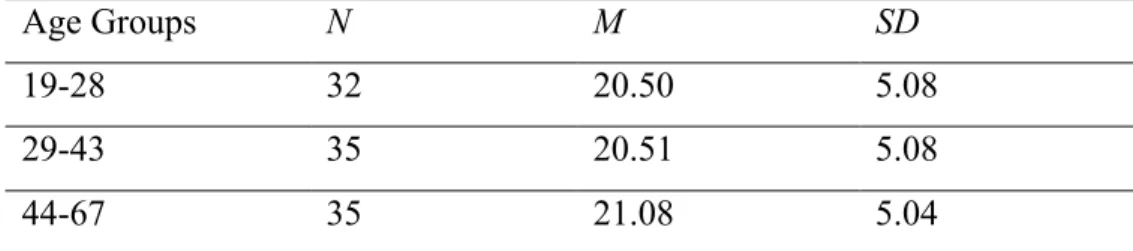
When age was considered as a continuous variable, spirituality did not correlate with age (r= .04, p>.05). Similarly, when participants were categorized into three age groups and one way ANOVA analysis was run, groups did not show a difference in terms of spirituality level F(2,99)=.15 p>.05. Means and standard deviations of Spirituality scores are presented in Table 3 according to different age groups.
Table 3
Means and SDs of Spirituality Scores for Different Age Categories
Age Groups N M SD
19-28 32 20.50 5.08
29-43 35 20.51 5.08
44-67 35 21.08 5.04
On the other hand, independent samples t-test analysis indicated a significant relation between spirituality and gender so that females (M = 22.13, SD = 4.69) had significantly higher spirituality scores compared to males (M = 19.27, SD = 4.98), t (100) = 2.99, p < .01.
No statistical analyses was run to see if spirituality is related to education level, marital status or occupational status due to insufficient number of participants in some categories of these variables (such as doctorate level of education).
2. Mortality Salience versus Dental Pain Prompts
If the participants were assigned to the groups of Mortality Salience or Dental Pain prompts, then no significant difference was expected
between two groups in terms of spirituality and demographic variables. However, since the assignment was based on convenience, there was possibility that two groups might show differences that could affect the proposed interaction effect between spirituality and mortality salience.
As revealed by Chi-square tests of independence, two groups did not differ from each other in terms of gender, X2 (1, N=102) = .35, p>.05; education level, X2 (2, N=102) = 1.82, p>.05; occupational status X2 (4, N=102) = .07, p>.05; and marital status X2 (3, N=102) = 5.32, p>.05.
The difference between the mean age of mortality salience group (M=40.22, SD = 14.91) and dental pain group (M = 36.09, SD = 12.80) was not significant either, t(100) = 1.49, p> .05.
An independent samples t-test analysis revealed that those who were prompted with mortality (M= 20.69, SD = 4.51) did not differ from those
who were prompted with dental pain (M= 20.28, SD = 4.51) in terms of spirituality t(100) = .646, p >.05.
To sum up, two groups (mortality salience - dental pain) did not significantly differ from each other in terms of demographic variables and spirituality.
3. Moral Transgression Scale (MTS) and Demographics
Moral Transgression Scale yields a Cronbach’s alpha score of. 90 signaling a high internal reliability.
As to demographics, age does not correlate with MTS scores, r(101) = -.093, p>.05. Moreover, females (M = 6.15, SD = .53) and males (M = 5.92, SD = .68) did not differ from each other in terms of MTS scores, t(100) = 1.94, p>.05.
No statistical analyses was run to see if MTS scores differ across education level, marital status or occupational status due to insufficient number of participants in some categories of these variables.
As far as age and gender were concerned, MTS did not have a significant relation with demographic variables.
4. Role of Spirituality in Mortality Salience Effects
4. 1. Spirituality as a Dimension
In order to test the hypothesized interaction effect of spirituality and mortality salience on judgments of moral transgressions, hierarchical regression analysis was run. Controlling for spirituality and group (Mortality Salience vs Dental Pain prompt) in Step 1, interaction of
spirituality with group added in Step 2. Results indicated that interaction of spirituality with group did not predict judgments of social transgressions, β =.02, p>.05. In other words, the main hypothesis of the study was not supported. Table 4 presents related statistics of the regression model.
Table 4
Coefficient Values for the Regression Model.
b SE b β ∆R2 Step 1: Spirituality Group .03 -.03 .01 .12 .23* -.02 .05 Step 2: Spirituality*Group -.01 .02 -.19 .00 Note. *p<.05
4.2. Spirituality as Categorical: Low and High Spirituality To test the role of spirituality in moderating the relation between Mortality Salience and judgment of social transgression, another way to go was to compare people with high spirituality levels with those of low spirituality levels. For this purpose, participants were first categorized according to their spirituality level. Participants who scored in the highest quartiles of spirituality were label as high spirituality group and those who scores in the lowest quartile as low spirituality group. Then, 2 (Mortality Salience vs Dental Pain prompt) x 2 (High spirituality vs Low Spirituality group) ANOVA was conducted. Table 5 presents related means and standard deviations.
Table 5
Mean MTS scores with SDs for 2 (Mortality Salience vs Dental Pain Prompt) x 2 (high vs low spirituality) ANOVA.
Mortality Salience Prompt N = 24
Dental Pain Prompt N =26 High Spirituality n = 26 n =14 M = 6.23 SD = .17 n = 12 M = 6.09 SD = .18 Low Spirituality n = 24 n = 10 M = 5.64 SD = .19 n = 14 M = 5.69 SD = .17
Results indicated that there was a main effect for spirituality F(1,48) = 5.59, p<.05. In other words, participants who scored high in spirituality judged social transgressions more harshly than participants who scored low
in spirituality, regardless of whether they were prompted by mortality salience or dental pain. There was no main effect of mortality salience on judgments of social transgressions, F (1,48) = .45, p>.05. Additionally, interaction effect of spirituality and mortality salience was not significant either, F (1,48) = .02, p>.05. Figure 2 depicts the means of 2x2 ANOVA analysis.
Figure 2. Mean Moral Transgression Scale scores by Group (Mortality Salience vs Dental Pain Prompt) and Spirituality (low vs high).
5. Spirituality and Moral Transgressions (MTS)
Although 2 (Mortality Salience vs Dental Pain Prompt) x 2 (High spirituality vs Low Spirituality Group) ANOVA did not reveal an
interaction effect of spirituality and mortality salience on judgments of moral transgressions, it pointed out a significant relation between spirituality and judgments of moral transgressions. To investigate this relationship further, correlation analysis was run and it was found that spirituality is positively correlated with MTS scores, r(100) = .23 p<.05. Regressing spirituality on MTS revealed that spirituality predicted 5.3% of variance in MTS scores, R2 = .053 F(1,102) = 5.56 p<.05.
DISCUSSION
1. Reliability of Spirituality Subscale
Psychometric analysis indicated that education level of the sample plays a significant role determining how reliable Spirituality subscale of the Turkish version of ANPS is. When the sample was composed of participants with university, masters and doctorate level of education, the scale yielded a good reliability. When high school graduates were added to this sample, reliability score dropped considerably. This indicated a poor reliability, suggesting that university level education was the minimum threshold for spirituality subscale to be reliable.
Although the methodological framework of this study does not allow empirical explanations regarding the relationship between education level and reliability of spirituality subscale, subjective observations suggest that some of the scale items might not be understood fully by the participants. Specifically, “feeling a oneness with all of the creation gives more meaning to my life” was the item which received the most feedback regarding its unclear content. What differentiates this item from the rest of the scale could be its relatively more abstract nature. An interesting and potentially related point was that among the 12 people who asked for a clarification, 11 people had an education level below university, whereas only 1 people had a university level of education. Such observations may point two