357
Determination of Consumption Habits of Goat Milk and Products in
Cukurova University Students,
M.Durmuş1*, D.J. Agossou1, N. Koluman1
1Agricultural Faculty, Department of Animal Science, Çukurova University, Sarıçam-
Adana.
*Corresponding author e-mail: [email protected]
Introduction
Every human has to feed to survive (Çalıştır et al., 2005). Nutrition is to take and use nutrient that will provide necessary energy and nutritional elements to live long periods of time in a growth, development, healthy and efficient way (Tanır et al., 2001). When any of these nutritional elements are not received or when received more or less than necessary, it has been scientifically demonstrated that growth and development are hindered and health is impaired (Baysal, 1993). Milk is the first food that enters their body after the birth of humans. Milk is an invaluable food that contains sufficient nutrients to meet the daily needs of humans except iron and vitamin C. In adequate and balanced nutrition of people; milk and milk products are important because they are rich in nutrients such as calcium, phosphorus, Protein, vitamins and minerals (Miller et al., 2000; Kırdar, 2001). Therefore, in order to ensure adequate and balanced food substance and energy intake, health professionals recommended to increase consumption of milk and milk products (Heaney et al., 1999). There are mainly four animal species raised for milk production in the world. The odors and tastes of milk and milk products of these four species are different from each other and caters to consumers that have different palatal delight (Akbay and Boz, 2005). Most consumed milk and milk products in Turkey is obtained from cow milk. In addition to cow milk, goat milk is another type of milk whose production and consumption in the world increases with each passing day. Goat milk produced in Turkey is generally processed into cheese by mixing with sheep and/or cow milk or used directly in ice cream production. Goat breeding is becoming increasingly important due to low input costs, ease of care and feeding, and healthy of goat milk and products (Kılıç et al., 2002; Kesenkaş et al., 2010). In addition, goat milk generally contains less microorganisms and pesticides than other milk, fat and protein of goat milk can be more easily digested and and its composition is increasing its importance due to being closest milk to breast milk (Güney and Kaymakçı 1997). Turkey is very suitable for goat breeding when considered its natural vegetation, soil structure, ecology and socioeconomic structure. Therefore, goat breeding should be encouraged in order to increase the role of goat milk and products in human nutrition thus consumers can access goat milk and products more easily. The present study was conducted to determine of consumption habits of goat milk and products of students at the Çukurova University campus.
Materials and Methods
The study consisted of data obtained from face to face committed surveys with students who are educated at Çukurova University campus. Also in the study, was used books, articles and statistics published by various institutions and organizations studying on the topic as secondary data. In order to obtain the data used in the research, a survey was conducted with 140 students randomly selected from a total of 27,101 1th education students. All student were enrolled at Çukurova University during the 2018-2019
358
academic year. Applied survey to students was applied equal number in terms of the region factor and completely randomly selected for other factors. In the survey, 10 questions were asked on consumption habits of goat milk and products based on the age of the students, their region, income level and place of residence. The results of the research were summarized in the tables and interpreted by giving frequency and percentage values. In addition, the statistical calculation of the data was calculated by the chi-square analysis method with the help of SPSS program.
Results and Conclision
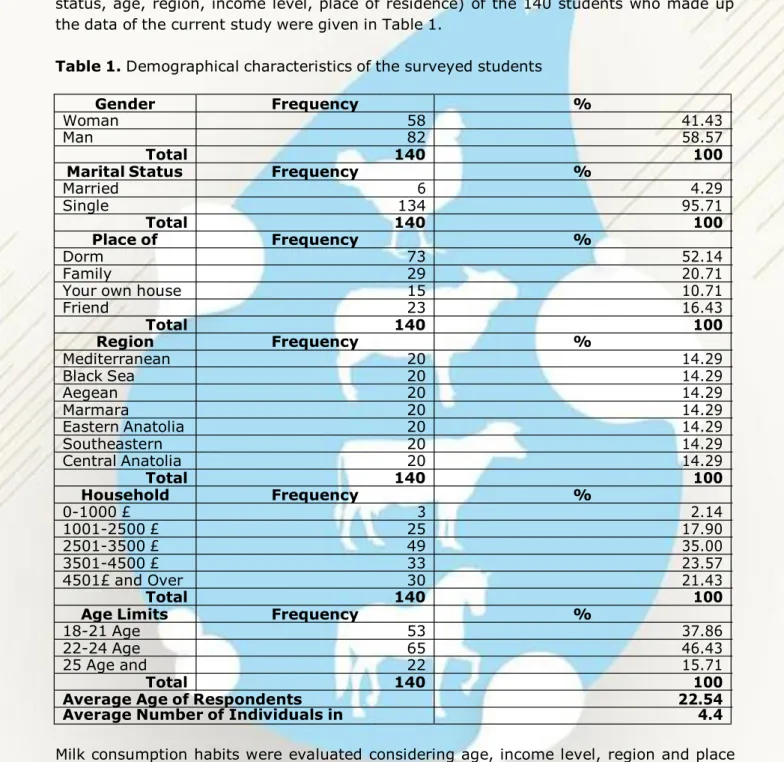
The frequency and percentage values on demographics characteristics (gender, marital status, age, region, income level, place of residence) of the 140 students who made up the data of the current study were given in Table 1.
Table 1. Demographical characteristics of the surveyed students
Gender Frequency %
Woman 58 41.43
Man 82 58.57
Total 140 100
Marital Status Frequency %
Married 6 4.29 Single 134 95.71 Total 140 100 Place of Frequency % Dorm 73 52.14 Family 29 20.71
Your own house 15 10.71
Friend 23 16.43 Total 140 100 Region Frequency % Mediterranean 20 14.29 Black Sea 20 14.29 Aegean 20 14.29 Marmara 20 14.29 Eastern Anatolia 20 14.29 Southeastern 20 14.29 Central Anatolia 20 14.29 Total 140 100 Household Frequency % 0-1000 £ 3 2.14 1001-2500 £ 25 17.90 2501-3500 £ 49 35.00 3501-4500 £ 33 23.57 4501£ and Over 30 21.43 Total 140 100
Age Limits Frequency %
18-21 Age 53 37.86
22-24 Age 65 46.43
25 Age and 22 15.71
Total 140 100
Average Age of Respondents 22.54
Average Number of Individuals in 4.4
Milk consumption habits were evaluated considering age, income level, region and place of residence of the students whose demographic characteristics (Table 1). As shown in Table 1, 58.57% of the surveyed students were male and 41.43% were female. The
359
average age of students was 22.54. Due to the fact that the survey was conducted in a university environment, the majority of the respondents constituted from students residing in dormitory, single and having family income (2501-3500 TL) slightly above the minimum wage. It is seen in Table 2 that 77.14% of the surveyed students did not have enough information about the benefits of goat milk and products. According to statistical calculations, it was found that the region, place of residence, income level and age factors did not significantly affect the question measuring the level of knowledge about the benefits of goat milk and products (p>0.05).
As seen in Table 3, 57.86% of the surveyed students reported not consuming goat milk and products. In this case, the low consumption rate of goat milk and products can be explained by insufficient knowledge of surveyed students about the benefits of these products. The consumption of goat milk and products was found to be the least in the Black Sea region, although it was mostly in the Eastern Anatolia and Southeastern Anatolia regions. The main reason for this result is that most of the goat breeding in our country is carried out in the eastern and south-eastern Anatolian regions. Therefore, people living in these regions have a habit of consuming to obtained products from goat species in food consumption of animal origin.
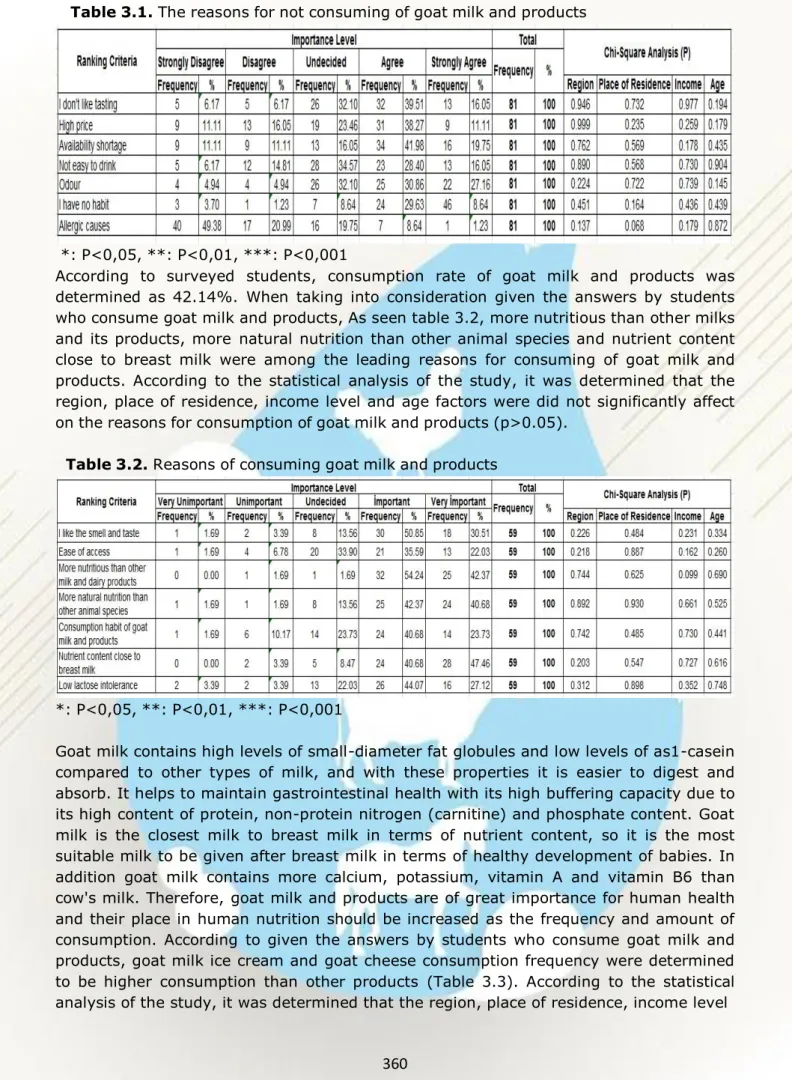
Consumption of goat milk and products varied depending on many factors. Habit, odour and accessibility among these factors were the most important ones. According to given the answers by students who do not consume goat milk and products, Table 3.1 showed that odour, accessibility and taste were among the leading reasons for not consuming of goat milk and products. According to statistical calculations of study, however, the region, place of residence, income level and age factors did not significantly affect the reasons for not consuming of goat milk and products (p>0.05).
Table 3.1. The reasons for not consuming of goat milk and products
*: P<0,05, **: P<0,01, ***: P<0,001
According to surveyed students, consumption rate of goat milk and products was determined as 42.14%. When taking into consideration given the answers by students who consume goat milk and products, As seen table 3.2, more nutritious than other milks and its products, more natural nutrition than other animal species and nutrient content close to breast milk were among the leading reasons for consuming of goat milk and products. According to the statistical analysis of the study, it was determined that the region, place of residence, income level and age factors were did not significantly affect on the reasons for consumption of goat milk and products (p>0.05).
Table 3.2. Reasons of consuming goat milk and products
*: P<0,05, **: P<0,01, ***: P<0,001
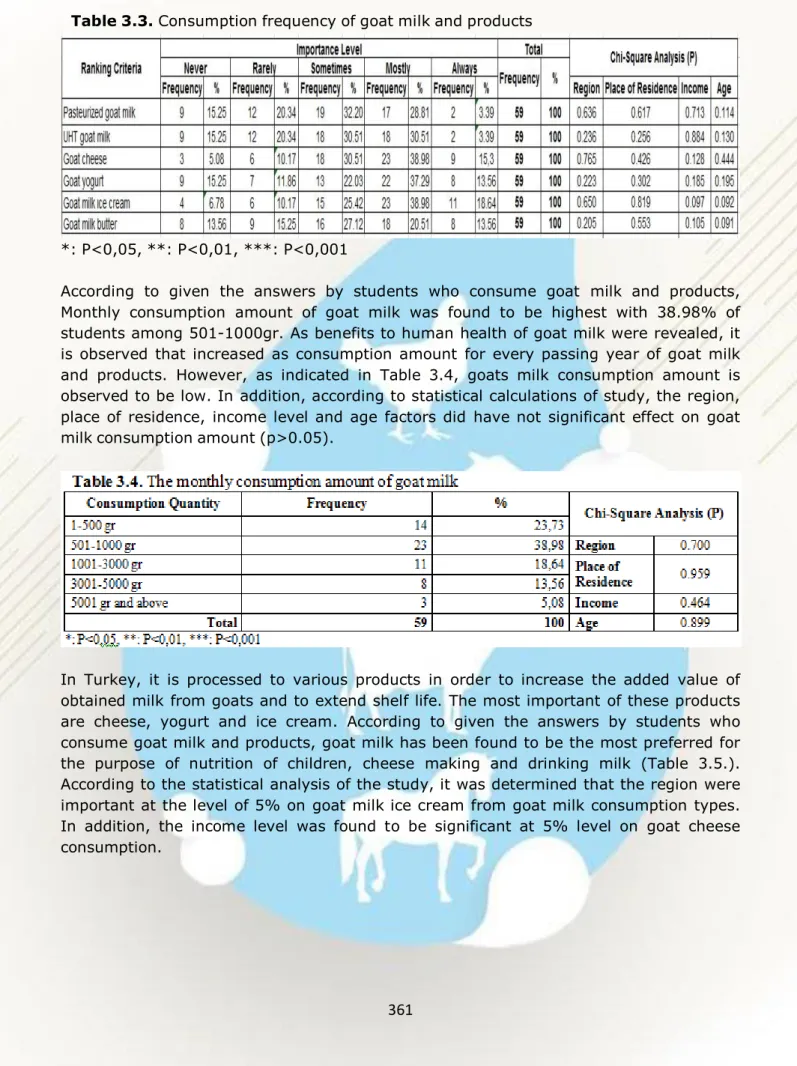
Goat milk contains high levels of small-diameter fat globules and low levels of as1-casein compared to other types of milk, and with these properties it is easier to digest and absorb. It helps to maintain gastrointestinal health with its high buffering capacity due to its high content of protein, non-protein nitrogen (carnitine) and phosphate content. Goat milk is the closest milk to breast milk in terms of nutrient content, so it is the most suitable milk to be given after breast milk in terms of healthy development of babies. In addition goat milk contains more calcium, potassium, vitamin A and vitamin B6 than cow's milk. Therefore, goat milk and products are of great importance for human health and their place in human nutrition should be increased as the frequency and amount of consumption. According to given the answers by students who consume goat milk and products, goat milk ice cream and goat cheese consumption frequency were determined to be higher consumption than other products (Table 3.3). According to the statistical analysis of the study, it was determined that the region, place of residence, income level
and age factors were did not significantly affect on consumption frequency of goat milk and products (p>0.05).
Table 3.3. Consumption frequency of goat milk and products
*: P<0,05, **: P<0,01, ***: P<0,001
According to given the answers by students who consume goat milk and products, Monthly consumption amount of goat milk was found to be highest with 38.98% of students among 501-1000gr. As benefits to human health of goat milk were revealed, it is observed that increased as consumption amount for every passing year of goat milk and products. However, as indicated in Table 3.4, goats milk consumption amount is observed to be low. In addition, according to statistical calculations of study, the region, place of residence, income level and age factors did have not significant effect on goat milk consumption amount (p>0.05).
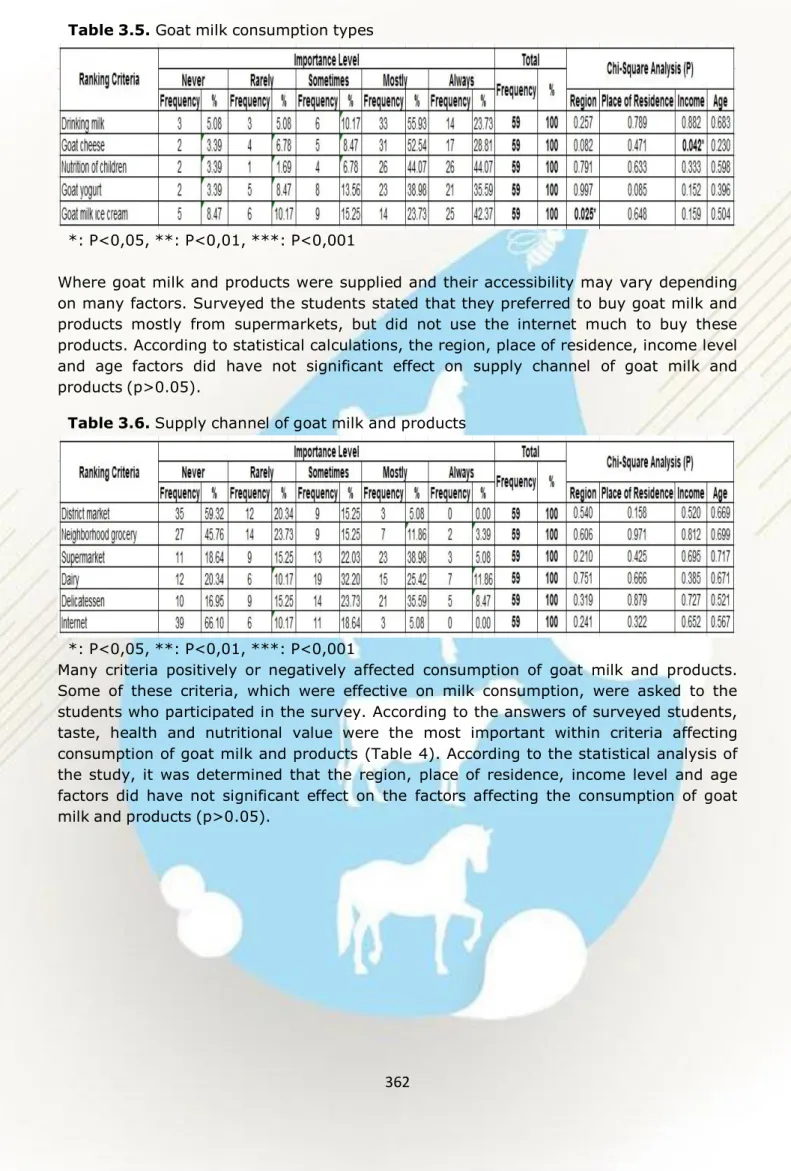
In Turkey, it is processed to various products in order to increase the added value of obtained milk from goats and to extend shelf life. The most important of these products are cheese, yogurt and ice cream. According to given the answers by students who consume goat milk and products, goat milk has been found to be the most preferred for the purpose of nutrition of children, cheese making and drinking milk (Table 3.5.). According to the statistical analysis of the study, it was determined that the region were important at the level of 5% on goat milk ice cream from goat milk consumption types. In addition, the income level was found to be significant at 5% level on goat cheese consumption.
Table 3.5. Goat milk consumption types
*: P<0,05, **: P<0,01, ***: P<0,001
Where goat milk and products were supplied and their accessibility may vary depending on many factors. Surveyed the students stated that they preferred to buy goat milk and products mostly from supermarkets, but did not use the internet much to buy these products. According to statistical calculations, the region, place of residence, income level and age factors did have not significant effect on supply channel of goat milk and products (p>0.05).
Table 3.6. Supply channel of goat milk and products
*: P<0,05, **: P<0,01, ***: P<0,001
Many criteria positively or negatively affected consumption of goat milk and products. Some of these criteria, which were effective on milk consumption, were asked to the students who participated in the survey. According to the answers of surveyed students, taste, health and nutritional value were the most important within criteria affecting consumption of goat milk and products (Table 4). According to the statistical analysis of the study, it was determined that the region, place of residence, income level and age factors did have not significant effect on the factors affecting the consumption of goat milk and products (p>0.05).
Table 4. The factors affecting the consumption of goat milk and products
*: P<0,05, **: P<0,01, ***: P<0,001
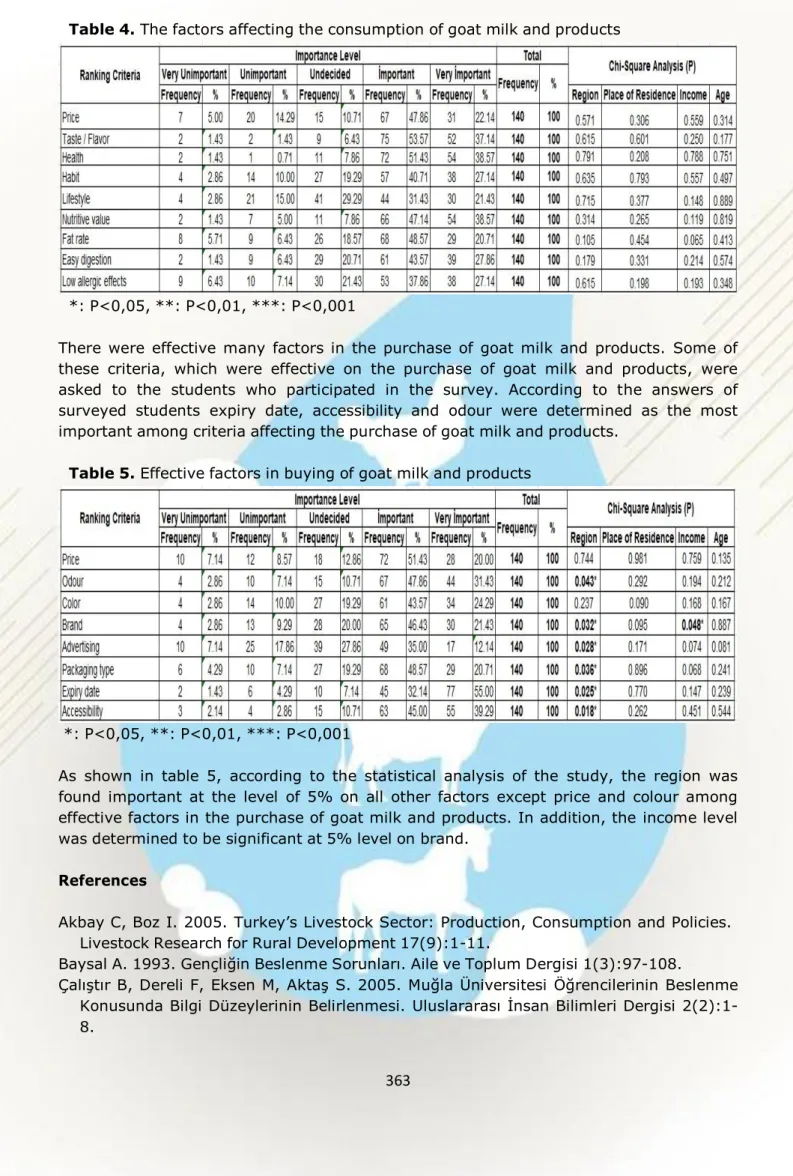
There were effective many factors in the purchase of goat milk and products. Some of these criteria, which were effective on the purchase of goat milk and products, were asked to the students who participated in the survey. According to the answers of surveyed students expiry date, accessibility and odour were determined as the most important among criteria affecting the purchase of goat milk and products.
Table 5. Effective factors in buying of goat milk and products
*: P<0,05, **: P<0,01, ***: P<0,001
As shown in table 5, according to the statistical analysis of the study, the region was found important at the level of 5% on all other factors except price and colour among effective factors in the purchase of goat milk and products. In addition, the income level was determined to be significant at 5% level on brand.
References
Akbay C, Boz I. 2005. Turkey’s Livestock Sector: Production, Consumption and Policies. Livestock Research for Rural Development 17(9):1-11.
Baysal A. 1993. Gençliğin Beslenme Sorunları. Aile ve Toplum Dergisi 1(3):97-108.
Çalıştır B, Dereli F, Eksen M, Aktaş S. 2005. Muğla Üniversitesi Öğrencilerinin Beslenme Konusunda Bilgi Düzeylerinin Belirlenmesi. Uluslararası İnsan Bilimleri Dergisi 2(2):1- 8.
Güney O, Kaymakçı M. 1997. Keçilerde Süt Üretimi. M. Kaymakçı, Y. Aşkın (Editör), Keçi Yetiştiriciliği, Ankara, s115-128.
Heaney RP, McCarron DA, Dawson-Huges B, Oparil S, Berga SL, Stern JS, Barr SI, Rosen CJ. 1999. Dietary Changes in Favourably Affect Bone Remodeling in Older Adults. Journal of the American Dietetic Association 99:1128-1133.
Kesenkaş H, Dinçki N, Kınık Ö, Gönç S, Ender G. 2010. Saanen Keçisi Sütünün Genel Özellikleri. Akademik Gıda Dergisi 8(2):45-48.
Kılıç S, Uysal H, Kavas G, Kesenkaş H, Akbulut, N. 2002. Pilot Tesis Koşullarında Pastörize Keçi Sütünden Çimi Peyniri Üretimi. Ege Üniversitesi Ziraat Fakültesi Dergisi 39(3):56-63.
Kırdar SS. 2001. Sütün Beslenmemizde Yeri ve Önemi. Süleyman Demirel Üniversitesi Fen Bilimleri Enstitüsü Dergisi 5(1):121-131.
Miller GD, Jarvis JK, McBean LD. 2006. Handbook of Dairy Foods and Nutrition. CRC Press, New York, 432s.
Tanır F, Şaşmaz T, Beyhan Y, Bilici S. 2001. Doğankent Beldesinde Bir Tekstil Fabrikasında Çalışanların Beslenme Durumu. Türk Tabipler Birliği Mesleki Sağlık ve Güvenlik Dergisi 2(7):22-25.