KADIR HAS UNIVERSITY
GRADUATE SCHOOL OF SOCIAL SCIENCES NEW MEDIA DISCIPLINE AREA
CHALLENGING THE INFLUENCE OF INTERACTIVITY
ON NARRATIVE STRUCTURES IN DIGITAL GAMES.
AN ANALYSIS OF ADVENTURE GENRES
NİLÜFER ZEYNEP YAVUZ
SUPERVISOR: ASSOC. PROF. DR. ÇİĞDEM BOZDAĞ
MASTER’S THESIS
CHALLENGING THE INFLUENCE OF INTERACTIVITY
ON NARRATIVE STRUCTURES IN DIGITAL GAMES.
AN ANALYSIS OF ADVENTURE GENRES
NİLÜFER ZEYNEP YAVUZ
SUPERVISOR: ASSOC. PROF. DR. ÇİĞDEM BOZDAĞ
MASTER’S THESIS
Submitted to the Graduate School of Social Sciences of Kadir Has University in partial fulfillment of the requirements for the degree of Master’s in the Discipline Area of New Media under the Program of New Media.
i
TABLE OF CONTENTS
LIST OF FIGURES...ii ABSTRACT...iii ÖZET...iv INTRODUCTION...11. REVIEW OF THE LITERATURE...5
1.1 Classical Narrative...5
1.1.1 Separation...7
2.1.2 Initiation...8
2.1.3 Return...9
1.2 Classical Narrative Structure by Vogler...10
1.2.1 Act 1...11
1.2.2 Act 2...12
1.2.3 Act 3...13
1.3 Games, Narrative and Interactivity...14
2. METHODOLOGY OF THE RESEARCH...21
2.1 Method...21
3. RESEARCH FINDINGS AND ANALYSIS...25
3.1 Dragon Age: Origins...25
3.1.1 General information...25
3.1.2 Plot...26
3.1.3 Quests & Analysis...27
3.2 The Witcher 3: Wild Hunt...29
3.2.1 General Information...29
3.2.2 Plot...30
3.2.3 Quests & Analysis...31
SUMMARY & CONCLUSION...35
SOURCES...39
ii
LIST OF FIGURES
Figure 1.1 The Hero’s Journey Graphic 6
Figure 1.2 The Hero’s Journey of Vogler 11
Figure 1.3 A Diagram of Video Game Structure 19
Figure 3.1.1 The DVD Cover of Dragon Age 26
Table 3.1.2 Dragon Age: Origins- Race & Class Diagram 27
Table 3.1.3 Dragon Age: Origins- Main Quests Diagram 28
Figure 3.2.1 The Map of The Witcher: Wild Hunt 30
Table 3.2.3 The Witcher 3: Wild Hunt Prologue 31
Table 3.2.4 The Witcher 3: Wild Hunt Act 1 33
Table 3.2.5 The Witcher 3: Wild Hunt Act 2 34
iii
ABSTRACT
YAVUZ NİLÜFER ZEYNEP. CHALLENGING THE INFLUENCE OF
INTERACTIVITY ON NARRATIVE STRUCTURES IN DIGITAL GAMES. AN ANALYSIS OF ADVENTURE GENRES, Master’s Thesis, Istanbul, 2018
This study analyzes the narrative structure of the computer games after the emergence of the computer technology which provides an opportunity for the game designers to create more extensive narrative structures. The aim is to introduce a framework which contains J. Campbell’s “monomyth” theory and C. Vogler’s modernization of the same theory, specify the indicatives, thereafter create an understanding of game narrative in an approach that is correspondent with the classical narrative structure. This thesis tries to indicate whether the entrance of a new perception of technology which brings the interactivity notion to human life, changes the practices and the fundamentals of the classical narrative structure. The purpose of this thesis is to understand how the adventure game scenarios are constituted, to see if the structure of the games have overtones of the classical narrative and to determine the influence of the interactivity by picking two games of adventure genre and analyzing their quest lines.
Key Words: Narrative, narrative structure, classical narrative, Hero’s Journey,
monomyth, video games, interactivity, adventure games, digital narrative, digital storytelling
iv
ÖZET
YAVUZ NİLÜFER ZEYNEP. DİJİTAL OYUNLARDA ANLATI YAPILARINDAKİ İNTERAKTİVİTE ETKİSİNİN SORGULANMASI. MACERA TÜRÜNÜN BİR ANALİZİ, Yüksek Lisans Tezi, İstanbul, 2018
Bu çalışma, oyun tasarımcılarının daha geniş anlatı yapıları oluşturmalarına imkân tanıyan bilgisayar teknolojilerinin gelişimden sonra ortaya çıkan anlatı yapısını analiz etmektedir. J. Campbell’ın “monomit” teorisini ve C. Vogler’ın, yine aynı teorinin bir modernizasyonu olan teorisini içeren bir akademik çerçeve oluşturmak, teorinin belirleyici özelliklerini belirlemek, daha sonrasında ise klasik anlatının yapısına paralel bir yaklaşımda oyunların anlatısındaki yapıyı ortaya koymayı hedeflemektedir. Bu tez, yeni bir teknoloji algısıyla beraber insan yaşamına giren interaktivite olgusunun, klasik anlatı yapısının uygulamalarını ve temellerini değiştirip değiştirmediğini göstermeye çalışmaktadır. Bu tezin amacı, macera türünden iki adet oyun seçip görev ağacını analiz ederek macera oyunu senaryolarının nasıl oluşturulduğunu anlamak, oyunların yapısında klasik anlatının izlerinin nasıl yer aldığını görmek ve bu duruma interaktivitenin etkisini belirlemektir.
Anahtar Sözcükler: Anlatı, anlatı yapısı, klasik anlatı, Kahramanın Yolculuğu,
monomit, video oyunları, interaktivite, macera oyunları, dijital anlatı, dijital hikâye anlatıcılığı
1
INTRODUCTION
State of the Problem
Murray (2004) indicates that games can be depicted as stories and in the twenty-first century one can see new ways of storytelling appears in order to fulfill the need for telling the stories to other people. Although storytelling is not really a new concept for the humanity, with the technological developments, computer technology, and interactivity coming to people’s lives in the last two centuries, the notion of ‘storytelling’ begins to change and evolve in different ways. This study aims to introduce a theoretical frame of storytelling, which will also be referred as ‘narrative structure’ in this research, by the means of the formal structure that Campbell (1949) points out in his book “The Hero with a Thousand Faces”. The similarities and differences will be shown between the structure he establishes and the stories that have been produced in video games, especially in the “RPG (Role Playing) adventure video games” which is considered to have the richest storylines, include the term “interactivity” to this formula. This may lead us to find out and explain the new kind of storytelling that can be seen in video games in adventure genre by combining it with the possibilities of multi-end stories, that hypertextuality in computer technology causes and show that if these new possibilities have changed people’s consuetudinary way to tell stories.
Joseph Campbell (1949) studied various kinds of myths and stories that have been produced verbal and written and discovered the pattern that all have in common, named it as the “Hero’s Journey” in his book “The Hero with a Thousand Faces”. He suggested that there is a pattern occurs in all of the stories and myths that have been told throughout the history and he referred this pattern as “monomyth”. Furthermore of these researches, the Russian scholar Vladimir Propp (1968) also studied the in a similar field by analyzing myths and stories in Russian Folktales in his book, the “Morphology of Folktales” and tried to find a pattern. Propp identified 31 functions and propound a structure by formulating narrative structures of Russian Folktales in his book as Joseph Campbell created a 17 staged structure which will be explained in further chapters. In the light of
2 Campbell, Vogler (1992) brought this 17 staged theory of Campbell to a modern version which includes 12 stage of the Hero’s Journey that will be depicted to analyse the selected games in this research.
Nowadays in the 21st century with the motivation of “storytelling” and “playing activity” that we bring from the evolution of humanity and with all of the computer and various technologies approached over time creates different opportunities to combine the storytelling and playing action. Therefore scholars and game designers are still searching for patterns or building the patterns in the games and analyzing them in order to improve the gaming experience by occasionally using classical narrative structures.
The fact that developing technology has the power to expand these classical narrative features and patterns, creates the possibility that the “interactivity” notion may lead to a sense of freedom to the player by flexing the linearity of the classical narrative and being able to create non-linear structures. The challenging aspect in this case is that despite this newly emerging non linear structure opportunities, the concept of interactivity and the freedom that is created by the computer technology may be misleading and insufficient when overlooking in the definition of the “interactivity” notion. In the following sections, the case of interactivity will be defined and the effect of this phenomenon on the games will be discussed by analyzing the quest line of the games in order to the theory of monomyth by using a method inverted from the scholars that will be cited in this work.
Study Objectives and Purpose of Research
The purpose of the study is to understand and explain the form of the RPG adventure game structure by comparing it with the formal structure that large amount of the verbal and written stories and scripts are based on. Explaining the new form that has been required after the approach of the computer, also the hypertextuality, and linking it with the theoretical ground may lead to a first step to other researches which may indicate the game story’s other factors which has an effect upon the gamers. One of these factors is the catharsis factor Aristotle (Aristotle. & Butcher, 1902) indicates in Poetics, which will be excluded from this study for the moment, with the meaning of "purgation and purification" that is cleansing the emotions, especially the feelings of pity and fear or the excessive emotional change resulting in art or regeneration and restoration.
3 This research aims to reinterpret and analyze the structure of the games that are been depicted in this thesis and describe the process of the narrative in adventure video games in the light of Campbell’s theory. By analyzing two games in order to the structure that will be explained in subsequent chapters, this study aims to show a way to put the storylines in an order that has been usable for myths and folktales. The objectives of this study are to summarize a certain theory that is usable for writing stories and try to adapt them to the quest lines of the Role Playing Computer games which are situated in the adventure genre. In the framework of this theoretical background and analysis, the degree of interactivity in games will be re-evaluated.
Developing an understanding may influence the researchers to seek out which way is the most powerful way to build up the game story and conduct the player to the best catharsis state by performing a user experience test for further researches. By learning these impacts, people who already are game developers and the people who want to be in this field will have a starting point to build and create an RPG adventure game effectively. Moreover this research will contribute to the academic work in this area by questioning the meaning of interactivity and how it participates in selected games. The academic literature will expand through user experience research that can be done with the gamers on various games, when taking into consideration the theoretical background of this research and analysis system.
Research Question
What are the differences and similarities between formal structure and the storyline of the game? How do the classical narrative structure change after the computer technology and the video games emerge? Do the basics of the Hero’s Journey that Joseph Campbell proposed, changes over time with the advancing technological opportunities? The concept of interactivity, which emerges as a result of the technology, exists at what level and how much in the computer games which are designed in the adventure genre? Overview
In this thesis, in order to answer the above mentioned research questions, 2 selected games will be analyzed in detail in the light of the mentioned theories. For this purpose, the theories on Campbell's and Vogler's classical narrative structure will be examined in
4 detail in order to establish a theoretical background. After examining all the steps that these two academics have put forward in their theories, the following sections will discuss the theories developed on games and game narratives. A theoretical framework will be established by defining the notion and taking into consideration the academic debates about the concept of “interactivity” in games. After determining the theoretical framework, general information about the two selected games will be given and then will be analyzed according to the branching scenario of these games. The main quests of the quest line in these games will be assessed according to the effects they have on the script and placed in correspondence with the 12 steps in Vogler's theory. The side quests on the quest line will be excluded from this classification since they generally have little effect on the scenario and often do not affect the plot significantly at the end of the story or the scenario itself. When analyzing the games, the general information about the games will be followed by the plot of the game and ofter the plot the charts and the explications of the quest branches will be given. As a result of these explanations and analyzes, a conclusion will be made about whether the computer adventure game scenarios carry the basic features of the classical narrative and contain what level of interactivity. The conclusions reached as a result of this thesis do not specify a definite statement of interactivity or do not state an unalterable structure of the form of the narrative in the games but are conducted to apply a perspective to the analysis process of the scenarios of the games which are depicted.
5
CHAPTER 1
REVIEW OF LITERATURE
1.1 CLASSICAL NARRATIVE
Human beings try to explain themselves by making up stories from the events they witness and experience. Storytelling is an ongoing human activity since the beginning of history. Human beings are in need of telling tales and stories in order to record their actions, pass the important events and information from generation to generation through tales. People constantly tell stories to present the events and put the aspects of the world into a narrative form. As Paul Cobbley (2001, p.2) indicates “Human beings, especially after the development of the verbal faculty, have constantly told stories, presented events and squeezed aspects of the world into narrative form. Wherever there are humans there appear to be stories.”. As the stories are a way of expression of the world all stories contain plot and narrative structure but there are tenuous differences between these notions. The differences can be understood by Paul Cobbley’s simplification in his book:
Put very simply, ‘story’ consists of all the events which are to be depicted. Plot is the chain of causation which dictates that these events are somehow linked and that they are therefore to be depicted in relation to each other. ‘Plot’ is the chain of causation which indicates that these events are somehow linked and that they are therefore to be depicted in relation to each other. Narrative is the showing or the telling of these events and takes mode selected for that to take place. (Cobbley, 2001, p.5-6)
Narratives move from beginning to a point where it finishes, need time and occupy space. Narrative is the movement between a starting point to a finishing point, which takes place within a certain time and space. In other words, narrative is the relationship of people or events in a particular place to time. The narrative enacts time, space, and sequence within a given causality, and although it has boundaries, it has complexity.
The stories are usually based on a structure and can basically be described as “narrative structure”. Joseph Campbell, in his book Hero with a Thousand Faces which is first published in 1949, reveals a theory called “Monomyth” where he examines important
6 myths around the world that have been told for thousands of years, share a similar structure. Campbell (1949, p.30) briefly explains monomyth as: “A hero ventures forth from the world of common day into a region of supernatural wonder: fabulous forces are there encountered and a decisive victory is won: the hero comes back from this mysterious adventure with the power to bestow boons on his fellow man.”.
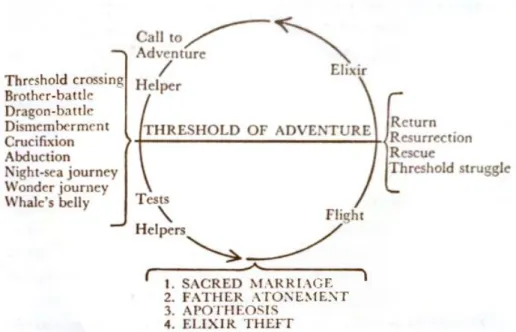
Campbell's book contains a schematic outline which can be seen in Figure 1.1, consisting of a three-stage structure, "separation, initiation and return" which is going to be explained below, occurs generally in this order. Separation briefly means the hero would have to separate from his comfort zone and have to go for an adventure which is needed for that time. Initiation is the adventures and challenges that the hero deals with, and last but not least, the Return represents the hero coming home with a power and knowledge that acquired on the journey.
Figure 1.1 The Hero’s Journey Graphic
Source: Campbell, 1949, p.245
In this chapter with the help of the following sections, Campbell’s (1949) theory will be explained in order to create a framework for the analysis of the games which are depicted. The three sections which are Seperation, Initiation and Return will be explained with the subsections that can be seen on the Figure 1.1.
7
1.1.1 Separation
This part of Campbell’s theory is mainly about the departure of the hero from his normal world. Mostly the hero is unwilling about the departure and is afraid of going to the adventure. But the hero will finally find a reason, meet someone who is able to convince him to go to the adventure or the adventure becomes unavoidable and inevitable for the hero.
The first step of the Hero’s Journey is the “call to adventure” step. The hero starts from a normal situation and receives some kind of information which can be a challenge, request or a problem that generates the motive of the journey.
After getting the information the hero may likely be reluctant or anxious about the call and going on the adventure which leads him beyond his comfort zone. He may see the call as an unimportant task between his usual routine and obligations. After refusing the call, the hero inescapably recognizes that no one is better able to accept the task or convenient for the task. This acceptance may come after a mentor’s persuasion, who also may grant the hero “Supernatural Aid”.
The hero is given some help, which is enough to make him smarter and stronger while the challenges he may need to overcome. This help can be an object that he can use during the adventure, a map, a weapon, a spell or a key information which is often introduced to the hero by a mentor. This can also be a companion who will provide service on the road but is unable to do what the hero must do to complete the adventure. The supernatural aid can be some kind of moral or spiritual support. But regardless if it is an object, a companion or a support, it can not provide a sublime, extreme power to the hero to overcome all the obstacles that he may face or make him immortal.
The crossing of the first threshold is “the point of no return”. This point refers to leaving behind the old and accept the new, show the loyalty and the change. This is a decisive moment for the hero, which is often the first active choice of the hero where he has to take responsibility and autonomy of his adventure. It may be a terrifying action for the hero to step out from a safer zone to a world he knows nothing about where the rules may differ and failure can cause damage even can be fatal.
8 This notion refers to the point that the hero enters the danger zone. There may be a travel in order to come to this step or the hero may just jump to this point right after the crossing of the first threshold.
1.1.2 Initiation
The hero has left his home to come to a world that he does not know for a little. He steps out from his comfort zone and “entered the belly of the whale” where there is no return. Then the initiation part comes. This part is considered as the main part of the story. In this part, the hero has been turned into a true hero through various tests and trials. Along with the struggle and his courage to overcome the difficulties, the true nature of the character emerges.
The adventure just begins with the hero entering the road of trials where he will be subjected to various kind of tests. On the road of trials, the hero may find companions, allies, information or armament which can help him through the adventure for him to overcome each and every test. As the hero learns and improves himself the trials get more difficult than the previous one.
Along the way, the hero meets a female figure who also may personify the female side of the hero that makes him whole. Also, this encounter may reveal love. This figure can be someone either the hero feels some kind of connection and synergy or a supernatural being.
During the adventure, the hero can encounter some kind of allurement, generally seen as a woman guise. The purpose of this encounter is to see if the hero can hold his temptation back and take a stand for the sake of the adventure protecting his rectitude by maintaining the task.
The hero meets a “father figure” which the hero probably seeks approval from. This figure may also represent the power that must be prevailed against and beaten in a symbolic way. “Father” may be the person who holds a significant power or a high authority, a god or even an ideal, a concept of directive actor to the hero.
9 Oxford dictionary also means the highest point of the development. In this step, the hero achieves an understanding which may lead him to the perfection and a different level of enlightenment. The “Women as a Temptress” and “ Atonement with the Father” trials are finished and the hero has overcome the trials and achieve a different kind of understanding by gaining knowledge. But there will be a more difficult part coming.
The hero is purified and tested during the previous steps and is now deserve to get the gift, gain the Elixir or whatever he embarked the adventure for. The goal will be achieved in this step which also means the ultimate boon. Before the boon, the hero generally has overcome a difficult test, trial or beat a villain or antagonist. The tension increases and this step usually called as the climax of the story.
1.1.3 Return
After the previous steps the triumphs that the hero gains cause a deserved recognition. But return will not be as easy as it seems, it contains its own trials and difficulties.
The hero may finally get used to be on the road, want to stay and experience the adventure longer by overcoming the trials. He feels satisfaction and enlightenment caused by the success and boon. The anxiety of the first step “Separation” is repeated by the idea of returning but this time the cause is not the departure of the comfort zone, on the contrary, it is caused by the distress from “returning to normal life routine” thought.
The hero is forced to return home with the treasure she achieves in Ultimate Boon. This could be caused by the necessity of getting away from the remaining enemy forces or fear of the loss of the treasure along the way. Sometimes the hero may face a time constraint for the treasure to be taken back.
At this stage, it is witnessed that the hero is rescued from a last difficult situation that came unexpectedly. It can be a person who had abandoned the hero previously or a person who had never known by the hero before. Also, it may be the god who made this intervention.
10 further search. But crossing of the return threshold may not be an easy task, since the hero may encounter a final challenge. Passing the first threshold represents a departure from normal life and a death of the person who performs daily routine every day, also crossing the return threshold represents the rebirth of the hero in “real world”, so passing the last gate is also as important as passing the first gate.
After completing the journey and return, the hero is now a master of both his own world and the world that he has experienced the adventures so he can pass through the bridge without further intervention. The hero also has become the master of both the inner world and the outer world by overcoming his own fears on this journey.
Eventually, after defeating demons inside and outside, the hero has obtained the right to live his remaining lifespan as he chooses. Oftenly the hero proceeds on a path that involves the wisdom of life by being an administrator, teacher, mentor or advisor. He can get married or prefer to get into an adventure again.
It is also referred as the freedom to live the moment without worrying about the future or the past. The hero is freed from despair, anxiety, desire and other emotions that keep him away from living the moment because he is wiser now.
1.2 CLASSICAL NARRATIVE BY VOGLER
In the light of the Joseph Campbell’s Hero’s Journey theory, Vogler has created a structure which is a revised version of Hero’s Journey by simplifying that theory, combining the fundamental steps and removing certain aspects in order to modernize it. Vogler put 12 steps coherently together which are divided into 3 sections (Act 1, Act 2, Act 3) that refers to the Separation, Initiation and Return parts of the Hero’s Journey theory. These 12 stages of the structure and the Separation, Initiation, Return parts can be seen in Figure 1.2 The following sections will explain the stages individually in order to do the game analysis accordingly.
11
Figure 1.2 The Hero’s Journey of Vogler
Source: Vogler, 2008, p.49
1.2.1 Act 1
This part is a revised version of the Separation part in Hero’s Journey where the story begins and it is also the first time that the hero is seen.
Ordinary world is the beginning of the story where the hero is introduced into his everyday routine. This scene is usually presented for people to associate the hero by seeing the hero as a normal person with normal concerns and works to do. The hero is unaware of the approaching adventure on this step.
Similarly to the Hero’s Journey, on Call to Adventure step the hero encounters a problem or a challenge. This challenge may be something that only he can solve or it can be something which grants him some kind of opportunity such as winning the heart of the queen or saving his realm. In a way, the challenge is presented and set.
12 again. He even can refuse the challenge at first. In hero's perception, the adventure may seem overwhelming, and the hero may be afraid to leave the comfort of his house and go out for the dangerous adventures. This hesitation or even the rejection causes more connection with the hero and enhance the believability of the story as there is the instinct of avoiding danger in human nature.
The hero comes across a mentor. This mentor is wise and usually old who most probably helps the hero to prepare for the adventure by teaching the skills that the hero may need during his challenge. This help may occur as giving important information or items that will support the hero which make him survive.
As a result of all these steps above, the hero is separated from his family or home and is ready to cross the threshold for his adventure towards the unknown.
1.2.2 Act 2
The steps which are explained below contains the main action events which the hero has to survive for maintaining the story by achieving his aims and showing that he deserves the reward.
After crossing the threshold, the hero is faced with a number of more difficult challenges that can easily exhaust a weaker person. These events can occur various ways, such as small conflicts, battles, struggles against the weather and land conditions, puzzles, distinct disruptions, and trouble.
During this tests, the hero may gain allies and new enemies which are not included in previous steps. In this way, the character and the abilities of the hero are developed. Eventually, the final destination for the hero's purpose will become apparent. The hero is worn out but has prepared for the final test as he learned from his experiences and improved his skills. He enters a cave, that may sometimes be a symbolic cave, full of enemies, where only courage can overcome the obstacles and no help is available. At this point, the hero continues on his way even if he faces death. The difficulties and faults experienced at this stage are proof that the hero is still a human being and capable of making mistakes.
13 test that the hero must pass through. Sometimes this battle can be a battle of the hero with the demons in his own inner world. It also can emerge as a battle with real enemies in the outside world. In this section, observers are afraid that the hero will fail or worse, die. But eventually the hero finds a way of salvation.
The hero becomes a new, fearless man, defeating his opponent and thus his fears. The reward in the story can be the hero's knowledge that he gains on the road, treasure or a princess that he rescued. But the main reward is the personal development of the hero during this adventure.
1.2.3 Act 3
After reaching the peak of the story, the new and developed version of the hero gets his way to his house, own realm. After claiming the treasure, there is nothing remains that the hero can prove, and the hero goes home because there is no need for more adventure. The stage of returning home is the reverse echo of the “crossing of the threshold” step of the beginning of the adventure. Contrary to the previous anticipation of danger, now the hero's expectation is to get righteous praise and rest.
At this step, the hero will face the final difficulty of the story. The enemy may not be defeated or the ones who need to be saved are left behind and it is needed to save them. Some kind of crisis arose when the hero felt that he was safe. During this crisis, the hero suffers again and is reborn in a new and improved form by following the journey and overcoming chaos. In some stories, before the returning, the hero must be purified. In this final step, the hero returns home being a different and developed man. The people in his home welcome the hero. The hero gives the treasure he has obtained during his journey to the person who needs it or save the people in his home town. This treasure can sometimes be wisdom and knowledge, a cure for a desease which affects the hero’s town, the love of the princess or the just the people’s happiness and welfare. In this last part of the story, all problems have been solved and all the questions have been answered, all puzzles have been revealed until the need of another adventure.
14
1.3 GAMES, NARRATIVE AND INTERACTIVITY
Throughout the history, the storytelling action occurred in many different ways and types. One of these many ways was the “playing activity”. Humans improve games by imitating their perception of life by designate certain messages in order to make a point of the situation which they want to express in these games. Similarly to the stories, games are also a representation of life, have limitations of time and place, pass information and experience from generation to generation in a framework of rules and several restrictions. The mission that is given to the games, the definition of games and the scope of these definitions have introduced in different ways by the scholars the over the years. One of these approaches revealed by J. Huizinga. As J. Huizinga (1998, p.28) defines “play is a voluntary activity or occupation executed within certain fixed limits of time and place, according to rules freely accepted but absolutely binding, having its aim in itself and accompanied by a feeling of tension, joy and the consciousness that it is ‘different’ from ‘ordinary life’.” With the line of this explanation and in light of the definitions about game and “playing activity”, it can be said that game is a “challenge” for something or some kind of representation of something, also all games have rules with no exception or give no right of objection to the players. The one who plays has to accept the rules and the nature of the game at the very beginning of it. Once the rules are derogated the game disintegrates. In order to make the game to continue, players should adapt the rules and follow them. Taking into consideration that game is a voluntary and a free act, rules will not be a problem for the players but giving them a guidance of how the game mechanics work and how can a player win or maintain the game. “A game takes place in an artificial universe that is governed by rules. The rules define actions or moves that the players make in the game, and also the actions that they may not make. ” (Rollings and Adams, 2003, p.34). Therefore games can be defined as a set of rules with predefined boundaries. In addition to the rules that contain actions and movements, these boundaries may also appear as limitations on the game map as some games are defined as open world and some games are closed world. This separation implies the limits of the areas that can be explored in the game. In a closed world game, the game system will not allow the player to go anywhere except certain checkpoints on the map where the player is going to be assigned to certain quests. Other areas are beyond reach to the player and the player
15 generally see a loading screen while being transferred from one point to another. At some point of the game some quest points may become unavailable to travel to. In game that contains an open world, each place that appears on the map can be visited and the player is able to wander around, explore and get acquainted with the characters all over the map. Even after finishing the main quest line all of the area occasionally remains within reach and the game may continue with side quests that the player hasn’t done yet or the game just allow the player to explore all of the areas.
Such as stories, games are also representations of the world or imagination, require time, have limitations of time and place, relieves ideas and acts, in a structure. This necessity for the structure, oblige the “game” notion to contain a particular narrative. Janet Murray (2004, p.3) implies that “the story that comes first, because storytelling is a core human activity, one we take into every medium of expression, from the oral-formulaic to digital multimedia.”. Computer technology is the most competent tool for creating patterns that can be used and contains the old pattern of traditional media but is not limited to just this old template. It redefines the limits of storytelling and the style of play in its own way by creating and prosecuting schemed rules. Thus, it creates a navigable, determined but also interactable and participatory medium. This new mechanism of storytelling provides the opportunity of creating new ways to express stories as well as the possibility to rehearse old narrations by trying to form it in a non linear way. Although games and the stories share the similar aspect of “narrative”, stories are mainly focused on the plot and the games which are created using this computer technology, are focused on the player's choices and actions which creates a distinction between them. Murray also (1998) suggests in her book Hamlet on Holodeck The Future of Narrative in Cyberspace three aesthetic categories for the analysis of interactive story experiences: immersion, agency and transformation. Immersion is basically the feeling of being present in another place and engaged in the action which means when a participant is to an immersed to an experience, they will be willing to accept inner logic of the experience even though it diverges from the real world. The agency is a feeling of empowerment that arises from being able to take action in relation to the intentions of players. And last but not least the transformation has three meanings for Murray. One meaning is experience when the player transform himself into someone else during the playing activity as the playing activity allows him to be. Another meaning is the variety as the fame offers variations on
16 the theme that the player can explore all of them. The last meaning is the personal transformation which means the personal journey and experience of the player himself. The immersion and transformation can be seen in the forms of classical narrative but the player’s experience of agency within the story can only be enabled by the interactivity. As Ken Perlin indicates in his article (2004, p.14) “A game does not force us to relinquish our agency. In fact, the game depends on it.". By this statement of Perlin, it can be said that the main differences between the stories and the games are the choices and the performances of the players which leads us to the point of thinking that the player have an influence on the game with his actions also being able to change the chain of events in games. According to S. Björk and J. Holopainen (2005, p.8) “playing a game can be described as making changes in quantitative game states, where each specific state is a collection of all values of all game elements and the relationships between them.”. In the light of these two explanations and statements, when talking about computer games, the concept of "interaction" is one of the concepts that are often considered and there are different approaches about whether or not games are interactive in the strictest sense and proper meaning of the word. For the Oxford English Dictionary, "interaction" in the context of the new media is "allowing a two-way flow of information between a computer or other electronic device and a user, responding to the user's input.". Another explanation of interactivity "...is the way that the players sees, hears, and acts within the game’s world- in short, the way the player plays the game." (Rollings and Adams, 2003, p.11,12) which covers almost everything as music, sound and environment design, graphics, user interface. The interactivity allows the player to reveal the plot and change or rearrange it at the same time with the computer technology. “The plot is not something delivered to the player, but something actively created by the player in interaction with the game system and its (often very large) implied space of possible detailed plots.” (Lindley, 2005, p.9) hence interactivity takes an important place for creating a game structure that is performative and immersive as the game system differs from the classical written stories. This aspect of so called interactivity also brings advantages. As Barry Ip (2011, p.109) implies “The principal advantage offered by a nonlinear approach is greater freedom, where the player is given the impression that a greater degree of control may be exerted over the progression of the game’s story than what is actually possible in terms of interaction” where we could underline the word “impression” in his sentence to mention
17 it later on.
In his article, Chris Crawford (1997) emphasized the importance of interactivity by using the following words: "First, it injects a social or interpersonal element into the event. It transforms the challenge of the game from a technical one to an interpersonal one."(Crawford, 1997, p.7) and he also mentions the fact that the opportunity of interaction reconstructs the perception of the challenge from passive to active, for the player. As long as the player feels that his/her actions change certain aspects of the plot, that action and the player’s behavior may become more dedicated. Although with these readings games are considered to contain certain level of interactivity, this deduction is open to debate. Through this so called interactivity, in the process of participating the gaming experience, gamers often feel that their actions are not only regulated by the gaming system but that they have a considerable amount of power to determine the course of events. In spite of the players’ feeling about the control and power on the plot of the game according to Schott’s (2006) perspective which is contarary to the others that accept the games contains interactivity, the gaming experience is more of a reactive process than an interactive one since the game responds the players’ actions and yet players’ actions can change the direction, course of events but not the structure that the producer or the designer indicates as the branching game scenario. In other words “Although the structure of the game allows for different ways of fulfilling its potential, progress and movement is very much guided, pre-structured and moulded by the game’s developers.” (Carr et al., 2006, pg.134). In most of the games that were created with the computer technology “the player is pulling the strings and plotting events. Yet the player is not designing these events a free hand. All the acts and happenings are shaped by their context: by the game, its physics and rules.” (Carr, 2006, p.39). The basic dynamics of the game are to allow the player to follow directions and instructions that have been given by the game system and make the player choose from a limited number of opportunities from the branching quest line for the game progress to take place. “Branching” is one of the basic concepts used by the game designers to create a narrative structure in games. The existence of more than one path that can be traced in a narrative, is called branching. Branching quest lines are crucial for the construction of the adventure games. But the branches also can be restrictive for the players as it is determined while programming process. Also the large content files which are missed by the players can be wasted. This notion of branching
18 raises the necessity of the players to keep up and cope with ever-increasing changes in the narrative and quests. Game designers often provide a group of choices for the players by adding various branches and quest lines to the baseline scenario. Even though the players encounter different parts of the game scenario, as a consequence of the different selections they make, they constantly encounter certain main events that all players must inevitably see and pass. In adventure games players can make their own choices about how a narrative is presented in accordance with his or her own sense of expeience, and that is the essence of this narrative of the adventure genre. If players reach their goals by successfully overcoming the challenges of the game it may change the course of main events or cause various consequences so that the actions of the players reveal a series of events that may involve a narrative in the process. These main events can sometimes lead to a quest or a cutscene or can be a result of a quest or a cutscene. Cutscenes are the predetermined story parts (often delivered by a video within the concept of the game) that the players come across but not interact with anything during the process which may be triggered or caused by a predetermined encounter. Through the cutscenes the situation of the game up to that moment can be summarized, the players can be given clues about what will happen in the rest of the story, or a piece with a critical prescription for the story of a place or a person that the player has not seen at the moment can be shown. The storyline always comes to a bottleneck in order to maintain the continuity of the game. Even if each player chooses a different path to continue the story, it is obligatory to reach these main events and see that particular cutscene that has been prepared for that moment or that conditions of the game. If and when the player meets this predetermined conditions, the cutscene for that situation triggers and like watching a video or a film, the player cannot interract with other things in the game freely or intervene the events. After this cutscene that the player has encountered, the player returns back to the branching quest line, where the options seem to belong to him again.
...a game presents a branching tree of sequences and allows the player to create his own story by making choices at each branch point. The audience of a story must infer causal relationships from a single sequence of facts; the player of a game is encouraged to explore alternatives, contrapositives, and inversions. The game player is free to explore the causal relationship from many different angles. (Crawford, 1997, p.5)
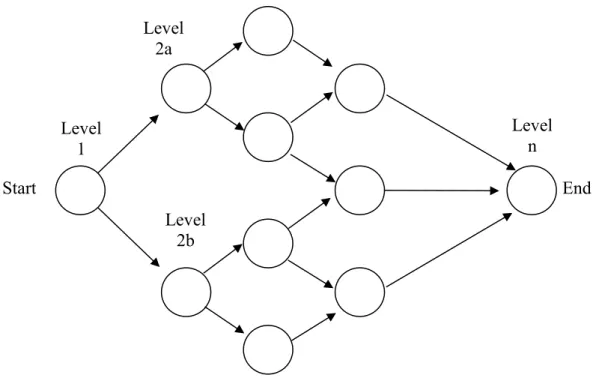
Despite the linearity in the classical narrative, the structure of the non linear/branching video game narrative, especially in adventure video games, differentiate into a form that is shown in Figure 1.3.
19
Figure 1.3 Nonlinear/branching game structure
Source: Ip, 2011, p.110
As can be seen in the Figure 1.3, the concrete constituents of the story lead the players from one chapter to another in various ways and finally to the possible endings. The main quests concatenate the chapters to each other regardless of the temporal axis of the side quests as the games are composed of hypertext and hypertext is a network of text pieces that can be read in different orders, which can be changed in order (Ryan,2009). This branching storyline which is a result of the opportunity of hypertextuality, is provided by the consecutive quests. The indicative quests for the game to advance can be considered as the main quests and this main quest line is enriched by the manifold sidequests. Thus, Campbell’s monomyth theory can be composed with the computer games’ structure, considering J. Howard’s implication “Campbell’s unified ‘monomyth’ becomes the ‘main quest’ in a complex quest system of intersecting, forking, and shifting ‘side quests.’”(Howard,2008). Moreover, in Campbell's theory, there are other features that game designers can use to maintain interest of the players. The hero of the mythical stories is usually struggling with various situations throughout the story in order to obtain a treasure, and must complete difficult tasks to reach the ultimate goal. As the theory of Campbell inherent the substantial characteristic of “challenge”, it complies with the objective of the adventure genre computer games which are mostly about discovering the game world, exploring the surroundings, finding solutions for the problems by using
Level 2a Level 2b Level 1 Level n End Start
20 puzzle solving abilities or overcoming the challenges that the game represents. This features of adventure genres helps increasing the possibilities by diversifying and enriching quest lines.
On the other hand the quest lines, according to Howard (2008), may provide a solution of long debates between ludologists and narratologists as the narratologists claim that the games can be analyzed as narratives despite of the ludologist idea which strongly insist on studying the games by accepting them as a set of rules / rule systems and should be studied for his features related to games. For the traditional game theory ludology a game can be defined as goal oriented and challenging activity which has limits determined by the rules. For narratologists games can be percieved as narratives and the studies must conducted story oriented. Since the continuation of the narrative of a game is provided by the quests and the quests emerged as a possibility for rule systems also when taking into consideration that the quests generates a narrative structure inevitably, all the aforementioned information provide a middleground for both the narratologists and ludologists. But even though both sides have been presented with a sufficient middleground when analysing games, it still does not present a solution for the lack of the interactivity that the hypertextuality brings by giving an illusion of choice to the player within the quest line. For Andrew Rollings and Ernest Adams (2003, p. 11) “the only way to complete the game is to allow the story to carry you along...Certain scripted events that are completely unalterable by the player push the story along- and the main challenge for the players is to fit in with these events, to become part of the story.” Rollings and Adams' idea of this, even if not so strict and precise, shows how restrictive the interactivity in games is. On the other hand, in games the power to make choices is not passively transferred to the game system like in any other narrative mediums such as written stories of films but actively conducted by the gamer himself within conditions so that the player is also controbuting the determined plot to be delivered himself by his choices.
21
CHAPTER 2
METHODOLOGY OF RESEARCH
2.1 METHOD
This research will be picking up the theory that Campbell suggests in his book “Hero with a Thousand Faces” and the theory that Vogler (1992) introduced in “The Writer’s Journey” which is a modernization of “Hero’s Journey”. By putting these theories in the center, this study will compare the new approaches that technology brings and try to explain how the quest line, game system and narrative works in adventure video games also will be seeking out the similarities and differences of their patterns that describes the process of the narrative and the interactivity in these games. In this study, I will pick 2 games and analyze their branching quest lines, compare them with the formal structure and find out if games are a resemblance of the formal structure by seeking the influence of the formal structure in these games despite interactivity and the feeling of freedom it brings to the players.
Dragon Age: Origins will be the first game that will be analyzed. Dragon Age: Origins (BioWare, 2009) is an RPG (Role Playing Game) developed by BioWare, released in November 2009 and by the year 2010 this game has already been sold over 3.2 million copies worldwide. It is a single player third-person game which includes fantastic elements in its story. It contains storyline and based on a closed world where the gamers have to visit some significant quest points and are not able to explore any other places between these specific points as mentioned above. Most of the actions and decisions affect the narrative progress. These effects will be expounded in forthcoming chapters. The other game that will be depicted in this thesis is The Witcher 3: Wild Hunt (CD Projekt RED, 2015) which is developed by CD Projekt RED. This game was published on 19 May 2015 and had sold over 4 million copies during its very first weeks. It is the last game of the series and also the most resonated one, considered as the most successful game of the series that also differs from the other two games of The Witcher series with
22 its richer quest line, more hours of content and also a bigger open world which means the gamers can actually discover and explore all of the areas that the game contains even when the main quest line is over. Almost all of the actions and decisions will impact the storyline and gradually leads one of the 36 possible ending variations which are result in 3 game endings. These impacts will also be explained in further chapters.
The narrative structure of the games that are listed and briefly explained above will be analyzed by the terms of classical narrative structure in this thesis by compiling the quests. The quest lines will be shown and compared with the structure that Vogler reveals in the light of Campbell’s introduction of Hero’s Journey.
These games above were selected because they are the most popular games of their time and they proceed their popularity over time. Also these games are defined as well known, mostly preferred and popular games by the community of players. One open world (The Witcher 3: Wild Hunt) and one closed world (Dragon Age: Origins) games were depicted in order to examine if there will be any changes caused by the extension of the range of the game.
For revealing the narrative structure, these two games were played on PC repeatedly by making different choices and experiencing the mutable course of events. After the playthrough transaction the Youtube Playthroughs were watched for each game in order to see other playing styles and to determine whether there are any missed consequences of the choices while playing the games. The last step was to read the Wikis of the games for further and comprehensive information. These three steps allowed a cross checking procedure for various options and choices for all the selected games but the main data was gathered from playing the game. The game playing and analysis process were conducted similarly as Barry Ip’s (2011) research.
In the analysis process firstly the two games were played by me (a subject who is familiar with games in adventure genre for over 6 years) in normal difficulty without skipping any process from the beginning to the end of the games. While playing the games all quests and course of events and the consequences were noted by writing down the significant events and choices simultaneously. All collected data were entered to Microsoft Excel afterwards in order to construct a categorized structure.
23 In both games the player can choose to behave either good (by being propitious, like when the decision of sparing someone’s life), neutral (by being judicious, like making the decision according to current circumstances) or evil (by being cruel, like when the decision of taking someone’s life). A neutral form of behavior was chosen on purpose as the player is given different behavior form choices. The reason for the selection of a neutral form of behavior is to minimize the influence of the behavioral form when making variable decisions in the course of the story. The main reason for the selection of a neutral behavior is to focus on the course of events rather than the effects of the behaviours. In The Witcher 3:Wild Hunt game the player can play as the main character, Geralt. Since the character is premeditated, the game has been played 3 times for seeing the 3 main endings. On the contrary, in Dragon Age: Origins the character is created by the player himself and there are several distinctions between the races of the character in the beginning of the game so the game was played 5 times in order to see all of the beginning types and to see the backstories of different races. During the gameplay it has been realized that the class of the character which gives the player to select between mage, rogue or warrior only affects the performance of the players as it enables alternating skills. Even though the selection of the skills can be modificative, this aspect does not change the storyline itself but changes the type of playing in order to increase the players’ enjoyment. Hence the class of the character was not changed during the repetitive gameplay process. This choice provides the opportunity to master on the skills of the particular class that has been selected and finish the game rapidly when playing again for seeing different ending possibilities since the game mechanics did not change significantly. So in these games it is possible for the player to master on the script, memorize the actions and perform them in the right order. For both games similar skills, items, armors and weapons were selected for each playthrough for the same purpose which is mastering in one play style and reducing the game time.
While selecting Youtube Playthroughs, some key features needed for game analysis were considered. These key features were whether or not the beginning and the ending of the game was available, the length and the fluidity (consistently progressing the story within the game mechanics) of the playthrough and the continuity of the gameplay. Especially for the Dragon Age: Origins the additional necessity was that the playlist contained all the possibilities arising from the variability of the beginning of the game.
24 The limitations of this research are stated below:
The number of the games that are depicted can not be increased in order to conduct a more comprehensive research when selecting games, since there is time limit while the research. The scope of the study can be extended in subsequent researches conducted in the same genre, using methods similar to this research. Also the number of the subjects in the study is limited to one. The number of the subjects who are going to play the depicted games can be increased during following studies with user experience tests and a longer research time. Another limitation is only the adventure genres were selected in this work in order to narrow the scope of the study and being able to focus on certain aspects of the depicted theories.
25
CHAPTER 3
RESEARCH FINDINGS AND ANALYSIS
In this part of the thesis, the selected games will be introduced and analysed according to the general informations of the games, the plots and the branching quest lines, in the light of the theories mentioned in the previous chapters. The first game to be dealt with is the Dragon Age: Origins. After revealing the scheme of the Dragon Age: Origins, The Witcher 3: Wild Hunt game will be examined.
3.1 DRAGON AGE: ORIGINS
3.1.1 General Information
Dragon Age: Origins is a role-playing computer game which can be played as third-person and single-player developed by BioWare using a game engine called Eclipse. It contains fantastic elements and the game scenario is based on these fantastic incidents. The game's first release date is November 3, 2009, and it first appeared in the North American region. The game is available to be played on PC, Xbox 360 and PlayStation 3. After being launched in North America, it was put on the market in Australia on November 5, 2009, and on the market in Europe on November 6, 2009. In addition, a digital download version released on December 21, 2009, it can be played on Mac computers after that date.
26
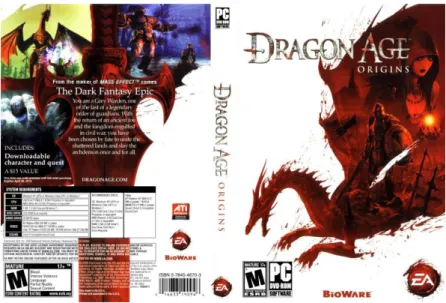
Figure 3.1.1 The DVD Cover of Dragon Age
3.1.2 Plot
The plot of the game is briefly and clearly explained on the DVD of Dragon Age: Origins which can be seen on Figure 3.1.1.
You are a Grey Warden, one of the last of a legendary order of guardians. With the return of an ancient foe and the kingdom engulfed in civil war, you have been chosen by fate to unite the shattered lands and slay an archdemon once and for all. Start your adventure by picking your race as a Human, Elf, or Dwarf, then your class as a Warrior, Mage, or Rogue. Then after that, it is all up to you. The choices you make guide the path you take through the Ninth Age: The Dragon Age. (BioWare, 2009)
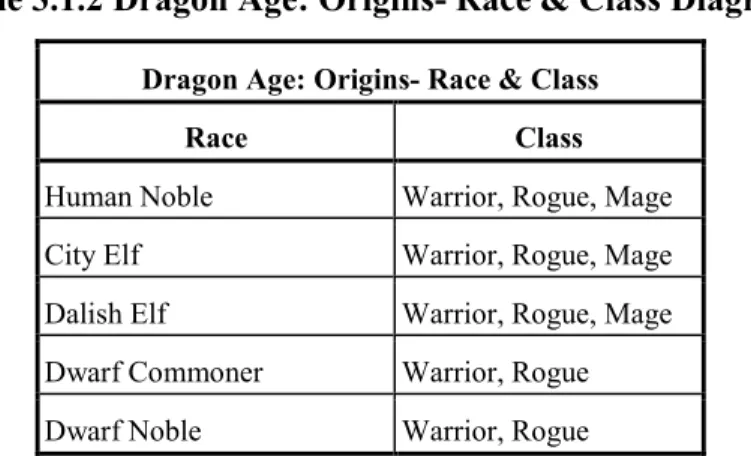
The game begins with one of six different starting points determined by the player's race and class which can be seen in the Table 3.1.2 created during the play testing process. These varying beginnings are the origin story of the character. In this phase, the player first begins to recognize the character he created and the environment in where he or she is located. After a while, with certain incidents the character meets a man called Duncan, one of the Grey Wardens, in Ferelden, and after this meeting the inevitable fact that the story of origin has drifted over the player, the character has to go with Duncan, who has come to town to recruit the Grey Wardens. Grey Wardens are a group of legendary guardians who rescued the world for several times from the Darkspawn. Darkspawns are corrupted creatures and the corruption they cause is called the Blight. Darkspawns are the
27 main enemy and the ultimate goal is to stop the Blight that the Darkspawns procure. Grey Wardens can sense the Blight but at the expense of great sacrifice. They have to drink the tainted blood of the Darkspawn and if they rescue from this fatal ritual called “The Joining” they ultimately become a Grey Warden which gives them the ability to sense the Blight, meaning that the player can sense the danger if an enemy is nearby in the game during the gameplay. Therefore the player’s first quest is to become a Grey Warden in order to overcome the events that the plot brings. It is an inevitable choice for the game to continue and progress.
Table 3.1.2 Dragon Age: Origins- Race & Class Diagram
Dragon Age: Origins- Race & Class
Race Class
Human Noble Warrior, Rogue, Mage City Elf Warrior, Rogue, Mage Dalish Elf Warrior, Rogue, Mage Dwarf Commoner Warrior, Rogue Dwarf Noble Warrior, Rogue
After the Joining rituel the player survives and the journey of a Grey Warden begins. The player has to overcome various events, meet possible companions, gather allies and prepare for his final battle with the Archdemon, the leader of the Darkspawns.
3.1.3 Quests & Analysis
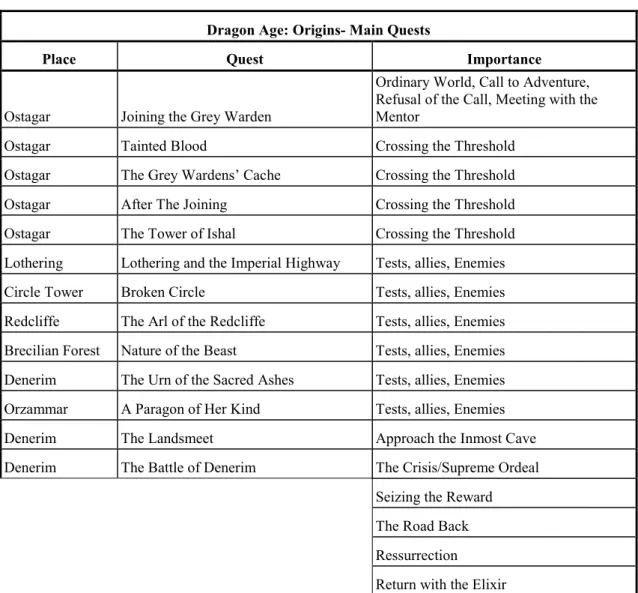
The quests of Dragon Age: Origins are listed on Table 3.1.3 which are gathered during the playthrough process. As can be seen on the charts, the list does not seem to be that long when the side quests are excluded, but the side quests are necessary for the development of the character, for acquiring new skills, gaining levels and for collecting new items. It is also possible to encounter certain companions and side characters in these side missions which will help the story to progress.
The first 5 main quests are always in this order and all the players experience these 5 main quests almost the same way when the play styles, the number of the enemies killed, the
28 exact paths that can vary from one player to another are ignored. The 6 quests below them can be rearranged by the players’ choices. But it is not recommended to go directly to the quests that are below the table because the difficulty increased when going down to the list. Last but not least the last two main quests are also fixed, determined. Player is not able to perform the “The Landsmeet” quest without finishing the previous quests.
Table 3.1.3 Dragon Age: Origins- Main Quests Diagram
Dragon Age: Origins- Main Quests
Place Quest Importance
Ostagar Joining the Grey Warden
Ordinary World, Call to Adventure, Refusal of the Call, Meeting with the Mentor
Ostagar Tainted Blood Crossing the Threshold Ostagar The Grey Wardens’ Cache Crossing the Threshold Ostagar After The Joining Crossing the Threshold Ostagar The Tower of Ishal Crossing the Threshold Lothering Lothering and the Imperial Highway Tests, allies, Enemies Circle Tower Broken Circle Tests, allies, Enemies Redcliffe The Arl of the Redcliffe Tests, allies, Enemies Brecilian Forest Nature of the Beast Tests, allies, Enemies Denerim The Urn of the Sacred Ashes Tests, allies, Enemies Orzammar A Paragon of Her Kind Tests, allies, Enemies Denerim The Landsmeet Approach the Inmost Cave Denerim The Battle of Denerim The Crisis/Supreme Ordeal
Seizing the Reward The Road Back Ressurrection Return with the Elixir
As can be seen in Table 3.1.3, each quest is paired with a particular "Hero's Journey step" placed in the "importance" column. The gameplay make the players pass through a process, which can also be called a “prologue”, before the main line of the quests begin.
29 At this stage, the player has the opportunity to test the game mechanics, character's features, skills and abilities. This process is shown to the player during the "origin" story of the hero, as mentioned above. In this part of the game players begin to get used to the game mechanichs also being able to see and experience the character’s ordinary world, receive a call to adventure, choose to refuse the call in the first time, then meet with the mentor (which is Duncan in this scenario) and cross the threshold. For this game, the ordinary world is widely up to the race of the player. If the player is a dwarf the game naturally begins in the dwarven city, if the player is an elf the game begins in a forest and if the player is a human the game begins in a castle. Crossing the threshold is the process of the character to become a Grey Warden by surviving the “Joining” rituel. It represents a separation from the ordinary world and stepping out the comfort zone of the character. The quests linked with the "Tests, Allies, Enemies" step from the Vogler’s theory, are mandatory but the alignment of this quests are left to the selection of the player. The “Approach the Inmost Cave” step is the preparations for the final battle in the game. The Landsmeet is the quest that the player manage to gather an army and get ready to the final battle. In order to arise a crisis in “The Crisis/Supreme Ordeal” step the game makes the player choose between himself or one of his companions by sacrificing either one to kill the Archdemon. When the tasks are over, the part of the story that is not covered by the chart but is seen as cutscene before the game is completely over, the game is resolved to the player. In this part, the player see all off the consequences of the choices he made. In the cutscenes the player can see that his character seize the reward, has a choice to go back to the adventure or settle down to rule the city, celebrate his success or mourn to his losses. At the end of cutscenes the hero resurrects to be a different person by gaining different skills and abilities which provides power to rescue the world.
3.2 THE WITCHER 3: WILD HUNT
3.2.1 General Information
The Witcher 3: Wild Hunt, which is acclaimed for its game design, narrative and visual appeal, was launched into the world’s gaming market on May 19, 2015. Playable with Microsoft Windows, PlayStation 4 and Xbox One, this game has won numerous awards.
30 It sold about ten million copies within a year after its release. It was developed with REDEngine 3 to create a complex story by the CD Projekt RED. In The Witcher 3: Wild Hunt players play as Geralt (also known as the Geralt of the Rivia), a monster hunter with a third person perspective in an open world where the players can explore the whole map and interact with almost every character in the game. The story of the game was written with the inspiration of Polish novelist Andrzej Sapkowski's fantastic novels and The Witcher: Wild Hunt is the continuation of The Witcher 2: Kings of Assassins published in 2011. As can be seen in the Figure 3.2.1 the map has several quest points and for arriving from somewhere to another players have to navigate through the map to arrive at those places though there are several quick travel points.
Figure 3.2.1 The Map of The Witcher: 3 Wild Hunt
3.2.2 Plot
In the beginning of the story Geralt meets with his former lover Yennefer in White Orchard and receive a message from her that he has to go to Vizima as the Emperor Emyr has summoned him. Emperor ask Geralt to find Ciri who has been seen in several places
31 but cannot be found. Ciri is like an adopted girl for Geralt since Geralt taught her when she was young. Ciri also is the last heir of the elfish bloodline which makes her the Child of the Elder Blood. Thus Ciri is an important character for both Geralt and the emperor. Thus a long twisted story begin in search of Ciri. Geralt first meet a sorceress called Keira Metz who gives Geralt clues about where Ciri can be. Keire directs Geralt to an elfish mage, Avallac’h who is olsa looking for her. Then Geralt acquainted with a baron and take information from the baron in exchange for finding the baron’s wife who was missing. Heading back to Novigrad Geralt meets Triss Merigold and Merigold direct Geralt to a bard named Dandelion who was Ciri’s friend. After a long and entangled search Geralt finds Ciri and learns that Eredin, the King of the Wild Hunt, is after her for her power to manipulate time and space and Ciri was teleporting from there to there to escape from Eredin. The main reason Eredin wants to capture Ciri was the fact that a White Frost destroyed Eredin’s homeworld and Eredin wants to teleport from one world to another with Ciri’s power. Geralt and his companions and allies he acquainted with during the search gather together for a final battle to protect Ciri and to stop Eredin to consume the life on every world. After a risky battle Ciri finally get into a portal which leads her to end the threat. The ending of the game varies in almost every choice that Geralt make.
3.2.3 Quests & Analysis
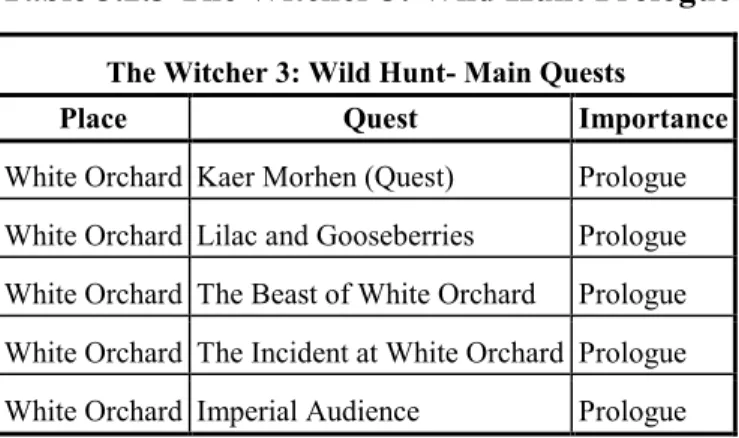
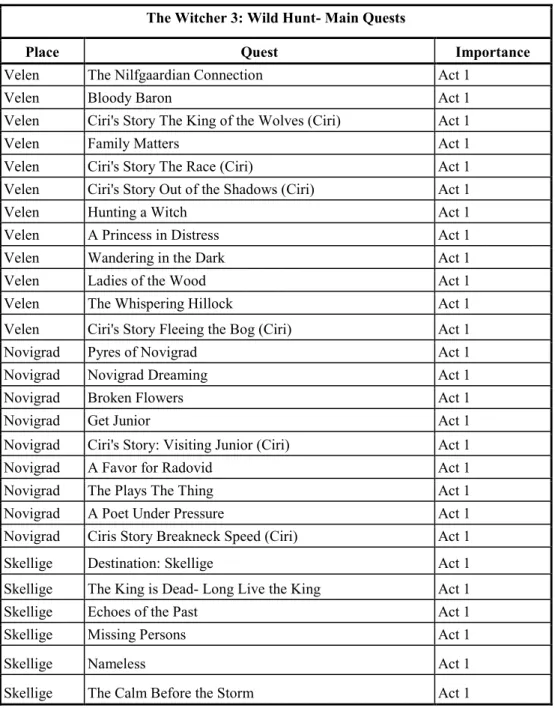
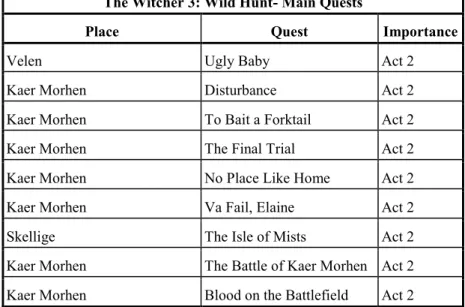
In The Witcher 3: Wild Hunt, the quest line is divided into four sections which are Prologue, Act 1, Act 2, Act 3 as can bee seen in Table 3.2.3, Table 3.2.4, Table 3.2.5, Table 3.2.6. Taking into consideration that Vogler’s 12 steps are divided into 3 sections which are called Act 1, Act 2, Act 3 refers to the Separation, Initiation and Return. All the datas for the tables are gathered while playing the games in the play testing process.
Table 3.2.3 The Witcher 3: Wild Hunt Prologue
The Witcher 3: Wild Hunt- Main Quests
Place Quest Importance
White Orchard Kaer Morhen (Quest) Prologue White Orchard Lilac and Gooseberries Prologue White Orchard The Beast of White Orchard Prologue White Orchard The Incident at White Orchard Prologue White Orchard Imperial Audience Prologue