Relationship between cytokine gene polymorphisms and
chronic hepatitis B virus infection
Semra Tunçbilek
Semra Tunçbilek, Department of Infectious Diseases and Clini-cal Microbiology, Ufuk University School of Medicine, 06520 Ankara, Turkey
Author contributions: Tunçbilek S reviewed all the manuscripts listed in references section and wrote this review.
Correspondence to: Semra Tunçbilek, Professor, Department of Infectious Diseases and Clinical Microbiology, Ufuk Univer-sity School of Medicine, Mevlana Bulvarı (Konya Yolu) No. 86-88, Balgat, 06520 Ankara, Turkey. [email protected] Telephone: +90-312-2044149 Fax:+90-312-2872390 Received: October 9, 2013 Revised: December 9, 2013 Accepted: January 2, 2014
Published online: May 28, 2014
Abstract
Hepatitis B virus (HBV) infection is still a public health
problem worldwide, being endemic in some parts of
the world. It can lead to serious liver diseases such as
chronic hepatitis, cirrhosis, and hepatocellular cancer.
The differences in host immune response can be one
of the reasons for the various clinical presentations of
HBV infection. Polymorphisms of genes encoding the
proinflammatory and antiinflammatory cytokines, which
are responsible for regulation of the immune response,
can affect the clinical presentation of the infection.
Particularly, the polymorphisms of the genes encoding
cytokines such as interleukin (IL)-1, IL-6, IL-8, IL-10,
IL-18, IL-28B, interferon-γ, tumor necrosis factor-α,
tumor growth factor-β1, and regulatory molecules like
vitamin D receptor and chemokine receptor 5 can be
responsible for different clinical presentations of HBV
infections. The genomic information about cytokines
and other mediators can be important for determining
high-risk people for developing chronic hepatitis or
he-patocellular cancer and may be used to plan treatment
and preventive approaches for these people. In this
review, the current knowledge in the literature on the
association between cytokine/regulatory molecule gene
polymorphisms and clinical course of chronic HBV
infec-tion is summarized, and the clinical implementainfec-tions
and future prospects regarding this knowledge are
dis-cussed.
© 2014 Baishideng Publishing Group Inc. All rights reserved.
Key words: Hepatitis B virus; Cytokine; Polymorphism;
Chronic hepatitis
Core tip: The specific polymorphisms of genes encoding
cytokines, such as interleukin (IL)-1, IL-8, IL-10, IL-18,
IL-28B, tumor necrosis factor-α, interferon-γ, tumor
growth factor-β1, and regulatory molecules such as
vitamin D receptor and chemokine receptor 5 affect the
clinical course of chronic hepatitis B virus (HBV)
infec-tion. This review aims to summarize the literature on
cytokine gene polymorphisms and chronic HBV
infec-tion and discuss future prospects regarding the clinical
implication of these polymorphisms.
Tunçbilek S. Relationship between cytokine gene polymorphisms and chronic hepatitis B virus infection. World J Gastroenterol 2014; 20(20): 6226-6235 Available from: URL: http://www.wjg-net.com/1007-9327/full/v20/i20/6226.htm DOI: http://dx.doi. org/10.3748/wjg.v20.i20.6226
INTRODUCTION
Hepatitis B virus (HBV) infection is a serious and
com-mon infectious disease of the liver, affecting 240 million
people worldwide with an estimated 600000 deaths per
year, and remains the major cause for chronic hepatitis,
cirrhosis, and hepatocellular carcinoma
[1-3]. HBV infection
is endemic, particularly in developing countries, and is a
serious public health problem
[3].
Following acute HBV infection, 1%-5% of adults
develop chronic infection
[4](Figure 1). Rate of chronicity
is inversely proportional to age, being higher in newborns
TOPIC HIGHLIGHT
WJG 20
thAnniversary Special Issues (9): Hepatitis B virus
and children than in adults. The prevalence of chronic
HBV infection is also higher (over 8%) in areas where the
disease is highly endemic than in those with intermediate
and low endemicity
[4].
The chronic diseases caused by HBV are chronic
hep-atitis, cirrhosis, and primary hepatocellular carcinoma
[5].
Chronic hepatitis can lead to end-stage liver disease in
15%-40% of patients
[6]. A number of factors, including
host-related factors (
e.g., genetic and immunological
back-ground), pathogen-related factors (
e.g., viral load,
geno-type), and environmental factors (
e.g., hygiene, nutrition,
treatment, vaccination)
[7]affect the outcome of HBV
infection.
It has been well known that the genetic background
of the host and host-pathogen interactions influence the
outcome of HBV infection
[8-12]. Hepatitis B surface
anti-gen positivity is more common in identical twins than in
fraternal twins
[13], which indicates that host-related genetic
factors have an impact on the course of HBV infection.
Gene polymorphisms such as the single nucleotide
polymorphism (SNP; replacement of a nucleotide with
another one) may change the structure and biological
function of the protein coded by that gene. A SNP in the
promoter region of a gene may cause increased or
de-creased production of the relevant protein. The presence
of these types of inherited gene polymorphisms may
make a person more susceptible or resistant to a certain
disease
[14].
Cytokines and regulatory molecules play a
fundamen-tal role in the immunopathogenesis of HBV infection.
The gene loci for cytokines are defined, and
polymor-phisms of these genes are suggested to influence the
outcome of HBV infection
[11]. Therefore, many recent
studies have focused on the effect of gene
polymor-phisms of cytokines on disease outcome and response to
vaccination and treatment
[10]. Understanding the genetic
background of this common public health problem may
give rise to new strategies for prevention, treatment, and
control of HBV infection.
In this systematic review of the literature, the impact
of gene polymorphisms on the course of chronic HBV
infection is evaluated and discussed with a focus on
poly-morphisms of genes encoding cytokines and regulatory
proteins.
CYTOKINES
Cytokines represent a large family of molecules,
includ-ing tumor necrosis factor-alpha (TNF-α), interleukin
(IL)-1β, IL-4, IL-6, IL-8, IL-10, IL-18, IL-28, interferon
(IFN)-γ, IFN-α, and tumor growth factor-beta (TGF-β).
Cytokines play an important role in the initiation and
regulation of immune responses and, therefore, might
affect susceptibility to HBV and/or the natural course of
the infection
[9].
In addition to cytokines, antioxidant enzymes (
e.g.,
nitric oxide synthase, manganese superoxide dismutase,
glutathione S-transferase), and regulatory proteins (
e.g.,
chemokine receptor 5 (CCR5), vitamin D receptor (VDR),
estrogen receptor, mannose binding lectin) may also
have a role in the course of HBV infection and
polymor-phisms of the genes encoding these proteins are
evalu-About 20% in low endemicity regionsAcute HBV infection No infection
Chronic HBV infection Asymptomatic HBsAg carrier
Asymptomatic HBsAg carrier Chronic active HBV hepatitis
Asymptomatic HBsAg carrier End-stage liver disease and hepatocellular carcinoma 0% of infants infected at birth,
25%-50% of 1-5 years old children 1%-5% of older children and adults > 8% in high endemicity regions 2%-8% in intermediate endemicity regions < 2% in low endemicity regions
8%-25% in high endemicity regions 2%-8% in intermediate endemicity regions < 2% in low endemicity regions
About 15%-40% Exposure to HBV
ated in various studies
[14].
The role of polymorphisms of genes encoding
cy-tokines and some regulatory proteins in chronic HBV
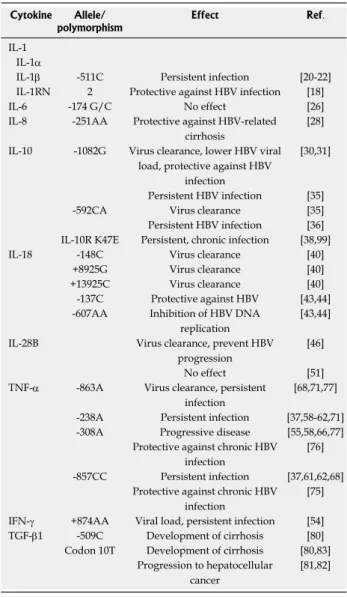
infection is summarized below (Table 1).
IL-1
IL-1 is a proinflammatory cytokine with various
biologi-cal activities
[15]. The
1 gene family encodes 1α,
IL-1β, and their natural inhibitor, IL-1 receptor antagonist
(IL-1RN)
[15,16].
IL-1RN allele 2 polymorphism is
associat-ed with an increase in IL-1β production
[17], which then
in-creases the production of other cytokines (
e.g., IL-2, IL-6,
and TNF-α), and stimulates the clearance of HBV
[18].
IL-1RN polymorphisms, thus, have a protective role against
HBV infection
[18].
In addition to its proinflammatory action, IL-1β has
a role in tumor growth
[19]. Polymorphism of
IL-1
β
at
-511C allele is associated with increased IL-1β level and
is a genetic indicator of hepatocellular cancer
develop-ment in chronic HBV-infected patients
[20].
IL-1
β
and
IL-1RN accessory protein gene polymorphisms are related to
chronic and persistent HBV infection
[18,21]. Fontanini
et al
[22]reported that
IL-1
β
proinflammatory polymorphisms
are associated with cirrhosis and end stage liver disease,
which are more pronounced in males.
IL-6
IL-6 is an important cytokine that regulates the immune
response to HBV infection
[15]. IL-6 level is significantly
increased in chronic HBV infection
[23]. However, studies
from Korea and Israel showed that there is no relation
between
IL-6 gene polymorphism and chronic HBV
infection
[24,25]. Similarly, studies from other populations
indicate no significant effect of
IL-6 polymorphism at
-174G/C on chronic HBV infection
[26].
IL-8
IL-8 has been associated with tumors and chronic
inflam-matory diseases through its mitogenic and angiogenic
functions
[27]. Qin
et al
[28]indicated that the polymorphism
of the
IL-8 gene at -251AA might be protective for
HBV-related cirrhosis.
IL-10
IL-10 is secreted mainly from T cells and has an
inhibito-ry action on both inflammatoinhibito-ry and immunoproliferative
responses. It stimulates the differentiation and
prolifera-tion of B cells producing immunglobulin M (IgM), IgG
and IgA. Moreover, IL-10 inhibits secretion of various
cytokines from T cells and monocytes/macrophages
[29].
The polymorphism of
IL-10 at -1082 region that results
in increased production of G allele is correlated with
virus clearance during intrauterine HBV infection.
More-over, increased IL-10 production has a protective effect
against HBV infection
[30]. The G/G genotype at -1082 is
further associated with lower HBV viral load at the
im-mune inflammatory phase in children with chronic HBV
infection
[31].
However, there are some conflicting results in the
lit-erature evaluating the effect of
IL-10 gene polymorphism
on HBV infection. Polymorphisms of genes encoding
IL-10 are related to increased hepatocellular cancer risk
in Korean, Taiwanese, and Chinese patients
[32-34]. A
meta-analysis of seven studies by Zhang
et al
[35]indicated that
there is an association between the gene polymorphism
IL-10 -1082GA and persistent HBV infection
susceptibil-ity. Moreover, this meta-analysis also showed that the gene
polymorphism
IL-10 -592CA and the clearance of HBV
are associated
[35]. The carriers of the -592A allele in the
IL-10 promoter region are proposed to have a higher risk
of persistent HBV infection
[36]. However, according to
some data in the literature, there is no association between
IL-10 gene polymorphisms and chronic HBV infection
[37].
IL-10RB is a subunit of receptor complexes for
IFN-λ and IL-22, which have antiviral- and
hepatocyte-protective activity, respectively. Polymorphism of
Cytokine Allele/
polymorphism Effect Ref. IL-1
IL-1α
IL-1β -511C Persistent infection [20-22] IL-1RN 2 Protective against HBV infection [18] IL-6 -174 G/C No effect [26] IL-8 -251AA Protective against HBV-related
cirrhosis
[28] IL-10 -1082G Virus clearance, lower HBV viral
load, protective against HBV infection
[30,31] Persistent HBV infection [35] -592CA Virus clearance [35] Persistent HBV infection [36] IL-10R K47E Persistent, chronic infection [38,99] IL-18 -148C Virus clearance [40]
+8925G Virus clearance [40] +13925C Virus clearance [40] -137C Protective against HBV [43,44] -607AA Inhibition of HBV DNA
replication
[43,44] IL-28B Virus clearance, prevent HBV
progression
[46] No effect [51] TNF-α -863A Virus clearance, persistent
infection
[68,71,77] -238A Persistent infection [37,58-62,71] -308A Progressive disease [55,58,66,77]
Protective against chronic HBV infection
[76] -857CC Persistent infection [37,61,62,68]
Protective against chronic HBV infection
[75] IFN-γ +874AA Viral load, persistent infection [54] TGF-β1 -509C Development of cirrhosis [80] Codon 10T Development of cirrhosis [80,83]
Progression to hepatocellular cancer
[81,82] Table 1 Role of polymorphisms of genes encoding cytokines and some regulatory proteins in chronic hepatitis B virus infection
HBV: Hepatitis B virus; IL: Interleukin; TNF: Tumor necrosis factor; IFN: Interferon; TGF: Tumor growth factor.
actions of IFN-γ play a key role in host defense
mecha-nisms. IFN-γ is secreted from T cells and natural killer
cells and regulates T cell response, activating monocytes
and macrophages, which then produce an antiviral
re-sponse by releasing free radicals and proinflammatory
cytokines such as TNF-α
[52]. The core response element
of HBV is sensitive to TNF-α, IFN-γ and IFN-α.
In-creased levels of TNF-α and IFN-γ intensify the antiviral
activity of T lymphocytes
[53].
IFN-γ gene polymorphism
at position +879 causing low IFN-γ level is reported to be
higher in patients with chronic HBV infection compared
to a control group
[25]. Additionally, a negative correlation
between necroinflammatory/fibrosis scores and genetic
production of IFN-γ and TGF-β1 was reported in
HBV-infected patients
[25]. A recent study from Turkey revealed
that
IFN-γ gene polymorphism at position +874AA is
correlated with viral load and chronic HBV infection
[54].
Conde
et al
[55]showed in a recent study performed
on 153 patients that higher serum levels of IFN-γ and
TGF-β1 are associated with chronic HBV infection, and
serum level of IL-10 is lower in patients with active
dis-ease
[55]. Furthermore, the authors reported that the
pres-ence of allele A of the
TNF-α -308 polymorphism is a
risk factor for progressive disease.
TNF-α
TNF-α is a key cytokine that determines host immune
response to HBV and viral clearance. Therefore,
TNF-α
gene polymorphism can have a role in the course of
HBV infection. TNF-α level and TNF-α receptor
ex-pression are increased in HBV-infected patients
[56,57]. The
TNF-α gene is localized at MHC HLA region III and
two polymorphisms at -308 G/A and -238 G/A
posi-tions of the promoter region may affect TNF-α
expres-sion
[58,59]. Polymorphisms at these regions may cause an
elevation of TNF-α transcriptional activity and increase
TNF-α serum level
[58]. In HBV-infected German patients,
the promoter variant at -238A location is significantly
correlated with chronicity of HBV infection
[60]. Similarly,
a study on Chinese patients showed that polymorphisms
at the promoter region at -238GA and -857CC locations
are associated with persistence of HBV infection
[37,61,62].
Although
TNF-α polymorphism is not a determinant of
HBV clearance in the Italian population, it is suggested
to play a role in the prognosis of patients with chronic
HBV infection
[63]. However, a study performed on
Ira-nian patients reported that
TNF-α polymorphism has no
role in HBV pathogenesis
[64]. Similarly, in HBV-infected
Japanese patients, there is no association between
TNF-α
polymorphism and progression to hepatocellular
carci-noma
[65].
A genetic analysis of 956 Chinese Han subjects
re-vealed an association between the polymorphism in the
promoter region of
TNF-α located at -308A and HBV
disease progression
[66]. A similar result was reported in a
study of 27 Turkish patients
[67].
TNF-α polymorphisms
at position -857CC and -863AA are also associated with
the development of persistent HBV infection in the
Chi-nese Han population
[68]. Another study from the South
10RB codon 47 is related to chronic HBV infection in
the Korean population
[38].
IL-18
IL-18 is a potent proinflammatory cytokine and an
im-mune activator. It is mainly produced in active
macro-phages and increases induction of IFN-γ and TNF-α,
and cytotoxicity of natural killer cells
[39].
IL-18 can promote hepatitis B virus clearance. Three
polymorphic sites in the
IL-18 gene at alleles -148C,
+8925G, and +13925C are associated with HBV
clear-ance in the Korean population
[40]. A possible positive
re-lationship between serum IL-18 level and disease severity
of HBV infection has been indicated in clinical studies
[41].
Three SNPs are defined in the promoter region of the
IL-18 gene that can affect IL-18 production and in return
IFN-γ expression
[42]. In a study of a Chinese population,
the polymorphism at -137 with C allele was associated
with protection against HBV infection
[43]. Moreover, AA
genotype at -607 position causes an inhibition of HBV
DNA replication
[43]. Migita
et al
[44]studied 204 chronically
HBV-infected patients; of these, 43 were inactive HBV
carriers and 161 had chronic progressive liver disease
including cirrhosis. The authors found that the AA
geno-type of
IL-18 gene-promoter polymorphisms at position
-607 and C allele at position -137 are significantly higher
in inactive HBV carriers than in those with chronic
pro-gressive liver disease, suggesting that the polymorphisms
of the
IL-18 promoter regions (-607 and -137) can be
as-sociated with different outcomes of HBV infection
[44].
IL-28B
IL-28B, which is also known as IFN-λ-3, is encoded by
the
IL-28B gene. IL-28B inhibits HBV replication in
he-patocyte cell lines and has been considered as a potential
new treatment for viral hepatitis
[45]. The genetic
polymor-phisms near the
IL-28B gene are strongly associated with
sustained viral response and spontaneous viral clearance
in patients with chronic HBV infection. Thus, genetic
variation of IL-28B may prevent progression of HBV
infection by reducing viral load and liver inflammation
[46].
However, some conflicting results have been reported so
far.
IFN-λ-3 (IL-28B) polymorphism is a reliable
predic-tor of IFN therapy outcome in patients with chronic
HBV infection
[47]. Moreover, it is a protective factor for
HBV infection recurrence and hepatic dysfunction after
liver transplantation
[48,49]. However,
IFN-
λ
-3 genotype was
reported to have no role in the development of chronic
HBV infection among HIV-infected patients
[50].
More-over, a study comparing patients with persistent infection
with individuals recovered from HBV infection found
that
IL-28B polymorphism has no association with
clear-ance of HBV and does not influence the outcomes of
HBV infection
[51].
IFN-γ
IFN-γ has a regulatory role in cellular immunity and
functions of cytotoxic T lymphocytes. Antiviral,
anti-proliferative, immunoregulatory, and proinflammatory
Indian population also showed that
TNF-α promoter
polymorphisms (at positions -238A, -308A, -857T, -863A
and -1031C) are important host genetic factors that may
determine the variable outcome of HBV infection
[69].
Cytotoxic T lymphocyte-associated antigen 4 (
CTLA-4)
polymorphism may also affect the host immune response,
including production of cytokines. Han
et al
[70]reported
that
CTLA4 +49GG genotype is associated with lower
TNF-α and IFN-γ levels in patients with chronic HBV
infection.
Overall results of a meta-analysis involving 19
stud-ies (5245 chronic HBV infection cases and 3181 controls
with G238A genotypes) and 11 studies (3576 cases and
2044 controls with C863A genotypes) suggested that
there is no significant association between
TNF-α -238
and
TNF-α -863 gene promoter polymorphisms and
chronic HBV infection
[71]. When subgroups were
ana-lyzed by ethnicity in this study, no significant association
was found in Asian populations, but the
TNF-α -238A
allele is still a risk for chronic HBV infection in European
populations
[71]. Moreover, carriers of -863A genotype
were reported to have increased levels of TNF-α in the
liver in response to HBV infection, and this induces
he-patocyte damage that may lead to hepatocellular
carcino-ma
[72]. Kao
et al
[73]reported that polymorphism at -863A
locus of the promoter region of the
TNF-α gene is
asso-ciated with lower TNF-α production and persistence of
HBV infection
[74]. Furthermore, a meta-analysis including
14 studies (4929 chronic HBV infection cases and 2702
controls with -857 genotype) showed that the
TNF-α
-857T allele reduces the risk of chronic HBV infection
in the Asian population
[75]. Similarly, it was proposed
that the
TNF-α -308A allele is protective against chronic
HBV infection in the Mongolian population
[76].
A meta-analysis of 12 studies suggested that
poly-morphisms -863A and -308G in the
TNF-α promoter
region might be a risk factor for HBV persistence
[77].
Since ethnicity plays an important role in HBV infection
outcome, conflicting results are reported on the
associa-tion between
TNF-α promoter gene polymorphisms and
HBV infection outcome.
TGF-β1
TGF-β1 shows an inhibitory effect in the early stages of
tumor development, while it stimulates tumor growth,
invasion, and metastasis in advanced stages
[78]. TGF-β1
plays a critical role in the pathogenesis of liver fibrosis
by stimulating extracellular matrix proteins and inhibiting
their destruction
[79]. Therefore, mechanisms increasing the
level of biologically active TGF-β1 have a potential role
in the development of liver fibrosis. A study of Chinese
patients revealed that even though there is no association
between
TGF-β1 -509C polymorphism and cirrhosis, this
polymorphism might affect TGF-β1 levels and
develop-ment of cirrhosis
[80]. However, in the very same study,
codon 10T polymorphism is related to the development
of cirrhosis, but not with progression of disease and
plasma TGF-β1 levels
[80]. Codon 10T polymorphism in
the
TGF-β1 gene was also reported to be associated with
progression to hepatocellular cancer
[81,82]and cirrhosis
[83]in patients with chronic HBV infection.
REGULATORY PROTEINS
Vitamin D
The active metabolite of vitamin D,
1,25-dihydroxyvi-tamin-D, has immunomodulatory action in addition to
its regulatory role in calcium metabolism. It activates
monocytes, increases cell-regulated immunity, inhibits
lymphocyte proliferation, immunoglobulin, and cytokine
synthesis, and inhibits type 1 cytokine secreting T helper
(Th1) response while activating Th2 response.
Addition-ally, vitamin D plays a role in programmed cell death.
Monocytes, macrophages, and active T lymphocytes carry
VDR. While the stimulation of VDR on monocytes and
macrophages increases production of TNF-α, IL-1, and
prostaglandin E2, stimulation of VDR on lymphocytes
inhibits T cell proliferation and production of IFN-γ,
IL-2 and TNF-β
[84]. Four polymorphisms of the
VDR
gene are associated with various immune diseases
[84].
Furthermore, being homozygous for
VDR gene
poly-morphism at codon 352 (genotype tt) is significantly
less frequent in patients positive for hepatitis B surface
antigen, and it was suggested that this genotype provides
resistance to chronicity of HBV infection
[85].
VDR a/a
allele is also associated with severity of HBV-related liver
disease and with higher viral load
[86].
CCR5
An efficient immune response against viral hepatitis
should promote inflammatory cells to be activated and
to migrate to the liver. Chemokines have important
func-tions during this process by means of their chemotactic
and immunoregulatory actions. The CCR5
acts as a
receptor for chemokines. Among the chemokines,
regu-lated on activation normal T cell expressed and secreted
(RANTES; CCL5), macrophage inhibitory protein-1α
(MIP-1α; CCL3), and MIP-1β (CCL4) are natural ligands
of CCR5. Both these chemokines and CCR5 regulate T
cell functions by mediating polarization, activation, and
differentiation of Th1 and cytotoxic T cells
[87]. Besides,
CCR5 has a regulatory function for the
immunoregula-tory action of vitamin D.
The frequency of heterozygosity of the
CCR5-delta
32 gene is higher in chronic hepatitis B patients than in
controls, which shows the relation of this polymorphism
with susceptibility to HBV-related liver disease
[86].
CCR5
59029A and 59029G alleles are associated with increased
chronic HBV infection risk and spontaneous HBV
clear-ance, respectively
[88]. The frequency of
CCR5 Wt/mt
allele is higher in chronic HBV patients than in healthy
subjects, while
CCR5 Wt/Wt allele is more common in
patients with severe liver disease than in mild cases
[86].
CURRENT INTERESTS AND FUTURE
PROSPECTS
clinical implication of polymorphism-HBV infection
as-sociations such as gene therapy targets
[46], prediction of
infection risk, disease progression, chronicity, response to
treatment
[89]or vaccine
[90-94], and susceptibility to
mother-to-child transmission of HBV
[95].
IL-28B genotyping is suggested to predict the
re-sponse to pegylated interferon
[96]and to provide a
valu-able gene therapy target due to its reducing effect on
HBV viral load and hepatic inflammation
[46].
Gene polymorphisms of
IL-1B, IL-4, IL-4R, IL-13
[90,93,94],
IL12A and IL12B
[92]are suggested to predict the immune
response to HBV vaccination.
Since TNF-α and vitamin D pathways are involved in
the susceptibility to, and the outcome of, HBV infection
acquired early in life, they can be used clinically to
deter-mine the susceptibility to mother-to-child transmission
of HBV
[95].
Although studies on the clinical application of gene
polymorphisms of cytokines have been increasing
re-cently, further clinical studies are needed for widespread
use of genotyping in the course of HBV infections.
CONCLUSION
Along with the establishment of the key role of
endog-enous mediators in the response to infection, effects
of host-related factors on the course of chronic HBV
infection have been investigated from different
perspec-tives. Some of these studies have focused on the effect
of diversity in genes encoding endogenous mediators of
inflammatory response to HBV infections.
Inflammatory processes are mostly regulated by
pro-inflammatory and antipro-inflammatory cytokines, and other
mediators, which are determinative for the course of
dis-ease. Polymorphisms in genes encoding endogenous
me-diators may be the underlying cause of clinical
differenc-es between patients. Rdifferenc-esults of the studidifferenc-es summarized
in this review suggest that cytokine gene polymorphisms
affect the level of cytokines during the inflammatory
response to HBV, and thus determine the clinical course
of chronic HBV infection. Genomic information with
regard to cytokines and other mediators can be used for
identifying individuals who are at high risk of developing
chronic hepatitis and hepatocellular carcinoma, and for
the planning of preventive measures and treatment
ap-proaches.
As recent studies have indicated, gene polymorphisms
of inflammatory mediators may be important in
deter-mining the response to both treatment and vaccine. For
example, serum levels of TNF-α in patients who respond
to treatment with interferon were found to be higher
than those in nonresponders
[97]. Granulocyte-macrophage
colony-stimulating factor has been reported to increase
the response rate to recombinant hepatitis B vaccine
[98].
Additionally, genetic factors may play a role in the
devel-opment of adverse reactions secondary to the vaccine
such as arthritis, multiple sclerosis, and other autoimmune
diseases. However, further studies are still needed to
in-vestigate in detail the effects of genetic polymorphisms
and their clinical implications for the response to
treat-ment and vaccine, and developtreat-ment of adverse events.
In conclusion, there is currently a vast amount of
evidence on the association between polymorphisms of
genes encoding cytokines/regulatory molecules and the
clinical course of chronic HBV infection. Conflicting
re-sults on the role of specific polymorphisms are probably
due to various ethnic groups studied. In the future,
de-termining genetic polymorphisms of mediators that have
a role in both the natural course of the infection and the
response to treatment and vaccination will contribute
sig-nificantly to the prevention and treatment of HBV
infec-tions by eliminating possible risk factors prior to disease
and by development of new treatment approaches.
REFERENCES
1 Chisari FV, Ferrari C. Hepatitis B virus immunopathogen-esis. Annu Rev Immunol 1995; 13: 29-60 [PMID: 7612225 DOI: 10.1146/annurev.iy.13.040195.000333]
2 Lee WM. Hepatitis B virus infection. N Engl J Med 1997; 337: 1733-1745 [PMID: 9392700 DOI: 10.1056/NEJM199712113372406] 3 World Health Organization. Hepatitis B. Fact Sheet No 204.
July 2013. Available from: URL: http://www.who.int/me-diacentre/factsheets/fs204/en/ Accessed on September 23, 2013
4 World Health Organization. Global Alert and Response (GAR). Hepatitis B. Available from: URL: http://www.who. int/csr/disease/hepatitis/whocdscsrlyo20022/en/index1. html Accessed on September 23, 2013
5 Wang FS. Current status and prospects of studies on human genetic alleles associated with hepatitis B virus infection.
World J Gastroenterol 2003; 9: 641-644 [PMID: 12679901]
6 Park W, Keeffe EB. Diagnosis and treatment of chronic hepa-titis B. Minerva Gastroenterol Dietol 2004; 50: 289-303 [PMID: 15788985]
7 Thursz M. Genetic susceptibility in infectious diseases.
Bio-technol Genet Eng Rev 2000; 17: 253-264 [PMID: 11255668 DOI:
10.1080/02648725.2000.10647994]
8 Thursz M, Yee L, Khakoo S. Understanding the host genetics of chronic hepatitis B and C. Semin Liver Dis 2011; 31: 115-127 [PMID: 21538279 DOI: 10.1055/s-0031-1276642]
9 Grünhage F, Nattermann J. Viral hepatitis: human genes that limit infection. Best Pract Res Clin Gastroenterol 2010; 24: 709-723 [PMID: 20955972 DOI: 10.1016/j.bpg.2010.07.009] 10 McNicholl JM, Downer MV, Udhayakumar V, Alper CA,
Swerdlow DL. Host-pathogen interactions in emerging and re-emerging infectious diseases: a genomic perspective of tuberculosis, malaria, human immunodeficiency virus infec-tion, hepatitis B, and cholera. Annu Rev Public Health 2000; 21: 15-46 [PMID: 10884944 DOI: 10.1146/annurev.publ-health.21.1.15]
11 Thursz MR. Host genetic factors influencing the outcome of hepatitis. J Viral Hepat 1997; 4: 215-220 [PMID: 9278218 DOI: 10.1046/j.1365-2893.1997.00052.x]
12 Mackay IR. Genetic susceptibility to chronic hepatitis B virus infection. J Gastroenterol Hepatol 2006; 21: 1087-1088 [PMID: 16824056 DOI: 10.1111/j.1440-1746.2006.04430.x] 13 Lin TM, Chen CJ, Wu MM, Yang CS, Chen JS, Lin CC,
Kwang TY, Hsu ST, Lin SY, Hsu LC. Hepatitis B virus mark-ers in Chinese twins. Anticancer Res 1989; 9: 737-741 [PMID: 2764519]
14 de Andrade DR, de Andrade DR. The influence of the hu-man genome on chronic viral hepatitis outcome. Rev Inst
Med Trop Sao Paulo 2004; 46: 119-126 [PMID: 15286811]
15 Dinarello CA. Biologic basis for interleukin-1 in disease.
16 Nicklin MJ, Weith A, Duff GW. A physical map of the region encompassing the human interleukin-1 alpha, inter-leukin-1 beta, and interinter-leukin-1 receptor antagonist genes.
Genomics 1994; 19: 382-384 [PMID: 8188271 DOI: 10.1006/
geno.1994.1076]
17 Hwang IR, Kodama T, Kikuchi S, Sakai K, Peterson LE, Gra-ham DY, Yamaoka Y. Effect of interleukin 1 polymorphisms on gastric mucosal interleukin 1beta production in Helico-bacter pylori infection. Gastroenterology 2002; 123: 1793-1803 [PMID: 12454835 DOI: 10.1053/gast.2002.37043]
18 Zhang PA, Li Y, Xu P, Wu JM. Polymorphisms of interleu-kin-1B and interleukin-1 receptor antagonist genes in pa-tients with chronic hepatitis B. World J Gastroenterol 2004; 10: 1826-1829 [PMID: 15188516]
19 Rahman MA, Dhar DK, Yamaguchi E, Maruyama S, Sato T, Hayashi H, Ono T, Yamanoi A, Kohno H, Nagasue N. Coexpression of inducible nitric oxide synthase and COX-2 in hepatocellular carcinoma and surrounding liver: possible involvement of COX-2 in the angiogenesis of hepatitis C virus-positive cases. Clin Cancer Res 2001; 7: 1325-1332 [PMID: 11350902]
20 Hirankarn N, Kimkong I, Kummee P, Tangkijvanich P, Poovorawan Y. Interleukin-1beta gene polymorphism as-sociated with hepatocellular carcinoma in hepatitis B virus infection. World J Gastroenterol 2006; 12: 776-779 [PMID: 16521194]
21 Kim SS, Cheong JY, Lee D, Lee SK, Kim MH, Kwack K, Yang SJ, Lee HY, Cho SW. Interleukin-1ß and interleukin-1 receptor accessory protein gene polymorphisms are associ-ated with persistent hepatitis B virus infection.
Hepatogastro-enterology 2012; 59: 190-197 [PMID: 22251538]
22 Fontanini E, Cussigh A, Fabris C, Falleti E, Toniutto P, Bitetto D, Cmet S, Fumolo E, Fornasiere E, Bignulin S, Pinato DJ, Minisini R, Pirisi M. Gender-related distribution of the interleukin-1 beta and interleukin-1 receptor antagonist gene polymorphisms in patients with end-stage liver disease.
In-flammation 2010; 33: 251-258 [PMID: 20087638 DOI: 10.1007/
s10753-009-9179-2]
23 Song W, Zhang F, Li Z. A quantitative analysis of IL-6 mRNA expression of peripheral blood monocyte cell in pa-tients with chronic hepatitis B. Zhonghua Ganzangbing Zazhi 2000; 8: 346-347 [PMID: 11135692]
24 Park BL, Lee HS, Kim YJ, Kim JY, Jung JH, Kim LH, Shin HD. Association between interleukin 6 promoter variants and chronic hepatitis B progression. Exp Mol Med 2003; 35: 76-82 [PMID: 12754410 DOI: 10.1038/emm.2003.11]
25 Ben-Ari Z, Mor E, Papo O, Kfir B, Sulkes J, Tambur AR, Tur-Kaspa R, Klein T. Cytokine gene polymorphisms in patients infected with hepatitis B virus. Am J
Gastroen-terol 2003; 98: 144-150 [PMID: 12526950 DOI: 10.1111/
j.1572-0241.2003.07179.x]
26 Giannitrapani L, Soresi M, Balasus D, Licata A, Montalto G. Genetic association of interleukin-6 polymorphism (-174 G/ C) with chronic liver diseases and hepatocellular carcinoma.
World J Gastroenterol 2013; 19: 2449-2455 [PMID: 23674845
DOI: 10.3748/wjg.v19.i16.2449]
27 Wei YS, Lan Y, Tang RG, Xu QQ, Huang Y, Nong HB, Huang WT. Single nucleotide polymorphism and haplotype association of the interleukin-8 gene with nasopharyngeal carcinoma. Clin Immunol 2007; 125: 309-317 [PMID: 17720627 DOI: 10.1016/j.clim.2007.07.010]
28 Qin X, Deng Y, Liao XC, Mo CJ, Li X, Wu HL, He YN, Huang XM, Peng T, Chen ZP, Li S. The IL-8 gene polymorphisms and the risk of the hepatitis B virus/infected patients. DNA
Cell Biol 2012; 31: 1125-1130 [PMID: 22335768 DOI: 10.1089/
dna.2011.1438]
29 Levings MK, Sangregorio R, Galbiati F, Squadrone S, de Waal Malefyt R, Roncarolo MG. IFN-alpha and IL-10 induce the differentiation of human type 1 T regulatory cells. J
Im-munol 2001; 166: 5530-5539 [PMID: 11313392]
30 Zhu QR, Ge YL, Gu SQ, Yu H, Wang JS, Gu XH, Fei LE, Dong ZQ. Relationship between cytokines gene polymor-phism and susceptibility to hepatitis B virus intrauterine infection. Chin Med J (Engl) 2005; 118: 1604-1609 [PMID: 16232344]
31 Wu JF, Ni YH, Lin YT, Lee TJ, Hsu SH, Chen HL, Tsuei DJ, Hsu HY, Chang MH. Human interleukin-10 genotypes are associated with different precore/core gene mutation pat-terns in children with chronic hepatitis B virus infection. J
Pediatr 2011; 158: 808-813 [PMID: 21168854 DOI: 10.1016/
j.jpeds.2010.11.015]
32 Shin HD, Park BL, Kim LH, Jung JH, Kim JY, Yoon JH, Kim YJ, Lee HS. Interleukin 10 haplotype associated with increased risk of hepatocellular carcinoma. Hum Mol Genet 2003; 12: 901-906 [PMID: 12668613 DOI: 10.1093/hmg/ ddg104]
33 Tseng LH, Lin MT, Shau WY, Lin WC, Chang FY, Chien KL, Hansen JA, Chen DS, Chen PJ. Correlation of interleukin-10 gene haplotype with hepatocellular carcinoma in Taiwan.
Tissue Antigens 2006; 67: 127-133 [PMID: 16441483 DOI:
10.1111/j.1399-0039.2006.00536.x]
34 Wang J, Ni H, Chen L, Song WQ. Interleukin-10 promoter polymorphisms in patients with hepatitis B virus infection or hepatocellular carcinoma in Chinese Han ethnic population.
Hepatobiliary Pancreat Dis Int 2006; 5: 60-64 [PMID: 16481285]
35 Zhang TC, Pan FM, Zhang LZ, Gao YF, Zhang ZH, Gao J, Ge R, Mei Y, Shen BB, Duan ZH, Li X. A meta-analysis of the relation of polymorphism at sites -1082 and -592 of the IL-10 gene promoter with susceptibility and clearance to persistent hepatitis B virus infection in the Chinese popula-tion. Infection 2011; 39: 21-27 [PMID: 21246248 DOI: 10.1007/ s15010-010-0075-3]
36 Cheong JY, Cho SW, Hwang IL, Yoon SK, Lee JH, Park CS, Lee JE, Hahm KB, Kim JH. Association between chronic hepatitis B virus infection and interleukin-10, tumor necrosis factor-alpha gene promoter polymorphisms. J Gastroenterol
Hepatol 2006; 21: 1163-1169 [PMID: 16824070 DOI: 10.1111/
j.1440-1746.2006.04304.x]
37 Li C, Zhi-Xin C, Li-Juan Z, Chen P, Xiao-Zhong W. The asso-ciation between cytokine gene polymorphisms and the out-comes of chronic HBV infection. Hepatol Res 2006; 36: 158-166 [PMID: 16931134 DOI: 10.1016/j.hepres.2006.07.007] 38 Cho O, Cheong JY, Jun KJ, Kim SS, Chwae YJ, Kim K, Park S,
Cho SW. Relevance of interleukin-10RB to chronic hepatitis B virus infection and biological activities of interferon-λ and interleukin-22. Hepatol Int 2013; 7: 111-118 [PMID: 23519428 DOI: 10.1007/s12072-012-9361-8]
39 Hoshino T, Wiltrout RH, Young HA. IL-18 is a potent coin-ducer of IL-13 in NK and T cells: a new potential role for IL-18 in modulating the immune response. J Immunol 1999; 162: 5070-5077 [PMID: 10227975]
40 Cheong JY, Cho SW, Oh B, Kimm K, Lee KM, Shin SJ, Lee JA, Park BL, Cheong HS, Shin HD, Cho BY, Kim JH. Asso-ciation of interleukin-18 gene polymorphisms with hepatitis B virus clearance. Dig Dis Sci 2010; 55: 1113-1119 [PMID: 19466545 DOI: 10.1007/s10620-009-0819-z]
41 Sun Y, Chen HY, Wang F, Zhang X, Jiang HQ, Shao FJ, Zhu SH. [Effect of IL-18 on peripheral blood monocytes from chronic hepatitis B patients]. Zhonghua Ganzangbing Zazhi 2003; 11: 470-473 [PMID: 12939178]
42 Giedraitis V, He B, Huang WX, Hillert J. Cloning and mu-tation analysis of the human IL-18 promoter: a possible role of polymorphisms in expression regulation. J
Neuroim-munol 2001; 112: 146-152 [PMID: 11108943 DOI: 10.1016/
S0165-5728(00)00407-0]
43 Zhang PA, Wu JM, Li Y, Yang XS. Association of polymor-phisms of interleukin-18 gene promoter region with chronic hepatitis B in Chinese Han population. World J Gastroenterol 2005; 11: 1594-1598 [PMID: 15786533]
Kon-doh S, Sugiura M, Kawasumi R, Segawa O, Tajima H, Ma-chida M, Nakamura M, Yano K, Abiru S, Kawasaki E, Yat-suhashi H, Eguchi K, Ishibashi H. Interleukin-18 promoter polymorphisms and the disease progression of Hepatitis B virus-related liver disease. Transl Res 2009; 153: 91-96 [PMID: 19138654 DOI: 10.1016/j.trsl.2008.11.008]
45 Robek MD, Boyd BS, Chisari FV. Lambda interferon inhibits hepatitis B and C virus replication. J Virol 2005; 79: 3851-3854 [PMID: 15731279 DOI: 10.1128/JVI.79.6.3851-3854.2005] 46 Li W, Jiang Y, Jin Q, Shi X, Jin J, Gao Y, Pan Y, Zhang H,
Jiang J, Niu J. Expression and gene polymorphisms of inter-leukin 28B and hepatitis B virus infection in a Chinese Han population. Liver Int 2011; 31: 1118-1126 [PMID: 21745278 DOI: 10.1111/j.1478-3231.2011.02507.x]
47 Lampertico P, Viganò M, Cheroni C, Facchetti F, Invernizzi F, Valveri V, Soffredini R, Abrignani S, De Francesco R, Co-lombo M. IL28B polymorphisms predict interferon-related hepatitis B surface antigen seroclearance in genotype D hep-atitis B e antigen-negative patients with chronic hephep-atitis B.
Hepatology 2013; 57: 890-896 [PMID: 22473858 DOI: 10.1002/
hep.25749]
48 Li Y, Shi Y, Chen J, Cai B, Ying B, Wang L. Association of polymorphisms in interleukin-18 and interleukin-28B with hepatitis B recurrence after liver transplantation in Chinese Han population. Int J Immunogenet 2012; 39: 346-352 [PMID: 22325058 DOI: 10.1111/j.1744-313X.2012.01097.x]
49 Chen J, Li Y, Wang L, Fu Y, Liao Y, Zhang J. Association of three SNPs in interleukin-28B with graft hepatic dysfunc-tion after liver transplantadysfunc-tion in Chinese Han populadysfunc-tion.
Gene 2012; 508: 121-124 [PMID: 22967712 DOI: 10.1016/
j.gene.2012.07.065]
50 Martín-Carbonero L, Rallón NI, Benito JM, Poveda E, González-Lahoz J, Soriano V. Short communication: Does interleukin-28B single nucleotide polymorphisms influence the natural history of hepatitis B? AIDS Res Hum Retroviruses 2012; 28: 1262-1264 [PMID: 22324878]
51 Peng LJ, Guo JS, Zhang Z, Shi H, Wang J, Wang JY. IL28B rs12979860 polymorphism does not influence outcomes of hepatitis B virus infection. Tissue Antigens 2012; 79: 302-305 [PMID: 22239156 DOI: 10.1111/j.1399-0039.2011.01835.x] 52 Biron CA, Nguyen KB, Pien GC, Cousens LP,
Salazar-Mather TP. Natural killer cells in antiviral defense: function and regulation by innate cytokines. Annu Rev Immunol 1999; 17: 189-220 [PMID: 10358757 DOI: 10.1146/annurev.immu-nol.17.1.189]
53 Romero R, Lavine JE. Cytokine inhibition of the hepatitis B virus core promoter. Hepatology 1996; 23: 17-23 [PMID: 8550037 DOI: 10.1002/hep.510230103]
54 Korachi M, Ceran N, Adaleti R, Nigdelioglu A, Sökmen M. An association study of functional polymorphic genes IRF-1, IFNGR-1, and IFN-γ with disease progression, aspartate aminotransferase, alanine aminotransferase, and viral load in chronic hepatitis B and C. Int J Infect Dis 2013; 17: e44-e49 [PMID: 23040881 DOI: 10.1016/j.ijid.2012.08.004]
55 Conde SR, Feitosa RN, Freitas FB, Hermes RB, Demachki S, Araújo MT, Soares MC, Ishak R, Vallinoto AC. Association of cytokine gene polymorphisms and serum concentrations with the outcome of chronic hepatitis B. Cytokine 2013; 61: 940-944 [PMID: 23395388 DOI: 10.1016/j.cyto.2013.01.004] 56 Sheron N, Lau J, Daniels H, Goka J, Eddleston A, Alexander
GJ, Williams R. Increased production of tumour necrosis fac-tor alpha in chronic hepatitis B virus infection. J Hepatol 1991; 12: 241-245 [PMID: 2051003 DOI: 10.1016/0168-8278(91)9094 5-8]
57 Zhang G, Li Z, Han Q, Li N, Zhu Q, Li F, Lv Y, Chen J, Lou S, Liu Z. Altered TNF-α and IFN-γ levels associated with PD1 but not TNFA polymorphisms in patients with chronic HBV infection. Infect Genet Evol 2011; 11: 1624-1630 [PMID: 21712100 DOI: 10.1016/j.meegid.2011.06.004]
58 Abraham LJ, Kroeger KM. Impact of the -308 TNF promoter
polymorphism on the transcriptional regulation of the TNF gene: relevance to disease. J Leukoc Biol 1999; 66: 562-566 [PMID: 10534109]
59 Wilson AG, de Vries N, Pociot F, di Giovine FS, van der Putte LB, Duff GW. An allelic polymorphism within the hu-man tumor necrosis factor alpha promoter region is strongly associated with HLA A1, B8, and DR3 alleles. J Exp Med 1993; 177: 557-560 [PMID: 8426126 DOI: 10.1084/jem.177.2.557] 60 Höhler T, Kruger A, Gerken G, Schneider PM, Meyer
zum Büschenefelde KH, Rittner C. A tumor necrosis factor-alpha (TNF-alpha) promoter polymorphism is as-sociated with chronic hepatitis B infection. Clin Exp
Im-munol 1998; 111: 579-582 [PMID: 9528902 DOI: 10.1046/
j.1365-2249.1998.00534.x]
61 Li HQ, Li Z, Liu Y, Li JH, Dong JQ, Gao JR, Gou CY, Li H. Association of polymorphism of tumor necrosis factor-alpha gene promoter region with outcome of hepatitis B virus infection. World J Gastroenterol 2005; 11: 5213-5217 [PMID: 16127755]
62 Xu XW, Lu MH, Tan DM. Association between tumour necrosis factor gene polymorphisms and the clinical types of patients with chronic hepatitis B virus infection. Clin
Mi-crobiol Infect 2005; 11: 52-56 [PMID: 15649304 DOI: 10.1111/
j.1469-0691.2004.01029.x]
63 Niro GA, Fontana R, Gioffreda D, Valvano MR, Lacobellis A, Facciorusso D, Andriulli A. Tumor necrosis factor gene poly-morphisms and clearance or progression of hepatitis B virus infection. Liver Int 2005; 25: 1175-1181 [PMID: 16343069 DOI: 10.1111/j.1478-3231.2005.01166.x]
64 Somi MH, Najafi L, Noori BN, Alizadeh AH, Aghah MR, Shavakhi A, Ehsani MJ, Aghazadeh R, Masoodi M, Amini S, Baladast M, Zali MR. Tumor necrosis factor-alpha gene pro-moter polymorphism in Iranian patients with chronic hepa-titis B. Indian J Gastroenterol 2006; 25: 14-15 [PMID: 16567888] 65 Migita K, Miyazoe S, Maeda Y, Daikoku M, Abiru S, Ueki
T, Yano K, Nagaoka S, Matsumoto T, Nakao K, Hamasaki K, Yatsuhashi H, Ishibashi H, Eguchi K. Cytokine gene poly-morphisms in Japanese patients with hepatitis B virus infec-tion--association between TGF-beta1 polymorphisms and hepatocellular carcinoma. J Hepatol 2005; 42: 505-510 [PMID: 15763337 DOI: 10.1016/j.jhep.2004.11.026]
66 Wang B, Wang J, Zheng Y, Zhou S, Zheng J, Wang F, Ma X, Zeng Z. A study of TNF-alpha-238 and -308 polymorphisms with different outcomes of persistent hepatitis B virus infec-tion in China. Pathology 2010; 42: 674-680 [PMID: 21080879 DOI: 10.3109/00313025.2010.523696]
67 Basturk B, Karasu Z, Kilic M, Ulukaya S, Boyacioglu S, Oral B. Association of TNF-alpha -308 polymorphism with the outcome of hepatitis B virus infection in Turkey. Infect
Genet Evol 2008; 8: 20-25 [PMID: 17974504 DOI: 10.1016/
j.meegid.2007.09.001]
68 Qiu B, Wang X, Zhang P, Shi C, Zhang J, Qiu W, Wang W, Li D. Association of TNF-α promoter polymorphisms with the outcome of persistent HBV infection in a northeast Chinese Han population. Acta Biochim Biophys Sin (Shanghai) 2012; 44: 712-718 [PMID: 22695741 DOI: 10.1093/abbs/gms046] 69 Fletcher GJ, Samuel P, Christdas J, Gnanamony M, Ismail
AM, Anantharam R, Eapen CE, Chacko MP, Daniel D, Kan-nangai R, Abraham P. Association of HLA and TNF poly-morphisms with the outcome of HBV infection in the South Indian population. Genes Immun 2011; 12: 552-558 [PMID: 21593777 DOI: 10.1038/gene.2011.32]
70 Han Q, Duan S, Zhang G, Li Z, Li N, Zhu Q, Lv Y, Chen J, Liu Z. Associations between cytotoxic T lymphocyte-asso-ciated antigen-4 polymorphisms and serum tumor necrosis factor-α and interferon-γ levels in patients with chronic hep-atitis B virus infection. Inflamm Res 2011; 60: 1071-1078 [PMID: 21847627 DOI: 10.1007/s00011-011-0368-8]
71 Zheng MH, Xiao DD, Lin XF, Wu SJ, Peng MM, Yu XY, Liu WY, Li LF, Shi KQ, Fan YC, Chen YP. The tumour necrosis
P- Reviewers Bener A S- Editor Wen LL L- Editor Cant MR E- Editor Li JY P- Reviewers Bener A S- Editor Song XX L- Editor Stewart GJ E- Editor Li JY
factor-α-238A allele increases the risk of chronic HBV infec-tion in European populainfec-tions. J Viral Hepat 2012; 19: e11-e17 [PMID: 22239507 DOI: 10.1111/j.1365-2893.2011.01491.x] 72 Kummee P, Tangkijvanich P, Poovorawan Y, Hirankarn N.
Association of HLA-DRB1*13 and TNF-alpha gene polymor-phisms with clearance of chronic hepatitis B infection and risk of hepatocellular carcinoma in Thai population. J Viral
Hepat 2007; 14: 841-848 [PMID: 18070287]
73 Kao PC, Wu JF, Ni YH, Lin YT, Chen HL, Hsu SH, Hsu HY, Chang MH. Tumour necrosis factor-α promoter region polymorphisms affect the course of spontaneous HBsAg clearance. Liver Int 2010; 30: 1448-1453 [PMID: 20825556 DOI: 10.1111/j.1478-3231.2010.02340.x]
74 Filik L. Tumour necrosis factor-α promoter region polymor-phisms and spontaneous HBsAg clearance. Liver Int 2011; 31: 1062; authors reply 1062 [PMID: 21733098 DOI: 10.1111/ j.1478-3231.2011.02456.x]
75 Shi KQ, Cai XH, Xiao DD, Wu SJ, Peng MM, Lin XF, Liu WY, Fan YC, Chen YP, Zheng MH. Tumour necrosis factor-α-857T allele reduces the risk of hepatitis B virus infection in an Asian population. J Viral Hepat 2012; 19: e66-e72 [PMID: 22239528 DOI: 10.1111/j.1365-2893.2011.01540.x]
76 Zheng MH, Qiu LX, Xin YN, Pan HF, Shi KQ, Chen YP. Tumor necrosis factor-alpha-308A allele may have a protec-tive effect for chronic hepatitis B virus infection in Mongol-oid populations. Int J Infect Dis 2010; 14: e580-e585 [PMID: 20004605 DOI: 10.1016/j.ijid.2009.08.010]
77 Xia Q, Zhou L, Liu D, Chen Z, Chen F. Relationship between TNF-α lt; alpha& gt; gene promoter polymorphisms and out-comes of hepatitis B virus infections: a meta-analysis. PLoS
One 2011; 6: e19606 [PMID: 21572952 DOI: 10.1371/journal.
pone.0019606]
78 Cui W, Fowlis DJ, Bryson S, Duffie E, Ireland H, Balmain A, Akhurst RJ. TGFbeta1 inhibits the formation of benign skin tumors, but enhances progression to invasive spindle carcinomas in transgenic mice. Cell 1996; 86: 531-542 [PMID: 8752208 DOI: 10.1016/S0092-8674(00)80127-0]
79 Gressner AM, Weiskirchen R, Breitkopf K, Dooley S. Roles of TGF-beta in hepatic fibrosis. Front Biosci 2002; 7: d793-d807 [PMID: 11897555 DOI: 10.2741/gressner]
80 Yang ZX, Wang H, Gao CF, Xu LL, Zhao WJ. [Effect of polymorphism of transforming growth factor beta1 gene on HBV-induced liver cirrhosis]. Zhonghua Yixue Zazhi 2005; 85: 1021-1026 [PMID: 16029542]
81 Gupta V, Arora R, Saha A, Dhir A, Kar P, Bamezai R. Novel variations in the signal peptide region of transforming growth factor beta1 gene in patients with hepatitis: a brief report from India. Int J Immunogenet 2005; 32: 79-82 [PMID: 15787639 DOI: 10.1111/j.1744-313X.2005.00499.x]
82 Kim YJ, Lee HS, Im JP, Min BH, Kim HD, Jeong JB, Yoon JH, Kim CY, Kim MS, Kim JY, Jung JH, Kim LH, Park BL, Shin HD. Association of transforming growth factor-beta1 gene polymorphisms with a hepatocellular carcinoma risk in patients with chronic hepatitis B virus infection. Exp
Mol Med 2003; 35: 196-202 [PMID: 12858019 DOI: 10.1038/
emm.2003.27]
83 Yu SK, Kwon OS, Jung HS, Bae KS, Kwon KA, Kim YK, Kim YS, Kim JH. Influence of transforming growth factor-beta1 gene polymorphism at codon 10 on the development of cirrhosis in chronic hepatitis B virus carriers. J Korean
Med Sci 2010; 25: 564-569 [PMID: 20357999 DOI: 10.3346/
jkms.2010.25.4.564]
84 Long KZ, Santos JI. Vitamins and the regulation of the im-mune response. Pediatr Infect Dis J 1999; 18: 283-290 [PMID: 10093956 DOI: 10.1097/00006454-199903000-00018]
85 Bellamy R, Ruwende C, Corrah T, McAdam KP, Thursz M, Whittle HC, Hill AV. Tuberculosis and chronic hepatitis B virus infection in Africans and variation in the vitamin D receptor gene. J Infect Dis 1999; 179: 721-724 [PMID: 9952386 DOI: 10.1086/314614]
86 Suneetha PV, Sarin SK, Goyal A, Kumar GT, Shukla DK, Hissar S. Association between vitamin D receptor, CCR5, TNF-alpha and TNF-beta gene polymorphisms and HBV infection and severity of liver disease. J
Hepa-tol 2006; 44: 856-863 [PMID: 16545485 DOI: 10.1016/
S0168-8278(06)80033-4]
87 Apolinario A, Majano PL, Alvarez-Pérez E, Saez A, Lozano C, Vargas J, García-Monzón C. Increased expression of T cell chemokines and their receptors in chronic hepatitis C: relationship with the histological activity of liver disease.
Am J Gastroenterol 2002; 97: 2861-2870 [PMID: 12425561 DOI:
10.1111/j.1572-0241.2002.07054.x]
88 Chang HY, Ahn SH, Kim DY, Shin JS, Kim YS, Hong SP, Chung HJ, Kim SO, Yoo WD, Han KH. [Association between CCR5 promoter polymorphisms and hepatitis B virus infec-tion]. Korean J Hepatol 2005; 11: 116-124 [PMID: 15980670] 89 Gong QM, Kong XF, Yang ZT, Xu J, Wang L, Li XH, Jin
GD, Gao J, Zhang DH, Jiang JH, Lu ZM, Zhang XX. As-sociation study of IFNAR2 and IL10RB genes with the susceptibility and interferon response in HBV infection. J
Viral Hepat 2009; 16: 674-680 [PMID: 19714778 DOI: 10.1111/
j.1365-2893.2009.01130.x]
90 Lin YJ, Lan YC, Huang YC, Lin TH, Huang SM, Lai CC, Liu CS, Lin CW, Chen SY, Tsai FJ. Effects of cytokine and cyto-kine receptor gene variation on high anti-HB titers: following up on Taiwan’s neonatal hepatitis B immunization program.
Clin Chim Acta 2012; 413: 1194-1198 [PMID: 22484276 DOI:
10.1016/j.cca.2012.03.004]
91 Macedo LC, Isolani AP, Visentainer JE, Moliterno RA. Asso-ciation of cytokine genetic polymorphisms with the humoral immune response to recombinant vaccine against HBV in infants. J Med Virol 2010; 82: 929-933 [PMID: 20419805 DOI: 10.1002/jmv.21762]
92 Pan L, Zhang W, Liang Z, Wu X, Zhu X, Li J, Li T, Wang L, Li H, Liu Y. Association between polymorphisms of the cytokine and cytokine receptor genes and immune response to hepatitis B vaccination in a Chinese Han population. J
Med Virol 2012; 84: 26-33 [PMID: 22052597 DOI: 10.1002/
jmv.22251]
93 Chen J, Liang Z, Lu F, Fang X, Liu S, Zeng Y, Zhu F, Chen X, Shen T, Li J, Zhuang H. Toll-like receptors and cytokines/ cytokine receptors polymorphisms associate with non-re-sponse to hepatitis B vaccine. Vaccine 2011; 29: 706-711 [PMID: 21111021 DOI: 10.1016/j.vaccine.2010.11.023]
94 Wang Y, Xu P, Zhu D, Zhang S, Bi Y, Hu Y, Zhou YH. Asso-ciation of polymorphisms of cytokine and TLR-2 genes with long-term immunity to hepatitis B in children vaccinated early in life. Vaccine 2012; 30: 5708-5713 [PMID: 22824342 DOI: 10.1016/j.vaccine.2012.07.010]
95 Chatzidaki V, Choumerianou D, Dimitriou H, Kouroumalis E, Galanakis E. Genetic variants associated with susceptibil-ity to mother-to-child transmission of hepatitis B virus. Eur
J Gastroenterol Hepatol 2012; 24: 1185-1190 [PMID: 22772094
DOI: 10.1097/MEG.0b013e328356440f]
96 Sonneveld MJ, Wong VW, Woltman AM, Wong GL, Cakalo-glu Y, Zeuzem S, Buster EH, Uitterlinden AG, Hansen BE, Chan HL, Janssen HL. Polymorphisms near IL28B and sero-logic response to peginterferon in HBeAg-positive patients with chronic hepatitis B. Gastroenterology 2012; 142: 513-520. e1 [PMID: 22108195 DOI: 10.1053/j.gastro.2011.11.025] 97 Daniels HM, Meager A, Eddleston AL, Alexander GJ,
Wil-liams R. Spontaneous production of tumour necrosis factor alpha and interleukin-1 beta during interferon-alpha treat-ment of chronic HBV infection. Lancet 1990; 335: 875-877 [PMID: 1969983 DOI: 10.1016/0140-6736(90)90475-K] 98 Kapoor D, Aggarwal SR, Singh NP, Thakur V, Sarin SK.
Granulocyte-macrophage colony-stimulating factor enhances the efficacy of hepatitis B virus vaccine in previously unvac-cinated haemodialysis patients. J Viral Hepat 1999; 6: 405-409 [PMID: 10607257 DOI: 10.1046/j.1365-2893.1999.00180.x]
99 Frodsham AJ, Zhang L, Dumpis U, Taib NA, Best S, Durham A, Hennig BJ, Hellier S, Knapp S, Wright M, Chiaramonte M, Bell JI, Graves M, Whittle HC, Thomas HC, Thursz MR, Hill AV. Class II cytokine receptor gene cluster is a major locus for hepatitis B persistence. Proc Natl Acad Sci USA 2006; 103: 9148-9153 [PMID: 16757563 DOI: 10.1073/pnas.0602800103]
100 Center for Disease Control and Prevention. Hepatitis B, Epidemiology and Prevention of Vaccine-Preventable Dis-eases. The Pink Book: Course Textbook - 12th Edition Second Printing (May 2012). Available from: URL: http://www.cdc. gov/vaccines/pubs/pinkbook/hepb.html Accessed on Sep-tember 23, 2013
P- Reviewers: Cunha C, Koubaa M S- Editor: Wen LL L- Editor: Logan S E- Editor: Wu HL
![Figure 1 Clinical presentations of hepatitis B virus infections [4,100] . HBV: Hepatitis B virus; HBsAg: Hepatitis B surface antigen.](https://thumb-eu.123doks.com/thumbv2/9libnet/5586356.109628/2.892.88.707.113.557/clinical-presentations-hepatitis-infections-hepatitis-hepatitis-surface-antigen.webp)