Received December 1, 2017, accepted January 10, 2018, date of publication January 23, 2018, date of current version February 28, 2018. Digital Object Identifier 10.1109/ACCESS.2018.2795752
A Flexibility Metric and Optimization Methods for
Mixed Numerologies in 5G and Beyond
AHMET YAZAR 1AND HÜSEYIN ARSLAN1,2, (Fellow, IEEE) 1Department of Electrical and Electronics Engineering, Istanbul Medipol University, Istanbul 34810, Turkey 2Department of Electrical Engineering, University of South Florida, Tampa, FL 33620 USA
Corresponding author: Ahmet Yazar ([email protected])
ABSTRACT Mixed numerology-based frame structures will be a part of 5G systems in order to enhance overall flexibility and user satisfaction. However, inter-numerology interference, spectral efficiency reduction, complexity, and signaling overhead type of issues arise in such structures. It is needed to limit the number of numerologies used together. In this paper, a novel heuristic method is developed to find the efficient number of mixed numerologies. The proposed method aims to control overheads in systems using multi-numerology structures. Analysis of the trade-offs and relationships between different services and user requirements are also presented. The designed algorithm employs a new flexibility function and performance metric. Simulation results are shown for three different numerology sets, which include 5G numerologies.
INDEX TERMS Adaptive scheduling, communication effectiveness, context awareness, OFDM, resource management, user centered design.
I. INTRODUCTION
Utilizing the first step provided by Long Term Evolu-tion (LTE), 5G and beyond cellular communicaEvolu-tions sys-tems have become suitable to be considered as an inclusive umbrella system. In this system, many different communi-cations systems and applicommuni-cations must use the same wire-less network structure. Meanwhile, the user concept has also changed. A sensor that uses cellular communications has also turned into a user. Furthermore, a vehicle is also considered as a user while it uses the same wireless network structure with the other users.
Different systems and applications have greatly increased the diversity of users’ needs. In order to be able to respond better to this diversity, different systems and applications have been examined under three main classes in 5G standard-ization [1]. While there is only one class implementation in LTE, the three classes of services, that came with 5G, have created a lot of research opportunities in the system designs. As the number of classes increases, the possibility of offering more application-specific or more user-centric solutions are arising. However, the increase in the number of classes also increases the complexity of the system. Therefore, many subsystems for 5G have been developed for only three classes of service situations. Each of the users falls in one of these classes. From this perspective, existing 5G technologies can be categorized as service-based approaches.
Apart from service-based approaches, user-based approaches should also be considered to bring more flexibil-ity to the overall system and increase user satisfaction. The need for user-based approaches is originated from the fact that wireless channel and RF-hardware related constraints diverge for each user. It can be said that the combination of service-based and user-service-based design approaches will provide better results in terms of flexibility and overall user satisfaction. However, it is important to keep the overheads under control while increasing the overall flexibility.
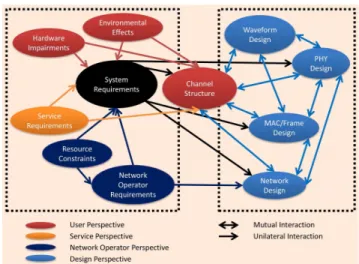
Service and user requirements can be satisfied partly or completely at different system levels. By this way, it is pre-vented focusing on a single layer, which makes the design of this layer more difficult. As can be seen from Figure1, it is possible to develop different solutions with different layers and subsystems where many interactions exist. It can be said that the PHY layer and waveform-based solutions will be employed in the cellular communications systems until 5G becomes operative. With perceived 5G essentials, it is seen that the MAC layer is going to be utilized more.
When the solutions that are developed for 5G and beyond are examined, it is comprehended that one of the basic motivations is increasing the flexibility in different layers. From the perspective of waveform design, many new wave-form methods have been developed but they can not flexibly meet all system requirements of 5G. Hence, under these
FIGURE 1. Various interactions between different system levels, requirements, and constraints.
circumstances, ‘‘one size fits all’’ approach may not be possi-ble [2]. Some of the new studies try to find more flexipossi-ble solu-tions such as ‘‘mixed waveforms’’ or ‘‘hybrid waveforms’’ for 5G beyond [3]. For now, 5G systems will use ‘‘mixed numerologies’’ with a single waveform which is cycle pre-fix orthogonal frequency division multiplexing (CP-OFDM) instead of ‘‘mixed waveforms’’ [4]. In this approach, it is aimed to meet system requirements with a frame design based solutions.
Employing mixed numerologies means adaptivity of the waveform. A base station and users can use one waveform with different parameters at the same time. In [5], three waveform designs including CP-OFDM, filtered OFDM (f-OFDM), and windowed OFDM (W-OFDM) are analyzed with the mixed numerology concept. The same concept is analyzed from a frequency-domain multiplexing perspective in [6]. In another study, authors present much important information about the OFDM numerologies for the new radio (NR), and also about the mixing numerolo-gies [7]. Different numerolonumerolo-gies are employed for service based or user based subband filtering methods separately in [8]. However, service and user requirements can be met together in the same subframe. For example, our study is built on this hypothesis. Actually, there is a huge research opportunity for the concept of mixed numerologies in the literature.
There are three main questions that this study aims to answer:
1) How many and which mixed numerologies should be used together in one transmission time interval (TTI) duration?
2) What are the effects of different numerology sets for the mixed numerology based frame structures? 3) How can be a flexibility metric defined from the frame
design perspective?
To the best of authors’ knowledge, these questions don’t have answers in the literature. Another important point is that there
is a very strong relationship between these questions. In this study, we tried to find answers to above-mentioned three questions while establishing the relationship between them. Consequently, three important contributions have been made by this paper:
1) Analysis of the trade-offs for different structures of mixed numerologies is provided.
2) A new flexibility metric is developed as a new perfor-mance metric.
3) A novel heuristic method is designed to decide on ‘‘the efficient number of mixed numerologies’’, and control overheads that are caused by multi-numerology structures.
These contributions can help 5G systems while performing the mixed numerology designs. Additionally, the flexibility metric can be used in the other adaptive subsystems of 5G and beyond.
In the remaining parts of the paper, SectionIIpresents the system model and preliminaries. Various relationships and trade-offs are provided in SectionIII, andIV, respectively. All details of the user satisfaction function and the flexibility metric are explained in SectionV. The details of the heuristic method to decide on the efficient number of mixed numerol-ogy structures are proposed in SectionVI. Simulation results are provided in SectionVII. Finally, the conclusion and likely future works are given in SectionVIII.
II. SYSTEM MODEL AND PRELIMINARIES
There are various wireless communications scenarios, and service requirements according to ETSI 3GPP documents [9]. These scenarios include 1) indoor hotspot, 2) dense urban, 3) rural, 4)urban macro, 5) high speed, 6) extreme long distance coverage in low density areas, 7) urban coverage for massive connection, 8) highway, 9) urban grid for con-nected car, 10) commercial air to ground, 11) light aircraft, 12) satellite extension to terrestrial. In [9], the given scenar-ios are discussed and some detailed scenario parameters are provided for 5G systems. These parameters are also used in the remaining part of this paper when needed.
Three main classes of services are considered for 5G including enhanced mobile broadband (eMBB), massive machine type communications (mMTC), and ultra-reliable and low latency communications (URLLC). As it is expected, service requirements differ between the three service classes under different scenarios. Some of the key requirements for 5G can be listed as 1) high throughput, 2) high data rate, 3) support for small data bursts, 4) high energy efficiency, 5) low latency, 6) high reliability [10]. They are analyzed from the perspective of different service classes and relationships in SectionIII.
In addition, user requirements are other important aspects for the system designs in 5G and beyond. The user require-ments include various constraints which can be described as wireless channel conditions and RF-hardware impair-ments. Some of these effects can be given as 1) Doppler spread, 2) multipath effects, 3) path loss, 4) phase noise,
5) frequency offset, 6) power amplifier (PA) non-linearity. This list may be improved to include other impairments in the future. We assumed that all these impairments are provided as feedbacks via channel quality information and other similar systems.
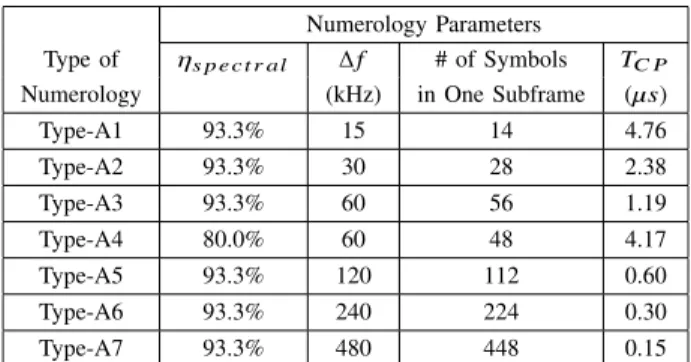
TABLE 1. Numerology structures in 5G.
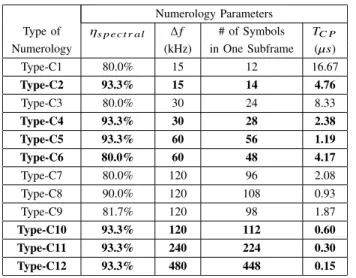
In this study, CP-OFDM with mixed numerology tures is analyzed. According to [11], seven numerology struc-tures are defined for 5G new radio (NR). Some of the main parameters of these numerology structures are presented in Table 1. Here, ten one-millisecond subframes constitute one frame like in LTE systems. The number of symbols in one slot and the number of slots in one subframe are not given in the table but the number of symbols in one subframe is presented. There can be 7 or 14 symbols in one slot for the first three types of numerology structures on the table. However, the number of symbols in one subframe is same in this situation independent of the number of symbols in one slot. CP durations are calculated considering that there are not any guard periods between adjacent symbols. Spectral efficiency values,ηspectral, are calculated without any guard periods and guard bands using (1) where TUis usable symbol duration, and TCP is CP duration. All results are presented in Table1. Additionally, there are 12 subcarriers with differ-ent sized subcarrier spacings,1f , in each of resource blocks which use different bandwidths.
ηspectral = TU TU+ TCP
(1) Three different numerology sets are used. First set is the numerology structures defined in Table 1. Also, alterna-tive types of numerologies are tested employing the other numerology sets especially if a longer CP duration is needed. The related simulation results are presented in SectionVI.
Different scenarios, service requirements, user require-ments, and numerology structures that are given in this section are going to be correlated to each other in the next section.
III. RELATIONSHIPS FOR DIFFERENT REQUIREMENTS In this section, service requirements, and user requirements are approached from the numerology design perspective under different scenarios.
As it is mentioned before, there are many different service types [12], and they are classified into three main service classes for 5G. The key requirements and necessities of these classes are analyzed in the next paragraphs, and a related summary is given in Table2.
The class of eMBB services generally requires high throughput and high data rate to provide the best opportu-nities for very high wireless data transfer. Because of that, the key necessities of eMBB services are mainly related to the spectrum usage. High spectral efficiency is a very critical necessity for the spectrum below 6 GHz. Employing mil-limeter wave frequencies is also another solution for eMBB services.
A massive number of sensor devices form mMTC ser-vice class that include the serser-vice types related with smart homes, smart cities, wearable sensors, environment monitor-ing, ultra-low energy sensors, and all other similar usages. The key requirements of mMTC services are high energy efficiency and support for small data bursts because these requirements are essential for the sensor communications. In this context, short data bursts result with large subcar-rier spacing, and the low number of subcarsubcar-riers is a need. Discrete Fourier Transform spread (DFT-s) OFDM waveform is a solution in uplink transmission of 5G for the low-power sensor devices because DFT-s OFDM provides the necessity of the low number of subcarriers. However, mMTC services need large subcarrier spacings for short data bursts in down-link and updown-link transmissions.
URLLC services, as the name implies, require high relia-bility, and low latency to be preferred by services related with autonomous vehicles, aviation, robotics, and medical appli-cations. TTI durations are needed to be kept short to provide low latency. As another key requirement, high reliability can be provided by using larger subcarrier spacings; and longer CP durations will help to decrease interferences. In this way, packet loss rate can be reduced to increase reliability.
Besides the service requirements, user requirements arise from the channel and RF-hardware impairments. Because, each of the users has different wireless channel, and RF-hardware constraints. Within this scope, there are different necessities for numerology choice of each of the user.
If the channel impairments are to be addressed, then a larger subcarrier spacing is needed to be used for the high Doppler spread which is a result of mobility, multipath, and angular spread. Furthermore, a longer CP duration is a need for the scenarios with long delay spreads. Additionally, the low number of subcarriers is needed for high path loss scenarios because the high number of subcarriers results in high PAPR values which is not a good condition for PA usage. Basically, the key necessities of the channel impairments can be achieved in this way.
For the RF-hardware impairments, a larger subcarrier spac-ing is a necessity for the high phase noise and frequency offset. Moreover, the low number of subcarriers is a solution for high PA non-linearity to restrain high PAPR values like in the high path loss scenario.
TABLE 2. Service requirements and their effects numerology parameters.
TABLE 3. User requirements and their effects numerology parameters.
Due to fixed one-millisecond subframes with 12 subcarri-ers in each of the RBs are used in 5G [11], we don’t need to include two key necessities in Table2 and Table3: The number of subcarriers, and TTI duration. For the necessity of the low number of subcarriers, larger subcarrier spacings can be preferred. The low latency requirement needs to be met in the other layers of the overall communications sys-tem. Therefore, three key necessities that include spectral efficiency, subcarrier spacing, and CP duration are considered in the remaining part of this paper.
In addition, different scenarios that are given in SectionII
change the weights of different requirement parameters related to the services and users in the coverage area of a system.
IV. TRADE-OFF ANALYSIS FOR THE DIFFERENT STRUCTURES OF MIXED NUMEROLOGIES
As is known, only one numerology can be employed for one TTI duration in LTE. Using one numerology for all situations can be considered as an efficient way but user and application specific systems need more flexibility to meet correlated requirements provided in Section II and III. An effective solution is, employing different numerologies which are not fixed for each of the users from the flexibility perspective without considering the other performance metrics. However, there is a need for a balance between flexibility and the other performance metrics because there are various trade-offs.
For 5G, three numerologies for three main service classes are not enough because there are also user requirements. Due to this reason, seven fixed numerologies are defined for 5G, and the list of them is given in Table 1. The number of numerologies is seven for the moment but may increase further in the future systems.
The number of different type of numerology structures preferred by users is needed to be decided in every TTI duration for a meaningful system. Besides, a different type of numerologies can be used in different amounts in accordance with the service and user requirements. Sometimes, a less number of numerologies can be enough to meet the require-ments. It should be noted that the assumption is that services are not mapped to the numerologies in a fixed manner, and bandwidth allocations for the numerologies can be different. Basically, the number of mixed numerology structures have effects on the performance metrics of spectral efficiency, scheduling complexity, computational complexity, and sig-naling overhead.
Spectral efficiency defined in (2) generally decreases depending on the increase in the number of mixed numerolo-gies and flexibility because there should be some guards between different numerologies to prevent inter-numerology interference (INI). Rather than flexibility, spectral efficiency can be more important under some scenarios. In such cases, the number of mixed numerology structures should be chosen less. ηspectral = TU TU+ TCP+ TG × BU BU + BG (2) In (2), TGis guard periods, BU is usable bandwidth, and BG is guard bands.
In this paper, it is assumed that the mixed numerologies are orthogonal to each other. However, we have an intention con-ducting a study provide another algorithm for non-orthogonal conditions in near future. Spectral efficiency analysis needs to be reconsidered for the non-orthogonal case.
In addition, flexibility comes with some other constraints including scheduling complexity, computational complex-ity, and signaling overhead which can be called as network
operator requirements. Increasing the number of numerolo-gies reduces the channel dependent scheduling complexity compared to LTE systems. Also, signaling overhead and computational complexity reduction is important for feasi-bility. The base station has to inform the users with enough details about the spectral structure of mixed numerologies. This process increases the control signaling overhead. For the multi-numerology systems, different-sized Fast Fourier Transform (FFT) blocks need to be employed together. This situation brings additional higher computational complexity to the system.
Considering the disadvantages of using the high number of mixed numerology structures, flexibility performance of a frame needs to be optimized to meet the key requirements and necessities of different users and services.
Another point is that, if we extend and enrich the numerol-ogy set, we can increase the probability of providing more suitable numerologies for the different necessities of users. It is possible to increase average user satisfaction by selecting more suitable numerologies from a larger numerology set without changing the number of used numerologies together. However, a larger numerology set generally includes less common numerologies, and it causes various difficulties in the scheduling processes.
V. A NEW FLEXIBILITY METRIC
To make an optimization on the flexibility, firstly it must be estimated. As far as we know, there are not any algorithms available in the literature for this purpose. That is why a new heuristic flexibility metric algorithm is developed in this paper.
Our flexibility metric, F , is estimated using (3) which employs (4) to provide a satisfaction result of only one user, Su. Actually, the flexibility metric is equal to the average satisfaction of all users. The flexibility metric is calculated with the average user satisfaction ratio in every TTI duration.
F =X u
Su
U (3)
In (3), U is the number of users in the same coverage area. Su=X
k Pk
K (4)
In (4), Pk is the user satisfaction for the necessity of k, and K is the number of key necessities defined in Table 2and Table3. Pk is estimated by (5) for each of the key necessities for every single user. Hence, Su can be also called average satisfaction result for all necessities of a user.
Pk = 1 Il,u,k = Nu,k 0 Dk+1 ≥ M 1 − Dk+1 M DkRk≤ Ak < (Dk+1)Rk (5)
In (5), Nu,kis the necessity function to determine ideal result for necessity k of a user u, Il,u,k is the l’th numerology selection from a set of numerologies for user u and necessity
k, Ak is found with (6) and it is the difference regarding to ideal solution for necessity k, Rk is the reference value for necessity k, Dkis found with (7) and it is the normalized value of Akfor necessity k, and M is a limit value for the resolution of the algorithm. Ak = |Il,u,k− Nu,k| (6) Dk = Ak Rk −[ Ak Rkmod(1)] (7) In our algorithm, the flexibility metric is estimated based on Pk values. The Pk values vary between 0 and 1. The higher Pk, the more user satisfaction will be for the related key necessity. Additionally, there can be maximum M + 1 different type of Pkvalues in the algorithm. If M is increased, the resolution for the satisfaction estimation also increase. However, a higher resolution brings more computational complexity.
As stated previously, if all users have their ideal numerol-ogy structures, then the number of numerolnumerol-ogy structures will be equal to the number of users. In this situation, F will be 1, and it represents the most flexible system. All users can be satisfied 100% in this way as an ideal system.
Algorithm 1 Heuristic Algorithm to Decide on the Efficient
Number of Mixed Numerologies
1: function OPTIMIZATION(I, U, N, M)
2: F Iis the numerology set, and N is the set of necessities F Lis the number of numerologies in I
3: for i = 1 do Lstart
4: for u = 1 do U
5: Il∗,u= argmax(I, N, M)
6: end for
7: Estimate F , and V using a fixed guard band, C 8: Sort the number of numerology selections. 9: Decide on the new numerology set, I , by
remov-ing the least used numerology.
10: end for
11: return The numerology selections of all users for a
reasonable case which maximizes the overall satisfaction for a given numerology set.
12: end function 13: function ARGMAX(I, N, M) 14: for l = 1 do L 15: Estimate Su,l 16: end for 17: Su= max(Su,l) 18: return Il∗,u 19: end function
VI. A NOVEL METHOD TO DECIDE ON THE EFFICIENT NUMBER OF MIXED NUMEROLOGY STRUCTURES
In addition to the flexibility metric proposed in the previ-ous section, we provide a fundamental algorithm defined in Algorithm 1 for the estimation of an efficient number of mixed numerology structures in this section. In other words,
more user satisfaction brings more flexibility, and flexibility metric is employed to decide on the efficient number of mixed numerology structures in one coverage area. For this purpose, (4) is used to decide on the best numerology selection, Il∗,u, from a set of numerologies for each of the users. After that, (8) finds the best numerology selection for user u.
Il∗,u=argmax Il,u
Su (8)
The best numerology selection process is repeated up to the number of members in a numerology set. For every stage, the usage of all numerologies is counted and sorted in a descending order. By this way, the least preferred numerology is removed from the numerology set in each stage. Then, (8) is performed again with the new set of numerologies which has a less number of numerology structures. The best numerologies for each of the users can be decided again at every stage. Meanwhile, overall satisfaction, V , is estimated using (3), (9), and (10) for the best numerology selections. In (9) and (10),ηBW is the spectral efficiency related with bandwidth usage of all numerologies employed in that stage. In (10), BG is the total guard bands used between different numerology structures to prevent or decrease INI.
V =ηBW × F (9) ηBW =
BU BU+ BG
(10) The more numerologies mean the more flexibility along with the more BG. A larger BGcauses decrease in the spectral efficiency of the system. Therefore, overall spectral effi-ciency changes while the number of mixed numerologies in the current stage is varying. V becomes maximum on one point while changing the number of mixed numerologies in each stage. When this point is found, it gives a reasonable result for the number of current mixed numerologies. At the end, the overall satisfactions are maximized on different points while changing the number of mixed numerologies. These points are the most reasonable points for the given numerology set but they cannot be accepted as optimum points for all numerology sets. The positions of the points can vary from one numerology set to another. The related simulation results are given under different scenarios in the next section.
Additionally, the proposed heuristic algorithm is designed in a simple manner considering the complexity and imple-mentation feasibility perspective.
VII. SIMULATION RESULTS
Simulation results are obtained for 12 scenarios given in Section II. Necessity weights differ from one scenario to another. Different users’ necessities, Nu,k, are randomly gen-erated regarding the related scenario. For example, a larger subcarrier spacing necessity is relatively high in ‘‘Highway’’ scenario.
Some algorithm parameters which are referred in SectionV, andVIare presented in Table4. In (5), resolution
TABLE 4.Simulation parameters.
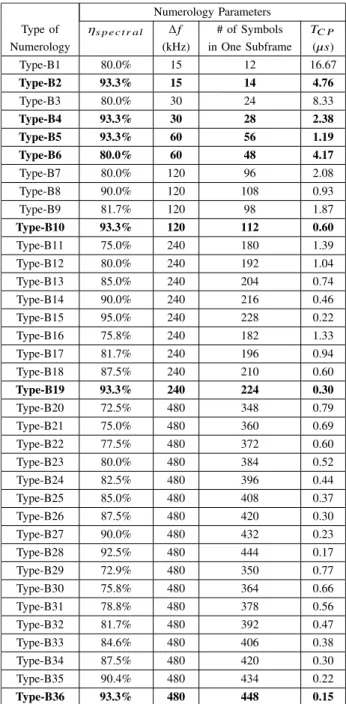
TABLE 5.Alternative numerology set with 36 numerologies.
steps are obtained by 1/M which is 0.05 in our simulations. For example, if there is a difference of 15 kHz between the numerology and user necessity for the subcarrier spacing, Pk
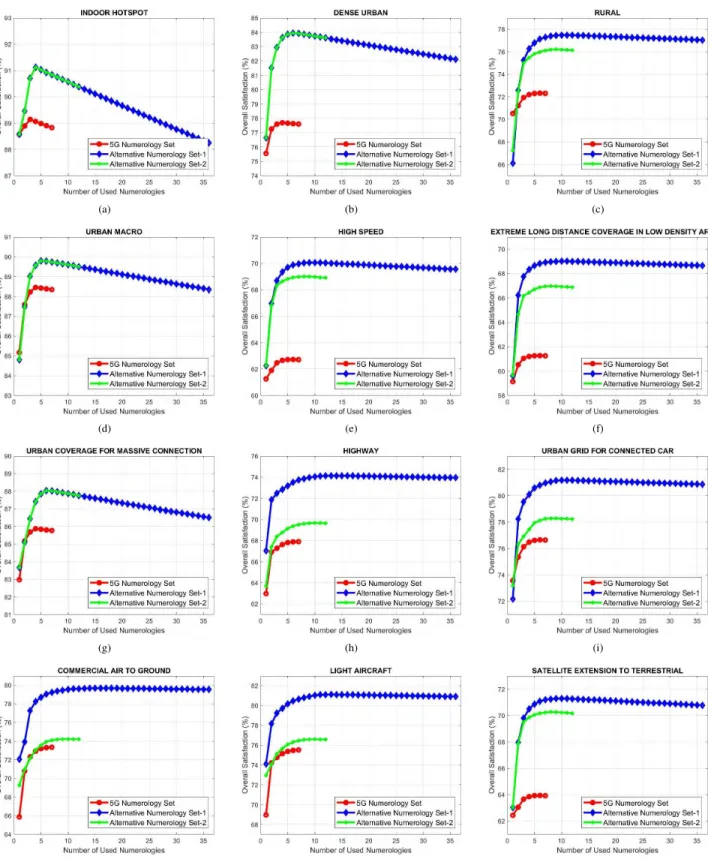
FIGURE 2. The results for 12 scenarios and three numerology sets. 5G numerology set includes 7 numerologies, the first alternative set includes 36 numerologies, and the third alternative set includes 12 numerologies. (a) Scenario 1. (b) Scenario 2. (c) Scenario 3. (d) Scenario 4.
(e) Scenario 5. (f) Scenario 6. (g) Scenario 7. (h) Scenario 8. (i) Scenario 9. (j) Scenario 10. (k) Scenario 11. (l) Scenario 12.
is estimated as 1 − 0.05 = 0.95 or if there is a difference of 30 kHz, it is estimated as 1 − 0.1 = 0.9 to present the user satisfaction out of 1.
U, K , and M parameters have effects on the complexity of the proposed algorithm. If they are increased, algorithm complexity also increases. The number of numerologies in
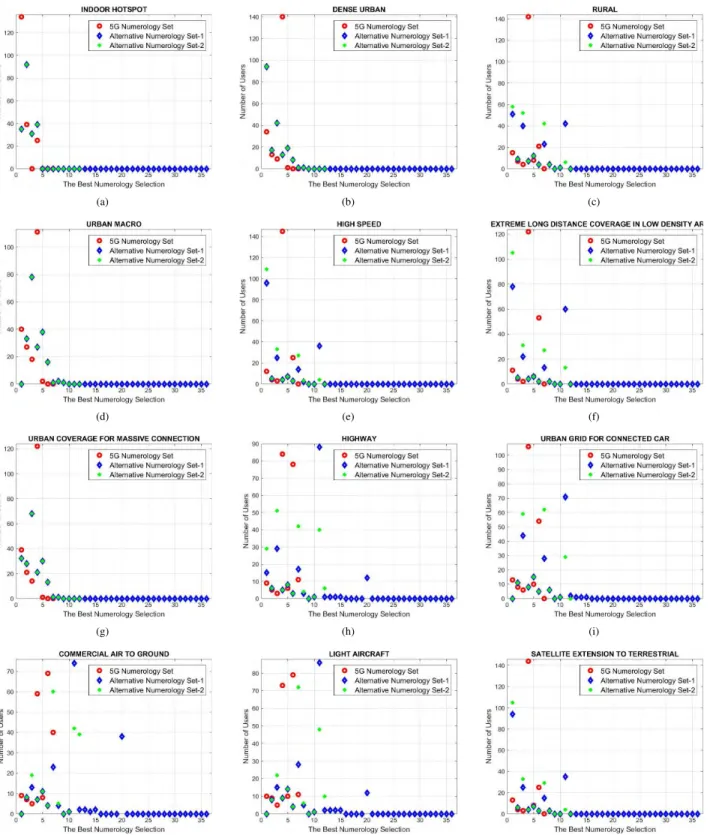
FIGURE 3. The number of users for each of the numerologies while using all of the numerologies in three numerology sets under 12 scenarios. (a) Scenario 1. (b) Scenario 2. (c) Scenario 3. (d) Scenario 4. (e) Scenario 5. (f) Scenario 6. (g) Scenario 7. (h) Scenario 8. (i) Scenario 9. (j) Scenario 10. (k) Scenario 11. (l) Scenario 12.
a numerology set also affects the algorithm complexity. More numerologies bring more complexity.
Fixed guard bands, C, are placed between the consecu-tive numerologies. Because of that total guard bands, BG,
increase linearly with the number of numerology struc-tures. Actually, the relationships between INI, spectral effi-ciency, the number of mixed numerologies, and adaptive guard bands between the consecutive numerologies need to
TABLE 6. Alternative numerology set with 12 numerologies.
TABLE 7. Efficient number of mixed numerologies for three different sets under 12 scenarios.
be analyzed but they are not included in the scope of this study.
In the simulations, three numerology sets are used: 1) 5G numerology set given in Table1with 7
numerolo-gies
2) Alternative numerology set given in Table 5 with 36 numerologies
3) Alternative numerology set given in Table 6 with 12 numerologies
5G numerology set is indicated with bold rows in Table5and6which include Table1. Also, Table5includes Table 6. The same input data are used for all numerology sets, and all tests are simulated 100 times with different input data to increase statistics. Average results of 100 tests are given in Figure2. The results base on the ideal results which are obtained by ideal numerologies of each of the users. The efficient number of numerologies for the simulation results in Figure2are presented in Table7.
Scheduling can be easier while using the multiple numbers of slots in all subframes for different numerologies but we test also alternative numerology sets which have different numbers of slots in the subframes. In other words, we used the number of slots as 1, 2, 4, 7, 8, 9, 13, 14, 15, etc. instead of 1, 2, 4, 8, 16, and 32. The alternative sets give better flexibility results compared to 5G numerology set. If we remove some of the constraints (e.g. using the multiple numbers of slots in all subframes), total satisfaction increases. It should not be forgotten that user satisfaction can be increased by providing a wider numerology set. Hence, the numerology set is also very important parameter from the flexibility perspective. Figure3shows the number of users for each of the numerolo-gies in case of using the best numerology selections for three numerology sets. Alternative sets offer better choices com-pared to 5G numerology set despite they include the first set. However, scheduling complexity and algorithm complexity increase when the numerology set is widened.
The main reasons for the differences between the results of three numerology sets can be listed as:
1) In the first set, there is not sufficient options if a longer CP duration is needed.
2) The second set covers too many options for a larger subcarrier spacing necessity.
Characteristics of the necessities or input data of all users can be analyzed from Figure 3. Figure 2 is used to find the efficient number of numerologies, whereas Figure 3
shows the most preferred numerology type in a numerology set under different scenarios. Generally, the most preferred numerology type is used when only one numerology needs to be selected.
In addition, as it can be seen from Figure2, flexibility generally is not good when only one numerology is used. Moreover, three numerologies are not enough in many situa-tions but they rarely give good results under some scenarios. Simulation results support our motivations for the algo-rithm designs on a flexibility metric and optimization meth-ods related with the mixed numerologies. In many cases, optimization algorithms need to be employed to increase the overall system performance.
VIII. CONCLUSION
The increasing number of numerologies brings more flexibil-ity to the system especially in return for spectral efficiency. Our algorithm finds a reasonable point for the number of mixed numerologies to not affect the other performance met-rics negatively rather than flexibility metric. The proposed scheme indicates a new direction for the mixed numerol-ogy concept from the resource and numerolnumerol-ogy management perspective. It is possible to provide different algorithms to decide on the efficient number of mixed numerology struc-tures for a given numerology set.
Overall satisfaction can also be increased using different numerology sets with the same number of mixed numerolo-gies. Hence, the larger numerology sets offer better flexi-bility results with the same number of mixed numerologies.
However, selecting less common numerologies in a large numerology set can increase scheduling complexity, and sig-naling overhead.
The flexibility metric we suggested in this study can be used to provide useful input for the other adaptive algorithms. It is also possible to provide different flexibility metrics in the other system layers. We preferred to provide it in the frame design.
Developing optimization algorithms for non-orthogonal conditions will be one of the future studies. Moreover, align-ment of the mixed numerology structures with adaptive guard bands between the consecutive numerologies can be pointed out as another future study; it may enhance the spectral efficiency of the system. For 5G beyond is considered, it can also be said that different waveforms can be employed with different numerology parameters. As a result, there is a huge necessity for the optimization of algorithms in this type of wireless communications systems.
REFERENCES
[1] Z. E. Ankaralı, B. Peköz, and H. Arslan, ‘‘Flexible radio access beyond 5G: A future projection on waveform, numerology frame design principles,’’
IEEE Access, vol. 5, no. 1, pp. 18295–18309, Dec. 2017.
[2] C. L. I, S. Han, Z. Xu, S. Wang, Q. Sun, and Y. Chen, ‘‘New paradigm of 5G wireless Internet,’’ IEEE J. Sel. Areas Commun., vol. 34, no. 3, pp. 474–482, Mar. 2016.
[3] A. Yazar, F. A. Onat, and H. Arslan, ‘‘New generation waveform approaches for 5G and beyond,’’ in Proc. IEEE Signal Process. Commun.
Appl. Conf. (SIU), May 2016, pp. 961–964.
[4] 3rd Generation Partnership Project; Technical Specification Group Radio
Access Network; NR; Physical Layer; General Description (Release 15) V1.0.0, document TS 38.201, 3GPP, 2017.
[5] P. Guan et al., ‘‘5G field trials: OFDM-based waveforms and mixed numerologies,’’ IEEE J. Sel. Areas Commun., vol. 35, no. 6, pp. 1234–1243, Jun. 2017.
[6] M. Iwabuchi et al., ‘‘5G field experimental trial on frequency domain multiplexing of mixed numerology,’’ in Proc. IEEE Veh. Technol.
Conf. (VTC-Spring), Jun. 2017, pp. 1–5.
[7] A. A. Zaidi et al., ‘‘Waveform and numerology to support 5G services and requirements,’’ IEEE Commun. Mag., vol. 54, no. 11, pp. 90–98, Nov. 2016.
[8] L. Zhang, A. Ijaz, P. Xiao, A. Quddus, and R. Tafazolli, ‘‘Subband filtered multi-carrier systems for multi-service wireless communications,’’ IEEE
Trans. Wireless Commun., vol. 16, no. 3, pp. 1893–1907, Mar. 2017. [9] 5G; Study on Scenarios and Requirements for Next Generation Access
Technologies. document ETSI TR 138 913 V14.3.0, 3GPP, Oct. 2017.
[10] ‘‘Making 5G NR a reality: Leading the technology inventions for a unified, more capable 5G air interface,’’ Qualcomm Technol., Inc., White Paper, Dec. 2016. [Online]. Available: https://www.qualcomm. com/documents/whitepaper-making-5g-nr-reality
[11] 3rd Generation Partnership Project; Technical Specification Group Radio
Access Network; NR; Physical Channels and Modulation (Release 15), V1.2.0, document TS 38.211, 3GPP, Nov. 2017.
[12] A. Yazar and H. Arslan, ‘‘Waveform design priorities in different wireless communications systems for 5G beyond,’’ in Proc. IEEE Signal Process.
Commun. Appl. Conf. (SIU), May 2017, pp. 1–4.
AHMET YAZAR received the B.Sc. degree in elec-trical engineering from Eskisehir Osmangazi Uni-versity, Eskisehir, Turkey, in 2011, and the M.Sc. degree in electrical engineering from Bilkent Uni-versity, Ankara, Turkey, in 2013. He is currently pursuing the Ph.D. degree as a member of the Communications, Signal Processing, and Net-working Center, Istanbul Medipol University. From 2011 to 2013, he was a member of the Bilkent Signal Processing Group, where he studied Wavelet Theory and some other signal processing methods in various pattern recognition projects. In 2013, he joined the Information and Communication Technologies Authority and he was involved in the Spectrum Management Department. In 2014, he was appointed under the Presidency of Telecommu-nication and CommuTelecommu-nication for one year. His current research interests are flexible waveform systems and mixed numerology structures.
HÜSEYIN ARSLAN (S’95–M’98–SM’04–F’15) received the B.S. degree from Middle East Tech-nical University, Ankara, Turkey, in 1992, and the M.S. and Ph.D. degrees from Southern Methodist University, Dallas, TX, USA, in 1994 and 1998, respectively. From 1998 to 2002, he was with the Research Group, Ericsson Inc., Raleigh, NC, USA, where he was involved with several projects related to 2G and 3G wireless communication sys-tems. Since 2002, he has been with the Electrical Engineering Department, University of South Florida, Tampa, FL, USA. He has also been the Dean of the College of Engineering and Natural Sciences, Istanbul Medipol University, since 2014. He was a part-time consultant for various companies and institutions, including Anritsu Company, Morgan Hill, CA, USA, and The Scientific and Technological Research Council of Turkey (TÜBİTAK). His research interests are in physical layer security, mmWave communications, small cells, multicarrier wireless technologies, co-existence issues on heterogeneous networks, aeronautical (high-altitude platform) communications, in vivo channel modeling, and system design.