COMMITMENT? THE MEDIATING ROLE OF JOB SATISFACTION
Metin OCAK1 Aslıhan YAVUZALP MARANGOZ2Abstr act
In this study the mediating role of job satisfaction over the impacts of organizations’ internal marketing acitivities on employees’ organizational commitment is examined. The sample of the study consists of 356 employees from several sectors. Mediation tests were carried out with traditional and modern methods to the data obtained through electronic survey method from these employees. Both analysis methods showed that job satisfaction has a partial mediating role in the relationship of internal marketing and employees' organizational commitment. Depending on these findings, it is suggested that organizations’ internal marketing activities are important for increasing organizational commitment of employees. However, this effect can be increased with developing job satisfaction through internal marketing acitivities.
Keywords: Internal Marketing, Organizational Commitment, Job Satisfaction, Mediating Role. JEL Classification: M1, M3
İÇSEL PAZARLAMA FAALİYETLERİ ÖRGÜTSEL BAĞLILIĞI NASIL ETKİLER? İŞ
TATMİNİNİN ARACILIK ROLÜ
Öz
Bu çalışmada örgütlerin içsel pazarlama faaliyetlerinin çalışanların örgütsel bağlılıkları üzerine etkisinde iş tatmini tutumlarının aracılık rolü incelenmiştir. Araştırmanın örneklemini farklı sektörlerde çalışan toplam 356 çalışan oluşturmuştur. Söz konusu çalışanlardan elektronik anket yöntemi ile elde edilen verilerle geleneksel ve modern yöntemlerle aracılık testleri yapılmıştır. Yapılan analizler neticesinde her iki yöntemde de örgütlerin içsel pazarlama faaliyetleri ile çalışanların örgütsel bağlılıkları etkileşiminde iş tatmininin kısmi bir aracılık etkisi olduğu tespit edilmiştir. Bu bulgulara göre örgütlerin içsel pazarlama faaliyetlerinin çalışanların
örgütsel bağlılıklarını artırmak için önemli olduğu, ancak örgütsel bağlılık üzerindeki etkinin bir kısmının çalışanların iş tatmini tutumlarının içsel pazarlama faaliyetleriyle olumlu yönde geliştirilerek artırılabileceği değerlendirilmiştir.
Anahtar Kelimeler: İçsel Pazarlama, Örgütsel Bağlılık, İş Tatmini, Aracılık Rolü. JEL Sınıflandırması: M1, M3
1 Dr. Öğ.Üyesi, Toros Üniversitesi, İktisadi, İdari ve Sosyal Bilimler Fakültesi, İşletme Bölümü, 33140, Mersin/Türkiye,
[email protected], ORCID: 0000-0002-1142-3661.
2Dr. Öğ.Üyesi, Toros Üniversitesi, İktisadi, İdari ve Sosyal Bilimler Fakültesi, Uluslararası Finans Bölümü, 33140,
1. Introduction
Organizations have noticed the importance of increasing and maintaining employees’ motivation and commitment to reach high performance and to ensure continuance of human resources. Kotler (2012: 13) pointed out the importance of customer orientation and employees. He also emphasized that organizations should take internal marketing serious as external marketing to serve customers successfully. Especially service organizations aim to provide better working conditions for their employees considering happy customers can only be possible with happy employees. In the workplace if employees feel themselves good, employees’ job satisfaction and organizational commitment will increase, thus will improve the job performance of employees and ultimately the performance of the organizations. Job satisfaction and organizational commitment are the important topics in the field of organizational behavior to understand and manage employees’ behaviors (Robbins and Judge, 2013: 107). Job satisfaction can be defined as employees’ positive feelings about their jobs after evaluating their jobs and organizational commitment shows the willingness of employees to continue working at their jobs. Organizations should organize some activities for their employees to develop both of these attitudes.
There are many studies on the effect of organizations’ internal marketing activities to employees’ job satisfaction and organizational commitment in local and international literature (Chang and Chang, 2007; Demir et al., 2008; İşler and Özdemir, 2010; Abzari et al., 2011; Chen et al., 2013; Kurşunoğlu Yarımoğlu and Ersönmez, 2017). In the local literature Demir et al. (2008: 143) stated that job satisfaction may have a mediating role in the interaction of organizations’ internal marketing and organizational commitment of employees. In this direction Yıldız (2011) found an empirical evidence for job satisfaction’s mediating role. Similarly, only one empirical research could be found in international literature (Ting, 2011). In this study, the mediation effect of job satisfaction was tested in a structural equation model. Generally, Baron and Kenny’s (1986) four steps mediation test and the modern approach (Hayes, 2009: Hayes, 2013) can be used in testing mediating effect statistically.
Gürbüz and Bayık, (2018: 31) reported that there are very limited researches using modern mediation approach in Turkish literature. In the scope of this gaps in literature, this study examines the mediating role of job satisfaction in the relationship of internal marketing and employees' organizational commitment in a different sampling. The most important originality of this study is that both approaches, Baron and Kenny’s (1986) four steps mediation test and modern mediation method (Hayes, 2009: Hayes, 2013) were used together.
2. Conceptual Framework
A review of the literature to unveil the relationship between research variables and to develop hypotheses is presented below.
2.1. Organizational Commitment
Organizational commitment concept became recognized by Whyte’s (1956) studies in organizational behavior. Porter et al. (1974: 604) characterized organizational commitment with three factors. These are strong belief and acceptance about organizations’ aim and values, willingness to strive for the organization and a strong desire for maintaining to be a member of organization.
Meyer and Allen (1991: 67) explained organizational commitment in three components named affective commitment, continuance commitment and normative commitment. They defined these components as a psychological statement that describes the relationship between employees and the organization and determined whether the relation will continue. The researchers explained affective commitment as the emotional connection of employees and their integration with the organization. Continuance commitment was qualified as employees’ cost that they will face if they
quit the job. The normative commitment is that the employee considers keeping up with work as an obligation and responsibility (Meyer and Allen, 1991: 67-68).
According to Robbins and Judge (2013: 109), organizational commitment refers employees’ integration with the organization and their willingness to maintain membership of the organization. Factors affecting organizational commitment are personal factors like age, gender, education, marital status, seniority and organizational factors such as the structure, size of the organization, wages, awards, team work and communication (Hoş and Oksay, 2015: 5-8). Internal marketing is another factor.
2.2. Internal Marketing
Purpose of internal marketing is to accept employees as a consumer and job as a product (Sasser and Arbeit, 1976: 61). Internal marketing means to market internally. The appearance, development and current situation of internal marketing increases employees pleasure and influences job satisfaction positively.
Internal marketing concept was first used by Berry (1981) in marketing literature (Foreman and Money,1995; Candan and Çekmecelioğlu, 2009; Rafiq and Ahmed, 2010; Qayum and Sahaf, 2013). Berry (1981), defined internal marketing as satisfiying employees needs and wants to reach organizational goals by assuming employees as a consumer and job as a product (Qayum and Sahaf, 2013: 51).
Main objectives of internal marketing are to attract qualified employees, develop, motivate and retain them (Berry and Parasuraman, 1992: 25). The elements of internal marketing are stated as awards, internal communication, training and developing, corporate structure, senior managers, physical environment, hiring process, coordination between functions, incentives, authorization and changes in the processes (Ahmed, Rafiq and Saad, 2003: 1223).
Internal marketing is promoting organizations, their products and services to employees. It should be owned by senior management to be successful (Greene et al., 1994: 5). Every department and employee in an organization is also a supplier and consumer at the same time. Therefore, they must work together to support the strategy and objectives of the organizations (Collins and Payne, 1991: 261).
Internal marketing is related with all of the functions of organizations but vitally associated with human resources management (Collins and Payne, 1991: 261). Therefore internal marketing was studied with different terms of management, in particular with job satisfaction.
2.3. Job Satisfaction
The beginning of the studies about job satisfaction is attributed to Hawthorne studies conducted between 1924-1933 (Kaur, 2012: 49). In these studies, with the emergence fact that productivity increase of employees is caused by factors except money. So researchers started to reveal the factors that provide job satisfaction. Herzberg (1959) categorized the factors that determined satisfaction or dissatisfaction of employees into two groups in his “two factor theory”. In the first group named motivators are recognition, success, opportunity of development, responsibility and the job itself. The second group of factors called hygiene factors and are considered as the business environment. These factors are wages, relations with administration, job security, colleagues, company policies, work conditions, personal factors and status. Herzberg reported that the first group causes job satisfaction while the second group directly does not cause job satisfaction but lack of these factors cause dissatisfaction (Ergeneli and Eryiğit, 2001: 163-164).
Job satisfaction is the sum of a person’s feelings and attitudes about his job (Graham, 1982: 68). It is the situation that employees’ physical and psychological needs are satisfied at workplace (Hoopock, 1935; Porter, 1962; Wolf, 1970). Job satisfaction is the attitude of a person about the job, positive comments about workplace and the degree of liking the job (Yıldız, 2014a: 201).
Briefly, it is employees feelings against their job (Spector, 1997: 2). Positive and likable thoughts cause job satisfaciton whereas negative ones cause dissatisfaction (Armstrong, 2006: 264). Positive outputs are reached in individual and organizational level when an employee is happy at his/her job. The results of satisfaction are the increase in employees’ efficieny, commitment and decrease in absenteeism (Aziri, 2011: 84-85). On the other hand job satisfaction and organizational performance have a high correlation (Bakotić, 2016: 118).
Several factors affect job satisfaction such as managers, job design, wages, work condition, social relations in the job, perceived long term opportunities, worker’s wants and motivation (Rue and Byars, 2003: 259). Additionally employees’ satisfaction oriented internal marketing is one of these factors. In the literature there are many researches about job satisfaction and internal marketing relationship.
2.4. Relationships Among Research Variables: Literature Review
Internal marketing aims to satisfy employees expactations and needs whereas job satisfaction is the emotional evaluations of employees about their job. Therefore internal marketing is an effective factor to create job satisfaction (Yıldız, 2014b: 140). Many studies showed a positive relationship between internal marketing and job satisfaction (Randall and McCullough, 1991; Rafiq and Ahmed, 2000; Conduit and Mavondo, 2001; Chang and Chang, 2007; Tansuhaj et al., 1991; Shiu and Yu, 2010; Iliopoulos and Priporas, 2011; Al-Hawary et al., 2013; Ergün and Boz, 2017; Yarımoğlu and Ersönmez, 2017). The researches about the relationship between internal marketing and job satisfaction showed that organizations must first serve to their employees and make them enjoying their job to provide an efficient service to their external customers (Chen et al., 2015: 298).
Sharma and Bajpai (2010) defined organizational commitment as one of the antecedent and determinant characteristics of job satisfaction (Karataş and Güleş, 2010: 79). In the literature Porter et al. (1974), also Steers and Steven (1978) found that the job satisfaction causes commitment whereas Bluedorn (1982), Spector (1982), Williams and Hazer (1986), Mathieu (1991) and Nauman (1993) revealed that these two concepts are affecting each other (Currivan, 1999: 495; Kök, 2006: 300).
Internal marketing make employees to feel their needs are satisfied and management is taking care of them (Caruana and Calleya, 1998: 110; İşler and Özdemir, 2010: 120). This causes employees to feel positive emotions towards their organization. One of the most important consequences of internal marketing is the increase of organizational commitment of employees (Tansuhaj et al., 1991: 198). In the organizations which internal marketing applications become an organization philosophy the employees tend to show more job satisfaction and organizational commitment (Chen et al., 2015: 298). Researches showed that there is a strong relation between the internal marketing and organizational commitment (Tansuhaj et al., 1991; Caruana and Calleya, 1998:110; Tsai and Wu, 2011; Kocaman et al., 2013; Yarımoğlu and Ersönmez,2017).
As it is mentioned above there are many researches examining the effect of internal marketing to job satisfaction and it’s effect to organizational commitment. In the literature there are several studies in which the effects of internal marketing on both organizational commitment and job satisfaction are studied. These studies were conducted on academicians (Demir et al., 2008), hospitals and nurses (İşler and Özdemir, 2010; Chang and Chang, 2007; Chen et al., 2013) and bank workers (Kurşunoğlu Yarımoğlu and Ersönmez, 2017).
In the local literature Demir et al. (2018: 143) said that job satisfaction can play a mediating role in the relationship of organizations’ internal marketing activities and employees’ organizational commitment. In a conducted structural equation model analysis study on 275 teachers, Ting (2011) and Yıldız (2011) found that job satisfaction of employees has a partial mediating effect in the relationship between the internal marketing activities of organizations and
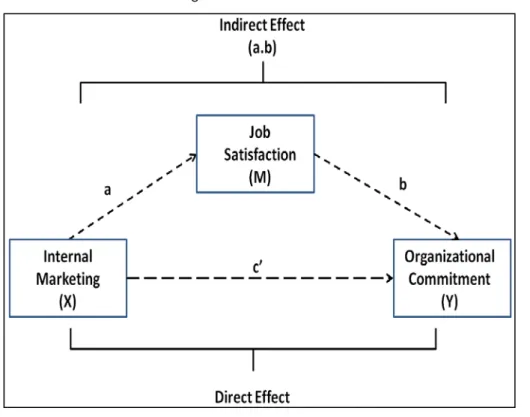
the organizational commitment of these employees. In the light of the theoretical grounds stated so far, the research model shown in Figure 1 is constructed.
Figure 1: Research Model
The hypotheses based on the model are presented below.
H.1. Internal marketing activities of organizations have a positive and significant effect on job satisfaction.
H.2. Job satisfaction has a positive and significant effect on organizational commitment. H.3. Internal marketing activities of organizations have a positive and significant effect on organizational commitment.
H.4. Job satisfaction has a mediating role in the relationship of internal marketing activities and organizational commitment.
3. Methodology
The sampling technique of the study, validity, reliability of the scales and executed statistical methods are clarified within the methodology.
3.1. Sample
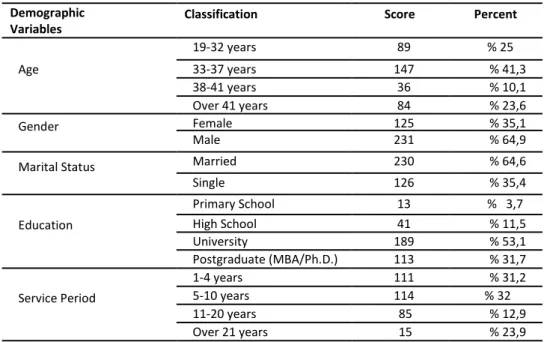
In the survey the convenience sampling method was used and an electronic questionnaire form in Google Docs was created to collect data from the participants. In total, 362 employees working in different jobs responded the questionnaire on a voluntary basis. Before the analysis, data of six employees who did not answer a large number of questions or collected their markings at the extreme limits were excluded. Therefore, the sample of our study consisted of 356 employees working in different public and private organizations. Of the participants, 125 (35,1 %) were female and 231 (64,9 %) were male. The mean age of the employees who make up the sample is 36,8 years and their mean service period is 11,8 years. Demographic variables statistics are shown in Table 1 below.
Table 1: Demographic Variables’ Statistics Demographic
Variables Classification Score Percent
Age 19-32 years 89 % 25 33-37 years 147 % 41,3 38-41 years 36 % 10,1 Over 41 years 84 % 23,6 Gender Female 125 % 35,1 Male 231 % 64,9
Marital Status Married 230 % 64,6
Single 126 % 35,4 Education Primary School 13 % 3,7 High School 41 % 11,5 University 189 % 53,1 Postgraduate (MBA/Ph.D.) 113 % 31,7 Service Period 1-4 years 111 % 31,2 5-10 years 114 % 32 11-20 years 85 % 12,9 Over 21 years 15 % 23,9 3.2. Instruments
Internal Marketing: The participants' perceptions of their organization internal marketing activities in which they are working were measured through using the 15-item Likert type scale developed by Foreman and Money (1995). The Cronbach's Alpha reliability was calculated as 0,93 by Başaran, Büyükyılmaz and Çevik (2011). In the present study, the Cronbach Alpha reliability was found as 0,97.
Organizational Commitment: In order to measure the organizational commitment level of employees, six questions from the “Organizational Commitment Scale” developed by Jaworski and Kohli (1993) and adapted by Şeşen (2010) were used. Although reliability value in the original study was found as 0,77, in our study it was computed as 0,86 after deleting the sixth question.
Job Satisfaction: For measuring the job satisfaction level the Turkish version (Basım and Şeşen, 2009) of a 5-item Likert type scale from Hackman and Oldham (1975) was used. In the Turkish adaptation study, the reliability of the scale was reported as 0,78. In the present study it was calculated as 0,88.
Confirmatory Factor Analysis (CFA) was performed to prove the validity of the research model. The research model has shown an acceptable goodness of fit. CFA results are displayed in Table 2.
Table 2: Research Model CFA Results
MODEL ∆χ² sd ∆χ²/sd RMSEA CFI GFI AGFI RMR
Research Model 374,41 260 1,44 0,03 0,99 0,93 0,90 0,05
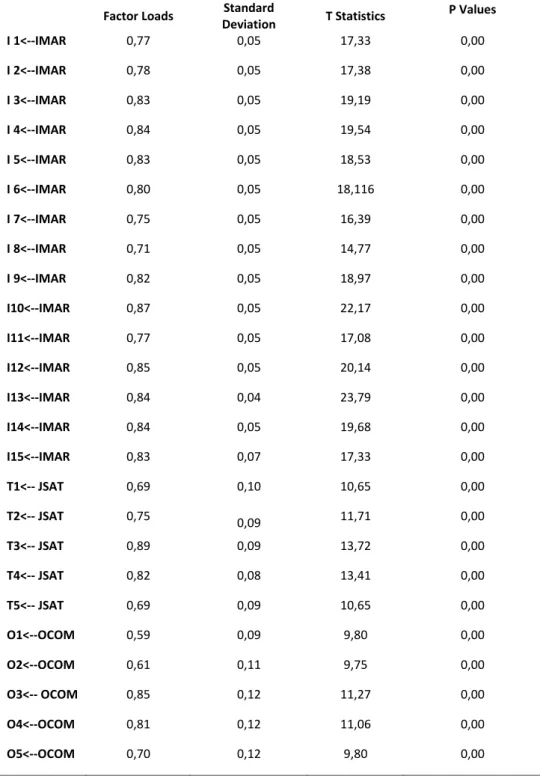
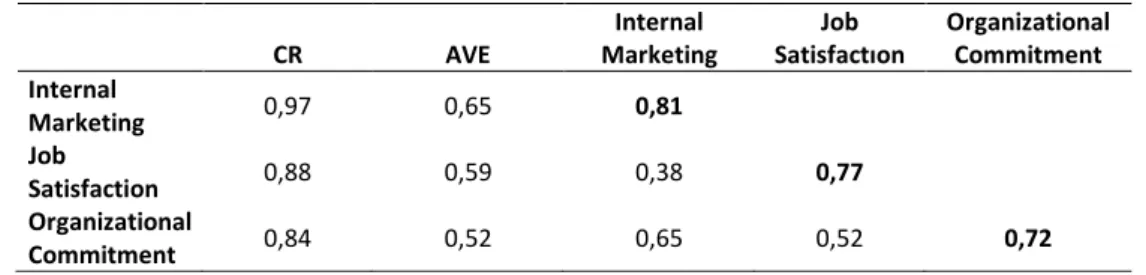
In addition, the compatibility of the measurement model with the data was evaluated in terms of convergent and discriminant validity within the scope of the results presented in Tables 3 and 4 below.
Table 3: Factor Loads, Standard Deviation, T Statistics and P Values
Factor Loads Deviation Standard T Statistics P Values
I 1<--IMAR 0,77 0,05 17,33 0,00 I 2<--IMAR 0,78 0,05 17,38 0,00 I 3<--IMAR 0,83 0,05 19,19 0,00 I 4<--IMAR 0,84 0,05 19,54 0,00 I 5<--IMAR 0,83 0,05 18,53 0,00 I 6<--IMAR 0,80 0,05 18,116 0,00 I 7<--IMAR 0,75 0,05 16,39 0,00 I 8<--IMAR 0,71 0,05 14,77 0,00 I 9<--IMAR 0,82 0,05 18,97 0,00 I10<--IMAR 0,87 0,05 22,17 0,00 I11<--IMAR 0,77 0,05 17,08 0,00 I12<--IMAR 0,85 0,05 20,14 0,00 I13<--IMAR 0,84 0,04 23,79 0,00 I14<--IMAR 0,84 0,05 19,68 0,00 I15<--IMAR 0,83 0,07 17,33 0,00 T1<-- JSAT 0,69 0,10 10,65 0,00 T2<-- JSAT 0,75 0,09 11,71 0,00 T3<-- JSAT 0,89 0,09 13,72 0,00 T4<-- JSAT 0,82 0,08 13,41 0,00 T5<-- JSAT 0,69 0,09 10,65 0,00 O1<--OCOM 0,59 0,09 9,80 0,00 O2<--OCOM 0,61 0,11 9,75 0,00 O3<-- OCOM 0,85 0,12 11,27 0,00 O4<--OCOM 0,81 0,12 11,06 0,00 O5<--OCOM 0,70 0,12 9,80 0,00
Table 4: Composite Reliability, AVE Values, Square Roots of AVE Values and Cross-Correlations of Factors
CR AVE Marketing Internal Satisfactıon Job Organizational Commitment
Internal Marketing 0,97 0,65 0,81 Job Satisfaction 0,88 0,59 0,38 0,77 Organizational Commitment 0,84 0,52 0,65 0,52 0,72
The Average Variance Extracted (AVE) values in Table 4 and factor loads of the scale items in Table 3 are used to evaluate the convergent validity. AVE values in Table 4 is 0,65 for internal marketing; 0,59 for job satisfaction; 0,52 for organizational commitment. AVE values are above the standard value of 0,50 (Zait and Bertea, 2011). In addition, as seen in Table 3, the factor loadings of the scale items are above 0.50 (Hair et al., 2017) and t-statistics are significant (Hair et al. 2012). These results indicate that the factors have convergent validity.
For the discriminant validity, Fornell-Larcker criterion (1981) was applied. According to this criterion; the square root of AVE values should be higher than the correlation between factors. Diagonal dark values show the square root of AVE values in Table 4 and the other values show correlations between each factor. It was seen that the square roots of AVE values are greater than 0.50 and are higher than the correlation between the factors. These results have shown us that the factors have discriminant validity. As shown in Table 4 Composite Reliability (CR) coefficients of the factors were found 0,97; 0,88 and 0,84 respectively. These results show that the CR value of the measurement model is above the standarts.
3.3. Statistical Methods
The collected data were analyzed in sequential steps. Firstly, all of research variables’ descriptive statistics and Pearson correlation coefficients were computed to determine the relationship between dependent and independent variables. Secondly, a hierarchical regression analysis was conducted within the traditional approach proposed by Baron and Kenny (1986) for mediation tests. Thirdly, an additional program PROCESS 2.16 (Hayes, 2013) on SPSS was used to calculate the indirect effect and to examine its significance within the proposed modern approach for mediation tests. This program is using the bootstrapping confidence intervals method (Shrout and Bolger 2002; Preacher and Hayes, 2008).
4. Findings
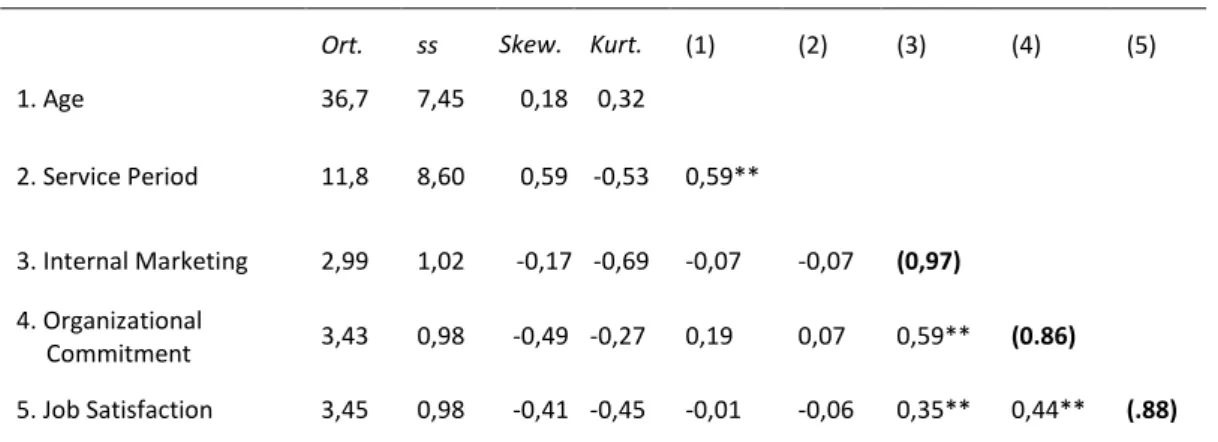
The descriptive statistics and the calculated Pearson correlation coefficients of the variables are shown in Table 5. Also, skewness and kurtosis values of each variable were examined to see if data have a normal distribution. Because skewness and kurtosis of each variable were between (-1 and +(-1) values, we accepted that data showed normal distribution (Tabachnick and Fidell, 20(-13).
Correlation analysis results showed no significant relationship between demographic variables and the research variables. Among the research variables, internal marketing was significantly related with organizational commitment (r =0,59, p <0,01) and job satisfaction (r =0,35, p <0,01). In addition, organizational commitment was found to be significantly related to job satisfaction (r =0,44, p <0,01).
Table 5: Variables’ Descriptive Statistics and Correlation Matrix
Ort. ss Skew. Kurt. (1) (2) (3) (4) (5)
1. Age 36,7 7,45 0,18 0,32 2. Service Period 11,8 8,60 0,59 -0,53 0,59** 3. Internal Marketing 2,99 1,02 -0,17 -0,69 -0,07 -0,07 (0,97) 4. Organizational Commitment 3,43 0,98 -0,49 -0,27 0,19 0,07 0,59** (0.86) 5. Job Satisfaction 3,45 0,98 -0,41 -0,45 -0,01 -0,06 0,35** 0,44** (.88)
*p < 0,05, **p < 0,01, n = 356, Skew.: Skewness, Kurt.: Kurtosis, Cronbach alfa reliability values are given in brackets.
Hierarchical regression analyzes were performed and the mediaton test was conducted based on the assumptions of Baron and Kenny (1986). In the first stage the effect of independent variable on mediating variable was examined. Secondly, the effect of independent variable on dependent variable was revealed. Finally, the regression analysis, which investigated the effect of independent and mediating variable together on dependent variable was conducted. Regression analysis results are submitted in Table 6. In all three stages, demographic factors were first included in the analysis and taken under control.
Table 6: Outcomes of Regression Analysis
*p < 0,05, **p < 0,01, B = Unstandardized regression coefficient.
Independent Variables
Dependent Variable
Job Satisfaction Orgazinational Commitment
Model 1 B Model 2 B Model 3 B Constant 2,88** 1.67** 0,90** Gender -0,22* 0.17 0,23** Age 0,073 0.27 0,01 Service Period 0,006 0,09* 0,09* Education -0,14* -0,16** - 0,12* Marital Status 0,144 - 0,39 - 0,08 Internal Marketing 0,33** 0,58** 0,49** Job Satisfaction - - 0,27** R2 0,15 0,39 0,45
The outcomes of the regression analysis pointed out that internal marketing had a significant effect on job satisfaction in the same direction (B = 0,33, p < 0,01). In addition, it was found that job satisfaction had a significant effect on organizational commitment in the same direction (B = 0,27, p <0,01). Additionally, it was seen that the internal marketing had a significant effect on organizational commitment (B = 0,58, p < 0,01). In this context, the H1, H2 and H3 hypotheses of the study was supported. In order to investigate the role of mediation, internal marketing and job satisfaction were entered into the analysis together it was determined that the effect of internal marketing on organizational commitment (B = 0,49, p <0,01) decreased, but the significant effect continued. These findings show that job satisfaction is a partial mediator between internal marketing and organizational commitment. Considering the non-standardized regression coefficients obtained above in order to say that job satisfaction (a.b = 0.33X0.27 = 0.09) has a partial mediating effect on the interaction of internal marketing and organizational commitment In traditional approach normally to test the significance of the mediating effect Sobel test results should be taken into consideration (Baron and Kenny, 1986: 1177). However, due to the many flaws of the Sobel test (Hayes, 2009: 411), we used the bootstrapping method to test the significance of the mediation results.
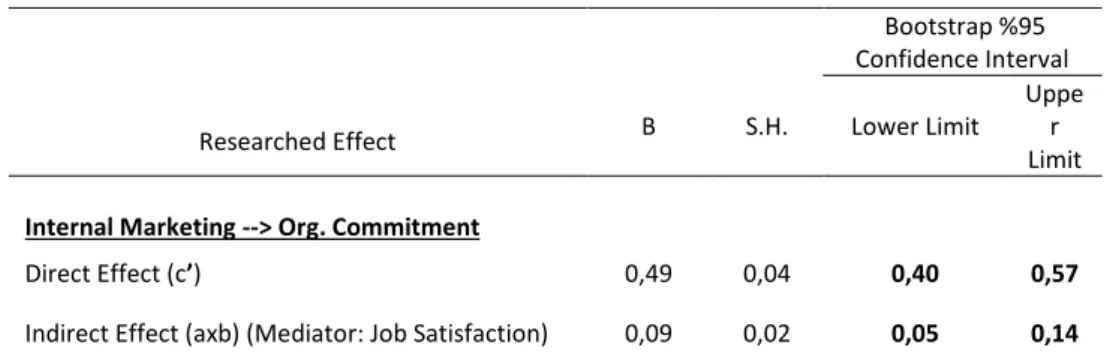
In line with modern approach the bootstrapping % 95 confidence interval method (Shrout and Bolger 2002; Preacher and Hayes, 2008) was applied by using the PROCESS 2.16 program (Hayes, 2013) to calculate the indirect effect and examine the significance of this indirect effect. The results are presented in Table 7.
Table 7: Mediating Analysis Results
Researched Effect
Bootstrap %95 Confidence Interval
B S.H. Lower Limit Upper
Limit
Internal Marketing --> Org. Commitment
Direct Effect (c’) 0,49 0,04 0,40 0,57
Indirect Effect (axb) (Mediator: Job Satisfaction) 0,09 0,02 0,05 0,14
B = Unstandardized Regression Coefficient, S.E.= Standart Error, a= Effect of predictor variable on mediating variable, b= Effect of the mediating variable on the dependent variable, c’= Effect of the predictor on dependent variable after mediating variable is included in the variable model.
Obtained values between lower and upper limits of the indirect effect are different from zero. This result indicates that the mediating effect is significant (Shrout and Bolger 2002). Also, in this method the indirect effect of job satisfaction was seen as 0.09 easily. In this context, H4 was supported due to the findings in both traditional and modern approaches.
5. Discussion and Concluding Remarks
Internal marketing aims to increase the quality of goods and services of the organization by acting their employees as a customer and raising their satisfaction and commitment. The aim of the concept is shortly giving the feeling to the employees that they are a valuable asset for the organization and that the organization is taking care of them. Like many researches this study’s findings show the importance of internal marketing and its effect on both job satisfaction and organizational commitment. Along this line the mediation role of job satisfaction in the relationship between internal marketing activities and organizational commitment of employees.
commited employees will increase consumer satisfaction especially in the service sectors. Satisfied and happy employees are more willing to execute their jobs and serve better to customers. Managers must identify the needs and expectations of employees to satisfy them. In the competition based business area the companies which can apply internal marketing as a company culture will be more successful than their rivals.
In this study, the mediating role of job satisfaction in the relationship of organizations’ internal marketing activities and organizational commitment was examined. Therefore to unveil the interaction between internal marketing and job satisfaction, internal marketing and organizational commitment, job satisfaction and organizational commitment a hierarchical regression analysis was executed. The findings showed that internal marketing has significant and positive effects on job satisfaction and organizational commitment in congruence with available literature (Tansuhaj et al., 1991; Conduit and Mavondo, 2001; Rafiq and Ahmed, 2000; Chang and Chang, 2007; Shiu and Yu, 2010; Iliopoulos and Priporas, 2011; Al-Hawary et al. ,2013; Chen et al., 2015). Also a positive effect of job satisfaction on organizational commitment was found in the line with available literature (Kök, 2006; Karataş and Güleş, 2010; Sharma and Bajpai, 2010). As a result of conducted mediation analyses based on traditional approach proposed by Baron and Kenny (1986) and modern approach proposed by Shrout and Bolger (2002), Preacher and Hayes (2008) and Hayes (2013) it was found that internal marketing affects the organizational commitment of the employees in the same way and employees' job satisfaction have a partial mediation role in this effect. These findings verified Demir et al. (2008:143) prediction and Ting’s (2011) and Yıldız’s (2011) findings.
Although the mediation relationship between these three variables has been examined by Demir et al. (2008:143), Ting’s (2011) and Yıldız’s (2011), our study is methodically separated from these three studies. Our study was carried out using the modern approach, based on the opinions of the Fritz and MacKinnon (2007); Hayes and Rockwood (2017) who suggested that the Baron and Kenny’s method was not a powerful method for mediation tests and recommended the bootstrapping technique which is providing faster, valid and reliable results. Gürbüz and Bayık (2018: 31) stated that a limited number of mediation analyzes in Turkey were executed through the modern method. In this context, it is thought that our study will provide an important contribution in terms of eliminating this lack of application. In addition, it is considered that our study will make a significant contribution to the literature due to the limited number of studies, both in Turkey and abroad, which include all three variables.
It is evaluated that for the future researches examining the mediating role of employees’ cognitive and emotional processes in the relationship of internal marketing activities, job and organizational performance of employees can contribute to the literature.
Undoubtedly, this research has some limitations. First, the generalizability of the findings is limited with our sampling features because of the used sampling method. The second limitation is in the explanation of causal relations because of the used cross-sectional research method. Thirdly, the scales used in the study consist of evaluation questions for the employees, working in any workplace and are based on the perception of the participants in this research. Therefore, by evaluating the results, it should be taken into consideration that social desirability and common method variance can be available.
References
Abzari, M., Ghorbanı, H. and Madani, F. A. (2011). The Effect of Internal Marketing on Organizational Commitment From Market-orientation Viewpoint in Hotel Industry in Iran. International Journal of Marketing Studies, 3(1), 147.
Ahmed, P. K., Rafıq, M. and Saad, N. M. (2003). Internal Marketing and The Mediating Role of Organisational Competencies. European Journal of Marketing, 37(9), 1221-1241.
Al-Hawary, S. I. S., Al-Qudah, K. A., Abutayeh, P. M., Abutayeh, S. M. and Al-Zyadat, D. Y. (2013). The Impact of Internal Marketing on Employee’s Job Satisfaction of Commercial Banks in Jordan. Interdisciplinary Journal of Contemporary Research in Business, 4(9), 811-826. Allen, N. J. and Meyer, J. P. (1990). The Measurement and Antecedents of Affective, Continuance
and Normative Commitment To The Organization. Journal of Occupational Psychology, 63(1), 1-18.
Armstrong, M. (2006). A Handbook of Human Resource Management Practice. Tenth Edition, Kogan Page Publishing, London.
Aziri, B. (2011). Job Satisfaction: A Literature Review. Management Research and Practice, 3(4), 77-87.
Bakotić, D. (2016). Relationship Between Job Satisfaction and Organisational Performance. Economic Research- Ekonomska Istraživanja, 29: 1, 118-130.
Baron R. M. and Kenny, D. A. (1986). The Moderator-mediator Variable Distinction in Social Psychological Research: Conceptual, Strategic and Statistical Considerations. Journal of Personality and Social Psychology, 51, 6, 1173-1182.
Basım, N. and Şeşen, H. (2009). The Mediating Role of Job Satisfaction in The Relationship Between Organizational Justice Perception and Organizational Citizenship Behavior. 17th Management and Organization Congress Proceedings Book, Eskişehir, 21-23 May 2009. Başaran, Ü., Büyükyılmaz, O. and Çevık, E. D. (2011). The Mediating Effect of Job Satisfaction on
The Relationship Between Internal Marketing and Perceived Service Quality. Journal of Business Administration, 12, 2, 201-225.
Berry, L. L. and Parasuraman, A. (1992). Services Marketing Starts From Within. Marketing Management, 1(1), 24-34.
Berry, L. L. (1981). The Employee As Customer. Journal of Retail Banking, 3(1), 33-40.
Bluedorn, A. C. (1982). The Theories of Turnover: Causes, Effects and Meaning. Research in The Sociology of Organizations, 1(1), 75-128.
Canan, H. O. Ş. and Oksay, A. (2015). Hemşirelerde Örgütsel Bağlılık İle İş Tatmini İlişkisi. Süleyman Demirel Üniversitesi İktisadi ve İdari Bilimler Fakültesi Dergisi, 20(4), 1-24.
Candan, B. and Çekmecelioğlu, H. G. (2009). İçsel Pazarlama Faaliyetlerinin Örgütsel Bağlılık Unsurları Açısından Değerlendirilmesi: Bir Araştırma. Yönetim, 20(63), 41-58.
Caruana, A., and Calleya, P. (1998). The Effect of Internal Marketing on Organisational Commitment Among Retail Bank Managers. International Journal of Bank Marketing, 16(3), 108-116. Chang, C. S. and Chang, H. H. (2007). Effects of Internal Marketing on Nurse Job Satisfaction and
Organizational Commitment: Example of Medical Centers in Southern Taiwan. The Journal of Nursing Research: Jnr, 15(4), 265-274.
Chen, S. Y., Wu, W. C., Chang, C. S., and Lın, C. T. (2015). Job Rotation and Internal Marketing For Increased Job Satisfaction and Organisational Commitment in Hospital Nursing Staff. Journal of Nursing Management, 23(3), 297-306.
Collins, B. and Payne, A. (1991). Internal Marketing: A New Perspective For HRM. European Management Journal, 9(3), 261-270.
Conduit, J. and Mavondo, F. T. (2001). How Critical is Internal Customer Orientation To Market Orientation? Journal of Business Research, 51(1), 11-24.
Currivan, D. B. (1999). The Causal Order of Job Satisfaction and Organizational Commitment in Models of Employee Turnover. Human Resource Management Review, 9(4), 495-524. Demir, H., Resul, U. and Tarhan, O. (2008). İçsel Pazarlamanın Örgütsel Bağlılık ve İş Tatminine
Etkisi. Hacettepe Üniversitesi İktisadi ve İdari Bilimler Fakültesi Dergisi, 26(2), 135-161. Ergeneli, A. and Eryiğit, M. (2001). Öğretim Elemanlarının İş Tatmini: Ankara’da Devlet ve Özel
Üniversite Karşılaştırması. Hacettepe Üniversitesi İktisadi ve İdari Bilimler Fakültesi Dergisi, 19(2), 159-178.
Ergün, G. S., and Boz, H. (2017). İşletmelerin İçsel Pazarlama Uygulamaları ve İşgörenlerin İş Tatmini İlişkisi: Konaklama İşletmelerinde Bir Araştırma. Pazarlama İçgörüsü Üzerine Çalışmalar, 1(1-2), 1-12.
Foreman S. K. and Money A. H. (1995). Internal Marketing: Concepts, Measurement and Application, Journal of Marketing Management, 11, 755—768.
Fornell, C. ve Larcker, D.F. (1981). Evaluating Structural Equation Models with Unobservable Variables and Measurement Error. Journal of Marketing Research, 18(1) 39-50.
Fritz, M. S., & MacKinnon, D. P. (2007). Required sample size to detect the mediated effect. Psychological Science, 18, 233-239.
Graham, G.H. (1982). Understanding Human Relations. The Individual, Organisations, and Management. Science Research Associates, Chicago Inc.
Greene, W. E., Walls, G. D. and Schrest, L. J. (1994). Internal Marketing: The Key To External Marketing Success. Journal of Services Marketing, 8(4), 5-13.
Gürbüz, S. and Bayık, M. E. (2018). Aracılık Modellerinin Analizinde Modern Yaklaşım: Baron ve Kenny Yöntemi Artık Terk edilmeli mi? 6. Örgütsel Davranış Kongresi Bildiriler Kitabı, 2-3 Kasım 2018/Isparta.
Hackman, R. and Oldham, G. R. (1975). Development of The Job Diagnostic Survey. Journal of Applied Psychology, 60, 2, 1975, 159-170.
Hair, J.F., Sarstedt, M. Ringle, C.M. and Mena, J.A. (2012). An Assessment of the Use of Partial Least squares Structural Equation Modeling in Marketing Research. Journal of the Academy Marketing Sciences, 40(3) 414-433.
Hair Joseph F, Jr., Hult G. Tomas M., Christian M. Ringle and Sarstedt Marko (2017). A Primer on Partial Least Squares Structural Equation Modeling (PLS-SEM). Second Edition, SAGE Publications.
Hayes, A. F. (2009). Beyond Baron and Kenny: Statistical Mediation Analysis in The New Millennium. Communication Monographs, 76, 4, 408-420.
Hayes, A. F. (2013). Introduction To Mediation, Moderation and Conditional Process Analysis: A Regression-based Perspective. New York, Ny: The Guilford Press.
Hayes, A. F., & Rockwood, N. J. (2017). Regression-based statistical mediation and moderation analysis in clinical research: Observations, recommendations, and implementation. Behaviour Research and Therapy, 98, 39-57.
Herzberg, F., Mausner, B. and Snyderman, B. (1959). The Motivation To Work (Vol.1), Transaction Publisher.
Hoopock, R. (1935). Job Satisfaction. Harper and Row, New York.
Hoş, C. and Oksay, A. (2015). Hemşirelerde Örgütsel Bağlılık ile İş Tatmini İlişkisi. Süleyman Demirel University Journal of Faculty of Economics and Administrative Sciences, 20(4).
Iliopoulos, E. and Priporas, C. V. (2011). The Effect of Internal Marketing on Job Satisfaction in Health Services: A Pilot Study in Public Hospitals in Northern Greece. BMC Health Services Research, 11(1), 261.
İşler, D. B. and Özdemir, Ş. (2010). Hastane İşletmelerinde İçsel Pazarlama Yaklaşımının İş Tatmini ve Örgütsel Bağlılık Üzerine Etkisi: Isparta İli Örneği. Hacettepe Sağlık İdaresi Dergisi, 13(2), 115-142.
Jaworski, B. J. and Kohli, A. K. Market Orientation: Antecedents and Consequences. Journal of Marketing, 57, July, 1993, 53-70.
Karataş, S. and Güleş, H. (2010). İlköğretim Okulu Öğretmenlerinin İş Tatmini ile Örgütsel Bağlılığı Arasındaki İlişki. Uşak Üniversitesi Sosyal Bilimler Dergisi, 2010 (6).
Kaur, R. (2012). The Role of Factors on Job Satisfaction of Employees. An Empirical Study. IOSR Journal of Business and Management, 2, 4, 49-52.
Kocaman, S., Durna, U., & İnal, M. E. (2013). Konaklama İşletmelerinde İçsel Pazarlama Uygulamalarının Örgütsel Bağlılığa Etkisi: Alanya Örneği. Journal of Alanya Faculty of Business/Alanya Isletme Fakültesi Dergisi, 5(1).
Kotler, P. (2002). Marketing Management (Millenium Edition). Pearson Custom.
Kök, S. B. (2006). İş Tatmini ve Örgütsel Bağlılığın İncelenmesine Yönelik Bir Araştırma. Atatürk Üniversitesi İktisadi ve İdari Bilimler Dergisi, 20(1), 291-317.
Kurşunoğlu Yarımoğlu, E. and Ersönmez, N. (2017). İçsel Pazarlama Faaliyetlerinin İş Tatmini ve Örgütsel Bağlılık Üzerindeki Doğrudan Etkisi: Bir Kamu Bankası Örneği. Doğuş Üniversitesi Dergisi, 18, 79-98.
Mathieu, J. E. (1991). A Cross-level Nonrecursive Model of The Antecedents of Organizational Commitment and Satisfaction. Journal of Applied Psychology, 76(5), 607.
Meyer, J. P. and Allen, N. J. (1991). A Three-component Conceptualization of Organizational Commitment. Human Resource Management Review, 1(1), 61-89.
Naumann, E. (1993). Antecedents and Consequences of Satisfaction and Commitment Among Expatriate Managers. Group and Organization Management, 18(2), 153-187.
Porter, L. W. (1962). Job Attitudes in Management: Perceived Deficiencies in Need Fulfillment As A Function of Job Level. Journal of Applied Psychology, 46(6), 375.
Porter, L. W., Steers, R. M., Mowday, R. T. and Boulian, P. V. (1974). Organizational Commitment, Job Satisfaction and Turnover Among Psychiatric Technicians. Journal of Applied Psychology, 59 (5), 603.
Poyraz, K. and Kama, U. B. (2008). Algılanan İş Güvencesinin, İş Tatmini, Örgütsel Bağlılık ve İşten Ayrılma Niyeti Üzerindeki Etkilerinin İncelenmesi. Süleyman Demirel Üniversitesi İktisadi ve İdari Bilimler Fakültesi Dergisi, 13(2), 143-164.
Preacher, K. J. and Hayes, A. F. (2008). Asymptotic and Resampling Strategies For Assessing and Comparing Indirect Effects in Multiple Mediator Models, Behavior Research Methods, 40, 879-91.
Qayum, M. N. and Sahaf, M. A. (2013). Internal Marketing: A Pre-requisite For Employee Satisfaction in Universities. International Journal of Business and Management Invention, 2(5), 50-55.
Rafıq, M. and Ahmed, P. K. (2000). Advances in The internal Marketing Concept: Definition, Synthesis and Extension. Journal of Services Marketing, 14(6), 449-462.
Robbins, S. P. and Judge, A. T. (2013). Organizational Behavior. Pearson Education Limited. Rue, L.W. and Byars, L. (2003). Management, Skills and Application, 10 Ed., Mcgraw-Hill/Irwin, New
York, P. 259.
Sasser, W. E. and Arbeit, S. P. (1976). Selling Jobs in The Service Sector. Business Horizons, 19(3), 61-65.
Sharma, J. P. and Bajpai, N. (2010). Organizational Commitment and Its Impact on Job Satisfaction of Employees: A Comparative Study in Public and Private Sector in India. International Bulletin of Business Administration, 9(1), 7-19.
Shiu, Y. M. and Yu, T. W. (2010). Internal Marketing, Organisational Culture, Job Satisfaction and Organisational Performance in Non-life Insurance. The Service Industries Journal, 30(6), 793-809.
Shrout, P. E. and Bolger, N. (2002). Mediation in Experimental and Nonexperimental Studies: New Procedures and Recommendations. Psychological Methods, 7, 422-45.
Spector, P. E. (1997). Job Satisfaction: Application, Assessment, Causes and Consequences (Vol. 3). Sage Publications.
Şeşen, H. (2010). Antecedents and Consequences of Intrapreneurship: A Study on Turkish Defence Industry. Turkish Military Academy Defense Science Institute, Department of Defence Management, Ph.D. Dissertation, Ankara.
Tabachnick, B. G. and Fidell, L. S. (2013). Using Multivariate Statistics (Sixth Edition). United States: Pearson Education.
Tansuhaj, P., Randall, D. and Mccullough, J. (1991). Applying The Internal Marketing Concept Within Large Organizations: As Applied To A Credit Union. Journal of Professional Services Marketing, 6(2), 193-202.
Ting Shueh-Chin (2011). The Effect of Internal Marketing on Organizational Commitment: Job Involvement and Job Satisfaction As Mediators. Educational Administration Quarterly, 47(2) 353–382.
Tsai, Y., and Wu, S. W. (2011). Using Internal Marketing to Improve Organizational Commitment and Service Quality. Journal of Advanced Nursing, 67(12), 2593-2604.
Whyte, W. (1956). The Organization Man. Garden City, Ny: Doubledy Anchor.
Williams, L. J. and Hazer, J. T. (1986). Antecedents and Consequences of Satisfaction and Commitment in Turnover Models: A Reanalysis Using Latent Variable Structural Equation Methods. Journal of Applied Psychology, 71(2), 219.
Wolf, M. G. (1970). Nedd Gratification Theory: A Theoretical Reformulation of Job Satisfaction/Dissatisfaction and Job Motivation. Journal of Applied Psychology, 54(1p1), 87.
Yıldız, S. M. (2011). İçsel Pazarlama, İş Tatmini ve Örgütsel Bağlılık İlişkisi: Spor Okullarında Görev Yapan Antrenörler Üzerine Bir İnceleme. Selçuk Üniversitesi Beden Eğitimi ve Spor Bilim Dergisi, 13(2), 216-225.
Yıldız, S. (2014a). Örgütsel Adaletin Örgütsel Vatandaşlık Davranışına Etkisinde İş Tatmininin Aracı Rolü. Ege Akademik Bakış Dergisi, 14(2), 199-210.
Yıldız, S. M. (2014b). İçsel Pazarlamanın İş Tatmini ve İşten Ayrılma Niyeti Üzerindeki Rolü: Spor ve Fiziksel Etkinlik İşletmeleri Üzerine Ampirik Bir İnceleme. Ege Akademik Bakış Dergisi, 14(1), 137-146.
Zait, A. and Bertea, P. E. (2011) Methods for Testing Discriminant Validity. Management & Marketing, 9, 2, 217-224.