SAKARYA UNIVERSITY JOURNAL OF SCIENCE e-ISSN: 2147-835X http://www.saujs.sakarya.edu.tr Received 19-07-2018 Accepted 05-09-2018 Doi 10.16984/saufenbilder.443551
A Sequence Bounded Above by the Lucas Numbers
Engin Özkan1 Ali Aydoğdu*2 Aykut Göçer1
Abstract
In this work, we consider the sequence whose term is the number of ℎ-vectors of length . The set of integer vectors ( ) is introduced. For ≥ 2, the cardinality of ( ) is the Lucas number is showed. The relation between the set of ℎ-vectors ( ) and the set of integer vectors ( ) is given. Keywords: Cardinality, ℎ-vectors, Hilbert function, Lucas numbers
1. Introduction
Firstly, we give the well-known definitions of the Fibonacci and Lucas numbers. The Fibonacci numbers are the terms of the sequence 1,1,2,3,5,8,13,21,34,55,89,… . Every Fibonacci number, except the first two, is the sum of the two previous Fibonacci numbers. The numbers satisfy the second order linear recurrence relation.
= + , = 2,3,4, (1)
with initial values = 0, = 1. The Lucas numbers are defined
= + , = 2,3,4, … (2)
with initial conditions = 2, = 1. The first a
few Lucas numbers are
2,1,3,4,7,11,18,29,47,76,… .
Hilbert functions of graded rings are more convenient for many applications and are known to relate to many different subjects such as dimensions, multiplicity and Betti numbers (see: Bruns and Herzog, [1]). In [2], Enkoskoy and Stone introduced recursion formulas related to Hilbert functions. They showed the term of
1 Erzincan Binali Yıldırım University, Faculty of Arts and Sciences, Department of Mathematics, Erzincan, Turkey.
* Corresponding Author
2 Beykent University, Faculty of Arts and Sciences, Department of Mathematics, İstanbul, Turkey.
sequence, whose term is the number of ℎ-vectors of length , is bounded above by the Fibonacci number. Ozkan et al. [4] introduced the cardinality of the M-sequence of length is bounded above by the Lucas number.
The aim of this paper is to show the sequence defined by the number of ℎ-vectors of length is bounded above by the sequence of Lucas numbers. This paper is organized as follows. In Section 2 we give some concepts of ℎ-vectors. Section 3 presents main results of this paper.
2. Materials and Methods
We first give some necessary background on Hilbert functions and ℎ −vectors.
Let = [ , , … ] be a polynomial ring over a field with the standard grading. In particular, = 1 for 1 ≤ ≤ . If is a graded ideal, the quotient ring is also graded and we denote by ( ) the vector space of all degree homogeneous elements of . The Hilbert function : ℤ → ℤ is defined to be the vector space dimension of each graded
1853
"Engin Özkan, Ali Aydoğdu, Aykut GöçerA sequence bounded above by the lucas numbers…"
component, i.e. ( ) ≔ . If the Krull dimension of the graded quotient ring is zero, there exists an ≥ 0 such that ( ) ≠ 0 but ( ) = 0 for all > . In this case the ℎ-vector of is defined as
ℎ =
(0), (1), (2), … , ( ) (3) Thus the ℎ-vector of has finitely many non-zero entries. The length of is the vector space dimension of , denoted . In particular = ∑ ( ). Throughout this paper we will refer to as the length of ℎ .
The sequence { ( )} is defined by the number of ℎ-vectors of length . In particular, for ≥ 1 we define
( ) = {ℎ = (ℎ , ℎ , … ) | ℎ ℎ −
∑ ℎ = } (4) and set ( )= | ( )|.
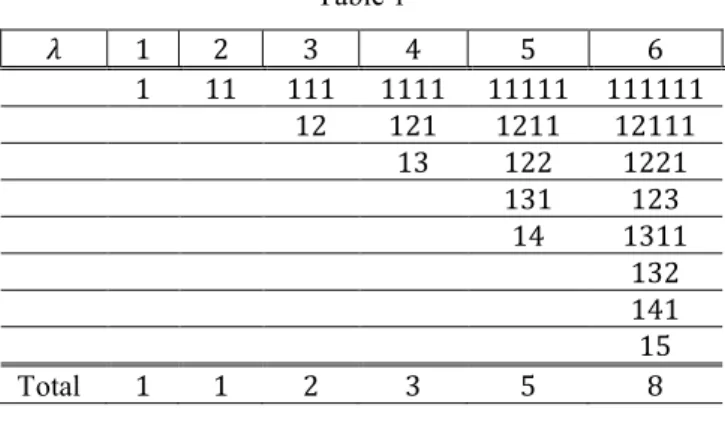
Using Macaulay’s Theorem, the authors of [2] constructed the ℎ-vectors of length at most 7. The ℎ-vectors of length at most 6 is given in Table 1. We write … for the ℎ-vector ( , , … , ).
Table 1 1 2 3 4 5 6 1 11 111 1111 11111 111111 12 121 1211 12111 13 122 1221 131 123 14 1311 132 141 15 Total 1 1 2 3 5 8
Definition 2.1. [3] For ≥ 1, the set of integer vectors ( ) is defined recursively as follows:
1. (1) = {(1)}, 2. (2) = {(1,1)}, 3. For ≥ 3 define ( ) ∶= ( ) ∪ ( ) where ( ) ∶= {(1, , . . . , , 1) | (1, , . . . , ) ∈ ( − 1)} ( ) ≔ {(1, , … + 1)|(1, , … , ) ∈ ( − 1), ℎ − 1 > 1 = 1}. Theorem 2.2. [3] The cardinality of ( ) is the
Fibonacci number .
Theorem 2.3. [2] For all ≥ 1, ( ) ⊆ ( ). In particular the sequence of the cardinality of ( ) is bounded above by the Fibonacci sequence.
Definition 2.4. For ≥ 1, the set of integer vectors ( ) is defined recursively as follows:
1. (1) = {(1)}, 2. (2) = {(1,1,1), (1), (1,2)}, 3. For ≥ 3 define ( ) ∶= ( ) ∪ ( ) where ( ) ∶= {(1, , . . . , , 1) | (1, , . . . , ) ∈ ( − 1)}, ( ): = {(1, , … , + 1)|(1, , … , ) ∈ ( − 1), with > 1 or = 1}. We set ( )= | ( )|.
Remark 2.5. It is worth noticing that the sets ( ) and ( ) of Definition 2.4 form a set partition of
( ).
The first few sets ( ) are (1) = {(1)}, (2) = {(1,1,1), (1), (1,2)}, (3) = {(1,1,1,1), (1,1), (1,2,1), (1,3)}, (4) = {(1,1,1,1,1), (1,1,1), (1,2,1,1), (1,2,2), (1,3,1), (1,2), (1,4)}, (5) = {(1,1,1,1,1,1), (1,1,1,1), (1,2,1,1,1), (1,2,2,1), (1,3,1,1), (1,2,1), (1,4,1) (1,2,3), (1,3,2), (1,3), (1,5)}.
In Table 2, the integer vectors of length at most 6 and cardinality of integer sets is given. We write
… for the ℎ-vector ( , , … , ).
1854 Sakarya University Journal of Science, 22 (6), 1853-1856, 2018.
"Engin Özkan, Ali Aydoğdu, Aykut GöçerA sequence bounded above by the lucas numbers…" Table 2 1 2 3 4 5 6 1 111 1 12 1111 11 121 13 11111 111 1211 122 12 14 111111 1111 12111 1221 1311 121 141 123 132 13 15 1111111 11111 121111 12211 1231 1321 1411 1211 131 151 1222 124 133 142 122 14 16 Total 1 3 4 7 11 18 3. Main Results
Theorem 3.1. The ( ) is the Lucas number , for ≥ 2.
Proof. We shall prove by induction that, for all ≥ 1. When = 1, the claim is true, since (1) = = 1. Since (2) = = 3, the claim is true for = 2.
Suppose the claim is true for all = , that is ( ) = . Then
( ) + ( − 1) = + = . (5) Thus the claim holds for = + 1, that is
( + 1) = | ( + 1)| = .
Theorem 3.2. For all ≥ 2, ( + 1) ⊆ ( ). In particular, the sequence ( + 1) is bounded from above by the Lucas sequence.
Proof. Note that ( ) is the set of all integer vectors (1, , . . . , ) with 1 + + + ⋯ + =
+ 1 and the property that if = 1 then = 1 for all ≥ . We will prove this by induction for all ≥ 2. For = 2 , the claim is true, since
(3) ⊆ (2):
(3) = {(1,1,1), (1,2)} and (2) = {(1,1,1), (1), (1,2)}.
When = 3, the claim is true, since (4) ⊆ (3): (4) = {(1,1,1,1), (1,2,1), (1,3)} and (3) = {(1,1,1,1), (1,1), (1,2,1), (1,3)}.
Suppose ( + 1) ⊆ ( ), for = . We have to show that the claim is true for = + 1, that is,
( + 2) ⊆ ( + 1).
Denote the number of element of a set by ( ). Then
( ) ⊆ ( − 1) ⇒ ( ) ≤ ( − 1) , ( + 1) ⊆ ( ) ⇒ ( + 1) ≤ ( ) , Since ( ) ∩ ( + 1) = ∅, this also gives ( ) ∪ ( + 1) = ( ) + ( + 1) . Since ( )⊆ ( − 1) and ( + 1) ⊆ ( ), we set
( ) ∪ ( + 1) ⊆ ( − 1) ∪ ( ). (7) Similarly, since ( − 1) ∩ ( ) = ∅, we get
( − 1) ∪ ( ) = ( − 1) + ( ) . We then get from (7)
( ) + ( + 1) ≤ ( − 1) + ( ) . (8) Hence ( ) + ( + 1) = ( + 2) , ( − 1) + ( ) = ( + 1) . We know ( + 2) ≤ ( + 1) . Hence ( + 2) ⊆ ( + 1).
Theorem 3.3. For all ≥ 2, we have the relation ( ) ∖ ( + 1) = ( − 1).
Proof. We will prove this by induction for all ≥ 2. When = 2 , the claim is true, since (2) ∖ (3) = (1). For = 3 , the claim is true, since
1855 Sakarya University Journal of Science, 22 (6), 1853-1856, 2018.
"Engin Özkan, Ali Aydoğdu, Aykut GöçerA sequence bounded above by the lucas numbers…"
(3) ∖ (4) = (2). Suppose that the claim is true for = , that is ( ) ∖ ( + 1) = ( − 1).
We have to show that the claim is true for = + 1, that is, ( + 1) ∖ ( + 2) = ( ).
The identity ( )∖ ( + 1) = ( − 1) implies ( ) = ( − 1) ∪ ( + 1). From the last equality, it can be easily seen that
( + 1) ∖ ( + 2) = ( ). (9) Example 3.4. (4)\ (5) = {(1,1,1,1,1), (1,1,1), (1,2,1,1), (1,2,2), (1,3,1), (1,2), (1,4)}\{(1,1,1,1,1), (1,2,1,1), (1,2,2), (1,3,1), (1,4)} = {(1,1,1), (1,2)} = (3)
Corollary 3.5. For all ≥ 2, we have | ( )| − | ( + 1)| = | ( − 1)|.
References
[1] W. Bruns and J. Herzog, “Cohen-Macaulay Rings, in: Cambridge Studies in Advanced Mathematics, vol 39,” Cambridge University Press, Cambridge, 1993.
[2] T. Enkosky and B. Stone, “Sequence defined by h-vectors,” Eprint arXiv:1308.4945. [3] T. Enkosky, B. Stone, “A sequence defined
by M-sequences,” Discrete Mathematics, vol. 333, pp. 35-38, 2014.
[4] E. Ozkan, A. Geçer and İ. Altun, “A new sequence realizing Lucas numbers and the Lucas Bound,” Electronic Journal of Mathematical Analysis and Applications, vol. 5, no. 1, 148-154, 2017.
1856 Sakarya University Journal of Science, 22 (6), 1853-1856, 2018.