The Laryngoscope
VC 2015 The American Laryngological,
Rhinological and Otological Society, Inc.
Auditory Brainstem Implant in Postlingual Postmeningitic Patients
Yildirim Bayazit, MD; Julie Kosaner, M.Ed (Aud); Fatih Celenk, MD; Mehmet Somdas, MD;
Ismail Yilmaz, MD; Gokhan Altin, MD; Rasit Cevizci, MD; Haluk Yavuz, MD; Levent Ozluoglu, MD
Objectives/Hypothesis: The aim of this study was to evaluate outcomes of postlingual postmeningitic patients who received an auditory brainstem implant (ABI).
Study Design: Retrospective analysis was performed on postlingual postmeningitic patients with bilateral profound sen-sorineural hearing loss who underwent ABI between the years 2007 and 2014
Methods: All patients were postlingually deaf due to cochlear ossification as a consequence of bacterial meningitis. The patients received a MED-EL or Neurelec ABI. All patients were operated on at different hospitals by the same primary sur-geon. The patients were tested using Ling 5 sound detection, sound field implant thresholds between 250 Hz and 6 kHz, and 6 to 12 choice closed-set word and sentence tests.
Results: Nine patients with postmeningitic cochlear ossification received an ABI. Five of nine ABI users (55.5%) wear their audio processors (AP) most of the time. Four (44.5%) with no perceivable benefit have become nonusers. Three of the five consistent ABI users reported good benefit. The other two ABI users who do wear their APs do not respond to sound in daily living but reported benefits such as “feeling sound” in a good way.
Conclusions: In this study, five of nine patients (55.5%) with bilateral ossified cochlea had some degree of benefit from their ABI. An ABI may be useful in hearing restoration in postlingual patients with bilateral ossified cochlea due to meningi-tis. However, poor results may be related to side effects, which may necessitate deactivation of electrodes, long duration of auditory deprivation, or impairments in the auditory neural structures as a result of meningitis.
Key Words: Auditory brainstem implant, meningitis, cochlear ossification. Level of Evidence: 4.
Laryngoscope, 126:1889–1892, 2016
INTRODUCTION
Bacterial meningitis is one of the main reasons of cochlear ossification that result in profound hearing loss. In some patients, cochlear ossification does not involve the entire cochlea, and cochlear implantation may provide
adequate auditory rehabilitation in such cases.1However,
the reported results of cochlear implantation are not sat-isfactory in severe cochlear ossification, although many techniques have been proposed to deal with this
prob-lem.2,3 The poor results of cochlear implants in patients
with severe cochlear ossification have been attributed to
peripheral nerve degeneration,4unstable insertion of
elec-trodes, insufficient contact of electrodes to the spiral
gan-glion, and decreased number of viable auditory
neurons.5–9 Accordingly, it is difficult and sometimes
impossible to perform cochlear implantation in patients with severe cochlear ossification. An auditory brainstem implant (ABI) can provide auditory rehabilitation in
sit-uations where cochlear implantation is not possible.7
The aim of this study was to evaluate outcomes of postlingual postmeningitic patients who received an ABI.
MATERIALS AND METHODS
This retrospective study included patients with bilateral profound sensorineural hearing loss who underwent auditory brainstem implantation between the years 2007 and 2014. All patients were postlingually deaf due to cochlear ossification as a consequence of bacterial meningitis. All patients were oper-ated on at different hospitals by the same primary surgeon.
The ABI surgeries were performed via a retrosigmoid approach. During the surgery a 3 3 3-cm craniotomy was made in the retrosigmoid area. The cerebellum was retracted after releasing the cerebrospinal fluid in the cisterna magna. The arachnoid and its adhesions were dissected. The foramen Luschka was identified between the root of the ninth cranial nerve and choroid plexus after dura incision and cerebellum retraction. The ABI electrode was placed on the cochlear nucleus in the foramen Luschka.
All MED-EL users were fitted and followed up by the same audiologist. The Neurelec user was fitted and followed up by a different audiologist. Initial switch-on was performed with the ABI user awake but under cardiac monitoring in the operat-ing room. At initial stimulation, after establishoperat-ing that the charge level used to measure impedance field telemetry (IFT) was not causing the ABI user any discomfort, telemetry
From the Department of Otorhinolaryngology (Y.B.G.A.,R.C.), Medi-pol University Faculty of Medicine, Istanbul, Turkey; MEDers Speech and Hearing (J.K.), Istanbul, Turkey; Department of Otorhinolaryngology (F.C.), Faculty of Medicine, Gaziantep University, Gaziantep, Turkey; Department of Otorhinolaryngology (M.S.), Faculty of Medicine, Erciyes University, Kayseri, Turkey; Department of Otorhinolaryngology (I.Y.,
H.Y.), Faculty of Medicine, Baskent University, Adana, Turkey; Depart-ment of Otorhinolaryngology (L.O.), Faculty of Medicine, Baskent Univer-sity, Ankara, Turkey
Editor’s Note: This Manuscript was accepted for publication September 17, 2015.
The authors have no funding, financial relationships, or conflicts of interest to disclose.
Send correspondence to Fatih Celenk, MD, Associate Professor, Department of Otorhinolaryngology, Gaziantep University Faculty of Medicine, Gaziantep, Turkey. E-mail: [email protected]
DOI: 10.1002/lary.25731
Laryngoscope 126: August 2016 Bayazit et al.: Auditory Brainstem Implant
measures were made and evaluated. At switch-on and follow-up fits, threshold (THR) levels were measured on all active electro-des. If users had hearing as opposed to a side effect, such as leg tingling or constriction in the throat, then stimulation was slowly increased above the THR level until the user reported the sound to be loud or until they reported that a side effect had started and was causing them discomfort. Any electrodes resulting in some hearing with some dynamic range (charge dif-ference between THR and maximum comfort level [MCL]) and no side effect were left activated. Electrodes where stimulation did not result in hearing but only side effects were deactivated. Once a program was configured and switched on (live mode), MCLs were globally increased until the user reported that sound was too loud or a side effect had started. Each ABI user’s latest audio processor (AP) program was analyzed, with the sta-tus of electrodes as defined by IFT; mean charge levels, number of active electrodes, and most prevalent side effects were recorded.
Latest reports obtained from each ABI user were ana-lyzed. AP wearing habits and the ABI users’ perceived benefit from their ABIs were recorded. Performance of ABI users with their latest AP program was checked. ABI users with no hear-ing could not be tested. Tests included: Lhear-ing 5 sound (/a/, /ee/, / u/, /sh/, and /s/) detection, sounds were presented with “live” voice at quiet conversational level, sound field implant THRs between 250 Hz and 6KHz (conducted in a sound-proofed cabin), and six to 12 choice closed-set word and sentence tests. The closed-set word tests used were the mono, trochee, polysyl-labic test and the bisylpolysyl-labic word test from the MED-EL EARS test battery adapted into the Turkish language. Sentences used for closed-set testing were chosen together with the ABI user, written down, and practiced with auditory and visual cues, before sentence recognition was tested using live voice and auditory cues only.
RESULTS
Nine patients with postmeningitic cochlear ossifica-tion received an ABI. The mean age at implantaossifica-tion of ABI users was 34.4 years, ranging from 17 to 47 years. There were seven (77.7%) male and two (22.3%) female patients. All ABI users had bilateral ossified cochleae as a sequelae of bacterial meningitis. In six patients a coch-lear implantation was attempted but no implantation was made because of total ossification of the cochlea. In the
remaining patients no prior cochlear implantation was attempted because a complete ossification of the cochlea was confirmed by computed tomography and magnetic resonance imaging. The mean duration of sound depriva-tion was 11.3 years, ranging from 18 months to 29 years.
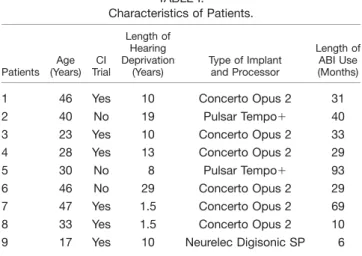
Eight patients received a MED-EL and one patient received a Neurelec ABI. Seven patients (77.7%) were implanted on the right side and two patients (22.3%) were implanted on the left side. The mean duration of ABI use for eight users was 30.8 months (range, 6–69 months). One ABI user has been using his ABI for nearly eight years. Of 8 MED-EL ABI users, six had a CONCERTO ABI and an OPUS 2 AP and two had a PULSAR ABI and used a TEMPO1 AP. The Neurelec user had a Digisonic SP ABI. Characteristics of patients are summarized in Table I.
Latest IFT measures for MED-EL ABI users were normal with impedances ranging from 2.00 to 9.56 KX. No electrodes had high impedances or short circuits. All ground path impedance values were normal, ranging from 0.37 to 1.22 KX. The mean MCL charge level for all eight MED-EL ABI users was 147 qu but for the three better performers was 78 qu. The average number of active electrodes was 4.25 for all eight MED-EL ABI users, but 6.3 for the three better performers. Most fre-quently activated electrodes were electrode (E) 5 and E7, followed by E4 and E10, the least frequently activated electrodes were E6 and E8. The most commonly seen side effects were constriction to throat and leg tingling.
Five of nine ABI users (55.5%) wear their APs most of the time. Three of the five consistent ABI users reported good benefit, and this is reflected in their per-formance. The other two ABI users who did wear their APs did not respond to sound in daily living but reported benefits such as “feeling sound” in a good way and relief from headache. Three ABI users who clearly benefit from their ABIs had sound field THRs varying from 25 to 50 dB HL. Sound field THRs were also measurable for patient 6 who had poorer high-frequency responses. Table II shows ABI sound field thresholds from 250 Hz to 6 kHz for patients 3 to 6. These users had access to quiet conversational speech. Four (44.5%) patients have become nonusers. Three of them had no perceivable ben-efit. The patient who received Neurelec ABI had limited benefit. He could detect two out of six Ling sounds. How-ever, he was uncooperative during speech perception testing. Unfortunately, he refused to wear the external unit and has become a nonuser.
TABLE I. Characteristics of Patients. Patients Age (Years) CI Trial Length of Hearing Deprivation (Years) Type of Implant and Processor Length of ABI Use (Months)
1 46 Yes 10 Concerto Opus 2 31 2 40 No 19 Pulsar Tempo1 40 3 23 Yes 10 Concerto Opus 2 33 4 28 Yes 13 Concerto Opus 2 29 5 30 No 8 Pulsar Tempo1 93 6 46 No 29 Concerto Opus 2 29 7 47 Yes 1.5 Concerto Opus 2 69 8 33 Yes 1.5 Concerto Opus 2 10 9 17 Yes 10 Neurelec Digisonic SP 6
CI 5 cochlear implant, ABI 5 auditory brainstem implant.
TABLE II.
Auditory Brainstem Implant Sound Field Thresholds From 250 Hz-6 kHz for Patients 3 to 6. 250 Hz 500 Hz 1 kHz 2 kHz 4 kHz 6 kHz Patient 3 45 45 45 35 50 40 Patient 4 30 30 45 30 30 25 Patient 5 30 30 35 35 45 35 Patient 6 40 25 40 55 75 NR NR 5 no response.
Laryngoscope 126: August 2016 Bayazit et al.: Auditory Brainstem Implant
The three higher performers could detect five out of five Ling sounds spoken softly; patient 6 could detect four out of five Ling sounds (not /s/) in the test situation. Patient 6, however, was not able to spontaneously respond to sound in daily living. The better performers, patients 3, 4, and 5, scored between 50% to 67% on 12 choice closed-set word recognition tests and 70% to 90% on 10 choice closed-set sentence recognition tests. Patient 6 could score above chance level on six choice closed-set word recognition and four choice closed-set sentence recognition tests. None of the patients were able to do open-set testing. Table III summarizes the results and parameters of ABI.
DISCUSSION
In severe cochlear ossification, cochlear
implanta-tion may be very difficult or impossible.10Several
techni-ques, including scala vestibuli insertion,11 multiarray
electrodes,12,13 insertion through middle cranial fossa,14
and basal turn drill-out,3 have been proposed to
over-come cochlear ossification. However, these techniques usually yield suboptimal or no results.
The outcomes of cochlear implantation in postme-ningitic deafness are variable. Degree of ossification is the most important factor affecting auditory
perform-ance after cochlear implantation. Rauch et al.3reported
poor auditory results in four patients who underwent radical drill-out for severe labyrinthitis ossificans. Only 17% of cases with complete ossification had open-set sen-tence recognition compared with 83% of cases with
non-ossified cochleae and 38% of cases with partial
ossification. Steenerson and Gary15 reported results of
cochlear implantation for postmeningitic deafness. They compared children who required drill-out with those who did not require drill-out. Test performance for speech understanding was highest in the nonossified group and lowest in the ossified group with complete drill-out. However, children with extensive ossification requiring complete drill-out had some benefit from
coch-lear implantation. El-Kashlan et al.16 evaluated the
effects of degree of ossification on auditory performance in prelingually deaf children who underwent cochlear implantation, and found that children with cochlear ossi-fication had a lower speech perception category than those with nonossified cochleae. The authors also reported that four of the children with cochlear ossifica-tion demonstrated open-set speech recogniossifica-tion with
long-term implant use. Nichani et al.1 compared
audi-tory performance outcomes in ossified and nonossified
cochleae among children who underwent cochlear
implantation after bacterial meningitis, and found that children with postmeningitic deafness benefit
signifi-cantly from cochlear implantation. Rotteveel et al.17
evaluated the long-term outcome of children with post-meningitic deafness and compared speech perception performance of partial-insertion and full-insertion cases. They found that speech perception in the partial-insertion children was poorer than that in the control groups. However, four of seven children with partial
insertion acquired open-set word recognition. The
T A B L E III. Posto perative Res ults of Au ditory Brainste m Impla nt. Patients T elemetry and GPI (K X ) Mean Char ge (qu) Active Electr odes Benefit Ling Sound Detection Sound Field Implant Thr eshold (dB HL) 0.25–6 kHz Closed-Set W ord Scor e (%)
Closed-Set Sentence Score
(%) W earing Habit 1 A ll OK 2.00 –7.23, GPI 0.37 162 5, 7, 10 No — — — — Becom e nonus er 2 A ll OK 3.16 –6.47, GPI 0.99 237 9, 11, 12 No — — — — Becom e nonus er 3 A ll OK 3.55 –7.30, GPI 0.55 95 10, 9, 7, 5, 4, 3, 2, 1 Significant ben efit 5 o f 5 45, 45, 45, 35, 50, 45 MTP 92% BIS 67% 90% Alway s wears 4 A ll OK 4.79 –9.56, GPI 0.45 56 10, 7, 2, 5, 4 Significant ben efit 5 o f 5 30, 30, 45, 30, 30, 25 BIS 71% 80% Alway s wears 5 A ll OK 2.71 –7.74, GPI 1.22 84 4, 5, 7, 9, 10, 12 Significant ben efit 5 o f 5 30, 30, 35, 35, 45, 35 MTP 50% 70% Alway s wears 6 A ll OK 3.18 –7.80, GPI 0.64 237 2, 4, 6, 1, 3 Limi ted ben efit 4 o f 5 40, 25, 40, 55, 75, NR MTP 100% 4 c h oice 100% Alway s wears 7 A ll OK 5.00 –7.50, GPI 0.53 69 8, 11 No — — — — Becom e nonus er 8 A ll OK 0.62 –3.60, GPI 0.62 237 5, 7 Limi ted ben efit — — — — Alway s wears 9 All OK 230 5, 15 Limi ted ben efit 2 o f 6 — — — B ecom e non user* *Refused to wear an exter nal unit although he had some benefit. BIS 5 bisyllabic; GPI 5 ground path impedance; MTP 5 mono, trochee, polysyllabic; NR 5 no response.
Laryngoscope 126: August 2016 Bayazit et al.: Auditory Brainstem Implant
authors concluded that the patients with partial inser-tion of the electrode array might have some benefit from
a cochlear implant. Cohen and Waltzman18 reported
poor speech perception outcomes in most of their partial
insertion cases. De Barros et al.19reported that four out
of five patients who underwent cochlear implantation for postmeningitic deafness had good results.
Satisfactory results were reported with ABI in
patients with severe cochlear ossification. Grayeli et al.5
first reported a case of postmeningitic deafness with totally ossified cochlea. Twelve electrodes were activated. Fifty percent disyllabic word scores and 60% sentence scores were achieved. These scores reached 80% and 93%, respectively, with lip reading. In a later study,
Grayeli et al.20 reported three cases of postmeningitic
profound hearing loss with complete cochlear ossifica-tion. All patients had significant speech discrimination in sound-only mode and enhanced lip reading
perform-ance with an ABI. Sanna et al.2performed ABI on a
12-year-old female child with postmeningitic deafness and bilaterally ossified cochleae. The authors reported that the patient can freely use the telephone after 8 months
of implantation. Colletti et al.7performed ABI on three
adults after unsuccessful cochlear implantation, and the patients had discrimination of two- or three-syllable
words with scores from 85% to 100%. Choi et al.6
reported three patients with ossified cochlea who under-went ABI. All patients reported auditory sensations when the ABI was activated. One patient achieved open-set speech recognition and had no difficulty with com-munication. A second patient had improved closed-set speech discrimination with visual cues but only limited open-set recognition scores. A third patient was not able to use the device due to nonauditory stimulation.
In this cohort, five of nine ABI users had some degree of benefit from their ABI. Although most of the ABI users could achieve satisfactory closed-set recogni-tion, none of the patients were able to achieve open-set speech discrimination. Three users received significant benefit allowing them to converse quite freely with con-versational partners as long as they could see the speak-ers face. Their ABIs also provided them with enough access to sound to enable them to understand some words and sentences through audition only, when they are in quiet surroundings and are cued into the “topic.”
In the current study, even though all nine ABIs are fully functioning, the benefit users receive from them is limited. One reason for this limited benefit may be the long mean length of sound deprivation users experienced prior to implantation. A more likely reason, however for limited benefit, is the high prevalence of side effects. Side effects prevent sufficient charge being delivered to bring about hearing. Two users, patients 3 and 8, in this cohort had such severe side effects that it was not possi-ble for them to use their ABI. These side effects and poor performance may be related to adhesions and scar-ring in the neural tissues as well as auditory pathways that are possible after bacterial meningitis. Similar adhesions and scarring also apply to the arachnoid mem-brane, which usually has a ground glass appearance and
needs meticulous dissection during surgery of postme-ningitic patients. The better performers in this cohort required smaller charge levels to hear and had more active electrodes. Smaller charge requirements and more active electrodes are indicators of better performance.
CONCLUSION
Five of nine patients (55.5%) with bilateral ossified cochlea had benefit to some degree from their ABI. Three users received significant benefit allowing them to converse quite freely with conversational partners as long as they could see the speakers face. ABI may be useful in hearing restoration in postlingual postmenin-gitic patients with bilateral ossified cochlea. However, poor results may be related to side effects, which may necessitate deactivation of electrodes, long duration of auditory deprivation, or impairments in the auditory neural structures as a result of meningitis.
BIBLIOGRAPHY
1. Nichani J, Green K, Hans P, Bruce I, Henderson L, Ramsden R. Cochlear implantation after bacterial meningitis in children: outcomes in ossified and nonossified cochleas. Otol Neurotol 2011;32:784–789.
2. Sanna M, Khrais T, Guida M, Falcioni M. Auditory brainstem implant in a child with severely ossified cochlea. Laryngoscope 2006;116:1700–1703. 3. Rauch SD, Herrmann BS, Davis LA, Nadol JB Jr. Nucleus 22 cochlear
implantation results in postmeningitic deafness. Laryngoscope 1997;107: 1606–1609.
4. Green JD Jr, Marion MS, Hinojosa R. Labyrinthitis ossificans: histopatho-logic consideration for cochlear implantation. Otolaryngol Head Neck Surg 1991;104:320–326.
5. Grayeli AB, Bouccara D, Kalamarides M, et al. Auditory brainstem implant in bilateral and completely ossified cochleae. Otol Neurotol 2003;24:79–82.
6. Choi JY, Song MH, Jeon JH, Lee WS, Chang JW. Early surgical results of auditory brainstem implantation in nontumor patients. Laryngoscope 2011;121:2610–2618.
7. Colletti V, Fiorino FG, Carner M, Miorelli V, Guida M, Colletti L. Auditory brainstem implant as a salvage treatment after unsuccessful cochlear implantation. Otol Neurotol 2004;25:485–496.
8. Nadol JB Jr, Hsu WC. Histopathologic correlation of spiral ganglion cell count and new bone formation in the cochlea following meningogenic labyrinthitis and deafness. Ann Otol Rhinol Laryngol 1991;100:712–716. 9. Hinojosa R, Green JD Jr, Marion MS. Ganglion cell populations in
labyrin-thitis ossificans. Am J Otol 1991;12(suppl):3–7.
10. Colletti V, Carner M, Miorelli V, Guida M, Colletti L, Fiorino F. Cochlear implant failure: is an auditory brainstem implant the answer? Acta Oto-laryngol 2004;124:353–357.
11. Steenerson RL, Gary LB, Wynens MS. Scala vestibuli cochlear implanta-tion for labyrinthine ossificaimplanta-tion. Am J Otol 1990;11:360–363.
12. Lenarz T, B€uchner A, Tasche C, et al. The results in patients implanted with the nucleus double array cochlear implant: pitch discrimination and auditory performance. Ear Hear 2002;23:90S–101S.
13. Richardson HC, Beliaeff M, Clarke G, Hawthorne M. A three-array coch-lear implant: a new approach for the ossified cochlea. J Laryngol Otol 1999;113:811–814.
14. Colletti V, Fiorino FG, Carner M, Sacchetto L, Giarbini N. New approach for cochlear implantation: cochleostomy through the middle fossa. Oto-laryngol Head Neck Surg 2000;123:467–474.
15. Steenerson RL, Gary LB. Multichannel cochlear implantation in children with cochlear ossification. Am J Otol 1999;20:442–444.
16. El-Kashlan HK, Ashbaugh C, Zwolan T, Telian SA. Cochlear implantation in prelingually deaf children with ossified cochleae. Otol Neurotol 2003; 24:596–600.
17. Rotteveel LJ, Snik AF, Vermeulen AM, Mylanus EA. Three-year follow-up of children with postmeningitic deafness and partial cochlear implant insertion. Clin Otolaryngol 2005;30:242–248.
18. Cohen NL, Waltzman SB. Partial insertion of the nucleus multichannel cochlear implant: technique and results. Am J Otol 1993;14:357–361. 19. De Barros A, Roy T, Amstutz Montadert I, et al. Rapidly progressive
bilat-eral postmeningitic deafness in children: diagnosis and management. Eur Ann Otorhinolaryngol Head Neck Dis 2014;131:107–112.
20. Grayeli AB, Kalamarides M, Bouccara D, Ben Gamra L, Ambert-Dahan E, Sterkers O. Auditory brainstem implantation to rehabilitate profound hearing loss with totally ossified cochleae induced by pneumococcal meningitis. Audiol Neurootol 2007;12:27–30.
Laryngoscope 126: August 2016 Bayazit et al.: Auditory Brainstem Implant