Effect of inorganic and organic trace minerals in diet on laying performance,
egg quality and yolk mineral contents in broiler breeder hens
SEYYED NAEIM SABER
1and HASAN RUSTU KUTLU
2Cukurova University, Adana, Turkey
Received: 13 July 2018; Accepted: 19 March 2019ABSTRACT
Two hundred and twenty (20 male and 200 female) 39 weeks old Ross-308 broiler breeder hens were used in this experiment. Birds were placed in a complete randomized design with 4 dietary treatments (A: 100% inorganic, B: 50% organic + 50% inorganic, C: 50% organic, and D: 100% organic source of trace minerals) and 5 replications containing 1 male + 10 females in each having similar body weight and egg production. Results indicated that inclusion of organic and inorganic trace minerals in broiler breeders’ diet did not have a significant effect on body weight change, feed intake, feed conversion ratio, and egg production. However, the diets containing organic and/ or inorganic trace minerals had a significant effect on some egg quality parameters such as albumin weight (%), egg shell weight, yolk weight, yolk index, shell strength, shell thickness, and yolk colour. Inclusion of organic and inorganic trace minerals in broiler breeders’ diet also affected yolk trace minerals content. It was concluded that egg quality and yolk trace minerals content in broiler breeders can be affected by source of trace minerals in diet.
Key words: Broiler breeder, Egg quality, Trace minerals
Present address: 1,2([email protected], hrk @cu.edu.tr), Animal Science Department, Agricultural Faculty.
Trace minerals are important nutrients which have
beneficial effects on male and female broiler breeder
chickens’ performance, embryo development and also
health. It has been reported that fatty acids sources and trace
minerals such as iron, manganese, zinc, copper and selenium
have significant effect on egg production, egg quality,
embryo development and hatchability (Smith and
Akinbamijo 2000, Ramadan et al. 2010, Olgun et al. 2012,
Saber and Kutlu 2018). Trace minerals are essential nutrients
affecting the quality of egg shell as they contribute to the
formation of enzymes that play an important role in egg
shell formation or directly help the formation of shell calcite
crystals. Manganese has an important impact on the
effective glycosyltransferase, which is vital in the formation
of egg shell mucopolysaccharides (proteoglycan
component). Lysyl oxidase is a cuproenzim that includes
copper which can convert lysine to desmosin and
isodesmosine (Chowdhury 1990). Zinc is one of the
components of the carbonic anhydrase enzyme which is
necessary in the structure of carbonate ions to form the egg
shell (Nys et al. 1999). In iron deficiency, many systems
are adversely affected because the oxygen in the tissues
decreases due to the reduction in hemoglobin concentration
and also it is important to say that egg formation and embryo
formation are largely dependent on iron availability
(Greengard et al. 1964). Selenium has an important role on
embryo and post hatch development, formation of
immunity, reproduction performance, formation of the
antioxidant system in the body (Choct et al. 2004, Juniper
et al. 2011), and muscle function (Zhang et al. 2012). Wang
et al. (2019) reported that inclusion of organic and inorganic
trace minerals in broiler breeders’ diet do not have a
significant effect on feed intake but have a significant effect
on laying rate, egg quality and blood profiles. The present
study aimed to investigate the effects of broiler breeders’
diets, containing different levels and forms (inorganic vs.
organic based) of trace mineral sources, on laying
performance, egg quality, and yolk minerals contents.
MATERIALS AND METHODS
Two hundred and twenty Ross-308 broiler breeders (200
females + 20 males) aging 36 weeks were used. All birds
were placed in experimental pens (2×1.5 × 2 m
2) with wood
shaving litter (7–8 cm height), female tubular feeder and
1 individual male feeder. Each pen included 1 male and 10
female broiler breeders. During the 36
thto 39
thweeks of
age, all birds were fed with standard broiler breeders’ diet
(pre-feeding) and through this period daily egg production
and weekly body weight of birds were recorded and at the
end of the 39
thweek of age all birds were divided into 4
treatments. The treatments were A: 100% inorganic, B: 50%
organic + 50% inorganic, C: 50% organic, and D: 100%
organic with 5 replications based on similar egg production
and their body weight. All treatment diets were formulated
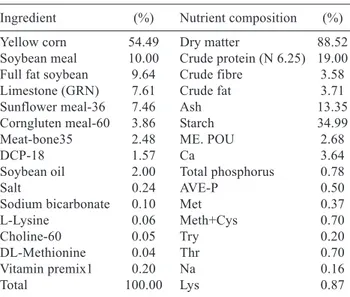
based on corn and soybean (Table 1) and the content of
organic and inorganic trace mineral contents were 0.20%
age, during which light and feed (female: 156 gram/day,
male: 130 g/day) were supplied according to
recommendations of Ross Breeding company (Ross, 2016)
without drinking water restriction. The environmental
temperature (18–22°C) and humidity (55–60% RH) were
maintained within the animal comfort zone using foggers
and tunnel ventilation. During the experimental period (40
thto 45
thweeks of age), feed intake, feed conversion ratio,
hen-day egg production and egg yield were recorded
weekly. Body weight of birds was recorded at 39
thand 45
thweeks of age in order to calculate the changes in body
weight. At the 44
thand 45
thweeks of age, eggs were
collected twice a week (5 eggs from each replication) and
analyzed for external + internal quality, and yolk trace
minerals content by using Mars Express Feed Grain,
XprAG-3, rev. date:/6/04.
The data obtained were analyzed using GLM (General
Linear Model) procedure of the Statistical Analysis System
(SAS, 2005), and Duncan’s New Multiple Range Test in
SAS was used to identify significant differences among
treatments means. Results obtained in this study are
presented as means per bird with standard errors of the
difference between means (SED) with P values, except for
feed intake as feed was given to the birds in equal amounts
according to the recommendation of the Breeding Company
(Ross, 2016).
RESULTS AND DISCUSSION
The inclusion of trace minerals in different forms and
Table 1. Composition of the basal dietIngredient (%) Nutrient composition (%)
Yellow corn 54.49 Dry matter 88.52
Soybean meal 10.00 Crude protein (N 6.25) 19.00 Full fat soybean 9.64 Crude fibre 3.58
Limestone (GRN) 7.61 Crude fat 3.71
Sunflower meal-36 7.46 Ash 13.35
Corngluten meal-60 3.86 Starch 34.99
Meat-bone35 2.48 ME. POU 2.68
DCP-18 1.57 Ca 3.64
Soybean oil 2.00 Total phosphorus 0.78
Salt 0.24 AVE-P 0.50
Sodium bicarbonate 0.10 Met 0.37
L-Lysine 0.06 Meth+Cys 0.70
Choline-60 0.05 Try 0.20
DL-Methionine 0.04 Thr 0.70
Vitamin premix1 0.20 Na 0.16
Total 100.00 Lys 0.87
*Vitamin premix (per 2 kg of diet): 15,000 IU vitamin A, 5,000 IU vitamin D3, 100 mg vitamin E, 3 mg vitamin K3, 3 mg vitamin B1, 8 mg vitamin B2, 60 mg niacin, 15 mg Ca-D-pantotenat, 5 mg vitamin B6, 20 mg vitamin B12, 2 mg folic acid, 200 mg D-biotin, and 100 mg vitamin C.
Table 2. Sources and contents of trace mineral premixes in organic or inorganic form used in the experiment
Trace mineral Source Source amount in mix Trace mineral amount in mix
Inorganic form (Per 2 kg)
Manganese MnSO4 (32%) 250 mg 80 mg Iron FeSO4 (30%) 200 mg 60 mg Zinc ZnO (72%) 83.333 mg 60 mg Copper CuSO4 (77%) 6.494 mg 5 mg Selenium Na2SeO3 (45%) 4.444 mg 0.200 mg Cobalt CoSO4 (20%) 1 mg 0.200 mg Iodine Ca(IO3)2 (62%) 1.613 mg 1 mg
Filling Mat. Limestone 1.453 mg
Total 2000 mg
Organic form (per 2 kg)
Manganese Mintrex Mn (Metionin-Hid. 516.129 mg 80 mg
Analog Mn Chelate 15.5%)
Iron Mintrex Fe (Methionine-Hid. 375 mg 60 mg
Analog Fe Chelate 16.0%)
Zinc Mintrex Zn (Metionin-Hid. 342.857 mg 60 mg
Analog Zn Chelate 17.5%)
Copper Mintrex Cu (Metionin-Hid. 27.777 mg 5.000 mg
Analog Cu Chelate 18.0%)
Selenium ZORIEN (SeY, % 2 Se) 10 mg 0.200 mg
Cobalt* CoSO4 (20%) 1.000 mg 0.200 mg
Iodine* Ca (IO3)2 (62%) 1.613 mg 1.000 mg
Filling Mat. Limestone 735614 mg
Total 2,000,000 mg
*not organic form.
inorganic, 0.10% inorganic + 0.10% organic, 0.10% organic
+ 0.10% woods havings, and 0.20% organic in control, A,
B, C and D groups respectivly. Also sources and contents
of trace mineral premixes in organic or inorganic form were
shown in Table 2.
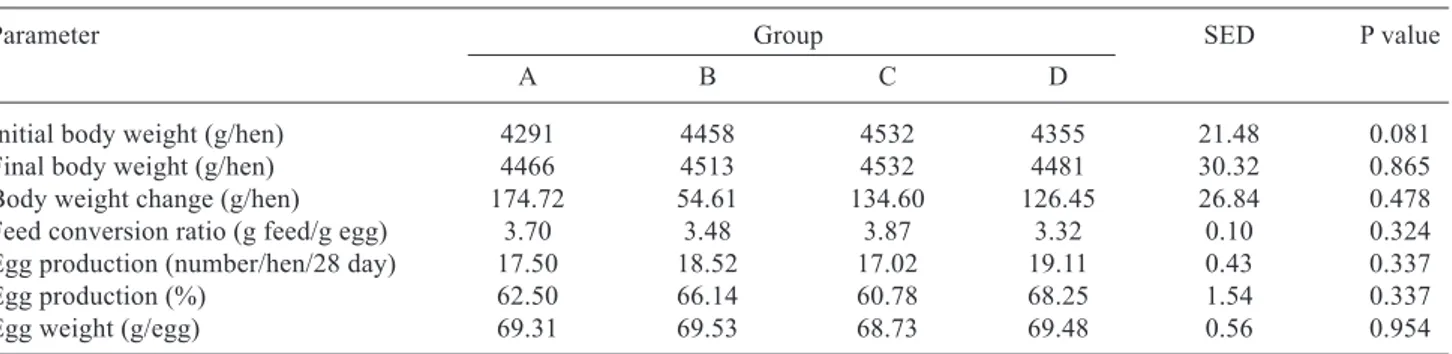
full or half amount in broiler breeders’ diet did not have
any effect on body weight, egg production, feed conversion
ratio and egg weight of birds (P>0.05) (Table 3).
It is noteworthy to say that according to the broiler
breeders’ management program, the amount of daily food
given to per animal in this period was 156 g; so the statistical
analysis was not performed for feed intake and total feed
intake parameters. Jegede et al. (2015) demonstrated that
using of high levels of copper in layer hens’ diet increased
egg production but did not have significant effect on feed
intake. They also reported that copper proteinate is
biologically more effective than copper sulphate
pentahydrate. Idowu et al. (2011) used 140 mg/kg zinc in
the form of inorganic (oxide, sulphate, and carbonate) or
organic (proteinate) in layer hens’ diet and they observed
that egg production and zinc accumulation in organism and
fecal zinc excretion were higher in the group, which
received a diet containing zinc proteinate. In addition, they
reported that organic zinc source was biologically more
effective than inorganic zinc sources. It was stated that using
of organic or inorganic trace minerals at 72 to 80
thweeks
of age in layer hens’ diets reduced egg losses and increased
egg weight and egg production (Maciel et al. 2010).
The inclusion of different forms and levels of trace
minerals did not have significant effects on external egg
parameters such as egg weight, albumen weight and yolk
weight (P>0.05) but egg shell weight was affected by dietary
trace mineral (P<0.05), which was higher in group D than
the other experimental groups (Table 4).
There were no significant differences in egg shape index,
albumin index, and Haugh unit (P>0.05). But yolk index,
shell strength and shell thickness were affected by dietary
forms and levels of trace minerals (P<0.05) as yolk index
was higher in group D. The results displayed that the eggs
obtained from group A (100% inorganic form) had higher
shell strength (3.65 kg/cm
2), shell thickness (335.62 µm),
and higher yolk index values than those of other
experimental groups (P<0.05). Amem and Al-Darji (2012)
reported that adding of zinc in broiler breeders’ diet had a
beneficial effect on egg quality and also increased egg
Table 3. Effects of diet’s trace minerals on broiler breeders laying performance.Parameter Group SED P value
A B C D
Initial body weight (g/hen) 4291 4458 4532 4355 21.48 0.081
Final body weight (g/hen) 4466 4513 4532 4481 30.32 0.865
Body weight change (g/hen) 174.72 54.61 134.60 126.45 26.84 0.478
Feed conversion ratio (g feed/g egg) 3.70 3.48 3.87 3.32 0.10 0.324
Egg production (number/hen/28 day) 17.50 18.52 17.02 19.11 0.43 0.337
Egg production (%) 62.50 66.14 60.78 68.25 1.54 0.337
Egg weight (g/egg) 69.31 69.53 68.73 69.48 0.56 0.954
A, 100% inorganic; B, 50% organic + 50% inorganic; C, 50% organic; D, 100% organic. The amount of food given per animal per day is 156 g; therefore no statistical analysis were performed. a,bMean in same row with different superscript letters are significantly different (P<0.05).
Table 4. Effects of trace minerals in diet on egg quality in broiler breeders
Parameter Group SED P value
A B C D
Egg weight (g) 67.58 67.32 67.74 67.73 0.23 0.917
Egg shell weight (g) 6.51b 6.42b 6.50b 6.78a 0.04 0.004
Egg shape index 76.23 75.35 75.48 76.22 0.21 0.297
Albumin weight (%) 57.71ab 58.13a 57.72ab 56.91b 0.15 0.038
Albumin index 5.15 5.37 5.27 5.35 0.10 0.841
Yolk weight (%) 32.63 32.33 32.67 33.06 0.15 0.414
Yolk index 39.76b 40.87ab 41.05ab 41.72a 0.25 0.049
Haugh unit 65.51 66.94 65.51 66.92 0.74 0.821 Shell strength (kg/cm²) 3.65a 3.32b 3.35b 3.41ab 0.01 0.068 Shell thickness (µm) 335.62a 325.93b 325.75b 324.46b 1.28 0.009 Yolk color l (Lightness) 60.06 59.79 59.32 59.70 0.13 0.219 a (Redness) 10.12a 9.75ab 9.73ab 9.52b 0.07 0.034 b (Yellowness) 62.83a 60.95b 62.05ab 60.75b 0.24 0.009
A, 100% inorganic; B, 50% organic + 50% inorganic; C, 50% organic; D, 100% organic. The amount of food given per animal per day is 156 g; therefore no statistical analysis was performed. a,bMean in same row with different superscript letters are significantly different (P<0.05).
production and fertility parameters. Amino acid chelate
form of zinc in broiler breeders’ diet increased egg shell
thickness and egg weight (Favero et al. 2013). Carvalho et
al. (2015) reported that replacing of 70% of inorganic
copper, manganese and zinc with organic sources in layer
hens’ diet did not affect performance and egg quality but
reduced fecal excretion of these trace minerals.
Inclusion of dietary trace minerals in broiler breeders’
diet had significant effect on yolk mineral contents (Table
5). The content of Fe, Zn and Mn at 44 weeks of age were
higher in group D, and Cu content was higher in group B.
At 45
thweek of age, the group fed diet containing 100%
organic based trace mineral had high contents of Fe, Cu
and Mn, and the group B had a higher Zn content in yolk.
Pekel and Alp (2011) reported that feeding of 250 ppm
copper sulphate reduced egg weight and feed intake and
also copper sulphate and copper lysine reduced egg shell
thickness. According to Bess et al. (2012), using of 60 mg/
kg iron in the form of amino acid chelate in broiler breeders’
diet increased iron content in egg yolk but egg production
was not positively affected by dietary iron source. Ramadan
et al. (2010) explained that use of different levels of
inorganic iron, zinc, and copper had a significant effect on
egg production, egg quality, feed conversion ratio, and yolk
trace minerals contents, specially due to the addition of
copper and zinc, the iron content in yolk was decreased.
The data obtained from this study revealed that using of
organic and/or inorganic form of trace minerals in broiler
breeders’ diet did not have any significant effect on laying
performance (P>0.05). Shell weight, shell thickness, yolk
index, and yolk colour were significantly affected by the
diet trace minerals form and levels (P<0.05) as using of
100% organic trace mineral source increased shell weight
and shell thickness. Using 100% inorganic trace mineral
source induced brighter, ruddy, and denser yolks.
REFERENCES
Amem M H M and Al-Daraji H J. 2012. Effect of dietary zinc on productive performance of broiler breeder chickens.
International Journal of Applied Poultry Research 1(1): 5–9.
Bess F, Vieira S L, Favero A, Cruz R A and Nascimento P C. 2012. Dietary iron effects on broiler breeder performance and
egg iron contents. Animal Feed Science and Technology 178: 67–73.
Carvalho L S S, Rosa D R V, Litz F H, Fagundes N S and Fernandes E A. 2015. effect of the inclusion of organic copper, manganese, and zinc in the diet of layers on mineral excretion, egg production, and eggshell quality. Brazilian Journal of
Poultry Science 87–92.
Choct M, Naylor A J and Reinke N. 2004. Selenium supplementation affects broiler growth performance, meat yield and feather coverage. British Poultry Science 45: 677– 83.
Chowdhury S D. 1990. Shell membrane system in relation to lathyrogen toxicity and copper deficiency. World’s Poultry
Science 46: 153–69.
Favero A, Vieira S L, Angel C R, Bess F, Cemin H S and Ward T L. 2013. Reproductive performance of Cobb 500 breeder hens fed diets supplemented with zinc, manganese, and copper from inorganic and amino acid-complexed sources. Journal of
Applied Poultry Research 22: 80–91.
Greengard O, Sentenac A and Mendelsohn N. 1964. Phosvitin, the iron carrier of egg yolk. Biochimica et Biophysica Acta
90: 406–07.
Idowu O M O, Ajuwon R O, Oso A O and Akinloye O A. 2011. Effects of zinc supplementation on laying performance, serum chemistry and Zn residue in tibia bone, liver, excreta and egg shell of laying hens. International Journal of Poultry Science
10(3): 225–30.
Jegede A B, Oso A O, Fafiolu A O, Sobayo R A, Idowu O M O and Oduguwa O O. 2015. Effect of dietary cooper on performance, serum and egg yolk cholesterol and cooper residues in yolk of laying chickens. Slovak Journal of Animal
Science 48(1): 29–36.
Juniper D T, Phipps R H and Bertin G. 2011. Effect of dietary supplementation with selenium-enriched yeast or sodium selenite on selenium tissue distribution and meat quality in commercial-line turkeys. Animal 5: 1751–60.
Maciel M P, Saraiva E P, Aguiar E F, Ribeiro P A P, Passos D P and Silva J B. 2010. Effect of using organic micro minerals on performance and external quality of eggs of commercial laying hens at the end of laying. Revista Brasileira de
Zootecnia 39: 344–48.
Nys Y, Hincke M T, Arias J L, Garcia-Ruiz J M and Solomon S E. 1999. Avian eggshell mineralization. Poultry and Avian
Biology Reviews 10: 143–66.
Olgun O, Yazgan O and Cufadar Y. 2012. Effects of boron and copper dietary supplementation in laying hens on egg shell Table 5. Effects of diet’s trace minerals on egg yolk trace minerals content
Week of age Parameter Group SED P value
A B C D 44 Fe (mg/kg) 126.35c 161.70b 163.09b 211.62a 3.118 <.0001 Zn (mg/kg) 66.62c 81.47b 77.60b 107.96a 1.107 <.0001 Cu (mg/kg) 1.31c 5.61a 3.97b 5.03a 0.150 <.0001 Mn (mg/kg) 3.30c 4.38b 3.78cb 6.07a 0.160 <.0001 45 Fe (mg/kg) 153.70b 146.28b 156.12b 171.16a 2.175 <.0012 Zn (mg/kg) 72.26 78.10 73.95 77.30 0.712 <.2091 Cu (mg/kg) 1.72b 1.88ab 1.71b 2.06a 0.020 <.0016 Mn (mg/kg) 2.39b 2.55ab 2.15b 2.64a 0.045 <.0001
A, 100% inorganic; B, 50% organic + 50% inorganic; C, 50% organic; D, 100% organic. The amount of food given per animal per day is 156 g; therefore no statistical analysis was performed. a,bMean in same row with different superscript letters are significantly different (P<0.05).
quality, plasma and tibia mineral concentrations and bone biomechanical properties. Revue de Medecine Veterinaire
163(7): 335–42.
Park S Y, Birkhold S G, Kubena L F, Nisbet D J and Ricke S C. 2014. Eeffects of high zinc diets using zinc propionate on molt induction, organs, and post-molt egg production and quality in laying hens. Poultry Science 83: 24–33.
Pekel A Y and Alp M. 2011. Effects of different dietary copper sources on laying hen performance and egg yolk cholesterol.
Poultry Science Association 20: 506–13.
Ramadan N A, Omar A S, Bahakaim A S and Osman S M H. 2010. Effect of using different levels of iron with zinc and copper in layer’s diet on egg iron enrichment international.
Journal of Poultry Science 9(9): 842–50.
Ross. 2016. Parent stock performance objectives. pp. 308. www.aviagen.com
Saber S N and Kutlu H R. 2018. Effect of omega-3 and omega-6
fatty acid inclusion in broiler breeder’s diet on laying performance, egg quality, and yolk fatty acids composition.
Indian Journal of Animal Science 88(12): 1374–78.
SAS Institue. 2005. SAS User’s Guide, Statistics. Version 5th Edition. SAS Institue Inc.,Cary, NC. USA.
Smith O B and Akinbamijo O O. 2000. Micronutrients and reproduction in farm animals. Animal Reproduction Science
61: 549–60.
Wang G, Liu L J, Tao W J, Xiao Z P, Pei X, Liu B J, Wang M Q and Lin Gand Ao T Y. 2019. Effects of replacing inorganic trace minerals with organic trace minerals on the production performance, blood profiles, and antioxidant status of broiler breeders. Poultry Science doi:10.3382/ps/pez035.
Zhang J L, Jin-Long L, Xiao-dan H, Sun B, Wang R, Shu L and Shi-wen X. 2012. Dietary selenium regulation of transcript abundance of selenoprotein N and selenoprotein W in chicken muscle tissues. BioMetals 25: 297–307.