
SYNTH. REACT. INORG. MET.-ORG. CHEM., 29(3), 513-524 (1999)
SYNTHESIS OF A NOVEL HETEROCYCLIC DIOXIME AND ITS MONONUCLEAR COMPLEXES WITH
Ni(II), Co(II), Cn(II), Zn(II), Cd(II) and Hg(II)
Bedrettin Mercimek*, M. Ali Ozier, Gazi irez
Department of Chemistry, Faculty of Arts and Sciences, Mugla University, 48000 Mugla, Turkey
and Ozer Bekaroglu
Department of Chemistry, Tcchnical University of istanbul, Maslak, istanbul, Turkey
ABSTRACT
In this work, a novel heterocyclic diox.ime (2,3-hydroximino-4-phenyl-6-phenlyazo- l -thia-4,5-diazacyclohexa-S-diene, H2L) was synthesized by reacting dithizone with cyanogen di-N-ox.ide. H2L forms mononuclear complexes [(HL) 2M] with a metal-ligand ratio of 12 with M = Ni(ll), Co(II) and Cu(II). Zn(II), Cd(II) and Hg(II) form with H2L complexes [(HL)C l(H 2O)M] which have a metal-ligand ratio of I: I and contain a six- membered chelate ring. Structures of these compounds are proposed based on elemental analyses, U.V.-Visible, IR, 1
H
NMR, mass spectra and magnetic susceptibility measurements.INTRODUCTION
Metal complexes of vic-diox.imes represent an important and interesting class of coordination compounds. vic-Diox.imes have not only produced stable metal complexes of
513
,
514 MERCIMEK ET AL.
transition, inner-transition and actinide metal ions, but these ligands and their metal complexes have also played a significant role in the domains of stereochmestry, structure, isomerism, magnetism, spectroscopy, model systems of biochemical interest, cation exchange and ligand exchange chromatography, analytical chemistry, catalysis, stabilizers, polymers and pigments and dyes'-17_
Although cyanogen di-N-oxide was first prepared 18 in 191 I, its properties and reactions have been studied only in 1965 by Grundmann and his co-workers 19. Besides having a tendency to give polymers, it reacts, like other nitrile oxides 20 with amines or 1,2- diamines to form substituted amidoximes, M- with Q-phenylenediamine and ethylenediamine it gives 2,3-bishydroxyimino-1,2,3,4-tetrahyroquinoxaline and 2,3-bishydroxyimino- piperazine, respectively. The reaction was found to be a general one, treatment of various compounds which contain -NH2, -SH and -OH with cyanogen di-N-oxide gave various vic- dioximes, respectively The formation of polymers was avoided by keeping the reaction mixture cool and employing dilute solutions of the reactants. The yields, based on the anti- dichloroglyoxime used, were in the 40-50% range. The relative order of the reactivity of groups in the reaction with cyanogen di-N-oxide is -NH2 >SH> OH21·22.
We have previously reported on the synthetic chemistry of vic- dio ximes 23
-n
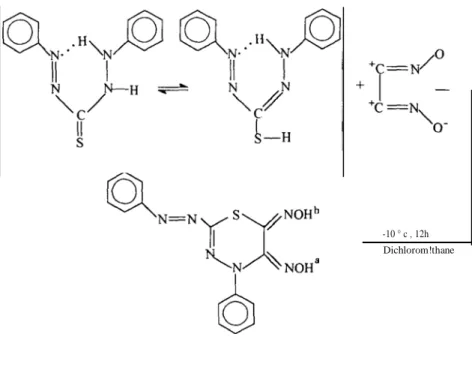
Dithizone and its derivatives as well as various of its reactions were also reported2-8 31.However, published information related to dithizone and vic-dioximes does not seem to exist in the available literature references. For the present work, we synthesized a novel 6- membered thia-diazaheterocycle with a vic-dioxime unit incorporated (Fig. I) end obtained mononuclear complexes with Ni(Il), Co(II), Cu(II), Zn(II), Cd(II) and Hg(II) ions.
RESULTS AND DISCUSSION
The ligand used for this study was 2,3-hydroximino-4-phenyl-6-phenlyazo-1-thia- 4,5-diazacyclohexa-5-diene (H2L). Its synthesis was accomplished in 95% yield by the reaction of cyanogen di-N-oxide and dithizone (H2Dz) as shown in Fig. I. The structure of H2L was confirmed by a combination of elemental analyses, UV-Visible, 1 H NMR.. mass and [R spectral data.
, JJ,
HETEROCYCLIC DJOXIME COMPLEXES 515
-10 ° c , 12h Dichlorom!thane
Fig. I. Synthesis of H1L
1
H NMR, Mass and IR Spectra of R,L
In the 'H NMR spectra (in DMSO-d6), two peaks are present for the OH protons of
the oxime groups. These two deuterium-exchangeable singlets correspond to two non-
equivalent OH protons that also indicate the anti-configuration of the OH groups relative to
each other (Fig. I) . When the chemical shift values of the two OH groups in H,L are
compared, the one of them is observed at lower field ((l >3
=
12.53 ppm) and the other isobserved at higher field
(6i,
=
1 2.04 p.p.m.)23 3 6_ Two multiplets at 7.91-7.14 ppm
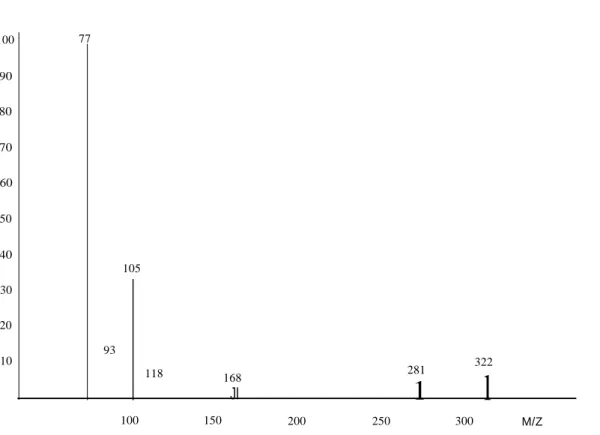
correspond to ten aromatic protons . The mass spectrum of H2L. which shows a molecular
ion at m/z 340.0767 (the theoretically calculated molecular weight: 340.00), confirms the
V,
°'
100 90 80 70 60 50 40 30 20 10 100 150 200 250 300 M/ZFig. 2. Mass Spectrum ofH2L {m/z (%): 340.076 (14), 322 (51), 168(35),118 (43), 105 (71), 93(59), 77(103)}
=
tT=
1PS
§:
►
r'
77 105 93 118 168JI
2811
322l
·
• •
HETEROCYCLIC DIOXIME COMPLEXES 517
The IR spectral data oflhDz and the vic-dioxime (H2L) are summarized in Table II. The disappearance of the N-H and S-H stretching bands, along with the appearance of new absorptions at 3250 cm·1 for 0-H stretching, 1630 cm·1 C=N stretching and 975 cm·1 N-0 stretching are in agreemen t2121" 24 3 with the structure in Fig I The aromatic C-H stretching vibrations were at 3050 cm·1
. Furthermore, the C=N stretching vibration frequency of H2Dz and H2L was at 1590 cm·1
IR Spectra and Magnetic Susceptibility of the CompleJ.es
Elemental analyses, IR spectroscopy and magnetic susceptibility were employed to detennine the structural characteristics of the complexes (Tables I and II). The reaction of H2L with Ni(II), Co(II) and Cu(II) salts gives products with the metal-ligand ratio of 1:2,
(Fig 3). For Ni(II), Co(II) and Cu(II), only mononuclear complexes were obtained even when the metal ions were used in excess 24'21 (Table I). Since a distinct lowering in the pH of the solution was observed during the complex formation, deprotonation of the ligand with subsequent N,N-chelation with the vic-dioxime groups probably occurs. The usual hydrogen bridges (H-0·-·H) of the square-planar vic-dioxime complexes are characterized by the weak deformation bands2327324 2 around 1750-1720 cm·1 in the case of [Ni(HL)
], and • •
2 [Cu(HL),]; but the Co(II) complex had two coordinated water molecules. Consequently, an octahedral structure for the Co(II) and a square-planar structure for the Ni(II) and Cu(Il) compounds are proposed (Fig. 3), (Table II). In the IR spectra in Table II of the ligand and complexes, the shifts of the C=N stretching frequency to lower frequency and the vibration of the N-0 band to higher frequency indicated the formation of coordination bonds between the metal and nitrogen atoms of the ligands. In the case of the Co(II) complexes, the coordinated H20 groups are identified by a broad OH absorption at around 3550 cm·1 which keeps its intensity even after heating at 110° C for 24 h.
H2L reacts with Zn(II), Cd(II) and Hg(II) salts to give 1:1 metal-ligand ratio complexes with two of four coordination sites on the metal occupied by the N atom of the oxime groups and the other by M-l 0 atom. A chloride ion and a water molecule are also coordinated to the metal ion in {[(HL)Cl(Hz())M]} (Fig 4). The physical data and IR spectra are consistent with such a structure 232638 (Tables I and II).
520 MERCIMEK ET AL.
OH2
I
Fig. 3. Structure of(M(HL)i]; M= Ni(II), Cu(Il) or Co(II)
6H2
Fig. 4. Structure of [(HL)Cl(H20)M] { M = Zn(ll), Cd(II) or Hg(II)}
In the region below 700 cm-1 several groups of bands appear, all of them are more or less sensitive to the central metal atom Metal-nitrogen stretching frequencies are reported by a number of workers to occur in the 300-600 cm-1 regio n44 . The presence ofa number of
bands or shoulders in a rather narrow range makes difficulty an unambiguous assignment of this vibration to M-N, M-0 and M-CI, in particular for ((HL)Cl(H20)Zn], ((HL)Cl(H,O)Cd] and
[(HL)Cl(l-1,0)Hg]. An empirical assignment for the other metal-nitrogen stretching vibration which is expected to appear in the far-infrared region for these molecules may be proposed: bands at 470,465,450 cm-1 for [(HL)iNi], [(HL):iCo] and [(HL):iCu],respectively, may be assigned to this mode.
- -4
HETEROCYCLJC DIOXIME COMPLEXES 521
The common features of the complexes of H2L are their insolubility that also hindered spectral investigations of their solutions. Magnetic susceptibility measurements provide sufficient data to characterize the structures (Table II). The mononuclear complex [Ni(HL)i] is diamagnetic as expected for a d8 metal ion in a square-planer field 25·26.34 35·40 2
The magnetic moment of [Co(HL)i] and [Cu(HL)i] at 20° C are 2.45 and 1.52 B. M, respectively; the mononuclear complexes [(HL)Cl(H2O)Zn], [(HL)Cl(H2O)Cd] and [(HL)Cl(H 2O)Hg] are diamagnetic as expected for d10 metal ions in a tetrahedral field 2_5·26
EXPERIMENTAL
anti- Dichloroglyoxim e45.46 and cyanogen-di-N-oxid e19 were prepared according to
the referenced procedures. The UV-Visible spectra were recorded on a 160 A Shimadzu spectrophotometer. The 1H NMR spectra were recorded on a Bruker 200 MHz spectrometer. Infrared spectra were obtained on a Unicam Mattson 1000 (FT-IR) spectrometer. Mass spectra were recorded on a Kratos MS 12 Mass Spectrometer, at 70 eY and 220° C ion source temperature (obtained at the University of Glasgow). The magnetic moments of the complexes were measured by the Gouy method with a Newport Instruments type D-104 magnet power supply (293 K). The metal contents of the complexes were determined by a Varian-Faction A-175 type atomic absorption spectrophotometer in solutions prepared by decomposing the compounds in aqua regia and then subsequently digesting in concentrated HCI.
2,3-Hydroxyimino-4-phenyl-6-phenlyazo-1-thia-4,5-diaza-cyclohexa-5-diene (H,L}
A solution of 2.56 g (IO mmol) of dithizone (3-thioxo-1,5-diphenylformazan, H2Dz) dissolved in 50 mL of dichloromethane was cooled to -15° C. A solution of cyanogen di-N- oxide in 50 mL dichloromethane, which was prepared from (1.57 g, 10 mmol) anti- dichloroglyoxime and 120 mL N Na2CO3 solution, was added to the solution of H2Dz. After
the addition was complete, the solution was stirred at -15° C for 12 hours, the resulting orange compound was separated, filtered and washed with dichloromethane and then dried in vacuo. Yield 3.23 g; UY-Visible (in ethanol)
Amax
=
436 (E 1=
1068), 305 nm (E 1=
522 MERCIMEK ET AL.
862 23), 218 run (E1
=
1012); 1H NMR (in DMSO-d,;) 8 = 12.53 (s, I H, disappears upon deuterium exchange), 12 04 (s, I H, disappears upon deuterium exchange), 7.91-714 (m, JOH); ms m/z 340.076 (14) (C15H12N6O2S), 322 (51) (C15H10N6OS), 28 I (51) (C14ll11N5S), 168 (35) (C7H11N3S), 118 (43) (C7l-L;- N2), 105 (71) (C6H5-N2)', 93 (59) (C6H5- NH 2), 77(103) (C6H5-) (Fig. I)
!Ni(HLhl, !Co(HLh) and Ku(HLh) Co mplexes
A solution of0.5 mmol of metal salt [NiCh-61-·hO (119 mg), C0Ch6H2O (119 mg) or CuCh-2H2O (85 mg)] in 30 mL hot water was added to the suspension of 340 mg (1.0 mmol) H2L in SO mL hot ethanol. The color after dissolution changed immediately and a sharp decrease in the pH of the solution to 3.5-4.0 was observed. When the pH was increased to 5.0-5.S with 0.5% NaOH solution in ethanol, precipitation started. The mixture was further stirred on a water bath at 60° C for I h in order to complete precipitation The precipitates were filtered, washed with hot ethanol and hot water and then dried in vacug
f (HL)ZnCl (ll 02 )), l(HL )CdCl(ll 02 )) and f(HL)HgCl{H20)) Complexes
A solution of I 0 mmol of metal salt [ZnCh 21hO ( I 70 mg), CdCh-2H2O (20 I mg) or HgCh-2lhO (308 mg)] in 30 mL water was added to the suspension of 340 mg ( 1.0 mmol) H2L in SO mL ethanol. The color of the mixture changed immediately and a sharp decrease in the pH of the solution to 1.0-2.0 was observed. When the pH was increased to 5.0-5 5 with 0.5% NaOH solution in ethanol, precipitation started. The mixture was further stirred on a water bath at 60° C for 2 h in order to complete precipitation. The precipitate was filtered, washed with hot ethanol and hot water and then dried in vacuo.
The colors, melting points, yields, elemental analyses, characteristics FT-IR absorptions and magnetic moments of the complexes are give in Tables I and II.
ACKNOWLEDGMENT
Thanks are due to Dr. H. J. Duncan (Department of Chemistry, University of Glasgow, Scotland) and Dr. \,1_ Ersoz (Department of Chemistry, University of Selvuk, Turkey) for providing help in the measurement of mass spectra
HETEROCYCLIC DIOXIME COMPLEXES 523
REFERENCES
G. N. Schrauzer, R. J. Windgassen and J. Kohnle, Chem. Ber., 98, 3324 (I 965). 2. A. Chakravorty, Coord. Chem Rev, 13, I (1974).
3. B. G. Brown, Prog. Inorg Chem, 18, 17 (1973)
4. T. W. Thomas and A. E. Underhill, Chem. Soc. Rev , !, 99 ( I 972).
5. A. E. Underhill, D. M. Watkins and R. Petring, lnorg. Nucl. Chem. Lett.,
2,
1269 (1973). 6. P K. Panja, S. Bala, C. Pal and P. N. Ghosh, J. Mol. Struct., 249, 277 (I 991). 7. K. Burger, I. Ruff and F. Ruff, J. Inorg. Nucl. Chem., ll, 179 (1965). 8. G. A. Pearse, Jr., and R T. Pflaum, Anal. Chem , 32, 213 (1960). 9. M. Ersoz, S. Y1ld1z and E. Pehlivan, J. Chromatogr. Sci, 31, 61 (1993). 10. M. Ersoz., E. Pehlivan and S. Y1ld1z, Anal. Lett, 22, 1839{1989) 11. T. Atalay and S. Alpaydm, Chimica Acta Turcica, 24, 55 (1996). 12. H. L Hall, J. Radioanal Nucl. Chem.-Articles, 158,211 (1992).13. S. Usami, T. Fukami, E. Kinoshita, B. K. Puri, M. Satake, Anal. Chim Acta, 230, 17 (1990).
14. S. M. Schildcrout and L. M. Besozzi, Inorg. Chem, 29, 1054 (1990).
15. S. Moitara, M. Biswas, A. S. Brar and R. G. Mendiratta, Polym. Commun., 31, 237 (1990)
16. K. C. Rosenspire, W Hirth, S. Jurisson, D. P. Nowotnik, W. C. Eckelman and A. D. Nunn, J. Chromatogr., 574, 119 (1992).
17. A. Bigotto, G. Costa, V Galasso and De Alti, Spectrochim. Acta,
M,
1939 (1970). 18. W. Steinkopf and B. Jurgens, l Prakt. Chem., 83, 453 (1911)19. C. Grundmann, V Mini, S. M. Dean and H. D. Frommeld, Ann. Chem , 687, I 91 (1965). 20. C. Grundmann, Fortschr. Chem. Forsch ,
1,
62 ( I 966).21. N. E. Alexandrou and D. N. Nicolaides, Chimika Chronika, 49 (1965) 22. N. E. Alexandrou and D. N. Nicolaides, Tetrahedron Letters, 2497 (1966). 23. G. irez and
b.
Bekaroglu, Synth. React. Inorg. Met-Org. Chem, 13, 781 (1985).524 MERCIMEK ET AL
24. B. Mercimek and G irez, Synth. React. lnorg. Met.-Org. Chem., 24,867 (1994). 25. B. Mercimek and G. irez, Synth. React. lnorg Met.-Org. Chem, 25,337 (1995) 26. B. Mercimek and G. irez, Synth. React lnorg. Met-Org Chem., 25, 1391 (1995) 27. B Mercimek and G. irez, Macromol. Reports, A32, I 47 ( 1995)
28. A T. Hutton, H. M. N. H. Irving, K. R. Koch and L R Nassimbeni, J CS. Chem. Comm , 57 ( I 979)
29. A T Hutton and H. M. N. H. Irving, J. CS. Perkin Trans II, 139 (1980).
30. AT. Hutton, H. M. N. H. Irving, and LR. Nassimbeni, Acta Cryst., B36, 2071 (1980) 31. A T. Hutton and H. M. N. H. Irving, J. Chem. Soc. Perkin Trans. II, 1117 (1982). 32. M. Koyak and O Bekaroglu, Synth. React. Inorg. Met-Org Chem., ' 479 (1985) 33. Y. Gok and A Demirba , Synth. React Inorg. Met.-Org. Chem., 19,681 (1989). 34. K. Karadeniz and
0.
Bekaroglu, Synth. React. Inorg. Met.-Org. Chem., Ll_, 1029 (1983). 35. V Ahsen, F Gokyelli and 0. Bekaroglu, J Chem. Soc. Dalton Trans., 1827 (1987). 36. A Gui and0.
Bekaroglu, J Chem. Soc., Dalton Trans., 2537 ( 1983).37. Y Gok and S Serin, Synth. React Inorg. Met.-Org Chem., 18,675 (1988) 38. Y Gok and E. Ozcan, Transition Met Chem.,.!§_, 393 (I 991 ).
39. Y Gok and O Bekaroglu, Synth. React. Inorg. Met-Org. Chem,!.§_, 675 (I 988) 40. V Ahsen, A Gurek, A Gui, and O Bekaroglu, J Chem. Soc , Dalton Trans, 5 (I 990) 41. A Gui, A
i
Okur, A Cihan, N. Tan and O Bekaroglu, J. Chem. Res, (S), 90, (M)881 (1986)
42. M. Erta , V Ahsen, A Gui and O Bekaroglu, J Organomet Chem., 335, 105 (1987). 43. D. A Skoog and J J Leary, "Principles oflnstrumental Analysis", Saunders College
Publishing, Fourth Edition, International Edition, p. 279 ( 1991 ).
44. K Nakamoto, "Chemistry of the Coordination Compounds", Macmillan, p. 437 (1961) 45. G. Ponzo and F. Baldroco, Gazz. Chem. Ital., 60, 415 ( 1930)
46. H. Brintzinger and R. Titzmann, Chem. Ber., 85, 344 ( 1952)
Received: 10 July I 997 Accepted: 23 October 1998
Referee I: R. J. Morris Referee II: R. K. Steinhaus
![Fig. 4. Structure of [(HL)Cl(H20)M] { M = Zn(ll), Cd(II) or Hg(II)}](https://thumb-eu.123doks.com/thumbv2/9libnet/3846088.34644/8.648.113.550.74.548/fig-structure-hl-cl-zn-cd-ii-hg.webp)
