Relationship between Local Residents’ Perceptions of
Tourism and Support Attitudes in Post-Communist Countries:
Case of Turkestan (Kazakhstan)
Uğur Çalişkanaand Özgür Özerb a
Faculty of Tourism, Muğla Sıtkı Koçman University, Muğla, Turkey;bFaculty of Tourism, Konya Necmettin Erbakan University, Konya, Turkey
ABSTRACT
The impacts of tourism and reactions of local residents toward tourism are examined frequently. However, the lights have been turned to mainly developed world and destinations. Post-communist and particularly Central Asian countries have almost never been examined. Through multivariate analysis on data compiled from 250 individuals, this study explores the perceptions of Turkestan (Kazakhstan) residents about economic, socio-cultural, and environmental impacts of tourism and their support attitudes toward tourism development. Findings underline that perceptions of social and environmental impacts were not clear and support to tourism development is basically related to economic issues, indicating that if the locals are economically active in the tourism sector, they would support more. The study has importance since it investigates a post-communist, new emerging, and non-examined destination having different political history from the mainstream tourism destinations.
KEYWORDS
Impacts of tourism; local residents; SET; post-communist countries; Kazakhstan; Turkestan
Introduction
Recording considerable development in recent years, tourism has increasingly become an important sector (Eraqi,2007). Therefore, many local and national governments are plan-ning or investing in tourism. Tourism development brings many spatial and social changes. Tourism affects also local residents’ life positively or negatively (Hartwell et al.,
2018; Su & Teo, 2008). The literature emphasizes that residents play critical role for tourism development (Nunkoo & Ramkissoon, 2009), and that their support is crucial (Gursoy & Rutherford,2004; Dyer et al.,2007; Nunkoo & Ramkissoon,2009,2010). There-fore, determining their perceptions of and support attitudes to tourism is an important policy instrument and has been amongst the most popular research topics for the last 30 years (Ambroz,2008; Andereck & Nyaupane,2011).
However, though many scholars (for example, Harrill, 2004; Mason & Cheyne, 2000) state that residents’ attitudes toward tourism should be examined in emerging desti-nations, most of the studies have been held in developed tourism destinations and western societies. There are very few studies in developing countries and newly emerging
© 2020 Informa UK Limited, trading as Taylor & Francis Group
CONTACT Uğur Çalişkan [email protected] https://doi.org/10.1080/21568316.2020.1837228
destinations (Fredline,2005; Hunt & Stronza,2014; Nepal,2008). Moreover, post-commu-nist countries are almost un-studied and thisfield is waiting to be touched (Pranic et al.,
2012), and no study has been conducted in the Central Asian countries including Kazakh-stan. As Sinclair-Maragh and Gursoy (2016) stated, the theoretical background of local residents’ attitudes toward tourism should be strengthened by examining different geo-graphical areas with different politic backgrounds.
This study, based on social exchange theory (SET), examines the relationship between local residents’ perceptions of tourism impacts and support to tourism development in Turkestan (Kazakhstan), and it would be the first for this area. Therefore, contribution of this study to the literature is three-fold. First, local residents’ perceptions of and atti-tudes toward tourism are examined in a new emerging destination. Secondly, it provides results from previously non-examined region, Central Asia. Lastly, it investigates a country with a different political regime history than the mainstream tourism destinations.
In the following “Literature Review” section, the theoretical framework will be dis-cussed. Then the studyfield and methodology will be explained and findings will be pre-sented. The paper will befinalized by discussing the results and recommendations.
Literature review
Many decision-makers consider tourism as a remedy for the way of development and have great appetence to constitute new tourism destinations, since tourism is very impor-tant sector all over the world in terms of international travelers and foreign exchange revenuefigures (World Tourism Organisation (UNWTO),2018).
With the development of tourism, positive and/or negative effects crop up and lead to changes both in the destination and the local population (Jurowski et al., 1997). Many studies address the impacts of tourism as important components of tourism development and destination management (Beeton,2006; Choi & Murray,2010; Gunn & Var,2002; Lepp,
2008).
Impacts of tourism
The studies mainly focus on three impact dimensions, economic, environmental, and socio-cultural (Andereck et al.,2005; Gursoy et al.,2002). Though tourism development efforts and pioneer tourism researches are mostly concentrated on economic factors (Ko & Stewart, 2002; Liu & Var, 1986), socio-cultural and environmental dimensions were also examined by subsequent studies (Kim et al., 2013; Nunkoo & Ramkissoon,
2010; Ozturk et al.,2015).
The literature points that tourism is related with economic growth (Caliskan et al.,
2019), since it increases investment and business opportunities (Liu et al., 1987; Pratt et al.,2016), helps diversification of local economies (Ap & Crompton,1998; Latkova & Vogt, 2012; Prentice, 1993; Sinclair-Maragh & Gursoy, 2016). Moreover, it increases employment and income opportunities for local people (Ap & Crompton, 1998; Ko & Stewart,2002; Ladkin,2011; Nunkoo & Ramkissoon,2009).
However, it is expressed that tourism causes destruction of traditional sectors (Stronza,
2001) and thus creates economic dependency (Andereck et al.,2007). Criticisms are also brought that local people are employed in sub-positions and at low wages (Gezon,2014),
and that the benefits are not fairly distributed in the society and thus income difference and poverty increases (Briedenhann & Wickens, 2004; Manyara & Jones, 2007). Further-more, an increase in the inflation rate (Pratt et al.,2016) and in prices of goods and ser-vices (Ko & Stewart,2002; Weaver & Lawton,2001) are also highlighted.
Since tourism envelopes interpersonal activities, it has many effects on social and cul-tural aspects, albeit these effects do not emerge as rapidly as economic effects (Ohmann et al.,2006). Mathieson and Wall (1982) stated that there are no clear differences between social and cultural impacts and they can be classified as socio-cultural impacts. The litera-ture emphasizes that tourism increases cultural exchange between hosts and tourists (Besculides et al.,2002; Mitchell & Reid,2001), and so helps fostering the idea of living in peace together with“others” (Cegielski & Mules, 2002; Gursoy & Kendall,2006). Like-wise, tourism increases the sense of identity, belonging, and pride in the local population (Akis et al.,1996; Kaplanidou & Karadakis,2010; Ko & Stewart,2002). Tourism results in a better quality of life since it increases the variety and quality of outdoor facilities (Alhasa-nat,2011) or the public services such as health, education, or culture (Brunt & Courtney,
1999; Dyer et al.,2007; Milman & Pizam,1988).
However, tourism is accused of damaging the local culture and language (Beeton,2006; Kousis,1989) or deterioration of social structure and family relations (Mbaiwa,2004; Milman & Pizam,1988). Tourism is also blamed for increased alcohol and drug addiction, gambling and prostitution (Andereck et al.,2007; Nunkoo & Ramkissoon,2011), and rates and types of crime (Brunt & Courtney,1999; Liu & Var,1986; Mbaiwa,2004).
From an environmental aspect, molding public opinion and awareness about environ-mental issues (Cegielski & Mules,2002; Gursoy & Kendall,2006) may be the most positive impact of tourism. Additionally, tourism encourages the protection of nature (Simpson,
2008) and improvement of environmental infrastructure (Beeton, 2006; Ko & Stewart,
2002). On the dark side, it is frequently emphasized that tourism brings in devastation of environment (Andriotis,2008), overuse of natural resources (Beeton,2006), destruction of wild life (Kim et al.,2013), degradation and destruction of landscape and forests (Brida et al.,2011), pollution (Dyer et al.,2007), and loss of traditional land use and character of settlement (Park & Stokowski,2009).
Local residents’ perception of tourism
Besides being very important attraction asset for tourists (Carneiro et al.,2018), local resi-dents’ support is very crucial for successful and sustainable tourism development (Ap,
1992; Lee,2013; Nunkoo & Ramkissoon,2010).
As Jimura (2011) pointed out, rather than the actual impacts, perceptions of local resi-dents are efficacious on their support for tourism. Therefore, analyzing local residents’ perceptions toward tourism is very basic and crucial for tourism development (Pratt et al., 2016) and many studies have investigated residents’ perceptions of tourism (Gursoy & Rutherford, 2004; Kim et al., 2013; Ko & Stewart, 2002; Sinclair-Maragh & Gursoy,2016; Vargas-Sanchez et al.,2015).
In these studies, many theoretical frameworks and models have been developed and utilized to measure and analyze local people’s perception. The pioneering models assumed that tourism development and the reactions of local people would develop lin-early and would evolve from warm welcome to indifference, avoidance from tourists and
even hostile attitudes. The well-known and most-cited linear models are Irridex (Doxey,
1975), tourism area life cycle (Butler,1980), Dogan (1989), and Ap and Crompton (1998). Later, theories such as “Community Attachment” which presumes that sense of belonging to the society would determine the perceptions about tourism impacts (Gursoy & Rutherford,2004; Lankford,1994; Vargas-Sanchez et al.,2015);“Equity” which assumes that impacts are perceived due to how fairly the benefits/costs are distributed through the society (Zamani-Farahani & Musa, 2012) or “The Social Representations” assuming that perceptions are influenced by wider social context (Yutyunyong & Scott,
2009) have been developed. However, mostly, SET presuming that individuals continue any exchange as long as they think that it is beneficial or its gains are more than costs (Chhabra & Gursoy,2007; Paraskevaidis & Andriotis,2017) is used (Lee,2013). Although it is criticized for predicting decision-making as a rational and mechanical process and for ignoring other psychological and social elements (Hadinejad et al.,2019), its explana-tory ability stems from considering forms and consequences of the exchange and also heterogeneousity of the communities.
Although it is underlined that especially in settlements facing economic problems, local people pay more attention to economic benefits (Chiang & Yeh,2011; McGehee & Andereck, 2004; Sánchez et al., 2014) and they may even ignore negative impacts in behalf of economic expectations (Stylidis et al.,2014), the literature points out that, per-ceptions of tourism impacts vary greatly amongst destinations. Some studies (e.g. Mordue,2001or Lepp,2008) stated that the tourism were generally perceived negatively, while some others (Chiang & Yeh,2011; Marzuki,2012) determined that local people per-ceive tourism positively. Chiang and Yeh (2011) stated that local people think that tourism does not have negative socio-cultural and environmental impacts, while Akis et al. (1996), Andereck et al. (2005), or Bitsani and Kavoura (2014) demonstrate that the perception about negative socio-cultural and environmental impacts is clear.
Relation between perceptions of and support for tourism development
Local residents are of great importance to contrive a successful and sustainable tourism development (Carneiro et al.,2018; Lee,2013; Nunkoo & Ramkissoon,2010). Residents who are positive about tourism are supposed to behave hospitable to tourists and indirectly encourage them to revisit the destination (Carneiro et al.,2018). On the con-trary, if the locals are unsatisfied with tourism development, they may exhibit negative and even hostile attitudes toward tourists, thus efforts of other actors in the tourism sector may be wasted (Lin et al.,2017).
Even though some studies found that perceived impacts of tourism and support are not directly linked (e.g. King et al.,1993or Andereck & Vogt,2000); the literature generally emphasizes that if the local residents perceive the tourism positively, they support tourism, but when they think that tourism has no benefit or has more costs, they oppose tourism development (Chhabra & Gursoy,2007; Kang & Lee, 2018; Lee & Back,
2006), confirming SET’s basic assumption.
The researchers generally point that support in underdeveloped regions is linked to economic benefits (Akis et al.,1996; Belisle & Hoy,1980), but that local people in devel-oped economies are more reluctant to tourism development (Ozturk et al., 2015). However, there are different findings regarding which impact dimensions are effective.
For example, while Gursoy et al. (2002) indicated that support for tourism was affected by all perceived costs and benefits, Tosun (2002), Lee and Back (2006), Ambroz (2008), or Uysal et al. (2016) reported that mainly economic impacts influence local residents’ support. On the other hand, Jurowski et al. (1997), Liang and Hui (2016), or Chen and Chen (2010) state that positive socio-cultural and environmental impacts increase support. Dyer et al. (2007) emphasize that economic and cultural impacts affect the support for tourism, but environmental ones do not. Similarly, Gursoy and Rutherford (2004) stated that economic and socio-cultural benefits and social costs were effective, and negative cultural and environmental impacts were not. Although some studies have been conducted in Asian countries such as China, Japan, Malaysia, and South Korea, the majority of the studies on the impacts of tourism and the local residents’ atti-tudes were carried out in western countries such as USA, Germany, France, England, and Australia (Hadinejad et al., 2019). Beyond the fact that developing countries or desti-nations have been studied very little (Gannon et al., 2020), post-communist countries were overlooked (Pranic et al.,2012) and the Central Asia is an untouched zone.
Post-communist countries
In the late 1980s, after the destruction of the Berlin Wall, and collapse of the communist system in the Eastern Europe and the Soviet Union, all former communist countries were called as“transition countries” (Pranic et al.,2012). Post-communist countries had central planning and economic regulation history where decisions were taken and implemented from top to bottom manner (Roberts & Simpson,1999), and have experienced social, pol-itical, and economic changes after“transformation” (Goic & Bilic,2008; Hall,2004).
Effects of the transformation in post-communist countries have been confined mostly to political and economic points. The scholars reported that due to the havoc/loss of key structures and institutions, post-communist countries faced with economic and social problems asfinancial irregularities, job insecurity, economic downsizing, gap between rich and poor, inequality in public services like education and health services, and identity crisis, increased crime, and drug use (Hall,2004; Khazanet,1997).
However, the tourism-related issues need to be investigated (Hall, 2004; Marangos,
2003). In few number of studies conducted on tourism, topics such as corporate social responsibility (CSR) practices in Russia, Slovakia, and Poland (Blam et al.,2016), the views and awareness of the national tourism authorities in Central and Eastern European countries about cultural heritage (Hughes & Allen,2005) were examined. Hall (2004) exam-ined rural tourism development in Southeast Europe including Romania, Bulgaria, Albania, and most of former Yugoslavia, and determined that there were perceptional variances and conflicts between private sector representatives and local people. Examining the views of Bulgarians on communist heritage monuments and their use for tourism, Ivanov and Achik-gezyan (2017) found that older people had nostalgic attitudes toward communist monu-ments, while young people perceived them only as traces of a period of history.
Local residents’ perceptions of and attitudes toward tourism have been more rarely investigated. Examining perceived impacts of tourism on the historic city center of Prague (Czechia), Simpson (1999) revealed that local people thought that tourism destroyed the identity of the historical city center; however, they continue to support tourism, especially because of economic benefits. Upchurch and Teivane (2000) state
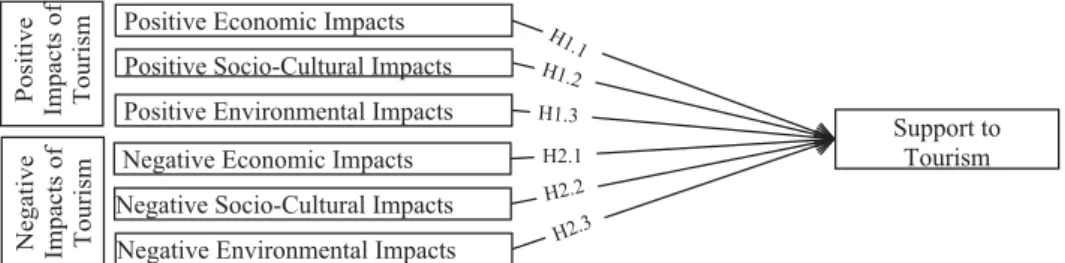
that the residents of Riga (Latvia) residents believe that tourism increases employment, lowers the prices of products and services, but does not increase their income. Further-more, they also think that tourism is socially salutary and that after tourism development, theft, prostitution, and alcohol and drug addiction in the community decreased and friendship, honesty, and trust among people improved significantly. However, local resi-dents are generally irresolute to tourism and they are hesitant about tourism develop-ment because of the negative environdevelop-mental impacts occurred even in the early stages of tourism. Similarly, Pranic et al. (2012) found that Split (Croatia) residents perceive social impacts of sports tourism positively. But they did not examine support attitudes of locals. Even these few studies reveal that the residents of post-communist countries have divergent perceptions and, therefore, need to be examined more. So, this gap in the literature is a token for the need to examine the determinants of perception of and support for tourism development in less or never examined regions (Sinclair-Maragh & Gursoy, 2016). This study examines the relationship between the perceptions of local people about the impacts of tourism and their support for tourism development in post-communist Central Asian countries. The hypotheses and the theoretical model to be tested in this context are as follows;
H1. Local residents’ perceptions of positive impacts increase their support for tourism. H1.1. Local residents’ perceptions of positive economic impacts increase their support for
tourism.
H1.2. Local residents’ perceptions of positive socio-cultural impacts increase their support for tourism.
H1.3. Local residents’ perceptions of positive environmental impacts increase their support for tourism.
H2. Local residents’ perceptions of negative impacts decrease their support for tourism. H2.1. Local residents’ perceptions of negative economic impacts decrease their support
for tourism.
H2.2. Local residents’ perceptions of negative socio-cultural impacts decrease their support for tourism.
H2.3. Local residents’ perceptions of negative environmental impacts decrease their support for tourism (Figure 1).
Methodology
Studyfield
With an area of 2,724,900 km2, Kazakhstan is the ninth largest country in the world and the second in the former Soviet Union. Its neighbors are China, Kyrgyzstan, Russia, Turk-menistan, and Uzbekistan. The survey was conducted in Turkestan (Figure 2). The city founded around 500 AD is one of the oldest cities of the country (Wikipedia, 2019a), and today has a population of∼100,000 people (Worldometers,2019).
Turkestan became famous as the city of Ahmed Yasawi who accelerated the transition of the Turks to Islam, and furthermore, with his shrine built by Tamerlane in 1396, the city
became an important religious point (Taşağıl,2012). Shrine of Ahmet Yasawi, a UNESCO World Heritage Site, is the most important tourist attraction in Turkestan. Also, the city has historical and natural attractions like Hilvet Semi-Underground Mosque (dated to twelfth century), History Museum of Turkestan, Otrar National Museum, and Sayram-Ugam National Nature Park (Kazakh Tourism, 2019). With an increase of 10% compared to 2017, 8.5 million tourists visited Kazakhstan in 2018 and 3/4 of international tourists were from neighboring countries (Russia, Uzbekistan, Kyrgyzstan, and Tajikistan) (Inform-Buro,2019).
While 1.15 million people visited Turkestan in 2017, the big majority of visitors are domestic, and the number of international visitors is only about 35,500 (Kursiv, 2018). Therefore, from the planning point of view, since it experiences the first stages of tourism development due to the number of international tourists and tourism revenues (UNWTO,2019), Turkestan would supply a proper case to examine the local residents’ per-ceptions of and reactions toward tourism in under-researched and new emerging tourism destinations.
Questionnaire and data gathering
Firstly, literature review was conducted and questionnaire was formed adopting the scales used in Ko and Stewart (2002), Caliskan (2003), and Jurowski and Gursoy (2004). Figure 1.Theoretical model.
The questionnaire had three parts. In thefirst part, 18 statements were used to gather the perceptions about the economic, socio-cultural, and environmental impacts of tourism, while in the second part, three statements were given to understand the level of support to tourism. In these 21 statements, the participants were asked to express their views on thefive-point Likert scale (1, Definitely disagree; 3, Nor agree, neither disagree; 5, Definitely agree). The third part consisted of five demographic questions about age, gender, educational level, marital status, and monthly income. Income was obtained in Kazakhstan currency (KZT = Tenge) and converted into US dollar based on the average exchange rate of the survey period.
This survey is based on examining a“case”. Through sampling, case studies serve to investigate a concept in real-life situations (Xiao & Smith, 2006) and to test theories (Chen & Xiao,2013; Eisenhardt,1989). To communicate with participants easier, the ques-tionnaire forms were administered by 3 Kazakh students who were studying at the Tourism Faculty of Ahmet Yasawi University and were informed about content and purpose of the study.
Due to time andfinancial constraints, convenience sampling was utilized. Since partici-pants are more willing to answer when they see the researchers (Zamani-Farahani & Musa,
2012), questionnaires were conducted face to face. The participants were approached in business and/or residential areas and in different time intervals of day. The participants were first asked if they were older than 18 years. Then, after brief information about the study and explanation that their personal information wouldn’t be recorded, they were kindly invited to participate in the study. The participants completed the question-naire in self-administered way. This procedure is preferred to prevent non-response or late response biases. However, people were reluctant tofill out the questionnaire, only approximately one-sixth of the individuals approached participated in the study. It was not surprising since they were not familiar with being asked for their opinions because of their communist regime background (Hall, 2004; Simpson, 1999). Therefore, the sample size of 250 was considered acceptable (Roberts & Simpson,1999) as it exceeds the threshold of 200 (Anderson & Gerbing,1988; Bollen,1989cited in Kim et al.,2013)
The data were analyzed with multivariate statistical methods. Frequency analysis and descriptive statistics regarding the demographic characteristics of the participants were performed. To test the research questions, reliability and validity analyses were run first, and then regression analysis was applied to determine the effects of perceptions on support for tourism. Findings are discussed below.
Findings
More than half of the participants were male (56.4%) and single (57.7%). While a very small number of participants were aged 55 and over, 52.6% of participants were between 18 and 24 years old and 45.7% of them (114 participants) were between 25 and 54 years old. Thesefigures are consistent with the demographic structure of the country. More than 90% of the Kazakhstan population is 60 years or younger (Konya Chamber of Com-merce,2016). Also, due to age distributions, it can be said that the data reflects opinions of both who were born after 1991 (the year Soviet system collapsed) and those who experienced communist regime. The education level of the participants is high. 87.9% of the participants reported that they received university and higher education. Moreover,
considering that the average income per capita in Kazakhstan is 26440 KZT (approxi-mately $68) in 2018 (National Bank of Kazakhstan, 2019), the sample’s representation power is good. A very large part of the respondents (86.4%) have a monthly income of $200 or less, while the income of 55% was $100 or less (Table 1).
Normality, missing values, and reliability
Before performing analyzes, missing values and the normal distribution of the data were checked. The statements of tourism is positive for the protection of local culture and tourism adversely affects children and young people had nine missing values (%3.6). In other expressions, there were three or four (1.5%) missing values on average. Therefore, since missing data for each variable were <5%, no action was taken (Schafer,1999). Afterwards, the normality of data was examined through skewness and kurtosis values. It was found that skewness values were ranged between−1.461 and 0.763; and kurtosis values were ranged between−1.166 and 2.507. Based on thresholds of skewness to be <3 and kurtosis to be <10 recommended by Kline (2011), it was accepted that the data were normally distributed.
In the next step, Cronbach alpha (α) was used to measure the reliability of the variables. The compositeα-value of 21 expressions was 0.699, while the reliability values (α) of 18 expressions for tourism impacts and three expressions for support were 0.704 and 0.697, respectively. For reliability, Hair et al. (1998) underline that α values between 0.60 and 0.70 indicate low reliability, while the values above 0.70 indicate mediocre reliability. Therefore, it was decided that the data were reliable and suitable for analysis.
Explanatory factor analysis
Explanatory factor analysis (EFA) was conducted to test the validity of the scales adopted from the literature. In EFA, Kaiser Normalization and Varimax rotation method were used and eigenvalue and factor loadings were accepted to be 1.0 or more and 0.30 or more, Table 1.Frequencies of demographic variables.
Gender Age N % N % Women 109 43.6 18–24 131 52.6 Male 141 56.4 25–34 66 26.5 Total 250 100 35–44 31 12.4 45–54 17 6.8 Marital status 55–64 3 1.2 N % 65 and over 1 0.4 Single 143 57.7 Total 249 100 Married 105 42.3
Total 248 100 Monthly Income ($)
N %
Education 0–100 133 55
N % 101–200 76 31.4
Primary 11 4.4 201–300 25 10.3
Secondary 19 7.7 301–500 5 2.1
University 188 75.8 501 and over 3 1.2
Master and PhD 30 12.1 Total 242 100
respectively (Hair et al.,1998). During EFA, since its communality was <0.5 (Kalaycı,2008), the item tourism causes increase in prices were extracted. Moreover the expressions tourism increases bad habits in society; tourism is useful for restoration of buildings; and tourism leads to traffic density were also excluded as they were loaded on two different factors and differences between factor loadings were <0.1. Afterwards, two factors com-posed of tourism is useful for diversification of cultural activities, tourism increases parks and green areas and tourism is useful for protection of local culture, tourism causes overcrowding expressions, respectively, were excluded, since their reliability values were very low (0.507 and 0.407, respectively) and the analysis was renewed.
In thefinal analysis, rotation was finalized in four iterations, the Kaiser–Meyer–Olkin (KMO) test results was 0.672, and significance level (p) of Bartlett sphericity test was <.001. A four-factor structure (Negative Cultural and Environmental Impacts [NCEI], Nega-tive Social Impacts [NSI], PosiNega-tive Economic Impacts [PEI], and Support [SUP]) explaining 59.486% of the total variance was erupted. The results that KMO value was over 0.60 (Hair et al., 1998), Bartlett test was <0.001, (Çokluk et al., 2016), the explained variance was above 50% (Yaşlıoğlu,2017), and all factors were loaded by at least two variables (Kim et al., 2013) indicate that factor analysis is appropriate and valid. Cronbach alpha (α) values of factors were 0.756, 0.633, 0.700, and 0.697 respectively (Table 2). Therefore, the scales and items used for analysis were found to be moderately reliable and valid.
The results of EFA show that the residents of Turkestan are aware of the negative effects of tourism. However, the means of negative environmental and cultural impacts and negative social impact factors (2.56 and 2.58, respectively) indicate that people don’t consider them as major problems. The most negative perceptions are about
Table 2.Results of EFA.
Factor loadings
Explained
variance (%) Eigenvalue Alpha Mean St. Dev.
NCEI 2.342 18.014 0.756 2.53 0.898
Tourism harms the customs and traditions 0.742 2.46 1.168 Tourism affects children and young people
adversely
0.748 2.53 1.187
Tourism destroys nature 0.743 2.39 1.172
Tourism creates noise and pollution 0.785 2.74 1.193
NSI 1.912 14.704 0.633 2.58 0.798
Local people have trouble living in the tourism area
0.610 2.33 1.117
Tourists adversely affect the local people 0.653 2.48 1.057 Tourism increases crime rate in society 0.732 2.64 1.139 Tourism increases violence in society 0.695 2.84 1.275
PEI 1.543 11.871 0.700 3.92 0.835
Tourism increases employment opportunities 0.859 3.99 0.990 Tourism attracts more investment to the region 0.876 3.86 0.918
SUP 1.937 14.897 0.697 4.17 0.665
More accommodation facilities must be built 0.711 4.14 0.899 Tourism types and activities should be diversified 0.835 4.10 0.756 Food and beverage and accommodation services
should be improved
0.805 4.28 0.875
Kaiser–Meyer–Olkin measure of sampling adequacy
0.672 Bartlett’s test of sphericity Approx. Chi-Square 582.340
Df 78
increase in violence (M=2.84, St. Dev. = 1.275), in noise and pollution (M=2.74, St. Dev. = 1.193), and in crime rates (M=2.64, St. Dev. = 1.139).
Also, in contrast to the notification of Vargas-Sanchez et al. (2015) that perceptions about positive impacts do not occur clearly in new emerging destinations, it is observed that the positive economic perception were very clear (M=3.92 St. Dev. = 0.835). Further-more, it is observed that local residents are very supportive to tourism development with the mean of 4.17.
Regression analysis
Regression analysis with stepwise method was performed to determine the relationship between independent variables (NCEI, NSI, PEI) and dependent variable (SUP). The corre-lation values between the variables which are <0.8 (Table 3) show that there is no multi-collinearity problem in the model (Büyüköztürk,2017). In other words, the contribution of each independent variable to the model is important (Kalaycı,2008). The Durbin–Watson value (which is 1.838 in this study) between 1.5 and 2.5 shows that there is no auto-cor-relation between the variables in the model (Kalaycı,2008). Depending on significance values of <0.05 (0.09 and 0.019 in this study), Anova test indicates if the models are stat-istically valid.
Analysis results emphasize that NSI and PEI are effective on SUP, but NCEI is not. However, it is revealed that independent variables explain the support attitude very low. PEI, alone, explains 1.8% while NSI and PEI together explain only 3% of the support attitude. The low rates of disclosure underline that rather than impacts of tourism, other factors are more important in support of tourism. Therefore, studies to determine the other factors affecting the attitude of supporting tourism will contribute to tourism planning.
Beta values also indicate that impacts are not very indicative. One-unit increase in per-ceptions of PEI increases the SUP by 0.144 units, while deepening perper-ceptions of NSI reduces it by −0.122. Thus, as it would be expected, there is a positive relation between SUP and PEI and an inverse relationship between NSI and SUP. In this context, findings supported the hypotheses H1.1 and H2.2, while the hypotheses H1.2, H1.3, H2.1, and H2.3 could not be confirmed. Therefore, according to the results of the study, the relationship between impacts of tourism and the support can be formulated as follows (Figure 3):
SUP= 3.994 + (0.144∗PEI)–(0.126∗NSI)
Table 3.Correlations between variables.
SUP NCEI NSI PEI
Pearson correlations SUP 1.000 NCEI −0.078 1.000 NSI −0.130 0.312 1.000 PEI 0.148 −0.040 −0.029 1.000 Significance (one-tailed) SUP . NCEI 0.110 . NSI 0.020 0.000 . PEI 0.010 0.266 0.324 .
Table 4.Results of regression analysis. Model ANOVA R R2 AdjustedR2 ErrorSt. Change statistics Durbin– Watson St. beta t Sig. F Sig. R 2 change changeF df1 df2 Sig.F change 1 5.565 0.019 0.148 0.022 0.018 0.65852 0.022 5.565 1 248 0.019 1.838 Constant 18.529 0.000 PEI 0.148 2.359 0.019 2 4.856 0.009 0.195 0.038 0.030 0.65447 0.016 4.079 1 247 0.045 Constant 16.426 0.000 PEI 0.144 2.314 0.021 NSI −0.126 −2.020 0.045
Dependent variable: SUP
U. ÇALI Ş KA N A ND Ö. ÖZ ER
Conclusions
Although local residents’ perception of and support for tourism have been frequently examined for the last decades, most of the studies have been carried out in developed countries and “mature” tourism destinations (Hunt & Stronza, 2014). Literature review showed that, in international journals, there were very few studies on the views of the local people in the former communist countries as well as none in Central Asian countries. Therefore, in post-communist countries which underwent many transformations after regime change, it is important to examine perceptions of local residents as tourism increases relations with foreigners with different cultural backgrounds and ideas (Simpson,1999). This study is important because it attempts to reduce this gap in the literature.
The results underline that the residents are aware that tourism brings both benefits and costs. Though they have some reservations about negative impacts on society, tra-ditions, and the environment, residents’ overall perception about tourism is fairly favor-able and they have positive attitudes toward tourism. As Upchurch and Teivane (2000) states, it can be noted that as the tourism industry develops, so do the perception about both benefits and costs, in post-communist countries too. The most positive per-ceptions were observed for positive economic impacts, while perper-ceptions about positive socio-cultural and environmental impacts were not clarified. This result may be bound to the fact that the majority of visitors are domestic and from neighboring countries having the same political and close cultural background. However, the residents of Turkestan are aware of the negative impacts of tourism but they think that these do not constitute a major problem for today. Therefore, it can be stated that in emerging destinations, posi-tive economic impacts come to the forefront, but negaposi-tive effects are also not neglected. These results are in line with McGehee and Andereck (2004), Chiang and Yeh (2011), and Sánchez et al. (2014) who emphasized that economic concerns are dominant, but they do not confirm the conclusion that the negative impacts are ignored in behalf of economic gains (Stylidis et al.,2014) in developing destinations. The results also partly contradict the results of Vargas-Sanchez et al. (2015) who claim that in emerging destinations, percep-tions of any positive effects do not occur, or of Allen et al. (1993), Amuquandoh (2010), and Chuang (2013) who assumed that negative impacts are less perceived at the initial stages of tourism development.
Turkestan residents think that tourism creates employment and attracts investment. Thisfinding supports conclusion of Hunt and Stronza (2014) that, in the early stages of tourism development, local people would be more interested in the new economic opportunities. Therefore, in order to manage the positive attitudes toward tourism, local people should be taken into consideration not only in planning but also in operation Figure 3.Thefinal model. Note: The relationships shown with straight line are statistically significant and the dashed lines are not.
processes. As Chuang (2013) points, possible perceptions may turn negative if the benefits are not spread to the whole population in the long term. Similarly, Liang and Hui (2016) state that in Shenzhen (China), where the local people are in passive position and large-scale investments have been made by non-local investors, attitudes toward tourism turns to negative, although it creates employment opportunities for many local residents.
As they emerge in longer term (Ohmann et al.,2006), thefindings suggest that percep-tions about social and environmental impacts of tourism were not clear in the early stages of tourism development. However, some negative effects were not ignored. Factor struc-tures on negative environmental and socio-cultural impacts indicate increased awareness about them. Although local people generally“partially disagree” that tourism has nega-tive socio-cultural and environmental impacts, they also think that tourism increases vio-lence, crime rates, and noise and pollution. Contrast to results of Zamani-Farahani and Musa (2012) who stated that crime and violence did not appear as important problems in newly developing destinations, these were declared as principal problems for Turke-stan. Moreover; while the results of the study were similar with Upchurch and Teivane (2000) and Pranic et al. (2012) about environmental impacts of tourism, the other two researches did not detect any social problem perception unlike this study.
As this study underlines, Chhabra and Gursoy (2007) point not only positive percep-tions increase support but also negative perceppercep-tions decrease it. Similar to Tosun (2002) and Chi et al. (2017), this study found that there is a direct relationship between support and positive (economic) impacts. Moreover, thefindings are also coherent with Simpson (1999) who stated that the residents of Prague, another post-communist desti-nation, support tourism due to economic benefits. However, though Gursoy and Ruther-ford (2004) and Lee and Back (2003,2006) stated that as well as economic impacts, socio-cultural, and environmental impacts also intensify the support, this study determines that only economic positive impacts are effective.
On the other hand, thefindings are also compatible with Gursoy and Rutherford (2004) who indicated that negative cultural impacts has no effect on support or with Lee and Back (2003) who revealed that negative environmental impacts are not effective on support. But they contradict with Upchurch and Teivane (2000), who stated that environ-mental impacts decreased support for tourism. Since, though negative social impacts decreases the support, the relationship between negative environmental impacts and support for tourism is not identified in this study. Even these differences emphasize that post-communist countries should be examined in detail rather than monotyping in terms of social problems and structure (Pranic et al.,2012).
Since the negative effects are not considered as a major problem and that people support tourism mainly for economic reasons, results of this research support the basic assumption of SET that as long as the benefits they get (or they perceive that they get) are greater than the costs they have to face, individuals would continue to change (support for tourism development) (Gursoy & Rutherford,2004). On the other hand, it has also been determined that perceptions of tourism impacts are insufficient to explain the local people’s attitude toward supporting tourism. Therefore, the results indi-cate that SET alone is not very competent in explaining local people’s attitudes toward tourism, at least in post-communist countries. Therefore, it will be useful to consider other theories/factors to examine the attitude of supporting tourism development.
As emphasized also in this study, tourism development has variable impacts on society and space. While some people perceive tourism positively, others may be disturbed. Determination of which parts of the society are in favor of or opposing tourism is impor-tant, because through actions designed specifically for groups, not only the support may be increased, but also the opposing views might be reduced. In this regard, it is important to ensure the effective participation and involvement of local people in tourism economy and to develop tourism in line with their wishes and expectations (Chhabra & Gursoy,
2007). Therefore, in addition to raising awareness of local people on tourism and effective participation of local people in the planning stage, paving the ways for local entrepreneurs would raise local support.
Limitations and opportunities for further research
As other ones, this study has some limitations either. Firstly, the data were collected by convenience sampling method, and though some measures were taken to secure the sample to represent the universe; the results are difficult to generalize. In future studies utilizing different sampling methods, different results may be derived. The fact that the data were collected through questionnaires is another limitation. In the studyfield, par-ticipants’ hesitations about filling the questionnaire also emphasize that qualitative research would be more appropriate for obtaining in-depth information (Hadinejad et al.,2019). Therefore, instead of quantitative methods, qualitative methods may allow deeper analysis, in settlements which are newly acquainted with tourism, and/or with local people who are not accustomed to being asked for opinions due to their political and cultural backgrounds.
Lastly, the fact that the variables used in this study do not constitute valid factor struc-tures for positive socio-cultural and environmental impacts of tourism accentuates that not only perceptions about these impacts are not clear, but also the statements used for the evaluation of perceptions about these impacts may not fit the study area. In other words, it can be stated using different items may ensue different results in future studies.
Disclosure statement
No potential conflict of interest was reported by the author(s).
References
Akis, S., Peristianis, N., & Warner, J. (1996). Residents’ attitudes to tourism development: The case of Cyprus. Tourism Management, 17(7), 481–494.https://doi.org/10.1016/S0261-5177(96)00066-0
Alhasanat, S. (2011). Sociocultural impacts of tourism on the local community at Petra, Jordan. Jordan Journal of Social Sciences, 4(1), 144–158.
Allen, L., Hafer, H., Long, R., & Perdue, R. (1993). Rural residents’ attitudes toward recreation and tourism development. Journal of Travel Research, 31(4), 27–33. https://doi.org/10.1177/ 004728759303100405
Allworth, E., Sinor, D., Smith, D. R., & Hambly, G. R. G. (2019). Kazakhstan. In Encyclopaedia Britannica.
https://www.britannica.com/place/Kazakhstan
Ambroz, M. (2008). Attitudes of local residents towards the development of tourism in Slovenia: The case of the Primorska, Dolenjska, Gorenjska and Ljubljana regions. Anthropological Notebooks, 14 (1), 63–79.
Amuquandoh, F. E. (2010). Residents’ perceptions of the environmental impacts of tourism in the Lake Bosomtwe Basin, Ghana. Journal of Sustainable Tourism, 18(2), 223–238. https://doi.org/ 10.1080/09669580903298531
Andereck, K. L., & Nyaupane, G. P. (2011). Exploring the nature of tourism and quality of life percep-tions among residents. Journal of Travel Research, 50(3), 248–260. https://doi.org/10.1177/ 0047287510362918
Andereck, K. L., Valentine, K. M., Knopf, R. C., & Vogt, C. A. (2005). Residents’ perceptions of commu-nity tourism impacts. Annals of Tourism Research, 32(4), 1056–1076. https://doi.org/10.1016/j. annals.2005.03.001
Andereck, K. L., Valentine, K. M., Vogt, C. A., & Knopf, R. C. (2007). A cross-cultural analysis of tourism and quality of life perceptions. Journal of Sustainable Tourism, 15(5), 483–502.https://doi.org/10. 2167/jost612.0
Andereck, K., & Vogt, C. (2000). The relationship between residents’ attitudes toward tourism and tourism development Options. Journal of Travel Research, 39(1), 27–36.https://doi.org/10.1177/ 004728750003900104
Anderson, J. R., & Gerbing, D. W. (1988). Structural equation modeling in practice: A review and rec-ommended two-step approach. Psychological Bulletin, 103(3), 411–423.https://doi.org/10.1037/ 0033-2909.103.3.411
Andriotis, K. (2008). Integrated resort development: The case of Cavo Sidero, Crete. Journal of Sustainable Tourism, 16(4), 428–444.https://doi.org/10.1080/09669580802154207
Ap, J. (1992). Resident perceptions on tourism impacts. Annals of Tourism Research, 19(4), 665–690.
https://doi.org/10.1016/0160-7383(92)90060-3
Ap, J., & Crompton, J. L. (1998). Developing and testing a tourism impact scale. Journal of Travel Research, 37(4), 120–130.https://doi.org/10.1177/004728759803700203
Beeton, S. (2006). Community development through tourism. Landlinks Press.
Belisle, F. J., & Hoy, D. R. (1980). The perceived impact of tourism by residents; A case study in Santa Marta, Colombia. Annals of Tourism Research, 7(1), 83–101.https://doi.org/10.1016/S0160-7383 (80)80008-9
Besculides, A., Lee, M., & McCormick, P. (2002). Residents’ perceptions of the cultural benefits of tourism. Annals of Tourism Research, 29(2), 303–319. https://doi.org/10.1016/S0160-7383 (01)00066-4
Bitsani, E., & Kavoura, A. (2014). Host perceptions of rural tour marketing to sustainable tourism in Central Eastern Europe. The case study of Istria, Croatia. Procedia-Social and Behavioral Sciences, 148, 362–369.https://doi.org/10.1016/j.sbspro.2014.07.054
Blam, I., Vitálišová, K., Borseková, K., & Sokolowicz, M. (2016). Peculiarities of corporate social respon-sibility development in the monotowns in post-communist countries. Social Responrespon-sibility Journal, 12(3), 463–483.https://doi.org/10.1108/SRJ-07-2015-0099
Bollen, K. A. (1989). Structural equations with latent variables. Wiley.
Brida, J. G., Osti, L., & Faccioli, M. (2011). Residents’ perception and attitudes towards tourism impacts: A case study of the small rural community of Folgaria (Trentino-Italy). Benchmarking: An International Journal, 18(3), 359–385.https://doi.org/10.1108/14635771111137769
Briedenhann, J., & Wickens, E. (2004). Tourism routes as a tool for the economic development of rural areas-vibrant hope or impossible dream? Tourism Management, 25(1), 71–79.https://doi. org/10.1016/S0261-5177(03)00063-3
Brunt, P., & Courtney, P. (1999). Host perceptions of sociocultural impacts. Annals of Tourism Research, 26(3), 493–515.https://doi.org/10.1016/S0160-7383(99)00003-1
Butler, R. W. (1980). The concept of a tourist area cycle of evolution implications for management of resources. The Canadian Geographer, 24(1), 5–12.https://doi.org/10.1111/j.1541-0064.1980.tb00970.x
Büyüköztürk,Ş. (2017). Sosyal Bilimler İçin Veri Analizi El Kitabı, İstatistik, Araştırma Deseni, SPSS Uygulamaları [Data analysis handbook for social sciences, statistics, research design, SPSS appli-cations]. Pegem Akademi Yayıncılık.
Caliskan, U. (2003). Turizmin Yerel Halk Üzerindeki Etkileri ve Kuşadası Ilçesi Uygulaması (in Turkish) [impacts of tourism on local people and Kuşadası Pattern]. [Unpublished Master thesis]. Dokuz Eylül University,İzmir, Turkey.
Caliskan, U., Saltik, I. A., Ceylan, R., & Bahar, O. (2019). Panel cointegration analysis of relationship between international trade and tourism: Case of Turkey and silk road countries. Tourism Management Perspectives, 31, 361–369.https://doi.org/10.1016/j.tmp.2019.07.003
Carneiro, M. J., Eusebio, C., & Caldera, A. (2018). The influence of social contact in residents’ percep-tions of the tourism impact on their quality of life: A structural equation model. Journal of Quality Assurance in Hospitality & Tourism, 19(1), 1–30.https://doi.org/10.1080/1528008X.2017.1314798
Cegielski, M., & Mules, T. (2002). Aspects of residents’ perceptions of the GMC 400-Canberra’s V8 Supercar Race. Current Issues in Tourism, 5(1), 54–70.https://doi.org/10.1080/13683500208667908
Chen, C. F., & Chen, P. C. (2010). Resident attitudes toward heritage tourism development. Tourism Geographies, 12(4), 525–545.https://doi.org/10.1080/14616688.2010.516398
Chen, G., & Xiao, H. (2013). Motivations of repeat visits: A longitudinal study in Xiamen, China. Journal of Travel & Tourism Marketing, 30(4), 350–364. https://doi.org/10.1080/10548408.2013. 784152
Chhabra, D., & Gursoy, D. (2007). Perceived impacts of gambling: Integration of two theories. UNLV Gaming Research & Review Journal, 11(1), 27–40.
Chi, C. G.-q., Cai, R., & Li, Y. (2017). Factors influencing residents’ subjective well-being at world heri-tage sites. Tourism Management, 63, 209–222.
Chiang, Y., & Yeh, S. (2011). The examination of factors influencing residents perceptions and atti-tudes towardfilm induced tourism. African Journal of Business Management, 5(13), 5371–5377.
https://doi.org/10.5897/AJBM11.475
Choi, H. C., & Murray, I. (2010). Resident attitudes toward sustainable community tourism. Journal of Sustainable Tourism, 18(4), 575–594.https://doi.org/10.1080/09669580903524852
Chuang, S.-T. (2013). Residents’ attitudes toward rural tourism in Taiwan: A comparative viewpoint. International Journal of Tourism Research, 15(2), 152–170.https://doi.org/10.1002/jtr.1861
Çokluk, Ö,Şekercioğlu, G., & Büyüköztürk, Ş. (2016). Sosyal Bilimlerİçin Çok Değişkenli İstatistik, SPSS ve LISREL Uygulamaları [Multivariate statistics for social Sciences, SPSS and LISREL applications]. Pegem Akademi Yayıncılık.
Dogan, H. Z. (1989). Forms of Adjustment: Sociocultural impacts of tourism. Annals of Tourism Research, 16(2), 213–236.https://doi.org/10.1016/0160-7383(89)90069-8
Doxey, G. V. (1975, September 8–11). A causation theory of visitor-resident irritants: Methodology and research inferences. In The Impact of Tourism: Sixth Annual Conference Proceedings (pp. 195– 198). San Diego: Travel Research Association.
Dyer, P., Gursoy, D., Sharma, B., & Carter, J. (2007). Structural modeling of resident perceptions of tourism and associated development on the Sunshine Coast, Australia. Tourism Management, 28(2), 409–422.https://doi.org/10.1016/j.tourman.2006.04.002
Eisenhardt, K. M. (1989). Building theories from case study. The Academy of Management Review, 14 (4), 532–550.https://doi.org/10.5465/amr.1989.4308385
Eraqi, M. I. (2007). Local communities’ attitudes towards impacts of tourism development in Egypt. Tourism Analysis, 12(3), 191–200.https://doi.org/10.3727/108354207781626848
Fredline, E. (2005). Host and guest relations and sport tourism. Sport in Society, 8(2), 263–279.https:// doi.org/10.1080/17430430500087328
Gannon, M., Rasoolimanesh, S.M., and Taheri, B. (2020). Assessing the Mediating role of residents’ perceptions toward tourism development. Journal of Travel Research. Advance online publication.
doi:10.1177/0047287519890926
Gezon, L. L. (2014). Who wins and who loses? Unpacking the“local people” concept in ecotourism: A longitudinal study of community equity in Ankarana, Madagascar. Journal of Sustainable Tourism, 22(5), 821–838.https://doi.org/10.1080/09669582.2013.847942
Goic, S., & Bilic, I. (2008). Business culture in Croatia and some countries in transition. Management, 13(2), 41–63.
Gunn, C., & Var, T. (2002). Tourism planning: Basics, concepts, cases. Routledge.
Gursoy, D., Jurowski, C., & Uysal, M. (2002). Resident attitudes: A structural modeling approach. Annals of Tourism Research, 29(1), 79–105.https://doi.org/10.1016/S0160-7383(01)00028-7
Gursoy, D., & Kendall, K. (2006). Hosting mega events: Modeling locals’ support. Annals of Tourism Research, 33(3), 603–623.https://doi.org/10.1016/j.annals.2006.01.005
Gursoy, D., & Rutherford, D. G. (2004). Host attitudes toward tourism: An improved structural model. Annals of Tourism Research, 31(3), 495–516.https://doi.org/10.1016/j.annals.2003.08.008
Hadinejad, A., Moyle, B. D., Scott, N., Kralj, A., & Nunkoo, R. (2019). Residents’ attitudes to tourism: A review. Tourism Review, 74(2), 150–165.https://doi.org/10.1108/TR-01-2018-0003
Hair, J. F., Anderson, R. E., Tatham, R. L., & Black, W. C. (1998). Multivariate data analysis (5th ed.). Prentice Hall.
Hall, D. (2004). Rural tourism development in Southeastern Europe: Transition and the search for sustainability. International Journal of Tourism Research, 6(3), 165–176.https://doi.org/10.1002/ jtr.482
Harrill, R. (2004). Residents’ attitudes toward tourism development: A literature review with impli-cations for tourism planning. Journal of Planning Literature, 18(3), 251–266. https://doi.org/10. 1177/0885412203260306
Hartwell, H., Fyall, A., Willis, C., Page, S., Ladkin, A., & Hemingway, A. (2018). Progress in tourism and destination wellbeing research. Current Issues in Tourism, 21(16), 1830–1892.https://doi.org/10. 1080/13683500.2016.1223609
Hughes, H., & Allen, D. (2005). Cultural tourism in Central and Eastern Europe: The views of‘induced image formation agents’. Tourism Management, 26(2), 173–183. https://doi.org/10.1016/j. tourman.2003.08.021
Hunt, C., & Stronza, A. (2014). Stage-based tourism models and resident attitudes towards tourism in an emerging destination in the developing world. Journal of Sustainable Tourism, 22(2), 279–298.
https://doi.org/10.1080/09669582.2013.815761
InformBuro. (2019).В 2018 году Казахстан посетили 8, 5 млн туристов. Зачем они приезжали и сколько денег оставили? [In 2018, 8.5 million tourists visited Kazakhstan. Why did they come and how much money did they leave?]. https://informburo.kz/stati/v-2018-godu-kazahstan-posetili-85-mln-turistov-zachem-oni-priezzhali-i-skolko-deneg-ostavili-.html
Ivanov, S., & Achikgezyan, V. (2017). Attitudes towards communist heritage tourism in Bulgaria. International Journal of Tourism Cities, 3(3), 273–290.https://doi.org/10.1108/IJTC-01-2017-0001
Jimura, T. (2011). The impact of world heritage site designation on local communities– A case study of Ogimachi, Shirakawa-mura, Japan. Tourism Management, 32(2), 288–296. https://doi.org/10. 1016/j.tourman.2010.02.005
Jurowski, C., & Gursoy, D. (2004). Distance effects on residents’ attitudes toward tourism. Annals of Tourism Research, 31(2), 296–312.https://doi.org/10.1016/j.annals.2003.12.005
Jurowski, C., Uysal, M., & Williams, D. R. (1997). A theoretical analysis of host community resident reactions to tourism. Journal of Travel Research, 36(2), 3–11. https://doi.org/10.1177/ 004728759703600202
Kalaycı, Ş. (2008). SPSS Uygulamalı Çok Değişkenli İstatistik Teknikleri (3rd Ed.) [SPSS applied multi-variate statistical Techniques]. Asil Yayın Dağıtım.
Kang, S. K., & Lee, J. (2018). Support of marijuana tourism in Colorado: A residents’ perspective using social exchange theory. Journal of Destination Marketing & Management, 9, 310–319.https://doi. org/10.1016/j.jdmm.2018.03.003
Kaplanidou, K., & Karadakis, K. (2010). Understanding the legacies of a host olympic city: The case of the 2010 Vancouver Olympic Games. Sport Marketing Quarterly, 19, 110–117.
Kazakh Tourism. (2019).Достопримечательности [Attractions].http://turkistantravel.com/ru/
Khazanet, V. L. (1997). Environment of transition: New and old positive and negative trends in the post-Soviet marketplace. European Business Review, 97(3), 111–123. https://doi.org/10.1108/ 09555349710167521
Kim, K., Uysal, M., & Sirgy, M. J. (2013). How does tourism in a community impact the quality of life of community residents? Tourism Management, 36, 527–540. https://doi.org/10.1016/j.tourman. 2012.09.005
King, B., Pizam, A., & Milman, A. (1993). Social impacts of tourism: Host perceptions. Annals of Tourism Research, 20(4), 650–665.https://doi.org/10.1016/0160-7383(93)90089-L
Kline, R. B. (2011). Principles and practice of structural equation modelling (3rd ed.). Guilford Publications.
Ko, D. W., & Stewart, W. P. (2002). A structural equation model of residents’ attitudes for tourism development. Tourism Management, 23(5), 521–530. https://doi.org/10.1016/S0261-5177 (02)00006-7
Konya Chamber of Commerce. (2016). Kazakistan Ülke Raporu [Report on Kazakhstan].http://www. ebso.org.tr/ebsomedia/documents/kazakistan-ulke-raporu_6774334.doc
Kousis, M. (1989). Tourism and the family in a rural Cretan community. Annals of Tourism Research, 16 (3), 318–332.https://doi.org/10.1016/0160-7383(89)90047-9
Kursiv. (2018).Развитие туризма в Казахстане: Туркестан ждет миллионного туриста [Tourism development in Kazakhstan: Turkestan is waiting for millions of tourists]. https://kursiv.kz/ news/otraslevye-temy/2018-10/razvitie-turizma-v-kazakhstane-turkestan-zhdet-millionnogo-turista
Ladkin, A. (2011). Exploring tourism labor. Annals of Tourism Research, 38(3), 1135–1155.https://doi. org/10.1016/j.annals.2011.03.010
Lankford, S. V. (1994). Attitudes and perceptions toward tourism and rural regional development. Journal of Travel Research, 32(2), 35–43.https://doi.org/10.1177/004728759403200306
Latkova, P., & Vogt, C. A. (2012). Residents’ attitudes toward existing and future tourism develop-ment in rural communities. Journal of Travel Research, 51(1), 50–67. https://doi.org/10.1177/ 0047287510394193
Lee, C.-K., & Back, K.-J. (2003). Pre-and post-Casino impact of residents’ perception. Annals of Tourism Research, 30(4), 868–885.https://doi.org/10.1016/S0160-7383(03)00060-4
Lee, C.-K., & Back, K.-J. (2006). Examining structural relationships among perceived impact, benefit and support for Casino development based on 4 year longitudinal data. Tourism Management, 27 (3), 466–480.https://doi.org/10.1016/j.tourman.2004.11.009
Lee, T. H. (2013). Influence analysis of community resident support for sustainable tourism develop-ment. Tourism Management, 34, 37–46.https://doi.org/10.1016/j.tourman.2012.03.007
Lepp, A. (2008). Attitudes towards initial tourism development in a community with no prior tourism experience: The case of Bigodi, Uganda. Journal of Sustainable Tourism, 16(1), 5–22.https://doi. org/10.2167/jost630.0
Liang, Z. X., & Hui, T. K. (2016). Residents’ quality of life and attitudes toward tourism development in China. Tourism Management, 57, 56–67.https://doi.org/10.1016/j.tourman.2016.05.001
Lin, Z., Chen, Y., & Filieri, R. (2017). Resident-tourist value co-creation: The role of residents’ perceived tourism impacts and life satisfaction. Tourism Management, 61(2017), 436–442.https://doi.org/10. 1016/j.tourman.2017.02.013
Liu, J., Sheldon, P., & Var, T. (1987). Residents perceptions of the environmental impacts of tourism. Annals of Tourism Research, 14(1), 17–37.https://doi.org/10.1016/0160-7383(87)90045-4
Liu, J., & Var, T. (1986). Residents attitudes toward tourism impacts in Hawaii. Annals of Tourism Research, 13(2), 193–214.https://doi.org/10.1016/0160-7383(86)90037-X
Manyara, G., & Jones, E. (2007). Community-based tourism enterprises development in Kenya: An exploration of their potential as avenues of poverty reduction. Journal of Sustainable Tourism, 15(6), 628–644.https://doi.org/10.2167/jost723.0
Marangos, J. (2003). Global transition strategies in Eastern Europe: Moving to market relations. Development, 46(1), 112–117.https://doi.org/10.1177/1011637003046001597
Marzuki, A. (2012). Local residents⍰ perceptions towards economic impacts of tourism develop-ment in Phuket. Tourism, 60(2), 199–212.
Mason, P., & Cheyne, J. (2000). Residents’ attitudes to proposed tourism development. Annals of Tourism Research, 27(2), 391–411.https://doi.org/10.1016/S0160-7383(99)00084-5
Mathieson, A., & Wall, G. (1982). Tourism: Economic, physical and social impacts. Longman. Mbaiwa, J. E. (2004). The socio-cultural impacts of tourism development in the Okavango Delta,
Bostswana. Journal of Tourism and Cultural Change, 2(3), 163–184. https://doi.org/10.1080/ 14766820508668662
McGehee, N., & Andereck, K. (2004). Factors predicting rural residents’ support of tourism. Journal of Travel Research, 43(2), 131–140.https://doi.org/10.1177/0047287504268234
Milman, A., & Pizam, A. (1988). Social impacts of tourism on Central Florida. Annals of Tourism Research, 15(2), 191–204.https://doi.org/10.1016/0160-7383(88)90082-5
Mitchell, R. E., & Reid, D. G. (2001). Community integration: Island tourism in Peru. Annals of Tourism Research, 28(1), 113–139.https://doi.org/10.1016/S0160-7383(00)00013-X
Mordue, T. (2001). Performing and directing resident/tourist cultures in heartbeat country. Tourist Studies, 1(3), 233–252.https://doi.org/10.1177/146879760100100302
National Bank of Kazakhstan. (2019). Statistical Bulletin, No:08 (297) August 2019. https:// nationalbank.kz/?docid=456&switch=english
Nepal, S. K. (2008). Residents’ attitudes to tourism in Central British Columbia, Canada. Tourism Geographies, 10(1), 42–65.https://doi.org/10.1080/14616680701825123
Nunkoo, R., & Ramkissoon, H. (2009). Applying the means-end chain theory and the laddering tech-nique to the study of host attitudes to tourism. Journal of Sustainable Tourism, 17(3), 337–355.
https://doi.org/10.1080/09669580802159735
Nunkoo, R., & Ramkissoon, H. (2010). Modeling community support for a proposed integrated resort project. Journal of Sustainable Tourism, 18(2), 257–277. https://doi.org/10.1080/ 09669580903290991
Nunkoo, R., & Ramkissoon, H. (2011). Developing a community support model for tourism. Annals of Tourism Research, 38(3), 964–988.https://doi.org/10.1016/j.annals.2011.01.017
Ohmann, S., Jones, I., & Wilkes, K. (2006). The perceived social impacts of the 2006 Football World Cup on Munich residents. Journal of Sport & Tourism, 11(2), 129–152.https://doi.org/10.1080/ 14775080601155167
Ozturk, A. B., Ozer, O., & Caliskan, U. (2015). The relationship between local residents’ perceptions of tourism and their happiness: A case of Kusadasi, Turkey. Tourism Review, 70(3), 232–242.https:// doi.org/10.1108/TR-09-2014-0053
Paraskevaidis, P., & Andriotis, K. (2017). Altruism in tourism: Social exchange theory vs altruistic surplus phenomenon in host volunteering. Annals of Tourism Research, 62, 26–37.https://doi. org/10.1016/j.annals.2016.11.002
Park, M., & Stokowski, P. A. (2009). Social disruption theory and crime in rural communities: Comparisons across three levels of tourism growth. Tourism Management, 30(6), 905–915.
https://doi.org/10.1016/j.tourman.2008.11.015
Pranic, L., Petrić, L., & Cetinic, L. (2012). Host population perceptions of the social impacts of sport tourism events in transition countries; Evidence from Croatia. International Journal of Event and Festival Management, 3(3), 236–256.https://doi.org/10.1108/17582951211262684
Pratt, S., McCabe, S., & Movono, A. (2016). Gross happiness of a‘tourism’ village in Fiji. Journal of Destination Marketing & Management, 5(1), 26–35.https://doi.org/10.1016/j.jdmm.2015.11.001
Prentice, R. (1993). Community-driven tourism planning and residents’ preferences. Tourism Management, 14(3), 218–227.https://doi.org/10.1016/0261-5177(93)90023-E
Roberts, L., & Simpson, F. (1999). Developing partnership approaches to tourism in Central and Eastern Europe. Journal of Sustainable Tourism, 7(3–4), 314–330. https://doi.org/10.1080/ 09669589908667342
Sánchez, S. M. S., Tabales, J. M. N., & García, F. J. F. (2014). Local residents’ attitudes towards the impact of tourism development in Cape Verde. Tourism & Management Studies, 10(1), 87–96. Schafer, J. L. (1999). Multiple imputation: A primer. Statistical Methods in Medical Research, 8(1), 3–15.
https://doi.org/10.1177/096228029900800102
Simpson, F. (1999). Tourist impact in the Historic Centre of Prague: Resident and visitor perceptions of the historic built environment. The Geographical Journal, 165(2), 173–183.https://doi.org/10. 2307/3060415
Simpson, M. C. (2008). Community benefit, tourism initiative: A conceptual oxymoron. Tourism Management, 29(1), 1–18.https://doi.org/10.1016/j.tourman.2007.06.005
Sinclair-Maragh, G., & Gursoy, D. (2016). A conceptual model of residents’ support for tourism devel-opment in developing countries. Tourism Planning and Develdevel-opment, 13(1), 1–22.https://doi.org/ 10.1080/21568316.2015.1047531
Stronza, A. (2001). Anthropology of tourism: Forging new ground for ecotourism and other alterna-tives. Annual Review of Anthropology, 30(1), 261–283.https://doi.org/10.1146/annurev.anthro.30. 1.261
Stylidis, D., Biran, A., Sit, J., & Szivas, E. M. (2014). Residents’ support for tourism development: The role of residents’ place image and perceived tourism impacts. Tourism Management, 45, 260–274.
https://doi.org/10.1016/j.tourman.2014.05.006
Su, X., & Teo, P. (2008). Tourism Politics in Lijiang, China: An analysis of state and local interactions in tourism development. Tourism Geographies, 10(2), 150–168. https://doi.org/10.1080/ 14616680801999992
Taşağıl, A. (2012). Türkistan [Turkestan].https://islamansiklopedisi.org.tr/turkistan
Tosun, C. (2002). Host perceptions of impacts: A comparative tourism study. Annals of Tourism Research, 29(1), 231–245.https://doi.org/10.1016/S0160-7383(01)00039-1
Upchurch, R. S., & Teivane, U. (2000). Resident perceptions of tourism development in Riga, Latvia. Tourism Management, 21(5), 499–507.https://doi.org/10.1016/S0261-5177(99)00104-1
Uysal, M., Sirgy, M. J., Woo, E., & Kim, H. L. (2016). Quality of life (QOL) and well-being research in tourism. Tourism Management, 53, 244–261.https://doi.org/10.1016/j.tourman.2015.07.013
Vargas-Sanchez, A., Valle, P. O. d., Mendes, J. C., & Silva, J. A. (2015). Residents’ attitude and level of destination development: An international comparison. Tourism Management, 48, 199–210.
https://doi.org/10.1016/j.tourman.2014.11.005
Weaver, D., & Lawton, L. (2001). Resident perceptions in the urban-rural fringe. Annals of Tourism Research, 28(2), 439–458.https://doi.org/10.1016/S0160-7383(00)00052-9
Wikipedia. (2019a).Туркестан (город) [Turkestan, the city].https://ru.wikipedia.org/wiki/Туркестан_ (город)
Wikipedia. (2019b). Central Asia.https://en.wikipedia.org/wiki/Central_Asia
World Tourism Organization (UNWTO). (2018). International tourism highlights, 2018. UNWTO. World Tourism Organization (UNWTO). (2019). International tourism highlights, 2019. UNWTO. Worldometers. (2019). Kazakhstan Population. https://www.worldometers.info/world-population/
kazakhstan-population/
Xiao, H., & Smith, S. L. J. (2006). Case studies in tourism research: A state-of-the-art analysis. Tourism Management, 27(5), 738–749.https://doi.org/10.1016/j.tourman.2005.11.002
Yaşlıoğlu, M. (2017). Sosyal bilimlerde faktör analizi ve geçerlilik: keşfedici ve doğrulayıcı faktör ana-lizlerinin kullanılması (in Turkish) [Factor analysis and validity in social Sciences: Application of exploratory and confirmatory factor analyses]. İstanbul Üniversitesi İşletme Fakültesi Dergisi, 46, 74–85.
Yutyunyong, T., & Scott, N. R. (2009). The Integration of social exchange theory and social represen-tations theory: A new perspective on residents’ perception research. In J. Carlsen, M. Hughes, K. Holmes, & R. Jones (Eds), CAUTHE 2009, See Change: Tourism & hospitality in a dynamic world (pp. 1–23). Curtin University of Technology.
Zamani-Farahani, H., & Musa, G. (2012). The relationship between Islamic religiosity and residents’ perceptions of socio-cultural impacts of tourism in Iran: Case studies of Sare’in and Masooleh. Tourism Management, 33(4), 802–814.https://doi.org/10.1016/j.tourman.2011.09.003