Kastamonu Eğitim Dergisi
Kastamonu Education Journal
Eylül 2019 Cilt:27 Sayı:6
kefdergi.kastamonu.edu.tr
Sosyal Hizmet Öğrencilerinin Sosyal Hizmet Eğitimi Hakkındaki Görüşleri:
Bir Odak Grup Çalışması
Social Work Students’ Opinions about Social Work Education: A Focus
Group Study
Seda ATTEPE ÖZDEN
1, Melike TEKİNDAL
2Öz
Bu çalışmanın amacı sosyal hizmet eğitiminin öğrencilerin gözünden değerlendirilmesidir. Bu amaca ulaşmak için iki üniversiteden toplam 23 öğrenci ile yarı yapılandırılmış dört odak grup görüşmesi yapılmıştır. Çalışmaya katılan 23 öğrencinin dokuzu erkek, on dördü kadındır. Öğrencilerin iki tanesi ikinci sınıfta diğerleri üçüncü sınıfta okumak-tadır. Öğrencilerin yaş ortalaması 22,3’tür. Veriler Maxqda programı kullanılarak analiz edilmiştir. Analiz sonucunda iki ana tema ortaya çıkmıştır. Bunlar; sosyal hizmet eğitiminde var olan durum ve sosyal hizmet eğitiminden beklen-tiler ve eğitime yönelik önerilerdir. Öğrenciler genel olarak derslere aktif olarak katılmayı istemekte, ezbere dayalı eğitim sistemini eleştirmekte, sosyal hizmet eğitimcisine bu konuda önemli bir rol düştüğünü söylemektedirler. Bu kapsamda ikinci temayı oluşturan öğrencilerin önerileri ise verilen eğitimin güncel olaylara duyarlı, uygulama becerisi kazandırmaya yönelik ve aktif öğrenmeyi destekleyen bir tarzda olmasıdır. Ayrıca eğitimcilerin öğrencilere rol model olan, sıcak, içten, eşitlikçi bir ilişki kuran özelliklere sahip olması gerektiğini belirtmişlerdir. Çalışmanın sonuçlarının sosyal hizmet eğitiminin planlanmasına ve yürütülmesine katkı sağlayacağı düşünülmektedir.
Anahtar Kelimeler: odak grup, öğrenci görüşleri, sosyal hizmet eğitimi.
Abstract
This study aims to present an assessment of social work education from the student’s perspective. In this sense, four semi-structured focus group interviews were held with a total of 23 students from two universities. Nine of the 23 students who participated in the study are male and fourteen are women. Two of the students are in the second class and others are in the third class. The average age of the students is 22.3. MAXQDA was used for the analysis. According to analysis, two themes were found. These are current status of social work education and expectations from the social work education and suggestions. Students were found to be willing to participate actively in the courses, criticizing rote-learning and emphasizing that social work educators play an important role. In this context, the suggestions of the students is that the education given is sensitive to current events, is oriented towards pro-viding practical skills and supports active learning. They also pointed out that educators should have role models, warm, sincere, egalitarian relationships with the students. The results of the study are thought to contribute to the planning and implementation of social work education.
Keywords: focus groups, students’ opinions, social work education.
1. Başkent Üniversitesi Sağlık Bilimleri Fakültesi Sosyal Hizmet Bölümü, Ankara, Türkiye; https:/orcid.org/0000-0002-2488-9583 2. İzmir Katip Çelebi Üniversitesi, Sağlık Bilimleri Fakültesi, Sosyal Hizmet Bölümü, İzmir,Türkiye; https://orcid.org/0000-0002-3453-3273
Başvuru Tarihi/Received: 22.06.2018
Kabul Tarihi/Accepted: 03.12.2018
Extended Abstract
Introduction: Social work education started to be given in Turkey in 60s. The first years of training were
suppor-ted by the Unisuppor-ted Nations. In the following years, the first graduates of social work students were trained and took part in education. In the 80s master’s and doctoral degree started to be given. However, only one department in Turkey provided training Until 2002, after 2006, the number of departments increased rapidly and uncontrollably. Nowadays, In Turkey, 44 universities offer social work undergraduate degrees. Current problems in education can be stated as being a social work lecturer without receiving social work education, training in crowded classrooms, not giving importance to social work as much as in the education process, education is memorizing and not giving importance to student participation.
Method: The purpose of this study is to evaluate student’s perspective on social work education in Turkey. In
order to achieve this aim, students from two universities where social work education was given in Turkey were selected. In this sense, four semi-structured focus group interviews were held with a total of 23 (9 male, 14 female) students from two universities. MAXQDA was used for the analysis. Two of the students are in the second class and others are in the third class. The average age of the students is 22.3. According to analysis, two themes were found. These are
• current status of social work education;
• expectations from the social work education and suggestions.
Results: The main reason for choosing the social work profession for our students is willingness to find an job
ea-sily, to just got enough points from the university exam and to stay same city where they live. When students define the profession, used equality, justice and rights. These definitions are important because in our country, especially in the recent times, the social work profession is defined and perceived on the basis of “pro bono”. This shows that the theoretical knowledge bases of the students are sufficient. Students have also stated that social work education also plays a transformative role in their personal lives. However, they expressed that they were disturbed by the way the crowded classes and the format of lecture. Students were found to be willing to participate actively in the courses, criticizing rote-learning and emphasizing that social work educators play an important role.
Discussion: This study is important because it aims to determine the educational evaluations of the students
who are an important part of the education system. However, replicating the study with larger samples will contri-bute to raising the quality of education in Turkey and also Social work education in the world.
1. Introduction
Today’s learning methods are moving away from the traditional approaches in which students are passive recipients and teachers are the only source of knowledge. Such conventional teaching involves teachers only lecturing the stu-dents. Especially at the higher education level, teaching and learning are viewed as a process in which both students and teachers contribute to academic success and share the responsibilities (McAleese et al., 2013).
As known, teacher-centered approaches began to be replaced by student-centered approaches around the world starting from 1980s. In a similar way, studies focusing on students have begun to be conducted in the field of social work education since those years (Burgess, 1992; Andron, 2013; Strand, Abramovitz, Layne, Robinson, and Way, 2014).
Studies show that students learn better and have improved skills of putting their knowledge into practice when they are actively involved in courses (Jaques 2000; Wilson, Pollock & Hamann, 2007). Panwar et al. (2014) used active lear-ning models in social work education as an alternative to the conventional practical courses and found that this method led to an improvement both in the social work education and performance of students and teachers after three years. A study where problem-based learning was used to teach the concepts of privilege and oppression (Avant & Bracy, 2015) reported that this learning method promoted self-examination by means of individual and group activities and had an effect on learning the concepts. In their study where the active learning approach was used to help students learn financial literacy in retirement in a classroom environment, Baker and Brown (2015) found that this approach enhanced interaction among small groups as well as raising awareness of financial status in retirement.
Students around the world are actively involved in the learning process (i.e. Finland, Japan, Denmark etc.). But in Turkey education system is different from other countries. When we come social work education in Turkey, even social work education given for more than 50 years, it can be said that it is not common using active learning methods; so the memorizing education system is non-effective. In historical perspective there is just only intervention for getting education effective. In 1994, the active learning method in social work education started to be adopted in the School of Social Work at Hacettepe University by taking Bristol University as a model (Arıkan, 2002; İl, 2001). In the interviews with the students who had the experience of active learning, students stated that they realized their learning respon-sibilities and were involved in the learning process more thanks to the active learning method (İl, 2001).
“In Turkey, the United Nations gave much support to the founding and development of our social work schools. Following the arrival of the United Nations Social Welfare Consultants, meetings were held with representatives of relevant ministries, public, private and volunteer organizations in 1957. The social services institute was founded in Turkey in 1959.” (Gökçearslan Çifci, 2009)
The first facility first the education of social workers in Turkey, the academy for social work (Sosyal Hizmetler Aka-demisi) was founded in Ankara under the auspices of the Ministry of Public Health and Social Welfare in 1961. Several foreign and international organizations (UNICEF, UNESCO etc.) provided advice and financial support for the foundation The Academy of Social Work (Gökçearslan Çifci, 2009).
In 1967, the School of Social Work and Social Services was founded within Hacettepe University as the second scho-ol providing social work education (Tuncay, 2011). The schoscho-ol first provided education at the undergraduate level, but then began to offer master’s and PhD degree programs in social work (Alptekin, 2016). In 1982, the school was shut down with the enactment of the Law No. 2547 on Higher Education in 1981. Afterwards, the Academy of Social Work joined Hacettepe University (Alptekin, 2016). In this way, the School of Social Work and Social Services and the Aca-demy of Social Work were united. Until 2002, Hacettepe University remained to be the only institution offering social work education. As the second institution, Başkent University started to offer social work education in the Department of Social Work in 2002. In the following years, the number of institutions offering social work programs increased. Cur-rently, there are 49 social work departments in Turkey (Öğrenci Seçme ve Yükseköğretim Programları ve Kontenjanları Kılavuzu [ÖSYS], 2017). However, there are still many problems in social work education. Despite the increase in the number of social work schools, the quality of education is complicated. In some social work schools there are no social work graduated faculty members, and teaching methods are presented in a memorizing structure that does not have a focus on students.
This study aims to present an assessment of social work education through the eyes of students. Understanding stu-dents’ perspectives is important for taking account of their needs and desires while shaping the social work education. By its very nature, social work requires students to be active participants of the educational process.
2. Method
This study was conducted by using a qualitative research design in order to understand the perspectives of the stu-dents who assess the quality of social work education provided to them. The focus group method was used to collect data. Focus group is one of the common qualitative research methods. It is an organized interview with a small group of purpose fully selected participants and focused on particular subject. Semi structured open end questions are usually used in focus groups (Gaižauskaitė, 2012). The purpose of using the focus group method was to encourage the students to interact with each other and be involved in discussions.
Participants
In the study, four focus groups were formed with the participation of second and third grade students from two different universities in Ankara. One university is a state university (named as X university) while the other is foundation university (named as Y university). University names are coded as X and Y to protect the privacy of participants. The study sample consisted of a total of 23 students. During the time when this study was conducted, there were four uni-versities offering social work degree programs in Ankara. Two of them were chosen to conduct the study. One of them was a state university, while the other one was a foundation university. The reason for choosing these universities to conduct this study was that they are the leading institutions in terms of social work education in Turkey.
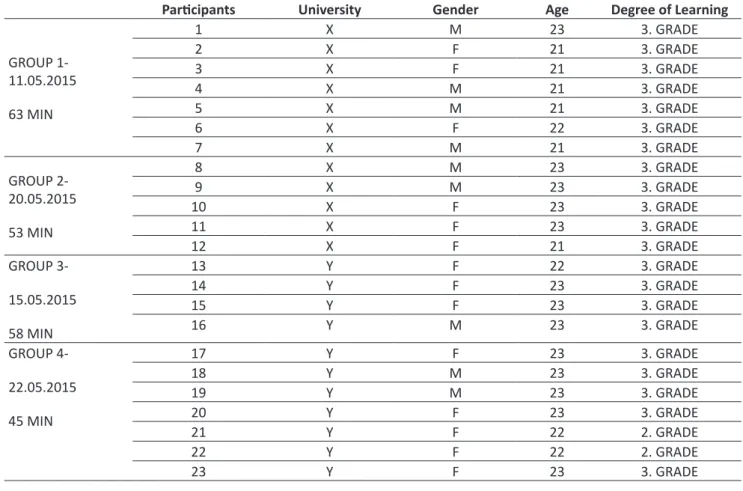
Out of 23 students, 9 were male, 14 were female. 2 were second grade students and the others were third grade students. The mean age of the sample was 22.3 years. Participant’s characteristics are shown in Table 1.
Table 1. Participant’s Characteristics
Participants University Gender Age Degree of Learning
GROUP 1- 11.05.2015 63 MIN 1 X M 23 3. GRADE 2 X F 21 3. GRADE 3 X F 21 3. GRADE 4 X M 21 3. GRADE 5 X M 21 3. GRADE 6 X F 22 3. GRADE 7 X M 21 3. GRADE GROUP 2- 20.05.2015 53 MIN 8 X M 23 3. GRADE 9 X M 23 3. GRADE 10 X F 23 3. GRADE 11 X F 23 3. GRADE 12 X F 21 3. GRADE GROUP 3-15.05.2015 58 MIN 13 Y F 22 3. GRADE 14 Y F 23 3. GRADE 15 Y F 23 3. GRADE 16 Y M 23 3. GRADE GROUP 4-22.05.2015 45 MIN 17 Y F 23 3. GRADE 18 Y M 23 3. GRADE 19 Y M 23 3. GRADE 20 Y F 23 3. GRADE 21 Y F 22 2. GRADE 22 Y F 22 2. GRADE 23 Y F 23 3. GRADE Procedure
To choose the students to be included in the focus groups, an announcement was made to the second and third grade students studying at these two universities. The reason for the selection of second and third classes in the study is that they have spent a certain amount of time in social work education. Those interested in the study were inter-viewed one-by-one and they were provided with information about the aim and structure of the study. We received the informed consent of all participants. The researchers held focus group discussions with those willing to participate in the study. Two researchers conducted focus groups at different universities; each of them held two groups. The in-terviews were conducted in May 2015. During the focus group sessions, the semi-structured interview form prepared by the researchers was used. The form included opinions and recommendations regarding the social work education
and the roles of teachers and students. These titles were prepared based on the literature review and the opinions and experiences of the researchers.
Focus group sessions were held by the researches at a convenient time for the students. To promote interaction during the sessions, the researchers gave some information about the purpose of the group at the beginning of the ses-sion. Then the students were encouraged to be involved in the discussion by means of asking them open-ended ques-tions. When necessary, probe questions were asked to find out more detail. In all groups, the students were observed to actively participate in the discussions. Each session took an average of 55 minutes. The discussions were recorded with a voice recorder. Then these records were transcribed.
Data Analysis
After the transcription of voice records, they were read by the researchers separately. Then the content analysis of the voice records was performed using MAXQDA.
At the end of the thematic content analysis of student’s opinions and recommendations, two themes were identi-fied. These are as follows:
1. Current status of social work education
2. Expectations from the social work education and recommendations. Each main theme included sub-themes. Table 2 shows these sub-themes.
Table 2. Main and Sub-themes
Main Themes Sub-themes
1. Current status of social work education a. Status of Educationb. Status of Teachers c. Status of Students 2. Expectations from the social work education and
re-commendations a. Expectations and recommendations regarding the form of deliveryb. Expectations and recommendations regarding the teachers 3. Findings
As can be seen in the Table 2, an inductive process was followed in the content analysis. First, the “themes” were identified. Based on these themes, the “sub-themes” and “main themes” were identified. The analysis of the main themes is given below.
Current status of social work education: “education”, “teachers” and “students”
The students were asked how they perceive the education currently provided to them. Here, the main theme can be divided into the sub-themes of “education”, “teachers” and “students”.
A. Status of education: “rote-learning based”, “lack of practice”, “inability to know about different areas of practice”
Table 3. Status of education according to the participants Status of education
physical conditions rote-learning approach
applying multiple-choice exams and giving functionless assignments inability to know about different areas of practice
The analysis of the educational content revealed that the students mostly pointed out the problems related to the physical conditions of the universities. The number of students to be placed in a social work department is determined by the Council of Higher Education (YÖK). In 2016, the number of students admitted by the state university is 180, while that of the Non-profit foundation university is 50. During the time when this study was conducted, the class size of the state university increased from 180 to 400 students, due to the abolishment of English preparatory program. This means there are 400 students in a single classroom for some courses. The total number of second and third graders is an average of 250 students. On the other hand, there are 50 students admitted by the Non-profit foundation univer-sity. There are a total of 50 students in the second and third grade. Therefore, the third graders studying at the state university are complaining about overcrowded classrooms.
“Something happened: I, we completed the preparatory program, these 200 people… I started to study in 2011. We were 200 students back then. When the preparatory program was abolished in 2012, 200 more students came to our class. We did our best not to allow this, started signature gathering campaigns, went to the head of the department etc. But... Sure, they are our friends, too. But we did it both for us and for them. We already knew that it was impos-sible to receive good education with 400 people. We even went to the Rector’s office, but they said there was nothing they could do and the number of students to be admitted was determined by YÖK. Our signature gathering campaign somehow remained inconclusive.” (Participant 6, University X)
“Yes. We directly came. Then we saw that the classroom was a little crowded. Then each teacher repeated the same things; ‘This classroom is too crowded; we will do our best; you should try, too; Anyone not sure about the department should change it; it is not a big deal to lose 1 year.” etc. Every single teacher said things like that. We got used to it. As we are a group like this...” (Participant 1, University X)
Since the preparatory program is optional, the classroom size doubled and hampered the learning process of stu-dents. The factors such as “absenteeism”, “inability to listen to the teacher”, “alienation from education”, “change of department”, “lacking a sense of belonging to the social work department”, “inability to find an elective course”, “ina-bility to find a seat in the classroom” are reflected on the education process.
While comparing the problems regarding the physical conditions of the universities, the students of both universi-ties complained about the rote-learning based nature of the education. Adoption of rote-learning approach, especially in the exams, is not for the benefit of the students.
“For example, it is directly based on memorization. They give us an article of 50 or 60 pages. We memorize it, memorize it, and memorize it. Most of the time, they include information that we can use in the future, some appro-aches etc. But most of the time they include information that are based on memorization and that we memorize for that moment but then forget, so I don’t find them useful. Only during the midterms and finals... The assignments are also like that, I mean they are all based on memorization or we can do them without much research.” (Participant 20, University Y)
“Due to our previous education which was based on memorization due to the educational system of our country, we applied the same logic when we started to study here. Therefore, it does not help us much. I think it is not the problem of the department, but our educational background.” (Participant 18, University Y)
In addition to these, “applying multiple-choice exams and giving functionless assignments” are among the other problems defined by the social work students. Moreover, third grade students of the foundation university stated, “there are some deficiencies in the delivery of courses, and especially the courses such as psychology and law lack educational content.”
“I think Family Law should be a little more detailed. It should be a real course, not an elective one, because general law is not sufficient alone. We will be working with families, children, and we should really have knowledge of the laws. I think this should be deepened one way or another. Besides, psychology seems very abstract to us. Sure, we take cour-ses. But we should enter into details more, as teachers skip the subjects saying ‘you do not necessarily know these’. I mean, we should really learn this, it should be in a way that will be useful for us, otherwise we remain very incapable.” (Participant 15, University Y)
“Human Behaviour and Social Environment and Psychology in a single course. Psychology seems very abstract to us. Our teachers deliver the courses superficially, saying ‘It is not your area of expertise’, but actually it is. We sometimes get distracted or have problems in restructuring the knowledge in our minds. I think more courses should be added.” (Participant 13, University Y)
B. Status of Teachers
Table 4. Status of teachers according to the participants
Status of Teachers Presentations with slidesTeachers and courses that repeat themselves
Difficulty in establishing communication between teachers and students
The students defined the problems regarding the teachers as “Presentations with slides”, “Teachers and courses that repeat themselves” and “Difficulty in establishing communication between teachers and students”.
“When we prepare slides, we are reprimanded for using sentences of more than 5 words. But our teachers write books and read them without adding anything to the text. We have teachers delivering the course by standing behind the lectern throughout the course. This might be resulted from the lack of technology. We pay more attention to the teachers who do not stand exclusively behind the lectern.” (Participant 6, University X)
“The form of delivery is important rather than the curriculum. A system that involves explaining something using slides but then saying ‘I will give you the slides later, read the notes on this article’ does not teach anything and stick in the mind at all. We memorize things before the exam, we read that article. We adopt a point of view such as ‘this part is likely to appear in the exam, this part can appear in the fill in the blanks section’ etc., and then all the things we have memorized are gone.” (Participant 15, University Y)
As indicated by the students, delivering the courses only using slides makes students’ learning difficult. This also makes us think that the active learning approaches are not used effectively by the teachers. Establishing one-on-one communication with students and placing students at the center of learning process are among the important ele-ments of the active learning approach. In this sense, the students criticized some behaviors of their teachers.
“They even do not know us and do not try to do so. Unavoidably, I get distracted when I was treated like that. I do not attend the obligatory classes, but the elective ones instead, because they are better. The teachers of these courses know me, thus I can participate in the learning process and understand the lecture better.” (Participant 11, University X)
“The teachers say, ‘a social worker should be like that, should be constructivist, should behave like that, should lis-ten’ etc. But there are some teachers in the department whose ego goes through the roof. I’m sorry but it’s true. I try to ask a question, but the teacher walks away without even listening to and waits for you to run after. Such teachers try to say ‘I am superior to you, you are just a student’. But it is not like that. If you are trying to tell and impress this on me, you can behave accordingly.” (Participant 8, University X)
These statements revealed the importance of social workers’ role of serving as a model for the students with their behaviors during the education process.
C. Status of Students
Table 5. Status of students according to the participants
Status of Students students tend to take the easy way out (a student’s mind!)not willing to attend courses and to be involved in the learning process they are undervalued and have a fear of getting low grades
The students also criticized the behaviors they exhibit throughout the education process. According to their state-ments, “students tend to take the easy way out (a student’s mind!)”. Moreover, they stated that they were “not willing to attend courses and to be involved in the learning process”, mostly because “they are undervalued and have a fear of getting low grades”.
“We are taking the easy way out. We are given assignments. One of the teachers gives us an assignment. Although we have to make some detailed research, we find something and copy it with a quick Internet search. Actually, it is you who allow for this. You allow us pass the course in some way.” (Participant 18, University Y)
“A student’s mind, we do what suits our interests.” (Participant 13, University Y)
“The teachers should not allow us to get anxious about grades. This stresses us out a lot. We all say ‘It’s ok as long as I pass the course’. Nobody gives a damn about learning.” (Participant 15, University Y)
From these statements, we can understand that the students still have not broken the habits they have acquired since elementary school. They still get anxious about grades and just care about getting a passing grade, without any expectation of learning to learn.
Expectations from the social work education and recommendations
Students’ recommendations about the social work education are related to the problems they have. They made recommendations that are mainly focused on two aspects: “Expectations and recommendations regarding the form of delivery” and “Expectations and recommendations regarding the teachers”.
A. Expectations and recommendations regarding the form of delivery
Table 6. Participants’ expectations and recommendations regarding the form of delivery
Expectations and recommendati-ons regarding the form of delivery
A syllabus should be designed for each course for a term and it should be followed
Exams should be focused on cases and interpretation instead of including multiple-choice questions
Course should be based on case discussions
Education should change according to the needs of the time Students should do more internships
The areas should be introduced at first and the number of practical activities should be in-creased
The problem of overcrowding should be solved and group seating should be used instead of conventional seating arrangements
Taking courses of upper or lower grades should be facilitated
Regarding the form of delivery, the students made some recommendations about both course content and course delivery. Their expectations and recommendations are as follows: “A syllabus should be designed for each course for a term and it should be followed”, “Exams should be focused on cases and interpretation instead of including multip-le-choice questions”, “Course should be based on case discussions”, “Education should change according to the needs of the time”, “Students should do more internships”, “The areas should be introduced at first and the number of pra-ctical activities should be increased”, “The problem of overcrowding should be solved and group seating should be used instead of conventional seating arrangements”, “Taking courses of upper or lower grades should be facilitated”.
“It can be student-centered and change according to the needs of the time. For example, today’s social problem is different. Therefore education should be changed according to changing social circumstances” (Participant 2, Univer-sity X)
“Group seating arrangement is more appropriate. In a seating arrangement like an amphitheater, you cannot conta-ct personally, or cannot make eye contaconta-ct... That person has to approach you... But that is not possible in that class. The teacher speaks while standing and you cannot make eye contact with the teacher. The class is already too crowded.” (Participant 6, University X)
B. Expectations and recommendations regarding the teachers
Table 7. Participants’ expectations and recommendations regarding the teachers Expectations and recommendations
regarding the teachers
They should listen to the student
They should build egalitarian relationship with the students and should be accessible They should have work experience in the field
They should be student-centered and active and should make the course interesting
Students’ expectations and recommendations regarding the teachers are as follows: “They should listen to the student”, “They should build egalitarian relationship with the students and should be accessible”, “They should have work experience in the field”, “They should be student-centered and active and should make the course interesting”.
“No assignment should be given. The teacher-student relationship should be more... Teachers usually come to the class, lecture about some stuff. But honestly the students don’t listen. Most of the time, I don’t listen, either. There is no need to hide stuff. As we said, more interesting videos about social work may be useful, they can attract the atten-tion of the students. For instance, the teacher should give lecture in the first twenty minutes and then should play a video. Following the video, he/she should tell something about it for ten minutes.” (Participant 16, University Y)
“Experience is very effective, because we learn better when our teachers talk about their experiences. We easily forget theoretical knowledge. But when teachers say, ‘Something happened when I was working at blah blah instituti-on’, we listen to him/her paying more attention so that we learn what we could do if we encounter such a situation.” (Participant 12, University X)
“Plus, some of the teachers in our department –we take the course ‘communication skills’- should detach from their ego and they should establish one-on-one communication with us.” (Participant 10, University X)
Students’ statements show that they want an education system in which they can be actively involved in the learning process, internalize the courses and put their knowledge into practice. They indicated the social work educators as the most important element for such an education system. They stated that a social work educator who has experience in the field, establishes an egalitarian relationship with the students, cares about them and adopts the principle of active learning will play an important role in helping students build self-confidence and changing their lives in a positive way.
Educators, especially those who adopt the values and moral rules of social work and reflect them on their perso-nality and their way of teaching will be more successful in conveying the nature of social work to the students. This is because the students, just like the clients, expect from the social work education system to be valued and to receive education in a fair way as well as expecting their rights to be advocated.
4. Discussion
This study aimed to assess the social work education and the role of teachers and students through the eyes of students. Today’s learning methods are moving away from the approaches in which teachers just verbally lecture about specific topics in the classroom. Especially since the 1960s, conventional approaches have been replaced by the approaches in which students personally assume the responsibility of their learning. In social work education, taking active role in the learning process is of crucial importance for the students. Student-centered teaching in social work education provides the students with the opportunity to improve their reflection and critical thinking skills as well as the skills of integrating theory and practice (Lawrence, 2009; İçağasıoğlu Çoban, Polat Uluocak, 2011).
According to the findings of this study, the most important reasons why students chose to study social work are as follows: finding a job easily, getting the score only good enough for this program and willing to study at a university located in the city they live in. In studies conducted by Demirbilek et al. (2015) and Demirbilek et al. (2016), social work students think that they can find a job easily after graduation. Sha et al. (2012) also reported that social work students preferred this profession due to the opportunity to find a job easily. This result shows that the profession of social work is preferred without focusing much on the purpose and scope of it in countries with relatively higher population and fewer employment opportunities like China and Turkey where this profession is not common.
The findings of this study revealed that the education system does not have the desired effect on the students. The students indicated that they are unable to participate in the learning process, but on the contrary, taken a passive role, adding that courses are based on memorization. However, studies reported that students were able to assist the clients better and to overcome practical problems more easily in their future life when they became reflective and active du-ring the education process (Ping, 2012).
Our findings showed that students were disturbed much by the learning methods based on memorization. They thought that the reason behind the other problems they had was the rote-learning based education system. According to their statements, the students have to memorize the content of the articles distributed by their teachers as they ask questions about it, but they easily forget this information after the exam. They also considered the presentation-based teaching and teachers’ lack of improving themselves as the reason of this situation. They stated that they were not able to improve their analysis and critical thinking skills due to the memorization-based education, adding that they did not carry out case-based activities and were not provided with sufficient information about different areas of pra-ctice and different client groups. Therefore, they complained that they usually get bored during the courses, are not willing to participate in the learning process, stating that they only want to pass the course. In a study conducted by Erbay and Sevin (2013), social work students think that the content is insufficient for some courses and similar topics are repeated In their study, Wilson and Kelly (2010) evaluated the effectiveness of social work education and found that the students needed to see more explicit links to application of knowledge in practice, to make more observations of social work practice and to receive more in-depth training on social work theory and methods and skills for social work practice. Similarly, the participants of this study also stated: they had difficulty in linking theory with practice; they would understand better if more example were used, practical courses were insufficient and the teachers should practice together with the students. Peleg-Oren, Aran, Even-Zahav, Macgowan & Stanger (2007) developed a program in which they brought academic faculty, field supervisors and students together to link the latest theories and practi-ces related to social work practice in health care settings. The feedback by most of the participants showed that the program contributed to the integration of theory and practice. The program was found to be to the greatest benefit of the second and third grade students. Similar studies to link theory and practice may be conducted in Turkey, too. In this
way, students’ wish to experience more practice and know about different fields can be met.
The students were also asked to assess their roles throughout the education process. They indicated that they sometimes “take the easy way out” and just memorize the information in order to get a passing grade, instead of ac-hieving real learning. It is possible to mention about the existence of a contradiction. The students complain about an approach based on memorization on the one hand, while writing their assignments by copy-pasting from the Internet without making any research on the other. When they were asked why they do so, they said educators do not assess the assignments sufficiently and accept them as they are. In a sense, they try to avoid taking responsibility for their learning and put this responsibility on the shoulders of educators, which makes us think that it is important to teach students how to learn first, and then teach social work. Some of the students complained about the excessive amounts of homework and reports and spending time for these. Papadaki, Katsouli, Tournikis & Papadaki (2012) also reported that most of the students involved in their study stated that they sometimes felt drained because of their responsibi-lities such as preparing reports.
An important finding of this study is that social work is defined by the students as a moral and value-based profes-sion. Although the number of social workers and institutions that offer social work education is increasing in Turkey, social work is still considered by the society as a profession committed to helping the poor and doing charity work. Therefore, students’ assessment of the profession on the basis of equality and social justice, instead on merely on the basis of helping other, is of great importance. This also reveals that the students have sufficient theoretical background.
Study Limitations
This study does not include the opinions of all social work students in Turkey. Besides, it is limited to the undergra-duate students. Further studies to be conducted in other universities at both undergraundergra-duate and graundergra-duate levels may provide more detailed insight into social work education.
As students have been raised with conventional education methods since elementary school, they have difficulties in overcoming it when they start university. Therefore, they also have difficulty in taking the responsibility for their learning. Moreover, in the developed countries, social work education is provided in the later ages, mostly based on individual choices. However, the high school graduation age is 17 in Turkey and students are placed in universities ba-sed on the score they get in the central placement exam. This may lead them to start university at an age which is too early to build their identities without much knowledge of what social work is. These issues constitute the cultural and structural limitations of this study.
5. Conclusion
Social work education should be viewed as a process which aims to ensure active participation of students in the course and in which both students and teachers share the responsibilities for learning. However, the content of the education provided in a country is a reflection of the social structure of that county. As also revealed in this study, the conventional education methods adopted by the Turkish education system are also maintained in the university edu-cation. A system where students are passive recipients and exams and grading are of utmost importance, while prac-tice-based education is of secondary importance also holds true for social work education. Therefore, students mostly blame the educators instead of themselves. Although the generalist social work approach is adopted in the universities incorporated in this study, we found that social work education was not able to move away from the conventional ap-proaches due to certain factors resulting from the educators, physical conditions of the departments and the students. In fact, teaching practical knowledge and skills is as important as teaching theoretical knowledge.
In social work education, it is necessary to place students at the center, to increase the existing physical capacity and to maintain a qualified and experienced academic staff. All these points should be taken into consideration especially by the newly established educational institutions that offer social work education.
6. References
Alptekin, K. (2016). Başlangıçtan bugüne ve yarına Türkiye’de sosyal hizmet eğitimi [Social work education in Turkey from begin-ning to today and tomorrow]. Ankara: Atlas Yayınevi.
Andron, S. (2013). Rebuilding New Orleans: A community field learning experience. Journal of Teaching in Social Work, 33(3), 297-307. DOI: 10.1080/08841233.2013.795207
Arıkan, Ç. (2002). Sosyal hizmet eğitiminde aktif öğrenmeye ilişkin düşünceler [Opinions about active learning in social work edu-cation]. In K.Karataş ve S.İl, (Ed.). Sosyal hizmet eğitiminde yeniden yapılanma I [Reconstruction in social work education I]. (163–169). Ankara: Hacettepe Üniversitesi Sosyal Hizmetler Yüksekokulu.
Avant, D. W., Bracy, W. (2015). Teaching note—Using problem-based learning to illustrate the concepts of privilege and oppressi-on. Journal of Social Work Education, 51(3), 604-614. DOI: 10.1080/10437797.2015.1043207
Baker, H. E., Brown, P. P. (2015). Teaching retirement financial literacy in an undergraduate gerontology classroom: broadening the concept of the tripodor three-legged stool of retirement ıncome utilizing active learning. Gerontology & Geriatrics Educa-tion, 36(4), 416-424. DOI: 10.1080/02701960.2015.1031892
Burgess, H. (1992). Problem-led learning for social work: the enquiry and action approach. London: Whiting and Birch.
Demirbilek, M.; Çakar, P.; Özcani H.; Önal, B.; Ünal, F.; Ünal, B. (2015). Sosyal hizmet bölümü birinci sınıf öğrencilerinin bölümü tercih etme nedenleri. Sosyal Hizmet Sempozyumu 2015: Türkiye’de Sosyal Hizmet Uygulamasının 50.Yılı: İnsan Değer ve Onu-runu Yüceltmek Bildiri Özetleri Kitabı içinde (298-299), 26-28 Kasım 2015, Manisa.
Demirbilek, M., Özdemirhan, S., Yiğit, M., Özdemir, L., Yüksel, H., Özdemir, Ö. (2016). Sosyal hizmet son sınıf öğrencilerinin eğitim-leriyle ilgili görüşleri ve mesleki beklentileri. International Journal of Social Sciences and Education Research, 2(3), 1044-1058. Erbay, E.; Sevin, Ç. (2103). Hacettepe Üniversitesi sosyal hizmet 4. Sınıf öğrencilerinin eğitim süreçlerine ve gelecekteki meslek
yaşamlarına ilişkin görüşleri. Toplum ve Sosyal Hizmet, 24 (1), 25-39.
Gaižauskaitė, I. (2012). The use of the focus group method in social work research. Socialinis Darbas Social Work, 11(1), 19–30. Gökçearslan Çifci, E. (2009). Social work profession and social work education in Turkey. World Conference on Educational
Scienc-es, Procedia Social and Behavioral SciencScienc-es, 1, (2063–2065).
İçağasıoğlu Çoban, A., Polat Uluocak, G. (2011). Bologna süreci sosyal hizmet eğitimine ne getiriyor? [What brings Bologna pro-cess to social work education?]. In Sosyal Hizmet Sempozyumu 2011: 50.Yılında Türkiye’de Sosyal Hizmet Eğitimi: Sorunlar, Öncelikler ve Hedefler. Ankara: Hacettepe Üniversitesi.
İl, S. (2001). Türkiye’de sosyal hizmet eğitiminde aktif öğrenme [Enquiry and action learning in social work education in Turkey]. Toplum ve Sosyal Hizmet, 12 (2), 99–105.
Jaques, D. (2000). Learning in groups. (3rd edn.). London: Kogan Page.
Karataş, K., İl, S. (Eds.). (2002). Sosyal hizmet eğitiminde yeniden yapılanma I [Reconstruction in social work education I]. Ankara: Aydınlar Matbaası.
Lawrence, S. (2009). The Bologna process: China- Europe forum social work education workshop summary paper from European participants. Retrieved May 2018, from http://www.china-europa-forum.net/bdfdoc-1420_en.html
McAleese, M. Bladh, A. Berger, V.Bode, C., Muehlfeit, J.,Petrin, T.,Schiesaro, A., Tsoukalis, L. (2013). High level group on the mo-dernisation of higher education. Report to The European Commission On Improving the quality of teaching and learning in Europe’s higher education institutions, Retrieved August 2016, from http://ec.europa.eu/dgs/education_culture/repository/ education/library/reports/modernisation_en.pdf
Öğrenci Seçme ve Yükseköğretim Programları ve Kontenjanları Kılavuzu, [ÖSYS]. [Guide to Student Selection and Higher Educa-tion Programs and Quotas]. (2017). Retrieved May 2018, from https://dokuman.osym.gov.tr/pdfdokuman/2017/OSYS/LYS/ KONTENJANKILAVUZ18072017.pdf
Panwar, M., Mathur, D., Chand, G., Dkhaka, M., Singh, R. R., Moxley, D. P. (2014). Action learning in the Indian village as an al-ternative to the traditional field practicum in the foundation year of the MSW. Social Work Education, 33(8), 984-997. DOI: 10.1080/02615479.2014.921285
Papadaki, V., Katsouli, M., Tournikis, A., Papadaki, E. (2012). ‘How do you feel about studying social work?’—social work students in Greece: Demands, support, feelings about their studies and attitudes towards themselves. Social Work Education, 31(7), 819-834, DOI: 10.1080/02615479.2011.607810
Peleg-Oren, N., Aran, O., Even-Zahav, R., Macgowan, M. J., Stanger, V. (2007). An innovative program in social work education. Journal of Teaching in Social Work, 27(3-4), 157-165. DOI: 10,1300/J067v27n03_10
Ping, L. X. (2012). Educating a reflective and active social worker: how social work education responds to a social problem. China Journal of Social Work, 5(3), 277-283. DOI: 10.1080/17525098.2012.721526
Sha, W., Wong, Y., Lou, V. W. Q., Pearson, V., Gu, D. (2012). Career preferences of social work students in Beijing and Shanghai, Social Work Education, 31(1), 4-21. DOI: 10.1080/02615479.2010.538672
Strand, V. C., Abramovitz, R., Layne, C. M. Robinson, H. Way, I. (2014). Meeting the Critical Need for Trauma Education in Social Work: A Problem-Based Learning Approach. Journal of Social Work Education, 50(1), 120-135.
The Council of Higher Education [COHE]. (2014). Higher Education System in Turkey. Ankara. Retrieved June 2016, from http:// www.yok.gov.tr/documents/10348274/10733291/TR’de+Y%C3%BCksek%C3%B6%C4%9Fretim+Sistemi2.pdf/9027552a-962f-4b03-8450-3d1ff8d56ccc
The Council of Higher Education [COHE]. (2016). Retrieved November 2016, from http://www.yok.gov.tr/web/guest/universite-lerimiz
Tuncay, T., Tufan, B. (2011). Social work education and training in Republican Turkey. In S. Stanley, (Ed.). Social work education in countries of the East: Issues and challenges (543-562). New York: Nova Publishers.
Wilson, B. M., Pollock, P. H., Kerstin, H. (2007). Does active learning enhance learner outcomes? Evidence from discussion parti-cipation in online classes. Journal of Political Science Education, 3(2), 131-142.
Wilson, G., Kelly, B. (2010). Evaluating the effectiveness of social work education: Preparing students for practice learning. British Journal of Social Work, 40, 2431–2449. DOİ: 10.1093/bjsw/bcq019