See discussions, stats, and author profiles for this publication at: https://www.researchgate.net/publication/237071924
Understanding the last 400 meters of the race by mobile (overground)
endoscopy
Conference Paper · April 2011
CITATIONS
0
READS
310
2 authors:
Some of the authors of this publication are also working on these related projects:
Clinical efficiency of Doxorubicin and Cisplatin in treatment of transmissible venereal tumor of bitchesView project
Effects Of Maca (Lepıdıum Meyenıı Walp) Powder On Serum Indıces And Metabolıc Responses In RacehorsesView project Cihan Kumas racehorse hospital 6PUBLICATIONS 67CITATIONS SEE PROFILE Mehmet Maden Selcuk University 50PUBLICATIONS 275CITATIONS SEE PROFILE
All content following this page was uploaded by Mehmet Maden on 24 May 2016.
Summary
In this study, efficiencies of dynamic (overground) and resting endoscopic examinations were compared in dynamic upper respiratory tract problems which are a cause of poor performance in race horses. Thirty actively-racing horses which were brought to Turkey Jokey Club Racehorses Hospital with poor performance and abnormal respiratory tract sounds were examined while running and rest. The diagnostic effectiveness of dynamic endoscopy and resting endoscopy procedures were compared for the diagnosis of dynamic obstructions of the upper respiratory tract. Dynamic pharyngeal collapse (DPC) in 5 race horses, third or fourth degree of left laryngeal hemiplegia (LLH) in 3 race horses, second degree of axial deviation of aryepiglottic folds (ADAF) in 3 racehorses, rostral displacement of the palatopharyngeal arch (RDPA) in 1 racehorse, and dorsal displacement of the soft palate (DDSP) along with first degree of ADAF in 1 racehorse were detected in the mobile endoscopic exams. Dynamic upper respiratory tract problem was detected totally in 13 horses. As a result, it was observed that dynamic upper respiratory tract problems could be safely detected by dynamic endoscopy and it was superior than routine endoscopic examination in racehorses.
Keywords: Dynamic (overground) endoscopy, Poor performance, Racehorse
Yarış Atlarında Performansı Etkileyen Üst Solunum Yolu
Hastalıklarının Teşhisinde Dinamik Endoskopi
Uygulamasının Değerlendirilmesi
Özet
Bu araştırmada, yarış atlarında performans kaybına neden olan dinamik üst solunum yolu problemlerinin teşhisinde dinamik (mobil) ve rutin endoskopi uygulamalarının etkinlikleri karşılaştırıldı. Performans düşüklüğü ve anormal solunum sesi şikâyetleri ile Türkiye Jokey Kulübü Yarış Atları Hastanesi’ne getirilen 30 yarış atı dinlenme halinde ve koşu sırasında değerlendirildi. Üst solunum yolunun dinamik tıkanıklarının teşhisinde, dinamik ve dinlenme halinde yapılan endoskopi uygulamalarının teşhisteki etkinlikleri karşılaştırıldı. Dinamik endoskopik muayenelerde; 5 atta dinamik farengeal kollaps (DPC), 3 atta 3. ve 4. derece sol larengeal hemipleji (LLH), 3 atta 2. derece ariepiglottik kıvrımların aksiyal deviasyonu (ADAF), 1 atta palatofarengeal kıvrımın rostral deplasmanı (RDPA), 1 atta yumuşak damağın dorsal deplasmanı (DDSP) ve 1. derece ADAF’ın birlikte bulunduğu gözlendi. Toplam 13 atta dinamik üst solunum yolu problemi belirlendi. Sonuç olarak, yarış atlarında dinamik üst solunum yolu tıkanıklıklarının, dinamik endoskopi ile güvenli ve rutin endoskopi uygulamasından daha iyi bir şekilde teşhis edilebileceği kanaatine varıldı.
Anahtar sözcükler: Dinamik (mobil) endoskopi, Performans kaybı, Yarış atı
Evaluation of The Dynamic (Overground) Endoscopy Procedure
in The Diagnosis of Upper Respiratory Tract Diseases Affecting
Performance of Racehorses
[1]Cihan KUMAŞ
1
Mehmet MADEN
2 [1]1 2
Bu araştırma, Selçuk Üniversitesi Bilimsel Araştırma Projeleri Koordinatörlüğü tarafından desteklenen (07202004) aynı adlı doktora tezinden özetlenmiştir
Türkiye Jokey Kulübü Yarış Atları Hastanesi, TR-34144 İstanbul - TÜRKİYE
Selçuk Üniversitesi, Veteriner Fakültesi, İç Hastalıkları Anabilim Dalı, TR-42031 Konya - TÜRKİYE
Makale Kodu (Article Code): KVFD-2012-7707
A common cause of poor performance in equine athletes
occurs when there is an anatomic or functional obstruction of the upper respiratory tract. These abnormalities can be a challenge to accurately diagnose. Previous studies have
INTRODUCTION
İletişim (Correspondence)
+90 535 2598661A56
Evaluation of The Dynamic ...
shown that some abnormalities can be seen in the upper respiratory tract only while the horse is exercising, but the upper respiratory tract can look normal at rest 1,2. The upper
airway is most often evaluated in standing horses by resting or dynamic endoscopy. Video endoscopy is an important tool for diagnosing upper respiratory tract abnormalities 3.
High-speed treadmill endoscopy and mobile endoscopy methods are used in upper respiratory tract examination. High-speed treadmill endoscopy (HSTE) is widely accepted as the current gold standard for the diagnosis of diseases of the upper portion of the respiratory tract in horses4,5.
The diagnosis of the HSTE upper respiratory tract disorders has been very useful in understanding its pathophysiology and its relations with dynamic upper respiratory tract ab-normalities 4,6-11. Although HSTE provides great advantages
in the diagnosis of dynamic obstructions of the upper respiratory tract, it also has some disadvantages including its high initial cost, the horse being unable to get used to running on the treadmill, and the failure of the artificial environment created to fully represent the environment that the horse is introduced on the racecourse 4,12,13. Dynamic
respiratory endoscopy or mobile endoscopy is an endo- scopic examination method recording the upper respiratory tract region of the horse while the horse exercises under normal exercise conditions or on the racecourse with on-board endoscopy. In mobile endoscopy, the endoscopy unit and the recording unit is attached to the horse. The endoscopy unit is placed into the nasal canal to monitor the larynx and the pharynx. Recording starts before the horse starts training. The horse is trained on the training and/or racecourse, with this equipment attached. The time and distance of the training will be determined in line with the complaints reported by a veterinary surgeon. Dynamic endoscopy is an effective method used to diagnose the obstructions of the dynamic upper respiratory tract such as axial deviation of aryepiglottic folds (ADAF) and dynamic pharyngeal collapse (DPC) that occur during high performance and cannot be detected during endoscopic examination while resting. Dynamic endoscopy allows the examination of the horse during high performance when it suffered dynamic obstructions and the accurate diagnosis of the problem. The heavy weight (14 kg) of the unit and the inability to remotely control the endoscopy probe of the endoscopy unit used in this study are its disadvantages, and these disadvantages were eliminated in different models of the same company. Upper respiratory tract diseases account for 47-49% of abnormalities causing poor performance in horses 15.
Disorders including recurrent laryngeal neuropathy (RLN), dorsal displacement of the soft palate (DDSP), epiglottic entrapment (EE), dynamic pharyngeal collapse (DPC), and rostral displacement of the palatopharyngeal arch (RDPA) are considered to be important abnormalities affecting the race performance of horses 16,17. With regards to
incidence in horses, it was reported that DDSP was seen highest (40%), followed by RLN (20%) 18. A total of 314
abnormalities were detected by resting endoscopic and
high-speed treadmill examinations in a study conducted on 291 horses with poor performance 11. It was detected
192 abnormalities by high-speed treadmill in this study, 105 of these 192 abnormalities were ADAF (55%), 74 were DDSP (39%), and 65 were LLH (34%).
Dynamic obstructions occurring in the upper respira-tory tract are the primary causes of poor performance in racehorses. Endoscopic examinations performed at rest prove insufficient in determining the source of upper respiratory tract problems. This study used the mobile endoscopy unit (Dr. Fritz® ETL-Equine Training Laryngo-scope) for the first time in Turkey to investigate the presence of obstructions of the dynamic upper respiratory tract in horses where resting endoscopic examination revealed no findings despite complaints of poor performance. This study evaluates the advantages of dynamic endoscopic examination over resting endoscopic examination. The aim of the study was to investigate the suitability of dynamic endoscopy in the diagnosis of the obstructions of the upper respiratory tract in racehorses during exercise under natural racecourse conditions.
MATERIAL and METHODS
This study was conducted between August 2008 and September 2009 in Istanbul Veliefendi Hippodrome. Ethical approval for the study was obtained from the Ethical Committee, Faculty of Veterinary Medicine, University of Selcuk (September 12, 2006-2006/079).
The animal material of this study consisted of 30 racehorses of different breeds (Thoroughbred, n: 24; Arabian, n: 6) and ages (2-5 years) that were admitted to The Racecourse Hospital of the Turkey Jockey Club with complaints of abnormal respiratory sounds and poor performance. The horses included in this study were stabled within the racetrack and exercised on the polytrack course in the racetrack six days a week. The horses’ histories were taken before dynamic upper respiratory tract endoscopy, their physical and laboratory analysis (haemotological, lactic acid, venous blood gas etc.) were made, other ab-normalities (including the diseases of the respiratory, cardio- vascular, musculoskeletal, or digestive system) that could result in poor performance were studied, and resting upper respiratory tract endoscopies were performed.
Dynamic Endoscopy
In the dynamic upper respiratory tract endoscopy procedure, the mobile endoscopy unit is mounted on to the horse together with its accessories (Fig. 1). The horse was then taken to the racecourse (Fig. 1). Dynamic endoscopic examination was performed while all horses were exercised on a 1.870 meter polytrack racecourse. The horses were ridden for 30 min on the racecourse before dynamic endoscopic examination. Then the horses cantered for
approximately 800 m, and galloped over 1.000 m the last 600 m at a fast gallop. Changes in the upper respiratory tract were recorded on a mobile endoscopy unit. Dynamic changes in the upper respiratory tract during exercise were evaluated based on these recordings. This exercise test was organized as a race experience, with the only difference being the horses running alone.
Dr. Fritz® ETL-Equine Training Laryngoscope consists of a recording unit, a 9 mm diameter 210 cm semi-rigid malleable insertion tube (Video bronco-laryngoscope), a battery, a saddle, a harness, a special snaffle and a laptop computer, with software recording and allowing the examination of patient data. An LCD screen on the recording unit enables the endoscope to be placed properly into the nasal canal and the resting upper respiratory tract examined before the workout. A full-charged system battery allows recording for about half an hour. The endoscope, recording unit, and the battery are mounted on top of a saddle specifically designed for racehorses. After the endoscope mounted on top of the saddle is connected to the recording unit, it is attached to the horse’s mane and extended to the forehead section through the ears. Here, it is placed on the snaffle with the help of a cane-like apparatus. The endoscope is placed on this apparatus, aligned with the nostrils, and fixed after being positioned into the nasal canal. An endoscope mounted in this fashion will not slip out of the nasal canal during the gallop. The camera is positioned inside the nasal canal with the direction arms inside the endoscopy locked. The time from start until completion of the recording is about 5 min. The recorded images were evaluated for detection of abnormalities after the examination.
RESULTS
In this study, all horses accepted the dynamic endoscopy equipment and the mobile endoscope was well tolerated. While dynamic upper respiratory tract abnormalities
(43.3%) were found in 13 horses in dynamic endoscopic examination, 17 horses (56.6%) had poor performance and/or abnormal respiratory sound complaints, no obstructive dynamic upper respiratory tract symptoms were seen. No obstructive upper respiratory tract disorders were observed in 7 (23.3%) racehorses despite complaints of poor performance and abnormal respiratory sound.
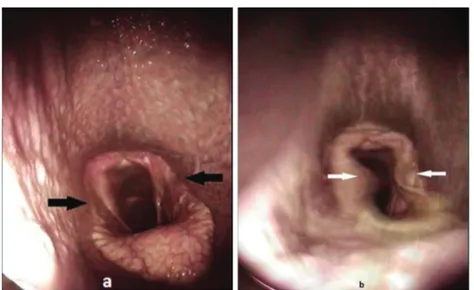
Using mobile endoscopy unit, DPC was diagnosed in 5 race horses (16.6%), third and fourth degree of LLH in 3 race horses (10%), second degree of ADAF in 3 race horses (10%) (Fig. 2), RDPA in 1 race horse (3.3%), and DDSP (Fig. 3) along with first degree of ADAF in 1 race horse.
Resting endoscopy revealed second degree lymphoid hyperplasia in 11 race horses (36.6%), LLH in 3 race horses (10%), and partial obstruction of rima glottis by the left arytenoid cartilage from RDPA in 1 race horse (3.3%). The diagnosis rate of dynamic upper airway obstructions was only 13.3% (n: 4) in resting endoscopy.
DISCUSSION
In this study, dynamic endoscopic procedure was applied successfully under the racetrack conditions. The mobile endoscope was well tolerated in all horses. The study confirmed the efficacy of dynamic endoscopy for the diagnosis of dynamic obstructions of the upper respiratory tract (DO-URT) in racehorses.
Detection of no abnormalities in resting endoscopic examination of the upper respiratory tract does not imply that poor performance is not caused by the upper respiratory tract and/or that the upper respiratory tract is healthy. Disorders including laryngeal hemiplegia, subepiglottic cyst, and arytenoid chondropathy can be detected by endoscopic examination during resting. However, resting endoscopic examination proves insufficient for the
Fig 1. The horse in gallop on the race course (polytrack race
course) with mobile endoscopy unit
Şekil 1. At mobil endoskopi cihazı ile yarış sahasında (polytrack
A58
Evaluation of The Dynamic ...
detection of dynamic obstructions including DPC, DDSP, ADAF, and epiglottic retroversion appearing during high performance 13,14,22. In this case, dynamic endoscopic
examination becomes compulsory. In this study, horses diagnosed with DPC and ADAF were examined many times by resting endoscopy, but a definitive diagnosis could not be made although accurate diagnoses could be made after dynamic endoscopic examination by mobile endoscopy. The cause of poor performance and abnormal respiratory sound was diagnosed by dynamic endoscopic examination.
Some researchers reported that high quality images are important in mobile endoscopic studies 13. Because of
that automatic water pump with a fixed flushing system would be useful 12,14. During this study, images could not
be collected in one case due to mucus accumulation in front of the camera, so the examination was repeated. Therefore, the addition of a fixed flushing system to the current system would be beneficial.
There are reports suggesting that dynamic upper respiratory tract abnormalities occurred during exercise (with high speed treadmill or dynamic respiratory scope (DRS)) in horses, that they should be considered at different exercise rates (during trot, gallop, jump, endurance), and that they are affected by sudden acceleration and exercising conditions 13,19. The reported abnormal respiratory sounds
and poor performance complaints were mostly experienced during the final meters of the race. So, in this study, the
horses were put into a race experience/trial (trot, canter and gallop (last 600 m at a fast gallop) of 1.870 m on the racecourse to ensure that the horses were optimally stressed. Detection of dynamic upper respiratory tract abnormality in 13 of 30 horses (43.3%) in this study shows that the exercise during mobile endoscopic examination was satisfactory, and that exercises at this level were the minimum requirements for the assessment of dynamic upper respiratory tract abnormalities.
Upper airway obstructions are a significant cause of poor performance in racehorses 11,16,17,20. In addition, abnormal
respiratory sounds during exercise are frequently associated with upper airway disorders 1. While some authors 3,20 report
that there was no history of abnormal noise production in some horses with DDSP, Lumsden et al.19 suggest that
up to 30% of horses with DDSP make audible abnormal respiratory sounds during exercise. Lane et al.4 have found
a history of abnormal respiratory noise in 85% and 75% of horses with DDSP and palatal instability (PI), respectively. Kannegieter and Dore 16 reported that 89% of 75 horses
with a history of abnormal respiratory noise had dynamic collapse in the upper respiratory tract (URT) during exercise whereas Tan et al.11 reported that 82% of 146 horses had
untoward respiratory noises, and only 49% of the horses produced no noises. In this study, 70% of racehorses diagnosed with DO-URT had a history of abnormal respiratory noise. Lane et al.4 reported that there were
Fig 2. Normal position of the aryepiglottic folds at
resting endoscopy (a, black arrows). Axial deviation of aryepiglottic folds at exercise with dynamic endoscopy (b, white arrows)
Şekil 2. Dinlenme halinde yapılan endoskopik
mua-yenede ariepiglottik kıvrımların normal pozisyonu
(a, siyah ok uçları). Dinamik endoskopide, egzersiz
esnasında, ariepiglottik kıvrımların aksiyal deviasyonu
(b, beyaz ok uçları)
Fig 3. Normal position of the soft palate at resting endoscopy
(a, black arrow) and epiglottis (a, white arrow). Dorsal
displacement of the soft palate at exercise with dynamic endoscopy (b, black arrow)
Şekil 3. Dinlenme halinde yapılan endoskopik muayenede
yumuşak damağın normal pozisyonu (a, siyah ok ucu) ve epiglottis (a, beyaz ok ucu). Dinamik endoskopide, egzersiz esnasında, yumuşak damağın dorsal deplasmanı (b, siyah ok
limitations in the evaluation of respiratory sounds by ear, and perception or interpretation of noises by the jockeys or trainers is not always reliable. In this study, too, some jockeys and trainers stated that an abnormal respiratory sound was heard from the horse controlled by the jockey until the last 600 m of the race, and that the abnormal respiratory sound disappeared when the horse stopped pulling and gained more speed during the last 600 m. This is interpreted by Strand et al.21, who argued that the
poll flexion by the jockey created pressure on the trachea and it caused mild and intermittent airway abnormalities resulting in dynamic upper respiratory tract disorders like dorsal pharyngeal collapse, bilateral aryepiglottic fold collapse, and bilateral vocal fold collapse. Strand et al.21 also
reported that such problems were not seen when the horse’s head was maintained in normal position. This study demonstrates how effective the environmental factors (particularly the jockeys) are in the creation of dynamic upper respiratory tract dysfunctions that the horses are exposed to when running during exercise or on the race- course. To this end, it is considered that dynamic endoscopy is an important tool for the accurate diagnosis of abnormal respiratory sounds and the problems during exercise and racing.
DO-URT can be diagnosed with the help of DRS and HSTE 5,11,12,14,22,23. The primary DO-URT cases seen in horses
are reported to be DDSP, Laryngeal Collapse (LC), Vocal Cord Collapse (VCC), LLH, ADAF, PI, and Epiglottic abnormalities 1,4,11,12,14,17,18. DO-URT can also be seen alone
or as multiple cases 4,11,12,14,22. DO-URT cases identified in
this study are DPC (16.6%), LLH (10%), DDSP (3.3%), ADAF (10%), DDSP along with ADAF (3.3%) and RDPA (3.3%), respectively. This data correlates with field studies and shows that the DO-URT cases observed in Thoroughbred and Arabian racehorses can be diagnosed by on-board mobile endoscopy.
This study found, by dynamic endoscopy, that upper respiratory tract hyperemia and secretion affected perfor- mance in 7 racecourses (23.3%) with no DO-URT. Desmaizieres et al.12 reported that symptoms like abnormal mucus
production or blood in the trachea in horses with negative dynamic obstructions and poor performance were indicators of the lower respiratory tract and that they could be quickly defined by DRS. In this study, symptoms described in 7 race horses with negative DO-URT are in support of this opinion.
Many researchers reported that DO-URT can be diagnosed easily by DRS during any type of performance. This technique can be used to diagnose common causes of URT associated with poor performance in horses during normal training. DRS equipment is safe and reliable. Toleration of the DRS was excellent. The results of this study verify that mobile endoscopy unit is a secure diagnostic tool and can be used in the diagnosis of dynamic upper respiratory tract abnormalities in horses in normal
racecourse conditions. The horse-mounted unit and endoscopy were well-tolerated by the horse, jockey, and the horse owners, with no negative experiences. This study concludes that the mobile endoscopy unit is a practical, safe, and useful diagnostic tool that can be used to diagnose DO-URT abnormalities in horses in normal racecourse conditions. Considering that DO-URT cases are suddenly-emerging dynamic disorders 13, it is clear that examinations
made by DRS or mobile endoscopic methods and in natural racecourse conditions supply useful data about DO-URT.
It is concluded that overground endoscopic examination enables safely to diagnose of DO URT at exercise in natural conditions and this technique has substantial implications for future clinical diagnosis, an enormous potential for further clinical research, and the most suitable treatment options of DO-URT pathology in racehorses.
REFERENCES
1. Franklin SH, Burn JF, Allen KJ: Clinical trials using a telemetric
endoscope for use during over-ground exercise: A preliminary study.
Equine Vet J, 40, 712-715, 2008.
2. Anonymous (Rural Industries Research and Development Corporation (RIRDC): Upper airway abnormalities in exercising horses. From RIRDC
Equine Research News, 25, 171, 2005.
3. Derksen FJ: Applied respiratory physiology. In, Beech J (Ed): Equine
Respiratory Disorders. 1st ed., pp. 1-26, Lea& Febiger, London, 1991.
4. Lane JG, Bladon B, Little DRM: Dynamic obstructions of the equine upper
respiratory tract. Part 1: Observations during high-speed treadmill endo- scopy of 600 thorougbred racehorses. Equine Vet J, 38, 393-399, 2006.
5. Parente EJ, Martin BB: Correlation between standing endoscopic
examination and those made during high-speed exercise in horses: 150 cases. Am J Vet Res, 41, 170-175, 1995.
6. Hodgeson D: Assessment of Performance: Treadmill Versus
Field Techniques. 10th International Congress of World Equine Veterinary
Association, 28 Jan - 1 Feb, Moscow, pp. 46-47, 2008.
7. King DS, Tulleners E, Martin BB, Parente EJ, Boston R: Clinical
experiences with axial deviation of the aryepiglottic folds in 52 race horses. Vet Surg, 30, 151-160, 2001.
8. Nostell K, Funkquist P, Nyman G, Essén-Gustavsson B, Connysson M, Muhonen S, Jansson A: The physiological responses to simulated
race tests on a track and on a treadmill in standardbred trotters. Equine
Vet J, 36 (Suppl): 123-127, 2006.
9. Parente EJ: Value of High-Speed Treadmill Endoscopy, 1998, http://www.
ivis.org/proceedings/AAEP/1998/Parente.pdf, Acessed: Jun 11, 2009.
10. Rakestraw PC, Hackett RP, Ducharme NG, Nielan GJ, Erb HN: Arytenoid
cartilage movement in resting and exercising horses. Vet Surg, 20, 122-177, 1991.
11. Tan RHH, Dowling BA, Dart AJ: High-speed treadmill video-endoscopic
examination of the upper respiratory tract in the horse: The result of 291 cases. The Veterinary Journal, 170, 243-248, 2005.
12. Desmaizieres LM, Serraud N, Plainfosse B, Michel A, Tamzali Y:
Dynamic respiratory endoscopy without treadmill in 68 performance Standardbred, Thoroughbred and saddle horses under natural training conditions. Equine Vet J, 41, 347-352, 2009.
13. Tamzali Y, Serraud N, Baup B: How to perform endoscopy during
exercise without a treadmill. Proceedings of the 54th Annual Convention
of the American Association of Equine Practitioners, December 6-10, San
Diego, California, pp 24-28, 2008.
14. Pollock PJ, Reardon RJM, Parkin TDH, Johnstone MS, Tate J, Love S:
A60
Evaluation of The Dynamic ...
under normal ridden exercise conditions. Equine Vet J, 41, 354-360, 2009.
15. Martin BB, Hammer E, Parente E: Examination of the Equine Respiratory
Tract. In, Introduction to Poor Performance. http://cal.vet.upenn.edu/ project/eqairway/ index.htm, Acessed: Nov 02, 2009.
16. Kannegieter NJ, Dore ML: Endoscopy of the upper respiratory tract
during treadmill exercise: A clinical study of 100 horses. Aust Vet J, 72, 101-107, 1995.
17. Morris EA, Seeherman HJ: Evaluation of upper respiratory tract
function during strenuous exercise in racehorses. J Am Vet Med Assoc, 196, 431-438, 1990.
18. Lane JG: Recurrent laryngeal neuropathy. Proceedings of the 15th
Bain-Fallon Memorial Lecture, Australian Equine Veterinary Association, pp.
173-192, 1993.
19. Lumsden JM, Stick JA, Caron JJ, Nickels FA, Brown CM, Godber LM, Derksen FJ: Upper airway function in performance horses: Videoendoscopy
during high speed treadmill exercise. Compend Cont Edu Pract Vet, 17, 1134-1143, 1995.
20. Martin BB, Parente EJ, Sage AD: Clinical evaluation of poor
training or racing performance in 348 horses (1992-1996). AAEP, 45, 322-324, 1999.
21. Strand E, Fjordbakk CT, Holcombe SJ, Risberg A, Chalmers HJ:
Effect of poll flexion and dynamic laryngeal collapse on tracheal pressure in Norwegian Coldblooded Trotter racehorses. Equine Vet J, 41 (1): 59-64, 2009.
22. Dart AJ, Dowling BA, Hodgson DR, Rose RJ: Evaluation of
high-speed treadmill videoendoscopy for diagnosis of upper respiratory tract dysfunction in horses. Aust Vet J, 79, 109-112, 2001.
23. Lane JG, Bladon B, Little DRM, Naylor JRJ, Franklin SH: Dynamic
obstructions of the equine upper respiratory tract. Part 2: Comparison of endoscopic findings at rest and during high-speed treadmill exercise of 600 Thoroughbred racehorses. Equine Vet J, 38, 401-407, 2006.
View publication stats View publication stats