T.C. DOĞUŞ UNIVERSITY INSTITUTE OF SOCIAL SCIENCES
MASTER OF ARTS IN CLINICAL PSYCHOLOGY
Graduation Thesis
Aşkım Nur Uysal 201280007
Supervisor:
Assist. Prof. Hasan Galip Bahçekapılı
İstanbul, January 2016
PREDICTING RELATIONSHIP SATISFACTION: DARK TRIAD
PERSONALITY TRAITS, LOVE ATTITUDES, ATTACHMENT
T.C. DOĞUŞ UNIVERSITY INSTITUTE OF SOCIAL SCIENCES
MASTER OF ARTS IN CLINICAL PSYCHOLOGY
Graduation Thesis
Aşkım Nur Uysal 201280007
Supervisor:
Assist. Prof. Hasan Galip Bahçekapılı Committee Members:
Assist. Prof. Olga Selin Hünler Assist. Prof. Gergely Czukor
İstanbul, January 2016
PREDICTING RELATIONSHIP SATISFACTION: DARK TRIAD
PERSONALITY TRAITS, LOVE ATTITUDES, ATTACHMENT
PREFACE
This thesis is submitted for the degree of Master of Arts in Clinical Psychology at the Doğuş University. The research described herein was conducted under the supervision of Assistant Proffessor Dr. Hasan Galip Bahçekapılı between March 2014 and January 2016. This study is an original, unpublished, and independent work by the author.
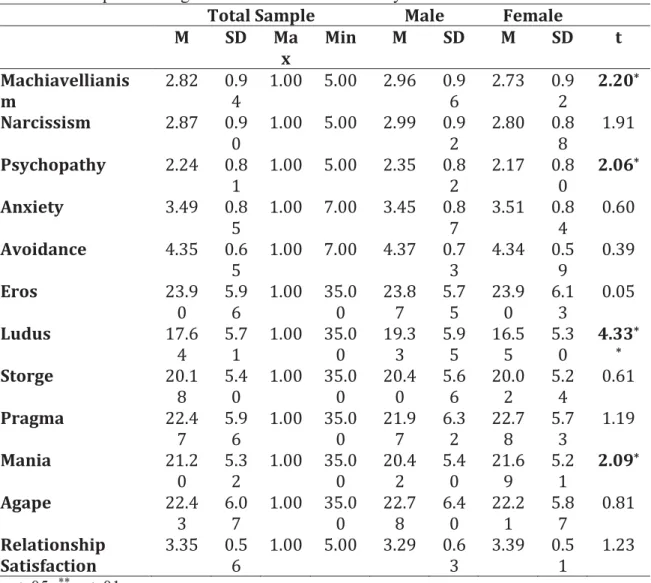
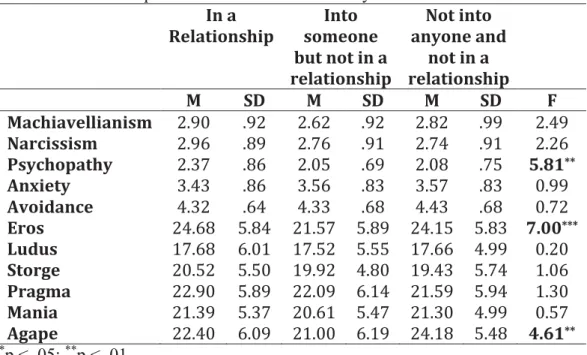
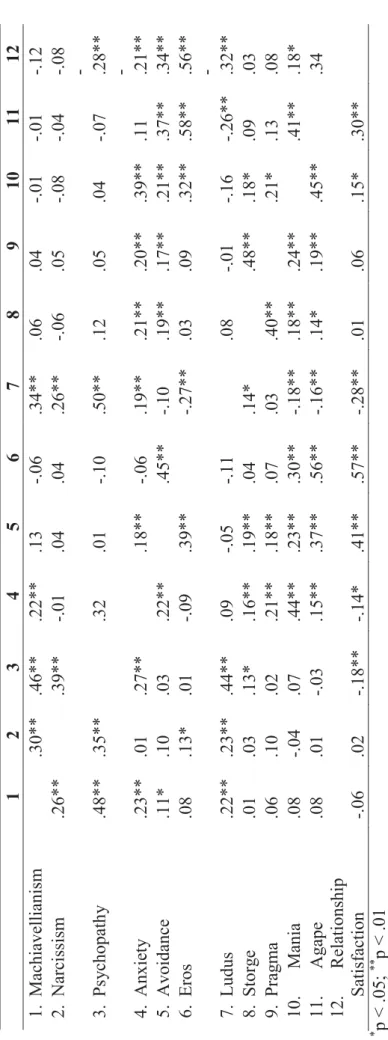
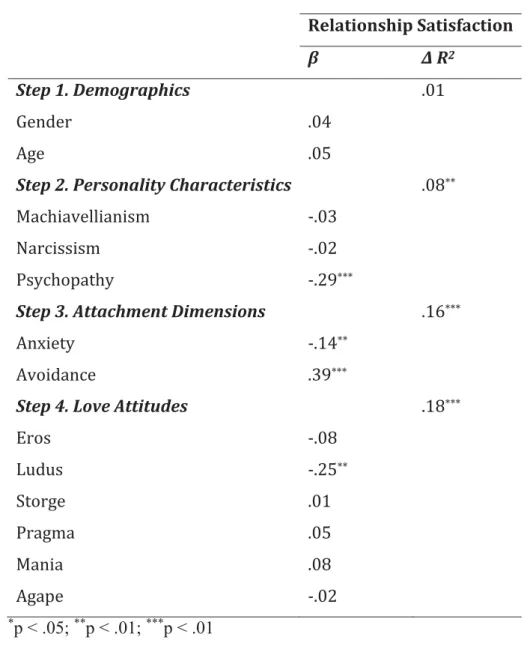
This work aims to explore the relationships between Dark Triad personality traits, love attitudes, attachment and relationship satisfaction. In order to examine gender differences, independent sample t-test was used. Relationship status differences was examined by conducting a series of One-Way between subjects analysis of variance (ANOVA). Pearson’s Correlation Analysis used to assess the relationship between Dark Triad traits, love attitudes, attachment dimensions and relationship satisfaction. A hierarchical regression analysis was performed to predict individuals’ relationship satisfaction scores from Machiavellianism, narcissism, psychopathy, attachment anxiety, avoidance, and love attitudes. A path analysis was conducted to test the proposed model indicating the associations between dark triad personality characteristics and relationship satisfaction via attachment dimensions and love attitudes.
ABSTRACT
PREDICTING RELATIONSHIP SATISFACTION: DARK TRIAD PERSONALITY TRAITS, LOVE ATTITUDES, ATTACHMENT DIMENSIONS
Uysal, Aşkım Nur
M.A., Department of Psychology
Supervisor: Assist. Prof. Hasan Galip Bahçekapılı January 2016
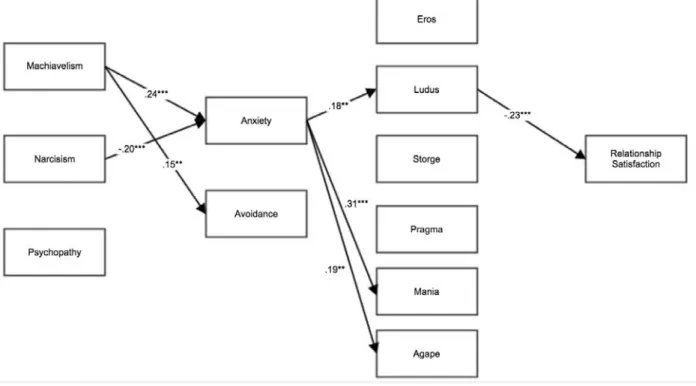
The present study aimed to investigate the role of dark triad personality traits (narcissism, Machiavellianism and psychopathy), love attitudes and attachment dimensions (attachment anxiety and attachment avoidance) on relationship satisfaction. The sample of the study composed of 336 (131 males, 205 female) university students with an age range between 19 to 43 years. The participants completed Experiences in Close Relationships Scale-Revised, Relationship Assessment Scale, Short Dark Triad Questionnaire, and Love Attitudes Scale. Regression analyses were conducted in order to find out the predictors of relationship satisfaction. Results showed that psychopathy, attachment anxiety, and ludus love style negatively predicted relationship satisfaction, whereas attachment avoidance positively predicted relationship satisfaction. Regression analysis suggested that there might be potential mediators, therefore a path analysis was performed to test the proposed model and to examine the associations between dark triad personality characteristics and relationship satisfaction via attachment dimensions and love attitudes. Results revealed significant pathways. Machiavellianism was found to be positive predictor of attachment anxiety, which in turn predicted increased ludus and lessened relationship satisfaction. Results also revealed
that narcissism was inversely associated with attachment anxiety; in turn it predicted ludus and relationship satisfaction, respectively. The results were discussed in terms of potential limitations and importance for future research.
Keywords: Relationship Satisfaction, Dark Triad, Attachment anxiety, Attachment avoidance, Love Styles, Love Attitudes
ÖZ
İLİŞKİ DOYUMUNUN KARANLIK ÜÇLÜ KİŞİLİK ÖZELLİKLERİ, AŞK BİÇİMLERİ VE BAĞLANMA BOYUTLARI TARAFINDAN YORDANMASI
Uysal, Aşkım Nur Yüksek Lisans, Psikoloji
Danışman: Yrd. Doç. Dr. Hasan Galip Bahçekapılı
Ocak, 2016
Bu araştırmada, karanlık üçlü kişilik özelliklerinin (narsisizm, makyavelizm, ve psikopati), aşk biçimlerinin ve bağlanma boyutlarının (kaçınma ve kaygı) ilişki doyumu üzerindeki etkisini incelemek amaçlanmıştır. Araştırmadaki örneklem, 131’si erkek, 205’i kadın olmak üzere 336 üniversite öğrencisinden oluşmaktadır. Katılımcıların yaş aralıkları 19 ve 43 arasındadır. Katılımcılar, Yakın İlişkilerde Yaşantılar Envanteri – II, İlişki Doyumu Ölçeği, Kısa Karanlık Üçlü Ölçeği ve Aşka İlişkin Tutumlar Ölçeği’ni doldurmuşlardır.
İlişki doyumunun yordayıcılarını belirlemek amacıyla regresyon analizleri uygulanmıştır. Sonuçlar, psikopati, bağlanma kaygısı boyutunun ve “oyun gibi” aşk biçiminin ilişki doyumunu negatif yönde yordadığını, kaçınma boyutunun ise ilişki doyumunu pozitif yönde yordadığını göstermiştir. Bunun yanında, regresyon analizleri aracı rol oynayan faktörler olabileceğini göstermiş, karanlık üçlü kişilik özelliklerinin aşk biçimleri ve bağlanma
boyutların aracılığıyla ilişki doyumunu nasıl etkilediğini görmek için yol analizi yapılmıştır. Sonuçlar bir takım anlamlı ilişkiler dizisi göstermiştir. Makyavelizmin bağlanma kaygısı boyutunu pozitif yönde yordadığı, buna bağlı olarak bağlanma kaygısının da oyun gibi aşk biçimini pozitif yönde ve ilişki doyumunu negatif yönde yordadığı bulunmuştur. Sonuçlar ayrıca narsisizmin bağlanma kaygısı ile, buna bağlı olarak da sırasıyla oyun tipi aşk biçimi ve ilişki doyumu ile ters olarak ilişkili olduğunu göstermiştir. Araştırmanın sonuçları, potansiyel sınırlılıkları ve gelecek araştırmalar için önemi çerçevesinde tartışılmıştır.
Anahtar Kelimeler: İlişki Doyumu, Karanlık Üçlü, Bağlanma Kaygısı, Kaçınma, Aşk Biçimleri, Aşka İlişkin Tutumlar.
ACKNOWLEDGEMENTS
First of all, I would like to offer my gracious thanks to my supervisor, Assistant Professor Hasan Bahçekapılı, for his remarkable advises and guidance through this process. He has always been an understanding and encouraging mentor throughout this journey.
Next, I am very thankful and appreciative to Assistant Professor Mehmet Harma, for his guidance and help in data analysis, and for his endless patience and positive attitude in this process.
I must express my deepest gratitude to my dear teacher Assistant Professor Olga Selin Hünler for her role in my success in the long run of my education. She inspired me and her support gave me the confidence I need to take the next step toward my goals.
I would also like to thank Assistant Professor Gergely Czukor, for accepting to be my committee member without knowing me well.
Finally, I would not imagine completing this dissertation without the support of my family and my fiancé. I am deeply grateful for them for their enduring love, respect, and believing in me in this long and sometimes frustrating process. Most importantly, I am thankful for them to make me realize what makes life worthwhile.
TABLE OF CONTENTS PREFACE……….………...iii ABSTRACT……….………...iv ÖZ………...vi DEDICATION………. ACKNOWLEDGEMENTS………..………...…viii TABLE OF CONTENTS………....………..….….ix LIST OF TABLES………...xi LIST OF FIGURES………...xii LIST OF ABBREVIATIONS………...……...xiii CHAPTER 1. INTRODUCTION………...……....1
1.1 Introducing the Key Concepts ………...2
1.1.1 Introducing the Dark Triad ………2
1.1.1.1 Narcissism and Subclinical Narcissism ……...2
1.1.1.1.1. Origins of Narcissism in Mythology and Psychology…2 1.1.1.1.2. Subclinical Narcissism and Measurement………..4
1.1.1.2 Machiavellianism: Origins of the Term and Measurement…..4
1.1.1.3 Psychopathy and Subclinical Psychopathy……….6
1.1.1.3.1 The Construct of Psychopathy & Measurement………..6
1.1.1.3.2 Subclinical Psychopathy & Measurement………7
1.1.1.4 Dark Triad as a Constellation……….……..8
1.1.1.2 Introducing Love Attitudes……….………...10
1.2.1 Early Theories and Lee’s Colors of Love………..10
1.1.3 Introducing Adult Attachment………12
1.1.3.1 Early Theories and Psychometric Assessment………...…...12
1.1.4 Introducing Relationship Satisfaction……….…...……….15
1.1.4.1 Definition and Psychometric Assessment ……...15
1.2 Linking The Key Concepts………...….….……….. 16
1.2.1 Love Attitudes & Relationship Satisfaction…………...……16
1.2.3 Attachment & Relationship Satisfaction………...19
1.2.4 Dark Triad Personality in Relationships………..…..21
1.2.4.1 Narcissism in Relationships……….…..21
1.2.4.2 Machiavellianism in Relationships……….……24
1.2.4.3 Psychopathy in Relationships……….…26
1.2.4.4 Dark Triad in Relationships………28
1.3 Aims of the Study……….…30
2. METHOD………....….………..33
2.1 Participants………...33
2.2 Instruments………...………...33
2.2.1 Demographic Information Form………...33
2.2.2 Experiences in Close Relationships Scale – Revised (ECR-R)…33 2.2.3 Relationship Assessment Scale (RAS)………...33
2.2.4 Short Dark Triad (SD3)……….…..……...34
2.2.5 Love Attitudes Scale (LAS)……….…35
2.3 Procedure……….………….…..36
3. RESULTS………...………...…...37
3.1 Descriptive Statistics and Bivariate Correlations between the Study Variables...……….…………..37
3.2 Predicting Relationship Satisfaction from Personality Characteristics, Attachment, and Love Attitudes………..42
4. DISCUSSION………..………..……...46
4.1 Discussion Regarding Gender and Relationship Status Differences...46
4.2 General Associations and Predictions Regarding Dark Triad Traits, Love Attitudes, Attachment Anxiety and Avoidance, and Relationship Satisfaction………...47
4. 2. 1 Love Attitudes and Relationship Satisfaction………47
4.2.2 Love Attitudes and Attachment………....48
4.2.3 Attachment and Relationship Satisfaction………..…..50
4.2.4 Dark Triad and Love Styles………..51
4.2.5 Dark Triad and Attachment……….….52
4.3 Discussions of the Proposed Model Regarding Dark Triad Traits, Love
Attitudes, Attachment Anxiety and Avoidance, and Relationship Satisfaction…...53
4.4 Limitations and Further Implications………56
REFERENCES………...58
APPENDICES………...………...….….83
A. Consent Form ………...…...83
B. Demographic Information Form.……...85
C. Experiences in Close Relationships – Revised………...……...88
D. Relationship Assessment Scale………...…...90
E. Short Dark Triad (SD3)……….…..……...91
F. Love Attitudes Scale………. ………...……..92
LIST OF TABLES
Table 1 Descriptives and Gender Differences in the Study Variables………...37 Table 2 Relationship Status Differences in the Study Variables……….38 Table 3 Correlations Between the Study Variables ………...41 Table 4 Hierarchical Regression Analysis in Predicting Relationship Satisfaction………43
LIST OF FIGURES
LIST OF ABBREVIATIONS
DT: Dark Triad
ECR-R: Experiences in Close Relationships Scale-Revised RAS: Relationship Assesment Scale
SD3: Short Dark Triad LAS: Love Attitudes Scale
1. INTRODUCTION
Being capable of love is one of the most important aspect of our nature. Having healthy intimate relationships are essential for general psychological well-being. This research aimed to explore the influence of particular personality characteristics -known as Dark Triad-, love styles and attachment dimensions on relationship satisfaction, for the better understanding of the factors interfering with healthy and satisfactory relationships.
Many research revealed the importance of good, healthy relationships and great degrees of relationship satisfaction, as they increase psychological well-being, and linked with better physical and mental health (Baumeister & Leary, 1995, Guerrero, Anderson & Afifi, 201l).
Research indicated that are many underlying psychological processes that influence the relationship quality, such as personality traits (Bradbury & Karney, 2004), attitudes toward love (Morrow, Clark & Brock, 1995) and attachment (Simpson, 1990).
Regarding relationship satisfaction, one important area to study has been the examination of love styles, which refers to six different types of attitude toward love (Lee, 1973). Another important concept related to relationship satisfaction is adult attachment. Attachment motivates us to create affectionate bonds with others, throughout our lifespan (Bowlby, 1982).
Recently, a new constellation of particular personality characteristics emerged in literature, namely, The Dark Triad. The Dark Triad refers to an assemblage of three characteristics: subclinical narcissism, Machiavellianism and subclinical psychopathy (Paulhus & Williams, 2002).
It is important to study the potential factors related to relationship satisfaction to learn more about improving relationships. Although previous research investigated the associations between adult attachment dimensions and love attitudes related to relationship satisfaction (Fricker & Moore, 2002), there were not any research investigated the joint influences of Dark Triad traits, attachment dimensions, and love attitudes on romantic relationship satisfaction. At present, the extent to which dark triad traits, attachment dimensions and love
attitudes are associated with the satisfaction in adult romantic relationships is not clear, and it is also not clear that how these relationship related elements are associated with relationship satisfaction in Turkey.
1.1 Introducing the Key Concepts 1.1.1 Narcissism
1.1.1.1 Origins of Narcissism in Mythology and Psychology
The origin of the term “narcissism” comes from Greek mythology, the story of Roman poet Ovid, about Narcissus. Narcissus is a very good looking young man who disdains the ones who fell in love with him and rejects many potential lovers, because in his eyes nobody matches him and none were worthy of him. One of the ones he spurns is the cursed nymph Echo, named after the fact that she can only echo the other people’s sounds because of the curse. After Narcissus rejects Echo, the gods grow tired of his behavior and they make him not recognize his own reflection and fall in love with himself in the waters of a spring. When he realized that the reflection cannot reciprocate his feelings, he dies out of misery.
Narcissism as a psychological concept was first brought in by Ellis (1898) to psychoanalytic theory. Ellis introduced narcissism to the psychiatry, by realizing the similarity between the myth of Narcissus to the concept of “auto-eroticism”, which he observed in a patient and refers to being sexually attracted to oneself. Later, Freud (1914/1957) utilized the term to describe extreme levels of love for oneself and self-centeredness. His presentation of narcissism was different than Ellis, because Freud presented narcissism by highlighting its importance on normal human development and normal adult psychology, as well as its importance in psychopathology. He theorized that narcissism was a normal part of developmental pathway, before the libidinal energy is invested to other people, instead of themselves. Freud argued an individual’s libidinal energy is limited, and can be directed toward only oneself or the others at the same time. Thus, he believed that the progression from primary narcissism to object love results in a decrease in self-regard. A healthy relationship is reciprocal, and because of the fact that both people invest their libidinal energy into the other, none of them experiences a loss. However, when the individual’s object of love doesn’t return the investment, a regression to the unhealthy state of narcissism
occurs, which is called as “secondary narcissism”, which serves as a compensatory mechanism, in order to love and gratify oneself.
In his famous monograph On Narcissism: An Introduction (1914/1957), Freud differentiated between two types of individual experiences of love. He explained that the “anaclitic” or attachment-type individuals focus their love outward, preferably to love objects that are reminiscent of early attachment figures. On the other hand, narcissistic-type individuals focus their love inward, toward the self. In other words, Freud was explaining that love could be about the connection with the other (anaclitic), or about the self (narcissistic).
He later suggested that narcissism is a personality variable which usually gets others’ attention, and characterized by being independent, self-preserved, confident, and inability to love or commit (Freud, 1931/1950).
Later, Karen Horney (1939/1966) described the concept of narcissism as “self-inflation”. She argued that narcissism indicates love and admiration for self when there is no basis for doing so. She indicated that admire and value oneself for actual qualities is real self- esteem. Horney shared the idea of the origin of narcissism comes from not getting adequate love by parents. She suggested that the unloved child creates a false and inflated self to get admiration. She believed that narcissism derives from not being able to love self or others, and the excessive self-love of a narcissist is just a display, and not real, in contrast with Freud’s theory that narcissistic people invest all their love to themselves thus cannot give it to others.
Years after the expanded conceptualization of narcissism by Freud and Horney, Kohut and Kernberg provide improvements to understanding of narcissistic personality. Heinz Kohut (1971, 1977) narcissism occurs due to inadequate mirroring and idealization from caregivers .He argued that pathology emerges if the infant could not properly develop self-assertive ambitions or internalized values and ideals.
Kernberg (1975) emphasized the difference between pathological narcissism and normal adult narcissism, describing that normal narcissism includes a realistic self-concept as a combination of good and bad, not an unrealistically perfect self-image. Kernberg indicated
that a pathological narcissist avoids depending on others, and display emotional coldness, and self-love serves a defense mechanism protects them from frustration and fear of abandonment that comes from early childhood.
1.1.1.2 Subclinical Narcissism and Measurement
Narcissistic Personality Disorder definition in the Diagnostic and Statistical Manual of Mental Disorders—5 (DSM–5; APA, 2013) includes need for admiration, lack of empathy, and grandiosity. In the past years, many studies revealed that narcissism is more of a continuum than a dimensional construct (e. g., Raskin & Hall, 1979; Samuel & Widiger, 2008), therefore, it was started to be studied in normal populations, as a subclinical trait (e.g., Miller & Campbell, 2008).
Narcissism has been studied as a personality characteristic since Freud (1931/1950), first described a narcissistic type person. Finally, Henry Murray (1938) developed the first measurement instrument for narcissism, which he named as “Narcism Scale”. Later, Raskin & Hall developed Narcissistic Personality Inventory (NPI; 1979), the most popular scale regarding narcissism. Many researchers have been shortened the inventory in later studies (e.g. Raskin & Terry, 1988; Rose, 2002). The NPI was designed based on DSM definition, but it enlighted a new path in the study of narcissism, because it was also applicable to be used in normal population.
Although the validation studies of NPI was conducted in clinical settings (Prifitera & Ryan, 1984), the results revealed that NPI indicates higher functioning than other narcissism inventories specified for clinic environments (Wink & Gough, 1990).
1.1.2 Machiavellianism: Origins of the Term and Measurement
The term Machiavellianism is originally inspired from Niccolo Machiavelli, who was Medici family’s chief political advisor in the 16th century. Machiavelli wrote about his counselling advices to maintain political control in his book The Prince (1513/1968), including the practice of manipulation and deceit to maintain political control and reach personal goals in public life. Based on his strategic, self-serving advices, the term
‘Machiavellian’ has become a concept synonymous with cunning and deceit. After four centuries, the personality psychologist Richard Christie, realized that these strategies of Machiavelli had also parallells with daily social behavior. Based on his writings, Christie and Geis (1970) identified an individual who successfully uses manipulation to achieve personal goals, and they use the term Machiavellianism to identify this type of interpersonal behavior.
Machiavellist people behave toward others in a manner that is manipulative, goal-oriented, and exploitative, and they have a sensitive, cynical view toward others, and pragmatic morality (Ali, Amorim, & Chamorro-Premuzic, 2009; McIlwain, 2003). Machiavellians’ world view includes strategical tactics and behaviours (McIllwain, 2003).
Machiavellian people do not care about conventional morality and perform deception tactics in order to achieve personal rewards, and they also use deception to prevent others’ benefits (Wilson, Near, & Miller, 1996). Research revealed their unability to recognize other people’s emotions (McIlwain, 2003), and they are not affected by emotional situations and they can keep their aloof attitude (McIlwain, 2003; Wilson, Near, & Miller, 1996).
Christie and Geis (1970) published a book including questionnaires developed by Christie, to reveal individual differences in Machiavellianism. Among these measures, the most well-known and widely used one has become the Mach IV. Later, Mach V, was designed to be an improved version, but it was more problematic than expected (Wrightsman, 1991), therefore, Mach IV was continued to be broadly used for measurement of Machiavellianism.
1.1.3 Psychopathy
1.1.3.1 The Construct of Psychopathy and Measurement
The term psychopathy similar to our modern description as personality disorder was originated in Cleckley's The Mask of Sanity (1941/1988) in which he discussed the core aspects of psychopathy and summarized the characteristics of psychopaths: “superficial charm and above average intelligence, absence of delusions or other signs of irrational thinking, absence of nervousness or psychoneurotic manifestations, unreliability, untruthfulness and insincerity, lack of remorse and shame, inadequately motivated and
poorly planned antisocial behavior, poor judgment and failure to learn from experience, pathological egocentricity and an incapacity for love and attachment, general poverty in major affective reactions, specific loss of insight, general interpersonal unresponsiveness, fantastic and uninviting behavior --such as vulgarity, rudeness, quick mood shifts--, after drinking and sometimes even when not drinking, suicide rarely carried out, impersonal and poorly integrated sex life, and failure to follow any life plan” (Cleckley, 1941/1988).
Generally, the characteristics that Cleckley defined still preserve their importance in today’s description of psychopathy, except for high intelligence, absence of delusions/irrational thinking, and suicide rarely carried out (Hare, 2003; Lilienfeld & Andrews, 1996). Later, the Psychopathy Checklist (PCL) was developed by Hare (1980), and it has created a milestone in psychopathy research. It was designed to identify forensic psychopaths. PCL and revised version (PCLR; Hare, 1991/2003) have been considered as the pioneers of forthcoming instruments assessing psychopathy (Lilienfeld & Fowler, 2006; Williams, Paulhus, & Hare, 2007). Hare’s (1980) PCL instrument did not involve an item about Cleckley’s low anxiety (nervousness), as Hare noted that Cleckley's item was unrelated to the other core elements of psychopathy in validation studies. Later, Hare (2003) indicated that the researches demonstrate that self-reported anxiety and fear had weak and mostly negative correlations with PCL-R scores.
Afterwards, the Self-Report Psychopathy Scale was developed by Hare, as a self-report form of PCL (SRP; Hare, 1985). SRP-III (Paulhus et al., in press) was developed as a current version of SRP. The four PCL-R factors have four factors which corresponds with four factors of SRP-III (Williams et al2007). Williams and colleagues (2007) found that SRP-III have good reliability and validity.
1.1.3.2 Subclinical Psychopathy and Measurement
Many researches have suggested that psychopathy, which is characterized by emotional shallowness, manipulation in interpersonal relationships, and antisocial behavior, can predict many behavioral outcomes in forensic settings (Salekin, Rogers, & Sewell, 1996). While there are many researches about the individual differences –regarding behavior and
personality- of psychopath and non-psychopath criminals (Newman & Schmitt, 1998; Rice, Harris, & Cormier, 1992; Smith & Newman, 1990), another literature has begun to emerge about self-reported psychopathic traits in normal populations (e.g., Benning, Patrick, Blonigen, Hicks, & Iacono, 2005; Levenson, Kiehl, & Fitzpatrick, 1995).
As seen in the early psychopathy literature, which encompasses many studies using the PCL-R to assess psychopathy specifically in forensic populations, the construct of psychopathy has generally been linked with antisocial and criminal behaviour, although years ago Cleckley (1941/1988) emphasized psychopathy do not have to essentially include antisocial behaviour, and antisocial behavior is not synonymous with psychopathology. Recently, Skeem & Cooke (2010) also emphasized that criminal behaviour is not the definitive feature of psychopathy. This point of view led the way toward developing self-report instruments that can be applicable to the nonclinical and noncriminal population, and researching about psychopathy as a personality trait in normal populations (Benning et al, 2005). There are three well-known measurements of self-reported subclinical psychopathy: Levenson's Primary and Secondary Psychopathy Scales (LPSP; Levenson et al., 1995), the Psychopathic Personality Inventory-Revised (PPI-R; Lilienfeld & Widows, 2005) and the Self-Report Psychopathy III (SRP-III; Paulhus, Neumann, & Hare, in press).
The LPSP was developed to assess primary and secondary psychopathy in civil populations. The PPI was developed by Lilienfeld & Andrews (1996) generally based on Cleckley's description, to assess the prototypical personality characteristics of psychopathy, not the antisocial behavior features in PCL-R Factor 2.
The newest version of Self-Report Psychopathy Scale (Hare, 1985), the SRP-III (Paulhus et al., in press) is also one of the popular instruments used for measurement of subclinical psychology.
1.1.1.4 Dark Triad: As A Constellation Of Three Dark Traits
Paulhus and Williams (2002) were the first researchers who emphasized the concept of ‘Dark Triad’, a constellation of three personality traits that are distinct but also have some similar qualities, namely narcissism, Machiavellianism and subclinical psychopathy. It refers to the
variables which are in the subclinical range, that do not require clinical attention. The development of measurement instruments of subclinical narcissism starting with NPI (Raskin & Hall, 1979) and subclinical psychopathy with SRP (Hare, 1991) has enabled research of the three dark personality variables in normal populations.
Narcissism shifted from clinical literature into the mainstream personality research when Narcissistic Personality Inventory was published (Raskin & Hall, 1979). The consistency between the subclinical version and the clinical definition made this transfer smoother (Campbell & Foster, 2007).
Ray & Ray (1982) has anticipated that psychopathy will transfer into the mainstream personality literature when the only questionnaire for psychopathy was the one within the MMPI. Psychopathy is identified by low empathy with high levels of impulsivity and thrill-seeking (Hare, 1985; Lilienfeld & Andrews, 1996). Even when it is subclinical, psychopathy is still considered as the most dangerous and malign trait of the Dark Triad concept (Rauthmann, 2012).
On the other hand, Machiavellianism has never been considered as a clinical syndrome. It has derived from the notes of Machiavelli, which represents cynical, pragmatic and manipulative behavior in order to reach success and personal goals (Christie & Geis, 1970).
Although these traits -narcissism, Machiavellianism, and psychopathy- had distinct origins, there are overlapping elements, as all three include a dark character with socially undesirable nature with behavioral dispositions such as emotional coldness, grandiosity, aggressiveness and manipulation (Paulhus & Williams, 2002).
McHoskey and colleagues (1998) reported that psychopathy and Machiavellianism may co-occur in non-clinical populations. Recently, a study by Nathanson & Paulhus (2006) including anonymous revenge anecdotes revealed that there is a significant overlap between The Mach IV and subclinical psychopathy measures (McHoskey, Worzel, & Szyarto, 1998; Paulhus & Williams, 2002). Morever, the correlation between revenge and Machiavellianism was entirely derived from the overlapping of Mach and subclinical psychopathy (Nathanson & Paulhus, 2006).
The association between psychopathy and narcissism has been reported in the clinical literature (Hart & Hare, 1998). Gustafson & Ritzer’s (1995) research provided empirical evidence for the overlap of narcissism and psychopathy. Another studies indicated a positive correlation between psychopathy and narcissism, which encompasses grandiosity, superiority, entitlement, and dominance (Lee & Ashton, 2005; Paulhus & Williams, 2002).
These correlations lead the questioning about Dark Triad members: if they are separate constructs, why they are always found to be positively associated no matter what measurement instrument was used. Paulhus & Williams (2002) noted that this possibly derives from an underlying element that is common for three constructs (Paulhus & Williams, 2002). Jones & Paulhus’ (2011a) further research revealed that callousness is the common element and the core of the triad. Research indicated that callousness (low empathy) appears to be having close relationship with using manipulation and exploitation in interpersonal settings (Miller et al., 2010).
There are two multivariate instruments to measure Dark Triad personality traits: Dirty Dozen (Jonason & Webster, 2010), and the Short Dark Triad (Jones & Paulhus, 2014). The results of these two scales are generally similar, however, 27 items of Short Dark Triad enhances its validity comparing to 12 items of Dirty Dozen (Maples, Lamkin, & Miller, 2014). Also, the intercorrelations among narcissism, Machiavellianism and psychopathy subscales are lower in Short Dark Triad, implying the better differentiation of overlapping constructs. Short Dark Triad was found to be have more predictive power, comparing to Dirty Dozen (Egan, 2012; Jones & Paulhus, 2014; Lee et al., 2013).
1.1.2 Introducing Love Attitudes
1.1.2.1 Early Theories of Love & Lee’s Colors of Love
Paulo Coelho said in his novel The Zahir: A Novel of Obsession, “Love is an untamed force. When we try to control it, it destroys us. When we try to imprison it, it enslaves us. When we try to understand it, it leaves us feeling lost and confused.” (p. 79). Love has been a part of being human, it is a primitive function of humanity, thus, throughout history, love has been one of the primary topics for many philosophers, authors, and poets. Despite its intriguing nature, the difficulty of operationally defining love has challenged researchers.
During the past decade, love finally has gained importance as a respectable study area for psychologists, and studies have gained a rise to understand the depth of love and how it affects human interaction (e.g. Kelley, 1983; Rubin, 1984, as cited in Hendrick & Hendrick, 1986). Researchers began to propose theories of love which describes different types of love, beginning with describing passionate love, and later adding companionate love, altruistic love, and pragmatic love (Berscheid & Walster, 1974; Walster & Walster, 1978; Kelley, 1983; as cited in Hendrick & Hendrick, 1986). Sternberg (1986) developed the well-known triangular theory of love, in which love is categorized on three dimensions as intimacy (feelings of closeness and affection), passion (the arousal that you experience when you are attracted to another person), and commitment (desire to maintain a relationship over time). He claimed that different love styles base on these three components, and emphasized that a relationship including two or more of these components is stronger than including only one.
One approach to understand the concept of love and different types of love, was proposed by Lee (1973/1976), who claimed a typology of six distinct love styles, each given a Greek name. Lee’s first primary love style is Eros, which describes romantic, passionate love. The individuals who have this love style are driven by passion in romantic relationships. The second primary love style is Ludus, game-playing love, which implicates a tendency to deceive, aversion to commitment and emotional involvement, and willingness to seek other potential partners when in a relationship. The last primary love style is named as Storge, friendship love, which refers to slow-developing relationship based on trust and companionship. First of Lee’s three main secondary styles is Mania, possessive love, which is dominated by a possessive, dependent attitude toward partner, involving feelings of jealousy. Another secondary love style is Pragma, which can be explained as logical and pragmatic, shopping list kind of love, based on suitability and practicality over emotional involvement. The third and final secondary love style is Agape, which describes self-sacrificing love. These individuals regard the best interest of the partner, and sacrifice their own desires and needs. Lee suggested that these secondary styles can be considered as base primary elements of pairs of three primary styles, but they are also distinct types of love. In other words, each of them are compounds of a pair of the primary love styles (Pragma is a compound of Storge and Ludus, Mania is a compound of Eros and Ludus, and Agape is a compound of Eros and Storge) but they each are also qualitatively different from each of the
primary styles (Hendrick & Hendrick, 1986).
Lee’s typography of love is important because it embodies the earlier proposed theories of love, and provides theoretical basis for developing scales to measure these six distinct love styles (e.g.: Hatkoff & Lasswell, 1979, as cited in Hendrick & Hendrick, 1986). Lee's research provided basis for the development of a 50-item true/false questionnaire to examine these love styles (Hatkoff & Lasswell, 1979; as cited in Hendrick & Hendrick, 1986). However, further research (Hendrick, Hendrick, Foote, & Slapion-Foote, 1984) combining the items in Lasswells' questionnaire with new Likert-type items, revealed some problems about factor structure of three main love styles (Eros, Ludus, and Storge), as they didn’t emerge as separate factors and tend to combine with another love style, triggered studies to develop a new measurement instrument for love attitudes. Hendrick & Hendrick (1986) developed Love Attitudes Scale (LAS), a 42-item-questionnaire with 6 subscales representing Lee’s six distinct love styles. Love Attitudes Scale has been used for many researches about attitudes toward love, and the initial studies generally focused on differences between men and women.
Previous studies about love styles frequently revealed sex differences. Generally, men were found to be more Erotic and Ludic lovers than women, whereas women reported more Pragma and Mania than men (e.g. Hendrick & Hendrick, 1995). In other words, men are more likely to have romantic and game-playing attitudes, whereas women tend to be pragmatic and possessive. Another previous study of Hendrick & Hendrick’s (1986) also revealed almost same results, as males scored higher on Ludus, and females scored higher on Storge, Pragma and Mania. These findings are indicating different behavioral tendencies of men and women in romantic settings.
Frazier and Esterly (1990) reported that men were found to be more Ludic and Erotic lovers, however, results did not indicate that women score higher on Storge, Pragma and Mania. On the other hand, results revealed that men were significantly more Agapic than women. Although this finding contrasts with previous studies’ findings (e.g Hendrick et. al, 1984), later, another study conducted by Fricker and Moore (2002) reported similar findings. In general, men have more game-playing attitudes in romantic relationships, whereas women tend to have more practical, friendship and possessive styles.
1.1.3 Adult Attachment
1.1.3.1 Early Theories & Assessment
Attachment theory (Bowlby, 1969) was originally proposed as a general theory of personality development. He claimed that our early experiences and availability expectations regarding our caregiver shapes our “internal working models” of the self and significant others.
According to Bowlby’s (1982) theory, attachment serves both an evolutionary role for the species and a developmental function for the individual. The interactions between infant and caregiver develop into affect-laden schemas that guide the attached individual’s perceptions of self and others (so-called internal working models) and shape behaviors related to biological and psychological needs (Mikulincer et al., 2002). There are different categorizations regarding sense of security in adult attachment, such as Bartholomew’s (1990) model of “secure, preoccupied, dismissing, and fearful attachment”; however, taxometric findings strongly support a latent dimensional structure of human attachment (Fraley & Waller, 1998); in turn, these findings prompted the development of multiple-item scales, which typically assess aspects of attachment anxiety and avoidance dimensionally (Fraley & Waller, 1998).
As many attachment theorists explained (e.g Collins & Read, 1990; Hazan & Shaver, 1987), experiences from early attachments with significant other are internalized to shape cognitive working models that guide individuals’ beliefs and expectations about later social interactions in life. If an individual fails to develop a secure attachment based on basic trust with the caregiver, a compensatory adaptive strategy is needed in order to maintain an intact identity and a coherent self image (Bowlby, 1982). Ainsworth and her colleagues (Ainsworth, Blehar, Waters & Wall, 1978) suggested if an infant could not form a secure attachment to its caregivers in its early emotional development, it develops one of the two alternative adaptive strategies to compensate its lack of security, and form an Avoidant attachment or Anxious Ambivalent attachment. Research revealed that these attachment categories can be applicable to adult attachment as well (Hazan & Shaver 1987). Shaver & Mikulincer (2002) defined these three attachment styles as “systemic patterns of expectations, needs, emotions, emotion-regulation strategies, and social behaviour that result
from the interaction of an innate attachment behavioural system” (p.134).
The theory of attachment facilitates understanding the phenomenon of love in terms of personality and evolutionary psychology. As a theoretical framework, attachment theory gives a basis for the understanding human affectional bonds, including romantic relationships.
Hazan and Shaver (1987, 1988) by focusing on the secure attachment, avoidant attachment and anxious/resistant attachment in their research, explained the typical romantic processes of adults and differences between styles of relating. Results revealed that the attachment styles of adults were similar to their infancy, which leads individual differences in experiencing love. Their attachment styles were related to childhood memories about relationships with parents and inner working models, which were shaped by the early childhood experiences with parents.
Secure attachment in adulthood is characterized by trusting the partner and getting close without completely merging with another. These individuals considered “the self” as worthy of care, they feel comfortable about being dependent upon and being dependent on their partner, and they are not concerned with feeling of abandonment. (Hazan & Shaver, 1987). Anxiously attached adults experience great desire to merge with their partner, and have constant concerns about abandonment. They crave for emotional closeness and constant reassurance for partner’s love (Collins & Read, 1990). Individuals with avoidant attachment feel discomfort with intimacy and interdependence. They want to keep emotions at low intensity (Hazan & Shaver, 1987).
Adult attachment is evaluated by two underlying dimensions, namely “attachment related anxiety and avoidance” (Brennan, Clark & Shaver, 1998). Anxiety, indicates constant rumination and worry about being abandoned or rejected by partner. On the other hand, avoidance indicates the extent of feeling comfortable with emotional intimacy and closeness with partner. People scoring high on this dimension are typically reluctant about investing in relationships and want to maintain emotional and psychological independence., Securely attached people score low on both dimensions (they are more comfortable with emotional intimacy and are not habitually concerned about abandonment or rejection). Research
revealed that even though individuals score high on attachment anxiety want to be able to trust their partners, they are skeptical about trusting them completely. Therefore, they are likely to have low or moderate degrees of trust in romantic partners (Brennan, Clark & Shaver, 1998).
1.1.4 Relationship Satisfaction
1.1.4.1 Definition and Psychometric Assessment
Relationship satisfaction is generally the most broadly studied variable in romantic relationship research literature. There are many terms in previous researches that have been used to indicate the overall quality of a romantic relationship and are considered synonymous, such as marital (or relationship) satisfaction, happiness, quality, and adjustment (Heyman, Sayers, & Bellack, 1994). Rusbult and collagues (1998, p.359) explained it as the “positive versus negative affect experienced in a relationship and is influenced by the extent to which a partner fulfils the individual’s most important needs”. Many research revealed that high levels of romantic relationship satisfaction increases well-being (Baumeister & Leary, 1995). Also, recent research revealed that good, healthy relationships are linked with better physical and mental health (Guerrero, Anderson & Afifi, 201l). These findings lead the research focus upon the factors which are linked with healthy relationship satisfaction.
Many components of romantic relationship has been studied in relation to relationship satisfaction. Because of the proposition that attachment manifest itself in close relationships and strongly connected to individual’s romantic attitude, research on relationship satisfaction generally includes attachment style (Hazan & Shaver, 1987; Hendrick & Hendrick, 1989; Collins & Read, 1990; Simpson, 1990). Link between love and relationship satisfaction also has been investigated (Contreras et. al, 1996; De Andrade et. al., 2015) which revealed significant relationships between components of love and satisfaction, indicating that romantic love is an important predictor of relationship satisfaction. Hendrick, Dicke & Hendrick’s (1998) research yielded that attitude toward love and therefore, the love style of individual also has contribution to the satisfaction from the relationship.
Relationship satisfaction has been generally measured by using self-report instruments to assess thoughts and feelings about relationship. The most popular measurement instruments of relationship quality include the Locke-Wallace Marital Adjustment Test (Locke & Wallace, 1959), Spouse Observation Checklist (Patterson, 1976), Dyadic Adjustment Scale (Spanier, 1976), and Marital Satisfaction Inventory (Snyder, 1979). Although all of these are widely used, several of them are relatively long with more than two hundred items, which make them unpractical, and all of them are oriented to marital relationships. There was a need for a shorter and general measure of relationship satisfaction, and 7-item Relationship Assessment Scale was developed by Hendrick (1988). Relationship Assessment Scale includes items that are worded as not specific to marriages, thus, it can be applied to other forms of intimate relationships.
1.2 Linking the Key Concepts
1.2.1 Love Attitudes and Relationship Satisfaction
Lee’s romantic love styles have been widely investigated in the literature and reported to be related with many consequences in everyday life, including relationship outcomes (e.g., relationship satisfaction, Davis & Latty-Mann, 1987; relationship longevity, Kimberly & Hans, 2012).
Eros love style is characterized by passion and deep physical attraction. Results revealed that Erotic lovers report high emotional intimacy and satisfaction in their relationships (Davis & Latty-Mann, 1987; Hendrick, Hendrick & Adler, 1988). Eros lovers also have high level of concern for well-being of partner and high relationship investment, therefore they tend to demonstrate healthy and successful communication and self-disclosure skills (Hendrick & Hendrick, 1987). Morrow and colleagues (1995) also reported that Erotic and Agapic lovers tend to find their romantic relationships more rewarding, more committed and more satisfying.
Ludus is also characterized by intense sexual attraction, but it differs from Eros in lack of emotional intimacy. Ludus lovers prioritize personal satisfaction and having fun, and may be comfortable maintaining multiple partners simultaneously (Lee, 1973). Hendrick et al. (1988) reported that Ludus love style indicated relationship dissatisfaction. Ludus love style
is found to be negatively correlated with intimacy and commitment (Morrow, Clark & Brock, 1995) and Ludus love style is found to be associated with the least satisfaction in relationships (Meeks, Hendrick & Hendrick, 1998).
Storge love is also known as friendship style of love, and storge lovers emphasize companionship and compatibility over physical attraction (Lee, 1973). Storge lovers indicated high levels of intimacy and relationship satisfaction (Hendrick & Hendrick, 1993; Meeks, Hendrick & Hendrick, 1998).
As a secondary love style, Agape can be seen as a combination of two primary styles: Eros and Storge. It is characterized by sacrificing own desires and needs on behalf of the best interest of the partner (Lee, 1973; Hendrick & Hendrick, 1986), and Agape lovers were found to be extremely forgiving, committed, and supportive partners (Hahn & Blass, 1997). Agape love is linked with high commitment, relationship satisfaction and intimacy (Lin & Huddleston-Casa, 2005; Hendrick, Hendrick & Adler, 1988; Morrow, Clark & Brock, 1995). Similar to Eros lovers, they have high levels of relationship investment and concern for partner’s well-being (Richardson et al., 1989). Individuals who are or have been in loving or committed relationships are more likely to adopt Agape love than those have never been in love (Hendrick & Hendrick, 1986).
Pragma love emphasizes on rational decision making about a relationship based on concerns such as personal and social compatibility, family values, or education over physical attraction (Hahn & Blass, 1997). Results demonstrated gender differences in characteristics of pragma lovers. For instance, Hendrick & Hendrick (1991) found that pragmatic females were more tend to pursue closeness in romantic relationships than males. Lower relationship satisfaction has been related with Pragma for men (Frazier & Esterly, 1990), and Morrow and colleagues (1995) reported that Pragma and Storge are linked with some relationship quality measures. This finding is inconsistent with some previous findings reported by others (Davis & Latty-Mann, 1987; Shaver & Hazan, 1988). In summary, there are not any findings indicating a direct correlation between Pragma love style and relationship satisfaction. Therefore, no significant association is expected between pragma and relationship satisfaction.
partner and constant need of great deal of attention and affection, and Mania lovers tend to be emotional, obsessive and jealous (Lee, 1973; Hahn and Blass, 1997). Hendrick, Hendrick & Adler (1988) found that Mania is more likely to result in a negative predictor of relationship satisfaction for women, than for their men counterparts.
Overall, mostly studies have reported higher relationship satisfaction for Erotic and Agapic lovers, and lower for Ludic lovers (Contreras, Hendrick, & Hendrick, 1996; Fricker & Moore, 2002).
Büyükşahin and Hovardaoğlu’s (2004) study in Turkey revealed that Ludus is linked with lower relationship satisfaction, while Agape and Eros love styles are linked with higher relationship satisfaction. All these findings reveal that love style of an individual can have a profound impact on relationship satisfaction.
1.2.2. Love Attitudes and Attachment
As Hendrick & Hendrick (1989) emphasized, the attachment styles focus on two themes: trust and intimacy, while the love styles extend this focus with communication themes essential to love. They suggested that attachment styles are typically “the building blocks of interpersonal relationships” (Hendrick & Hendrick, p.792), whereas the love styles reflect the many beliefs and attitudes regarding love that result.
Hazan & Shaver (1987) used the theory of attachment as a pathfinder to understand adult love. Based on the characteristics of Lee’s six love styles, Hazan and Shaver (1988) have argued this typology of love is corresponding to the three attachment styles. They claimed that Pragma and Storge were not qualified as romantic love forms; secure attachment would be associated with Eros and Agape, anxious-ambivalent attachment with Mania, and avoidant attachment with Ludus. Levy and Davis (1988) also reported similar findings, with positive relationships between Eros and Agape love styles-secure attachment, Ludus-avoidant attachment, and Mania-anxious attachment. Another study by Hendrick & Hendrick (1989) used the same attachment items used by Hazan and Shaver (1987). In accordance with previous research, avoidant attachment was associated with Ludus, and anxious-ambivalence attachment style was associated with Mania. Moreover, an additional relationship was reported between avoidant attachment and Pragma (Hendrick & Hendrick,
1989). On the other hand, later study by Fricker & Moore (2002) reported null findings for Ludus-avoidant attachment and Agape-secure attachment links. Also, previous studies reported that greater infidelity is linked with both avoidant (Feldman & Cauffman, 1999) and anxious attachment (Bogaert & Sadava, 2002).
Another study of Hendricks et al. (1989) investigating gender differences in love styles, can also shed some light on gender differences in romantic attachment styles. Results revealed that indicating that there were no significant gender differences on Eros and Agape, however, men reported higher Ludic love style –which is related to avoidant attachment- than female participants. Morrow et al. (1995) also reported similar findings, indicating that Eros and Agape lovers reported higher commitment, whereas Ludus lovers reported lower. Similar results were reported by others (Neto, 1993; Sprecher & Toro-Morn, 2002; Neto, 2007). These finding demonstrates there are gender differences in attachment and love styles, which fundamentally can lead to differences in levels of relationship satisfaction. 1.2.3 Attachment and Relationship Satisfaction
Because of the fact that securely attached individuals are comfortable with emotional closeness and don’t experience feelings of abandonment, they tend to define their relationship as happy and positive (Hazan & Shaver, 1987; Hendrick & Hendrick, 1989), and they generally report greater trust, satisfaction, commitment and interdependence in their relationship (Collins & Read, 1990; Simpson, 1990).
Anxiously attached people usually idealizes their partner, but they feel uncertain about partner’s responsiveness, so they exhibit clingy and needy behavior. Their self worth is low, and they find it hard to believe their partners’ love toward them, so they habitually wait for reassurance from their partner. They tend to report lower interdependence, commitment, trust and relationship satisfaction in relationship (Simpson, 1990).
Avoidantly attached individuals experience discomfort with emotional intimacy and closeness, thus, expectedly, they have difficulties about trusting and they expect that partners will be unresponsive. They report lower commitment, trust and relationship satisfaction (Collins & Read, 1990; Simpson, 1990).
linkage between relationship satisfaction and attachment dimensions (anxiety and avoidance) is constructed by using one of the two underlying strategies called as “hyperactivation” or “deactivation” of attachment system. Attachment related anxiety acts on hyperactivation strategies including ruminating about negative life events and adopting emotion-focused coping strategies. As research supported, these hyperactivation strategies are highly correlated with high degrees of stress and low relationship satisfaction (Allison, Bartholomew, Mayless, & Dutton, 2008; Mikulincer & Florian, 1995, as cited in Harma & Sümer, 2015). Attachment avoidance, on the other hand, activates deactivation strategies that include fear of intimacy and avoiding to depend on other individuals. These individuals with high avoidance also do not feel comfortable about providing support to their partner, therefore, attachment avoidance is linked with relationship dissatisfaction (Feeney, 2008, as cited in Harma & Sümer, 2015).
Studies showed that insecure attachment which includes high attachment anxiety or avoidance has been linked with romantic jealousy, greater partner aggression, and higher levels of reactivity and anger during conflict (Hazan & Shaver, 1987; Mikulincer, 1998, as cited in Miga et. al, 2010). Research revealed that both anxiously and avoidantly attached individuals reported lower satisfaction, commitment and trust in romantic relationships (Collins & Read, 1990; Simpson, 1990).
Another research indicated that in contrast to securely attached ones, anxious individuals consider conflict as a threat toward relationship and their reactions include intense negative emotions (Paley, Cox, Burchinal, & Payne, 1999, as cited in Harma & Sümer, 2015) and behaviors that damage their relationship (Simpson, Rholes, & Philips, 1996, as cited in Harma & Sümer, 2015). This also might imply that individuals high on attachment anxiety are likely to be more dissatisfied in their relationship. Moreover, as Li & Chan (2012) noted, attachment anxiety was reported to be linked with more conflict in relationship, comparing to attachment avoidance. This finding might be derived from anxious individuals’ low threat threshold and their hypervigilance to problems in their relationship (Mikulincer & Shaver, 2007, as cited in Harma & Sümer, 2015). Another explanation might be the high rejection sensitivity of highly anxious individuals, which makes them more inclined to perceive daily interactions as conflictual (Campbell, Simpson, Boldry, & Kashy, 2005, as cited in Harma
& Sümer, 2015). On the other hand, Mikulincer and Florian’s (1998, as cited in Harma & Sümer, 2015) research revealed that avoidant individuals usually deactivate feelings related to attachment, therefore, they are less likely to perceive conflict in relationship and tend to withdraw, rather than engaging in disagreements. This might indicate that highly anxious individuals might report lower satisfaction than avoidant individuals.
Previous research reveals that there are gender differences in predictive power of attachment anxiety and avoidance on relationship satisfaction. Both attachment dimensions seem to have almost equally associations with relationship dissatisfaction of women, while avoidance was found to be mostly linked with relationship dissatisfaction of men (Mikulincer & Shaver, 2007, as cited in Harma & Sümer, 2015).
1.2.4 Dark Triad Personality in Relationships
1.2.4.1 Narcissism in Relationships
There is considerable interest in the construct of narcissism across subfields within psychology (Miller & Campbell, 2008). Recent social psychological research revealed that Narcissism is linked to many dysfunctional behaviors related to interpersonal relationships, and findings include that they are unable to maintain healthy long-term interpersonal relationships, they have low levels of commitment in romantic relationships, and they display aggression in response to perceived threats to self-esteem (Foster & Campbell, 2005; Paulhus, 1998).
When we look at the interpersonal dynamics of narcissistic traits, two of the core aspects of narcissism gains importance. First, as mentioned before, narcissism is associated with an excessively inflated self-view on agentic traits such as physical attractiveness, importance, power (e.g., Campbell, Rudich & Sedikides, 2002). Another one is that narcissism is linked with extraversion, although narcissists do not prefer having emotionally close relationships with other people (Campbell, 1999).
Narcissists prefer partners who can provide esteem and status for them both in a direct and indirect way (Campbell, 1999). They consider physical attractiveness and agentic traits such as status and success, and they report that the reason they are drawn to these successful and
attractive partners is partly because these people are similar to them (Campbell, 1999). Horney (1939/1966) saw dire consequences in romantic relationships of narcissistic individuals if children’s “narcissistic trend” was not outgrown. They prefer shallow relationships that improve their prestige and status, tend to have dysfunctional social behaviours such as being self-centered and they have excessively inflated self-view. They always need other people’s admiration and support, but they have difficulty in finding partners who will constantly do this for them. Thus, Horney argues that narcissistic individuals always in a alienation from the self and other people.
Kernberg (1975) noted that narcissistics generally formed clearly exploitative and even parasitic relationships with others, they control and exploit other people without guilt, and although they are charming on the surface, behind that, there is coldness and ruthlessness. He noted that these individuals appeared to be dependent because of their constant need of adoration from others, but deep inside they are actually unable to truly depend on to anyone because they depreciate others and do not trust in them (p .227-28).
Further research reveals results that strengthen these general opinions such as Horney’s theory about narcissists seek relationships which contribute their prestige and Kernberg’s thoughts about they are charming at the surface. Based on the fact that narcissism is defined by grandiosity, entitlement, vanity, and exploitativeness (Raskin & Terry, 1988), Campbell (1999) reported that narcissists generally don’t pursue relationships in order to fulfill intimacy needs, and they are attracted to people whose status are high and full of admiration for them (Campbell, 1999). Their extraversion and energy are attract others at first for a short period of time (Paulhus, 1998; Oltmanns, Friedman, Fielder, & Turkheimer, 2004), but results reveals that this attraction tends to fade, as their partners report that the relationship can be satisfying and exciting especially at first, but that they lack intimacy (Foster, Shira, & Campbell, 2003).
Many researches reveal that narcissistic people tend to report high Ludus love style in relationships and always seek for better options, even when they are a part of a serious committed relationship (Buss & Shackelford, 1997; Campbell, Foster, & Finkel, 2002). Narcissists game-playing serve to maintain their power and autonomy, and their low empathy allows them to avoid developing emotionally close bonds (Campbell, Foster, &
Finkel, 2002; Le, 2005). In summary, the relationship of subclinical narcissist brings many positive outcomes to the self, at least in the short-term, whereas it brings many negative consequences to their partner, at least in the long-term.
Ahmadi and colleagues (2013) study shows that both ambivalent and avoidant attachment are associated with high levels of narcissism, whereas secure attachment is negatively correlated with high narcissism, similar to previous findings (e.g Bennet, 2006; Moemeni et al., 2011; Ahmadi, 2012; as cited in Ahmadi et. al, 2013).
Research also yielded that avoidant attachment is linked with overt narcissism or grandiosity, characterized by self-praise and denial of personal weaknesses, whereas attachment anxiety is associated with covert narcissism, which includes exaggerated sense of entitlement, self-focused attention and hypersensitivity to others’ evaluations (Wink, 1991). As Kernberg (1975) speculated to understand the causes of narcissism, there could be genetic factors that creates tendecy toward low anxiety tolerance or aggressiveness.
At the same time, Campbell et al. (2006, as cited in Rohmann et al, 2012) noted that approach orientation toward other people is a fundamental narcissistic quality. This assumption is supported by further research by Rohmann and colleagues (2012), in which they reported that grandiose narcissism related to low attachment avoidance, whereas vulnerable narcissism was positively correlated with attachment anxiety. The positive association between narcissm and attachment anxiety is supported by many other studies (Dickinson & Pincus, 2003; Neumann & Bierhoff, 2004; Smolewska & Dion, 2005), while there are some research yielding different results considering avoidance, indicating that narcissism is positively related to attachment avoidance (Popper, 2002, as cited in Rohmann et al., 2012), or there is no relation at all (Smolewska & Dion, 2005, as cited in Rohmann et al, 2012). Therefore, further research is required to clarify the association between narcissism and attachment avoidance.
Several studies (Dickinson & Pincus, 2003; Otway & Vignoles, 2006; Smolewska & Dion, 2005) consistently reported an association between attachment anxiety and vulnerable/hypersensitive narcissism. No significant links between grandiose narcissism and attachment were found in these studies, with the possible exception of the high rate of
dismissive attachment observed among grandiose narcissists by Dickinson and Pincus (2003).
These findings indicating strong associations with vulnerable narcissm with attachment can probably be explained by the emphasis that although vulnerable narcissism substantially overlaps with grandiose narcissism, vulnerable narcissism turns out to be the key predictor of attachment –especially anxiety- and love styles (Rohmann et al, 2012), compared to grandiose narcissism. Anxiety which is associated with vulnerable narcissism, seems to influence to the formation of relational styles either in terms of attachment related anxiety or in terms of different personal love attitudes.
Previous researches investigated narcissism in romantic relationships, however, research rarely examined the relation of narcissism to relationship satisfaction. Lam (2012) found that narcissism has a negative correlation with relationship satisfaction, however, the association is mediated by positive love perception discrepancy.
1.2.4.2 Machiavellianism in Relationships
Although research rarely examined Machiavellianism in romantic relationships, existing studies shows that Machiavellian people lack warmth and emotional bonding in interpersonal communications, and they tend to avoid emotionally close relationships (Ali, Amorim, & Chamorro-Premuzic, 2009; Bereczkei, Birkas & Kerekes, 2010; McIllwain, 2003; Wai & Tiliopulous, 2012; Wastell & Booth 2003; Wilson et al., 1996). They have an utilitarian approach toward personal relationships, and they see other people as tools to reach personal goal (Christie & Geis, 1970; Wastell & Booth, 2003; Pilch, 2008). Expectedly, Machiavellianism is associated with lower quality friendships in adulthood (Lyons & Aitken, 2010).
Christie and Geis (1970) theorized that the main differentiating component between low and high Machiavellians is the extent of their emotional investment into relationships. The emotionally detached interpersonal orientation is considered as an essential component of Machiavellianism and the degree of this orientation identifies high Machiavellians by the term “cool syndrome” opposing to low Machiavellians described by the term “soft touch”
(Christie & Geis, 1970). More recently, Wastell and Booth (2003) supported this idea by finding that Machiavellian individuals are characterised by alexithymia, which refers to having poor inner experiences, they are unaware of their own emotions. Consequently, as many researchers reported, they are unable to empathize with others (Jakobwitz & Egan, 2006; Paál & Bereczkei, 2007).
Many studies suggest that Machiavellianism, partly derives from early relationships with unexpressive and restrictive parents, similar to the development of dismissive-avoidant attachment (Christie & Geis, 1970; Guterman, 1970; Ojha, 2007). As Sherry, Hewitt, Besser, Flett, & Klein (2006) argue, Machiavellian individuals prefer to show their positive abilities to the others and they do not disclosure their feelings or flaws based on the belief that sharing feelings or personal vulnerabilities indicate weakness which led others to exploit them. This finding is compatible with previous research, reported that Machiavellian individuals’ view of other people is highly negative, and they think that people are cheaters (Mudrack, 1993). These features are likely to negatively affect the Machiavellian individual’s intimate relationships. Research shows that high Machiavellist individuals avoid to establish committed, emotionally intimate bonds and they prefer short-term relationships with low emotional investment (Jonason, Li, Webster, & Schmitt, 2009).
Although the results reported that Machiavellians are mostly dismissing-avoidant, avoidance seems to be accompanied by some attachment anxiety characteristics in their close relationships. Many research emphasized that high Machiavellians have dysfunctional qualities including unbalanced emotional functioning, the experience of negative affect such as increased anxiety, depressive symptoms, and negative and hostile attitudes (Jakobwitz & Egan, 2006; McHoskey, 2001b; McHoskey et al., 1998; Paulhus & Williams, 2002). Ináncsi, Láng and Bereczkei (2015) has found that four anxious attachment dimensions is closely related to Machiavellianism: individuals high on Machiavellianism feel lower separation anxiety, greater attachment-related anger, more desire to merge with their partner and they are more uncertain about their feelings towards their partners.
Research revealed that high Machiavellianism is linked with hostile sexual attitudes, selfish/deceptive sexual tactics (i.e cheating), and promiscuity (Linton & Wiener, 2001, Jonason, Li, Webster, & Schmitt, 2009; McHoskey, 2001a). However, these links seem to be absent or weakened in females (McHoskey, 2001a). This finding is similar to the gender
differences in general Machiavellianism scores, that men scores higher in Machiavellianism than women (Christie & Geis, 1970), because women have more long-term-oriented reproductive strategies (Buss & Schmitt, 1993).
Although research examining the link between Machiavellianism and relationship satisfaction is very rare, Ali & Chamorro-Premuzic (2010) reported that Machiavellianism has negative associations with the two of Sternberg’s (1988) intimate love components related to a satisfactory relationship : commitment and intimacy. Recently, Hyla (2015) noted that Machiavellianism is negatively correlated with and predicted relationship satisfaction, for both women and men.
1.2.4.3 Psychopathy in Relationships
Psychopaths are described as selfish, lacking guilt and empathy, and desire to dominate and manipulate others for personal gains (Hare, 1999). As expected, their friendships and romantic relationships generally tend to be short-lived (Jonason et al. 2009). Promiscious behavior is generally known as a defining feature of psychopathy (Cleckley 1941/1988; Hare, 2003). Previous studies has reported that promiscuous sexual behavior is positively related with psychopathy, in both community settings (Seto, Khattar, Lalumiere, & Quinsey, 1997), and forensic settings (Harris, Rice, Hilton, Lalumiere, & Quinsey, 2007). Williams and colleagues (2005) reported that psychopathy appears to be linked with infidelity. Results showed that psychopaths are constantly thinking about or actively seeking other potential short-term sexual partners, even when they are or their target is in a relationship. This research also revealed that it is not important for psychopaths to know about their target, it can even be a stranger.
Although the research examining the link between attachment styles and psychopathy is relatively little, recently, Mack, Hackney, and Pyle (2011) conducted a study including college students and indicated that individuals that scored high on attachment avoidance (dismissing) and attachment anxiety (preoccupied) reported both more primary psychopathy traits, such as low empathy and manipulativeness, and secondary psychopathy traits, e.g their degree of engaging in antisocial behavior. Overall, this finding reveals that individuals who have hyperactive and deactivated attachment systems tend to have more interpersonal and affective psychopathy traits.