
İSTANBUL BİLGİ ÜNİVERSİTESİ SOSYAL BİLİMLER ENSTİTÜSÜ
KLİNİK PSİKOLOJİ YÜKSEK LİSANS PROGRAMI
THE RELATIONSHIP BETWEEN PSYCHOSOMATIZATION LEVEL OF WOMEN AND THEIR RELATIONSHIP SATISFACTION, EMOTIONAL
PROCESSING AND LIFE QUALITY
Ahmet Eren GÜNSAN 114649008
Yrd. Doç. Dr. Alev Çavdar SİDERİS
İSTANBUL 2017
ABSTRACT
The aim of the study was to investigate the relationship between psychosomatiza-tion level of women and their relapsychosomatiza-tionship satisfacpsychosomatiza-tion, emopsychosomatiza-tional processing and life quality. The sample of the study consisted of women between the ages of 20 and 40, who have a romantic partnership. Participants were evaluated with a De-mographic Form, Somatization Scale (SS), Relation Assessment Scale (RAS), Emotional Intelligence Scale (EIS), World Health Organization Quality of Life Scale (WHOQOL-BREF-TR). The results revealed that physical life quality, rela-tionship status, romantic relarela-tionship satisfaction and appraisal of emotion were found as factors that are associated with psychosomatization. In other words, women who have low physical life quality, low romantic relationship satisfaction, low appraisal of emotions ability and who are not married are more likely to expe-rience psychosomatic symptoms. Among these variables, physical aspect of life quality was found as the strongest predictive factor for psychosomatic symptoms, and it was followed by relationship status, relationship satisfaction and appraisal of emotion. On the other hand, psychological, social and environmental aspects of the life quality were not found as significant predictors of psychosomatization. Key Words:
1. Psychosomatization
2. Romantic relationship satisfaction 3. Emotional processing
ÖZET
Bu araştırmanın amacı kadınların psikosomatizasyon düzeyleri ile romantik ilişki tatminleri, duygu işleme kapasiteleri ve yaşam kaliteleri arasındaki ilişkiyi in-celemektir. Araştırmanın örneklemi, 20 ile 40 yaşları arasında ve romantik ilişki içinde olan kadınlardan oluşmaktadır. Katılımcılar, Demografik Bilgi Formu, Somatizasyon Ölçeği, İlişki Doyum Ölçeği, Duygusal Zeka Ölçeği ve Dünya Sağlık Örgütü Yaşam Kalitesi Ölçeği aracılığı ile değerlendirilmişlerdir. Analiz sonuçlarına göre fiziksel yaşam kalitesi, ilişki statüsü, ilişki tatmini ve duyguların değerlendirilmesi psikosomatizasyonu önemli derecede açıklayan faktörlerdir ve psikosomatizasyon ile negatif yönde ilişkililerdir. Diğer bir deyişle, fiziksel yaşam kalitesi, romantik ilişki tatmini, duyguları değerlendirme kapasitesi düşük olan ve evli olmayan kadınların psikosomatik semptom gösterme eğilimi daha yüksektir. Bu faktörlerden psikosomatizasyonu en güçlü şekilde açıklayan fiziksel yaşam kalitesidir ve onu sırasıyla ilişki statüsü, ilişki tatmini ve duyguların değer-lendirilmesi takip etmektedir. Buna karşın, fiziksel yaşam kalitesinin psikolojik, sosyal ve çevresel alt boyutlarının psikosomatizasyonu açıklayan bir etkisi bulu-namamıştır.
Anahtar Kelimeler: 1. Psikosomatizasyon 2. Romantik ilişki tatmini 3. Duygu işleme
ACKNOWLEDGEMENTS
First and foremost, I am greatly thankful to my thesis advisor, Asst. Prof. Alev Çavdar for her sincere encouragement to challenging process, for her guidance and motivation. I would like to thank my second commitee member and co-advi-sor Asst. Prof. Yudum Akyıl, for her contributions to my professional growth. I am also thankful to my third commitee member Asst. Prof. Gizem Erdem for her sup-port. I would like to express my gratitude to Iraz Polat, Neşenur Altıniğne who have closely supported me during this journey. Lastly, I am deeply grateful to my family for their love and kindness.
TABLE OF CONTENTS
Abstract i
Özet ii
Acknowledgements iii
Table of Contents iv
List of Tables vi
INTRODUCTION 1
1. Psychosomatization 1.1. Definition of Psychosomatization 1
1.2. Historical Antecedents 1
1.3. Psychoanalytic Perspective 2
1.3.1. Freud’s View of Somatization 2
1.3.2. Post Freudian Approach to Psychosomatization 3
1.3.3. Paris School of Somatization 5
1.3.4. Contemporary Psychoanalytic Perspective 6
1.4. The View of Family Systems Theory 8
1.5. Somatization in Diagnostic System 9
1.5.1. DSM-V 9
1.6. Etiology of Psychosomatic Symptoms 11
1.7. Epidemiology of Psychosomatic Symptoms 11
2. Romantic Relationship Satisfaction 13
2.1. Somatization and Romantic Relationship Satisfaction 14
3. Emotional Processing 14
3.1. Emotional Processing and Psychosomatization 16
4. Quality of Life 17
4.1. Quality of Life and Psychosomatization 18
METHOD 21 1. Sample 21 2. Instruments 21 3. Procedure 24 RESULTS 25 1. Descriptive Statistics 25
2. Factors that Predict Psychosomatization 28
DISCUSSION 35
1. Clinical Implications 41
2. Summary, Limitations & Suggestions 42
REFERENCES 44
APPENDICES 52
APPENDIX A Consent Form 52
APPENDIX B Demographic Form 53
APPENDIX C Relationship Assessment Scale (RAS) 55
APPENDIX D Somatization Scale (SS) 56
APPENDIX E Emotional Intelligence Scale (EIS) 58 APPENDIX F World Health Organization Quality of Life Scale
(WHOQOL-BREF) 61
LIST OF TABLES
Table 1: Descriptive Statistics for SS, EIS, RAS, WHOQOL-BREF Table 2: Descriptive Statistics for Relationship Status
Table 3: Pearson Correlation Coefficients Table 4: Stepwise Regression Analysis Table 5: Regression Coefficients Table 6: Excluded Variables
INTRODUCTION
1. PSYCHOSOMATIZATION
1.1. Definition of Psychosomatization
Somatization or psychosomatization is commonly defined as the expres-sion of distress and psychological disturbance in bodily forms. Escobar et al., (1987) broadly defines somatization as physical symptoms that are medically un-explained. Further, it is a common notion that these medically unexplained physi-cal symptoms are caused by pent-up psychologiphysi-cal states. In other words, emo-tional states that could not have been expressed in any other form might reveal themselves physically (Breuer & Freud, 1893). Similarly, mental tensions may have various impacts on central and autonomic nervous system. These impacts cause functional changes in circulation, respiration, endocrine glands and organs of the body (Hartley, 2004). From another perspective, somatization might be un-derstood as the physical indicator of psychological and social issues (Kleinmann, 1982). In this sense, it can be accepted as a “call for aid.” Ford (1983) also stated that physical symptom is a tool which is used unconsciously to be able to reach psychological and individual aims. With varying emphases on cause or conse-quences, all definitions refer to the existence or exacerbation of disturbing bodily experiences due to an underlying psychological issue.
1.2. Historical Antecedents
The term, psychosomatization consists of two words psyche and soma, which refer to mind and body, respectively. Heinroth, a German physician, is the first one who used the term psychosomatic in 1818 (cited in Sofuoğlu, 1984). From a historical perspective, the concept of integrated body-mind duality goes
back to Ancient Greeks and it was prevalent in both healing practices and philos-ophy (Hartley, 2004). The concept of body-mind duality in Ancient Greek was quite different than current contemporary view and it was thought that there was a split between body and mind. Plato stated that body and mind are fighting each other in a constant struggle (as cited in Shaw, 1995; Hutchins, 1952). According to Descartes, mind and body are separate substances in the same unit (Duncan, 2000). Body-mind related disorders date back to the Egyptian Era, and it was be-lieved that those disorders were caused by the movement of the uterus in human body. In other words, when “wandering uterus” relocates from one organ to an-other organ, several physical symptoms were thought to arise. Furthermore, the word hysteria was grammatically derived from uterus in Ancient Greek times. In middle ages, hysteria was also considered to be a representation of involvement with demons, witchcraft and sorcerers (Videbeck, 2010).
As it can be seen above, there are several approaches that explain somati-zation from different perspectives. These varied approaches enable somatisomati-zation to be distinctly discussed. Yet, all these approaches put emphasis on body-mind duality as a holistic view.
1.3. Psychoanalytic Perspective
1.3.1 Freud’s View of Somatization.
Although Freud’s view about physical symptoms is accepted as the build-ing block of psychosomatic approach, the term psychosomatic was not mentioned explicitly in his works (Denzler, 2002). Instead of that, he discussed bodily symp-toms by way of two separate concepts, “actual neuroses” and “psychoneuroses”. Actual neuroses, differently from psychoneurosis, was described as physical expe-riences that is the outcome of physical sensations without any access to the mind; in other words, the ones that have a purely somatic origin. In other words, actual
neuroses have no psychical meaning since they were not formed as a result of re-pression (Zeph, 2014). On the other hand, hysterical conversion of psychoneu-roses is characterized as physical experiences which have symbolic meaning, and which are internal conflict based (Gubb, 2013). In his works with Breuer, Freud studied Hysteria as a bodily manifestation of unaccepted desires, fantasies and impulses (Breuer & Freud, 1893). Specifically, when wishes were in conflict with each other, countered by a fear or incongruent with the expectations of the real world -that are thought to be intrapsychically represented as the moral demands of the superego,- they were repressed. Consequently, some of the libidinal energy stays bound to the repressed material. Then, the withdrawn energy turns into so-matic sensations, which are defined as conversion (Taylor, 2003). In Freud’s and Breuer’s studies; headaches, muscular pain, neuralgia, gastric pain, tics, vomiting, clonic spasms, petit mal seizures, epileptoid convulsions were mentioned under the title of hysterical symptoms (Breuer & Freud, 1893). Along these lines, psy-choneuroses were accepted as a principle model of hysteria (Akhtar & O’Neil, 2013).
Although Freudian thought does not explicitly mention somatization, its suggestion of a connection between the physical symptoms without a known physical cause and the underlying intrapsychic causes that are not readily accessi-ble to consciousness serves as the basis for the current model of somatization.
1.3.2. Post Freudian Approach to Psychosomatization
The concept of psychoneuroses, actual neuroses and organic illnesses, fol-lowing Freud, continued to be discussed from the viewpoint of various theorists and/or schools within psychoanalysis. Sándor Ferenczi is the pioneer among the psychoanalysts who worked on the concept of psychosomatization. In his paper titled “Organ Neuroses and Their Treatment”, Freud’s concept of actual neuroses was expanded by Ferenczi, and he proposed the term “organ neuroses,” which
refers to real disturbances that arise in the normal functioning bodily organs. Thus, organ neuroses was distinguished from hysteria by definition. Freud’s idea that the redirection of erotic object cathexes towards the affected organ creates a mechanism in individual with a somatic illness is the cornerstone of Ferenczi’s works on neurotic illnesses (Smadja, 2011). Moreover, by the notion called pathoneurosis, he sought to shed light on neurotic, psychotic and narcissistic forms, which arise after somatic illnesses and he stated that “masochism” could be a significance factor in the developing of these illnesses (Aisenstein & Smadja, 2010).
Afterwards, Felix Deutsch expanded Ferenczi’s organ neuroses concept and worked on organ specificity. According to Felix, Deutsch’s statement, specific organs might be affected from early developmental problems and as a result of the interaction between these specific organs and intra-psychic conflict, a “psychoso-matic unit” can arise (Bronstein, 2011; Deutsch, 1939). “Psychoso“psychoso-matic unit” refers to the idea that there is not a split between body and mind; therefore, the fluctuation in any part of the organism is reflected upon the whole body (Deutsch, 1952). The bodily behaviour integrated into psychomatic patterns which “are formed as the result of experiences during the individual's psychological and bio-logical development” (Deutsch, 1952, p.615).
Franz Alexander, student and collaborator of Ferenczi, was the first person who systematically studied psychosomatization (Gubb, 2013). He developed a new concept called “psychosomatic medicine,” and founded Chicago School of Psychosomatic Medicine (Aisenstein & Smadja, 2010). According to his ap-proach, psychosomatic illness should be discussed from a dualistic point of view that combines psychoanalysis and physiopathology. Psychosomatic medicine was built on two main ideas; (1) organic neurosis that is rooted in actual neurosis -which is also known as the Freudian notion-, and (2) repressed emotions at the psychic level. This approach suggests that emotions that were repressed can be transmitted through autonomic nervous system to bodily organs. This
transmis-sion initially leads to functional disturbances, which may further develop into or-ganic illnesses. Alexander (1950) listed seven categories of psychosomatic illness (the Chicago Seven): peptic ulcer, ulcerative colitis, bronchial asthma, neuroder-matitis, rheumatoid arthritis, essential hypertension, and thyrotoxicosis. One of the most significant contributions of Alexander’s systematic work was his attempt to link each emotion with a corresponding physiopathological syndrome (Smadja, 2011). For instance, a cause-effect relation had been assumed between unex-pressed, unconscious rage and headaches, other cardiovascular disorders; gas-trointestinal disorders and fears that come up with threat to dependency needs (Alexander, 1950)
1.3.3. Paris School of Somatization
After the Second World War, a group of psychoanalysts from Paris Psy-choanalytic Society such as Pierre Marty, Michel Fain, Michel de M'Uzan and Christian David took an interest in somatic complaints. The approach of these psychoanalysts, who identified themselves as Paris School of Psychosomatics, was also grounded on Freudian drive theory (Gubb, 2013).
The main difference between the previous approaches to psychosomatic symptoms and the view of Paris Psychosomatic School is about their starting point. Paris School began to identify somatization process in terms of one’s men-tal life, unlike the medical approaches that has the body as their outset. They had a special interest in concepts of mentalization, operational thinking and essential depression (Aisenstein & Smadja, 2010).
Mentalization can be defined as “psychic working-through,” and it con-tains one’s representational world and fantasy activity (Aisenstein & Smadja, 2010). Operational thinking, in other words mechanical thinking, is factual and it is not linked to symbolization and fantasy. Patients with this mental functioning do not have ability to do psychic work of elaborating or working through. Besides
that, they cannot mentalize because they lack the connections between their psy-chic apparatus and their body.
The third concept, essential depression, might be described as “little or no emotional life, and lack of desire” that occurs in the sequel of libidinal loss (Gubb, 2013). Patients with essential depression, in other words white depression or depression without an object, feel tired; they want nothing. Moreover, these patients deny that they mourn or that they feel depressive by reason of someone or something. Contrary, they report that they “feel just empty” (Aisenstein, 2006).
Concepts mentioned above, operational thinking and essential depression, can be explained as pathways that enable uncovering of the conflicts that somatiz-ing patients have. In this way, through the uncoversomatiz-ing process, these conflicts that were previously somatized can be mentalized (Gubb, 2013).
1.3.4. Contemporary Psychoanalytic Perspective
In addition to several approaches that ground on drives and defenses, chosomatization was also discussed by more developmental and relational psy-choanalytic schools of thought. The common point in contemporary psychoanalyt-ic perspectives is that they ascribe the early relational exchanges a pivotal role in the development of a child’s affect regulation capacity, which is a direct corollary of the abilities to symbolize physical and affective states.
Peter Fonagy and his theory on mentalization is one of the most prominent approaches in contemporary psychoanalysis. Fonagy (1991) highlighted the im-portance of the disturbances of child’s early relationships in terms of his/her inner capacity and he stated that these disturbances may impede child’s “capacity to un-derstand interpersonal behavior in terms of mental states” (Fonagy et al., 2002, p. 191). He conceptualizes the development of a cohesive self and the affect regula-tory functions as mutually interacting; and both are formed through early interac-tions with the caregiver. Such a perspective prioritizes the relational world over
the solely intrapsychic, and paves the way for a further understanding of psycho-somatization as a consequence of relationships and as a factor that might influence the relationships in turn. As Fonagy et al., (2002) suggests, when in the early rela-tional exchanges, the caregiver(s) are expected to symbolize the inner tensions of the child in a way that would signify that the child is a separate mental agent and that the affects can be regulated. Otherwise, it would not be possible for the child to connect physical sensations to internal states, and interpersonal behavior to mental state of the other.
Peter Fonagy’s perspective closely parallels and expands Stern’s earlier contributions about the importance of affective attunement in the early relation-ship with the caregiver (Stern, 1985). He specifically emphasized that affective attunement is an experiential concept, rather than a cognitive one, that signifies psychic security and intimacy. He also suggests a developmental line for the for-mation of self, that’s almost solely based on the “shared experiences” in the early relational context.
Similarly, Krystal (1988) more directly pointed out the importance of caregiver’s empathy and attuned responsiveness that enable development of child’s bodily states becoming verbally articulated. In this sense, limitation of in-terpreting/regulating emotions, and presence of early relational challenges which cause to diminish affectivity may drive one’s somatic distress.
There are several implications of these contemporary psychoanalytic per-spectives on the current understanding of psychosomatization. Although there are no systematic studies that directly focus on somatization from a relational psycho-analytic perspective, it can be inferred that the conceptualization of psychosoma-tization cannot be reduced to solely intrapsychic processes. Placing the core of the selfhood as well as the capacity to regulate affect in the early relational context might have two repercussions: (1) any failure in the early exchanges will result in psychosomatization, (2) psychosomatization will be closely related to the intimate relationships in adulthood, in terms of unfolding and/or escalating within these
context, and also in terms of shaping the experience of the affectively loaded inci-dents within the intimate relationships.
1.4. The View of Family Systems Theory
In addition to psychoanalytic approach to somatization, it is also essential to mention systemic view that discusses psychosomatization through family sys-tems model. Family syssys-tems theory asserts that experiences of a member of the family affect the whole family system (Becvar & Becvar, 1996). Based on the sys-tems theory, Minuchin et al, (1975) developed a concept called “psychosomatic families” and asserted that there are four typical family system characteristics of these families: enmeshment, overprotectiveness, rigidity and avoidance of con-flict. Enmeshment basically refers to lack of differentiation in family system. Namely, the family members intrude on each others’ thoughts and emotions. Overprotectiveness, the second concept, indicates high concern of family mem-bers for each others’ welfare and being hypersensitive to sign of distress. Rigidity can be explained as maintaining the status quo and resistance to change and growth in family. Lastly, avoidance of conflict mainly refers to lack of the capaci-ty for conflict resolution and tolerating any conflict in family.
Minuchin is the pioneer who demonstrated the relationship between family interactions and physiological processes. Minuchin and colleagues (1975) indicat-ed that exacerbation of the illness -in child- stems from stress that arises with parental conflict in the family (as cited in McKenry & Price, 2005). The psycho-somatic family system model highlights that certain types of families are related to development of psychosomatic syndromes -in children- which enables main-taining the family homeostatis (Minuchin et al., 1978). Among these syndromes; child diabetes, asthma, anorexia nervoza are the psychosomatic disorders which Minuchin treated through the “psychosomatic families” model (Minuchin, 1978).
1.5. Somatization in Diagnostic Systems
1.5.1. DSM - V
Somatization is listed as a disorder in the oldest psychiatric and medical categorization systems (North, 2002). Although the exact names of the disorders changed in time, medically unexplained or psychologically instigated presence of physical symptoms were always included. Recently, in DSM - IV the title that is used to denote such conditions was “Somatoform Disorders,” and this category included Somatization Disorder, Hypochondriasis, Pain Disorder, and Undifferen-tiated Somatoform Disorder.
In the latest version, DSM-V, the title was changed to “Somatic Symptom and Related Disorders,” and the disorders that are listed under this title are revised as Somatic Symptom Disorder, Illness Anxiety Disorder, Conversion Disorder, Psychological Factors Affecting Other Medical Conditions, Factitious Disorder, and Other Specified and Unspecified Somatic Symptom and Related Disorders. According to DSM V, to be diagnosed as a disorder, somatic symptoms must be significantly distressing or disruptive to daily life. Plus, somatic symptoms must be accompanied by “excessive” thoughts, feeling or behaviors (American Psychi-atric Association, 2013). Absence of medical explanation for the somatic symp-toms was mentioned as a diagnostic criterion for only the Conversion Disorder and one of the Other Specified disorders of the category, Pseudocyesis, whereas it is not a key diagnostic feature for the other disorders that are listed as Somatic Symptom and Related Disorders. Thus, the diagnostic emphasis in DSM-V is not on the explanation of the symptoms, but on the incongruence of the affective, cognitive and behavioral components of the experience with the existing condi-tion.
This diagnostic emphasis of DSM V put the disorder with quite distinct clinical presentations together under the Somatic Symptom and Related Disorders
category. Somatic Symptom Disorder (SSD) is characterized by the presence of one or more somatic symptoms that are distressing or that result in significant dis-ruption of individual’s daily life. Other criteria includes a high level of health con-cern and a persistent symptomatic presentation that typically last at least for 6 months. Illness Anxiety Disorder is considered as the diagnosis for conditions in which the person has a preoccupation with having or acquiring a serious, undiag-nosed medical illness despite the lack or insufficiency of the somatic symptoms, which also should persist for at least 6 months. The definitive diagnostic criteria for these disorders, as described above, do not require the physical symptoms to be unexplained; in fact, in some cases there is a medical condition that explains it.
On the other hand, Conversion Disorder (also called as Functional Neuro-logical Symptom Disorder) diagnosis requires the individuals to have one or more symptoms of altered voluntary motor or sensory function. The most important cri-terion is that these symptoms must not be explained by another medical or mental disorder. Besides, clinical findings must provide evidence incompatibility be-tween the symptom and medical conditions. Conversion Disorder closely echoes the initial formulations and the psychoanalytic understanding of psychosomatiza-tion as discussed above.
Other Specified Somatic Symptom and Related Disorder category includes somatic disorders, which do not meet the full criteria of the main categories above. The category includes Brief Somatic Symptom Disorder, Brief Illness Anx-iety Disorder, Illness AnxAnx-iety Disorder (without excessive health-related behav-iors), Pseudocyesis which refers to a false belief of being pregnant. Patient with Pseudocyesis not only think that they are pregnant, but also experience physical symptoms of pregnancy. In this case of Other Specified Somatic Disorders only, there is an indication of a mental/psychological cause for the physical symptoms.
To sum up, the definition that psychosomatization is a disorder that is caused by unconscious or unexpressed conflicts is not valid for the all disorders listed under Somatic Symptom and Related Disorders in DSM V. The
categoriza-tion logic of the DSM series for somatoform disorders is whether the symptom is body-related or not.
1.6. Etiology of Psychosomatic Symptoms
From a diagnostic point of view, although there is a consensus about the idea that emotional states of the individuals have an impact on their health status, the etiology of somatization is not totally clear (Sayar, 2002). There are several factors considered to be effective on somatic symptoms and related disorders. The first factor is genetic and biological vulnerability, such as increased sensitivity of pain. Another factor is early traumatic experiences; violence, deprivation, abuse can be listed as examples. Learning is another effective factor, since it comprises attention obtained from illness and lack of reinforcement of non-somatic expres-sions of distress. Additionally, cultural and social norms that might devalue or stigmatize psychological suffering are also mentioned as one of the factors that are effective on somatic symptoms and related disorders (American Psychiatric Association, 2013). Overall, somatization contemplates a combination of biologi-cal, developmental and social factors that almost explicitly suggest a tendency to somatically express or exacerbate experience.
1.7. Epidemiology of Psychosomatic Symptoms
The first study aimed at obtaining the prevalence rate of Somatization Dis-order was conducted in New Haven, United States with an urban community, and 0.4 was reported as the prevalence rate (Weissman et al., 1978). According to the results of another study conducted by Swartz et al., (1990) and included patients who apply to general practitioners, an estimated 0.13 percent of the general popu-lation, in other words one person in a 1,000, has somatization disorder. Further-more, Hamilton et al., (1996) conducted a study in United Kingdom with the
pa-tients who apply to gastroenterology, neurology, cardiology clinics with several medically unexplained complaints. The results showed that %53 percent of pa-tients applied to gastroenterology, %42 percent of papa-tients applied to neurology and %32 percent of patients applied to cardiology by reason of medically unex-plained complaints. According to findings of another study conducted in Canada, 15-30% the percentage of patients who applied to primary health care centers had medically unexplained symptoms (Kirmayer et al., 2004).
Furthermore, Barsky and Klerman (1983) stated that individuals who have low socio-economic and educational level have a higher tendency to present with psy-chosomatic symptoms. Escobar et al., (1987), also highlighted that gender and age are related to psychosomatization. According to the findings of their fieldwork, being a female and being 40-yrs-old or older are associated with an increased somatization tendency.
In Turkey, there is a limited number of studies about psychosomatization. According to the findings of a study conducted with patients who apply to prima-ry health care centers in Ankara, the mean score of somatic symptoms was 3.46 measured by Sağduyu (1995), and females have tendency to show somatic symp-toms two times more than males. Among the sympsymp-toms that were reported by the patients, headaches (%24) was the most reported (Sağduyu, 1995). Besides, the prevalence rates of psychosomatization of the patients referred to the hospital with psycohsomatic complaints in Turkey were found to be between %43 and %68 (Ayhan et al., 1988).
The theoretical literature and research findings on somatization suggest that it is a widely experienced condition, especially by women. Further, in addi-tion to the affective regulaaddi-tion and expression component, the relaaddi-tional correlates of psychsomatization might be a promising area for further exploration. In this study, experiences in romantic relationships is selected as a vantage point for this further exploration, since it reflects the most intimate adult relationship (Maister & Tsakiris, 2016). The emotion processing capacity will also be considered, as
one of the most common explanations of psychosomatization.
2. ROMANTIC RELATIONSHIP SATISFACTION
It is defined as an interpersonal evaluation of the positivity of feelings for one’s partner and attraction to the relationship (Rusbult & Buunk, 1993). Rela-tionship satisfaction would be also considered basically as feelings, thoughts and behaviors within the relationship (Hendricks, 1988). Sprecher and Hendrick (2004) discussed relationship satisfaction within the context of emotional self-dis-closure, which refers to the process of expressing one’s own feelings about, atti-tudes towards, and experiences with the partners.
Since it is an all-encompassing concept, marriage and other types of ro-mantic partnerships can be efficiently evaluated in terms of relationship satisfac-tion. By evaluating relationship satisfaction, both the negative and positive as-pects of the relationship would be taken into account. Besides, several studies in-dicate that relationship satisfaction is a significant correlate of several important factors, which supports it as a potent measure in terms of the assessment of a rela-tionship. Rusbult and Buunk (1993) stated that couples that reported higher levels of commitment and intimacy also reported high relationship satisfaction. Other components, namely love, trust and cohesion, were also positively correlated with relationship satisfaction (Kurdek, 2005). On the other hand, verbal and physical aggression were negatively correlated with relationship satisfaction (Lavner & Bradbury, 2010). Higher psychological stress also predicted lower relationship satisfaction (Kurdek, 2005). Furthermore, including lower rates of relationship dissolution and greater relationship stability are related with high level of relation-ship satisfaction (Malouff et al., 2014). Lastly, better mental health, physical health, and well-being are also associated with high levels of relationship satisfac-tion (Hendrick et al., 1988; Prigerson et al., 1999).
2.1. Somatization and Romantic Relationship Satisfaction
The association between somatization tendency and experiences in close relationships, as indicated both by theory and observations, has not been widely studied yet. Although limited in number, several studies directly addressed an as-sociation between relationship satisfaction and psychosomatization. Gottman and Levenson (1986, 1988) stated that in marriages, when partners were not satisfied with the relationship, the tense atmosphere of conflict resulted in high physiologi-cal arousal. This physiologiphysiologi-cal activity had a negative impact on the autonomic nervous and endocrine systems, which in turn weakened the immune system (Jemmott & Locke, 1984). If the physiological arousal due to the marital conflict had not been processed in healthy ways, the general well-being of each person was affected and psychosomatic problems were exacerbated. Additionally, it was reported that lower marital satisfaction was related with poor immune system (Kielcott-Glaser et al., 1987). According to Moore and Chaney (1985), pain plays a critical role on maintaining homeostatis of the problematic marriages. This point of view was also supported by Feinauer and Steele (1992), they defined these ro-mantic relationships as “caretaker marriages”. This view is not very far from Minuchin’s idea of “Psychosomatic Families” that are characterized by children who give psychosomatic reaction to conflictual pattern -in order to maintain ho-meostasis- in the family (Minuchin et al., 1978).
These correlational studies do not provide the readers with a sound expec-tation about the cause-effect in terms of somatization and relationship continua-tion and satisfaccontinua-tion. Still, they offer invaluable examples of possible associacontinua-tions between somatization and relationship satisfaction.
3. EMOTIONAL PROCESSING
carry out accurate reasoning about emotions and the ability to use emotions and emotional knowledge to enhance thought” (Mayer et al., 2008, p. 111). Similarly, it is defined as “the capacity for recognizing our own feelings and those of others, for motivating ourselves, and for managing emotions well in ourselves and in our relationships” (Goleman, 1998a, p.137).
The term “emotional intelligence” was first used by Salovey and Mayer (1990) however, this term gained popularity in the public arena through Gole-man’s book (1996) called as "Emotional intelligence: Why it can matter more than IQ”. Salovey and Mayer (1990) stated that emotional intelligence comprises of three different categories of adaptive abilities which are appraisal and expression of emotion, regulation of emotion, and utilization of emotions in solving prob-lems.
The first one, appraisal and expression of emotion, basically refers to iden-tification and expression of emotions. Appraisal and expression of emotions in-cludes two aspects: (1) in the self and (2) in the others. Appraisal and expression in the self, further consists of two facets: verbal and nonverbal, whereas appraisal and expression in the others have two different subcomponents: non-verbal per-ception and empathy. Zhou and George (2003) explain the differences of these aspects through individuals’ abilities and they stated that some of the individuals have an ability to express their feelings and emotions, whereas some of them have not and they are not even aware of their emotions and feelings.
The second component, regulation of emotion, refers to regulation of emo-tions in the self and in others. It refers to something more than just understanding emotions. Regulation of emotions refer to managing one’s own emotions and emotions of others. The capacity of managing emotion varies from individual to individual, and managed emotions might provide the individuals with useful in-sight. Unmanaged emotions, on the other hand, blocks effective information pro-cessing. In other words, the individual who has the capacity to regulate his/her own emotions can manage and control emotional reactions, and communicate
them in a controlled manner. Moreover, delaying instant emotional reactions and managing them is related to regulation of emotion (Zhou, George, 2003).
The third component, utilization of emotion, refers to flexible planning, creative thinking, redirected attention and motivation (Schutte et al., 1998). Con-sidering the relation between emotion and cognition, it is expected that ability to utilize emotion bridges over the effective cognitive processing of information. In this sense, individuals can enhance their effective cognitive functioning with their ability to use emotions in addition to the ability of appraisal and expression of emotions. Thus, an individual with a low level of emotional intelligence is expect-ed to have difficulty in coordinating his/her own feelings, since s/he cannot utilize emotions effectively. In contrast, an individual with a high level of emotional in-telligence is expected to have the ability to adjust according to the changing situa-tions via utilization of emotion (Zhou, George, 2003).
3.1. Emotional Processing and Psychosomatization
Since the introduction of the concept of somatization, the idea that difficul-ties in emotion processing would result in a higher tendency to express affect us-ing bodily symptoms has been widely discussed in theory. In terms of empirical work, studies in reference to the relation between psychosomatization and alex-ithymia are prevalent in literature, whereas direct studies of the broader notion of emotional intelligence and psychosomatics are rare. According to Lipowski’s (1987) definition of somatization, one of the main feature is absence of emotional experience. Alexithymia is defined as literally “no words for feelings” (Sifneos, 1973), and it contains subdimensions; difficulty identifying feelings, difficulty describing feelings to others, constricted imaginal capacity and externally oriented thinking (Nemiah et al., 1976). Besides, when personality disorders and impulse control disorders are thought, inability to manage emotions and lack of awareness of emotion can be accepted as key symptoms (Matthews et al., 2002). Schutte et
al., (1998) stated the relation between lower emotional intelligence and less im-pulse control.
The idea that higher emotional intelligence enables individuals to be more sentimental puts a different standpoint. In other words, individuals with higher emotional intelligence give a strong reaction to mood related stimuli as against reactions of individuals with lower emotional intelligence (Petrides & Furnham, 2003). Taking into account the prevalence of comorbidity of mood disorders and medical disorders, especially ones have psychosomatic character, it is possible to predict a relationship between emotional intelligence and psychosomatization.
As implied above, a relation between romantic relationship satisfaction and psychosomatization can be expected, and further emotion processing is a fac-tor that is directly associated to both. Yet, “quality of life” is a comprehensive concept that is affected individual’s varied dynamics. In this sense, when the psy-chosomatization is being studied, the “overall quality of life” should also be taken into consideration, as the quality of life is expected to both affect and be affected psychosomatization.
4. QUALITY OF LIFE
Thorndike (1939), the pioneer of the researchers who worked on the con-cept of life quality, defined life quality as the impact of social environment on person. According to Ferrans (1990), life quality can be defined as "a person's sense of well-being that stems from satisfaction or dissatisfaction with the areas of life that are important to him/her” (p.15). Moreover, quality of life was also de-fined as “the satisfaction of an individual’s values, goals and needs through the actualization of their abilities or lifestyle” (Emerson, 1985, p.282).
Although the concept called life quality seems to be a generic term, it con-tains various dimensions. Borthwick-Duffy (1992) explained quality of life through three different axes, which are the quality of one’s life conditions, one’s
satisfaction with life conditions and a combination of both life conditions and sat-isfaction.
As an alternative view, several dimensions were listed under the life quali-ty main concept: physical well-being, material well-being, social well-being and cognitive well-being (Blunden, 1988). The first dimension, physical well-being, refers to the ability to use one’s body as effectively as possible (Janicki, 1997) and it subsumes health, fitness and nutrition (Blunden, 1988). Material well-being contains several factors such as housing, income, possessions, food, neighbor-hood, security, transport. Social well-being includes interpersonal relationships such as family, friends, and acquaintance. Cognitive well-being basically indicates one’s own perception of life satisfaction, and it comprises socioeconomic factors, level of social interactions and aspects of living situations (Larson, 1978).
4.1. Quality of Life and Psychosomatization
Most of the researchers asserted that life satisfaction should be a major component of the concept of mental health (Sells, 1969). There is a relation be-tween longer stressful experiences and greater risk on one’s health (Cohen et al., 2007). According to Kiritz and Moos (1974), social environment can affect indi-viduals’ health and physiological process. They discussed this view through three dimensions; relational dimension which refers to the degree of biological, psycho-logical, social support; the dimension of personal development and the dimension of a certain functional system of the social environment. Furthermore, the studies about relationship between the social support and physiological processes showed that social support, one of the components of the quality of life, has a significant impact on the cardiovascular, endocrine, and immune systems (Uchino et al.,
1996). Additionally, Gotay et al., (1992) stated that a good mental and physical health are the components of a better quality of life. Besides that, social relations, financial situation, health status, family should be taken into account when
evalu-ating one’s quality of life (Jarema, 1996).
When, Freud’s and Breuer’s (1983) idea that distress that could not be ex-pressed can arise as a psychosomatic symptom and the possible relation between higher stressful life events causing distress and lower quality of life are consid-ered, a relation between quality of life and psychosomatization is indicated. Be-sides, Kleinmann’s (1982) definition of psychosomatization as a “physical indica-tor of psychological and social issues” and the multidimensional structure of qual-ity of life including physical well-being, material well-being, social well-being, cognitive well-being (Blunden, 1988) indicates a direct association between two concepts.
5. THE PRESENT STUDY
The main aim of the study was to investigate the relationship between psy-chosomatic tendency and romantic relationship satisfaction for the population who comprises of women between the ages of 20 and 40. As the literature sug-gest, psychosomatization is more prevalent in women; therefore, women were de-termined as sample group in this study. Besides, to avoid the level of both psycho-somatization and romantic relationship satisfaction being influenced by aging-re-lated factors through the observation of romantic partnership, 20 and 40 was des-ignated as the age range of the sample group.
Further, the roles of the overall life quality and emotional processing were also included, since they are commonly associated with both romantic relationship satisfaction and psychosomatization. Emotional processing is the factor that af-fects both psychosomatization and romantic relationship satisfaction. In detail, one of the reasons that cause psychosomatization is the failure in emotional regu-lation. Especially a failure in appraisal and expression of emotions, as suggested by literature, is thought to be an important predictor of somatization. Besides, ca-pacity for emotional regulation have an impact on the quality of their romantic
relationship satisfaction. On the other hand, quality of life which contains one’s physical well-being, material well-being, social well-being and cognitive well-be-ing is also related both psychosomatization and romantic relationship satisfaction. These specific common grounds guided the selection these as aspects of study. Besides these, in order to provide a wider picture in terms of somatization that is experienced by women in Turkey, demographic factors such as age, place of birth, education level, romantic relationship status, the frequency of communication with the partner, socio-economic status, and medical condition were also ex-plored.
Considering the literature and the aims of this study, following hypotheses are formulated:
1. There will be a negative correlation between relationship satisfaction and soma-tization.
2. There will be a negative correlation between all aspects of life quality (physi-cal, psychologi(physi-cal, social and environmental) and somatization.
3. There will be a negative correlation between all dimensions of emotional intel-ligence (mood regulation, utilization of emotions, appraisal of emotions) and somatization.
4. Relationship satisfaction will be an important predictor of somatization level. 5. Among the dimensions of emotional intelligence, appraisal of emotions will be the strongest predictor of somatization level.
METHOD
1. SAMPLE
Sample of this study was restricted to women between the ages of 20 and 40, who have a romantic partnership. This specific age range was chosen to elimi-nate the effects of other health related symptoms that may be seen in older women. Participants were recruited online from the cities in Turkey by snowball sampling and participation was on a voluntary basis. Following the exclusion of participants that did not meet the initial selection criteria, the final sample consist-ed of 318 women.
The mean age of the participants is 27.45 (SD = 4.85). The sample was highly educated; only 11.5% of the participants defined their education level as high school or below, whereas 42% were university graduates and 47% had post-graduate degrees. In terms of socio-economic status, 2.9% of the participants de-fined their socio-economic status as low, 7.3% of the participants dede-fined as low-middle, 47.9% of the participants defined as low-middle, 37.7% of the participants de-fined middle-high and 4.2% of the participants dede-fined their socio-economic sta-tus as high. Regarding their current romantic relationship, 2.9% of the participants defined their relationship status as flirting, 55% of the participants defined as ro-mantic partnership, 1.9% of the participants defines as betrothed, 4.5% of the par-ticipants defined as engaged, whereas 33.2% of the parpar-ticipants defined them-selves as married and 2.6% of the participants reported to be in open romantic re-lationship.
2. INSTRUMENTS
Demographic Form. The demographic form, which was created by the re-searcher, included questions about gender, age, place of birth, education level,
romantic relationship status, the frequency of communication with the partner, socio-economic status, medical diagnosis, and physical complaints (See Appendix B).
Romantic relationship status of the participants was evaluated through several questions that investigate the duration, living situation, and frequency of communication via different means.
Regarding the medical history and physical complaints, participants were expected to report presence and type of any acute and/or chronic physical illness.
Relationship Assessment Scale (RAS). To measure participants’ romantic relationship satisfaction, Relationship Assessment Scale (RAS), developed by Hendrick (1988), was used. The scale has 7 items that were rated on a Likert type scale. Each item of the scale comprises a 7-point scale ranging from 1 (low satis-faction) to 7 (high satissatis-faction). Two items, 4 and 7, were inversely scored when computing the final score of the scale and total sum score was computed (See Ap-pendix C). For the original version of the RAS, Cronbach’s Alpha score was found as 0.91 by Hendrick (1988). Turkish adaptation of the RAS was done by Curun (2001). The reliability score of the Turkish adaptation was found as 0.86 (Curun, 2001).
Somatization Scale (SS). It is originally a subscale of Minnesota Multiple Personality Scale (MMPI) developed by Hathaway and McKinley (1943). It con-sists of 33 questions and participants are expected to answer questions either yes or no (Dülgerler, 2000). Following the calculation guidelines, a single score is ob-tained by summing the scores of 33 items (See Appendix D). Turkish adaptation of the Somatization Scale was done by Dülgerler (2000). According to this study, test-retest reliability score was reported as 0.96 and Kuder-Richardson-20 coeffi-cient was reported as 0.83. The validity of the Turkish version was checked by its correlation with SCL-90, and found as 0.80 (Dülgerler, 2000).
Emotion Intelligence Scale (EIS). The first version of the Emotional
by Schutte, Malouff, Hall, Haggerty, Cooper, Golden and Dornheim. (Schutte et al., 1998). Basically, emotional intelligence model developed by Salovey and Mayer (1990) is the keystone of the EIS. The first version of the EIS was com-posed of 33 items and one dimension. After the revision of the scale by Austin, Saklofese, Huang and McKenney, number of items was increased to 41, and three and four-dimensional versions were suggested. Items are rated on a 5-point scale; where 1 represents “strongly disagree” and 5 represents “strongly agree” (Schutte et al., 1998). Cronbach’s alpha score was reported as 0.85 for the original version of the scale whereas the scores of the subdimensions (Optimism/Mood Regula-tion, Utilizations of Emotions and Appraisal of Emotions) were reported 0.78, 0.68 and 0.76 by Austin et al., (2004), respectively.
The study of Turkish adaptation of the scale conducted by Tatar et al., (2011) comprises 41 items and three subscales which measures Optimism/Mood Regulation, Utilizations of Emotions and Appraisal of Emotions (See Appendix E). According to the result of the study adapted Emotional Intelligence Scale (EIS) into turkish, the Cronbach’s Alpha internal consistency coefficient for the entire scale was reported as 0.82 by Tatar et al., (2011). Specifically, 0.75, 0.39 and 0.76 were reported as Cronbach’s Alpha internal consistency score for Opti-mism/Mood Regulation, Utilizations of Emotions and Appraisal of Emotions, re-spectively. For the validity study, Five Factor Personality Inventory was used in addition to Emotional Intelligence Scale through 100 participants. The results in-dicated that there was a significant correlation, ranging from -0.29 to 0.34, be-tween Emotional Intelligence Scale and personality traits.
World Health Organization Quality-of-Life Scale (WHOQOL-BREF). The
original version of the World Health Organization Quality of Life Scale consists of 100 questions, 6 subscales and 25 facets. It is a 5-point scale and each facet contains 4 questions. The short version of the WHOQOL called WHOQOL-BREF contains 4 subscales and 26 questions. Four subscales are physical (7 items), psy-chological (6 items), environmental (8 items) and social (3 items) dimension of
life quality.
Cronbach’s Alpha score of the WHOQOL-BREF was reported as 0.66 to 0.84. Validity of the short version was supported by its correlation with the origi-nal scale that was found to vary between 0.89 to 0.95.
The Turkish adaptation of the World Health Organization Quality of Life Scale called (WHOQOL-BREF-TR) was conducted by Fidaner et al., (1999). One item that directly asks the participants to rate their overall life quality was added to 26 questions (See Appendix F). Test re-test reliability coefficients of the Turk-ish version of the scale ranged from 0.51 and 0.81 whereas The Cronbach Alpha score was reported as 0.85 (Fidaner et al., 1999).
3. PROCEDURE
The target population of the study was women between the ages of 20 and 40, who were involved in a romantic relationship at the time of the study. The data were collected through an online survey tool and the criteria for participation was stated in the description of the study. Participation was voluntary. Upon ob-taining the informed consent, the demographic form, Emotional Intelligence Scale (EIS), World Health Organization Quality of Life Scale (WHOQOL-BREF), Somatization Scale (SS) and Relationship Assessment Scale (RAS) were present-ed in this order to all participants. Completing all of the questions took
RESULTS
1. DESCRIPTIVE STATISTICS
In this study, individual’s level of psychosomatic tendency was the depen-dent variable, whereas aspects of emotional intelligence, quality of life and ro-mantic relationship satisfaction were independent variables. Besides, following the initial inspection of the data, romantic relationship status was also included as a possible predictor of somatization.
Initial inspection of data revealed that 43 (%13.7) participants had a chron-ic medchron-ical condition and 37 (%11.8) partchron-icipants had an acute medchron-ical condition. 15 of these participants reported both. Since the presence of such a chronic and/or acute condition might elevate the reported number of physical symptoms that would not qualify as psychosomatization and might have strong associations with other variables that might modify the associations hypothesized in this study, the responses of the participants who reported to have such a condition were exclud-ed. Further analyses were conducted on the remaining 250 participants, who did not report any chronic or acute disorder.
Table 1 shows the mean, standard deviations, minimum and maximum values for psychosomatic symptoms, romantic relationship satisfaction, quality of life and emotional intelligence. The mean score for the participants who show psychosomatic symptoms was found as 9.12 (SD=5.65) whereas the possible maximum score is 32. Thus, the level of somatization of this sample is notably low. Moreover, the mean score for the participants’ romantic relationship satisfac-tion was found as 39.12 (SD=7.71) and the possible maximum score is 49. It can be said that romantic relationship satisfaction is markedly high. The mean values of the subdimensions of the emotional intelligence (Optimism/Mood Regulation, Utilizations of Emotions and Appraisal of Emotions) were found 46.07
(SD=4.75), 22.56 (SD=2.48) and 40.91 (SD=4.88), respectively. The possible maximum scores were found as 57 for Optimism/Mood Regulation, 29 for Uti-lizations of Emotions and 50 for Appraisal of Emotions. It is possible to say that mean scores of the subdimension of emotional intelligence quite high. Further-more, the mean values of the subdimensions of the Quality of Life (physical, psy-chological, social and environmental life quality) were found as 15.37 (SD=2.51), 14.18 (SD=2.33), 14.60 (SD=2.94) and 14.22 (SD=2.24). The possible maximum scores were found as 20 for physical, psychological, social and 19.5 for environ-mental life quality. Based on the possible maximum scores and each mean score, quality of life can be reported as moderate.
Overall, the young, well-educated, typically middle or middle-high SES
Table 1
Descriptive for SS, EIS, RAS, WHOQOL-BREF (N = 250)
Min Max Mean SD
Somatization 0 32 9.12 5.65
Romantic Relationship Satisfaction 14 49 39.12 7.71 Emotional Intelligence
Optimism/mood Regulation 30 57 46.07 4.75
Utilization of Emotions 15 29 22.56 2.48
Appraisal of Emotions 26 50 40.91 4.88
Quality of Life
Physical Life Quality 7.4 20 15.37 2.51
Psychological Life Quality 6.7 20 14.18 2.33
Social Life Quality 4 20 14.60 2.94
Environmental Life Quality 8 19.5 14.22 2.24 Note. N=250
women participants of this study demonstrated a low level of somatization, a moderate quality of life and high emotional intelligence and relationship satisfac-tion. The data was explored to see if there was any unforeseen demographic char-acteristic that would significantly influence the level of somatization. Education, income, living situation and aspects of the relationship, other than the status of the relationship, were not significantly associated with somatization.
Participants of different relationship statuses demonstrated varying levels of somatization (See Table 2). Due to unbalanced number of participants at each category and since it is beyond the scope of this study, further significance testing was not conducted. Still, depending on this observation, a dichotomous version of relationship status is included as a possible predictor in the analyses below.
Table 2
Descriptive for Relationship Statuses
N Mean SD Min Max
Flirting 8 12.63 3.54 8 18 Romantic Partnership 140 9.94 5.77 1 32 Engaged 16 9.33 4.84 2 15 Married 82 7.15 5.14 0 21 Open Relationship 4 10.50 7.33 3 20 Note. N=250
2. FACTORS THAT PREDICT PSYCHOSOMATIZATION
This study hypothesized low levels of relationship satisfaction to be asso-ciated with high levels of somatization. Further, a negative correlation was ex-pected between somatization and emotional intelligence (especially expression of emotions) as well as life quality (especially psychological and social).
In order to examine the association of each variable with the level of som-atization, Pearson correlation coefficients were calculated (See Table 3). As ex-pected, it was observed that level of somatization is significantly negatively corre-lated with relationship satisfaction, all aspects of life quality and dimensions of emotional intelligence, except for Utilization of Emotions. Physical Life Quality (r = -.561) and Psychological Life Quality (-.498) had the strongest correlations with Somatization. The conditional associations of life quality, emotional
intelli-Table 3
Pearson Correlation Coefficients
Somatization
Romantic Relationship Satisfaction -.376**
Emotional Intelligence
Optimism/Mood Regulation -.323**
Appraisal of Emotions -.287**
Utilization of Emotions -0.100
Quality of Life
Psychological Life Quality -.498**
Physical Life Quality -.561**
Social Life Quality -.380**
Environmental Life Quality -.371**
gence and relationship satisfaction to somatization as well as their predictive po-tential were further investigated. To be able to determine whether these variables would predict the level of psychosomatic symptoms or not, and to allow for fur-ther comparisons of their relative impact, a stepwise regression analysis was con-ducted. Since Life Quality and Emotional Intelligence could be strongly related to each other, correlations among all independent variables were checked to deter-mine multicollinearity. The correlations ranged between .008 and .563. Since pos-sible interaction effects were additionally analyzed, mean-centered scores of these variables were used for Regression analyses.
Other than the hypothesized variables, socio-economic status was included in this analysis since the literature indicated it as a possible predictor. Further, ini-tial inspection of the data suggested that the type of the relationship might have been associated with somatization. In order to see whether this initial observation is maintained while controlling for other related variables, relationship status was also included in the following analyses. In order to balance the number of partici-pants and to be able to include the variable in the regression analysis, categories of relationship status were reduced to two: flirt / relationship and married. Further, since the sample had a wide age range of 20-40 that might introduce effects of aging, age was also included in the analyses. Thus, in the regression analysis, ro-mantic relationship satisfaction, the subscales of quality of life (physical, psycho-logical, environmental, social), the subscales of emotional intelligence (optimism/ mood regulation, utilizations of emotions, appraisal of emotions), age and the two-category relationship status were independent variables whereas somatization level was the dependent variable.
The models generated by the stepwise regression are summarized in Table 4. In the final step, Physical Life Quality, Relationship Status, Relationship Satis-faction, Appraisal of Emotions entered the equation (F (4, 243) = 40.063, p < . 000), explaining approximately 40% of the variance in Somatization. Psychologi-cal, social and environmental life quality variables as well as utilization of
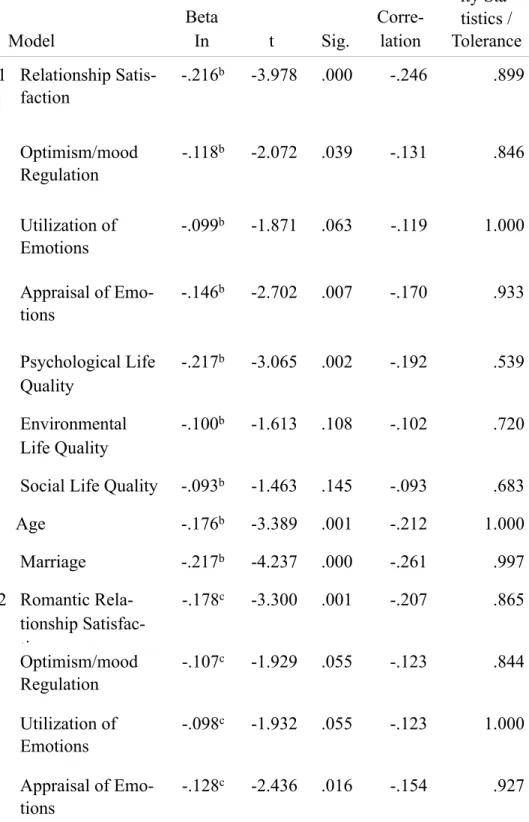
emo-tions and optimism / mood regulation were excluded from the model. Although they were significantly negatively correlated with somatization except utilization of emotions, these variables were not found to be significant predictors of somati-zation in this sample. On the other hand, Appraisal of Emotions, being the only emotion processing related variable that could enter the model further supports the hypothesis of this study that ascribes a prominence to appraisal over the other as-pects of emotional intelligence.
The regression coefficients and significance of each predictor is reported in Table 5 whereas excluded variables reported in Table 6.
Table 5
The Regression Coefficients
B
Std.
Error Beta t Sig.
(Constant) 9.820 .346 28.3
93 . 000 Physical Life Quality -1.051 .121 -.466 -8.6
62 . 000 Marriage -2.134 .614 -.177 -3.4 78 . 001 Relationship Satisfac-tion -.123 .040 -.167 -3.1 16 . 002 Appraisal of Emotions -.132 .060 -.114 -2.1 90 . 029 Note. N=250
Table 6 Excluded Variables Model Beta In t Sig. Partial Corre-lation Collinear-ity Sta-tistics / Tolerance 1 Relationship Satis-faction -.216b -3.978 .000 -.246 .899 Optimism/mood Regulation -.118b -2.072 .039 -.131 .846 Utilization of Emotions -.099b -1.871 .063 -.119 1.000 Appraisal of Emo-tions -.146b -2.702 .007 -.170 .933 Psychological Life Quality -.217b -3.065 .002 -.192 .539 Environmental Life Quality -.100b -1.613 .108 -.102 .720
Social Life Quality -.093b -1.463 .145 -.093 .683
Age -.176b -3.389 .001 -.212 1.000 Marriage -.217b -4.237 .000 -.261 .997 2 Romantic Rela-tionship Satisfac-tion -.178c -3.300 .001 -.207 .865 Optimism/mood Regulation -.107c -1.929 .055 -.123 .844 Utilization of Emotions -.098c -1.932 .055 -.123 1.000 Appraisal of Emo-tions -.128c -2.436 .016 -.154 .927
Psychological Life Quality -.178c -2.561 .011 -.162 .527 Environmental Life Quality -.078c -1.287 .199 -.082 .714
Social Life Quality -.099c -1.605 .110 -.102 .683
Age -.080c -1.304 .193 -.083 .693 3 Optimism/mood Regulation -.076d -1.374 .171 -.088 .815 Utilization of Emotions -.093d -1.855 .065 -.118 .999 Appraisal of Emo-tions -.114d -2.190 .029 -.139 .919 Psychological Life Quality -.103d -1.366 .173 -.087 .441 Environmental Life Quality -.043d -.704 .482 -.045 .689
Social Life Quality -.007d -.106 .915 -.007 .534
Age -.113d -1.863 .064 -.119 .677 4 Optimism/mood Regulation -.026e -.422 .673 -.027 .643 Utilization of Emotions -.081e -1.624 .106 -.104 .986 Psychological Life Quality -.075e -.989 .324 -.063 .426 Environmental Life Quality -.009e -.152 .879 -.010 .643
Social Life Quality .041e .570 .569 .037 .487
An increase in each of the predictor variables cause a decrease in somati-zation. In other words, individuals who have lower physical life quality, who have lower romantic relationship satisfaction, who have lower appraisal of emotions ability and who are not married are more likely to experience psychosomatic symptoms. Among these variables, physical aspect of life quality was found as the strongest predictive factor for psychosomatic symptoms. It is followed by rela-tionship status and relarela-tionship satisfaction. As also seen in Table 4, Physical Life Quality alone explains 31% of the variance in somatization for this sample.
Last, in addition to its direct association with somatization, any possible interaction of appraisal of emotions with relationship satisfaction and life quality was also explored by adding the interaction terms to the above regression analy-ses. None of the interactions were significant.
To sum up, the hypotheses that expect a negative association between somatization and relationship satisfaction, life quality and emotion processing are all supported by correlations. In addition, in terms of the relative prominence and predictive power, physical quality is quite strongly associated with somatization and it is followed by two relational variables; satisfaction and status. This finding also supports the hypotheses that relationship satisfaction is an important correlate and predictor of somatization. However, regarding life quality, although all as-pects are negatively correlated with somatization as expected, psychological, so-cial and environmental aspects were not significant predictors of somatization (See Table 6). In terms of emotional intelligence, only appraisal of emotions was found to be predictor and utilization of emotions had no association with somati-zation. This finding partially supports the hypothesis that emotion processing would be negatively correlated with somatization. As expected, appraisal of emo-tions is the most related aspect of the emotional intelligence. However, mood reg-ulation, although significantly correlated, did not appear to be a significant
![Intussusception of the appendix induced by sessile serrated adenoma: A case report [Sesil serrated adenomun uyardı?ı apendiks i?ntüsüsepsiyonu]](data:image/gif;base64,R0lGODlhAQABAIAAAP///wAAACH5BAEAAAAALAAAAAABAAEAAAICRAEAOw==)