ЕіГШ
á SHAPE
QWktámm
í o o e l
fgü
INATOUAH MADRASAH ARCHITESTURË
ς;ΐ \n h ñ v «!!►'* á ' x ’ -й-í; і іГ * 2“ %î“ 2?"Î a ;. Λ
»· Щ f. y **«Ці iH* 5 t íUe. ’■■‘“^ f· *'ï'f î !'.T*i ·'; .· î*
» Vj#> к t tí Ä » La ? f Ъм ·.: ; ΐ 5 Í V S fc » ï li ·' l u / i
'’•1. Í ί1^·1ϊ’Μί*Ι :■· · " »( *· f ".' y **«4I IH* 5 t íUe. ’■■**« î·
t s . î ** ^ r fc jT fc % » I il · K>* vka» % w к t tí вш» La ? f tiw :: ; v i V S 6ä
ff4T£RiOR ARCHiTEGTUBE AND E N V IO N '
AND THE ^
mS T H
uTE OF SCO^NO
m îCS AND
A P ?iîi tf РКГГ8 !***■ 3) йлг: ■'* : 'i; ^ "...j.® ·; v xï x ·.'. г ·· «
A « .a,v- -«a- k. 4 ■. i<
t\- ■■: i 'r- 3 i A ·- w~JF »~-â· V i# : ¿n, j^w ii- !·. ¡ü JŞ í““ -Γ,. г'Т'·· i- t ?**¿ j: ÿ : ip· ι·'·,:·ι? .»>*- 'V · ·.*_» 't t '««' ·.' <!<>»« «3«> tf w к <iL -;г*'2. ?■·»' í*'’J : U, ; V ,J :»«ı Й t M. 3 î,i к ·ν,ϊΙ & . и . - j.··^, Λ W ■■ ·ί·4 SfOfíKvS й Щ о ç n r J à:İL· i f -\ 3 · ΐ î î“' i 5
% î *ï, È r r % ^ V Í î;*... • -V4A. :гі c -■i ■:·■* Λ.. *At T «f ■» >‘„· >< -...·■-.. Ί Í ÏL·. . l « ?î
іг::.гтр,.з r::?DfI:!p.vJîZ iî 'V i» î ♦ î î t' £ - . ЗЮ^ t.«j •^ri.l» 3 t îiwt .Uk J
ТЪ e£}.·./Ч. ; .H* ;“*i ξ Tf“ ϊ**“« íTj ί“ ά
.·-■ % i " '*ii -e'S·
A SHAPE GRAMMAR MODEL FOR
ANATOLIAN MADRASAH ARCHITECTURE
A THESIS
SUBMITTED TO THE DEPARTMENT OF
INTERIOR ARCHITECTURE AND ENVIRONMENTAL DESIGN
AND THE INSTITUTE OF ECONOMICS AND SOCIAL SCIENCES
OF BİLKENT UNIVERSITY
IN PARTIAL FULFILLMENT OF THE REQUIREMENTS
FOR THE DEGREE OF
MASTER OF FINE ARTS
By
Senem Tekin
May, 1999
QA
I certify that I have read this thesis and that in my opinion it is fully adequate, in scope and in quality, as a thesis for the degree of Master of Fine Arts.
a \ e J v t r - . w ^
Assist. Prof. Dr. Mesut Göktepe
I certify that I have read this thesis and that in my opinion it is fully adequate, in scope and in quality, as a thesis for the degree of Master of Fine Arts.
Dr. Burcu Şenyapıh
I certify that I have read this thesis and that in my opinion it is fully adequate, in scope and in quality, as a thesis for the degree of Master of Fine Arts.
Assist. Prof. Dr. Haliqfiie Demirkan
Approved by the Institute of Fine Arts
ABSTRACT
A SHAPE GRAMMAR MODEL FOR
ANATOLIAN MADRASAH ARCHITECTURE
Senem Tekin
M. F.A. in Interior Architecture and Environmental Design Supervisor: Assist. Prof. Dr. Mesut Göktepe
Supervisor: Dr. Burcu Şenyapılı April, 1999
This thesis explores the role and potential of computational tools in the analysis of an existing corpus of work and synthesis of new designs. The research would like to demonstrate that, the basic grammar rules underlying the composition can be described by analyzing a set of similar designs, and new designs can be derived based on the extracted rules. Examples of Anatolian madrasahs from Anatolian region of Turkey have been chosen as a research corpus. The body of research is limited to Anatolian madrasahs that were built in the period of XII and XIII centuries having morphological similarities. After an initial evaluation of the material gathered from Kuran (1969) and Sozen (1970, 1972), in the first step, common features in plan composition are described within a research body. A classification for the plan types of the madrasahs is established. The location of main components like court, iwan(s), and other rooms are a major factor at the classification stage. The next step is the introduction of a shape grammar system for generating the plan layouts of Anatolian madrasahs through a number of rules by using the main plan components and their spatial relations. In the final step, a simple interpreter is developed by using the programming language AutoLisp for the representation of the shape grammar system for Anatolian madrasahs. The shape grammar system is realized in computer-aided design (CAD) environment to present an automated mechanism for generating different designs of Anatolian madrasahs through these rules. Such computational tools provide easy and flexible manipulation of objects so that many compositions can be created. Keywords: Shape Grammars, Anatolian Madrasahs, AutoLisp, Architectural
ÖZET
ANADOLU MEDRESELERİ MİMARİSİ İÇİN
BİR BİÇİM GRAMERİ MODELİ
Senem Tekin
İç Mimarlık ve Çevre Tasarımı Bölümü Yüksek Lisans
Tez Yöneticisi: Y. Doç. Dr. Mesut Göktepe Tez Yöneticisi: Dr. Burcu Şenyapılı
Nisan 1999
Bu tez varolan yapıların tasarım çalışmalarının incelenmesinde ve yeni tasarımların üretilmesinde uygulama araçlarının rolünü ve potansiyelini araştırmaktadır. Bu
çalışma ile gösterilmek istenen, bir kompozisyonu oluşturan temel gramer kurallarının benzer tasarım örnekleri analiz edilerek tanımlanabilmesi ve çıkarılan bu kurallara dayanılarak yeni tasarımların üretilmesini sağlamaktır. Bu çalışma XII ve XIII. yüzyılda inşa edilen ve morfolojik benzerlikler gösteren Anadolu medreseleri ile sınırlı tutulmuştur. Kuran (1969) ve Sözen’in (1970, 1972) yaptığı çalışmalarının incelenmesi ile yapılan bir ön değerlendirmeden sonra, ilk aşamada plan
kompozisyonunu oluşturan ortak elemanlar araştırma bünyesinde tanımlanmıştır. Anadolu medreselerinin plan tiplerine ilişkin bir sınıflandırma varolan çalışmaların ışığında zenginleştirilmiştir. Avlu, eyvan, ve odalar gibi planı oluşturan ana
elemenlarm yerleşimi bu sınıflandırmada önemli bir etkendir. Daha sonraki aşamada, belirlenen ortak plan elemanları ve bunların mekansal ilişkileri göz önünde
bulundurularak Anadolu medreselerinin plan şemasını üretebilecek kuralların saptanmasına geçilmiş ve bir biçim grameri modeli tanımlanmıştır. Son aşamada, Anadolu medreseleri için üretilen biçim grameri sisteminin sunumu için AutoLisp proglamlama dili kullanılarak basit bir model geliştirilmiştir. Biçim grameri sisteminin bilgisayar destekli tasarım ortamında gerçekleştirilme sebebi farklı Anadolu mederese tasarımlarını üreten kuralları uygulamak için otomatik bir mekanizma sunmasıdır. Bu tip uygulama araçları objelerin kolaylıkla ve esneklikle biçimlenmesini sağlayarak pek çok düzenlemenin yaratılmasında yardımcı olurlar.
Anahtar kelimeler: Biçim Grameri, Anadolu Medreseleri, AutoLisp, Mimari Dil,
ACKNOWLEDGEMENTS
Foremost, I would like to thank Assist. Dr. Mesut Gdktepe for his invaluable friendship, encouragement, support, and help to figure out many of the things.
TABLE OF CONTENTS
1 INTRODUCTION... 1
1.1 GENERAL...1
1.2 RESEARCH BACKGROUND... 3
1.3 AN OVERVIEW OF THE THESIS... 7
2 SHAPE GRAMMARS IN COMPUTATIONAL DESIGN... 9
2.1 FORMAL GRAMMARS AND FORMAL LANGUAGES...9
2.2 SPATIAL GRAMMARS... 11
2.3 SHAPE GRAMMARS IN ARCHITECTURAL LANGUAGES... 14
2.3.1 FORMALIZATION OF ARCHITECTURAL LANGUAGES...16
2.3.2 SHAPE GRAMMARS...18
2.4 CASE STUDIES ABOUT SHAPE GRAMMARS... 22
2.4.1 A GRAMMAR OF PALLADIAN VILLA PLANS... 23
2.4.2 A GRAMMAR OF QUEEN ANNE HOUSES... 26
2.5 IMPLEMENTATIONS OF SHAPE GRAMMARS...29
2.5.1 TWO DIMENSIONAL IMPLEMENTATIONS... 30
2.5.1.1 A GENERATIVE MODELING EXPERIMENTATION WITH AUTOLISP...31
2.5.1.2 A PARAMETRIC SHAPE GRAMMAR FOR THE PLANS OF TRADITIONAL TURKISH HOUSES...34
2.5.1.3 A PROLOG IMPLEMENTATION OF A GENERIC SHAPE GRAMMAR SYSTEM...35
2.5.2 THREE DIMENSIONAL IMPLEMENTATIONS...35
2.5.2.1 BASIC GRAMMARS WITH FROEBEL BLOCKS...36
2.5.2.2 A THREE-DIMENSIONAL SHAPE GRAMMAR IMPLEMENTATION... 37
2.5.3 PROGRAMMING LANGUAGES FOR SHAPE GRAMMAR IMPLEMENTATION... 38
2.5.3.1 AUTOLISP... 39
2.5.3.2 PROLOG...39
2.5.3.3 ACIS... 40
3 SHAPE GRAMMARS FOR ANATOLIAN MADRASAHS...41
3.1 ORGANIZATION OF MADRASAH PLAN LAYOUTS... 41
3.1.1 DESIGN ELEMENTS OF MADRASAH ARCHITECTURE... 42
3.1.1.1 COURT... 43
3.1.1.2 IWAN... 43
3.1.1.3 WINTER CLASSROOM...44
3.1.1.4 STUDENT CELL... 44
3.1.2 PLAN TYPES... 45
3.2 A SHAPE GRAMMAR REPRESENTATION FOR ANATOLIAN MADRASAH PLAN LAYOUTS...48
3.2.1 VOCABULARY ELEMENTS OF SHAPE GRAMMAR...48
3.2.2 DERIVATION OF SHAPE GRAMMAR RULES...50
3.2.3 SHAPE GRAMMAR RULES FOR ANATOLIAN MADRASAHS...50
3.2.4 USING SHAPE GRAMMARS FOR GENERATING PLAN LAYOUTS OF ANATOLIAN MADRASAHS... 54
4 AUTOLISP IMPLEMENTATION OF A SHAPE GRAMMAR FOR ANATOLIAN MADRASAHS... 56
4.1 INTRODUCTION TO AUTOLISP PROGRAMMING LANGUAGE... 56
4.2 A SHAPE GRAMMAR SYSTEM IN AUTOLISP FOR ANATOLIAN MADRASAHS...62
LIST OF REFERENCES...78 GLOSSARY OF ARCHITECTURAL TERMS...82 APPENDIX...83
LIST OF FIGURES
Figure 2.1 An example of a structure grammar... 13
Figure 2.2 Objects in a graph grammar: (a) the initial graph and (b) two sample graphs generated with the grammar...13
Figure 2.3 Three descriptive rules...17
Figure 2.4 Two replacement rules...18
Figure 2.5 The rules and successive application of the rules to an initial shape..20
Figure 2.6 Derivation of the plan of the Villa Malcontenta... 25
Figure 2.7 Some stages of the derivation for Queen Anne style houses... 28
Figure 2.8 Generation of four and three sides Sierpinski gaskets... 31
Figure 2.9 The algorithm of the chaos game program drawing a Sierpinski gasket... 32
Figure 2.10 Complex and interesting patterns; (a) Fern Leaf (b) Bush curves... 33
Figure 2.11 Generation of recursive Koch Snowflake...33
Figure 2.12 Representation of a shape grammar made up of parameterized blocks... 34
Figure 2.13 Representation of a simple shape grammar made up of maximal lines... 35
Figure 2.14 Vocabulary of shapes and some possible spatial relations... 37
Figure 2.15 The eight basic grammar rules and corresponding designs...38
Figure 3.1 Layout o f a typical Anatolian madrasah... 43
Figure 3.2 Classification tree for the plan types of Anatolian madrasahs...45
Figure 3.4 Schematic floor plans of Anatolian madrasahs...49
Figure 3.5 Shape rules...51
Figure 3.6 Two sample generation processes for the plan layouts A12 and B21 with the original p lan s...55
Figure 4.1 Shape described by the Lisp clause... 59
Figure 4.2 Illustration of parametric relations... 59
Figure 4.3 Sample screen from an interactive Lisp session...63
Figure 4.4 The simple and detailed flow-charts for the description of Anatolian madrasah plans... 67
1 INTRODUCTION
1.1 GENERAL
A design language used within a particular style can be analyzed by studying various existing samples in that style. The language in this context refers to vocabulary elements and grammar rules that define the relationships between these elements. In architectural design, shape grammars can be used to explore various design
languages as well as to discover rules underlying a set of related designs. This thesis demonstrates that, the basic grammar rules underlying a composition can be
described by analyzing a set of similar designs, and new designs can be generated based on the extracted rules.
Within this context, a shape grammar system that can generate the plans of Anatolian madrasahs is introduced in this study. Shape grammars have been used by various researchers to define languages o f architects and for vernacular styles from different periods and places. They provide designs for churches, villas, houses, and buildings of other types, and also designs for ornamentation, furniture, and gardens.
Here, samples of Anatolian madrasahs from Anatolian region of Turkey have been chosen as a research corpus. The body of research is limited to Anatolian madrasahs that were built within the period of XII and XIII centuries aiming to exploit
In the first step of the study, common features in plan compositions of various Anatolian madrasahs are extracted through a detailed evaluation of the materials gathered from Kuran’s (1969) and Sozen’s (1970, 1972) researches on the
madrasahs. A taxonomy of the madrasahs is established based on the location of the main elements in madrasah plans, after the formal and syntactic analysis of the plan compositions. In the next step, a shape grammar system is introduced for describing the plan layouts of Anatolian madrasahs through a number of rules.
The final step is the implementation of a simple interpreter for realization of the shape grammar system developed for Anatolian madrasah plan layouts using AutoLisp programming language. The purpose of the realization of the shape grammar, developed within the research context, in a computer-aided design (CAD) environment is to provide an automated mechanism for generation of different designs of Anatolian madrasahs through the grammar rules provided. Design can be looked at as a computational process since it involves the manipulation of visual material. Computational tools provide easy and flexible manipulation of objects so that many compositions can be created. Otherwise, the computation has to be performed manually with the active participation by hand and eye.
This study demonstrates how the shape grammar formalism (Stiny, 1980a) can be used to characterize the formal compositional features of Anatolian madrasahs in the plan layouts where the composition of the madrasahs is based on certain spatial relations.
1.2 RESEARCH BACKGROUND
The origin of shape grammars stems from formal grammars. Grammars are collection of rules and symbols/characters. The rules are composed of strings of symbols represented in the form of a ^ p , indicating that string a generates string p. By applying these rules to an initial symbol, linear strings are derived as objects constituting a language. Shape grammars are also a collection of rules and symbols. Here, the symbols are represented by visual graphical elements instead of the
character strings. The shape rules are applied to an initial shape in a recursive manner to generate a set of shapes, which constitute a language. It is possible to apply the ideas emerging from the shape grammars to architectural designs.
In the analysis of architectural designs, the issue of the architectural language is important. The language in this context refers to formal and symbolic elements together with the relationship between them (Tuncer, 1998: 1). An architectural language is characterized by a vocabulary of elements and a grammar whose rules indicate how these elements can be placed in space (Flemming, 1990: 31). Therefore, design can be viewed as a computational process since it involves the manipulation of visual materials.
The success of shape grammars, “as a way of characterizing and exploring possibilities in design” as stated by Stiny (1998: 73), is coming from “the direct contact they enjoy with visual and spatial material”. Shape grammars have been shown to be useful in the generation and analysis of designs (Chase, 1998a). The goal of grammars is “not merely to produce a single design as the final outcome, but rather, to provide an understanding of the underlying spatial relations”
(Krishnamurti, 1998). This is specified by Mitchell (1986: 154) as “to know how a building is put together is to know a language”. He claimed that “an appropriate language is a knowledge structure that must be acquired to design effectively”. According to Stiny (1990: 102), this shows “the kind of virtuosity that is to be encouraged in intelligent practice” and provides “a generous framework in which to think about designs in various ways”. Therefore, as Stiny (1990: 101) stated “new shape grammars are always forthcoming”.
The sample style chosen to be used as a case study for the shape grammar research should fulfil some conditions in order to be effective and relevant for the analysis. Tuncer (1998: 3) states some of these conditions as follows:
• the architectural domain must have a large body of documented and built examples,
• there must be a sufficient amount of sources for the work,
• there must be a variety and evolution in the architectural domain through the time of consideration,
• the body of work must be of interest to professionals such as architects and art historians.
Anatolian madrasahs fulfil these conditions. Here, Anatolian madrasahs are chosen as a research corpus because the composition of the madrasahs is based on certain spatial relations. The works of Kuran (1969) and Sözen (1970,1972) are particularly useful in this regard. Kuran and Sözen analyzed particular madrasahs referring to some written sources, plans, sections, and photographs that they had recorded. In this study using these documents, common elements of Anatolian madrasahs and their
spatial relations are derived, which are further used to define vocabulary elements of the grammar for the madrasahs.
The shape grammar developed here for Anatolian madrasahs, is based on the plan layouts o f these madrasahs. Architectural organization of the madrasah stems from the relationship between the court and the iwans. They constitute the key elements in the typology of Anatolian madrasah architecture (Kuran, 1969: vii).
The main elements of the plans of Anatolain madrasahs are court, iwan, revak (portico), winter classroom, and student cell. After describing the main design elements of madrasah architecture in plan composition, taxonomy for the plan types of the madrasahs is established. The location of the main plan elements is major factor at this classification scheme. A classification tree for the plan types of
Anatolian madrasahs is based on the form of their masses and spatial organization in plan compositions ignoring age, climate, or geographical location properties.
The madrasahs are classified into two groups according to form of their masses. The first group is enclosed type madrasah, the second one is open type madrasah (Kuran, 1969: 146). These groups are further classified according to the spatial organization, which specify the number and the location of iwans within the plan. When there is one or two iwans facing each other across the courtyard on the longitudinal axis of the building, they are called axial type. If three or four iwans are placed one on each side of the court, these madrasahs are called cross-axial type. Revak placement around the court is the last branch in the classification of the plan types for Anatolian
madrasahs. Madrasahs may have two, three, or four revaks around the court or they may have no revak in a plan composition.
Beginning with the vocabulary elements and building up some spatial relations, the plans are formalized and schematic floor plans are established. The next step is the introduction of a shape grammar system for describing the plan layouts of Anatolian madrasahs through a number of rules based on the analysis. The grammar describes the rules for placing the plan elements such as court, iwan(s), revaks, student cells, and winter classrooms addressing analysis carried out for the compositional features of the style. All shape grammars dealing with the generation of architectural plans create a geometric pattern that determines the compositional characteristics of the plans (Downing and Flemming, 1981: 276). The generation of traditional Turkish houses, for example, starts with the location of a court and follows the placement of other rooms around the court (Çağdaş, 1996b). A similar approach is employed for Anatolian madrasahs. As Kuran (1969: 13) stated, the form is developed from the court to the outside making the court most important design element shaping the building in Anatolian madrasahs. Thus, the main vocabulary element, the two
dimensional rectangular block representing the court, is located at the initial stage of the generation; at the progressive stages, the iwan(s), and the rooms are located so as to generate plan layouts.
The grammar of Anatolian madrasahs is presented in a sequence of seven stages each comprising one or more shape rules. The generation process involves the following stages:
(1) choosing the court type and locating it, (2) locating the rooms around the court,
(3) determining the number of iwan(s) and location(s),
(4) checking the existence of revaks, determining their number, and locations, (5) determining the number of student rooms and locations,
(6) locating the winter classrooms,
(7) checking the existence of service rooms and their locations.
The final step is the development of a simple interpreter for the representation of the shape grammar system in a computer-aided design environment using AutoLisp programming language aiming an automated mechanism in generation of different designs of Anatolian madrasahs.
1.3 AN OVERVIEW OF THE THESIS
This thesis is organized in eight chapters forming three parts:
The first part defines shape grammar notion in relation with formal grammars and architectural languages and combines them with existing analysis and
implementations. The aim, scope, and method of the study are described in Chapter 1. In Chapter 2, formal grammars and formal languages in which the shape grammars have their origin are described. This chapter also examines the shape grammar
formalism starting from the study of architectural language, types, and then stating how the architectural language, vocabulary, grammar, rules, syntax, semantics, and types relate to each other to form the theoretieal basis. Moreover, Chapter 2 presents sample studies about the use of shape grammars in the architectural design. In this
chapter, some two and three dimensional shape grammar implementations on computer are examined and programming languages used in implementations are introduced.
The theory given in the first part is employed in the second part, in an exposition of the representation of shape grammars for Anatolian madrasahs. Chapter 3 analyzes the language of Anatolian madrasahs, and their spatial organization. The vocabulary elements and the underlying spatial relations applied in the definition of the shape grammar are described. Chapter 3 also covers the generation of plan layouts through the use o f the shape grammar developed so far.
Part three investigates the applicability of the shape grammar implementation for Anatolian madrasahs in a CAD environment. Chapter 4 introduces AutoLisp programming language and AutoLisp implementations of the shape grammar developed for Anatolian madrasahs, in particular. Chapter 5 concludes the thesis discussing the results and contributions of this study and summarizes the further research concepts to improve the applicability of the shape grammar system to more general design issues.
2 SHAPE GRAMMARS IN COMPUTATIONAL DESIGN
2.1 FORMAL GRAMMARS AND FORMAL LANGUAGES
Grammars are rule-based methods of generation. They have found wide-ranging use in a variety of fields. As applied in logic, linguistics, and computer science, formal grammars usually specify languages of character strings. However, a number of different grammar formalism exist such as string grammars, set grammars, graph grammars, and more recently and originally shape grammars by Stiny (1980a) in design. Shape grammars have been used to describe languages of two or three dimensional shapes and have received the most attention in design and architecture contexts. Shape grammars have their origin in formal grammars, which are collection o f rules and symbols/characters. The rules are composed of strings of symbols
represented in the form of a->P, indicating that string a generates string p.
The formal notion of a grammar, based on the studies of Ulmann and Hopcroft (1979: 10) is formalized by four concepts:
(1) Vn is non-terminal vocabulary or variables, (2) Vt is terminal vocabulary,
(3) P is a set o f generation rules or productions, (4) S is a start symbol.
A set of generation rules is applied to a start symbol in order to generate a language of linear strings as objects. This generative nature of grammars suits well in design and architecture contexts.
Ulmann and Hopcroft (1969: 12) denote a grammar G by (Vn, Vt, P, S). The
symbols Vn, Vt, P, and S are vocabulary of variables or non-terminals, vocabulary of terminals, productions, and start symbol respectively. For example, let
VnH S, B, C K VtH a, b, c f·, P consists of the following productions: l.S -> aS B C 4. aB ^ab
2. S ^ a B C 5. b B ^ b b 3. C B ^B C 6. bC->bc 7. cC“^cc
By applying the productions beginning with the starting symbol, one can derive complex strings:
S^aSBC^aaSBCBC-^aaaBCBCBC^aaaBBCCBC^aaaBBCBCC-^aaaBBBCCC -> aaabBB CC ^ aaabbB CCC aaabbbCCC -> aaabbbcCC aaabbbccC aaabbbccc
As Stouffs stated (1994: 5): “The set of rules, together with the starting symbol and the vocabulary elements from which the rules are composed is termed a grammar and the objects resulting from a generative application of such a grammar constitutes the derived language”. Consistent application of rules contained in a grammar will produce a set containing all compositions, that is a language. Therefore, a grammar defines a language, that is the set of all possible strings derived by the grammar.
Grammars consist of conditional rules of the form Each rule specifies a condition and an appropriate response associates with that condition. As Mitchell (1986: 154) pointed out, in architectural contexts, the conditional rules are expressed graphically by drawing a context and an appropriate design response to that context. Grammars for generation and analysis have found wide-ranging use in a variety of fields.
The grammars are also being used in design contexts. Krishnamurti and Stouffs (1993: 58-59) put three reasons for that. First, grammars are succesful in analyzing styles of designs. Humans are inclined to rely on experience and familiarity with certain known concepts and apply them to the way of doing things. Through a corpus of spatial designs, designers tend to employ a limited set of spatial relationships to produce distinctive designs. Second, grammar systems bring to play with spatial forms and relationships. Third, the techniques by which drawings can he constructed such as the use of lead, eraser, and geometrical transformations are quite similar to a rule application mechanism of grammars (Krishnamurti and Stouffs 1993: 58-59).
2.2 SPATIAL GRAMMARS
The grammars applied in design contexs are called as spatial grammars. In addition to shape grammars, there are other spatial grammars such as string grammars, set grammars including structure and solid grammars, and graph grammars.
String grammars include set of all strings over a set of symbols. According to the form of the rules concerning the terminal and nonterminal symbols, they are classified into three types: regular string grammars, context-free string grammars.
and context-sensitive grammars (Ulmann and Hopcroft, 1969: 13). The sample grammar presented at the beginning of this chapter is a context-sensitive grammar.
Suppose that every production in P is of the form A->B or A->a where A and B are variables and a is a terminal, then G is called regular grammar. It is also called phase structure grammar. When a production of the form A->B allows the variable A to be replaced by the string B independent on the context in which A appears, it is called context-free. When a production xAy->xBy allows A to be replaced by B whenever A appears in the context of x and y, then it is context sensitive (Krishnamurti and Stouffs 1993: 61).
However, as Knight (1999: 16) stated, shape grammars are different from symbolic grammars. Symbolic grammars transform strings of symbols in one dimension, while shape grammars transform shapes in two and three dimensions.
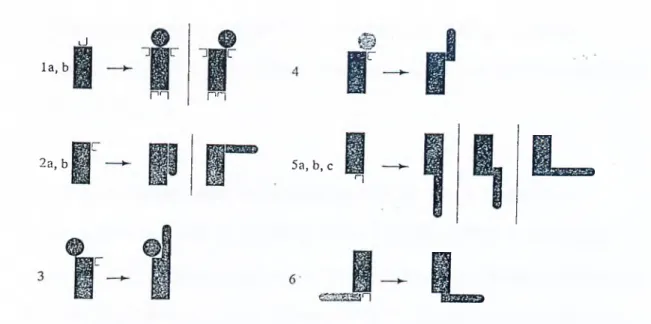
On the other hand, set grammars (Stiny, 1982) deal with objects expressed as sets of entities. Structure grammars and solid grammars may be considered as set grammars. Structure grammars are useful when establishing one to one correspondence between symbols and spatial icons where an object is represented as a set of pairs (Carlson, Woodbury, Me Kelvey, 1991: 418). Figure 2.1 shows an example of a structure grammar. Solid grammars manipulate data structures that represent the faces, edges, and vertices of a solid by a set of triples. Here, a solid rule a->P serves to replace one or more faces by a collection of faces satisfying the requirements of a solid (Krishnamurti and Stouffs 1993: 63).
u la, b nn PH 2a, b S9P 5a, b, c n
Figure 2.1 An example of a structure grammar (Source: Carlson, Woodbury, Me Kelvey, 1991:418).
Graph grammars are useful when connectivity or incidence between elements is the dominant feature of the design problem (Krishnamurti and Stouffs, 1993; 64).
(a)
Figure 2.2 Objects in a graph grammar: (a) the initial graph and (b) two sample graphs generated with the grammar (Source: Krishnamurti and Stouffs, 1993: 64).
Although, the formal notion of grammar is the same for all grammar types, these grammars can be differentiated with respect to rules and/or vocabulary elements defined within the grammar. These grammars can also be applied to problems without spatial content. Unlike other spatial grammars, shape grammars operate
directly on spatial forms. A shape grammar is a formal rewriting system for
producing languages of shapes (Stiny, 1980a: 343). Shape grammars are discussed in detail in Section 2.3.
2.3 SHAPE GRAMMARS IN ARCHITECTURAL LANGUAGES
In the analysis of architectural systems, the study on the architectural language is important. The language in this context refers to “formal and symbolic elements and to the relationship between them” (Tuncer, 1998: 1). Single building elements are similar to words and the rules governing their composition are similar to rules of a formal grammar in language. An architectural language is characterized by a
vocabulary of elements in the form of graphical symbols and a grammar whose rules indicate how these elements can be placed in space (Flemming, 1990: 31). Therefore, design can be viewed as a computational process since it involves the manipulation of visual material.
The theory of architectural languages exhibits a linguistic analogy. There is a
potential use of the analogy through a set of descriptive rules which involves both the study of meaning and form (semantics) and the study of formal relationships (syntax) (Tuncer, 1998: 1).
Similar to linguistics, in architecture there is implicit conventions and rules, which help to determine the relationship between syntax and semantics. There is a
dependency between the parts and the whole. The details in a building sometimes do impose the organization. The grammar specifies how the meaning o f parts determine the meaning of the whole. Syntax has to be correlated by semantics. Thus, the
implication of the separate architectural parts on the whole is determined by the grammar (Tuncer, 1998: 1).
In other words, in the technical sense as Flemming (1990: 32) stated, an architectural language is a collection of rules that embody the compositional principles or
conventions that underlie a certain piece of architeeture. The rules form the grammar of the language and they manipulate the shape, which constitute the vocabulary of the language.
However, linguistie structures cannot be directly applied to architectural languages. In linguistics, changing the order of words cause the sentence loose its meaning (semantics). In case of architecture, an object may still have meaning even it is not complete. Thus, the meaningfulness of architectural objects cannot be explained only by the obedience to a rule (Tuncer, 1998: 1). Thus, the term architectural language is used in the technical sense as Flemming (1990: 32) in this study.
In order to deal with semantics and syntactical issues, types from the collective architectural memory come into the descriptive process. As Tuncer stated “When type is considered as an artistic, an intellectual manifestation of architectural culture, study of types, its internal rules, and recognition its instances in an architectural system becomes profitable in a comprehensive analysis process” (Tuncer, 1998: 1).
In dealing with types, a distinction stated by Mitchell (1990: 86) brings a more precise identification of the type in formalizing an architectural language. This is the distinction between essential and accidental properties of an object. Former is the
properties that are shared with others of its type. Latter is the property that may vary from instance to instance within type. The grammar of the type takes these properties into consideration and includes design principles, procedures for variations, and knowledge of the key design variables and their main states (Oxman and Oxman, 1990: 179). Thus, as Tuncer (1998: 2) pointed out, type implies the vocabulary of the language and the underlying grammar. The concept of an architectural language seems indispensable in the conceptualization and description of buildings.
2.3.1 FORMALIZATION OF ARCHITECTURAL LANGUAGES
Design can be viewed as a computational process, since it involves the manipulation of visual material. In other words, it is a sequence of operations performed on a symbolic representation of the object, thus the shape. The shapes constitute the vocabulary of the language. They are placed and manipulated by the grammar of the language. The grammar is formed by a set of rules. Thus, this set of rules or grammar corresponds the composition principles of a piece of architecture.
As Kurmarm stated, “Many design decisions can be expressed in the form of: if then. Such pairs can be viewed as guiding principles or rules to develop a design
composition” (Kurmann, 1998: 11). In that sense, these design principles or rules are similar to the use of grammar rules in linguistics to specify how words may be composed together to form a correct sentence or an expression.
The grammar rules in an architectural language are in the form of a->p. The left- hand side is an if condition specifying the context in which the rule can be applied, and the right-hand side is a then action specifying the result of its application. As
Stiny (1999: 10) stated “any two shapes that are shown one after the other determine a rule”.
The set of rules may be specified in a variety of formats like the grammars in formal languages. It may be in the form of stating the prescriptive rules as Mitchell (1986:
152) stated. The vocabulary and certain types of relationships between them are specified in a structured way. These procedures generate, construct or transfer the required instances or relations. The rules restrict the variety of relations so that gives coherence and unity to a composition (Mitchell, 1986: 150). Figure 2.3 shows three descriptive rules.
□
□
□
□
□
o
O
Figure 2.3 Three descriptive rules.
Another approach is to specify replacement rules (Mitchell, 1990: 134). These rules demonstrate substitutions, which include either adding a shape to another shape or subtracting a shape from another shape. It is a process of replacing one kind of thing with another from a chosen vocabulary. Substitution is typically used to develop a simple schematic design into something more elaborate. Figure 2.4 shows two replacement rules.
□ - ► B
Figure 2.4 Two replacement rules.
Mitchell (1990; 139) stated that, when one uses a set of rules or a grammar to restrict the possible states of a design world, it is necessary to formulate the rules in terms of the types of shapes, labels, and relations in that architectural language. This can be done according to the type diagrams.
After formalization of the rules by the help of type diagrams, two different design processes can be used in the generation of the language. These are top-down and bottom-up design processes (Mitchell, 1990: 141). The top-down approach starts with an abstract definition of an overall geometric scheme then it is refined to generate the detailed composition by use of rule-sets. The bottom-up approach starts with locating a certain shape and then other shapes are added by use of rule-sets. Therefore, a language is generated with the series of computations from one shape to another in a generative process of search and exploration (Stouffs, 1994: 5).
2.3.2 SHAPE GRAMMARS
Stiny and Gips (1972) first presented the idea of shape grammars and Stiny (1975) gave the formal definitions. Shape grammars define languages of designs. The main elements and the relations between the elements in these languages are used to compose several architectural and other styles of designs. They are used to define designs in known styles as well as to create original designs.
Shape grammars directly operate on shapes, and allow spatial computations to be carried on them. Shape grammars help one to represent a design language from a generative point of view.
Shapes under Stiny’s (1999: 7) definition ar combination of basic elements. These include points, lines, planes, and solids. They represent the main vocabulary elements in designs. A shape is a member of an algebra that is a set of objects and binary operations (arithmetic “+, -, Boolean algebras “U , n, -”) acting upon them. Stiny (1990: 98) has defined two basic algebras for shape grammars- the algebra o f shapes, and the algebra of sets of labelled points. They are combined to define spatial relations in shape grammars. Shapes can be augmented with labels to introduce new spatial relations and to unambiguously define the rule applications. A label from a given alphabet is associated with a point. The labelled points also have algebra. Shapes and labelled points are combined to make labelled shapes.
The formal notion of shape grammars consists of four parts (Stiny, 1980a: 347): (1) S is a finite set of shapes,
(2) L is a finite set of symbols,
(3) R is a finite set of shape rules of the form a->p, where a and p are labelled shapes,
(4) I is a labelled shape and called the initial shape.
In a shape grammar, the shapes and the symbols provide the basic building elements for the definition of shape rules and the initial shape. Whereas shapes and symbols
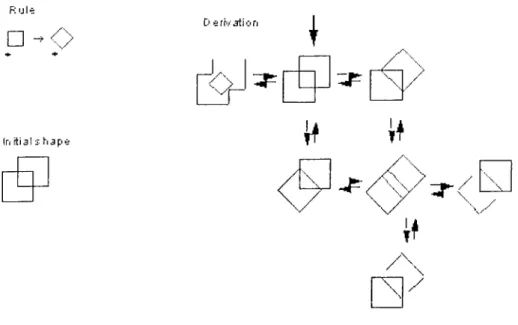
constitute the main vocabulary elements, the rules specify the main spatial relations between the elements of that architectural language. A shape rule in the form a->p specifies a relationship between two shapes one on each side of the arrow. When applied to a shape, it replaces the shape or a part of the shape a by p by using the operations of sum and difference and the Euclidean transformations (translation, reflection, and rotation) augmented with scale. The definition of shape grammars may be clarified through an example where sample line drawings are used to introduce shapes and show how shapes work in computations.
R u le s
1
2
2
->2
2
3 Initial D e r i v a t i o n S h a p eFigure 2.5 The rules and successive application of the rules to an initial shape
The abstract pattern shown in Figure 2.5 is developed by rotating and placing a smaller square inside another one, where the amount of rotation and reduction in size can be expressed using a single rule. In the example, there are three rules. The first rule places an initial labelled shape on the right hand side. A label is placed at a point on one of its edges. The second rule places another square inside the initial square. Each vertex of the inside square coincides with the same point for each side of the initial shape. By applying the second and the third grammar rules to the initial shape, an abstract kind of pattern is generated.
In this example, the spatial relations between elements of shapes-their relative
lengths and angles between them are maintained. Such kinds of grammars are known as Standard Shape Grammars. When these relations are allowed to change, such grammars are called as Parametric Shape Grammars (Kurmann, 1998: 11).
Instead of using a fixed square, for example one can use a quadrilateral so that it is possible to generalize the design idea by parameterizing the dimensions of the shape.
In the generation of shape grammar rules, the transformations may be in the form of rule addition, deletion or change as specified by Chase (1998b). We may change the state labels, spatial labels, or spatial relations of the shapes. When changing spatial relations between the shapes, it is possible to introduce new shapes or resize or reposition the shapes. The shape grammar rules are applied to the initial shape in a recursive manner to generate a set of shapes that constitute a language.
It is possible to apply the ideas emerging from shape grammars in architectural designs. Shape grammars have been used by various researchers to define languages
of architects and for vernacular styles from different periods and places. Section 2.4 presents two of the prominent analysis examples.
2.4 CASE STUDIES ABOUT SHAPE GRAMMARS
The designs are analyzed by decomposing them into a vocabulary of shapes and by identifying arrangements, spatial relations of vocabulary elements (Knight, 1998b: 88). The vocabulary and spatial relations, given a language of designs are defined by a shape grammar. The shape grammar generates the intended descriptions of these designs by use of a recursive schema based on this shape grammar (Stiny, 1981: 257).
Shape grammars can be used for both analysis and generation. These kind of studies, as Mitchell (1986: 154) stated, begin with some existing corpus of work and attempt to produce a grammar that regenerates the original corpus, plus other designs that are intuitively recognised as being in the same style. The rules are inferred from sets of examples.
Several kinds of aetual and architectural designs have been analyzed by various researchers with some designs being in two dimensions, some both in two and three dimensions. Traditional Chinese lattice designs, whieh exist in craft production were described by Stiny (1977) in two dimensional shape grammars. Palladian villas from classical architecture were analyzed by Stiny and Mitchell (1978) in two dimensional plan layout through shape grammars. The study on Mughul gardens (Stiny, 1977) indicated how the shape grammar formalism is flexible in scale and size in two dimensions. Hepplewhite chair-back designs (Knight, 1980), Japanese tearoom plans
(Knight, 1981), the architecture of Guisseppe Terragni (Flemming, 1981), and bungalows of Buffalo (Downing and Flemming, 1981) are also two dimensional studies about shape grammar representation in design. Koning and Eizenberg (1981) worked on the plans of the prairie houses of Frank Lloyd Wright and tried to capture his organic style in three dimensions. Greek vase motifs (Knight, 1986) and Ndebele homesteads (Herbert, Sanders, Mills, 1994) are two dimensional shape grammar studies. Queen Anne houses (Flemming, 1987) and Taiwanese traditional vernacular dwellings (Chiou and Krishnamurti, 1995) were analyzed both in two and three dimensions. Row-houses (Çağdaş, 1996a), and traditional Turkish houses (Çağdaş, 1996b) are two dimensional shape grammar studies analyzing these housing
schemes. Two of the prevailing examples, Palladian villa plans (Stiny and Mitchell, 1978) and Queen Anne houses (Flemming, 1987) are going to be explained in detail in this Section.
2.4.1 A GRAMMAR OF PALLADIAN VILLA PLANS
Stiny and Mitchell (1978) discussed the vocabulary and rules of the language of the Palladian style villa plans in this grammar. In order to describe the architecture of Palladian style villas formally, Stiny and Mitchell (1978) studied Palladio’s drawings about how to find an abstract method of expressing the style. Palladio had explored his design ideas by sketching numerous variants. Therefore, as Mitchell (1990:152) stated, it was appropriate to define this style in two dimensions. That abstraction is called a shape grammar. The shape grammar here is a type of formal model for Palladian style villa plans. While developing this model, Stiny and Mitchell (1978) decided on:
• the vocabulary of shapes,
• the spatial relations between the shapes in the vocabulary, • the shape rules formally,
• the generation process where the shape rules map shapes to shapes. Application of the rules recursively starting from initial shapes produces designs of several villa plans with bilateral symmetry.
A step-by-step derivation of the plan of the Villa Malcontenta is illustrated (Mitchell, 1990: 153). As Mitchell (1990; 153) stated, this grammar derives plans in top-down fashion. It starts from the footprint and an organizing grid, then goes down to the details of walls, columns, doors, and windows. Designs of the villa plans are produced in eight main stages:
1. grid defrnition,
2. exterior-wall defrnition, 3. room layout,
4. interior-wall realignment,
5. principal entrances - porticos and exterior wall inflections, 6. exterior ornamentation - columns,
7. windows and doors, 8. termination.
Figure 2.6 shows the main stages of the derivation. As Stiny (1981: 257) stated, the occurrence of specifrc functional elements and their relationships in these plans correspond to the application of specifrc shape rules in the grammar. Seventy-eight
rules are specified within a fairly sophisticated grammar to generate villa floor plans in the style of Palladio.
The vocabulary of shapes, the initial shapes and the shape rules comprise a formal model called the shape grammar for Palladian style villas. The set of all designs produced by the shape grammar is called the language of designs. By this way, several plans of Palladio and several villa plans not in the Palladio’s corpus but in the same style are produced.
1 1 ^ i i 1 1 ! 1 ! ■"1 i r 1 : 1 I 1 3. Room Layout
Figure 2.6 Derivation of the plan of the Villa Malcontenta (Source: Mitchell, 1990: 158, 160,166,168,170).
2.4.2 A GRAMMAR OF QUEEN ANNE HOUSES
Flemming (1987) specified shape grammars to generate houses in the Queen Anne style that dominated domestic architecture in the United States of America in the
1880’s. In order to describe Queen Arme houses architecture, a sample set of plans obtained from various sources such as on-site measurements, drawings by the
original architects, remodelling plans, and plans published in journals were studied to find how the buildings are arranged. Similar to the other shape grammar analysis, the vocabulary elements and the plan types constituting the spatial organization are determined.
As a result, Flemming (1987) treated the plans as variations within the same type and used that part of the grammar that deals with the spatial organization to discover and express the principles common to all plans. For the particularly intricate geometry of the houses, separate grammars are given for the generation of plans and for the articulation of plans in three dimensions. The grammar works in a bottom-up
fashion. The generation starts with the location of a hall at the first stage, and follows the placement of rooms, the kitchen, and the stair hall at the progressive stages:
1. allocation of rooms around a hall, 2. allocation of kitchen,
3. addition of stair hall,
4. extrusion in three dimensions, 5. exterior articulation.
The grammar comprises thirty-two rules. Flemming (1987) have used American Queen Anne houses as examples because their geometry is particularly intricate. In this study, the design of a house is divided into two phases; the first phase determines its basic layout, and the second phase articulates the resulting organizational pattern in a particular style (Flemming, 1987: 326). Figure 2.7 shows some stages of the derivation for the plans and three dimensional features of Queen Anne style houses. Some of the shape grammars developed by various researchers are also implemented on a computer environment and discussed in Section 2.5 in different programming languages and tools.
i i H B 3 B R B r·; M ^ i ! R ! • 1 ^ 1 1 ! ¡I! /\ ! 1 ! ¡Í R ■ R
r ' h
!
i i 1 ! 1 1- 1 i R H 1: R ! i !' ! ! , ! ‘‘ ! i u f Ü i ! ·· II ! I| 1 r R k k R 1 R o o m s a r o u n d h a l l ¡1 H i i B 5 5 I3 i;
i
1 1 ; 1 i . I L U : ^ j K p : i i i 1 i 'i ! ^' p ; : ■j h 1 D i 1 D i: “ Î! R ■ ‘ ii i· ; i: r 2· ? s ' s s 2 K i t c h e n a l l o c a t i o n p, ! i n ! R ! 1' ’ S i: : i ;· j3 Stair hall addition
T T
4 Extrusion in three dimension
fr P Í J „ if-l i ' « Ip ' ^
C /
4'., % T §/ S' IH s
. A-T V" ; ::i : : \ 5 Exterior articulation h- V · '^'T'W··'' y 'IFigure 2.7 Some stages o f the derivation for Queen Anne style houses (Source; Flemming, 1987: 332, 335, 337, 341, 342, 344,346).
2.5 IMPLEMENTATIONS OF SHAPE GRAMMARS
It has been shown that shape grammars as a sophisticated, useful, and structured method are well suited to generate original designs and possibly new designs. As a well-structured method, shape grammars are suitable for computer implementation. Knight (1998b: 90) claimed that computer implementations would demonstrate “the potential of shape grammars for the rapid creation of many, diverse, sophisticated, and complex designs”.
In a shape grammar, computation is done by eye and by hand. Computer is a fast device or a media, providing an experimental approach to designs. Stiny (1998: 72) explained evolution steps about developing shape grammars and their relation with computers. First, computation goes forward with drawings using a paper and a pencil, and if one likes, these drawings are manipulated and kept in a computer. Second, rules are defined using these drawings. They tell how to carry out a
computation by dividing the drawings into parts and then changing the drawings by replacing the parts. In this way, the drawings in the computation are restructured dynamically in computer. Finally, new rules are produced and applied dynamically at any time into the computer, which make the work computationally feasible.
Shape grammars can be used for both analysis and generation phases. They can generate designs related to an existing corpus of work or create new designs that are not present in the corpus with the same style (Chase, 1998b). Here, style is
considered as an artistic manifestation of architecture covering the semantics and syntactical issues in formalizing an architectural language. Besides, generation of various solutions can assist the designer in the exploration of design alternatives. It
may be in the form of transformation of an existing style into a new language of forms or development of a new, stylistically consistent language of forms (Chase, 1998b). In this section, we examine some two and three dimensional shape grammar implementations with shape grammar interpreters developed over the years.
Computer programs provide an automated mechanism to encode and apply the rules of shape grammars to generate designs. Computational foundations for shape
grammars have been developed over years and several shape grammar interpreters have been presented. Krishnamurti and Giraud (1986), and Chase (1989) describe computer implementations of two dimensional shape grammar systems. As for three dimensional shape grammars, a computational model for shapes has been outlined by Earl (1986) and further detailed by Krishnamurti and Earl (1992). Some other kinds of systems have been presented like set grammar systems by Stiny (1982), boundary solid generative systems by Heisserman (1991), a Lisp based system by Tapia
(1998), and more recently an ACIS Scheme shape grammar system (Piazzalunga and Hopcroft, 1998).
These examples present alternative representations of shapes and shape grammars. However, they have a common constructive and generative character of shape grammars consisting of a vocabulary, spatial relations, shape rules, and an initial shape (Stiny, 1980b: 409).
2.5.1 TWO DIMENSIONAL IMPLEMENTATIONS
Computer implementations of two dimensional shape grammar systems are given with three examples.
2.5.1.1 A GENERATIVE MODELLING EXPERIMENTATION W ITH AUTOLISP
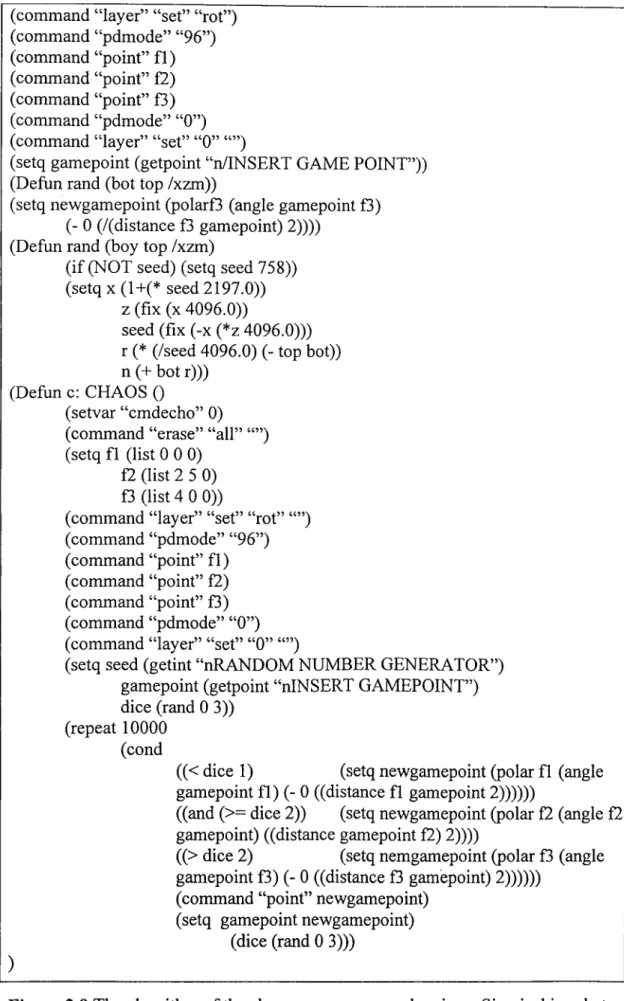
AutoLisp programming language allows to device programs for the generative creation of forms both in two and three dimensions in AutoCAD envirorunent. Some two dimensional examples of Chaos Theory and Fractals can be considered to show the automatic generation of form (Workbook, 1998, and Kurmann, 1998). Simple rules for symmetrical patterns, fractals, and similar geometrical figures are easy to define in AutoLisp. Fractals are deterministic and regular structures. They like symmetry patterns. A symmetry pattern can be written as:
A-^t(A) or EH 0
shape shape + t(shape)
Like almost all symmetry patterns, fractals can be written in the following way: A"^ Et(A) or A"^ 11 (A)+t2(A)+... +tn(A)
The following examples generate fractal forms. A program is designed to draw Sierpinski gasket point by point shown in Figure 2.8. The algorithm of the program is given in Figure 2.9. - 4 -J _ L j i E m h 4 ñ ñ I i i
Figure 2.8 Generation of four and three sides Sierpinski gaskets (Source: Kurmann, 1998: 100).
(command (command (command (command (command (command (command
‘layer” “set” “rot”) ‘pdmode” “96”) ‘point” fl) ‘point” f2) ‘point” D) ‘pdmode” “0”) ‘layer” “set” “0” “”)
(setq gamepoint (getpoint “n/INSERT GAME POINT”)) (Defim rand (bot top /xzm))
(setq newgamepoint (polarfB (angle gamepoint f3) (- 0 (/(distance О gamepoint) 2))))
(Defun rand (boy top /xzm)
(if (NOT seed) (setq seed 758)) (setq X (l+(* seed 2197.0))
z (fix (x 4096.0))
seed (fix (-x (*z 4096.0))) r (* (/seed 4096.0) (- top bot)) n (+ bot r)))
(Defun c: CHAOS ()
(setvar “cmdecho” 0) (command “erase” “all” “”) (setq fl (list 0 0 0)
f2 (list 2 5 0) f3 (list 4 0 0))
(command “layer” “set” “rot” “”) (command “pdmode” “96”) (command “point” fl) (command “point” f2) (command “point” O) (command “pdmode” “0”) (command “layer” “set” “0” “”)
(setq seed (getint “nRANDOM NUMBER GENERATOR”) gamepoint (getpoint “nINSERT GAMEPOINT”) dice (rand 0 3))
(repeat 10000 (cond
)
((< dice 1) (setq newgamepoint (polar fl (angle gamepoint fl) (- 0 ((distance fl gamepoint 2))))))
((and (>= dice 2)) (setq newgamepoint (polar f2 (angle f2 gamepoint) ((distance gamepoint f2) 2))))
((> dice 2) (setq nemgamepoint (polar f3 (angle gamepoint f3) (- 0 ((distance f3 gamepoint) 2))))))
(command “point” newgamepoint) (setq gamepoint newgamepoint)
(dice (rand 0 3)))
Figure 2.9 The algorithm of the chaos game program drawing a Sierpinski gasket
Another program can create more complex structures for example a Fern leaf or Bush curves (Figure 2.10).
·. ·. / / ■·. / / M i 1.." ' ' . i M*;.'*·" .·■ T·"·’ // \·.: V
1
r
'
M
A Jr . t /
r
I. xX (a) (b)Figure 2.10 Complex and interesting patterns: (a) Fern Leaf (b) Bush curves (Source: Workbook, 1998: 21 andKurmann, 1998: 10).
Another program is used to create the recursive version of the Koch curve. (Figure 2.11).
A
Figure 2.11 Generation of recursive Koch Snowflake (Source: Workbook, 1998: 30).
As specified in Workbook (1998: 20), all these programs are short and elegant simply because they are able to rely on AutoCAD. These examples show the recursive nature o f forms. This feature is then used to show the recursive nature of architectural forms by shape grammars. Only because fractals are regular, they are similar to shape grammars. However, architectural or any other designs are
nondeterministic and they involve variants and transformations unlike jfractals. Therefore, designs are more complicated than fractals.
2.5.1.2 A PARAMETRIC SHAPE GRAMMAR FOR THE PLANS OF TRADITIONAL TURKISH HOUSES
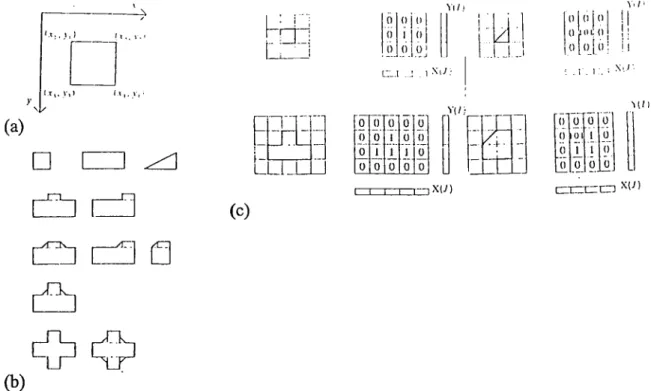
Instead of using shapes in fixed scale and orientation, one can generalize the ideas by parameterizing the generation process. Shapes may have proportion parameters. The values of these can be left unassigned so that when needed this dimensionless plan schemata can be proportioned. The example used to generate designs based on a corpus of traditional Turkish houses can be considered here (Çağdaş, 1996b). Pascal programming language is used to describe the rules for generation of the floor plans. The vocabulary elements are polygonal blocks that are described by a matrix
corresponding the spaces in traditional Turkish houses. A grid representation system is used for the spatial relations between elements. The blocks are shown on the coordinate system where both x and y coordinates are fully parameterized. Two groups of rule sets combining twenty-six rules for each are defined and these rules are applied in eight stages to the initial shape.
i . t . . y, ) < r , . y , I (a)
□
Û c r û □ L. ^ L(c)
^■| / ) 0|0 r ; '1 0 (i j O' L7_.1 . 1 iz] 0 0 o ' Ü o' 0 Ö’ I 0 0 0 1 1 1 Ü 0 0 0 0 r I I T--r-1XU) 0 0 0 0 ¡1 (I i! 0 I tf, ! ! o[()|o; ji ciTz:i=cn M/1 XU)(b)
Figure 2.12 Representation o f a shape grammar made up of parameterized blocks
Keeping the essential, central idea of drawing the grammar rules and coding them symbolically, one can write algoritlims in different programming languages.
Chase (1989) demonstrated an implementation of a generic shape grammar system in two dimensions and used Prolog programming language. The grammars here are based on the representation of shapes as individuals made up of maximal lines and labelled points. An initial shape is chosen from an initial shape file. Similarly, a rule is chosen from a rule database and the program requests the user to select the points to define the transformations.
2.5.1.3 A PROLOG IMPLEMENTATION OF A GENERIC SHAPE GRAMMAR SYSTEM R1JI4 □ - 0 In rti 3 1 S h J p ·=; D ·=: rr·.·· 3 ti 0 n
I
3 ^ 1 \ \ X ' / V \ 7 i t / \ \ \Figure 2.13 Representation o f a simple shape grammar made up of maximal lines
(Source: Chase, 1998b: 20).
2.5.2 TH R EE DIM ENSIONAL IMPLEMENTATIONS
Three dimensional computer implementations of two shape grammar studies are given in this section.
A computer implementation o f a three dimensional shape grammar described by Knight (1998a) is based on ideas first presented in the paper “Kindergarten grammars: designing with Froebel’s building gifts” by Stiny (1980b). Stiny’s program has been reworked and expanded into a series of exercises with using the Froebel bloeks or other three dimensional forms by Knight (1992, 1994) who concerned with the use o f grammars to invent new architectural and other styles of designs. This program was assigned as exercises in classes in the Design Theory and Methods elective eourse at U.C.L.A (Knight, 1992) and in Computational Design: Theory and Applications course at M.I.T (Knight, 1998a).
The project consists of development of a computer program that generates designs based on the production of three dimensional models in shape grammars. The goal is to illustrate how one can generate very complex geometries based on a few basic shapes and rules beginning with basic shape grammars. The grammar is based on a vocabulary o f Froebel blocks that includes three dimensional rectangular blocks of cubes, pillars, oblongs, and wedges. For each spatial relationship between two shapes, two additive and two subtractive rules are derived. The implementation is done in AutoLisp. The first step is to select the shapes to be in relation and to dimension them. Then, the relation is established based on the indexing of their vertices, faces, and edges. Finally, the eventual translations and rotations are specified (Knight, 1998a).
№ l l § ^
Figure 2.14 Vocabulary o f shapes and some possible spatial relations (Source: Knight, 1998a: 1).
2.S.2.2 A THREE-DIM ENSIONAL SHAPE GRAMMAR IM PLEM ENTATION
In the work of Piazzalunga and Fitzhom (1998), a three dimensional shape grammar implementation is described based on a commercial solid modelling kernel, ACIS® (http://www.spatial.com), and an associated functional language. Scheme language. As in the kindergarten grammars (Knight, 1998a), shapes here are made out of solid bodies. These solid building blocks are represented by using the solid modelling facilities of ACIS. However, unlike kindergarten grammars, the vocabulary may be any geometric solid entity computable within ACIS Scheme, not necessarily block like solids. Shapes are represented a set of solid bodies and labelled points. Then the rules are chosen within an interactive exploration o f the design, like the ideas
presented by Knight (1994) “the most simple and most basic” designs as well as the complex grammars from more complex initial shapes and rules are produced within this three dimensional shape grammar interpreter.
B ash Grammar 0: Rah'
f'':·' .1ft! ■..,
■=¿1^ Basfc C ram ifi^Q : L W a sh G ram m ar4rR ahyK ''
#
C3i-^
B ash Grammar 4 : Deslgif'^;.;^,jf
c=>[ B ash Grammar 7: Rufe YBash G ram ^ ri'G
Bash: Grammar 2: R a l^ ^ ^ :
dot dot
^-Ba^h G /^nhr. 2: Pi
^ B ash Grammar S: flah
dpt X
c : ^ T B ^ia Grammar 6:
dot
# >
■=iaj B ash Grammars: Design %
''^hGrami^
d;5t dot
Figure 2.15 The eight basic grammar rules and corresponding designs (Source: Piazzalunga and Fitzhom, 1998: 18).
2.5.3 PROGRAM M ING LANGUAGES FO R SHAPE GRAMMAR IM PLEM ENTATION
Many programming languages are available and widely used in different software development applications today. In order to use a given programming language, one only needs to get a software package consisting o f the programming editor, compiler or interpreter, and some other utilities or libraries for a specific brand of computer. Some programming languages are more popular than others since some languages are better for certain tasks than others. Following are some of the programming languages that have been used in shape grammar realizations.
2.5.3.1 AUTOLISP
Lisp (‘List processing’) is a programming language. The Lisp interpreter used with AutoCAD program is called AutoLisp. In other words, AutoLisp is the programming environment of AutoCAD. It provides a number o f specialized graphics functions like calls to AutoCAD commands in Lisp which are not part of the standard Lisp language (Kurmann, 1998: 3).
Lisp supports different programming paradigms. The use of logic programming in the evaluation is one of them. The usefulness of logic operations has been proved in descriptions o f design languages (Mitchell, 1990: 21), and in implementations of shape grammars by Chase (1989). Writing programs as a collection of small
functions - also known as modular programming, relates them to the incrementally developing nature of shape grammars. Lisp is rooted in the lambda calculus,
therefore is a functional programming language. The iterative and recursive natures o f the shape grammars are supported by the repetition and recursion control
structures. Hierarchy and similarity which are the two prevailing characteristics of almost all-natural and artificial objects so the architectural designs are also supported by the program (Kurmann, 1998: 34). It allows nested expressions in which one expression is contained within another.
2.5.3.2 PROLOG
Prolog (‘Programming in Logic’) is designed as a programming language for symbolic, nonnumeric computation. It has its roots in predicate logic and is
especially well suited for solving problems that involve objects and relations between objects. The programming paradigm of Prolog is preferred in expert systems
applications because of its object-oriented attributes and its pattern-matching capabilities (Chase, 1989: 229).
2.5.3.3 ACIS
ACIS is an object-oriented geometric modelling software designed for use as a geometry engine for three dimensional modelling applications. It is written in C++ programming language. ACIS provides an efficient architectural framework by integrating wire frame, surface, solid modelling. This model reduces the burden of developing geometric representation, operation, and visualization code by building the shape grammar interpreter on top of a three dimensional geometric modelling kernel, ACIS.
The capabilities of the geometric modeller are accessible with the use of the Scheme language, which is a small, simple but powerful dialect of Lisp. Like Lisp, it is rooted in the lambda calculus and therefore is a functional language. Scheme’s object-oriented programming constructs provide a framework for modularity and extensibility of the system where Chase (1989) and Krishnamurti and Giraud (1986) have already proved the usefulness of logic programming in implementation. Also the recursive sprit of schema as a control-flow mechanism is well suited to the recursive n a to e o f shape grammars. Unlike other interpreted languages. Scheme is relatively efficient, since it is possible to code critical shape grammar command extensions in C++ rather than only in Scheme (Piazzalunga and Fitzhom, 1998). The shape grammar notion given so far in relation with formal grammars and
architectural languages as well as sample analysis and implementations are employed in Chapter 3 for representation of shape grammars for Anatolian madrasahs.
3 A SHAPE GRAMMAR FOR ANATOLIAN MADRASAHS
3.1 ORGANIZATION OF MADRASAH PLAN LAYOUTS
In this section, an architectural language for Anatolian madrasahs is presented based on the works of Kuran (1969) and Sözen (1970, 1972). Kuran and Sözen analyzed particular madrasahs referring to some written sources, plans, sections, and
photographs that they had recorded. Using this documentation, common elements of Anatolian madrasahs and their spatial relations are derived, which are further used to define vocabulary elements of the grammar for the madrasahs.
Madrasahs were institutions of higher education in which the experimental sciences as well as the religious ones had been educated in a structured way such as theology, medicine, philosophy, mathematics, and astronomy through the centuries (Kuran, 1980: 89). They had affected the Middle Ages Anatolia by accomplishing an intensive cultural content and an advanced situation in its own age. The oldest madrasahs in Anatolia, that today we know their existences were built in mid XII’s (Sözen, 1970: xi).
Madrasah architecture can be stated as an introverted style. Its exterior form has little order, whereas the interior space is arranged around a rectangular or square court articulated with one to four recessed parts {iwan) in between the row of rooms around the court. It is usually one storied. Although some o f the madrasahs may have
one upper floor, the same plans of ground floors are used for those upper floors. Therefore, in this study, the main ground floor plans are taken into consideration. The plan compositions can be used to create an architectural language to describe the style o f Anatolian madrasahs. Although they were built in different regions far from each other, an original style that can be realized at the first look does exist common to all madrasahs (Aslanapa, 1993; vii). As Aslanapa stated: “Starting from a basically unchanged plan layout, the creation of an architecture with very rich variations determines dynamic and powerfully rooted starting points of Turkish art ” (Aslanapa,
1993; 135).
The shape grammar developed here for Anatolian madrasahs, is based on the plan layouts o f these madrasahs. Architectural organization of the madrasah stems from the relationship between the court and the iwans. They constitute the key elements in the typology of Anatolian madrasah architecture (Kuran, 1969: vii).
3.1.1 DESIGN ELEMENTS OF MADRASAH ARCHITECTURE
The main elements of the plans of Anatolian madrasahs are court, iwan, revak
(portico) winter classroom, and student cell (Kuran, 1969: 132). Figure 3.1 shows the layout o f a typical Anatolian madrasah.