J I Y
f f 1 b h Î k b i i l f â f ? f 1’ I I? f*· T Î ii 1 l i l i l í ¿ Ё І І і Ъ І І І І і R ü í  t l ı î i i l f l í í ,3ïÂ! Діііі ·<··« ·<κ A THESISSUBM ITTED TO THE öEPARTMErîT OF İHDUSTRIAL E U G l H E m U Q à.HÙ ΎΗΈ IN S TITU T» O r ENGINEERÍMG AND SCIEMCE :
âSîï-ÎîWsa-ôrrv·
•ил*·’· ям·«'w »»»я ñi<*Sü 1» ni i U ·ΐ ЧііѴ 4 I i
3?í ?
м ш ім
.г и т а м ш ш
o f t h e b e û u i h ê m e n t s *> ?"ï·. '*'ч -,' І-. а**' ж.. .Р» .1».'» .i'·.*·»» Л№ -jif-nii»3t <.ϋ|1ί^ ,.! ·>»»ι.4ί». t ίΚ :tM İt uç ıtolrf ш r ¿¿XÍÜ ■m*»· ^ -p w Ä i? * 1» -aa#^ Л» 4fea» V *İ ánw «Λ w I. DOOTOS Gr^ PHiLOSOrHY V / : 0 r | j 3 t ' Ш ^<uJî‘ Ч»« "»¡&Λί· nu' vtf w ;l! iy iS ^ it jP .\ K i. ai«t. Λ 3.--. лкмц^ P “■ '·.■* j*«î» »ТЛ « * g g H! y S ^ J? í¡ ·5*<ψ Μ \ / , îî V"5 f ¿ ' t j •W·'^
FACILITY LOCATION, CAPACITY ACQUISITION
AND TECHNOLOGY SELECTION MODELS FOR
MANUFACTURING STRATEGY PLANNING
A THESIS
SUBMITTED TO THE DEPARTMENT OF INDUSTRIAL ENGINEERING AND THE INSTITUTE OF ENGINEERING AND SCIENCE
OF BILKENT UNIVERSITY
IN PARTIAL FULFILLMENT OF THE REQUIREMENTS FOR THE DEGREE OF
DOCTOR OF PHILOSOPHY
By
Vedat Verter
February, 1993
н ъ
-I certify that -I have read this thesis and that in my opinion it is fully adequate, in scope and in quality, as a dissertation for the degree of Doctor of Philosophy.
Assoc. Prof. Dr. M. Cemal Dinger (Supervisor)
I certify that I have read this thesis and that in my opinion it is fully adequate, in scope and in quality, as a dissertation for the degree of Doctor of Philosophy.
Nesim Erkip
I certify that I have read this thesis and that in my opinion it is fully adequate, in scope and in quality, as a dissertation for the degree of Doctor of Philosophy.
I certify that I have read this thesis and that in my opinion it is fully adequate, in scope and in quality, as a dissertation for the degree of Doctor of Philosophy.
Miarles H. Falkner
I certify that I have read this thesis and that in my opinion it is fully adequate, in scope and in quality, as a dissertation for the degree of Doctor of Philosophy.
Assoc. Prof. DiT Osman Oğuz
Approved for the Institute of Engineering and Science:
__ ______________________ __________________
Prof. Dr. Mehmet Ba^ay,
Tek başına zoru başarmanın
bana en yakın örneği, annem,
A cknow ledgem ent
I would like to express my sincere gratitute to the numerous people who have supported me in various ways during the process of this dissertation research. I am indebted to my supervisor Cemal Dinger. I have benefited a lot from his expertise on international facility location. Although, his time-consuming managerial activities as the Assistant Dean of the Faculty of Engineering prevented him from being daily involved, his supervisory support has been invaluable. 1 am grateful to him for always being open to my new ideas, and supportive of my endevaours to conduct research at the intersection of operations research and strategic management. I am also grateful to the members of my dissertation committee for their comments on the final draft of the thesis. In particular, I believe the remarks of my external examinee, Nesim Erkip, will also be useful in improving the papers to be published from this dissertation.
The other readers of my dissertation have provided substantial support starting at the earlier phases of this research. Akif Eyler supervised my MS Thesis at Boğaziçi University, and actively encouraged me to continue my graduate studies at Bilkent. I greately appreciate his friendship at one of the turning points of my life. I am happy to have the opportunity to collaborate with Charles Falkner. Not only he provided me with valuable insights regarding advanced manufacturing technology, but also the things he taught me will prove to be useful in any kind of environment in the future, scientific or not. I thank him for repeatedly telling me that “Ph.D. is an endurance process” whenever something went wrong in the progress of my dissertation research. I am indebted to Osman Oğuz for our intensive discussions on the technicalities of integer programming which helped me in carrying out the various stages of this research.
I am grateful to Peter Primrose of UMIST who hosted my short visit to Manchester, and collaborated with me for the development of a systematic approach for manufacturing strategy planning. Although, the methodology we have developed is descriptive in nature, and hence is not included in this thesis, his ideas and comments remained influential on my own work. I would like to thank Peter Kas for our numerous discussions on network flow models during his two years stay at Bilkent. I thank Diwakar Gupta of McMaster University for hosting my visit to Canada, during the final stages of this research.
I received financial support from The National Productivity Center, The Scientific and Technical Research Council of Turkey, and Bilkent University at various stages of my dissertation research and all are gratefully acknowledged. Last but not least, I owe special thanks to Sıla Çetinkaya. This study could have taken much longer without her understanding, patience, continuous morale support, and encouragement.
A b stract
FACILITY LOCATION, CAPACITY ACQUISITION
AND TECHNOLOGY SELECTION MODELS FOR
MANUFACTURING STRATEGY PLANNING
Vedat Verier
Ph.D. in Industrial Engineering
Supervisor: Assoc. Prof. Dr. M. Cemal Dinger
February, 1993
The primary aim of this dissertation research is to contribute to the manufacturing strategy planning process. The firm is perceived as a value chain which can be represented by a production-distribution network. Structural decisions regarding the value chain of a firm are the means to implement the firm ’s manufacturing strategy. Thus, development of analytical methods to aid the design of production-distribution sytems constitutes the essence of this study. The differentiating features of the manufacturing strategy planning process within the multinational companies are especially taken into account due to the significance of the globalization in product, factor, and capital markets.
A review of the state-of-the-art in production-distribution system design reveals th at although the evaluation of strategy alternatives received much attention, the existing analytical methods are lacking the capability to produce manufacturing strategy options. Further, it is shown that the facility location, capacity acquisition, and technology selection decisions have been dealt with
separately in the literature. Whereas, the interdependencies among these structural decisions are pronounced within the international context, and hence global manufacturing strategy planning requires their simultaneous optimization. Thus, an analytical method is developed for the integration of the facility location and sizing decisions in producing a single commodity. Then, presence of product-dedicated technology alternatives in acquiring the required production capacity at each facility is incorporated. The analytical m ethod is further extended to the multicommodity problem where product- flexible technology is also available as a technology alternative. Not only the arising models facilitate analysis of the trade-offs associated with the scale and scope economies in capacity/technology acquisition on the basis of alternative facility locations, but they also provide valuable insights regarding the presence of some dominance properties in manufacturing strategy design.
K e y w o rd s: Manufacturing Strategy, Production-Distribution Systems, Facil ity Location, Capacity Acquisition, Technology Selection, Global Manufactur ing.
ö z e t
ÜRETİM STRATEJİSİ PLANLAMA İÇİN YER
SEÇİMİ, KAPASİTE SATIN ALMA VE TEKNOLOJİ
SEÇİMİ MODELLERİ
Vedat Verter
Endüstri Mühendisliği Doktora
Tez Yöneticisi: Doç Dr. M. Cemal Dinçer
Şubat, 1993
Bu çalışmanın ana amacı, üretim stratejisi tasarımı sürecine katkıda bu lunmaktır. Her firma, belirli girdilerin, belirli aşamalardan geçerek ürün ve/veya servise dönüştürüldüğü bir katma-değer zinciri olarak ele alınabilir. Bu bağlamda, üretim-dağıtım serimleri firmaların modellenmesinde etkin bir araçtır. Bir firmanın üretim stratejisi, o firmanın katma-değer zin cirinin yapısına ilişkin uzun vadeli kararlar içerir. Üretim-dağıtım serim- lerinin tasarım ına yönelik analitik yaklaşımların geliştirilmesi, bu çalışmanın özünü oluşturm aktadır. Ürün, faktör ve sermaye pazarlarında gözlemlediğimiz küreselleşme nedeniyle, çokuluslu şirketlerde üretim stratejisi tasarımı sürecinin ayırdedici nitelikleri bu çalışmada özellikle gözönüne alınmıştır.
Üretim-dağıtım serimi tasarımı üzerinde yapılan bir literatür taraması şu sonucu açığa çıkarmıştır: Bugüne kadar, strateji seçeneklerinin değerlendirilmesi ile ilgili birçok çalışma yapılmakla birlikte, önerilen yaklaşımlar üretim stratejisi seçeneklerinin belirlenmesinde yetersiz kalmaktadır. Ayrıca, yer seçimi, kapasite satın alma ve teknoloji seçimi problemleri bugüne dek
ayrı ayrı incelenmiştir. Halbuki, bu yaprsal kararlar arasındaki ilişkiler özellikle uluslararası ortam da ön plana çıkmaktadır. Bu nedenle, global üretim stratejisi tasarımı yapısal kararların birlikte eniyilenmesini gerektirir. Öncelikle, bir ürünün üretiminde, tesis yeri seçimi ve kapasite satın alma kararlarının entegrasyonuna yönelik bir analitik yaklaşım geliştirilmiştir. Daha sonra, bu modele teknoloji seçimi kararları da dahil edilmiştir. Ayrıca, sözü edilen tek ürün modeli, çok sayıda ürünün üretimine yönelik, geleneksel/esnek teknoloji seçimi, kapasite ve tesis yeri kararlarının birlikte alınmasına olanak sağlayacak şekilde geliştirilmiştir. Önerilen yaklaşım, teknoloji seçeneklerine ilişkin ölçek ve çeşitlilik ekonomilerinin incelenmesi yanında, üretim stratejisi tasarımında varolan dominans özellikleinin de belirlenmesine yardımcı olmuştur.
A n a h ta r K e lim e le r: Üretim Stratejisi, Üretim-Dağıtım Serimleri, Yer Seçimi, Kapasite Satın Alma, Teknoloji Seçimi, Küresel Üretim.
C o n ten ts
A b stract O zet 111 C onten ts List of Figures Vlll List o f Tables IX 1 In trod u ction 12 P ro d u ctio n -D istrib u tio n S ystem D esign for M anufacturing S tra teg y P lanning: A R eview
2.1 The manufacturing strategy planning process... 9 2.2 Manufacturing strategy planning within the international context 12
2.3 Domestic production-distribution systems 16
2.4 International production-distribution systems ... 24
3 A n In tegrated Evaluation of the Facility L ocation, C apacity
A cq u isition and Technology Selection D ecisions 31
3.1 Facility location ... 33
3.1.1 The simple plant location problem ...35
3.1.2 Plant location under uncertainty 38 3.1.3 The international plant location p ro b le m ... 42
3.2 Capacity a c q u isitio n ... 44
3.2.1 The capacity expansion problem ... 44
3.2.2 Capacity expansion under uncertainty 49 3.3 Technology s e le c tio n ... 52
3.3.1 The technology selection p ro b le m ... 54
3.3.2 Choice of flexible technology... 57
3.4 Concluding comments ... 62
4 F acility L ocation and Capacity A cquisition 64 4.1 The facility location and capacity acquisition p ro b lem ... 65
4.2 Review of the relevant lite ra tu re ... 68
4.3 Analytical properties of the U F L & C A P... 71
4.4 An algorithm for solving the U F L & C A P ... 75
4.5 Computational r e s u l t s ... 81
4.6 Analytical properties of the C F L & C A P ... 85
4.7 Concluding rem a rk s... 89 vi
5 Plant Location and Technology Acquisition 91
5.1 The facility location and technology acquisition problem . . . . 92
5.1.1 The model 94 5.1.2 Airalytical properties of the UFL&TAP 95 5.1.3 An algorithm for solving the UFL&TAP 99 5.2 The plant location and technology acquisition problem 100 5.2.1 The model 101 5.2.2 Analytical properties of the U P L & T A P...102
5.2.3 An algorithm for solving the UPL&TAP 106 5.3 The plant location and flexible technology acquisition problem . 112 5.3.1 The m o d e l... 113
5.3.2 Analytical properties of the U P L & F T A P ...116
5.3.3 An algorithm for solving the UPL&FTAP ... 119
5.4 Concluding rem a rk s... 124
6 C on trib u tion s and Future Research 126
B ib liograp h y 128
List o f F igures
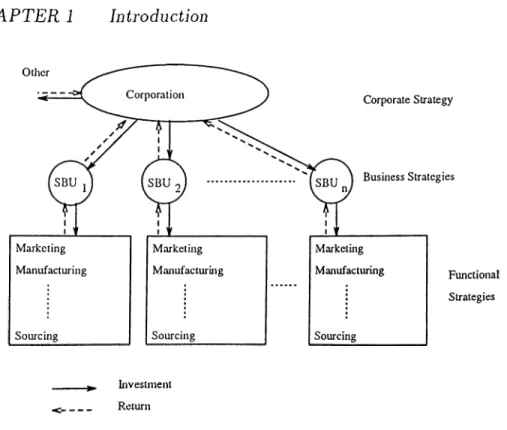
1.1 A three-level corporate h i e r a r c h y ... 3
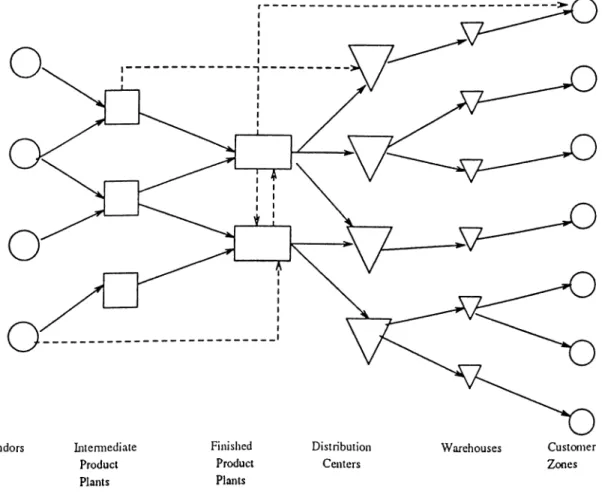
1.2 Production-distribution n e tw o rk ... 5
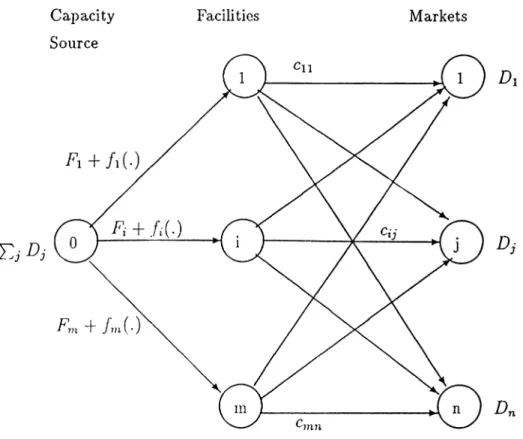
4.1 Network flow representation of U F L & C A P ... 70
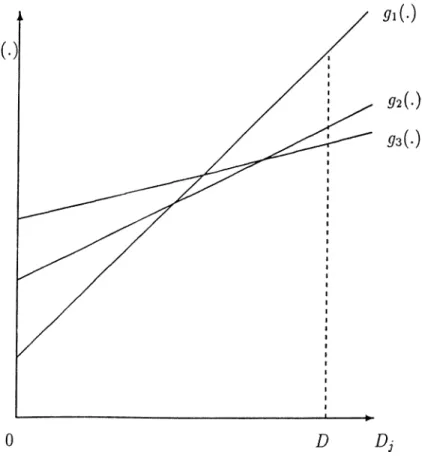
4.2 Conditional dominance for fixed-charge c o s ts ... 74
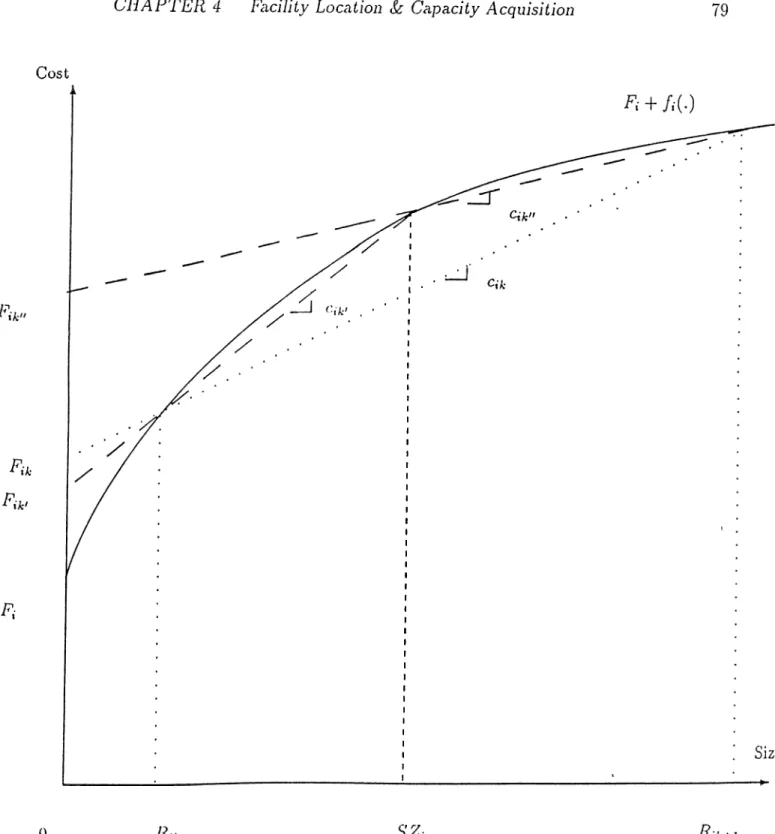
4.3 Step 2 of the algorithm for facility i ... 79
5.1 Network flow representation of UFL&TAP 96 5.2 Network flow representation of UFL&TAP 98 5.3 Network flow representation of U P L & T A P ... 103
5.4 Network flow representation of M U P L P ...110
5.5 Network flow representation of U P L & F T A P ... 116
5.6 Network flow representation of T U F L P ... 122
List o f Tables
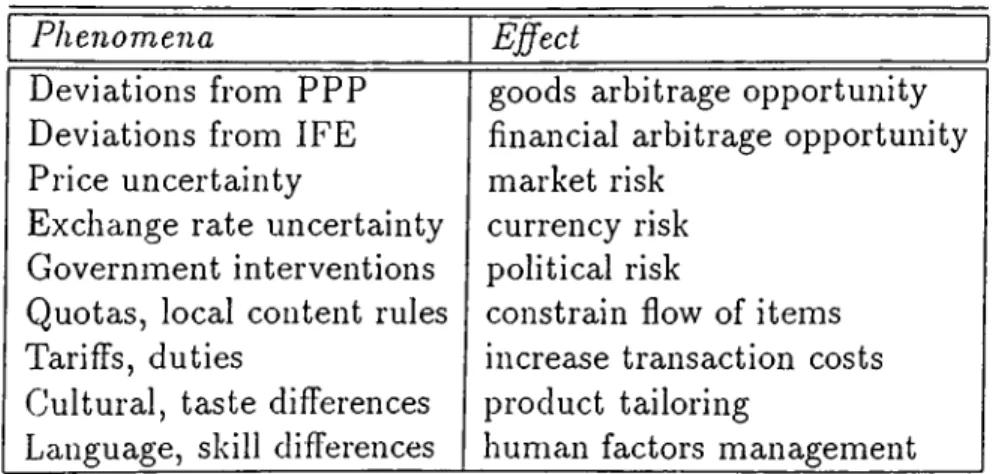
2.1 Distinguishing Features of the International Environment . . . . 14
82 2.1 Distinguishing 4.1 Computational 4.2 Computatioiicil 4.3 Computational 4.4 Computational ^ = 20, a = 0.95 84 84 IX
C h ap ter 1
In tro d u ctio n
A firm’s manufacturing activity provides a reliable basis for being successful in the product markets. Thus, manufacturing performance is an important strategic weapon for both achieving and sustaining competitiveness. Long term goals for manufacturing performance and policies adopted to achieve those goals constitute the manufacturing strategy of a firm. Design and implementation of a manufacturing strategy is conceived to be crucial especially when there is intensive rivalry, as in international markets. There are two main approaches to the manufacturing strategy planning problem: descriptive frameworks and analytical models. In general, descriptive frameworks provide an understanding of the firm’s environment as well as its internal structure to aid formation of the policies that will presumably enable the firm to attain a better position in its future environment. Analytical approaches however, prescribe the best action plan for manufacturing in order to maximize the firm’s performance. Classical economic theory and mathematical programming have long been in use for modeling the firm behavior in product markets, the decisions suggested by these models being policy alternatives for achieving strategic goals. A survey of the prevailing literature reveals that the descriptive and analytical studies on manufacturing strategy have articulated in a rather fragmented manner. This study demonstrates that these two modes of analysis complement each other especially for global manufacturing strategy planning.
CHAPTER 1 Introduction
Cost, quality, delivery performance, and flexibility are the most common criteria to evaluate performance of a manufacturing system. Firms need to develop their own performance measurement schemes in order to both operationalize their long term goals in terms of the above criteria and monitor the implementation of their manufacturing strategy. Relative priorities of these objectives however, are dictated by the particular strategy being implemented and hence, differ from firm to firm. It should be noted that firms are not in a position to choose between cost and quality or dependability and flexibility objectives. Empirical studies did not justify the existence of such tradeoffs suggested in early conceptual work on manufacturing strategy. In accordance with the intensive rivalry in global markets, innovativeness and time-based competition are emerging as important manufacturing objectives.
Policies that enable a firm to meet its long term goals comprise a collection of strategic decisions. In their recent review, Leong et al. [96] pointed out the consensus among several authors about the strategic decision areas for manufacturing. These include structxiral decisions associated with facilities, capacity, technology, and vertical integration as well as infrastructural decisions associated with production planning and control, quality, organization, workforce, new product development, and performance measurement systems. In general, structural decisions constitute long term investments whereas infrastructural decisions mostly address the people and systems that run manufacturing activity.
In strategy planning, the manufacturing activity has to be conceived within the context of the corporate hierarchy. A typical three-level hierarchical model of a corporation is depicted in Figure 1.1. A corporation comprises a collection of Strategic Business Units (SBUs) each functioning in a particular industry in order to serve a well-defined market segment. Naturally, an SBU consists of several functional units such as purchasing, marketing, finance, personnel, R&D, and manufacturing. An industry however, is defined to be a collection of rivals competing directly with each other via the products/services they produce. Strategy planning aims achievement of a long-term sustainable competitive advantage at each SBU, and hence at the corporate level.
C H A PTER 1 Introduction
Livestmenl Return
Figure 1.1: A three-level corporate hierarchy
This requires consistency of the strategies designed and implemented at all hierarchical levels of the corporation. Therefore, manufacturing strategy cannot be formed without considering its interactions with the business and corporate strategies as well as with other functional strategies.
Corporate strategy planning involves decisions regarding the business portfolio of a corporation. T hat is, the long term goals and policies for the collection of industries to compete in are determined by the corporate strategy. As pointed out by Naylor and Thomas [109] the allocation of strategic investments to the SBUs is an interface between the corporate and business strategies. Hence, in designing its business strategy, each SBU is constrained by the availability of strategic resources provided by the corporation, and needs to be consistent with its mission dictated by the corporate strategy. Business strategy however, provides a framework for the marketing, manufacturing, sourcing, and other functional strategies. We perceive the firm as an SBU operating in a particular industry, and use the terms firm and company interchangeably. Although, many firms belong to corporations in reality, analysis of the strategic issues regarding that interaction is out of the scope of this study. Our focus however, will remain on the consistency of the manufacturing and business strategies in
CHAPTER 1 Introduction a firm.
Since the beginning of 1980’s the world has been going through an era of restructuring. The end of cold war between super-powers, rapid liberalization movements within the socialist block, geographical enlargement and economical strengthening of the European Community and rise of the Asia-Pacific rim via industrial growth of countries like Japan and South Korea are some of the striking examples. This restructuring process is accelerated by the continual transformation of the closed national economies to open economies all over the world. In most industries firms are now exposed to global competition. Globalization of product markets provides an opportunity for scale economies. However, it becomes more difficult for the firms to survive even in their domestic market against the global rivals. Therefore, all firms need to understand the dynamics of global competition, analyze the specifics of their industry, assess the strengths and weaknesses of their own production-distribution system, and adopt explicit strategy formulation and implementation processes.
In response to the trend toward opening closed national economies to international competition and hence globalization of markets, firms tend to restructure themselves into multi-activity settings. This stems from the motivations to explore the tradeoffs between inbound-outbound logistics costs and plant operation costs as well as to take advantage of the inefficiencies in the international product, factor, and capital markets. Globalization of firms however, increases the organizational complexity which requires development of appropriate ways to model and analyze the firm behavior within the inter national context. Production-distribution networks provide an effective tool in modeling global firms. A typical production-distribution network is depicted in Figure 1.2. Here, nodes represent the vendors, production plants, distribution centers, and warehouses of the firm, and the customer zones whereas arcs represent the flow of items. Note that firms implement their manufacturing strategy via the facility location, capacity acquisition, technology selection, and product mix decisions at each node of their production-distribution system. Time-phasing and financing of these investments naturally constitute
im portant elements of the decision process. Since it allows incorporation of all of the structural and some of the infrastructural strategic decision categories, the producton-distribution system design problem can be regarded as an analytical framework for manufacturing strategy planning. Clearly, improvements in designing international production-distribution systems will contribute to the formation of global manufacturing strategies.
CHAPTER 1 Introduction 5 Product Plants Product Plants Centers Zones
Figure 1.2: Production-distribution network
The primary objective of this dissertation research is to contribute to the manufacturing strategy planning process. Development of analytical methods for designing production-distribution systems is conceived to be the major task in achieving the research objective. The dynamics of manufacturing strategy design in multinational companies are especially taken into account due to the globalization of product, factor, and capital markets. It is necessary to ensure th at the manufacturing strategy will be consistent with the company strategy. Thus, Chapter 2 presents the descriptive methods for strategy planning, which
CHAPTER 1 Introduction 6 constitute a framework for the detailed analysis to be performed via the analytical approaches presented in this thesis. Chapter 2 also provides a review of the literature on production-distribution system design which reveals th at the existing methods are lacking the capability to assist management in determination of the manufacturing strategy options. Therefore, Chapter 3 focuses on the structural decisions during the manufacturing strategy planning process. It is observed that the facility location, capacity acquisition, and technology selection decisions have been dealt with separately in the literature. These decisions however, are interdependent for global firms, and hence global manufacturing strategy planning requires simultaneous optimization of the location, capacity, and technology investments. Chapter 4 presents an analytical approach for the single-commodity facility location and sizing problem. In Chapter 5 the basic model is extended to incorporate the presence of technology alternatives in acquiring the required production capacity. Then, the method is further generalized to optimize the location, sizing, and technology selection decisions in the multicommodity setting. Chapter 6 discusses the major contributions of this dissertation research as well as the directions for future research.
C h ap ter 2
P ro d u ctio n -D istrib u tio n
S y stem D esign for
M an ufacturing S trategy
P lanning: A R eview
There are two basic categories of problems pertaining to the management of production-distribution systems:
i) Design problems] How to structure the system?
ii) Material flow problems] How to manage the flow of items?
The distinguishing characteristic of a design problem is that it requires a large capital outlay for implementation. That is, the solution process of design problems involves medium-long term decisions which are mostly irreversible in the short run. Whereas, material flow problems are concerned with short term decisions such as production, inventory, and transportation planning etc. Note that however, manufacturing strategy of a firm essentially constitutes the goals and policies for the future structure of its production-distribution network. Hence, the multicommodity, multi-echelon production-distribution
CHAPTER 2 Production-Distribution System Design 8 system design problem is an integral part of the manufacturing strategy planning process. Global firms however, have their production/distribution facilities located in a variety of countries so as to take advantage of the inefficiencies in the international product, factor, and capital markets. Hence, the production-distribution network of a global firm would normally have a multi-echelon structure (as in Figure 1.2) where the items flow across national boundaries. This further allows the firm to exploit the tradeoffs between transportation and operation costs. Moreover, it is a common practice to produce and distribute various products via the same production-distribution network in order to take advantage of the economies of scope.
This chapter aims to show that the descriptive literature on manufacturing strategy planning justifies utilization of the production-distribution design techniques in strategy design, and to provide an assesment of the state of the art in production-distribution system design on which the literature is rather sparse. Aikens [1] provided a comprehensive account of the facility location models for distribution planning problems. An application- oriented review of mathematical models and solution algorithms for designing production-distribution systems can be found in Moon [107]. Section 2.1 provides a selective review of the vast literature describing the business and manufacturing strategy planning processes. The competitive strategy framework is emphasized due to its relevance to the analytical models for production-distribution system design. Section 2.2 discusses the factors that need to be taken into account during the process of manufacturing strategy planning within the international context. In Section 2.3 the literature pertaining to the domestic version of the production-distribution system design problem is reviewed. Incorporation of distinguishing features of the international environment are presented in Section 2.4. A critical evaluation of the prevailing literature is provided in the final section.
CHAPTER 2 Production-Distribution System Design 9
2.1
T h e m a n u fa ctu rin g stra te g y p lan n in g p ro
cess
Gilbert et al. [51] ¡provided a review of the state-of-the-art in strategy. They presented a classification of the prevailing literature on business strategy into six frameworks namely; Harvard Policy, Poidfolio, Competitive Strategy, Stakeholder Management, Planning Process, and Seven-S. The first three frameworks share some quite fundamental features such as, an attem pt to match internal structure of firms with their external environment, and confinement of the strategy problem solely to the managerial level, and hence are called the managerial models of strategy. Stakeholder Management however, conceives a firm as a set of relationships among stakeholders rather than a collection of processes that converts inputs to outputs for providing returns to stockholders. Planning Process framework is concerned with the formalization of the strategy planning process to ensure the necessary organizational interactions for strategy formulation. The Seven-S framework provides an extension of the formalization idea via indicating the necessity to incorporate strategy-structure relationship in a more comprehensive scheme which also includes systems, style, skills, staff, and superordinate goals. Note that, although each framework has pros and cons in assisting strategy planning, the descriptive approaches as a whole provide management with several strategy alternatives from different viewpoints.
Harvard Policy framework developed at the Harvard Business School since the beginning of 1950’s is the ancestor of many other studies in the field. It essentially constitutes a systematic questioning process for investigation of the firm specific material, technical, financial and human resources, and the environment to aid the strategy formulation and implementation processes. Portfolio framework however, aims to come up with the universal laws for classification of the SBUs according to their competitive power. This would enable a more realistic statement of performance targets for SBUs which leads to a better deployment of a firm’s strategic resources. The Competitive Strategy framework dwells on the idea that long term performance of a firm
CHAPTER 2 Production-Distribution System Design 10 is a function of the industry forces and the extent to which the managers are able to position the firm among and against these forces. In his seminal work Porter [114] described the opportunities for success of a company as a function of the forces at work in the industry. These forces are relative bargaining power of buyers, relative bargaining power of suppliers, threat of new entrants, threat of substitute products, and intensity of rivalrous activity among competitors. Analysis of the industry forces can provide a sound basis for designing successful sti'ategies only if it is accompanied with an investigation of the internal structure of the firm. Porter [114] proposed the value chain analysis in determining the competitive advantages of a firm.
The Competitive Strategy framework is essentially concerned with the achievement of a profit level above the industry average. Porter [117] provided a set of generic strategies for the firms to achieve and sustain above average returns: Cost leadership. Differentiation, Cost focus, and Focused differentiation. According to Porter [115] the cost leader is not merely a low cost producer but the lowest cost producer in the industry. This leads to an above average performance by charging prices at or near the industry average. Differentiation constitutes creating value for the buyer via a unique dimension which is important for the buyer’s value chain. This enables commanding above average prices which translates into above average returns if production costs are at or near industry average. Cost focus or focused differentiation becomes necessary when the firm cannot attain a leadership in the market as a whole. In this case, a firm may choose to serve a particular target market segment with distinctive needs. Commitment to one and only one of the generic strategies is strongly recommended for exploring the competitive advantages of a firm. Despite the fact that P orter’s work has been quite popular among managers and very influential in academia, there are many criticisms. Gilbert et al. [51] accepted the strength of the value chain idea and the operationality of the framework. However, they noted that complexity of the value chain analysis may defer timely decisions in some instances, and that people are not very im portant in Porter’s work. Further, various external factors such as government are not given enough attention. The framework dwells heavily on
CHAPTER 2 Production-Distribution System Design 11 the concept of industry, boundaries of which may be hard to identify in many cases. Hendry [60] reported that exceptions to the rule that cost leadership and differentiation are incompatible, are so many which make the rule virtually worthless. This also causes confusions in having a clear understanding of the generic strategies. It is further noted that extending the model beyond the single product-group industries and business units is quite problematic.
Several authors have spent considerable effort in assuring the consistency of manufacturing strategy with business strategy as well as with other functional strategies a predominant example being the work of Fine and Hax [40]. Kotha and Orne [87] aimed at capturing the manufacturing implications of generic business strategies in devising their generic manufacturing strategy model. Extending the ideas due to Hayes and Wheelwright [58], [59], manufacturing function is perceived as a three dimensional structure, the dimensions being process structure complexity, product line complexity, and organizational scope. Factors leading to the high or low levels in each of these dimensions are further identified, and analyzed. In this context, manufacturing strategy constitutes a movement in the three dimensional space from a point that designates the current manufacturing structure to a target point implied by the generic business strategy being implemented. Although their representation of manufacturing structure remains quite descriptive, the work of Kotha and Orne [87] achieves the fit between strategy and structure via an integration of the classical concepts on manufacturing strategy with Porter’s Competitive Strategy framework. Empirical studies on the implementation of generic manufacturing strategies will presumably provide substantial insight in manufacturing strategy planning.
Cohen and Lee [19] presented a paradigm for manufacturing strategy planning. They stressed incorporation of the following issues in a framework for the evaluation of manufacturing strategy alternatives: economies of scale and scope in manufacturing; behavior of manufacturing costs in conjunction with plant focus, production system flexibility, and product line complexity; interactions between the decisions, costs, and performance throughout the value chain; impacts of adoption of new technology; and vertical integration, supplier
CHAPTER 2 Production-Distribution System Design 12
sourcing and material management. The Cohen and Lee [19] paradigm aims to identify a manufacturing mission as suggested by Skinner [124], which essentially is a weighted average of performance requirements associated with cost, quality, service, and flexibility measures, in terms of each product segment. Each strategy option is evaluated with respect to the manufacturing mission requirements, the product market structure, and the cost/performance capabilities of the manufacturing system. Cohen and Lee [19] developed an integrated software system to operationalize their model which is used in the consulting practice of Booz, Allen and Hamilton Inc. As another example of such normative frameworks, Breitman and Lucas [10] reported the worldwide use of PLANETS (The Production, Location Analysis NETwork System) throughout General Motors, in helping managers to decide what products to produce; when, where and how to make these products; which markets to pursue; which resources to use; how to ship; and where and when to make capital investments.
2.2
M an u factu rin g str a te g y p lan n in g w ith in
th e in tern a tio n a l co n te x t
In his pioneering article Levitt [97] noted that “companies must learn to operate as if the world were one large market - ignoring superficial regional and national differences.” It is necessary to make a distinction between multinational corporations and global firms. The former operates in a number of countries while each subsidiary is run as a domestic firm. Whereas, the latter operates as if the entire world were a single entity. There are several distinguishing features of the international environment which have to be taken into consideration for global manufacturing strategy planning.
According to classical economic theory, the law of comparative advantages provides a basis for international transactions. That is, trade will be m utually advantageous if countries are relatively more efficient in producing different goods. Ideally, an international equilibrium will be attained when
CHAPTER 2 Production-Distribution System Design 13 exports and imports of individual countries reach a balance in their own currency. Exchange rates among currencies provide the means for adjustment of the international disequilibrium. This is apparent from the following theorems on the relationships between exchange rates, interest rates and price levels: Purchasing Power Parity (PPP) states that exchange rates off set the differences between national price levels of freely tradeable goods, and International Fisher Effect (IFE) states that exchange rates off-set the differences between interest rates for different currencies. These fundamental exchange rate relationships however, are based on some assumptions such as; perfect product markets (no transportation cost or time, no barriers to ti’cide), perfect financial markets (all relevant information is reflected in prices, no taxes, no transaction costs, no controls), and future certainty. These assumptions are quite unrealistic in many cases, since product and capital markets are not “perfect” and the future is not known with certainty. Deviations from PP P exist due to lags in market responses, transportation costs, national differences in the price ratios of internationally traded goods to domestically traded goods, government interventions and risk expectations. Furthermore, deviations from IFE exist due to the availability of subsidized financing and differentials in corporate tax rates. In addition to the various arbitrage opportunities provided by these imperfections, uncertainities regarding future exchange rates, interest rates and price levels cause various types of risks the firms have to undertake when designing their manufacturing strategy. Distinguishing features of the international environment and their potential impacts on firm behavior are depicted in Table 2.1.
Porter [114], [115] proposed the conceptualization of a firm’s activities as a value chain. This is due to the perception of a firm as an organization which creates value for its buyers. A typical value chain consists of prim ary activities such as purchasing, production, distribution, marketing, and servicing products, and support activities such as R&D, and human resources management. It is necessary to analyze the linkages among these activities as well as the linkages between the entire value chain and the firm’s buyers and suppliers. Firms would be able to identify their competitive advantages to the
CHAPTER 2 Production-Distribution System Design 14 extent th at they know the strengths and weaknesses of their value generation process.
Phenomena Effect
Deviations from PPP Deviations from IFE Price uncertainty
Exchange rate uncertainty Government interventions Quotas, local content rules Tariffs, duties
Cultural, taste differences Language, skill differences
goods arbitrage opportunity financial arbitrage opportunity market risk
currency risk political risk
constrain flow of items increase transaction costs product tailoring
human factors management
Table 2.1: Distinguishing Features of the International Environment
Kogut [85] described the interplay of the firm specific competitive advantages and the location specific comparative advantages for global firms. Every firm should identify and control the critical success factors in its value chain for serving the buyers’ needs. Global firms however, have facilities located in different countries. This requires the value chain analysis to address the differences between countries in terms of production factor costs as well as institutional and cultural issues which affect the manufacturing strategy decisions. Hence, global strategies should be designed so as to take advantage of the interrelations between competitive and comparative advantages. Kogut [86] pointed out the importance of creating operational flexibility within the corporation in order to benefit from being global. Operational flexibility provides the capability to explore arbitrage and leverage opportunities. Arbitrage opportunities include; production shifting in response to changing circumstances in factor markets, information arbitrage, tax minimization via transfer pricing, and financial arbitrage via subsidized loans. Leverage opportunities arise from global coordination and may be a hedge against political risk among other things.
Porter [117] provided a paradigm to assess the attractiveness of a nation as a home base for an industry. (Note for comparison that his earlier work aimed
CHAPTER 2 Production-Distribution System Design 15 to assess the attractiveness of an industry for a firm.) A home base for a global firm’s activities in an industry is the country which reaps the profits and which is usually where the majority of production and management takes place. Porter [117] identified the determinants of national advantage as; factor conditions, demand conditions, related and supporting industries, and firm strategy, structure, and rivalry. Government and chance are perceived as the factors influencing these determinants. Implementation of Porter’s paradigm in the analysis of a selection of industries in ten countries provided valuable insights regarding the dynamics of global competition.
In their introduction to the special issue of Management Science Day, Farley and Wind [25] identified integration of theoretical contributions in relevant disciplines, and hence development of new methods of analysis as a viable research direction for strategy planning. In accordance with the above observation, this study presents methods for designing international production-distribution systems to enhance the analytical treatment of the theory regarding the driving forces of international competition. Perceiving the global firm as an international value chain facilitates analysis of the value creation process, and determination of the firm’s competitive abilities. Production-distribution networks constitute an operational representation of the value chain concept, since it is possible to model each value generating activity as a node in these networks. Note that the primary activities of the value chain are affected by the structural decisions during the strategy planning process. Whereas, the infrastructural decisions affect the support activities. Thus, not only the production-distribution networks provide an effective tool in modeling the global firms, but they also enable us to strengthen the linkages between the descriptive and the analytical approaches for manufacturing strategy planning.
In addition to the issues critical to global operations such as configuration, logistics, sourcing, planning, technology transfer, and risk management, globalization also requires addressing the changes in firm structure including joint ventures, strategic alliances, franchising and licencing, as well as the need for international cross-functional coordination such as that of manufacturing
CHAPTER 2 Production-Distribution System Design 16
and marketing as emphasized by Hill [61]. This study however, is not intended to be a comprehensive account of all the theoretical and empirical work relevant to the globalization phenomenon. Therefore, the interested reader is referred to the recent bibliography in Lawrence and Rosenblatt [94] and to the books edited by Porter [116] and Ferdows [36]. The focus of this thesis will remain on the analogy between the value chain concept and the production-distribution network models. Thus, the perception of the (global) firm as a (international) value chain justifies utilization of the methods for production-distribution network design in a rigorous pursuit of the problems in planning manufacturing strategy.
2.3
D o m e stic p ro d u ctio n -d istrib u tio n sy ste m s
Warszawski [144] reported one of the earliest work on multicommodity problems. The simple plant location problem is generalized to incorporate product specific fixed costs of opening plants at the potential locations, ^rhis cost structure recjuires the restiiction of each plant to produce a single commodity. The plant loading and location decisions are provided simultaneously. Warszawski [144] devised a heuristic algorithm whereas, Neebe and Khumawala [110] suggested a branch and bound procedure for this class of problems. Akinc [2] analyzed the capacitated multicommodity problem where plants are capable to produce more than one commodity. That is there are fixed costs associated with all possible plant loadings in addition to the fixed costs of opening plants. The branch and bound procedure of Akinc and Khumawala [3] for the single-commodity capacitated problem has been extended for solving the problem.
Kaufman, Eede and Hansen [77] suggested a generalization of the Efroymson and Ray [28] algorithm, for simultaneous location of uncapacitated single commodity plants and warehouses. It is also possible to utilize their model for locating two echelons of warehouses given the locations of production plants. Capacitated, multicommodity, multi-echelon formulations are mostly
CHAPTER 2 Production-Distribution System Design 17 focused on location of a single echelon of warehouses on the basis of existing production facilities. Elson [29] presented one of the pioneering studies where the existence of different customer service levels is analyzed. Availability of management options to expand existing distribution centers (DCs) in addition to opening new ones is also incorporated. Proposed optimization procedure however, decomposes the commodity flows into the plant-to-DC and the DC- to-customer portions.
Geoffrion and Graves [49] provided the most influential work on the multicommodity production-distribution system design problem. Given a set of production plants each with known capacity, the authors were concerned with locating a single echelon of DCs and assigning those DCs to customer zones in order to satisfy the demand. The model formulation is as follows:
Minimize ¿r = Yip,{,d,j (^pidj^pidj + + '^d D pj DpjZdj], subject to
Y^dJ ^pidj ^ ^pi ) Api'rfj = DpjZdj,
EdZdj = l,
V d y d < L p j D p j Z d j < V d Y d ,
Linear configuration constraints on Y and/or Z, Yd, Zdj,E {0,1], A pidj ^ 0, DpjZdj], (2.1) \/p,i, (2.2) Vp, d ,j, (2.3) Vi, (2.4) Vd, (2.5) (2.6) Vd,i, (2.7) ^P D ,d ,j, (2.8) wherI'e
p — index for commodities,
i — index for the existing production plants, d = index for potential DC sites,
j = index for customer zones (CZs),
CHAPTER 2 Production-Distribution System Design 18 Dpj = demand for commodity p in CZ j ,
V^, Vd = minimum, maximum allowed annual throughput for DC d, Fd = annualized fixed setup cost of opening DC d,
Vd = variable unit cost of throughtput for DC d
Cpidj = unit cost of producing and shipping commodity p from plant i to CZ j through DC d.
The decision variables are:
Xpidj =am ount of commodity p produced and shipped from plant i to CZ j through DC d,
Tj = 1 if DC d is opened, 0 otherwise, Zdj = 1 if DC d serves CZ ; , 0 otherwise.
Constraints (2.2) are supply constraints and (2.3) ensure that demand from each CZ will only be satisfied by a DC assigned to serve that CZ. The single-sourcing of CZs by DCs is imposed by constraints (2.4). That is the model suggests construction of a dominant DC for each CZ which fully serves the demand. Constraints (2.5) keep the total annual throughput of each DC between the required limits. They also enforce that a closed DC cannot be assigned to serve a CZ. Linear configuration constraints (2.6) allow representation of managerial requirements about the selection of DC sites and the DC-CZ assignments in the model. The objective is to minimize the sum of total production, transportation, DC construction and operation costs.
Geoffrion and Graves [49] adopted a variant of the Benders [7] decomposition th at solves the master problem as a feasibility problem. This is primarily in order not to waste effort solving a master problem to optimality when there are only a few Benders cuts to represent the subproblem at the earlier iterations. Their algorithm also describes how to synthesize the dual solutions to the
CHAPTER 2 Production-Distribution System Design 19 single-commodity transportation sub-subproblems to obtain dual solutions to the multicommodity transportation subproblem. The authors reported application of the solution technique to a real problem for a major food firm with 17 commodity classes, 14 plants, 45 possible DC sites, and 121 CZs. They also mentioned another large scale application for a major manufacturer of hospital supplies.
Moon [108] extended the problem formulation to incorporate the nonlinearities in DC throughput costs due to economies of scale. He presented an application of the Generalized Benders Decomposition devised by Geoffrion [48] to the nonlinear production-distribution system design problem. Approximate dual prices are generated by solving linear (instead of concave) subproblems which are then adjusted to better represent the concavity in throughput costs. These adjusted dual prices are incorporated in the Benders cuts. The computational results are reported to be encouraging.
Van Roy [139] presented an extended application of the Geoffrion and Graves [49] model for multi-level production-distribution planning and transportation fleet optimization. The problem belongs to a liquified petroleum gas company with 2 commodities (propane and butane), 2 refineries, 10 potential bottling plant locations, 40 potential depot locations, 40 potential breakpoints (transporters’ home sites), and 200 customer regions. Location and capacity expansion decisions associated with the bottling plants, depots and breakpoints are given together with the decisions concerning the transportation fleet size, and the transportation shift systems and schedules. Note that, this problem requires optimization of the location decisions related with three echelons of the production-distribution system compared to the single-echelon model of Geoffrion and Graves [49]. The problem was solved using a matrix generator for network-like problems and MPSARX (Van Roy and Wolsey [141]), a general-purpose mathematical programming software system augmented with autom atic reformulation and cut generation features.
Cohen, Lee and Moon [21] presented an integrated model for production- distribution system design as an implementation of the manufacturing strategy
CHAPTER 2 Production-Distribution System Design 20 paradigm suggested by Cohen and Lee [19]. The model formulation is as follows:
Minimize 2 = FiYi + Ep,,· CvirQvW + Ei.t'.p C{i'pQii>p (2.9)
+ J2d[Y' dYd + E p J ' ^pdDpj Zdj ] + E p ,i,d,j ^pidjQpidj i
subject to
“■P!
MINP < E.· Yi < MAXP, (2.10)
Yi = 1 for. i € IFIX(2.11)
E t QvtT ^ Svrj Vn,r, (2.12)
Ep Urp^pi ^ Eu Qvin Vz',r, (2.13)
Ep Rpi^pi < E.· CAPiYi, Vz·, (2.14)
SpiYi < Xpi < SpiY, Vp, z. (2.15) ip — E t' Qii'p ~~ Y^p'>p UpplXp'i ^ ^d,j Qpidj·) Vp, Z, (2.16)
Y d = l for. d G DFIX,(2.17) V_dYd ^ Ylp,j RpjYdj S: y dYd·, Vd, (2.18)
EdZdj = Y V;·, (2.19)
E t Qpidj ~ FpjZdji Vp, d,j,, (2.20) K, z , e { o , i ] , y i,d ,j, (2.21) Q, X > 0 , y p ) h d ,j ,v ,r , (2.22) where in addition to the previous notation;
r = index for raw materials,
p = index for intermediate and finished products, V — index for vendors,
Fi = annualized fixed cost of opening plant i,
MINP, MAXP = minimum, maximum number of plants to be open, IFIX = set of plants that are fixed open.
DFIX = set of DCs that are fixed open,
CAPi = aggregate production capacity at plant i,
Rpi = utilization rate of the aggregate capacity at plant i per unit product p,
£.pijSpi — minimum, maximum production volume for product p at plant e,
Cyir = unit cost for raw material r purchased and transported from vendor V to plant i,
Vpi = unit variable production cost for product p at plant i, Syr = supply capacity of vendor v for raw material r,
Urp = utilization rate of raw material r per unit product p,
Up'p = utilization rate of intermediate product p' per unit of finished product p. ( The utilization matrix U is upper triangular to account for the hierarchical use of products in the bill of material.)
CHAPTER 2 Production-Distribution System Design 21
The decision variables are:
Qyir = amount of raw material r purchased from vendor v by plant z, Xpi = amount of product p produced at plant
Qii'p — amount of intermediate product p shipped from plant i to
Qpidj = amount of product p shipped from plant i to market j through DC d,
yi = 1 if plant i is opened, 0 otherwise, = 1 if DC d is opened, 0 otherwise, Zdj = 1 if DC d serves CZ j , 0 otherwise.
CHAPTER 2 Production-Distribution System Design 22 Production plant and DC locations, DC-CZ assignments, and flow of raw materials, intermediate and finished products through the system are simultaneously provided so as to minimize the sum of plant / DC construction and operation costs, raw material purchase costs, and transportation costs. Constraints (2.10), (2.15), and (2.18) ensure that the number of open plants, production volume at each plant, and DC throughput levels are within their upper and lower limits. Constraints (2.11) and (2.17) fix certain production plants and DCs open as a managerial policy. Customer demand need to be fully satisfied due to (2.20), taking into account the production capacities represented by (2.14) and the raw material supply constraints (2.12). Constraints (2.13) and (2.16) establish the raw material utilization limits and the intermediate product balance respectively. Each CZ is sourced by a single DC due to the constraints (2.19). The model locates a single-echelon of DCs each having product dependent throughput costs Vpd compared to the average throughput costs vj of Geoffrion and Graves [49]. Note also that, a single echelon of product plants are located each capable of producing the full set of interm ediate and finished products (indexed by p). If any of the plants is not capable of producing product p then this has to be represented in the model by setting Spi to zero.
Cohen, Lee and Moon [21] made a special effort to capture the scale and scope economies in production costs. The base level production costs at each plant are adjusted via a production cost multiplier which is a function of the capacity utilization rate and the number of products produced. Thus, the model is a large scale mixed-integer mathematical program with a nonlinear objective function. The authors devised an iterative solution procedure controlled by a model hierarchy. The algorithm requires an initial plant configuration to be provided. Then, a DROP/ADD heuristic is utilized to generate a new plant configuration with either one less or one more plant. The current DC configuration is taken as input and initial DC-CZ assignments are either carried out by an assignment heuristic or provided by management. The first submodel deals with the product mix, inbound and outbound optimization which is a linearly constrained nonlinear mathematical program. A simplex based
CHAPTER 2 Production-Distribution System Design 23 algorithm is suggested for solving this subproblem. Submodel 1 provides plant production capacities as an input to the submodel 2 which is a distribution system design problem solved by the Geoffrion and Graves [49] procedure. Submodel 2 provides new DG configuration and DC-GZ assignments for the next iteration of submodel 1. The DROP/ADD heuristic is activated for a new plant configuration upon convergence of the subproblem iterations.
Cohen and Moon [22] employed the model described above to investigate the impact of production scale economies, manufacturing complexity and transportation costs on production-distribution systems. They analyzed the behavior of optimal solutions in response to variations in the input param eters of the production-distribution system design problem. It has been observed that economies of scale and scope as well as transportation costs can significantly affect the system structure. Transportation costs tend to affect various echelons simultaneously whereas plant fixed costs tend to be dominant in structuring the system despite various offsetting factors.
Recently, Cohen and Moon [23] presented an integrated plant loading model with economies of scale and scope. The plant loading problem takes the configuration of plants and DCs, and the DC-CZ assignments given, in order to optimize the product mix at each facility and the flow of materials through the production-distribution system. Note that, this problem corresponds to the first subproblem of Cohen, Lee and Moon [21]. In Cohen and Moon [23] cost of complexity is captured via a fixed cost of assigning a product line to a plant They represented economies of scale by the aid of a piecewise linear concave pi'oduction cost function (compared to the nonlinear representation in Cohen, Lee and Moon [21]). A variant of Benders decomposition is suggested for solving this plant loading problem.
CHAPTER 2 Production-Distribution System Design 24
2 .4
In te rn a tio n a l p ro d u c tio n -d istr ib u tio n sy ste m s
The previous section enables the reader to trace the development of methods for production-distribution system design and their validation through real life applications. These models allow for the incorporation of multiple echelons of facilities, multiple commodities, and the nonlinearities due to economies of sccile and scope that are inherent in international networks, and hence provide valuable insights in designing such systems. Note that however, the analytical approaches mentioned above are confined to a cost minimization objective. This creates a deficiency in dealing with the uncertainties associated with product markets which happen to be crucial in the international context. A significant line of research is focused on the international plant location problem (IPLP) to remedy this weakness. Unfortunately, the improvements in the incorporation of uncertainty are offset by the fact that IPLP addresses a very simplistic (single commodity, single echelon) production-distribution system. Pomper [112] provided one of the earliest studies on international investment planning. He proposed a model to assist management in the evaluation of alternative manufacturing policies on a global basis. The model prescribes the optimal time-phasing of the location, technology and capacity investments as well as the optimal flow of materials throughout the future network. Pomper [112] analyzed the single-commodity, single production stage firms. He assumed th at the multicommodity, multi-echelon structures can be decomposed into these easier to handle type of elements. Uncertainty in the environment is modeled by an uncertainty tree to represent the time-phased relationships among the environmental scenarios each occur with a certain probability conditional to the previous state of the environment. The expected present value of consolidated cash flow is maximized. Financial decisions are not considered although, Pomper [112] accepted that the international financial m arkets are not perfect. Economies of scale in production costs and in investment costs associated with the alternative technologies are approximated via fixed-charge linear functions. Dynamic programming is used to model and solve the international investment problem where a manufacturing state
CHAPTER 2 Production-Distribution System Design 25 is defined to be the number of plants of each technology in each country. An alternative mixed-integer programming formulation of the problem is also presented which is claimed to be superior in large scale applications. Pomper [112] reported iin application of his model to a mature agricultural chemical product of a US-based multinational chemical company.
Kendrick and Stoutjesdijk [79] devised an investment project evaluation model. The single-country based firms are analyzed taking into account their international activities such as imports and exports. Their model can bo conceived as a manufacturing strategy planning tool since the chosen investments constitute means to implement the manufacturing policies. Decisions prescribed by the multiproduct, multiperiod model are; increments to the capacities of production units, shipments from plants to markets and among plants, exports, imports, domestic purchases of production factors, and by-product sales. The only set of integer variables in the mathematical program represents the capacity expansion decisions. Economies of scale in capacity acquisition is represented via a fixed-charge linear approximation. A two-stage production structure is incorporated and the future is assumed to be known with certainty. Net present costs are minimized to satisfy the demand by upgrading the current system via capacity expansion investments. Kendrick and Stoutjesdijk [79] suggested usage of the general-purpose integer programming softwares for solving their model.
Cohen, Fisher and Jaikumar [17] proposed a normative framework for strategic management of the international production-distribution systems. The firm’s product mix, production plant locations, capacities and production technologies are taken as given and the raw material sourcing, production, and market supply decisions are optimized. The multicommodity, multiperiod model seeks to maximize the net present value of the after-tax profits in the numeraire currency of the firm. Many of the international issues are incorporated such as duties and tariff’s, currency exchange rates, differences in corporate tax rates in each country, market penetration strategies, and local content rules. Economies of scale in raw material purchasing is represented by the availability of a set of vendor contract options. There are fixed costs of