Araştırma/Research
IS LAPAROSCOPIC CHOLECYSTECTOMY SAFE FOR ACUTE CHOLECYSTITIS? Ferhat CAY1, Mustafa GİRGİN2
1
Midyat State Hospital, Department of General Surgery, Mardin
2
Firat University School of Medicine, Department of General Surgery, Elazıg ABSTRACT
PURPOSE: Laparoscopic cholecystectomy has become the best treatment method for the patients with symptomatic gallstones. However, "the gold standard" treatment method is still not clear for patients with acute cholecystitis. The aim of our study is to examine the results of early cholecystectomy applied to patients with acute cholecystitis together with the literature review. METHODS: 106 patients with acute cholecystitis who underwent early laparoscopic cholecystectomy were retrospectively studied between September 2014 and September 2017.
FINDINGS: The total number of the patients was 106, 71 of which were female and 35 of which were male. The average age of the patients was 49.5 (16-83). Laparoscopic cholecystectomy was successfully performed in 92 of 106 acute cholecystitis cases whereas 14 patients underwent open surgery. The average duration of the surgery was determined to be 57.5 minutes. Drains were placed in the subhepatic region at 56 patients (53%). The numbers of the patients with gallbladder perforation, empyema of the gallbladder, and pericholecystic fluid were 9 (8%), 19 (18%), and 3 (3%) respectively. 11 patients (10%) developed postoperative complication.
RESULT: Surgical treatment has come to forefront for the patients with early acute cholecystitis. Considering both the duration of the operation and postoperative morbidity and mortality rates, laparoscopic cholecystectomy has still been the effective treatment method for early acute cholecystitis.
Keywords: Laparoscopy, cholecystitis, cholelithiasis,
DOI:10.30569/adiyamansaglik.375097 Yazışmadan Sorumlu Yazar
Ferhat ÇAY
Midyat State Hospital, Department of General Surgery, Mardin, TURKEY.
Tel : +0 90 482 4621106 Email: [email protected]
Geliş Tarihi: 04.01.2018 Kabul Tarihi: 10.01.2018
488
Akut Kolesistitte Laparoskopik Kolesistektomi Güvenli mi?
ÖZET
AMAÇ: Semptomatik safra kesesi taşı olan hastalarda laparoskopik kolesistektomi en iyi tedavi yöntemi haline gelmiştir. Fakat akut kolesistitli hastalarda hala altın standart tedavi yöntemi net değildir. Çalışmamızın amacı, akut kolesistitli hastalara uygulanan erken kolesistektominin sonuçlarını literatür eşliğinde irdelemek olacaktır.
YÖNTEMLER: Eylül 2014 ile Eylül 2017 tarihleri arasında akut kolesistit tanısı alarak erken laparoskopik kolesistektomi uygulanan 106 hasta retrospektif olarak incelendi.
BULGULAR: Hasta sayısı 71 kadın ve 35 erkek olmak üzeri toplam 106 hastadan oluşup yaş ortalaması 49.5 (16-83) yıl idi. 106 akut kolesistitli vakanın 92’inde başarılı laparoskopik kolesistektomi gerçekleştirildi, 14 hastada açık ameliyatla devam edildi. Ameliyat süresi ortalama 57.5 dakika oldu. 56 hastaya (%53) subhepatik alana dren konuldu. 9 hastada (% 8) safra kesesi perforasyonu, 19 hastada (% 18) safra kesesi ampiyemi, 3 hastada (% 3) perikolesistik sıvı vardı. Onbir hastada (%10) postoperatif komplikasyon gelişti.
SONUÇ: Erken dönem akut kolesistitli hastaların tedavisinde cerrahi planlamak düşüncesi ön plana çıkmaktadır. Gerek operasyon süresi ve gerekse postoperatif morbidite ve mortalite oranları ile erken akut kolesistitte laparoskopik kolesistektomi etkin bir tedavi şekli olmaya devam etmektedir.
489 INTRODUCTION
Laparoscopic cholecystectomy is the gold standard method for the treatment of
symptomatic gallstones treatment (1.2). In line with the developments in medicine and
medical technology, it has also been successfully applied to the patients with acute
cholecystitis in many healthcare centers (3).
Today, although laparoscopic cholecystectomy is proposed for the acute cholecystitis
cases in the first 72 hours, there are still some schools that consider early surgery in acute
cases to be not safe (4,5). One of the major reasons for this idea may be the surgeons'
persistence to finish the operation laparoscopically. Therefore, the transition to open surgery
should not be considered a failure either by the doctor or by the patient and his/her relatives.
Our aim in this study is to present the laparoscopic cholecystectomy applied for acute
cholecystitis in our clinic together with the other studies in the literature.
MATERIALS AND METHODS
The patients who were treated for acute cholecystitis between September 2014 and
September 2017 in our clinic were retrospectively assessed. 140 patients were determined to
be treated in this period and 106 of them were found to undergo laparoscopic
cholecystectomy at the early phase. We carried out our study on this 106 patients who were
operated.
The patients were diagnosed with acute cholecystitis by using clinical, physical
examination, and radiological findings. [pain in the right upper quadrant and/or epigastric
region and temperature >37.8 °C and/or leukocytosis > 10 x 109
/l (normal, < 10 x 109/l),
radiological findings (increase in the gallbladder wall thickness, hydropic gallbladder,
490
Patients with concurrent pancreatitis and choledocholithiasis were excluded from the study.
The operative intervention was defined as the admission to the hospital at the onset of the
acute symptoms and the cholecystectomy operation before discharge.
All preoperative, intraoperative, and postoperative data were collected in the standard
forms. Later exploration findings, postoperative morbidity, hospital stay, duration of the
operation, the histological features of the gallbladder, the rate of transition to open, and the
ultrasound findings were analyzed.
The operation was performed as a standard four-port laparoscopic cholecystectomy
under general anesthesia with endotracheal intubation by the general surgeon on duty.
Transition to open procedure was performed by using right subcostal incision. The patients
without any additional problem started phase 1 diet after 8 postoperative hours.
FINDINGS
There were 106 patients in the patient population and 71 of them were female and 35
of them were male. The average age was 49.5 (16-83) years. The ultrasonographic findings of
491 Table 1. Findings of the patients (n = 106)
Findings N % Abdominal Pain 100 94 Examination Finding 86 81 Laboratory Finding 82 77 Radiological Finding 103 97 Pathological Finding 104 98
Presence of Gallstones in USG 106 100
Presence of Pericholecystic Fluid in USG 33 31
Presence of Perforation at Exploration 2 2
Using Drains 56 53
Rate of Transition to Open Surgery 14 13
Complication Rates 11 10
100 patients (94%) presented with abdominal pain, 56 patients (53%) with fever and
81 patients (76%) had right upper quadrant tenderness. 82 patients (77%) were observed to
have an increase in the white blood cell. 92 patients (87%) underwent laparoscopic
cholecystectomy successfully. Transition to open was required at 14 patients (13%).
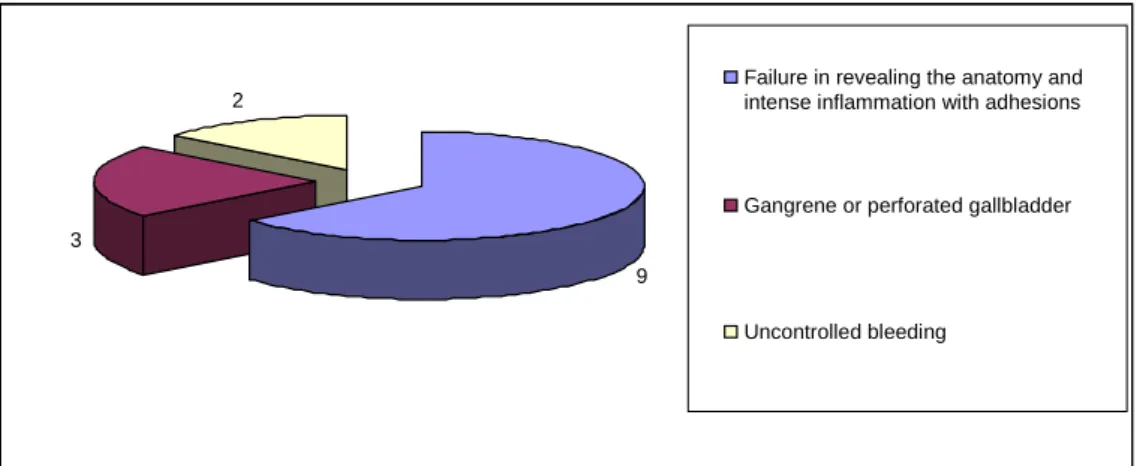
Transition to open was required for 9 patients (63%) due to failure in revealing the anatomy
and intense inflammation with adhesions, for 3 patients (22%) with gangrene or perforated
gallbladder, and for 2 patients (15%) with uncontrolled bleeding (Figure 1). Patients over 65
years old were determined to be independently associated with a high conversion rate of
492
Figure 1. Causes of Transition to Open Surgery (n = 14)
The average duration of the operations was 57.5 minutes. 64 patients (60%) were
aspirated before gallbladder cholecystectomy. The drains were placed to 57 (54%) patients.
The numbers of the patients with gallbladder perforation, empyema of the gallbladder, and
pericholecystic fluid were 9 (8%), 19 (18%), and 3 (3%) respectively.
Complications developed in 11 patients (10%) (Table 2). There were no important
gallbladder injury and mortality. 3 patients (27%) had a fever and abdominal fluid collection.
All of them were treated with antibiotics. 4 patients (36%) developed a wound infection and
they responded to conservative treatment. 2 patients (18%) had a postoperative bowel
obstruction and recovered with conservative treatment. 2 patients (18%) had cystic duct stump
leak. They were treated by using nasobiliary drainage.
Table 3. Postoperative Complications (n = 11)
Wound Site Infection 4 36
Fever and Intra-abdominal Fluid 3 27
Biliary leak 2 18
Ileus 2 18
9 3
2
Failure in revealing the anatomy and intense inflammation with adhesions
Gangrene or perforated gallbladder
493 DISCUSSION
In the early years of laparoscopic surgery, laparoscopic cholecystectomy has also been
considered as relatively contraindication in patients with acute cholecystitis (6). In the
literature, there are studies revealing a significant increase in operation duration and
hospitalization duration, the morbidity rate ranging between 3% and 30% after laparoscopic
cholecystectomy in patients with acute cholecystitis (7,8). The complication rate in our series
is (10%) which seems parallel to those in the literature.
There are studies in the literature reporting that laparoscopic cholecystectomy can be
performed safely by experienced surgeons in acute cholecystitis cases (9,10). However, there
is no doubt that the transition to open surgery in patients with acute cholecystitis is more
frequent than those with elective cholecystectomy. In a study, the rate of transition to open
surgery from early laparoscopic cholecystectomy for acute cholecystitis cases was reported to
be 10.3% (11). When seven different studies in the literature were examined, the rate of
transition to open surgery from early laparoscopic cholecystectomy in acute cholecystitis
cases was reported to be between 7% and 36%. In these seven studies, 69 patients (22%) from
a total of 316 patients underwent a transition to open surgery (12-18). The major reason for
the high rate of transition to open surgery is the adhesions due to inflammation around the
gallbladder and dissection hardening caused by that and the failure to reveal the anatomy
clearly. The bleeding and biliary tract injuries are the other common causes. The rate of
transition to open surgery in our series was recorded as 13% (14 cases) which is conforming
to the literature. In our study, failure in revealing the anatomy and having intense
inflammation with adhesions were determined to be the major reasons for the transition to
494
There is a common belief that a conservative treatment approach to cholecystitis will
increase the chance of successful laparoscopic cholecystectomy in the future. Since the rate of
transition to open surgery was not high in our study, it may not confirm this proposition.
The gallbladder having hydrops and edema are usually observed in the cases with
acute cholecystitis. We believe that some key points should be kept in mind while performing
laparoscopic surgery in acute cholecystitis cases. For example, gallbladder decompression
should be done early in order to determine the Calot triangle well during the operation. In our
study, the gallbladder decompression was required for 60% of the patients.
Early laparoscopic surgery offers definitive treatment at first admission and also
avoids recurrent symptoms that may develop afterwards. Moreover, the early surgical
intervention not only contributes to the patient in terms of shorter hospitalization period but
also provides significant economic benefit to the healthcare system. The waiting period for
elective cholecystectomy, after being discharged from the hospital ranged between 4 weeks
and 12 months. The recurrent gallstone complications, such as acute pancreatitis and clogging
at the patients whose surgical intervention is postponed cause increase in the overall health
and care costs (19.20.21).
In the current literature, the early laparoscopic treatment for acute cholecystitis (up to
72 hours after the onset of symptoms) has been considered to be among the recommended
treatments (22). We believe that laparoscopic cholecystectomy should be done early after the
onset of symptoms thus it will reduce the complications that will occur due to cholecystitis
and the duration of hospitalization will be shortened.
To conclude, the early cholecystectomy was not accepted as a routine for the acute
cholecystitis cases. There is no consensus chart, national or international policy or guidelines
495
effective, and associated with low incidence of complications when routine surgery is
performed by experienced surgeons.
REFERENCES
1. Cuschieri A, Dubois F, Mouiel J, et al. The European experience with laparoscopic cholecystectomy. Am J Surg 1991; 161:385–7
2. Dubois F, Berthelot G, Levard H. Laparoscopic cholecystectomy: historic perspective and personal experience. Surg Laparosc Endosc 1991; 1:52–7.
3. Tekin A, Küçükkartallar T, Belviranlı M et al. Early laparoscopic cholecystectomy for acute
cholecystitis, Turkish Journal of Trauma and Emergency Surgery 009; 15(1):62-6
4. Azra A Ghani, Waqar Alam Jan, Aminul Haq. Acute cholecystitis: Immediate versus interval cholecystectomy J Postgrad Med Inst 2005;19(2);192–5
5. Saeed A, Nawaz M, Noreen V, Ahmad S. Early cholecystectomy ın acute cholecystıtıs:
experıence at dhq hospıtal abbottabad. J Ayub Med Coll Abbottabad 2010;22(3): 182-4
6. Kolla SB, Aggarwal S, Kumar A, Kumar R, Chumber S, Parshad R, Seenu V. Early Versus delayed laparoscopic cholecystectomy for acute cholecystitis. Surg Endosc 2004; 18:1323–1327 7. Belloso, R.M., Ayala, L.A., Souchon, E.A., Henriquez, L.J., Leon- Ponte, O. Colecistitis aguda:
es un procedimiento laparoscopico? G.E.N 1993;47:226.
8. Kum, C.K., Goh, P.M.Y., Isaac, J.R., Tekant, Y., Ngoi, S.S.: Laparoscopic cholecystectomy for acute cholecystitis. Br. J. Surg. 1994; 81:1651.
9. Prakash K, Jacob G, Lekha V, Venugopal A, Venugopal B, Ramesh H. Laparoscopic cholecystectomy in acute cholecystitis. Surg Endosc 2002;16:180-3.
10. Glavic Z, Begic L, Simlesa D, Rukavina A. Treatment of acute cholecystitis. A comparison of open vs laparoscopic cholecystectomy. Surg Endosc 2001;15:398-401.
11. Kanat BH, Yur M, Girgin M, Erol F, Bozan MB, Emir S, Yazar MF, Özkan Z. The Results of Early Cholecystectomy in Acute Cholecystitis. KocaeliMJ. 2013; 2(1): 21-24
12. Ambe PC, Weber SA, Christ H, Wassenberg D: Primary cholecystectomy is feasible in elderly patients with acute cholecystitis. Aging Clin Exp Res 2015;27:921-926.
13. Fuks D, Duhaut P, Mauvais F, Pocard M, Haccart V, Paquet JC, et al: A retrospective comparison of older and younger adults undergoing early laparoscopic cholecystectomy for mild to moderate calculous cholecystitis. J Am Geriatr Soc 2015;63:1010-1016.
14. Fukami Y, Kurumiya Y, Mizuno K, Sekoguchi E, Kobayashi S: Cholecystectomy in octogenarians: be careful. Updates Surg 2014;66:265-268.
15. Nikfarjam M, Yeo D, Perini M, Fink MA, Muralidharan V, Starkey G, et al: Outcomes of cholecystectomy for treatment of acute cholecystitis in octogenarians. ANZ J Surg 2014;84:943-948.
16. Fujikawa T, Tada S, Abe T, Yoshimoto Y, Maekawa H, Shimoike N, et al: Is early laparoscopic cholecystectomy feasible for acute cholecystitis in the elderly? J Gastroenterol Hepatol 2012;1:247-251.