KADİR HAS UNIVERSITY
GRADUATE SCHOOL OF SOCIAL SCIENCES BUSINESS ADMINISTRATION DISCIPLINE AREA
THE CONTRIBUTION OF ENTREPRENEURIAL
LEARNING, RESILIENCE AND RECOVERY TO
VENTURE SUCCESS AFTER FAILURES: TWO CASE
STUDY EXAMPLES
HEERA MEHWISH SUKHERA
SUPERVISOR: ASSOC. PROF. CEYDA EYİUSTA MASTER’S THESIS
1
THE CONTRIBUTION OF ENTREPRENEURIAL
LEARNING, RESILIENCE AND RECOVERY TO
VENTURE SUCCESS AFTER FAILURES: TWO CASE
STUDY EXAMPLES
HEERA MEHWISH SUKHERA
SUPERVISOR: DOÇ.DR. CEYDA EYIUSTA
MASTER’S THESIS
Submitted to the Graduate School of Social Sciences of Kadir Has University in partial fulfillment of the requirements for the degree of Master’s in the Discipline Area of Business Administration under the Program of Business Administration
4
ABSTRACT
In the past, studies on entrepreneurship are all exploring the successful journey of entrepreneurs. However, research on entrepreneurial failure to create a more comprehensive meaning of entrepreneurs’ journey has begun recently. Despite these attempts, failure remains a fairly under investigated area and thus it is vital to comprehend the experience of failure in entrepreneurial context. The intention of this thesis is to provide a comprehensive and critical scrutiny of the research on entrepreneurial failure and develop an organized framework of the entrepreneurial failure phenomenon. This thesis analyzes the failure from the standpoint of entrepreneurs who have the experience of failure/abandonment in their venture. Using the philosophical position of explanatory approach, two case studies were used as the research method. Failure stories of two entrepreneurs were analyzed and subsequently, theoretical themes derived from the findings were integrated into a theoretical model. Findings showed that the failure may affect an entrepreneur both emotionally and psychologically. In this context, resilience plays a crucial role in re-entry to business and future venture success. Additionally, results revealed that the entrepreneurs are becoming more self-aware after the failures and they come up with different learning outcomes, which facilitate the re-emergence and recovery. This study ultimately demonstrates how failure, despite being an unwanted experience, can be exploited as a foundation to bounce into a substantial venture creation by tapping into one’s values and beliefs, inter-personal, intra-personal and contextual factors and resources within the social environment.
Keywords: entrepreneurship, entrepreneurial failure, entrepreneurial learning, resilience, recovery, new venture success
5
ÖZET
Geçmişte, girişimciliğe yönelik çalışmalar, girişimcilerin başarılı bir şekilde gerçekleştirdiği yolculuk üzerine odaklanmışlardır. Bununla birlikte, girişimcilik yolculuğunda girişim başarızılığının da incelemeye alınması yakın zamanda göndeme gelmiştir. Yakın zamandaki çabalara rağmen, başarısızlık girişimcilik yazınında oldukça az araştırılmıştır. Bu tezin amacı, girişim başarısızlığı üzerine kapsamlı ve eleştirel bir inceleme yapmak ve bu konuyla ilgili kapsamlı bir çerçeve geliştirmek ve sunmaktır. Çalışma, başarısızlığı kariyerlerinde bunu deneyimlemiş girişimcilerin bakış açısıyla ele almaktadır. Tez kapsamında, açıklayıcı bir araştırma tasarımıyla, iki faklı vaka analizi yapılmış; iki faklı girişimcilerin başrısızlık ve takip eden başarı hikayeleri analiz edilmiştir. Sonuçlardan elde edilen temalar kurulan modele entegre edilmiştir. Bulgular başarısızlığın girişimcileri hem duygusal hem de psikolojik olarak etkileyebileceğini göstermiştir. Bu bağlamda, dayanıklılık yeni bir girişim kurma ve başarı olma noktasında önemli bir etken olarak ortaya çıkmıştır. Bununla birlikte, bulgular girişimcilerin başarısızlık sonucunda kendileriyle ilgili farkındalıklarının arttığını ve başarısızlıktan farklı dersler çıkardıklarını göstermiştir. Sonuç olarak bu çalışma, istenmeyen bir durum olmasına karşın başarısızlığın kişinin değer ve inançları, bireylerarası ilişkileri, çevresel faktörler ve sosyal çevredeki kaynaklar dahilinde, bir sonraki girişimde başarılı olma anlamında temel bir çıkış noktası olabileceğini göstermektedir.
Anahtar kelimeler: girişimcilik, girişimcilik başarısızlığı, girişimcilikte öğrenme, dayanıklılık, iyileşme, yeni girişim başarısı
6
ACKNOWLEDGMENTS
Many people contributed boundlessly to this achievement. To begin with, I owe my debt of gratitude to my beloved parents, Mohammad Irshad Sukhera and Zarina Irshad, their love, faith, and never-ending support has inspired me to reach higher than I believed was possible. Your sacrifice has made this all possible. I love you
Deepest gratitude towards my dearest siblings Khadija, Elisha and Laraib for providing love and support whenever I needed it, even being far away from you, you are my guiding light every day. You have taught me to never give up on my dreams. I love you
I would like to extend sincerest gratitude and appreciation to my advisor and mentor, Dr. Ceyda Maden Eyiusta for all her support and time. Your guidance has meant the world to me. Whether you realized it or not, you inspired me in many ways. I thank you for sharing your knowledge with me. You have made my experience nothing short of wonderful. You have been the perfect advisor for me, laid-back but always made sure I had my questions answered. Thank you for your many dutiful readings of my manuscript and valuable suggestions for improvement. Thank you, Dr. Ceyda.
Special thanks to all my professors your teaching and guidance will never be forgotten. Thank you to the Kadir Has University, for believing in me.
Thank you to all my friends for making the university life a little more fun and filled with beautiful memories. You guys have been the best support to me and always kept me smiling, even when I was exhausted, overwhelmed, and ready to throw in the towel. Your positive attitude was contagious! Thank you for always being there for me and offering suggestions and support when it was most needed.
7 CONTENTS ABSTRACT ... 4 ÖZET ... 5 ACKNOWLEDGMENTS ... 6 INTRODUCTION ... 10109
CHAPTER ONE: LITERATURE REVIEW ... 121211
1. ENTREPRENEURSHIP ... 12
1.1 DEFINITION OF ENTREPRENEURSHIP ... 12
1.2 WHO IS AN ENTREPRENEUR? ... 161615
1.3 ENTERPRENEURS AND THEIR CHARACTERISTICS ... 20
CHAPTER TWO: ENTREPRENEURSHIP FAILURE: DEFINITON, CONCEPTUALIZATION, CAUSES AND ITS OUTCOMES ... 242423
2.1 DEFINITION OF ENTREPRENEURIAL FAILURE ... 24
2.2 CONCEPTUALIZATION OF ENTREPRENEURIAL FAILURE ... 26
2.3 ORIGINS OF ENTREPRENEURIAL FAILURE ... 28
2.4 OUTCOMES OF ENTREPRENEURIAL FAILURE ... 30
CHAPTER THREE: ENTREPRENEURIAL RECOVERY, LEARNING AND RESILIENCE AFTER FAILURE ... 34
3.1 ENTREPRENEURIAL RECOVERY ... 34
3.2 ENTREPRENEURIAL LEARNING ... 34
3.3 ENTREPRENEURIAL RESILIENCE ... 40
3.4 ATTRIBUTES OF ENTREPRENEURIAL RESILIENCE AND THEIR IMPACTS ON ENTREPRENEURIAL PERFORMANCE AFTER FAILURE ... 41
3.4.1 INTERPERSONAL FACTORS ... 42
3.4.2 INTRAPERSONAL FACTORS ... 44
3.4.3 CONTEXTUAL FACTORS ... 46
3.4.4 THE BALANCING ACT ... 48
CHAPTER FOUR: RESEARCH METHODOLOGY ... 49
4.1 METHOD OF THE STUDY ... 49
4.2 DATA COLLECTION PROCESS ... 50
4.2.1 CASE STUDIES ... 50
4.2.1.1 CASE STUDY A ... 51
4.2.1.2 CASE STUDY B ... 58
4.3 CODING AND ANALYSIS OF DATA ... 67
8
CHAPTER SIX: DISCUSSION AND RECOMMENDATIONS ... 88
6.1 DISCUSSION ... 88
6.3 MAJOR CONTRIBUTIONS ... 91
REFERENCES ... 93
9
LIST OF TABLES AND FIGURES
Table 1 Definition of entrepreneurship ... 13
Table 2 Determinants of successful entrepreneurship in the view of classical authors .. 14
Table 3 Definitions of the entrepreneur ... 18
Table 4 Key contributions to understanding recovery and learning from failure ... 35
Table 5 General external and internal aspects of resilience ... 39
Table 6 Intra-personal aspects affecting entrepreneurial resilience ... 42
Table 7 Interpersonal aspects affecting entrepreneurial resilience ... 44
Table 8 Contextual aspects affecting entrepreneurial resilience ... 46
Table 9 Overview of the entrepreneur’s profiles and the business created ... 65
Figure 1 Characteristics of the enterpreneur ... 16
Figure 2 Integrated model of entrepreneurial resilience ... 47
Figure 3 Structure of data after coding ... 67
Figure 4 Process of of re-entry to successful entrepreneurial venture creation (entrepreneurial experience of venture creation) ... 69
10
INTRODUCTION
Entrepreneurs are naturally predisposed to failure. Twenty-four percent of all entrepreneurial startup ventures tend to fail within the first two years and the sixty-three percent fail within the first six years (Timmons & Spinelli, 2006). Do we really identify the causes of failure, learning outcomes out of failure and how might this catastrophe be converted into upcoming entrepreneurial success? How does entrepreneur’s respond to failure as they establish subsequent ventures? These are the questions for which we don’t have enough information. Regrettably, past studies show a greater emphasis on entrepreneurial success than on failure in startup ventures (Shepherd, 2003). Moreover, the main emphasis of studies, which have studied failure, understood causes of failure (Abdullah, Deen, Saban, & Abdurahman, 2009; Zacharakis, Meyer & DeCastro, 1999). As Minniti and Bygrave (2001) put it, entrepreneurial failure is undeniably a vital area of investigation, and scrutinization of the reasons of business failure can improve the probability of success in the subsequent ventures.
Failure might cause stress, trauma, and pain for the entrepreneurs as it may cost them to lose their social identity. Some entrepreneurs can be stigmatized as a result of failure, for some it can result in sadness and feeling of loss and denial (McGrath, 1999; Shepherd, 2003; Coelho & McClure, 2005; Politis & Gabrielsson, 2009; Smith & McElwee, 2011). The mishandling of failure for entrepreneurs can cost them financial loss and, psychological wellbeing (Coelho & McClure, 2005; Shepherd, Wiklund & Haynie, 2009). Nevertheless, in spite of the negative outcomes, failure cans also extant incredible learning prospects for the entrepreneurs (Cope, 2005; Cope, 2011). It can, for example, help them develop valuable skills such as being resilient in the face of challenges (Shepherd, 2003). It can influence an entrepreneur’s enthusiasm and motivation to reenter (Cope, 2011; Singh, 2007).
Undeniably, many entrepreneurs who experience both failure and success become “serial entrepreneurs” (Wright, Robbie, & Ennew, 1997). Serial entrepreneur is the term to define those who, after spending a certain amount of time in a start-up, move on to another business, or start multiple businesses.
This study is about entrepreneurial failure and recovery. The main purpose of this research is to comprehend the concept of entrepreneurial failure from the viewpoint of
11 experienced entrepreneurs whose ventures got failed and who subsequently start a new venture. The second, but correspondingly a vital, aim is to develop a conceptual model focusing on the factors, which influence entrepreneurs’ “recovery” process and lead them to establish a subsequent successful business startup.
The research questions for this research can be listed as:
1) How do entrepreneurs perceive the causes of their failed ventures?
2) What are the learning outcomes for the entrepreneurs out of their failed
ventures?
3) What factors drive entrepreneurs to become resilient when they experience a
venture failure?
4) What factors impact entrepreneurs’ ability to learn, persist and attain a
12
CHAPTER ONE: LITERATURE REVIEW
1. ENTREPRENEURSHIP
1.1 DEFINITION OF ENTREPRENEURSHIP
According to Business dictionary, entrepreneurship is the capacity and willingness to develop, establish and manage a business venture along with any of its risks in order to make a profit. The most superficial example of entrepreneurship is the starting of new businesses (Business Dictionary, 2018). Similarly, according to Cambridge dictionary, entrepreneurship is an expertise in starting new businesses, particularly when this contains seeing new opportunities (Cambridge Dictionary, 2008). Thus, Entrepreneurship is the state of being an entrepreneur, or the activities connected with being an entrepreneur.
The term "entrepreneurship" originates from the French term "entrepreneur". The term "entrepreneur" appears for the first time in the text written by Richard Cantillon in 1755 (Essai, 1755) entitled "Essai sur la Nature du Comerce en Général". The word is used for a person who purchases products at known prices and later resells them on the market at prices not known, bringing stability to the market system. Classical economic movement that followed Cantillon set the stage for the balance models that helps to approach to uncertainty in business and forecasting economy. So, according to Cantillon for an entrepreneur to be successful, she/he needs to be vigilant, cautious, and risk bearer.
Verin (1982) introduces the first traces of the semantic concept of entrepreneurship, which locates the historical origins of this term in the late 17th and early 18th centuries. There were two initial uses of the term: According to the first one, entrepreneur was a fighter who wants a conquest, the typical spirit of the Middle Ages Crusades and in the second, an entrepreneur was described as a person doing a civil engineering construction with an established design and Payment. In the modern sense of market economy, an entrepreneur is an individual who deliberately accepts financial risks to develop new projects and is considered as an economic agent assuming an innovative and active behavior. To this level, thanks to the noteworthy number of companies who give contribution to the evolution of the entrepreneurial environment and their great
13 consideration and acknowledgement to entrepreneurs; entrepreneurs have impact on the macroeconomic indicators.
In economists’ point of view, entrepreneurship would be the same with individual achievements in the business arena. But then again as the business has settled, the collective performance of the people within the group or company becomes life-threatening for its victory and success. Hence, entrepreneurship is vital for the continuance of the business (Panda, 2011). Around 1800s, the French economist named Jean Baptiste Say, was the person who literally invented the term entrepreneur. He described the entrepreneur “as a person who allocate resources from one person with a lower productivity to another with higher productivity to increase profit that results in creating value|”
Later, in the beginning of 20th century, the theories of entrepreneurship which relates to the term innovation dates back to the work of Joseph Alois Schumpeter. Schumpeter was one of the first to overthrow the static neoclassical economic theories and foresaw creative destruction as the crucial factor of the growth of innovation and economy (Schumpeter, 1951). According to Schumpeter, entrepreneurs such as Alexander Graham Bell and Thomas Edison were visionaries with specific characteristics who could build new industries with Schumpeterian profits. Schumpeter, however, reconsidered the major role of entrepreneurs in his later works resulting in an interesting discussion between Schumpeter as an advocate of big monopolies and Arrow, as an advocate of perfect competition and thus more entrepreneurship as drivers of innovation (Schumpeter, 1943; Arrow, 1962). This discussion has led to a number of scholarly works to investigate entrepreneurship and most of the scholars have sought a magic pill to identify and inspire entrepreneurs. Constructed on the early theories of Schumpeter, some scholars have focused on the individual characteristics of the successful entrepreneurs. On the other hand, there were concerns about whether entrepreneurial ‘traits’ or ‘founding processes’ need to be studied as the defining entrepreneurial characteristics. According to the trait researchers, entrepreneurs were motivated out of opportunity related to their specific background. For Max Weber (1898), as quoted by Swedberg (1990, p.57) entrepreneurship refers to “taking over and organization of some part of an economy, in which people’s needs are satisfied through exchange, for the sake of making a profit and at one’s own economic risk”. Moreover, Weber also added
14 that entrepreneurs were the main check and balance upon the power of bureaucrats in society. Since then the word entrepreneurship is the combination of investor and entrepreneur because of the expectations and difference action they are taking.
One of many complications in outlining entrepreneurship is that it entails a relation between two spectacles: there are rewarding opportunities on one hand and there are private entrepreneurs on the other (Page, 2009). According to Israel Kirzner, who is an Austrian economist, entrepreneurship is a concept as a prospect to identify profit opportunities (Klein, 2008). Based on the discussions above, the following table provides different definitions of entrepreneurship which have been widely used in the literature.
TABLE 1 ENTREPRENEURSHIP DEFINITIONS
Author Definitions
Cole (1968) “Entrepreneurship is an activity dedicated to initiation, maintenance and development of a profit-oriented business”
Drucker (1985) “Entrepreneurship is an innovation act who presupposes the endowment of the exciting resources with the capacity of producing wealth”
Gartner (1985) “Entrepreneurship is the creation of new organizations” Hisrich and
Peters (1989)
“Entrepreneurship is the process of creating something different, with value, by allotting the necessary time and effort, presupposing the taking of financial, social and physical risks and obtaining monetary rewards and personal satisfaction” Stevenson et al.
(1989)
“Entrepreneurship is following an opportunity irrespective of the existing resources” Kaish and Gilad
(1991)
“Entrepreneurship is first of all a discovery process and secondly is the process of acting on an opportunity of lack of balance”
Herron and Robinson (1993)
“Entrepreneurship is a set of behaviors which initiate and manage the re-allotment of economic resources and whose purpose is the creation of value by these means” Source: Misra and Kumar (2000)
Previous definitions reveal that entrepreneurship is very tough to define as it is a multi-dimensional term. This is the reason that makes its really complicate to calculate different entrepreneurial activities, in diverse sectors as technology, trade, demand curve and mechanism of discovery etc. Similarly complicate to present new concept of activities that are of entrepreneurial nature.
According to Shane & Venkataraman (2000) in the early 1990s, entrepreneurship has been encouraged as a vital factor for the growth of economy. In both academy and practice, the most noteworthy and lasting finding was that entrepreneurship is accomplished by “enterprising individuals”. Similarly, in this scenario an entrepreneur
15 is a heroic symbol (e.g. Hatch, 2005), even a protector and savior of the economic growth and survival (Sørensen, 2008). Major determinants of how different authors define successful entrepreneurship are compiled by Praag (1999) as seen in Table 2. As such, risk bearing, competency in creativity, managerial activities and development are the significant features of entrepreneurship.
Finally, according to Osberg (2007), entrepreneurship has three foundations: Opportunity creation or seizing that opportunity, Opportunity seeking ability, personal qualities and abilities to use these opportunities and capabilities to manage and get benefit from these opportunities thus, making a business or getting capital out of it. Additionally, sometimes entrepreneurs create these opportunities themselves by following the need or solving certain problem in the market. Thus, their actions create certain results like more opportunities which did not exist before.
TABLE 2 FEATURES OF SUCCESSFUL ENTREPRENEURSHIP ACCORDING TO CLASSICAL AUTHORS
Source: Adapted from Van Praag (1999)
Author Entrepreneur(starting) Entrepreneur(successful) To be successful Cantillon
(1755)
Attentiveness and careful
Risk bearing Say (1832) Sufficient reputation to
obtain capital
Judgment, perseverance knowledge of world, business and occupation
To support risk Marshall
(1920)
youngsters risk taking actions
Intelligence, general ability (dependent on family background and education), knowledge of trade, bear the risk, leadership, to hold capital
Schumpeter (1951)
The desire to start with more determination and energy if there are less alternatives for societal divergence
Leadership
Knight (1921) Ability to raise capital, desire/motivation is important
Ability to cope with uncertainty, trust in yourself, vision and intellectual capacity
Luck
Kirzner (1985)
Vigilance Creativity and leadership to exploit the profit opportunities
16
1.2 WHO IS AN ENTREPRENEUR?
By definition, an entrepreneur is a person, an innovator, and/or a decision maker who finds out an opportunity or a need and creates a business to fill it. As clarified by Drucker (1985), the French term meaning “between” and “to take “were the words that developed “entrepreneur”. With this paraphrase in mind, the person one who take risks for success by introducing a business between the supplier and the customer in order to take advantage of on new endeavors. Risk has been acknowledged as a distinctive attribute of an entrepreneur.
Since the days of Aristotle, entrepreneurs have been a cause of debate. Historians have been studying what entrepreneurship is for more than 200 years and all over history, the description of an entrepreneur has altered to match according to time period. As change as the economy fluctuates and changes (Praag, 1999), economists, investigators, and scientists identically have altered the definition of an entrepreneur.
By means of description, an entrepreneur is the “one who starts a business or other venture that promises economic gain but that also entails risks” (The New Dictionary of Cultural Literacy, 2005). Richardson (1994) contemplates an innovator as a synonym for an entrepreneur. Similarly, according to U.S. Small Business Administration an entrepreneur is the one who “organizes and manages a business, assuming the risk for the sake of profit. An entrepreneur sees an opportunity, plans, starts the business, manages the business and receives the profits” (Entrepreneur post, 2015).
The term “entrepreneur” is frequently used in the context of economy, by media or in academia, and also by regular people in their daily communications (Buame, 1996). In 1800s, a French economist and plenty of other writers pay specific attention to the both entrepreneurs and entrepreneurship together with different features they possess and specifically which part of economic sector they belong to. Although the term entrepreneur primarily was applied to the civil engineers, contractors and later on architects were also called as entrepreneurs by the government of France. Subsequently, after the 1700s, the French economists, Cantillon (1986) were the first handler of the notion of ‘entrepreneur’ in technical terms. Cantillon (1986) defined the entrepreneur as the agent who manufactures a service or a product by organizing a mechanism of
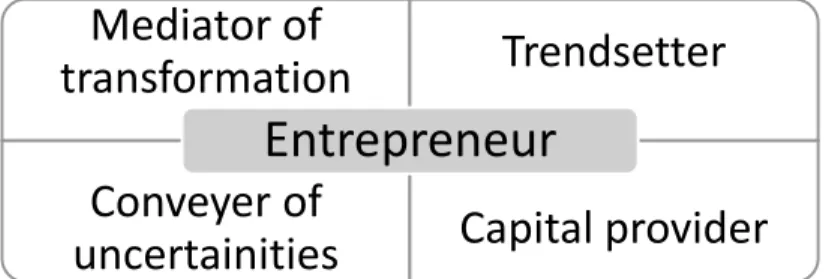
17 production. Similarly according to Schumpeter (1951) an entrepreneur is the person who is responsible for collecting and joining all features of production to produce high quality products, and similarly a person who is a competent organizer of resources in quest of opportunity and prospect for adding value, might create the capital and turn out to be successful and then, possibly will be called as an entrepreneur. An entrepreneur might be also described as a bearer of uncertainty, an economic function, as provider of resources or as an innovator as represented in Figure 1.
Figure 1 Characteristics of the entrepreneur
Source: Kaslsson, Friis, and Paulsson (2004)
Few scholars have labeled the person who is keen to accept high level of financial, professional and personal risks to chase a prospect as an entrepreneur; but the rising indication displays that entrepreneurs are more compulsive entrepreneurship specialists than simply speculators and gamblers (Schumpeter, 1951). This proposes that an entrepreneur is not only a person that owns a small business (Sexton and Bowman-Upton, 1990). “Risk bearing” impression exists in many present theories on entrepreneurship; however, the philosophy of bearing risk alone is not satisfactory enough to explain why some people turn out to be entrepreneurs while others do not. For example, Marshall (1920) proposed that unusual skills are essential to contribute to entrepreneurial activities while Kirzner (1985) stated that the compulsory trait of an entrepreneur is the capacity to identify opportunities and prospects.
Based on these opinions, combination of two different ideas is important: the distribution of information presented to the potential entrepreneurs, and how environmental issues change the rate of creating entrepreneurs in one society (Schumpeter, 1951). Additionally, Gartner (1985) described that the art of establishing and combining available resources of production into goods and services of a higher social value stretches to an extensive series of domains other than economic means of production. Vast amount of theories has proposed that entrepreneurs progress from the
Mediator of
transformation
Trendsetter
Conveyer of
uncertainities
Capital provider
18 population in which there are diverse entrepreneurial chances. Specifically, entrepreneurs, and entrepreneurial behavior, can be initiated in all systems of professions for instance research, education, science, political and medicinal fields and social work. Therefore, other compulsory characteristics may exist that may help to clarify why some people become entrepreneurs while some don’t.
Entrepreneurs can be seen as people of business, who built (start and develop), produce and accomplish a venture, take risk, put in their hard work, finances and time in it. The leadership and self-awareness qualities like being creative and an innovator are the new features of the entrepreneur, in addition to the risk bearing feature (Biswas, 2000). The entrepreneur as the manager of big corporations, has to manage their company when facing challenges like new mergers, new products creation and even when pivoting their companies, while negotiating all these challenges the authority given to them is increasing in a way that when they have proficiency of multi-actions, when they have access or control over the data and info and when they represent huge cost to substitute them if they left the company (Arthurs, 2009).
The entrepreneurs see the change as standard and vigorous part of their business. Generally, they do not create these variations themselves. But this can be classified as an entrepreneur or the entrepreneurial spirit - because the entrepreneurs are always a change seeker, is receptive to it and takes advantage of it as a prospect. Thus, entrepreneur is not likely to act as a mediator of change but a person who recognizes and seize risks and challenges and turning them into business projections.
As Ronstadt (1984) stated, that entrepreneurship is the self-motivated process of producing capital. This capital is formed by the persons who take risks in terms of impartiality, stability, time, and assurance in contrast they offer value for some services and products. The value in these services and product must be added by entrepreneurs contributed the essential resources and capabilities. Lazear (2005) stated that entrepreneur is the people who are capable to manage insufficiency of resource. Panda (2001) describes an entrepreneur as a person that takes a decision by seizing an opportunity in society, sets up a business by buying necessary raw material, produce the product/service go on board with all administrative processes of revolution,
19 investigation and coordination of all activities related to that particular product/ service. Panda (2011) states that the entrepreneur:
i) seizes and creates new prospects for venture creation;
ii) Works under challenges, takes risks, presents new products to the market, uses the allocated resources and chooses the purpose and meaning of the product/service.
iii) Is self-aware of their own abilities, takes on competition and manages his/her entrepreneurial activities.
In addition to the various definitions presented above, there are also other popular definitions for the term “entrepreneur” as seen in Table 3.
TABLE 3 DESCRIPTIONS OF THE ENTREPRENEUR
Author Definitions
Schumpeter (1934) “An entrepreneur is a person making new combinations causing discontinuity. The realization of new combinations may include a new product or a quality of a product, a new method of production, finding a new source of raw materials or reorganization of the industry”
Hoselitz (1960) “An entrepreneur is a person who buys at a price that certain and sells at a price that is uncertain”
Leibenstein (1968) “An entrepreneur is a person who owns all the necessary resources to produce and launch on the market a product which responds to a market deficiency”
Kirzner (1985) “An entrepreneur is a person who perceived the existence of profit opportunities and initiated some actions to complete the unsatisfactory current needs”
Bygrave and Hofer (1991)
“An Entrepreneur is a person who perceives an opportunity and creates an organization to follow it”
Source: Adapted from Misra and Kumar (2000)
In general, entrepreneurs are continuously watching their actions and then consequences of these actions, if changes are required, they made it and then act again thus this process eventually produce and create new opportunities’, it can be said the entrepreneurs are the identifiers and creators of opportunities (Henry, 2010). As Lambing (2000) described, entrepreneurs who build or create their business on new product by innovating it with a new perception are the classical type of entrepreneur on the other hand some entrepreneur build or buy their business on an existing product in existing market.
In the light of above discussions, it can be said that an entrepreneur is someone who starts a side hustle or a new venture or take advantage of a new opportunity that can
20 sooner or later create a full-time, justifiable business with full time workforce. Being an entrepreneur means not just owning a business or job creator. The world’s most powerful modernizers are entrepreneurs for example from Bill Gates and Steve Jobs who made Pc a part of every home to Elon Musk sending people to Mars, entrepreneurs visualize the world in a different way. But the existing definitions in the literature hardly ever highlight the massive influence the entrepreneurs have on the world. Entrepreneurs perceive opportunities and respond to them whereas a regular person perceives them as irritating problems and complications.
1.3 ENTERPRENEURS AND THEIR CHARACTERISTICS
In the United States, entrepreneurship is viewed as significance big source of employment like at social level eighty percent of the jobs come from entrepreneurship field. (Birch, 2000; Birley, 1986). Schumpeter (1951) described entrepreneurship as a big source for invention and progress in technology field. As for individuals, it is the most significance job option because it can give enough sources to fulfill their career dreams, provide freedom from authority and financial independence, and furnish goals to do something big and giving back to society (Evan Douglas, 2000). Although the main interesting element for all entrepreneurs is to create a successful business, most of the entrepreneurs fail because of the uncertainty of the startups (Knight, 1921; Ucbasaran, 2013).
The integral part of the entrepreneurial journey is doubt and uncertainty as consequences of entrepreneurship are not known so some may fail and others may be successful. However, most studies on the concept of entrepreneurial process especially in past are mainly interested in entrepreneurs, theirs ventures and the growth element. Due to such arguments, the research on entrepreneurship failures is increasing and researchers are using different tactics such as academic and theoretic to understand this phenomenon. Nonetheless, to understand and examine and entrepreneurship failure, it is imperative to understand the major characteristics of the entrepreneurs first.
Personal characteristics of entrepreneurs and their relation to entrepreneurial success have been widely researched so far. Olson (2000) studied aforementioned relationship by focusing on the traits of risk-taking or risk tolerance, control, and ambition and
21 found that these traits are correlated with the venture success. Timmons (1989) described entrepreneurship as the act of innovation and creativity because the entrepreneurs are creating something out of nothing they are continuously innovating, learning and taking risks, basically they are opportunity seekers. This idea of entrepreneurs needs enthusiasm, devotion and leadership abilities like taking a risk head on, accepting challenges in the face of trials. However according to some intellectual’s entrepreneurship quality is by birth it’s not something you can learn, while for others it’s a lifelong learning journey. According to Deamer (2004) only personal qualities and abilities does not make one an entrepreneur, however for becoming an entrepreneur one has to own some specific characteristics because first and foremost they have to be fully committed to what they are building, and having a passion and hardworking capabilities like working for 40 hours in a week, they have to have a vision and goals for success. Even if the entrepreneur failed in his/her past ventures, resilience is the key that will make goals attainable and thus result in success. In addition, various scholars have discussed that following characteristics or traits may also have an impact on entrepreneurial success.
Risk taking. The first person who used the concept of “entrepreneur” was J.S Mill
according to Brockhaus (1987, p. 1) “when defining entrepreneur and his
characteristics he concluded risk bearing is the main characteristics of an entrepreneur in addition with management , command, control and vision for success”. Entrepreneurs
are acknowledged to be risk takers because they are putting their resources, time and energy into their business without a guarantee. Opportunity seeking, risk bearing and ambition to open a new venture and to create value is the amalgamation of entrepreneurial process.
Ambition. Determination, self-awareness, setting goal, having a vision and getting in a
competition are the features associated with the ambition aspect of entrepreneurs. Individuals with these features and traits are more conscious and driven with ambition to reach their goals (Olson, 2000). Determination, resilience and personal ingenuity and commitment towards one’s goals are related to ambition and there are the traits of entrepreneurs who are successful (Administration, 2015).
22
Self-efficacy. Self-awareness and to believe in one’s ability to succeed is known as
self-efficacy. It’s the awareness of own abilities and personal insights to achieve the goals and the vision. As Krueger (1998) states that one can increase determination and ambition due to self-efficacy and it can result in future successful venture creation. For entrepreneur’s self-efficacy is the achievement of business goals. For instance, a famous well-known clothing brand Tommy Hilfiger, started his business with the capital of just $150.00. Hilfiger’s success is the result of his capabilities, ambition and increased determination with skills (Gehlhar, 2005). Consistent with Krueger’s definition, Tommy Hilfiger’s self-efficacy among other personal skills is the reason of his success. Due to his high-level self-awareness he has bested so many other designers in his field.
Discipline. During the turmoil in entrepreneurial journey, discipline is the most
effective trait entrepreneurs possess as it keeps them determined in the face of challenges. So according to Finkekstein (2006), discipline is all about following rules, regulation and not altering business plan and goals due to market fluctuation. Discipline also refers to following a plan that was original and focusing on goals, so that tracking growth and success can be measured. As entrepreneurs are acting on their own so it’s safe to say they have to stick with their decision because they will handle the consequences of their own decisions and for that motivation and discipline is the key. Other traits associated with discipline are compliance, values and work ethics, commitment and control, which are the personal traits of successful entrepreneurs.
Positive attitude. Right attitude and optimism are the key to any entrepreneur because
it’s what will get you through trials and challenges even failures. According to the U.S. Small Business Administration’s program office the study on successful entrepreneur shows that determination, ambition and being optimistic was one of the key traits. (Administration, 2015). Thus, it can be concluded that successful business is also associated with the attitude and determination of entrepreneur and the ability of an entrepreneur to be optimistic and to comprehend the internal system is the key for successful venture creation.
Locus of control. One’s inner control and the belief that they are in control of the
situation is said to refer as Locus of control. Entrepreneurs with high locus of control are more than willing to accept challenges and consequences of their own actions they
23 accept tasks connected with their business (Olson, 2000). Littunen (2000, pp. 298-300) observed that locus of control, ambition, determination, self-efficacy, good work ethics and leadership abilities are the key traits that motivate entrepreneurs to achieve their goals thus eventually resulting in success.
Gender. Commonly gender is said to be a factor affecting the success of venture. In
past, stereotypes of the society gave men the advantage of attaining and starting their own ventures. In contrast women were at disadvantage. Nonetheless in today’s world women have come so far. Regardless of these complications women still have difficulty to overcome gender discrimination. However, according to Merrett and Gruidl (2000) “female entrepreneurs are less successful than their male competitors” (Merrett & Gruidl, 2000, p. 426). In their study, women-owned businesses are still at large and succeeding. Recent research has also specified that business, work and employment are initially the pursuit of men. Nonetheless, now many women are pioneers in business world. Gender is not connected to the success of business. (Women’s Business Center, 2008).
24
CHAPTER TWO: ENTREPRENEURSHIP FAILURE: DEFINITON,
CONCEPTUALIZATION, CAUSES AND ITS OUTCOMES
In more recent times, researchers are keen to investigate the concept of entrepreneur and their actions in venture creation. They are more focused and more determined to find out the main reasons of success (Venkataraman, 1997; Hannafey, 2003) as well as the elements that bring success (Alstete, 2008). However, according to some scholars research on the notion of failure in entrepreneurial journey is not adequate enough and investigation on failure will contribute so much to the understanding of entrepreneurial process (McGrath, 1999; Singh, 2007; Shepherd, 2003).
2.1 DEFINITION OF ENTREPRENEURIAL FAILURE
To comprehend entrepreneurship, it is vital to investigate failure as it can help to understand and process what are the learning outcomes (Warren, 2004) and to why failure is considered critical in an entrepreneurial expertise creation. Thus, failure research will be of great assistance to policy makers, educational institutions and governmental institutes to comprehend the demands of individual who wants to be an entrepreneur and to serial and profile entrepreneurs who are facing challenges in this journey.
What is failure? As scholars define failure in many contexts like death, exit, end point, so it can be said that failure have diverse terminology (McGrath, 1999; Shepherd, 2003). Furthermore, according to Carter and Auken (2006, p. 494) in terms of clear definition of failure it can be defined in four ways: “insolvency, discontinuance, business winding up avoiding additional suffering, and failing to make a go of it.”
Cannon and Edmondson (2001, p. 162), theorize failure as “deviation from expected and desired results” in their group study, thus this definition means failure resulting from group level conflicts and problems of different situations and scale. Consequently, failure can be defined as small problems that leads to big conflicts thus resulting in big calamities and trials. In McGrath’s view if the venture does not fulfill the vision and main goals this contribute to failure (1999, p. 14). McGrath’s description of failure is more related to entrepreneurial context as compare to Canon and Edmondson. Both
25 descriptions have a similarity that failure is outcome of inability to meet the firm goals and objectives.
Bankruptcy is another way of describing failure (Zacharakis, 1999; Carter & Auken 2006) many defined failure as financial incapability. On contrary, according to Lussier and Halabi (2010, p. 366), when the business is not making any profit it’s a failed business. Similarly, Coelho and McClure (2005, p. 15) states that failing the market test run, making less profit than cost results in firm failure. In this definition, it can be said that to cease the business operation is also considered as a firm failure, bankruptcy is not the only reason.
Failure is “firm’s value falls below the opportunity cost of staying in business” (Cressy, 2006; p. 103). It can be said that failure is about value creation, if a firm cease to create value it means a failure. It can have two themes: one can be from entrepreneur’s point of view like a firm falls below entrepreneur’s standard. Thus, if there is no opportunity left to run this particular business, then it’s a failed business in entrepreneurs’ perception, he/she may leave, pivot or abandoned the firm. Likewise, this definition does not specify that the firm continuance in business or just the entrepreneur abandoned it to pursue another venture.
Failure in terms of “business discontinuance” is stated by Bruno (1992, p. 293). Many issues such as financial, environmental, regulations and lack of resources can result in business discontinuous. Correspondingly, Shepherd (2003) states that failure “occurs when a fall in revenues and/or a rise in expenses are of such a magnitude that the firm becomes insolvent and is unable to attract new debt or equity funding; consequently it cannot continue to operate under the current ownership and management” (p. 318). In Shepherd’s definition a major calamity and severe consequences are seen as the result of failure. Furthermore, Gelder (2007) describes failure as a ceasing business when a new improved opportunity arrived, which is better in terms of finances and employee’s point of view. Gelder (2007) also describes it as outcome of fewer resources and due to financial loss entrepreneurs are forced to shut down business. Similarly, according to Michael and Comb (2008) state: “failed outlets include those not renewed by the franchisor, closed for voluntary reasons, cancelled for quality control, and terminated for not paying fees. We specifically excluded reacquisitions by the franchisor because
26 reacquisitions do not imply franchisee failure” (p. 80). Most comprehensive definition is of Singh (2007) as it describes failure as“business discontinuance” and defining it as “failure involves not only economic factors such as bankruptcy and liquidation but also other factors such as intractable disputes and legal problems and personal issues of the entrepreneur”.
To conclude, studies shows that entrepreneurial failure can be individual and firm level failure. According to Sarasvathy, Menon and Kuechle (2013), there are two basics concepts of failure in individual level failure it is a possibility of just failure of an entrepreneur not the firm, because firm may continue to succeed in authority of another subsequent entrepreneur. In contrast a business may fail and entrepreneur may cease to create another venture. Thus, as defined by Sarasvathy (2004), firm failure does not mean entrepreneur failure.
Entrepreneurial failure can also occur in the context of exit for entrepreneurs such as retiring, moving investment to another business. Such extractions and exit are often described as failures (DeTienne, 2010). Henceforth, the entrepreneur leaving or abandoning a firm does not seem reasonable to classify as an entrepreneur failure. This concept will be further discussing in next section.
2.2 CONCEPTUALIZATION OF ENTREPRENEURIAL FAILURE
It is hard to separate an entrepreneur from the venture (Ucbasaran, 2013) as is the human capital of the entrepreneur is a key resource for the firm (Busenitz, 2001). Therefore, when conceptualizing failure, both firm and individual-level criteria need to be considered with an objective and subjective focus
Objective firm-level criteria. Shepherd and colleagues (Shepherd, Douglas and Shanley
, 2000; Shepherd, 2003; Wiklund, 2006) suggest that insolvency can be a significant criterion to understand failure. Precisely, they state that a failure takes place when there is expenditure is high and profits are low to such a level that the company turns out to be insolvent and incapable to attract new funding. Thus, if the firm is not flourishing under the same administration (Shepherd, 2003, p. 318).
27 Thus, in objective firm level criteria failure in context of lack of financial resources and bankruptcy imply failure (Shepherd, 2003; Shepherd, 2009; Shepherd and Haynie, 2011), so Failure here means that business cannot continue under the current administration. Therefore, to comprehend the notion of failure it is important to investigate entrepreneur’s personality, traits and characteristics (Shepherd and Haynie, 2011).
Subjective firm-level criteria. Is about entrepreneur’s perception of firm’s progress
(Gaskill, Van Auken & Manning, 1993; Headd, 2003). For instance, in the study by Headd (2003), to estimate the rate of failure when entrepreneurs were asked about their firms’ performance, it led to the classification of failure on basis of performance and other motives. The firms who were on verge of bankruptcy and liquidation can also be included in this criterion (Wennberg, 2010). Firms which have met their designated objectives but there is also a chance of poor and low performance. DeTienne (2014) suggests that sometimes in entrepreneur’s point of view firm main objectives are fulfilled and now it’s in vain to continue can also be the reason of ceasing the firm functions voluntarily. Some of these acts are considered positive and some can be negative, thus proving the approach of subjective-firm failure.
Objective individual-level criteria. When the business fails to fulfill entrepreneurs’
objectives or goals, this concept of failure is considered as objective individual level criteria. According to Gimeno’s (1997) threshold performance theory, “an entrepreneur’s human capital influences the minimum performance level he/she is keen to show. If the venture functions fall below the level set by entrepreneur, he/she exits the firm”. As every individual has a different threshold performance scale some might find a successful firm as a failure while for other it might be a successful venture creation. (Gimeno, Folta & Cooper, 1997). Ucbasaran (2013) proposes a similar definition of business failure: one has a lower level of threshold performance rate will exit the firm if it’s not fulfilling their basic criteria to remain (Ucbasaran, 2013).
Subjective individual-level criteria. According to Cope (2011) and Singh (2007) firm
28 For example, Singh (2007) discovered the outcome and consequences of failure and its impact on entrepreneurs. In Cope’s (2011) study, the cases for investigation were chosen on a criteria of learning outcomes of failure, impact of failure on their life, and personal wellbeing. These investigations focused on the impact of failure on entrepreneurs and how entrepreneurs recovered from these trials and what the learning outcome were. Thus, personal impact of failure was used to standardize the concept of entrepreneurial failure.
2.3 ORIGINS OF ENTREPRENEURIAL FAILURE
Abundant studies have so far focused on the origins of failure (Borchert & Cardozo, 2010), with the assumption that understanding what originate the venture failure can decrease the probability of failure in the future (Abdullah, 2009; Carter & Auken, 2006). Additionally, as business failures influence the national economy negatively as well as leading to negative consequences for individual entrepreneurs (Ahmad, 2009), it is important to identify their major causes. Existing studies highlight that there are various motives for venture failure and main causes will be summarized below:
Financial issues. Lack of capital for startups is the main financial motive and cause of
failure (Bruno, 1992). Lack of financial strategy, not pivoting fast enough can also be included in this criterion of failure cause. Furthermore, lack of knowledge before staring a venture, lack of information about rules and regulations of governmental bodies are also main causes, thus subsequent impact which lead entrepreneurs to ask help from, family friends and colleagues (Ekanem, 2007). Having a backup plan, savings or personal financial resource can make a lot of difference on the probability in ceasing the severe trauma and sometimes may help saving the business. Moreover, it can help the entrepreneur to focus on the main goals of company and how to save it from potential failure. Other financial issues can be increased debt, late debt payments, pressures from investors, low cash flow due to no profit as suggested by Abdullah (2009).So these issues are also the causes of failure. Also, poor financial goals, no financial strategy, not having enough financial resources and no plan for contingency also result in firm failure (Hogarty, 1993).
29
Employee- and customer-related issues. Second main cause of failure is the lack of
suitable employees or their incapability’s, lack of skills and necessary education (Abdullah, 2009). When entrepreneurs failed to manage their employees or have a difference of opinion, conflicts may occur (Ahmad, 2009). Customer related issues rise due to the lack of mutual trust or broken trust payment delays, when a firm does not have a customer strategy or lack of loyalty programs for customers (Abdullah, 2009).
Business planning issues. Third issue arises when a firm does not have a business plan
(Gelder J.-L. V.-P., 2007; Hogarty, 1993). Without a business plan, a firm failure rate is higher due to lack of research and strategy for how to run a business for long time or lack of business goals. Similarly, firms which have a business plan and goals are in less danger of failure (Hiemstra, Kooy and Frese , 2006). Last but not the least, lack of marketing research, no distribution and targeting strategy, failing to launch the product according to market standards also result in business failure (Ahmad, 2009).
Leadership issues. Leadership related problems are the fourth category of failure
reasons which are associated with the role and abilities of the owners and/or managers. Owner-manager’s inability to run a business, lack of experience or necessary skills also results in venture failure (Liao, 2008). Lack of adequate training (Michael, 2008), lack of management abilities and experience may result in venture failure. On the contrary, if the manager/owner has the plenty of required skills in managing one’s business, he/she can reduce the potential dangers of future failure (Swiercz and Lydon, 2002). Furthermore, an owner-manager’s overconfidence, egoistical approach and bias in firms’ function can also result in venture failure (Beaver, 2005). Not being able to create a balance between employees and incapability to challenge competition, or lack of risk bearing skills (Bruno, 1992; Cannon & Edmondson, 2001), mistaken judgments of investor and employees (Ahmad, 2009; Busenitz & Barney, 1997), bad relationships and lack of trust with investors and stakeholders (Ahmad, 2009; Bruno, 1992; Zacharakis, 1999) and falling into the traps of success (Bruno, 1992) are cited as the causes of firm failure.
Product- and service-related issue. If the services and products are not aligned with the
market quota it can be a cause of firm failure glitches in product manufacturing (Hogarty, 1993). In addition, issues related to products like wrong launching strategy,
30 faulty product, lack of marketing before launch, relying too much on one class of customers (Bruno, 1992), lack of distribution and marketing channels of the product/services (Hogarty, 1993), can also lead to business failure.
Environmental issues. Like bad economy, state of market, market collapse and more
issues related with environmental factors lead to ultimate failure (Zacharakis, 1999). The state of the overall economy, presence of market giants, negative cultural impact, the state of the industry, hence all aspects of environmental issues lead to venture failure (Abdullah, 2009).
Cognitive biases. An overconfident entrepreneur can impact firm growth hence result in
failure (Hayward, 2006). Biased judgments such as the wrong idea of success (Hogarth & Karelaia, 2011) may explain the wrong time entry and thus business failure. Hayward (2006) suggests that overconfidence of an entrepreneur is also a reason for venture failure and thus deny any chance of success. Recently, in an empirical study on overconfidence, Cardon (2011) found that in the origins of business failures, overconfidence is 5 % (Cardon, 2011). Yet, overconfidence can also perceive as a positive characteristic of entrepreneur as it will help entrepreneurs develop resiliency in bouncing back from failure thus helping them (Hayward, Forster, Sarasvathy & Fredrickson, 2010).
Thus, these seven factors are the main causes of venture failure. According to Cope (2005) it is better to investigate the origins of failure together with the outcomes of failure. This issue is worth investigation as entrepreneurs are the main actors of venture creation and learning outcomes of failure may influence the choice to reenter in entrepreneurial activity (Minniti & Bygrave, 2001; Cannon & Edmondson, 2001).
2.4 OUTCOMES OF ENTREPRENEURIAL FAILURE
After the venture failure, entrepreneurs are subjected to trials which can be both positive and negative. According to some scholars, failures can be used as a stepping stones for future success by learning from it (Coelho & McClure, 2005; Shepherd, 2003). Nevertheless, according to Shephard (2003), there are several consequences of failure on entrepreneurs. Financial cost is the first one as it’s the major source of destruction, loss of income and joblessness followed by it. In extreme situations entrepreneurs are
31 on danger of survival. Emotional cost of failure is also a failure outcome as entrepreneurs are experiencing emotional turbulence Precisely, failure brings numerous negative emotions like stress, fear, pain, trauma, stigma (Shepherd, 2003).
In particular, Shepherd (2003) describes emotional cost as the case that entrepreneurs are so attached with their venture that for them it’s like losing a dear one which result in grief and pain. Social cost is the third reason that leads to failure, such as in the both formal and informal relationships (Singh, 2007). Moreover, it can damage the relationship in professional context (Singh, 2007).
As predictable, failure has a huge impact on entrepreneurs’ life. Sometimes they fell into deep traumatized situation because failure has cost them almost everything they own from financial resources to their personal life like separation and broken marriages hence losing loved ones (Singh, 2007).
While some studies highlight the financial and monetary cost failure implicates on entrepreneurs, others focus on more personal costs of failure and its impact on entrepreneurs that results in grief and feeling of loss, losing one’s identity, confidence due to business failure (Shepherd, 2003; Shepherd, 2009). The results shown in latter section shows that failure does not only effect entrepreneurs on external level but it also influences them on personal, emotional and psychological level (Cope, 2003).
The widespread impact of failure affects not only entrepreneurs but it has effect on their families, friends and other social contacts. One of the entrepreneurs scrutinized in Cope’s (2011)1 study, clearly stresses on this suggestion. The entrepreneur in this study stated that he felt he was a total “failure” because everything came crashing down. The results suggest that failure works as a detach toll in the context of entrepreneurs’ personal life by making him suffer resulting in grief and emotional turmoil. As a result, entrepreneurs become socially isolated and can further go in social oblivion (Whyley, 1998).
1 In Cope’s (2011) study which involve both the UK and the US, the aim of the research was to develop a
detailed “phenomenological hermeneutical” conceptualization of the lived experience of failure (Lindseth and Norberg, 2004). Such an approach moves beyond description to enable interpretative accounts that do “not negate the use of a theoretical orientation or conceptual framework as a component of inquiry” (Lopez and Willis, 2004; 730). The sample consists of three entrepreneurs that were geographically spread throughout the UK (Gill, Colin, and Ben), whilst the remaining one (US participant, George) was based in Silicon Valley, California.
32 The experiences of the participants in Cope’s study (2011) also reveal that failure has an enormous impact on entrepreneur’s life —financial, emotional, social, professional and entrepreneurial cost was discovered as an outcome of failure. As financial costs concern, all entrepreneurs went through financial loss in the form of income or job and huge debts but few were able to recover quickly than others. Entrepreneurs who recover quickly were the ones that didn’t invest too much of their personal resources in venture creation so they recover more quickly and found another job. Nonetheless, some consequences were far worse as it took them about five to six years to recover from debt. Though the financial cost is clearly damaging, there was a robust effect on entrepreneurs’ emotional wellbeing and one may describe it as “emotional toll which is the hardest part”. The emotional cost inflicted by failure was draining for the entrepreneurs as one described it as “shock to the system”. Many experience stress, sadness, grief and depression. In one case such extreme levels of stress and grief led to high blood pressure and the need to take various medications.
The findings also explain that entrepreneurs also experience complex social cost. The main cause that they find failure very hard because of the aftershocks like how are they going to manage after such a big loss. In the context of social cost entrepreneurs explained the feeling of guilt, shame, embarrassment. Consequently, all entrepreneurs experience some kind of social disability in terms of relations with family, friends and colleagues and professional contacts as they became distant. As for physiological costs, the influence was on their psychology as they found themselves become isolated from others like friends and family.
The results concluded that huge influence of failure was on social thus leads to loneliness, as he/she felt that they can turn to no one for advice or support. But this issue was not long lasting as they did move out of isolation phase and regain their social status eventually. The last but not least cost is entrepreneurial cost of failure. While most entrepreneurs moved on after failure they got a job, joined another venture, but failure did take a toll on their confidence, resilience, decision making just as seen in entrepreneur’s narratives: “I am a bit more wary now”, another said “I had to be bailed out in the end and that just knocked my self-confidence, it knocked everything…I think from that time I became less go for it”. It can be seen that entrepreneurs lost their optimism, and decision-making as a result of failure.
33 Furthermore, research emphasizes on the fact that failure can cause emotional distress and low self-esteem. An entrepreneur can feel self-stigmatized and can go under depression on extreme level (Shepherd, 2003). Cope’s (2011) study also highlighted that failure may have influence on entrepreneur’s family, social acquaints and professional relations. Similarly, Singh (2007) found that three out of five marriages broke up within a few months of failure.
34
CHAPTER THREE: ENTREPRENEURIAL RECOVERY,
LEARNING AND RESILIENCE AFTER FAILURE
3.1 ENTREPRENEURIAL RECOVERY
Based on the cases and arguments in previous sections, a significant topic to investigate is that during or immediate aftermath of failure, from whom entrepreneur can seek support. According to Shepherd (2003), some entrepreneurs might recover quickly from this traumatized event called failure with the support of their family, friends and colleagues, thus concluding that to recover from failure social interaction plays a crucial role. Similarly, Shepherd (2009) also suggests that new relationship acts as a distraction from failure thus helping them recover from it.
In the recovery process, entrepreneur goes through the feeling of loss due to the attachment with their venture, because they put so much time, effort and money. He generates a familiarization thus creating a feeling of loss in result of the failure. Grief is another outcome of failure in process of recovery. Grief is a negative emotion associated with the feeling of loss (Archer, 1999). According to Royer (2003) “Managing grief represents a particularly salient task in the context of corporate entrepreneurship practice because team members are often passionate about ‘their’ projects”.
The main goal for venture creation is success. However, when a venture does fail it’s not all about negative outcomes because within this disastrous event there may be a hope and learning lesson for subsequent success. The phenomenon of failure to subsequent success is not an unexpected result of failure. For subsequent success, entrepreneurs must learn from their mistakes so that in the next venture these mistakes can be avoided (Green, 2003). Learning from prior mistakes can lay a foundation for future entrepreneurial successful venture creation (Hayek, 1945).
3.2 ENTREPRENEURIAL LEARNING
Entrepreneurial learning theory has proposed that failure in entrepreneurial journey can cause a significant amount of learning outcome which are helpful in entrepreneurs
35 personal and professional career (Cope, 2003). Thus, learning in entrepreneurial failure context is described as an interactive process (Hamilton, 2004). Accordingly, it seems important to examine specific contexts like learning outcomes of failure (Cope, 2005; Politis, 2005).
Failure is not a desirable outcome of venture creation as for many entrepreneurs it’s the most painful and expensive consequence (Coelho & McClure, 2005).
According to McGrath (1999), some scholars perceive failure as a negative event thus creating “anti- failure bias”. Similarly, in empirical studies on entrepreneurial failure, there is a major focus on “liabilities of newness” (Thornhill and Amit, 2003). Therefore, Stokes and Blackburn (2002) state that with this overwhelming study conducting on origins of failure result in the ignorance of more important areas for investigation such as learning outcomes of failure. As shown in Table 5, learning from failure can be taken as a prerequisite in entrepreneurial journey.
According to Sitkin (1992), all types of failure cannot be considered as learning lessons as some are just disasters. He also described the term “intelligent failure” which means the small failure which can induce enormous learning outcomes. Alternatively, Sitkin (1992) claims that sometimes when failure attacks an entrepreneur’s values and beliefs it can be hard for them to process the whole failure experience and use it as a learning lesson. Moreover, according to Ellis and Davidi (2005), there is a fair chance that we can use success as a learning lesson too in order to comprehend the why and how it happened and what works as in context of venture success. Hence, it can be said that it is of significance if we don’t overemphasize the importance of learning from failure while neglecting the possibility of important lessons learned from success. Thus, this proposal has a probability of implication that how entrepreneurs recover and learn from experience of failure in entrepreneurial venture creation.
Scholars from Organizational Behavior (OB) suggest there is a possibility of an individual and organizational level hindrance regard the learning outcomes from impending failure in entrepreneurial activity which is shown in Table 5 (Cannon and Edmondson, 2001). In psychology field, Shepherd (2003, 2009) asserts that in order to learn from failure, entrepreneurs have to recover form psychological and emotional turmoil that failure has implement on them. In the context of entrepreneurship, Baumard and Starbuck (2005) inquire about the magnitude of learning from this failure.