Graduate School of Social Sciences
Istanbul Aydin University
ISTANBUL TURKEY
MBA THESIS
A CASE-STUDY OF EMPLOYEES’ PERCEPTIONS
ABOUT ORGANIZATION, LEADERSHIP &
TEAMWORK
Student: -
Syed Abid ZIA
Supervisor: -
Yrd. Doç. Dr. Tuğba ALTINTAŞ
DECLARATION
I hereby declare that all information in this document has been obtained and presented in accordance with academic rules and ethical conduct. I also declare that, as required by these rules and conduct, I have fully cited and referenced all material and results that are not original to this work.
Name: Syed Abid ZIA
ACKNOWLEDGEMENTS
I would like to extend my deepest gratitude to Yrd Doç Dr. Tuğba ALTINTAŞ, for her valuable guidance, unwavering support and direction, without which this thesis would not have been possible. Despite her heavy commitments and busy schedule she was always forthcoming in giving me the support I needed. I must also mention that despite being on holidays, she especially gave me time for completing my thesis.
I would also like to thank Dr. Nurgün Komşuoğlu YILMAZ for her patronage and support. Half way down the thesis she was quite helpful in solving the problems I faced in continuing this research.
I would also like to thank my friends; Abdus SALAM and Sohaib HASSAN, who have time and again come to my rescue.
This thesis would not have been possible without the emotional and moral support of my family members: my son and my daughter, and especially my wife, who not only helped me in my research, she always made sure that the environment was conducive for studies. Over the last one year, there have certainly been numerous occasion where she took over my duties in the house so that I would not be bothered. Thank you Farheen for being there.
In the end I would like to thank Istanbul Aydin University for providing me this opportunity to learn and to make my stay here rewarding and enjoyable.
Table of Contents Approval page………...i Declaration………...ii Acknowledgements………...…..iii Table of Contents……….iv Chapter-1 (Introduction) 1.1 Statement of the problem……..………...4
1.1.1 Hypothesis………..4
1.2 Purpose of the study………4
1.3 Delimitations………… ………...6 1.4 Definitions…………...……….7 Chapter-2 (Literature Review) 2.1 Organizational Culture………..8 2.2 Components of a culture………...8 2.2.1 Communication…….………8 2.2.2 Cognitive………...9 2.2.3 Behavioral………...……..9 2.2.4 Material………...………..9
2.3 What is Organizational Culture?...………10
2.4 Historical Background………11
2.5 Constituents of organizational culture………11
2.5.2 Award & reward system………12
2.5.3 Norms & practices………...………...……12
2.5.4 Leadership………...13 2.6 Understanding leadership………..14 2.7 Leadership defined………15 2.8 Influence of Leadership………….………16 2.9 Styles of leadership………17 2.9.1 Autocratic style……….………….17 2.9.2 Democratic/participative style………..….………18
2.9.3 Lessiz-faire (free reign)……….18
2.10 Nature or nurture………..18
2.11 Leader vs manager……….…….…..,19
2.12 Perception about leader……….…………20
2.13 Leadership capabilities & its application on teamwork………..………..20
2.14 Competencies matrices……….……….20
2.14.1 Competencies matrices criticized……….……… 21
2.14.2 Size of an organization……….……….22
2.14.3 Future of competency matrices………..……....22
2.15 Leader’s awareness of followers………..…….23
2.16 Attributes of leader………..… .23
2.17 Outcome of leadership………...24
2.18 Integrity of Leaders………...25
2.19 Teamwork………..26
2.21 Competencies of teamwork……….…….27
2.21.1 Knowledge, skills & abilities for teamwork……….…27
2.22 Conflict in teamwork………..……..28
2.23 Decision-making in teamwork……….29
2.24 Communication barriers in teamwork………..30
2.25 Media age & its impact on teamwork………...31
2.26 Mutual trust & its impact on teamwork………32
2.27 Indicators of dysfunctional team………..32
Chapter-3 (Methodology / Research Design) 3.1 Data collection method……….35
3.2 Target audience……….36
3.3 Criteria for sample selection……….36
3.3.1 Preferred sampling technique………...37
3.4 Methodology………37
3.5 Likert scale……….…..38
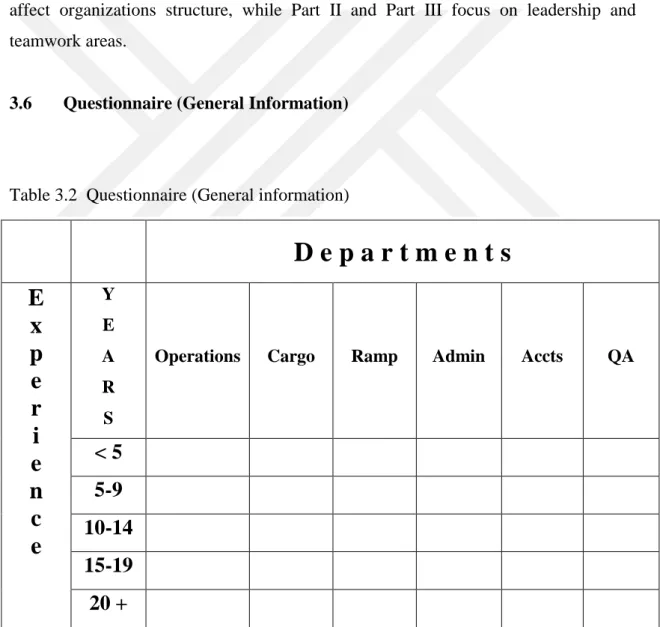
3.6 Questionnaire (general information)………39
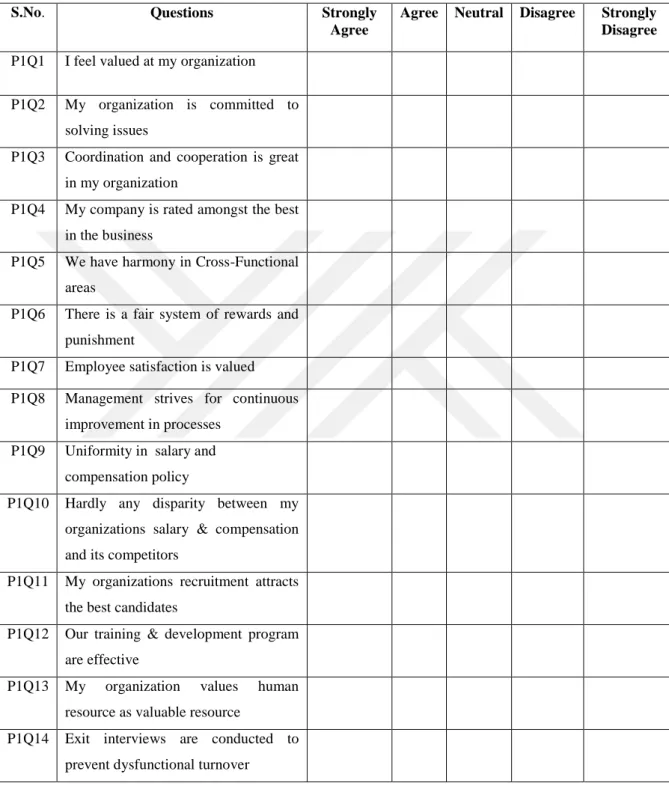
3.7 Questionnaire part I (organizational performance)………..40
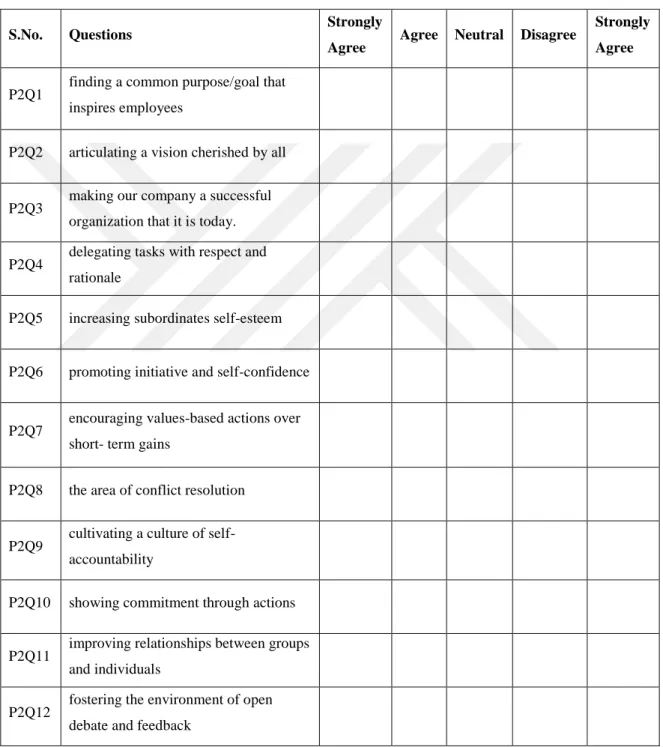
3.8 Questionnaire part II (Leadership)………..…….41
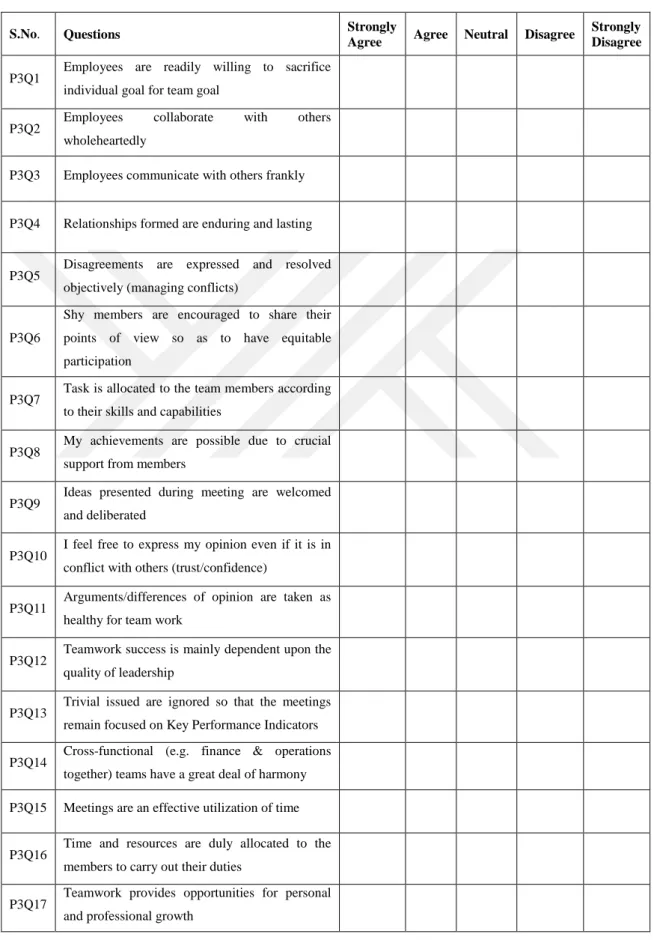
3.9 Questionnaire part III (teamwork)………...42
3.10 Respondents’ feedback breakdown………43
3.11 Statistical tool………...43
Chapter 4
(Report of Findings)
Frequency Tables……….46
4.1 Organizational performance (part I)………46
4.1.1 Employee ownership………...46
4.1.2 Compensation packages & performance appraisal system……….…47
4.1.3 Organizational environment………47
4.1.4 Organizational performance (key-question) ………..48
4.2 Leadership (part II)……….50
4.2.1 Influence of leader………..50
4.2.2 Attributes of a leader………..50
4.2.3 Leadership style………..51
4.2.4 Leadership contribution (key –question)……….………...51
4.3 Teamwork (part III)………...53
4.3.1 Communication………..53
4.3.2 Mutual support………..54
4.3.3 Conflict-management……….54
4.3.4 Knowledge, skills & abilities……….54
4.3.5 Leadership impact on teamwork (key-question)………....55
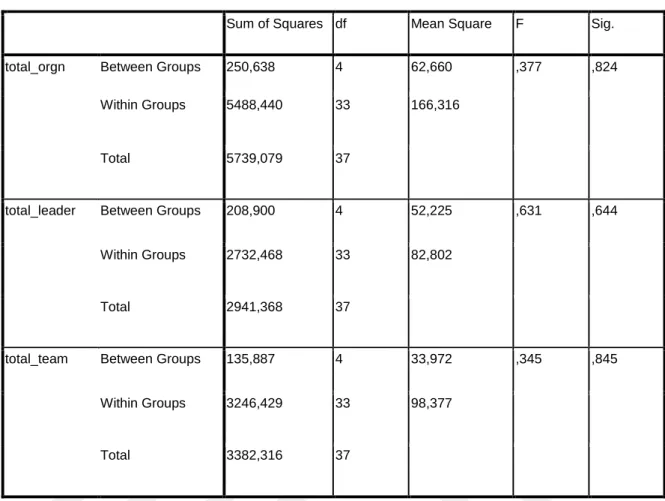
4.4 One-Way ANOVA………....57
4.4.1 Department Vs all three Parts………....57
4.4.2 Experience Vs all three parts……….58
Chapter 5
Analysis of findings
5.1 Common trends in all the three portions………..…..61
5.1.2 Department-wise………....61
5.1.2 Experience-wise……….61
5.2 Part I (organizational effectiveness)………..61
5.2.1 Employee ownership……….61
5.2.2 Performance appraisal, incentives & salaries………62
5.2.3 Organizational environment………..62
5.2.4 View about organizational performance (key question)………...62
5.3 Part II (leadership)………..62
5.3.1 Influence of a leader……….62
5.3.2 Leadership style………63
5.3.3 Effect of leadership on company’s performance (key question)……..63
5.4 Part III (teamwork)……….63
5.4.1 Communication……….63
5.4.2 Mutual Support……….63
5.4.3 Knowledge, skill & ability………64
5.4.4 Teamwork success depends upon leadership (Key question)……….. 64
5.5 Hypothesis accepted or rejected………...65
Chapter-6 Conclusion 6.1 Systemic approach………...……….67 6.2 Results………...67 6.3 Suggestion……….68 References………69 Appendices……….………..72 Abstract………..……….109 Özet...112
CHAPTER 1
INTRODUCTION
Man has enormous potentials. What individuals cannot accomplish alone is possible through organization. Human resource is the critical factor to achieve competitive advantage. Strategic Human Resource Management (SHRM) focuses on proactive management of people. Aligning physical and mental orientation of employees towards common goals is best accomplished by creating conducive environment. Teamwork is an attribute which provides impetus and added traction to group of employees in its march towards excellence. Leadership improves individual and team focus and adds energy and passion to pursuits. Virtually all stakeholders agree to need of team work implying unanimity and complete agreement on intention. But good teamwork is not common, implying problems in action and not intention. There is no dearth of literature or knowhow on teamwork and some lip service to teamwork is common in most enterprises. While a large number of factors is measured and tracked but there is no measure of teamwork in CEOs dashboard o f Key performance Indicators (KPIs).
Leadership and teamwork have been recognized as Critical Success Factors (CSFs) for any organization. These two are intertwined and one cannot succeed without the other. Leadership has always been a topic of interest amongst the academicians, philosophers, businesses and the general population. Teamwork, on the other hand has come under discussion only in the last century. However, with each passing generation the phenomenon of leadership-followership has become more and more pronounced. The factors that affect the leaders also trickle down to the team members and eventually the organization of which, both are a constituent.
Organizational performance is directly associated with the quality of leadership and effectiveness of the teamwork. While there are a number of tangibles to measure the success or failure of an organization, it becomes a tricky affair to gauge the value of leadership or teamwork. Involvement of intangible and vague tools makes it important to pay attention to how employees feel about their
leadership the organizational effectiveness.
In today’s competitive world, an organization that is not flexible tends to become rigid and dies its own death. External environment coupled with internal culture, decides the future of the organization. The central belief of any organization rests on the notion that the human potential has to be exploited so that the organizational goals are achieved. The pivotal point of this idea is that an organization cannot accomplish unless its workforce exercises its strengths and overcomes its weaknesses, for such an organization would be a learning organization. In the book by, Senge, P. M., Cambron-McCabe, N., Lucas, T., Smith, B., & Dutton, J. (2012), describe the nature of a learning organization as one which is fundamental to the essence of the human nature. Senge also suggests that central to the human nature is to learn, which he refers to as the higher human essence. Learning does not only mean to understand what is happening around but to be able to comprehend, adapt and sustain. This very nature of learning has to be embedded into the organizational culture. With learning comes the very concept of change. Unfortunately most organizations are averse to change. The very question is why should the organizations care about learning and embrace that change? In most economies and markets there is no definite recipe for success and therefore the companies have to continuously look out for ways to succeed.
While the human resource has been acknowledged to be a strategic asset to achieve organizational competitiveness, dealing with the humans is a complex task. People are emotional creatures. Their decision-making and performance are often guided by perceptions. Traditionally, teamwork is realized as a good and desirable attribute but, what is hampering the teamwork, is rarely addressed formally in an organization. This research will attempt to find out the factors affecting leadership and teamwork dynamics and how these factors influence peoples’ outlook towards the organization. An enabling environment can only take place when the impediments to teamwork are overcome and the leadership shows resolve and commitment in doing so.
External environment coupled with the internal organizational factors affect how the employees behave. The leadership must know how to adapt to the changing
environments. As managers and leaders, they are required to interact with followers and other team members, without whose support the goals cannot be accomplished. To get this support, the leadership must understand their workforce and motivate them enough to overcome their inhibitions. Humans have needs and they are governed by their values and beliefs. For an organization to succeed, the management must address peoples’ needs. One of the major responsibilities of the leaders is to enhance peoples’ skills knowledge and abilities, so that the employees remain focused and produce desired results. A recent study Tay, L., & Diener, E. (2011). Needs and subjective well-being around the world. Journal of personality and social psychology, 101(2), 354. Discovered that as hypothesized by Maslow, people tend to achieve basic and safety needs before they are ready to move up the hierarchy to other needs. However, in the context of organizational environment, the basic human needs are usually met. It is the other needs up the hierarchy that need to be focused upon. A person’s perceptions are influenced by a number of stimuli. Some are personalized like fear, insecurities, accomplishments and health while others are external such as job security, personal growth, career opportunities and expectations from the peers.
In the context of organizational setup, we must first understand that like people, organization also behave in a certain manner. Each organization is unique in its own way, for it carries a particular set of principles and displays a certain set of values and beliefs. This in turn reflects what sort of culture it has. Simplistically speaking, a company is like a person with its own set of habits and personality. For example, an organization like a multinational corporation is quite different in its objectives from a charitable hospital, or a bank from a college. But one thing that is common in all these entities, or for that matter any type of organization, is the presence of a leadership / followership working together to achieve a common goal. Therefore, it is important for us to understand how the organization functions and behaves before we look at the dynamics of leadership-followership relationship. We shall first focus our study on explaining organizational culture, and then move on to describe the relationship of leadership with the employees.
1.1 Statement of the Problem
Many organizations are functioning in routine manner but the energy or spark has been lost while others are constantly exploring new methods to improve. The excitement of challenges and uncertainty has been replaced by bureaucratic entangle and passing the buck. Initiatives are non-starter due to vested interests and status quos is ‘order of the day’. The zeal while creating the organization has gone missing and the huge loss is unnoticed. For organizations to become live again, from robotic movements, there is a need to infuse energy of team spirit. Leaders and professionals hold an array of divergent views about external challenges but ignore the problem within; importance of involved and aligned manpower.
1.1.1 Hypothesis. There is a significant relationship between organizational performance, leadership and teamwork.
1.2 Purpose of the Study
This research shall examine the “teamwork” concept to gain improved understanding of cause and effect. The leadership role will also be reviewed, as leader is responsible to create the right environment. Based on the study, a framework shall be developed to examine employee’s perceptions about key areas effecting leadership and teamwork. While examining the selected areas in reasonable depth, the framework shall briefly touch upon other human resource (HR) areas, which could impact teamwork including recruitment and selection, training and development, reward and compensation etc.
Since the human resource in such a skill intensive organization is crucial to the success of the company, it is paramount for the management to have a pulse of its people. Understandably members of the organization carry opinions from within an outside, which affect their performance. One of the primary aims of the research work is to see how people view their leadership and how these views affect their performance
as well as that of an organization. This brings us to one of the most challenging and ever interesting topics of leadership. How leadership affects its followership, determines the fate of an organization. During our research, it will be our endeavor to determine how people work within teams and how these teams get affected by the quality of leadership. Also, quite often the perceptions held by the employees about the leadership directly impact the organizational performance. This research has been divided into primary and secondary objectives. While both these levels will help us determine our final objective of gauging employee perceptions, the division has been done so as to move along in a more structured and sequential manner.
Organizational culture essentially depends upon its people. Humans are susceptible to perceptions. It is important to understand that when dealing with humans, perceptions play an important role in determining the organizational culture. How people view their leadership affects how they function as teams. Therefore there is connection between employees’ perception of their organization and that of the leadership and teamwork. Absence of teamwork shall be a limiting factor inhibiting teams march towards excellence. The objective of this study is to see if the employees’ view of their organization is affected by the perceptions that they hold about their leadership and teamwork. The study would also endeavor to find out what is holding the team from continually improving and striving to be the best (from where it stands) as the best can also improve. The diagnostics can help focus on finding out few vital factors affecting development of teamwork in a given setting, and provide an opportunity for the leadership to improve upon.
The organization’s foundation depends upon leadership’s philosophy, vision and goals. As a result, the culture of an organization comes into being. It is this very culture of an organization that describes the nature of the leadership, the team dynamics and the interplay of these two. The perceptions carried by the employees’ affect the quality of work, which also influences the level of their motivation. A s a result of this organizational performance, individual satisfaction and effective leadership takes place. These factors combine together to offer a framework from which the organization operates. Although there are number of models or frameworks that the organization works from, essentially there are four types of
frameworks namely autocratic, custodial, supportive and collegial Clark, D. (2013). Leadership and Organizational Behavior. All these models indicate a varying degree of authority from the highest or central authority down to the democratic style of framework. The last one being collegial means that the organization framework is based upon the model of partnership. Although all these models are distinct, it is not possible for any organization to operate exclusively in one model without going back and forth to the other. However there would predominantly be one model essentially guiding the culture of an organization. In today’s world of globalization diversified workforce, increased governmental regulations and depleting natural resources dictate that we pay special attention to how the employees feel about their organization in general and leadership in particular.
1.3 Delimitations
While this study will strictly focus on the internal environment of the organization, some extenuating factors may affect the inputs given by the research participants. Therefore in order to be more robust in our research, we may have to ignore external stimuli that could offer a biased result. Moreover the interaction of the employees with the leadership could also affect the feedback. Therefore this study focuses on leadership and teamwork, and might ignore some external factors which affect development of enabling environment. Future study may improve upon the framework as usage can bring out additional points. Keeping in view the scope of the study, the top leadership has been excluded from the list of potential respondents. The reason for this exclusion is simply the assumption that the presence of top leadership may influence the opinions of employees which can lead to a biased feedback.
Since this target company is geographically displaced from where the thesis work is being carried out, this researcher was severely handicapped in getting access to the respondents. However, the survey questionnaire was administered physically by this researcher, as he had the opportunity to visit Pakistan once during the course of this study. Since this was a single shot at getting the data, complete represe ntation of the entire available workforce was not possible. Instead a ‘satisficing approach’
was adopted, in that the best available conditions were selected and looking to have ideal ones... Due to the paucity of opportunities to collect data, the top leadership could not be interviewed. Therefore the data collected would be based on the available employees’ input only. The length of the questionnaire was kept short, simple and basic so as to extract unfiltered thoughts.
1.4 Definition of Terms
A. Culture is defined1 as; “The arts and other manifestations of human intellectual achievement regarded collectively”.
B. “Leadership is a process2 whereby an individual influences a group of individuals to achieve a common goal
C. Organizational culture is “The values3 and behaviors that contribute to the unique, social and psychological environment of an organization.
D. Norms are defined4 as informal guidelines about what is thought to be correct or incorrect (normal verses abnormal).
1
Oxford Dictionary
2
Gandhi Zigarmi, D., Blanchard, K., O’Connor, M., & Edeburn, C. (2005)
3 www.businessdictionary.com 4
CHAPTER 2
REVIEW OF THE LITERATURE
2.1 Organizational Culture
In order to understand organizational culture we must first understand what culture is. There are a number of definitions about the culture, all trying to describe in their own way. Oxford dictionary defines culture as; “The arts and other manifestations of human intellectual achievement regarded collectively”. In a broader perspective, the culture is defined as ‘peoples’ way of life’. There are various components of a culture such as attitudes, beliefs, customs and traditions etc.
2.2 Components of a Culture
If we take systemic view of a culture, we can essentially categorize culture into; communication component, cognitive component, behavioral component and material componentSchein, E. H. (2010). Organizational culture and leadership (Vol. 2). John Wiley & Sons.These entire components combine together to form a society which is a reflection of its people. While some of the subsets of these components are universal in nature such as basic human values and emotions, other differ from each other in terms of languages, traditions, rituals and the physical side of the culture. Let’s look at these components one-by-one:
2.2.1 Communication. It basically involves languages and symbols. It is natural for people to have affinity with the other people speaking the same language. In today’s world of globalization, the importance of one’s language is being understood and respected across the societies. On the other hand, the same affinity can also lead to negative feelings by the people not speaking the same language. Each language has a peculiar way of showing emotions, and reflects cultural meanings. The other aspect of communication is symbols. What doesn’t cover in verbal communication comes under symbolic communication. That means that from physical gestures, to one’s way of dressing, all comes
under symbols. At times, symbols become a stronger medium of carrying the message than the language itself. What constitutes as a funny sign in one’s society may be construed as a gesture of rudeness or even vulgarity in another culture. Therefore communication is the very foundation of how cultures progress and adapt to the surroundings.
2.2.2 Cognitive. This component of the culture generally entails one’s ideas, beliefs, knowledge and values. How the society thinks collectively reflects in the form of ideas that stimulate the societies. These ideas are also the elementary unit of the knowledge which in-turn is the foundation of the society’s progress. While beliefs maybe handed down from generation to generation and can vary from one culture to another, values are usually constant throughout the society. These values provide the basic framework for living in a society.
2.2.3 Behavioral. Behavior is defined as the physical manifestation of attitudes. A typical human behavior consists of various types of norms and expectation, which guide the society’s conduct. There are rules and standards that define the boundaries of a culture. There are various types of norms such as customs, traditions and folk-ways. One more important norm is the law of the land, be it a modern society or a tribal one, the laws govern the overall balance of the society.
2.2.4 Material. This component of the culture contains the physical side of the culture like; infrastructure, machines, wealth and the local landscape. Cultures emanating from country-side are quite different from those which come from the cosmopolitans. The contours of a capitalistic culture lie in consumption and wealth accumulation, whereas the dynamics of socialist societies indicate pluralistic behaviors and reduced focus on materials.
There are equally abundant studies that have tried to explain organizational culture. In the following paragraphs, we shall try to limit our discussion within the scope of the topic. Before we dwell onto the various aspects of organizational culture,
we must focus our attention towards the definition of the organizational culture. The first recorded formal use of the concept of organizational culture in the extensive studies conducted by English sociologists Barry. A. Turner, which appeared in 1971. Also its roots can be traced back to the earlier works of public administration institutionalisms such as Barnard, Selznick, Kaufman and Thompson Newbold, S. P. (2008). Teaching organization theory from a constitutional perspective: A new twist on an old flame. Journal of Public Affairs Education, 335-351. Its roots may also lie in the famous Hawthorne studies conducted at the Western Electric company in 1930’s (Tharp, B. M. (2009). Defining “Culture” and “Organizational Culture”: From Anthropology to the Office. Interpretation a Journal of Bible and Theology, Harworth.
2.3 What is organizational culture?
After having discussed a brief overview of a culture and what it constitutes, we now move onto define organizational culture and what its components are. Organizational culture has many definitions. Every definition reflects its proponent’s educational background, work, experience and professional knowledge. It is also difficult for the academicians to agree on one universal definition. However one of the most widely used definitions of organizational culture is “The values and behaviors that contribute to the unique, social and psychological environment of an organization (www.businessdictionary.com). Simplistically speaking, it means “the way we do things around here” (www.uri.edu). Like culture of a society, the organizational culture also comprises certain elements. While each organization has a unique culture, there are certain elements which are common to all the organizations alike. The foundation of a culture is based upon these elements. How the organization behaves, what type of leadership it has and the actions of the workforce are guided by the boundaries set by these very elements. These include; a historical background of the company, communication (top-down, bottom-up/horizontal), award and reward system, norms, behavior and practices and quality/style of leadership. Let’s suppose that we work in an organization which has a history of risky business, displays employee ownership and values honesty and professionalism. Based on this small scenario, it can be inferred that the culture of this organization is one of risk-taker, where employees are felt important and the company has the ability to adapt. In order to proceed further, we will discuss
these components one by one.
2.4 Historical Background
The formative years of a company have a lasting effect on its culture. The leadership of a company from the early days leaves behind stories and legacies that are passed on from one generation to the other. Based on these stories, the employees predict the future course of action for the organization and guide their own actions. The underlined message of these legacies helps understand what is encouraged or what is valued at the organization. For example, the enduring effect of Steve Jobs’ legacy can be found in the actions taken by the management and the behavior of the people within the organization “Your time is limited, so don’t waste it living someone else’s life. Don’t be trapped by dogma-which is living with the results of other peoples’ thinking. Don’t let the noise of other’s opinions drown out your own inner voice. And most important, have the courage to follow your heart and intuition” Jobs, S. (2011). I, Steve: Steve Jobs in his own words. Agate Publishing. This very history of Apple guides the e philosophy of the company and can be seen in the products it makes.
2.5 Constituents of Organizational Culture
Following are the constituents:
2.5.1 Communication. One of the most important elements of organizational culture is communication. How does the management talk to the employees, how do the employees communicate with the leadership and how do the organizational members talk with each other, affect the very culture of the company. For example, if the top-down communication is rigid, it leaves less space for the employees to ask for the clarifications and limit feedback. This leads to more hierarchical chain of command, leading to less employee involvement. It also inhibits one’s initiative and creativity. On the other hand, if the bottom-up communication is too casual, it may lead to blurring of boundaries, obscuring responsibility area, giving rise to irregularities and over-stepping one’s official authority. So far we have talked about the formal part of
the communication. The other part which is informal entails symbols and physical gestures. For example, leaving extra parking space for the employees is a visual sign to tell the employees that they are important for the organization.
2.5.2 Award and reward system. Employee motivation is directly affected by how they are evaluated and recognized. A fair and just appraisal system reflects that the merit and performance is valued at the organization. A special award or a bonus makes the employee feel valued at the organization. Peer assessment, consultative performance-appraisal and performance-based compensation signify how an organization values its employees. For example today’s financial scandals have roots in management incentives of the high flying 1980’s. The financial scandals at Enron, Tyco, WorldCom, and other companies paid huge incentives at the cost of shareholders and employees (www.knowledge.wharton.upenn.edu/).
2.5.3 Norms and practices. Norms are defined as informal guidelines about what is thought to be correct or incorrect (normal verses abnormal). These norms form the bases of collective thinking of a community or a group of people and play a crucial role in guiding everyday activities. Although there are various types of norms, only four types are discussed more commonly “folklore, mores, taboos and laws). Folklores are practices or customs and traditions, which are socially approved and may not be officially significant. For example, the way the juniors sit in front of seniors maybe acceptable in American society, but maybe construed as rude in Asian culture. Mores are essentially about morality. Violating them will offend people but may not be taken as a legal violation. For example, not going for Friday prayers during the official break is not illegal, but may not be endorsed by other employees. Taboos are those customs which are either forbidden or forsaken by the society, like offering pork to Muslims. Laws are formal or documented norms enforced by the management, and all the employees have to abide by them, like abstain from drinking while driving. In the context of organizational environment, these norms can be taken as informal chats and casual interactions. For example, do the employees talk frankly about their failures, or does the management feel that
frank communication will lead to an undesired lax culture. Some of these norms are taken from parents, teachers etc. while others are learned within the organization and the surroundings. Some norms in the organization are healthy and some are even damaging. Because the norms are usually associated and exhibited within a group, undesirable norms may not be noticeable, until seen from the context of another culture.
2.5.4 Leadership. The impact of leadership on organizational culture cannot be over-emphasized. Leaders impact the way people think and act. Employees tend to follow leaders as they are considered role models and are looked up to. The leadership of an organization also sets the agenda. One can have a fair idea of the organizational culture by looking at its leadership. There is a common belief that strong leadership creates a strong culture in the organization. It is also a common belief that the organizations performance depends upon the quality of leadership. “Management is doing things right; leadership is doing the right thing”. Drucker, P. F. (2008). Managing oneself. Harvard Business Press.
The nature of business decides the type of culture, and correspondingly the leadership. In a military organization, hierarchy is important and therefore the leadership style is authoritarian. In such an organization, the channels of communications are more formal, top-down and smaller margin for individual’s personal expression. As opposed to this, a research organization will have a flatten hierarchy with a loosely structured leadership model, encouraging openness, innovation and creativity.
Organizational culture is rather abstract in nature. It is difficult to quantify or measure the components of a culture. Different experts have come up with different approaches to define organizational cultures but most have agreed that this is a set of values and beliefs held within the organization. All the elements of an organizational culture interact with each other to give a value to the organization. So in essence, we can say that the organizational culture is its personality. A purely commercial organizational culture will be totally different from that of a not-for-profit organization.
The concept of culture becomes more important when attempting to bring a change within the organization, interact with external environment, or even going across the globe. The employees of an organization will have varying perceptions of the culture. This is particularly true when a comparison is drawn between the top level management and the organizational workforce. . It is important to study organizational culture not only for its narrative but also for predicting a future course of action. An organization’s performance, whether commercial or for charity, depends upon how the cultural elements are managed in it. The interest in organizational culture becomes more important when the organization is under-going a change, whether technological, geographical or strategic. If an organization has an unhealthy culture, it will not be able to cope with the competition in the open world and will eventually fade away. Organizational culture has three main functions. Firstly, it helps in predicting a pattern of behavior, secondly it reflects as to where the priorities lie and finally convey expectations. It connects employee’s performance with the leader’s expectations in the overall ambit of organizational philosophy.
2.6 Understanding Leadership
Leadership plays crucial role in setting the tone and determining the destiny of organization. A Leader is typically seen as a man with vibrant personality, charisma, stamina, energy, head, heart, and soul and what not. What qualities distinguish leader from common mortals is a subject of interest but literature on subject is often biased as the success of leader comes first and research on causes of success follows and attributes and tails get attached to it. An example is a story attributed to Gandhi on about successfully advising a child to change his behavior is attributed to other great leaders before Gandhi Zigarmi, D., Blanchard, K., O’Connor, M., & Edeburn, C. (2005). The leader within. Brutal dictators try to project soft image. Victors exert influence to paint a favorable picture to help their image in form of biographies or other means. For similar acts and dispositions the winner may be painted as man with strong self-belief, persistence and perseverance while the looser may be termed as stubborn, obstinate and adamant. Jack Welch is highly acclaimed while Rick Wagoner, chairman and CEO, General Motors was shown the door because of results and not the leadership qualities. The later got title
of the worst CEO’s of the year with charges like corporate insensitivity, avarice and callousness and without regards to their past achievements. An objective comparison of the two may be a good research on outcome bias or hindsight bias. Nevertheless hero worshipping and study of leadership shall continue to attract attention and only the successful shall be acclaimed.
Leadership has been a topic of interest since the beginning of times. The role of leaders in religion, society and businesses has been discussed from different angles. But of all the theories that have been put forward, most seem to converge on one thing; all leaders have an undying influence over the people resulting in an unwavering support of the followers. Different theories have been proposed to answer the proverbial question as to what it is that makes leader a leader. Is it that the leaders are born or they are made? One more generally accepted belief about the concept of leadership is that it is rather a process by which people an individual influences other people in order to achieve an objective or a shared goal Sharma, M. K., & Jain, M. S. (2013). Leadership Management: Principles, Models and Theories. It is this very influence that inspires the followers to work as a team or a group, realize their capabilities and overcome their weaknesses and limitations. Some believe that the leadership is a process by which people are driven through to achieve a desired result.
One of the most intriguing questions is what inspires these people. Is it the charismatic personality of the leader, expertise in the field, the valiant spirit, power, situations, or is it just as simple as ‘at the right place at the right time’ adage, that explains the becoming of a leader. Whatever the explanation, it is but clear that there is a certain level of trust in the leader that motivates the people in to getting a common goal.
2.7 Leadership Defined
Perhaps the most extensively studied and discussed area of management is leadership. There as many definitions of leadership as there are people interested in this topic. If we go through the literature about leadership, one notion stands out to
be the most recurring feature in almost all the definitions. That is, the influence of a leader on the people. Like in the one of the most widely quoted definition of leadership is that the “Leadership is a process whereby an individual influences a group of individuals to achieve a common goal (Afzal, B., Ur Rehman, S. S. F., & Mehboob, S. A. A. (2010).
2.8 Influence of Leadership
Historically, muscles, horse riding skills, sword and marksmanship skills and public speaking skills were essential leadership traits but as more and more people start mastering these skills a leader had to have more than these to distinguish themselves to command followership and allegiance. Conventional leadership toolkit consists three categories namely: 1) What they are [Be] (such as beliefs and character), 2) what they [know] (such as job, tasks, and human nature) and 3) what they [Do] (such as implementing, motivating, and providing direction), (Hesselbein, F., & Shinseki, E. K. (2004). Be, know, do: Leadership the Army way. Jossey-Bass.). (See Appendix ‘A,B’). In this US army model, the word ‘be’ refers to the person himself. The leader should be a true professional who puts service before self he displays highest level of integrity, competence courage and other traits of a strong character. The KNOW part means that the leader should be aware of tasks at hand the job to be done and the competency of his people. He must also be aware of people’s needs, emotions, and the operating environment. As far as the part DO is concern the leader must clearly set a goal carry out planning take decisions and solve problems. Besides doing the four basic functions of management; planning, organizing, leading and controlling, he must motivate his team and provide an enabling environment.
Many styles of leadership are practiced and work and are listed in literature including: Autocratic Leadership, Bureaucratic Leadership, Charismatic Leadership, Democratic Leadership or Participative Leadership, Laissez-Faire Leadership, People-Oriented Leadership or Relations-Oriented Leadership, Servant Leadership, Task-Oriented Leadership, Transactional Leadership and Transformational Leadership. The list is not exhaustive and some other types are also listed which
includes Strategic Leadership, Team Leadership, Facilitative Leadership. Leadership Influence Styles include Cross-Cultural Leadership, Coaching, Level 5 Leadership and Servant Leadership etc. Situational leadership is about choosing the appropriate leadership style to match situation and subordinates skill and commitment level. “It makes no difference whether your organization is a corporation, a nonprofit, a school, or an athletic team”: Heroic Leadership is crucial (Cohen, W. A. (2010). Heroic leadership: leading with integrity and honor. John Wiley & Sons.). Attributes such as initiative, trust, openness, helpfulness, flexibility and support are desirable leadership traits.
2.9 Styles of Leadership
Leadership style is determined by the authority gradient and decision-making level. Higher the decision-making, steeper the authority gradient, and more centralized the power. While each style has its own pros and cons, no organization can follow only one type of leadership. More often than not, there is a back and forth movement of leadership styles depending upon the situation, nature of the business and type of an organization. There are numerous models that propose different leadership styles. But the most common factor among the models is the decision totem pole. Going back into the history the earliest account of study on leadership styles has been found by Kurt Lewin in 1939 who spearheaded a set of researchers who found out various styles of leadership Schneider, B., Ehrhart, M. G., Mayer, D. M., Saltz, J. L., & Niles-Jolly, K. (2005).
2.9.1 Autocratic style. At the top of the authority gradient lays autocratic or authoritarian style of leadership. This style is typified by highly directive behavior, very close oversight and very little reliance on others. While this style of leadership may seem highly inappropriate to a lot of people, it may be the best strategy when there is a little margin for thinking or in a highly time compressed environment. For example, in case of war or when there is a patient on a deathbed. This may also be the case where the management has complete information, skill and control with little room for sharing these factors with the employees. This type of leadership style can be
found in those businesses which are run by a family, very hierarchical and very well defined boundaries of communication. The benefit of this style is this style is that it produces swift decision making, closer supervision and fewer employee errors. The disadvantage of this style is that it generates demotivation and resentment amongst employees, and increased absenteeism/turnover. This style is best suited when the job involves lower skill levels, monotony in routine and a low margin for error.
2.9.2 Democratic / Participative style. This style of leadership lies in the center of the authority/decision making gradient. This type of leadership seeks to involve people in the process by including their inputs. Flexible organizations with enhanced emphasis on teamwork tend to follow participative style of leadership. Involvement of the employees improves the comprehension of the problem, and reaches the decisions owned by all those involved in the process. One of the assumptions is that the people prefer collaboration over competition. Collective decision making increases the ownership towards the decision. One of the underlying suppositions is that
collective wisdom is better than single person taking on the problem. (A Leadership Perspective of the Ripple Effect, Ronald H. Bordelon, James
A.Gordon, Joyce A. Parks, Glenda A. Riley)
2.9.3 Lessiz-Faire (Free reign). On the other end of the totem pole lies a style of leadership with the lowest level of authority. In this domain the employees have complete freedom of decision making and control over their activities. This type of leadership style can be found at research organizations, fashion houses or other such entities where innovativeness and creativity are the driving force.
2.10 Nature or Nurture
‘Leadership is nature or nurture’ is often discussed and while leaders are born (nature) they are also developed (nurtured) as per pre transformational leadership theory. The Trait Theory explains that some personality traits may propel people
gradually into leadership roles. The Great Events Theory explains that challenging situation or important event may cause an ordinary person to rise to the occasion and respond in such a way that brings out extraordinary leadership qualities and instantaneously propel him to leadership position. Transformational or Process Leadership theory applies where people choose to become leaders by learning leadership skills. Supportive leadership is essential requirement for teamwor k to exist and flourish. In organizational settings, leadership entails aligning and striking balance between organizational interests, followers’ interests and leaders own interests and have to be based on solid principles and fairness (Bass, B. M., & Riggio, R. E. (2012). Transformational leadership. Psychology Press.)
2.11 Leader versus Manager
While we need managers to maintain order, we need leaders to create future. Dera Zegarmi others in ‘The Leader Within’ has done synthesis of literature on the difference between manager and leader, and summarized the difference into three major categories namely: self-orientation, followers’-orientation and organization’s-orientation (See Appendix ‘C’). While the manager is too involved in “doing the things right”, leader focuses on “doing the right things”. The manager is focusing on improving bottom line while leader has eyes on horizon. Managers would want us to be compliant and rob us of the excitement in facing challenges and innovating and experimenting. We surely need managers to run the show but we need leaders to lead the way to carve out future. When a person is a manager and also leader, then whenever he is trying to influence the behavior of someone, he is putting on the leadership hat. Leadership has been defined as “the act of arousing, engaging, and satisfying the motives of followers—in an environment of conflict, competition, or change—that results in the follower taking a course of action toward a mutually shared vision”(Drea Zigrami et al, 2005). Leadership is not about manipulating or exploiting followers. It cannot be faked. It is not about oration and making a historic speech. Such gimmicks can be short-lived and cannot provide durable and enduring relationship. Even rewards-sharing is a single dimensional incentive which cannot be enduring. As W C H Prentice opined in his article articulates about longevity of such approach. (Prentice, W. C. H. (2004). Understanding leadership. Harvard business
review, 82(1), 102-109.
2.12 Perception about Leader
“Human beings are not machines with a single set of push buttons. When their complex x responses to love, prestige, independence, achievement and group membership are not recognized on the job, they perform at best as robots who bring far less than their maximum efficiency to the task, and at worst as rebellious slaves who consciously or unconsciously sabotage the activities they are supposed to be furthering…”. Conventional managers lack skill or capacity to remove the deep-rooted mistrust between management and employees. Perceptions and suspicions are two-way and a serious baggage to carry. While explaining pitfalls of perception W C H Prentice argues that “for followers to recognize their leader as he really is may be as difficult for him to understand them completely” (WCH Prentice Harvard Business Review, 2004).
2.13 Leadership Capabilities and its Application on Teamwork
A good leader is aware of the background of mutual suspicion between management and workers and recognizes need of regaining trust and is aware of ways of doing so. Leader is a promoter of the group’s aims and advocate of the values of the organization and is always exploring for ways of carving o ut better techniques for reaching organizational goals efficiently while encouraging and supporting others in similar pursuit. Slick use of social or psychological tricks can indeed persuade others to do your bidding, but they are unfit for continuing relationship. Leader has a task at hand.
2.14 Competencies Matrices
Many organizations are drawing up competency matrices for the challenging position of leader. The Center for Creative Leadership (CCL) focuses on leadership education and research on competencies essential for leaders and recommends 20 competencies for leaders (McCauley, C. D., & Van Velsor, E. (Eds.). (2004). The
center for creative leadership handbook of leadership development (Vol. 29). John Wiley & Sons. (Appendix “B”). Leadership competencies are important to exploit organizations HR potentials. CCL leadership competency model is believed to be closely matching to the competencies uncovered by the Hay Group study of leadership values in Indian leaders (Arrowsmith, T. (2005). Distributed leadership: three questions, two answers A review of the Hay Group Education research, July 2004. Management in Education, 19(2), 30-33.).
While organizations are undertaking gap analysis to develop and groom present and future leaders, skeptics are critical of the approach of breaking up of leadership into unmanageable list of leadership competencies. The main objections of skeptics are that in trying to summarize leadership into distinct competencies the classic art of leadership loses its anchor as discussed below.
2.14.1 Competencies matrices criticized. While one can have a list of endless attributes for leader but leadership shall remain an art and shall not become a science. The auditor like approach is rightly criticized for being overly reductionist: An accountant’s style balance sheet approach is being applied to leadership which is (not mathematics/science, but) human behavior issue. It has been extensively criticized for weaknesses in its ability to take into account occupations which are characterized by a “high degree of uncertainty, unpredictability and discretion, and it’s arguable tendency – contrary to the aims of the model on which it is based to atomize work roles rather than represent them holistically” (Bolden, R., & Gosling, J. (2004). Leadership and management competencies: lessons from the national occupational standards. www. leadership-studies. com, Intermittent, 1. Lester 1994). The main argument of the skeptics to this approach is that in trying to split the leadership role into constituent elements, it is losing the big picture of the integrated whole. It is articulated that standards tend to fragment the leaders role into its elements rather than representing it as a unique whole with overlapping effects of components not as tangible as being presented. While this simplification is indeed the main beauty of the competency approach, the representation is not close to representing leader’s real time
situation.
2.14.2 Size of organization. Another objection pertains to the failure to distinguish between size of organization or position in the organization, or the variation in situations etc. “Standards are criticized for being overly universalistic”. A quote from the Management Standards Centre “whatever the size of your organization, you will find the standards have been written to meet your needs” (MSC website, 2004), All issues individually seem OK but the manner in which standards may actually reinforce rather than challenge traditional ways of thinking about management or leadership, is a cause of concern. The approach seems to be unpractical and is correlated as (Bolden, R., & Gosling, J. (2004). Leadership and management competencies: lessons from the national occupational standards. www. leadership-studies. com, İnternetten, 1.) Little discretion or flexibility is available to adopt and adjust according to subtle differences in situations, individuals, impact of new technologies and globalization etc. The standards excessive focus on observable behaviors and indicators “to the exclusion of less overt aspects such as values, beliefs and relationships” could be counterproductive and become a cause of discord, cited ibid (Bolden, R., & Gosling, J. (2004). Leadership and management competencies: lessons from the national occupational standards. www. leadership-studies. com, İnternetten, 1. Bell et al., 2002). The warmth of relationships and spirit de corps, the common cause seems to be put on back burner.
2.14.3 Future of competency matrices. The approach may one day combine emotional intelligence with artificial intelligence or other leadership models to improve current work to doable dimensions. A compassionate and relationship based approach is considered more appropriate to unify team members from danger of falling into a bureaucratic tangle presently. The aim of this study is not to accept or reject the competency models but to search for a model that brings out the best in a team. Ideas of teamwork, synergy and continuous improvements cannot flourish under environment of suspicion and mistrust. Leadership must play a role to improve organizational climate and
trust and communication is important in this regards. The authority vested with leader is most potent when it is not used and there is no obvious threat or intent of using the authority. The workforce and management have to be on the same page to make a winning time. “A leader knows thyself”. As leader, we need to appreciate that our values, beliefs, and personality are driving our success -- or our failure and we need to lead in ways that reflect our own values and personality and we do not have to put an act. We act relaxed and natural when and connect comfortably in group settings as well as one-to-one contexts. We discover and liberate personal qualities and energies we never knew we had. We can generate team’s spirit and build stronger, more effective, more joyful organizations by liberating the leader inside us and not emulating someone or his set of rules. Only after knowing our inner self we can learn to truly know others and to be leader one has to know followers.
2.15 Leader’s Awareness of Followers
“Leaders must know their followers well enough to coalesce the followers motives toward a common outcome. This cannot be done for any length of time, unless the follower is offered an opportunity to engage in value based activities. In other words the values and believes of those you wish to influence must be understood, verbalized, and coupled with organizations social purpose”() What few crucial competencies or approach should leader have remains an important question needing answer.
2.16 Attributes of Leader
Heroic Leadership, Leading with integrity and honor (Cohen, W. A. (2010). Heroic leadership: leading with integrity and honor. John Wiley & Sons. William A Cohen, 2010) presents eight principles of leadership, 1) Maintain absolute integrity, 2) Know your stuff, 3) Declare your expectations, 4) Show uncommon commitment, 5) Expect positive results, 6) Take care of your people, 7) Put duty before self and 8) Get out in front. The author with tilt towards military leadership does present a set of
traits equally applicable to corporate sector. In the “The Leadership Challenge”, 4th Edition, (James M. Kouzes, 2010) (Kouzes, J. M., Posner, B. Z., & Biech, E. (2010). The Leadership Challenge: Activities Book (Vol. 163). John Wiley & Sons.) has articulated the historically proven and still valid five practices of exemplary leadership namely 1). Model the way; dealing with leading by example, 2) Inspire a shared vision; involving everyone 3). Challenge the process; innovating and exploring 4) Enable others to act; empowerment and involvement 5). Encourage the heart; celebrating and rewarding.
2.17 Outcome of Leadership
The leader’s unique legacy is the creation of valued institutions that survive over time. The most significant contribution leaders make is not simply to today’s bottom line; it is to the long-term development of people and institutions so they can adapt, change, prosper and grow. The integrity or credibility of leader is the sole basis on which people are ready to be led voluntarily. Credibility is not measureable and until proven guilty leaders integrity cannot be questioned. Subordinates perception about leader’s integrity is crucial and often it is also correct so those who fake can do so for little while. Injustice has adverse effect on employee’s perception about organizational justice especially if the outcome has adverse effect on individual. When organization treats leader with injustice it gets noticed by employees more so in cases where high quality relationship existed between leaders and followers. Organizations dealing with leader fairly and leaders dealing with followers appropriately thus form important prerequisite for effective leadership. People want to be guided by those with integrity and a clear sense of direction. Leader must possess a clear sense of direction and articulate a strong vision of the future. A person who fakes commitment to values may look good and get promoted but cannot inspire others. Self-serving leaders are less effective because their subordinates only obey them, and they do not follow them. But as the Hawthorne experiments confirmed, perception of genuine concern about workforce shall move team’s productivity graph in only one direction even when management takes opposite actions.
2.18 Integrity of Leaders
Integrity of managers is important to determine but is a tough ask as it is easy to wear integrity on sleeve through deception (Kaiser, R. B., & Hogan, R. (2010). How to (and how not to) assess the integrity of managers. Consulting Psychology Journal: Practice and Research, 62(4), 216.) also emphasizes integrity as a leadership competency for managers and cites previous research showing that subordinates performance gets affected due to low integrity of managers. Deceitful behavior of managers of Enron and Tyco in 2001was cited as cause of demise of firm but the discovery after the fact is of less value and there is need to preempt such events. The research found that subordinates may not express their true reservations about integrity of managers while we know that their perception degrades their performance as already discussed. The low performing managers scored well on integrity issues along with high performing managers. The researchers then devised an alternative method and inquired on subordinate expectations about the likelihood that their boss could behave unethically responded differently. This method suggested that a much larger segment of subordinates perceive their managers to be having integrity issues and this had correlation with low-performing managers. The manager with integrity is better placed to get results from team members by learning about team dynamics. Simply stated teamwork is about splitting task into constituents and hiring individuals to undertake individual constituents for the t ask to be completed with leader undertaking function of coordination and control. Studies reveal those effective and efficient teams are rare and minor problems can cause dysfunction to teamwork.
Nations rise and fall due to leadership. Companies that were at the top of the chart came crumbling down because their leaders failed them (Enron, WorldCom, Union Carbide) . When Apple was at the brink of bankruptcy, Steve Jobs rescued the come company single-handedly and made it what it is today. There are different types of leadership, each suitable for a particular situation. From authoritarian style to a free rein type, each one is defined by the how steep the authority gradient is. Concentration of authority leads to totalitarian kind, while democratic / participative style of leadership involves people in decision-making. Each type of leadership style
has its pros and cons. Role of the leadership is direct people into achieving a common goal. The most important aspect of leadership is its ability to influence. Each leader has a unique set of qualities that attracts people. Personality, charisma, expertise and power are but a few attributes/qualities of a leader. Teamwork essentially depends upon leadership. The leadership role is comprehensive and apart from creating a vision and engaging employees, leaders have to ensure that systems are effectively implemented and opportunities are created for employees to actively get involved and deliver. Leaders need to set a positive example and encourage teamwork by rewarding an enabling behavior.
2.19 Teamwork
Common goal is best achieved when individual contributions are synchronized. Delivery of a letter by post-office involves separate actions by various players like acquiring postage stamps, dropping and collection from letterbox, sorting, dispatch to destinations and delivery. The actions are undertaken by individuals separately but failure of one component effects outcome while individual is not dependent on support of others in accomplishing individual role or task. While a surgeon is undertaking a complex surgery or a manufacturing plant is making a complex part, underperformance of one casts effect on effectiveness of others. The interdependence augments need of teamwork which requires understanding how my part of job affects the person and the ultimate goal. Individuals have to look beyond their unique activities and understand the bigger picture for organizational effectiveness. Team and teamwork is no panacea for all ills. Teamwork is no guarantee for success and “social scientists have found it much easier to prove process losses rather than synergy gains due to teamwork” and limits its size to 20 with smaller the better. (Antoni, C. (2005). Management by objectives–an effective tool for teamwork? The International Journal of Human Resource Management, 16(2), 174-184.) Cooperation, coordination, and satisfied employees are essential teamwork requirements, including some conditions given at the appendix.
2.20 Advantages and Disadvantages of Teamwork
While autonomy or participation in decision making has long been discussed from a motivational perspective” only its more useful benefits include “advantages of shared mental model and broader input base” at the time of planning. There are 12 advantages of the teamwork alongside 12 disadvantages of teamwork (Biech, E. (Ed.). (2008). The Pfeiffer book of successful team-building tools: Best of the annuals. John Wiley & Sons) produced at Appendix “F”. The list depicts how complexity increases due to increased need of coordination, communication and cooperation. Advantages occur due to more brains and physical resources. To make Team successful, environment may be made conducive to exploit the advantages and safeguards be erected against disadvantages. This shall require individual members to be trained looking forward to contribute towards group objectives. Intrinsically satisfied employees can think and act in this direction and managements must focus on having satisfied employees.
2.21 Competencies for Teamwork
Literature is littered with competencies required for teamwork as well as Leadership. Like Be-Know-Do model for leadership (App ‘A’), a Think-Do-Feel model is presented by (J A Canon-Bowers and E Salas (2010) reflecting ‘what team members’ Think-Do-Feel. The competencies required are broken down into Knowledge, Skills and Attitude or KSA. While discussing leadership competencies and Hay groups 75 or CCL’s 20 leadership competencies we cited critics questioning the wisdom of breaking down into constituents as overly simplistic. As leadership is part of teamwork, 130 competencies list are drawn for effective teamwork, and divided these into 8 skill dimensions including adaptability, shared situational awareness, interpersonal skills, and communication skills, in Team Effectiveness and Competencies (J A Canon-Bowers and E Salas (2010).
2.21.1 Knowledge, skill and abilities for teamwork. Attitude of members and leader is important for teamwork. Winston Churchill said “Attitude is a little thing that makes a big difference”. Mutual respect and trust creates cohesion