MASTER OF BUSINESS ADMINISTRATION
VARIETY SEEKING BEHAVIOUR IN TURKISH TOURISM
MBA Thesis
Meltem Aydınoğlu
200881001
Thesis Advisor:
Asst. Prof. Dr. Erdoğan Koç
i CONTENTS PAGE PREFACE IV ÖZET V SUMMARY VI FIGURES VII TABLES VIII CHAPTER 1: INTRODUCTION 1
1.1 The Importance of Research 1
1.2 The Aim of Research and Reserarh Questions 1
1.3 Research Hypothesis 2
1.4 Methodology 2
1.5 Data Collection Procedure 2
1.6 Limitations 3
1.7 Structure of The Thesis 3
CHAPTER 2: TOURISM 5 2.0.0 Overview 5 2.1.0 Definition of Tourism 5 2.1.1 Economic Definition 5 2.1.2 Technical Definition 6 2.1.3 Holistic Definition 6 2.2.0 Forms of Tourism 6 2.3.0 Tourism as a Service 7 2.3.1.Inseperability 7 2.3.2.Perishability 7 2.3.3 Heterogeneity 7 2.3.4 Intangibility 7 2.3.5 Ownership 8
2.4.0 The Economic Contribution of Tourism Sector 8
2.5.0 Socio-Cultural Impacts 9
ii
CHAPTER 3: TURKISH TOURISM INDUSTRY 14
3.0.0 Overview 14
3.1.0 Recent Developments 14
3.2.0 Tourism in the Economy 15
3.3.0 Domestic Tourism in Turkey 17
3.4.0 Tourism Organisation in Turkey 18
CHAPTER 4: CONSUMER BEHAVIOUR IN TOURISM 21
4.0.0 Overview 21
4.1.0 General Profile to Tourist Consumer Behaviour 21
4.2.0 Tourism Demand and Consumption 24
4.3.0 Tourist Motivation 26
4.3.1 Dimensions of Tourist Motivation 27
4.3.1.1 Function or Utility; Emotion 27
4.3.1.2 Self or Identity 28
4.3.1.3 Symbolism or Context 28
4.4.0 Tourist Typologies 28
4.5.0 Decision Making 31
4.5.1 Influential Factors on Decision Making 32
4.5.1.1 Media and Tourism Destination Image 34
4.5.1.1.1 Cognitive Approach to Image 34
4.5.1.1.2 Affective Approach to Image 35
4.5.1.2 Past Experiences 35
4.5.1.3 Age and Gender 35
4.6.0 Perceived Risk in Tourism 36
4.7.0 Satisfaction with the Tourism Destination 37
4.7.1 Satisfaction and Revisit Intention 38
4.8.0 Customer Loyalty in Tourism 40
4.8.1 The Effect of Service Quality on Customer Satisfaction and Loyalty 42
4.9.0 Revisit Intention and Repurchase in Tourism 43
iii
5.1.0 Variety Seeking Behaviour as a Concept 48
5.2.0 Product Specific Characteristics on Variety-Seeking Behaviour 41
5.2.1 Need For Variety 51
5.2.2 Purchase Frequency 51
5.2.3 Perceived Difference Between Brands 51
5.2.4 Available Alternatives 52
5.2.5 Purchase History 53
5.3.0 Motivation For Variety Seeking Behaviour 53
5.4.0 Hedonic and Utilitarian Motivational Factors 53
5.4.1 Hedonic Motivational Factors 54
5.4.1.1 Experimental Shopping Value 54
5.4.1.2 Shopping Impulsiveness 54
5.4.2 Utilitarian Motivational Factors 55
5.4.2.1 Information Seeking 55
5.4.2.2 Shopping Convenience 55
5.4.2.3 Price Consciousness 56
5.5.0 Innovativeness as a Trait 56
5.5.1 Innate Innovativeness as an Expression of the Need For Stimulation 57 5.5.2 Innate Innovativeness as an Expression of the Need for Stimulation 57 5.5.3 Innovativeness as Independence Toward Other’s Communicated Experience 58 5.5.4 Innate Innovativeness as an Expression of the Need For Uniqueness 59
5.6.0 Novelty Seeking in Tourism 60
5.7.0 Why People Seek For Variety in Tourism 62
CHAPTER 6 : FINDINGS 64
CHAPTER 7 : DISCUSSION AND CONCLUSION 79
SOURCES 82
APPENDIX 100
iv
I gratefully acknowledge all those who has contributed to the preparation of this thesis. I owe my special thanks to Asist. Prof. Dr. Erdoğan Koç for his valuable help, interest, supervision, and suggestions for this study.
v
Bu çalışmanın amacı turizm sektöründeki çeşit arama davranışını kavramsallaştırmak ve ampirik olarak analiz etmektir. Turizm esas olarak sadakat ilişkisine dayalı pazarlamayı benimseyen önemli bir hizmet sektörü olarak tanımlanmaktadır. Fakat yenilik arayışı turizmde yeniden ziyaret etmeyi büyük ölçüde etkilemektedir. Bu nedenle, tüketici tatil deneyiminden çokça tatmin olmasına rağmen aynı tatil destinasyonunu ve konakladığı işletmeyi tekrar ziyaret etmeyebilir. Dört temel satın alma davranışından biri olan çeşit arama davranışı, turizm işletmelerinde müşteri sadakati kavramına ve dolayısıyla turizm işletmelerinin karlılık oranına zarar vermektedir.
Bu çalışmanın teorik kısmı konuya derin bir anlayış kazandırmak amacıyla turizmdeki temel kavramlar, Türk turizminin profili ve ekonomideki yeri, turizmde tüketici davranışı, müşteri memnuniyeti ve müşteri sadakati, turizmde servis kalitesinin önemi ve turizmde çeşit arama davranışı gibi bölüm ve başlıklar altında incelenmiştir. Buna ilave olarak, ampirik bir yaklaşımla turizmdeki çeşit arama davranışını analiz etmek amacı ile 200 potansiyel turiste anket uygulaması yapılmış ve elde edilen veriler istatistiksel olarak analiz edilmiştir. Anket soruları demografik ve tatil alışkanlıkları olarak iki bölümden oluşmaktadır ve turizmdeki çeşit arama davranışının etkilerini analiz etmek üzere tasarlanmıştır.
Bulgular, yorumlar ve sonuçlar kısımları ise anket uygulamasından elde edilen verilerin istatistik analizine dayanmaktadır.
vi
This study aimed to conceptualise and analyse empirically the variety-seeking behaviour in tourism sector. Tourism, broadly defined, is a key services sector that has embraced loyalty-related marketing however, there is a large novelty factor in tourism which acts against revisiting. Hence, although a consumer may be very satisfied with the vacation experience, he or she may not revisit the same destination and accomodation. As one of the consumer buying behaviour model, variety seeking behaviour is an obstacle for the customer loyalty in tourism sector and by the way it damages the profits of tourism enterprises.
This study consists of theoratical framework including tourism concepts, a profile to Turkish tourism and importance of tourism in Turkish economy, consumer behaviour in tourism, customer satisfaction, customer loyalty, importance of service quality in tourism, and variety seeking behaviour in tourism in order to get a deeper understanding of the issue. This research also attempts to incorparate the experiental application into a construct and tested variety seeking tendancy in tourism by an emprical study of 200 potential tourists. The questionnaire has two parts as a demographic and holiday habits and designed to analyse the influences of variety seeking behaviour in tourism.
There are findings, interpretations conclusion parts which are based on the feedback and statistical datas from the questionnaire.
vii
Figure 2.1 Factors that influence the economic impacts of tourism Figure 3.1 Organisational Chart of Tourism bodies in Turkey Figure 4.1 Consumer decision-making framework
Figure 4.2 The escaping and seeking dimensions of leisure motivations Figure 4.3 A linear model of tourism decision-making process
viii Table 2.1 Key players in tourism industry Table 2.2 Top earners of tourism industry Table 3.1 Tourism in the national economy
Table 3.2 Inbound tourism: International arrivals and receipts Table 4.1 The role of consumer behaviour in marketing process Table 4.2 The shift to post-Fordist consumption in tourism
Table 4.3 Service quality models, customer satisfaction and customer loyalty Table 6.1 Demographic characteristics of participants
Table 6.2 Frequency of travel
Table 6.3 Being on holiday in all life Table 6.4 Vacation accompanying
Table 6.5 Individually organization of holidays Table 6.6 Organization of holidays by travel agency Table 6.7 Reasons for travel
Table 6.8 Holiday preference
Table 6.9 Frequency of Visiting the Same Destination Table 6.10 Staying at the same accommodation
Table 6.11 Satisfaction with the last travel
Table 6.12 Prefering the same destination next time
Table 6.13 Prefering different destinations, just for a change Table 6.14 Buying unfamiliar brands just to get some variety Table 6.15 Doing things on impulse
Table 6.16 Changing a holiday accomodation from one year to another Table 6.17 Changing a holiday destination from one year to another Table 6.18 The cross table of satisfaction and revisit intention
CHAPTER 1: INTRODUCTION
1.1 The Importance of Research
Tourism is the world’s largest industry and so is of vital importance to the global economy. Its contribution has risen dramatically over recent decades. The World Travel and Tourism Council (WTTC) estimate that in 2015 travel and tourism were directly and indirectly responsible for generating 11.3 % of world GDP and 269 million jobs across the global economy. The economic figures cited show that tourism has grown to be an activity of worldwide importance and significance. For a number of countries, tourism is the largest commodity in international trade. In many others, it ranks among the top three industries. Tourism has grown rapidly to become a major social and economic force in the world. Besides, in tourism marketing, customer loyalty is a crucial issue as marketing in all areas. It is a well-known fact that keeping customers is less expensive than creating new ones. The success of tourism destination is mostly depend on the ratios of its repeat customers. However, the novelty drive is an underlying motivation for tourism and leads to variety seeking behaviour which is seen as the opposite of repetitive buying behaviour. This thesis studies variety seeking behaviour in Turkish tourism context as a main reason that discourage loyal tourism behaviour.
1.2 The Aim of The Research and Research Questions
The principle aim of this research; to consider the variety seeking behaviour in travel decisions of people and to make recommendations to managers working in accomodation establishements so as to be able to prevent the negative effects, if any, of this behaviour. With this in mind the key questions of this research are as follows:
• Do people visit the same holiday destination a) when they are happy and satisfied with their holidays b) when they are not happy and not satisfied with their holidays?
• Do people stay at the the same accomodation establishment a) when they are happy and satisfied with their holidays b) when they are not happy and not satisfied with their holidays?
• How may demographic differences of toursits and their holiday organising patterns influence their variety seeking behaviour?
• When tourist engage in variety seeking behaviour is it a) due to the attractivity of other options b) being displeased with the past holiday experience or c) just for the sake of variety seeking?
• What sort of demographic processes may influence the above?
1.3 Research Hypothesis
It is difficult to establish customer loyalty in tourism as tourist engage in variety seeking behaviour even when they are satisfied with their holidays.
1.4 Methodology
To verify the reliability and the validity of the scales, and to test the hypotheses put forward, an empirical study has been carried out. The questionnaire was carried out between October and November 2009 in Istanbul. The sample size was 200 potential tourists. Responses were received from 109 males (52%) and 91 females (48%). Each participant received a survey questionnaire consisting of two parts. The data set included a wide range of questions encompassing demographic and trip characteristics. The population of interest was current tourism consumers. Data were analyzed using, SPSS16.0 (Statistical Packet for The Social Science). Independent-Samples T Test and ANOVA were employed to analyze the collected data.
1.5 Data Collection Procedure
A structured questionnaire has been developed to collect information. A questionnaire is an efficient data-collection mechanism when the researcher knows exactly what is required and how to measure the variables of interest (Sekaran, 1992: 200). It is highly efficient method of collecting a large amount of relatively precise data about many variables. The advantage of using existing procedures is that their reliability and validity have already
been established. The questionnaire consisted of mainly closed questions. The questionnaire also contained two parts and 23 questions. Part 1 included questions about the demographic characteristics of the respondents, Part 2 included questions about trip characteristics such as travel frequency, type of destination experience, satisfaction issues. A Likert scale was employed in many questions as a measurement scale of choice. The Likert scale is one of the most widely used attitude-scaling techniques and it allows respondents to express the intensity of their feelings. In developing the Likert scale for this study, statements were generated corresponding to the important issues that were identified in the literature study. Each statement had to be judged as favorable or non-favorable. Respondents are asked to judge their expectations and experience on a five-point scale ranging between degrees of strongly agree and strongly disagree with a neutral point in the middle.
1.6 Limitations
It is necessary to be aware of the limitations of this study. drawing conclusions and making generalisations a bit difficult. People in different cities may have different motivations. Another limitation is to do with the sample size of this study. The size of the sample is not very large, which may pose problems regarding sample error. However, as this study is intended to be an exploratory one, findings may further investigated in future research.
1.7 Structure of the Thesis
The thesis has seven chapters. The first chapter is “Introduction” which provides a preview of the thesis. The second chapter is “Tourism” which presents basic facts about the tourism sector. The third chapter is titled “Turkish Tourism Industry” and it analyzes the development of tourism in Turkey and impacts on Turkish economy. The fourth chapter is “Consumer Behaviour in Tourism” which explains the pre-purchase, purchase and post-purchase stages of tourism consumption. The fifth chapter is “Variety Seeking Behaviour in Tourism” which gives information about the causes of variety seeking behaviour and explains how novelty seeking behaviour leads to seek for variety. The sixth chapter is
“Research Methodology and Findings” which explains the characteristics of the research and discusses the collected data. The final chapter of the thesis is titled “Discussion and Conclusion” and it provides recommendations to various practitioners.
CHAPTER 2: TOURISM
2.0.0 Overview
Tourism is vital for many countries because of the large intake of money for businesses with their goods and services and the employment opportunities in the service industries associated with the tourism. This chapter is intended to give basic information about the tourism sector as a general and to emphasize the importance of tourism as an industry and service sector by world tourism statistics of WTO.
2.1.0 Definition of Tourism
Tourism is travel for recreational, leisure or business purposes. Most of scholars agree that tourism involves a trip away from home that is done for pleasure and ends with a return to the traveler’s point of origin. The word “tourist” comes from the Greek word tornos which means making a circle. The word ‘tourism’ emerged from the custom of the English wealthy classes, who sent young people on extensive circuits of continental Europe to finish their education (Leiper, 1979). According to definition of The World Tourism Organization tourists are people who "travel to and stay in places outside their usual environment for more than twenty four hours and not more than one consecutive year for leisure, business and other purposes not related to the exercise of an activity remunerated from within the place visited". The other definition which views tourism as a sociocultural phenomenon concludes that "Tourism is the study of man (the tourist) away from his usual habitat, of the touristic apparatus and networks, and of the ordinary (tourism) and non-ordinary (tourism) worlds and their dialectic relationship" (Jafari, 1987, p. 158).
Now, tourism involves almost all aspects of the human society and has multidisciplinary nature. Many researchers have tried to define tourism from different perspectives.
2.1.1 Economic Definition
identifiable nationally important industry, which involves a wide cross section of component activities including the provision of transportation, accommodation, recreation, food, and related services. This limited definition mainly focuses on the economic aspect of tourism.
2.1.2 Technical Definition
Technical definitions provide some statistical, legislative, and industrial components. As tourism is a data-intensive industry, statistics thus become very important. The most widely accepted technical definition of tourism is proposed by the United Nations in 1963, in which, a “visitor” describes a person who visited a country other than his/her usual place of residence, for any reason other than taking up a remunerated job from within the country visited.
2.1.3 Holistic Definition
Holistic definitions attempt to embrace “the whole” essence of a subject. According to Hunziker and Kraph (Burkart and Medik, 1974), tourism is the sum of the phenomena and relationships arising from the travel and stay of non- residents.
2.2.0 Forms of Tourism
United Nations classified forms of tourism in 1994:
1- International Tourism consists of inbound tourism and outbound tourism. Inbound Tourism: involving non-residents travelling in the given country. Outbound Tourism: involving residents travelling in another country. 2- Internal Tourism; comprises domestic tourism and inbound.
3- Domestic Tourism; involves residents of the given country travelling only within this country.
4- National Tourism:comprises domestic tourism and outbound tourism; ( the resident tourism market for travel agents, airlines, and other suppliers)
2.3.0 Tourism as a Service
Services have been defined by Kotler and Armstrong (1994) as an any activity or benefit that one party can offer to another that is essentially intangible and does not result in the ownership of anything. There is general consensus that services have unique characteristics that differentiate them from goods and there should be different marketing strategies for services and goods. Tourism has also number of characteristics that distinguish it from physical goods.
2.3.1 Inseperability
Production and consumption of tourism services are inseperable. Tourism services are sold first and then produced and consumed simultaneously at the same place and time. As a result, to a greater or lesser extent customer need to be present when the service is being performed even customers have to carry out part of the service delivery process sometimes.
2.3.2 Perishability
The tourism product is perishable because it cannot be stored for sale at a later date. ‘Lack of transferable ownership’ is another dimension of this charactersitic according to Gronroos (1988). Persihability creates particular marketing and sales needs.
2.3.3 Heterogeneity
The interaction between customer and the front-line member of staff is very important aspect in order to manage the service delivery process. As a result, services are almost never the same. Becker (1996) suggests that many delivery service processes require a high level of labour input; therefore spontaneity from front-line employees is possible.
2.3.4 Intangibility
Tourism services are primarily intangible which means that tourism services do not have any physical dimensions. Tourism services cannot be displayed, sampled, tested, or
evaluated before purchase.
2.3.5 Ownership
When purchasing a service, the buyer generally does not obtain ownership of anything. In tourism industry, a customer is merely given the right to use the service for a limited period of time.
2.4.0 The Economic Contribution of Tourism Sector
By the end of the 20th century tourism became the industry of primary importance for the world economy. The tourism industry has showed one of the fastest growing economic sectors in the world at the beginning of the 3rd millennium and much more attention devoted to tourism. For some countries, tourism became the first source of income and foreign currency, and many local economies heavily depend on tourism. From a positive perspective, tourism has provided an important source of income and employment. Tourism increases spending in destinations and also additional demand on services are required as a result of tourism. The economic impact of tourism results from the balance of these costs and benefits (Pearce, 1989). Studies investigating the economic impact of the tourism have concentrated primarily upon the impact of visitor expenditures, the multiplier effect of expenditures, and the employment that is generated as a result of tourism (Butler, 1974; Mason, 2003).
World Tourism Organization(WTO) points out the datas below which shows the contribution of tourism to economic well-being.
• From 1950 to 2005, international tourism arrivals expanded at an annual rate of 6.5%, growing from 25 million to 806 million travellers.
• The income generated by these arrivals grew at an even stronger rate reaching 11.2% during the same period, outgrowing the world economy, reaching around US$ 680 billion in 2005.
in 1970 the proportion was 75% and decreased to 57% in 2005, reflecting the emergence of new destinations, many of them in developing countries.
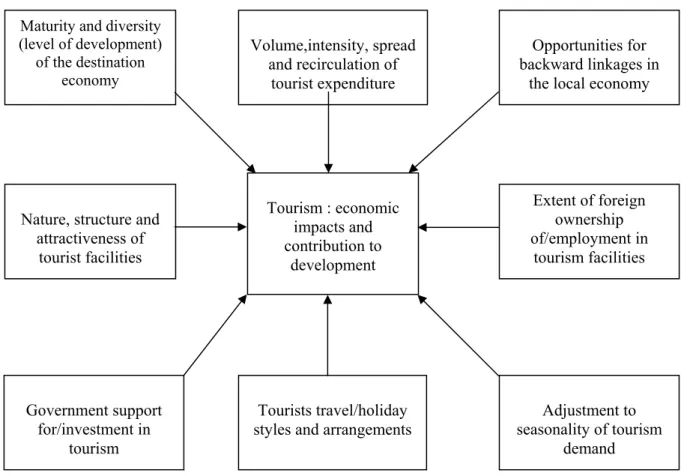
Tourism undoubtedly makes a measurable contribution to destination economies. The table below which is adapted from Lea and Mathieson & Wall shows the factors that influence the economic impacts of tourism.
Figure 2.1 Factors that influence the economic impacts of tourism. ( Adapted from Lea(1988); Wall and Mathieson (2006 : 90) Lea, J. (1988).”Tourism and Development in The Third World”. London: Routledge. Wall, G., Mathieson, A. (2006). Tourism: Change, Impacts and Opportunities.
Pearson.) 2.5.0 Socio-Cultural Impacts
There are made many survey researches and case studies at destinations in order to demonstrate the socio-cultural changes as a result of tourism. There is a general consensus about the association of tourism development consistently with certain cultural impacts. Also, Mathieson and Wall(1982) in their pionering book, highlighted the nature of tourist
Tourism : economic impacts and contribution to development Extent of foreign ownership of/employment in tourism facilities Nature, structure and
attractiveness of tourist facilities Volume,intensity, spread and recirculation of tourist expenditure Opportunities for backward linkages in
the local economy Maturity and diversity
(level of development) of the destination
economy
Tourists travel/holiday styles and arrangements Government support for/investment in tourism Adjustment to seasonality of tourism demand
impacts in both physical and socio-cultural terms. These socio-cultural impacts result from two main sources:visitor interaction with residents and the destination, and the development of infrastructure (Keogh, 1989). The type and the amount of impact can vary greatly depending on the characteristics of the destination and characteristics of the visitor (Butler, 1974; Mason, 2003). According to WTO, socio-cultural impacts are more evident in tourist destinations in developing countries, where the difference in cultural and economic characteristics between local people and, primarily, relatively wealthy Western tourists is likely to be greatest.
UNESCO study(1976) also shows the relationship between hosts and guests which is characterized by four major features by First, they involve transitory relationships. Visitors are only in a community for a short period, so any interaction between hosts and guests has little chance to progress beyond casual and superficial levels. Second, there are temporal and spatial constraints to visitor-host interaction.Visits are usually seasonal and non-repeated events, so the hospitality business often becomes exploitative to take advantage of this situation. Tourism facilities and services are frequently concentrated in a few locations, due to the locational pull of outstanding attractions and the destination community’s desire to minimize the disruption of other activities. Third, with the development of mass tourism visitor-resident meetings lack the spontaneity associated with individual schedules. Most contacts are now arranged via package tours, planned attractions, or even ‘arranged’ meetings. Such meetings are controlled events and often become commercial arrangements. Fourth, when visitors and residents meet it is generally an unequal and unbalanced experience. Residents often feel inferior when they compare their situation to a visitor’s apperant wealth and can become resentful at the contrast. Furthermore, the visitor is on holiday and enjoying novel experiences while for the residents such events have become routine, and represent work not fun.
2.6.0 Current developments and forecasts by WTO
WTO reports the following datas about the tourism sector.
• Worldwide arrivals reached 842 million in 2006, representing a 4.6% year on year growth.
• 2007 looks set to be the fourth consecutive year of sustained growth for a global tourism industry that continues to show its resilience to any natural or man-made crises.
• UNWTO predicts a 4% growth of international tourist arrivals in 2007, in line with its long-term forecast growth rate through to 2020 of 4.1%.
• By 2020 international arrivals are expected to surpass 1.5 billion people.
2.7.0 Key Players in Tourism Industry
The World Tourism Organization reports the following ten countries as the most visited in between 2006 and 2008 by number of international travelers. Most of the top visited countries belongs the European continent. When compared to 2006, Ukraine entered the top ten list, surpassing Russia, Austria and Mexico, and in 2008 surpassed Germany. In 2008 the U.S. displaced Spain from the second place.
Table 2.1 Key players in tourism industry Rank Country Regional Market International Tourist Arrivals (2008) International Tourist Arrivals (2007) International Tourist Arrivals (2006)
1 France Europe 79.3 million 81.9 million 78.9 million
2 United States North America 58.0 million 56.0 million 51.0 million
3 Spain Europe 57.3 million 58.7 million 58.2 million
4 China Asia 53.0 million 54.7 million 49.9 million
5 Italy Europe 42.7 million 43.7 million 41.1 million
6 United Kingdom
Europe 30.2 million 30.9 million 30.7 million
7 Ukraine Europe 25.4 million 23.1 million 18.9 million
8 Turkey Europe 25.0 million 22.2 million 18.9 million
9 Germany Europe 24.9 million 24.4 million 23.5 million
10 Mexico North America 22.6 million 21.4 million 21.4 million (http://docsonline.wto.org.)
2.8.0 Top Earners of Tourism Industry
In 2008, there were over 922 million international tourist arrivals, with a growth of 1.9% as compared to 2007. International tourism receipts grew to US$944 billion in 2008, corresponding to an increase in real terms of 1.8% on 2007. Total receipts in 2008 reached a record of US$1.1 trillion, or over US$3 billion a day when the export value of international passenger transport receipts is accounted for.
The World Tourism Organization reports the following countries as the top ten tourism earners for the year 2008. It is noticeable that most of them are on the European continent, but the United States continues to be the top earner.
Table 2.2 Top earners of tourism industry (http://docsonline.wto.org.) Rank Country Regional Market International Tourism Receipts (2008) International Tourism Receipts (2007) International Tourist Receipts (2006)
1 United States North
America
$ 110.1 billion $96.7 billion $85.7 billion 2 Spain Europe $ 61.6 billion $57.6 billion $51.1 billion 3 France Europe $ 55.6 billion $54.3 billion $46.3 billion 4 Italy Europe $ 45.7 billion $42.7 billion $38.1 billion
5 China Asia $ 40.8 billion $37.2 billion $33.9 billion
6 Germany Europe $ 40.0 billion $36.0 billion $32.8 billion 7 United
Kingdom
Europe $ 36.0 billion $38.6 billion $33.7 billion 8 Australia Ocenia $ 24.7 billion $22.3 billion $17.8 billion 9 Turkey Europe $ 22.0 billion $18.5 billion $16.9 billion 10 Austria Europe $ 21.8 billion $18.9 billion $16.6 billion
CHAPTER 3: TURKISH TOURISM INDUSTRY
3.0.0 Overview
Turkey with its natural and historical richnnesses is one of the most favourable destination for tourists. Especially, the developments after 1980 made Turkey as a one of the key players and top earners in tourism. In this chapter, the recent developments of Turkish tourism, tourism organisation in Turkey and the role of tourism in Turkish economy will be explained by theoratically and statistacally.
3.1.0 Recent Developments
For the last two decades, the number of tourists visiting Turkey has been steadily rising. This can be attributed to integration of Turkey with the modern world, free market economy, and the advertising efforts of the government(Yaya, 2008). On the other hand, Turkey has made considerable investments on infra and super structure. Upgrades to airports and roads in the 1990s, have made many types of tourism more affordable. In addition to the international airports in the main cities and resort destinations, there has been an increase too in the number of scheduled and charter flights to all major cities and tourist centres. The highways crisscrossing the entire country; regular comfortable bus services and coach tours make travelling in Turkey easy and enjoyable. The transport infrastructure and the efficiency of services as well as advanced communication network system meet all the requirements of contemporary tourism.
In addition to these efforts, developments in accomodation industry for last decades can not be ignorable. There are build many super modern deluxe category hotels and holiday complexes, summer resort hotels, city hotels which includes variety of recreation, entertainment facilities. There are also a number of ski, winter resorts, spa hotels and golf hotels in many parts of the country.
While sun and sand make up the backbone of the tourism industry for Turkey, the government, along with the private sector, is planning for the future. Also, travel industry
players are upgrading facilities, training staff and diversifying Turkey's tourism product, targeting niche markets such as yacht charters, golf and, surprisingly, skiing. In line with its other economic reforms, the government is encouraging foreign and other entrepreneurs to invest in tourism infrastructure, by offering low-interest loans and releasing land for economic development.
TURSAB points out that there is in fact a huge development potential for Turkey to increase its share in various market segments, and to further diversify its tourism because Turkey has a great diversity of its natural resources, historical treasures, cultural values and activities, life style, attractions and with its efficient, dynamic tourist industry offers wide selection of products that can satisfy the demand of different market segments including the most sophisticated and demanding traveller. Turkish tourism seems so very bright and it will continue to grow at a higher rate than the European and the world average.
3.2.0 Tourism in the Economy
Tourism is one of the most dynamic and fastest developing sectors in Turkey and has been playing an important role in the Turkish economy since 1980s. Tourism in Turkey has emerged as an enormous branch of industry with its approximately US$20 billion annual foreign exchange earning and direct and indirect employment opportunities it provides for more than 3 million people. Statistical datas indicate that there has been a rapid growth in Turkish tourism in volume and value since 1980’s. Tourist arrivals were measured at 200,000 in 1963 and 1,341,500 in 1973, which is a 570% increase in a ten-year period. Between 1974 and 1984, international tourist arrivals increased by 90%. International arrivals gained speed between 1984 and 1994 by 206%, and in 2001 11,619,909 foreigners visited Turkey, an increase of 11% from the previous year. Similar growth trends have also been observed in bed capacity and tourism revenues. Tourism revenues were US$7.7 million in 1963. For 2001, this figure was estimated to be some US$8.1 billion. Bed capacity and number of lodging establishments were 28,354 and 292 respectively in 1970, and these reached 331,023 and 1911 respectively in 2000.
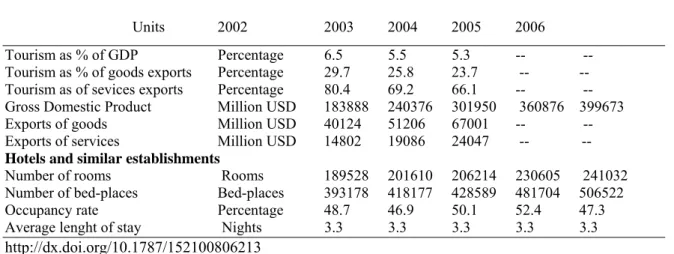
Table 3.1 Tourism in the national economy
Units 2002 2003 2004 2005 2006
Tourism as % of GDP Percentage 6.5 5.5 5.3 -- -- Tourism as % of goods exports Percentage 29.7 25.8 23.7 -- -- Tourism as of sevices exports Percentage 80.4 69.2 66.1 -- -- Gross Domestic Product Million USD 183888 240376 301950 360876 399673 Exports of goods Million USD 40124 51206 67001 -- -- Exports of services Million USD 14802 19086 24047 -- --
Hotels and similar establishments
Number of rooms Rooms 189528 201610 206214 230605 241032 Number of bed-places Bed-places 393178 418177 428589 481704 506522 Occupancy rate Percentage 48.7 46.9 50.1 52.4 47.3 Average lenght of stay Nights 3.3 3.3 3.3 3.3 3.3 http://dx.doi.org/10.1787/152100806213
(Ministry of Culture and Tourism, 2007).
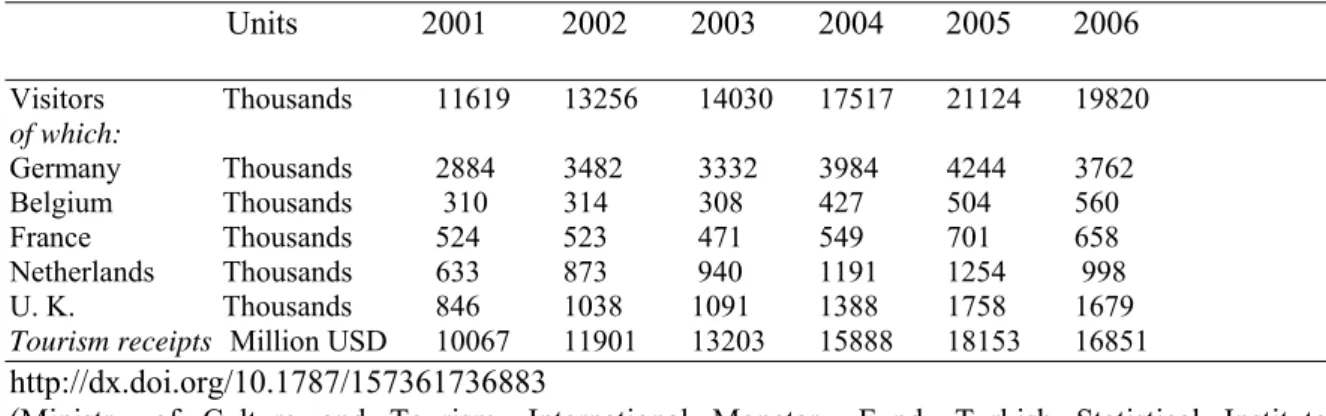
Foreign tourist arrivals increased substantially in Turkey between 2002 and 2005, from 12.8 million to 21.2 million, which made Turkey a top-10 destination in the world for foreign visitors. 2005 revenues are US$17.5 billion which also made Turkey the top-10 biggest revenue owners in the world. In 2004, tourism contributed some 5.3% to Turkish GDP, and accounted for 66% of the value services exports and 24% of the value of goods exports. In all three measures, the relative importance of tourism declined in the period 2002-04. The table 3.1 shows the contribution of tourism to national economy between 2002 and 2006. International arrivals in 2006 were, at 19.8 million, 6.2% down on 2005 (which had been a record year, recording 21.1 million arrivals, 20.6% above the level recorded in 2004). In 2006, 59% of foreign visitors came from OECD countries(60.3% in 2005), with 5.6 million or 28.3% coming from Eastern Europe. The leading origin market for Turkey in 2006 was Germany, which contributed 19% of total arrivals, followed by the Russian Federation with 9.4% and the UK with 8.5%.
International tourism receipts in 2006 were USD 16 851 million (7.2% down on the previous year), of which USD 4.3 million was spent by Turkish citizens resident abroad but returning to visit their homeland. The table below(Table 3.2) shows the international arrivals and the international tourism receipts in Turkey between 2001 and 2006.
Table 3.2 Inbound tourism: International arrivals and receipts Units 2001 2002 2003 2004 2005 2006 Visitors Thousands 11619 13256 14030 17517 21124 19820 of which: Germany Thousands 2884 3482 3332 3984 4244 3762 Belgium Thousands 310 314 308 427 504 560 France Thousands 524 523 471 549 701 658 Netherlands Thousands 633 873 940 1191 1254 998 U. K. Thousands 846 1038 1091 1388 1758 1679
Tourism receipts Million USD 10067 11901 13203 15888 18153 16851
http://dx.doi.org/10.1787/157361736883
(Ministry of Culture and Tourism, International Monetary Fund, Turkish Statistical Institute (TURKSTAT), 2007).
3.3.0 Domestic Tourism in Turkey
During the last two decades tourism in Turkey has become a mass industry concentrated in the western and southern coastal areas. TURSAB(1998) reported that over US$ five billion was spent by domestic tourists in 1997. According to Ministry of Tourism(2001a), the vast majority of domestic tourists (66%) visited the coastal regions such as Aegean(24%), Marmara(25%), and Mediterranean(17%), and only a small percentage of them(25%) visited non-coastal regions, including Central(16%), Eastern(4%) and Southeast(5%) Anatolia.
According to Ghimire (2001), the contribution of domestic tourism - that is, people consuming tourism in their own countries – can make to sustainable development. Domestic tourism provides many of the benefits of international tourism, such as employment, income, new business development and economic diversification. In Turkey, domestic tourism is a growing sector and a potential contributor to regional development (Seckelman, 2002). However a careful evaluation of the domestic tourism demand structure suggests that ‘domestic tourism is almost as concentrated in the coastal areas as foreign tourism in Turkey ( Seckelmann, 2002;89).
With respect to statistics, in 1983, 6.4 million Turkish citizens travelled within the boundries of Turkey, this number reached approximately 16.4 million Turkish citizens in 2001. TURSAB points out in the profile of domestic travel market for Turkey that almost
one out of four people travel domestically in Turkey each year. According to Olali(1993, p.63), some of the reasons of increasing domestic travel rate in Turkey; increasing income levels, transportation have been improving to meet the needs of international travellers, Turkish citizens are more educated and cultured than before; and the number of lodging operations has been increasing. According to TURSAB(2003a) the number of travel agencies is 4,494 which help to make travel chepaer and more available than before for Turkish citizens.
3.4.0 Tourism Organisation in Turkey
In order for the Tourism Strategy of Turkey 2023 is to be carried out, the correct institutional arrangements are crucial. The roles and responsibilities of inter and intra-organisational actors in Turkey are as follows.
The National Tourism Council is a guiding and decision making body for determining policies, and realising the implementation of the Turkish tourism strategy. This body, managed by a board of executives, consists of 15-20 members, qualified to represent all shareholders in the industry. It is composed of delegations from the Ministry of Culture and Tourism, the State Planning Organisation and a group of representatives from the tourism industry. The Council’s duties are as follows:
• Creating national, regional and local brands and co-ordinating efforts to market tourism centers.
• Making all necessary arrangements to ensure that the positive impacts of tourism are received by all, in line with the development of domestic tourism.
• Setting out the minimum quality standards applicable to accomodation facilities, products and labour in the travel and tourism industry.
• Diversifying the tourism product.
• Supporting business enterprises through in-service training.
• Carrying out research and compiling and preparing data for use by the Ministry of Culture and Tourism in the policy-making process.
• Measuring and monitoring the consistency of tourism policies and informing the Ministry of Tourism and Culture and Tourism of the results.
• Making suggestions to guide the Ministry in crisis management.
The State Planning Organisation takes full responsibility and plays an active role in the industry’s development by being a member of the National Tourism Council. The Ministry of Culture and Tourism has a regulatory role in tourism and is responsible for the planning, implementation, documentation, and orientation of tourism education. The Ministry is thus the main regulatory, supervisory and directing body.
The General Directotare of Promotion (GDOP) within the Ministry, operates 36 offices worldwide and carries out marketing and advertising activities. The GDOP’s role, based on market trend assessments and a detailed knowledge of the tourism product, is to carry out strategic marketing activities. It has defined the main points for its activities in the future, which will be based on: funding, market identification, market research, goal setting, marketing and promotion, measuring the effectiveness of marketing initiatives and encouraging year-round tourism.
Figure 3.1 Organisational Chart of Tourism Bodies in Turkey ( OECD, adapted from Ministry of Culture and Tourism, 2007.)
CHAPTER 4: CONSUMER BEHAVIOUR IN TOURISM
4.0.0 Overview
Consumer behaviour is the study of when, why, how, where and what people do or do not buy products. This consumer buying process is a complex matter as many internal and external factors have an impact on the buying decisions of the consumer. These chapter attemts to explain decision process, purchase decision, and postpurchase behavior of tourism consumption. In addition, characteristics of tourism consumers such as demographics and behavioural variables, and other factors which influence the consumer behaviour will be analyzed. The importance of positive post-purchase phenomenons such as satisfaction, repurchase intention which lead to loyalty will be explained in the end of the chapter. Loyalty is the reward of repurchasing and it is the opposite phenomenon of brand switch behavior. Like the two sides of a coin, the results of loyalty explain only half of the repurchase phenomena. In order to have a greater understanding the issue, we have to know both why people purchase certain products repeatedly and also why people switch from one product to another.
4.1.0 General Profile to Tourist Consumer Behaviour
Consumer behavior has been defined by Engel, Blakwell and Miniard(1995) as those activities directly involved in obtaining, consuming, and disposing of products and services including the decision processes that precedes and follows these actions. Solomon(1996) defines consumer behavior by incorporating the concept of consumer needs and wants as the process involved when individuls or groups select, purchase, use, or dispose of products, services, ideas or experiences to satisfy needs and wants. On the other hand, Horner and Swarbrooke (1996) have defined consumer behavior in tourism as the study of why people buy the product they do, and how they make their decision. Similarly, Foxall and Goldsmith suggest that consumer behavior is a sequence of problem solving stages as follows: the development and perception of a want or need, pre-purchase planning and decision making, the purchase act itself and post-purchase behavior which may lead to repeat buying, repeat sales and disposition of the product after consumption.
In spite of these definitions of consumer behavior, Schmoll (1977) hypothesized that consumer decisions in tourism were result of four elements:
1. Travel stimuli, including guide books, reports from other travellers and advertising and promotion
2. Personal and social determinants of travel behaviour including motivators, desires and expectations
3. External variables, including destination image, confidence in travel trade intermediaries and constraints such as money and time
4. Characteristics and the features of the service destination such as the perceived link between cost and value and the range of attractions and amenities offered.
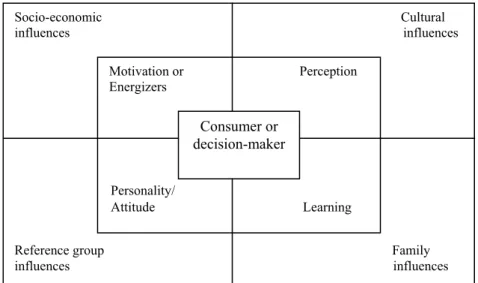
Tourim is a service rather than a product which may have a considerable effect on consumer behavior. An in-depth exploration of psychological concepts such as attitudes, decision making processes, emotions, experience and satisfaction or loyalty is necessary for understanding the consumer psychology of tourism, hospitality and leisure (Crouch, Perdue, Timmermans and Uysal, 2004). Because of this, many researchers developed consumer behaviour models in order to have a deeper insight of consumer behaviour in tourism. According to Gilbert model (Figure 4.1), there are two levels of forces which are effective on consumer behaviour. The first level include psychological factors such as perception and learning. The second level include forces such as reference groups and family influences which lead the socialization process.
Figure 4.1 Consumer Decision Making Framework (Gilbert, D.C. (1991). “An Examination of the Consumer Behavior Process Related to Tourism.)
Socio-economic Cultural
influences influences
Reference group Family
influences influences Motivation or Perception Energizers Personality/ Attitude Learning Consumer or decision-maker
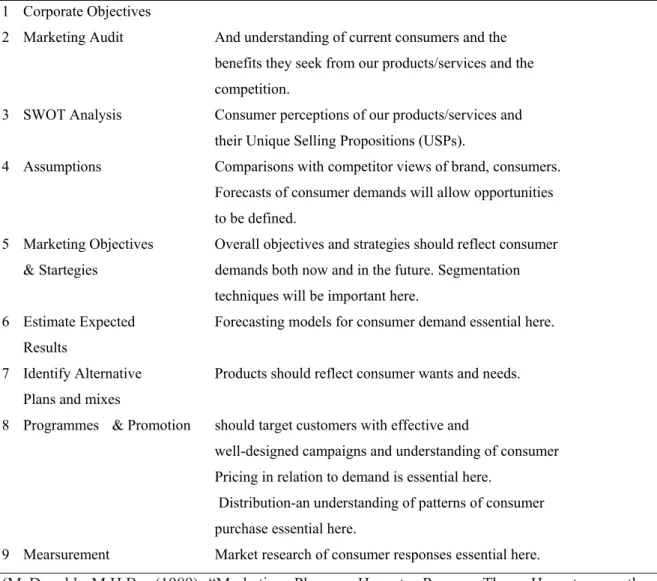
In the case of practical implications, the understanding of consumer behaviour will allow a more effective marketing planning process. Calantone and Mazanec (1991) outlined the value of consumer behavior for the marketing management process in tourism. An understanding of consumer needs, attitudes and decision processes will allow the marketing manager to improve thier decision making process. It will allow the marketing manager to forecast behavior in the future and therefore avoid over-optimism or underestimates of consumer demand (Calantone, di Benedetto and Bojanic, 1987,1988). The marketing planning process and the usefulness of an understanding of consumer behaviour is seen at the table which is adapted from McDonald (1989).
Table 4.1 The role of consumer behaviour in marketing process. 1 Corporate Objectives
2 Marketing Audit And understanding of current consumers and the benefits they seek from our products/services and the competition.
3 SWOT Analysis Consumer perceptions of our products/services and their Unique Selling Propositions (USPs).
4 Assumptions Comparisons with competitor views of brand, consumers. Forecasts of consumer demands will allow opportunities to be defined.
5 Marketing Objectives Overall objectives and strategies should reflect consumer & Startegies demands both now and in the future. Segmentation techniques will be important here.
6 Estimate Expected Forecasting models for consumer demand essential here. Results
7 Identify Alternative Products should reflect consumer wants and needs. Plans and mixes
8 Programmes & Promotion should target customers with effective and well-designed campaigns and understanding of consumer
Pricing in relation to demand is essential here.
Distribution-an understanding of patterns of consumer purchase essential here.
9 Mearsurement Market research of consumer responses essential here.
(McDonald, M.H.B., (1989) “Marketing Plans – How to Prepare Them How to use them “ Heinemann, London).
4.2.0 Tourism Demand and Consumption
Tourism demand or consumption is very complex process. The demand process is influenced by many internal and external variables, such as money and time constraints, social stimuli, media influences, destination image. Researchers make explanations about tourism demand in the form of the notions of consumption from different points of view. According to Sinclair and Stabler (1997) , demand and expenditure on tourism have been investigated by a wide variety of economic studies, focusing on the effect of income, prices and information. On the other hand, Pearce (1995: 18) saw demand in a broader behavioural concept ‘in terms of the relationship between an individuals motivation to travel and their ability to do so’. He also described the tourist demand as ‘discreationary, episodic, future-oriented, dynamic, socially-influenced and evolving’. In contrast, Hall and Page (1999: 51) argue that, ‘geographers view demand in a uniquely spatial manner’.
Furthermore, Cooper et al. (2005;53) summarizes the factors which influences the demand process:
1- Energizers of demand. These are the forces and influences (or personal push factors ) that collectively create the motivation to travel or go on holiday, or initiate the demand process.
2- Effectors of demand. The information search /evaluation process and subsequent purchase decision is influenced by the tourist’s knowledge and perceptions of particular places, destinations or experiences. These are sometimes referred to as destinational ‘pull’factors which lead the tourist to making particular travel choices. 3- Filteres/determinants of demand. A variety of economic, social and demographic
factors determine particular choices or ‘filter out’ inappropriate products. These include: mobility; employment and income; paid holiday entitlement; education levels; and age, gender, race and stage in family life cycle. In addition, choice may be determined by intangible, pschographic variables, such as attitudes, values and lifestyle.
4- Roles. Holiday and travel choices are also influenced by roles within the purchasing ‘unit’ (for example, the different roles adopted by family members in choosing a holiday) and as tourists.
On the other hand, Urry (1995:129) sought to outline a sociology of consumption ‘concerned with the differential purchase, use and symbolic signicance of material objects’, but more especially the consumption of tourism, a signicant feature of which is the ability to buy time and replace work with leisure activities. In his earlier studies, Urry argues that disorganized capital increasingly involves the dissolving of ‘tourism’s specifity’ when tourism as a form of consumption ‘starts to take over and organise much contemporary social and cultural experience’ (p.148). Urry also made many studies about the growth of new forms of tourism. He explained the process of shifting from mass package tourism to post- Fordist forms of tourism consumption (Table 4.2). There are still strong elements of ‘older’ or Fordist forms even there are signs of this shift in tourism consumption.
Table 4.2 The shift to post-Fordist consumption in tourism Post-Fordist consumption Tourist examples
Consumers increasingly dominant and Rejection of certain forms of mass tourism producers have to be much more (holiday camps and cheapre packaged holidays) consumer-oriented and increased diversity of preferences Greater volatility of consumer preferences Fewer repeat visits and the proliferation of alternative sights and attractions
Increased market segmentation The multiplication of types of holiday and visitor attractions based on life-style research
The growth of consumer movement Much more information provided about
alternative holidays attractions through the media
The development of many new products The rapid turnover of tourist sites and
each of which has a shorter life experiences because of rapid changes of fashion Increased preferences experienced for The growth of gren tourists and of forms of non- mass forms of production/ refreshment and accomodation which consumption are individually tailored to the consumer
(such as country house hotels)
Consumption as less and less The differentiation of tourism from leisure, functional and increasingly culture, retailing, education, sport, hobbies aestheticized (Urry, J. (1995). Consuming Places. London: Routledge)
4.3.0 Tourist Motivation
As a word meaning, motivation refers to the process by which an individual will be driven to act or behave in a certain way. It is characterized by a ‘state of tension within the individual which arouses, directs and maintains behaviour toward a goal’( Mullen and Johnson, 1990, p.178). Many internal and external motivators influence consumers in their decision-making process. Motivations for making holiday decision have been classified (Mathieson & Wall, 1982; Murphy, 1985) as:
i- physical (or physiological), e.g. search for relaxation, health, sport, or challange; ii- cultural, i.e. the wish to learn about foreign places;
iii- social, e.g. the visits made to friends and relatives, or for prestige or status reasons; and
iv- fantasy(or personal), i.e. escape from present reality
According to Mansfeld (1992: 10), different motivations lead to different spatial behaviours in the so-called tourist space. As parallel to this assumption, Cohen (1979) argued that different types of tourist have different motives for travelling. He also proposed that there are five different reasons for travel that are embodied within the tourist experience. These are; recrational, diversionary, experiential, experimental and existential. On the other hand, Pearce (1993: 113) explains, ‘tourist motivation is a hybrid concept’. Pearce (p.114)goes on to argue that, ‘some of the novel features pertaining to tourist motivation are that tourists select a time and place for their behaviour, often well in advance of the event’. Gnoth (1997) has linked tourism motivation to consumer behaviour models in an attempt to develop a more comprehensive perspective based on motivation and expectation. Tourist motivation is explored from a variety of perspectives because of the complexity of subject.
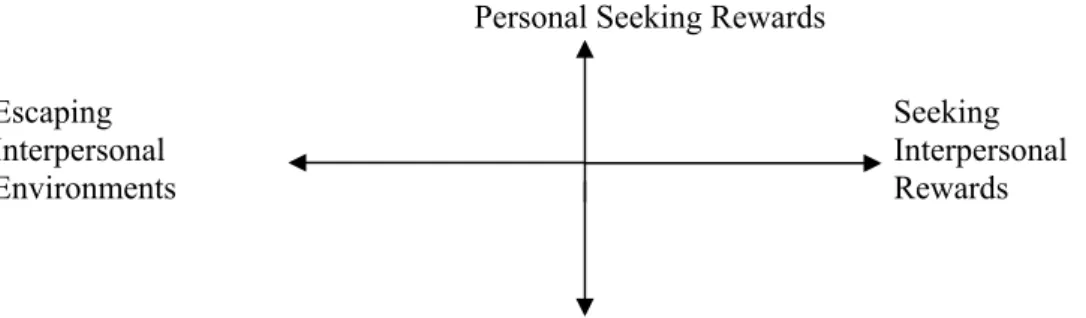
On the other hand, Mannel and Iso-Aloha(1987) identifies two main types of push and pull factors, personal and interpersonal. According to their suggestion people are motivated to travel in order to escape from the personal or interpersonal problems of the environment and to obtain compensating personal or interpersonal rewards. The personal rewards are mainly, self-determination, sence of competence, challange, learning, exploration and relaxation. The interpersonal rewards arise from social interaction.
Personal Seeking Rewards
Escaping Seeking
Interpersonal Interpersonal Environments Rewards
Escaping Personal Environments
Figure 4.2 The Escaping and Seeking Dimensions of Leisure Motivation
(Mannell RC, Iso-Aloha SE. (1987). “Psychological nature of leisure and tourism”experience” Annals of Tourism Research 124(2): 314–331.)
4.3.1 Dimensions of Tourist Motivation
4.3.1.1 Function or Utility; Emotion
This perpective has focused on identifying a series of underlying structures relating to both ‘push’ and ‘pull’ factors of motivation. In these approaches motives are linked to needs. According to Crompton’s (1979) there are two categories of motivation; socio-physical or push motivators (a combination of the natural and social environments) and cultural or pull motivators. Physical motivators are the search for improvement of mind and body: convalescence for health problems; exercise through golfing, playing tennis, and hiking; and relief from psychological enervation by searching out the exciting, the romantic, or the entertaining. There are also pull factors such as stimuli for new places and attractions of new destinations, curiosity about unusual places and foreign locales.
In addition to push and pull factors for motivation, personal motivation is affective for taking a holiday decision. Most basic form of personal motivation is to visit family or friends. Other personal motivations include the desires: to experience new places and people, to make new friends, desire to escape from home and work environment, and daily routine, and to travel.
4.3.1.2 Self or Identity
The concept of self or identity are also important motivative factors. Russel Belk notes that external objects to which individuals are affectively attached and which are considered as parts of individuality comprise the extended self (Belk, 1988) and these objects are highly congruent with the individual’s sense of self. When every holiday in the choice list offers the same utility or meta-experiential options, consumer behavior becomes an identity project (Thompson and Tambiah, 1999) and identity almost wholly determines the purchase decision (Holcomb, 1999).
4.3.1.3 Symbolism or Context
Purchasing a holiday may be seen as a way to raise one’s prestige or status. In addition, the socio-cultural context predominantly defines what is prestigious. Prestige is normally accomplished by fostering socially preferable associations with people, places, or events. Prestige enhancement may also be through the pursuit of hobbies, continuation of education, ego enhancement, and sexual indulgence.
Furthermore, this motivation could also include simply doing what is in fashion. In this regard, Bourdieu’s (1984) reflection that consumption in modern societies acts as a symbolic statement about consumers as individuals and about their lifestyles and in this way consumption encourages differentiation based on symbolic capital is extremely significant.
4.4.0 Tourist Typologies
There are many types of tourists who have different demands of a destination. Tourist typologies are descriptors of distinctive forms of tourist consumer behaviour. They reflect different motivations, interests and styles of travel on the part of tourists. Most of the typologies attempt to group tourists according to their preferences in terms of destinations, activities while on holiday, independent travel versus package holidays. The purpose of these typologies is to divide the tourists into the different groups in order to find out what the specific tourist want.
The increasing of number and specifity of typologies started by the end of the Second World War, as a result of the scientification of tourism progressed. First of all, Plog(1964) classified tourists according to destinations they prefer. He argued that there was a continuum between types of tourists from the allocentric to the psychocentric tourist. The allocentric tourists seek new destinations, and are prepared to take risks in searching for new cultures and places. On the other hand psychocentric tourists seek the familiar, and are happier in an environment where there are many likeminded tourists. They are not risk takers and adhere to the proven product, being conservative in choice.
During the 1970s typologies based on age and economy dominated led by Cohen(1972) whose initial typology established two non-intitutionalized roles as drifter and Explorer, and two intitutionalized types, organized mass tourists and individual mass tourists.
1.organized mass tourist: These are the least adventurous tourists. On buying their package holiday they remain encapsulated in an ‘environmental bubble’ , divorced from the host community as they remain primarily in the hotel complex. They adhere to an itinenary fixed by the tour operators, and even their trips out of the complex are organised tours. They make few decisions about their holiday.
2.Individual mass tourist: They are similar to organised mass tourists in that they utilise the facilities made available by the tour operator, but they have some control over their own itinarary. They may use the hotel as a base and hire a car for thier own trips. However, many will tend to visit the same places as the mass organised tourist in that they will visit the ‘sights’.
3.Explorer: The explorer arranges his or her trip alone, and attempts to get off the beaten track. Yet such tourists will still have recourse to comfortable tourist accomodation. However, much of their travel will be associated with a motivation to associate with the local people, and they will often speak the language of the host community. Nonetheless, the explorer retains many of the basic routines of his or own lifestyle.
identifiy with the host community. Drifters will live with the locals and adopt many of the practices of that community. Income is generated by working with the community, but often through low-skilled work, which creates a tendency to mix with the lower socio-economic groups.
Cohen(1979) also summarised five modes of touristic experience: recreational, diversionary, experiental, experimental and existential.
Furthermore, Valene Smith(1977) described the demographic aspects of tourism, in seven levels as:
1-Explorer: very limited numbers looking for discovery and involvement with local people. 2-Elite: special individually tailored visits to exotic places.
3-Off-beat: the desire to get away from the crowds.
4-Unusual: the visit with peculiar objectives such as physical danger or isolation.
5-Incipient mass: a steady flow travelling alone or in small organized groups using some shared services.
6-Mass: the general packaged tour market leading to tourist enclaves overseas.
7-Charter: mass travel to relaxion destinations which incorparate as many standardized western faclilities as possible.
Further, she defined five destination interests and motivations: ethnic, cultural, historical, environmental and recreational.
During 1980s typologied extended and included historic types such as the Grand Tour, north-south tourism, and long-term youth and budget travel, some of which is self-testing(Riley, 1988). Graburn(1983) differentiated two types of contemprory tourism, as the annual vacation or holiday break and the rites of passage tourism associated with major changes in status such as adulthood or career changes.
In decade of 1990, the importance of the links between lifestyle and consumption patterns was increasingly recognized through the construction of broader sets of typologies. Because of this, Gratton(1990), Cooper et al.(1998), Shaw and Williams(2002) and Schott(2002) have all rewieved or applied value and lifestyle typologies to understanding
of tourism trends. Environmental concerns generated numerous new tourist types related to ‘appropriate’ or alternative tourism, such as ecotourists or green tourists (Smith and Eadington, 1992). Postmodernism has dominated the 1990s with renewed interests in levels of reality (Urry, 1990), concerns with levels of carrying capacity and sustainability, and types of tourist lifestyle and behaviour experiences (Mazanec et al., 1998).
Despite their limitations, the tourist typology models are useful because of the fact that they highlight the broad diversity of tourists, in addition they provide an insight into the motivations of tourists and their behaviour and it is a way to segment tourists into different groups.
4.5.0 Decision Making
As a result of higher levels of disposable income, greater leisure time, improved opportunities for mobility, better education, having more sophisticated tastes and flow of information easily people’ attitudes about their holidays start to change. However potential tourists are lost in options due to the fact that there are variety of destinations in many countries, huge number of holiday types, flexibility of travel, accomodations and timing arrangements. Tourists most possibly favour those holidays which offers the fullest realisations of their expectations between these so many choice. Chon(1990) explains decision-making process as a complex process consisting of the following stages: 1-)The recognition of needs. The tourist believes that a holiday purchase will satisfy his or her needs. The tourist has now tentatively decided to go on holiday. Now she/he must decide where to go. 2-)Deciding where to go. This process involves: information searches, the evaluation of alternatives, the choice of a product and post-purchase evaluation
The decision-making process has been conceived in a variety of ways. Buying a holiday is for many individuals and families high-risk decision, the planning stage assumes a major role (Gitelson and Crompton, 1983). On the contrary of retail purchases, a holiday purchase is a highly risky because there is no chance for tourists to observe directly what is being bought nor try it. Also previous experience of holiday-maker does not gurantee the future satisfaction. The degree of planning varies between different types of tourists. The
planning of holiday incuding decisions whether to go and where to go generally takes place over a long time as a result of systematic process. Systematic information search of external sources is used much more frequently in making holiday and travel-related decisions to purchase most of other types of product( Gitelson & Crompton, 1983). It should be emphasized the factors that lead an individual to decide on a holiday, variables that may suppress or heighten such factors, and the roles that family members or others may play in the holiday decision process (Hall and Page, 1999). Howard and Sheth (1969) also drew attention to the infuence of socio-environmental variables, on the other hand Crompton (1993) explored the importance of imagery and marketing. Ryan (1997) has attempted to conceptualize the whole decision- making process in terms of a model of ‘the tourist experience’. In addition, a linear model of tourism decision-making process which is adapted from Wahab, Crampton and Rothfield(1976) suggested that all decision making goes through the same process and goes through the same steps.
Initial framework Conceptual alternatives Fact gathering Definition of assumptions Design of stimulus Forecast of consequences Cost
benefits of alternatives Decision Outcome
Figure 4.3 A Linear Model of Tourism Decision-Making Process
(Wahab S., Crampton L. J. and Rothfield L.M. (1976). Tourism marketing, London: Tourism International Press).
4.5.1 Influential Factors on Decision Making
4.5.1.1 Media and Tourism Destination Image
The evaluation or selection process of individual’s choice of destination and holiday type are strongly infuenced by the media and images projected of various destinations. Each tourist has a certain level of mental images about their ideal holiday, influenced by their motives. Many researchers have a consensus that that the image is a valuable concept for understanding the process of selection of a destination by tourists. According to Goodall (1988: 3), this ‘conditions their expectations setting an aspiration level or evaluative
image, against which actual holiday opportunities are compared’. Nolan (1976) states that the information on and images of holiday areas are provided by a large media industry (formal sources), and informal recommendations from friends. In many cases, the combination of these formal and informal sources constitute the mental image which provide the basis for holiday selection.
The concept of image was defined by many researchers. Fakeye and Crompton (1991) defines image as a mental schema developed by a tourist on the basis of a few impressions selected from among a flood of all impressions. Bigne´ and Andreu (2000) emphasized the importance of image as a “the competitive advantages will no longer lie in the quality of the visible attributes of products, but in those that are not easy to imitate, in intangible resources rather than tangible ones and in particular, a large part of these intangible resources are centred on service and image.” Tourists, on their first visit to a destination, or on a repeat visit, will perceive a primary image of the place (Beerli et al., 2002), which will enable them to have a more general perception, as the number of visits made and the time spent there substantially influence the formation of the image of the destination (Baloglu and Mangaloglu, 2001).
Also, the image of the tourism destination is a complex construct. Variety of components such as natural and scenic resources, accessibility, cultural resources, security, night life and entertainment, and quality/price ratio, environmental factors, geographical conditions, climate of a destination help potential tourists to form a certain image of tourist destination.
Tourism destination image is crucial for tourism industry because it has direct consequences on the satisfaction experienced by tourists and their loyalty to the tourism destination. Image has elements allowing destinations to make strategic and marketing decisions. The key objective in generating and commercializing a successful destination image is that tourists’ perception of the destination should correspond to the one that the marketing managers have tried to project (Andreu et al., 2000).
The image of a tourism destination is made up of both cognitive and affective dimensions. The interaction between cognition and affect has become a major line of research in recent years.