Haccucpe l'iniversitesi Egitim Fakiiltesi Dergisi (H. U. Joumal of Education) 43: 198-209 [20121
BASIC TRAINING AND PROFESSIONAL QUALIFICATIONS OF
TEACHERS IN BULGARIA AND TURKEY: A COMPARATIVE STUDY
TÜRKIYE VE BULGARiSTAN'DA ÖGRETMEN YETÍ$TÍRMEDE TEMEL
EGÍTÍM VE MESLEKl YETERLÍKLER: KARÇILAÇTIRMALI BÍR
ÇALIÇMA
Emilia EVGENIEVA* and §erife ARSLAN**
ABSTRACT: The professional qualification of teachers is a derivative of the career development system, the lifelong study
model, the expected efficiency of the leaming process and others. Motivating a teacher with regard to the need for continuous development depends on the order of the profession with respect to other professions, the remuneration, the satisfaction one gets from the accomplished work and other conditions. The purpose of this study is to discover the mode of interaction of these factors with continuous development phenomenon of every person, and to relate the accumulated experience of one's personal training at different stages with the project for career development of students with educational majors.
Keywords: learning culture, leaming strategies,, professional project
ÖZET: Ulusal egitim sistemlednin çagdaç sorunlan, küresel toplumun açik alaninda meydana gehnekte ve degiçmektedir. Ortak özcllikler, baçarilar ve aksakliklara dair arayiç, birçok uluslararasi çaliçma ve raporun odak noktasi olmuçtur. Bu makalede Pedagoji ögrencilerinin ögrenme sürecine iliçkin yaklaçimlanna dair çevirisi yapilmiç karçilaçtirmali bir çaliçmadan bir bölüm sunulmaktadir. Çaliçmada iki ana evre hakkinda veriler toplanmaktadir - lise egitimi ve université egitimi. Bu, pedagoji ögrencilerinin gelecegin ögretmenleri olarak gelecek kariyer planlarini gerçekleçtirmeye yönelik projelerin analizine olanak vermektedir. Bu çaliçma karçilaçtirmali bir çaliçmadir. Çahçma gmbu Turk ve Bulgar birinci sinif ögrencileridir. Çaliçma, 2011 yih Çubat - Haziran aylan arasinda yürütülmüctür.
Anahtar sözcfikler: ögrenme kültürü.ögrenme stratejileri, mesleki projeter
I. INTRODUCTION
In service and pre service teacher training are an important task of the contemporary education-related institutions. Nowadays, as the world stands before the hardships of a severe financial crisis, the matter is of exfreme significance. According to the UNESCO report (2010), the flnancial crisis may affect a large number of youth who have difficulties to reach education. This is why the contemporary world has the task to devote their utmost care to the education and prospedfy of the population if it desires to overcome the ddfring of the marginal groups and their low social activify. A vital part in solving the problem in this context is the continuous renewal of teacher training programs. The traditional school has dudng the past decade opened up to active life by means of receiving a significant autonomy and an opportunify to stmcture and develop its own policy. The world is changing. The processes of globalization and liberalization of 7 systems allow larger and larger communities of people to travel, select their field of professional career and their place to live. These dynamics have placed the school before a challenge which leads to reorganization of the system and to delegating the right to choose where to study to the students themselves, while allowing schools to select freely what they want to use in order to teach children and how to do it. Information technology itself has changed the needs of this exact same world. The daily life of each and every one of us has been burdened and/or relieved by the new devices - the mobile phone, the computer, trading, e-govemments and so on. The prospedfy of a sociefy is measured by the content and development of its IT infrastmcture, its virtual markets, developed and adopted patents and so on.
* Kliment Ohridski University, Bulgaria, eevgeniyevaiS.gmail.eom **Bilkent University, Turkey, arslan.serife(2),gmail.com
E.EVGENIEVA-§.ARSLAN I H. Ü. Egitim Fakültesi Dergisi (H. U. Joumal of Education), 43 (2012), 198-209
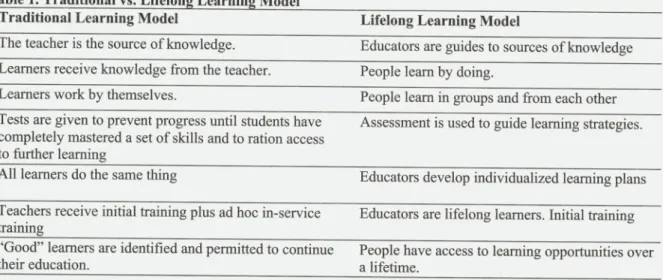
199 All this leads to the imperative acceptance of a new schooling content -that is the so-called Information and Communication Technology (ICT) that has slowly and offensively been taking up a larger and larger territory of the leaming space, taking over the functions of classical school material and changing the type of relationship between the teacher and the leamer. Such and other changes in time have established conditions suitable for talking about the forms and content of the teachers' basic training more actively, as well as their continuous training to come, conceming the change in their responsibility towards the effectiveness of the fulfilhnent of their activity in order to create a new philosophy in education. The European strategy for cooperation in the field of education and training is a part of a universal policy and has been developed as a result of an agreement on the program "Education and Training 2010" on European level, which took place in the beginning of this century. This program substantiates the significance of education and training for progress of the society and its economy. The agreement reached based on this program is established on the understanding that even though national governments are responsible for the education and training in their countries, some challenges are common for all member countries, such as the aging society, the shortage of contemporary skills and the insufficiency of working hand that has these contemporary skills, global competition, climate changes, etc. This makes it necessary to constmct a new strategy for leaming. Even in the earliest of documents related to its development, it is noted that both the quality of teacher qualification and the establishment of a new model for relationship are of vital essence. To do this, a new task is formulated for the teacher: to change the philosophy of his/her attitude towards the leamer and thus the profile of his/her social role. A comparative presentation of the specifics of the model of traditional leaming and those of lifelong leaming allows us to observe what this could look like (Table 1).
Table 1. Traditional vs. Lifelong Learning Model
Traditional Learning Model Lifelong Learning Model
The teacher is the source of knowledge. Educators are guides to sources of knowledge Leamers receive knowledge from the teacher. People leam by doing.
Learners work by themselves. People leam in groups and from each other Tests are given to prevent progress until students have
completely mastered a set of skills and to ration access to further leaming
Assessment is used to guide leaming strategies.
All leamers do the same thing Educators develop individualized leaming plans
Teachers receive initial training plus ad hoc in-service
training Educators are lifelong leamers. Initial training "Good" leamers are identified and permitted to continue
their education. People have access to leaming opportunities overa lifetime.
As a result of this comparison of approaches towards leaming, the training team of the World Bank (2003) motivates that the appearance of the modem teacher should change with regard to the following:
• Approach
• Attitude towards the leaming content • Refiectionof the role being fulfilled
It also analyzes that teachers and other educationalists in the system should change the following:
• Their stereotypes related to the "institutional frames" in action so far • Teaching methods during training
200 E.EVGENIEVA-§.ARSLAN I H. Ü. Egitim Fakühesi Dergisi (H. U. Journal of Education), 43 (2012), 198-209
Increasing the quality of education and training in EU countries is vital for the development and competitiveness of the community. In the Council's Information as of May 12, 2009, regarding the strategic frame for cooperation in the field of education and training (ECET 2020) the second strategic target is namely the enhancement of the quality of education and training. One of the tasks necessary for the achievement of this goal is "to provide high- quality teaching, to provide adequate initial education for the teachers, continuous professional development of the teachers and trainers and to tum teaching into an attractive career choice." In search for an opportunity to check how this happens at schools and in universities, in this exposé we decided to present data from different researches conducted and to trace how and to what extent the opinions of the respondents coincide. On one hand, a good overlap of opinions will show us where the visible characteristics of the systems are. On the other hand, it will also give us a hint on how to proceed if we plan steps for changing it. In the past few years, a series of intemational research has been conducted, clearly outlining the status of schools nowadays.
In this study, basic training and professional qualification of teachers in Bulgaria and Turkey were compared. This is why we have decided to ask freshman students with educational majors how they evaluate what's happening at school.
2. METHOD
2.1. Research Design
The study adopted a descriptive survey research design to find out basic training and professional qualification of teachers in Bulgaria and Turkey.
2.2. Sample
240 students from universities in Bulgaria and Turkey, aged between 18 to 20, participated in the survey.
2.3. Research Instruments
The attitudes of Pedagogy students on the significance of leaming, lifelong leaming and the link between basic education and vocational qualification were studied by means of a specially designed questionnaire of 41 questions. In this questionnaire, the questions seek to retrieve information regarding what the students enjoy in the process of teaching that they have participated in at schools or they arc participating in at the moment at the university. This information is collected through questions 1 to 23 in the questionnaire. The following questions ask the students what they know about the process of education (questions 24 to 38). The last part of the questions inquire about what the students undertake in order to create a successful project for themselves as future teachers (questions 39-41). A part of the collected data is presented for this analysis. There are two sets of questions. The first set of questions they answered were related to the assessment of the quality of study culture formed at school, of the ability of the teachers to direct their activity towards the individuality of the leamer, of the ability of the teachers to use IT devices during class, of the effective stimulation of the leamers' creativity during class. These four questions communicate directly with the posed characteristics of the new type of lesson which will form the skills and needs of leaming through the entire life span, presented earlier. In order to be sure that the replies were not random, the second set of questions on whether the culture of lifetime leaming is formed exactly at school and whether this has occurred along with their ability of informal leaming. We also asked them if there is a relation between the use of IT in class and leaming motivation and whether the teachers' use of more individual approaches in class will create more socially resistant leamers. The answers to these two sets of questions present an interesting picture. The fact that it is performed simultaneously in two
E.EVGENIEVA-^.ARSLAN I H. Ü. Egitim Fakültesi Dergisi (H. U. Journal of Education), 43 (2012), 198-209
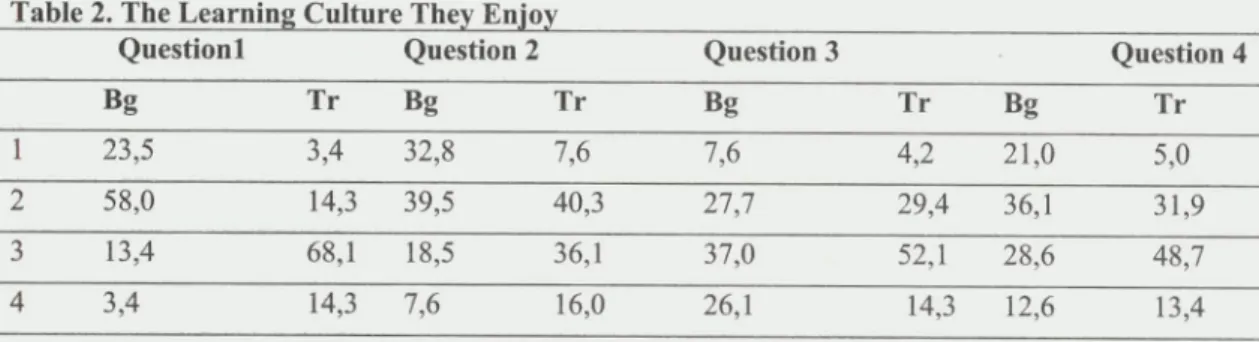
201 countries gives the opportunity to assess not only the differences, but also the resilience of the opinions of young people aged 18 to 20. The results are presented in Table 2.
Table 1 2 3 4 2. The Learning Questionl Bg 23,5 58,0 13,4 3,4 Culture Tr 3,4 14,3 68,1 14,3 They Enjoy Question 2 Bg 32,8 39,5 18,5 7,6 Tr 7,6 40,3 36,1 16,0 Question 3 Bg 7,6 27,7 37,0 26,1 Tr 4,2 29,4 52,1 14,3 Bg 21,0 36,1 28,6 12,6 Question 4 Tr 5,0 31,9 48,7 13,4
The following relativity is observed in the students' responses. The students from Turkey consider that the culture of leaming is formed "to a large extent" (68.1%) at school, whereas 58% of the Bulgarian students consider that it is formed at school "not so much". If we take a look at the table and observe the manner of distribution of this first question, we notice that Bulgarian students are generally more critical in their assessment than the Turkish ones. The Bulgarian students state that the leaming culture at schools is not well accepted (23.5%) whereas merely 3.4% of the Turkish students give this assessment. Relativity is also close with regard to the ones who have responded that the leaming culture is formed entirely at school, only 3.4% of the Bulgarian students believe that this takes place at school while this answer is chosen by 14.3% of the Turkish students
This difference in the final assessments may be interpreted in a different way. There possibly are various prerequisites the first of which could be the cultural differences, then the differences in the manner of management of the school system, the teacher's personal presence and so on. These prerequisites are not a subject of this analysis and any comment would not be useful. With regard to how much teaching is personality oriented towards the leamer, students share the same opinion. Students who agree "not so much" that teachers do exert effort in this direction are 39.5% fi-om Bulgaria and 40.3% fi-om Turkey. Additional verification of this answer can be found in the answers of thee teachers in the TALIS (2009) report. Being asked about the three methods they most fi-equently use in their work, teachers give the following answer (Fig. 1).
Fig. 1. Subject profiles of classroom teaching practices (2007-08), mean of ipsative scores among countries
We should remind that the methods used by the teachers are selected with complete autonomy. This is why the representation of the graphics shows that the main preference of the teacher remains the stmctured method. This confirms the opinion shared by the students - that they hardly focus their attention on the leamer's personality. This is a priority of the other two methods (leamer oriented and/or creative).The second group of questions aimed at checking how to define the meaning of the Lifelong Leaming and Informal Leaming policies on one hand, and how to define the influence of IT on the leamers' motivation to leam, in addition to the student personality oriented training for their social resilience. The results are in Table 3.
202 E.EVGENIEVA-§.ARSLAN I H. Ü. Egitim Fakültesi Dergisi (H. U. Journal of Education), 43 (2012), 198-209 Table
1 2 3
3. The Learning Culture They Are Familiar Question25 Bg Tr 12,90 15,32 23,39 43,55 41,94 29,84 Question Bg 5,65 19,35 33,87 26 Tr 3,23 26,61 41,94 With Question 27 Bg 4,84 16,94 50,81 Tr 4,84 19,35 50,00 Question 28 Bg 2,42 7,26 59,68 Tr 4,84 32,2 46,7 18,55 7,26 38,71 25,81 23,39 21,77 26,61 13,7
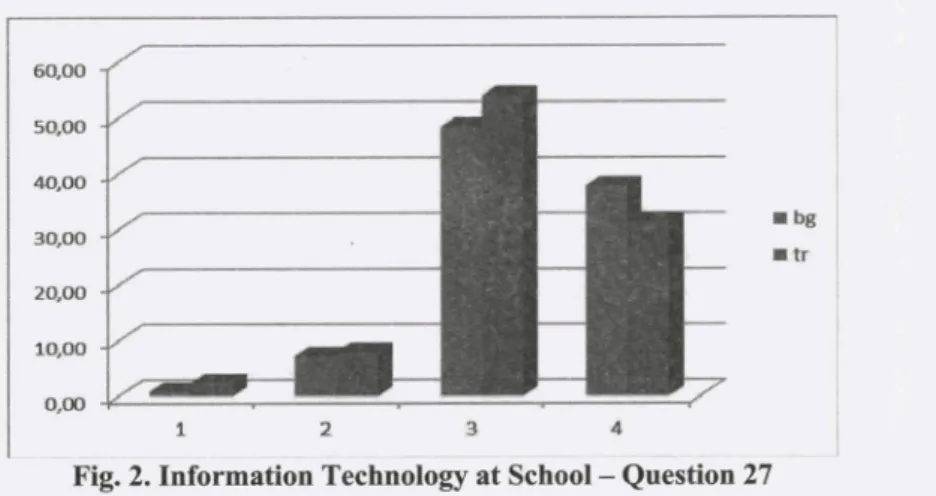
In the answers of 25 questions we can observe an interesting fact. The Bulgarian and Turkish students share the same opinion regarding the fact that school does not form lifelong leaming skills (12.9% of the Bulgarian students; 15.32% of the Turkish students). This fact is much more interesting because in the TALIS research (2009) the percentage of the teachers who have no desire at all to have additional qualification is 11%. In other words, this confirms the assumptions of Barber and Mourshed (2007), that "the quality of the educational systems cannot exceed the quality of its teachers". If 11% of the teachers refuse to accept the philosophy of Lifelong Leaming, then it is logical that a similar percentage of the students feel the same way. As of the opinion of the students on the infiuence of IT in class on leaming motivation, students from both countries consider that it is "very" important (50.81% for Bulgaria and 50.00% for Turkey). The comparative data from the responses of this question 27 are presented in Fig. 2.
0,00
bg tr
Fig. 2. Information Technology at School - Question 27
Similarly, students share opinion regarding the extent to which the teacher's approach towards the leamer's personality would affect his social resilience positively. 59.8% of the Bulgarian students say this affects "pretty much", and 46.77% of the Turkish students believe the same thing. Are the students pleased with the beginning of their educational preparation? This is the third set of questions analyzed (Table 4).
Table 4. The Quality of the University Educational Training They Are Familiar
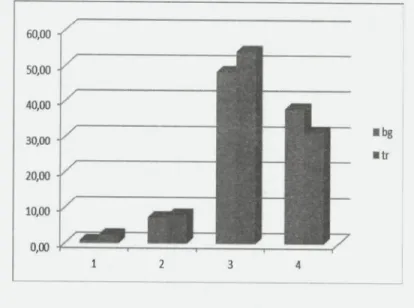
1 2 3 4 Question 35 Bg 0,81 7,26 48,39 37,90 Tr 2,42 8,06 54,03 31,45 Question 36 Bg 2,42 15,32 58,06 20,16 Tr 3,23 18,55 53,23 20,97
E.EVGENIEVA-§.ARSLAN I H. Ü. Egitim Fakültesi Dergisi (H. U. Joumal of Education), 43 (2012), 198-209 203
The flgure 3 shows that both groups of students have answered "very" or "completely" content of the fact that their training at the universify is directed towards their practical creativify. This is the opinion of two-thirds of the students in both countdes. The students also answer the following question in the same convincing manner. In their opinion, the way theoretic disciplines are taught at the universify will allow an easier application in their ñiture practice.
60,00 • 50,00 • 40,00 • 30,00 -20,00 • 10,00 • 0,00
-• L
• •
• •
1 2 3 4 - •bg • trFig. 3. The Practical Purpose of University Education (Question 35)
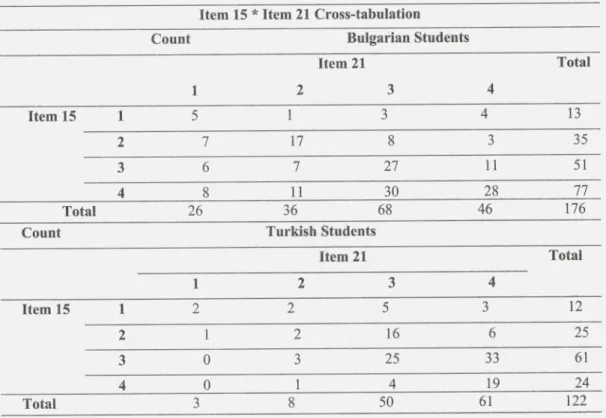
It is probably because they are in the beginning of their study course, their opinions tend to vary between "Accept a little" to complete acceptance. In order to be able to more convincingly motivate the extent to which students make this education status assessment in educational universities and have a motivated approach towards school, we asked them one special question. This question enabled us to be sure that their assessment of the system is committed. The question demanded information regarding how motivated they are by their choice of educational major that they study at universify. In their answers, 77% of the Bulgadan students state that they were "completely motivated" when choosing this major, whereas 61% of the Turkish students state that they were "very motivated" when choosing the major. This difference in the answers is present almost everywhere. It is only with regard to IT and to a large extent the necessify of teachers using individual approached in teaching where answers almost coincide. In order to trace how this happens we conducted a cross-analysis of the question on motivation with the other 5 questions. Here are the results of the cross-analysis: Table 5 shows the answers to questions 15 and 21 of the Bulgadan and Turkish students. The column represents the answers to question 15 and the row -the answers -the question 21. The data shows that -the level of motivation in choosing -the major influences the idea that students form about their friture career.
Students believe that they will be modem teachers "pretfy much" (which is the answer of 30%) and they are "completely" sure they'll be modem teachers (28% of the answers).This shows that almost half of the students have an optimistic vision of their career with regard to its being contemporary.
Table 5 also shows the answers of the Turkish students. We are obliged to remind that their motivation in choice of major in the universify is far less than that of the Bulgadan students. This leads to a slighfly different picture with regard to how they see their careers as contemporary teachers.Here we can make a qualify conclusion: In general, the students from Turkey are more tolerant towards the system as it is. This influences the way they plan their friture.
2 0 4 E.EVGENIEVA-§.ARSLAN I H. Ü. Egitim Fakültesi Dergisi (H. U. Joumal of Education), 43 (2012), 198-209
Table 5. Motivated Choice of Major and Career Project - Bulgarian and Turkish Students Item 15 * Item 21 Cross-tabulation
Count Bulgarian Students
Item 21 Total Item 15 1 2 3 5 7 6 1 17 7 3 8 27 4 3 11 13 35 51 Total Count
4
8 26 1 11 36 Turkish 2 Students Item 21 30 68 3 28 46 4 11 176 Total Item 15 1 2 3 2 10
2 2 3 5 16 25 3 6 33 12 25 61 19 24 Total 50 61 122In the data presented in Table 6 we can see how choice motivation relates to the evaluation of the significance of teaching at the university. The diversity of the answers in the third column shows that the high motivation in choice is a condition for the diversity of the students' requirements and thus for their requirements towards the education offered.
Table 6. Motivated Choice of Teaching Method -Bulgarian and Turkish Students Item 15 * Item 35 Cross-tabulation
Count Bulgarian Students
Item 35 Total Item 15 1 2 3 3 4 5 2 6 11 7 20 27 1 5 8 13 35 51 13 28 27 74 Total 18 32 82 41 173
Count Turkish Students
Item 35 Total Item 15 1 2 3 0 1 2 5 8 3 3 14 42 4 1 14 12 24 61 Total 19 14 73 26 24 121
E.EVGEN[EVA-§.ARSLAN I H. Ü. Egitim Fakültesi Dergisi (H. U. Joumal of Education), 43 (2012), 198-209
205
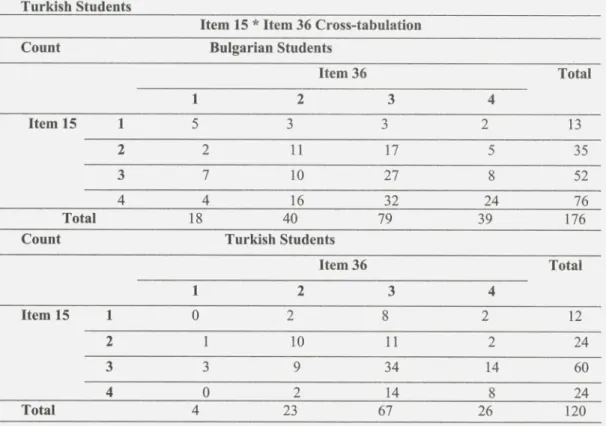
The image of the answers of the Turkish students is more definite. One can say that the choice motivation extent corresponds to the "higher level" of acceptance of what is taught in the university. Again we observe column 3.This relation between motivation and the process of education in theuniversity is the same for the answers of question 36 where studentswere asked whether they will be able to transform what they are taught in the university into their practices (Table 7).
Table 7. Motivated Choice of Ability to Transform the Theory Taught into Practice - Bulgari$an and Turkish Students
Item 15 * Item 36 Cross-tabulation Count Bulgarian Students
Item 36 Total Item 15 1 2 3 5 2 7 3 11 10 3 17 27 2 5 8 13 35 52 Total Count 4 4 18 1 16 40 Turkish Students Item 36 2 32 79 3 24 39 4 76 176 Total Item 15 1 2 3 0 1 3 2 10 9 8 11 34 2 2 14 12 24 60 14 24 Total 23 67 26 120
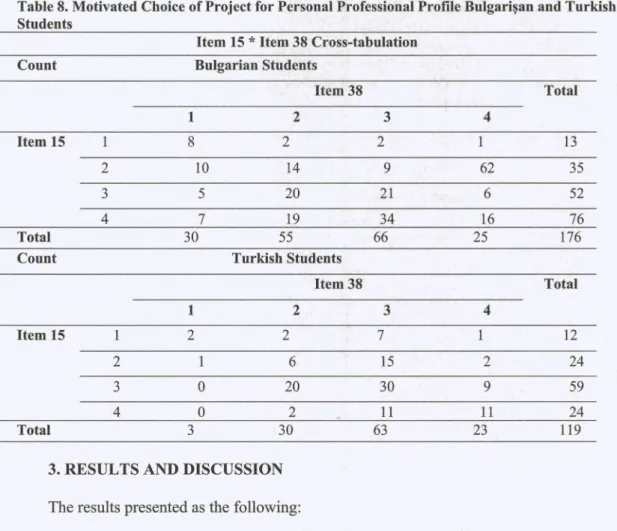
The high motivation level influences the understanding of the Bulgarian students of the theory taught at university. Their answering with "I pretty much agree", "I completely agree" can be explained with the fact that the theory could be transformed into practice. The Turkish students are a little less confident regarding this ability. This gives ground to believe that it is necessary to complement university teaching with content to support and enhance the motivation for the specific career of the students. This will have a positive impact on their professional creativity. Their personel professional profile are shown in Table 8. The variety of opinions demonstrates specifically that personal responsibility towards the future career, on one hand. On the other, and despite the fact that most students have answered that their choice of major was motivated, this doesn't mean this motivation is not sustained during the course of study in the university. It is exactly this variety that shows this specific necessity.
The variety of opinions demonstrates specifically that personal responsibility towards the future career, on one hand. On the other, and despite the fact that most students have answered that their choice of major was motivated, this doesn't mean this motivation is not sustained during the course of study in the university. It is exactly this variety that shows this specific necessity.
206 E.EVGENIEVA-§.ARSLAN I H. Ü. Egitim Fakültesi Dergisi (H. U. Joumai of Education), 43 (2012), 198-209
Table 8. Motivated Choice of Project for Personal Professional Profile Bulgariçan and Turkish Students
Item 15 * Item 38 Cross-tabulatíon
Count Bulgarian Students
Item 38 Total Item 15 1 2 3 8 10 5 2 14 20 2 9 21 1 62 6 13 35 52 Total Count 4 7 30 1 19 55 Turkish Students Item 38 2 34 66 3 16 25 4 76 176 Total Item 15 1 2 3 2 1 0 2 6 20 7 15 30 1 2 9 12 24 59 11 11 24 Total 30 63 23 119
3. RESULTS AND DISCUSSION
The results presented as the following:
• The profile of a ñiture educator greatly depends on their personal experience at school,
• The motivated choice of career, in addition to the opportunity to build and develop the idea of a personal education style while in university,
• It is extremely important that the process of teaching be individualized, • It is important that IT is present in this process,
• The idea that the culture of lifelong leaming and informal leaming during fi-ee time is a priority for school education is applied.
We also looked for evidence for the opinion shared by the students within the premises of educational majors. We will now demonstrate only one fragment of the results of the survey conducted on^y Market LINKS (Bulgarian . Ministry of Education, Youth and Science, 2011) which was performed using two instmments - a quantitative instmment and a qualitative one. In it we have searched for the model of professional qualification desired by the students. 1087 students in educational majors of up to 45 years were surveyed, covering the entire spectmm of majors in the system. We will not be pausing in detail on the general task of the survey. We shall only point out two fi"agments corresponding to our data. First we would like to present the list of criteria, which educators believe they should be evaluated. This is how the list appears in the presentation of those conducting the survey:
The career progress of educators should be based on a significantly more complex system of evaluation of the teachers' achievements than the one currently present. It should measure the following criteria, factors and indexes:
• Achievements/ results of the leamers
• Coefficient of difficulty - e.g. working with children of marginal groups • Assessment of the school or kindergarten principal based on general
E.EVGENtEVA-§.ARSLAN I H. Ü. Egitim FakUitesi Dergisi (H. U. Joumai of Education), 43 (2012), 198-209 207 • Vocational-qualification degrees (VQD's)
• Participation in extracurricular activities • Evaluation by colleague educators • Open classes
• Psycho-emotional tests
• Interview with an evaluating expert or committee • Evaluation by the mentor educator
• Self-evaluation test
• Satisfaction of the leamers' parents • Student evaluation
• Average marks of the students in the subject during the evaluated period" The criteria are listed in decreasing of importance, where most important are the achievements of the leamers. Two types of criteria follow that - administrative evaluation and collected certificates. Third come evaluations of persons - colleagues, parents during an open class, educators. The instability of this third group of criteria is found in that among them evaluations such as a psycho-emotional test and a meeting with evaluators are foimd. This fact may be referred to the opinion shared by students, that their teachers did not direct their work towards their personality. This is logical because if a teacher does not place these requirements as basic to himself, he can not pose them to his students. In both of its phases (qualitative and quantitative), the survey showed that teachers are very sensitive towards being evaluated by the students and teachers. According to some of them, their students' evaluation cannot be objective. The principals, on the other hand, believe that it should be taken into consideration because the students themselves are the users/ the clients of the service of teaching, provided by the teachers.
As we have seen before, the assessment of teachers in TALIS (2009) and the evaluation of the students are identical. This is the other big issue that we are not prepared to comment on right now: How to stmcture teachers' training in the university and in the continuous training so that it can accept the leamer as a user of their effort and not as a recipient of their knowledge. In the EU policy for the coming decade, which comes a result of the global processes, attention is now directed towards visible targets and the achievement of specified results. Thus the five tasks for education should give us the opportunity to form a good evaluation of the status and find the successñil way to achieve them. This is a good situation after the years of wide change in the system and the establishment of new realities - mobility, lifelong study, formal/informal leaming, leaming as a means of social acceptance, etc... Today we should concentrate on the details. If we still believe that educating is an art, then it would not be difficult to create a beauty in the educational system.
REFERENCES
Barber, M. & Mourshed, M. (2007). How the world's best performing schools come out on top. McKinsey and Company.
ECET (2020). A strategic framework for European cooperation in education and training ("ECET 2020") http://ec.europa.eu/educationyiifelong-leaming-policv/doc 1120 en.htm
Market LINKS (Bulgarian . Ministry of Education, Youth and Science, 2011). Career development in pre-school and pre-school education in Bulgaria. Survey among educational and administrative personnel. September-December 2011. Ministry of Education, Youth and Science, Market Links.
The World Bank (2003). Education.TechKnoLogia January-March 2003. www.TechKnoLogia.org
TALIS (2009). Creating efective teaching and leaming environments. First results from TALIS. Paris: OECD Publications.
UNESCO (2010). Reaching marginalized, EFA Global :onitoring Report . 2010. UNESCO & Oxford University Press, http://www.unesco.org/en/efareport/reports/2010-marginalization/
2 0 8 E.EVGENIEVA-§.ARSLAN I H. Ü. Egitim Fakültesi Dergisi (H. U. Joumal of Education), 43 (2012), 198-209
Geni§letilmi§ Özet
Ulusal egitim sistemlednin çagdaç somnlan, küresel toplumun açik alaninda meydana gelmekte ve degiçmektedir. Ortak özellikler, baçanlar ve aksakliklara dair arayiç, birçok uluslararasi çaliçma ve raporun odak noktasi olmuçtur. Bu çaliçma ve raporlar, devam eden egitimin özel bir vedmlilikte ohnasini saglayan bildirilmiç ön koçullann tamamen ayni nedenlerle önceden tahmin edildigini ve ayni degiçiklikleri gerektirdigini giderek daha fazla dogmlamaktadir. Bu da, sürecin benzerlikled ve farkliliklannm daha aynntih ve dinamik bir tanimina ulaçmak için karçilaçtirmali çahçma araligini geniçletmeyi gerekli kilmaktadir.
Bu makalede Pedagoji ögrencilerinin ögrenme sürecine iliçkin yaklaçimlanna dair çevirisi yapilmiç karçilaçtirmali bir çaliçmadan bir bölüm sunulmaktadir. Çaliçmada iki ana evre hakkinda veriler toplanmaktadir - lise egitimi ve université egitimi. Bu, pedagoji ögrencilednin gelecegin ögretmenleri olarak gelecek kariyer planlarini gerçekleçtirmeye yönelik projelerin analizine olanak vermektedir. Bu çahçma karçilaçtirmali bir çaliçmadir. Katihmcilar birinci sinif Bulgar ve Turk ögrencilerdir. Çahçma, 2011 yili §ubat - Haziran aylan arasinda yürütülmüctür. Bu sürede, ögrenciler okuUanndaki ilk yillanni bitirmektedir. Sonuç olarak, üniversitedeki ögrenme sürecine iliçkin yeterli ilgili deneyimi de kazanmiç olmaktadirlar.
Toplanan vedler, bize süreci farkli açilardan analiz etme firsati vermektedir. Bu makalede, dikkatimiz egitim sistemlerinde ciddi farkliliklar olan iki ülkeden ögrencilerin tutumlannin ne kadar ve ne ölcüde benzer olduguna ve ögretmenledn gelecek kariyer geliçimlerine iliçkin projelere odaklanmaktadir.
Pedagoji ögrencilerinin ögrenmenin, yaçam boyu ögrenmenin ve temel egitim ile mesleki vasif arasindaki baglantinin önemine dair yaklaçimlan, özel olarak tasarlanmiç 41 somluk bir anket aracihgiyla incelenmiçtir. Bu ankette, somlan somlar ile, ögrenciledn okullarda katildiklan veya çu an üniversitede devam ettikled ögretme sürecinde nelerden keyif aldiklanna dair bilgileri elde etmek amaçlanmaktadir. Açagidaki somlarda ögrencilere egitim süreci hakkinda ne bildikleri somlmaktadir. Daha sonraki somlar, ögrencilerin gelecegin ögretmenleri olarak kendiled için baçanli bir proje oluçturmak için neleri üstlendikledni sorgulamaktadir.
Sonuçlann analizi, çu hususlan gostermiçtir: Öncelikle, her iki ülkeden ögrenciledn ögretme sürecine dair aktif bir yaklaçimlan vardir. Sunulan, ögrenme kültürüne yönelik yaklaçim, ülkelerden her bidne için somlann iç mantigi bakimindan çok farkli olmamakla birlikte, dengelidir. Bu özel husus, bize cevaplann içten geldigine ve ögrenciledn kendi dücüncelerini ifade ettikledne inanmamiz için gerekçe saglamaktadir. Íkincisi, her iki ülkeden ögrenciler, ögretme sürecinde biliçim teknolojilednin hedef odakliligma ve etkin kuUanimma olan büyük ihtiyacm hesabini vermektedir. Bu ortak dücünce, dünyamn eçdeger süreclere - bu ömekte, biliçim teknolojiledne - tanik oldugunu kanitlamaktadir. Bu eçdegerlik, ulusal egitim sistemlednin özel dummlanndan etkilenmemektedir. Ücüncüsü, her iki ülkedeki ögrenciledn görücled ile ögretmenledn, söz gelimi siniftaki görev organizasyonuna dair, uluslararasi çahçma TALIS ile araçtmlan görücled uyuçmaktadir. Bu dumm, ögrenme sürecindeki katilimcilann, bu sürecin parametrelerine iliçkin ortak görücte birleçtikledni göstermektedir. Bu husus, sadece verilerin tarafsizligini degil, ayni zamanda geleneksel didaktikledn ögretmen ve ögrencilerin rollednin tek biçimliligi olarak tanimladigi bir sürecin her iki egitim sisteminde meydana geldigini göstermektedir. incelenecek ve analiz edilecek som çudur: bu tek biçimlilikle, hangi rol (ögrencininki veya ögretmeninki) sürece dair, sürecin etkinligini olumsuz etkileyen bazi kusurlan etkileyebilir ve bu kusudann açilmasina yardim edebilir? Bunun arkasina, kariyer gerçekleçtirme projelerinin ögrencinin kendi université egitimi için bu bölümü seçme konusundaki motivasyon derecesine bagli oldugu hususunu getirebilidz. Buna dayanarak, ulusal egitim sistemi ne olursa olsun, dücük maaç dahil, pek çok nedene bagli olarak ögretmenin görevinin degednin dücürüldügüne dair yerleçik kamuoyunun tartiçilmasim önermekteyiz. Bu durumun muhtemelen ödemeden çok daha önemli olan baçka bir nedeni daha vardir. Üniversitenin gençledn bu meslegi seçme konusundaki motivasyonunu sürdürme ve takviye etme çabasinin yetednce hedef odakli olmamasi yüksek ihtimaldir. Bu konuyu açikliga kavuçturmak, gelecek yillarda bu yöndeki yenilikled gerçekleçtirmeye ve çimdiki ve gelecekteki ögrenciler için yeni bir proje tipi oluçturmak
E.EVGENIEVA-^.ARSLAN I H. Ü. Egitim Fakültesi Dergisi (H. U. Joumal of Education), 43 (2012), 198-209 2 0 9 için gerçekçi ko§ullar oluçturmaya yardim edecektir. iyi yapilandinlmi§ bir gelecek kariyer geliçimi projesi, bunun gerçekleçmesinin koçuludur. Projeyi geliçtirme azmi mevcuttur; bunu kitle egitimine uygulama çekli ise henüz bulunmayi beklemektedir. Bu cabalar, Pedagoji ögrencilerinin université egitimi kadar erken bir sürede birleçtirilirse muhtemelen daha baçanli olacaktir.