T. C.
BALIKESİR ÜNİVERSİTESİ
SOSYAL BİLİMLER ENSTİTÜSÜ
YABANCI DİLLER EĞİTİMİ ANABİLİM DALI
THE ATTITUDES OF FOREIGN LANGUAGE LEARNERS
TOWARDS CONCEPT BASED INDUCTIVE METHODOLOGY FOR
TEACHING PHONEMES
YÜKSEK LİSANS TEZİ
Funda KURT
T.C.
BALIKESİR ÜNİVERSİTESİ
SOSYAL BİLİMLER ENSTİTÜSÜ
YABANCI DİLLER EĞİTİMİ ANABİLİM DALI
THE ATTITUDES OF FOREIGN LANGUAGE LEARNERS
TOWARDS CONCEPT BASED INDUCTIVE METHODOLOGY FOR
TEACHING PHONEMES
YÜKSEK LİSANS TEZİ
Funda KURT
Tez Danışmanı Yrd. Doç. Dr. Fatih YAVUZ
iv
ACKNOWLEDGEMENTS
Learning a foreign language entails proficiency over four basic language skills; speaking, reading, writing and listening. A language learner is also required to have enough knowledge about sub skills of the language system. Pronunciation is one of the significant components in this system and plays a crucial role in communication. For an intelligible and comprehensible speech, it is better for language learners to be trained with elements of pronunciation field and make them be conscious about the sound features of target language. The purpose of this study is to investigate the impact of concept-based pronunciation instruction on the articulation of regular past tense morpheme.
Firstly, I would like to thank and appreciate to my thesis advisor Asst. Prof. Dr. Fatih Yavuz for his endless support and contributions throughout the study.
I would like to thank all my teachers for their contributions during Master Thesis Program. I would also like to thank Özgür Çelik for his suggestions and contributions for data analysis process.
I would like to thank my father and mother, who supported me all the time.
Finally, I would like to express my gratitude to my husband for his unlimited patience, support and love.
v ÖZET
YABANCI DİL ÖĞRENCİLERİNİN KAVRAM TEMELLİ TÜMDENGELİM YÖNTEMİYLE SES ÖĞRETİMİNE KARŞI TUTUMLARI
Kurt, Funda
Yüksek Lisans, Yabancı Diller Eğitim Ana Bilim Dalı İngiliz Dili Eğitimi Bilim Dalı
Tez Danışmanı: Doktor Öğretim Üyesi Fatih YAVUZ 2019, 96
Yeni bir dili öğrenmek o dilin tüm bileşenlerini yeterli derecede doğru kullanmayı kapsayan bir süreçtir. Telaffuz da bu bileşenlerden sadece bir tanesidir. İletişimde anlaşılabilir ve kavranabilir bir konuşma için, telaffuzun önemli bir yere sahip olduğu tespit edilmiştir. Fakat telaffuz eğitimi ile ilgili çalışmalar kelime bilgisi veya gramer bilgisi alanları kadar ilgi görmemiştir. Bununla birlikte, telaffuz öğretimi çeşitli dil öğretme yöntem bilimlerinden etkilenmiş ve bu durum telaffuz eğitimi alanında dalgalanmalar yaşanmasına sebep olmuştur. Son zamanlarda, iletişimsel dil öğretme yöntem biliminin popüler olmasıyla, iletişim unsuru vurgulanmış ve telaffuz eğitiminin önemi tekrar açığa çıkmıştır. Bu çalışmanın amacı, kavram temelli tümden gelim telaffuz eğitiminin düzenli geçmiş zaman biçimbiriminin üretilmesindeki etkisini incelemektir. Çalışmanın diğer bir amacı da öğrencilerin bu tür telaffuz eğitimine karşı tutumlarını ortaya çıkarmaktır. Çalışmanın örneklemi ortaokul 6. sınıf düzeyindeki 13 öğrenciden oluşmaktadır. Dört haftalık telaffuz eğitim planı Milli Eğitim Bakanlığının önerdiği müfredata paralel olarak hazırlanmıştır. Araştırma araçları ise eğitime başlamadan ve eğitim sonrası öğrencilere uygulanan yüksek sesle okuma metni ve öğrenci görüşmeleriyle geliştirilen temaların frekans analizleridir. Araştırmanın sonucunda, hedef seslerin öğretiminde kavram temelli tümdengelim yöntem bilimi etkili olmuş ve aynı zamanda öğrencilerin bu yönteme karşı olumlu tutumlar geliştirdiği tespit edilmiştir.
vi
ABSTRACT
THE ATTITUDES OF FOREIGN LANGUAGE LEARNERS TOWARDS CONCEPT BASED INDUCTIVE METHODOLOGY FOR
TEACHING PHONEMES KURT, Funda
Master’s Thesis, Department of English Language Teaching Advisor: Asst. Prof. Dr. Fatih Yavuz
2019, 96
Learning a new language is a process which involves using all components of the language properly. Pronunciation is only one of these components. For an understandable and comprehensible speech in communication, pronunciation is regarded as a crucial component. However, studies on pronunciation education have not received as much interest as vocabulary or grammar knowledge so far. In addition, pronunciation teaching has affected by many language teaching methodologies and experienced many fluctuations regarding with its significance in foreign language learning. In recent years, with the popularity of Communicative Language Teaching in foreign language, communication element has emphasized and its significance has revealed again. The purpose of this study was to analyze the impact of concept based methodology on the articulation of regular past tense morpheme. Another aim was to outline the attitudes of language learners towards such kind of pronunciation training. The sample consisted of 13 6th grade secondary level learners. A four-week pronunciation training plan was prepared in parallel with the curriculum Ministry of National Education suggested. Research tools were a read aloud task applied before and after the training and the frequency analysis of emerging themes obtained from structured interviews.The data were analyzed with Statistical Package for Social Sciences (SPSS). The results of the paired sample tests indicated that concept based inductive pronunciation training was an effective method for teaching the accurate articulation of target sounds. It was also found out that learners had positive attitudes towards pronunciation instruction.
1
TABLE OF CONTENTS
ACKNOWLEDGEMENTS ... iv ÖZET... v ABSTRACT ... vi TABLE OF CONTENTS ... 1 LIST OF TABLES ... 2 LIST OF ABBREVIATIONS ... 4 1. INTRODUCTION ... 51.1. Background of the Study ... 5
1.2. Statement of the Problem……… 7
1.2.1. Problems Related to External Factors In Pronunciation Teaching in EFL . 8 1.2.2. Problems Related to Learner-Centred Internal Factors ... 10
1.3. The Purpose of the Study ... 11
1.4. Significance of the Study ... 12
1.5. Research Questions ... 12
1.6. Limitations of the Study ... 13
2. RELATED LITERATURE ... 14
2.1. Theoretical Framework ... 14
2.1.1. Introduction ... 14
2.1.2. Foreign Language and Pronunciation Instruction ... 14
2.1.3. Definition of Pronunciation... 15
2.1.3.1. Aspects of pronunciation... 17
2.1.3.2. Significant Concepts of Pronunciation ... 17
2.1.3.3. Sound System and Inflectional Morphology ... 22
2.1.4. The Goal of Pronunciation Instruction in Language Classes ... 23
2.1.4.1. Decision of the Pronunciation Model in English Language Classes …26 2.1.5. Selected Models for Acquiring L2 sounds ... 29
2.1.5.1. The Perceptual Assimilation Model (PAM ) ... 29
2.1.5.2. The Speech Learning Model (SLM) ... 30
2.1.6. Significant Selected Factors Affecting Pronunciation Acquisition ... 31
2
2.1.6.1.1. Age ... 32
2.1.6.1.2. Aptitude, Learning Styles and Learning Strategies... 34
2.1.6.1.3. Attitude and Motivation ... 36
2.1.6.2. Selected External Factors for Pronunciation Acquisition ..38
2.1.6.2.1. Native Language, Exposure and Instruction ... 38
2.1.7. Pronunciation Teaching Approaches and Current Perspectives ……41
2.1.7.1. Concept Based Pronunciation Instruction ... 45
2.1.7.2. Learning Mechanisms and Language Instruction ... 50
2.2. LITERATURE REVIEW... 51
2.2.1. Introduction ... 51
2.2.2. Research on the Aspects of Pronunciation ... 51
2.2.3. Research on Factors Affecting Pronunciation Acquisition ... 54
2.2.4. Research on Pronunciation Instruction ... 57
3. METHOD ... 60 3.1. Research Design ... 60 3.2. Participants ... 60 3.3 Tools ... 61 3.4. Procedure... 62 4. RESULTS ... 64 4.1. Introduction ... 64 4.2. Data Analysis ... 64
4.3. Research Question 1: Does concept-based inductive pronunciation instruction chave an impact on learners’ articulation of target phonemes accurately? If Yes, cTo what extent? ... 65
4.4. Research Question 2: What are the attitudes of EFL learners towards concept-cbased inductive pronunciation instruction? ... 66
5. FINDINGS AND DISCUSSIONS ... 69
6. CONCLUSIONS AND RECOMMANDATIONS ... 71
REFERENCES ... 73
3
LIST OF TABLES
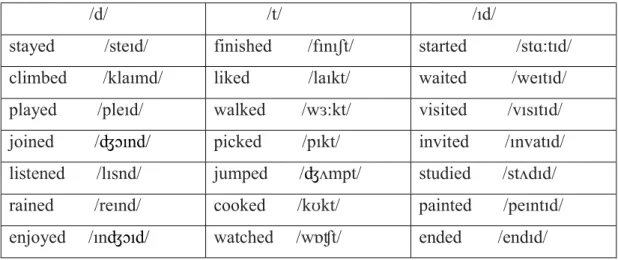
Table 1. The Articulation of Consonants ... 20 Table 2. The Articulation of Vowels ... 21 Table 3. Interview Questions ... 60 Table 4. Selected Regular Past Tense Verbs for Pronunciation Evaluation XXXXXXXX Rubric ... 61
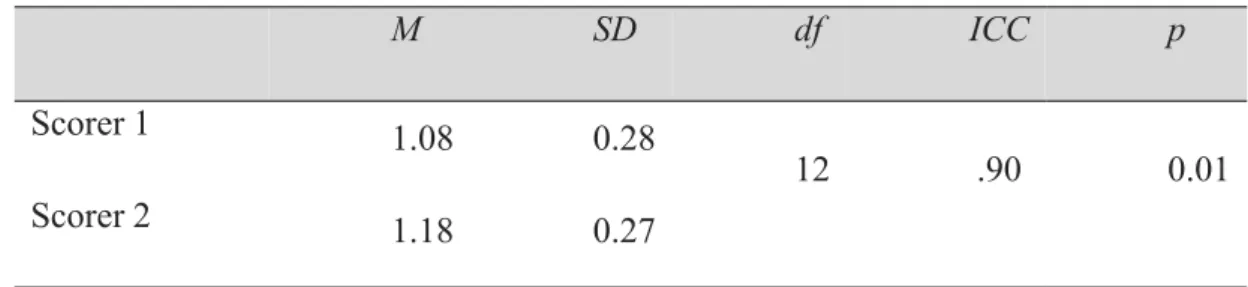
Table 5. Inter-rater Reliability Analysis Results ... 65 Table 6. Paired-Sample T-Test Results Showing the Impact of Pronunciation XXXXXXXXXInstruction on Learners’ Articulation of Target Phonemes... 65
Table 7. The Frequency Analysis of the Emerging Themes in the Interviews
……… 66
4
LIST OF ABBREVIATIONS
CPH: Critical Period Hypothesis MNE: Ministry of National Education EFL: English as Foreign Language ELT: English Language Teaching NNS: Non- native Speaker
NS: Native Speaker LFC: Lingua Franca Core
EIL: English as International Language ESL: English as Second Language RP: Received Pronunciation
PAM: Perceptual Assimilation Model SLM: Speech Learning Model
FDH: Fundamental Difference Hypothesis CAH: Cognitive Aging Hypothesis
LLS: Language Learning Strategies PLS: Pronunciation Learning Strategies FD: Field Dependence
FI: Field Independence
CAH: Constrastive Analysis Hypothesis IPA: International Phonetic Alphabet CLL: Community Language Learning AAM: Audio Articulation Model
5
1.
INTRODUCTION
This chapter comprises the background of the study, statement of the problem, purposes and significance of the study, research questions and limitations of the research. Firstly, the significance of pronunciation for listening and speaking skills is briefly mentioned. Then, problems related to teaching and learning pronunciation in EFL settings are classified as under the two titles; problems related to external factors such as instructors’ attitude towards pronunciation teaching, the role of curriculum; problems related to learner- centred internal factors categorised as biological, cognitive and psychological. Next, research questions are presented. Finally, limitations of the study are given.
1.1. Background of the Study
As one of the significant sub-skills of the language systems along with grammar and vocabulary, pronunciation is a crucial component for an effective communication. Morley (1991) identifies pronunciation as an integral part of overall human communication. It plays a vital role during the interactions between interlocutors in terms of getting the message across correctly. Having a competency over just grammar rules, words or phrases is not enough for learners required to sustain intelligible and comprehensible communication. Pronunciation skills are necessary for learners perceiving and producing these components in a proper way throughout the interaction which constitutes the basis of the comprehensible and intelligible communication. The intelligibility principle in communication refers that if a listener is able to identify the message uttered by a speaker correctly, the speaker has an intelligible speech by getting the meaning across properly (Kenworthy, 1987). Pronunciation is an essential element on account of assuming a facilitative role in intelligible communication. The correct articulation of the sounds and words ensures the mutual understanding of interlocutors with different L1 backgrounds (Szyszka, 2017; Shabani; Ghasemian, 2017; Offerman& Olson, 2016; Kelly, 2000; Levis, 2005; Morley, 1991; Celce-Murcia et all, 1996; Kenworthy, 1987) whereas mispronunciation
6
of the sounds and utterances causes misunderstandings between interlocutors (Shabani; Ghasemian, 2017).
Burgess and Spencer (2000) assert that pronunciation in the process of language learning should be correlated with speaking and listening skills. While speaking skills enable learners to practise meaningful use of target language phonological features, listening skills are used for the identification of phonological features of target language with segmental or supra segmental levels. Hişmanoğlu (2006) mentions that listening and speaking skills are beneficial for learners’ developing and internalizing the phonological features of target language. Discrimination and recognition of target sounds through spoken texts aid learners to articulate these sounds correctly while expressing themselves in proper situations. For this reason, exposure to sounds in target language has a positive impact on learners’ oral production performances and if learners are not exposed to target language for a while, their discriminative and perceptive abilities begin to decline leading to mispronunciation of target sounds or words and intelligibility problems. Gilbert (1984) states that listening skills and pronunciation are linked with each other. It is indicated that speech perception has an effect on speech production (Rivers, 2018; Noteboom, 1983;O’ Connor, 1980).
Even though pronunciation is regarded as one of the crucial ingredients in skill-based EFL (English as Foreign Language) settings, it is a mostly disregarded area by instructors and material developers (Szyszka, 2017; Demircioğlu, 2013; Atlı, 2012; Isaacs, 2009; Hişmanoğlu, 2006; Wei, 2006; Levis, 2005; Macdonald, 2002; Sliveira, 2002; Fraser, 2001; Celce-Murcia et all., 1996). Celce-Murcia et all. (1996) emphasize “Cinderella” term with the purpose of drawing attention to inadequate studies in the area of pronunciation teaching. Pronunciation teaching has not been remarked by the focus of studies when compared with grammar and vocabulary components of language teaching. Gilbert (1984) regards pronunciation as an orphan in English language teaching by accentuating that it is a neglected area; however, within the communicative framework in language teaching methodology, there occurs a threshold level in which learners with intelligibility problems due to the mispronunciations and articulation problems, fall behind other learners in terms of oral
7
production performances regardless of their proficiency in grammar and vocabulary areas (Yoshida, 2016; Yates and Zielinski, 2009).
1.2.Statement of the Problem
When compared to other language areas in terms of teaching and learning strategies, pronunciation is an overlooked component or its practices are based on intuition rather than a systematic research (Levis, 2005); nevertheless, this situation needs to be changed as the impact of communicative framework on language teaching entails one of the significant principles: interaction (Sliveira, 2002). According to communicative framework, a learner’s speech is required to be comfortably intelligible so that he/she is able to achieve success in communication (Kenworthy, 1987). Comfortably intelligibility principle consists of good vocabulary knowledge, grammar and effective pronunciation abilities and learners are required to be competent enough at recognizing and utilizing intra-segmental features composed of more microscopic aspect of language such as sounds and inter-segmental features (prosodic features) throughout interactions. In spite of its significance, numerous studies have indicated that teaching pronunciation is still an evaded area by instructors and this situation causes learners’ misperceptions and misinterpretations of intra-segmental and inter-intra-segmental features of target language. There are many factors having a great impact on instructors’ refraining from teaching pronunciation such as their lack of self-confidence, lack of enough knowledge about phonetics, pronunciation and proper methodology, curriculum, lack of enough course hours and lack of effective evaluation techniques categorised as external problems in pronunciation teaching. Learner- based factors called as internal problems are composed of biological, cognitive and affective factors (Szyszka, 2017; Sardegna and McGregor, 2013; Demircioğlu, 2013; Isaacs, 2009; Berkil, 2008; Hişmanoğlu, 2006; Fraser, 2006; Wei, 2006; Burger & Spencer, 2000; Macdonald, 2002; Celce-Murcia et all., 1996; Morley, 1991).
8
1.2.1. Problems Related to External Factors in Pronunciation Teaching in EFL
First external factor is instructors’ viewpoints towards integrating pronunciation training to their course plans. These viewpoints can be classified as lack of enough knowledge about pronunciation teaching strategies of instructors and drawbacks in curriculum. Some of the instructors state that teaching pronunciation is a challenging area and are inclined to avoid teaching it as they believe that they do not have necessary skills, knowledge and teaching strategies (Hişmanoğlu, 2010; Fraser, 2006; Wei, 2006; Macdonald, 2002; Burges & Spencer, 2000; Celce- Murcia et all., 1996). Whereas some of the instructors refrain from including pronunciation in their course plan, some of them teach it with the aim of finding a solution for learners’ some articulation problems by planning reactive lessons or practising a particular pronunciation feature through isolated items, mere repetition drills and de-contextualised settings. Furthermore, it is also claimed that mere repetition is not beneficial for learners’ deep encoding of target sounds or prosodic elements of target language and these features are not be able to be transferred from short term memory to long term memory (Kelly, 2000). Another difficulty for this area is that instructors are not skilled enough to integrate pronunciation with other language components and skills. Burgess and Spencer (2000) list some problematic areas for this integration. Instructors face difficulty in the selection of pronunciation features, order of selected features, and the choice of type of discourse and methods. Furthermore, that instructor focuses on just grammar, vocabulary and reading skill causes the negligence of listening and speaking skills. The former enables learners to be exposed target sounds and prosodic features through spoken texts and guides them for developing their perception and discrimination abilities while the latter aids learners for meaningful usages of phonological features in target language. Demircioğlu (2013) asserts that too much focus on grammar and traditional techniques causes learners’ having difficulty in advanced stages and prevents them from communicating effectively. Thus, one of the essential problems instructors have is their lack of necessary pronunciation teaching strategies. In line with pronunciation teaching strategies, although communicative language teaching regards intelligibility principle as a crucial element and gives significance to intra segmental and prosodic features of target language, the
9
proponents of this approach have not defined the role of pronunciation in language teaching adequately and have not developed agreed upon strategies for teaching pronunciation which result in a major gap in the area of pronunciation learning and teaching strategies (Szyzska, 2017).
Second external factor is the absence of enough support to instructors in terms of teaching pronunciation in curriculum. Celce- Murcia et all. (1996) and Macdonald (2002) assert that syllabuses involve many drawbacks as regards to reflecting pronunciation instruction. As the curriculum does not encourage instructors to teach pronunciation, this area is envisaged as a trivial issue in comparison with other areas in language teaching. In Turkey, Although New English Language Curriculum developed in 2018 for secondary level 5th, 6th, 7th and 8th grades (for more detail see
Milli Eğitim Bakanlığı (MEB), 2018 ) aims at highlighting the communicative principle in language learning through authentic contexts, process-oriented, learner and task based activities, they do not include any explicit objectives for specific intra segmental or prosodic features in pronunciation instruction but seeks to teach these items through an integration with listening and speaking skills in an implicit way ( T.C Talim Terbiye Kurulu Daire Başkanlığı). Nevertheless, it is claimed that learners having a transition from elementary to upper elementary level in secondary schools require a further academic development. As learners in this stage are able to develop abstract and reflexive thoughts, their language system becomes more abstract and academic by getting less closely to everyday life situations. For this reason, it needs more intense analysis of language which is likely to be enabled with setting clear and explicit objectives for any specific feature in pronunciation instruction in the curriculum. Another problem regarding curriculum is that due to large classes, time constraint, loaded content and lack of suitable learning and teaching materials, instructors either avoid teaching pronunciation or teach it reactively or traditionally in order to find solutions for their learners’ mispronunciation of the sounds in the lessons ( Isaacs; 2009; Fraser, 2006; 2001; 2000; Macdonald, 2002).
10
1.2.2. Problems Related to Learner-Centred Internal Factors
Learner-centred internal factors impeding the effectiveness of pronunciation instruction are classified into three main areas; biological, cognitive and psychological features of learners. Firstly, age of the learners categorized in biological factor in terms of acquiring language components is one of the significant research subjects among researchers. Lenneberg (1967) with Critical Period Hypothesis (CPH), Acton (1984), Odisho (2014), Ellis (1994) and O’Connor (1980) indicate that younger learners have a superiority over older learners for acquiring necessary language skills and assume that as learners undergo neurological and maturational alterations in the age of puberty, it is not possible for adolescents to learn language components just through being exposed to target language. For this reason, along with mere exposure to target language, learners in the age of puberty require more conscious language instruction grounded within the communicative framework throughout their learning process as they develop more abstract and conceptual thinking abilities.
Secondly, cognitive factors are composed of learners’ language aptitude, and their learning styles. Caroll (1981) defines language aptitude by making a list of four subcomponents; phonetic codic ability, grammatical sensivity, inductive language learning ability and memory. In the concern of this study, phonetic codeing ability has a direct relation with learning pronunciation and entails a process in which auditory discrimination of target sounds and associating sounds with symbols or symbols with sounds have primary concern for learners. Kenworthy (1987) emphasizes the significancy of these subcomponents by referring to a new concept; oral mimicry which highlights to the competency for articulating sounds in a proper way. Another cognitive factor is the impact of learning styles upon pronunciation instruction. Celce- Murcia et all. (1996) reveal that most of the pronunciation training activities are consisted of auditory elements and address to just learners with using auditory learning style dominantly; however, Odisho (2014) and Hişmanoğlu (2006) stress the notion; multi-sensory teaching process composed of a range of activities supporting eye training, neuro muscular training and brain training creates more effective teaching atmosphere for learners with different learning styles during pronunciation instruction.
11
Finally, motivation level of learners and attitudes towards pronunciation learning form the basis of psychological factors for pronunciation instruction and these affective factors influence the pronunciation learning developments of the learners. Kenworthy (1987) and Sardegna and McGregor (2013) accentuate that instructors should establish a supportive and friendly atmosphere by lowering anxiety levels of learners in the class. Szyzska, (2017) identifies anxiety in the area of pronunciation learning in reference to Tobias’s model involving three stages; input, information processing and output. Learners who have anxiety problems in input stage are prone to having difficulty in focusing on the target sounds and encoding them by blocking themselves. In processing stage, anxiety lowers the speed of learner’s cognitive process such as the performance of short term memory and retrieval of the target sounds. Anxiety in input and processing stages causes learner’s poor discrimination of target sounds or prosodic elements in listening skills and failure of learners which lowers the motivation and therefore learners take a negative attitude towards listening skills. Output stage includes the indication of learners’ actual performances acquired in input and processing stages. Performances of learners in this stage are reflected through speaking skills. Learners encounter with difficulty in mispronunciation of the words and are anxious about being evaluated negatively by their peers and teachers. Furthermore, learners in the age of puberty are inclined to refrain from expressing their thoughts in front of the class as they apprehend making mistakes and being ridiculous in the eye of their peers which leads to communication apprehension problems for learners. In addition to these factors, another reason for this apprehension is the result of alterations in adolescences developmental period with respect to psychological aspects. Moreover, it is indicated that children are more eager to learning pronunciation compared to adults and as the learners become older, they tend to resist pronunciation learning an account of these affective factors (Szyzska, 2017).
1.3. The Purpose of the Study
Even though pronunciation training is a neglected component on account of aforementioned problems, it has an inevitable place for not only listening but also speaking skills. Based within the scope of communicative principles, curriculum is
12
required to integrate pronunciation instruction with other skill areas. In order to design an effective syllabus regarding to this training, variables such as learner-related variables, setting variables, institutional variables and linguistic variables impacting the quality of pronunciation training should be considered (Stern, 1992). In line with all these issues discussed in the previous sections, the first purpose is to investigate the impact of concept-based inductive teaching approach using communicative principles in the teaching intra-segmental features in EFL setting. Second aim of this research is to outline the effects of the approach mentioned above on the performances of learners’ articulation of the target sounds. The last aim of this research is to define the attitudes of learners and instructors towards this kind of instruction and syllabus.
1.4. Significance of the Study
Although there have been numerous research examining the effects of pronunciation teaching methods outside Turkey, studies in Turkey only focus on definition of common pronunciation errors of learners with different levels of language proficiency. For this reason, this research introduces an eclectic pronunciation teaching method in which the principles of cognitive and communicative language teaching methodologies are combined with the purpose of teaching segmental elements of pronunciation through listening and speaking skills. This research is also significant for language instructors in that it aims at teaching target sounds within the framework of a syllabus designed by the Ministry of National Education (MNE). Thus, this research proposes an alternative way for teaching pronunciation and the results of the research may serve many contributions to the area of pronunciation teaching strategies by questioning the impacts of this teaching method on articulation performances of language learners.
1.5. Research Questions
13
1. Does concept-based inductive pronunciation instruction have an impact on learners’ articulation of target phonemes accurately? If Yes, To what extent? 2. What are the attitudes of EFL learners towards concept-based inductive
pronunciation instruction?
1.6. Limitations of the Study
This study includes some limitations. First one is that this research only focuses on the investigating the impact of concept-based inductive pronunciation instruction on learners’ oral production of regular past tense inflectional morphemes; “ed”. For this reason, it does not give an answer what kind of result it has for the teaching of other phonemes in EFL which should be searched for further research. Secondly, segmental features of instruction are analysed through this research; however, it does not emphasize the teaching of supra segmental features of language.
14
2. RELATED LITERATURE
This chapter consists of two sections. First section focuses on theoretical background information about pronunciation, factors affecting teaching or learning this component and pronunciation teaching approaches in ELT (English Language Teaching). Second section compromises the summary of related literature on pronunciation, factors affecting teaching or learning pronunciation and the effect of pronunciation instruction.
2.1. Theoretical Framework
2.1.1. Introduction
This section encompasses theoretical background of pronunciation component in ELT reviewed within three titles. In the first title, definition and aspects of pronunciation are briefly outlined along with the goals and importance of teaching and learning pronunciation. Theories for second language pronunciation are also briefly mentioned. In the second title, factors having a great impact on teaching or learning pronunciation are presented. Finally, in the third title, pronunciation teaching approaches and current perspectives for teaching pronunciation are given.
2.1.2. Foreign Language and Pronunciation Instruction
Learning a language entails competency over four basic skills; reading, writing, listening and speaking and other integration of sub skills such as grammar, phonology and vocabulary. It is identified that these systems are interwoven with each other. The sound system is not separated from other skills. Functioning as a source for structuring meaning and stating various language functions in a communicative base, this system
15
is bound to each aspect of language system when learners listen, speak, write and read. For instance, if learners want to master in the area of listening and speaking, it is necessary for them to develop some competency in understanding and articulating English sounds, tones and rhymes or the proficiency in reading and writing skills requires analysing and perceiving the connection between writing system and the sound system. Instructors should be aware of these relationships and build a lesson structure which aids learners to improve efficient listening comprehension and intelligible pronunciation for their proficiency in communication (Celce-Murcia et all., 1996). Pennington and Revell (2019) support the view that pronunciation based instruction can develop listening comprehension skills of learners. Instructors can also integrate pronunciation instruction with other sub skills such as grammar and vocabulary. The reduction patterns of auxiliaries or verbal / nominal inflections such as –ed, -en, -es, -ing can be combined within the structure of grammar lesson enhancing the capacity of learners in perception and production. The reason for learners’ failure in articulating these structures can stem from the failure in perceiving them in daily life activities. In the field of vocabulary, the instruction of stress patterns, phoneme identification or vowel shift is introduced to learners through different types of nouns such as irregular, regular or plural, singular, etc. and different types and forms of verbs such as regular, irregular, etc. ( Pennington and Revell, 2019; Rivers, 2018).
2.1.3. Definition of Pronunciation
Yates and Zielinski (2009) refer to pronunciation term as the way sounds are produced while interlocutors are speaking. Nunan (2003) and Szyzska (2017) state that pronunciation includes a process through which certain sounds are produced by the speaker and perceived by the listener so that these interlocutors are able to provide a mutual intelligibility with each other without having a difficulty during an interaction. Nunan (2003) addresses mutual intelligibility principle while defining the term in terms of accentuating not only production but also perception stages in communication. Thornbury (2005) defines pronunciation as the competency of learners for uttering comprehensible statements with the purpose of completing a list of language tasks. Furthermore, Seidlhofer (1995) and Dalton & Seidlhofer (1994) add a new perspective to the definition of the term by stating that apart from involving the
16
representations of individual sounds and consonants, pronunciation not only enables negotiation of meaning between interlocutors but also is a crucial indicator of socia-cultural background of these interlocutors. In most contexts, speakers are easily identified as non-native. For this reason, it might function as a filter leading even discrimination in some language contexts (Rezaei et all., 2015; Pennington, 1996).
The study of pronunciation embodies two areas; phonetics and phonology. Phonetics centres upon the physical properties of speech sounds and does not have to be in a direct relation with the study of language. It is divided into such areas;
- Physiological phonetics is concerned with anatomical, neurological and physiological aspects of speech.
- Articulatory phonetics is concerned with physical aspect of speech organs while speaking.
- Acoustic phonetics is concerned with the nature and acoustic of the sound waves aiding the process of transmitting speech.
- Auditory phonetics is concerned with the way speech is sensed by ears. - Perceptual phonetics is concerned with the way speech is perceived by the
brain (Kelly, 2000).
It is clear that these areas of phonetics are dependent on each other from the stage of producing sounds through speech organs becoming sound waves to the stage of being sensed by ears and perceived by the brain (Kelly, 2000). On the other hand, phonology mainly deals with the way the sounds are interpreted and categorized in a particular language. In a broad sense, it points to the sound system of language. Recognised as being either a corner stone or superficial feature of the language, phonology is analysed in terms of three aspects; psychological, social and cognitive aspects of a spoken language. Psychological aspect is a significant marker of the meaningful sound units indicating the internal features of human beings such as their thoughts and feelings. Social aspect points at social interactions of human beings. Cognitive aspect reflects subconscious and conscious processes combined and controlled by the brain entrenching the comprehensibility in accordance with the purpose of the speaker (Pennington and Revell, 2019). While phonetics is concerned
17
with physical features of the units of a language, phonology focuses on the system and those units which form a meaningful base for a language. (Pennington and Revell, 2019; Kelly, 2000). Pennington and Revell (2019) indicate that in a general sense, language teachers prefer using the term pronunciation with the aim of referring to a kind of skill in spoken performance rather than phonology. As the term pronunciation reflects a practical ground for the study of a language, theoretical linguists and researchers generally tend to refrain from using the term pronunciation in their studies and refer them as phonology or phonetics.
2.1.3.1. Aspects of pronunciation
As well as being regarded as an essential aspect for communication, pronunciation is also one of the constituents in a spoken language leading to effective interactions. It is a fundamental and valuable feature realized in social, academic and professional lives in particular spoken contexts (Pennington and Revell, 2019). Belkheir (2017) identifies pronunciation as one of the significant components in the process of producing sounds with the purpose of conveying meaning in interactions. For this reason, speaking of a language and successful communication necessitate a process in which one is required to use four crucial elements sufficiently;
1. Segmental elements embody the attention to the particular sounds of a language.
2. Supra segmental elements refer to prosodic features such as stress, rhythm, and intonation, etc. rather than more microscopic components.
3. Voice quality signifies the way the voice is formed.
4. Paralinguistic features include the attention to gestures, facial expressions and body movements rather than linguistic features (Belkheir, 2017).
2.1.3.2. Significant Concepts of Pronunciation
Identified as a kind of language skill, pronunciation contains having enough knowledge about articulating and discriminating individual sounds; phonemes
18
comprised of the system of consonants and vowels mentioned as segmental aspect of pronunciation and knowledge about connected speech elements; prosodic features referred as supra segmental aspect of pronunciation skill (Belkheir,2017).
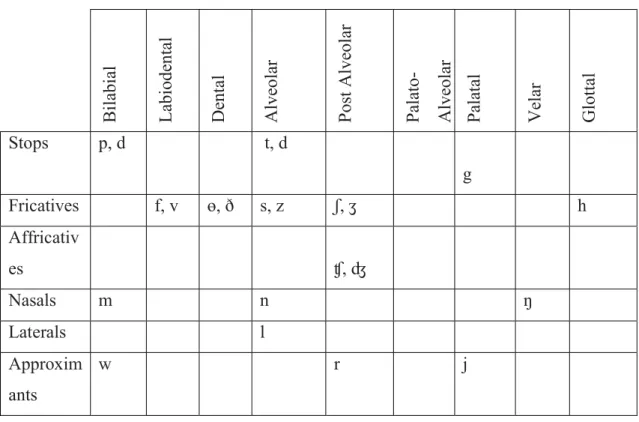
Reflecting microscopic aspects of a language, phonemes in other words segmental features refer to different sounds composed of consonants and vowels. Consonants are categorised as voiced or unvoiced (voiceless). If a vibration occurs in the vocal cords in the larynx when one particular sound is articulated, it is referred as a voiced sound and if there is not a vibration, an unvoiced sound occurs (Kelly, 2000). For instance, it is easily to recognize the difference between /f/ fan and /v/ van in terms of voicing. It is possible to distinguish the difference through touching Adam’s apple during the articulation of the sound and identify whether there is a vibration or not (Kelly, 2000). In addition to having a property as voiced or unvoiced sounds, consonants can be identified as the manner and place of articulation which means the way sounds occur through interrupting, constraining and deviating the airflow in variety aspects.
1. The manner of articulation describes the connection between the articulators and the airflow. For instance, articulation of plosives requires such a process in which the air is entrapped for a while and then absolved in a sudden way. The manners of articulation are classified as;
- Plosives sometimes mentioned as stops exist when the air is entrapped in the vocal tract. As the air pressure increases due to this enclosure, it is absolved suddenly. Example sounds for plosives are /p/, /b/,/t/, /d/, /k/ and /g/. In a general sense, Turkish learners do not face any difficulty in discriminating or articulating plosives.
- Affricatives exist when the air stream is closed somewhere in the mouth and the raise of soft palate occurs. Air pressure occurs behind this closure as in the case of the way plosives are articulated; however, the difference is that the air is composed more slowly than in plosives. Example sounds for affricatives are /ʈʃ/, /dʒ/. Turkish learners have difficulty in discriminating or articulating /dʒ/ sound.
19
- Fricatives exist when the airflow moves as two vocal organs come together and this air can be heard due to this movement. Example sounds for fricatives are /f/, /v/, /θ/, /ð/, /s/, /z/, /ʃ/, /ʒ/ and /h/. Turkish learners have difficulty in discriminating or articulating /z/ sound.
- Nasals exist when the air is closed completely somewhere in the mouth and this air is lapsed into the nasal cavity an account of the lowered soft palate. Example sounds for nasals are /m/, /n/ and /ŋ/. Turkish learners have difficulty in discriminating or articulating /ŋ/ sound.
- Lateral /l/ sound exists when the air stream circulates around the sides of tongue. Turkish learners do not have any difficulty for this sound.
- Approximants exist when the movement of an articulator is in such a closure that any friction or the stop of the airflow occurs. Example sounds for approximants are /r/, /j/, /w/. Turkish learners have difficulty in discriminating or articulating /w/ sound.
2. Place of articulation describes how sounds occur in terms of basic movements of different articulators.
- Bilabials occur within the closure of both lips, e.g. /p/ and /m/.
- Labio- dentals occur within the usage of the lower lip and the upper teeth, e.g. /f/ and /v/.
- Dentals occur within the usage of the tongue tip between the teeth or close to the upper teeth, e.g. /θ/and /ð/.
- Alveolars occur if the tip of tongue is close to the alveolar ridge, e.g. /t/ and /s/.
- Palato alveolars occur within the usage of tongue tip just behind the alveolar ridge, e.g. /ʈʃ/ and /dʒ/.
- Palatals occur when the front of tongue is so close to the palate, e.g. /j/. - Velars occur when the back of the tongue is placed against the soft palate,
e.g. /k/ and /ŋ/.
- Glottals occur when the usage of the gap between vocal cords causes a friction, e.g. /h/ (Kelly, 2000).
20
Table 1. The Articulation of Consonants
Bi lab ial La bi od en tal De nt al Al ve ol ar Po st Al ve ol ar Pa lat o-Al ve ol ar Pa lat al Ve lar Gl ot tal Stops p, d t, d g Fricatives f, v ɵ, ð s, z ʃ, ʒ h Affricativ es ʧ, ʤ Nasals m n ŋ Laterals l Approxim ants w r j
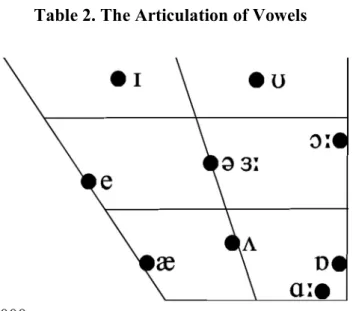
Vowel sounds are regarded as voiced sounds even though there might be some exceptions in the articulation of some words including diphthongs or trip thongs. Diphthongs are combinations of one vowel sound to another as in the case of /eı/ late. Trip thongs contain the combination of three vowel sounds as in the case of /auə/ in the articulation of our. Single vowel sounds are also identified as short like /ı/ in the articulation of hit and long like /i: / in the articulation of heat. /:/ symbolizes the long sound in the articulation of single vowel sounds (Kelly, 2000). Vowel sounds are classified in terms of the distance between the tongue and the roof of the mouth as Close, Mid and Open or the vertical lines on the part of the tongue as Front, Centre and Back. They can be also identified in terms of the positions of the lip as Rounded, Spread and Neutral (Lane and Brown, 2010; Kelly, 2000; Celce-Mercia et all.; 1996).
21
Kelly, 2000
While phonemes refer to distinctions in a particular language, allophones are defined as the specific articulation of phonemes in a variety of contexts. Their perception is different; however, this does not have any effect on distinguishing words. In other words, allophones are different representations of a particular phoneme. Although sharing common features by having roots from the same family, they hold unique characteristics (Pennington, 2019; Celce-Murcia et all., 1996). Pennington and Revell (2019) identify that all of the speakers from one or different language backgrounds have common phonemes; nevertheless, there is massive amount of diversity in terms of the articulation of it an account of some variants.
- Contextual variants (identified with the different articulation of phonemes in different contexts).
- Regional variants (identified with the impact of regional accents on the way phonemes are articulated).
- Social variants (identified with the impact of social groups such as the role of gender, ethnic groups or speech style on the way some phonemes are articulated).
Supra segmental aspects or prosodic elements of a language reflect features of speech applied generally to segments. These features are stress, rhythm, intonation.
22
1. Stress refers that generally one syllable of a words is articulated more dominantly than the others
2. Rhythm occurs where stressed syllabus is identified regularly in speech. Owing to this perception, English is regarded as a stress-timed language. 3. Intonation refers how the pitch of the voice increases or decreases in the course
of an utterance articulation as important as stress in terms of differentiating sentence meaning (Belkheir, 2017; Kelly, 2000; Kenworthy, 1987).
2.1.3.3. Sound System and Inflectional Morphology
Morphology is a language area that focuses on studying the smallest units of meaning including grammatical functions and structure of the words (McKay and Cosmos, 1986). These units have to be subdivided into the meaningful units. This language area is examined as two subcategories. First one is inflectional morphology encompassing the attached grammatical endings to words. Second one is derivational morphology containing lexical features such as compounding or affixiation used for forming new words through stems, affixies or stock of roots (Celce-Murcia et all., 1996). Celce-Murcia et all. (1996) identify eight regular morphological inflections; plural, possessive, third-person singular present tense, past tense, present participle, past participle, comparative degree and superlative degree. It is also detected that most of these inflections include sensible perceptions. (Murcia et all., 1996). Celce-Murcia et all. (1996) assume that in English language, regular grammatical inflections have the closest connections with the sound system among other constituents. This scope is referred as morpho phonology focusing on the articulation of allomorphs. The concept allomorph refers to different form of a morpheme but does not cause any alterations in meaning. It also describes the perception of these variants for particular morphemes. For instance, /z/, /s/, /ız/ and /əz) are allomorphs of regular plural, third person singular present tense and possessive. This situation might cause a complexity for language learners required to perceive, discriminate and articulate these allomorphs (Lane and Brown, 2010).
Lane and Brown (2010) list some problematic subjects for learners regardless of their language background and reveal that the pronunciation of grammatical
23
inflectional endings is one of the difficult areas for language learners. Similarly, Pennington and Revell (2019) support to the idea that grammar should be integrated with the pronunciation skill and pronunciation instruction can contain some verbal and nominal inflections particularly such as –ed, -en, -(e)s, and –ing which contributes the perception and production processes of these items. Pennington and Revell (2019) also refer that as sounds form the basic elements for larger units of a language system, differences in phonological system can be the indicator of the changes in lexical meaning, grammatical meaning and utterance meaning Furthermore, it is suggested that the reason for learners who mispronounce these inflections might stem from their failure in noticing them in their daily speech (Pennington and Revell, 2019; Rivers, 2018).
2.1.4. The Goal of Pronunciation Instruction in Language Classes
In a broad sense, it has been ascertained that the significance of pronunciation instruction has had some fluctuations regarding the attitudes taken by language teaching approaches. Some language teaching approaches such as reform movement and audiolingual teaching accentuate the importance of teaching it whereas others such as cognitive movement and communicative language teaching generally disregard its integration with other language areas (Yoshida, 2016; Jones, 2002; Celce-Murcia et all., 1996). Due to these fluctuations, two conflicting issues have influenced pronunciation pedagogy and research; nativeness principle and intelligibility principle (Levis, 2005). The nativeness principle holds the view that it is probable for language learners to attain native like pronunciation in a foreign language. Before 1960s, this view was a prevailing approach; however, it lost its validity an account of the research revealing the fact that some biological factors play a major role and having a native like pronunciation is only possible before adulthood (Lane and Brown, 2010; Fraser, 1999; Schovel, 1995; Lenneberg, 1967). For this reason, desiring a native-like pronunciation was realized as an unrealistic goal for both instructors and learners (Lane and Brown, 2010; Levis, 2005; Dalton et all, 1997; Kenworthy, 1987). Furthermore, Kenworhty (1987) suggests that very few adults could achieve native-like pronunciation and majority of the learners do not regard the nativeness in pronunciation as a beneficial issue. As nativeness principle was not viewed as an
24
essential element for a successful communication, new paradigms have been supported on basis of main goals for learning or teaching pronunciation; intelligibility, comprehensibility, interpretability and accent (Pennington and Revell, 2019; Rivers, 2018; Yoshida, 2016; Offerman and Olson, 2016; Saito and Lyster, 2012; Şenel, 2006; Levis, 2005; Lane and Brown, 2010; Derwing and Munro,2005; Goodwin, 2001; Celce-Murcia et all., 1996; Morley 1994; Kenworthy, 1987; Gilbert, 1980).
The first term intelligibility signifies the extent to which a listener is able to identify words, phrases or sentences accurately uttered by a particular speaker (Lipinska, 2018; Yoshida, 2016; Lane and Brown, 2010; Yates and Zielinski, 2009; Levis, 2005). In this perspective, intelligibility associates with clarity and accuracy enabling for listeners to differentiate the message components and identify them as meaningful parts (Pennington and Revell, 2019). Jenkins (2000, 2002) stresses the significance of mutual intelligibility learners should concentrate on during their interactions. Kenworthy (1987) indicates that the amount of words the listener can recognize correctly has a strong connection with the intelligibility of the speaker. As the sounds constitutes words in a language, the incorrect substitution of one sound with another or the incorrect usage of one language element by the speaker leads to unintelligible speech as the listener identifies and understands a completely different word or feature from what the speaker intends to mention (Hamzah et all, 2017; Kenworthy,1987). Kenworthy (1987) also refers to comfortably intelligible notion underpinning the view that in spite of setting high goals, learners should set more sensible ones while learning pronunciation. Moreover, Gilakjani (2011) supports the idea that effective and intelligible pronunciation enhances learners’ self-confidence as they are able to comprehend the language utterances in the environment without facing difficulty. Fraser & Perth (1999), Levis (2005), Morley (1991), Afshari& Ketabi (2017) assert that it is not possible for learners to have native like pronunciation; however, effective pronunciation teaching can aid them in terms of developing a more intelligible speech. Kenworthy (1987) outlines some sources of intelligibility problems as sound substitutions, sound deletions, sound insertions, links between words, the use of stress, rhythm and intonation. Deterding (2013) confirms that most of the intelligibility problems stem from consonants.
25
The second term comprehensibility reflects the degree of difficulty a listener faces in understanding a non-native speech (Derwing and Munro, 2005; Derwing et all., 1998). Derwing and Munro (2009) state that this principle is closely interwoven with successful communication. In a general sense, intelligibility and comprehensibility principles have an interchangeable usage with the purpose of identifying the ability of the listener to recognize L2 speech (Levis, 2006). Munro (2011) distinguishes these two principles by pointing that comprehensibility indicates the experience of the listener perceive the speech in target language in terms of difficulty level whereas intelligibility refers to the extent to which the speaker can be understood by the listener. Derwing and Munro (1999) also ascertain that L2 instruction should reflect these two principles as appropriate objectives in teaching or learning foreign language pronunciation. Pennington and Revell (2019) mention interpretability principle referring to the competence of the learners in figuring out the real intentions of the speaker by focusing on communicative function or pragmatic deduction of the message entailing functional and situational knowledge along with markers of language- specific contextualization. This principle hints the ability of the listener to interpret the meta-message embedded in language specific contexts. Another principle accent indicates the distinctness between native and non-native pronunciation recognized by the native speaker (Derwing et all., 1998). For the last term; accent encompassed by segmental and supra segmental elements is defined as an indicator of the speaker first impression and status (Pennington and Revell, 2019). Derwing et all. (1998) identify the term as the discrepancy between the pronunciation features used by native and non-native speakers (NNS) recognized by native speakers (NS). Accent reflects associations with phonemes, prosodic elements and voice quality (Lane and Brown, 2010). Accent of the speaker is not directly associated with intelligibility or comprehensibility principle for a native speaker; nevertheless, it can influence the perceptions of NS towards NNS (Derwing and Munro, 2009). NS can interpret the speech of NNS inaccurately regardless of its intelligibility and comprehensibility (Levis, 2005; Pennington and Revell, 1998).
26
2.1.4.1. Decision of the Pronunciation Model in English Language Classes
English language has been labelled as a global language in the twentieth century as Britain and United States have gained the power in the areas of political, military economic areas and its technological advancements (Hietanen, 2012; Mckay and Cosmos, 1986). McKay (2002) and McKay and Cosmos (1986) claim that English is a predominant language as being a trend in international organizations, communications, business and publishing and it is also used prevalently in music and movie industry leading the expansion of the English language usage. As people are required to use this language effectively in public or professional lives, English is regarded as a significant issue in the design of curriculum (McKay, 1986). Until now, in a general framework, pronunciation instruction has focused on native models of British and American English standard dialects (Hietanen, 2012). Bentahila and Davies (1989) assert that it is better for learners to acquire particular amount of information about native language standards; however, instructors should present other varieties of language usages to their learners which aids them for the selection of ideal for themselves according to their goals. Conversely, for McKay and Cosmos (1986), although standard usage of language does not contribute for making a learner impressive speaker or writer, these features act like a social passport through which learners is able to fulfil their needs and goals in English speaking world; nevertheless, it is asserted that due to its function as a world language, the number of non-native speakers as a second or foreign language contexts is increasing day by day (Graddol, 1999). Seidlhofer (2001) and Kirkpatrick (2007) propose that this standard version of pronunciation instruction should be reviewed as it is deprived of reflecting cultural and linguistic varieties. In the light of these criticisms, Kachru (1992) develops the World English Approach with the purpose of creating an awareness and emphasis for these varieties. This approach deals with English pronunciation by concentrating on the local differences of spoken English around the world. Three interbedded circles are mentioned within the frame of this paradigm; inner, outer and expanding circles. Inner circle consists of native speakers norms from United States or United Kingdom. Outer circle is comprised of countries such as India and Singapore where English is used as a second language approved by officially and in these contexts, new norms is merged
27
within native speaker norms. Lastly, expanding circle including China, Japan or Turkey, presenting language instruction as a foreign language performance pivoting the standard norms of the inner circle (Kachru, 1992); however, this paradigm is criticised in terms of disregarding the functions of English in expanding circle countries and being restricted only with local boundaries (Matsumato, 2011; Pennycook, 2003). Firth (1996) points out the term as lingua franca English which refers to a contact language enabling the communication between two interlocutors who do not share either common language or common culture. Kirkpatrick (2006) outlines three models for learners of English relying on the learners’ background and the country; native-speaker model, nativized model and lingua franca model and their usage parallels with Kachru’s (1992) paradigm. Jenkins (2004) also stresses the notion Lingua France Core (LFC) by identifying the contexts English language is used. In English as international contexts (EIL), learners are not required to acquire native speaker norms but should adjust their speech to enable mutual intelligibility predominantly with NNS; nevertheless, the case might not validate for English as second language (ESL) contexts as ESL learners are required to be comprehensible and intelligible to the listeners primarily from NSs community (Derwing and Munro, 2005; Jenkins, 2006, 2004, 2000). For this reason, Jenkins (2006, 2004, 2000) supports the view that as in the first context, mutual intelligibility is regarded as the core element for interlocutors from expanding circles, the emphasis on teaching standard accent is useless. Furthermore, it is claimed that although Standard English is considered a social dialect, it has been detected that minority group use it. For instance, three percentage of British population uses Received Pronunciation (RP) and ninety-seven percentage of it speaks regionally modified RP. The perception reflecting that standard NS accent is intelligible in international settings is evaluated as a myth and it is supported that in EIL language contexts, NNSs accents are more intelligible than NSs accents (Jenkins, 2000). In addition, Jenkins (2000) suggests that the first aim is to create awareness about the notion of LFC and its rationale for pronunciation in English language teaching ELT education for EIL; therefore, decision of target English pronunciation model concerning with the aims of instruction includes two elements; the characteristic of the environment where the language is learnt and the goals of the learners studying English such as travel, education, life skills, survival, business, occupation or ELF interaction, etc. (Murphy, 2014). Levis (1999) and Celce-Murcia et all. (2010) also supports the view that the selection of target pronunciation model is
28
directly connected with the aim of the learners and context of learning and teaching process. For instance, Harmer (2001) suggests that beginners should be presented to similar pronunciation model as too many varieties and accents will have debilitative effects. Porzuczek (1997) states that learners might feel confusion when confronting with too many varieties. For this reason, as the learners progress in terms of their level of foreign language competence, it is better for them to be introduced other varieties and different accents in authentic speech (Harmer, 2001). Rogersen- Revell (2011) presents some arguments for and against RP;
Supporters of RP;
- RP is recognised as the most extensively used accent in the world.
- Most of the teaching materials such as text books and dictionaries are premised on RP.
- When evaluated within the social cultural framework, RP is still identified as the indicator of prestige and social statue. Thus, learners with RP are able to gain power and statue.
- Learners attempt to attain RP accent with the purpose of enhancing academic and language learning competencies.
Opponents of RP;
- RP is regarded as being used by small number of people and reflects the norms of elite community. Thus, it is claimed that as learners have little opportunity for meeting such community, it is not useful to teach such an accent.
- RP is thought as a difficult accent and involves various pronunciation rules. - RP is thought as an old version as it has undergone many alterations.
29
2.1.5. Selected Models for Acquiring L2 Sounds
A child goes through an implicit process in which L1 elements are formed slowly and gradually by building perceptual knowledge in the long term memory. This slow implicit and perceptual knowledge is associated with the development of the child’s articulatory abilities. Gradually, these abilities are attuned to adult native speaker pronunciation level through practice over time in perception and production of language features; however, in the acquisition of L2 elements, the case occurs in a different path due to different learning contexts such as school and neighbourhood, different learning aims, precedences and some limitations due to different learning process or consequences containing transfer of skills or past learning experiences (Pennington and Revell, 2019). Foreign accent appears as a consequence of the distinctions of segmental articulation between native and non-native (Flege, 1984). It is possible to hypothesize that there is a critical period for the competency to acquire the new elements of segmental articulation in speech. After a critical period, this ability decreases (Flege, 1987). Two language perception language models; The Perception Assimilation Model (PAM) and The Speech Learning Model (SLM) attempt to examine the acquisition of L2 segmental components.
2.1.5.1. The Perceptual Assimilation Model (PAM )
Best (1995) suggests that the ability of novice L2 adult learners in discriminating the differences between non-native elements is associated with the way contrasting L2 phones internalized and classified into present L1 phonological categories. If there is a perceived difference between L1 and L2 sounds, the learner might have difficulty in identifying between L2 contrasts. In PAM, the capacity of learners is evaluated in terms of discriminating L2 phones regarded as good or bad examples of L1 category. If the learner interiorises the two L2 phones by assimilating into two corresponding L1 categories, the most accurate discriminability occurs; however, if the learner associates two L2 sounds with single L1 category, poor discriminability occurs. The non-perception of L2 components results in not assimilating within L1 category. If L2 phone in L1 category does not indicate any
30
correlation with any specific sound, it is regarded as an uncategorized sound (Ingham, 2014).
2.1.5.2. The Speech Learning Model (SLM)
Concentrating on L2 speech acquisition explicitly, main goal of this model is to examine alterations in learning the segmental perception and production throughout life (Flege, 1988). Essentially, this model contains two basic principles. The first one is that bilinguals cannot completely distinguish L1 and L2 phonetic features. The second more debated one is that abilities underpinning a successful L1 speech acquisition process retain whole throughout life (Ingham, 2014).
SLM focuses on the ultimate attainment of L2 pronunciation. For this reason, most of the studies have been carried with adult bilinguals not beginners (Flege, 1995). In L1 acquisition, speech perception is based on the attuned distinctive phonic elements of L1. During L2 learning, learners might have difficulty in recognizing the phonetic contrasts between pairs of sounds in L2 or between L2 and L1 sounds. The reason for this might be that phonetically different sounds are interiorised in a single category. The model underlines the significance of perceptual targets as without these targets aiding sensorimotor acquisition of L2 sounds, it is not possible learners to produce L2 sounds accurately (Flege, 2009, 1995, 1987). The assumptions underlying SLM;
1. The processes and the mechanisms with category formation utilized while acquiring L1 sound system retain intact throughout life and can be implemented to L2 learning.
2. Phonetic categories or speech sounds are designated in the shape of long term memory reflections.
3. Constituted in childhood for L1 sounds, phonetic categories change over time with the aim of conveying features of L1 and L2 sounds.
4. Bilinguals endeavour to sustain the distinctness between L1 and L2 phonetic categories situated a common phonological space (Flege, 2003, 1995, 1987).
31 The significant aspects of hypothesis of SLM;
- L1 and L2 sounds are associated with each other perceptually at a position of sensitive allophonic level. They are represented as concrete components rather than abstract ones.
- If L2 sound can be recognized and classified differently from the closest L1 sound, a new category for L2 sound can be constituted.
- The better a learner perceives the dissimilarity between L2 sound and the closest L1 sound, the more possible phonetic distinctness between the sounds will be distinguished.
- Category formation can be restrained due to the mechanism of equivalence classification referring to the process in which single phonetic category is connected perceptually with L1 and L2 sounds. Ultimately, these sounds resemble one another in the articulation resulting in the foreign accent (Pennington, 2019).
- The articulation of a sound ultimately correlates with the features reflected in its phonetic category representation (Flege, 2009, 2003, 1995, 1987).
2.1.6. Significant Selected Factors Affecting Pronunciation Acquisition
It has been asserted that there are some factors affecting the pronunciation attainment of language learners (Pennington and Revell, 2019; Yoshida, 2016; Celce-Murcia et all., 1996; Kenworthy; 1987). Celce-Celce-Murcia et all. (1996) classify these factors as learner- centred and external variables based on instructional and setting issues. Yoshida (2016) categorizes them by referring to inside and outside factors; however, Zhang (2009) outlines a more comprehensive categorization of these factors by classifying them as internal and external factors. Internal factors are composed of learner centred variables including biological, cognitive and psychological factors. External factors are evaluated according to the setting of learning from the perspective of social, cultural and pedagogical contexts.
32
2.1.6.1. Selected Internal Factors for Pronunciation Acquisition.
Zhang (2009) identifies internal factors by associating them with some biological, cognitive and psychological variables. Age of the learners is considered as one of the significant variables within the biological framework. Cognitive variables comprise the aptitude, learner styles and learning strategies for pronunciation skills. Psychological variables are related with the affective states of learners such as motivation and attitude (Szyszka, 2017).
2.1.6.1.1. Age
It has been proposed that adults and children use different mechanisms while learning a second language. This view is supported by Fundamental Difference Hypothesis (FDH) referring to a range of differences between adults and children in terms of dealing with the language elements. It has been posited that children apply Universal Grammar and its field for learning new components, whereas adults utilize their native language background and problem solving abilities (Brey-Vroman and Ioup, 1988). Celce-Murcia et all. (1996) reveals that although many adult second language learners are able to achieve target language morphology and syntax proficiently, it has been recognised that they do not succeed in reflecting such success in pronunciation domain. This issue has generally been questioned by many researchers (Saito, 2015; Flege, 2009, 1987; Lenneberg, 1967). Lenneberg (1967) introduces CPH positing a particular critical period in which maximum language acquisition performance can be obtained by learners. After this critical period supposed to occur around puberty between the age of 12 and 14, as the brain goes through a lateralization, adults have difficulty in achieving native- like proficiency. Scovel (1969) and Krashen (1973) assert the notion of brain elastically along with lateralization. It has been claimed that the brain loses the its plasticity after critical period causing a difficulty for adult learners in terms of achieving native like pronunciation. Children are identified more advantageous than adults in terms of approaching native like pronunciation on the condition that they are exposed to target language for a while as they can absorb language elements in a natural way (Rivers,