First-principles study of the iron pnictide superconductor BaFe
2As
2 E. Aktürk1 and S. Ciraci1,2,*
1UNAM-Institute of Materials Science and Nanotechnology, Bilkent University, Ankara 06800, Turkey 2Department of Physics, Bilkent University, Ankara 06800, Turkey
共Received 3 November 2008; revised manuscript received 25 March 2009; published 26 May 2009兲
This paper presents our study on the atomic, electronic, magnetic structures, and phonon modes of the low-temperature orthorhombic phase of undoped BaFe2As2crystal. The electronic structure is characterized by a sharp Fe-3d peak close to the Fermi level and is dominated by Fe-3d- and As-4p-hybridized states. Ba contribution occurs only at lower energies. The spin ordering of the magnetic ground state, which is determined by minimizing the total energy of different spin alignments on Fe atoms in the conventional cell, is in agreement with experimental findings but is different from the antiferromagnetic spin ordering obtained by assigning antiparallel spin directions on two Fe atoms in the primitive unit cell. Valuable information about the charge transfer and bonding is revealed through the analysis of the charge density. Electrons are transferred from Ba to Fe-As layers and also from Fe to As atoms. The magnetic phonon calculations of the ground state are carried out to predict Raman and infrared-active modes. Softening of some calculated spin-dependent phonon modes corroborates the contribution of spin-lattice coupling to the structural phase transition from I4/mmm to Fmmm.
DOI:10.1103/PhysRevB.79.184523 PACS number共s兲: 74.25.Jb, 74.25.Kc, 74.25.Ha, 74.70.⫺b
I. INTRODUCTION
The superconductor phase occurring at the transition tem-perature Tcas high as 55 K has initiated active research on
iron-oxypnictide compounds.1 BaFe
2As2 has been found to be superconductor up to 38 K upon hole doping by the sub-stitution of potassium for barium.2On the other hand, recent experiments predict that BaFe2As2without doping has been made superconducting under high pressure by about 2–6 GPa.3 In an effort to understand the mechanism of this su-perconducting state the atomic structure of parent共undoped兲 BaFe2As2 compound has been investigated experimentally by Rotter et al.4 It has been found that undoped BaFe
2As2 undergoes a structural phase transition at ⬃140 K from te-tragonal I4/mmm symmetry to orthorhombic Fmmm sym-metry. The structural phase transition, which is confirmed also by a sharp peak observed in the variation in specific heat,5 has been shown to strongly affect the electronic and magnetic properties of the crystal.6 For example, the anomaly in resistivity is related to the structural phase tran-sition.
The magnetic susceptibility of BaFe2As2exhibits an anti-ferromagnetic共AFM兲 spin ordering at ⬃140 K. The antifer-romagnetic ordering has been investigated by neutron pow-der diffraction4,7,8 and neutron-scattering9 experiments on BaFe2As2. Huang et al.7 have also observed a three-dimensional long-range AFM ordering occurring below T ⬃100 K. It appears that the antiferromagnetism is destroyed upon doping and the metallic state changes into supercon-ducting state. The metallic properties of undoped BaFe2As2 have been revealed at the high plasma frequencies, p
ⱖ1.5 eV.10 Based on density-functional calculation, Yildirim11predicted that there is a strong interplay between structural and magnetic properties of Fe-pnictide system where the c axis collapses with the loss of Fe magnetism. In contrast to cuprate superconductors 共where localized elec-trons due to the large Coulomb repulsion give rise to the
antiferromagnetic state兲 the metallicity of BaFe2As2suggests relatively weaker U and hence spin-density wave rather than localized AFM order.
In this paper we investigate atomic, electronic, magnetic structures, and phonon modes of the low-temperature Fmmm phase of parent-undoped BaFe2As2. For the sake of compari-son, we carried out calculations on the tetragonal high-temperature I4/mmm phase. We presented an analysis of charge transfer and bonding between atoms. The ground-state spin ordering determined among six different spin con-figurations on Fe atoms is antiferromagnetic, but it is ferro-magnetic共FM兲 only along Fe rows in the direction parallel to the shortest vector of orthorhombic lattice. We presented an extensive analysis of electronic structure and charge density. This AFM ground state is metallic with total and orbital pro-jected density of states 共DOS兲 is dominated by Fe-3d- and As-4p-hybridized states near but below the Fermi level. We found that phonon modes calculated for the AFM ground state at the center of the Brillouin zone 共BZ兲 are compared with those observed experimentally. We believe that our findings are crucial for the understanding of this class of materials.
II. METHOD
Our results are based on the first-principle plane-wave calculations within generalized gradient approximation using Perdew-Burke-Enzerhof. The band theory is applicable for iron pnictides, since the effective U共which is estimated to be less than 0.5兲 is reduced by hybridization of localized Fe-3d electrons with As-4p electrons. We use ultrasoft pseudo-potentials12and plane-wave basis set with kinetic-energy cut-offប2兩k+G兩2/2m=476 eV. Numerical results have been ob-tained by using plane-wave self-consistent field 共PWSCF兲
code.13In the self-consistent potential, total energy, and other calculations, the BZ is sampled in the k space within Monkhorst-Pack scheme.14 The numbers of these k points
are 共6⫻6⫻3兲 for Fmmm, and 共9⫻9⫻3兲 for I4/mmm, re-spectively. Atomic positions in all structures are optimized.15 Convergence of structure optimizations is achieved when the difference of the total energies of last two consecutive steps is less than 10−6 eV, the maximum force allowed on each atom is less than 10−3 eV/Å, and the pressure is less than 0.05 kbar. In addition to full structure optimization, calcula-tions of phonon modes within linear-response theory13 yielded positive phonon frequencies for all modes, and hence confirmed the stability of the low-temperature BaFe2As2 structure.
III. RESULTS
A. Optimized lattice parameters
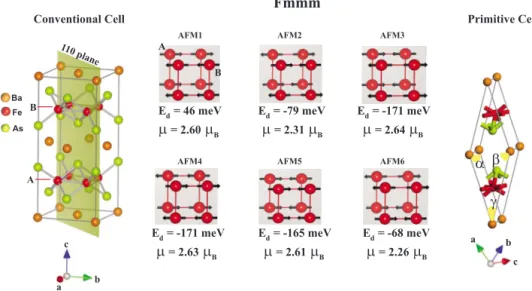
The structure of BaFe2As2 in orthorhombic Fmmm sym-metry is optimized for the FM, AFM, and nonmagnetic共NM兲 states. The AFM spin ordering is determined among six pos-sible complex spin configurations on Fe atoms in different layers as shown in Fig.1. We found that the spin configura-tions AFM3 and AFM4 correspond to the ground state for Fmmm orthorhombic phase. The other excited configura-tions, AFM1, AFM2, AFM5, and AFM6 have energies of 217, 92, 6, and 103 meV/Fe higher than the ground state. The ground-state spin ordering specified as AFM3 is com-plex and is antiferromagnetic between adjacent Fe layers, which are parallel to the 共001兲 plane. However, in each Fe plane the spin ordering continues to be antiferromagnetic in Fe rows parallel to the lattice vector a, while it becomes ferromagnetic in Fe rows along the shortest lattice vector b. The magnitude of magnetic moment on each Fe atoms is calculated to be⬃2.6B for ground-state spin configuration,
but the total magnetic moment is found to be zero. The
pre-dicted AFM state and its spin order of BaFe2As2 in Fmmm are in agreement with the experimental observations.7,8 An-other magnetic state specified as AFM2 has energy 92 meV/Fe higher than that of AFM3 and has perfect antiferro-magnetic spin ordering not only inside the Fe planes but also between adjacent ones. As seen in Fig. 1, the magnetic mo-ments of AFM2, AFM5, and AFM6 spin orderings are, re-spectively, 2.31, 2.61, and 2.26B/Fe, which are smaller
than that of AFM3. It is important to note that earlier calcu-lations have represented the antiferromagnetic state of the Fmmm phase in the primitive unit cell共see Fig.1兲 by
assign-ing opposite spins to two Fe atoms. However, this magnetic state, which is equivalent to AFM2 state is only an excited state and is 92 meV higher in energy relative to the true excited state AFM3 calculated in the conventional cell.
The total energies and optimized structural parameters of the undoped BaFe2As2in Fmmm symmetry are presented in Table I for different magnetic states. For the sake of com-pleteness, the calculated data of the nonmagnetic high-temperature phase having I4/mmm symmetry are also pre-sented. These structure parameters are in agreement with neutron and x-ray data.4,7 The As-Fe-As tetrahedral angle and Fe-As distance are smallest for the NM but largest for the FM state, whereas the nearest As-As distance is largest in the AFM state. It is also seen that the calculated c of the nonmagnetic state is 0.54 Å smaller than c measured experi-mentally for I4/mmm.
B. Electronic structure
Earlier the electronic band structure of the high-temperature I4/mmm phase of BaFe2As2 with experimental lattice constants has been thoroughly investigated.16–21
How-AFM1 AFM2
Fmmm
Primitive Cell Conventional Cell
AFM3
AFM4 AFM5 AFM6
b α β γ c b a Ba As Fe Ed µ µB = 46 meV Ed= -79 meV = 2.60 µ= 2.31µB Ed= -171 meV µ= 2.64µB Ed µ µB = -171 meV = 2.63 Ed= -165 meV µ= 2.61µB Ed= -68 meV µ= 2.26µB A B B A 110 plane a c
FIG. 1. 共Color online兲 Optimized atomic structure of the low-temperature phase of BaFe2As2having orthorhombic Fmmm symmetry. AFM1 , . . . , AFM6 are six different spin configurations in the conventional unit cell. Primitive unit cells of crystal structure is also shown. The antiferromagnetic state specified as AFM2 can also be obtained by assigning opposite spins to two Fe atoms in the primitive cell at the right hand side of the figure. This AFM2 state is an excited state with an energy 92 meV/Fe higher relative to the true AFM ground state corresponding the spin configurations either AFM3 or AFM4. The energy of nonmagnetic state is taken to be zero. Lattice vectors a, b, and c of the conventional and primitive cells are shown. Units of the total energy relative to the nonmagnetic state, Edand the magnetic moment, are meV/Fe and B/Fe, respectively.
ever, there is not much known about the electronic structure and phonon modes corresponding to the low-temperature Fmmm phase in the AFM ground state. Here we carried out band calculations on BaFe2As2 having Fmmm symmetry. The energy bands corresponding to the NM and AFM2 states are calculated in the primitive cell of the optimized structure shown in Fig. 1. In order to reveal the effects of different atomic layers on the electronic structure, we also calculate the bands of individual Ba and Fe2As2 layers having the same atomic configuration in the optimized primitive cell. In addition to these the band structures of the AFM2 and AFM3 ground states calculated in the conventional cell are indi-cated in Fig. 1. The orbital-projected state densities and re-sulting total density of states 共TDOS兲 of the AFM 共AFM3兲 ground state is given to identify the character of bands. En-ergy bands together with the density of states in Fig.2 pro-vide a detailed information for the electronic structure of the Fmmm phase.
The energy bands of BaFe2As2 crystal near the Fermi level共EF= 0兲 is dominated by the bands of Fe2As2layers. In fact, one can trace the bands of individual Fe2As2layer in the band structure of BaFe2As2. However, this is not the case for the bands of the individual Ba layer despite their seemingly isolated configuration in BaFe2As2crystal. The states due to Ba atoms are shifted to lower energies due to significant charge transfer from Ba to As atoms as demonstrated by the charge distribution analysis later in this section. The contri-bution of Ba orbitals to the filled states between EF and
−5 eV is rather small, but becomes significant between −15 and −10 eV. In fact, Ba-4p orbitals give rise to a pro-nounced peak at approximately −15 eV in TDOS. Both structures, namely the NM and the AFM2 states of BaFe2As2 are metallic, but their energy bands are significantly differ-ent. Note that the crystal structure, magnetic order, and elec-tronic structure of BaFe2As2 共Ref. 22兲 and SrFe2As2 共Ref.
23兲 are affected by pressure. For the NM state, the flat band
between⌫-Z direction of the BZ becomes above Fermi level,
if the band structure were calculated using experimental lat-tice parameters. However, this band occurs below the Fermi level as in Fig. 2共c兲, since the optimized lattice parameters are used.
The bands of AFM2 presented in the conventional cell as presented in Fig. 2共e兲 are different from those of the AFM ground state共namely, AFM3兲 presented in Fig.2共f兲. The flat band just below the Fermi level of the AFM3 state in Fig.
2共f兲gives rise to a sharp peak in the total density of states close to the Fermi level. However, this peak is sharper in the AFM2 state. The states of this band originate from the strongly localized Fe-3dxy orbitals. Hybridization of Fe-3d
orbitals with As-4p orbitals is minute in the states of this particular flat band, but becomes crucial for the states be-tween −4 and −1 eV. While the contribution of Fe-3d orbit-als in the states between −6 and −4 eV recedes, the contri-bution of As-4p orbitals increases.
The Fermi surface of BaFe2As2 in the nonmagnetic I4/mmm symmetry consists of two holelike orbitals near the zone center and two electronlike orbitals near X point. This is in agreement with the results of angle-resolved photoemis-sion spectroscopy共ARPES兲.24The Fermi surface of the AFM ground state constructed from the calculated electronic struc-ture consists of four separated sheets at the four edges of the Brillouin zone, which are combined to nonuniform tubes leading to holelike orbitals and a single circular tube along Z-⌫-Z direction leading to electronlike orbitals.
C. Phonons
The magnetic properties and superconductivity of Fe-pnictide compounds exhibit strong sensitivity to the lattice and hence to the corresponding phonon spectrum.25,26 Here we carried out magnetic phonon calculations of BaFe2As2 crystal for the AFM 共AFM3兲 ground state at the ⌫ point of the conventional cell. In these calculations we used the opti-mized lattice parameters and determined the infrared 共IR兲
TABLE I. Optimized structure parameters of the undoped BaFe2As2 crystal and their total energies calculated for different phases and different magnetic states. The total energies Edare given relative to the total energy of the NM state calculated for optimized crystal structure. Calculated results for the high-temperature I4/mmm phase in NM state are also given.
Fmmm State a 共Å兲 b 共Å兲 c 共Å兲 Fe-Fe 共Å兲 Fe-As 共Å兲 As-As 共Å兲 Ba-As 共Å兲 Ed 共meV/Fe兲 AFM3 5.696 5.586 12.856 2.84;2.79 2.41 3.92; 3.74 3.359; 3.403 −171 AFM4 5.585 5.691 12.868 2.84;2.79 2.41 3.93; 3.73 3.357; 3.401 −171 AFM2 5.650 5.630 12.780 2.82;2.81 2.39 3.85; 3.79 3.390; 3.394 −79 NM 5.577 5.577 12.470 2.79 2.32 3.70; 3.79 3.370; 3.372 0 Expt. 5.614 5.574 12.950 2.81;2.79 2.39 3.91; 3.75 3.369; 3.385 97 I4/mmm State a 共Å兲 b 共Å兲 c 共Å兲 Fe-Fe 共Å兲 Fe-As 共Å兲 As-As 共Å兲 Ba-As 共Å兲 Ed 共meV/Fe兲 NM 3.944 3.944 12.470 2.79 2.32 3.70; 3.79 3.37 0 Expt. 3.960 3.960 13.010 2.80 2.40 3.74; 4.03 3.38 78
and Raman-active共R兲 modes. Calculations are performed us-ing the density-functional perturbation theory with plane-wave methods as implemented in PWSCFpackage.13Our re-sults are presented in TableII. While Ba atoms contribute to the low-energy part of the calculated spectrum at⌫ point, Fe and As atoms contribute to the frequency range 10–37 meV of the spectrum. The Fmmm phase has six Raman-active modes. In this respect, the IR data are crucial, since they can
provide reliable information about the atomic structure. The analysis of symmetry and frequency shows that Eu and Eg
modes of I4/mmm phase are doubly degenerate for normal phase, but are split under the applied pressure or collapse of c axis. These modes are also nondegenerate in the Fmmm phase.
Using inelastic neutron scattering, Mittal et al.27measured the temperature dependence of the phonon density of states of BaFe2As2and determined the Raman-active modes. They also performed calculations of phonon spectrum for the non-magnetic state. Our results are in fair agreement with the experimental data on Raman-active modes.25,27We are pre-dicting a phonon peak at 20 meV using spin-polarized cal-culation, which originates from vibrations of As atoms in Fmmm phase. This mode is observed experimentally at 21.5 meV,27 but is not predicted by direct method with nonmag-netic calculations.26 Earlier, phonon-dispersion curves of LaOFeAs have been obtained by Boeri et al.28and Singh et al.29 In addition, Zbiri et al.26 have obtained Raman-active modes for Fmmm and I4/mmm phases of BaFe2As2by non-magnetic calculations using experimental lattice parameters. Present results indicate however that the phonon spectrum of BaFe2As2cannot properly be described by nonmagnetic pho-non calculations which are performed using experimental lat-tice parameters.
As for IR-active modes, until now there is no theoretical treatment for the antiferromagnetic spin configuration of BaFe2As2crystal. Experimentally, at the zone center, an IR-active Fe-As out-of-plane vibration mode is observed at ⬃35 meV.25 We are predicting this mode at 33.28 meV. Note that our results indicate softening and shift of some modes. As seen in Table II, almost all of Raman and IR frequencies are softened to smaller values when the effect of magnetic order is taken into account in phonon calculations.30 For example, IR-active E
u modes of Fe in
I4/mmm are lowered from 36.45 and 36.79 meV to 34.82 and 32.71 meV in Fmmm. The Fe and As B2gRaman modes show a giant phonon softening: Raman-active Eg modes of
As in I4/mmm are lowered from 18.31 and 19.20 meV to 13.93 and 18.52 meV B2gand B3gmodes in Fmmm, respec-tively. Similarly, Raman-active Eg modes of Fe in I4/mmm
are lowered from 32.624 and 37.64 meV to 31.43 and 32.55 meV B2g and B3g modes in Fmmm, respectively. All these results show spin-lattice interaction in the structural phase transition from the high temperature to the low-temperature phase as found earlier by Yildirim6for LaOFeAs and by Hou et al.31for BaFe
2As2.
D. Analysis of charge distribution
The analysis of charge distribution is carried out to reveal valuable information about the character of the bonding and basic features of the structures. In spite of ambiguities in determining the rigorous values, the calculation of charge transfer between atoms or atomic layers may be useful in understanding the system under consideration. Here we present the isosurfaces of total charge density of the AFM ground state in the conventional cell in Fig. 3. In the same figure the counterplots of the total charge are also shown on
FIG. 2. 共Color online兲 Energy-band structures of individual Ba 共a兲 and Fe2As2 layers 共b兲 together with the energy bands of the BaFe2As2crystal in Fmmm symmetry corresponding to NM state 共c兲 and AFM2 共d兲 states are calculated for the primitive cell of the optimized structure. Bands of the AFM2 state共e兲 and AFM ground state共AFM3兲 共f兲 both calculated in the conventional cell. 共g兲 TDOS of the optimized AFM3 state together with orbital-projected DOS. The energy-band calculation of the NM state is carried out using optimized lattice parameters given in TableI.
the specific planes. Isosurfaces of the total charge clearly show the bonds between As atoms in the 共100兲 plane. The counterplots of charge density on the 共100兲 plane quantify these isosurface plots on the faces of orthorhombic cell. However, neither isosurface, nor contour plots calculated on the 共100兲 plane present any evidence for directional 共cova-lent兲 bonding between Ba and As atoms. Such a bond is also absent between two As atoms below and above the Ba atomic layer. The low value of charge density 共0.005 unit兲 between As atoms above and below Ba atom is actually due to the metallic charge in the Ba layer. In the case of collapse 共nonmagnetic兲 phase of BaFe2As2crystal the bond between these As ions do not occur due to the interaction between Ba ions and As ions.
The metallic bond between Ba atoms within the Ba layers is revealed only if the isosurface values were lowered. It is, however, clearly seen in the charge density counterplots on the共110兲 plane. High charge density around Fe ions is due to Fe-3d orbitals. Each Fe atom forms four Fe-As bonds in tetrahedral directions, which are achieved through the hy-bridization of Fe-3d and As-4p orbitals. Even if one cannot
calculate rigorously, the charge transfer from Fe to As atoms 共which is estimated to be 0.16 electrons using Bader scheme兲32 attributes a minute ionic character to the four Fe-As bonds. Our charge density analysis based on Bader scheme also estimates that 1.24 electrons are transferred from Ba atoms. Considering the charge transferred from Fe and Ba atoms, the excess charge on the As atoms amounts to 0.78 electrons. Moreover, Mulliken33population analysis in-dicates that the Mulliken charge of Ba, Fe, and As in BaFe2As2 crystal in the AFM ground state were approxi-mately, +1.20, +0.26, and −0.86, respectively. These values corroborate the charge-transfer values revealed by Bader analysis and both Bader and Mulliken charge analyses dem-onstrate that electrons are transferred from Ba layer to FeAs layer.
Despite the ambiguities in quantitative determination of the charge transfer between constituent atoms, critical infor-mation can be revealed from the calculation of the difference charge density. We first plot the difference charge density obtained by subtracting the charges of Fe-As and Ba layers from the total charge density of the AFM ground state,
TABLE II. Calculated frequencies of Raman-active共R兲 and IR-active modes 共in meV兲 of Fmmm and I4/mmm phases at the ⌫ point and their symmetry analysis. The subscripts u and g represent antisymmetric and symmetric vibrations, respectively. The other subscript i 共i = 1 , 2 , 3兲 indicates the stretching modes. Modes of the AFM ground state corresponding to AFM3 spin configuration are calculated in the conventional cell with optimized lattice parameters. As for the phonon modes, specified as AFM3共expt.兲 and NM 共expt.兲, are calculated by using experimental lattice constant with experimental As coordinate, zAs.
Fmmm
Atom Wyckoff position Phonon modes
Ba 4a B1u+ B2u+ B3u Fe 8f B1g+ B2g+ B3g+ B1u+ B2u+ B3u As 8i Ag+ B1u+ B2u+ B3u+ B2g+ B3g Raman= Ag+ B1g+ 2B2g+ 2B3g IR= 3B1u+ 3B2u+ 3B3u State IR 共meV兲 R 共meV兲 AFM3共Expt.兲 B1u共10.94,32.59兲; B2u共29.32,37.59兲; B3u共27.88,32.71兲 Ag共25.82兲, B1g共26.33兲; B2g共12.71,32.26兲; B3g共18.64,35.0兲 AFM3 B1u共11.36,33.28兲; B2u共30.26,34.82兲; B3u共27.85,32.71兲 Ag共26.061兲, B1g共27.57兲; B2g共13.93,31.434兲; B3g共18.52,32.55兲 I4/mmm
Atom Wyckoff position Phonon modes
Ba 2a A2u+ Eu Fe 4d B1g+ Eg+ A2u+ Eu As 4e A1g+ A2u+ Eg+ Eu Raman= 2Eg+ A1g+ B1g IR= 3A2u+ 3Eu State IR 共meV兲 R 共meV兲 NM A2u共11.52,33.99兲, Eu共17.87,18.17,36.45,36.79兲 Eg共18.31,19.20,36.24,37.64兲, A1g共26.55兲, B1g共27.48兲 NM共expt.兲 A2u共10.92,33.64兲, Eu共15.80,30.08兲 Eg共16.79,30.47兲, A1g共25.79兲, B1g共27.22兲
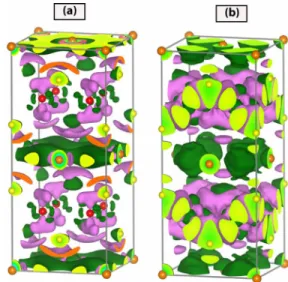
namely⌬L=T−FeAs−Ba. As mentioned in Sec.III B, we considered Ba and FeAs layers as if the ingredients of the BaFe2As2 iron-pnictide crystal, and calculated the charge density of each layer individually in the same unit cell keep-ing their atomic structure the same as in BaFe2As2crystal. In these plots negative values of the difference charge density indicate the depletion of the electrons from the layer. The positive values are interpreted as the accumulation of excess electrons to the layer. Isosurface plots of calculated differ-ence charge density, ⌬L, are presented in Fig. 4共a兲. Dark
共green兲 isosurfaces show the charge transfer from the Ba layers to the pink共light兲 isosurfaces of FeAs layers. In Fig.
4共b兲we calculate the isosurface plots of the difference charge density, which are obtained by subtracting the charge densi-ties of the constituent free atoms共Ba, Fe, and As兲 located in the positions equivalent to their positions in the crystal, namely,⌬A=T−Ba−Fe−As. Charge depletion on Ba and Fe atoms and charge accumulation on As atoms are clearly seen.
IV. CONCLUSIONS
In conclusion, we presented a theoretical study of the un-doped iron-pnictide BaFe2As2 crystal based on first-principles plane-wave calculations within density-functional theory. Our analysis comprises atomic, electronic, and mag-netic structures, as well as phonon modes at the center of the Brillouin zone. While our study is focused on the orthorhom-bic Fmmm phase, we also considered the tetragonal I4/mmm phase for the sake of completeness. Among different spin
configurations we determined the magnetic ground state of the Fmmm phase. The complex spin configuration of this ground state agrees with the experimental results, but differs from that of the antiferromagnetic state achieved by the an-tiparallel spin alignment on two Fe atoms in the primitive unit cell. We found that the electronic state density of the antiferromagnetic ground state close to the Fermi level is characterized by a sharp peak, which is derived mainly from Fe-3dxy orbitals with a small contribution from the As-4p
orbitals. Whereas states originating from Ba orbitals become pronounced at the lower part of the spectrum. The analysis of charge transfer reveals valuable information about charge states and bonding between atoms. The magnetic phonon calculations are essential to distinguish the correct spin con-figuration. Our analysis of the phonon modes of the AFM ground state at the ⌫ point predicts Raman- and IR-active modes, some of which were softened.
ACKNOWLEDGMENTS
This research was supported by the Scientific and Tech-nological Research Council of Turkey under Project No. TBAG 104536. Part of the computational resources have been provided through Grant No. 2-024-2007 by the Na-tional Center for High Performance Computing, Istanbul Technical University. We are grateful for helpful discussions with Taner Yildirim, Ercan Alp, Can Ataca, and S. Cahangi-rov.
FIG. 3. 共Color online兲 Charge distribution of the Fmmm phase in the AFM ground state. Left: Total charge-density isosurface plots in the conventional cell with isosurface value of 0.0012 electrons/Å3. Middle: contour plots calculated on the共100兲 plane 共i.e., one of the side faces of the conventional cell兲. Right: Contour plots on the 共110兲 plane. In the counterplots, the charge density increases along the direction indicated by small arrows. Numerals in the counterplots indicate the values of charge density in units of at the specific locations.
FIG. 4. 共Color online兲 Top panels: 共a兲 Isosurface plots of the difference charge density⌬Lcalculated by subtracting the charge densities of individual FeAs and Ba layers from the total charge density of the AFM ground state.共b兲 Isosurface plots of the differ-ence charge density⌬Acalculated by subtracting the charge
den-sities of the constituent free atoms from the total charge density. Pink-light and green-dark isosurface plots are for positive and nega-tive values, respecnega-tively. Isosurface value is 0.0012 electrons/Å3
1Y. Kamihara, T. Watanabe, M. Hirano, and H. Hosono, J. Am. Chem. Soc. 130, 3296共2008兲.
2M. Rotter, M. Tegel, and D. Johrendt, Phys. Rev. Lett. 101, 107006共2008兲.
3P. L. Alireza, Y. T. Chris Ko, J. Gillett, C. M. Petrone, J. M. Cole, G. G. Lonzarich, and S. E. Sebastian, J. Phys.: Condens. Matter 21, 012208共2009兲.
4M. Rotter, M. Tegel, D. Johrendt, I. Schellenberg, W. Hermes, and R. Pöttgen, Phys. Rev. B 78, 020503共R兲 共2008兲.
5J. K. Dong, L. Ding, H. Wang, T. Wu, X. H. Chen, and S. Y. Li, New J. Phys. 10, 123031共2008兲.
6T. Yildirim, Phys. Rev. Lett. 101, 057010共2008兲.
7Q. Huang, Y. Qiu, W. Bao, M. A. Green, J. W. Lynn, Y. C. Gasparovic, T. Wu, G. Wu, and X. H. Chen, Phys. Rev. Lett.
101, 257003共2008兲.
8Y. Su, P. Link, A. Schneidewind, Th. Wolf, P. Adelmann, Y. Xiao, M. Meven, R. Mittal, M. Rotter, D. Johrendt, Th. Brueckel, and M. Loewenhaupt, Phys. Rev. B 79, 064504 共2009兲.
9R. A. Ewings, T. G. Perring, R. I. Bewley, T. Guidi, M. J. Pitcher, D. R. Parker, S. J. Clarke, and A. T. Boothroyd, Phys. Rev. B 78, 220501共R兲 共2008兲.
10W. Z. Hu, J. Dong, G. Li, Z. Li, P. Zheng, G. F. Chen, J. L. Luo, and N. L. Wang, Phys. Rev. Lett. 101, 257005共2008兲. 11T. Yildirim, Phys. Rev. Lett. 102, 037003共2009兲.
12J. P. Perdew, K. Burke, and M. Ernzerhof, Phys. Rev. Lett. 77, 3865共1996兲.
13S. Baroni, A. Del Corso, S. Girancoli, and P. Giannozzi, http:/ www.pwscf.org/
14H. J. Monkhorst and J. D. Pack, Phys. Rev. B 13, 5188共1976兲. 15E. R. Davidson, J. Comput. Phys. 17, 87共1975兲.
16I. A. Nekrasov, Z. V. Pchelkina, and M. V. Sadovskii, JETP Lett.
88, 144共2008兲.
17D. J. Singh, Phys. Rev. B 78, 094511共2008兲.
18F. Ma, Z.-Y. Lu, and T. Xiang, Phys. Rev. B 78, 224517共2008兲.
19I. R. Shein and A. L. Ivanovskii, Phys. Rev. B 79, 054510 共2009兲.
20C. Krellner, N. Caroca-Canales, A. Jesche, H. Rosner, A. Or-meci, and C. Geibel, Phys. Rev. B 78, 100504共R兲 共2008兲. 21G. Xu, H. Zhang, X. Dai, and Z. Fang, EPL 84, 67015共2008兲. 22W. Xie, M. Bao, Z. Zhao, and B.-G. Lui, Phys. Rev. B 79,
115128共2009兲.
23M. Kumar, M. Nicklas, A. Jesche, N. Caroca-Canales, M. Schmitt, M. Hanfland, D. Kasinathan, U. Schwarz, H. Rosner, and C. Geibel, Phys. Rev. B 78, 184516共2008兲.
24L. X. Yang, H. W. Ou, J. F. Zhao, Y. Zhang, D. W. Shen, B. Zhou, J. Wei, F. Chen, M. Xu, C. He, X. F. Wang, T. Wu, G. Wu, Y. Chen, X. H. Chen, Z. D. Wang, and D. L. Feng, Phys. Rev. Lett. 102, 107002共2009兲.
25D. Reznik, K. Lokshin, D. C. Mitchell, D. Parshall, W. Dmowski, D. Lamago, R. Heid, K.-P. Bohnen, A. S. Sefat, M. A. McGuire, B. C. Sales, D. G. Mandrus, A. Asubedi, D. J. Singh, A. Alatas, M. H. Upon, A. H. Said, Yu. Shvyd’ko, and T. Egami, arXiv:0810.4941共unpublished兲.
26M. Zbiri, H. Schober, M. R. Johnson, S. Rols, R. Mittal, Y. Su, M. Rotter, and D. Johrendt, Phys. Rev. B 79, 064511共2009兲. 27R. Mittal, Y. Su, S. Rols, T. Chatterji, S. L. Chaplot, H. Schober,
M. Rotter, D. Johrendt, and Th. Brueckel, Phys. Rev. B 78, 104514共2008兲.
28L. Boeri, O. V. Dolgov, and A. A. Golubov, Phys. Rev. Lett.
101, 026403共2008兲.
29D. J. Singh and M.-H. Du, Phys. Rev. Lett. 100, 237003共2008兲. 30Note that specific modes such as E
uIR-active modes of As in the
xy plane of I4/mmm phase is increased to 30.26 meV in Fmmm phase.
31D. Hou, Q. M. Zhang, Z. Y. Lu, and J. H. Wei, arXiv:0901.1525 共unpublished兲; in this work, the phonon calculation was per-formed using experimental lattice constant.
32G. Henkelman, A. Arnaldsson, and H. Jonsson, Comput. Mater. Sci. 36, 354共2006兲.