rÏÏjL· v b İ J J / V I i '· . 1 ‘ ' ■ ■ Г “ " I ■^m Ч « ''< K ^ ' «> Ч··''' ti Ф · · ' *' témi * вы y * J ·Λ/0' « * y. 4. * vTT K r ' " ϊ ν ' γ χ , '·;:;■ r s І Э І
• yíSisr
9 Э ^PLANNING AND CONTROL OF AGVS IN AMRF
DECISION HIERARCHY
A THESIS
SUBMITTED TO THE DEPARTMENT OF INDUSTRIAL ENGINEERING
AND THE IN STITU TE OF ENGINEERING AND SCIENCES OF BILKENT UNIVERSITY
IN PARTIAL FULFILLMENT OF THE REQUIREMENTS FOR THE DEGREE OF
MASTER OF SCIENCE
By
Haluk Yılmaz
September, 1993
/ ί
Μ
I certify that I have read tliis thesis and th at in my opinion it is fully adequate, in scope and in quality, as a thesis for the degree of Master of Science.
5
X .Ml
Assist. Prof. M. Selim Aktürk (Principal Advisor)
I certify th at I have read this thesis and th at in my opinion it is fully adequate, in scope and in quality, as a thesis for the degree of Master of Science.
Assoc. Prof. Omer Benli
I certify th at I have read this thesis and th at in my opinion it is fully adequate, in scope and in quality, as a thesis for the degree of Master of Science.
^'-Assöci^rof. ^ m a l Dinçer
Approved for the Institute of Engineering and Sciences:
_____________________________________________________________________________________________________________
Prof. Mehmqiid^aray
ABSTRACT
PLANNING AND CONTROL OF AGVS IN AMRF
DECISION HIERARCHY
Haluk Yılmaz
M.S. in Industrial Engineering
Supervisor: Assist. Prof. M. Selim Aktiirk
September, 1993
Scheduling efforts made without considering the special limitations of the ma terial handling system might lead to infeasible results. This problem especially becomes important when the Automated Guided Vehicles (AGV) are the main m aterial handling media due to their inherent flexibility and adaptability that increase the scheduling complexity. In this thesis, an analytical model is pro posed, first, to incorporate the AGV module into the overall decision making hierarchy. A mathematical formulation is developed to include interaction be tween the AGV module and other modules in the system by considering the restrictions of the material handling system. A micro-opportunistic approach is proposed to solve the AGV scheduling problem. Finally, the proposed method is compared with a number of dispatching rules.
K e y words: Factory Reference Models, AGVS, Opportunistic Scheduling.
ÖZET
AMRF KARAR HİYERARŞİSİ İÇİNDE OTOMATİK
GÜDÜMLÜ ARAÇLARIN PLANLANMASI VE KONTROLÜ
Haluk Yılmaz
Endüstri Mühendisliği Bölümü Yüksek Lisans
Tez Yöneticisi: Yrd. Doç. Dr. M. Selim Aktürk
Eylül, 1993
Malzeme taşınmasına özel sınırlamaları gözöııGne almayan çizelgeleme yaklaşımları olursuz sonuçlara yol açabilir. Bu problem, özellikle Otomatik Güdümlü Araçların (OGA) ana taşıma aracı olduğu durumlarda bu araçların esneklikleri ve uyumluluklarından ötürü önem k2izanmaktadır. Bu tez çalışma sında, önce OGA modülünün karar verme hiyerarşisine katılması için analitik bir model önerilmiştir. Malzeme taşınmcisı sistemi kısıtları gözönüne alınarak, OGA modülüyle diğer modüllerin ilişkilerini sisteme dahil etmek üzere bir matematiksel formulasyon geliştirilmiştir. OGA çizelgeleme problemini çözmek için bir mikro-oportünist yaklaşım önerilmektedir. Son olarak, önerilen metot diğer sezgisel metotlarla karşılaştırılmaktadır.
A n a h ta r sözcükler: Fabrika Bellik Modelleri, OGA Sistemleri, oportünist çizelgeleme.
VI
ACKNOWLEDGEMENT
I would like to express my gratitude to Assist. Prof. Selim Akturk due to his supervision, guidance, understanding and encouragement throughout the development of this thesis. I am also indebted to Assoc. Prof. Cemal Dinçer and Assoc. Prof. Ömer Benli for showing keen interest to the subject m atter and accepting to read and review this thesis.
I would like to extend my deepest gratitude and thanks to my family for their morale support and encouragment.
I greatly appreciate my friends Orhan Dağlıoğlugil, Mehmet Özkan, Selçuk Avcı, Okan Balköse, İhsan Durusoy, Elif Görgülü, Oğuz Işıklı and Alper Erdoğan for their accompany and patience in any way during my studies.
Contents
1 INTRODUCTION 2 LITERATURE REVIEW 2.1 In tro d u ctio n ... 3 2.2 M otivation... 4 2.3 Factory Reference M o d e l s ... 52.4 Decision Making H ierarchy... 11
2.5 Problems Related with A G V S ... 15
2.5.1 AGV Types and F u n ctio n s... 15
2.5.2 Design P r o b l e m s ... 18 2.5.3 Operational Problems ... 22 2.6 Vehicle R o u tin g ... 27 2.7 Opportunistic Scheduling... 29 2.8 Conclusion... 31 3 PROBLEM FORMULATION 33 vm
3.1 In tro d u c tio n ... .33
3.2 The Scheduling M o d e l ... 34
3.2.1 Shop Level... 3.5 3.2.2 Cell L e v e l... 36
3.2.3 AGV M o d u le ... 37
3.3 AGV Scheduling Problem ... 37
3.4 Mathematical M o d e l ... 40
3.5 Conclusion ... 43
4 SCHEDULING ALGORITHM 44 4.1 In tro d u c tio n ...44
4.2 Fundamentals of the a lg o rith m ... 44
4.3 The scheduling h e u r is tic ... 45
4.3.1 Key ideas in the a lg o rith m ... 46
4.3.2 The A lg o r ith m ...47
4.3.3 Determination of slot lo a d s... 49
4.3.4 Scheduling the jobs in the most contended s l o t... 50
4.3.5 Block Merging P r o c e s s ...54
4.4 C onclusion... 57
5 EXPERIMENTAL ANALYSIS 58 5.1 In tro d u c tio n ... 58
CONTENTS
5.2 Experimental Design 58
5.2.1 Choice of Factors and Levels 59 5.2.2 Alternatives for Comparison 62
5.2.3 Response Variable 64
5.2.4 Type of Experimental Design 64 5.2.5 Computational Comparison 65
5.3 Analysis of Variance 67
5.3.1 Effect on Total Lateness 68
5.3.2 Effect on Computation Time 69
5.4 Conclusion 69
6 CONCLUSION 72
List of Figures
3.1 Proposed Hybrid Model . ... 34 3.2 Functional Relations in Hybrid M odel... 35
4.1 Individual job weights and slot l o a d s ... 50
List of Tables
2.1 Levels and tasks of DEC/Philips Control H ie ra rc h y ... 7
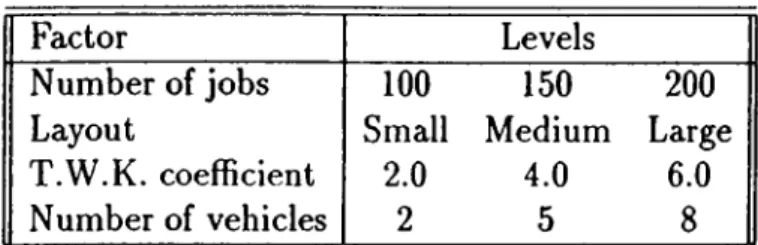
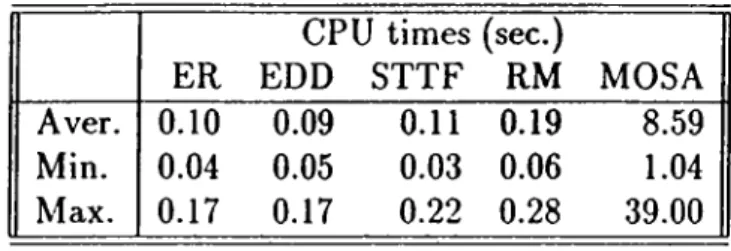
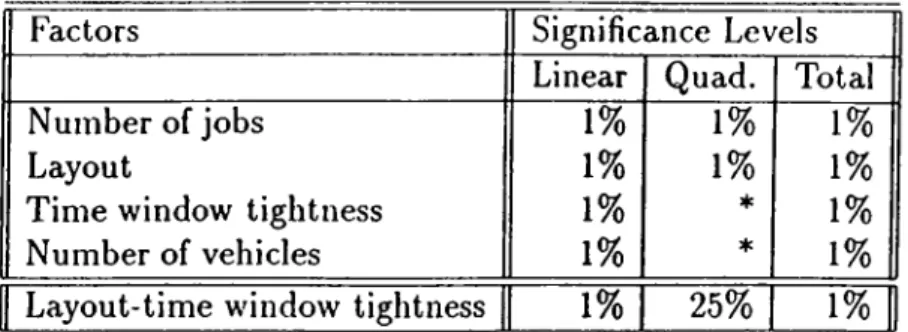
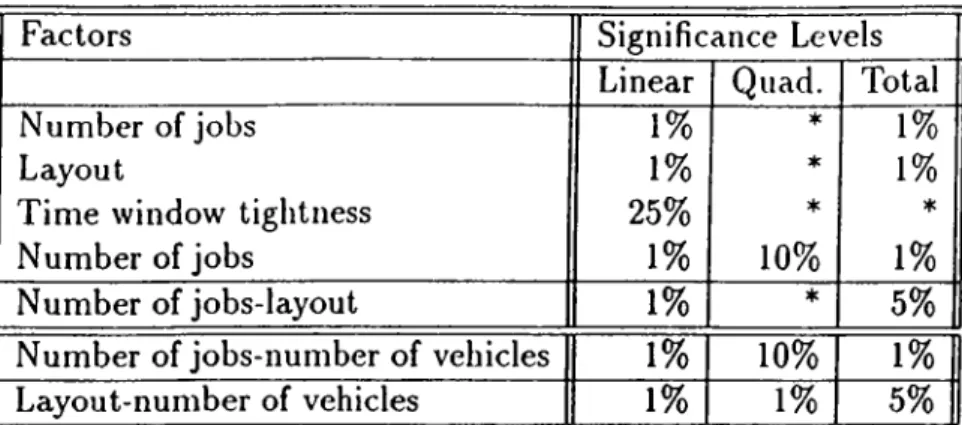
5.1 Factors and levels in the experimental design 60 5.2 Fixed Parameters in experimental design 61 5.3 Total Deviation C om parison... 66 5.4 Computation times c o m p a ris o n ... 67 5.5 Significant factors for total lateness 69 5.6 Significant factors for computation tim e , 70
A.l Total Deviation for Replication 1 ... 75 A.2 Total Deviation for Replication 2 ... 78 A.3 Total Deviation for Replication 3 81 A.4 Total Deviation for Replication 4 ... 84 A.5 Total Deviation for Replication 5 ... 87
Chapter 1
INTRODUCTION
Material Handling does not receive the attention it deserves in manufacturing systems. One important reason of this fact is the difficulty in placing the mate rial handling modules in decision hierarchy. This causes ignorance of material handling in decision making and considerable productivity losses are incurred. Automated Guided Vehicle Systems (AGVS) have gained considerable popu larity because of their flexibility and Automated Guided Vehicles (AGVs) have become the main transport media especially in Flexible Manufacturing Sys tems. However, their flexibility makes the problem of incorporation of AGV module to the decision hierarchy even more serious.
In this study, main objective is to overcome the problem of incorporating the AGV module to the decision making hierarchy. First, the reasons of this problem are identified. As a solution to the problem, a hierarchical model is proposed. The tasks of modules in this new hierarchical model are defined. Furthermore, the AGV module’s scheduling problem is formulated as a mixed integer program. However, the computational time requirements suggest devel oping a heuristic method for this problem. Therefore, utilizing the successful ideas of recent scheduling literature, a heuristic algorithm is developed. The experimental analysis shows that the scheduling method is quite successful.
CHAPTER I. INTRODUCTION
of incorporation problem and its results are analyzed in detail in the context of factory reference models. Next, the current AGV scheduling literature is discussed. The hierarchical model proposed in this study requires solution of the AGV scheduling problem bcised on the AMRF decision hierarchy. In order to identify the difficulty of this problem, the next item in literature review is the Time-Const rained Vehicle Routing Problem (TCVRP), which is similar to AGV scheduling problem. Computational tim e requirements for this problem propose that a heuristic method should be developed for AGV scheduling. The last item in literature review discusses some of the recent successful ideas in scheduling that can be used in developing a heuristic algorithm. The third chapter discusses the hierarchical model that we are proposing for incorporation problem. The resultant scheduling problem for the AGV module is also defined and a mixed integer p rogramming formulation is presented in this chapter. In Chapter 4, a heuristic method is presented for AGV scheduling problem. In Chapter 5, an experimental analysis is made. The method is compared with alternative rules. Also an ANOVA model is prepared in order to search for the factors that might affect the performance of our method. Finally, concluding remarks and future research directions are given in Chapter 6.
Chapter 2
LITERATURE REVIEW
2.1 In tro d u ctio n
The development of the model presented in this study is based on a wide range of results of previous studies. In this chapter, we will mention the relevant literature that was used in the study. Different topics th at will be mentioned are;
1. Factory Reference Models 2. Decision Making Hierarchy 3. Problems Related with AGVs 4. AGV Scheduling
5. Vehicle Routing
6. Opportunistic Scheduling
These different areas are all used in different parts of the model. Before re viewing these areas in the literature, the next section briefly draws the picture of where these topics were used in the study, giving the motivation and the way they are linked.
2.2
M o tiv a tio n
The order of the items listed to be discussed follows the real order of areats of literature studied. Factory Reference Models are studied first, because Hi erarchical Planning Systems are very appropriate for the systems requiring multilevel decision making. The second item, Decision Making Hierarchy is important in the sense th at problems related to inclusion of material handling in Hierarchical Planning Systems can be identified. This item will make the motivation of the model clearer.
CHAPTER 2. LITERATURE REVIEW 4
In the third area. Problems Related W ith AGVs, the AGV settings and studies in the literature will be discussed. This is for the purpose of identi fying the characteristics and attributes of an AGV system in practice. These characteristics are especially important in forming the structural settings for our model as well as determining the scope of the study. Also a clcissification of the studies in the literature is made. AGV scheduling approaches so far do not make use of vehicle routing literature. However, by our settings, AGV scheduling and vehicle routing problems are very closely related. Because of this reason, the fourth area in the review is Vehicle Routing. This item will be utilized to identify the complexity of our problem.
The last item in the review is Opportunistic Scheduling, which is important for the purpose of developing the solution algorithm to the problem defined in our model. In this part, some recent scheduling methods are studied, by stressing the motivations of these algorithms. These algorithms construct the motivation of the algorithm th at will be proposed in our study. Meantime, we will adapt a recent heuristic sequencing rule to form an AGV dispatching rule.
2.3
F a cto ry R eferen ce M o d els
In literature, Hierarchical Planning Systems are studied by many authors. Es pecially in systems requiring multilevel decisions, Hierarchical Planning Sys tems have become very popular. Typically in a production system, there are a series of decisions to be made over time. These range, at lecist from low level decisions such as assignment of tasks and workers to machines and ordering of jobs; to high level decisions such as amount of hiring, layoff and over-times, amount to be produced in different product groups, setting due-dates, etc. The timing requirements of these decisions change significantly. The typical and intuitive approach is decomposing the system, having smaller problems to solve which consist, more or less, decisions of same time horizon. First the high level decisions are made and put in execution. The results and output of these decisions are used to make the low level decisions.
The high level decisions are aggregated and much of required information is not known with certainty yet, including future demands, job processing times, worker availability, machine availability (because of breakdowns) and raw m aterial availability. W hat is more, related with aggregation, many details are ignored at this level, to be considered in lower level decisions. For example, setups are treated as if sequence independent and product groups are used instead of individual stock keeping units.
A hierarchical system uses separate mathematical models to make decisions at each level. Solution of a higher level model is used as the parameters or constraints for the model below. From a simplistic point of view, this is the way the system would be expected to work in itself. The main difference of Hierarchical Approach is the explicit emphcisis on the linkages between the modules and designing all modules in the system simultaneously so that they fit well together [7]. Hierarchical planning approaches have two important advantages as also noted by Dempster et al. [7]:
CIlAPTL·:I{ 2. LirERArURE REVIEW 5
d i A P T E R 2. LITERArURE REVIEW
Coping with uncertainty
One important point of hierarchical planning systems is that, being similar in structure, they are parallel to hierarchical organizations operationally. Making use of this similarity, like organizational structures, different architectures are found in literature for hierarchical planning.
In literature, hierarchical production planning systems are studied by many authors. Hax and Meal [14] are the one of the first that propose decomposi tion models in order to resolve the mathematical complexity of the problem. Architectural approaches are made after these studies such as Biemans L· Vis- sers’ DEC/Philips Control Hierarchy [3] and Jackson and Johnson’s AMRF Decision Hierarchy [15]. These studies propose a number of levels, which are placed in a hierarchy like an organizational hierarchy tree structure. Each level heis some tasks to complete and each level can only interface either with its supervisor or subordinate.
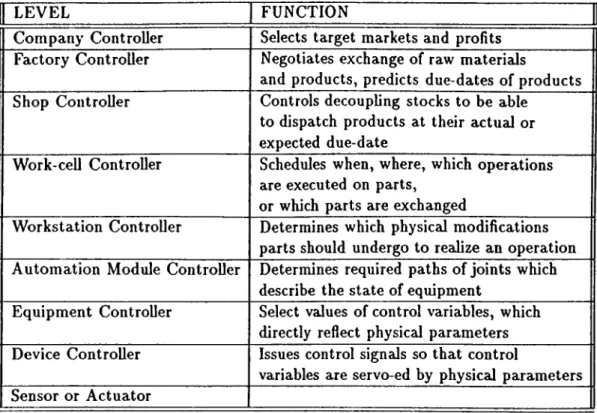
One of these studies is made by Biemans and Vissers [3]. In their study, they form a nine level control structure, which is called DEC/Philips Control Hierarchy. The task of each level is given in Table 2.1.
For the Work-cell Level, the authors have a single controller. They do not form manufacturing cells, actually, but claim that a single controller would be sufficient even if there were. They argue that even physically new cells do not necessarily require existence of work-cell controllers, giving the example of not necessarily appointing a director when a new building is erected to a company. According to their structure, the work-cell controller (typically there is only one) coordinates the exchange of parts among workstations and tells worksta tions with whom they have to exchange parts. They view the transport system as a specialized instance of a workstation that executes displacement opera tions [3]. However the resemblance they have put is not so much valid in this case from a functional point of view. The advantages of cellular manufacturing are being lost in some sense since they are not being used to achieve a spatial decomposition to simplify the problem even further.
CHAPTER 2. LITERATURE REVIEW
L E V E L F U N C T IO N
C o m p a n y C o n tr o lle r S elects t a r g e t m a r k e ts a n d p r o fits F a c to r y C o n t r o ll e r N e g o tia te s e x c h a n g e o f ra w m a te r ia ls a n d p r o d u c ts , p r e d ic ts d u e - d a te s o f p r o d u c t s S h o p C o n t r o ll e r C o n tro ls d e c o u p lin g s to c k s to b e a b le to d is p a tc h p r o d u c ts a t th e ir a c t u a l o r e x p e c te d d u e - d a te W o rk -c e ll C o n tr o lle r S ch e d u le s w h e n , w h e re , w h ic h o p e r a t io n s a re e x e c u te d o n p a r t s , o r w h ich p a r t s a r e e x c h a n g e d W o r k s t a t i o n C o n tr o lle r D e te rm in e s w h ic h p h y s ic a l m o d if ic a tio n s p a r t s s h o u ld u n d e rg o t o re a liz e a n o p e r a t io n A u t o m a t i o n M o d u le C o n tr o lle r D e te rm in e s re q u ire d p a t h s o f j o i n t s w h ic h d e s c rib e t h e s t a t e o f e q u ip m e n t
E q u i p m e n t C o n tr o lle r S elect v alu e s o f c o n tr o l v a ria b le s , w h ic h d ire c tly refle c t p h y sic a l p a r a m e t e r s D e v ic e C o n t r o ll e r Issu e s c o n tr o l sig n a ls so t h a t c o n tr o l
v a ria b le s a r e se rv o -e d b y p h y s ic a l p a r a m e t e r s S e n s o r o r A c t u a t o r
Table 2.1: Levels and teisks of DEC/Philips Control Hierarchy
The second architecture for hierarchical planning is developed at the Na tional Institute of Standards and Technology in the USA, for the Automated M anufacturing Research Facility, (AMRF). Quite similar to Biemans and Visser’s architecture, it consists of individual modules, which have limited size functionality and complexity. Each level decomposes input commands from its supervisor into procedures to be executed at that level and subcommands to be issued to one or more subordinate modules. From top to lower levels, this process continues, which transforms to very primitive actions at the lowest level to actuate shop floor equipment. In the opposite way, status feedback is provided to supervisors by their subordinates. This ensures good performance of adaptive real-time decision making as discussed by Jackson and Jones [15].
There are five levels in AMRF architecture:
• Shop • Cell
• Workstation • Equipment
The responsibilities of these five levels can be explained briefly as follows:
Facility is the highest level. The activities of facility level can be grouped in three classes of functions:
• Manufacturing Engineering: This class includes Computer Aided Design (CAD), Group Technology classification and Process Planning.
• Information Management: Activities that provide user data interfaces to support administrative and business management functions are in this class. •
• Production Management: This class includes generating long range sched ules, identifying production resource requirements, determining the need for additional capital investments to meet production goals, determining excess production capacity, and summarizing quality performance data.
Shop is the second level in the hierarchy. This level is responsible for:
• Conducting the production and supporting jobs on the shop floor • Allocating resources to those jobs
CHAPTER 2. LITERATURE REVIEW 8
Shop floor level can be considered forming with two major component modules, which are Task Manager and Resource Manager. Task Manager is responsible for capacity planning, grouping orders into batches, assigning and releasing batch jobs to cells and tracking individual orders to completion. Resource
CHAPTER 2. LITERATURE REVIEW
Manager is responsible for allocating production resources to individual cells, ordering new resources and managing repair of resources at hand.
Cell is the third level. Sequencing of batch of similar parts through work stations and supervising for support services such as material handling and calibration are duties of this level. Typically, there will be jobs that require the services of one or more workstations assigned to a cell, material handling being one of these workstations. Together with jobs, certain due-date and priority data will be given. The cell must sequence these jobs and develop a schedule of start and finish times of each job at each workstation. This includes material handling requirements as well. Of course, when conflicts or delays ap pear in workstations, cell must re-plan, reroute and reschedule to overcome these problems. The task of a cell is quite complex, and part of the difficulty is due to shared resources like material transport devices [15].
Workstation level is the level at which activities of small integrated group ings of shop-floor equipment are directed and coordinated. Typically, a work station in AMRF consists of a robot, a machine tool, a material storage buffer and a control computer. The controller sequences equipment level subsystems through job setup, part fixturing, cutting processes, chip removal, in-process inspection, job take-down and cleanup operations.
Equipment level is the lowest level in the hierarchy. Equipment controllers translate workstation commands into a sequence of simple tasks for that equip ment. Individual equipments can be from different vendors and therefore it may be required to use different ‘languages’ that each one can understand. Another task of equipment controller is to monitor the execution of the tasks which is translated by means of sensors in the hardware.
As would be valid for any hierarchical structure, the nature of the problems involved in each level changes from top level to down levels in AMRF Decision Hierarchy. These changes can be listed as [15]: •
• Each level must sequence through the list of jobs assigned by its super visor and develops a schedule of tasks for its subordinates.
CHAPTER 2. LITERATURE REVIEW 10
• The number of problems to be solved and the frequency with which they must be resolved increases dramatically
• Time available to find solutions decreases significantly
• Information used to solve the problems becomes more abundant and de terministic
The AMRF Decision Hierarchy is quite similar to that proposed by Biemans and Vissers. One difference is in the number of Work-cell controllers in the decision hierarchy. As mentioned before, we do not view having a single Work cell controller appropriate for the system. For the Decision Hierarchy in our study, AMRF Decision Hierarchy is selected.
Mathematically, from the scheduling point of view, the scheduling problem is generally considered once for the whole system, which is usually off-line. Jackson and Jones [15] propose th at each level should be responsible for gen erating and maintaining its own schedule, quickly and only as needed. By nature of hierarchy, the constraints imposed by the upper level should be satis fied, which are in the form of priorities among jobs, and start and finish times for jobs. As an output, a schedule of jobs assigned by the supervisor should be given to the lower level.
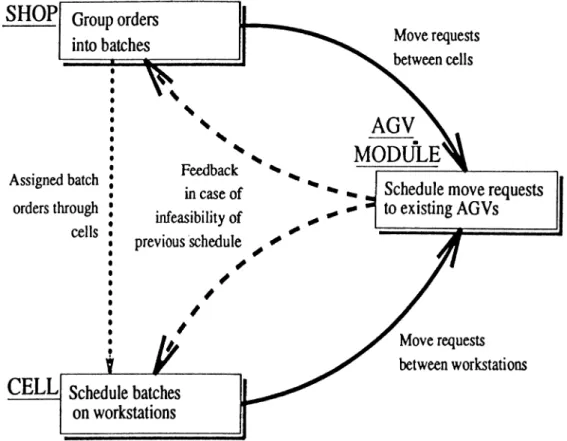
R e m a rk 1: Jackson and Jones’ framework accounts to the following set ting: From shop level, there are job orders given to cells and move orders given to material handling module. The jobs given to each cell have due-dates and priorities (or weights) as well as release times. These times are typically com puted by taking an approximate processing time for the operations. If the parts to be processed will arrive from some other cell or required material will be delivered at a certain time, there may be known release times. The cell level has to identify the workstations that will process these jobs, sequence their operations and then schedule the operations of each job on the workstations including ‘Material Handling W orkstation’. For the material handling module, it has to complete the move orders between work stations in a cell, as well as move orders between cells. Material Handling module has to schedule all
CHAPTER 2. LITERATURE REVIEW 11
these tasks. The resultant schedule of the cell level will form the orders for the workstations. In the other way around, any conflicts in the schedule formed will be fed back to the shop level so th at the shop level can re-schedule the jobs between cells.
2.4
D ecisio n M ak in g H ierarch y
In the previous subsection, we discussed the possible success of hierarchical structures in controlling manufacturing processes. In this second item, we will discuss the studies in the literature th at highlight the difficulty of fitting material handling modules in any hierarchical architecture.
In literature, McGinnis has a study in which he first notes the fact th at fit ting material handling module in any hierarchical architecture is very difficult. He explores some of the reasons of this fact and suggests an approach to re solve the problem [21]. In his study, he gives AMRF and DEC/Philips control hierarchies as reference models. For a single cell, he takes Automated Guided Vehicle System (AGVS) as a very popular technology for moving material on the factory floor. In the control structure, he takes AGVS as a special worksta tion as was suggested by Jackson and Jones [15] and Biemans and Vissers [3]. As every workstation, AGVS must have a dedicated controller to assign load movements to vehicles. He then identifies the problems with representation of AGVS control systems by a pure hierarchy. The problems he identifies are as follows;
PROBLEM 1: AGVs typically move on uni-directional flow paths and, although there are other ways, generally these paths are divided into segments for management of vehicle traffic. If a segment is employed by a vehicle, no vehicle is allowed to enter that segment until first one gets out. Typically, AGVS controller assigns loads to individual vehicles. For a load movement, AGV has to pass more than one segment in general. Here the problem arises. In a strict hierarchy, segment vehicle relation cannot be modeled. If segments
CHAPTER 2. LITERATURE REVIEW 12
are subordinates of vehicles, viewing vehicles assigning themselves to segments, then a segment hcis to subordinate more than one vehicle. In the opposite view, if vehicles subordinate segments, same problem arises. Thus, in the AGVS workstation, there cannot be strict hierarchy.
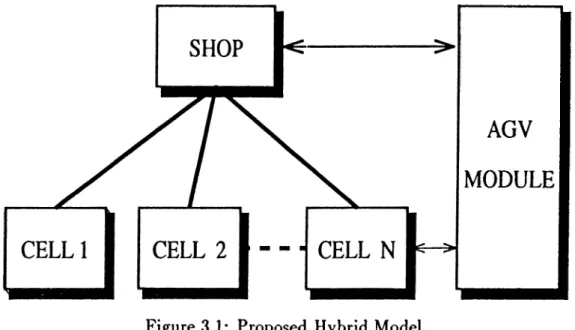
PROBLEM 2: This problem is because of the flexibility of AGVs. AGVs can interface with different levels in the manufacturing system. Typically, AGVS is modeled as a special workstation in a cell. But an AGV may interface with some other cell, which is the way proposed by Solberg and Heim [27] model. This is, even if we view an AGVS as a workstation in a cell, quite logical. There is a material flow requirement also between cells and AGVs are the best candidates. If there is another AGV module within the shop, there will be no problem. But if, instead, the individual cell modules have the task to move material th at is required for the cell, the problem arises. McGinnis notes even the possibility of interfacing of an AGV with a shop level [21]. He gives an electronic assembly plant as an example for this purpose [21]. The problem here is twofold:
Problem 2 A: One face of the problem is the ambiguity, related with the hierarchy. Who will be the ‘peers’ of the AGVS controller? Every shop, cell and workstation has its own controller, but AGV can interfaice with all of them. AGVS controller is typically a ‘peer’, th at is at the level of a workstation controller. Thus, controller can only interface with its supervisor, which is the cell controller, and subordinates, which are individual vehicles. In order to have a direct interface with another cell or shop, they must have the same supervisor. Thus, there is a problem of where to place the AGVS controller.
Problem 2 B: The second face of the problem has to do with implementation issues. The messages of material movement requirements have to pass several levels of the hierarchy to arrive at the AGVS controller. This naturally creates delays in the system. McGinnis notes th at although this delay was only a few seconds in a single load movement, it turned out to be quite significant for overall performance in the electronic system example, since there can be thousands of load movement requests [21].
CHAPTER 2. LITERATURE REVIEW 13
McGinnis offers some modifications in the control hierarchy to solve these problems. His first modification is in the task decomposition function. He proposes that the two elements of this function, operation assignment (oper ation planning) and activation (operation execution) should be differentiated. Operation planning is placed in the hierarchy, but execution process is not. Any ‘peer’ can give the activation key for a job for which, the assignment was already made. In order to execute this assignment, both of these elements should be complete. In this way, the hierarchy problem can be solved, as well as decreasing the delays in the system.
The second modification offered by McGinnis is viewing the material han dling system as a black box entity in the hierarchy. Thus, interfacing with different levels should not be conflicting to the hierarchy. But this can only be justified if the first modification is already made.
In this study, McGinnis notes the following as a research problem, which is im portant for our purposes:
...another research problem, which has attracted less attention is the problem of devising command arbitration schemes which can simultaneously optimize the material handling system and consider the urgency of specific move commands, so th at the variance in execution times does not lead to much higher buffer requirements.
[
21]
In another study by Solberg and Heim [27], the authors first discuss some characteristics of manufacturing information. They, then, give four strategies for managing manufacturing information:
• Subsystem Optimization • Total Integration
CHAPTER 2. LITERATURE REVIEW 14
• Heterarchical Decomposition
They then evaluate the performance of the heterarchical decomposition which eliminates the rigid supervisor/subordinate relationship in a hierarchical struc ture, and hierarchical strategies by a small batch manufacturing factory exam ple. They make a modification and evaluate the adaptability of the strategy to this change. The original system is the one that has a single AGV system for a single shop (conflicting the general view of having one AGVS module for every cell). Then their change is addition of a new type of AGVs that will move small sized loads. As a result, the authors note similar problems identified by McGinnis for hierarchical decomposition strategy. Different layers have to be added to the hierarchy, as well as changes in the task assignment duties. The authors, identifying the strength and weaknesses of the heterarchical strategy, propose a hybrid system of these two systems and show that this system can handle such a change a lot easier. This study is important in the sense that difficulty of managing information related to material handling and adapting AGVS to the decision hierarchy is quite clear. That is the reason why their modification was in the AGVS module.
R e m a r k 2: Placing AGVS modules in control structures is quite difficult and deserves high degree of attention.
Although not studied well in the literature, command schemes should be developed which simultaneously optimizes the material handling system and urgency of specific move commands. When the task of a cell module in AMRF hierarchy and Jackson and Jones’ remark on scheduling [15] are considered, we can come up with the following remark:
R e m a r k 3: Scheduling decisions for a shop should not be made indepen dent of AGVS function, but the shop level should find a schedule for all the cells, including the schedule of AGVs.
CHAPTER. 2. LITERATURE REVIEW 15
2.5
P ro b lem s R ela ted w ith AG VS
A utom ated Guided Vehicle is a driver-less machine that can be controlled by a system operator (which can also be a computer). First AGV was invented 35 years ago, which then was called ‘driver-less systems’. Advances in electronics through years have led to advances in guided vehicles, giving more flexibility and capability. But the real factor in application spread is the market accep tance. Today, AGV is accepted as the standard material handling method for the Flexible Manufacturing Systems [17].
2 .5 .1 A G V T y p e s and Functions
There are a number of different AGV types. These are:
• AG VS towing vehicles are the first type that was used and is still used extensively today. Towing vehicles can pull a range of trailer types with capacities from 3500 kgs to 25,000 kgs.
• AGVS unit-loaid vehicles are equipped with decks, which permit unit-load transportation and automatic load transfer.
• AGVS pallet trucks are designed to transport palletized loads to and from floor level, eliminating need for fixed load stands.
• AGVS fork truck is a relatively new type. This has the capability to service palletized loads both on the floor level and on fixed stands, and sometimes in a rack.
• Light-load AGVS are vehicles which have capacities of approximately 500 kgs. They are used to transport small parts, baskets, or other light loads through a small manufacturing environment, typically with a limited space.
• AGVS assembly-line vehicles are adaptations of light-load AGVS for ap plications involving serial-assembly processes.
CHAPTER 2. LITERATURE REVIEW 16
W ith this wide range of application types, AGVs are preferred in many systems. Ray Kulwiec [29] lists the following advantages of AGVS:
• Less safety stocks, and high material control.
• More efficient use of personnel, since less operators are needed.
• Efficient work environment: AGVs allow independent loading and un loading at stations from operators.
• Flexibility: Routes can be changed, new ones can be added with great ease than other systems.
• Better use of floor space: No floor space is occupied permanently by AGVs.
• Adaptability to automation: AGVs can operate efficiently with other au tomated and computer controlled systems such as robots, AS/RS, con veyors, elevators, doors and automatic production machines.
• Integration within plant: AGVs can provide a link between cells in a plant which contributes to overall system integration.
• Adaptability to existing facilities: Little structural change and cost is required for constructing an AGV system to an existing plant.
Koff identifies the following technological functions that are essential in an AGVS application [17]:
1. Guidance is the way vehicles can change their directions. Guidance allows the vehicle to follow the predetermined route.
2. Routing is making the decisions in the path to follow from one point to another. There are two methods used when an AGV approau:hes a decision point and has to select one of the paths to go:
(i) Frequency-select method: AGV receives one frequency for every path, selects appropriate one at decision points.
CHAPTER 2. LITERATURE REVIEW 17
(ii) Path switch method: When approaching a decision point, AGV activates a device which closes all but one of the path at the decision point, which is the correct one for AGV.
3. Traffic management is the way collisions with other vehicles are avoided. Of course, this is done by trying to minimize the traffic flow. Traffic management function is satisfied by the following ways:
(i) Zone control: This is the most popular one. The layout is parti tioned to segments or zones, and each zone is allowed to include at most one vehicle at any time.
(ii) Forward sensing: The vehicle is capable of detecting the presence of another vehicle in front of it. These sensors are useless at corners. (iii) Combination control: The paths are separated into two and in one
part, forward sensing is used. If the paths do not have so much corners, forward sensing is preferred because of less costs. In the other part, zone control is used.
4. Load transfer: is picking-and discharging of loads to and from vehicles. 5. AG VS system management is the method of controlling the system. This
includes vehicle dispatching and system monitoring. Vehicle dispatching, that is selection of the vehicle to move the particular load can be accom plished in a number of different ways:
(i) On-board dispatching (ii) Off-board call systems (iii) Remote terminal (iv) Control computer
(v) Remote terminal control computer combination.
The areas of study about AGVs in the literature can be classified in parallel to AGV functions listed in the previous sub-section. However, for our purposes, we prefer to classify them on a different basis. Some issues related to AGVs
CHAPTER 2. LITERATURE REVIEW 18
are directly related to the installation (or re-design) of the system. Unless a major change in system settings, these decisions are made once for the system. We call these ‘design problems’. Meantime, there are decisions to be made that are related to the working of AGVs in the installed system, which we call ‘operational problems’. Now, with this classification, we have:
Design problems:
1. Determination of the number of vehicles required
2. Designing the flow path (and pick-up and drop-off points) 3. Determination of the routes to follow
Operational problems:
1. Vehicle dispatching 2. Traffic management
Design problems studied in the literature are discussed below. For the opera tional problems, since we are much more related to this type, we discuss this class in the next sub-section, AGV Scheduling.
2 .5 .2
D e sig n P ro b lem s
As stated, these are related to decisions in the design stage. These are high level decisions that are usually made once in the implementation stage and rarely changed.
Number of Vehicles Required
Determination of the number of AGVs required is strongly related to the type of vehicles to be used. However this technical choice is not studied. Practically,
CHAPTER 2. LITERATURE REVIEW 19
the transport requirements, weight of parts, the particular manufacturing en vironment and the usage mode of the vehicles (only carriers vs. mobile work stations) are used to determine the type of vehicle to be used.
In determination of the number of vehicles required, the general practice is to study minimum number of vehicles required rather than optimal number of vehicles required. For the optimal number, one has to consider the time phased material pick-up and delivery requirements (the schedule of transport requests, due-dates, amounts to be transported, etc.), pick-up and drop-off area floor space capacity (and the speed of pick-up and drop-off operator as well), track congestion (shop or path blocking), and even the numbers of different types of vehicles. In addition to these factors, the cost of the vehicles has to be considered, since for a certain range, increasing number of vehicles results in increased performance even though the diminishing rate of return concept applies. As a result of these factors, the pay-back period concept should be considered. Thus it is very difficult, if possible, to determine the optimal number of vehicles.
Instead of optimal, the minimum number of vehicles required is studied by some simplifying assumptions. The following assumptions are usually made:
• static rather than dynamic system • no floor space requirements considered • no track congestion considered
In this respect. Maxwell and Muckstadt [20] gave a mixed integer program ming formulation for determining the minimum number of vehicles required. This problem turns out to be a transportation problem. The objective in their study is to minimize the total vehicle tim e required for a shift. Number of vehicles is determined by dividing total vehicle time required for a shift to the capacity of a single vehicle in a shift (in hours). In their work, they also propose a dispatching procedure, and a way to me«isure the blocking time caused by congestion and size of shipping areas. In this way, they show that the minimum
CHAPTER 2. LITERATURE REVIEW 20
number of vehicles found by the simplified model above can be re-evaluated and result can be adjusted considering the assumptions.
In a similar work, Leung et al. [19] extend the work of Maxwell L· Muckstadt to situations where there are different types of vehicles with different travelling speeds in the system. Their model is more complex as should be expected (not a transportation problem anymore) but they consider the same objective.
Flow P a th D esign
This problem involves determination of the aisles th at will be included in the guide path of the AGV’s. Ideally the flow paths for the AGVS should be determined together with the determination of the manufacturing layout. This accounts to designing the layout with performance of the AGVs’ as one of the objectives. However, in practice, the general approach is either determining the guide path first, and the pick-up and drop-off points later, or taking the pick-up and drop-off points of departments as given and determining the guide path afterwards. In this respect, Gaskins and Tanchoco [11] give an integer programming formulation for determining the flow path for a given layout. Uni directional flow is assumed and total loaded vehicle time is the objective to be minimized. In another study of the authors with Taghaboni [12], virtual flow paths (for free ranging AGVs) are determined. In this study, unloaded travels are also considered. Objective function is the sum of total distance traveled and total number of lanes. However, these are summed without weighting factors, which does not seem realistic and might cause some problems due to the different unit of measures. Their model makes use of multiple commodity flow problem. Both of the models above are quite hard to formulate and solve especially for relatively large layouts. The authors tidmit this fact and note presence of the simulation alternative. The particular case for which these models can be justified are flexible systems, where the flow intensity data change quite often so th at only the flow rate parameters are changed in the formulation. However, a new formulation has to be made each time the layout is changed. The most difficult part of the models above is the formulation
CHAPTER 2. LITERATURE REVIEW 21
part. One more disadvantage of the two models in common is that neither of them considers the traffic or blocking aspects of the problem. Though it is quite hard to consider these in an analytical study, this can be a reason for preference of simulation study since it considers both. The recommendation about these models is th at simulation should be used after the model is solved analytically by the appropriate model.
The difficulty associated with the analytical model for flow path design problem, together with some other reasons have led to different approaches in flow path design. One is designing flow paths in the form of a single loop. Single loops have a number of advantages. First, they are very simple and require very little control. Furthermore, other problems associated with the AGVS such as dispatching and traffic management are facilitated considerably when a simple loop is used as the guide path. Especially for small layouts consisting of up to six departments, single loop paths are ecisily used. In this respect, Bartholdi and Platzm an [2], Tanchoco and Sienrich [30], and Bozer and Srinivasan [5] have studied single loop guide paths. In the study of Bozer and Srinivcisan, the authors propose placing a number of disjoint simple loops instead of a traditional guide path so that the benefits of single loop is used in larger layouts. In every loop, there is a single AGV operating. In this way, traffic management problem is completely eliminated and dispatching prob lem is very much facilitated. Total travel distance in the system is decreased by means of many loops as well, which is an advantage against a single loop. However, the potential disadvantage of the model is that for a particular re quest, more than one vehicle in turn need to be used and if a single AGV fails, many requests cannot be met. W hat is more, the load of the AG Vs is hardly balanced, since eeich is dedicated to operate in an isolated loop.
Route Planning
R oute Planning is, in general, made after the guide path is determined. In fact, for an efficient AGVS, route planning has to be considered together with guide path designing problem. At least in determining the flow in uni-directional flow
CHAPTER 2. LITERATURE REVIEW 22
systems, the length of the resultant route depends upon the direction. However, in practice, route planning is made after the guide paths are determined. In this respect, the routes are shortest paths between the pick-up and drop-off points.
Although there is no such study, one area where the route planning can be used is identifying alternative routes. This issue is related to the traffic management task. When a particular segment of a path cannot be used for a particular amount of time because of traffic intensity, an analysis can be made comparing the time required for the alternative route(s) with the time th at the present route cannot be used. In this way, considerable savings can be gained.
R e m a rk 4: We have to define the settings in our system related with AGVs. The AGV application type in our study is a unit-load application type. The technological functions that Koff has identified, namely guidance, routing, traffic management, load transfer and system management are not significant for our purposes. Related to design problems, we <issume that the AGV System already exists. We will assume that number of vehicles, the layout with pick up and drop-off spurs and the flow path are already specified. We also assume th at the flow path is uni-directional. In fact, uni-directional flow path is quite wide spread as mentioned above, and most of the design studies propose uni directional flow for many purposes [2][5][11][12][21][30].
2.5.3
O p era tio n a l P rob lem s
These are related to the operation of the system. These decisions can be changed according to the dynamic situation of the system. For instance, the vehicle dispatching rule can be changed according to capacity of AGVs and the urgency of certain jobs in the system. These decisions are generally made on lower levels.
CHAPTER 2. LITERATURE REVIEW 23
Vehicle Dispatching
Vehicle dispatching is simply cissigning a vehicle to a job (or assigning a job to a vehicle). For reasons related to the general settings in the system, no off-line schedule is made. The schedule for each cell and the shop is made ignoring the material handling requirements. The AGV module is expected to move the loads from desired points to certain destinations, but no prior informa tion is given to the module. This makes any off-line scheduling mechanism impossible. All the AGV module can do is try to complete the move orders on time, if impossible, giving priorities towards the objective of the system. These objectives might be meeting the due-dates as much as possible, avoiding shop blocking, increase the throughput, etc. Thus, basically, the task of AGV mod ule in classical settings is choosing the vehicle dispatching strategy, which may be a single rule or combination of rules according to the state of the system.
The decision on the selection of two possibilities for dispatching, namely assigning jobs to vehicles or vehicles to jobs mainly depends on load of the system. Logically, if there are more vehicles available than the number of jobs waiting then vehicles should be assigned to jobs. This idea is also shown empirically by Egbelu and Tanchoco [8]. However, one should expect that in a typical AGV system, there are more jobs waiting than vehicles available in the average. Sufficiently large number of vehicles for the opposite can be hardly justified because of the high investment cost of an AGV. Actually, most of the dispatching rules studied in the literature are based on selecting jobs for vehicles, that is vehicle based rules.
The studies in the literature about the dispatching rules explore the perfor mance of certain rules in certain settings in terms of different objectives. The well known vehicle-based dispatching rules are listed as follows by Bozer [4]:
1. Random Workstation Selection (RAND): The next load to be moved is selected randomly.
CHAPTER 2. LITERATURE REVIEW 24
first-in-first-out queue and the first job in this list is selected as the next load.
3. Modified First Come First Served (MODF): A variation of FCFS. In this rule, any pick-up station cannot have more than one outstanding request, th at is other than first request of a point is not taken into consideration. 4. First Encountered First Served (FEFS): The vehicle follows a pre-specified
route as it gets empty. Regardless of the number and time of outstanding move requests, it takes the first load on its way th at it encounters. 5. Shortest Travel Time First (STTF): The next load is the one th at is
nearest in distance (or time) to the point where vehicle drops its previous load. Also known as vehicle-looks-for-work (VLFW).
6. Longest Travel Time First (LTTF); The next load is the one that is furthest in distance (or time) to the point where vehicle drops its previous load.
7. Maximum Outgoing Queue Size (MAXQ): The next load to be moved belongs to the pick-up station which has the maximum number of move requests.
8. Minimum Remaining Queue Space (MINQ): The next load to be moved belongs to the pick-up station which has the minimum remaining space for possible request arrivals.
9. Load Shop Arrival Time (LSAT): The next load to be moved is selected according to the time each load originally entered the shop. A load that hzis been in the shop for the longest time (that is earliest arrival time) is to be moved next.
10. Most Desirable Station First (MOST): The next lo<ul belongs to the sta tion that has the largest weight. Weight is a weighted combination of mean arrival rate of move requests, proximity to current AGV location, and whether another move request exists at the delivery point of the requests. This calculation is made continuously and the previous assign ment are changed if a higher weight is met.
CHAPTER 2. LITERATURE REVIEW 25
The well known job bcised rules, on the other hand, are listed as follows by Egbelu L· Tanchoco [8]:
1. Random Vehicle (RV) rule: The vehicle is selected randomly for the current job.
2. Nearest Vehicle (NV) rule: The nearest vehicle to the current job is selected.
3. Farthest Vehicle (FV) rule: The furthest vehicle to the current job is selected.
4. Longest Idle Vehicle (LIV) rule: The vehicle that has been idle longest among the idle ones is selected.
5. Least Utilized Vehicle (LUV) rule: The vehicle with smallest utilization is selected, so as to balance workload.
There are a number of studies evaluating the performance of the rules listed above. In their study, Egbelu & Tanchoco [8] analyzed the effect of different vehicle initiated and work center initiated combinations on throughput of the system. Their first result is that work center based priority rules are insignifi cant. Next, with infinite queue capacities, they found that modified first come first served (MFCFS) rule results in maximum throughput in the system. They conclude their study noting that the performance of dispatching rules, espe cially distance based ones are effected from the layout considerably. King et al. [16] compare, for a single AGV system, STTF and MOST. They found that MOST results in shorter queue lengths. As can be noticed, it is hard to identify a ‘best’ dispatching rule for a number of reasons. The main reason behind this fact is the difference in experimental conditions. These studies are generally empirical and for fixed layouts. Number of departments, location of the pick-up and drop-off points effect the results considerably. W hat is more, the workload of the system is also very important, although its effect is not noted. In relatively more loaded cases, rules minimizing unloaded travel are more likely to perform better, whereas in other cases, rules considering high
CHAPTER 2. LITERATURE REVIEW 26
priority jobs may work well. Yet, the performance measures in these studies are different and success of rules depend on the performance measure very much.
Although there are many dispatching rules studied in the literature, a gen eral gap is easily noticed. The dispatching rules are adaptations of classical dispatching rules, most of them are either job based or resource based. How ever, as will be discussed in the next section. Opportunistic Scheduling, new directions in scheduling is joining the two perspectives, job biised and resource based approaches in a single method. Such a method is more likely to be robust and its performance will less likely to be case dependent.
Traffic Management
Traffic Management is scheduling the vehicles so that collisions are avoided and shop blocking is minimized. For traffic management, the procedure to be used should re-schedule any vehicle that has to enter a segment or node that will be occupied by a previously assigned vehicle, if vehicles are assigned one by one. Generally, traffic management is viewed only as a technological function. By means of sensors or zone control, the collisions are prevented. However, some off-line mechanisms can be constructed so th at the waiting times resulting from traffic congestion are decreased. One way is providing an alternative route for the vehicle to follow to reach its destination (as mentioned in Route Planning, alternative routes should be considered). In scheduling, there are two similar works in this area by Walker et al. [32], and Taghaboni and Tanchoco [31]. Traffic management is related to other problems as well. For instance, if the guide path is a virtual guide path, where there are more than one lane between nodes, the traffic management process needs fewer controls and is simpler. In bi-directional flow case, the waiting tim e should be larger because control of segments is necessary, whereas, in a uni-directional case, control of nodes is sufficient. If loaded and unloaded travel speeds are not significantly different and pick-up and drop-off points are outside the flow path on a uni-directional layout, the importance of traffic management becomes ignorable. Actually, since most of the layouts studied in the literature are uni directional, ignoring
CHAPTER 2. LITERATURE REVIEW 27
traffic problems even in an off-line scheduling method becomes reasonable. As stated before, the AGV studies can be grouped in two classes: Design and Operational problems of AGVS. Much of the current studies are related to design part of the problem. Only few studies are made about the operational part and the studies are narrow in the sense that all cissume similar settings. As noted, the studies assume that the move orders for AGVs will not be known a priori, and not deterministic. W ith a quite myopic point of view, material handling part of the overall system is under-emphasized. The operational de cisions in the system are made with no feedback from the Material Handling subsystem. The orders are forwarded to Material Handling “module”. The studies try to identify well responding dispatching rules for these settings so th at certain objectives are aimed to be improved. Thus material handling is, to an extent, perceived as an independent manufacturing subsystem, having a little impact on the performance of the overall system, which might con flict with the observation th at Material Handling makes 30-70% of the total manufacturing cost [29].
2.6
V eh icle R o u tin g
In literature, there is a vast amount of studies on vehicle routing. Although none of the AGVS research deals with this problem or any solution approach, this problem is im portant for our study.
Vehicle Routing Problem (VRP) is the problem of serving a set of clients with known demands by a fixed fleet of vehicles of limited capacity. The objective is to minimize the total route length by serving each client exactly once. VRP has received much attention in literature.
Time-Constrained Vehicle Routing Problem (TCVRP) [18] or Vehicle R outing and Scheduling Problem with Time Windows (VRSPTW) [28], is a generalization of VRP. In this problem, each client hcis a time window in which he must be served. Time windows are very common in practice; such as
CHAPTER 2. LITERATURE REVIEW 28
bank delivery problems, industrial refuse collection problems, dial-a-ride prob lems, and school bus routing and scheduling problems. However, this problem has received very little attention compared to VRP.
VRP itself is NP-hard and by restriction, VRSPTW is also NP-hard. Savels- bergh has shown that even finding a feasible solution to this problem is NP-hard [28]. Thus, from a computational complexity perspective, these problems are quite difficult [28]. For optimal solution to the problem, there are a number of studies using special structures. Even these studies require large computa tional times. The first optimization method for the problem is developed by Kolen et al. [18] and requires more than two minutes of CPU time (at Vax 11/785) for a problem with 15 clients. Thus, practically, this problem cannot be solved optimally for a large number of clients.
Because of the computational requirements, many heuristic methods have been proposed for VRPSTW. These can be classified as follows:
• Savings Heuristics
• (Time-oriented) Nearest Neighbor Heuristics • Insertion Heuristics
• Time-oriented Sweep Heuristic
Solomon [28] has made a computational study to compare the performance of these heuristics. He found out that an insertion heuristic performed best. The 100 customer problem took from 2.4 seconds to 24.7 seconds in experiments and the insertion heuristic took 24.7 seconds on average (on DEC-10).
R e m a r k 5: The current AGV scheduling methods are only based on a set of dispatching rules as discussed in previous section. However, if the move re quests can be brought in a deterministic form, an off-line schedule can be maide. T h e AGV scheduling problem is very similar in many respects to VRSPTW. We can utilize the literature on vehicle routing to show the computational complexity of the AGV scheduling problem with time windows.
CHAPTER 2. LITERATURE REVIEW 29
2 .7
O p p o rtu n istic Scheduling
In scheduling literature, scheduling based on bottlenecks, which is called bot tleneck approach, has been started with OPT approach [13]. OPT decomposes scheduling to three basic strategies;
1. Determine the bottleneck resource
2. Schedule to use the bottleneck resource most efficiently 3. Schedule the remainder of the resources up to the bottleneck
Goldratt’s idea of scheduling on the bottlenecks has become quite popular. One extension is the shifting bottleneck algorithm by Adams et al. [1]. The idea of shifting bottleneck method comes from nonlinear programming. In this approach, the sequences on all machines but one is held fixed and for each machine a solution is found. The idea is that the overall solution is one of or a t least close to one of these solutions.
One important advance in scheduling literature is combining the two gen eral perspectives in one method. The first perspective is the job based one, which tries to meet the due-dates of jobs. The idea of bottlenecks has brought the resource bcised perspective, which tries to maximize the utilization of re sources so that the increased flow in bottleneck resources increases the overall system performance. These two perspectives are, in general, conflicting. The term called bottleneck dynamics stems from considering these two views simul taneously. In addition to costs related to completion times of jobs (i.e. penalty costs), there is an opportunity cost of using the resource, since it may become bottleneck. There are several heuristic methods developed that consider these two costs simultaneously and among them, Rachamadagu & Morton’s (RM) [22] sequencing rule is found to be very successful. RM heuristic evaluates the priority of each job by simultaneously considering the time left to its due-date and amount of time th at job will occupy in the resource:
CHAPTER 2. LITERATURE REVIEW 30
where Vj, wj and pj are the priority, weight and processing times of job re spectively, S j is the slack time (time between due-date and possible completion,
which can also be negative, corresponding to amount of tardiness) of job j , k is a constant and pav is the average processing times of candidate jobs. A single priority is calculated for each job and the job having largest priority value is selected as the next job to be processed. Dynamism stems from the ability to select only one job at a time and evaluating other jobs once more at each selection. The time dimension of bottlenecks refers to the idea that a certain resource need not be a bottleneck for the whole planning horizon, advantages of a job based perspective can be used for those periods that the resource is not a bottleneck. What is more, scheduling a bottleneck resource for a certain time period may create other bottlenecks for other periods. Thus, switching from one perspective to the other is likely to result in better schedules. This ability to switch from one perspective to another is called Opportunistic Scheduling. Well known OPIS methods are first examples of opportunistic scheduling [26]. In the earlier approaches, ability to switch between perspectives is limited and large subproblems are solved before the decision to switch. These methods are called Macro-opportunistic approaches. Recently Sadeh has developed a Micro- opportunistic approach, which decides on the perspective after assignment of every operation [25].
Dynamic view of bottlenecks is used by other authors as well. Recently, M uscattola [23] has developed Conflict Partition Scheduling concept, in which he repeatedly identifies the bottleneck conflicts and instead of solving it, he imposes constraints into the problem, which decrecises the search effort and the criticality of the bottleneck is only decreased.
Experiments in all studies show that methods that base on the dynamism of bottlenecks concept are superior in many performance measures [9] [25] [23].
Remark 6: In our model, we come up with a scheduling problem. However,