Education and Science
Vol 45 (2020) No 204 41-63Investigation of the Effects of Engineering-Oriented STEM Integration
Activities on Scientific Process Skills and STEM Career Interests:
A Mixed Methods Study
Hicran Özkul
1, Muhammet Özden
2Abstract
Keywords
The aim of this research study was to examine the effects of engineering-oriented STEM integration activities on middle school students’ science process skills and STEM career interests. Intervention design, one of the mixed research method designs, was employed. One group pre-test post-test design was utilized in the quantitative part of the study and basic qualitative research design was used in the qualitative part of the study. The experimental intervention of the study was carried out with 19 middle school students. Quantitative data were obtained by using the Science Process Skills Scale and Science, Technology, Engineering, and Mathematics Career Interest Survey. In the qualitative part, semi-structured interviews were conducted with eight students after the experimental intervention. Wilcoxon Signed Ranks Test was utilized in the analysis of quantitative data and thematic analysis technique was used in the analysis of qualitative data. As a result of the research, it was found that science process skills and STEM career interests of students showed statistically significant improvement. Similarly, qualitative data showed that participants' career awareness related to the field and tendency to choose a profession of STEM field in their future professional lives enhanced. Additionally, participants thought that they gained 21st century skills such as scientific thinking, creativity, multi-faceted thinking, using engineering design, cooperating and communicating.
Science education Integrated STEM education Engineering education Scientific process skills STEM career interests
Article Info
Received: 07.04.2019 Accepted: 06.03.2020 Online Published: 08.17.2020 DOI: 10.15390/EB.2020.88701 Kütahya Dumlupınar University, Graduate School of Educational Sciences, Department of Elementary Education, Turkey, [email protected]
2 Kütahya Dumlupınar University, Faculty of Education, Department of Elementary Education, Turkey, [email protected]
Introduction
Societies need individuals who can produce solutions to problems and create new products in order to adapt to the present era (National Academy of Engineering and National Research Council, 2009; National Research Council [NRC], 2012). The success of individuals in inter-communal competition and the advancements in essential fields such as science, technology, economics depends on the understanding and use of science, technology, engineering and mathematics (STEM) disciplines (Afterschool Alliance, 2008; Brophy, Klein, Portsmore, & Rogers, 2008; Çorlu, Capraro, & Capraro, 2014; NRC, 2012). For this reason, many countries have initiated reforms to eliminate the distinction between disciplines for having needed individuals in the 21st century. STEM education is the most recent of these reforms (Akgündüz, 2018; Bybee, 2010; Karahan, 2017; National Academy of Engineering and National Research Council, 2009).
STEM education is a pedagogical approach in which real-world problems are addressed, multiple sensory organs are used (Bagiati & Evangelou, 2015), imaginations are developed, and learning is applied in new and different situations (Tseng, Chang, Lou, & Chen, 2013). STEM education, which provides students with opportunities to make sense of the integrated world they live in rather than teaching the information piece by piece on a topic (Dugger, 2010), is an interdisciplinary learning-teaching approach where at least one of the STEM disciplines is centered and integrated with students’ knowledge, skills, and experiences, and students characteristics of questioning, investigation, and production are actively used in the learning process (Çorlu et al., 2014). According to another definition, STEM education is an approach that enables teaching and learning between two or more STEM subject areas and/or between one STEM subject and one or more school subjects (Sanders, 2009). As it is seen, the most important aim of STEM education is to achieve STEM integration (Cavlazoglu & Stuessy, 2017a, 2017b; National Academy of Engineering and National Research Council, 2014), that is, integrated STEM education (Guzey, Harwell, Moreno, Peralta, & Moore, 2017). STEM education aims to integrate various disciplines (i.e., science, technology, engineering, and mathematics) that are used in solving real-world problems in a purposeful way (Breiner, Harkness, Johnson, & Koehler, 2012). This is because STEM integration is not just about teaching two disciplines together or using one as a tool to teach the other. STEM integration should be purposeful and specific, taking into account both content and context (Bryan, Moore, Johnson, & Roehrig, 2016). This current perspective is based on the idea that an interdisciplinary approach is more functional in understanding real-life problems and developing problem-solving skills (Dugger, 2010; Karahan, 2017; National Academy of Engineering and National Research Council, 2009; P21, 2018).
STEM education is critical in that all students in K-12 education have deep technical and personal skills to solve today's major problems and provide opportunities for them to specialize in 21st century skills (Bybee, 2010; Gonzalez & Kuenzi, 2012; Meyrick, 2011). As a result of the problem solving and questioning the philosophy of this approach (Wang, Moore, Roehrig, & Park, 2011), researchers claimed that students could develop 21st century skills including critical thinking, problem solving, creativity, innovation, using information technologies, collaboration, work ethics, teamwork and verbal communication skills (Şahin, 2013). Moreover, STEM education targets to raise a productive generation that conducts research, asks questions, thinks logically and critically, solves problems in the real world context and makes new inventions (Çorlu & Aydın, 2016; Morrison, 2006; Yıldırım & Altun, 2015). The achievement of the mentioned goals suggests that STEM education can make essential contributions to students in enhancing their technological and scientific literacy (National Academy of Engineering and National Research Council, 2009; NRC, 2011).
One of the most effective ways to implement the STEM approach is via engineering practices (National Academy of Engineering and National Research Council, 2009, 2014). In K-12 science education, integration of engineering design and practices for STEM education has been recommended (Guzey et al., 2017). Engineering can be expressed as a systematic design practice to produce solutions
to specific problems (NRC, 2012). Engineering practices provide opportunities for students to learn connections between science and engineering and apply scientific knowledge and skills to solve engineering problems presented to them in science classrooms (Guzey, Ring-Whalen, Harwell, & Peralta, 2019). Moreover, since engineering knowledge contains science, mathematics and technology concepts (Cavlazoglu & Stuessy, 2018; National Academy of Engineering and National Research Council, 2014), engineering can serve as a catalyst for STEM integration (Cavlazoglu & Stuessy, 2017b). Additionally, as engineering practices require the application of mathematics and science in the process of technology development, it can increase awareness and interest in meaningful integration of STEM disciplines (Moore et al., 2014) and understanding the role of engineers in supporting and advancing humanity (Brophy et al., 2008). Thus, engineering education can help students understand how science is applied in the real world (NRC, 2012). Despite the described contributions of engineering practices in STEM education, such experiences continue to be neglected in elementary and middle school classrooms (English, King, & Smeed, 2017).
Existing engineering-based science programs tend to show a single form in which engineering is viewed as a design or model-making activity (Guzey, Moore, Harwell, & Moreno, 2016). National Academy of Engineering and National Research Council (2009) reported the basis of existing engineering education programs in the document of Engineering in K-12 Education: Understanding the Status and Improving the Prospects. In this document, the principles that should be in the focus of K-12 engineering education are (i) emphasis on engineering design, (ii) appropriate mathematical, science and technology knowledge and skills, and (iii) development of engineering habits of mind. Numerous studies advocating and adopting the highlighted principles in the document have been conducted (e.g., English, 2018; English & King, 2015; English & Mousoulides, 2015; English, Hudson, & Dawes, 2013; Purzer, Goldstein, Adams, Xie, & Nourian, 2015). In the related research, engineering practices were carried out by providing design tasks to the students. Design tasks are ideal activities for hands-on learning since they provide context for the basic concepts of content (Carlson & Sullivan, 2004).
One of the studies considered engineering practices as design tasks was a research study by English and Mousoulides (2015). In the study, sixth-grade students were given design tasks in a bridge building problem. The problem contained consideration of engineering concepts, principles, and design processes as well as multiple factors including mathematical reasoning and data-based problem-solving. The students compared different types of bridges offered to them in order to choose the most appropriate bridge and created their models by considering all possible related factors including bridge type, used materials, bridge design, safety, and cost. Then, the students shared their models with their peers and explained their basic findings. In the activity, mathematics was considered as primary discipline content, science (environmental factors) as supporting content, and engineering as a discipline context. In another study, English et al. (2017) focused on sixth-grade students’ approaches to solving an engineering-based problem about earthquakes. The research process involved building, testing, redesigning and retesting in the production of products that meet the given criteria and constraints. While working on the problem, the students applied their preliminary learning about earthquakes to the design and construction of a building to withstand earthquake damage. The students took into account the cost and constraints of the materials, and then tested their buildings using a shaker table symbolizing the earthquake while constructing engineering design processes and STEM disciplinary knowledge structures. Using the test results, students designed a second design to build a building that would better withstand earthquake damage. Another example of design-based engineering applications is the research study of Purzer et al. (2015). In their study, Purzer et al. (2015) asked students to design energy-efficient solar buildings in a city block surrounded by buildings of different heights. The activity included use of design applications such as solar radiation varying by days and seasons, analyzing simulation data, considering constraints and optimizing solutions (for example, minimizing consumption of energy required to heat a building in winter and cool a building in summer). The Energy3D software was used to allow verification or testing of design performance.
The students designed environmental solutions by using engineering principles (design knowledge), solar energy and heat transfer concepts (science knowledge). During the design process, it was determined that students discovered and developed scientific explanations. Researchers documented that students provided scientific explanations about the relationship between building geometry (more specifically surface area) and solar energy gains in order to make more use of solar energy in summer and winter seasons. In another study conducted by English et al. (2013), catapult design was given to students as an engineering problem and students' learning about simple machines was applied to design, construction, testing and evaluation processes of catapults. In the research study, students took two courses to construct catapults, one course to test and evaluate catapults, and one course to explain their conceptual understanding via writing. At the end of the implementation, researchers embarked that students could simulate with the materials provided to them, comprehend their simple machines’ properties and identify multiple simple machines. It was also found out that students understood the need to combine a series of simple machines to design and build a complex machine.
In the given examples, students were provided with opportunities to apply science content knowledge to solve design challenges. In the results of the research studies, it was emphasized that the students both created thoughts on the cognitive aspects of designs and learned science content knowledge. The fact that engineering is an area that necessitates the application of content knowledge and cognitive processes in order to design, analyze and troubleshoot complex systems (Brophy et al., 2008) can be the reason of this situation observed in the research studies. The general framework of the mentioned previous research, in which engineering was used as a context, is (a) identifying the scope or scope of the problem in which the boundaries, objectives, and constraints of the problem are described, (b) creating ideas for planning and potential structure against to focusing on developing only one idea, (c) designing and constructing design sketches and transforming designs into products, (d) testing and reflecting on the results in which achievement of the objectives and compliance with restrictions are checked, (e) redesigning and restructuring where improvements identified on the initial design are reflected in the new/revised design, and (f) reflecting on the design and construction processes as a whole and sharing views (English, 2018). An understanding of the engineering design processes is central to engineering education (English et al., 2013). Focusing on these key elements can help students understand the engineering design process (Fan & Yu, 2017). Students should be able to use basic STEM concepts in the implementation process without being overshadowed by the design components. It should be remembered that the application of STEM disciplinary knowledge is essential in guiding each of these iterative processes (English et al., 2017). Additionally, the iterative feature of engineering design is important in that students can test and review a possible solution to achieve the best possible result, thus enabling learning while designing (Crismond & Adams, 2012). It is meaningful to use engineering as a context to teach content knowledge. Otherwise, if students are not able to use scientific knowledge in their designs, such practices can only be called as art or craft projects (Guzey, Tank, Wang, Roehrig, & Moore, 2014).
Previous research shows that engineering design and practices support the development of students' science achievement (Barrett, Moran, & Woods, 2014; Lachapelle & Cunningham, 2007; Moreno, Tharp, Vogt, Newell, & Burnett, 2016). For example, Barrett et al. (2014) reported that engineering integrated STEM module increased students' basic content knowledge in both meteorology and engineering subject areas. It was also claimed that developing and enriching STEM approach engineering education enables students to think high-level, conduct research, question, use scientific process skills, and see that there is more than one solution to a problem (Fan & Yu, 2017; Marulcu, 2010; National Academy of Engineering and National Research Council, 2009; Wendell, 2008). Fan and Yu (2017) found that students who participated in STEM engineering and technology education modules acquired more complex high-level thinking skills than students in the first group of technology education module students. In other words, the STEM engineering module effectively developed high-level thinking skills of students in the engineering design process. Finally, since students actively
involved in engineering design processes through engineering practices, their engineering profession awareness, engineering career awareness and STEM attitudes increased (Gülhan & Şahin, 2016; Guzey et al., 2016; Pinelli & Haynie, 2010; Tseng et al., 2013). In their study, Guzey et al. (2016) found that students attending an engineering design curriculum enhanced their attitudes towards STEM.
Developing engineering integrated STEM modules for inside and outside of schools due to their mentioned advantages, researchers continue to examine the applicability of these contents and their impacts on learning outcomes (see Barker, Nugent, & Grandgenett, 2014; Barrett et al., 2014; Fan & Yu, 2017; Guzey et al., 2017; Julià & Antolí, 2019; Tippett & Milford, 2017). In Turkey, there has been a growing literature in STEM education (Acar, 2018; Bircan, 2019; Çetin, 2019; Gül, 2018; Kavak, 2019; Pekbay, 2017; Sarıcan, 2017) and engineering-oriented STEM education research (Altaş, 2018; Bozkurt, 2014; Ercan, 2014; Hacıoğlu, 2017; Koç, 2019, Yavuz, 2019). Additionally, it can be stated that there have been limited research studies on engineering-oriented STEM integration for middle school students. However, it can be said that middle school students are suitable candidates especially for engineering-oriented STEM integration research because students in this age group are both curious and desire to learn math and science skills to be able to continue their higher education in engineering and technology subjects (Carlson & Sullivan, 2004). In this study, an engineering-oriented STEM activities module was designed to demonstrate how to design and teach an engineering-oriented STEM activities module at the middle school level. This research is significant in terms of facilitating efforts of science teachers to gain an understanding of the applicability of the integrated STEM approach, and determining the effects of engineering-oriented STEM integration activities on students' science process skills and professional interests in STEM fields. The purpose of this research study was to investigate the effects of engineering-oriented STEM integration activities on middle school students’ science process skills and STEM career interests. For this purpose, the following questions were sought in the research:
• Is there a statistically significant difference between students’ pre- and post-test scores of science process skills in the experimental group where engineering-oriented STEM integration activities implemented?
• Is there a statistically significant difference between students’ pre- and post-test scores of STEM career interests in the experimental group where engineering-oriented STEM integration activities implemented?
• What do students' views on the implementation process of engineering-oriented STEM integration activities?
• Do quantitative results from the process of engineering-oriented STEM integration activities and qualitative results from the views on the implementation process support each other?
Method
Research Design
Intervention design (Creswell, 2015), one of the mixed methods research designs, was employed in this study. In this design, the experimental intervention process is supported by qualitative data (Creswell, Fetters, Plano Clark, & Morales, 2009). One group pre-test post-test design (Cohen, Manion, & Morrison, 2007) was used in the quantitative part of the study and basic qualitative research design (Merriam & Tisdell, 2015) was used in the qualitative part.
One group pre-test post-test design was employed to determine whether the implementation of engineering-oriented STEM integration activities in the experimental group had statistically significant impacts on students’ science process skills and STEM career interests. This design is considered as one of the weak experimental designs. However, it is useful in developing and implementing a new training module (Creswell, 2012). In the pre-test and post-test experimental intervention process, researchers can also use qualitative data. Qualitative data can be used before,
during, or after the experimental intervention in the research process (Creswell, 2015). In this research study, qualitative data were added to the research after the experimental intervention. Qualitative data were used to support the results of quantitative data, explain statistical results in more detail, compare quantitative and qualitative results, and help to interpret the results. By doing so, it was aimed to eliminate the limitations of the one group pre-test post-test design. In the study, quantitative phase was dominant. Figure 1 shows a visual presentation of the research design in the form of QUAN → qual (Morse, 1991).
Figure 1. A Visual Presentation of the Research Design (Morse, 1991) Quantitative Phase
Population and Sample
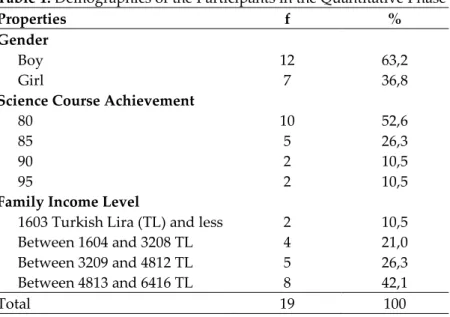
The sample of the study was selected from the accessible population by using simple random sampling (Cohen et al., 2007). The designated school was located in a neighborhood of a city center in the Aegean Region of Turkey. Elementary and middle school students were studying together in the school building. In the school, after regular class hours, students were offered optional elective courses in the fields of sports and arts such as swimming, basketball, and theater. Also, the academic success of the school was high. Particularly, preparations of middle school students for the high school entry exams were considered essential. The number of sixth-grade students studying at the designated school was 68, and 27 of these students agreed to participate in the research process. Büyüköztürk, Kılıç Çakmak, Akgün, Karadeniz, and Demirel (2008) stated that random assignment does not work well on small groups. Since the number of students to participate in the study was not sufficient to form experimental and control groups, the study was conducted without a control group. Additionally, in the first four weeks of the study, eight students withdrew from the study due to personal reasons. As a result, 19 students participated in the experimental intervention. The demographics of the participants are shown in Table 1.
Table 1. Demographics of the Participants in the Quantitative Phase
Properties f %
Gender
Boy 12 63,2
Girl 7 36,8
Science Course Achievement
80 10 52,6
85 5 26,3
90 2 10,5
95 2 10,5
Family Income Level
1603 Turkish Lira (TL) and less 2 10,5
Between 1604 and 3208 TL 4 21,0
Between 3209 and 4812 TL 5 26,3
Between 4813 and 6416 TL 8 42,1
Total 19 100
The participant students’ achievements in science course were 80 and above, and more than half of them were male. Also, more than half of the participants had a family income of 3209 TL and above.
Experimental Intervention + Quantitative Data Collection +
Quantitative Data Analysis
Qualitative Data Collection + Qualitative Data Analysis
Data Collection Tools
The quantitative data of the research were obtained by using Science Process Skills Scale (SPSS; Aydoğdu, Buldur, Tatar, & Yıldız, 2012) and Science, Technology, Engineering, and Mathematics Career Interest Survey (STEM-CIS; Koyunlu Ünlü, Dökme, & Ünlü, 2016).
The SPSS was developed to identify science process skills of 6th, 7th and 8th-grade students.
Consisting of 27 items, the scale’s reliability coefficient (KR-20) was 0.84 and difficulty level average was 0.54. The scale includes questions that measure basic and high-level science process skills. In this context, the scale contains questions related to the basic skills of observing, classifying, using space/time relations, making predictions and inferences. There are also questions related to high-level skills including problem identification, hypothesis building, determining and controlling variables, conducting experiments and interpreting data. Among the questions on the scale, nine questions are related to basic skills and 18 of them are related to high-level skills (Aydoğdu et al., 2012). The scale was employed before and after the experimental intervention to document the students' level of scientific process skills. For this research, the SPSS was formed in two parts. In the first part, there are questions to determine the demographic characteristics of the students. In the second part, there are 27 multiple-choice questions. The application of the scale was carried out in the science courses before the experimental intervention and in the engineering-oriented STEM integration activities course after the experimental intervention. The reliability coefficient (KR-20) of the scale was 0.79.
The STEM-CIS was developed by Kier, Blanchard, Osborne, and Albert (2014) to determine STEM career interests of 6th, 7th and 8th-grade students. The scale was adapted to Turkish by Koyunlu
Ünlü et al. (2016). Consisting of 40 questions with four factors, the Cronbach alpha reliability coefficient of the Turkish version of the scale was 0.94. Measurement reliability was calculated as 0.86 for Science sub-dimension, 0.88 for Technology sub-dimension, 0.94 for Engineering sub-dimension and 0.90 for Mathematics sub-dimension. There are 10 items in each sub-dimension (Koyunlu Ünlü et al., 2016). For this research, the STEM-CIS was formed in three parts. The first part contains explanatory information about the scale and STEM professions. In the second part, there are questions to ascertain the demographic characteristics of the students. In the third part, there are 40 items to identify the views of the students. The students answered the items in this part of the scale by selecting one of the options as “I strongly disagree”, “I disagree”, “Neither agree nor disagree”, “I agree”, and “I strongly agree”. The application of the scale was carried out in science courses before the experimental intervention and in the engineering-oriented STEM integration activities course after the experimental intervention. In this study, the Cronbach alpha reliability coefficient was calculated as 0.91 for the STEM-CIS. Measurement reliability was found as 0.82 for Science sub-dimension, 0.87 for Technology sub-dimension, 0.92 for Engineering sub-dimension and 0.78 for Mathematics sub-dimension.
Experimental Intervention
In order to examine changes in middle school sixth-grade students’ science process skills and STEM career interests, 19 students were involved in the engineering-oriented STEM integration activities for 15 weeks as two lessons per week in the 2018 Spring semester. The experimental intervention process was done after the regular course hours of the students. For this purpose, one of the elective courses offered to students was STEM Activities. STEM Activities course was not graded in terms of academic success and carried out as extracurricular activities. Within the scope of this course, experimental procedures were implemented two hours a week on Thursday every week. In the first week of the experimental process, students identified problems, developed possible solutions and created prototypes. In the second week, students tested the prototypes and did evaluation, redesigning and improving. In these activities, engineering was used as a rich and authentic context. During the implementation, the students did group studies with three students in one group and four students in four groups. The groups were reorganized in each activity.
In the implementation, the engineering-oriented STEM integration approach (Guzey et al., 2017) was utilized. The steps of the engineering design process employed in this study were (1) identifying problems, constraints, and limitations, (2) developing possible solutions, (3) constructing prototypes by
evaluating possible solutions, (4) testing and replacing the prototype, (5) evaluating the final design, and (6) redesigning and optimizing (English, 2016, 2018). The development of the teaching process, designed based on the mentioned principles, is explained below.
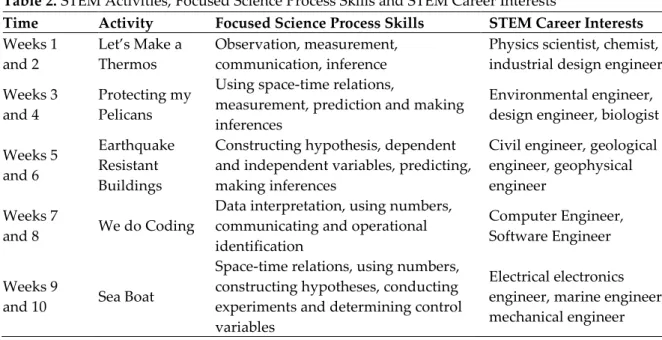
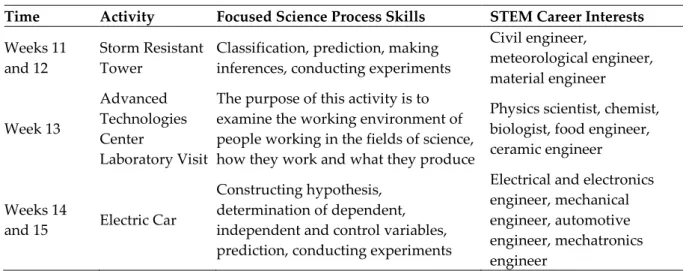
First of all, students were immersed in problems via various methods including open-ended problem situations, videos, stories, and case studies. Then, students were asked to identify problems. This stage was followed with students' determination of possible solutions and students were asked to write their proposals in their STEM notebooks. Next, each student was asked to justify his/her proposal scientifically. Other group members in each student group and other students in the class evaluated the proposals and explained the strengths and weaknesses of the proposals. In doing so, it was ensured that the students socially structured and reasoned their knowledge. Then, researchers introduced materials for the activities one by one to let students think like engineers. In this process, the researchers presented students with multiple materials that served the same purpose but could be alternatives. For example, a pet bow was not only material to be used for the main body in a boat design activity. Other materials such as styrofoam, foam, and plastic box along with pet bottle together were provided to students to make sure that students had chances to select appropriate materials by considering different parameters including durability, aesthetics, economics, and usability. The group members then gathered in groups to draw prototypes/sketches of their designs. In the related drawings, students were asked to specify materials they intended to use and measurements of their designs to make sure that they used mathematical content knowledge. In the later stages of the activities, students created the most appropriate solutions to the problem statements for their designs by taking their drawings into consideration. Students developed one or more features (e.g., scientific, economic, aesthetic, usability and robustness) by considering their imagined products. In this process, group members in each student group were in constant communication with each other. A teacher guided students by visiting the groups, asking questions about their designs and providing explanations when needed. Products were tested after the designs were completed. As a result of the tests, if designs of the students failed (when it did not meet specified criteria), students were allowed to discuss and discover the reasons for the failed designs. At the end of this process, the products were modified and finalized. In the last stage, once all groups completed their designs, the products were presented by group spokespersons. In each activity, the responsibility of the groups’ spokesperson was switched among group members to make sure that each student in groups had a role in presenting the products. By doing so, it was aimed to enhance students’ communication skills. Table 2 illustrates the used activities of engineering-oriented STEM integration with focused science process skills and STEM career interests in this study.
Table 2. STEM Activities, Focused Science Process Skills and STEM Career Interests
Time Activity Focused Science Process Skills STEM Career Interests Weeks 1 and 2 Let’s Make a Thermos Observation, measurement, communication, inference
Physics scientist, chemist, industrial design engineer Weeks 3
and 4
Protecting my Pelicans
Using space-time relations,
measurement, prediction and making inferences
Environmental engineer, design engineer, biologist
Weeks 5 and 6
Earthquake Resistant Buildings
Constructing hypothesis, dependent and independent variables, predicting, making inferences
Civil engineer, geological engineer, geophysical engineer
Weeks 7
and 8 We do Coding
Data interpretation, using numbers, communicating and operational identification
Computer Engineer, Software Engineer
Weeks 9
and 10 Sea Boat
Space-time relations, using numbers, constructing hypotheses, conducting experiments and determining control variables
Electrical electronics engineer, marine engineer, mechanical engineer
Table 2. Continued
Time Activity Focused Science Process Skills STEM Career Interests Weeks 11
and 12
Storm Resistant Tower
Classification, prediction, making inferences, conducting experiments
Civil engineer, meteorological engineer, material engineer Week 13 Advanced Technologies Center Laboratory Visit
The purpose of this activity is to examine the working environment of people working in the fields of science, how they work and what they produce
Physics scientist, chemist, biologist, food engineer, ceramic engineer
Weeks 14
and 15 Electric Car
Constructing hypothesis, determination of dependent, independent and control variables, prediction, conducting experiments
Electrical and electronics engineer, mechanical engineer, automotive engineer, mechatronics engineer
Before preparing the activities, similar previous research studies were examined (see English et al., 2013; English & King, 2015) and an activities pool consisting of relevant activities with research content was created. The related activities were examined in terms of criteria such as science, technology, engineering or mathematics content prioritization, suitability to students levels, economy (time and cost) and activities that were re-adapted for this research. Through these activities, students were informed about STEM-related professions including an environmental engineer, computer engineer, electrical and electronics engineer, geological engineer, design engineer, material engineer, industrial engineer, civil engineer, physics, chemistry, and biology scientists. In addition, using basic (observation, classification, communication, measurement, using space/time relationships, using numbers, making inference, prediction) and high-level (controlling variables, constructing hypotheses, interpretation of data, operational identification and conducting experiments) science process skills with appropriate questions were ensured in each activity. As applied at the beginning of the study, the assessment instruments (i.e., SPSS and STEM-CIS) were applied as post-tests to determine whether there were significant differences between the pre- and post-tests after the intervention.
Data Analysis
In the quantitative data analysis, firstly, Skewness, Kurtosis, Shapiro-Wilk results and Stem-and-Leaf Plot, Q-Q Plot graphs of pre-test and post-test data were examined to determine the normality of the distribution. As a result of the mentioned statistical analyzes, it was found that the data were not normally distributed. Therefore, the Wilcoxon Signed Ranks Test technique was employed (Büyüköztürk, Çokluk, & Köklü, 2012) to compare students’ pre- and post-test average scores. This analysis technique was employed because the number of subjects was lower than 30 (Erkuş, 2013) and the data were not normally distributed (Cohen et al., 2007). A significance level of .05 was set in the interpretation of the data (Creswell, 2012). In order to interpret statistical significance, effect size estimation was employed in the research. Since one of the non-parametric statistical analysis techniques was utilized in the study, the following formula was used in calculating the effect size (Fritz, Morris, & Richler, 2011; Pallant, 2016):
𝑟 = 𝑧 √𝑁
In the interpretation of the obtained r ratio, the principles proposed by Cohen (1988) were observed. When the above formula is considered, the r ratio can be equal to 0.5, 0.3, or 0.1. Accordingly, 0.5 is interpreted as a large effect size, 0.3 as a medium effect size, and 0.1 as a small effect size value (Cohen, 1988).
Qualitative Phase Participants
Criterion sampling (Patton, 2001) was used to determine participants to collect qualitative exploratory data after the experimental procedure. Accordingly, the identified criteria were (i) reaching out participants who received medium and high-level scores from the post-tests that was applied as quantitative data collection tools and (ii) being a volunteer to participate in the qualitative phase of the study. Eight students, five female and three male, who met the defined criteria were participants of the qualitative phase. Four of the participants were received high scores in the post-test of the SPSS, while four of them received midlevel scores. The demographics of the participants are depicted in Table 3. Table 3. Demographics of the Participants in the Qualitative Phase
Participant Gender Overall Average Score
(Out of 100 points) SPSS Scores* STEM–CIS Scores*
Naz Girl 75 48.1 167 Esra Girl 70 59.2 164 Ahmet Boy 90 70.3 150 Yağmur Girl 75 62.9 118 Aylin Girl 85 88.8 162 Su Girl 90 88.8 150 Giray Boy 80 77.7 171 Yusuf Boy 70 48.1 137
*The maximum score that can be obtained from the SPSS was 100. The maximum score that can be obtained from the STEM-CIS was 200.
Data Collection
In the qualitative phase of the research, semi-structured interviews were conducted to reveal participants' experiences about the activities, their perspectives on the learning process and their feelings about the learning process (Saldana, 2011; Spradley, 1979). An interview form consisting of eight open-ended questions was created for semi-structured interviews. Two of the eight questions were used as probing questions. In the preparation of these questions, field notes, observations and related literature were utilized. Interviews were conducted separately with each participant and recorded with a voice recorder. The shortest interviews lasted in 2 minutes 30 seconds and the longest took 5 minutes 58 seconds.
Data Analysis
Thematic analysis technique (Braun & Clarke, 2006) was used in the analysis of the obtained data. Thematic analysis is a strategy for analyzing common points, similarities and differences in the data (Gibson & Brown, 2009). In this study, the followed thematic analysis steps were (i) getting familiar with data, (ii) creating initial codes, (iii) creating categories with related codes, (iv) examining and relating categories, (v) creating and naming themes, (vi) writing findings (Braun & Clarke, 2006). The followed steps during the thematic analysis process are explained in more detail below.
The first author of this research study transcribed the data. After transcribing interviews of the participants, each researcher (i.e., author) in this study repeatedly read transcripts independently and noted their first thoughts about the data. In the second step, the researchers coded the transcripts by considering the characteristics of the research questions to form the first codes. At this step, for each code, participants' statements about the engineering-oriented STEM integration activities were underlined and researchers formed their codes index. At the end of this step, the first author of this study created 113 codes and the second author of this study created 161 codes. “Unique designs,” “using imagination,” and “assimilating science experiments” were some of the code examples.
In the third step, the researchers presented to each other the codes they created. At this step, the researchers compared and discussed the code indexes they created. Researchers explained the meaning of the codes they created and the adequacy of defining the data. For example, three different interview data coded by the first researcher with the code of “fun lessons” were coded by the second researcher in the form of “having fun while performing activities,” “having fun while designing,” and “enjoyable learning.” In this process, researchers explained to each other what labels they used in coding and how they coded the same data. They also decided that instead of abstract coding, concrete coding was more functional in managing the data. 154 codes were created after these steps. In the following data coding sessions, the researchers tried to create categories by clustering the codes. As a result of this process, “knowledge,” “skills” and “emotion” categories emerged.
In the fourth step, the researchers examined the categories that they created independently from each other and tried to group these categories as themes in which they could form a meaningful pattern. At this step, it was decided that the “knowledge” and “emotion” categories were closely related and could not be separated because it was considered that the participants' development of career awareness and desire to make a career in STEM fields were interrelated. For this reason, “knowledge” and “emotion” categories were combined to create a theme of STEM areas knowledge and interest. Additionally, since it was seen that the participants’ expressions under the “skills” category focused on 21st learning, life and professional skills, it was decided to call the theme as 21st century skills.
In the last two steps, the researchers came together to discuss the names of the themes they created, their compatibility with the categories and codes and reviewed the names and explanations of the created themes. Both researchers agreed that (i) STEM areas knowledge and interest and (ii) 21st century
skills themes were reflecting the characteristics of the data obtained from the research. In this step,
researchers also selected effective and related excerpts explaining the relation among themes, categories, and codes.
Validity
In this mixed methods research study, the validity included some strategies used in sampling, data collection, data analysis, and presenting results. Accordingly, samples were created for the quantitative and qualitative phases from the same universe to make the data comparable. For the qualitative stage, a sample was created from the subjects who participated in the quantitative phase. In the study, quantitative and qualitative data collection processes were separated. Qualitative data were collected at the end of the intervention process to enrich and support quantitative data. Thus, data diversity was enabled, and validity and credibility were strengthened. During the data analysis process, the distribution of quantitative data was examined, and discussions about possible statistical techniques were held. In the analysis of qualitative data, two coders did the analysis process independently and discussed the quality and scope of the codes and categories that they collected. After quantitative and qualitative data were analyzed separately, qualitative quotations matching statistical findings were determined and prepared for reporting. The results of both data groups were presented equally, and the merge of the two data groups was done in the conclusion section. In this regard, how qualitative data supported quantitative data was examined (Creswell & Plano Clark, 2011).
Results
The results of this study are provided in the two separate sections, quantitative results and qualitative results, due to the nature of the mixed methods study design and internal consistency of the study. The combination of quantitative and qualitative data can be seen in the conclusion section of the study.
Quantitative Results
In this section, researchers examined whether there were significant differences between participated students’ SPSS and STEM-CIS scores of the pre- and post-tests before and after the intervention. The results of the Wilcoxon Signed Ranks Test regarding students’ pre- and post-test scores of the SPSS are shown in Table 4.
Table 4. Results of Wilcoxon Signed Ranks Test Regarding Students’ Pre- and Post-Test Scores of the SPSS
Pretest-Posttest N Mean Rank Sum of Ranks z p
Negative Ranks 4 6.00 24.00 -2.926 .003
Pozitive Ranks 15 11.07 166.00
Ties 0
*Based on negative ranks
The results of the analysis in Table 4 show that there was a significant difference between students' science process skills pre- and post-test scores (z = -2.92; p <.05). When mean ranks and the sum of ranks were taken into consideration, the observed difference was in favor of positive ranks, that was, post-test scores. Based on this result, it can be noted that the engineering-oriented STEM integration activities improved students' science process skills. Additionally, the calculated effect size value (i.e., r = .47) as a result of the test showed that the difference between the scores was medium. According to these results, it can be stated that the implemented STEM activities enhanced students' science process skills.
The results of the Wilcoxon Signed Ranks Test regarding students’ pre- and post-test scores of the STEM-CIS are exhibited in Table 5.
Table 5. Results of Wilcoxon Signed Ranks Test Regarding Students’ Pre- and Post-Test Scores of the STEM-CIS
Pretest-Posttest N Mean Rank Sum of Ranks z p
Negative Ranks 4 11.50 46.00 -1.973 .048
Pozitive Ranks 15 9.60 144.00
Ties 0 - -
*Based on negative ranks
The results of the analysis in Table 5 show that there was a significant difference between students' STEM career interests pre- and post-test scores (z= -1.973; p<.05). When mean ranks and the sum of ranks were taken into consideration, the observed difference was in favor of positive ranks, that was, post-test scores. Additionally, the calculated effect size value (i.e., r = .32) as a result of the test indicated that the difference between the scores was medium. According to these results, it can be affirmed that the experimental intervention increased students' STEM career interests.
Qualitative Results
As a result of the semi-structured interviews conducted with the participants, the themes of
STEM areas knowledge and interest and 21st century skills were identified. The explanations regarding the
STEM Areas Knowledge and Interest
This theme includes participants' knowledge of career areas in STEM, development of career awareness, interests in STEM professions and enjoyment of the engineering-oriented STEM integration activities.
The participants associated engineering-oriented STEM integration activities with the knowledge of career areas in STEM and development of career awareness. One of those students, Giray, emphasized that his interest in an engineering profession evolved into different disciplines of engineering with his practical experience of the activities. Regarding this, he said, “I was already thinking
of becoming an engineer. Like a software engineer. I started thinking that I could be also a civil engineer.” Another
student, Ahmet, stated about his development of career awareness as “My point of view has changed. I
have learned to look at science professions differently.” Aylin indicated that the profession she will choose in
the future is a profession of STEM and noted, “I think the activities had positive effects on my career
awareness.” Naz expressed similar opinions. Naz mentioned that the engineering-oriented STEM
integration activities provided the opportunity to see the correctness of her career choice she planned in her adult life by stating “For example, as I said at first, I want to be a doctor and the activities motivated me
more. I felt closer to science because the activities made me more successful in science.” Another participant, Su,
explained the contribution of the engineering-oriented STEM integration activities in her development of career awareness as
At the beginning, I was undecided [about choosing a career], but after starting the course, I became interested in architecture, but I also started to be interested in engineering. I already love science and also love math. This has influenced good, influenced in a good direction, and allowed me to know the professions better.
All participants thought that the STEM activities were fun. For example, regarding the STEM activities, Esra commented, “I think it was very enjoyable because we designed it on our own. We also developed
our imagination, but it would not have been so much fun if they were provided as a model. I think that's why it was so enjoyable.” As can be seen in Esra’s comments, the enjoyment of the activities is explained with
the open-ended nature of the process and encouraging creative thinking. Another participant, Su, shared his thoughts as “We did many activities in STEM classes and I really enjoyed them. So it was very good
for me. It was very productive.” Su emphasized that the practices were both real life and activity-based
and mentioned that learning was fun and enjoyable. Yusuf emphasized similar thoughts. Different than Su’s expressions, Yusuf pointed out that the fact that the activities were student-centered and unstructured made the activities fun. Yusuf stated his views, as “For example, I liked the sea boat activity.
You asked us to do something that could really swim. We designed it in our minds. You do it all yourself. You get tired of nobody, nothing because you did it yourself. You don't want to give up.”
21st Century Skills
This theme indicates participants’ acquisition of scientific thinking, creativity, engineering design and collaboration skills with engineering-oriented STEM integration activities.
The participants stated that they learned how to use science process skills, which are accepted as a tool for scientific discoveries, as a result of the engineering-oriented STEM integration activities. Ahmet, one of these participants, said, “We saw the electrical circuits in science too. But for example, we
learned the dependent variable and the independent variable, but we saw them more in detail. Like the control variable. My point of view changed, my observation skill improved.” As can be seen in Ahmet’s statements,
the students learned some science process skills in the science course but the activities made the learning concrete and understanding easier. Additionally, he noted that he gained observation skills. Naz also mentioned similar arguments. She thought that she learned science process skills through activities as
can be seen her comments of “For example, there was a lot of things that we didn't learn in science such as
dependent and independent variables, and there were many things that I didn't learn in science as experiments. I learned this with STEM activities.” Yusuf expressed that “I could mix them [scientific process skills] before but I can do it now” indicating that before the activities he was confused in using science process skills but
could use them after the activities. When the opinions of the participants are taken into consideration as a whole, it is understood that they used science process skills by knowing and understanding in the problem-solving process.
All of the participants affirmed that they developed their own imagination by using the engineering-oriented STEM integration activities and created their ideas and unique designs as a result of their creativity. For example, Giray’s expression of “So my imagination was not so broad before. I mean, I
didn't know exactly what and how to design. Now I have learned to do many things from different things like this” supports this result. The participants especially pointed out that the engineering-oriented STEM
integration activities were different from science courses. They stated that experiment sheets were given to their hands in a ready-made manner and the results of the experiments were already known in their regular science classes. However, they declared that they did not know the results they would reach in the engineering-oriented STEM integration activities, the shape of the design would not be given; therefore, their imagination and creativity could develop, and they could have a versatile perspective in their daily life. For example, Su mentioned “…in science classes, they give us the results of experiments,
they put their materials in a model but here we imagined them in our own minds with our own thoughts…” and
Yagmur stated “For example, imagination. In STEM, we're running our imagination, we could do what we
want, but in science class, the teacher does what he wants. (…) The difference from science course in STEM course is we can do what we want and consider.”
The participants addressed that engineering-oriented STEM integration activities also improved their engineering design skills. Esra expressed her thoughts by, “In STEM you look more
seriously. You're getting into the bottom of it. We design at STEM but we do in science. (…) They are ready to do in science.” Similarly, Aylin’s statements indicating her development of relevant skills in an effective
way were “Last year we had a class called science activities. Our teacher did them himself or draw it somewhere.
Then, we did based on what he did. Here [in engineering-oriented STEM integration activities] we used all parts of engineering materials. For example, I used both a tape and its inside part. We were given nothing, absolutely nothing. For example, we made an earthquake-resistant house. Regarding it, we received information and paper, but nothing was given about how we did it. We designed it ourselves and it was good.” Additionally, Giray
shared his gains of planning, design and production skills by stating, “I normally never plan anything like
this. For example, I came here and started to do it. I've done things like designing and production.”
Furthermore, the participants mentioned their development of collaboration skills. However, there were only two participants who indicated that they were doing group work, learning from each other and working to learn together. One of these participants, Esra said, “So we thought here in a group.
We were being in groups. For example, I was watching my friends if I didn't know anything. I could understand that this could be like this.” Another participant, Yağmur, noted about the fun side of collaborating and
learning together as “The activities were enjoyable. It was fun. It was more fun to do with my friends.” Esra and Yağmur thought that while doing their designs in groups they were in collaboration, considered about the activities as groups and enjoyed this situation. Other participants stated that they were doing group works during the process, but they defined the classroom environment as “noisy” and “crowded.”
Discussion, Conclusion and Suggestions
In this study, it is aimed to examine the effects of engineering-oriented STEM integration activities on middle school students’ science process skills and STEM career interests. Many researchers claim that the integration of STEM education is critical for economic development; therefore, researchers in education have been working to develop integrated teaching programs (Tseng et al., 2013). There have been many studies, especially at the international level, motivating students to make career choices in STEM areas (see Commonwealth of Australia, 2015; European Parliament, 2015; National Science and Technology Council, 2013) because it is thought that increased interests in STEM careers will stimulate the economic growth of the countries and increase innovation.
This research study revealed that the engineering-oriented STEM integration activities enhanced the cognitive and affective domains of middle school students. In the cognitive domain, it was determined that the engineering-oriented STEM integration activities improved students' science process skills. Qualitative results showed that the participants used science process skills in engineering activities and learned meaningfully. The main reason for this was the principles utilized in the design of the implementation process. During the implementation process, researchers let students (a) feel like scientists and engineers that use work and processes like real scientists and engineers in their research processes, (b) meaningfully use students' observations, predictions, inferences, designing experiment settings and determination of variables in open-ended contexts. For these reasons, it is thought that the students' science process skills enriched. Many previous studies stated that engineering-based teaching practices improve students' science process skills (see Hutchinson, 2002; Merrill, Custer, Daugherty, Westrick, & Zeng, 2008; Wendell & Lee, 2010). In their study, Yamak, Bulut, & Dündar (2014) indicated that STEM practices increased science process skills of middle school students. Similarly, Cotabish, Dailey, Robinson, and Hughes (2013) reported that STEM practices improved the science process skills of elementary school students.
In this study, it was found that STEM activities increased students’ STEM career interests. The qualitative results of the study also supported this result. In this context, it was determined that with the STEM activities participants' career awareness related to the field and tendency to choose a profession of STEM field in their future professional lives enhanced. Thus, it can be concluded that students' career choices can be improved through engineering-oriented STEM integration activities. In addition, it can be said that the activities enhanced students' knowledge and awareness in choosing a profession in STEM. By integrating engineering with appropriate activities in science education programs, students can be interested in STEM professions (Bybee, 2010). Especially the middle school period has an essential place in students’ career choices because students begin to make decisions about their future career choices in this period (Wyss, Heulskamp, & Siebert, 2012). In the literature, it is noted that attitudes and mental characteristics that support students' success in STEM education and motivation to pursue careers in STEM areas should be developed (e.g., Guzey et al., 2016; van Tuijl & van der Molen, 2016). In this context, it can be said that the activities provided to the students in this study strengthened their career interests about STEM fields, gave them opportunities to review their thoughts about their career choices and helped them to increase their interests in different professions in the STEM areas. For example, Christensen and Knezek (2017) and Gülhan and Şahin (2016) found that STEM activities increased interests and perceptions of middle school students towards STEM areas. Also, Guzey et al. (2019) documented that middle school students' interests in science and engineering enhanced as a result of their participation in engineering education. In their research study, Tseng et al. (2013) pointed out that students' attitudes towards engineering increased significantly after the implementation of project-based STEM activities.
Results of the study showed that the participants enjoyed doing STEM activities. A research study conducted by Dewaters and Powers (2006) revealed that students were satisfied with integrated STEM courses. Although eight of the 27 students dropped from the activities for various reasons in the first four weeks, it was determined in the interviews that students’ interests towards engineering-oriented STEM integration activities increased as the implementation process progressed. This result is similar to Pekbay's (2017) conclusion that students who had a low-interest level at the beginning of the process enriched their interest at the end of the process and enjoyed STEM activities. Similar results were also reported by Julià and Antolí’ (2019) in a research study with middle school students. Julià and Antolí’ (2019) observed that participants’ motivation towards courses sometimes decreased and sometimes increased during the process. Overall, however, it is indicated that students had high motivation for STEM activities. Researchers interpreted this situation as a result of the material and methodology used in STEM courses to motivate students to learn (Julià & Antolí, 2019). In this research, there may be several reasons for students’ low interest and enjoyment levels at the beginning of the implementation process. The first is the non-pedagogical experience of students who know and observe popular STEM activities. In such activities, educational objectives and outcomes are not focused on and only fun experiences are provided for students in the foreground. In this aspect, students' expectations regarding STEM activities may not match the content of the research process. The second is the understanding of knowledge transfer based teaching and learning. The engineering-oriented STEM integration activities aim to enable students to use and develop knowledge by providing them with real-life situations. In this respect, deductive and inductive reasoning are used together. Another reason for the lack of initial interest could be due to students' limited learning experiences based on this philosophy and a high level of students’ responsibility in the learning process. Additionally, after students getting used to their roles in this process, transforming students' content knowledge into a concrete product with the engineering-oriented STEM integration activities could be vital. Students' understanding that science and mathematics worked in designing concrete products and finding solutions to real life problems by imagining freely in the process also helped them develop understanding the place of science and mathematics in daily life. For the reasons mentioned above, it is thought that students found STEM activities enjoyable. Parallel to the results of this study, in their research with elementary and middle school students Dickerson, Eckhoff, Stewart, Chappell, and Hathcock (2014) reported that participants described their STEM learning activities as their favorite experiences and they wanted to increase the time allocated to such activities. In the same study, it was pointed out that students were excited about the practical activities and experiences.
In this study, it was determined that the participants thought that with engineering-oriented STEM integration activities, they gained 21st century skills such as scientific thinking, being creative, multifaceted thinking, using engineering design, collaborating, and communicating. Certainly, the set of skills students need for their lives in the 21st century cannot be reduced to a definite list. However, it can be necessary to clearly state some basic skills for each child to acquire relevant skills (Marzano & Heflebower, 2012). Therefore, it is highly valuable that students clearly emphasized their acquisition of skills such as scientific thinking, creativity, multifaceted thinking, using engineering design, collaborating and communicating. In fact, English and King (2015) pointed out that the creation of productive collaborative groups is a critical feature to solve problems in engineering activities. Bozan and Anagün (2019) expressed similar results indicating that STEM activities improved students' analytical thinking, engineering and design skills, and collaboration and cooperation skills. Wan Husin et al. (2016) documented that use of project-oriented problem-based learning activities in STEM education program increased participants’ 21stcentury skills. Moreover, the authors identified that participants’ scores obtained before and after activities in the fields of Digital Age Literacy, Creative
Thinking, Effective Communication, High Efficiency and Spiritual Value showed statistically significant differences. There are also other studies indicating that STEM-based practices enhance students' creativity and problem-solving skills (see Ceylan, 2014).
First of all, this research provided empirical evidence that engineering-oriented STEM integration activities improved students' science process skills and supported their tendency to make career choices in STEM fields. Secondly, the students in this study were asked to participate in the activities in different course hours from the regular course environment, this did not affect their willingness and happiness negatively. Finally, this research revealed a structure on how to perform engineering-oriented STEM integration activities. Based on these results, it is suggested that science teachers should include engineering-oriented STEM integration activities in science classrooms. Teachers can benefit from STEM integration activities used in this research in their activities.
This research includes two limitations. Firstly, the research data that were obtained from students studying in a middle school. Therefore, this situation should be taken into consideration in the generalization of the results. Secondly, the control group was not included in the quantitative stage of the study. Researchers of this study suggest conducting future research studies using pre-test and post-test control group experimental designs.
References
Acar, D. (2018). FeTeMM eğitiminin ilkokul 4. sınıf öğrencilerinin akademik başarı, eleştirel düşünme ve problem
çözme becerisi üzerine etkisi (Unpublished doctoral dissertation). Gazi University, Ankara.
Afterschool Alliance. (2008). Afterschool programs: At the STEM of learning. Retrieved from http://www.afterschoolalliance.org/issue_briefs/issue_stem_26.pdf
Akgündüz, D. (2018). STEM eğitiminin kuramsal çerçevesi ve tarihsel gelişimi. In D. Akgündüz (Ed.),
Okul öncesinden üniversiteye kuram ve uygulamada STEM eğitimi (pp. 19-47). Ankara: Anı Yayıncılık.
Altaş, S. (2018). STEM eğitimi yaklaşımının sınıf öğretmeni adaylarının mühendislik tasarım süreçlerine,
mühendislik ve teknoloji algılarına etkisinin incelenmesi (Unpublished master’s thesis). Muş Alparslan
University, Muş.
Aydoğdu, B., Tatar, N., Yıldız, E., & Buldur, S. (2012). İlköğretim öğrencilerine yönelik bilimsel süreç becerileri ölçeğinin geliştirilmesi. Journal of Theoretical Educational Science, 5(3), 292-311.
Bagiati, A., & Evangelou, D. (2015). Engineering curriculum in the preschool classroom: The teacher’s experience. European Early Childhood Education Research Journal, 23(1), 112-128. doi:10.1080/1350293X.2014.991099
Barker, B. S., Nugent, G. C., & Grandgenett, N. F. (2014). Examining fidelity of program implementation in a STEM-oriented out-of-school setting. International Journal of Technology and Design Education,
24(1), 39-52.
Barrett, B. S., Moran, A. L., & Woods, J. E. (2014). Meteorology meets engineering: An interdisciplinary STEM module for middle and early secondary school students. International Journal of STEM
Education, 1(6). doi:10.1186/2196-7822-1-6
Bircan, M. A. (2019). STEM eğitimi etkinliklerinin ilkokul dördüncü sınıf öğrencilerinin STEM’e yönelik
tutumlarına, 21. yüzyıl becerilerine ve matematik başarılarına etkisi (Unpublished doctoral dissertation).
Ondokuz Mayıs University, Samsun.
Bozan, M. A., & Anagün, S. Ş. (2019). Sınıf öğretmenlerinin STEM odaklı mesleki gelişim süreçleri: Bir eylem araştırması. Anadolu Journal of Educational Sciences International, 9(1), 279-313.
Bozkurt, E. (2014). Mühendislik tasarım temelli fen eğitiminin fen bilgisi öğretmen adaylarının karar verme
becerisi, bilimsel süreç becerileri ve sürece yönelik algılarına etkisi (Unpublished doctoral dissertation).
Gazi University, Ankara.
Braun, V., & Clarke, V. (2006). Using thematic analysis in psychology. Qualitative Research in Psychology,
3(2), 77-101.
Breiner, J. M., Harkness, S. S., Johnson, C. C., & Koehler, C. M. (2012). What is STEM? A discussion about conceptions of STEM in education and partnerships. School Science and Mathematics, 112, 3-11. Brophy, S., Klein, S., Portsmore, M., & Rogers, C. (2008). Advancing engineering education in P‐12
classrooms. Journal of Engineering Education, 97(3), 369-387.
Bryan, L. A., Moore, T. J., Johnson, C. C., & Roehrig, G. H. (2016). Integrated STEM education. In C. C. Johnson, E. E. Peters-Burton, & T. J. Moore (Eds.), STEM road map: A framework for integrated STEM
education (pp. 23–37). New York, NY: Routledge.
Büyüköztürk, Ş., Çokluk, Ö., & Köklü, N. (2012). Sosyal bilimler için istatistik. Ankara: Pegem Akademi. Büyüköztürk, Ş., Kılıç Çakmak, E., Akgün, Ö. E., Karadeniz, Ş., & Demirel, F. (2008). Bilimsel araştırma
yöntemleri (1st ed.). Ankara: Pegem Akademi Yayıncılık.
Bybee, R. W. (2010). What is STEM education? Science, 329(5995), 996. doi:10.1126/science.1194998 Carlson, L. E., & Sullivan, J. F. (2004). Exploiting design to inspire interest in engineering across the
K-engineering curriculum. International Journal of Engineering Education, 20(3), 372-378.
Cavlazoglu, B., & Stuessy, C. (2017a). Changes in science teachers' conceptions and connections of STEM concepts and earthquake engineering. The Journal of Educational Research, 110(3), 239-254.