3” ^ t l s i l :a ;.ii i ^ i δ h ñ i f x  . ; â f t * L â ; i f ^ t j ÿ » -İH ,. ■tt. ШЦ ^№^2 s И "S í i 's í '« 5 ? ' S t í ''■i»S' ;« ’іДк?? ‘ Viiaim Щ : ísl. "**5)^ Λ r ^ h ί··1 5! í f í ü r s ; ü* *" ■^*!'**""Г : r : ! ii-áí?' * . # ν i» X AwP w '« í w f «í :* ;^T.i ►:. ~ : r : . : t : . í ; ; f > · ríiíi ‘^f... i? ц- ί ϊ . -Ξ ;í 4< ·** M' x ^ -m , ■«· жViji' t t suÍ -U i ï i «ïjl· · _ ^ t ^ li. f i / A 6 3 / S
PLANNING CONSIDERATIONS FOR UNDERGROUND
TRAIN STATIONS
A TH E SIS S U B M IT T E D T O T H E D E P A R T M E N T O F IN T E R IO R A R C H IT E C T U R E A N D E N V IR O N M E N T A L D E S IG N A N D T H E IN S T IT U T E O F FIN E A R T S O F B iL K E N T U N IV E R S IT Y IN P A R T IA L F U L F IL L M E N T O F T H E R E Q U IR E M E N T S F O R T H E D E G R E E O F M A S T E R O F F IN E A R T S larafm'ii·?. L· rr/fftr. B y Y unus A lta y Jan u ary , 1997NA
63-^5 •Tg
I certify that I have read this thesis and that in my opinion it is fully adequate, in scope and in quality, as a thesis for the degree o f M aster o f Fine Arts.
P ro f Dr. Mustafa Pultar (Principal Advisor)
I certify that I have read this thesis and that in my opinion it is fully adequate, in scope and in quality, as a thesis for the degree o f M aster o f Fine Arts.
Assoc. P ro f Dr. Cengiz Yener
I certify that I have read this thesis and that in my opinion it is fully adequate, in scope and in quality, as a thesis for the degree o f M aster o f Fine Arts.
ABSTRACT
PLANNING CONSIDERATIONS FOR UNDERGROUND TRAIN STATIONS
Yunus Altay
M.F. A. in Interior Architecture and Environmental Design Supervisor: Prof. Dr. Mustafa Pultar
January, 1997
The basic design considerations of an underground train station are tried to be defined and examined in this study. The issues covered are, basically, the circulation and spatial
orientation, satisfaction of psychological and physiological comfort and safety issues. In the first stage of the study, data that can be used to improve underground train station
environment was gathered. This data consisted of information on the major problems that the currently fimctioning systems are facing, various techniques and concepts developed to overcome these problems and evaluations on the effectiveness of such methods. With the help of the data and information gathered, a checklist on planning considerations for an
underground train station was developed. The recently built Ankara Lightweight Public Transportation System’s stations were observed and evaluated as a case-study, according to the issues raised in the checklist.
ÖZET
YERALTI TREN İSTASYONLARI PLANLAMASINDA
KULLANILABİLECEK TASARIM ÖLÇÜTLERİ
Yunus Altay
İç Mimari ve Çevre Tasarımı Bölümü Yüksek Lisans Çalışması Danışman: Prof. Dr. Mustafa Pultar
Ocak, 1997
Bu çalışmada yeraltı tren istasyonlarınm planlama aşamasında kullanılabilecek temel tasarım ölçütleri geliştirilmeye çalışılmıştır. Ele alınan konular dolaşım ve mekansal yönlenme, psikolojik ve fiziksel rahatlığm sağlanması, ve güvenliktir. Çalışmanm ilk aşamalarmda, yeraltı tren istasyonu çevresini geliştirmeye yönelik bilgi toplanmıştır. Bu bilgi kapsammda, şu anda dünyada çalışmakta olan sistemlerin karşılaştığı belli başlı sorunlar, bu sorunlan
çözmeye yönelik geliştirilmiş farklı yöntemler ve bu yöntemlerin değerlendirilmeleri vardır. Toplanan bu bilgilerin ışığmda, yeraltı tren istasyonlan tasanm ölçütlerini özetleyen bir liste hazırlanmış ve bu liste kullanılarak, Ankara’da hizmete yeni açılmış olan Ankara hafif raylı toplutaşım sistemi Ankaray dahilindeki yeraltı istasyonlan incelenmiştir.
TABLE OF CONTENTS
A B S T R A C T ... iii Ö Z E T ...iv TABLE OF C O N T E N T S ... v LIST OF F IG U R E S ... viii LIST OF T A B L E S ... xi 1. IN T R O D U C T IO N ...12. ISSUES RELATED TO THE INTERIOR ARCHITECTURE OF UNDERGROUND TRAIN S T A T IO N S ...3
2.1. In tro d u ctio n ...3
2.2. Circulation and Spatial O rientation... 4
2.2.1. Entrance D e sig n ... 4
2.2.2. P assagew ays... 8
2.2.3. Underground Halls, Access Control Systems, Platforms... 13
2.2.4. Wayfinding and S ig n ag e...15
2.2.4.1. Architectural M eans to Improve Wayfinding... 16
2.2.4.2. Graphical Wayfinding Communication...18
2.3. Satisfaction o f Psychological C o m fo rt... 22
2.3.1. “Humanization” o f the E nvironm ent... 24
2 3 .1 .1 . Utilization o f A rtw o rk s... 25
2.3.1.2. Utilization o f Natural E lem en ts...28
2.3.2. Creating a Spacious E nvironm ent... 32
2.3.2.1. Colour: Improving Spaciousness and Creating a W arm E nvironm ent... 32
2.3.3. Lighting; Psychological Disturbances, Absence o f Daylight
and Artificial Means o f L ig h tin g ... 39
2.3.3.1. Direct and Reflected D ay lig h t... 41
2.3.3.2. Artificial Light that Resembles Natural L ig h t... 42
2.3.3.3. Creating Daylighting Illusion by Using Artificial Lighting .43 2.4. Satisfaction o f Physiological C o m fo rt...44
2.4.1. Lighting and Physiological C o m fo rt... 45
2.4.2. Heating, Ventilation and Air C onditioning... 46
2.4.3. Noise and Sound C o n tro l...48
2.5. S a fe ty ... 50
2.5.1. Safety Against D isaste rs... 51
2 5 .1 .1 . Safety Egress and Smoke R em o v al... 54
2.5.1.2. Emergency Signs and L ig h tin g ...57
2.5.2. Safety Against Vandalism and C rim e ... 58
2.6. Checklist for Planning Considerations o f Underground Train Stations. .62 3. OBSERVATIONS ON THREE UNDERGROUND TRAIN STATIONS IN A N K A R A ... 67
3.1. In tro d u ctio n ...67
3.2. Description o f Stations Studied... 67
3.3. Case Study... 82
3.3.1. The Research Question and M ethod... 82
3.3.2. The Findings o f the Case S tu d y ... 83
3.3.2.1. Evaluation o f Stations with regard to Functional C riteria... 84
3.3.2.2. Evaluation o f Stations with regard to Safety Criteria...94
3.3.2.3. Evaluation o f Stations with regard to Psychological Comfort and Aesthetic Criteria... 97
4. C O N C L U SIO N ...101
5. BIBLIOGRAPHY. .104
F ig u re 1. An Entrance to an Underground Train S ta tio n ...5
F ig u re 2. The Entrance to Frankfurt Main Underground Train Station...5
F ig u re 3. The Stairway Entrance to the Les Halles Complex, Paris...6
F ig u re 4. Access to Noisy-Le-Grand Station, Paris... 8
F ig u re 5. Moving Walkway, Ropsten Station, Germany... 10
F ig u re 6. Artwork Display in a Passageway, Sweden... 10
F ig u re 7. Artwork and Lighting in a Passageway, Sweden... 11
Figure 8. A M ap in an Underground Train Station, S w ed en ...21
F ig u re 9. Means o f Graphic Wayfinding Communication in Tokyo Subway Station... 22
F ig u re 10. Rodin Exhibit at Varenne Station , Paris... 26
F ig u re 11. Artw ork in Underground Train Station, Sweden...27
F ig u re 12. Artw ork in Underground Train Station, Sweden...28
F ig u re 13. Utilization o f a Waterfall in an Atrium o f an Underground Building, T oronto... 30
F ig u re 14. Tiled Floor and Wall Finishing in an Underground Station, Hanover. . 31
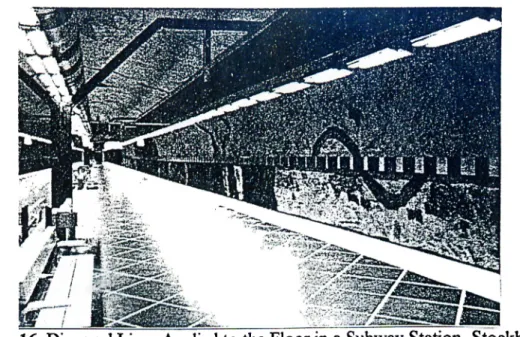
F ig u re 15. W arm Coloured Brick Finishing in an Underground Station, Montreal.31 F ig u re 16. Diagonal Lines Applied to the Floor in a Subway Station, Stockholm. 37 F ig u re 17. Application o f Natural Light in a Subway Station, M ontreal... 42
F ig u re 18. Application o f Artificial Light that resembles Natural Light... 44
LIST OF FIGURES
F igure 19. The R oute o f Ankaray and Location o f the Stations, A n k a ra ... 69
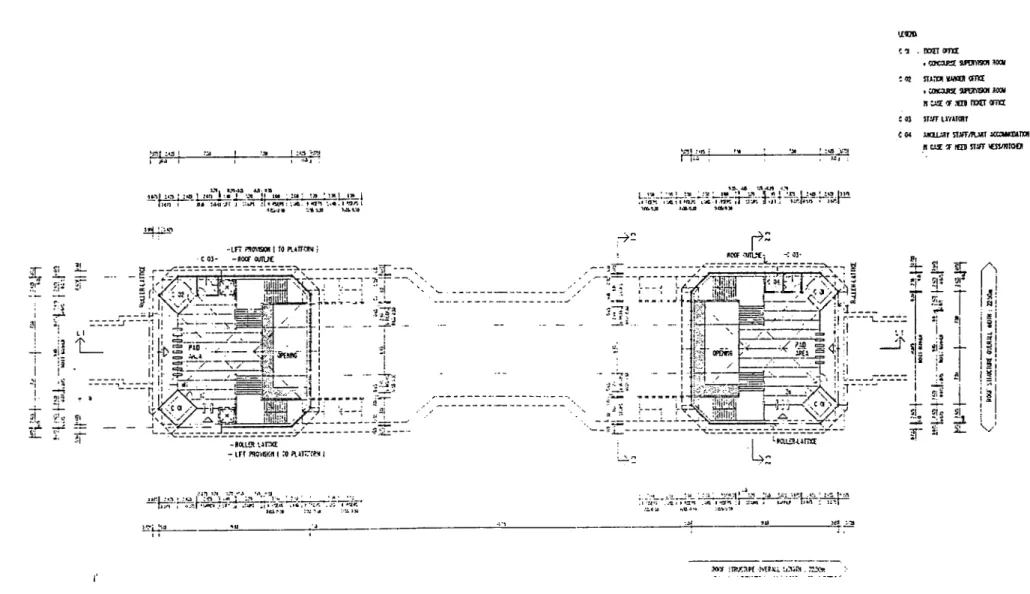
F igure 20. Concourse Level Plan o f the Tandogan Station, A n k a ra ... 70
Figure 21. Platform Level Plan o f the Tandoğan Station, A n k a ra ... 71
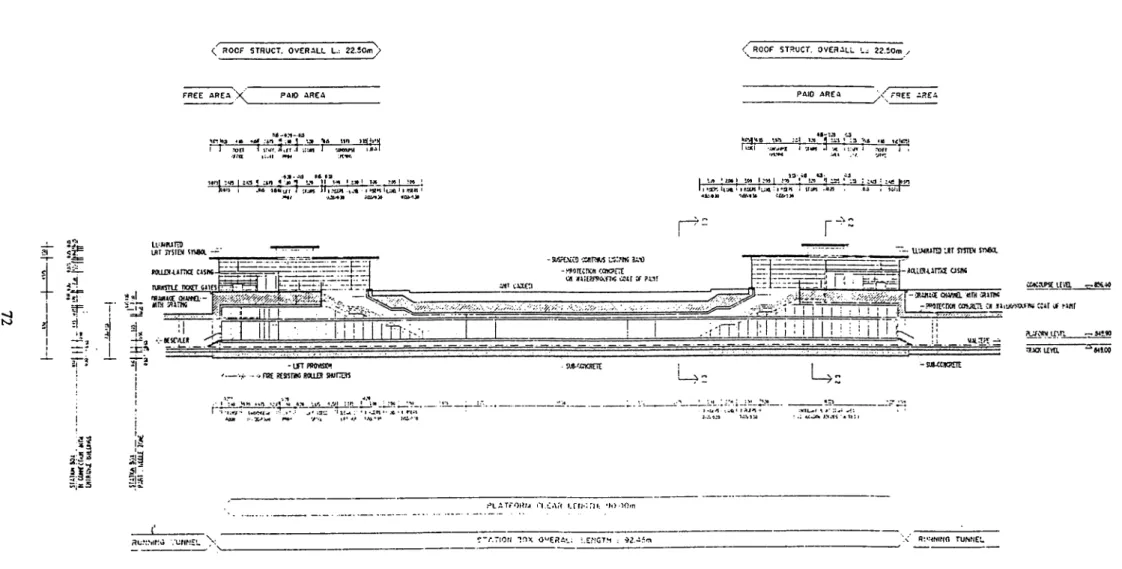
F ig u re 22. Longitudinal Section o f the Tandoğan Station, A n k a ra ... 72
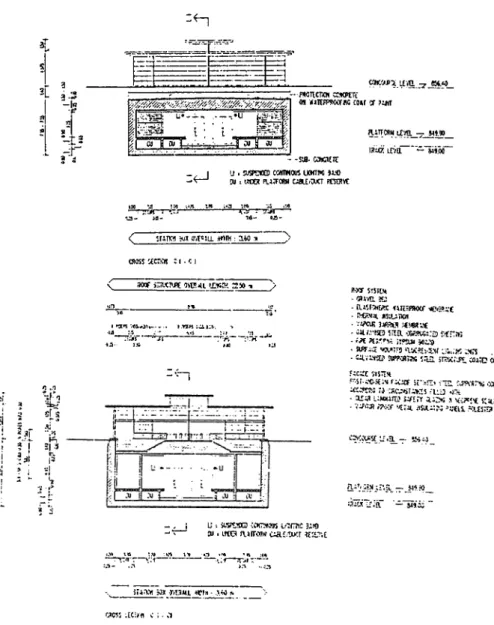
F ig u re 23. Cross Section o f the Tandoğan Station, A n k a ra ... 73
F ig u re 24. Concourse Level Plan o f the A.Ş.T.İ. Station, A n k a ra ... 74
F ig u re 25. Platform Level Plan o f the A.Ş .T.İ. Station, A n k a ra ... 75
F igure 26. Longitudinal Section o f the A.Ş.T.İ. Station, A n k a ra ...76
Figure 27. Cross Section o f the A.Ş.T.İ. Station, A n k a ra ...77
Figure 28. Plan o f the Kızılay Underground Hall, A n k a ra ... 78
Figure 29. Intermediate Level Plan o f the Kızılay Station, A n k a ra ... 79
Figure 30. Platform Level Plan o f the Kızılay Station, Ankara... 80
Figure 31. Sections o f the Kızılay Station, A nkara... 81
Figure 32. Exterior Signage o f the Kızılay S ta tio n ...85
Figure 33. Exterior Signage o f the Tandoğan S ta tio n ... 85
Figure 34. The Entrance to the Kızılay Station from Karanfil Sokak...86
F ig u re 35. the Entrance to the A.Ş.T.İ. Station... 86
F ig u re 36. The Entrance building o f the Tandoğan S ta tio n ... 87
F ig u re 37. The Alternative Entrance for the Mobility Impaired... 87
F ig u re 38. The Stairways to the Kızılay S ta tio n ...88
F ig u re 39. Train W aiting Platform o f the Tandoğan S ta tio n ...89
F ig u re 40. The Signage and City M ap in the Kızılay S ta tio n ... 90
F ig u re 41. The M ap Cases at the Kızılay S ta tio n ... 91
F ig u re 42. The Plan and Directional Signage at the Kızılay S ta tio n ... 91 F ig u re 43. Reflection o f the Light from the W indows on Signage in the
Tandoğan S ta tio n ... 92
F ig u re 44. The Passageway Connecting the Station to A .Ş.T.İ... 92
F ig u re 45. Access Control Systems in the Tandoğan S ta tio n ...93
F igure 46. The Entrance/Exit to the Kızılay S ta tio n ...95
F ig u re 47. The Exit Sign in the Kızılay S ta tio n ...95
F ig u re 48. A Sharp, Isolated C om er at the Kızılay Underground Shopping H a ll. .96 F ig u re 49. The Main Hall o f the A.Ş.T.İ. Station...97
T able 1. The C hecklist... 64 T ab le 2. Answers to the Checklist Q u estio n s... 83 T able 3. Normalized Values o f the Answers... 84
LIST OF TABLES
1. INTRODUCTION
In the past thirty years, the social and economic developments in our country have led to a migration from rural areas to the big cities, and this, together with a population boom, has brought vast amount o f problems to the daily city life. With regard to rapid and unorganized expansion o f the cities, these problems easily found roots and
flourished. Transportation and pollution o f the environment are tw o o f the major problems related to the quick development o f our cities. Together with residential problems, transportation has become the main issue that the local municipalities are dealing with. Other than building more roads or increasing the number o f busses, neither o f which helps to reduce the pollution or traffic, the primary solution was the utilization o f railed public transportation.
Railed public transportation is usually found in tw o forms; above-ground and sub surface. Above ground railed public transportation is highly dependent on the topographic characteristics o f the city and also consumes a lot o f above-ground valuable city space just like the roads and automobiles. Sub-surface railed
transportation, on the other hand, is dependent on the geological characteristics o f the land, but does not consume much o f the valuable above-ground space. Hence, it can be considered as a system that works within itself, with minor relation to the other elements o f the city. The advantages o f underground public transportation has been best summarized by Lupiac, who illustrates the space-saving characteristic o f the
metro by giving an astonishing example: the same amount o f passengers carried by a single metro lane can be carried by 12 bus lanes or 32 private car lanes (213). As well as mentioning space-saving and pollution decreasing characteristics, he also explains the “regularity” effect o f the underground railed transportation system: “ N o longer subject to the hazards o f routine traffic, a metro system may be fitted with automated or semi-automated devices”(214). Lupiac also points out the passenger carrying advantage and the commercial speed o f a metro system. However, a brief glimpse at publications about city transportation reveals the fact that both above and
underground installations are quite expensive and should be carefully planned,
foreseeing the needs o f the society they will be o f service. The International Tunneling Association report analyzing the cost-benefit methods for underground public
transportation systems emphasizes this clearly (Blennemann, 3). It is stated that there exists a gap between transportation needs and existing systems, and the reason o f this gap has been stated as not only the extent o f the needs, but also the high costs. In fact, cutting the high costs o f subways has become a major issue that the tunneling and underground associations are dealing with. This can be seen in an interview conducted with Russell McFarland, the director o f the Urban Mass Transportation Administration in U.S.A. McFarland states that it is not the technology but the process and the management that causes the more-than-expected costs (334). H e explains how planning effects the cost and time spent. Examining the literature also reveals that, other then cost, planning and constructional studies on a city scale, there are some factors that are w orth calculating with regard to human relations with his/her environment. This issue comes as one o f the main determinants o f the functionahty o f such a system if the comfort and safety o f people is to be assured.
2. ISSUES RELATED TO THE INTERIOR ARCHITECTURE OF
UNDERGROUND TRAIN STATIONS
2.1. INTRODUCTION
Train stations are the significant components o f an underground transportation system considering the human-environment relations point o f view. The architectural and finishing w ork gains importance in an underground train station, due to its
characteristic o f being an underground public space. The impression an underground environment creates on people is very different than an ordinary above-ground building. The different aspects o f an underground structure have been discussed in various sources and there is also a number o f research analyzing this issue, which will be mentioned in the further parts o f this study. These aspects o f underground train stations can be categorized into four groups; the circulation and spatial orientation in an underground train station, the satisfaction o f psychological comfort, the satisfaction o f physiological needs, and safety in an underground environment.
The main problems related to the general layout o f an underground train station have various aspects that may be examined under different headings. Since one o f the aims o f this study is to bring together the data available under different sources, these headings may be related to the architectural areas ( or zones ) that are determined by the functions o f that specific area; namely, the entrances, passageways, access zones and systems, and waiting platforms. One exception to this is a com m on topic, which actually concerns all o f the zones mentioned above: wayfinding and signage. The reason for this separation is due to the fact that wayfinding and signage needs further explanation not as a part o f these zones but as a major problematic issue that w e are bound to see at almost every part o f the system.
2.2.1. Entrance Design
2.2. CIRCULATION AND SPATIAL ORIENTATION
The entrance to the underground train station is the first point where the contact with the user takes place. Since the entrances are distributed throughout the city at various sites, they should, first o f all, indicate their function by their appearance. This issue has been discussed in various sources. The entrance itself may be a sign or an architectural landmark, as stated by Farray (118) or it may be blended with its surroundings, being a “transparent” architectural element, providing an agreeable view as stated by Lupiac (217). Carmody and Sterling, on the other hand, claim that if there is no visible mass, finding the entrance can be difficult and confusing {U nderground Space D esign, 173). W hatever the visual appearance is, the entrance should indicate its function through its design. The user should understand where he/she is entering, for what reason and
without hesitation (Fig. 1,2). The entrance shown in Figure 1 for example, does not provide enough information. The entrance shovm in Figure 2 on the other hand, is easy to find, and indicates its function by architectural and graphic means.
F ig u re 1. An Entrance to an Underground Train Station. From Carmody, John, and Raymond Sterling. Underground Space Design.
(New York: Van Nostrand Reinhold, 1993). 174
F ig u re 2. The Entrance to Frankfort Main Underground Train Station.
From Muller, Karlhans. The Architecture o f Transport in the Federal Republic o f Germany. (Bonn: Inter Nationes, 1981) 97.
The entrance to an underground environm ent has certain psychological effects on people, the effects are usually negative due to the nature o f the activity; making a downAvard m ovem ent to a dark, underground and unknow n place. However, using the right design initiatives, this problem can be solved, m oreover can be turned in to a positive factor, that helps orientation and wayfinding. Carmody and Sterling discuss this issue in detail emphasizing the psychological issues such as claustrophobia, fear o f entrapm ent and negative cultural associations ( U nderground Space D esign, 175 ). They propose the use o f spacious, well lighted entrances that are considered not as a separate part jfrom the overall structure, but as a transition zone which combines interior with exterior. Ylinen, also mentioning this problem, suggests the use o f horizontal o r ram p-hke entrances if there is enough space available, as this type o f structures can create an impression o f easier access and m ore certain exit than stairs or lifts (6). H e also suggests the use o f high quahty material on walls o r other surfaces, and using plants o r shrubs at the entrances in order to create a visual appeal. In Figure 3, visual appeal is achieved by a series o f pools w ith plantation in the entrance.
F ig u re 3. The Stairway Entrance to the Les Halles Complex, Paris. From Carmody, John, and Raymond Sterling. Underground Space Design.
A nother point that should considered is the access for the mobility-impaired people. The fact that these people do not prefer to use a secondary entrance other than the main entrance should not be neglected. The light intensity at the entrance and especially at the stairs should not be in contrast with the exterior level. This is also essential for users that are not mobility-impaired.
Creating a “ sense o f place” is the m ost im portant determinant o f the entrance design. This is supported in almost every study o r observation done about the entrance design to an underground building. Other than safety requirements, the entrance means a lot to the user; it is here w here people get their first idea on w hat may be awaiting them inside. Entrances should not be considered as just a pair o f stairs, as in Figure 1, or a tunnel leading the user to the trains, but they should give the user the idea that they will be safe and unconfused inside. H ector G uim ard’s Paris metro entrances exemplify the notion o f creating a sense o f place very well. H e constructed m ore than 200 entrances between 1900 and 1913, stylizing the act o f traveling with metro. Today, as stated by Abramson, G uim ard’s m etro entrances have become a landmark o f Paris, and a symbol o f both the m etro and the age in w hich they were built (74). Though it is a fact that a well planned entrance using architectural “specialties”, such as a daylighted, spacious entrance using higher quality material, costs higher, if the aim is the comfort and well-being o f the people, certain expenses should be granted.
F ig u re 4. Access to Noisy-Le-Grand Station, Paris.
From Lupiac, L. “ Underground Mass-Transit Systems; The Optimmn Solution in Major Cities.” Underground Space 5 (1981): 218
2.2.2. Passageways
In currently functioning underground train stations o f the world, w e can see that passageways are used, both for inter-connecting various parts o f a station, and also for connecting tw o different stations to each other. In some cases these passageways are utilized before entering the fare zone, for public use, as a pedestrian passage or as a shopping place w here the customers are not only the passengers o f the subway, but other people passing-by. Aside from their multi-purpose characteristics, there are a number o f architectural criteria that should be considered for the design o f these connecting passageways. The first is that the passages should not be very long or narrow and the ceilings should not be low. Ylinen states that the length o f the passageway should not exceed 40 meters, so that the people entering will feel that
they can exit easily (7). They must also provide a simple route avoiding mazes,
winding stretches and darkness in order to provide safety and minimum traveling time. The first solution that comes to mind is to build a straight route, how ever the
constructional and the geological characteristics o f the site may not enable this. Apart from this, straight routes have certain disadvantages. Farray first discusses the
disadvantages o f a straight route from the point o f view o f user psychology: “ ...a straight route evokes the immediate feeling o f a distance which must be crossed, and a route which is too straight can instill a feeling o f claustrophobia ” . H e also mentions other advantages o f a straight route: He emphasizes the availability o f mechanized pedestrian-ways which helps to increase time-savings and reduce the fatigue that the users experience (120).
If mechanized passageways are to be utilized, the design o f the environment that surrounds this system should not be neglected. Mechanized systems can be used to pass longer distances, without any fatigue and usually at a standard time. However, in some cases, these passages may have to cover hundreds o f meters. W hat is done under these circumstances, in order to prevent a long and dull trip, is usually the application o f artworks on the walls. One point that is brought up again by Farray, is to consider the speed o f the mechanized pedestrian-way ( 1 2 km /hr if the passage is about a few hundred meters long) and its rate o f accelerated vision. Farray suggests that the artwork applied under such conditions must avoid m onotony and the
repetition o f any theme, which may create a sense o f discomfort or weariness if used systematically (120). H e points out that the artwork should be easy to view and understand (Fig. 5-7).
F ig u re 5. M oving W alkway, R opsten Station, Germany
From Muller, Karlhans. The Architecture o f Transport in the Federal Republic o f Germany. (Bonn; Inter Nationes, 1981) 47.
F ig u re 6. Artw ork Display in a Passageway, Sweden.
From Soderstorm, Goran. A rt Goes Undergrotind. Trans. Laurie Thompson. Sweden: (Centraltryckeriet AB, 1988) 199.
The lighting in passageway is important. N o t only does lighting provide safe passage against both accidents and crime, it may also be applied as a means o f increasing the quality o f the atmosphere and spaciousness (Fig. 7). This gains more importance if the passage does not have sufficient space due to the constructional o r geological
with quiet colors in order to enlarge the apparent size o f a passage (7). Farray, on the other hand, states that any visual fatigue which may be caused by a contrast between bright and dark areas should be avoided, thus a uniformity o f colour should be provided (120).
F ig u re 7. Artwork and Lighting in a Passageway, Sweden.
From Soderstorm, Goran. Art Goes Underground. Trans. Laurie Thompson. Sweden; (Centraltryckeriet AB, 1988) 120.
Aside from lighting, other architectural elements can be applied in order to provide a less confined and understimulating environment. Carmody and Sterhng recom m end placing interior windows that show other parts o f the structure, if possible
(U nderground Space D esign, 210). For example, windows may afford a view o f the waiting platforms, in the case o f an underground train station. H ow ever, placing such windows may not be possible in most o f the cases because o f constructional
be placed to reduce the narrow impression o f the passageways. These niches can as well be used to display maps indicating the train routes or interconnections between the station passageways. I f such maps are to be put how ever, an area to look at and examine these should also be provided, in order not to impede other passengers passing through.
W herever possible, day-lighting such narrow passageways will help to reduce the negative psychological impressions. As well as providing illumination, day-light will bring a feeling o f safety and will also increase the perceived space w hich helps to compensate for the psychological drawbacks o f being underground. The effects o f day-lighting will be discussed in more detail in the following chapters o f this study.
Connecting passageways in an underground transportation system are very important both for functional circulation in the system and for the impression it creates on users. A well designed system o f passageways will save a lot o f time for the passengers especially in a complex system. In addition to providing a well-lit, safe, and
psychologically undisturbing environment, passageways should always be kept clean with adequate air ventilation during the operational phase o f the system. The
acoustical quality o f the system should be kept in mind while deciding about the floor and ceiling materials.
U nderground halls include the areas that are used for waiting, thoroughfare, information and also the access control zones. The main function o f these zones is providing transition between the train platforms and other parts o f the system.
U nderground halls serve as relaxation and waiting zones as a secondary function, and also in some o f the train stations, shops or other commercial establishments are placed here. D ue to their characteristic o f being a transition zone, the underground halls should provide adequate information on how to go where, therefore the principles o f wayfinding and signage should be well-applied. The underground halls o f the major train stations that are placed at the intersection o f several routes, tend to be very crow ded and various people other than passengers can be seen here. In the examples o f such stations in Europe w e can see a wide variety o f people including beggars, homeless, street musicians, etc. These people usually do not enter the fare-zone but, rather they inhabit the underground halls. The safety and comfort o f the passenger can be increased by using architectural means, such as avoiding sharp com ers or providing adequate illumination.
Access systems are used to control the passage to the fare zone. In quite a number o f the currently active underground railed transportation systems, the access control systems are changed regularly. The main reason for this is the loss o f their
effectiveness in time. The users find a way to pass through the access system without paying a fee. One solution to this is to utilize a number o f operators to control w hether the controlling devices are adequately used or not. This solution, however, increases the expenses noticeably especially in a large system with hundreds o f stations
and thousands o f entrances. To design a flexible access controlling system that can easily be changed, on the other hand, will allow the ease o f applying different controlling methods at certain periods o f time when the old one looses its
effectiveness. In this case there will be very little need for a controlling staff and the system may function as a really automated system. I f the passengers’ cheating is inevitable, then it will be wise to design a system that can be changed. A nother point that should be considered about the design o f such a system is to choose a durable material considering vandalism.
The train platforms are the places where the passengers wait for and board the trains. For the benefit o f the passenger circulation, situations such as train delays should be considered. For various reasons certain trains may delay and this may lead to a overcrowding in the train waiting platforms. Being in an underground space w ith an outgrowing number o f people will cause physiological and psychological discomforts. Because o f the great number o f people, the noise, humidity and tem perature levels will increase in this enclosed, and in a way, isolated space. Since the main ventilation system o f the underground train systems is the piston-effect caused by the trains, there will be almost no other ventilation. These physiological conditions will also lead to psychological results such as fear o f entrapment or claustrophobia. U nder these conditions, the passenger safety and comfort is questionable. There are some
architectural means to lessen such negative effects, however. Providing enough space with emergency ventilation systems and well illumination will both reduce these discomforts and will also decrease the panic formed under the conditions o f accidents.
Wayfinding design is basically a set o f tools, devised to help the people to reach their destination in an unfamiliar or familiar environment. With the emergence o f large, public spaces which are above the perception scale o f human, the need for such solutions has increased greatly. It is evident that people have certain difficulties in perceiving and understanding such environments, not because they are ignorant or stupid, but because the environments are complicated (Sims, 90). W hen adequate wayfinding in a setting is lacking, a set o f problems are likely to occur (A rthur and Passini, 7). Frustration and stress caused by feeling alienated, lost and being unable to find your way is the first problem faced. Functional inefficiency is another outcom e o f the poor wayfinding design, causing a great loss o f time. Besides, the differently abled people will have greater difficulty in such a building, in terms o f accessibility. Finally, safety concerns (such as emergency exits) are endangered in an environment where it is hard to find your way.
Wayfinding, which is a major problem in many pubUc buildings, becomes even m ore problematic in an underground environment. As stated by Arthur and Passini (135), underground spaces such as parking garages, subway stations, shopping malls, and multifunctional urban complexes are am ong the m ost difficult settings to understand. Two major reasons are given for this difficulty. First is that the underground settings are usually less organized than buildings. The underground netw ork in Osaka, for example, which links tw o main stations, a num ber o f smaller railways, and the subway stations through shopping concourses, lacks any organizational principle. This
complex has over fifty entrances and it is confusing for the foreigners and the natives
as well. As a second reason, it has been claimed that underground settings are difficult to understand even if the circulation system is simple (due to the lack o f
communication that is normally given by the outer form o f the building). Even a rectangular shaped layout becomes problematic because it is underground. A building above-ground has an outer form which can be perceived from outside. The outer form gives certain messages about what is going on inside. However, this is not the case in an underground environment. The outer visible mass, that is usually the entrance in the case o f underground train stations, hardly gives any message to the user about the setting they are about enter. In some examples, even a visible mass does not exist, but just a stairway going down to an unknown destination with a w eak sign.
An additional third problem to these is the lack o f windows in an underground
environment. Since there is no information about the exterior, the overall layout is not easily perceived, therefore people can not easily locate themselves, which results with a lack o f orientation. Bronzait, discussing the issue o f orientation in a subway system, states that it is difficult for a person to build a cognitive map if the legibility o f the system is poor (579). Methods to improve wayfinding communication in an underground train station can be discussed under tw o categories: architectural and graphical.
2.2.4.1. Architectural Means to Improve Wayfinding
The properties o f the natural and built environment play a very important role in wayfinding design; providing the users a variety o f wayfinding cues. Receiving basic
circulation information by the help o f architectural features that define it in a built environment is essential for wayfinding communication. One solution to improve wayfinding and spatial orientation is to apply certain significant elements in the interior to help people maintain orientation. The main idea behind this method is to give identities to the different parts o f the environment so that they can be
differentiated from each other, with distinct characteristics. For example, instead o f building m onotonous passageways that look similar to each other but lead to different destinations, the passageways may have different architectural characteristics
(different colors, materials, decorative elements, special illumination, etc.), so that they will have an “identification” which the users will recall when trying to reach a certain destination. This can also be achieved by utilizing architectural “landmarks” . A landmark, as described by Lynch (1960), is a simply defined physical object; a
building, a sign, or a mountain. In a complex underground train station for example, a landmark can be a sculpture, or a decorative element that is placed at a main hall w here different routes o r passageways meet. This method will help people give names to places and improve wayfinding. People can describe each other the ways
referencing on these landmarks, for example: “ ...go through the blue passageway, turn right from the statue,..” .
A nother point that should be considered is the visibility o f certain paths, entrances and exits in the station. Paths that provide vertical access, such as elevators, escalators and stairs must be considered strongly within the spatial layout o f the setting. They should be perceived clearly, architecturally expressed and visible, leaving no need for a signage that identifies the circulation element. They should not be hidden and
The architectural elements such as walls, columns, etc. should not represent an obstacle against visibility from certain approaches. Especially, the junctions and intersection points o f paths should be clarified to help decision-making since at those points the user will usually have difficulty and will seek visual clues from the
environment to orient himselfrherself
Briefly, architectural elements, integrating to the circulation system and expressing the main layout and organization o f the station, can by themselves be important cues for the occupants w ho have wayfinding difficulty.
2.2.4.2. Graphic Wayfinding Communication
The graphic components o f wayfinding design include system o f signs, maps, directories, and other graphical elements. Their main purpose is to provide visual communication in the setting that will help the occupants understand the space around them, making it easier for them to reach the desired destination. It should not be thought that a successful signage system can alone avoid wayfinding problems in a badly planned building, however, signage systems provide essential supplementation to overcome the problems related to spatial orientation.
Basically, there are four categories o f signs, classified according to their function by Arthur and Passini (143). Directional signs indicate the direction o f a certain
destination informing the designated route to the destination. Identification signs, on the other hand, contain the information at the destination. Orientational signs provide a general view o f the setting in the forms o f directories, maps, models and basic
schemes. Finally, informational signs give certain information within a setting such as the arrival and departure times o f a train.
The message given by a sign can be in two forms: verbal (typographic) and non verbal (pictographic) (Arthur and Passini, 150). The problematic issues, however, can be considered similar for both o f them and these problems are basically illegibihty and inaccessibility o f the signs, and unclarity o f the message (Carmody and Sterling, U nderground Space D esign, 255).
In order to improve the legibility o f a signage system, there are some basic guidelines that should be paid attention to. Firstly, legibility should be considered while placing signs within the setting, in terms o f at what distances the sign is to be perceived and recognized. Thus, the w ord and letters o f a verbal sign should be legible from the required distances. Lettering for directional purposes, including emergency signs, should be at least o f 4.5 cm height, considering angular distortion o f the human eye, possibility o f visually imperfect occupants, and inadequate hghting (Arthur and Passini, 166). Besides, letter spacing and w ord spacing should be designed so that visual balance is reached, whereas the choice o f weight (the thickness, the contrast and the proportioning o f the letters) should be made considering legibility (Sims, 49- 50). The signs should be placed correctly within the interior o f the subway station, being in consistent and predictible locations (Carmody and Sterling, U nderground Space D esign, 255). The signs also should be differentiated from the background in which they are placed in order to be easily recognized.
The clarity o f signs is another important issue discussed by Arthur and Passini (180). In order to get the message through, the languague o f the verbal signs should be plain, easily understandable and unambigous using well known terms. The amount o f
information given should neither be more than required (which may lead to
confiision), nor they should lack the necessary information. For directional signs, the arrows beside the w ords should correspond to the actual setting. Non-verbal signs are advantageous to verbal signs since they can be understood by children, people with low education, foreigners, and illiterate (Ota, 22-24). However, they are successful only if they are easily understandable providing the correct information, perceived and identified by everyone in the same way. Orientational signs, such as maps, should emphasize the basic elements o f the circulation systems, such as circulation paths, landmarks, nodes, etc. to provide an accurate image o f the interior space, avoiding confusion (Carmody and Sterling, U nderground Space D esign, 256). At points o f alternative routes, information on every possible direction and the following routes should be mentioned (Fig. 8).
F ig u re 8. A M ap in an U nderground Train Station, Sweden.
From Sôderstôrm, Goran. A rt Goes Underground. Trans. Laurie Thompson. Sweden: (Centraltryckeriet AB, 1988) 34-35.
Selection o f colour for a sign system is one o f the m ost im portant aspects o f design. Certain colours are expected to imply certain m eanings in m ost o f the public space signs. For example, Japanese, Enghsh and Turkish standards have conveyed similar meanings to the same colors: R ed means prohibition o r prevention; yellow used for warning; blue for mandatory; and green for safety signs (Ota, 139; BS5499; TS853). Colour schemes o f architectural elements and sign systems may be integrated with each other, to enhance orientation and wayfinding fo r users.
Besides orientational signs such as maps, directories, etc., artworks, architectural features and other graphic material may be utUized to aid at wayfinding. F or example, to enhance wayfinding in a transit complex in Helsinki, a figure resembling a large compass is placed on the floor. Likewise, in order to overcome the orientation difiBculty o f the underground subway stations in Tolq^o, photographs o f buildings
that are above the exit are placed, providing a connection to the exterior (Carmody and Sterling, U nderground Space Design·, 254, 256) (Fig. 9).
F ig u re 9. M eans o f Graphic Wayfinding Communication in Tokyo Subway Station. From Carmody, John, and Raymond Sterling. Underground Space Design. New York; (Van
Nostrand Reinhold, 1993) 254.
2.3. SATISFACTION OF PSYCHOLOGICAL COMFORT
Today, the functionality o f a built environment depends not only on its success in dealing with primary human needs such as heating, lighting, providing a shelter, etc., but also on the psychological comfort it provides fo r the user. Therefore, architecture today requires a broader sense o f knowledge and an interactivity with certain other disciplines then in the past. In the case o f creating an underground environment, one o f the major problems is to control the psychological disadvantages due to the spatial characteristics o f the environment. The psychological effects which an underground environment instills on human beings are n o t uniform. They may differ from person to person, o r even different societies may have different beliefs or attitudes towards being in underground. In addition, the general psychology o f a passer-by is much
different then that o f an underground worker. In spite o f this, underground train station environments are quite similar to each other throughout the world. The main reason for this is that the history o f these systems does not go very far in human history, thus they are not very much effected by the cultural and technological evolution o f societies. Rather, they all speak the language o f the post-industrial age.
The psychological effects o f an underground environment are usually negative, according to the studies done analyzing this issue. Research w ork by W ada and Sakugawa illustrates this very well: 79.8 % o f the people w ho w ork in a subway station stated they wished to w ork above-ground, 14.8% wished to w ork at a higher floor above ground, and only 6.6% stated that they are satisfled w ith their present location (36). The reasons for these answers were also given: bad air, oppressive feeling, low ceiling, noisiness, limited visibility, and being unaw are o f the weather outside. Similar negative effects are also given by Carmody and Sterling: lack o f natural light, lack o f exterior views, undesirable internal conditions, etc. ( “Design Strategies..”, 59). Regarding the reasons given, it can be claimed that these conditions can be changed by using architectural means. Various solutions are being applied to alleviate the negative psychological effects associated with an underground
environment in the currently functioning systems o f the world.
It should not be thought that the underground environments always bring negative psychological feelings. Certain studies conducted on the various underground establishments’ personnel, show that there are also a number o f positive effects associated with being in an underground environment. These installations, however
are usually not public places like subway stations, but m ore private places such as space research centers, special companies, etc. (Hughey et al., 381-386).
2.3.1. “Humanization” o f the Environment
W hat is meant by the “humanization” o f the environment is the creation o f a warm and pleasant atmosphere by using various means o f architecture and art, in order to decrease the negative psychological effects the underground environment instills on people. This rather untechnical aspect o f the underground train station design has gained more importance in time and today has becom e a major area o f interest for those who wish to Ughten the negative psychology o f the underground train systems. The discussions on transforming the underground train stations into m ore friendly and inviting environments is widespread on literature. Especially, in the cities "with fairly older systems, this issue becomes a major topic o f controversy, such as London underground : “ ...scruffy stations, bewildering ticket machines, unfriendly barriers, confusing signage and a mish-mash o f platform furniture have combined to create an unwelcoming, even hostile environment for the system’s captive customers” (Trevett, 41). This criticism about the unfriendliness o f the environment covers not only one com ponent (for example, only the furniture o r the lighting) o f the system, but the system as a whole: the image o f the system is unpleasant from the point o f view o f the user. Carmody and Sterling support the idea that an underground building may be considered “unpleasant”, even if it has similar physical properties with a building above-ground. It is claimed that some individuals may experience claustrophobia or fears related to safety that result in negative reactions to underground spaces, and in addition to this, there may be a general negative association with death and burial
related to underground. However, they also note that the integral drawback o f an underground environment is related to the fear for personal safety: “ It is generally assumed, however, that these attitudes are m ore closely related to a fear o f structural collapse, fear o f being trapped in a fire in a windowless building, or fear o f flooding in a fully below -grade sp ac e .... These negative reactions tend to heighten awareness o f and exaggerate objects to other physical characteristics o f the space that may go unnoticed in a conventional building. For example, small interior spaces, low ceilings, o r entry dow n a narrow, dark stairway may increase these negative associations with being underground” ( “Design Strategies..”, 354 ).
2.3.1.1. Utilization o f Artworks
One approach to overcome this problem is to make the station m ore “aUve” by utilizing art and social events. The main procedure for such an approach is to utilize artists as well as architects and engineers. Abramson claims that transit art projects are both decorative and functional, as they both contribute to the cultural life in the city and also help attract the users back to pubUc transportation. In addition, such
applications will enhance the feeling o f safety, comfort and orientation in systems that are often unfamihar and disorienting (74). Lupiac suggests placing exhibitions and entertainm ent shows (Fig. 10) on the premises in order to further humanize the station (217). A nother suggestion which is actualized in a number o f the underground
stations in Europe (e.g. the Louvre M useum Station in P a ris), is to use the decorative features characteristic o f the surface in the station platforms and halls.
F ig u re 10. Rodin Exhibit at Varenne Station, Paris .
From Lupiac, L. “Underground Mass-Transit Systems: The Optimum Solution in Major Cities.” Underground Space 5 (1981) 218.
A significant example using this approach is the Stockholm metro. In 58 o f the netw ork’s 99 stations, 159 artists worked for thirty years to produce w orks o f art for the underground. The art works applied range from single paintings, to a completely carved station, and the Stockholm M etro is claimed to be the biggest monumental art project in Europe, and the w orld’s longest art gallery. Sbderstrom explains these efforts in the Stockholm metro as a way to make the journeys bearable and pleasant, and adds that these applications give the individual stations a characteristic and a recognizable identity (11). A noticeable point is that the travel by the underground trainway becomes a different experience than the ordinary transportation in the city. Every different station that one passes through may provide different artistic
pleasures, or at least will let the passengers observe something different than endless tunnels and corridors made up o f rock and concrete (Fig. 11,12). A nother interesting
point mentioned again by Soderstrom is that these applications have been widely accepted by the public and never led to a political disagreement; there was a common consent by all the parties. However, there is a major criticism today on the
“ durability” o f these art w orks in time; durability both as physical means, (cost o f maintenance, etc.) and also as spiritual means, in the sense that certain popular artworks may have no meaning for future generations (Sbderstrom, 63-64). Another question that can be discussed on this issue is how exciting would it be to see the same pictures o r a rtw o rk s, while going to w ork, every day o f your life. Perhaps it would be a good idea to have the availability o f changing these artworks regularly, but then you change the identity, the “sense” o f the place, which is quite important, as mentioned before.
F ig u re 11. Artw ork in Underground Train Station, Sweden Soderstorm, Goran. A rt Goes Underground. Trans. Laurie Thompson.
F ig u re 12. Artwork in Underground Train Station, Sweden Soderstorm, Goran. A rt Goes Underground. Trans. Laurie Thompson.
(Sweden: Centraltryckeriet AB, 1988) 126-127.
2.3.1.2. Utilization o f Natural Elements
A nother approach to make the underground environment more pleasant and further “humanized” is the utilization o f natural elements and materials. The idea that many o f the negative associations with underground spaces are as a result o f the lack o f
connection with the outside, the natural world on the surface has been agreed upon by many observers and researchers. The pessimistic and artificial atmosphere o f the underground can be soothed and furthermore can be transformed into a positive and inspiring atmosphere by the use o f natural elements. As stated by Carmody and Sterling, it is not only the visual qualities o f nature that is appealing, but the overall
sensory experience; the sounds, smells, and the tactile associations with the highly textured natural materials {U nderground Space D esign, 236). One o f the methods used to improve the quahty o f an underground environment is to use green plants. A study conducted by Laviana, M attson, and Rohles (quoted in Carmody and Sterling, U nderground Space D esign, 237) concluded that plants had a significant contribution to the perceived quality o f the space, how ever it is also stated that they did not
contribute much to the perception o f spaciousness. Carmody and Sterling suggest that plants can be placed in the form o f clusters into centrally visible areas with higher illumination, to create a focal point and an illusion o f exterior courtyard
{U ndergroundSpace D esign, 237). Plants can also be used to create subsurface gardens especially at the waiting halls, together w ith other natural elements in order to create a relaxation zone and a landmark as well.
Utilization o f flowing w ater is another m ethod that will help improve the pleasantness o f the environment. W ater can be utilized in the forms o f fountains, waterfalls or small underground ponds. It has been observed in a study by Ulrich (523) that w ater and natural landscapes with vegetation had positive influences on peoples’ emotional states. Just like the plants, it is not only the visual characteristics o f w ater that makes it appealing, the sound and cool air created by the falling or movement o f w ater creates a soothing and relaxing atmosphere. W ater also improves the feeling o f association with nature and outside w orld (Fig. 13).
F ig u re 13. Utilization o f a Waterfall in an Atrium o f an Underground Building, Toronto. Carmody, John, and Raymond Sterling. Underground Space Design.
(New York; Van Nostrand Reinhold, 1993) 237.
O ther than using plants and water, the general selection o f “natural” materials can also improve the warmth and pleasantness o f the underground environment. It is true that most o f the materials that we use to build and construct in our world are nature-based, but w hat is meant by “ natural” here, is not the molecular composition o f the materials. Carm ody and Sterling define the basic characteristics o f a “natural” material as
follows: First o f all it is taken from the natural world and processed minimally, secondly they are irregularly textured, and thirdly they are colored in warmer tones {U nderground Space D esign, 238). Suggested materials are wood, rock and soil, brick and tiles m ade up o f clay (rougher and earth-colored bricks, such as terra-cota) o r combination o f these (Fig. 14,15). It is also true that these materials are expensive and it may not be desirable to apply them to every part o f an underground train station, which is usually large in size and a rather crowded public space used by thousands o f people every day. However, at certain locations where people who actually w ork at the station and spend their whole day, such as control rooms, offices.
F ig u re 13. Utilization o f a Waterfall in an Atrium o f an Underground Building, Toronto. Carmody, John, and Raymond Sterling. Underground Space Design.
(New York; Van Nostrand Reinhold, 1993) 237.
O ther than using plants and water, the general selection o f “natural” materials can also improve the warmth and pleasantness o f the underground environment. It is true that most o f the materials that we use to build and construct in our world are nature-based, but w hat is meant by “natural” here, is not the molecular composition o f the materials. Carm ody and Sterling define the basic characteristics o f a “natural” material as
follows: First o f all it is taken fi-om the natural world and processed minimally, secondly they are irregularly textured, and thirdly they are colored in warmer tones (U nderground Space D esign, 238). Suggested materials are wood, rock and soil, brick and tiles m ade up o f clay (rougher and earth-colored bricks, such as terra-cota) or combination o f these (Fig. 14,15). It is also true that these materials are expensive and it may not be desirable to apply them to every part o f an underground train station, which is usually large in size and a rather crowded public space used by thousands o f people every day. However, at certain locations where people who actually w ork at the station and spend their whole day, such as control rooms, offices.
dining-halls, etc., certain expenditures should be granted, in order to improve the working conditions.
F ig u re 14. Tiled Floor and Wall Finishing in an U nderground Station, Hanover. From Muller, Karlhans. The Architecture o f Transport in the Federal Republic o f Germany.
(Bonn: Inter Nationes, 1981) 108.
F ig u re 15. W arm Coloured Brick Finishing in an U nderground Station, M ontreal From Cannody, John, and Raymond Sterling. Underground Space D e si^ .
One o f the solutions to overcom e the negative feelings o f the underground mentioned above is to change the perceived spatial characteristics o f the environment by using various methods. The underground environment may associate feelings o f narrowness or crampedness at certain locations, such as corridors, passageways, entrances, etc. However, using color and spatial arrangements, these feelings can be changed by increasing the perceived space. The apparent volume o f a space can be larger than the actual volume and size o f that space.
The main concern o f this part o f the study is to discuss various methods that are applied or can be applied to improve the spaciousness in an underground train station. One significant characteristic o f the methods and techniques suggested is that they are usually the ones that can be applied during the finishing phase. M ethods such as increasing the height o f the ceilings or making ceilings o f variable heights are given as a secondary suggestion though they also are proved to increase spaciousness in an underground environment. This is due to the fact that applying these more
“illusionary” methods are less restricted with the geological and constructional limitations.
2.3.2.1. Color; Im proving Spaciousness and Creating a Warm Environment
It is a common consent that color is an important tool that affects the entire image; the attractiveness and the overall perception o f a built environment. Color can be used to create a w arm and welcoming environment and it can also be utihzed to
improve the spaciousness in an underground environment. There are a number o f studies done in order to understand the effect o f color on the pleasantness o f an environment. In an investigation conducted by the Department o f Psychology o f the University o f Göteborg (qtd. in M ahnke and Mahnke, 63) where 600 people living in two diflferent housing areas (one with gray buildings, the other with strongly colored buildings) were asked to describe their environment; the people living in the complex o f gray buildings evaluated their homes as “concrete boxes” and “bunkers”, while almost all o f the people living in the colored buildings stated that they were happy to live in their environment. A similar conclusion has been brought by KuUer (qtd. in Carmody and Sterling, U nderground Space D esign, 231); the presence o f color gives rise to positive evaluations o f the environment while the absence o f color is generally considered as a negative factor. It has also been claimed by Küller that it is not the hue, lightness, or the chromatic strength, but the presence o f the color itself that makes an environment desirable.
The associations that come together with certain colors is also an important factor. For example, gray colored concrete walls in an underground environment may feature an unpleasant atmosphere, because they can be easily associated with the cold and dusty basement floors o f our apartments. It has been described by Carmody and Sterling that colors Avith longer wavelength (i.e., red, orange, yellow, brown) are considered to be associated with warmth, while those with shorter wavelengths (i.e., blue and green) are considered to be “cooler” (U ndergroundSpace D e sig n , 232). Since the general atmosphere o f the underground is usually associated with cold and damp spaces, it is advised in many cases that warm colours should be applied. It has been described by M ahnke and Mahnke, for example, that warm colours such as
yellow represent cheerfulness, vitality and sunlight (12). Carmody and Sterling also suggest the use o f warm colours in order to offset the damp and cold image o f an underground environment. The question, if a colour giving warm or cool senses should be applied in an underground environment, however, can better be answered upon discussing other effects that can be given by the utilization o f colour, such as spaciousness.
Carmody and Sterling {U ndergroundSpace D e sig n , 232) note that the widely believed rule that the warm colours advance toward the viewer and the cool colours recede (thus cool colours creating a greater feeling spaciousness) can be considered “untrue” . The main opposition to the falsity o f this rule is due to the consideration o f other attributes o f colour, such as hue, saturation and value. H ue is determined by the wavelength o f the colour, it is the characteristic that distinguishes one colour from another; saturation is related to the “purity” o f a colour, the lesser the amount o f gray in a colour, more saturated the colour is; and lightness o f a colour is a measure o f how much light is reflected from that colour, the quality that differentiates a dark colour from a light one. Carmody and Sterling, citing from other researchers namely, Tiedje, and Wise and Wise {U nderground Space D e sig n , 232-233), note that the spaciousness is not strongly affected by the hue, but more by the lightness and saturation: “ High value colours reflect more light, and lighter spaces are generally perceived as larger and more open. In addition, saturated colours appear closer than less saturated, grayer colours. Thus, the perceived depth or distance to a colour is relative to the colour o f the surfaces around it and the properties o f the light falling on it. Enhancing spaciousness using lighter colours on enclosing surfaces will be most successful with higher levels o f illumination directed on these surfaces” {U nderground
Space D esign, 233). How ever, it should not be forgotten that, not the colour itself, but the combination o f different colours, the colour schemes in an environment is important. The surfaces o r the materials the colour is applied on may change the overall effect, for example, red on a sm ooth plastic surface is much m ore different than red on a rough and textured stucco surface. The colour o f the light (spectral composition) is also important, same walls may have different colours under daylight o r a coloured artificial light. The effect o f shadows should also be considered, the contrast between the shadowy and bright parts o f a surface can change the space and atmosphere perceived. Though certain colours o r hues, or their saturation is proved to have certain consequences on the environment and people, the combination o f all these different colours, lights, shadows, on different surfaces shape the overall image o f the environment, be it warm, cold or spacious.
To summarize, the hue o f a color can be claimed to have a certain influence on creating the “ atmosphere” o f an environment, but w hen considering spaciousness the more im portant attributes are the saturation and lightness o f the color, and the way o f illumination. It has been found out that lighter and less saturated coloured surfaces, under proper illumination, will improve spaciousness. However, the importance should be given on the combination o f different colors, material and lighting effects; the colour schemes. In relation to this, it can be claimed that, even if cooler or hghter colours are used in order to improve spaciousness at certain locations, the coldness or dullness o f the environment can still be prevented by the utilization o f warm-colored furnishings and artworks, or by placing natural elements.
Just as color can be used to improve the spaciousness and the general pleasantness o f the underground train station’s atmosphere, another m ethod to improve the
spaciousness o f an environment is to benefit o r to take advantage from the human perception o f a space. This can be done by the application o f various patterns, lines or textures. Carmody and Sterling provide information on how this can be done; “Line, pattern and texture actually can increase spaciousness in tw o ways. First, patterns and textures make an environment more complex, with more visual information to
explore, and this tends to make a space seem larger because it can not be
comprehended at a glance. Second, because lines suggest direction while patterns and texture suggest scale due to the size o f the repetitive elements, they can influence the perception o f distance therefore spaciousness” {U nderground Space D esign, 234 ). It is a well-known phenomenon about human visual perception that the application o f a line in a certain direction emphasizes the size on that direction, for example a person wearing a shirt with horizontal lines on it seems to be somewhat broader. The same technique can be applied to the walls or floors o f an underground train station, for example, vertical lines on walls will make the ceiling appear higher. Using horizontal lines, on the other hand, is not advised in an underground environment where spaciousness is a m ajor concern, since they will increase the apparent width, but decrease the perceived height o f the environment. Diagonal lines are considered as real space enhancing elements, and if applied on the floors they will make the space appear larger (Fig. 16).
Figure 16. Diagonal Lines Applied to the Floor in a Subway Station, Stockholm. From Carmody, John, and Raymond Sterling. Underground Space Design.
(New York: Van Nostrand Reinhold, 1993) 234.
The application o f patterns on the surfaces o f the underground environm ent in order to increase spaciousness is another technique. This technique is generally based on the fact that smaller and finer pattern size appears farther than larger and bolder elements. Smaller and less distinct objects also seem to be farther than their actual location. According to Tiedje (quoted in Carmody and Sterling, U nderground Space D esign, 234), this occurs because distant objects are not as clear as close ones in an actual three-dimensional view. Therefore a ceihng with large and dom inant elem ents will appear lower (as it appears to be closer) than one with a finer pattern. Tiedje suggests manipulating the pattern effect by decreasing the pattern sizes and spacing on a wall while moving to the upper parts o f the wall to the ceiling. The same technique can also be apphed on the floor, by decreasing the pattern size and spacing through the edges o f a tiled floor for example. Though no applied examples o f this optical illusion method could be found while preparing this study, this method could be effective in increasing the perceived space, thus bringing a slight relaxation to a space w here
crampedness is a problem. The main drawback o f this method, however, seems that it requires an unstandardized means o f production, for example, in the case o f different sized tiles. M oreover it may require a special design at eveiy location it is to be applied, thus increasing the expenses and decreasing applicability.
The properties o f the patterns mentioned above basically go parallel when considering the textures on the surfaces. The main difference is that the textures are actually three dimensional, therefore in some cases they may provide enhanced effects. According to Carmody and Sterling, for example, complex patterns o f light and shadow can be created by hghting a heavily textured surface (IJndergrcnind Space D esign, 235). Ylinen, on the other hand, states that heavy textures and strong contrasts makes a space seem smaller (7). Therefore it can be said that the use o f textures should be under control, and too much textures should be avoided. In fact, the same notion is valid for patterns and lines as well.
A nother method that can be considered is placing mirrors on walls, to create an illusion that doubles the perceived space, thus enhancing spaciousness. However, it should not be forgotten that mirrors also double the crowd and may cause a confusing environment.
In order to obtain a safety and comfort-assuring atmosphere for the user, the quality o f the finishing is another important point that should be mentioned. This does not necessarily mean the use o f expensive or luxurious materials, but the finishing should bring the impression o f a well finished work. For example, electrical cables, pipes or similar fittings should not be located on any visible surface. The impression o f a cellar
like or a warehouse-like structure should be avoided. Also the floor is an influential factor in creating a pleasant environment w hen considering the covering materials, according to Ylinen. N ext to the floor are the walls and then the ceiling. As
exemplified by Ylinen, a person walking at a passage looks ahead to the end o f the way, rather then the walls or the ceiling, therefore particular attention should be given to the floor covering as well (7).
2.3.3. Lighting: Psychological Disturbances, Absence o f Dayhght and Artificial M eans o f Lighting
Lighting is essential in order to maintain both the psychological and the physiological com fort and safety o f the users, especially in a sub-surface environment. In this part o f the study, the psychological aspects o f fighting will be analyzed. The relation between fighting and physiological concerns o f an underground train station will be discussed in the following part o f the study; and another aspect o f fighting, the safety concerns, will be discussed in the last part o f the study.
There are two ways to illuminate a space; artificial and natural. Natural fighting is, o f course, to use the sunlight for illumination. This has certain applicability and
availability problems, especially in an enclosed, windowless place such as the underground train station. It depends on many variables, such as, the seasons o f the year, or the time o f the day, also the constructional drawbacks make this type o f fighting hard to apply and expensive to build. Artificial fighting methods, on the other hand, are easily applicable but they also have certain drawbacks due to their fight quality. In an underground environment, artificial means o f fighting may enhance the