FULL PAPER TAM MAKALE
JOURNAL OF AQUACULTURE ENGINEERING AND FISHERIES RESEARCH E-ISSN 2149-0236
DETERMINATION OF SOME HEMATOLOGICAL
PARAMETERS AND NON-SPECIFIC IMMUNE RESPONSES
IN Garra rufa (HECKEL, 1843) LIVING IN KANGAL
(SİVAS) BALIKLI ÇERMİK THERMAL HOT SPRING AND
TOPARDIÇ STREAM (SİVAS)
Selçuk Duman
1ORCID ID: 0000-0002-6771-3385, Aysel Şahan
2ORCID ID: 0000-0001-8000-8923 1 Cukurova University, Imamoglu Vocational School, Department of Fisheries, Adana, Turkey2 Cukurova University, Fisheries Faculty, Balcalı-Sarıçam, Adana, Turkey
Received: 19.08.2016 Accepted: 27.02.2017 Published online: 18.06.2017
Corresponding author:
Selçuk DUMAN, Cukurova University, Imamoglu Voca-tional School, Department of Fisheries, 01700, Imamoglu-Adana, Turkey
E-mail: [email protected] Abstract:
In this study, Garra rufa Heckel, 1843 (popularly known as doctor fishes), which is a fatty fish species living in Kangal Balıklı Çermik Thermal Hot Springs and Topardıç Stream mixing with these hot spring waters, was investigated. Hema-tological and non-specific immune parameters were investi-gated by comparing each environment in terms of seasons and each season in terms of environments. The amount of eryth-rocyte (RBC) and leukocyte (WBC) in the stream was found to be increased in summer and decreased in winter. On the other hand, no seasonal differences were observed in the pools due to the thermal water. Hb, Hct, monocyte, neutro-phil, phagocytic activity values were found to be low in the winters and high in the summers in the stream whereas no changes were observed in the pools. No difference was found between seasons and environments in terms of the amount of eosinophil cells. Lymphocyte and MCV levels in the stream were found to be increased in winter and decreased in sum-mer. No change was observed in the pools. Seasonal and en-vironmental no difference was observed in MCH values of both pools and the stream, whereas MCHC values in the stream were found to be high in summer and low in winter. In the research, differences in winter and summer seasons and effects of different environments in these values were inves-tigated.
Keywords: Garra rufa, Kangal Balıklı Çermik Thermal Hot Springs, Hematology, Non-Specific Immunity
Introduction
Hematological parameters are very important in determining health and physiological status of the fish (Clauss et al., 2008; Adeyemo et al., 2009). In addition, these parameters reflect the changes in the organism correctly and play an important role in the detection of disease and metabolism of fish living in different ecological environments (Clar-ence and Hickey, 1982; Cengizler and Şahan, 2000). Hematological and immunological values are considered important criteria for fish health (Siwicki et al., 1994). Fishes are poikilothermic creatures, in which changes are observed in hema-tological parameters due to environmental factors such as bacteria, parasites, water temperature, ox-ygen content, pH and so on. Hematological values in fish changes with the effects of seasonal varia-tions that are associated with changes in water temperature and climatic changes(Atamanalp and Yanık, 2003).
In this study, Garra rufa (Heckel, 1843) fish spe-cies living in Kangal Balıklı Çermik Thermal Hot Spring (Sivas) and Topardıç Stream (Sivas) and their hematological and non-specific immune pa-rameters were investigated by comparing each en-vironment in terms of seasons and each season in terms of environments. Within the scope of the study, hematological parameters such as red blood cells count (RBC), mean corpuscular volume (MCV), mean hemoglobin concentration (MCH), mean corpuscular hemoglobin concentration (MCHC), white blood cell count (WBC), hemo-globin (Hb) and hematocrit (Hct) amounts were analyzed. In addition, non-specific immune pa-rameters such as phagocytic cell activity, mono-cyte, lymphomono-cyte, eosinophil and neutrophil cells were discussed. The results of the mentioned pa-rameters were evaluated in a comparative manner for summer (June, July and August) and winter (December, January, February) months in terms of the fishes living in Kangal Balıklı Çermik Ther-mal Hot Spring and Topardıç Stream. This study mainly aims to reveal some unknown hematologi-cal parameters and non-specific immune response characteristics of the doctor fish (Garra rufa) liv-ing in Balıklı Çermik Thermal Hot Sprliv-ing and Topardıç Stream which are known to host a quest for finding health in the history of humanity.
Materials and Methods
Kangal Balıklı Çermik Thermal Hot Springs is lo-cated 13 km in the north-east direction of Kangal
(Özer et al., 1987). There are pools flowing with hot thermal waters and these waters in pools mix with Topardıç Stream in a distance of 100 meters (Duman and Şahan, 2014). The pH value of the isothermal water is about 7.2 and its temperature ranges between 35 oC – 36 oC throughout the year (Özer et al., 1987). In the research, fishes were ob-tained from thermal pools and 500 meters away from the stream where pools are discharged into the stream. A total of 180 Garra rufa fishes were used during the research. Temperature and amount of oxygen in the pools and stream was measured and weight, total lenght and age of the fishes were determined. These measurements were taken in both winter and summer seasons on a monthly ba-sis and average values are given for these seasons. Peterson method is used for determining the age of the fish in the pools (Akbulut et al., 2008). Dur-ing samplDur-ing, no gender discrimination was made and the fish were taken from each environment randomly. These fishes collected from pools are fatty fish species (Garra rufa) adapted to hot en-vironments (Timur et al., 1983; Demirsoy, 1993; Gözükara and Çavaş, 2004). Ectoparasites and bacteriological examination were realized in fish. Blood samples were collected from caudal vein of the fishes with an injector by using an anesthetic agent (MS-222) (Imanpoor et al., 2010).
In the research, Cyanmethemoglobin method was used for determination of hemoglobin amount (Blaxhall and Daisley, 1973; Tanyer, 1985) “Mi-crohematocrit Technique” was employed for de-termination of Hct (Blaxhall and Daisley, 1973; Konuk, 1981; Şahan and Cengizler, 2002). The blood samples collected from caudal vein of fishes for determination of “leukocyte cell formulas" were spread on a slide with the help of another slide. These samples were examined under a light microscope at x100 magnification by using May-Grünwald and Giemsa staining methods. All areas in each preparation were scanned and percentage of leukocyte cells (monocyte, lymphocyte, neutro-phil, eosinophil) were determined by counting a total of 100 leukocyte cells (Şahan and Cengizler, 2002; Dorafshan et al., 2008). The cells were counted on a thoma slide for determination of erythrocyte and leukocyte cells by using Natt-Her-rick solution (Arnold, 2005). The erythrocyte in-dices were calculated according to the following formula:
Mean Hemoglobin Concentration (MCH) (pg) = Hb (g/100 mL) ÷ RBC (106/ mm3) x 10
Mean Corpuscular Hemoglobin Concentration (MCHC) (%) = Hb (g/ 100mL) ÷ Hct (%) x 10 (Kocabatmaz and Ekingen, 1984).
The phagocytosis experiment is based on spectro-photometric measurement principle of phagocyted levels of yeast cells stained with Congo red by leu-kocytes. Histopaques are sodium diatrizoate and polysucroz solutions with a density of 1.077 ±0.001 g/mL and 1.119 ±0.001 g/mL, respec-tively. Histopaque 1.119 (Sigma) and Histopaque 1.077 (Sigma) containing hemagglutination buffer solution that will from layers is added to sili-conized tubes. Then, 1 ml blood is carefully added to the tubes in the form of layers. Samples (500 g) were centrifuged for 15 minutes (4°C) and leuko-cytes were separated carefully. Then cells washed twice in HBSS (Hanks Balanced Salt Solition, Sigma) and adjusted to 2x10⁶ viable cells ml-1. 250 ml leukocyte solution was mixed with 500 ml yeast cell suspension that was autoclaved and stained with Congo red (yeast cells/leukocyte count: 40/1). This mixture was incubated for one hour at room temperature and then 1 mL HBSS was added to the mixture and 1 mL Histopaque 1.077 (Sigma) to the bottom part of the mixture. Samples were centrifuged at 850 g for 5 minutes in order to separate leukocytes from yeast cells.
The resulting leukocytes were washed twice with HBSS and stored at 37 °C for 12 hours after mix-ing with 1 ml trypsin EDTA solution (5.0 g/L tryp-sin and 2.0 g/L EDTA, Sigma). Tryptryp-sin-EDTA was measured as 510 nm at the spectrophotometer (Jeney et al., 1997; Şahan and Duman, 2010; Du-man and Şahan, 2014).
SPSS 10.0 software was used for statistical anal-yses. The differences between experimental groups and significance levels of these differences were determined by One-Way ANOVA – Tukey Test (P<0.05 P>0.05) (Hayran and Özdemir, 1995).
Results and Discussion
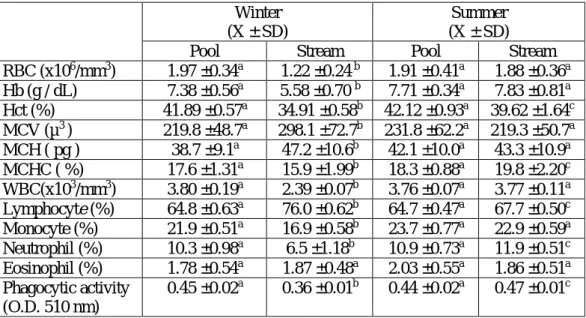
Total lenght, weight and age data of fishes col-lected from pools and the stream are presented in Table 1; oxygen amounts and temperature values are presented in Table 2; RBC, Hb, Hct, MCV, MCH, MCHC, WBC, lymphocytes, monocytes, neutrophils, eosinophils and phagocytic activity values of Garra rufa are given in Table 3 and other properties of thermal hot spring water are pre-sented in Table 4, respectively. In addition, pic-tures of erythrocyte, lymphocyte, monocyte and neutrophil obtained from this Cyprinidae species are shown in Figure 1, 2 and 3. No findings were found in the bacteriological and parasitological examinations of the examined fish.
Table 1. Total lenght, weight and age Garra rufa's in the stream and pools
Garra rufa
Winter (X ± SD)
Summer (X ± SD)
Pool Stream Pool Stream
Total lenght (cm) 11.82 ±0.49 12.19 ±0.72 11.55 ±0.76 11.78 ±1.15
Weight (g) 15.96 ±1.89 16.71 ±1.51 17.33 ±1.29 16.64 ±1.97
Age (year) 3 3 3 3
X ± SD: Mean value ± Standard deviation
Table 2. Oxygen and temperature levels in stream and pools
Winter (X ± SD)
Summer (X ± SD)
Pool Stream Pool Stream
Oxygen (mg/L) 5.1 ±0.15 11.6 ±0.35 4.9 ±0.16 5.8 ±0.40
Temperature (oC) 35.3 ±0.36 10.3 ±0.60 35.1 ±0.20 31.6 ±1.45
Table 3. RBC, Hb, Hct, MCV, MCH, MCHC, WBC, lymphocyte, monocyte, neutrophil, eosinophil,
and phagocytic activity values of Garra rufa Winter
(X ± SD)
Summer (X ± SD)
Pool Stream Pool Stream
RBC (x106/mm3) 1.97 ±0.34a 1.22 ±0.24 b 1.91 ±0.41a 1.88 ±0.36a Hb (g / dL) 7.38 ±0.56a 5.58 ±0.70 b 7.71 ±0.34a 7.83 ±0.81a Hct (%) 41.89 ±0.57a 34.91 ±0.58b 42.12 ±0.93a 39.62 ±1.64c MCV (µ3 ) 219.8 ±48.7a 298.1 ±72.7b 231.8 ±62.2a 219.3 ±50.7a MCH ( pg ) 38.7 ±9.1a 47.2 ±10.6b 42.1 ±10.0a 43.3 ±10.9a MCHC ( %) 17.6 ±1.31a 15.9 ±1.99b 18.3 ±0.88a 19.8 ±2.20c WBC(x103/mm3) 3.80 ±0.19a 2.39 ±0.07b 3.76 ±0.07a 3.77 ±0.11a Lymphocyte (%) 64.8 ±0.63a 76.0 ±0.62b 64.7 ±0.47a 67.7 ±0.50c Monocyte (%) 21.9 ±0.51a 16.9 ±0.58b 23.7 ±0.77a 22.9 ±0.59a Neutrophil (%) 10.3 ±0.98a 6.5 ±1.18b 10.9 ±0.73a 11.9 ±0.51c Eosinophil (%) 1.78 ±0.54a 1.87 ±0.48a 2.03 ±0.55a 1.86 ±0.51a Phagocytic activity (O.D. 510 nm) 0.45 ±0.02a 0.36 ±0.01b 0.44 ±0.02a 0.47 ±0.01c
X ± SD: Mean value± Standard deviation. Different letters in averages means statistical difference (p<0.05).
Table 4. Other properties of thermal hot spring
water (Timur et al., 1983)
Properties Values Appearance Limpid Smell None Taste None Color Typical Turbidity None Ph 7.8 Hardness (F.S.º) 26 Organic matter (p.p.m.) 0 Ca+Mg (mg/lt) 80+14 Cl2 0 NH3 None NO2 None NO3 None
Figure 1. Blood cells of Garra rufa (M:
mono-Figure 2. Blood cells of Garra rufa (E:
Erythro-cyte, N: Neutrophil), May-Grunwald Giemsa x100
Lympho-In summer, there was no statistically significant difference between RBC, Hb, MCV, MCH, WBC, monocyte, eosinophil levels of fishes collected from pools and the stream; while there was an in-crease in the MCHC, lymphocyte, neutrophil and phagocytic activity values and decrease in the Hct values of the fishes in the stream compared to those in the pools.
On the other hand, in winter, there was decrease in RBC, Hb, Hct, MCHC, WBC, monocyte, neutro-phil and phagocytic activity levels and an increase in MCV, MCH and lymphocyte values of the fishes in the stream compared to those in the pools. No differences were determined in terms of eosin-ophil.
In the comparison between the fish in the pool in summer and winter seasons; statistically no signif-icant differences were determined in RBC, Hb, Hct, MCV, MCH, MCHC, WBC, lymphocyte, monocyte, neutrophil, eosinophil and phagocytic activity levels.
As a result of the comparisons of fishes living in the stream in summer and winter seasons; RBC, Hb, Hct, MCHC, WBC, monocyte, neutrophil, phagocytic activity levels of Garra rufa fishes were found to be increased in summer and de-creased in winter; whereas MCV, MCH and lym-phocyte values were found to be decreased in sum-mer and increased in winter, respectively. There was no difference in the level of eosinophil. The presence of thermal water in the pools made the pool water unaffected from the seasonal changes, however the water in the stream being not thermal originated has caused differences on the hematological and immunological parameters of the fish. The difference between water temper-atures, the change in oxygen levels, increased met-abolic activities and increased energy demand caused an increase in the amount of RBC in the summer. According to the results of earlier stud-ies, these changes are caused by seasonal differ-ences between water parameters, oxygen-carrying capacity of blood depends on water temperature and therefore, changes in water temperature have effects on erythrocyte cells (Nanba et al., 1987; Örün et al., 2003; Aras et al., 2008). Living condi-tions of the fishes and oxygen levels in different environments as well as water temperature changes are observed to have effects on Hb, Hct, MCV, MCH and MCHC amounts. Similar studies shows a changing trend in MCH and MCHC val-ues with temperature. Researchers have identified
higher MCV values and winter and lower values in summer. These differences are considered to be caused by environmental changes such as changes in water temperature and oxygen levels (Siwicki et al., 1994; Yılayaz and Bitmiş, 2002; Ginneken et al., 2007; Dias et al., 2008; Arnaudova et al., 2008). There is a proportionally relationship be-tween RBC and these parameters. These changes are considered to be associated with increases and decreases in the amount of RBC. Hct, Hb, RBC and WBC values were determined to be decreased due to the decline of water temperature and this finding is supported by other researchers (Grigg, 1969; Leard et al., 1998; Rambhaskar and Rao, 2006). In the related studies, it has been reported that seasonal changes in water temperature cause differences in the non-specific immune response parameters of fishes (Yılayaz and Bitmiş, 2002; Örün et al., 2003). These studies suggest that there are different values in different seasons. In our study, the increase in lymphocyte percentages starting in the winter months were followed by the decrease during summer months, it was found that there were differences in monocyte and neutrophil percentages based on the cold and warm seasons and they reached the maximum in the summer. The percentage of eosinophil was found to be al-most zero and no seasonal or environmental changes were seen in the percentage of eosinophil for the species included in the study. Although the number of studies related to this field is very lim-ited, researchers reported similar results (Morvan et al., 1998; Swain et al., 2007; Kortet and Vain-ikka, 2008). In our study, phagocytic cells were found to be increased in spring and summer sea-sons when the water temperature also increased, and we have found that there was a decline in the phagocytic activities due to the immune suppres-sion of the fishes at lower temperatures. This find-ing is in line with similar studies and phagocytic activity is found to be at highest in summer and at lowest in winter, respectively. They have deter-mined that this is associated with the response cre-ated by immune system of the fish with increased microbial capacity in the water due to the higher water temperature in summer (Collazos et al., 1995; Korter and Vainikka, 2008). In the present research, it was observed that the water tempera-ture has effects on the leukocytes and seasonal changes in the water temperature positively affect WBC. In the earlier studies, increased metabolic activity, reduced oxygen level and increased en-ergy demand caused by increased water tempera-ture are reported to be main reasons of these
changes (Yılayaz and Bitmiş, 2002; Akmirza and Tepecik, 2007).
Conclusion
It was thought that, with the increase in the micro-biological activity in the warming waters in the summer and the increase in the microorganism density in the water, the immunological responses by the fish had an effect on these changes. The pre-vious study results on this subject were found to be in line with the results obtained in our study.
Acknowledgements
This article produced from some part of PhD sci-ence thesis and supported by Cukurova University Scientific Research Projects Unit. (Project No: FBE2006D7)
References
Adeyemo, O.K., Okwilagwe, O.O. & Ajani, F. (2009). Comparative assessment of sodium edta and heparin as anticoagulants for the evaluation of haematological parameters in cultured and feral African cathfish (Clarias gariepinus). Brazilian Journal of Aquatic Science and Technology, 13(1), 19-24. Akbulut, K., Zengin, U., Gönek, Ü. & Bakır, M.
(2008). Balıklarda yaş tayini yöntemleri veönemi. Erzincan Üniversitesi Aquaclub Su Ürünleri Araştırma ve Geliştirme Bilim Kulübü Kemaliye 5. Geleneksel Su Ürünleri Bilimsel ve Kültürel Platformu, Kemaliye, Erzincan.
Akmirza, A. & Tepecik, R.E. (2007). Seasonal variation in some haematological parame-ters in naturally infected and uninfected roach (Rutilus rutilus) with Cryptobia tin-cae. Journal of Applied Biological Sci-ences, 1(3), 61-65.
Aras, M., Bayır, A., Sirkecioğlu, A.N., Polat, H. & Bayır, M. (2008). Seasonal variations in se-rum lipids, lipoproteins and some haemato-logical parameters of chub (Leuciscus ceph-alus). Italian Journal of Animal Science, 7, 439-448.
Arnaudova, D., Arnaudova, A. & Tomova, E. (2008). Selected hematological indices of freshwater fish from studen kladenetsh res-ervoir. Bulgarian Journal of Agricultural Science, 14(2), 244-250.
Arnold, J.E. (2005). Hematology of the sandbar shark, Carcharhinus plumbeus standardiza-tion of complete blood count techniques for elasmobranchs. Veterinary Clinical Pathol-ogy, 34, 115-123.
Atamanalp, M. & Yanık, T. (2003). Alterations in hematological parameters of rainbow trout (Oncorhynchus mykiss) exposed to man-cozeb. Turkish Journal of Veterinary and Animal Sciences, 27, 1213-1217.
Blaxhall, P.C. & Daisley, K.W. (1973). Routine haematological methods for use with fish blood. Journal of Fish Biology, 5(6), 771-781.
Cengizler, İ. & Şahan, A. (2000). Seyhan Baraj Gölü ve Seyhan Nehrin de yaşayan ayna-lısazan (Cyprinus carpio, Linnaeus, 1758)’ larda bazı kan parametrelerinin belirlen-mesi. Turkish Journal of Veterinary and Animal Sciences, 24, 205-214.
Clauss, T.M., Alistair, D.M. & Arnold, J.E. (2008). Hematologic disorders of fish. Vet-erinary Clinics of North America: Exotic Animal Practice, 11(3), 445-462.
Clarence, R. & Hickey, J.R. (1982). Comparative hematology of wild and captive cunners. Transactions of the American Fisheries So-ciety, 111, 242-249.
Collazos, M.E., Barriga, C. & Ortega, E. (1995). Seasonal variations in the immune system of the cyprinid Tinca tinca phagocytic func-tion. Comparative Immunology, Microbiol-ogy and Infectious Diseases, 18(2), 105-113.
Demirsoy, A. (1993). Yaşamın Temel Kuralları (Omurgalılar/Anamniyota). Cilt-III/Kısım-I, 38, 387, Hacettepe Üniversitesi Yayınları, Ankara.
Dias, M.T., Affonso, E.G., Oliveria, S.R., Marcon, J.L. & Egami, M.I. (2008). Comparative study on hematological parameters of farmed matrinxa, Brycon amazonicus spix and agassiz, 1829 (Characidae: Bryconinae) with others bryconinae species. Acta-Amo-zanica, 38(4), 799-806.
Duman, S. & Şahan, A. (2014). Kangal (Sivas) Balıklı Çermik Termal Kaplıcası İle Top-ardıç Deresi'nde (Sivas) Yaşayan Benekli Sazan Cyprinion macrostomus (Heckel,
Non-Spesifik İmmün Yanıtın Belirlenmesi. Yunus Araştırma Bülteni, 4, 21-28.
Dorafshan, S., Kalbassi, M.R., Pourkazemi, M., Amiri, B.M. & Karimi, S.S. (2008). Effects of triploidy on the caspian salmon Salmo trutta caspius haematology. Fish Physiol-ogy and Biochemistry, 34(3), 195-200. Ginneken, V.V., Durif, C., Balm, S.P., Boot, R.,
Verstegen, M.W.A., Antonissen, E. & Thil-lart, G.V.D. (2007). Silvering of european ell (Anguilla anguilla L.) seasonal changes of morphological and metabolic parame-ters. Animal Biology, 57(1), 63-77.
Gözükara, S.A. & Çavaş, T. (2004). A karyologi-cal analysis of Garra rufa (Heckel, 1843) (Pisces, Cyprinidae) from the eastern Med-iterranean River Basin in Turkey. Turkish Journal of Veterinary and Animal Sciences, 28, 497-500.
Grigg, G.C. (1969). Temperature induced changes in the oxygen equilibrium curve of the blood of the brown bullhead, Ictalurus neb-ulosus. Comparative Biochemistry and Physiology, 28(3), 1203-1223.
Hayran, M. & Özdemir, O. (1995). Bilgisayar İstatistik ve Tıp. Hekimler Yayın Birliği, Ankara.
Imanpoor, M.R., Bagheri, T. & Hedayati, S.A.A. (2010). The anesthetic effects of clove es-sence in persian sturgeon, Acipenser persi-cus. World Journal of Fish and Marine Sci-ences, 2(1) 29-36.
Jeney, G., Galeotti, M., Volpatti, D., Jeney, Z. & Anderson, D.P. (1997). Prevention of stress in rainbow trout (Oncorhynchus mykiss) fed diets containing different doses of glucan. Aquaculture, 154, 1-15.
Kocabatmaz, M. & Ekingen, G. (1984). Değişik Tür Balıklarda Kan Örneği Alınması ve He-matolojik Metotların Standardizasyonu. Doğa Bilim Dergisi, 8, 149-159.
Konuk, T. (1981). Pratik Fizyoloji Ders Kitabı, Ankara Üniversitesi Veteriner Fakültesi Yayınları. Ankara Üniversitesi Basımevi. Ankara.
Kortet, R. & Vainikka, A. (2008). Seasonality of innate immunity; evolutionary aspects and latest updates. In M. Durand & C.V. Morel (Eds), In New Research on Innate Immunity
(pp. 13-45). NY: Nova Science Publishers. ISBN 978-1-60456-549-2.
Leard, A.T., Wanger, B.A., Camp, K.L., Wise, D.J. & Gao, X.D. (1998). Seasonal values of selected blood parameters of farm-raised channel catfish (Ictalurus punctatus) in the Mississippi Delta. Journal of Veterinary Diagnostic Investigation, 10, 344-349. Morvan, C.L., Troutaud, D. & Deschaux, P.
(1998). Differential effects of temperature on specific and nonspecific immune de-fences in fish. The Journal Experimental Biology, 201, 165-168.
Nanba, K., Kakuta, I., Uematsu, K. & Murachi, S. (1987). Annual changes in the osmolarity and inorganic ion level ratios between urine and plasma in carp Cyprinus carpio. Nippon Suisan Gakkaishi: Bulletin of the Japanese Society of Scientific Fisheries, 53 (6), 913-918.
Örün, İ., Dörücü, M. & Yazlak, H. (2003). Hema-tological parameters of three cyprinid fish species from Karakaya Dam Lake, Turkey. Online Journal of Biological Sciences, 3(3), 320-328.
Özer, Z., Akpınar, M.A., Akçay, M., Erdem, Ü., Güler, R., Yanıkoğlu, A., Ergenoğlu, B., Dere, Ş. & Savaşçı, Ş. (1987). Kangal Balıklı Kaplıcanın (Sivas) bazı kimyasal ve biyolojik özelliklerinin araştırılması. Cum-huriyet Üniversitesi Fen Edebiyat Fakültesi Fen Bilimleri Dergisi, 5, 1-34.
Rambhaskar, B. & Rao, S.K. (2006). Comparative haematology of ten species of marine fish from Visakhapatnam Coast. Journal of Fish Biology, 30(1), 59-66.
Siwicki, A.K., Anderson, D.P. & Rumsey, G.L. (1994). Dietary intake of immunostimulants by rainbow trout affects non-specific im-munity and protection against furunculosis. Veterinary Immunology and Immunopath-alogy, 41, 125-139.
Swain, P., Dash, S., Sahoo, P.K., Gupta, S.D., Me-her, P.K. & Sarangi, N. (2007). Nonspecific immune parameters of brood indian major carp Labeo rohita and their seasonal varia-tions. Fish & Shellfish Immunology, 22(1)2, 38-43.
Şahan, A. (2000). Seyhan Nehri (Adana kent içi bölgesi)’nde yaşayan bazı Cyprinid’lerde
hematolojik araştırmalar. PhD Thesis Çukurova University. Adana.
Şahan, A. & Cengizler, İ. (2002). Seyhan Nehri (Adana kent içi bölgesi)’ nde yaşayan benekli siraz (Capoeta barroisi Lorted, 1894) ve kızılgöz (Rutilus rutilus, Linnaeus, 1758)’ de bazı hematolojik parametrelerin belirlenmesi. Turkish Journal of Veterinary and Animal Sciences, 26, 849-858.
Şahan, A. & Duman, S. (2010). Influence of β-1,3/1,6 glucan applications on some non-specific cellular immune response and he-matologic parameters of healthy nile tilapia (Oreochromis niloticus L., 1758). Turkish Journal of Veterinary and Animal Sciences, 34(1), 75-81.
Tanyer, G. (1985). Hematoloji ve Lobaratuvar Ders Kitabı, Ayyıldız A.Ş., Ankara.
Timur, M., Çolak, A. & Marufi, M. (1983). Balıklı Kaplıcadaki (Sivas) balık türlerinin tanımı ve deri hastalıkları tedavisindeki etkisinin araştırılması. Ankara Üniversitesi Veter-inerlik Fakültesi Dergisi, 30(2), 276-282. Yılayaz, Ö. & Bitmiş, K. (2002). Keban Baraj
Gölü’nde yaşayan Barbus rajanorum mys-taceus (Heckel, 1843)’ da kan para-metrelerinin incelenmesi. Gazi Üniversitesi Gazi Eğitim Fakültesi Dergisi, 22(2), 11-21.