İPOTEĞE DAYALI MENKUL KIYMETLERİN SERMAYE
PİYASASINDAKİ ROLÜ
GÖNÜL YILMAZ
108673004
İSTANBUL BİLGİ ÜNİVERSİTESİ
SOSYAL BİLİMLER ENSTİTÜSÜ
BANKACILIK VE FİNANS YÜKSEK LİSANS PROGRAMI
Tez Danışmanı: PROF. DR. NURGÜL CHAMBERS
2012
ii
The Role of Mortgage Backed Securities in Capital Markets
İpoteğe Dayalı Menkul Kıymetlerin Sermaye Piyasasındaki
Rolü
Gönül Yılmaz
108673004
Prof.Dr. Nurgül Chambers : ...
Yrd.Doç.Dr. Cenktan Özyıldırım : ...
Kenan Tata
: ...
Tezin Onaylandığı Tarih
: ...
Toplam Sayfa Sayısı: 127
Anahtar Kelimeler (Türkçe) Anahtar Kelimeler (İngilizce)
1) Mortgage 1) Mortgage
2) İpoteğe Dayalı Menkul Kıymetler 2) Mortgage Backed Securities 3) 2007 Mortgage Krizi 3) 2007 Mortgage Crisis
iii
Abstract
The aim of this paper is to analyze the effects of mortgage backed securities in capital markets. It consists of primary and secondary markets with subprime mortgage crisis. The analysis is carried out against the role of mortgage backed securities in the US subprime mortgage crisis as a structure product.
iv
Özet
Bu çalışmanın amacı ipoteğe dayalı mankul kıymetlerin sermaye piyasalarındaki etkisini incelemektir. Birincil ve ikincil mortgage piyasaları ile mortgage krizi üzerine yoğunlaşılmıştır. Çalışma yapılandırılmış ürün olarak ipoteğe dayalı menkul kıymetlerin Amerika’daki mortgage krizindeki rolü ile tamamlanmıştır.
v
TABLE OF CONTENT
ABSTRACT ... III ÖZET ... IV LIST OF TABLE ... VIII LIST OF FIGURE ... IX
1. INTRODUCTION ... 1
2. LITERATURE REVIEW ... 3
3. THE PRIMARY MORTGAGE MARKET ... 8
3.1. Definition ... 8
3.2. Participants in the Primary Mortgage Market ... 9
3.2.1. Mortgagers in the Mortgage Market ... 9
3.2.2. Originators in the Mortgage Market ... 10
3.2.3. Insurance Companies in the Mortgage Market ... 12
3.2.4. Investors in the Mortgage Market... 13
3.2.5. Other Actors in the Mortgage Market ... 13
3.3. Types of Mortgage ... 15
3.3.1. Fixed Rate Mortgage ... 15
3.3.2. Adjustable Rate Mortgage ... 15
3.4. Effects of Mortgage System on Economy ... 17
4. THE SECONDARY MORTGAGE MARKET ... 19
4.1. Scope of Mortgage Backed Securities ... 19
4.2. Parties in a Securitization Transaction... 25
4.2.1. The Obligor ... 27
4.2.2. The Originator ... 28
4.2.3. The Underwriter... 29
4.2.4. The Trustee / Investor Representatives... 29
4.2.5. Credit Enhancement... 30
vi
4.3. Risks of Mortgage Backed Securities ... 33
4.3.1. Credit Risk ... 33
4.3.2. Liquidity Risk ... 34
4.3.3. Market Risk ... 36
4.3.4. Prepayment Risk ... 37
4.3.5. Performance Risk... 38
4.4. Pricing of Mortgage Backed Securities ... 39
4.4.1. Interest Rate Model and Future Interest Rate Scenarios ... 42
4.4.2. Calculation of Prepayments ... 43
4.4.3. Calculating Cash Flows and Average Present Value ... 44
4.5. Evaluation of Mortgage Backed Securities ... 48
4.6. The Types of Mortgage Backed Securities ... 52
4.6.1. Pass Through Securities ... 52
4.6.2. Collateralized Mortgage Obligations (CMOs) ... 53
4.6.3. Stripped Mortgage Backed Securities ... 56
4.7. Mortgage Systems in the World ... 56
4.7.1. Mortgage Backed Securities in USA ... 57
4.7.2. Mortgage Backed Securities in Germany ... 60
4.7.3. Mortgage Backed Securities in Europe ... 63
4.7.4. Mortgage Backed Securities in Turkey ... 64
5. SUBPRIME MORTGAGE CRISIS ... 66
5.1. The Reasons of Subprime Mortgage Crisis ... 66
5.1.1. Liberalization ... 66
5.1.2. Deterioration in Mortgage Credit Structure ... 67
5.1.3. Maturity Mismatching in Interest Rates ... 71
5.1.4. Balloon Increases in House Prices ... 72
5.1.5. Over-Securitization ... 74
5.1.6. Problems in Securitization Process ... 78
5.1.6.1 Deterioration in Mortgage Quality .………78
5.1.6.2 Premature Innovations in Mortgage Market ……….79
5.1.6.3 Non-Agency Securitization………. 80
5.1.6.4 Collateralized Debt Obligations ………...82
vii
5.1.6.6 Incentive Problems in Securitization Process …………. 86
5.1.7. Problems in the Rating Process ... 87
5.2. Effects of the Subprime Mortgage Crisis ... 88
5.2.1.Effects on Financial Markets ... 88
5.2.2.Measurements against Subprime Crisis ... 99
6. CONCLUSION ... 102
viii
LIST OF TABLE
Table 1: Function and Institutions in U.S. Mortgage System ... 8
Table 2: Comparison of Fixed and Adjustable Rate Mortgages... 16
Table 3: Distribution of Mortgage Loans in Percentage ... 23
Table 4: Parties in Securitization Transaction ... 26
Table 5: Borrower Credit Quality Categories ... 27
Table 6: Credit Risk Diversification ... 30
Table 7: Investment Grade Ratings ... 33
Table 8: Simulation Analysis: OAS Model Functions ... 41
Table 9: Benefits of MBS ... 50
Table 10: Sequential CMO ... 54
Table 11: Function and Institutions in U.S. Mortgage System... 60
Table 12: The Pfhandbrief Bank’s Financial Techniques ... 61
Table 13: Subprime Securitization of Home Mortgage Originations ... 77
Table 14: US Mortgage Related Security Issuance (USD Billions) ... 81
Table 15 : US Mortgage-Related Security Issuance ( billions) ... 89
Table 16: Fannie Mae MBS Issuance and Total Unpaid Balance ... 90
Table 17 : Write-downs of Investment Banks ... 95
ix
LIST OF FIGURE
Figure 1: Mortgage Brokers Accounts in Recent Mortgage Originations ... 14
Figure 2: Distribution of MBS Issuance, by Issuer ... 22
Figure 3: Simulation of Interest Rate Path ... 42
Figure 4: Subprime Mortgage Originations ... 69
Figure 5: House Price Appreciation over Previous Four Quarters ... 73
Figure 6: RMBS versus Other Securitized Assets as a per cent of GDP ... 75
Figure 7: US Agency Mortgage Securities Issuance (USD Billions) ... 89
Figure 8: ABX Index Changes ... 91
Figure 9: Investment Banking Performance Index ... 92
Figure 10: Fannie Mae and Freddie Mac’s Net Income ... 96
x
LIST OF ABBREVIATIONS
ARM: Adjustable Rate Mortgage
CDO: Collateralized Debt Obligations
CDS: Credit Default Swap
CMO: Collateralized Mortgage Obligations
FCC: Collective Investment Vehicles
FHA: Federal Housing Administration
FHLB: Federal Home Loan Bank System
FRM: Fixed Rate Mortgage
GSE: Government Sponsored Enterprises
HOLC: Home Owners Loan Corporation
HUD: Housing and Urban Development
MBS: Mortgage Backed Securities
NYSE: New York Stock Exchange
OAS: Option Adjusted Spread
PAC: Planned Amortization Class
RBC: Risk-Based Capital
REMIC: Real Estate Mortgage Investment Conduit
ROA: Return on Asset
SML: Specialized Mortgage Lenders
SPE: Special Purpose Entities
SPV: Special Purpose Vehicles
TAC: Targeted Amortization Class
1
1. INTRODUCTION
Mortgage system refers to a mechanism including self-financing, in other words, with its primary and secondary market processes provides house ownership to low and middle income individuals as well as ensuring long term financing for new mortgage loans through its derivative products.
Although mortgage system has different structures and institutions in the world due to differentiation in economic, social and demographic structures the basic purpose is to bring a solution to housing problems and housing deficit. The way of resources and solutions mainly depend on financing of housing sector. Secondary market functions gain importance regarding to financing of existing loans and meeting demand in new loans.
The way of creating liquidity in the secondary market is securitization of mortgage loans which is called “Mortgage Back Securities”. As a derivative product of mortgage loans MBS represents a new investment tool for the investors in the capital markets as well as it represents the way of financing of mortgage market.
On the other hand, securitization gains prevalence in countries having developed and deep financial markets because an investors intend to buy derivative products only if they can sell it to other investors with any price. In other words deep financial markets include many buyers and sellers for any product which can be traded in the capital markets.
This study aims to explain the role of mortgage backed securities as a structure product in capital markets and US subprime mortgage crisis. It focuses on the mortgage back securities as a liquidation tool and being obtained by securitization of mortgage loans and the effects of these securities on the capital markets.
In the first part of study, definition and scope of mortgage system are placed with functions of and actors in primary and secondary markets are
2
emphasized. In addition, fixed rate and adjustable rate mortgages have been mentioned as types of mortgages. Mortgage system is encountered as a whole in terms of economic benefits and risks of the counterparties in the process.
The second section includes information about scope of mortgage back securities, functions, pricing of MBS and advantages and disadvantages of this derivative product. Also, mortgage systems in the world especially focusing on ABD and Europe tried to be summarized.
The final section focuses on 2007 subprime mortgage crisis experienced in recent history and influence the whole world in order to show the reasons and effects of mortgage back securities on the capital markets with the measurements to mitigate subprime mortgage crisis effects.
In conclusion, general assessment and comments are placed related with the crisis and its consequences.
3
2. LITERATURE REVIEW
Mortgage backed securities were almost seen as the reason due to backed by subprime mortgages and deterioration in their issuance process.
Weaver (2008) stated that depending on lower interest rates mortgage lending became profitable, market participants did not expected fall in house prices. On the other hand, Weaver concluded subprime crisis to unregulated originators which aimed to sell subprime mortgages and lack of involvement of the Federal National Mortgage Origination (FNMA) and Federal Home Loan Mortgage Corporation (FHLMC).
According to Hampel, Schenk & Rick (2008), subprime crisis depended on usage of new credit scoring techniques which included creditworthiness degrees and interest rates with risk premium. Many of these loans were bought by Wall Street Investment Banks.
The subprime loans sold to Wall Street investment banks were converted into mortgage backed securities in secondary markets to fund the market transactions.
Guseva (2011) specialized securitization as a profitable financing, its consequences on related parties and effects on other countries. The article states that mortgage backed securitization were the basic of US mortgage market in terms of financing from 1960-70s to present.
McDonald (2008) focused on securitization process and government sponsored enterprises following up regulatory changes after subprime crisis and highlighted the subprime mortgage secondary markets as the cause of subprime crisis. McDonald (2008) argued that defaults in primary subprime market deteriorated secondary market for subprime MBS which led to huge losses for Wall Street Banks. Due to tend to conforming loan market, subprime mortgage market faced with illiquidity problems.
4
Contact with the role of MBS in subprime crisis, Bianco (2008) states that subprime MBS share was 54 percent in 2001 which ramp up 75 percent in 2006. Also, the article took place Alan Greenspan speech in London in October 2007. In the speech Alan Greenspan defending the U.S. subprime mortgage market and showed the securitization as the main reason for mortgage meltdown rather than mortgage loans.
In order to show MBS effect in crisis, Weaver (2008) expressed the subprime MBS. In other words, the subprime MBSs as wrong products were marketed to wrong borrowers at wrong time.
MBS process criticized in different dimensions such as lack of performance data, off-balance sheet activities, credit rating process, asymmetric information between insiders (namely originators) and outsiders (investors) and the valuation model of MBS.
Although Guseva (2011) highlighted benefit of MBS and defended that MBS provides easier access to secondary mortgage and capital markets in exchange for creating more effective mortgages, MBS was criticized due to a new product, MBS has no long term performance records in the article.
In line with Guseva (2011), Garfinkel (2009) observed that new innovations in the mortgage markets such as securitization and originate-to-distribute model resulted as decline in underwriting standards, greater underpricing of credit risk, a huge infusion of easy credit and serious adverse selection concerns as well as their benefits. Therefore, mortgage defaults were seen as the Achilles heel of MBSs, leading to deterioration of this asset class.
As well as lack of long term track records in subprime MBS, Guseva (2011) pointed out reliance on rating process tied to complex instruments and ineligible of analytical data which led to overinvestments in subprime MBS.
5
Weaver (2008) emphasized wrong ratings due to lack of effective evaluation of mortgages to evaluate risk factors. The rating agencies expected soft landing in home prices, therefore made optimistic assumptions for ratings.
Kroon (2008) aimed to test stock returns for financial and non-financial firms during crisis period by using a regression analysis which depended on different variables. According to Kroon (2008) these defaults led to downgrade in MBS and CDO relied on subprime and Alt-A mortgages. The downgrade created uncertainty in the market. Together with increasing uncertainty and losses investors tend to invest safer products such as government securities.
Bianco (2008) stated that rating agencies were criticized as a result of their investment grade ratings in mortgage backed securities because of conflicts of interest. The critics directly related with payments to rating agencies by investment banks selling MBS to investors.
As another factor MBS provides transfer of risk to counterparties. This creates conflicts of interests such as adverse selection and moral hazard in the securitization process. According to Guseva (2011) low quality mortgage loans and underwriting standards originated from information asymmetries among originators and investors which affected pricing of assets.
Weaver (2008) defended that securitization played a role in the subprime mortgage crisis in terms of conflicts of interest and development of synthetic market in the subprime MBS included default effect.
In terms of problems in valuation, Kroon (2008) stated that the increasing uncertainty in the financial markets led to wrong valuation of securitized products and increased the need for re-evaluation of price assumptions. Investors and lenders became reluctant for investments due to uncertainty, therefore funding and liquidity problems occurred. Besides, the
6
actual default rate exceeded the forecasted rate in the valuation models and rating process. Investors exposed to price volatility depending on liquidity and valuation problems.
Moreover, Kroon (2008) supported the idea about uncertainty and lack of transparency with Crouhy and Turnbull (2008), the IIF (2008) and the Financial Stability Forum. Increased uncertainty resulted as damaged confidence in the market. Unexpected level of write-downs and commitments of financial institutions shook the confidence of investors.
Rankov emphasized the effect of US mortgage crisis on Europe by summarizing the reasons and giving examples on British and German economies and the bailout programs. Regarding to highlight risk reducing, securitization is an off balance sheet activity which allows to risk transfer. Rankov expressed that By MBS process originators remove substantial assets and associated liabilities from their balance sheets which resulted as distribution of risk among larger list of investors.
Also, Rankov stated that risk transfer became a tool for reducing risk for banks which tend to transfer their junk assets. This action formed a base for MBS backed by subprime mortgage loans.
Garfinkel and Sa-Aadu compared the subprime mortgage crisis with the previous U.S. housing crisis of the early 1990s in terms of default effect and lending attitudes with focus on housing sector, banking sector and stock market. Garfinkel and Sa-Aadu (2009) emphasized prime loan default sensitivities which were changed in the recent period. In the article subprime mortgages were seen as candidates for loss. Due to defaults in both prime and subprime loans, negative wealth effect expanded even among traditional banks.
Garfinkel and Sa-Aadu (2009) worked on a study to associate the hypothesis with the mortgage market. The study focus on banks that have publicly traded equity and bank holding company data available via the
7
Federal Reserve’s Y-9 forms. It included the changes in the third quarter of 2007 when the AAA tranche of the ABX index (which measures the performance of MBS) dropped by at least 1%. As a result, the study showed the truth of hypothesis and the banks which were active lenders in the mortgage market exposes to larger than expected losses due to surprising declines in the AAA tranche of the ABX index.
Shortly; Hampel, Schenk & Rick (2008) attracted attention to primary mortgage market while Guseva (2011), McDonald (2008), Weaver (2008) and Bianco (2008) pointed out securitization as blame of subprime crisis.
8
3. THE PRIMARY MORTGAGE MARKET
3.1. Definition
Fabozzi (2001) illustrates mortgage as following:
“A mortgage is a loan secured by the collateral of some specified real estate property and is a contractual agreement between the lender and borrower that pledges the property to a lender as a security for the repayment of the loan through a series of payments.”
In other words, Berberoğlu (2009) defines a mortgage as a debt which provides purchase a home, land or other real property.
Oksay (2006) states that in this type of loan, while financing institutions give mortgage loans, they place a mortgage on the property subject to guarantee their selves. With this feature, the concerned loans give collection right to credit vendor through converting of hypothec into cash as limp of promised payments by borrower.
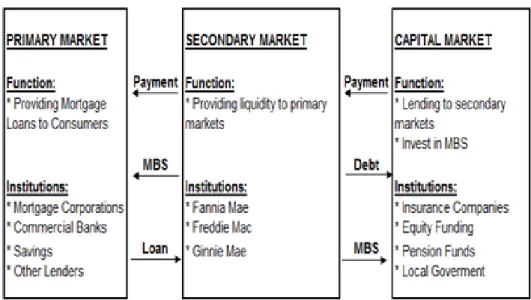
Table 1: Function and Institutions in U.S. Mortgage System
Source: Kömürlü, R., & Önel H. 2007, ‘Türkiye’de Konut Üretimine Yönelik Kaynak Oluşturma Model Yaklaşımlar’, YTÜ Mimarlık Fakültesi E-Dergisi, vol:2, p: 95.
9
As shown in Table 1, Aydoğdu (2007) shows that mortgage is processed in two markets: primary and secondary markets. Primary markets mainly depends on mortgage of real estate property in favor of lender or in the future residential estate rental by consumers through financial leasing in order to obtain property in return the loans consumers obtain for residential purpose; secondary markets also relies on the claims or the value of real estate that is an asset in financial leasing by funds (housing finance or asset finance fund) via securitization (mortgage back or asset back securitization) and usage of gains from these securitized mortgage or assets in terms of refinancing of primary markets.
Mortgage is a kind of consumer loan but the most important features distinguish from other consumer loans are; having long term, being a system based on the mortgage and usage of derivatives in order to refinance of portfolios and liquidity for the system.
3.2. Participants in the Primary Mortgage Market
The actors in the primary markets, which include the relationship between the borrowers who intend to buy a real estate and lenders who are credit provider, are as following:
1. Mortgagors
2. Mortgage Originators 3. Insurance companies 4. Investors
5. Other actors in the market.
3.2.1. Mortgagers in the Mortgage Market
The origin of the mortgage system is application to creditor aiming to obtain credit for home ownership. The individuals who want to buy a real state but do not have enough money can apply for mortgage loans if they
10
meet the requirements which are put by financial institutions. Following application process, creditor focus on lenders’ ability to pay and the value of appraisal value of real estates which are mortgaged in return mortgage loans. The evaluations in this step become important for the purposes of healthy system.
The clarifications of income properties assist to determine customers’ profiles and payment system with optimum principle amounts and monthly payments. On the other hand these evaluations are not only belonging to creditors, customers should make objective assessments about their possible loans. Consumers should gather detailed information related with payment procedure in terms of advantages and disadvantages or future value and risks of their real estate because creditors utilize in all chooses to be preferred by the customers.
Time value is another factor that should be evaluated by the customers. The important thing is the aim of real estate according to customers. Long term mortgage loans are logical if customers plan a long home stay in the real estate but it should be opposite in loans for investment purposes or resources and income owned by customers are determinant for long or short term mortgage loans. For instance, a customer who has enough saving to pay higher principle amount can shorten instilment period. Higher principle amounts help to eliminate risk therefore he pays lower interest rates and lowers monthly payments.
3.2.2. Originators in the Mortgage Market
The creditor institutions are commercial banks, constructions institutions, pension funds, insurance companies, leasing companies...etc.
Oksay (2006) highlights the basic functions of credit institutions in primary mortgage market as following:
11 ‘Give credit,
Issue mortgage back securities based on these loans,
Manage repayment process and translate these payments to MBS investors.’
These companies generate income through application and origination fees, selling them in secondary markets or hold them in their portfolio.
Oksay (2006) denotes that origination fee is expressed in terms of points, where each point represents 1% of the borrowed funds. For example, an origination fee of 2 points on a $100.000 mortgage is equal to $2.000.
These institutions rate borrowers on qualitative assessments such as consumer characteristics, guarantee, life standards and quantitative assessments such as income level and continuity of this. This is called as “Scoring Method”. The real value of this method reflects quality of mortgage loans. The financial institutions can organize scoring method or apply for consultancy to another firm.
In the scoring method, a limit is established to determine the level of clients’ qualifies for acceptance. If results exceed the fixed upper limit, this indicates that the risk is too high and the applicant will be rejected or if score is lower than the fixed lower limit, applicant will be accepted. The real value of this method reflects quality of mortgage loans. The financial institutions can organize scoring method or apply for consultancy to another firm. Besides, credit scoring facilitates risk-based pricing. In other words, financial institutions charge higher interest rates for borrower with low scores and charge lower interest rates for borrower with high scores. Therefore, depending on customers’ score level cost of funding varies.
During evaluations by financial institutions, consumers’ ability to pay of monthly payments and other significant features of collaterals are pointed out. The standards for determination of “Payment to Income” and “Loan to Value” ratios have significant role in measuring capacities of
12
collaterals and consumers which are the basic of mortgage loan. The acceptable levels for these ratios differentiated from country to country due to economic and financial structures in these places. For example in U.S. “payment to income” ratio should be 35% maximum while in Turkey this ratio is acceptable up to 60%. In other words, if consumers realize their loan payments with at most 35% of income in United States and 60% of income in Turkey, this kind of loan can find acceptance. If these ratios come closer to optimum level, the value and quality of loans will increase.
3.2.3. Insurance Companies in the Mortgage Market
According to Oksay (2006), insurance companies locate as a an important actor in the mortgage system due to contribute to sustainability by securing risks by mortgage, in interest paid loans guarantee principle amounts with saving products and undertake investor role in secondary markets to buy and sell funds.
The saving products offered by insurance companies are endowment policies and private pension plans. By this way, they ensure repayments of mortgage loans by tending consumers to save.
In addition, insurance companies undertake a guarantor role against defaults in repayment process in terms of consumers and lenders.
Güzey (2009) states that long term mortgage loans depend on the availability of long term investors in the capital markets. These long term investors are predominantly corporate investors such as private pension funds, insurance companies, etc. In short, these companies are effective for the purposes of primary market’s funding.
13
3.2.4. Investors in the Mortgage Market
Investors are the key factors that provide translation of funds to primary markets. Actually, they have important role in mortgage system through source of fund via buying securitized mortgage loans.
The mortgage backed securities are marketed to investors to raise funds in the market. The originators deduct servicing or guarantee fees form mortgage loans. By investors’ activities in the mortgage market, products become more liquid.
Investing in mortgage market includes risks such as prepayment risk. When the interest rates fall, borrowers tend to make prepayments to benefit from lower rates which force investors to reinvest with lower returns.
3.2.5. Other Actors in the Mortgage Market
The other actors in the mortgage system are real estate valuation experts, brokers and capital markets institutions.
Demir (2005) explains that in the long term mortgage system, valuation is analysis of real estate sale and all conditions related with these process for financial decisions. As a result of valuation process financial institutions can make right decisions about amount of credit, interest rate, time interval for repayment and guarantee conditions.
In addition, financial institutions work with brokers that undertake intermediary role behalf of them in mortgage system to assist in customer assessment. Brokers are responsible for credit consultant rather than creditor. Banks offer only existing credit packages they own to customers but brokers take offers from various local banks or banks around the country in order to create more attractive alternatives. In the face of limited financial strength of local banks, national banks’ in the brokers’ national networks present advantages.
14
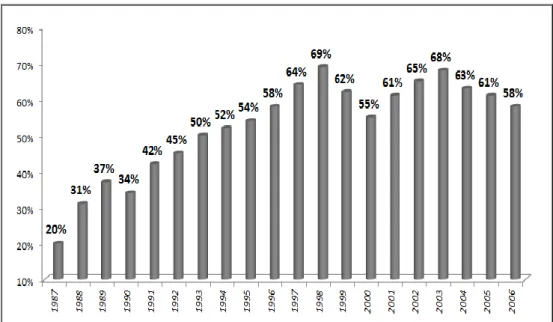
In Figure 1 the share of mortgages that originated by brokers is showed year by year. In 2003 the share of brokers among real state credits climbed to 68% because individuals that are eligible to receive credits in case of apply directly to a bank, can obtain credits through brokers easily.
As shown in Figure 1 above, the share of mortgage origination ramped up as of 1991 with increase demand in mortgage loans especially through loosing standards in mortgage originations. The pick point in originations by brokers was experienced in 1998 as 69% of total originations and this share decreased beginning from 2004.
Figure 1: Mortgage Brokers Accounts in Recent Mortgage Originations
Source: Barth J. R. & Triphon, T.L.& Phumiwasana, G. Y., 2008, ‘A Short History of the Subprime Mortgage Market Meltdown, Milken Institute, p::6.
On the other hand, capital market institutions ensure selling of securities gathering in the pool.
15
3.3. Types of Mortgage
Mortgages can mainly be classified into two groups according to repayment amounts (Fix Rate Mortgage vs. Adjustable Rate Mortgage) and quality (Prime vs. Subprime Mortgages).
3.3.1. Fixed Rate Mortgage
Fixed rate mortgage is a mortgage loan in which preconcert interest rates are performed throughout the life of the loan.
McDonald states that the most common mortgage type is fixed rate mortgage, which is about 70 percent of the total mortgage market.
In FRM interest rates are relatively higher than market interest rate but homeowners make constant payment regardless the market conditions. On the other hand, interest rates produce a dominant conundrum for most homeowners have to procure their home with FRM in volatile markets. For example, as interest rates increase in the country, people tend to lend cheaply from a financial institution to close the loan but this prepayment risk has some penalties such 2% of remaining loan. Therefore, FRM can create prepayment risk for financial institutions and interest rate risk originated from market volatility for counterparties.
3.3.2. Adjustable Rate Mortgage
Adjustable rate mortgages are the mortgage loans in which interest rates are adjusted periodically generally every six months throughout the life of loan in order to bear interest rate risk for borrowers and financial institutions. These loans index mainly the Eleventh Federal Home Loan Bank Board District Cost of Funds Index (COFI) and the National Cost of Funds Index.
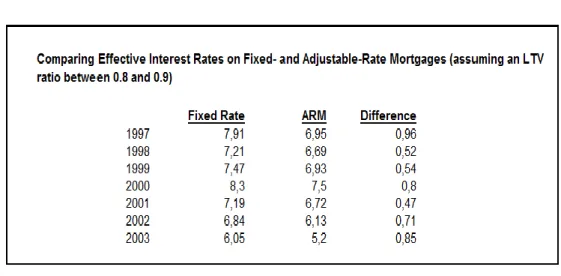
Table 2 refers ARM has lower interest rates mainly in line with market rates comparing with FRM interest rates due to level of protection
16
against interest rate risk that fluctuated by several factors in the market such as economic, political, etc.
Table 2: Comparison of Fixed and Adjustable Rate Mortgages
Source: Mc Donald, D. J. & Thonton,D.L. 2008, ‘A Primer on The Mortgage Market and Mortgage Finance’, Federal Reserve Bank of St. Louis Review, p:34.
According to Federal Reserve Board article (2003) in addition to these advantages, the consumers protect themselves regarding an increase in interest rates in the future. On the other hand, the consumer can use ARM to get a lower initial rate in exchange for assuming more risk over the long run. To avoid risk in the long run, upper and lower bounds are determined.
Besides, in contrast with FRM, in ARM, interest rates and principle amount per month vary from month to month that is the main reason for uncertainty. To clarify ambiguity, counterparties determine beginning interest rate, time intervals at which interest rates adjusted and the basic index used for adjustments.
In ARMs financial institution arrange monthly payments and the term of loan according to borrowers’ monthly income, ability to pay, etc.
17
3.4. Effects of Mortgage System on Economy
Eriş (2008) specifies that unlike other consumer loans mortgage loans do not fall within import so it has higher usage rate in domestic spending that contributes to economic growth.
Mortgage system provides real estate ownership in suitable conditions to middle income consumers, who have not enough saving, through the availability of credit resources. As a result of increasing demand in mortgage loans, the expansion of credit volume occurs as well as increase in buy-sell facilities and product range in the secondary market so financial sectors deepens. Also, economic growth will be achieved by transferring these funds to economy.
Oksay (2006) denotes that one of the basic indicators of financial deepening is the transferring rate of financial sector funds to real sector. Depending on this rate level, financial deepening will increase, and therefore economic growth increases. In the event of low rate, due to lack of resources in real sector through weak financial deepening, economic growth will not be at a desired level.
The funds transferring to real sector ensure particularly development of housing sector and the sectors in connection with this sector. Thus, in parallel with growth in housing sector labor requirements will increase and this positively influence employment in the country. Increase in unskilled labor, needs of this sector, can decrease unemployment and ensures emergence of new expertise fields with the need such as real estate valuation expertise, mortgage brokerage...etc.
However, Eriş (2008) also indicates that transfer of funds just limited with housing sector lead to contraction of others sectors in the country and production, trade and employment in these sectors will cause the fall. With the growth in housing sector increase in demand for unskilled workforce and decline demand in qualified workforce in narrowing sectors cause to
18
decrease in qualified labor in the country. In order to create resource in narrowing sectors, hot money, syndicated loans, private sector foreign credits and securitization are mainly requested.
Mortgage system can be a solution for housing problem, a construction with infrastructure, buildings not generate health risk, healthy living conditions and quality of life will be provided.
19
4. THE SECONDARY MORTGAGE MARKET
Early housing finance system depended on a simple basis, called as originate-to-distribute model. According to this model, borrowers lenders mainly banks and saving and loan associations and depositor took place in the mortgage market. Funding of mortgage loans were almost provided from depository institutions and were held in lenders’ balance sheets until they were repaid.
In 1970s primary mortgage market funding shifted to capital markets rather than depository institutions, represented as originate-to-distribute model. Mortgage loans gave in primary markets have started to be pooled and bundled in the secondary markets in order to be sold to investors as mortgage backed securities in the capital markets. Holders of an MBS have the right to receive the principal and interest payments made by mortgage borrowers in the underlying pool, which is held by a trust on behalf of MBS investors.
Yücel (2007) points out that secondary markets increase liquidity and marketing of mortgages thanks to its link to capital markets. Mortgage backed securities are offered these markets; by this way a mechanisms that provide funds and liquidity to secondary markets and new investments instruments are created in order to be useful for investors.
Due to new way, illiquid mortgage loans have converted into liquid instruments as well as primary market funding. Also, originate-to-distribute model has allowed cost reduction, therefore lower cost of borrowing which has given a chance to be a homeowner to middle and low income borrowers.
4.1. Scope of Mortgage Backed Securities
Mortgage backed securities represent an investment tool which represent creation of liquid assets and are served as an underlying asset and
20
refer to source of cash flow for the security. “MBSs are known as “fixed income” investments and represent an ownership interest in mortgage loans.”
In the Educated Investor Article (2009) mortgage backed securities is defined as;
“Mortgage backed securities are also sometimes referred to as “mortgage pass-through certificates,” because the security passes through to its investors (at a specific coupon) the monthly principal and interest due on the outstanding balance of the loans backing the security, as well as any unscheduled prepayments.”
Originators pools mortgage loans and sell them to a special purpose vehicles or an investment bank in return for MBSs formed by the proceeds of mortgages. By this way, originators isolate the pools from their risks as well as their balance sheets. These mortgage pools include the combination of mortgage loans and the certificate holder of pass through securities receives monthly scheduled payments depending on the principle and interest from the mortgages in the pool. Investment banks divide principle and interest payments into tranches. Each tranche includes different credit risk levels, therefore has different ratings. Junior tranches of MBSs absorb all the losses firstly, due to them senior tranches are protected from these losses. Due to their riskiest structure junior tranches have higher returns and longer lives. Until senior tranches are retired or paid off, they do not receive principle payments. This tranche system in MBSs called as senior-subordinate structure. Through this system investors are able to determine risk levels for their investments in exchange for returns which they are willing to gain.
MBS is issued by commercial banks, saving and loan associations, mortgage bankers and other lending institutions as well as government sponsored or quasi-government agencies such as Ginnie Mae or Freddie Mac, Fannie Mae which are the key to shift to capital markets-based funding of mortgage lending and publicly issued certificates by private
21
financial institutions. The originator must agree to abide by the GSEs’ underwriting guidelines, which specify types of loans each GSE will buy as well as processes for verifying the creditworthiness of borrowers. Mostly investors tend to invest in agency mortgage backed securities due to their guarantees in timely and full amount payment, liquidity and its capital treatment. In exchange for providing guarantee against defaults in payments, Fannie Mae and Freddie Mac deduct guarantee fee from MBS annual interest rate.
The Professional Risk Managers’ Internal Association’s article states that Fannie Mae and Freddie Mac undertake an important role in mortgage market. They purchase the mortgage loans and by this way, these institutions provide fresh money to banks and other financial institutions in order to make even more new loans.
While Ginnie Mae issues FHA and VA mortgages guaranteed by government, Fannie Mae and Freddie Mac that private corporations chartered by Federal Government are major issuers of conventional loans in the mortgage market. MBSs backed by government sponsored agencies carry a guarantee by government.
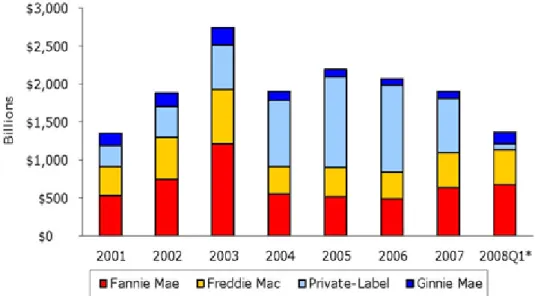
As shown in Figure 2 government sponsored enterprises heavily operated until 2004. Due to lower interest rates, therefore increase in subprime mortgage shares (with no documentation) non-agency mortgage originations showed a dramatic increase. In 2008, tighten standards in mortgage market led to decrease in non-agency mortgages.
According to the Office of Federal Housing Enterprise Oversight’s article (2008), at the end of 2007, outstanding MBS backed by single-family mortgages totaled $6.6 trillion. Securities guaranteed by Fannie Mae and Freddie Mac accounted for $4.1 trillion, MBS guaranteed by Ginnie Mae accounted for $0.4 trillion, and PLS accounted for $2.1 trillion of that total.
22
Figure 2: Distribution of MBS Issuance, by Issuer
Source: ‘A Primer on the Secondary Mortgage Market’ 2008, Federal Housing Finance Agency. Available: www.fhfa.gov.
Following up GSEs other financial institutions would securitize mortgage loans in the market. In private label, namely non-agency securitization process there is an MBS sponsor such as investment banks, commercial banks, mortgage banks…etc. They retain mortgages by originating or buying from an originator. On order to issue MBSs they transfer mortgages to special purpose vehicles (SPV).
In contrast, private label MBSs provide only cash advance provision in case of delinquencies in monthly scheduled payments and principle payments rather than government guarantee due to their non-conforming standards such as little documentation, borrower who have credit problems… etc. of quasi government agencies. Therefore, they played significant role in subprime, jumbo and Alt-A markets especially in 2000. To receive higher investment grades from rating agencies for their MBSs they use a set of credit enhancements.
In comparison with agency MBSs, private labels are smaller source of mortgage pass through securities.
23
Table 3: Distribution of Mortgage Loans in Percentage
Source: Avey,y R. B. & Bhutta N.& Brevoort,K.P. & Glenn, B. C. & Gibbs, C.N. ‘The Mortgage During The Turbulent Year’, Federal Reserve Bulletin, p: 44.
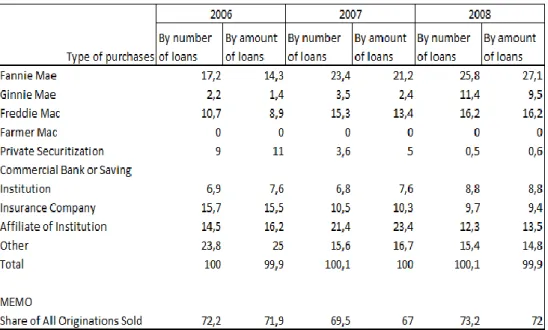
Table 3 represents distribution of loans sold during the year of origination, by type of purchasers, number of loans, and amount of loans in 2006-2008 periods. As shown in the table, in 2006 Fannie Mae bought 17.2% of number of loans which equal to 14.3% of amount of loans originated. The share of government sponsored agencies’ shares in terms of number of loans realized as 30.1%, 42.2% and 53.4% in 2006, 2007 and 2008 respectively while share of all originations sold realized as 72.2%, 69.5% and 73.2% consecutively in 2006-2008. The share of insurance companies decreased year by year as well as other institutions.
MBS shows a dramatic growth since 1970 in the secondary mortgage market. Before the innovation of this financial instrument, mortgage loans are relatively illiquid. Illiquid mortgage market refers to a risk for mortgage lenders who are not able to find buyers when they want to sell their portfolio at an acceptable price. Besides, mortgage lenders expose to interest rate risk which arose from rising interest rates that triggered the gap between their interest income and costs. MBS are beneficial to alter
24
these risks in order to create more attractive mortgage markets for investors and lenders. In MBS process similar loans are combined into pools and agencies are able to pass the mortgage payments through investors.
Prerequisites for Secondary Mortgage Market Development’s article explains that;
“A sustainable secondary market involves generating an on-going flow of transactions that will develop liquidity in the market, enhance investor and regulatory understanding and comfort and achieve the desired increase in availability of funds and decreased relative cost of mortgage credit.”
By means of MBS, mortgage lenders are able to minimize their interest rate risk by moving mortgages off their balance sheets.
MSB is used as financial tool in order to use mortgage market funding. With the help of these financial instruments excess demand relative to supply can be met and this led to creation a competitive mortgage market due to existence of new financial institutions and organizations in mortgage market. Competition triggers decrease in interest rates and thrift institutions profits. By a sizeable and affordable secondary market, integration with capital markets realizes.
Banks has converted their originate-hold credit mechanism into originate and distribution model. By this way, mortgage credits in primary markets could be exported to international markets via securitization. Due to to securitization US expanded mortgage credits into financial markets in order to meet housing demand in the primary markets with funds coming from secondary markets. Liquidity from secondary markets increased especially 2000-2006 periods depending on securitization promotions.
In addition, MBS has a crucial role in US mortgage market in order to provide housing finance at lower costs to home owners. Investors such as corporations, banks & thrift institutions, insurance companies and pension funds prefer to invest in MBS due to its liquidity, yield and capital management flexibility.
25
Yield is the return of an investment in terms of annual percentage rate. For MBS payments are done monthly and payments differentiate according to prepayments. The price of MBS affected from interest rate change. When interest rates fall, MBS prices fall too. People tend to refinance their mortgages cause prepayment risk. The earlier than expected return of principle led to reduce in yield. By the way, average life of investment, which affects potential MBS investment return, decreases due to prepayment represented as call risk. Due to lower interest rate investors forced to make investments at lower interest rate. On the other hand, along with rising interest rates, average life of investment increases and investors are not able to anticipate reinvestment at higher interest rate what is called an extension risk in parlance of mortgage finance.
MBS prices fluctuate due to interest rate changes. MBS is sold at or close to its face value. The prices above or below face value called as premium or discount respectively. The factors such as interest rates, coupon rate, type of mortgage backing the security, prepayment rates and supply & demand.
Some investors intended to hold bonds until they mature put MBS in held to maturity accounts while some of them use available for sale accounts in order to sell them prior to maturity.
4.2. Parties in a Securitization Transaction
Securitization process includes several participants in order to provide sufficient control and necessary infrastructure. All participants in securitization process undertake specific role or roles such as originator, servicer, credit enhancer, underwriter, trustee and investor in terms of creating and analyzing the asset pools, accounting and legal terms, credit rating, administration, … etc.
26
Table 4: Parties in Securitization Transaction
Source:Shiva,G. 1997, ‘Securitization of Debt’, Head-Fixed Income &Money Markets, Citibank, India ,p:205.
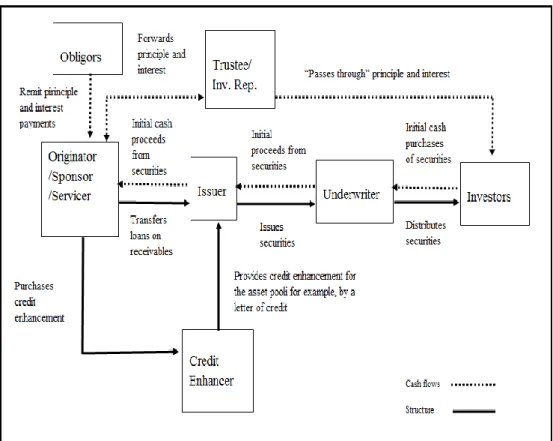
As Table 4 “Parties in Securitization Transaction below”; originators pools mortgage loans and sell them to a special purpose vehicles or an issuer in return for MBSs formed by the proceeds of mortgages. SPEs are owned by originators but legally separated entities. In effort to guarantee losses the loan pools which the securitization character is added to, go through credit enhancement or rating agencies to be rated. After rating process, SPEs/issuers combine loans into an asset pool which are structured as a set of tranches or bonds. They sell these securities to investors. Underwriters are responsible for grasping the collateral in terms of the value of properties underlying the pool. Trustee is usually a bank which undertakes intermediary responsibilities between originators and investors and work as on behalf of investors in securitization process. Underwriters pay issuers with a part of proceeds they collect from the investors. As obligors make
27
principle and interest payments, trustees pass through principle and interest payments to investors.
4.2.1. The Obligor
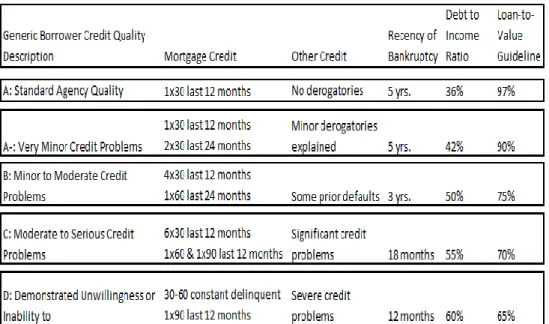
The Obligor is an individual who remit principle and interest payments to mortgage originator (for MBS process) in return for his payable. In securitization process the obligors, interchangeably refer as borrowers, are grouped into categories according to their mortgage credit, regency of bankruptcy, debt to income ratio, loan to value ratio, etc. which is shown in “Borrower Credit Quality Categories” below. “A: Standard Agency Quality” represents the borrowers who have the capacity to meet standards insofar as good for instance 36% debt to income ratio and 97% loan-to-value ratio with an extension credit history together with no derogatoriness.
Table 5: Borrower Credit Quality Categories
Source: ‘Liquidity and Funds Management’ 1997, Asset Securitization, p:9. Available:
28
4.2.2. The Originator
The Originator is a financial institution that acts as a seller in terms of its receivable portfolios in securitization process. They create and sometimes service their receivables as well as securitize or sell them to a Special Purpose Entities (SPE) and act as last users of funds providing from securitization process in order to meet new credit demands in the market.
According to Gorton and Nicholas (2005) special purpose entity (SPE) is a legal entity created by the sponsor or originator. It undertakes some specific purpose or activities, or a series of such transactions.
SPEs have symbolic capitals because the crucial point in securitization process is quality of securitized receivable instead of financial structure of originator or SPE.
Moreover, SPEs book securities originated from receivables assigned from originator as debit while interests and principle amounts are booked as credit.
The originator assigns its receivables to SPE in return for discount. Following assignment, rights for usage of receivables pass through to SPE completely or except in the frame of agreement. By this way securitized papers isolates from originator risk. In case of agreement, should default in monthly payments rise, the originator have to dedicate new receivables or pay interest and principle payments.
Bank for International Settlements’ article (2009) states that SPEs are isolated from originators risk, therefore they have bankruptcy remoteness in case of originator’s bankruptcy.
In addition, if SPE has some difficulties related with source and liquidity, originator can mediate to provide liquidity to SPE.
29
4.2.3. The Underwriter
Underwriter is an entity which is responsible for providing consultancy to seller subject to security structure, pricing and its marketing. It is also beneficial in terms of its relationships within the market, legal and structural advices.
Underwriters take on the risk of having to sell securities; therefore if they are not able to find investors for all securities, they hold some securities. Underwriters pay issuers with a part of proceeds they collect from the investors.
Lea (2000) highlighted the objectives of home mortgage underwriting as follows;
1. To control the probability and cost of default losses,
2. Satisfaction of all legal and financial requirements,
3. To meet requirements in terms of safety, secondary markets organizations and security rating services.
4.2.4. The Trustee / Investor Representatives
Trustee / the Investor Representative act as a fiduciary capacity to guarantee interest and principle payments in order to preserve the rights of investors and act as on behalf of investors.
Festante (2008) defined the trustee’s responsibilities as holding the receivables and maintaining the mortgage files, collecting payments on receivables from the borrowers on behalf of investors It reviews the securitization process to ensure adequate cash flow production. Also, it requests financial information from originator and servicer throughout securitization.
30
4.2.5. Credit Enhancement
Credit Enhancement is used for decreasing risks in securitization followed up providing improvement in credit rating. Credit enhancement is possible with a letter of credit or a surety bond from highly rated financial institutions such as banks, insurance companies or other institutions. In case of defaults in monthly payments investors have rights to apply these institutions to dedicate their interest and principle amounts.
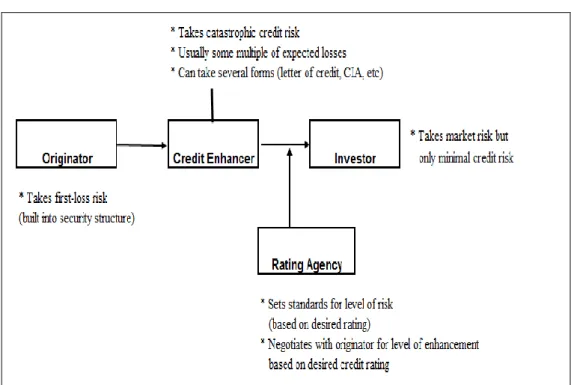
In order to classifying credit risk, securitization creates several tranches. As “Credit Risk Diversification table” shown below, normal or expected risk refers as first loss which is able to absorb by originator. Second tranche represents higher risks that exceed originator capacity and absorb by credit enhancer. Third tranche is directly related with investors.
Table 6: Credit Risk Diversification
31
Credit enhancement can be separated into two groups; credit enhancement provided by external parties or internal parties. External credit enhancement includes third-party or seller’s guarantee and provided by letter of credit, recourse to seller and surety bonds. Surety bonds guarantee 100% of interest and principle payments while letter of credit and resource to seller methods give limited guarantees.
Statement of Cameron L. Cowan Partner Orrick, Herrington, and Sutcliffe (2003) explained that;
“Internal enhancements include subordinating one or more tranche, or portion, of the securities issued. This practice places the claims of one tranche over another. Any defaults affecting the securities must be absorbed by a subordinate tranche before the senior tranche is affected.”
The credit enhancement techniques provided by internal structure are;
1) Overcollateralization: Overcollateralization is used when the principle amount of asset becomes greater than principle amount of security. By the way of senior/subordinate structure, overcollateralization can be used to protect senior tranche from an expected loss. Because investors who willing to buy senior tranches accept lower yield in return of lower risk. Conversely, subordinate tranches are bought by risk lover investors who willing to accept higher risk in exchange for the possibility of higher yields or losses.
2) Excess Spread: Excess spread is the remaining financial charges after securitization costs such as coupon, servicing costs and unexpected losses. The excess spread mainly used for unexpected losses arising from delinquencies and credit losses rather than additional profit.
3) Spread Account: Excess amount within a given month normally used for cover unexpected losses. In case of no need to cover these losses, excess amount reverts to originator as additional profit. On the other hand,
32
many trusts put this profit as reserve to protect investors against losses higher than expected in order to provide future credit enhancement.
4) Cash Collateral Loans: According to Hahn in many securitizations, excess spread is deposited into a reserve account. This reserve account refers as cash collateral accounts. The lender makes a loan to cash collateral account. Telpner (2003) denoted that the loan proceeds are pledged as collateral for the covered tranche and losses are funded from this account.
4.2.6. The Rating Agencies
A credit rating agency evaluates the credit risk in securitization process and undertakes a crucial role in determination of credit quality of securitized paper. The ratings by credit rating agencies are basis of product pricing as well as accepted as a reference point for investors to determine risk-income ratio.
Katz, Salinas and Stephanou state that credit ratings help to mitigate principle-agent problems through information asymmetries. The rating agencies are the main tools used during investment decisions and the guides for investors because search the credit-worthiness of a security or issuer.
Rating agencies hired by the underwriters to assess and assign credit ratings to the credit quality of pools of mortgages before the issuers and underwriters can sell them.
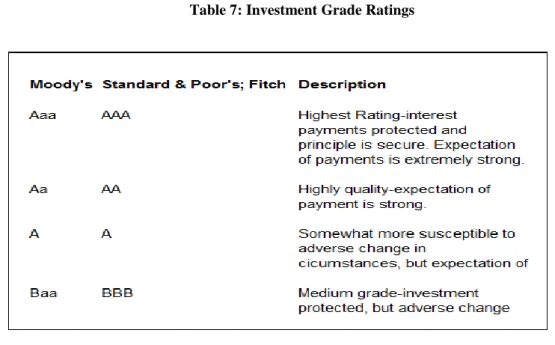
Ratings are investment guidelines for investors. As shown in below table ratings range from triple-A to triple-B (higher to lower) and they have a major influence on structure and pricing. Triple-A represents highest quality and lowest risk rating which provide lowest return to investor in line with its risk level. Triple-B represents minimum grade for investments which contains higher risk and return compare with triple-A.
33
Table 7: Investment Grade Ratings
Source: Forti, D. D. & Dechert, M. W. & Cleary, G. & Steen & Hamilton, 2002, ‘Underwriter and Rating Agency Issues in Securitized Loan Transactions.’
However, the unique role belongs to investors due to their investment attitudes which mainly effects value of securitized paper. Their decisions in securitization process led to an effective securitization process and benefits for counterparties.
According to Comptroller’s Handbook (1997);
“A participant can assume particular role or roles depending on their organization structure to take advantage of expertise or economies of scales like banks. Also, each role exposes to a risk varying from responsibilities in securitization process.”
4.3. Risks of Mortgage Backed Securities
4.3.1. Credit Risk
One of the most important risk faced in the mortgage system fail to pay the monthly payments of not paid on time.
34
Credit institutions calculate default risks on loans. However, if the risk level they face occurs higher than their forecasts, credit institutions fall in difficulties about financing of new mortgage credits as well as difficulties in interest and principle payments to investors that invest in derivative products via securitization in the secondary markets.
Against default risk, the assessment of customers’ profile by these institutions is important in order to minimize default risk in the credit assessment process. Customers income level and sustainability of these income, “Monthly Income/ Monthly Payment” rate, should be more as possible as the specified rate in the country. Besides, the value of real property based on mortgage loan should be determines fairly by real estate experts because the value of real property is only source of collection by the sale in case of defaults in mortgage loans in the future. Present and possible future value with liquidity rate of real estate is one of factor to decrease credit risk. In addition, default risk increases when amount of loans include 100% of real estate value. Therefore, 75% of generally accepted value of real estate should be gave for loan and remain 25% should be maintained by financial institution ensure guarantee in case of possible depreciation. In other words, “Value of Real Estate/Credit Amount” rate should be 75% at most provide minimum default amount at least.
Requested insurances in the mortgage loan approval process are of use to eliminate default risk arising from unexpected situations. For example, in the case a person’s long term injury, illness or unemployment, mortgage payment protection insurance protects creditors and borrowers against credit risk by ensuring on time and on a regular basis loan payments throughout time period the person have not ability to pay.
4.3.2. Liquidity Risk
Liquidity risk represents losses of financial institutions due to fail to meet demand for new credits or obligations when they due because of
35
irregular monthly payments, at the time of real estate sale through defaults and lack of maturity concentrations and long term funding requirements. Also, liquidity risk depends on inability to address changes that affect liquidity of assets in the market.
Perry, Robinson and Rowland (2011) showed that the lender can be exposed to interest rate and liquidity risk when they borrow at a fixed rate.
Securitization provides to financial institutions liquidity for their balance sheets in terms of source of liquidity management, easy access to and presence in capital markets. The main problem is lack of contingency planning reflecting potential problems such as security amortization period and maturity mismatching in cash flow provided by securitization. The financial institution should find alternative funding tools for funding difficulties in case of problems in securitization amortization phase to provide its presence in the market and reputation against investors. For instance, irregularity in mortgage payments causes to delay in payments to investors investing in derivative products in the secondary market. In other words, collection and payment imbalances are embarrassing for investors in capital markets as well as financial institutions.
In addition, the risk the financial institution faced during sale of real estate is difference between buying and selling price.
Kabataş (2007) states that various kind of factors affecting liquidity transformation rate of real estate occur in cases where loan payments cannot be made and decide for sale. Physical condition of property, demanded amount and demand and supply factors in the market has effects on liquidity.
The financial institution should prepare a contingency planning that reflects possible returns and losses in various conditions. To achieve an effective liquidity management, financial institutions may arrange schedules for securities which have different amortization characteristics and include
36
early amortization possibilities as well as long and short term funding tools with replacement alternatives to obtain necessary amounts of liquidity quickly.
4.3.3.Market Risk
Türker (2009) defined market risk as market risk, also known as price risk or systematic risk, defined as risk of asset prices affecting from opposite movements in macro-economic factors on financial status of institutions. These macroeconomic factors are mainly interest rates, stock prices, exchange rates and commodity prices.
Interest rates are consistently effective in credits. Interest rate changes for any reason can create problems for customer and financial institutions. For example, in a period interest rates increase, if the customer has a fixed interest loan, creditor will incur losses, or on the contrary interest rates have fallen, consumer will pass through hard times due to higher interest rates than market rates. Therefore, differentiation of market and loan interest rate can be prevented by adjustable rate mortgages against interest rate risk should be used.
However, Türker (2009) states that belief in adjustable rate mortgages include more default risk than fixed rate mortgages dominated. The reason for this belief is at a time increase in inflation as a result of customers’ income cannot capture inflation rate customers have difficulties about fulfillment of obligations.
Exchange rates are another effective factor in the mortgage market. The important thing here is primary market loans and secondary market securitized loans are in the same currency. Because, primary market loans refers to collections and securities in secondary market represents payments for financial institutions. Therefore, collections and payments in different currencies will create a mismatch between two parts due to depreciation in
37
one of these currencies. For example, if loans given in TL are securitized in USD, depreciation in TL against USD causes depreciation in collections against payments and therefore losses of financial institutions.
According to Doğru (2007) if receivables and security currencies cannot be harmonized, elimination or reduction of risk is possible with “swap” or another derivative contract. However, such a derivative contract contains a certain amount in order to minimization risk.
4.3.4. Prepayment Risk
Risk of early payment or premature payment refers to full or partial payments by consumers more than expected amounts or real estate sale before maturity in default.
Yalçıner (2006) mentions about downward trend of interest rates in the market increases risk of early payment. In such cases, the person using mortgage loan can able to decide to refinance and close by early payment through provide savings in interest payments.
This situation creates risk for mortgage backed security investors because they will sell the funds as a result of early payment to other consumers with lower interest rate or the investor will be forced prematurely to reinvest at a lower interest rate than was embodied in the MBS that is being prepaid although the value of securitized mortgage loans decrease from these investments in low-interest loans.
Early payment risk is almost more common in fixed rate mortgages. Due to fix rate characteristics of mortgages mainly lower interest rates below borrowers’ contractual rate direct borrowers to refinance their mortgage loans at a lower interest rate or completely paid off. Consequently, the holders of these mortgages or MBSs exposed to prepayments.
38
Besides, sale of real estate before maturity prior to default triggers early payments to investors investing in securities.
Due to effect of prepayment MBS pricing models must take into account prepayment risk. Mortgage Bankers Association article (2009) explains the reason as;
“Because investors demand different yields to lend money for different periods of time, a mortgage that is likely to pay off in two years has a very different value (and therefore interest rate) than one that is likely to pay off in seven years.”
In order to cope with this issue, security industry practices substantial amount of analytical effort to measure and model prepayment experiences. These predictions depending on specific conditions help to determine prepayment proclivities of specific MBS pools. Also, these probabilities reflected to MBS prices in terms of investors’ protection against situations led to prepayments.
Besides, one of the ways used to minimize prepayment risk is collateralized mortgage obligations (CMOs) which represent multi-tranche securities. By help of these tranches, prepayment risk distributed over three or more bond classes.
Finally, contract clauses, which include time restrictions or punitive substances for early payment in order to assist reducing payment risk, can be placed in loan agreements by financial institutions. For example, in our country early payment penalty amounting 2% of remain debt is important to be deterrent power for closing credits because this penalty creates extra cost for customer decreasing benefits of early payment.
4.3.5. Performance Risk
Performance risk is a risk encountered in secondary markets. In securitization process financial institutions securitize their possible gains in