An Analysis of the Role of the Social Acceptance
of University Students’ Bicycle Use in Sustainable
Urban Development when Epidemics Spread
Vahid Saatchian
1, Amin Azimkhani
2, Habib Honari
3and Mutlu Türkmen
41Imam Reza International University, Sports Management Department, Mashhad, Iran, 2Imam Reza International University, Sports Science Department, Mashhad, Iran, 3Allameh Tabataba'i University, Sports Management Department, Tehran, Iran, 4Bayburt University, Physical Education and Sport College, Turkey
Abstract
The purpose of this study was to investigate the role of the acceptance of university students’ bicycle use in sustainable urban development in Iran when epidemics spread. The research method was descriptive-correlational, and the investigation was carried out as a field study. The statistical population of the study consisted of university students, 254 of whom were selected by a simple random sampling method to participate in the research. The research instrument was a questionnaire based on the Sustainable Development with a reliability coefficient of 0.83; the social acceptance component was based on the theory of planned behaviour with a reliability coefficient of 0.8. As the results of the investigation have demonstrated, the bicycle plays a significant role in the development of the socialization process of people, and there is a positive and significant relationship between social acceptance and sustainable development (p<0.05). Furthermore, 20% of sustainable development change was achieved through the dimensions of social acceptance (planned behaviour theory). Finally, it can be argued that perceived behaviour in social acceptance is most likely to play a significant role in the emergence of sustainable development by external factors such as encouragements and persuasion of the family, important people, friends, acquaintances, and even by the existing norms in society. Subsequently, as people change their mindset when epidemics spread, they can turn all the behaviours they manifest in their leisure time into a culture development movement.
Keywords: coronavirus, social acceptance, bicycle, epidemic spread, sustainable development
Introduction
In recent decades, much work has been undertaken, led by the WHO, to better prepare and protect health systems during mass gatherings (WHO, 2020). Due to the restric-tions imposed by the WHO to prevent overcrowding during the outbreak of epidemics, it is best to use personal trans-portation instead of public transport. One of these devices is the bicycle, which is emphasized as a green tool. In a pan-demic, primarily the health sector, then all aspects of the
social, economic life, the daily lives of individuals, and fi-nally all the sports activities are facing an exceptiofi-nally large challenge (Closkey et al., 2020). Professional sports events which are followed by crowds of spectators, all the business initiatives providing various sports services, industries pro-ducing sports products, the businesses within the marketing chain of all these products, the industry of sports tourism, all the individuals working for sports organizations of dif-ferent levels, and all other industries and businesses linked Correspondence:
A. Azimkhani
Imam Reza International University, Sports Science Department, Razavi Khorasan Province, Mashhad, Iran Email: [email protected]
with the sports industry have suffered from huge financial losses in the most recent pandemic (Turkmen & Özari, 2020). Undoubtedly, slowing down the spread of COVID-19 to manageable levels for the health systems to operate is the overriding priority. Re-thinking sport, whether elite or com-munity/recreational, will play a significant part of that. The consequences of these postponements and cancellations are unknown, yet many commentators and those within sport expect this to fundamentally change the way the industry operates in the future (Parnell, Widdop, Bond, & Wilson, 2020). Relevantly, we should examine sports actions related to COVID-19, as there are valuable lessons to be learned. Certainly, when the next pandemic comes (which it will), we are better prepared in sport and society. Since a mul-titude of transportation issues and various environmental pollution problems have been created recently, the role of the bicycle as an active and sustainable transportation tool has gained significance in reducing traffic and air pollution (Saraei & Shamsi., 2012). Also, according to Moradi and Rostami (2013), cultural weakness in the field of traffic and lack of integrity in the management and decision making regarding bike riding projects in the city are the causes of lack of interest in bike lanes.
Travelling by bicycle brings about numerous benefits such as reduced traffic noise, cost-effectiveness, lack of pol-lution, good exercise for the body, parking convenience and health for both the individual and the others (Dolatkhah, Saatchian, & Keshtidar, 2018). For example, in Sydney, special routes have been arranged for buses, cars and am-bulances along the streets. A 35-km route designated soles for bicycle has enhanced the bicycle culture in Sydney by about 500% (The Bureau of Infrastructure, Transport and Regional Economics). Therefore, attention to the promo-tion of walking and cycling culture is one of the approach-es to integrate physical exercise into everyday activitiapproach-es (Su, Winters, Nunes, & Brauer, 2010) and the creation of this culture is influenced by existing attitudes and norms. Attention and identification of the effective aspects of us-ing bikes by modifyus-ing human behaviour can and should be studied. These behaviours are well-documented in Eisen’s theory of planned behaviour (1985), which suggests that attitudes, mental norms, and perceived behavioural control are influential factors that predict an individual’s intention to engage in a particular activity and promote social accep-tance. This approach plays a significant role in providing the basis for sustainable development (Mirmiran, Mirbolooki, & Azizi, 2001), the central goal of which is to provide for basic needs and improve and enhance the standard of living for all beings. Dolatkhah et al. (2018) have concluded that green marketing in sport-recreational activities can predict citizens’ satisfaction and loyalty and public bicycle system can attract their attention to public bicycle use by em-ploying any of the compounds of green marketing. Savan, Cohlmeyer and Ledsham (2017) suggest a five-part model and its integration with continuous activities. The model has the following parts: “(1) division of strategic popula-tion; (2) identification and removal of barriers; (3) use of commitment strategies; (4) tactics for maintaining behavior change, including images, encouragement, social indicators and modeling, social norms, feedback and motivation; and (5) continuous social support through modeling, local cen-ters and community participation”. These have been used to
bring about successful participation and acceptance of cy-cling by means of various tools to create change, and allows communities to utilize scarce resources of active transpor-tation. According to Babiano, Kumar, and Mejia (2017), the proper implementation of shared bicycle project can create long-term positive impacts by creating a cycling culture and changing travelling behaviour.
Biking is a part of sustainable development and a fac-tor in dealing with the negative consequences of urbaniza-tion. For human resources to be efficient, students should be involved in physical and recreational activities alongside educational and research activities so that they can enjoy a healthy lifestyle. Despite the importance of the mentioned research variables, thus far there has been no similar study on the relationship between social acceptance based on the theory of planned behaviour and sustainable development according to economic, ecological, cultural and social com-ponents. The present study emphasizes the use of bicycles by students to manage their lives better when epidemics such as corona occur.
Methods
In terms of research objectives, this was an applied study; regarding research type, it was descriptive-correla-tional. The statistical population of the study comprised male students in Iran (N=3000). The sampling method used in this research was simple random sampling. According to the statistical methodology of the research, the sample selection was five to ten times greater than the number of research questions (taking the correlational studies and re-turn rate of the questionnaires into account). Finally, 254 questionnaires with 10% reduction were distributed among the individuals.
To collect information, two questionnaires were used. The first was an 18-item questionnaire of social acceptance based on Eisen’s theory (1985) including dimensions of at-titude, perceived behaviour and norms; the second was a 14-item questionnaire of sustainable development based on Spritzer’s model (1997) with three subscales of econo-my, ecology and social-cultural components, used in a five-point Likert scale.
To confirm the face and content validity, questionnaires were distributed to five relevant university professors. Cronbach’s alpha test was used to determine the reliability of the questionnaires; the reliability of social acceptance and sustainable development questionnaires were α = 0.83 and α = 0.81, respectively. Also, to collect data, the purpose of the study was explained to students, and they were asked to express their views following a discussion of the meaning of the questions. Finally, the collected data were analysed in two sections. In the first part, descriptive statistics and in the second part, inferential statistics (Kolmogorov-Smirnov test, correlation test, regression test, one sample t-test and structural equation model fit) were analysed using SPSS and LISREL software.
Results
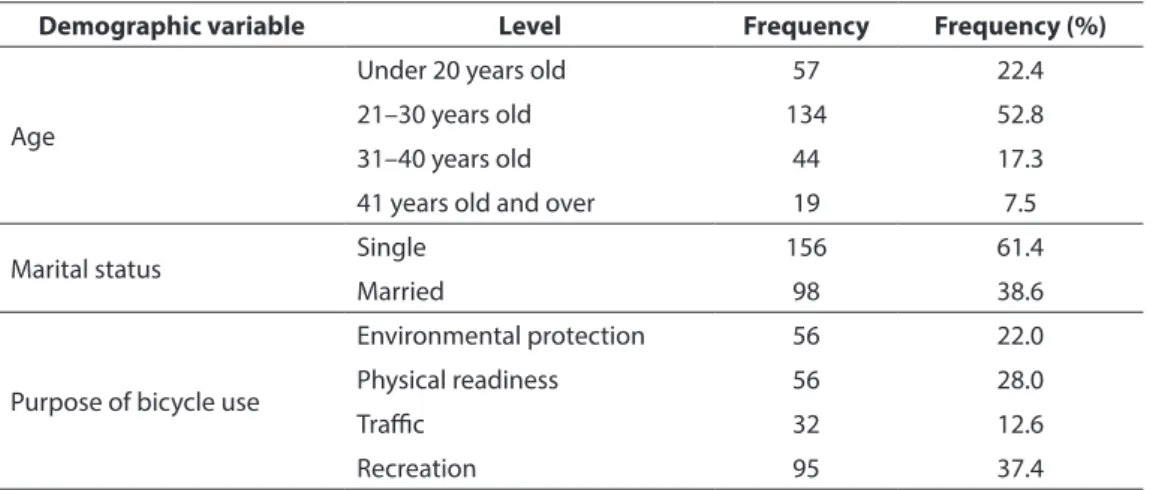
Based on the results of Table 1, the highest number of people belonged to the age range of 21 to 30 years old (52.8). Regarding marital status, 61.4% were single; in terms of the purpose of bicycle use, the highest percentage cited the rec-reational option (37.4%).
Subsequently, Table 2 examines the role and importance of
so-cial acceptance variable components. According to the results and the mean score of social acceptance variable components, only perceived behaviour and norms indicate a relative desirable status. Table 1. Statistical description of demographic characteristics
Demographic variable Level Frequency Frequency (%)
Age
Under 20 years old 57 22.4
21–30 years old 134 52.8
31–40 years old 44 17.3
41 years old and over 19 7.5
Marital status Single 156 61.4
Married 98 38.6
Purpose of bicycle use
Environmental protection 56 22.0
Physical readiness 56 28.0
Traffic 32 12.6
Recreation 95 37.4
To determine the status of the components of the
sustain-able development varisustain-able, a one-sample t-test was applied. As shown in Table 3, the components of sustainable development indicate a favourable situation. Table 2. One-sample t-analysis to determine the role of the score of social acceptance components
Variable Mean t-statistic Significance level
Social attitude 2.85 -3.86 0.001
Perceived behaviour 3.28 6.299 0.01
Norms 3.19 3.940 0.001
Table 3. One-sample t-analysis to determine the role of sustainable development score and its components
Variable Mean t-statistic Significance level
Economy 3.67 12.183 0.001
Ecology 3.88 13.774 0.01
Cultural and social 3.84 14.628 0.001
To determine the internal relation between the compo-nents, the Pearson correlation test was used (Table 4). A pos-itive and significant relationship between all components of
social acceptance and sustainable development is present, and the correlation between them is reported to be moderate (p<0.05).
Table 4. Correlation test between social acceptance components and sustainable development
Components Sustainable Development
Correlation Significance level
Social attitude 0.24 0.01
Perceived behaviour 0.43 0.01
Norms 0.30 0.01
To fit the research model using structural equations in standard mode, results are presented in Figure 1.
The relationship between research variables and their components had acceptable values; these indicators demon-strate that the observed measured variables are well reflect-ed in the hidden variables (social acceptance and sustain-able development). The results also show that social accep-tance can have a positive and significant effect equal to the path coefficient of 0.62 on sustainable development (t=7.20, Sig=0/01). The results of the fit indexes of the model show that fit indexes have a satisfactory value and the indexes of χ2/df (2.40), GFI (0/98), NFI (0/96), AGFI (0.94) are at fa-vourable levels and are higher than 0.9. Therefore, the re-search model based on the impact of social acceptance on sustainable development is supported.
Discussion
Travel bans imposed due to epidemics may acceler-ate fear and, in turn, impact the supply of essential items. Therefore, it is essential that reduced frequency of transport means such as bicycles is incorporated with route restric-tions to lessen the demand for travel. Indeed, schools and universities have long been considered the main pillars of society for the promotion of the culture of sport, and it is almost impossible to take any cultural action in society without taking them into account. Consequently, the con-cept of social accon-ceptance is introduced as a challenge in identifying the behaviour of sports consumers. Attention to factors affecting the improvement and progress of exercise goals among different levels of society can promote sport. Therefore, development is introduced based on a sustain-able outlook.
According to the results of the research, the social ac-ceptance variable, and components of perceived behaviour and norms indicate a relatively favourable status, which is in line with the results of studies conducted by Babiano (2015), Saffar and Azimzadeh (2014) and De Bruijn (2005). Results of the data analysis demonstrated that most people agree to use bicycles and encourage people close to them (e.g., family members, spouses, and friends) to use bikes. In the same vein, according to a study conducted by Babiano (2015), a significant issue contributing to the success of bicycle projects in Asian countries is the balance of transportation programs and policies with environmental, economic and social conditions of urban environments.
Furthermore, Saffar and Azimzadeh (2014) report that universities can create conditions for students to bring their bicycles to universities, thereby promoting the culture of bi-cycle use among students, which can result in a comprehen-sive student-led program to help the promotion of riding bicycles. Savan et al. (2017) concluded that a socio-psycho-logical approach to behavioural change should be employed to increase the potential of bicycle use in transportation.
As the existing literature suggests, designing a program for social interventions to increase beneficial biking requires a combined or multi-step approach. Moreover, the relatively good prediction power of social acceptance (attitude, per-ceived behaviour, norms) about sustainable development confirms the fact that change in each of these components can exert an impact on sustainable urban development. Therefore, attention to the enrichment of sports-based leisure time among different classes of society, especially university students as cultural advocates in social environ-ments, can lead to the promotion of favourable behaviour
among other people.
Development of sport infrastructure among university students and attention to the bicycle as a facilitating tool can provide the basis for sustainable urban development in terms of financial resources, environment, health develop-ment, and transportation. The bicycle is a vehicle that (other than its application for recreational purposes and compe-titions at universities to grant special privileges to cyclists) can be employed as a means of transportation that not only does not pollute the air but also engenders a healthy life-style. Continued use of bicycles among university students and the staff cultivates the culture of bicycle use for other members of the community, because these people inevitably influence their families. In contrast, providing and main-taining favourable conditions for bicycles and cyclists leads to sustainable development at the community level.
In the present study, it has been concluded that perceived behaviour as an external factor plays a significant role in social acceptance, and encouragement of the individual by family, friends, acquaintances, and other significant people, and thus plays an essential role in bicycle use acceptance. Since people have more leisure time nowadays in compar-ison to the past, they can plan to improve their mental and physical condition during those times. Therefore, use of lei-sure time to engage in enjoyable activities is vital. University students, as a vital category of society who play a central role in the creation and promotion of culture and as future planners for the community, must be provided with the ini-tial support, and have high-quality leisure time themselves. Bicycles as public transportation could be valuable in the decision-making processes of leaders in sport, in partic-ular. If events are cancelled without a risk assessment being done, the social and economic consequence of cancelled events may prove costly, both human and financial (Parnel et al., 2020). In the present study, the researcher concluded that perceived behaviour as an external factor plays a signif-icant role in social acceptance, and encouragement of the individual by family, friends, acquaintances, and other im-portant people plays a major role in bicycle use acceptance. This factor, in turn, influences the role of internal factors among influential factors on social acceptance. Internal fac-tors, such as the norms in society about which people have their perceptions in different situations, as well as the atti-tude of people in all the behaviours they demonstrate, cou-pled with the lack of infrastructure and the idleness of indi-viduals in some cases, all result in the failure to use bicycles. However, this can be compensated through encouragement to use bicycles, and will ultimately lead to the promotion of cycling culture. The expansion of this culture will increase demands and infrastructure for bicycle use and even create jobs, and the continuation of this process will result in the conservation of fossil and financial resources, and will great-ly contribute to the preservation of the environment. The impact of COVID-19 on sport will take some time to play out. While, the evidence base is still developing on the infec-tious disease transmission during sport events (Memish et al.,2019), it is likely that any forthcoming event will attract intensified media interest, which will impact public and po-litical perceptions and expectations (Closkey et al., 2020), whether in 2020 or 2021 and beyond. Therefore, as we look forward, it is appropriate for sport leaders and authorities to examine new WHO recommendations for mass gatherings.
Acknowledgements
There are no acknowledgements.
Conflict of Interest
The authors declare that there are no conflicts of interest.
Received: 07 June 2020 | Accepted: 11 August 2020 | Published: 01
October 2020
Reference
Ansari, M. (2014). The Structure of Exercise in Sustainable Development. Proceedings of the National Conference on the Role of Sports in the Health and Sustainable Health System 11 and 12 Bahman, Faculty of Physical Education, University of Tehran.
Baghianimoghadam, M., Gholianavval, M., Karimi, M., Kamalikhah, T., Roohi Moghadam, R. (2014). Investigating the Views of Male Students on Using Bicycles Based on the Theory of Planned Behavior in Yazd University. Medical Sciences, 13(4), 83 93. http://tbj.ssu.ac.ir/article-1-1195-fa.html
Babiano, I. (2015). Public bicycle sharing in Asian cities. Journal of the Eastern Asia Society for Transportation Studies, 11, 60-74.
Beth, S., Cohlmeyer, E., & Ledsham, T. (2017). Integrated strategies to accelerate the adoption of cycling for transportation. Transportation Research Part F, 46, 236-249.
Chen, S.H.Y. (2016). Using the sustainable modified TAM and TPB to analyze the effects of perceived green value on loyalty to a public bike system. Transportation Research Part A, 88, 58-72.
De Bruijn, G-J., Kremers, S.P., Schaalma, H., Van Mechelen, W., & Brug J. (2005). Determinants of adolescent bicycle use for transportation and snacking behavior. Preventive medicine, 40(6), 658-67.
Dolatkhah Laein, D., Saatchian, V., & Keshtidar, M. (2018). Green Marketing Mix Analysis in Promoting the Culture of Using Bicycles with a Sport-Recreational Approach (Case Study: Public Bike System of Mashhad City). New Trends in Sport Management, 6(22), 81-92. http://ntsmj.issma. ir/article-1-1174-fa.html
Closkey, B., Zumla, A., Ippolito, G., Blumberg, L., Arbon, P., Cicero, A., Endericks, T., Lim, P. L., & Borodina, M. (2020). Mass gathering events and reducing further global spread of COVID-19: A political and public health dilemma. The Lancet. https://doi.org/10.1016/S0140-6736(20)30681-4.
Memish, Z.A., Steffen, R., White, P., Dar, O., Azhar, E.I., Sharma, A., & Zumla, A. (2019). Mass gatherings medicine: Public health issues arising from mass gathering religious and sporting events. The Lancet, 393(10185), 073–2084. https://doi.org/10.1016/S0140-6736(19)30501-X
Mirmiran, P., Mirbolooki, M., & Azizi, F. (2011). Familial clustering of obesity and the role of nutrition: Tehran Lipid and Glucose Study. International Journal of Obesity, 26, 1617-22.
Moradi, M., & Rostami, F. (2013). Bicycle Studies and Proposals for Special Bicycle Routes in Tabriz. International Conference on Civil Engineering, Architecture and Sustainable Urban Development, Islamic Azad University, Tabriz Branch. https://www.civilica.com/Paper-ICCAU01_ ICCAU. html.
Parnell, D., Widdop, P., Bond, A., & Wilson, R. (2020). COVID-19, networks and sport. Managing Sport and Leisure, 1-7.
Saffar, Y., & Azimzadeh., S. (2014). Development of Bicycle Culture in Ferdowsi University of Mashhad. Two Journal of Management and Development of Sport, Spring and Summer, 1, Successive 10.
Saraei, M., & Shamsi., H (2012) revival of cycling and sustainable urban transportation with emphasis on sustainable development of Yazd. The first international conference on urban cycling, Tehran, the country’s transportation and fuel management headquarters. https: // www. civilica.com/Paper-CITYBIKE01-CITYBIKE01_021.html.
Su, G.J, Winters, M, Nunes, M, & Brauer, M. (2010). Designing a route planner to facilitate and promote cycling in Metro Vancouver, Canada, Transportation. Research Part A, 44, 495-505
Turkmen, M., & Özsari, A. (2020). Covid-19 Salgını ve Spor Sektörüne Etkileri. International Journal of Sport Culture and Science, 8(2), 12-30.
World Health Organization. (2020). Country and tech-nical guidance—coro-navirus disease (COVID-19). https://www.who.int/emergencies/diseas-es/novel-coronavirus-2019/technical-guidance.