Outcomes for revision total knee replacement
after unicompartmental knee replacement
Correspondence: Burak Akan, MD. Ufuk Üniversitesi Tıp Fakültesi, Ortopedi ve Trav. ABD., Mevlana Bulvarı (Konya Yolu) No: 86-88, 06520 Balgat, Ankara, Turkey.
Tel: +90 505 – 502 53 27 e-mail: [email protected] Submitted: September 07, 2013 Accepted: May 28, 2014
©2014 Turkish Association of Orthopaedics and Traumatology
Available online at www.aott.org.tr doi: 10.3944/AOTT.2014.13.0067 QR (Quick Response) Code
doi: 10.3944/AOTT.2014.13.0067
Burak AKAN, Tuğrul YILDIRIM, Berk GÜÇLÜ, Alper KAYA, Doğaç KARAGÜVEN, İlker ÇETİN Department of Orthopedics and Traumatology, Faculty of Medicine, Ufuk University, Ankara, Turkey Objective: The aim of this retrospective, observational study was to describe the outcomes of total knee replacement (TKR) after failed Oxford phase 3 medial unicompartmental knee replacement (UKR). Methods: The study included 24 revision TKRs (20 females, 4 males; mean age: 61 years) performed following failed aseptic UKR. Outcomes were assessed using the Knee Society Score (KSS).
Results: The most common causes for revision were mobile bearing dislocation and unexplained pain. Mean preoperative KSS was 50.3 (range: 37 to 66) and 82.2 (range: 58 to 97) after TKR. There were 17 excellent, 4 good, 2 fair and 1 poor results.
Conclusion: The type of UKR performed (cemented versus uncemented) had no effect on TKR suc-cess. Revision for failed UKR with TKR appears to be a technically straightforward procedure with satisfactory early clinical results.
Key words: Knee; osteoarthritis; revision surgery; total knee replacement; unicompartmental knee replacement.
Over the past 20 years, there has been an increased use of unicompartmental knee replacement (UKR) for medial osteoarthritis of the knee as an alternative treatment to total knee replacement (TKR), with recent reports de-scribing success rates of 90% or higher at the long-term follow-up.[1] These higher success rates have been
attrib-uted to better surgical techniques, new implant designs, improved instrumentation and careful patient selection.
[2] Unicompartmental knee replacement has several
ad-vantages over TKR, including better knee kinematics, fewer serious complications and a more cost-effective strategy. However, despite these benefits and improved success rates, joint registries in recent years have shown higher revision rates for patients with UKR than for those with TKR.[3,4] Many failed UKRs are
subsequent-ly treated with TKR and controversy exists as to the
suc-cess of TKR in cases previously treated with UKR. In-deed, some authors report that UKR revision with TKR leads to poorer results as compared with patients treated with primary TKR, with revision patients frequently re-quiring the use of bone grafts, wedges and stem exten-sions during surgery.[5] In contrast, other studies suggest
that UKR revision using TKR is a relatively easy proce-dure if properly planned.[6]
The aim of this study was to evaluate the clinical re-sults of 24 revision TKRs after failed UKRs. We also sought to identify the potential causes of failure leading to the requirement for UKR revision and to ascertain whether there was a difference in revision surgery suc-cess rates in patients previously treated with cemented versus uncemented unicompartmental prostheses.
Materials and methods
A total of 330 UKRs were performed by one of four sur-geons (BA, BG, AK, IÇ) or under their supervision in our clinic between 2007 and 2012. The study included 24 patients (20 females, 4 males; mean age: 61 years, range: 46 to 76 years; mean BMI: 29.3, range: 23.9 to 35.8); 18 failed aseptic primary Oxford phase 3 medial UKRs (Biomet UK Ltd., Bridgend, United Kingdom) converted to standard TKRs and 6 revisions of failed aseptic UKRs performed in other hospitals. Revisions were made on 12 right and 12 left knees. Indications for initial UKR were medial compartment osteoarthritis with intact ligaments, absence of degenerative findings in the lateral compartment, and a correctable varus de-formity. No patient had undergone previous knee sur-gery before the initial UKR.
Biomet Vanguard Complete Knee System (Biomet Inc., Warsaw, IN, USA) (posterior cruciate ligament re-taining design) was used in 12 cases and the NexGen LPS-Flex (Zimmer Inc., Warsaw, IN, USA) (posterior cruciate ligament sacrificing design) in the other 12 cas-es. Knee prosthesis was selected depending on surgeon preference.
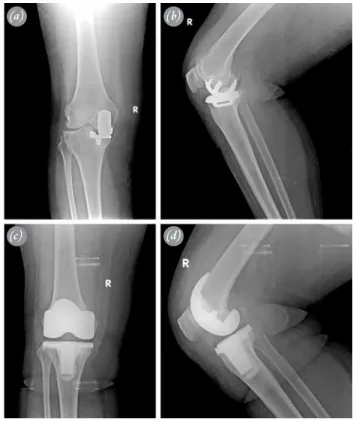
Patient demographics, initial and post-revision bear-ing thickness, implant requirements and the interval between initial surgery and revision (Tables 1 and 2) were retrospectively collected for all UKR patients. All patients were reviewed clinically and radiologically on anterior-posterior and lateral radiographs (Fig. 1). Clini-cal and functional scores were evaluated using the Knee Society Score (KSS).
SSPS for Windows v.15.0 (SPSS Inc., Chicago, IL, USA) was used for statistical analyses. Quantitative variables are shown as the mean and standard devia-tion, median, number or percentage. Pearson correlation analysis was conducted to examine the relationship be-tween KSS and quantitative variables. Differences in the quantitative variables between the groups were cal-culated using the Student’s t-test or one-way analysis of
variance (ANOVA), depending on the normal distribu-tion. Chi-squared and Fisher’s exact tests were used for qualitative variables. Differences between preoperative and postoperative values were evaluated in each group and among groups using a variance analysis in repeated measurements. The level of statistical significance was set at p≤0.05.
Results
Mean follow-up period was 30.4 (range: 12 to 60)
Table 1. Bearing thickness data.
Type of prosthesis n
Oxford UKR bearing thickness (mm)
3 7 4 11 5 6 TKR bearing thickness (mm) 10 11 12 12 14 1
Table 2. Demographic data of the patients.
Mean age (range) 61 (46-76)
Gender 20 females, 4 males
Mean follow-up period in months (range) 30.4 (12-60) Average interval between the initial and 24.1 (6-36) revision surgery in months (range)
Mean BMI (range) 29.3 (23.9-35.8)
Sides 12 left, 12 right knees
Implant requirements 3 tibial stem
extension; 1 tibial stem extension + autologous bone graft with screw fixation
(a)
(c)
(b)
(d)
Fig. 1. Case of a 64-year-old female with mobile bearing disloca-tion. (a) AP and (b) lateral radiographs showing dislocation 8 months after initial surgery with unicompartmental knee replacement. (c, d) Unicompartmental knee arthroscopy was converted to primary total knee replacement during revision.
months. Mean interval between primary UKR and revi-sion TKR was 24.1 (range: 6 to 36) months. For the
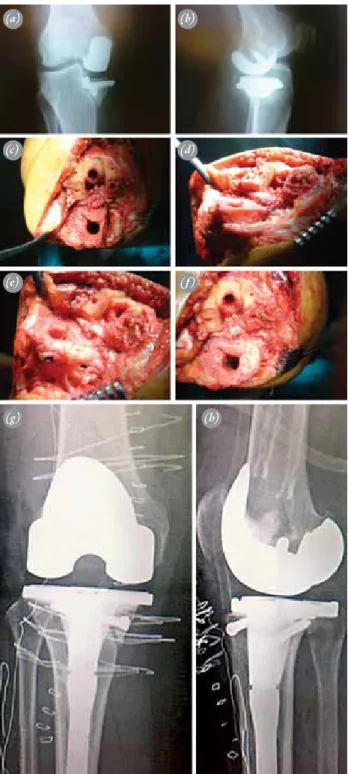
pri-mary UKR, 16 cemented prostheses with mobile-bear-ing medial Oxford UKR (Biomet UK Ltd., Bridgend, United Kingdom), and 8 uncemented prostheses with mobile bearing medial Oxford UKR (Biomet UK Ltd., Bridgend, United Kingdom) were used. Mean polyeth-ylene bearing thickness was 4 mm (Table 2). All failed UKRs were revised to standard TKR. A tibial stem ex-tension was used in 3 patients. One patient with a tibial periprosthetic fracture required bone grafting from re-vision cuts and screw fixation to repair the tibial defect (Fig. 2). No femoral stems were used in any patient. All TKRs were cemented. Mean polyethylene bearing thick-ness for TKRs was 12 mm (Table 2). None of the re-vised patients had early or late complications or required a second revision surgery.
The most common reasons for revision were mobile-bearing dislocation (n=11) and unexplained pain (n=8). Other reasons were tibial periprosthetic fracture (n=4) and lateral osteoarthritis (n=1). None of the patients had aseptic loosening or periprosthetic infection.
Mean postoperative KSS for the 24 revised patients was 82.2 (range: 58 to 97). There were 17 excellent, 4 good, 2 fair and 1 poor scores. Mean preoperative KSS was 50.3 (range: 37 to 66) for the 18 revision patients initially treated at our clinic and this score significantly improved after the revision UKR (p<0.05). Preopera-tive KSS data for patients from other clinics were not available.
Mean postoperative KSS was 83.0 (range: 58 to 97) for the 16 original cemented UKR and 80.7 (range: 63 to 93) for the 8 uncemented UKR. There was no signifi-cant difference in KSS following revision between the cemented and uncemented UKR groups (p>0.05). Age, gender, BMI, follow-up time, average interval between operations, initial bearing thickness and TKR type had no effect on the postoperative KSS. Patients with peri-prosthetic fracture had significantly poorer postopera-tive KSS values than patients who experienced failure because of other causes (p<0.05). There was no signifi-cant difference in KSS between the posterior cruciate ligament sacrificing and the retaining designs (p>0.05).
Discussion
Unicompartmental knee replacement failure rates are similar to that of TKR, assuming that UKR is per-formed on appropriately indicated patients and that the correct surgical technique is followed.[7] According to
the United Kingdom National Joint Registry, revision rates after 5 years are estimated to be 9.4% for UKR and 3% for cemented TKR.[3] However, this measure of
revision is thought to be misleading and some authors
Fig. 2. Case of a 54-year-old female patient who underwent ce-mented unicompartmental knee replacement at another hos-pital. (a, b) The patient experienced a tibial plateau fracture. (c, d) Intraoperative photographs showing the bone defect after the tibial cut. (e, f) Intraoperative photographs showing the tibial surface after reduction and fixation of the fracture with two cannulated screws. The bone defect was filled with autograft from the femoral notch. (g, h) Postoperative X-rays of the patient. [Color figure can be viewed in the online issue, which is available at www.aott.org.tr]
(a) (c) (e) (b) (d) (f) (g) (h)
question its relevance when comparing UKR and TKR.
[8] Unicompartmental knee replacement is chosen for
more active patients who may put the prosthesis under a higher level of stress than TKR patients, leading to a higher requirement of revision surgery. This higher reg-istry for revision rates also reflects the fact that surgeon’s experience, surgical technique and appropriate patient indication are important considerations for the choice of UKR as a primary treatment.
It is currently unclear whether revision of a UKR provides an equivalent result to that observed in patients with a primary TKR, with only a few studies provid-ing a comparison of these two modes of treatment. A few studies have indicated that revision of a UKR to a TKR is a technically demanding surgery that requires bone grafts, wedges and stems.[5,9] In addition, some
have suggested that UKA revision patients show poorer clinical results as compared with primary TKR patients.
[10,11] In contrast, other studies have shown that revision
of an Oxford UKR is an easier procedure and provides more superior results than revision of a TKR.[12]
In-deed, Levine et al. reported that the results of revised failed UKR are superior to those of a failed TKR and a failed high tibial osteotomy, showing comparable results to those of patients treated with primary TKR with a similar-length follow-up.[13] Another recent study by
O’Donnell et al. found similar results.[14]
In the present study, only four of 24 cases required the use of a stem or bone grafting, suggesting that failed UKR revision to TKR is a less demanding procedure than primary TKR revision. This low need for the use of other materials was attributed to the small number of cases encountered with bone loss or collapse. In addi-tion, the Oxford phase 3 design allows the use of a thin polyethylene insert of about 4 mm, which preserves the bone stock in the medial compartment. Using the Na-tional Joint Registry (United Kingdom) database, Sar-raf et al.[15] compared 251,803 TKRs and 374 revision
UKR to TKR procedures. They found that a polyethyl-ene bearing size of 10 mm was most common in TKR revision patients and 12.79 mm in UKR to TKR revi-sion patients and that constrained knee implants were required in 2.15% of primary TKR and 4.19% of UKR revisions. In accordance with the literature, we used a standard cemented primary total knee prosthesis in all patients, with a mean polyethylene bearing thickness of 12 mm; a 14-mm polyethylene bearing was required in only one patient. In a study by Saldanha et al., in which 36 revisions were required in a cohort of 1060 Oxford UKRs, only 8 constrained/semi-constrained TKRs, 6 stemmed revision implants and 2 metal augments were
used.[16] In a recent study of the Oxford Group of 1000
UKRs, the survival rate was 96%, and only two of the 17 failed UKRs converted to TKRs required stems and wedges.[17] In our study, stem extension was necessary
only in patients that experienced periprosthetic fracture complications with their failed UKRs. Thus, the mean postoperative KSS for our patients was 82.2, which is very close to primary TKR scores.[18] Of note, in our
practice, we do not use UKR implants for revision as the literature does not recommend revising a failed UKR with another UKR. Indeed, Pearse et al. reported that the rate of revision required for a UKR-replaced failed UKR was higher than a primary TKR and a failed UKR replaced by TKR.[11]
Unlike previous studies and in contrast with registry data, the most frequent causes of revision in our study were unexplained pain and insert dislocation. For the 6 patients with unexplained pain, UKR revision was de-termined to be more beneficial for these patients than an alternative treatment. Goodfellow et al. reported that unicompartmental implants were more susceptible to revision, especially in patients with unexplained pain.[8]
Eight patients in the cemented group and three patients in the uncemented group underwent revision TKR be-cause of mobile-bearing dislocation. For social and re-ligious reasons, Turkish people require high degrees of knee flexion and studies have reported that bearing dis-locations occur more commonly in patients from Asian cultures than those from Western cultures because of these demands.[19] Many of our patients had a history of
hyperflexed knee activity before insert dislocation, and these dislocations may be caused by imbalanced flexion-extension gaps.
In this study, no pathological radiolucencies in either the cemented or uncemented UKR groups were found and no revision for component loosening was necessary. None of our patients required revision for peripros-thetic infection. According to data from the Norwegian Arthroplasty Register, revision rates for UKR patients because of infection are lower than those in TKR pa-tients.[20] We also found that BMI was not associated
with postoperative KSS in our study. Patients with peri-prosthetic fracture were more likely to have higher BMI than patients with other failure reasons. However, oth-ers have reported that increasing BMI is not associated with an increasing failure rate.[21]
In conclusion, the use of TKR for revision UKR requires experienced surgeons; however, this method involves a technically straightforward procedure. While others have reported higher revision rates for UKR than for TKR, we showed equally good clinical results for
re-vised UKR patients as those treated with primary TKR, with few patients requiring grafts, wedges, stems and constrained implants during UKR revision.
Conflicts of Interest: No conflicts declared.
References
1. Murray DW, Goodfellow JW, O’Connor JJ. The Oxford medial unicompartmental arthroplasty: a ten-year survival study. J Bone Joint Surg Br 1998;80:983-9.
2. Saenz CL, McGrath MS, Marker DR, Seyler TM, Mont MA, Bonutti PM. Early failure of a unicompartmental knee arthroplasty design with an all-polyethylene tibial component. Knee 2010;17:53-6.
3. National Joint Registry for England and Wales. In: 7th Annual Report 2010. p. 116-17.
4. Furnes O, Espehaug B, Lie SA, Vollset SE, Engesaeter LB, Havelin LI. Failure mechanisms after unicompartmental and tricompartmental primary knee replacement with ce-ment. J Bone Joint Surg Am 2007;89:519-25.
5. Padgett DE, Stern SH, Insall JN. Revision total knee arthroplasty for failed unicompartmental replacement. J Bone Joint Surg Am 1991;73:186-90.
6. Barrett WP, Scott RD. Revision of failed unicondylar uni-compartmental knee arthroplasty. J Bone Joint Surg Am 1987;69:1328-35.
7. Newman J, Pydisetty RV, Ackroyd C. Unicompartmental or total knee replacement: the 15-year results of a prospec-tive randomised controlled trial. J Bone Joint Surg Br 2009 Jan;91:52-7.
8. Goodfellow JW, O’Connor JJ, Murray DW. A critique of revision rate as an outcome measure: re-interpreta-tion of knee joint registry data. J Bone Joint Surg Br 2010;92:1628-31.
9. Otte KS, Larsen H, Jensen TT, Hansen EM, Rechnagel K. Cementless AGC revision of unicompartmental knee arthroplasty. J Arthroplasty 1997;12:55-9.
10. Järvenpää J, Kettunen J, Miettinen H, Kröger H. The clini-cal outcome of revision knee replacement after unicom-partmental knee arthroplasty versus primary total knee arthroplasty: 8-17 years follow-up study of 49 patients. Int Orthop 2010;34:649-53.
11. Pearse AJ, Hooper GJ, Rothwell A, Frampton C. Survival
and functional outcome after revision of a unicompart-mental to a total knee replacement: the New Zealand Na-tional Joint Registry. J Bone Joint Surg Br 2010;92:508-12.
12. Saragaglia D, Estour G, Nemer C, Colle PE. Revision of 33 unicompartmental knee prostheses using total knee ar-throplasty: strategy and results. Int Orthop 2009;33:969-74.
13. Levine WN, Ozuna RM, Scott RD, Thornhill TS. Con-version of failed modern unicompartmental arthroplasty to total knee arthroplasty. J Arthroplasty 1996;11:797-801.
14. O’Donnell TM, Abouazza O, Neil MJ. Revision of mini-mal resection resurfacing unicondylar knee arthroplasty to total knee arthroplasty: results compared with primary total knee arthroplasty. J Arthroplasty 2013;28:33-9. 15. Sarraf KM, Konan S, Pastides PS, Haddad FS, Oussedik
S. Bone loss during revision of unicompartmental to total knee arthroplasty: an analysis of implanted polyethylene thickness from the National Joint Registry data. J Arthro-plasty 2013;28:1571-4.
16. Saldanha KA, Keys GW, Svard UC, White SH, Rao C. Revision of Oxford medial unicompartmental knee ar-throplasty to total knee arar-throplasty - results of a multi-centre study. Knee 2007;14:275-9.
17. Pandit H, Jenkins C, Gill HS, Barker K, Dodd CA, Mur-ray DW. Minimally invasive Oxford phase 3 unicompart-mental knee replacement: results of 1000 cases. J Bone Joint Surg Br 2011;93:198-204.
18. Smith H, Jan M, Mahomed NN, Davey JR, Gandhi R. Meta-analysis and systematic review of clinical outcomes comparing mobile bearing and fixed bearing total knee ar-throplasty. J Arthroplasty 2011;26:1205-13.
19. Kim KT, Lee S, Kim TW, Lee JS, Boo KH. The influence of postoperative tibiofemoral alignment on the clinical re-sults of unicompartmental knee arthroplasty. Knee Surg Relat Res 2012;24:85-90.
20. The Norwegian Arthroplasty Register Report 2010. p. 57-9.
21. Murray DW, Pandit H, Weston-Simons JS, Jenkins C, Gill HS, Lombardi AV, et al. Does body mass index af-fect the outcome of unicompartmental knee replacement? Knee 2013;20:461-5.