Impact of HLA-DPB1 Matching in Unrelated
Allogeneic Stem Cell Transplantation:
Results of Two Centers From Turkey
Bulent KANTARCIOGLU1, Huseyin S. BEKOZ1, Ipek Y. HINDILERDEN2, Demet KIVANC1,
Yeliz D. OGRET3, Sevgi K. BESISIK2, Fatma S. OGUZ3, Deniz SARGIN1
1 Istanbul Medipol University, Faculty of Medicine, Department of Internal Medicine, Division of Hematology 2 Istanbul University, Istanbul Faculty of Medicine, Department of Internal Medicine, Division of Hematology
3 Istanbul University, Istanbul Faculty of Medicine, Department of Medical Biology, Istanbul, TURKEY
ABSTRACT
In this study, we retrospectively examined 34 donor/recipient transplant pairs fully tested for the alleles HLA-A, B, C, DRB1, DQB1 and DPB1 in two different centers in Istanbul, Turkey. HLA-DPB1 disparity in at least one antigen level was 79.6% and only 20.6% of transplant pairs were fully identical for HLA-DPB1, in our study group. Neutrophil and thrombocyte engraftment successfully oc-curred in the entire study group. When the occurrence of severe (Grade III-IV) aGVHD was taken into account, we have observed that, non-permissive HLA-DPB1 mismatches were a significant factor for development of severe aGVHD (p= 0.019). There was a trend of increasing significance for the gut (p= 0.006) and liver (p: 0.054) aGVHD but not for skin aGVHD in non-permissive HLA-DPB1 mismatched transplantations. In multivariate analysis, non-permissive HLA-DPB1 mismatches remained as an independent factor for severe aGVHD. Our results did not show a significant impact of DPB1 mismatches on relapse. In survival analysis, both HLA-DPB1 disparities and non-permissive mismatches showed a decreasing trend of event free and overall survival times. Considering these results during donor selection may improve transplant outcomes in the setting of unrelated ASCT.
Keywords: Allogeneic stem cell transplantation, GVHD, Human leukocyte antigen, HLA-DPB1
ÖZET
Akrabadişi Allojeneik Kök Hücre Naklinde Hla-Dpb1 Tayininin Önemi: Türkiye’den İki Merkezin Sonuçları
Çalışmamızda, İstanbul, Türkiye’de bulunan 2 farklı merkezde takip ettiğimiz ve HLA-A, B, C, DRB1, DQB1 ve DPB1 için tam olarak test edilmiş, 34 donör/alıcı çiftinin akraba-dışı allojeneik kök hücre nakli verileri geriye dönük olarak incelendi. En az bir antijen se-viyesinde HLA-DPB1 uyumsuzluk oranı %79.6 olarak saptandı. Sadece %20.6 transplant çiftinde HLA-DPB1 tam uyumlu olduğu görüldü. Nötrofil ve trombosit engraftmanı tüm hasta grubuda başarılı bir şekilde meydana geldi. Şiddetli (Derece III-IV) aGVHH dik-kate alındığında, nonpermisif HLA-DPB1 uyumsuzluklarının önemli bir faktör olduğu saptandı (p= 0.019). Nonpermisif HLA-DPB1 uyumsuzluğu bulunan nakillerde barsak (p= 0.006) ve karaciğer (p: 0.054) aGVHH’nda artış saptanırken, cilt aGVHH’da bu bulguya rastlanmadı. Çok değişkenli analizde, permisif olmayan HLA-DPB1 uyumsuzlukları şiddetli aGVHH için bağımsız bir faktör olduğu görüldü. HLA-DPB1 uyumsuzluklarının relaps üzerine anlamlı bir etkisinin olmadığı görüldü. Sağkalım analizinde, hem HLA-DPB1 uyumsuzluklarının, hem de nonpermisif uyumsuzlukların olaysız ve genel sağkalım zamanlarında azalma eğilimine neden olduğu görül-dü. Donör seçimi sırasında bu sonuçların gözönüne alınması akraba-dışı allojeneik kök hücre nakli sonuçlarını iyileştirebilir.
UHOD
INTRODUCTION
Allogeneic stem cell transplantation (ASCT) is a treatment of choice for many malignant and non-malignant hematological diseases. In ASCT, hu-man leukocyte antigen (HLA) compatibility be-tween donors and recipients is one of the most important determinants, affecting post-transplant survival and relapse. Recently conducted stud-ies have shown that the disparitstud-ies in HLA-DPB1 may have a negative impact on the development of acute graft versus host disease and overall survival
after ASCT.1 In addition, the nature of the
dispar-ity, whether it is a permissive and non-permissive mismatch of the HLA-DPB1, can have a further impact on the outcome. Recent research developed a functional ‘epitope-based’ algorithm analyzing HLA-DPB1 mismatches, based on T-cell allore-activity patterns targeted to HLA-DPB1 antigens. This algorithm allows HLA-DPB1 mismatches to be classified into permissive or non-permis-sive based on immunogenicity to a shared T cell epitope. It was observed that the non-permissive mismatches may further negatively affect the
out-come of unrelated ASCT.1-2
Unrelated donor selection generally relies on matching for HLA-A, -B, -C, -DRB1 and -DQB1, but does not consider HLA-DP. In this study, we aimed to examine the impact of HLA-DPB1 com-patibility on the outcome of matched unrelated ASCT. For this purpose, we studied 34 donor/re-cipient transplant pairs fully tested for the alleles HLA-A, B, C, DRB1, DQB1 and DPB1 in two dif-ferent centers in Istanbul, Turkey.
PATIENTS AND METHODS Patients
Thirty-four patients who received ASCT from an unrelated donor between January 2011 and January 2016 in adult bone marrow transplantation units of Istanbul Medipol University and Istanbul Univer-sity, Istanbul Medical Faculty, were included in the analysis. All of the treatments before ASCT and the transplant decision were performed according to intention to treat basis on the relevant diagnoses for all patients. The expected prognosis were poor without an unrelated ASCT for all patients. The
do-nor/recipient pairs were tested for HLA-A, -B, -C, - DR, -DQ alleles before the transplantation. ASCT was performed only for 9/10 or 10/10 matching status. HLA-DP matching was performed retro-spectively at the time of this study was designed.
Methods
In order to investigate the impact of HLA-DPB1 on the outcome of matched unrelated ASCT, pa-tients’ files were retrospectively examined. For this purpose, the data of age, gender, blood group and CMV serostatus of the patients and the donors, the diagnoses of the patients, the conditioning regi-mens used for stem cell transplantation, the stem cell source, number of stem cells infused, engraft-ment times, peripheral blood chimerism results, existence, grade and timing of graft-versus-host disease, existence of relapse and survival data were recorded. HLA matching status (matched vs. mismatched) and degree (permissive vs. nonper-missive) were examined between the donors and patients. Event-free-survival (EFS) was calculated as the time between the date of transplantation and the date that aGVHD occurrence or the date of the treatment related death or the the date of relapse or the last control date in patient’s file (whichever occurs first). Overall-survival was calculated as the time between the date of transplantation and the time of death or the last control date in patient’s file. All patients and their donor samples were test-ed for HLA-DPB1 in Istanbul University, Istanbul Medical Faculty, Department of Medical Biology. We typed HLA-DPB1 alleles in thirty-four patients who were unrelated donors and HLA typed by a sequencing-based method. DNA was extracted from peripheral blood using Invitrogen Library Builder. Amplifications were accomplished on a Perkin Elmer thermocycler. Sequencing was per-formed in both forward and reverse directions
(In-vitrogen SeCore® HLA Sequence-Based Typing
Kit) DNA from sequencing reactions was electro-phoresed on an ABI 3730XL DNA sequencer (Ap-plied Biosystems, Foster City, CA, USA). Written informed consent was obtained from all individual participants according to the local ethics commit-tee guidelines.
UHOD
Statistical Analysis
All statistical analyses were performed using SPSS (v.23.0) (SPSS Inc., Chicago, IL, USA) and STATA (v.14) (StataCorp LP,Texas,USA) software. Chi-square statistics were used to compare categorical variables among the different patient groups cat-egorized according to the HLA-DPB1 matching status. Analysis of continuous variables among the groups was performed using the Mann-Whitney U test. The influence of factors on engraftment, aGVHD, relapse, and survival was analyzed by using logistic regression models in multivariable analysis. Binary logistic regression analysis have been performed using the variables; diagnosis, conditioning regimen, HLA matching status, HLA-DPB1 compatibility (matched vs. mismatched) and degree of HLA-DPB1 mismatch (permissive vs.nonpermissive) for further determine the fac-tors associated with aGVHD. Overall survival and event-free survival were analyzed using Kaplan– Meier methods and were compared using the log-rank statistic. A p-value of less than 0.050 was con-sidered to indicate statistical significance; all tests were 2-tailed.
RESULTS
General Demographic Characteristics
Out of 34 patients included in the study 21 (61.8%) patients were male, 13 (38.2) patients were female. Median age was 32 (Range 20-60 yrs). 9 patients (26.5%) diagnosed with ALL, 11 patients (32.4%) diagnosed with AML, 4 patients diagnosed with CML (11.8%), 3 patients (8.8%) diagnosed with aplastic anemia, 4 patients (11.8%) diagnosed with high-risk MDS and 3 patients (8.8%) diagnosed with NHL underwent ASCT from a matched unre-lated donor. Median donor age was 31 (Range: 19-57). There was 17 male donor, 17 female donors. ABO blood groups were fully matched between re-cipient and donor in 11 transplants, however minor mismatch was observed in 12 transplants, major mismatch was observed in 8 transplants and bidi-rectional mismatch was observed in 3 transplan-tation procedure. CMV serostatus was positive in all recipients before the transplantation. 14 donors were positive, 20 donors were negative for CMV
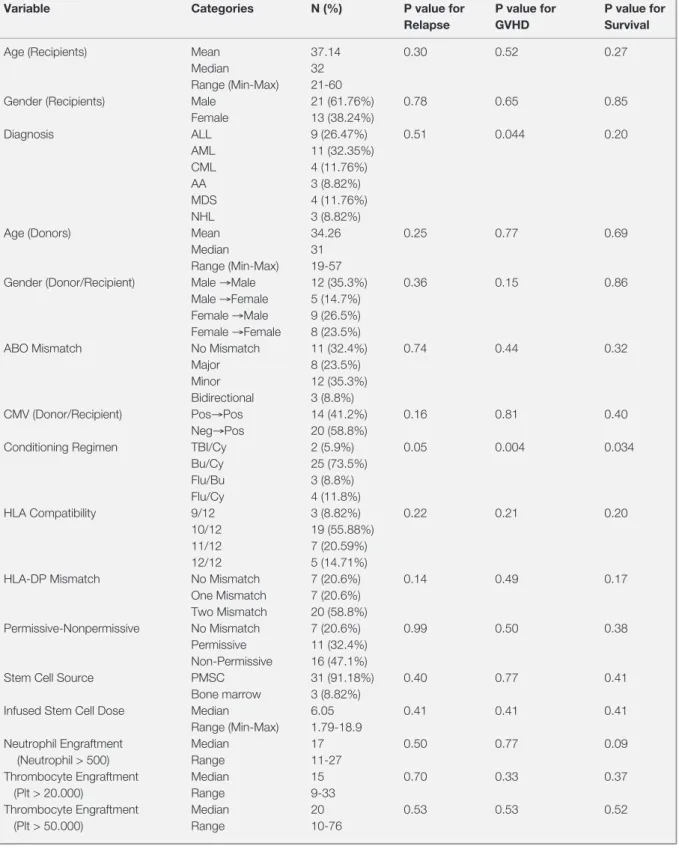
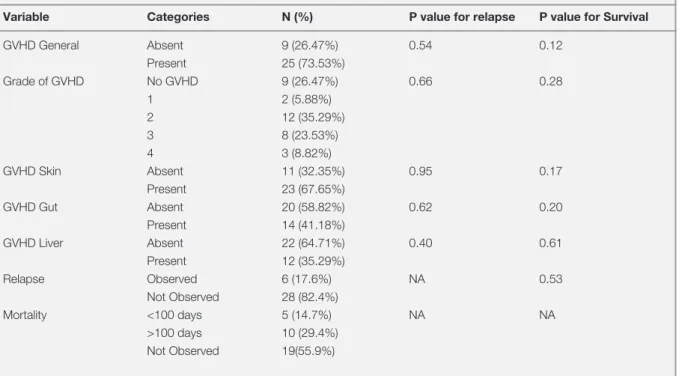
serology. During ASCT, TBI/Cy regimen was used in 2 (5.9%) transplants, Bu/Cy was used in 25 transplants (73.5%) , Flu/Bu regimen was used in 3 transplants (8.8%) and Flu/Cy regimen was used in 4 transplants (11.8%). As the stem cell source, PMSCs were used in 31 transplants, bone marrow harvested stem cells were used in 3 transplants. Median stem cell dose infused was 6.05x10⁶/ kg (Range: 1.79-18.9x10⁶). The combination of methotrexate, cyclosporine-A and ATG was used for GVHD prophylaxis in all patients. The disease status was complete remission in all recipients ex-cept for patients with aplastic anemia before ASCT. Main patient-, donor-, disease-, and transplantation characteristics and post-transplantation outcome are described in Table 1 and Table 2.
Donor/recipient HLA Matching Status and Testing for HLA-DPB1
HLA matching status was 9/10 for 7 (20.6%) recip-ient/donor pairs and 10/10 in 27 (79.4%) recipient/ donor pairs before DPB1 testing. After HLA-DPB1 testing, it was noticed that, the compatibil-ity of recipient/donor pairs was 9/12 in 3 (8.8%) transplants, 10/12 in 19 (55.9%) transplants, 11/12 in 7 (20.6%) transplants and 12/12 in 5 (14.7) transplants. Within 27 transplants presumed to be transplated with a 10/10 HLA matching status before HLA-DPB1 testing, only 5 of them was fully matched for HLA-DPB1 after testing was performed. In the remaining 22 transplants, there was at least one antigen level mismatch (5 one an-tigen mismatch, 17 two anan-tigen mismatch/full mis-match) according to HLA-DPB1 testing. Likely 7 transplants presumed to be transplated with a 9/10 HLA matching status before HLA-DPB1 testing, only 2 of them was fully matched for HLA-DPB1 after testing was performed. In the remaining 5 transplants, 2 of them were performed with one an-tigen mismatch and 3 of them were performed with fully mismatch in HLA-DPB1 testing. As a result, among the 34 transplant pairs, only 7 (20.6%) were full-matched for HLA-DPB1, whereas there were one antigen mismatch in 7 (20.6%) trans-plant pairs and 20 (58.8) transtrans-plant pairs were fully mismatched. Within 27 transplant pairs that have at least one antigen mismatch in HLA-DPB1,
UHOD
11 transplants was performed with permissive HLA-DPB1 mismatches and 16 transplants were performed with non-permissive HLA-DPB1 mis-matches.
Engraftment
Neutrophil and thrombocyte engraftment were suc-cessfully occurred in the entire study group.
Medi-an time to neutrophil engraftment (≥ 500/mm3) was
Table 1. Patient, donor, disease and transplantation characteristics and univariate analysis on relapse, GVHD and survival
Variable Categories N (%) P value for P value for P value for
Relapse GVHD Survival
Age (Recipients) Mean 37.14 0.30 0.52 0.27
Median 32 Range (Min-Max) 21-60
Gender (Recipients) Male 21 (61.76%) 0.78 0.65 0.85
Female 13 (38.24%) Diagnosis ALL 9 (26.47%) 0.51 0.044 0.20 AML 11 (32.35%) CML 4 (11.76%) AA 3 (8.82%) MDS 4 (11.76%) NHL 3 (8.82%)
Age (Donors) Mean 34.26 0.25 0.77 0.69
Median 31 Range (Min-Max) 19-57
Gender (Donor/Recipient) Male →Male 12 (35.3%) 0.36 0.15 0.86
Male →Female 5 (14.7%)
Female →Male 9 (26.5%)
Female →Female 8 (23.5%)
ABO Mismatch No Mismatch 11 (32.4%) 0.74 0.44 0.32
Major 8 (23.5%) Minor 12 (35.3%) Bidirectional 3 (8.8%)
CMV (Donor/Recipient) Pos→Pos 14 (41.2%) 0.16 0.81 0.40
Neg→Pos 20 (58.8%)
Conditioning Regimen TBI/Cy 2 (5.9%) 0.05 0.004 0.034
Bu/Cy 25 (73.5%) Flu/Bu 3 (8.8%) Flu/Cy 4 (11.8%) HLA Compatibility 9/12 3 (8.82%) 0.22 0.21 0.20 10/12 19 (55.88%) 11/12 7 (20.59%) 12/12 5 (14.71%)
HLA-DP Mismatch No Mismatch 7 (20.6%) 0.14 0.49 0.17
One Mismatch 7 (20.6%) Two Mismatch 20 (58.8%)
Permissive-Nonpermissive No Mismatch 7 (20.6%) 0.99 0.50 0.38 Permissive 11 (32.4%)
Non-Permissive 16 (47.1%)
Stem Cell Source PMSC 31 (91.18%) 0.40 0.77 0.41
Bone marrow 3 (8.82%)
Infused Stem Cell Dose Median 6.05 0.41 0.41 0.41
Range (Min-Max) 1.79-18.9
Neutrophil Engraftment Median 17 0.50 0.77 0.09
(Neutrophil > 500) Range 11-27
Thrombocyte Engraftment Median 15 0.70 0.33 0.37
(Plt > 20.000) Range 9-33
Thrombocyte Engraftment Median 20 0.53 0.53 0.52
UHOD
17 days (Range: 11-27 days), median thrombocyte
engraftment was 15 days (Range:9-33 days) for
platelets ≥ 20.000/mm3 and 20 days (Range:
10-76 days) for platelets ≥ 50.000/mm3. In
univari-ate analysis, while the conditioning regimen (p= 0.021) was a significant factor for neutrophil en-graftment time, HLA matching status (p= 0.71) and non permissive HLA-DPB1 mismatch (p= 0.46) found to be insignificant. Statistical analysis did not show any significant impact of HLA matching and HLA-DPB1 matching status on thrombocyte engraftment.
Analysis of Factors Influencing aGVHD
Among the entire study group, aGVHD was ob-served in 25 (73.5%) patients, that was graded as I to IV. In univariate analysis diagnosis of the patient (p= 0.044) and intensity of conditioning regimen (p= 0.004) were significant factors for develop-ment of aGVHD.
aGVHD was observed in all of the 3 patients trans-planted with 9/12 HLA matching status, 14 of the 19 patients transplanted with 10/12 HLA match-ing status, 6 of the 7 patients transplanted with 11/12 HLA matching status and 2 of the 5 patients
transplanted with 12/12 HLA matching status (p= 0.212).
According to HLA-DPB1 matching status, aGVHD was observed in 4 of the 7 patients transplanted with a fully matched HLA-DPB1 donor, 5 of the 7 patients transplanted with one antigen mismatched donor and 16 of the 20 patients transplanted with two antigen mismatched (fully mismatched) donor. (p: 0.494) 7 of the 11 patients transplanted with permissive mismatches and 14 of the 16 patients transplanted with non-permissive mismatches ex-perienced aGVHD (p= 0.082).
In the entire patient population, 23 patients (67.6%) experienced skin aGVHD ( Grade I: 4 patients, Grade II: 12 patients, Grade III: 5 patients, Grade IV: 2 patients), 14 patients experienced aGVHD of the gut (Grade I: 3 patients, Grade II: 7 patients, Grade III: 3 patients, Grade IV: 1 patient) and 12 patients experienced liver aGVHD ( Grade I 2 pa-tients, Grade II: 6 papa-tients, Grade III: 3 papa-tients, Grade IV: 1 patient). HLA matching status (p: 0.357), HLA-DPB1 compatibility (p= 0.549) and non-permissive HLA-DPB1 mismatches was not significant factors for skin GVHD. However, for aGVHD of the gut, while the HLA matching status (p= 0.627) and HLA-DPB1 mismatches (p= 0.547)
Table 2. Post-Transplantation Outcome and univariate analysis on relapse and survival
Variable Categories N (%) P value for relapse P value for Survival
GVHD General Absent 9 (26.47%) 0.54 0.12 Present 25 (73.53%) Grade of GVHD No GVHD 9 (26.47%) 0.66 0.28 1 2 (5.88%) 2 12 (35.29%) 3 8 (23.53%) 4 3 (8.82%) GVHD Skin Absent 11 (32.35%) 0.95 0.17 Present 23 (67.65%) GVHD Gut Absent 20 (58.82%) 0.62 0.20 Present 14 (41.18%) GVHD Liver Absent 22 (64.71%) 0.40 0.61 Present 12 (35.29%) Relapse Observed 6 (17.6%) NA 0.53 Not Observed 28 (82.4%) Mortality <100 days 5 (14.7%) NA NA >100 days 10 (29.4%) Not Observed 19(55.9%)
UHOD
were not significant, non-permissive mismatches were. (p: 0.006). Similarly, for the aGVHD of the liver, while HLA matching status (p= 0.249) and HLA-DPB1 mismatches (p= 0.423) were not sig-nificant, there was a medium level of significance of non-permissive mismatches (p= 0.054).
When the occurrence of severe (Grade III-IV) aG-VHD was taken into account, it has been observed that, 1 of 7 patients fully matched for HLA-DPB1 developed severe aGVHD, 1 of the 11 patients with permissive HLA-DPB1 mismatches devel-oped severe aGVHD, however 9 of the 16 patients with nonpermissive HLA-DPB1 mismatches de-veloped severe aGVHD (p= 0.019). This indicates that there may be significant correlation between the occurrence of severe aGVHD and nonpermis-sive mismatches.
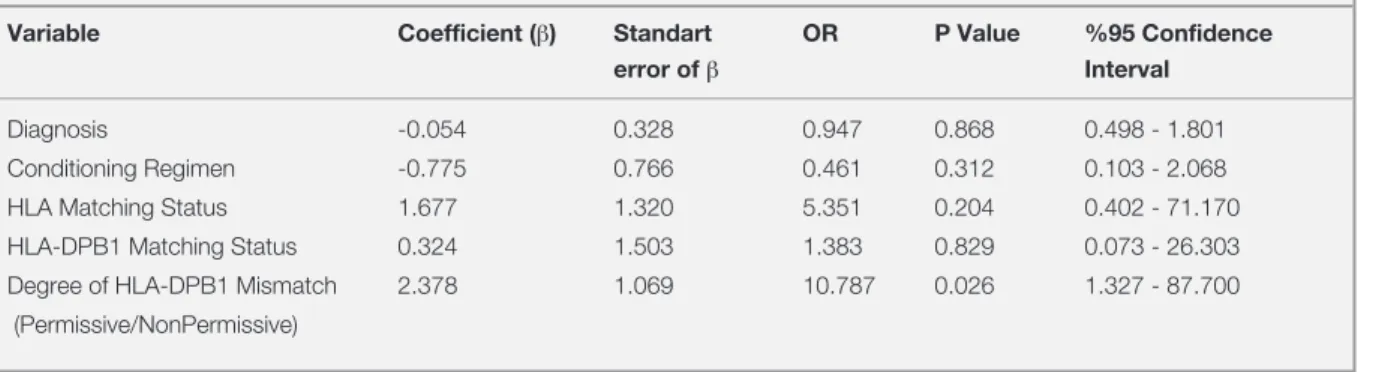
Multivariate analysis with the variables; diagno-sis, conditioning regimen, HLA matching status, DPB1 compatibility and degree of HLA-DPB1 mismatch (permissive vs.nonpermissive) have been performed showed that the degree of HLA-DPB1 mismatch was an independent factor for severe aGVHD (Table 3).
Disease Relapse and HLA-DP1 Status
Six patients (3 ALL, 1 AML, 1 high-risk MDS, 1 NHL patients) out of the 34 patients underwent a relapse. Among these 6 patients, 1 patient was fully matched for HLA-DPB1, 3 patients presented one antigen mismatch in HLA-DPB1 and 2 patients presented two antigen mismatch in HLA-DPB1. Statistical analysis did not show any significant impact of DPB1 mismatches on relapse. (p: 0.141)
Analysis of Factors Influencing the Survival
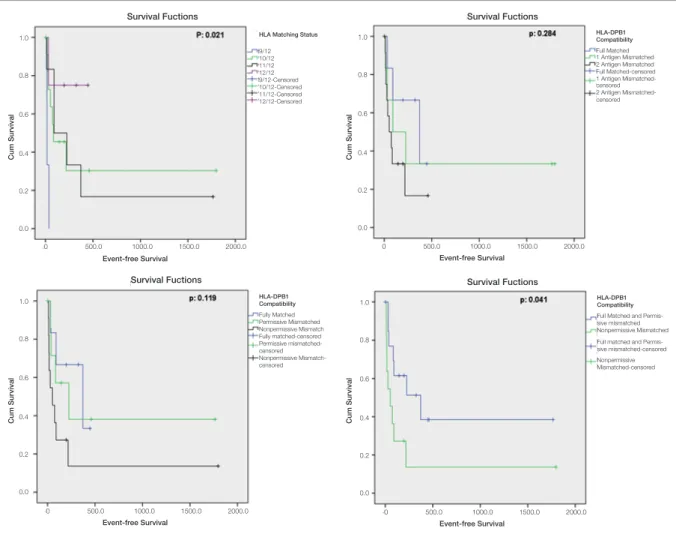
Estimated median event-free-survival (EFS) was 90 days (95% CI: 0-246.3) for entire patient group. Estimated median EFS was 17 days (95% CI : 13.7 - 20.2) for 9/12 HLA matching status, 84 days (95% CI: 0-229.6) for 10/12 HLA matching status, 90 days (95% CI: 0-260.4) for 11/12 HLA Match-ing status and it was not reached for 12/12 HLA matching status. (p: 0.021) For HLA-DPB1 fully matched patients, estimated EFS was 372 days (95% CI: 0-794.1). The estimated EFS was 90 days (95% CI: 0-324.0) for one antigen mismatch in HLA-DPB1 and 52 days (95% CI: 0-116.5) for two antigen mismatches in HLA-DPB1 (p= 0.284). In HLA-DPB1 permissive mismatched transplants, estimated EFS was 225 days (95% CI: 0-514.2), while it was 52 days (95% CI: 0-113.5) in nonper-missive mismatched transplants (p= 0.041) (Figure 1). Fifteen (%44.1) patients have died during the follow-up period. Transplant related mortality in first 100 days of ASCT was 14.7% (5 patients). 10 (29.4%) patients have been deceased after first 100 days of ASCT. Of those 15 patients, 13 of them ex-perienced aGVHD; the remaining 2 patients died of other causes, but not aGVHD (p= 0,035). All of the 3 patients transplanted with 9/12 HLA match-ing status, 8 of 19 patients transplanted with 10/12 HLA matching status, 2 of 7 patients transplanted with 11/12 HLA matching status, 2 of 5 patients transplanted with 12/12 HLA matching status have deceased (p= 0.208). Three of 7 patients fully matched for HLA-DPB1, 1 of 7 patients that have one antigen mismatch for HLA-DPB1 and 11 of 20 patients that have two antigen mismatch for HLA-DPB1 died during the follow-up period (p= 0.174). Three of 11 patients with permissive HLA-DPB1
Table 3. Binary logistic regression analysis of factors affecting severe GVHD
Variable Coefficient (β) Standart OR P Value %95 Confidence
error of β Interval
Diagnosis -0.054 0.328 0.947 0.868 0.498 - 1.801
Conditioning Regimen -0.775 0.766 0.461 0.312 0.103 - 2.068 HLA Matching Status 1.677 1.320 5.351 0.204 0.402 - 71.170 HLA-DPB1 Matching Status 0.324 1.503 1.383 0.829 0.073 - 26.303 Degree of HLA-DPB1 Mismatch 2.378 1.069 10.787 0.026 1.327 - 87.700 (Permissive/NonPermissive)
UHOD
mismatches and 9 of 16 patients with
nonpermis-sive HLA-DPB1 mismatches deceased in the fol-low-up (p= 0.329). 9/12 HLA matching status was a significant negative prognostic factor for survival when it is compared with 10-11-12/12 matching levels (p= 0.041). Another interesting finding was, while none of 7 the patients transplanted with a reduced intensity conditioning died in the follow-up period, all 15 patients that have deceased in the follow-up were transplanted with a myeloablative conditioning regimen (p= 0.017). However statisti-cal analysis did not show any significant factor in multivariate analysis.
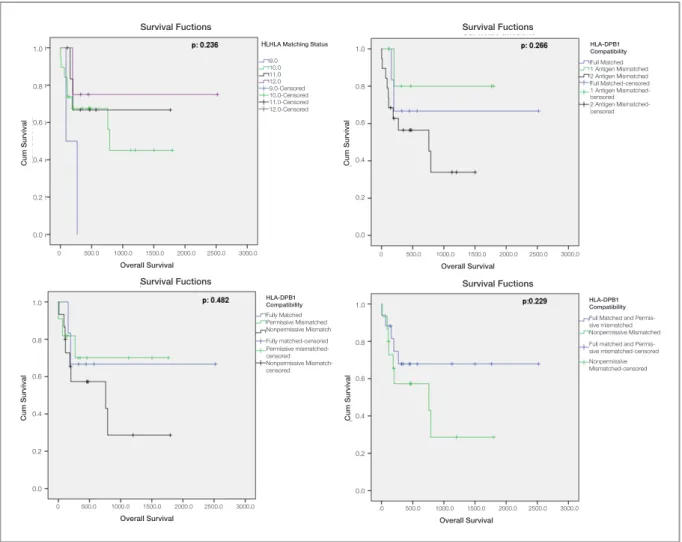
The mean overall survival (OS) was 1364 days in the entire patient group. The mean OS was 180 days (95% CI: 3.6-356.4) for 9/12 match-ing status, 1010.3 days (95% CI: 617.3-1403.3) for 10/12 matching status, 1236.1 days (95%
CI: 305.3-637.6) for 11/12 matching status and 1939 days for 12/12 matching status (p= 0.236). The estimated mean OS was 1738.8 days (95% CI: 854.8-2622.8) for HLA-DPB1 fully-matched transplants, 1476.8 days (95% CI: 917.2-2036.3) for HLA-DPB1 one antigen mismatched trans-plants and 731.7 days (95% CI: 424.0-1039.3) for two antigen mismatched transplants. (p= 0.266) The estimated mean OS was 1275.5 days (95% CI: 806.2-1744.8) for permissive HLA-DPB1 mis-matched transplants, while it was 788.2 days (95% CI: 369.7-1206.7) for nonpermissive HLA-DPB1 mismatched transplants (p= 0.229) (Figure 2).
DISCUSSION
HLA-DP molecules are known to have many func-tions in human body. They can be effective in
ei-Figure 1. Event-free-survival curves according to HLA matching status and HLA-DPB1compatibility HLA Matching Status
9/12 10/12 11/12 12/12 9/12-Censored 10/12-Censored 11/12-Censored 12/12-Censored HLA-DPB1 Compatibility Full Matched 1 Antigen Mismatched 2 Antigen Mismatched Full Matched-censored 1 Antigen Mismatched-censored 2 Antigen Mismatched-censored HLA-DPB1 Compatibility Full Matched and Permis-sive mismatched Nonpermissive Mismatched Full matched and Permis-sive mismatched-censored Nonpermissive Mismatched-censored HLA-DPB1 Compatibility Fully Matched Permissive Mismatched Nonpermissive Mismatch Fully matched-censored Permissive mismatched-censored Nonpermissive Mismatch-censored Survival Fuctions Survival Fuctions Survival Fuctions Survival Fuctions Event-free Survival Event-free Survival Event-free Survival Event-free Survival
Cum Survival Cum Survival
Cum Survival Cum Survival
1.0 0.8 0.6 0.4 0.2 0.0 1.0 0.8 0.6 0.4 0.2 0.0 1.0 0.8 0.6 0.4 0.2 0.0 1.0 0.8 0.6 0.4 0.2 0.0 0 500.0 1000.0 1500.0 2000.0 0 500.0 1000.0 1500.0 2000.0 0 500.0 1000.0 1500.0 2000.0 0 500.0 1000.0 1500.0 2000.0
UHOD
ther inducing T cell responses or in antigen pres-entation to T cells. As of HLA-DP does play a role in immunogenicity, associations have been shown between certain DPB1 alleles and susceptibility to
particular diseases.3-5 These observations shown
that the HLA-DP molecule can act as a transplanta-tion antigen. In transplant setting allogeneic HLA-DP-specific T cells have been identified in both
GVHD and GVL cases.6-9 However, the
impor-tance of this locus, as a transplantation antigen re-mained poorly understood. One of the reasons that this antigen has received less attention is the weak linkage disequilibrium, dependent on a recombina-tion hot spot between the HLA-DQ and DP loci. As a result, HLA-DPB1 disparity is reported to be present in up to 5-10% of siblings and in 60-90% of unrelated donor transplants. In accordance with the literature, HLA-DPB1 disparity in at least one
antigen level was 79.6% and only 20.6% of trans-plant pairs was fully identical for HLA-DPB1, in our study group. However HLA-DPB1 matching is not included in most donor selection procedures, despite growing evidence reporting a significant impact of disparity at this locus on post transplant complications.
On this subject, HLA-DP disparities and “T-cell epitope-based” HLA-DPB1 matching have
be-came a research interest by several groups.10-27 For
instance, in the study by Loiseau et al. reported increased frequency of severe aGVHD and poor-er survival in two HLA-DP incompatibilities in a
group of unrelated ASCT patients.10 In this study
they were not able show a significant relationship between HLA-DP mismatches and disease relapse. Later, Shaw et al. studied the importance of
HLA-Figure 2. Overall survival curves according to HLA matching status and HLA-DPB1compatibility HLA Matching Status
9.0 10.0 11.0 12.0 9.0-Censored 10.0-Censored 11.0-Censored 12.0-Censored HLA-DPB1 Compatibility Full Matched 1 Antigen Mismatched 2 Antigen Mismatched Full Matched-censored 1 Antigen Mismatched-censored 2 Antigen Mismatched-censored HLA-DPB1 Compatibility Fully Matched Permissive Mismatched Nonpermissive Mismatch Fully matched-censored Permissive mismatched-censored Nonpermissive Mismatch-censored HLA-DPB1 Compatibility Full Matched and Permis-sive mismatched Nonpermissive Mismatched Full matched and Permis-sive mismatched-censored Nonpermissive Mismatched-censored Survival Fuctions Survival Fuctions
Survival Fuctions Survival Fuctions Overall Survival Overall Survival
Overall Survival Overall Survival
Cum Survival Cum Survival
Cum Survival Cum Survival
1.0 0.8 0.6 0.4 0.2 0.0 1.0 0.8 0.6 0.4 0.2 0.0 1.0 0.8 0.6 0.4 0.2 0.0 1.0 0.8 0.6 0.4 0.2 0.0 0 500.0 1000.0 1500.0 2000.0 2500.0 3000.0 0 500.0 1000.0 1500.0 2000.0 2500.0 3000.0 0 500.0 1000.0 1500.0 2000.0 2500.0 3000.0 0 500.0 1000.0 1500.0 2000.0 2500.0 3000.0
UHOD
DP matching in recipients of T-cell depleted
unre-lated ASCTs.11 In this study, a significant decrease
in aGVHD and higher relapse rate was observed in fully matched HLA-DPB1 ASCTs. But there was no significant difference in engraftment times and OS. Gallardo et al. researched the importance of HLA-DPB1 mismatches in HLA-A-B-DRB1
iden-tical sibling ASCTs.12 In their report, increased
in-cidence of grade II-IV GVHD, have been observed in HLA-DPB1 mismatched transplantations. Inter-estingly, no significant difference was observed in terms of OS in this study. Thereafter, Zino et al, published their T-cell epitope based HLA-DPB1
matching results.13 In this study, the presence of
nonpermissive HLA-DPB1 mismatches was corre-lated with an increased risk of grade II-IV aGVHD and transplantation-related mortality (TRM) but not relapse, as compared with the permissive group. There was also a marked but statistically unsignifi-cant decrease in OS. Another article, that is pub-lished by Shaw et al, reported a higher relapse rate in HLA-DPB1-matched pairs as compared with HLA-DPB1-mismatched pairs in a group of 10/10
matched T-cell depleted unrelated ASCTs.14 In this
study, researchers observed a higher rate of aG-VHD, without a difference in TRM or OS in HLA-DPB1 mismatched transplantations. Fleischhauer et al reported an increased risk of graft failure with the presence of nonpermissive HLA-DPB1 mis-matches, in a group of unrelated ASCT for
beta-thalassemia patients.15 Interestingly there was not
increased risk of GVHD and decreased OS in non permissive HLA-DPB1 disparities in this study population. Later, Shaw et al once again analyzed the clinical importance of HLA-DPB1 in unrelated
ASCT.16-18 In this study HLA-DPB1 mismatch
pre-dicted an increased risk of aGVHD and the effect of HLA-DPB1 on relapse was significant only in patients matched for 10/10 alleles. There was an increased risk of mortality in the patients who were mismatched for HLA-DPB1, however this did not remain significant in multivariate analysis. In the study of Ludajic et al. HLA- DPB1 allele mis-matches were found to be significantly associated with an increased incidence of grade II-IV aGVHD
and worse overall survival.19 However HLA-DPB1
mismatches between recipients and donors had no influence on relapse in this study. In the study that Crocchiolo et al were published, there were
signifi-cantly higher probabilities of GVHD, graft failure and poor OS in permissive compared with nonper-missive transplantations [20]. In the study of Ka-wase et al, they identified 6 HLA- DPB1 mismatch combinations responsible for a decreased risk of
relapse.21 Pairs with these combinations of
HLA-DPB1 were associated with a significantly better overall survival than were completely matched pairs. Similarly, the study of Bettens et al also showed that HLA-DPB1 disparities have
signifi-cant impact in terms of aGVHD and OS.22
Unlike-ly, in the study of Touzeau et al from France, HLA-DPB1 non permissive disparities did not cause any adverse prognosis in terms of GVHD, survival or relapse in a series of patients who underwent 10/10
HLA matched unrelated ASCT.23 In the study of
Pi-dala et al, among 8/8 matched cases, HLA-DPB1 and -DQB1 mismatches resulted in increased aG-VHD, and HLA- DPB1 mismatch had decreased
relapse.24 In the study of Fleischhauer et al,
nonper-missive mismatches associated with higher risks of TRM compared to permissive mismatches or allele
matches.25 Another study from France, published
by Gagne et al. could only show an adverse prog-nosis in two HLA-DPB1 mismatches for severe
aGVHD.26 HLA-DPB1 disparities did not cause
a worse outcome in terms of relapse and overall survival in this study. Similarly, the results of Pan et al showed that the presence of HLA anti-bodies and their dynamic changes after transplan-tation were associated with increased occurrence of grades II to IV acute and chronic GVHD, higher treatment-related mortality, and reduced OS and
disease-free survival.27 There was no significant
difference in grades II-IV aGVHD, OS and disease free survival in patients receiving grafts from ei-ther HLA-DPB1 matched donors or HLA-DPB1 mismatched donors in this study. As we retrospec-tively examined our study group, we were not able to demonstrate the status of anti-HLA antibodies in our study group.
According to these data, the expected increase in the incidence of GVHD in HLA-DPB1 mis-matched transplants was observed in only some of the studies, while in some studies was not. And, the expected decrease in relapse and survival rate with the increased rate of GVHD could be observed in only some of those studies. It is obvious that the
UHOD
results of these studies are not uniform and some of these studies confirm the impact of HLA-DPB1 disparities on transplantation outcome, while some of them do not. In addition, most of the data re-garding this subject are obtained based on retro-spective or registry studies, which the results are difficult to interpret. Therefore, our results from Turkey are important from our study. In our Turk-ish patient group, we did not observe any signifi-cant impact of HLA-DPB1 matching and T-cell epitope based HLA-DPB1 mismatches either on engraftment or graft failure. When the occurrence of severe (Grade III-IV) aGVHD was taken into account, we have observed that, nonpermissive HLA-DPB1 mismatches was a significant fac-tor for development of severe aGVHD. Interest-ingly, there was a trend of increasing significance for the gut (p= 0.006) and liver (p= 0.054) GVHD but not for skin aGVHD in nonpermissive HLA-DPB1 mismatched transplantations which may be related with the negative impact of mismatched HLA-DPB1 in unrelated ASCT. In multivariate analysis, nonpermissive HLA-DPB1 mismatches also remained as an independent factor for severe aGVHD. Our results, did not show a significant impact of HLA-DPB1 mismatches on relapse. In survival analysis, both HLA-DPB1 disparities and non permissive mismatches showed a decreasing trend of event free and overall survival.
Nevertheless, we retrospectively examined the im-pact of HLA-DPB1 matching in 34 donor/recipi-ent transplant pairs in this study. The nature of the retrospective study method and the count of our sample size are the major limitations of our study. However the reported results are from a very rare patient group in the field of stem cell transplanta-tion. To our knowledge, our study is the first study that is reporting on this subject from Turkey. Ad-ditionally, our study also important because past reports never described the target organ of aGVHD in HLA-DPB1 mismatched transplantation. In conclusion, our results indicate that DPB1 HLA-DPB1 mismatch is common in Turkish society and increases the level of HLA mismatch. HLA-DPB1 disparities increase the risk and severity of aGVHD in unrelated ASCT. HLA-DPB1 disparities, espe-cially two antigen mismatches and non permissive
mismatches have negative impact on survival after unrelated ASCT. Considering these results during donor selection may improve transplant outcomes in the setting of unrelated ASCT.
REFERENCES
1. Shaw BE, Arguello R, Garcia-Sepulveda CA, Madrigal JA. The impact of HLA genotyping on survival following unrelated do-nor haematopoietic stem cell transplantation. Br J Haematol 150: 251-258, 2010.
2. Shaw BE, Robinson J, Fleischhauer K, et al. Translating the HLA-DPB1 T-cell epitope-matching algorithm into clinical practice. Bone Marrow Transplant 48: 1510-1512, 2013. 3. Yu M, Kinkel RP, Weinstock-Guttman B, et al. HLA-DP: a
class II restriction molecule involved in epitope spreading dur-ing the development of multiple sclerosis. Hum Immunol 59: 15-24, 1998.
4. Bugawan TL, Angelini G, Larrick J, et al. A combination of a particular HLA-DP beta allele and an HLA-DQ heterodimer confers susceptibility to coeliac disease. Nature 339: 470-473, 1989.
5. Begovich AB, Bugawan TL, Nepom BS, et al. A specific HLA-DP beta allele is associated with pauciarticular juvenile rheu-matoid arthritis but not adult rheurheu-matoid arthritis. Proc Natl Acad Sci USA 86: 9489–9493, 1989.
6. Gaschet J, Gallot G, Ibisch C, et al. Acute graft-versus-host disease after bone marrow transplantation with a single HLA- DPB1*1001 mismatch: involvement of different TCRBV sub-sets. Bone Marrow Transplant 22: 385-392, 1998.
7. Ibisch C, Gallot G, Vivien R, et al. Recognition of leukemic blasts by HLA-DPB1-specific cytotoxic T cell clones: a per-spective for adjuvant immunotherapy post-bone marrow transplantation. Bone Marrow Transplant 23: 1153-1159, 1999.
8. Rutten CE, van Luxemburg-Heijs SA, Griffioen M, et al. HLA-DP as specific target for cellular immunotherapy in HLA class II-expressing B-cell leukemia. Leukemia 22: 1387-1394, 2008. 9. Herr W, Eichinger Y, Beshay J, et al. HLA-DPB1 mismatch
alleles represent powerful leukemia rejection antigens in CD4 T-cell immunotherapy after allogeneic stem-cell transplanta-tion. Leukemia 31: 434-445, 2017.
10. Loiseau P, Espérou H, Busson M, et al. DPB1 disparities contribute to severe GVHD and reduced patient survival after unrelated donor bone marrow transplantation. Bone Marrow Transplant 30: 497-502, 2002.
11. Shaw BE, Potter MN, Mayor NP, et al. The degree of matching at HLA-DPB1 predicts for acute graft-versus-host disease and disease relapse following haematopoietic stem cell transplan-tation. Bone Marrow Transplant 31: 1001-1008, 2003.
UHOD
12. Gallardo D, Brunet S, Torres A, et al. Hla-DPB1 mismatch in HLA-A-B-DRB1 identical sibling donor stem cell transplanta-tion and acute graft-versus-host disease. Transplantatransplanta-tion 77: 1107-1110, 2004.
13. Zino E, Frumento G, Marktel S, et al. A T-cell epitope encoded by a subset of HLA-DPB1 alleles determines nonpermissive mismatches for hematologic stem cell transplantation. Blood 103: 1417-1424, 2004.
14. Shaw BE, Marsh SG, Mayor NP, et al. HLA-DPB1 matching status has significant implications for recipients of unrelated donor stem cell transplants. Blood 107: 1220-1226, 2006. 15. Fleischhauer K, Locatelli F, Zecca M, et al. Graft rejection after
unrelated donor hematopoietic stem cell transplantation for thalassemia is associated with nonpermissive HLA-DPB1 dis-parity in host-versus-graft direction. Blood 107: 2984-2992, 2006.
16. Shaw BE, Gooley T, Madrigal JA, et al. Clinical importance of HLA-DPB1 in haematopoietic cell transplantation. Tissue Anti-gens 69 Suppl 1: 36-41, 2007.
17. Shaw BE, Gooley TA, Malkki M, et al. The importance of HLA-DPB1 in unrelated donor hematopoietic cell transplantation. Blood 110: 4560-4566, 2007.
18. Shaw BE. The clinical implications of HLA mismatches in un-related donor haematopoietic cell transplantation. Int J Immu-nogenet 35: 367-374, 2008.
19. Ludajic K, Balavarca Y, Bickeböller H, et al. Impact of HLA-DPB1 allelic and single amino acid mismatches on HSCT. Br J Haematol 142: 436-443, 2008.
20. Crocchiolo R, Zino E, Vago L, et al ; Gruppo Italiano Trapianto di Midollo Osseo, Cellule Staminale Ematopoietiche (CSE) e Terapia Cellulare; Italian Bone Marrow Donor Registry. Non-permissive HLA-DPB1 disparity is a significant independent risk factor for mortality after unrelated hematopoietic stem cell transplantation. Blood 114: 1437-1444, 2009.
21. Kawase T, Matsuo K, Kashiwase K, et al. Japan Marrow Donor Program. HLA mismatch combinations associated with decreased risk of relapse: implications for the molecular mechanism. Blood 113: 2851-2858, 2009.
22. Bettens F, Passweg J, Schanz U, et al. Impact of HLA-DPB1 haplotypes on outcome of 10/10 matched unrelated hemat-opoietic stem cell donor transplants depends on MHC-linked microsatellite polymorphisms. Biol Blood Marrow Transplant 18: 608-616, 2012.
23. Touzeau C, Gagne K, Sébille V, et al. Investigation of the im-pact of HLA-DPB1 matching status in 10/10 HLA matched unrelated hematopoietic stem cell transplantation: results of a French single center study. Hum Immunol 73: 711-714, 2012. 24. Pidala J, Lee SJ, Ahn KW, et al. Nonpermissive HLA-DPB1
mismatch increases mortality after myeloablative unrelated al-logeneic hematopoietic cell transplantation. Blood 124: 2596-2606, 2014.
25. Fleischhauer K, Fernandez-Viña MA, Wang T, et al. Risk as-sociations between HLA-DPB1 T-cell epitope matching and outcome of unrelated hematopoietic cell transplantation are independent of HLA-DPA1. Bone Marrow Transplant 49: 1176-1183, 2014.
26. Gagne K, Loiseau P, Dubois V, et al. Is there any impact of HLA-DPB1 disparity in 10/10 HLA-matched unrelated hemat-opoietic SCT? Results of a French multicentric retrospective study. Bone Marrow Transplant 50: 232-236, 2015.
27. Pan Z, Yuan X, Li Y, et al. Dynamic Detection of Anti-Human Leukocyte Antigen (HLA) Antibodies but not HLA-DP Loci Mismatches Can Predict Acute Graft-versus-Host Disease and Overall Survival in HLA 12/12-Matched Unrelated Donor Allogeneic Hematopoietic Stem Cell Transplantation for He-matological Malignancies. Biol Blood Marrow Transplant 22: 86-95, 2016.
Correspondence:
Dr. Bulent KANTARCIOGLU Medipol Mega Hospital Complex Hematology Klinigi
TEM Avrupa Otoyolu Goztepe Cikisi No: 1, Bagcilar 34214
ISTANBUL / TURKEY Tel: (+90-532) 547 62 08