IC
ON
A
RP
ICONARP International Journal of Architecture & Planning Received 13 October 2016; Accepted 18 November2016 Volume 4, Issue 2, pp: 35-57/Published 20 December 2016 DOI: 10.15320/ICONARP.2016.8 - E-ISSN: 2147-9380
Abstract
A special case of transforming churches into mosques was practiced after the population exchange agreement signed on 1923 between Greece and Turkey, which forced thousands of Greeks and Turks to migrate. The churches in Ayvalık, turned into mosques by incoming Turkish migrates, are representatives of this last practice. This paper discusses the concepts of appropriation and authenticity via examining the changes introduced in the form of alterations, additions and removal during the transformation of Ayvalık churches into mosques. This discussion is contextualized within the broader issue of appropriating past buildings and it has been argued that understanding of authenticity cannot be limited to the original meaning when the building was first designed and appropriated meaning can be as authentic as the original meaning.
Appropriation and
Authenticity: The case of
Transforming Churches
into Mosques in Ayvalık
Yasemin İnce Güney*
Keywords: Appropriation, authenticity, Ayvalık, Kydonies, churches, mosques, re-use *Assoc..Prof..Dr..Balıkesir.University.Department of Architecture, Balıkesir, Turkey.E-mail:[email protected]
32 0/ IC O N ARP. 20 16 .8 – E -I SSN : 2147 -9 38 0 INTRODUCTION
The concept of authenticity as discussed in architectural discourse refers to something being true to its origin. As such authenticity of a human habitat refers to the original intention of the designer and the users of this habitat to construct it in the first place. However, within history it is witnessed that once the current function of a building become obsolete, people give them a new purpose for existence. As such authenticity cannot be equal to those properties of an environmental form that is given to it by its first designer and users. Rather, the concept of authenticity should be understood as the specific properties of the relationship between that environmental form and its users at different times. Authenticity understood as a relationship refers to the process that involves an act of appropriation. To appropriate, i.e. to make one’s own what was initially alien, requires a fresh attitude from the people towards the environment. In this paper, transformation of churches into mosques in Anatolian town of Ayvalık will be examined as a case study to explore the concepts of appropriation and authenticity. Hagia Sophia is one of the well-known examples of Ottoman practice of turning churches into mosques. Built as the new Cathedral of Constantinople of the Byzantine Empire by Emperor Justinian in 532-537 CE, Hagia Sophia was transformed into a Muslim mosque after the Ottomans conquered the city in 1453. Indeed, since the first days of Islam, Muslims transformed the existing religious buildings into mosques in towns that they conquered. The Umayyad Mosque in Samarra, known earlier as St. John’s Church, is one of the earliest examples of this practice. There might be quite a number of reasons that enabled to transform churches into mosques and one of them might be related to Islamic world view. According to Islamic thought, since everything in this world is created by the will of God, the environment, man-made as well as natural, are considered Islamic in origin. Because of that, according to (Kuban, 1998), it is not possible to think that any building with any kind of form might be against Islamic ideology. However, it should also be noted that converting a religious building from one to another was not unique to Muslims. After Spanish army conquered Spain in 1492 and ended the Islamic Empire that lasted for about 700 years in Spain, they transformed Cordoba Mosque into a cathedral in 1523. In other words, it might be possible to say that there was a general attitude of acceptance towards converting religious buildings and in general appropriating past buildings for new functions. Today, it is not even possible by most to accept the idea of converting a religious building.
ICO N ARP - V olu m e 4, Is su e 2 / Pu bli shed : D ecemb er 20 16
In this paper, a specific case of this transformation process is being examined. The 19th century Greek orthodox churches in Ayvalık, a small coastal town on western Anatolia, had been transformed into mosques by incoming Turkish migrants who were displaced after the 1923 population exchange agreement in accordance with the Treaty of Lousanne that was signed between Greece and the newly established Turkish Republic. Although most of the churches were transformed into mosques, in time only three of them were able to keep their function as mosques. Others functioned as tobacco depots and one as oil factory until 1984 protection law that left them unoccupied and in turn caused them to be in ruins. This study will enable us to examine and discuss the attitude of incoming Turkish migrants to these churches, which will help us to discuss the nature of appropriation and relate it to the idea of authenticity. It is also expected that this discussion will lead to contemplating and questioning our attitudes towards appropriating past buildings. The paper first presents a brief history of the context of the study, the town of Ayvalık and then proceeds to describe the churches that are the subject of the study. The next section includes the examination of the transformation process of these churches into mosques after the population exchange agreement. The paper concludes with a discussion of appropriation and authenticity concepts during this transformation process.
AYVALIK: A SMALL ANATOLIAN TOWN
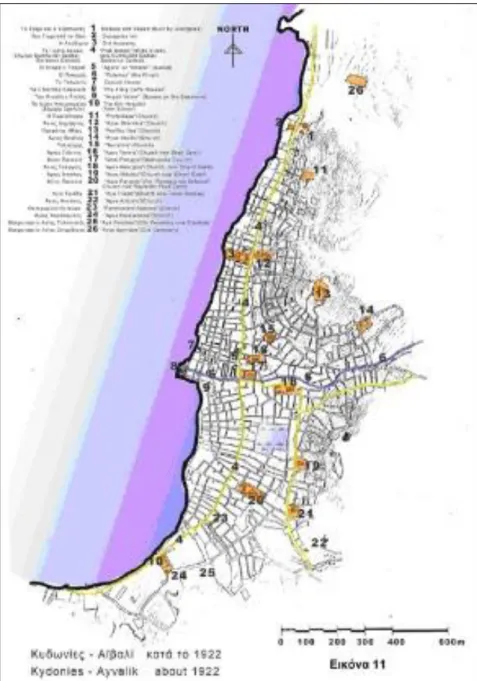
Located on the Aegean cost of Anatolia across from Midilli Island, Ayvalık was first known in history as Kydonies, a tiny port used by the pirates of the Mediterranean (Fig.1). It was named after quince fruit trees and its name ‘Ayvalık’ in Turkish and ‘Kydonies’ in Greek both means place with quince fruit trees. It was established as a settlement in the late 16th century by the Greek migrates from Midilli. After 1770s, Ayvalık started to flourish as did the coastal towns of the period due to their becoming trade and education centers. It was also around this time that Greeks under Ottoman rule gained some economic and social privileges based on the Küçük Kaynarca Treaty. Ayvalık, for example, had established an independent Greek municipality in 1773 and the Academy of Kydonies was established in 1803 as one of the few Greek academies permitted to open on western Anatolia, the others being in Izmir (1733), Sakiz (1792) and Istanbul (1804) (Arıkan, 1988; Clogg, 1972; Erim & Uygur, 1948). During this period, Turkish population had to leave the town except for the government workers and their families, who then lived in Sakarya neighborhood.
32 0/ IC O N ARP. 20 16 .8 – E -I SSN : 2147 -9 38 0
It was also around this time that Greeks under the Ottoman rule in Anatolia started to feel connected culturally and socially to newly established Greece sharing the same Greek past. As a result, there was an upheaval in 1821 mimicking the Greek revolution in the Balkans, when the town was completely demolished together with its eight churches. After the upheaval ended, which left the town in ruins, the Greek population had to flee the town. Only after 1832 decree that enabled them to move back in their homes that the town started to be reconstructed. It took until 1880s for the town to gain its prosperity back. The churches that were demolished during the upheaval were reconstructed, usually in bigger sizes, and some new ones were Figure 1. Ayvalik in
1922, (Psarros, 2004)
ICO N ARP - V olu m e 4, Is su e 2 / Pu bli shed : D ecemb er 20 16
added. By late 19th century, Ayvalık had a population of twenty-two thousand, eleven neighborhoods and fourteen churches (11 in city center and 3 in nearby Alibey Island) along with forty olive oil and thirty soap factories (Bayraktar, 1998; Psarros, 2004). The oil and soap produced in the town were not only sold in Istanbul but also exported to Balkans, Marsalis and even to Russia. The city’s importance was also reflected in the embassies opened in the town, including the embassies of Greece, Britain, Italy, France and Norway. Sir Charles Elliot defined the town at this time as the “Boston of the East” with its beautiful streets, parks, academia, library and loyal residents (Arıkan, 1988). With its population getting closer to thirty-thousand, Ayvalık was a metropolitan during the late 19th century.
One can only imagine the chaos that Greek and Turkish migrants lived, who left all their belongings together with their past lives and past histories back in their home in Ayvalık, Girit, Midilli or Macedonia. (Cengizkan, 2004a, 2004b; Güvenç, 2011; Pekin, 2005; Tosun, 2002) For all of them, it sure had to be a difficult process to make their new homes in the places they started to live in. In Ayvalık, there was no new construction or restoration of existing buildings until 1934 law that gave the migrants the ownership of the houses that they were living in. Yet, it was only after a decade in 1944 when the town was hit by a major earthquake considerably damaging the existing building stock. The 1944 earthquake forced the government to focus on the town’s development. The first city plan of Ayvalık in 1947 proposed a driveway on the shore, which opened in 1950, connecting the city to the country’s major road network (İpek, 2003; Şahin, 1986). Until then, Ayvalık was a port-town on the shore that used sea transportation to connect to the world. It’s being on the sea-line between Istanbul and Izmir provided to the city major advantages over the centuries. The oil and soap factories, for example, were constructed next to the sea to ease the problem of transportation. The new driveway damaged the city’s connection to the sea but it helped the city to get connected to the country.
Due to the growing interest in the city, there was a major study conducted in 1964 by Istanbul Technical University Department of Urban Planning. The study examined the city history as well as its economic and social structure and proposed the town to be promoted as a tourist attraction site due to its well-preserved architecture that reflects the 19th century social and cultural life. With the increased touristic activity, national at first, new buildings started to be constructed causing the historic structures to be demolished. To preserve the architectural and
32 0/ IC O N ARP. 20 16 .8 – E -I SSN : 2147 -9 38 0
cultural heritage, the town has been accepted as natural and historical site in 1976 which stopped the construction within the boundaries of the historic city. Especially after 1984 study by Ministry of Culture and Tourism, the town was promoted and advertised to become a famous tourist attraction. The shift in the economy of the town from industry to tourism was also highlighted in 1985 Ayvalık master plan that suggested having pilot areas and pilot buildings to be restored and used for touristic activities (İpek, 2003). Today, not only national but also international tourists, 60% of whom are Greeks from close by islands, visit the town often.
AYVALIK CHURCHES
Along with the tall oil-factory chimneys, the churches in Ayvalık, with their size, height and form are the most dominant features in the city silhouette. These churches, though considered as part of Byzantine Orthodox churches, present original regional architectural features as the last Greek Orthodox churches constructed on western Anatolia and have been extensively studied since 1990s (Akın, 1998; Akpınar, 2012; Aktepe, 1994; Nigdelioglu, 2000; Psarros, 2004; Uçar & İnce Güney, 2007). Of the fourteen churches that are known to exist in Ayvalık by late 19th century, eleven were located in the town center and three in nearby Alibey (named earlier as Cunda) Island. Today, only six of these churches still exist in the town center: Taksiarhis, Hagia Triada, Kato Panayia (Hayrettin Paşa Mosque), Hagios Ioannes (Saatli Mosque), Hagios Georgios (Cınarlı Mosque) and Feneromeni (Ayazma) churches. There is also a smaller privately owned church that needs to be mentioned: Portaitissa church located within the garden of the house that belonged to the bishop of Taksiarhis. It is known that the bishop held smaller ceremonies here during the weekdays and went to Taksiarhis only for Sunday public gatherings. Of the other churches—Hagios Dimitrios, Messi Panayia, Hagia Nikholaos and Profitis Ilias—some had been demolished during the war and some during the early Republican period and we only know their location1.
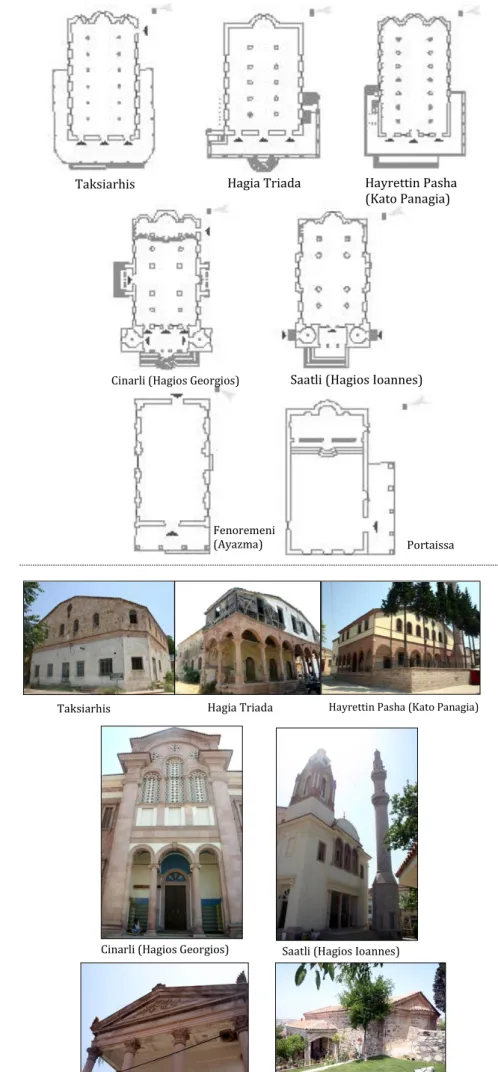
In this paper, I will focus on and examine the seven churches, including the privately owned Portaitissa, which still exist today in Ayvalık city center. Of the seven examined churches, three of them have rectangular basilical plans, two of them belong to cruciform plan typology that emphasizes centrality and the other two have plans with a single nave (Fig. 2a and 2b).
1. Hagios Dimitrios has been used as a mosque until 1944 earthquake and then as an atelier for the nearby school. In time however, it was left to be demolished instead of being taken care of. A new building is erected on its place today. Profiti Elias, which is located on the highest hill in Ayvalık was constructed in 1835 and we have its pictures that show its bell tower as well. Messia Panagia, next to the bazaar area in the metropolitan center, was completely demolished in a fire during the republican period. We have no idea how Hagios Nichalous was demolished (Uçar & İnce Güney, 2007).
ICO N ARP - V olu m e 4, Is su e 2 / Pu bli shed : D ecemb er 20 16
Taksiarhis Hagia Triada Hayrettin Pasha
(Kato Panagia)
Cinarli (Hagios Georgios) Saatli (Hagios Ioannes)
Portaissa Fenoremeni
(Ayazma)
Figure 2a. Schematic plans of
the church buildings that still exist in Ayvalik (İpek, 2003).
Figure 2b. Pictures of church
buildings that still exist in Ayvalık (İnce Güney, 2007). Taksiarhis Hagia Triada Hayrettin Pasha (Kato Panagia)
Cinarli (Hagios Georgios) Saatli (Hagios Ioannes)
Fenoremeni (Ayazma) Portaissa
32 0/ IC O N ARP. 20 16 .8 – E -I SSN : 2147 -9 38 0
All of the churches with basilical plans had been constructed around the same time: Taksiarhis in 1844, Hagia Triada in 1846 and Kato Panagia in 1850.2 The plan typology of these churches
are very similar to the early church form of a rectangular hall, that is timber roofed, with two aisle on each side of the larger central nave, a sanctuary to the east and the principle entrance to the west. Taksiarhis, Hagia Triada and Kato Panagia also consist of a rectangular building running on east-wes t direction and enclosing the nave and the sanctuary. The U-form narthex surrounds the western end of these rectangular buildings though in Hagia Triada the narthex is closer to an L-form. The top part of the narthex is used as logia and reached via two staircases located on the northern and southern ends of the narthex.
Although they have similar basilical plans, these churches differ in terms of their sizes: Hagia Triada covers an area of 400sqm, Taksiarhis 500sqm, and Kato Panagia 750sqm. Kato Panagia, one of the three mosques used today, is the largest church in town in terms of its size. The difference in their sizes reflected in the number of columns placed between the central and side aisles— five in Hagia Triada, six in Taksiarhis, and seven in Kato Panagia. These equal-sized columns emphasize the east-west direction within the church interior.
Another common feature of these basilical churches is their collar braced roof made of timber. The ceiling over the central nave is higher then the side aisles and this enables to have roof windows over the central nave creating a unique interior atmosphere. This is a special characteristic of these churches that distinguishes them from similar basilical churches of Midilli Island (Psarros, 2004).
Except Hagia Triada with a single apse, the other two have three apses on their eastern walls. On their western walls, after the narthex, all of them have three entrances. The door in the center is larger then the doors on the sides. There are templons, icon covered screens, that separate the nave from the sanctuary in Kato Panagia and Taksiarhis churches, and there is no sign of a templon in Hagia Triada. Templons not only separate the sanctuary from the rest of the nave but also encloses the altar as well. On the surface of the templon, there are two kinds of entrances that lead from the nave to the sanctuary area: the main one in the middle of the templon known as “beautiful gate” from which only the clergy could pass, and the others on one or both sides of this door. The beautiful door is always more decorated then the others. In Kato Panagia and Taksiarhis, there is also a separate entrance to the sanctuary area from outside. This door does not exist in Hagia Triada.
2. In a small town in Ayvalık region, Kucukkoy, there is another basilical church, Hagios Athanasios which was constructed in 1840 (Uçar & İnce Güney, 2007).
ICO N ARP - V olu m e 4, Is su e 2 / Pu bli shed : D ecemb er 20 16
It is known that Taksiarhis Church located on Ismetpasha neighborhood has been constructed by builders Voyanikos and Yannis on the location of a church that was demolished earlier. The second inscription found on the exterior wall of the church indicates that this earlier church was constructed in 1753. The court in which the church is located is enclosed with high walls and covers an area of 1200sqm. At the corner of the court a monumental entrance door exists, which is reached from the street level via couple of circular-stairs. The bell tower that is known to be located on top of this door structure does not exist today. There is a small square in front of this monumental door and across the door is the main axis leading to the town center. Kato Panagia Church, located in Hayrettin Pasha neighborhood, also has a court that is covered with high walls enclosing an area of 4000sqm. In addition to its being the largest church in terms of its size, Kato Panagia has the court with the largest area as well. Hagia Triada, on the other hand, does not have high walls surrounding its court today. Still, from the foundation of these walls that can bee seen on the ground today, it is clear that once Hagia Triada also had a court. Hagia Triada differs from the other churches with its ceiling that is covered with intricate wooden decorations. Another characteristic feature of Hagia Triada is its circular-formed stairs leading to the narthex. The only other circular stair leading to the narthex is found on Hagia Georgias. After 1870s, the basilical plan typology was discontinued and in the new churches cruciform plan typology was used together with neoclassical treatment of the facades. Hagia Ioannes (1870) and Hagios Georgias (1880) churches are the only representatives of this plan typology in Ayvalık town center. Taksiarhis Church in Alibey Island (1873), currently damaged considerably waiting to be renovated, is the only other church that share the cruciform plan typology in Ayvalık region. All three of these churches had been designed by the same architect from Ayvalık, Emmanues Kounas (Psarros, 2004). Hagios Ioannes Church, located in Fevzipasha neighborhood and constructed in 1870, covers an area of 375 sqm and its court covers an area of 1250sqm. The other church with cruciform plan, Hagios Georgias, located in Hamdibey neighborhood, is much bigger covering an area of 600sqm and its court 2800sqm. Hagia Ioannes and Hagios Georgias churches belong to cruciform plan typology but they are rectangular in form. Similar to square Byzantine churches which emphasize Greek-cross form in their plan, the cruciform in the plan of these churches has been emphasized with four bigger columns that are located at the centre and carry the dome on top, which is located on the
32 0/ IC O N ARP. 20 16 .8 – E -I SSN : 2147 -9 38 0
octagonal drum. At the center of these bigger columns are found wooden columns just as the others that are circular, but their sizes are increased and their form became rectangular due to the additional brick wall that surrounds them. The transept is emphasized in Hagia Ioannes as mere facade treatments, though they become entrances with narthexes in Hagios Georgias. The vaulted roofs over both ends of the central nave and the transept further emphasize the cruciform typology.
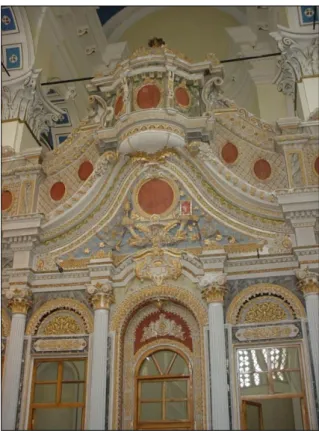
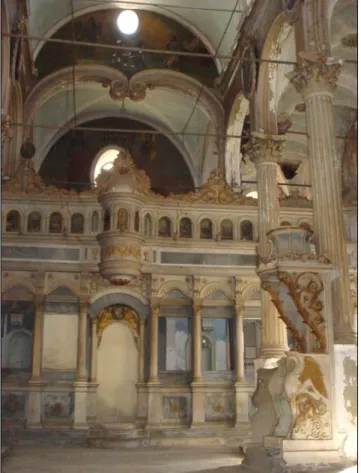
In both of the churches, the stairs leading to the logia on top of the nartex have been located within a tower on both ends of the narthex. In Hagios Georgias, the entrances to these towers are directly provided from the narthex while in Hagios Ioannes they are from the garden. In Hagios Georgias, the staircase towers are not emphasized in the elevation. In Hagios Ioannes, on the other hand, the tower on the north has been made taller (36m) to be a bell tower. In both of the churches, the apses on the eastern wall are polygonal in form unlike all the basilical churches in which they are circular. Unlike Hagias Ioannes that does not have a templon, Hagia Georgias has a highly decorated templon that separates sanctuary from the nave (Fig. 3).
Feneromeni (Ayazma) and Portaitissa Churches have single naves as they are much smaller then the other basilical and cruciform churches. Unlike Orthodox churches with single naves, that were usually constructed in out of town places, these churches are located within Ayvalık town center. Portaitissa is a Figure 3. The current situation
of templon in Hagios Georgios (İnce Güney, 2007)
ICO N ARP - V olu m e 4, Is su e 2 / Pu bli shed : D ecemb er 20 16
very small private church located within the garden of the house of the bishop. It is known that the bishop held ceremonies in this church during the weekdays and went to Taksiarhis only for Sunday sermons. Since it was owned privately, earlier studies might have not mentioned it and yet it should be recognized as part of the Ayvalık churches and be protected. Feneromeni (Ayazma) church is known for its sacred wells, one inside and one on its garden. Summer times, you can still see Greek people who come and visit this particular church.
Feneromeni (Ayazma) church also requires special attention as it is the only church that has the form of a Greek temple. It was the latest constructed church, in 1898, and shows distinct qualities from the other Greek Orthodox churches in town especially in terms of the treatment of its elevation: It was built in the form of a Greek temple unlike any other church in town. It is known that since 1870s, the growing influence of neoclassism had been affecting the styles in Ayvalık churches. But deliberate use of Greek temple front also suggests the influence of nationalist ideas. Considering the growing influence of nationalism during the late 19th century among the Greek population in Ayvalık and the symbolic value of Greek temple form, it might be possible to think that the building was constructed not only as a spiritual building but also as a symbol of Ancient Greek democracy that Greek population on Ayvalık admired and wanted to have. AFTER THE POPULATION EXCHANGE: THE PROCESS OF APPROPRIATION
It is known that most if not all the churches were turned into mosques in 1923 by incoming Turkish migrants when they first arrived in Ayvalık. The smaller church, Portaissa, was never used as a mosque as it has always been a private property and used as mere depot. It is known that Fenoremeni church was used for a short while as a mosque by incoming Turkish migrants. However, after the imam left the town the building was left unoccupied for a while and later was rented to a private company
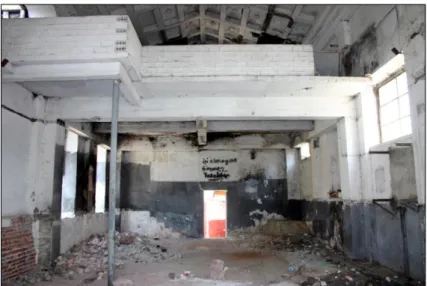
Feneromeni church was first turned into a depot by the private company. During this time, a galleria was added on the eastern part of the nave, which was reached via the staircases added at the back. Because of the alteration on the east wall, it is not clear even today if Feneromeni ever had an apse or not (Fig. 4). Later, it was transformed into an olive oil factory. During this period, the interior decorations were damaged and as much damage was given to the outside. The narthex was enclosed and a chimney was constructed running through the ceiling of the narthex. Since
32 0/ IC O N ARP. 20 16 .8 – E -I SSN : 2147 -9 38 0
1984, it has been unoccupied and vandalized during the nights and weekends.
It is known that at first Hagia Triada was also used as a mosque as its old name indicates: Biberli Mosque. Similar to Feneromeni, it was later turned into a tobacco depot when a second floor was constructed to have extra space (Fig. 5). The bell tower that is known to exist has been demolished, most probably during the 1944 earthquake, and there is no sign of the bell as well. After the 1984 law that aimed to preserve the cultural heritage sites, the building was left unoccupied. Because of the unrepaired damage on the roof that let the rain water inside, the wooden ceilings damaged first and then eventually all the interior.
Hagia Triada is the church with the most damage and none of the features found inside a typical Greek orthodox church, such as ambon and raised throne for the bishop, exist today. There is Figure 4. Inside of Feneromeni
Church (İnce Güney, 2007)
Figure 5. Inside Hagia Triada
Church (İnce Güney, 2007)
ICO N ARP - V olu m e 4, Is su e 2 / Pu bli shed : D ecemb er 20 16
also no sign of templon in Hagia Triada even though the door on the southeastern corner leading from the outside to the sanctuary area suggests its existence. The only hint that let us a glimpse of the interior of the church is the damaged ceiling covered with timber ornate.
We have no information if Taksiarhis was ever used as a mosque but we know that it was used as a depot. During this time, the arches in the narthex were enclosed with walls and a sleeping corner for the guard was installed in this area. After 1984 law, Taksiarhis was also left unoccupied. However, it was selected as the pilot building to be renovated in 1985 Ayvalık master plan that suggested restoring historic structures to be used for touristic activities. The building was renovated together with the smaller buildings next to it. This was a short lived experience and the building was left unoccupied after a short while. However, the increased attention to this building due to increased publication has caused dearly as it became a target at nights for people searching for treasures. Despite the damages, the highly decorated templon inside the building is intact even today, though its icons had been stolen. The bishop’s throne as well as the ambon still exist, albeit damaged, while the stairs leading to the ambon is missing (Fig. 6).
Figure 6. Inside Taksiarhis
Church (İnce Güney, 2007)
32 0/ IC O N ARP. 20 16 .8 – E -I SSN : 2147 -9 38 0
When the 1984 law caused these buildings to be left unoccupied, it also provided an opportunity for them to get damaged and vandalized. Some of the damages were done just to vandalize and some for economic reasons while others were due to religious beliefs. They included removal of icons, painting over the frescoes, collecting the materials that they might sell such as lead covering the ceiling or handrails over the stairs or logia, removing templons, ambons and bishop’s chairs, removal of colored mosaics in the windows, and removal of floor coverings. There were also damages caused by natural disasters. Damages in the occupied buildings were repaired by the users but when the buildings were left unoccupied there were nobody to repair them. 1944 earthquake, for example, caused major damage to a number of buildings but only those that were used on a daily basis were repaired. The bell tower of Saatli Mosque (Hagios Ioannes), for example, had been demolished during this time and a clock was put during this time when the tower was reconstructed, which gave the mosque its name.
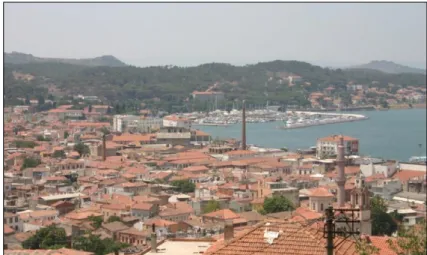
The minarets were also constructed for the first time during this period. In Saatli Mosque, when looked from outside the only element that says the building is no longer a church but mosques is the added minaret that rises along with the bell tower. Though the two are still in contest to each other, the minaret being taller says it was built later and thus the building is a mosque (Fig. 7). The minaret in Hagia Georgias has been constructed very close to the stair tower on the north. The minaret in Saatli Mosque (Hagia Ioannes) reaches 44m, while the clock tower is 36m and the building is 24m. In Cinarli Mosque (Hagia Georgias) the minaret reaches to 38m while the building reaches 30m. The minaret in both cases is 8m higher then the highest point in the building. The requirement of constructing the minaret higher then the bell tower caused it to be unstable and some were demolished during storms and earthquakes and had to be reconstructed a couple of times. Addition of a minaret requires considerable effort but is needed as it provides the symbolism that communicates to viewers that the building is a mosque.
Figure 7. A recent view of
Ayvalık with Saatli Mosque on the
ICO N ARP - V olu m e 4, Is su e 2 / Pu bli shed : D ecemb er 20 16
It might also be speculated that addition of the minaret, the most costly alteration that is required to turn a church into a mosque, played a significant role in the number of churches that are appropriated. Having a minaret might differentiate these mosques from the others that do not have it. It might be also the reason why the minarets are reconstructed better and bigger after being demolished due to a storm in 1950s. The minaret of Cınarlı Mosque (Hagios Georgias) was again demolished in 2002 due to a storm, while in 2003 another storm demolished the minarets in Hayrettin Pasha Mosque (Kato Panagia) and Saatli Mosque (Hagios Ioannes), which fell and damaged the ceiling and the dome as well.
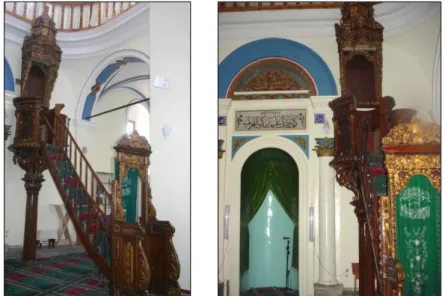
The interior of a mosque should also have a mimber, an elevated sitting place where the leader of the congregation could deliver the Friday sermon as well as formal pronouncements. Thus, a mimber had to be added during the transformation of churched into mosques. Both in Hayrettin Pasha Mosque and Saatli Mosques, it is clear that mimbers are regular ones that could be found in any Turkish mosque. However, mimber in Cinarli Mosque needs to be examined more in detail as it reflects the creativity of the designer who created the mimber out of an ambon and a bishop’s chair found in a church (Fig. 8).
Ambon is a special elevated sitting place in Greek orthodox churches, very similar to mimbers in mosques, where Bible is cited and formal pronouncements are delivered. Ambons usually are located around the third or fourth column from the east, which separates the central aisle from the northern side aisle. There is a wooden staircase on the side aisle to provide access to this ambon. Only in Taksiarhis church the ambon still sits on its original location though without its staircase. There were no
Figure 8. Two views of the mimber
in Çınarlı Mosque constructed by transforming an ambon and a bishop’s chair (İnce Güney, 2007)
32 0/ IC O N ARP. 20 16 .8 – E -I SSN : 2147 -9 38 0
ambons in the three buildings that are still used as mosques, though the empty place of the ambon can still be recognized in Hayrettin Pasha Mosque over the third column on the north side of the central aisle.
It is interesting to notice that although ambon’s function is very similar to a mimber’s function, at first Muslims did not want to appropriate these ambons that could easily have been used as mimbers. In the case of loggias, which were prayer spaces in churches dedicated for women, there was no need even to think how to appropriate them: they were just used for the same purpose when churches were converted to mosques.
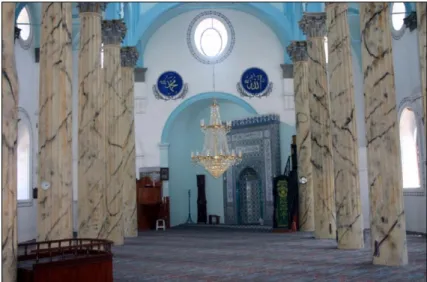
Another special characteristic of a mosque is the deliberate indication of the axis directed towards Mecca, towards southwest in Ayvalık, according to which prayers should direct their faces. This axis usually terminates on the inner face of a mosque by a niche where the leader of the congregation makes his prayer, the mihrap. The prayer of the leader that involves prostration must be observed by other prayers as they need to face the same direction and act in harmony with the leader. In Cinarli and Saatli Mosques, mihrap is placed on the south arm of the cross in a shifted position towards west. In Hayrettin Pasha Mosque, the mihrap is placed within the central apse that is bigger in size in a tilted position (Fig. 9). It is also interesting to recognize that the traverse aisles created on southwestern axis by making use of carpet designs or by literally attaching strings on the ground. The same traverse aisles also continue on the loggias. One can only guess that it should have been difficult for the prayers to follow this tilted angle towards southwestern axis, which run in conflict with the natural east-west direction of the church.
Figure 9. Placement of the mihrap
in Hayrettin Pasha Mosque on the central apse (İnce Güney, 2007)
ICO N ARP - V olu m e 4, Is su e 2 / Pu bli shed : D ecemb er 20 16
Another condition that a mosque has to satisfy is the lack of human or animal depictions. Thus the oval surfaces prepared for icons in these churches have to be transformed as well. They were not taken out completely but instead they were covered with scriptures from Quran and kept their usage as decorative elements. It is also possible to find additional features such as an elevated sitting place for müezzin, müezzin mahvili, placed on the northern arm of the cross in Cinarli Mosque.
It is also interesting to note that only three of the churches, which were turned into mosques kept their function till today. Looking at physical properties of these churches might give an answer as to why these three were kept as mosques and not the others. It is clear that all of the churches that function as mosques today as well as others were located prominently in the town as the neighborhoods grew around them, thus by itself this cannot be the answer.
Hagia Georgias and Hagia Ioannes might be selected because of their cruciform plans that emphasize centrality especially with their domes at the center. The dome is the most characteristic feature of a mosque where is emphasizes the central space. It might be that Hagia Georgias and Hagia Ioannes, the only two churches that has a central space covered with a dome on top, resembled the mosques image that Turkish migrants had in their minds. Moreover, all of the three churches that still function as mosques today are the ones that were constructed in later years and they are bigger then the others in terms of their size and height, Hagia Georgia being the highest and Kato Panagia—the only one with basilical plan—being the biggest in area. Kato Panagia’s being the largest church might be the reason why it has kept its function as Hayrettin Pasha Mosque, as the only mosque that was transformed from a church with a basilical plan.
The appropriation process requires enormous effort on the part of the people who are appropriating. The transformation of these churches into mosques took the form of addition, removal, and alterations in order to provide the features required. The reason why only three of the buildings were kept as mosques might also be related to this effort. First of all, there definitely was an abundance of religious buildings in town. To appropriate these buildings required quite an effort from these people and thus they picked only some that they thought they could transform them and make their own. Hagia Triada, though acted as Biberli Mosque for a while, was not able to be kept as a mosque neither the Feneromeni church.
32 0/ IC O N ARP. 20 16 .8 – E -I SSN : 2147 -9 38 0
The end result of the appropriation process also reflects itself as the naming of these buildings. The ones that are used as mosques today are always referred to with their Turkish names as mosques. But the other churched that were used as tobacco depots or oil factory sometimes named with their function and sometimes with their Greek names. Its only Hagia Triada’s name “Biberli Mosque” that still lives today in spite of the fact that the building is no longer a mosque.
DISCUSSION AND CONCLUSIONS
Authenticity might be translated as something being true to its origin. In that sense, the true meaning of a building is that of the designer and of the users at the time when the building was constructed. Accordingly, when the churches were transformed into mosques one might suggest that they become inauthentic as they were not true to their original purpose. Similarly, the ambon that is transformed into a mimber in Cinarli Mosque might also be considered as inauthentic. In this understanding, authenticity has been considered as a property of an environmental form, a property that is based on the culturally endowed meaning of that form. However, authenticity cannot be thought as frozen in time during the life time of that environmental form when its users would be different at different times. As Dovey points out, authenticity is a property of a process and a relationship: “As a process, it is characterized by appropriation and an indigenous quality. As a relationship it speaks of a depth of connectedness between people and their world” (Dovey, 1985). As such, these mosques are authentic as much as the time when they were constructed as churches because they reflect the incoming Turkish migrants connectedness to their world and their indigenous creativity to reinterpret these buildings so as to make them their own mosques.
The aim of incoming Turkish migrants was not to destroy but to appropriate these churches as they needed a prayer space. The churches had inherent qualities, pronounced more distinctly in some then in others, which enabled them to be appropriated by Turkish migrants. Paul Ricouer (Ricoeur, 1965) defines appropriation as “to make one’s own what was initially alien.” In the appropriation process the aim of Turkish migrants was not to seek the original intention of the building but to make the building their own. Appropriation might be characterized as a struggle against cultural distance and historical alienation as it is a process where the culturally endowed meaning is being stripped from the form and a new one is created. Hence, the act of Turkish migrants was authentic as it reflected their indigenous
ICO N ARP - V olu m e 4, Is su e 2 / Pu bli shed : D ecemb er 20 16
creative nucleus power, which projected a way of life, a mode of being in the world appropriate to their own culture.
The physical properties of these buildings helped them to make sense in a different setting within a different culture. They were appreciated and the expressive properties of them were shared by this new culture. Culture is definitely one of the authorities as a meaning giver to an architectural form, but form itself has to do with meaning as well. Culturally endowed meaning, which might be defined as arbitrary meaning, gets lost in the course of a shift to another culture. But iconic meaning, meaning based on inherent qualities of an architectural form related to organization of its substituent parts, stays still in this process. In these buildings, it is clearly seen that culturally endowed meaning of being a church has been lost for all of them when they were transformed into another function by their new users. However, in especially three of them the expressive properties of the buildings that depend on their inherent qualities stayed with them even when they were turned into mosques. It was indeed these physical properties that helped them to keep their function as religious buildings, mosques in this case. At a smaller scale, another example for this transformation is the decorative elements. The oval surfaces for icons lost their culturally endowed meaning when the icons were covered, but their expressive content due to their physical properties caused them to be used in a similar way where Islamic decorative scriptures were put on.
It was an authentic act of incoming Turkish migrants to appropriate these churches that were left unoccupied due to circumstances and transform them into mosques and use them in their daily life. When Greek population left the town, the way of living which once kept these building alive was lost as well. The newcomers appropriated the building, not the way of life, and transformed it into mosques that were true to their own way of living. This was a natural authentic act and the churches being appropriated and transformed into mosques become part of their daily life. In other words, the lost past of Greek Kydonies was appropriated and it was kept alive as part of the new history of Turkish Ayvalık. It would have been inauthentic if the buildings had been kept as churches. It would also be inauthentic if they were to be transformed into churches now. As Dovey suggests, “inauthenticity emerges out of the very attempt to retain or regain authenticity… out of very attempts to find and create a lost authenticity, a lost world of meaning” (Dovey, 1985).
32 0/ IC O N ARP. 20 16 .8 – E -I SSN : 2147 -9 38 0
Ayvalık churches are representatives of the local past including the past of Greek Kydonies, a past that was also part of the Ottoman history. All the basilical churches were constructed during the Tanzimat period of Ottoman history between 1839-1856 when the first steps towards modernization were taken and minorities were given social, cultural and economical privileges. After 1870s the neoclassical style was well spread in Istanbul and its effects were even felt in the churches constructed in Ayvalık. In this period it is known that a number of basilical churches were reconstructed in neoclassical style. Moreover, new churches were designed in neoclassical style as well such as Hagios Ioannes and Hagios Georgias. Both basilical and neoclassical churches reflected the creative nucleus of the local people living in Ayvalık at that time and as such need to be appreciated and protected.
Today, the churches that still function as mosques are well preserved as they are daily used. And for the others that are damaged and unoccupied, there is a growing interest to renovate them mostly because of touristic reasons as the town became a major tourist attraction since 1980s. Moreover, in Turkey in general, there is a growing concern to renovate and protect cultural heritage, which is partly due to membership with European Union and their demands. There are also some agreements between Greece and Turkey, in which each part agrees to renovate each other’s religious buildings. The church in Alibey Island is being renovated based on this agreement, for example. The projects are being prepared to turn them into cultural centers or museums both for the occupants of the town and for the national and international tourists, including Greek tourists that visit the town often. When these churches are turned into cultural centers they will once again be part of the daily life.
Some might question the function these churches will have. They might even argue that, since they were constructed as churches originally they need to be kept as such. This understanding values the original function as the only true function and rejects the possibility of having another authentic function for them. The history of Feneromeni (Ayazma) Church that was transformed into an oil factory seems to suggest that this idea might be valid. But, Feneromeni shows how disrespectful one can be toward an architectural object more then it shows the possibility of loosing all culturally endowed meaning. Its transformation to an oil factory is not the result of a connectedness between people and their world; it’s a mere reflection of the functional requirement to gain economic value.
ICO N ARP - V olu m e 4, Is su e 2 / Pu bli shed : D ecemb er 20 16
A similar attitude is to reject these buildings as part of Turkish cultural heritage, which in fact can be interpreted as part of the idea that rejects their Greek past as well. Some might have a tendency, sometimes felt as an unspoken reality, to think that these buildings should be demolished all together and turned down to get rid of all the past that come with them. According to this idea, keeping these buildings alive is similar to keeping the Greek past of the town to live, thus the buildings should be left to die with their past.
No matter how they differ in their approaches, both of these ideas reject the possibility of appropriating these buildings as they reject the possibility of having an authentic meaning for these buildings apart from their original meaning. They reject the possibility that when they have been appropriated, their iconic meaning, i.e. their inherent properties would have the most influence on the new meaning making it possible to change their culturally endowed, arbitrary meaning.
This is an understanding that reflects a changed attitude towards the past buildings then in the earlier times when it was considered possible to convert religious buildings. This new attitude sees the original function of the building as the only meaning that the building has to offer. In this conception, the meaning of buildings are seen as the static legacy of their past, which cannot be changed not reinterpreted. Accordingly, authenticity is limited to the original meaning when the building was first designed and appropriated meaning can never be authentic as the original meaning. This is an understanding that if it was realized the past of Kydonies would have really been lost.
Acknowledgement
An earlier version of this study has been presented at IASTE 2008 Conference in Oxford, UK.
REFERENCES
Akın, B. (1998). Kentli Ayvalık. Küçükköy Belediye Başkanlığı Yayınları.
Akpınar, İ. Y. (2012). Moonlight Monastery. İstanbul: Cafecity Bız Yayınları. .
Aktepe, H. M. (1994). Ayvalık’ta Dini Yapıların Fiziksel Çevre Etkilerine Bağlı Oluşumu. Mimar Sinan Üniversitesi Fenbilimleri Enstitüsü, Yayınlanmamış Yüksek Lisans Tezi, İstanbul.
Arıkan, Z. (1988). 1821 Ayvalık İsyanı (1 hrt. ile birlikte). BELLETEN, LII(203).
32 0/ IC O N ARP. 20 16 .8 – E -I SSN : 2147 -9 38 0
Ayvalık’ta Şehircilik Arastirmaları. (1964). İstanbul Teknik Üniversitesi. İstanbul.
Ayvalık’ta Tarihsel Dokunun Korunması ve Turizm Amaçlı Kullanılması. (1984). Retrieved from Anakara:
Bayraktar, B. (1998). Osmanlı'dan Cumhuriyet'e Ayvalık tarihi: Atatürk Kültür, Dil ve Tarih Yüksek Kurumu, Atatürk Araştırma Merkezi.
Cengizkan, A. (2004a). Mübadele Belgelerinde Ayvalık. Paper presented at the EGE’nin Iki Yakası-I: Ayvalık Kent Tarihi Çalışmaları Konferansı, Ayvalık.
Cengizkan, A. (2004b). Çağa Yerleşmek 1: Mübadele, Konut ve Yerleşimleri. Ankara: ODTÜ Mimarlık Fakültesi ve Arkadaş Yayınevi.
Clogg, R. (1972). Two Accounts of the Academy of Ayvalık in 1818-1819. Revue des études sud-est européennes, 633-667.
Dovey, K. (1985). The Quest for Authenticity and Replication of Enviornmental Meaning. In D. Seamon & R. Mugerauer (Eds.), Dwelling, Place, and Environment: Towards a Phenomenology of Person and World, Dordrecht: Martinus Nijhoff, pp 33-49
Erim, H., & Uygur, M. (1948). Ayvalık Tarihi. Ankara: Güney Matbaacılık.
Güvenç, S. (2011). (ed) European Capital of Culture, Population Exchange Museum. Lozan Mübadilleri Vakfı, İstanbul. İpek, G. (2003). Ayvalık Tarihi Kent Merkezindeki Kiliselerin
Incelenmesi Unpublished MSc. Dissertation. Dokuz Eylül University. İzmir.
Kuban, D. (1998). Sinan'in sanati ve Selimiye: Turkiye Ekonomik ve Toplumsal Tarih Vakfi.
Nigdelioglu, A. (2000). Ayvalık Tarihi Çevre Dokusu İçindeki Manastırların İncelenmesi. (Yüksek Lisans Tezi), Dokuz Eylül Üniversitesi, İzmir.
Pekin, M. (2005). Yeniden Kurulan Yaşamlar 1923 Türk-Yunan Zorunlu Nüfus Mübadelesi. İstanbul: İstanbul Bilgi Üniversitesi Yayınları.
Psarros, D. (2004). Kydonies-Ayvalık’ın Kentsel Tarihi. Ege’nin İki Yakası-I: Ayvalık Kent Tarihi Çalışmaları Konferansı, Bildiriler Kitabı, 28-30.
Ricoeur, P. (1965). History and truth: Northwestern University Press.
Şahin, N. (1986). A Proposed Planning Model for Present Preservation and Rehabilition Problems of Historical Sites, A Case Study in Cunda Island-Ayvalık. (MSc.), METU, Ankara.
Tosun, R. (2002). Türk-Yunan İlişkileri ve Nüfus Mübadelesi (1821-1930). İstanbul: Berikan Elektronik Basım Yayın. Uçar, H., & İnce Güney, Y. (2007). Ayvalık ve Alibey Ondokuzuncu
Yüzyıl Ahşap Rum Ortodoks Kiliseleri. Bap Yayınları, Balıkesir.
ICO N ARP - V olu m e 4, Is su e 2 / Pu bli shed : D ecemb er 20 16 Resume
Yasemin Ince Guney received Bachelors in Architecture (1992) and M.Sc. in Environment Behaviour Studies (1996) degrees from METU-Middle East Technical University, Ankara, Turkey; M.Sc. in Architectural History (1998) from University of Nebraska-Lincoln, USA, and PhD. in Architecture (2005) from University of Michigan, USA. Her doctoral dissertation is the recipient of 2005-2006 Architectural Research Centers Consortium King Student Medal for Excellence in Architectural and Environmental Research and has been nominated for University of Michigan’s Outstanding Doctoral Dissertation Award. Her research interests focus on Turkish domestic culture, notions of home and dwelling, issues of modernization and modernity, and spatial morphology. She has lectured at Lawrence Technological University, Southfield, Michigan, USA (2001-2005), Eastern Mediterrenean University, North Cyprus (2011-2012) and since 2005 has been a member of faculty at Balıkesir University in Turkey.