1
House Prices and Tourism Development in Cyprus:
A Contemporary Perspective
Andrew A. Alola1,a, Simplice A. Asongu2 & Uju V. Alola3,a
Abstract
This study investigates the nexus between tourism development and house prices in the Republic of Cyprus over the period spanning from 2005Q1 to 2016Q4. Tourism indicators vis-à-vis tourism arrivals along with other explanatory variables (domestic credit, land area per person, and the consumer price index) are employed in a multivariate Autoregressive Distributed Lag (ARDL)-bound test model. The empirical results indicate a significant evidence of cointegration. Indicatively, an observed adjustment of about 44% from short-run to long-short-run implies that the model is not relatively slow to adjust to disequilibrium. Importantly, a percent increase in tourism arrivals is observed to cause a rise in house price by about 37%. Expectedly, it is statistically observed that as the land area per person decreases, it is accompanied by a hike in house price. Also, the impacts of domestic credit offered to private enterprises and the consumer price index are different from the results in previous studies. As a policy guide, the government of Cyprus and stakeholders in the
1Department of Economics and Finance, Faculty of Economics, Administrative and Social Science, Istanbul Gelisim University,
Turkey.E-mail: [email protected] Phone: +90 538 060 3701 a South Ural State University, Chelyabinsk, Russia.
2 African Governance and Development Institute, P.O. Box 8413, Yaoundé, Cameroon. E-mail: [email protected]
3 Department of Tourism Guidance, Faculty of Economics, Administrative and Social Sciece, Istanbul Gelisim
2 tourism and housing sectors should outline a strategy that will ensure the social welfare of people such that housing availability is not hampered by tourism activities.
Keywords: house prices; tourism; domestic credit; cointegration; ARDL; Republic of
Cyprus
JEL classification : C22; O50; R31
1. Introduction
In reality, issues of health, food and housing are importantly attributed to human basic needs. As echoed in the key message of the World Bank on housing finance, “Housing plays a key
socio-economic role and represents the main wealth of the poor in most developing countries” (Housing
Finance-World Bank, 2017). This message further opined the importance of housing to human survival. The importance of housing is not far from the main cause of the 2007-2008 global financial crises which is traceable to the United States’ housing market negatively affecting housing and other human basic needs (Batuo, Mlambo & Asongu, 2018). Prior to the global financial crisis, a substantial body of literature had documented the relationship between house price and a handful of macroeconomic (Kishor & Marfatia, 2017), financial (Estrella & Mishkin, 1998 and Aoki, Proudman & Vlieghe, 2004), and socio-economic variables (Luttik, 2000). To mention a few, population, dependency ratio, unemployment, income/wage pressure, interest rate, mortgage rate, construction cost, marriage or marital status, migration patterns, are among others, variables that have been linked with house prices. For instance, population is reportedly vital to the dynamics of the housing prices (United Nations, UN, 2017). The UN report indicates that about 83 million people are currently being added to the global population annually and such a trend projects an increase in the world population from 7.6 billion people in 2017 to 8.6 billion, 9.8
3 billion and 11.2 billion in 2030, 2050 and 2100, respectively. Subsequently, it also maintained that in 2017, 962 million people were 60 years old and above. This demography is forecasted to increase to 2.1 billion and 3.1 billion in 2050 and 2100, respectively. The statistical implication among other things supports the perception of the challenge of rapid urbanization and ageing, resulting to an immense pressure on housing delivery systems.
Moreover, the population-induced factor that is being associated with the housing market includes migration and tourism (Hämäläinen & Böckerman, 2004; Alola & Alola, 2018a&b; Alola & Alola, 2019a&b). The recent dynamics in the real estate and property sector of the island of Cyprus may as well make the country’s housing sector more desirable. In a recent study of the Cyprus housing market, Coutinho et al (2018) highlighted the determinants of the housing market to include the purchasing capacity, household deposit, unemployment rate, sales to foreigners, housing stocks, household non-performing loans (NPL) ratio, and microfinance (MFI) loans. However, other salient factors such as the citizenship-by-investment program and other specific government policies are being projected to cause another property bubble in the country (Cyprus Property News, 2019a). The report of the Cyprus Property News indicates that the prices for housing, offices, warehouses and retails increased by 4.8%, 11.6%, 4.2%, and 1.7% respectively against 4 per cent growth rate of the country’s Gross Domestic Product (GDP). Indicatively, the obvious increase in the property prices has been largely attributed to foreign buyers whose main intent is to acquire the European passport instead of living in Cyprus (Cyprus Property News, 2019b).
1.1 Contribution of the Study
The novelty of this study is that the nexus of between house prices and tourism is sparse in the literature. Previous studies have investigated the nexus between house prices and migration, and
4 mostly fell short of focusing on the housing-tourism nexus (Hämäläinen & Böckerman, 2004; Meen, 2003; Portnov, Kim & Ishikawa, 2001). The motivation for this study is built on the evidence that consistently classify both the housing market and the tourism sector of Cyprus (Alola & Alola, 2018a). Only a handful to authors to the best of our knowledge have so far investigated housing prices in Cyprus without involving the country’s tourism sector (Pashardes & Savva, 2009; Sivitanides, 2015). Using 1998 to 2008 annual data, a relatively small sample, Pashardes & Savva (2009) noted the country’s population as a leading determinant of housing prices in addition to costs and economic growth. Sivitanides (2015) proceeded further by using quarterly data from 2006Q1 to 2014Q2 and maintained that nominal gross domestic product (GDP) per capita which is a proxy for economic growth, construction cost and interest rates, as determinants of house prices in that order. Also, the studies mentioned above fell short of investigating whether a long-run equilibrium relationship exists between these determinants of housing prices in Cyprus. Hence, in order to complement the extant literature, the present study provides empirical evidence of cointegration between house price and tourism indicators, conditioning the investigated nexus on other potential determinants of house prices, notably: land area per person, domestic credit, and the consumer price index.
The rest of the study is structured as follows. Section 2 highlights existing studies and trends of housing prices and tourism in Cyprus while Section 3 covers the data description and empirical methodologies. The empirical findings are reported in Section 4. Concluding remarks and implications for policy are provided in Section 5.
5 Consistent scholarly studies continue to reveal intriguing and more interesting behavioral patterns associated with the housing price indices. For instance, one of the earliest related studies is the work of Mankiw & Weil (1989) that detailed the relationship between house prices and ageing. Very recently, the study by Hiller & Lerbs (2016) while supporting the evidence of the relationship between housing price and population, further simplified the population effect to three distinct perspectives: the investment demand effect, the age effect (age composition of the population) and the size effect (size of the population). The study maintained that the total population is not as important as the size of households. This argument is based on the fact that if the household size (i.e. number of people in a family) decreases, housing price is expected to increase due to an increase in number of people in need of housing. While studying relationship between housing price and changes to the age distribution using 87 German cities of strong cross sectional dependence over 1995 to 2014, Hiller and Lerbs (2016) employed a mixed-regression spatial panel model with an underlying multivariate framework. The results revealed a minimal increase in the real urban housing price across cities with higher aged people and heterogeneous effects caused by populations aging across housing segments. A follow-up study by Park, Park, Kim & Lee (2017) using panel regression also showed significant evidence of inverse correlation between housing prices and dependency ratio in overall regional market while a positive correlation was observed between housing prices and real GDP per capita in each region. They opined that the negative correlation estimates between house price and dependency ratio is expected to cause between 3 to 12% decline in house prices by 2020 and about 20% by 2030 especially in the observed cities of South Korea.
Moving from population as a unit variable, Sirmans, Macpherson and Zietz (2005) used hedonic regression analysis to estimate the marginal contribution of each of the eight enumerated
6 characteristics of macroeconomics to house prices. Sirmans, Macpherson and Zietz (2005) characterized the macroeconomics variables affecting house prices as construction and structure variables, external house features, internal house features, environmental neighborhood and location factors, natural and environmental characteristics, public service amenities, marketing, occupancy and selling factors, and financial issues. But the studies of Tu (2000, 2004) clearly noted the significance of real GDP per capita, total housing stock, affordability, housing finance and supply, inflationary effects and demographic variables on house price. The dilemmas caused by the nature of these variable dynamics on house price paved way to the study by Berry and Dalton (2004) such that the factors affecting housing price were classified as institutional, short-run and long-short-run factors. Berry and Dalton (2004) opined that the institutional factors include government taxes and levies, short-run factors include investment demands and interest rate and the long-run factors are the wealth level, economic growth and demography. Likewise, Canarella, Miller and Pollard (2012) empirically discovered that the effect of shocks to the capital gain series on housing price which could be permanent or transitory would rather depend on the test assumptions since the result shows evidence of lack of uniformity.
Furthermore, while studying house prices in Australia, Abelson, Joyeux, Milunovich and Chung (2005) detailed both the long-run equilibrium and short-run asymmetric error correction of housing price dynamics. The study revealed empirically that both real disposable income and the consumer price index significantly and positively determine house prices. Moreover, the unemployment rate, real mortgage rates, housing stock and equity prices have significant and negative effects on Australian house prices. In a similar attempt, Reichert (1990) also detailed the microeconomic aspects of demand and supply side of the housing dynamics. Demand induced factors were implied
7 by Pitkin and Myers (1994) and Flavin and Yamashita (2002). On the other hand, the supply-related effects examined were presented in the studies of Painter and Redfearn (2002) and Ball, Meen and Nygaard (2010). Other potential factors that affect the housing price dynamics are land-use policy and governmental or organizational policies (Bajic, 1983; Katz & Rosen, 1987; Pollakowski & Wachter, 1990; Campbell & Cocco, 2007; Ihlanfeldt, 2007).
However, research on housing dynamics in the context of the afore mentioned variables have been explored in several other studies (Johnes & Hyclak, 1999; Meen, 2003; Hämäläinen & Böckerman, 2004; Kishor & Marfatia, 2017, 2018). For instance, using an error correction model, Johnes and Hyclak (1999) showed a significant evidence that unemployment and labour force changes affect house prices. Also, Kishor and Marfatia (2017, 2018) observed the impact of domestic interest rates on the house prices of selected OECD (Organization for Economic Co-operation and Development) countries. In another perspective, the high frequency impact of both conventional and unconventional monetary policy together with macroeconomics on the United States’ housing market were investigated in the studies of Gupta & Marfatia, (2018) and Nyakabawo, Gupta & Marfatia (2018). Likewise, the evidence of volatility in the housing prices dynamics (Case & Shiller, 2003; Case, Quigley & Shiller, 2005) and in the context of the stock market (Ding, Granger & Engle, 1993) were carefully considered. The evidence obtained from the study on house price and stock market dynamics as mentioned in the above studies is consistent with the observations of Luo, Liu & Picken (2007) and Case and Shiller (1990) such that the dynamics of housing prices were evidently regarded as unstable in nature.
8 Overtime, few and rare studies have establish a link between house prices and migration, and some in a related perspective (Portnov et al., 2001; Meen, 2003; Hämäläinen & Böckerman, 2004; Alola & Alola, 2018a). But the link between refugee and migration in the context of house prices was establish by Alola and Alola (2018a) by citing the case of Malta and Cyprus. The island of Cyprus with a population of less than two million people (World Bank, 2019) is one of the 22 coastline Mediterranean countries and among the most preferred by international tourists in the region. Across the island’s regions are notable natural and man-made tourist attraction sites and historical landmarks that annually compel millions of visitors (Andronicou, 1979; Gillmor, 1989; Ioannides, 1992; Katircioglu, 2009a; Sharpley, 2001; Alola, Alola & Saint Akadiri, 2019). This narrative is consistent with factors affecting tourism in countries with islands (Katircioglu, 2009a, 2019b, 2011). The property and housing markets in addition to tourism have consistently remained the leading contributors to the economy of the island nation. Over three million visitors were recorded in 2016; this was reported to be about a 19% percent increase from the previous year and consequently generating about 12% of the country’s GDP in the same year4. The government of
Cyprus formulated several tourism and housing policies, being the country’s most resilient commercial sectors. Such policies are aimed at boosting its economy as it targets to generate twenty billion euros (€20bn) worth of new investments to the country by 2030. The country’s location as a gateway bordering northern Africa, Middle East and Europe, remains a competitive advantage. This is one of the policy mechanisms employed as an economic recovery strategy since the 2012-2013 financial crisis. As hinted by Sharpley (2000), the peculiarity of the country’s housing and tourism sectors is a pointer suggesting a link between the two active sectors of the
4 Statistical service provides detail information regarding Cyprus economic sectors.
9 country. Added to this are reports of skyrocketed rent prices in Limassol (Cyprus Mail, July 2017) and other major cities across the island which is intuitively caused by the significant investment in the country’s tourism sector as indicated by the report on the 2016 surge in the tourism sector. Since tourist activities are commonly measured using international tourists’ arrivals and departures, the dynamics of the two indicators along with respective house prices for the estimated period (2005 to 2016) is presented in Table 1 and Figure A of the Appendix.
“Insert Table 1 here” “Insert Figure A here” 3.Data and Empirical specifications
3.1 Data
A quarterly dataset that spans from 2005Q1 to 2016Q1 and comprising of 48 observations is employed for this study. Similar to the indication from the study of Coutinho, et al (2018), the restriction to the span of years was due data availability constraints in Cyprus’ house price (HP) index which was obtained from the European Commission database (Eurostat, 2017). The consumer price index (CPI) was retrieved from the International Financial Statistics database of the International Monetary Fund (International financial statistics, 2017). The World Development Indicators (WDI, 2017) of the World Bank database is the source of international tourist arrivals (ARR) and domestic credit. The land area per person was computed as the ratio of the land area to the population over the estimated period. All the datasets were subsequently balanced in uniformity with the quarterly dimension. The consumer price index (CPI) is adjusted by 100 units using the base year 2010. The house price (HP) index is the dependent variable while others are the independent variables. Both international tourists arrivals account for the short and seasonal periodic change in migration patterns (Hämäläinen & Böckerman, 2004; Meen, 2003; Portnov et
10 al., 2001; Munandar,2017; Koshteh, 2018; Asongu, Nnanna, Biekpe & Acha-Anyi, 2019; Asongu & Nwachukwu, 2019; Asongu & Odhiambo, 2019). GDP per capita, domestic credit and the consumer price index are among the commonly used variables as determinants of house prices (Case & Shiller, 2003; Case et al., 2005; Ding & Kim, 2017; Kheishor & Marfatia, 2017). Hence, the descriptive statistics of the variables are displayed in Table 2.
“Insert Table 2”
3.2 Model Specification
The study by Reichert (1990) considered the changes in real housing prices through the development of a reduced form equilibrium model. The implied eight-factor model was further modified to reflect the equilibrium of supply and demand for housing services. Hence, the house price (HP) is represented as a function of quantity demand (Qdt) and quantity supplied (Qst) of
housing during a period t as:
HPt = f (Qdt, Qst) (1)
Similarly, the study by Kheishor & Marfatia (2017) recently investigated the relationship between house prices, personal disposable income and interest rates which are components of demand and supply in the housing market. In a related study, Park et al. (2017) also considered the equilibrium of housing demand and supply using fluctuation rate of per capita real GDP, fluctuation rate of population and dependency ratio, in addition to the housing demand and supply components adopted by Kheishor & Marfatia (2017).
Hence, by advancing the study of Alola and Alola (2018) in which migration and tourism were separately modelled along with house price, the present study specifically models the house price-tourism nexus for Cyprus by using the representation below:
11
Hpt = αi + β1 arrivalst+ β2CPIt+β3lpersont +β4 ldcreditt+ εt (2)
where Hpt represents the housing price, ARRt denotes international tourist arrival, lpersont is the land area per person (number of persons in square meter area of land), CPIt is the consumer price index, and dcreditt is the domestic credit, all for the period t = 1, 2, …n. Subsequently, the above representation is transformed by using the natural logarithm (ln) which indirectly reduces or eliminates the effect of hetereoscadacity. Hence, the expression becomes
lnHpt = αi + β1 lnarrivalst+ β2 lnCPIt + β3lnlpersont + β4lndcreditt+ εt (3)
3.2.1Empirical specifications
Before investigating the aforementioned relationship between fluctuations in housing prices and tourist movements, it is important to ascertain the stationarity of the variables. Although the ARDL approach is capable of modeling series’ with either I (0) or I (1) and even for a mixed order of integration, yet it is necessary that none of the series is I (2). Therefore, the Augmented Dickey-Fuller (ADF), and KPSS are adopted to investigate the series’ stationarity properties. Although, the step-by-step procedure is not specified5, the results of the estimations are presented in Table 2. Similarly, prior to employing the Autoregressive distributed lag, the cointegration properties of the variables of interest are examined by using the Johansen (1995) cointegration approach. The result of the Johansen (1995) cointegration test establishes that the variables are significantly cointegrated (see Table A of the Appendix). This is in addition to the redundant test that further justifies the use of the independent variables, thus addressing the possible estimation biasness due to misspecification (Hamilton, 1987; Ferson, Sarkissian & Simin, 2003).
5 The ADF (from Dickey & Fuller, 1981 and 1979) , PP and KPSS unit root test models are respectively detailed in MacKinnon (1996), Phillips & Perron (1988) and the Kwiatkowski, Phillips, Schmidt & Shin (1992)
12
3.2.2ARDL-bounds testing approach
Sequel to the application of the specification tests, the ARDL-bound testing approach is employed in this study to investigate the likelihood of the long-run equilibrium relationship between tourist arrivals and house prices in Cyprus. The ARDL model was a follow-up to an earlier method applied by Pesaran and Shin (1998) and further developed by Pesaran, Shin & Smith (2001). The uniqueness of this model to the study is not only due to the insensitivity of the model to sample size but also, it is not dependent on whether the variables are stationary at levels or first difference i.e.I(0) or I(1) except for I(2).This is because the output statistics (Wald statistics or joint F-statistics) is compared with the set of critical values variables; the lower bound critical values are estimated with assumption that variables are I(0) and the upper bound critical values are estimated with assumption that the variables are I(1). Hence, evidence of long-run cointegration in the system is established when theF-statistic is greater (>) than the upper bound critical value, the case when the null hypothesis of no cointegration is rejected. Alternatively, we fail to reject the null hypothesis of no cointegration when the F-statistics is less than (˂) the lower bound critical value. An inconclusive result is noticeable when the estimated F-statistics is between the two values. This cointegration procedure begins with the lag selection using the two main information criteria by Akaike (AIC) and Schwarz (SIC). Preliminary diagnostic tests for stability, serial correlation and Hetereoscadacityare performed before the eventual bound test is employed.
This ARDL-bound test model which uses a more general expression of conditional error correction model (ECM) in addition to the option of imposing restrictions on the intercept, trend, and or both is performed for the general model of equation (3), therefore resulting in the given expression below:
13 Δ lnHP = α0 + ∑ bj ΔlnHPt – j+ ∑ cj Δlnarrivalst – j+ ∑ dj Δlnlpersont – j + ∑ ej
Δlndcreditt – j+ + ∑ fj Δlncpit – j + ∂1 ln HPt =1 + ∂2 ln arrivalst =1 + ∂3 ln lpersont =1+ ∂4 ln
dcreditt =1 + ∂5 ln cpit =1 + ε1 t (4)
where the underlying ARDL model presents the parameters bj, cj, dj, ej, and fj as the short-run
dynamic coefficients and ∂1, ∂2, ∂3 ,∂4, and∂5are the corresponding long-run multipliers and εt is the
(iid) serially independent random “disturbance” term.
Hence, the specified model above presents the null hypothesis of no cointegration as
H0: ∂1 = ∂2 = ∂3 = ∂4 = ∂5 =0 against the alternative by comparing the estimated F-statistics with the
critical lower and upper bound values detailed above. The above estimation output using the lag order of 4 is presented in Table 3.
“Insert Table 3 here”
3.2.3Diagnostic tests
Following the estimation of the dynamic long-run and short-run properties of the aforementioned model and the ARDL-bound test approach, a series of diagnostic tests are performed to validate the tests (see Table 3). The first category of these tests is the Wald test (short-run diagnostic) which presents the F-Statistics of 3.7249 and chi-square statistics of 33.5240 (both rejecting the null hypothesis of ‘no short-run’). Furthermore, the Serial correlation and Heteroscedasticity by Breusch-Godfrey Serial Correlation Lagrange Multiplier test and Breusch-Pagan-Godfrey Heteroscedasticity respectively, were employed. The report of the test as shown in Table 3 implies failure to reject the null hypothesis for both no serial correlation and homoscedasticity, thus validating reliability of the results. In addition, while the Normality test(by Jarque-Bera, 3.0548) suggests failure to reject the null hypothesis of normal distribution, the Skewness and Kurtosis
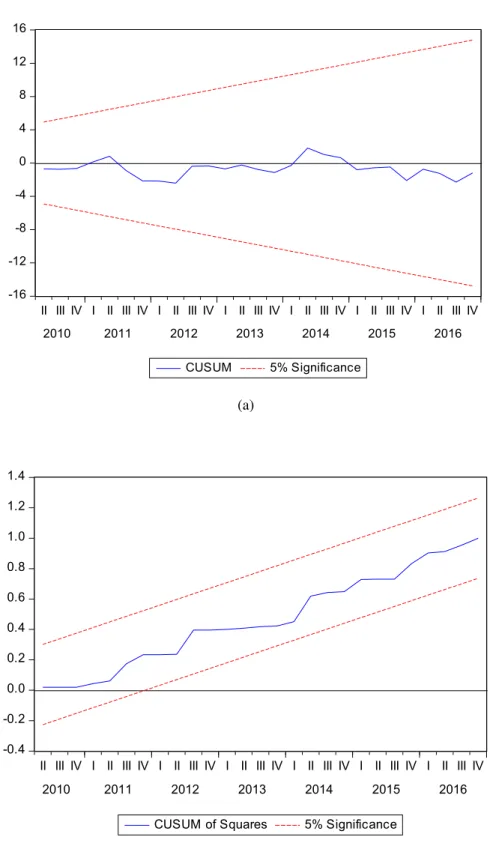
14 present desired results (see Table 3). Moreover, the stability of the estimation is further validated through the CUSUM and CUSUM squared tests as indicated in Figure 1.
“Insert Figure 1 here”
4.Results and discussion
As observed from Table 1, international tourist arrivals and departures from the Republic of Cyprus have been on an increasing trajectory during the period under estimation. This indication coincides with the house price of the country being peaked at 113.52 in 2008, the year of the global financial crisis (GFC). Although the years 2007, 2009, and 2010 witnessed an average rise in house price, the prices are averagely below the peak price in 2008.The estimated variables desirably show statistical evidence of normality except for the arrivals and the cpi as implied in Table 2. Also, as indicated in Table 2, there is statistical evidence of negative skewness from domestic credit (dcreditt), thus the deviations observed in the dynamics of the variables are largely positive.
Furthermore, the dynamic estimates illustrated in Table 3 posit interesting and expected findings that indicate that there is a significant adjustment speed of about 44% after disequilibrium. Prior to the dynamic estimation, the cointegration test (see Table A of the appendix) suggests a significant evidence of cointegration, thus indicating run dynamics. For instance, the long-run and short-long-run relationships between house prices (hp) and the consumer price index (cpi) is significant and positive. The result implies that a 1% increase in the cpi is expected to cause about 8.5% and 1.2% increase in hp in the long-run and short-run, respectively. As such, the result directly corroborates the evidence of house price-“consumer price index” nexus opined by Abelson, Joyeux, Milunovich and Chung(2005) and Tu (2000, 2004). Interestingly, the magnitude of the impact of domestic credit made available by financial institutions to domestic investors is
15 significant, positive and almost unchanged in the course of time. The evidence of the impact of domestic credit on house price is related to the significant evidence of the “house price”-“domestic interest rate” nexus noted in selected OECD countries by Kishor and Marfatia (2017, 2018). On the other hand, land per person (lperson) is observed to have a significant and negative impact on
hp in both the long-run and short-run. This is an indication that as the land available per person
increases; the price of housing expectedly reduces, suggesting that land availability is a vital factor towards mitigating undesirable price hikes of housing in Cyprus. The result validates the relationship between the dynamics of land (expressed as land use in other terms), population and the house prices as detailed in extant studies (Katz & Rosen, 1987; Pollakowski & Wachter, 1990; Ihlanfeldt, 2007; Pashardes & Savva 2009; Alola, & Alola, 2019; Uzuner & Alola, 2019).
Additionally, the relationship between tourism activity and housing price in Cyprus as investigated in the current study is significant and positive (also see Table 3). Indicatively, a 1% increase in the number of the international tourist arrivals is expected to cause about a 37% and 16% increase in the house price in both the long-run and short-run, respectively. This further informs that tourism activities in the Republic of Cyprus are a catalyst for the hike in the price of housing in the country. Considering that earlier studies posit a positive relationship between house price and migration (Hämäläinen & Böckerman, 2004; Meen, 2003; Portnov et al.2001; Alola & Alola, 2018), the present study extends the attendant scholarship within the framework of tourism. The explanation for the positive nexus between house price and tourist arrivals in Cyprus could be linked to the high tendency of tourists buying residential properties and engaging in other property investment businesses.
16 Moreover, the ARDL bound testing result (see Table 3) further illustrates a significant evidence of a combined long-run relationship with an F-statistics of 8.762 against the lower bound (I, 0) and upper bound (I, 1) at 3.74 and 5.06 significance levels, respectively. In addition to the diagnostic inference, the short run estimate (the Wald test) which shows a significant estimate further validates that there is statistical evidence of short-run relationships among the indicators.
5. Concluding Remark and Policy Suggestion
In underpinning the relationship between international tourist arrivals and house prices over the period 2005Q1 to 2016Q1, the present study further shows nexuses between house prices and land per person, domestic credit, and the consumer price index in the Republic of Cyprus. Besides, the island of Cyprus which is regarded by the World Bank as a high income economy with tourism as one of the country’s main economic sectors has about 3% economic growth rate. Expectedly, the current study posits a positive relationship between the house price (hp) and tourism activity vis-à-vis international tourist arrivals (arrivals) in the country. Also, while a positive relationship is revealed between the house price and domestic credit and consumer price index, the house price and land per person relationship is negative. Importantly, the nexus of the house price and arrivals is expectedly positive because Cyprus has significantly experienced an investment boom in the real estate and residential property market in the last decade (Cyprus Mail, July 2017). According to the Cyprus Mail, the real estate investment and residency permit policy introduced by the government to boost the investment confidence in the sector is likely responsible for motivating tourists’ investments in residential property across the country.
17 5.1 Policy Suggestion
By implication, the policy of the government is expected to be geared towards ensuring that house prices in the country are not abnormally high. The Republic of Cyprus has continued to strategically revisit a handful of policies that are targeted at boosting its economy, thereby easing the country’s financial recession of the year 2012-2013. Both the country’s “Scheme for Naturalization of Investors in Cyprus by exception” that is aimed at boosting its housing and the real estate market through foreign direct investment in Cyprus (Cyprus Ministry of Interior, 2017) and the recently introduced strategic policies, are targeted at tripling the tourism earning to the tune of € 20 billion by 2030 as reported by Cyprus Mail, (2017). Since housing prices do jointly move with their determinants (such as international tourist arrivals) in the long-run, it is expected that the stakeholders in the tourism, the real estate and housing sectors engage proactive measures towards avoiding unnecessary adverse effects of the ‘Naturalization of Investors’ policy. Considering that an increase in land per person is expected to cause a decline in house price in the country, the land use policy of the country could be further reviewed in order to remedy the possible adverse effects of the ‘Naturalization of Investors’ policy.
Future studies can focus on assessing whether the established linkages withstand empirical scrutiny in other developing countries. In order to address the caveats of the current study, future investigation could look at whether house prices significantly influence tourists’ arrivals. In addition, future research could also be positioned on employing the market classification of housing or the real estate and the property sector.
18 Declaration
Availability of data: The data utilized for this study can be made available upon request. Funding: Not applicable.
Acknowledgement: Authors acknowledge the contribution of every individual that make the preparation of the manuscript either directly or indirectly possible.
19 References
Abelson, P., Joyeux, R., Milunovich, G., & Chung, D. (2005). Explaining house prices in Australia: 1970–2003. Economic Record, 81(s1).
Alola, A. A., & Alola, U. V. (2018a). The Dynamics of Tourism—Refugeeism on House Prices in Cyprus and Malta. Journal of International Migration and Integration, 1-16.
Alola, A. A., & Alola, U. V. (2018b). Agricultural land usage and tourism impact on renewable energy consumption among Coastline Mediterranean Countries. Energy & Environment,
29(8), 1438-1454.
Alola, A. A., & Alola, U. V. (2019). The dynamic nexus of crop production and population growth: housing market sustainability pathway. Environmental Science and Pollution Research, 1-9.
Alola, A. A., Alola, U. V., & Saint Akadiri, S. (2019). Renewable energy consumption in Coastline Mediterranean Countries: impact of environmental degradation and housing policy.
Environmental Science and Pollution Research, 1-13.
Aoki, K., Proudman, J., & Vlieghe, G. (2004). House prices, consumption, and monetary policy: a financial accelerator approach. Journal of financial intermediation, 13(4), 414-435. Andronicou, A. (1979). Tourism in Cyprus. Oxford University Press for World Bank and
UNESCO.237-265.
Asongu, S. A., Nnanna, J., Biekpe, N., & Acha-Anyi, P. N., (2019). Contemporary drivers of global tourism: evidence from terrorism and peace factors. Journal of Travel & Tourism Marketing, 36(3), 345-357.
Asongu, S. A., & Nwachuwku, J. C., (2019). Mitigating externalities of terrorism on tourism: global evidence from police, security officers and armed service personnel. Current Issues in Tourism. DOI:10.1080/13683500.2018.1527825.
Asongu, S. A., & Odhiambo, N. M., (2019). Tourism and Social Media in the World: An Empirical Investigation. Journal of Economic Studies. DOI: 10.1108/JES-07-2018-0239.
Bajic, V. (1983). The effects of a new subway line on housing prices in metropolitan Toronto.
Urban studies, 20(2), 147-158.
Ball, M., Meen, G., & Nygaard, C. (2010). Housing supply price elasticities revisited: Evidence from international, national, local and company data. Journal of Housing Economics,
20 Batuo, M., Mlambo, K., & Asongu, S., (2018). Linkages between financial development, financial instability, financial liberalisation and economic growth in Africa. Research in International Business and Finance, 45 (October), 168-179.
Berry, M., & Dalton, T. (2004). Housing prices and policy dilemmas: a peculiarly Australian problem?. Urban Policy and Research, 22(1), 69-91.
Campbell, J. Y., & Cocco, J. F. (2007). How do house prices affect consumption? Evidence from micro data. Journal of monetary Economics, 54(3), 591-621.
Canarella, G., Miller, S., & Pollard, S. (2012). Unit roots and structural change: an application to US house price indices. Urban Studies, 49(4), 757-776.
Case, K. E., & Shiller, R. J. (2003). Is there a bubble in the housing market?.Brookings papers on
economic activity, 2003(2), 299-342.
Case, K. E., Quigley, J. M., & Shiller, R. J. (2003). Home-buyers, Housing and the Macroeconomy. Berkeley Program on Housing and Urban PolicyCyprus Mail, online. (30thJuly 2017). Rents in Limassol skyrocket.
www.cyprus-mail.com/2017/07/30/rents-limassol-skyrocket.
Coutinho, L., Castiaux, J., Bricongne, J., & Philiponnet N. (2018). Housing Market Developments in Cyprus. European Commission. https://ec.europa.eu/info/publications/economy-finance/housing-market-developments-cyprus_en.
Cyprus Ministry of Interior, (2017). Grant of the Cypriot citizenship to non–Cypriot entrepreneurs/ investors through the “Scheme for Naturalization of Investors in Cyprus byexception. http://www.moi.gov.cy/moi/moi.nsf/All/36DB428D50A58C00C2257C1B00218CAB. Cyprus Property News (2019a). Cyprus property rise index.
https://www.news.cyprus-property-buyers.com/2019/01/13/new-property-bubble/id=00155187.
Cyprus Property News (2019b). A new property bubble in the making. https://www.news.cyprus-property-buyers.com/2019/01/13/new-property-bubble/id=00155187.
Dickey, D. A., & Fuller, W. A. (1981). Likelihood ratio statistics for autoregressive time series with a unit root. Econometrica: Journal of the Econometric Society, 1057-1072.
Dickey, D. A., & Fuller, W. A. (1979). Distribution of the estimators for autoregressive time series with a unit root. Journal of the American statistical association, 74(366a), 427-431.
21 Ding, Z., Granger, C. W., & Engle, R. F. (1993). A long memory property of stock market returns
and a new model. Journal of empirical finance, 1(1), 83-106.
Ding, H., & Kim, J. (2017). Inflation-targeting and real interest rate parity: A bias correction approach. Economic Modelling, 60, 132-137.
Estrella, A., & Mishkin, F. S. (1998). Predicting US recessions: Financial variables as leading indicators. The Review of Economics and Statistics, 80(1), 45-61.
European Commission, (Eurostat, 2017). http://ec.europa.eu/eurostat/data/browse-statistics-by-theme.
Flavin, M., & Yamashita, T. (2002). Owner-occupied housing and the composition of the household portfolio. The American Economic Review, 92(1), 345-362.
Ferson, W. E., Sarkissian, S., & Simin, T. T. (2003). Spurious regressions in financial economics?
The Journal of Finance, 58(4), 1393-1413.
Gillmor, D. A. (1989). Recent tourism development in Cyprus. Geography, 74(3), 262-265. Gupta, R., & Marfatia, H. A. (2018). The Impact of Unconventional Monetary Policy Shocks in
the US on Emerging Market REITs. Journal of Real Estate Literature, 26(1), 175-188. Hämäläinen, K., & Böckerman, P. (2004). Regional labor market dynamics, housing, and
migration. Journal of regional science, 44(3), 543-568.
Hamilton, D. (1987). Sometimes R 2> r 2 yx 1+ r 2 yx 2: Correlated variables are not always redundant. The American Statistician, 41(2), 129-132.
Hiller, N., & Lerbs, O. W. (2016). Aging and urban house prices. Regional Science and Urban
Economics, 60, 276-291.
Ihlanfeldt, K. R. (2007). The effect of land use regulation on housing and land prices. Journal of
Urban Economics, 61(3), 420-435.
International Monetary Fund, (IMF, 2017). http://data.imf.org/?sk=388DFA60-1D26-4ADE-B505-A05A558D9A42.
Ioannides, D. (1992). Tourism development agents: The Cypriot resort cycle. Annals of tourism
research, 19(4), 711-731.
Johansen, S. (1995). Likelihood-based inference in cointegrated vector autoregressive models. Oxford University Press on Demand.
22 Johnes, G., & Hyclak, T. (1999). House prices and regional labor markets. The Annals of Regional
Science, 33(1), 33-49.
Katircioglu, S. (2009a). Tourism, trade and growth: the case of Cyprus. Applied Economics,
41(21), 2741-2750.
Katircioglu, S. (2009b), Revisiting the Tourism-led-growth Hypothesis for Turkey Using the Bounds Test and Johansen Approach for Cointegration, Tourism Management, 30 (1): 17-20.
Katircioglu, S. (2009c), Testing the Tourism-Led Growth Hypothesis: the Case of Malta, ActaOeconomica, 59 (3), 331-343.
Katircioglu, S. (2011c), Tourism and Growth in Singapore: New Extension from Bounds Test to Level Relationships and Conditional Granger Causality Tests, Singapore Economic Review, 56 (3), 441-453.
Katz, L., & Rosen, K. T. (1987). The interjurisdictional effects of growth controls on housing prices. The Journal of Law and Economics, 30(1), 149-160.
Kishor, N. K., & Marfatia, H. A. (2017). The Dynamic Relationship between Housing Prices and the Macroeconomy: Evidence from OECD Countries. The Journal of Real Estate Finance
and Economics, 54(2), 237-268.
Kishor, N. K., & Marfatia, H. A. (2018). Forecasting house prices in OECD economies. Journal
of Forecasting, 37(2), 170-190.
Koshteh, K. (2018), Strategic Planning for Sustainable Tourism Development in Central Zagros Mountains, Journal of Economic & Management Perspectives, 12(2), 39-47.
Kwiatkowski, D., Phillips, P. C., Schmidt, P., & Shin, Y. (1992). Testing the null hypothesis of stationarity against the alternative of a unit root: How sure are we that economic time series have a unit root?. Journal of econometrics, 54(1-3), 159-178.
Luo, Z., Liu, C., &Picken, D. (2007). Granger causality among house price and macroeconomic variables in Victoria. Pacific rim property research journal, 13(2), 234-256.
Luttik, J. (2000). The value of trees, water and open space as reflected by house prices in the Netherlands. Landscape and urban planning, 48(3), 161-167.
MacKinnon, J. G. (1996). Numerical distribution functions for unit root and cointegration tests. Journal of applied econometrics, 601-618.
23 Mankiw, N. G., & Weil, D. N. (1989). The baby boom, the baby bust, and the housing market.
Regional science and urban economics, 19(2), 235-258.
Meen, G. (2003). Housing, random walks, complexity and the macroeconomy. Housing economics
and public policy, 90-109.
Munandar, A. (2017). The Business Strategy and Management of Tourism Development for the Growth of Tourist Visits, International Journal of Economic Perspectives, 11(1), 1764-1774.
Nyakabawo, W., Gupta, R., & Marfatia, H. A. (2018). High Frequency Impact of Monetary Policy and Macroeconomic Surprises on US MSAs, Aggregate US Housing Returns and Asymmetric Volatility. Advances in Decision Sciences, 22, 1-25.
Painter, G., & Redfearn, C. L. (2002). The role of interest rates in influencing long-run homeownership rates. The Journal of Real Estate Finance and Economics, 25(2), 243-267. Park, S., Park, S. W., Kim, H., & Lee, S. (2017). The dynamic effect of population ageing on house
prices: evidence from Korea. Pacific Rim Property Research Journal, 1-18.
Pesaran, M. H., & Shin, Y. (1998). An autoregressive distributed-lag modelling approach to cointegration analysis. Econometric Society Monographs, 31, 371-413.
Pesaran, M. H., Shin, Y., & Smith, R. J. (2001). Bounds testing approaches to the analysis of level relationships. Journal of applied econometrics, 16(3), 289-326.
Pashardes, P., & Savva, C. S. (2009). Factors affecting house prices in Cyprus: 1988-2008. Cyprus
Economic Policy Review, 3(1), 3-25.
Phillips, P. C., &Perron, P. (1988). Testing for a unit root in time series regression. Biometrika, 75(2), 335-346.
Pitkin, J. R., & Myers, D. (1994). The specification of demographic effects on housing demand: avoiding the age-cohort fallacy. Journal of Housing Economics, 3(3), 240-250.
Pollakowski, H. O., & Wachter, S. M. (1990). The effects of land-use constraints on housing prices. Land economics, 66(3), 315-324.
Portnov, B. A., Kim, D. C., & Ishikawa, Y. (2001). Investigating the effects of employment‐ housing change on migration: evidence from Japan. Population, Space and Place, 7(3), 189-212.
Reichert, A. K. (1990). The impact of interest rates, income, and employment upon regional housing prices. The Journal of Real Estate Finance and Economics, 3(4), 373-391.
24 Sirmans, S., Macpherson, D., & Zietz, E. (2005). The composition of hedonic pricing
models. Journal of real estate literature, 13(1), 1-44.
Sivitanides, P. (2015). Macroeconomic Influences on Cyprus House Prices: 2006Q1-2014Q2.
Cyprus Economic Policy Review, 9(1), 3-22.
Sharpley, R. (2000). The influence of the accommodation sector on tourism development: lessons from Cyprus. International Journal of Hospitality Management, 19(3), 275-293.
Sharpley, R. (2001). Tourism in Cyprus: Challenges and opportunities. Tourism Geographies,
3(1), 64-86.
Tu, Y. (2000). Segmentation of Australian housing markets: 1989–98. Journal of property
research, 17(4), 311-327.
United Nations, Department of Economic and Social Affairs. (June 2017). World population prospects: the 2017 revision.https://www.un.org/development/desa/publications/world-population-prospects-the-2017-revision.html.
Uzuner, G., & Alola, A., (2019). Does asymmetric nexus exist between agricultural land and the housing market? Evidence from non-linear ARDL approach. Environmental Science and
Pollution Research, 1-11.
World Bank. World Development Indicators (WDI, 2017). http://data.worldbank.org/indicator. World Bank Housing Finance (2017). Housing Finance Key messages and overview report.
25 Table 1: House prices and tourism indicators__________________________________________ Period House Price(hp) Tourist departure (dpt) Tourist arrival(arr)__
2005 85.97 914000 2470000 2006 96.17 932000 2401000 2007 107.46 1081000 2416000 2008 113.52 1210000 2404000 2009 106.08 1172000 2141000 2010 100 1246000 2173000 2011 98.40 1209000 2392000 2012 95.39 1194000 2465000 2013 91.43 1115000 2405000 2014 89.88 1209000 2441000 2015 88.58 1119000 2659000 2016 87.84 1268000 3187000 _____________________________________________________________________________________
Source: TheHp is from the European commission, while dpt and arrivals are from the World
26 Table 2: Descriptive statistics and Unit root test with ADF and KPSS____________________________________________________
Variables Mean Median Maximum Minimum Skewness Kurtosis Jarque-Bera
lhp 4.5680 4.4417 4.7494 4.4157 0.3933 2.1666 2.6267
larrivals 14.7117 14.6977 15.0547 14.5607 1.4950 6.1059 37.1725**
llperson -4.7875 -4.7964 -4.7115 -4.8413 0.4596 1.9694 3.8141
ldcredit 5.3811 5.4434 5.5344 5.0542 -0.9710 2.4131 8.2323
lcpi 4.6892 4.6084 9.1283 4.4672 6.6311 45.3380 3936.772*
Unit root tests Level Δ
ADF with intercept intercept and trend with intercept intercept and trend Conclusion__
lhp -1.6344 -3.1900** -4.6789* -4.9107* I (1) larrivals 0.3086 -0.1276 -3.5096* -3.4415** I (1) lpperson -1.9816 -12.1387* -3.2630* -3.5171* I (1) ldcredit -3.3646** -3.6837** -15.3474* -15.2913* I (0) lpi -5.0405* -5.1341* -7.9332* -16.3271* I (0) KPSS lhp 0.3491 0.1619** 0.4584 0.2273** larrivals 0.4324 0.1941** 0.0825 0.0864 llperson 0.8879* 0.2327* 0.3438 0.1040 ldcredit 0.6808** 0.2276* 0.1004 0.0816 lcpi 0.1224 0.0511 0.0542 0.0526
Note: Level and Δ respectively indicates estimates at the level and the first difference with lag selection by SIC (lag=4) for the ADF (Augmented Dickey-Fuller) and KPSS () unit root test. * and ** are statistical significance at 10% and 5% levels, respectively. Number of observations is 48.
27 Table 3: Dynamic ARDL estimate, ARDL (1, 0, 4, 1, 4)_________________________________ Long-run
larrivals llperson ldcredit lcpi c_____
β 0. 3683** -1.0776 0.6240** 0.0847* 0.2221
Short-run
β 0. 1609** -10.6031** 0.6035* 0.0121**
ECT (-1) -0.4368
p-value 0.0032*
R 0.9757 Sum error of regression = 0.0161
R-square 0.9641 F-statistic = 83.3859* (0.0000) Bound test (long-run evidence)
I0 Bound I1 Bound
1% 3.74 5.06
F-statistics = 8.7616* 2.5% 3.25 4.40
K = 4 5% 3.86 4.01
Wald test (short-run estimate) F-statistic 3.7249* p-value 0.0033 χ2 33.5240* p-value 0.0001 Residual diagnostics
Breusch-Godfrey SR LM test Breusch-Pagan-Godfrey H test χ2
(p-value) 0.1013 0.7180
Normal (Jarque-Bera) 3.0548(0.2171)
Skewness 0.0177
Kurtosis 2.3746
Note: Autoregressive Distributed Lad (ARDL) model employed is (1, 0, 4, 1, 4), β is the coefficient of the
regressors, the p-value is the probability value and ECT is the Error Correction Term also known as the adjustment parameter. I0 and I1 are lower and upper bounds of the bound test, respectively, χ2 is the Chi-square, SR LM is Serial correlation Lagrange Multiplier and H is Heteroscedasticity. Number of models evaluated is 14406.*, **, and *** indicate 10%, 5%, and 1% statistical significance levels.
28 -16 -12 -8 -4 0 4 8 12 16
II III IV I II III IV I II III IV I II III IV I II III IV I II III IV I II III IV 2010 2011 2012 2013 2014 2015 2016 CUSUM 5% Significance (a) -0.4 -0.2 0.0 0.2 0.4 0.6 0.8 1.0 1.2 1.4
II III IV I II III IV I II III IV I II III IV I II III IV I II III IV I II III IV 2010 2011 2012 2013 2014 2015 2016
CUSUM of Squares 5% Significance
(b)
29
Appendix
Table A. Specification and Johansen Cointegration test_________________________________
Redundant Variable Test
t-statistic (p-value) F-statistic
With larrivals 1.9613 (0.0595) *** 3.8470
With llperson 1.9275 (0.0638) *** 3.7153
With lcpi 2.3641 (0.0250) ** 5.58895
With ldomestic 4.3495 (0.0002) * 18.9180
No. of cointegration equations Trace test Maximum Eigenvalue
test__ None 206.3179* 60.3459* (0.0000) (0.0001) At most 1 145.9720* 55.7361* (0.0000) (0.0000) At most 2 90.2359* 37.5948* (0.0000) (0.0019) At most 3 52.6411* 30.1811* (0.0000) (0.0020) At most 2 22.4600* 21.9636* (0.0038) (0.0025) _____________________________________________________________________________
Note: The estimate adopts the SIC (maximum lag = 4). *, **, and *** indicate 10%, 5%, and 1% statistical significance levels. Also, larrivals, llperson, lcpi, and ldomestic are the logarithmic of the international arrivals, land per person, consumer price index, and domestic credit.
30 Figure A: The visual presentation of Table 1 i.e. line plot of the logarithm of the house
price index and international tourist arrivals (arrivals) over the period 2005 and 2016. 0 1 2 3 4 5 6 7 2005 2006 2007 2008 2009 2010 2011 2012 2013 2014 2015 2016
Line Plot of log of house price and tourist arrivals