Procedia - Social and Behavioral Sciences 116 ( 2014 ) 3771 – 3775
1877-0428 © 2013 The Authors. Published by Elsevier Ltd. Open access under CC BY-NC-ND license. Selection and/or peer-review under responsibility of Academic World Education and Research Center. doi: 10.1016/j.sbspro.2014.01.839
ScienceDirect
5
thWorld Conference on Educational Sciences -WCES 2013
Comparison of High School Students’ Ideas about Momentum and
Impulse Conceptions Before and After Instruction
Ayberk Bostan Sarıoğlan
a*, Hüseyin Küçüközer
baBalıkesir University, Balıkesir University Necatibey Edcation Faculty, Primary Science Education Department, Balıkesir and 10100, Turkey bBalıkesir University, Balıkesir University Necatibey Edcation Faculty Physics Education Department, Balıkesir and 10100, Turkey
Abstract
In this study, it is aimed to determined and compared high school students’ ideas about momentum and impulse before and after instruction. For this purpose, 26 students were asked open-ended questions. Question 1and 2 are about momentum, question 2 and 3 are about impulse. Consisting of six categories of evaluation categories were created for the analysis of the questions and answer given by the students before and after instruction is placed in this category. After instruction most of the responses to these four questions take part in scientific or scientific fragment categories. Instruction organized according to new program effective to exchange students’ ideas.
Selection and peer review under the responsibility of Prof. Dr. Servet Bayram
© 2013 The Authors. Published by Elsevier Ltd. All rights reserved.
Keywords: High scool students, misconceptions, momentum, impulse
1. Introduction
The importance of prior knowledge of students is referred in the student centered training programs which have been predominantly used for the last 20 years .So many researches have been made intended to reveal students’ ideas about a variety of concepts. (Duit, 2009) As a result of these researches it has been determined that students have ideas that are not compatible with scientific facts and it is started to search how to change these ideas. Studies that have been made to reveal and compare the students’ ideas about pre and post education have become important.
A lot of studies intended to search the students’ ideas about momentum and impulse have been encountered in literature. But here the results of these studies intended to search students’ ideas about pre and post education are included. The concepts of 'impulse' and 'momentum' have been searched by Çirkinoğlu (2004) on 89 primary school science course students and 124 high school 2nd year students before and after traditional teaching, by Pride, Vokos and McDermott(1998) on 28 physics course students before and after cooperative learning, by Sarıay and Kavcar (2009) on 29 high school 2nd year students before and after cooperative teaching, by Singh and Rosengrant (2003) on 1356 university students before and after traditional teaching and by Ünlüsoy (2006) on 44 high school students before and after cooperative teaching. The common result obtained from these studies is that pre-education students
* Corresponding name:Ayberk Bostan Sarıoğlan Tel.: +90-266-2412762
E-mail address: [email protected]
© 2013 The Authors. Published by Elsevier Ltd. Open access under CC BY-NC-ND license.
have a variety of misconceptions about these concepts and it has been determined that these misconceptions cannot be completely removed in the post-education period. It has been determined that cooperative teaching methods are more effective than traditional teaching methods for elimination of these misconceptions in all these studies.
1.1. The importance and purpose of the study
It is intended to reveal and compare 11th grade high school students’ pre and post education ideas about momentum and impulse concepts. For this purpose it has been tried to determine effectiveness of teaching physics (within the framework of the concepts of momentum and impulse) in accordance with the constructivist theory since 2007.
2. Method
2.1. Sample selection and characteristic
25 11th grade students selected from a high school consist the sample of the study. The sample of the study has been determined by easily accessible sample method which is one of the non-random sampling methods. Easily accessible sampling method is based on selecting the sample of people that can be reached at the time of research (Gay and Airasion, 2000).
2.2. Data collection and analysis
4 open-ended questions intended to determine students’ pre and post education ideas about impulse and momentum have been asked to 11th grade students. The questions asked in the test have been developed by Ünlüsoy (2006) and the reliability coefficient has been calculated as 0.77. For the analysis of answers given by students for 4 open-ended questions, the answer categories developed by Trundle, Atwood and Christopher (2002) have been organized for the purpose of this study and an analysis method has been determined consisting of 6 categories. These categories are ‘scientific’, ‘scientific fragment’, ‘scientific fragment with alternative fragment’, ‘alternative’, ‘alternative fragment’ and ‘no conceptual understanding’. The answers for the open-ended questions that pre and post education students have, have been placed in these categories and frequency calculation is made.
3. Findings
In this section, the answers for the open-ended questions that pre and post education students have, have been placed in answer categories and they have been compared.
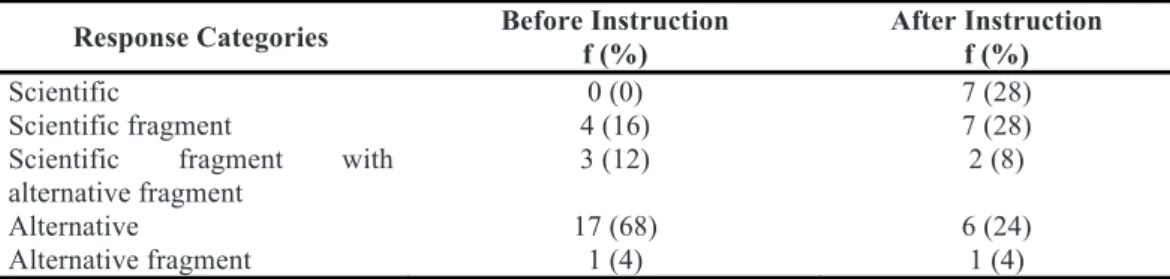
Question 1: Does a keeper either catch a ball with mass of 1 kg which is coming towards him rolling on the floor at a speed of 50m/s or a ball mass of 2 kg at a speed of 30m/s harder? Why?
Table 1. The finding obtained from analysis of question 1
Response Categories Before Instruction
f (%)
After Instruction f (%)
Scientific 0 (0) 7 (28)
Scientific fragment 4 (16) 7 (28)
Scientific fragment with alternative fragment
3 (12) 2 (8)
Alternative 17 (68) 6 (24)
No conceptual understanding 0 (0) 2 (8)
While pre-education students have no response, %28 of post-education students have given the scientifically correct response for question 1. An increase has been observed in students' responses to the category of scientific track .An important reduction has been observed in post-education students’ responses to the alternative category but students could not change their ideas completely and it has been observed in the post-education period. The students taking part in this category have given the response that it is more difficult to catch the ball which has greater speed and have not used the concept of momentum. There is no change in the alternative segment category and %8 of post-education students has no answer.
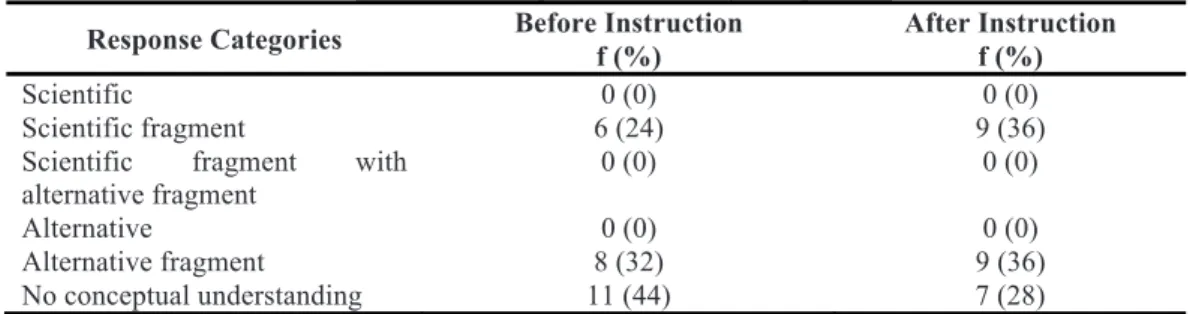
Question 2: When a little train that moves in a straight line crashes a fixed bigger train, the smaller one begins to move backward and the bigger one begins to move forward. Compare the momentum of bigger train after crash with the smaller train’s starting momentum.
Table 2. The finding obtained from analysis of question 2
Response Categories Before Instruction
f (%)
After Instruction f (%)
Scientific 0 (0) 0 (0)
Scientific fragment 6 (24) 9 (36)
Scientific fragment with alternative fragment
0 (0) 0 (0)
Alternative 0 (0) 0 (0)
Alternative fragment 8 (32) 9 (36)
No conceptual understanding 11 (44) 7 (28)
For question 2, pre and post education students have not given the scientific response. In the scientific segment category, while %24 of pre-education students takes part, this rate has become %36 in the post-education period. Scientific segment with scientific alternative segment and alternative categories have never been encountered in pre and post education periods. In the alternative segment category, 1 student has involved in the post education period. While the rate of students who did not give a response was %44 in the pre-education period, this rate became %28 in the post-education period.
Question 3: Mehmet and Ahmet have been pushing their friends having the same weight in the same direction along the icy road on sledges which have the same features. Mehmet uses force of 10N to his friend for 7 seconds and Ahmet uses force of 15N to his friend for 4 seconds. Whose friend’s speed is greater? Why?
Table 3. The finding obtained from analysis of question 3
Response Categories Before Instruction
f (%)
After Instruction f (%)
Scientific 4 (16) 3 (12)
Scientific fragment 3 (12) 8 (32)
Scientific fragment with alternative fragment
7 (28) 6 (24)
Alternative 6 (24) 2 (8)
Alternative fragment 3 (12) 2 (8)
No conceptual understanding 2 (8) 4 (16)
A reduction has been observed in the scientific response in the post-education period for the question 3. While the rate of students have given answer in scientific segment category is %12 in pre-education period, this rate has become % 32 in the post-education period. In the scientific segment with alternative segment category a little
reduction has been observed. Number of students has decreased in the alternative segment category in the post-education period. Students taking part in this category have given the answer that Ahmet’s friend is faster because he pushed the sledge by using much more force. While the number of students taking part in alternative segment category has decreased, the number of students that have no response has increased.
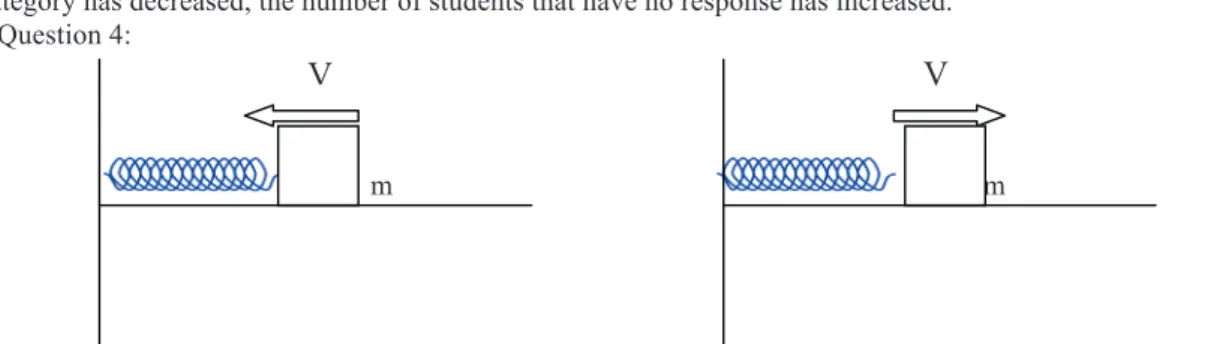
Question 4:
m m
As above, mass of object m hits the string and returns at the same speed. Indicate the direction and magnitude of pushing (impulse) applied by string.
Table 4. The finding obtained from analysis of question 4
Response Categories Before Instruction f (%) After Instruction f (%)
Scientific 2 (8) 1 (4)
Scientific fragment 2 (8) 0 (0)
Scientific fragment with
alternative fragment 3 (12) 0 (0)
Alternative 1 (4) 4 (16)
Alternative fragment 7 (28) 9 (36)
No conceptual understanding 10 (40) 11 (44)
While % 8 of the pre-education students has given the scientific answer for the question 4, this rate has become % 1 in the post-education period. While the number of pre-education students in the scientific segment category was %8, this rate has become zero in the post-education period. For this question, a reduction has been observed in the number of post-education students in the category of scientific and scientific segment. While the rate of scientific response has decreased in the post-education period, the rate of alternative response has increased. The number of post-education students who confuse the magnitude of impulse applied by the sledge and the direction of the sledge has increased. While %40 of pre-education students did not present an opinion, this rate has become % 44 in the post-education period.
4. Result and Suggestion
As a result of this study, an increase has been observed in the rate of scientific response about the concept of momentum in the pre-education period. For this question, a reduction has been observed in the frequency of encountering misconceptions in the post-education period. Education has had an effect on changing the students’ ideas for this question. For the 2nd question students could not give the scientific response about the concept of momentum in the pre and post education period. Many of pre and post education students have had no idea for this question. A reduction has been observed in the number of misconceptions and scientific response that post-education students have for the first question about the concept of momentum. While the post-education has an effect on students’ misconceptions, it is not enough for them to have scientific ideas. Misconception of students in the category of scientific segment has changed. While a reduction has been observed in the category of scientific and scientific segment, an increase has been observed in the alternative and alternative segment categories for the 2nd
question about the concept of impulse. The education did not have an effect on attainment of students to the scientific ideas about the concept of impulse and it caused the misconceptions to increase.
According to these results, the education which was renovated in 2007 and carried out according to the requirements of physic programs based on the constructivist teaching theory did not have a great effect on changing students’ ideas which were not compatible with scientific ideas. This education did not have an effect on attainment of students to the scientific ideas and it caused a lot of new misconceptions. So the content of education is important and instead of using traditional teaching methods, the teaching can be performed by using different methods for conceptual change. Some studies can be carried out in which different teaching methods are used for the conceptual change of impulse and momentum concepts.
References
Çirkinoğlu, A.G. (2004). Orta öğretim ve yüksek öğretim öğrencilerinin itme-momentum konusunu kavrama düzeyleri ve öğrenmelerinde meydana gelen değişimler.Yüksek Lisans Tezi, Balıkesir Üniversitesi Fen Bilimleri Enstitüsü.
Duit, R. (2009). Bibliography – STCSE students‘ and teachers‘ conceptions and science education. Kiel, Germany: University of Kiel.
Gay, L.R., & Airasian, P. (2000). Educational research: Competencies for analysis and application, Merrill an imprint of Prentice Hall, Upper Saddle River, New Jersey, Columbus, Ohio.
Pride, T.O., Vokos, S., & McDermott, L. (1998). The challenge of matching learning assessments to teaching goals: An example from the work-energy and impulse-momentum theorems. American Journal of Physics, 66(2), 147-157.
Sarıay, M., & Kavcar, N. (2009). İtme ve momentum konusunda işbirlikli öğrenme yönteminin etkililiğinin araştırılması. DÜ. Buca Eğitim Fakültesi Dergisi, 25, 9-24.
Singh, C., & Rosengrant, D. (2003). Multiple-choice test of energy and momentum concepts. American Journal of Physics, 71(6), 607-617. Trundle, K.C., Atwood, R.K., & Christopher, J.E. (2002). Preservice elementary teachers’ conceptions of moon phases before and after
instruction. Journal of Research in Science Teaching, 39(7), 633-658.
Ünlüsoy, M. (2006). Orta öğretim fizik müfredat konularından “impuls ve momentum” konularındaki kavram yanılgılarının tespiti ve düzeltilmesinde işbirlikli yaklaşımın etkisi. Yüksek Lisans Tezi, Gazi Üniversitesi Eğitim Bilimleri Enstitüsü Orta Öğretim Fen ve Matematik Alanları Eğitimi Anabilim Dalı, Ankara