л,
R fl.
& ^|ZÄ-TI-f^l4rÄ-f·
1 I ί^·Τΐ· .î
Ш
^
^■¿^ 3 j j y . \¡*¿ »;iir^í¿ * ■^1 Й «и г а »іГ ^ ^ -й' .«. Νώ»»:·': * --к * ·**'i··',«. 's W W h«:,..··- -if - т'-'зіг?' «
J; Λ e r . А Г* Λ С* S -Cr іЬ**»Г. :■· ϊ : -à Awi«. ·^k’ñtw.H· ІІЦ» ■ •| § r··')^ ΧΫ -^ί m-* W Li? S' ***^'*‘ ^ ·,ΐ ^ ■■' Û’ ■ rss<; Γ.' ^vAii .'Д ϊ“*ί: V· ■'. “ ^ ‘j- ■‘•<W# W - - Т 1= ?П :! .‘ÿ“4i· ;í^^" i^ ^ S 3 í q ^ s
ORGANIZATIONAL STRUCTURE AND CHANGE: A CASE STUDY OF
THE WAREHOUSE AND STOCK CONTROL SYSTEM IN TEPE CO.
A THESIS
SUBMITTED TO THE DEPARTMENT OF MANAGEMENT AND THE INSTITUTE OF BUSINESS ADMINISTRATION
OF BiLKENT UNIVERSITY
IN PARTIAL FULLFILLIMENT OF THE REQUIREMENTS FOR THE DEGREE OF
MASTER OF BUSINESS ADMINISTRATION
By
MEHTAP EMİNE ONARCAN July, 1988
AÇ O p or c o
tarafpdan
н о S i
@ Copyright 1988 by
Mehtap Emine Onarcan
I certify that I have read this thesis and that in my opinion it is fully adequate, in scope and in quality, as a thesis for the degree of Master of Business Administration.
Prof. Dr. Ümit Berkman
I certify that I have read this thesis and that in my opinion it is fully adequate, in scope and in quality, as a thesis for the degree of Master of Business Administration.
Assist. Prof. Kür§at Aydogan
I certify that I have read this thesis and that in my opinion it is fully adequate, in scope and in quality, as a thesis for the degree of Master of Business Administration.
Assist. Prof. Erdal Erel
Approved fo r the Institute of Business Administration
U/< Prof. Dr. Siibidey Togan
ABSTRACT
ORGANIZATIONAL STRUCTURE AND CHANGE: A CASE STUDY OF
THE WAREHOUSE AND STOCK CONTROL SYSTEM IN TEPE CO.
MEHTAP EMİNE ONARCAN M .B.A. in management
Supervisor: Prof. Dr. Ümit Berkman July 1988, 75 Pages
A sophisticated information processing system can cause a change in the organizational structure. In this work, the Warehouse and Stock Control System in TEPE CO. is chosen as a case study to examine a planned organizational change by the implementation of an MIS.
Keywords: Organizational Struture, Planned Organizational
Change, MIS., Sophisticated Information Processing
System. ^
ÖZET
ORGANİZASYON YAPISI VE DEĞİŞİMİ ÖRNEK OLAY
TEPE ŞİRKETLER GRUBUNDA AMBAR VE STOK KONTROL SİSTEMİ
MEHTAP EMİNE ONARCAN
Yüksek Lisans Tezi, İşletme Enstitüsü Tez Yöneticisi: Prof.D r. Ümit Berkman
Temmuz 1988,75 sayfa
Gelişmiş bilgi işlem sistemleri organizasyon yapısını değiştirirler. Bu çalışmada, TEPE Şirketler Grubunun Ambar ve Stok Kontrol
Sistemi, m is tarafından ortaya çıkan planlı organizasyon
değişimlerinin incelenmesi için örnek olay olarak seçilmiştir.
Anahtar Kelimeler: Organizasyon Yapısı, Planlı Organizasyon
Değişimi, Yönetim Bilgi Akışları, Gelişmiş Bilgi İşlem Sistemi
ACKNOWLEDGEMENT
I would like to express my gratitute to Prof. Dr. Ümit Berkman for his patient supervision. 1 am also grateful to Assist. Prof. Kürşat Aydogan and Assist. Prof. Erdal Erel for their suggestions.
TABLE OF CONTENTS
ABSTRACT ... i v ÖZET ... V ACKNOWLEDGEMENT ... v i TABLE OF CONTENTS ... v i i LIS T OF TABLES ... XLIST OF FIGURES
...
xi
1. INTRODUCTION ... 11 .1 . Pu rpose and Scope ... 2
2. AN OVERVIEW ON ORGANIZATIONAL STRUCTURE ... 4
2.1 Elem ents o f O r g a n iz a t io n a l S tr u c tu r e ... 4 2.2 D eterm in a n ts o f O r g a n iz a t io n a l S tr u c tu r e ... 5 2 .1 .1 . S t r a t e g y and O r g a n iz a t io n a l S t r u c tu r e . 6 2 . 2 . 2 . T e c h n o lo g y as a d e te rm in a n t o f s t r u c t u r e 6 2 . 2 . 3 . P e o p le as a d e te rm in a n t o f s t r u c t u r e . . 7 2 . 2 . 4 . S i z e and S tr u c tu r e ... 7
3. AN OVERVIEW ON ORGANIZATIONAL CHANGE ... 8
3 . 1 . F o rc e s f o r Change ... g 3 .1 .1 . E x te r n a l F o rc e s ... 3
3 . 1 . 2 . I n t e r n a l F o rc e s ... 9
3 . 2 . M a n a g e ria l Responces t o P r e s s u r e s f o r Change . 9 3 . 3 . The Four B a s ic S tep s in P la n n in g ... 10
3. 4 . The R o le o f The Change A gen t ... 11
3. 5 . M odels o f The Change P r o c e s s ... 12
3. 6 . R e s is ta n c e t o Change ... 13
3. 7 . Overcom ing R e s is ta n c e t o Change ... 14
4. ORGANIZATIONAL STRUCTURE AND
MANAGEMENT INFORMATION
SYSTEM ...
164 . 1 . D e f i n i t i o n o f MIS ... 16
4 . 2 . MIS and O r g a n iz a tio n T h eo ry ... 17
4 . 3 . MIS and Form al O r g a n iz a t io n a l S tr u c tu r e ... i s 4 . 4 . P la n n in g and C o n t r o l l i n g F or M a t e r ia ls Needs 18 5. A CASE STUDY OF THE WAREHOUSE AND STOCK CONTROL SYSTEM IN TEPE CO... 20
5 . 1 . Background o f TEPE ... 20
5 . 2 . The S t r a t e g y o f TEPE ... 22
5 . 3 . I n i t i a t i o n o f The Plan n ed Change ... 23
5. 4 . The P r e v io u s Warehouse and S to ck C o n t r o l System 25 5. 5 . The New P ro p o sed System ... 29
5. 6 . Im p lem e n ta tio n o f MIS ... 34
Page
5. 7. E v a lu a tio n o f The P lan n ed Change ... 37
5. 8. R e s is ta n c e t o Change and The S o lu t io n s ... 40
6. RESULTS ... 43
7. CONCLUSION ... 48
REFERENCES ... 51
APPENDICES A. The R e p o r t on The Warehouse and S to ck C o n t r o l System ... 53
B. The E x p ec te d C om p u terized System ... 60
Page
LIST OF TABLES
Table Page
LIST OF FIGURES
F ig u r e Page
5. 5. The S t r u c tu r e o f "NATO S to ck C odin g S ystem " 30
5 . 6 . 1 . The I n t e g r a t i o n Between The D epartm ents . . . 35
5 . 6 . 2 . The O p e r a tio n s o f The Main System ... 36
I. INTRODUCTION
Organizations can have similar goals and environments, but they d iffer significantly in the rate at which they initiate change. A growing body of evidence indicates that structure of these organi zations may offer insights into how likely they are to change them selves. Organizations by their nature are conservative and actively resist change, because any change can be an actual threat to a group's power, prestige or security. Hence, the greater the threat, the greater the resistance.
Planned organizational change attracts lot more attention in theory than it does in practice. The reason for the difference be tween theory and practice is explained by the power-control p e r spective. Essentialy, it can be explained as follows: those in power have little reason to initiate change. The current structure main tains control and furthermore increases the interests of the power- holders. The assumptions such as "changes in structure will be im plemented as needed to ensure high performance" are probably more credible than myths. In reality, the structural changes that do oc cur are neither planned nor in response to facilitate technical efficiency or demands of environment.
Change is most likely a response to pressing demands created by internal and external parties interested in the organization. That
means, it is reactive rather than anticipatory. In practice, "planned change" is typically a process of "ch an ge", followed by "the plan ning" that legitimates and ratifies this change. So, while change is made in response to demands by powerful interest groups, it is packaged and sold in a more legitimate form, it is rationalized as being consistent with the goals of enhanced organizational effective ness.
1.1. Purpose and Scope
All corporations, whether large or small, must perform data processing. They do so manually or with computers and other de vices such as calculators and adding machines. Often, managers of small business depend less on formal data-processing system and more on informal information sources in making their decisions. Since, a small business manager is ve ry familiar with all aspects of the business, there is less need fo r a formal data-processing sys tem. As a business grows larger, managers depend much more on data-processing systems fo r their information. Such an approach would be a disaster, since the higher-level managers are not close enough to day-to-day operations to have the necessary information for their decisions. This study aims to examine the relation between organizational structure and information systems within the context of planned organizational change.
Strategies that entailed a great deal of change had different implications on structure than did those that were essentially stable. Nonroutine technologies entail more change than do routine ones, and, to ensure effectiveness, the nonroutine type requires a more flexible structure. Similarly, organizations facing a rapidly changing
environment will look fo r flexibility in their structures.
Adhocracy was introduced as the model most compatible with change. Change demands flexibility, innovation, and rapid respon siveness. Organizations facing a high degree of change, it was a r gued, will be most effective with an adhocratic structure or at least a structure within a number of adhocracy's primary characteristics such as high in complexity, low in formalization and decentralized. A fter a brief review of the relevant literature, the question " How an organizational structure is affected and altered by the implemen tation of sophisticated information processing system?" will be stud ied by examining the Warehouse and Stock Control System in TEPE Co.
The Warehouse and Stock Control System is highly related with a sophisticated control machanism, to provide the right in for mation to the right people at the right time. Moreover, it needs a network and close contacts between the staff and the superiors fo r building the cooperation in the company. A failure or a delay in these aspects will probably cause big problems and unexpected re sults at the end. Basically, the purpose of this study will be exam ine, "How a problematic area of company can be analyzed and solved by the existing methods of Organizational Structure and Change." So, as an example, the Warehouse Stock Control problem of TEPE is choosen in the "case study" part.
2. AN OVERVIEW ON ORGANIZATIONAL STRUCTURE
Organizational structure can be defined as the arrangement and interrelationship of the component parts and positions of a com pany. An organization’s structure specifies its division of work ac tivities and shows how different functions or activities are linked; to some extent it also shows the level of specialization of work ac tivities. It also indicates the organization's hierarchy and authority structure, and shows its reporting relationship. It provides the sta bility and continuity that allow the organization to survive the com ings and goings of individuals and to coordinate its dealings with its environment.
2.1. Elements of Organizational Structure
It is useful to analyze organizational structure in terms of following five elements (16):
1. Specialization of activities,
2. Standardization of activities,
3. Coordination of activities,
4. Centralization and decentralization of decision making, 5. Size of the work unit.
Specialization of activities refers to the specification of indi vidual and group work tasks throughout the organization (division of work) and the aggregation of these tasks into work units
standardization of activities refers to the procedures used by the organization to ensure the predictability of its activities. Many of these procedures are established by formalizing the activities of and relatinships within the organization.
Coordination of activities refers to the procedures that inte grate the functions of subunits within the organization. According to H. Mintzberg, standardization mechanisms make it easier to coor dinate activities, especially in organizations with uncomplicated work patterns (13).
Centralization and decentralization of decision-making refer to the location of decision-making power. In a centralized organizational structure, decisions are made at a high level by top managers or even by a single individual. In a decentralized structure, the deci sion-making power is dispersed among more individuals at middle and lower management levels.
Size of the work unit refers to the number of employees in a work group.
2.2. Determinants of Organizational Structure
If we had studied organization theory thirty years ago, the subject that we call as "strategy" would have been the only variable considered as causing "structure of an organization." Strategy is now just one, in a set of variables as determinants of organizational structure. Today, the four major determinants of organizational structure are; strategy, technology, people and size.
2.2.1 Strategy and Organizational Structure
When management authors such as A. D. Chandler use the phrase "structure follows strategy", they mean that the mission and overall goals of an organization will help shape its design (4) .
Strategy will determine how the lines of authority and chan nels of communication are set up between various managers and subunits. It will influence the information that follows along those lines, as well as the mechanism for planning and decision-making. The close relationship between organizational strategy and structure was demonstrated by Chandler in a classic study. A fter analyzing the administrative histories of such companies as Du Pont, General Motors, Standard Oil, Sears and Roebuck, Chandler concluded that changes in corparate strategy proceede and lead to changes in orga nizational design.
2.2.2. Technology as a determinant of structure
The nature of the technology used in an organization to create its products (o r the methods by which it offers its services) also influences the way the organization is set up, the coordination mechanism, the level at which decisions are made, and the size of organizational units.
J. Woodward categorized the firms as unit, mass or process production, according to the type of technology that they use (19). She threated these three categories as unit being the least complex and process being the most complex from the perspective of the type of technology. She also found that there were distinct relation ships between these technology classifications and the structure of
the firms. In addition the effectiveness of the organizations was related to the "fit" between technology and structure.
2.2.3. People as determinant of structure
The people involved in the organization's activities affect its structure. Managers make decisions relating to the lines of communi cation and authority and the relationships between work units. In making these decisions, managers are influenced by their own needs and preferred work environments. The abilities and attitudes of subordinates, including their need to work with each other in spe cific ways, must also be taken into account when work units are set up and tasks allocated. In addition, people outside the organization influence its structure, which must provide fo r regular interactions with clients or customers, suppliers, and others in the external en vironment .
2.2.4. Size and structure
Both the overall size of an organization and the size of its subunits influence its structure. Large organizations tend to have greater specialization of activities and more formalized procedures (greater standardization). Chandler has suggessted that as organi zations increase in size, they are forced to decentralize and to de velop a greater variety of formal mechanisms to coordinate their ac tivities .
P. Blau is also found that "size is the most important condi tion affecting the structure of organizations" ( 3) . He concluded, if the size and differentiation are related with each other, then the rate of differentiation decreases with increasing size.
3. AN OVERVIEW ON ORGANIZATIONAL CHANGE
Even if organization's design appropriate for its environment at a given time, the managers must anticipate changes in the en vi ronment that will require future adjustments in the organization's design.
This chapter will focus on systematic programs to bring about planned change in organizations or their subunits. The forces that create the need for organizational change, when to recognize that the time fo r change has come and how to overcome resistance to change will complete our discussion.
3.1. Forces fo r Change
Any factor in the external environment that interferes with the organization's ability to attract the human and material resources it needs, or to produce and market its services or products, be comes a force for change. Furthermore, any factor in the internal environment that affects the way the organization carries out its ac tivities is also a force for change.
3.1.1. External Forces
There are numerous specific types of external forces fo r change. Increasing costs and scarcity of natural resources, work- safety and antipollution regulations, consumer boycotts, higher
levels of education in the labor market, high interest rates are some of the environmental factors that have changed our lives in recent years. An enormous variety of external forces, from technological advances to competitive actions, can pressure organizations to mod ify their structure, goals and methods of operation.
3.1.2. Internal Forces
Pressures for change may also arise from a number of sources within the organization, particularly from new strategies, technolo gies and employee attitudes and behavior. For example, a top man ager's decision to seek a higher rate of long-term growth will affect the goals of many departments and may even lead to some reorgani zation .
External and internal forces fo r change are often linked. The link is particularly strong when changes in values and attitudes are involved. Persons with new attitudes enter the organization and cause it to change.
3.2. Managerial Responses to Pressures fo r Change
Managers can respond to pressures fo r change in ’ several ways, such as denying that they exist, resisting them or avoiding them.
To deal with change, managers use two major approaches. First, they "react" to the signs that changes are needed. At this stage, they make modifications to deal with particular problems as they arise. Second, they develop a "program of planned change." Here, they make significant investments of time and other resources
to alter the operations in the organization. In the latter case, they deal not only with present difficulties but with anticipated problems which has not clearly observable.
The first response which is simpler or less expensive than the second is necessary for the small, day-to-day adjustments integral to the manager's job. This type of response requires minimal plan ning because it can and should be handled in a quick and routine manner. We will not deal with this type of reactive response in this study, however mainly will focus on planned change.
The second response, a program of planned change, has been defined by J.M. Thomas and W.G. Bennis as "the delibarate design and implementation of a structural innovation, a new policy or goal, or a change in operating philosophy, climate, and style" (17). Such a response is appropriate when the entire organization, or a major portion of it, must prepare for or adopt to change.
Planned change is greater in scope and magnitude than reac tive change. It is dealing with those changes that may crucial for survival. It involves a greater commitment of time and resources, requires more skills and knowledge fo r successful implementation, is unsuccessful. Planned change has become so important to many or ganizations in today's world.
3.3. The Four Basic Steps in Planning
Step 1: Establish a goal or set of goals
Planning begins with decisions about what the organization or subunit wants or needs. Without a clear definition of goals, organi zations can not allocate their resources effectively.
step 2: Define the present situation
How far is the organization or the subunit from its goals? What resources are available for reaching the goals? Especially f i nancial and statistical data is a necessity for this second stage. Step 3: Identify the aids and harries to the goals
What factors in the internal and external environments can help the organization reach its goals? What factors might create problems?
Step 4: Develop a plan or set of actions for reaching the goal(s) This final step involves developing various alternative courses of action for reaching the desired goal or goals, evaluating these alternatives, and choosing from among them the most suitable or at least a satisfactory alternative for reaching the goal. This is the step in which decisions about future actions are made and where the guidelines for effective decision-making are most relevant.
3.4. The Role of The Change Agent
The "change agent" is the individual who is responsible fo r taking a leadership role in managing the process of change. The in dividual, group or organization that is the target of the change at tempt is called the "client system". Change agents can be members of the organization or they can be consultants brought in from out side. For complex change programs, it is often desirable that an outside change agent manage the process. Since specialized exper tise and skills may required, freedom from the day-to-day operating responsibilities may be essential and the prestige of being an out sider can be helpful. Also, outsiders with no interests in the orga nization are often more likely to be listened to and able to form
objective judgements.
We should expect, that every change agent will bring along his or her own self-interests. What one manager considers a situa tion "in need of change" may be fully within the acceptable range for another.
The change agent also is in the position of choosing the role he will play. He may "view his role as boss with absolute authority and responsibility for making and implementing decisions or as a partnership collaborating with other employees in deciding on solu tions to problems" (15).
3.5. Models of The Change Process
The Lewin-Schein change model implies that planned change efforts may fail because too much energy is needed to bring the system to the point where change is desired or because those seek
ing change do not put energy into attempts to bring it about (12).
D.B. Gleicher has proposed a simple general formula to help managers determine whether an organizational change effort is likely
to be successful (2):
C = ( A x B x D ) > X
Here, C= changes; A= level of dissatisfaction with the status quo; B= clearly identified desired state; D= practical first steps toward the desired state; X= cost of the change in terms of en ergy, emo tions, financial costs, etc.; and the X denotes multiplication of A times B times D.
In other words, change takes place when the cost is not too high or if it is in the acceptable range. The cost of change will be too high unless dissatisfaction with the status quo (A ) is quite strong, unless the desired state (B ) is clearly evident, and unless practical steps can be taken toward the desired state ( D) . The mul tiplication signs indicate that if any of the factors A, B, or D is zero, there will be no change. For example, if we are satisfied with the status quo ( A ) , we are not likely to change even if we can en vision more desirable state (B ) and we can take the practical steps to move toward it ( D) .
In addition to diagnosing how ready the system is for change and predicting how likely it is that change will take place, the fo r mula can also suggest ways to bring the system more ready for change. For example, if dissatisfaction with the current state of a f fairs is strong on everyone's part, but there is no concrete notion of how things could better, then a vision of a future ideal state needs to be created and communicated.
3.6. Resistance to Change
A major obstacle to the implementation of new policies, goals or methods of operation is the resistance of organization members to change.
An outside change agent is often necessary for the success of change programs is an indication of how strong such resistance can
be. There are three general sources of resistance to change (9).
1. Uncertainity about the causes and effects of change. Orga
nization members may resist change because they are worried about how their work and lives will be affected by the proposed change.
Even if they have some appreciable dissatisfaction with their present work, they may still worry that things will be worse when the pro posed changes are implemented. When the change is initiated by someone else, they may feel manipulated and wonder what is the "real" intention behind the change.
2. Unwillingness to give up existing benefits. Appropriate change should benefit the organization as a whole, but for some in dividuals, the cost of change in terms of lost power, prestige, salary, quality of work, or other benefits will not be sufficiently offset by the rewards of change.
3. Awareness of weakness in the changes proposed. Organiza tion members may resist change because they are aware of potential problems that have been overlooked by the change initiators. D iffer ent estimations of the situation represent a type of desirable conflict that managers should recognize and make their change proposals more effective.
3.7. Overcoming Resistance to Change
Resistance to a change proposal is a signal to managers that something is wrong with the proposal or that mistakes have been made in its presentation. Managers, therefore, must determine the actual causes of resistance and then remain flexible enough to over come them in an appropriate manner.
Hotter and Schlesinger offer six ways of overcoming resistance
to change (8). These techniques which may be used in any given
situation are discussed below:
1. Education and communication. The need fo r and logic of the
change are explained individually to subordinates, to groups in
meetings, or to entire organizations through elaborate audiovisual education campaigns.
2. Participation and involvement. According to a classic study by L. Coch and J. French, resistance to change can be reduced or eliminated by having those involved participate in the design of the change ( 5) . P. Lawrence came to similar conclusions, suggesting that in order to avoid resistance, managers should take into account
what he called to social effects of change (10).
3. Facilitation and support. Managers can also deal with re sistance by providing support fo r those who are affected by the change process. Retraining programs, allowing time o ff after a d iffi cult period, and offering emotional support and understanding may help.
4. Negotiation and agreement. It is sometimes necessary for managers to negotiate with potential resisters to change, and even to obtain written letters of understanding from the heads of organi zational subunits that would be affected by the change.
5. Manipulation and co-optation. Sometimes managers co-opt an individual, perhaps a key person within a group, by givin g him or her a desirable role in describing or carrying out the change pro cess.
6. Explicit and implicit coercion. Managers may force people to go
along with a change by explicit or implicit threats involving loss or transfer of jobs, lack of promotion, and the like. Such methods, be cause of carrying a risk, making it more difficult to gain support for future change efforts.
4. ORGANIZATIONAL STRUCTURE AND MANAGEMENT INFORMATION SYSTEM
In this chapter, first a definition of MIS will be given to point out the importance of this subject in business life. Then, we will concentrate on the relation between MIS and Organization Theory. Following this topic, MIS and Formal Organization Structure will be discussed, before completing this chapter with the topic. Planning and Controlling For Materials Needs.
4.1. Definition of MIS
A definition of a Management Information System., as the term is generally understood, is an integrated, user-machine system for providing information to support operations, management, and deci sion-making functions in an organization. The system utilizes com
puter hardware and software; manual procedures; models for
analysis, control and decision-making; and a database (6).
A business simply could not service its customers or make higher level decisions without information to support customer ser vice and decision-making. The use of computers in information pro cessing has had several impacts on business. Among these are eas ier business growth, fewer clerical workers, reduced data process ing costs, automation of some decisions, and the availability of d if
ferent types and greater quantities of information (7).
Computers have become an essential part of organizational in formation processing because of the power of the technology and the volume of data to be processed. The current challenge in informa tion processing is to use the capabilities of computers to support knowledge work, including managerial activities and decision making. The wide variety of computer resources to perform transaction pro cessing, to provide processing for a formal information and report ing system, and to accomplish managerial-decision support are broadly classified as the organization's "management information system" or MIS.
4.2. MIS and Organization Theory
Since the MIS is a support system for organizational func tions, it draws upon concepts of organization, organization behav ior, management, and decision-making. The field of management (o r organizition behavior) and organization theory provide several im portant concepts which are key to understanding the function of an MIS in an organization. Some of these concepts are:
1. Behavioral theory of organizational and individual decision making
2. Individual motivation
3. Group processes and group decision making 4. Leadership techniques
5. Organizational change processes
6. Organizational structure and design
4.3. MIS and Formal Organizational Structure
It has been predicted that information systems lead to in creasing centralization, which generally refers to the level in the organization where decision-making occurs at the top of the hierar chy; the more decision-making authority is delageted to lower le v els, the greater the decentralization. If it is true that information systems cause an increase in centralization then improved access to relevant information allows top management to act on a wider range of problems and thus retain centralized control of decision-making. This prediction was first made by Leavitt and Whisler in 1958 (11). There has been some evidence of increased centralization, primarily reported by Whisler in a study of insurance companies (18). Other studies have shown no change in centralization as a result of the computer. In a study of eight organizations reported by Robey, five of the organizations had no change in formal structures (14). Where changes did occur, the existing organizational structure was usually reinforced. Today, it is generally accepted that,
1. Information systems do not cause structual changes
2. Information systems can be designed to support increasing
centralization or decentralization, depending on the objectives,
strategies and goals of the organization. Factors other than the use of information systems are more crucial to the decission to centralize or decentralize.
4.4. Planning and Controlling For Materials Needs
In recent years materials planning systems (e g . MRP) have replaced reactive inventory systems in many organizations. Computer
based techniques such as material requirement planning (MRP) are used to coordinate such activities as purchasing, production and in ventory management. This concept used to be viewed as highly un structured, requiring the skill and knowledge of an experienced production manager. It permits better control over materials flow and, by looking ahead to ensure that all materials are available when needed for product build up, it reduces order processing de lays (1 ). By setting job completion dates, it gets job done on time, order promises are kept, and production lead times are shortened. This better customer service and inventory cost reduction, along with reduced efforts, come at a cost. They require an information system with accurate inventory and product build up information. They also require a planning orientation and a realistic master pro duction schedule (MPS) to specify when various quantities of end items will be completed. Finally, and perhaps most important, they require a certain discipline, a commitment by schedulers, supervi sors, managers and shoop floor employees to make the system work.
5. A CASE STUDY OF
THE WAREHOUSE AND STOCK CONTROL SYSTEM IN TEPE CO.
5.1 Background of TEPE
TEPE Furniture is a foundation of Hacettepe Universiy which spends its revenue on educational purposes. BEYTEPE Prefabricated Buildings Co. Ltd and TEPE Marketing and Trade Co. Ltd. are also establishments within the same foundation. Until recently, these three companies had gathered under the name of "TEPE Group", one of the larger enterprises of Turkey that has been built on 50.000 square meters closed area. Moreover, with almost 1000 skilled work ers, they produce for both domestic and foreign markets by imple menting technologies in the contemporary standards of the world.
TEPE Furniture Production Complex, established in 1969, is provided with modern machinery and covers 25,000 square meters open and 18,000 square meters built-up space. Over 50 skilled workers are employed, for this section of the company.
The factory organization comprises, - Research and Project Division - Long-cutting Workshop
- Timber Drying Kilns - Machinery Division - Assembly Division - Upholstery Divisin
- Varnish and Painting Division
- Metal Workshop
- Quality Control Section
BEYTEPE Prefabricated Buildings Co. L td ., is another pro duction complex of the company which manufactures prefabricated houses, school buildings, kinder-gardens, social and administration buildings fo r the industries and private sector. The factory complex shares the area of TEPE Furniture in Ankara. Internal demand and orders from abroad are met via time-saving production process.
The factory organization comprises, - Planning and Architectural Division - Panel Production Line
- Roof Structures Production Line - Joinery Division
- Prefabricated House Structural Elements Production Division - Erection Teams Programming Unit
TEPE Marketing and Trade Co. L td ., is a complete marketing and full-furnishing organization. Many large turn-key furnishing projects are under way both in Turkey and abroad.
TEPE Group, which has organized its activities via Ankara, Aegean and Marmara Regional Directorates enlarging the field of ac tivities on the Mediterranean and Middle East Countries.
The organization employs marketing experts, economists, inte rior architects, research teams and engineers project study and as sessment is an important TEPE activity featuring the basis for "turn-key projects."
It's activity areas are as follows;
For hotels, motels, hospitals, schools, seaside resorts and for other private and pubhc buildings,
- Production of betopan (concrete panel)
- Production of standard furniture
- Production of standard doors and door frames - Production of window frames
- Full decoration and upholstery projects and applications
- Special orders for upholstery furniture, door and window frames
- Production of prefabricated building materials
- Production of prefabricated buildings with one or two floors for administration, health and education buildings and for industrial complexes.
- Steel sheds and for building constructor's supply areas
- Completed furniture, inside decoration projects and contract services
5.2. The Strategy of TEPE
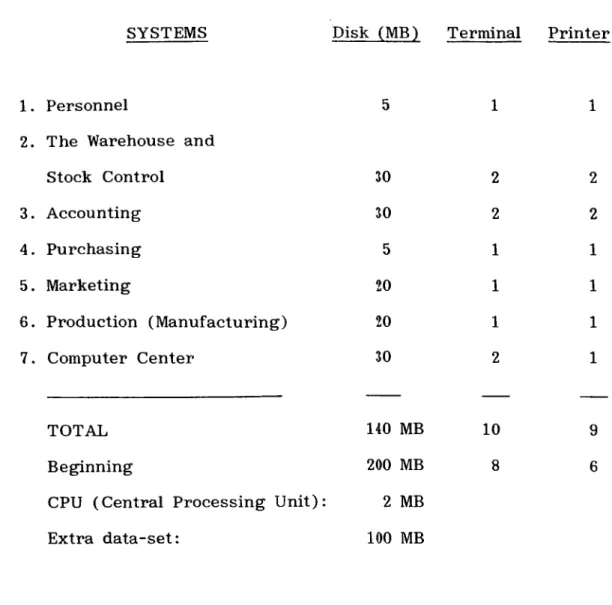
Since 1980, The Accounting and Stock Control System of TEPE has been operated and stored by personel computers. Then in March 1987, some exacutives of the company had gathered at a meeting to discuss "What should be done to make the computer usage more e f fective" in some of the systems Listed below:
- Personnel
- The Warehouse and Stock Control - Accounting
- Purchasing - Marketing
- Production (Manufacturing) - Computer Hard-ware System
First, a "team balding" strategy was approved. This team was responsible of pointing out the main steps in a planned change pro cess. The members of the team are expected to work together and to solve the problems related to the organizational structure of TEPE. The names of the members and their positions in the company are as follows.
Metin ARIKAN; civil engineer, experienced on directing Hard ware Systems and MIS.
Cengiz SÜRÜCÜ; manager of the Warehouse and Stock Control Department.
Yılmaz EREN; computer engineer, working for The Computer Center of TEPE
Hakan A YTA Ç ; coortinator of Finance and Administrative A f fairs .
According to M. Arikan, the leader of the team, their planned change means;
"Our planned change will be including a group of activities and procedures consistent with our company objectives. As the word "planned" implies, our organizational change effort will start from the point where we can diagnose our problems. Then we can think about developing a strategy fo r an effective resource allocation among subunits, as a final task. We are really in need of a new generation of equipment which should o ffer us a faster, cheaper and a more reliable service than our existing Computer Department."
5.3. Initiation of The Planned Change
TEPE Co. was planning an organizational change, involving the use of an advanced computer system in some of its departments.
Although it is difficult to draw significant conclusions from inter views, most of the exacutives shared the feeling that "The Ware house and Stock Control System of the company can no more work with the existing procedures than a circle can have corners."
Actually, the starting point of changes in the previous Ware house and Stock Control System were happened as, "key personnel with new attitudes entered the organization and caused it to change." In March 1987, a new manager was appointed to the Ware house and Stock Control Department. The first thing that this new manager did, was to ask for a report, showing "how the existing system was applied and what was the problematic areas of this de partment. "However, no one seemed to be willing to take this re sponsibility or found himself qualified to arrange such a report. As a result, C. Sürücü, the new manager of this department decided, the problems of the system can only be solved by a re-organization study so he applied to the top manager of the company to develop a planned change.
As a matter of fact, in those days, Ali KANTUR, the company manager was thinking about starting a study on "negotiation." Be cause, he found it useful to get into close contacts with the heads of the organizational subunits in order to be informed by the resis tance to the existing system of the company. The company manager also found it appropriate to search for a "Change Agent" or a con sultant who could work for them, what means a top management did the strategy in the short-run. It is observed in TEPE, the first steps of the planned change started with a largely centralized deci sion making. Soon, the personal contact were made between the company and the two different consultancy firms. LİNK Bilişim be came the consultant firm since it has been found superior with
respect to technical feasibility, background, the staff and re fe r ences .
However, the main problem is, "from where to sta rt." Both the client and the consultant put forward their own ideas and agree that the study should start with analyzing "the previous warehouse and stock control system."
5.4. The Previous WzLpehouse and Stock Control System
In this part we will attempt to deal with the question of "How to change the previous system."
LİNK Bilişim had spent around four months time, to sum up the data and the information that they were in need of to arrange their report. By that time, the team members and the representa tives from the consultancy firm had gathered for several times, to discuss the main subjects of this report according to serve to the expectations of this department. Appendix A is showing the general principles of the report prepared on The Warehouse and Stock Con trol System.
At this stage, it will be helpful to give some information about the expectations mentioned above. First, we know that people who are involved with this system in TEPE are as follows; the personnel of Warehouse and Stock Control Department, the coordinator of Fi nance, Production and Sales managers. Therefore, if this planned change did not serve to the aims or goals of all these people and departments, then it would be only adding further problems to the existing ones. It is clear that after the necessary changes, the new proposed system would be used again by the same steiff so they should be convinced that this new system would be superior than
the old one. At the same time, they would be the ones who were re sponsible of the problems or delays during the adaptation period. Thus, the consultancy firm stayed faithful to the procedures of the previous system but at the same time brought new changes which could solve the problematic areas and could provide convenience and comfort in usage.
The Warehouse System which has been working under the structure of TEPE Co. until March 1987, was confronted with a change from then on. Before, The Warehouse System showed a vari ation according to the production districts but now the whole system is conjucted to The Warehouse and Stock Control Department in the center of the company, in Ankara. It is expected that, this will al low a standardization of the procedures for all the warehouses of the company.
The Warehouse and Stock Control System worked as follows until the new organizational studies started just a year ago:
TEPE Furniture and TEPE Prefabric sections separately have their own Warehouses which they keep and store their raw materials These separate Warehouses also served under the control of The Warehouse and Stock Control Department. There are also two more Warehouses fo r manufactured goods which work in cooperation with Sales Department.
Moreover, the materials are controlled on special cards. Ware house of TEPE Furniture has about 1000-1500 of these cards for each type of materials. On the other hand, in TEPE Prefabric, these cards are about 3000. However, only 1800 of them are used as "active materials card." The most important problem of the previous system was the insufficient codding system; Although there is a special section on these cards fo r the case of an order it is usually
not used. In addition, the information about the origin of these materials has not been clearly mentioned on these cards. Due to an insufficient codding system, more than one type of material is being controlled on a single card.
Another problem is related with minimum stock levels of mate rials that TEPE Furniture was in need of. A study had been done but were paid few attention. Below, we will discuss the forms of the previous system together with the problems that they caused.
When the Workshop were in need of materials, they could ap ply to the Warehouse by a "Demand Form." However, the sections for the purpose of the request and the type of work are usually not filled carefully on this form. Two copies are filled, one stays at the Chief of the Workshop and the other goes the Chief of the Ware house .
I f the materials requested by a Demand Form does not exist in the Warehouse at the present time, then a "Materials Order Form" will be filled. It has some special sections such as, request date, origin of the request and an explanation section fo r the type of work demanded. It is clear that, if all the sections were filled, this document would serve to its purpose more fu lly. Two copies are sent to the Purchasing Department and the third one stays in the Warehouse. In addition an approval is expected both from the Chief of the Warehouse and from the Production Manager.
Then a "Material Delivery Form" should be prepared to indi cate the amount of material delivered to the Warehouse. Usually, two copies are filled and one of them is sent to the Purchasing Depart ment.
"Warehouse Entry Form" is filled when a material enter the Warehouse. The sections of this form for the quantity of material is
filled in the Warehouse. One copy stays there and the other two are sent to the Purchasing Department. Later, one of these two is sent to the Accounting Office to let them make their analysis on Cost A c counting.
Another form should be filled under the name of "Warehouse Exit Form" while the materials are being taken out of the Warehouse and the remaining sections are left to be filled in the Accounting Office. Moreover, it is a common rule that all the materials are de livered to the Chief of the Workshop who had requested them and an approval is taken by the Production Manager. Here again, three copies are prepared. One of them stays in the Warehouse, the other is sent to the Workshop and the last one is given to the Accounting Office.
Both of the two branches, TEPE Furniture and TEPE Prefabric are using the forms which are similar in content, as mentioned above.
Although, all these forms are defined in the recent studies, still several questions remain unanswered. It is obvious that the forms had not been designed carefully to serve their real purpose. Meanwhile, most of the exacutives who are related with the subject, found this system as a disaster. Most of the complaints that they put forward was about the conflict in stock numbers. It is men tioned that, some forms had the section for a stock number but there was not any similar section in the rest of the forms. If this was the case, then they would fill the forms carefully, especially the sections about the discrimination and the category of the mate rial . However, we know that, most of the times the forms lacked, giving the right information or people did not spend sufficient time and effort to fill them properly.
As a last trouble, we can say the one in between the Ware house and the Purchasing Department. There is a special section on the Materials Order Form about the "Request Date" which is show ing, until what time this order should be delivered to the Ware house. The problem here is, this information has never been written on the document in a systematical way. It is examined that the Pur chasing Department faced with a conflict which had to deal with all these requests, in a certain period of time.
5.5. The New Proposed System
The old system which was discussed above had been used un til March 1987, and it was again the same system which had been used in the Warehouse during the re-organizational studies on a new system. At the end of all these studies, new regulations for the Warehouse and Stock Control Department were confirmed. Meanwhile, there were some outstanding changes for the forms that have been used for keeping the necessary information about the materials. As a matter of fact, some of these previous forms were replaced with the new ones which were different both in methodology and in con tent. Besides, some of the forms were found inconsistent with the new applications so they were ultimately approved not to be used any more. These forms which have been used in The Warehouse and Stock Control Department in the new proposed system are;
- Necessity Form
- Materials Provision Demand Form - Warehouse Entry Form
- Materials Return Form - Materials Transfer Form
- Materials Receipt Form - Shipping Form
- Equipment Receipt Form - Warehouse Stock Card
Moreover, a "Form Usage Instruction" was formed regarding to the which had been suffered with a change or prepared recently apart from the old ones.
One of the most important subjects which had been handled during the organizational studies of the planned change was to improve a "TEPE Stock Codding System" to be used through the whole structure of the TEPE Group. At the end of these studies "NATO Stock Codding System" was ratified and assumed to be the best system which has been consistent with the company objectives.
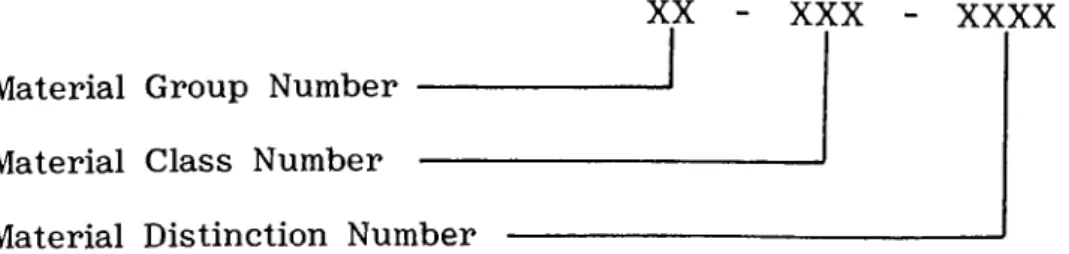
The main idea behind this NATO system is to distinguish the stock codding number of a material into the levels in different lengths, and to provide a hierarchy between all these levels. The contribution of this structure is also to separate the materials into groups and classes according to their Stock Codding Number. As a matter of fact, A TEPE Stock Codding Number has been developed in a structure which has a length of nine digits, for its numerical information. The dispersion of the hierarchy of the stock codding system is having the structure as shown in figure 5.5.
Material Group Number Material Class Number Material Distinction Number
XX - XXX - XXXX
FIG. 5.5. The Structure of "NATO Stock Codding System"
Material Group Number: This code number is used fo r group ing the materials in an upper level. At the same time, it is arranged in a way to form the stock numbers in the Accounting Plan.
Material Class Number: This code number is given to the ma terials which are in the same group. These groups form the classes to initiate where the material is being used and to show the cate gory of this material. Thus, under a material group number some classes are formed according to the qualifications of the materials.
Material Distinction Number: This code number is put forward, in order to make a distinction of the material under the two previ ous codding number.
A small example can be given to clarify how a material is be ing distinguished with this codding system. For instance, if we take sand and gravel which are used materials for construction of a re inforced concrete building, how can we code these materials? First of all, a group number is chosen fo r these materials to indicate they are used for construction purpose. Then, a class number is as signed to indicate that they are being used in a reinforced concrete building and as a last procedure a distinction number is chosen, to inform the people that these materials are sand and gravel.
The new procedures were started mainly by the additional us age of forms such as the "Necessity Form." This document is filled by technical directorship and it should indicate the necessary infor mation about the materials like the reason of demand, the amount of expenditure, stock levels and the amount of sales. In this way, when a demand occurs, a discrimination seems to be possible ac cording to the reason of demand for this material. So fa r, if the information is filled entirely and correctly, there would be no anxi ety about observing the reason of expenditures for the necessary
materials.
Some previous type of procedures on the other hand, clarified and became easier to use. Before, if a material had been delivered or entered to the Warehouse, two different forms would have to be prepared. Now, these two separate procedures and the two forms combined into a single new document.
Another new application is about the procedures for purchas ing materials. A new term, "Materials Receipt Form" is started to be used as one of the recent forms. In this structure first a Necessity Form is arranged then Material Receipt Form needs to be filled and ratified in the subunit which requires for the material. A fter all these operations, the material will be ready to be sent to this sub unit. As we all understand from the applications of the new system, a "reservation structure" has been tryin g to be formed. So, if the required material is available in the Warehouse, it will be never given to another subunit as it has already been reserved. There can be only some exceptions like special and urgent orders which posses a privilage. All these operations were planned on a purpose, to ascertain the demand for materials and make them available in the Warehouse to be ready for requirement.
TEPE CO. is also considering a "Cost Accounting System" as a long-term objective, which may be realized in the following years. In this instance, if the parts of a Materials Receipt Form are filled to show the distinction of the material to be used and if an explana tion is written for the type of the material then this information would be a novice study for this Cost Accounting System which is expected to be executed, soon. So, the new type of forms are used not only fo r their own purpose in the system but also fo r different reasons for the company's long-term objectives.
Despite of all these facts, the organizational structure of TEPE needs an intensive usage of "Shipping Form" and this is the reason, a concept as "arrangement of a shipping form" has been put forward in the recent studies. In this way, the shipping forms could have the same files and volumes but the purpose for usage might be quite different.
Meanwhile, "Equipment Receipt Forms" are also carrying im portance in the new applications. I f the expenditure for an equip ment is mentioned clearly on this form during the time of demand, then the style and the proportion of the equipment usage would be ascertained, later on. The structure of this form also plays the role of a base for an "Equipment Pursuit System" which is expected to happen soon.
It was also observed that, a material or an equipment was both used for construction in prefabric unit or fo r production in furniture unit but at the same time could also be marketable by the Sales Department. It is obvious that, these situations could be in conflict from the perspective of production and/or sales procedures. In order to eliminate this conflict and to cause a discipline, again a reservation structure has been brought for the equipments and ma terials which are offered fo r a sale. In this way, the amounts which were required by Sales Department could be set apart fo r this unit, for certain periods. Besides, all the other units which are dealing with the same materials and equipments would be informed about the reserved amount.
5.6. Implementation of MIS
Since the beginning of 1980's TEPE has been involved with computers, mainly in Accounting and Payroll procedures and then for data storage in Stock Control System. All these applications were directed and controlled by The Computer Department whereas data storage was carried out by the computer operators.
The Warehouse and Stock Control Department was willing to standardize the duties of their staff and to accomplish this, they knew that they were in need of a control system which could be built by a network. By this system, they expected to computerize not only the basic data storage process but also some more applica tions such as the movements of a material into or out of the Ware house and all the operations related to a Stock Control System. In addition, this new computerized system of the Warehouse and Stock Control Department was supposed to be an entire system but also could be integrated with the other units of the company.
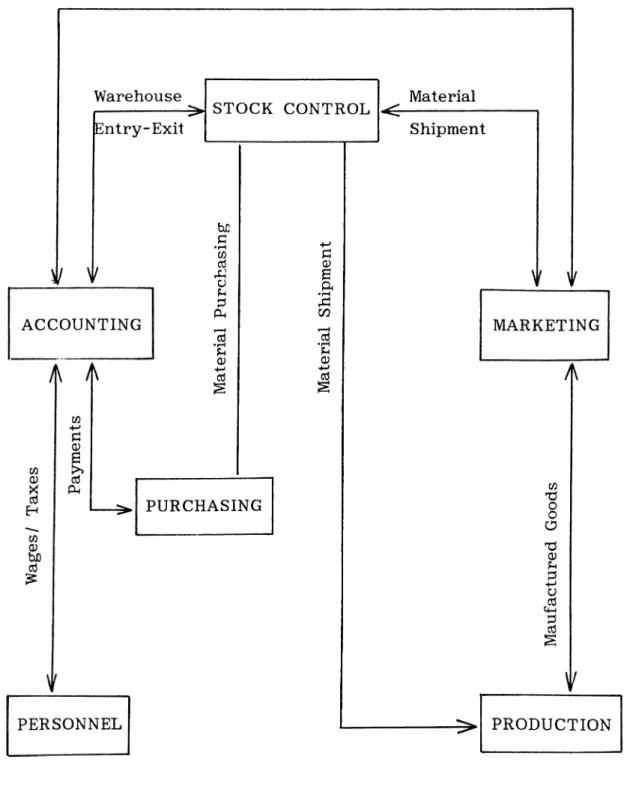
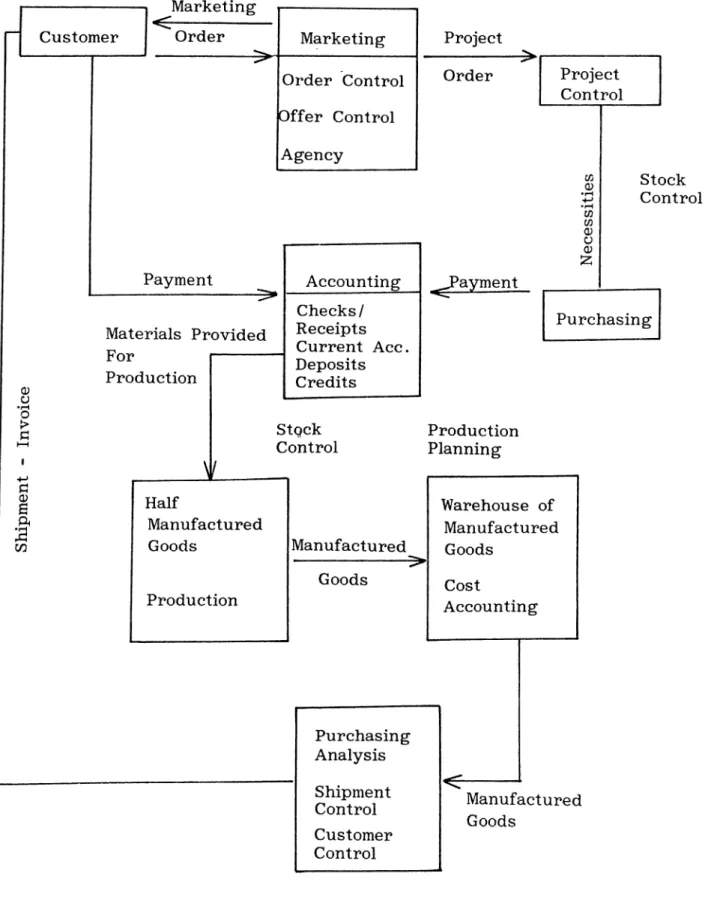
The flow-chart as shown in figure 5.6.1., will be helpful to understand the integration between The Warehouse and Stock Con trol Department with the other units of the organization. Moreover, figure 5 .6 .2 ., will give the operations of the main system in a more detailed way.
FIG. 5.6.1. The integration between the departments
FIG. 5.6,2. The Operations of The Main System
We can conclude that the real intention behind, the planned change of TEPE was "altering the old system by giving a push to computer usage in the new. applications." Accordingly, the purpose of the Warehouse and Stock Control Department was applying the procedures in a more healty and a faster way with a computerized system, rather than doing all these manually, as before.
As a matter of fact, the team member and the consultant firm have started their study on building a computer system during the last months of 1987. They gave the priority to micro computers be cause introducing the mainframe would need at least one year. On the other hand, when it happens and TEPE starts to operate all its procedures by directing from a Computer Center, they will be look ing forward to an MIS which can provide a network system for get ting the right information at the righ t time. So, MIS will be a pre cise solution with its contribution to both subordinate and superior participation to the system at all levels of the hierarchy.
5.7. Evaluation of The Planned Change
The important ascept of this topic is, to ensure that the choosen strategy and its implementation will meet the objectives of the organization. Also, usually some contingency and tactical plans used and explicit distinction is made between short-term and long term goals.
At this stage of the planned change, some top managers of TEPE suggested to make o performance evaluation. In fact, they were willing to feel a confidence to their planned change process by examining the implemented strategies met at least their short-term objectives.
In March 1988, a feed-back had been suggested by the exac- utives of the company. This suggestion was somewhat related with the fact that the top managers had taken decision by consensus to analyze how much of the organizational resources and financial val ues have been spent fo r this "change process."
Hereby, we are going to enumarete the resources and expen ditures that have allocated for the change process, during in one years time:
1. Employing a new Warehouse and Stock Control Manager. 2. Team building with the cooperation of an outside consultant
agency.
3. Arrangement of a report to analyze the problematic areas of the old system and to indicate the possible solutions for this case.
4. Employing a system-operator to direct the file process. 5. Purchasing one more micro-computer.
6. System analyze together with the other integrated systems of Stock Controlling.
7. Starting micro-computer operation for the new structure of Stock Control System.
8. Programming the Warehouse and Stock Control System for the mainframe as a long term objective.
In December 1987, the first part of the payment had been made to LİNK Bilişim fo r the registered report. This amount was around 4 milhon TL. Then some more had been spent for the rest of their service. Recently, LÎNK has earned around 13 milhon TL. for their total consultancy service for TEPE, and they are still working for the company. Morever, the top managers of TEPE indicated for several times, they would never take a risk of a change process, if
they had some doubtö like, "the return might be less than the cost." They added that "a change can only take place when the cost of change is in the acceptable ran ge."
The last point which is given importance at the evaluation step was the distinction between the short-term and long-term goals. The implementation of the strategies showed that the company is supposed to be successful to accomplish its short-term goals, in one year. This success is highly depending on the efficiency of the new applications with a computerized system. TEPE had already manage to operate its Warehouse and Stock Control procedures by micro-computers. The main distinction between the short-term and long-term goals of the organization is lying at this point. Because, TEPE is now working on transposition from micro-computers to the mainframe and to reach this aim they are thinking of a Computer Center (BÎM - Bilgi İşlem Merkezi) as a long-term goal. Also, an MIS will provide a network between the subordinates and the execu tives then will allow the necessary information can be taken or sent in the fastest way without a delay. Therefore, control mechanism will expected to be exist spontaneously by the dealers of the sys tem.
Meanwhile, the variation in the behaviors of some of the stock controllers has drawn the attentions of the team members from the objectives of the company over the subject know as, "resistance to change." Although it is usually inevitable to face with a situation like this while tryin g to implement a change within the organization, the superiors know ve ry well that they should never go through the further steps before convincing the system-user about the necessity and the positive returns of the changes.